
How to eat Peking duck 北京烤鸭
Peking duck (北京烤鸭, běi jīng kǎo yā) is a whole duck roasted until the skin is lacquered and crisp, carved at the table and eaten rolled in thin wheat pancakes with sweet bean sauce, scallion and cucumber. Beijing's signature dish, not spicy, served off the bone.
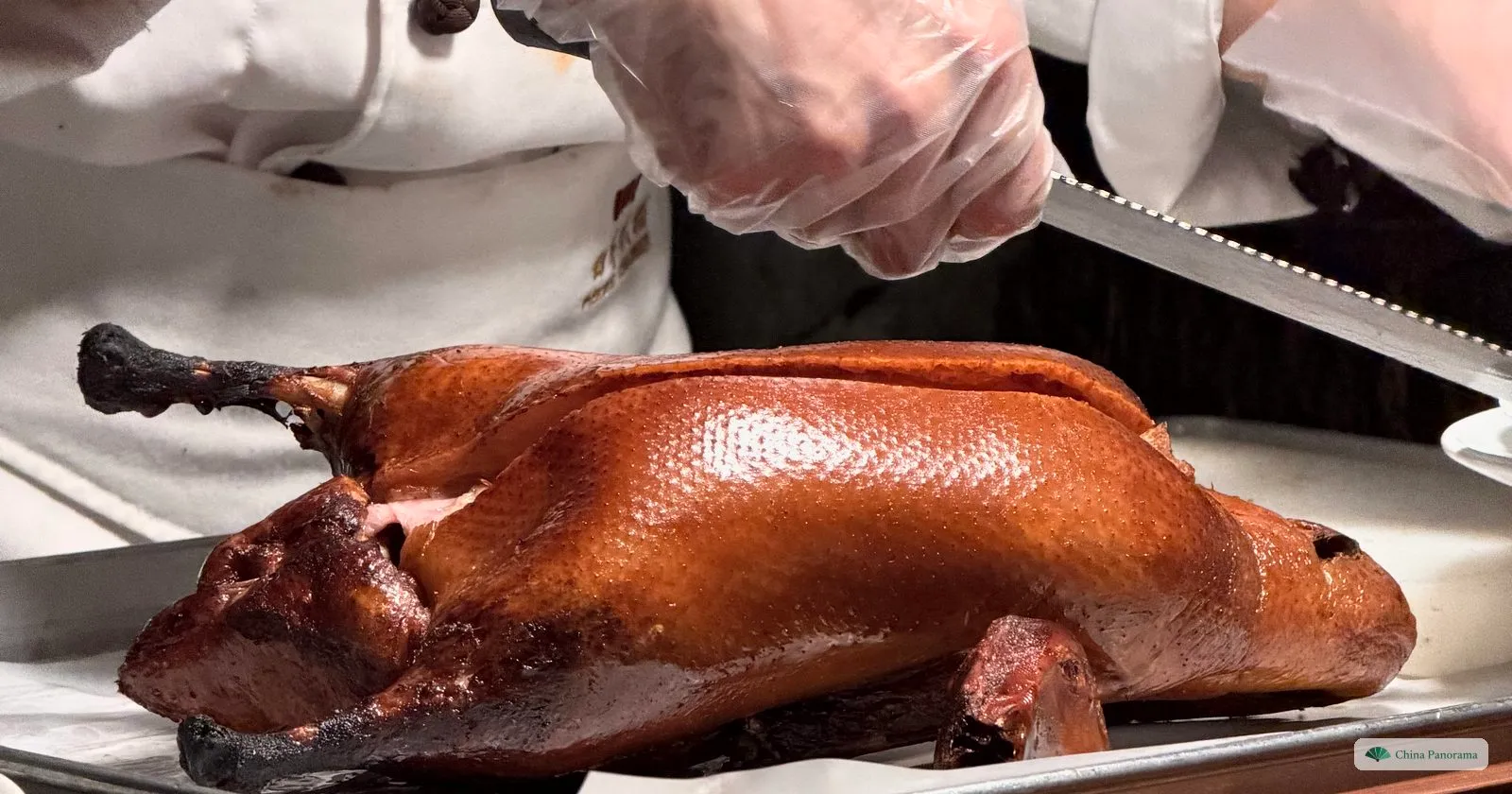
What is Peking duck?
A whole duck, roasted until the skin is dark and glossy and shatters like thin glass. The chef carves it at the table, and everyone rolls their own: a paper-thin wheat pancake, a little dark bean sauce, two or three slices of duck, a few strips of scallion and cucumber. In Beijing it is not an everyday meal but the dish for guests, family celebrations and business dinners.
What it tastes like. The skin is the point: thin, crackling and glossy, with a little melting fat underneath and a faint smoky sweetness from the glaze. The meat is tender and mild. Rolled up, the pancake is soft and neutral, the sweet bean sauce salty-sweet and dark, the scallion sharp and the cucumber cool and crunchy, so each bite goes rich, sweet, sharp and fresh at once.
A bit like … A wrap like a tortilla, but the filling is a few slices of crisp-skinned roast duck – nearer to a perfectly roasted Christmas goose than to the deep-fried 'crispy duck' on takeaway menus.
Read the duck: tap the numbers
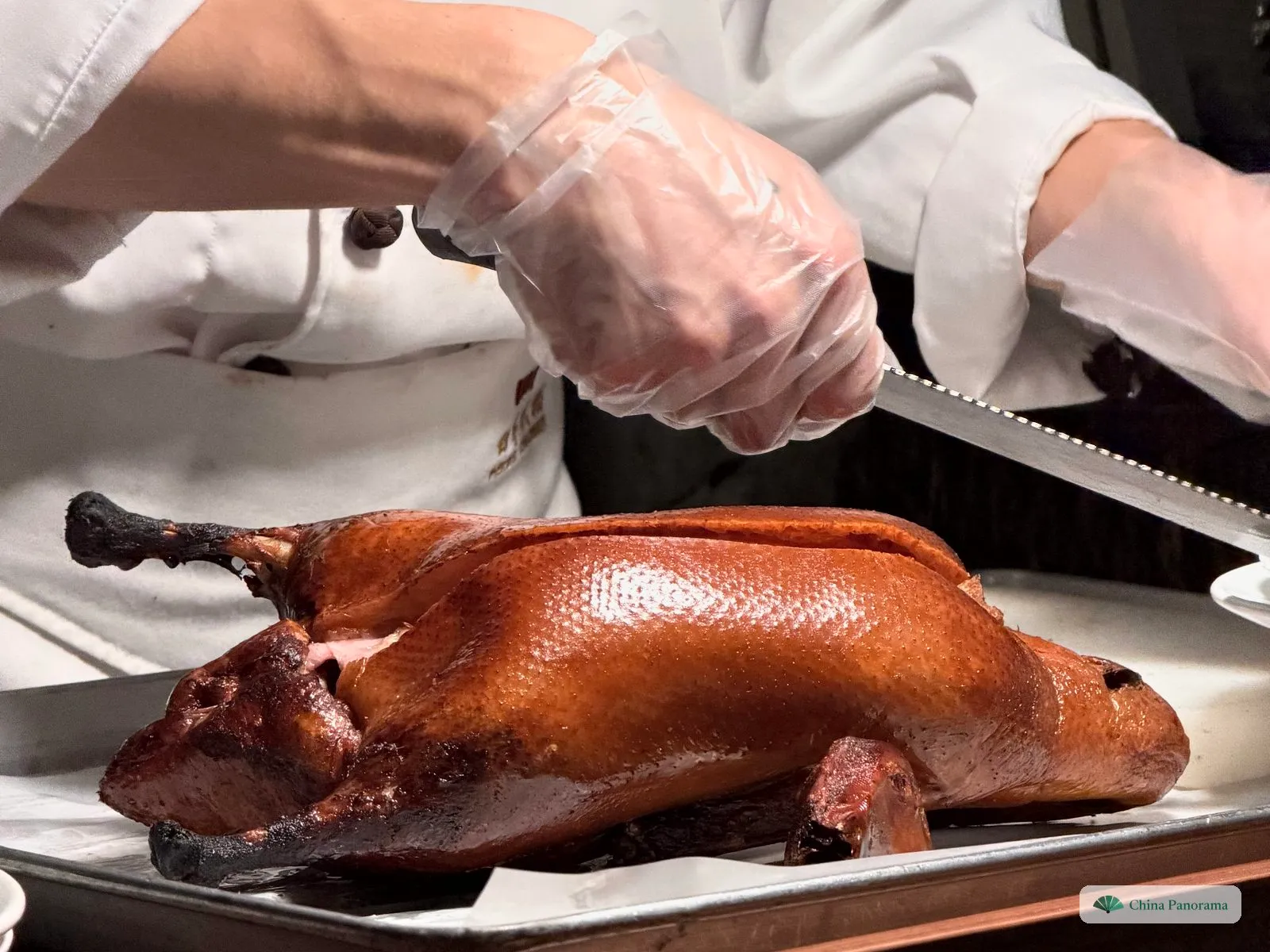
1The lacquered skin
鸭皮 yā pí
Before roasting, the duck is scalded with hot water, brushed with sugar syrup and hung up to dry. That is why the skin shines like lacquer and turns glass-crisp in the oven.
Tap a number on the photo, or a name in the list.
What is Peking duck served with?
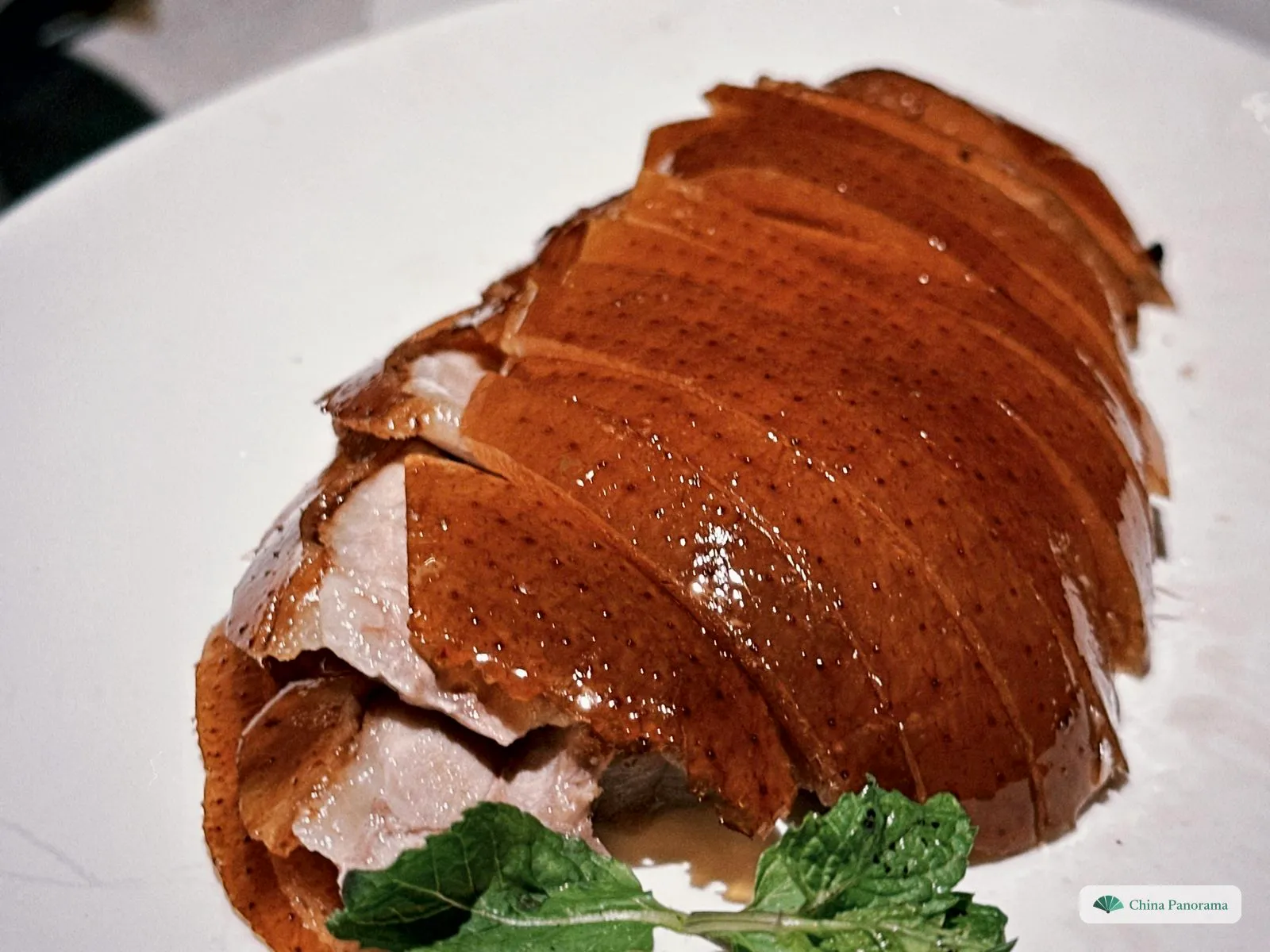
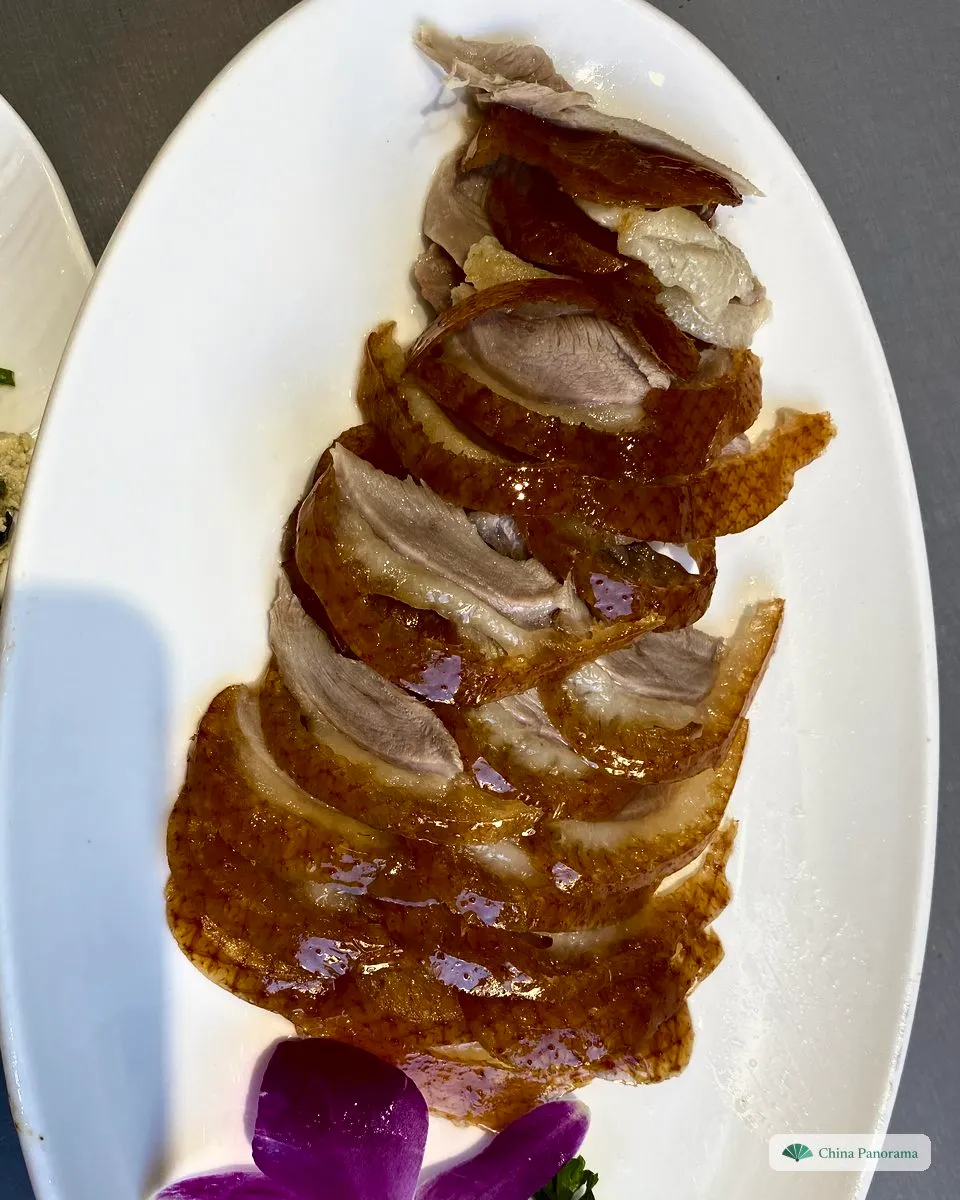
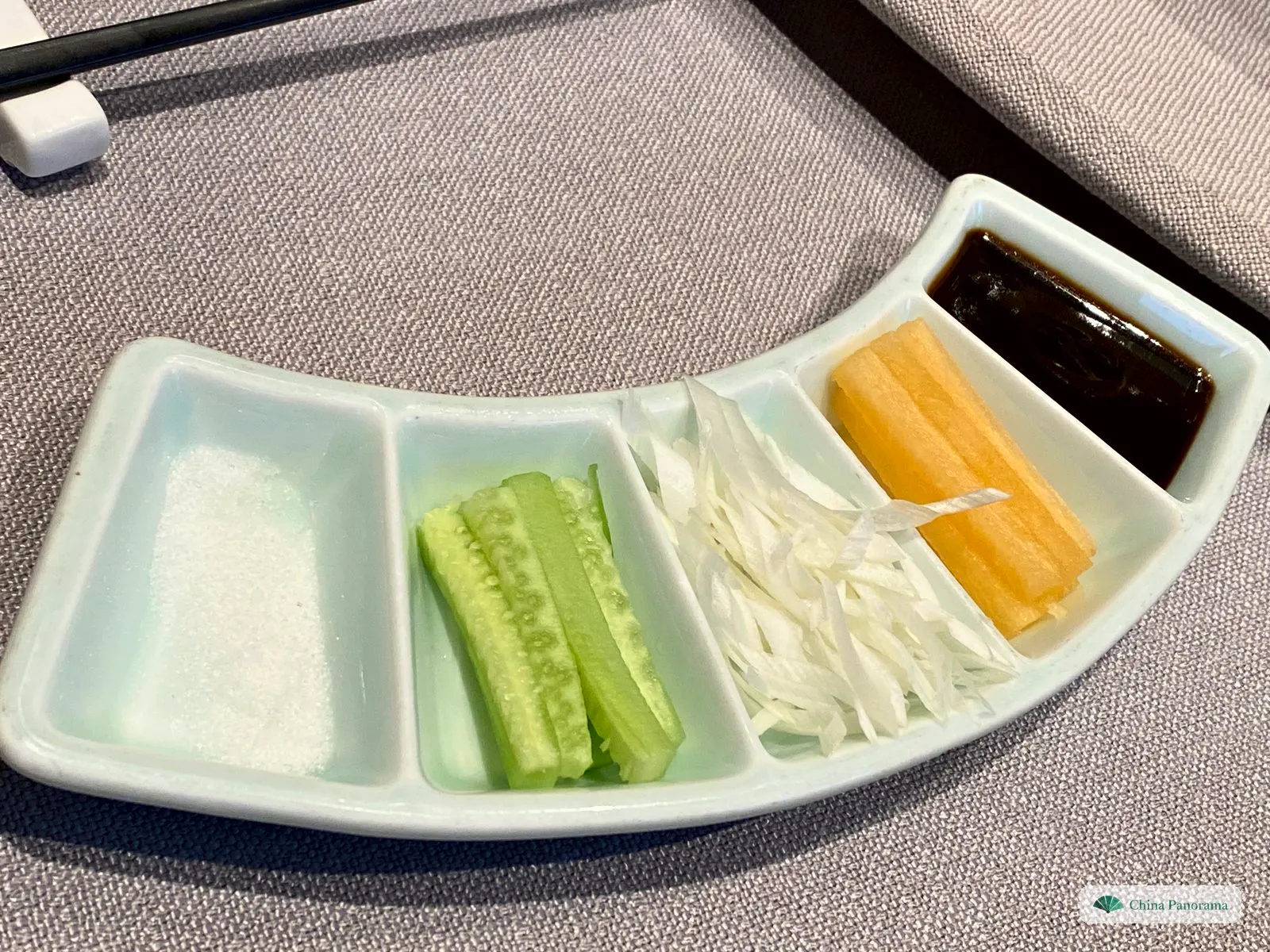
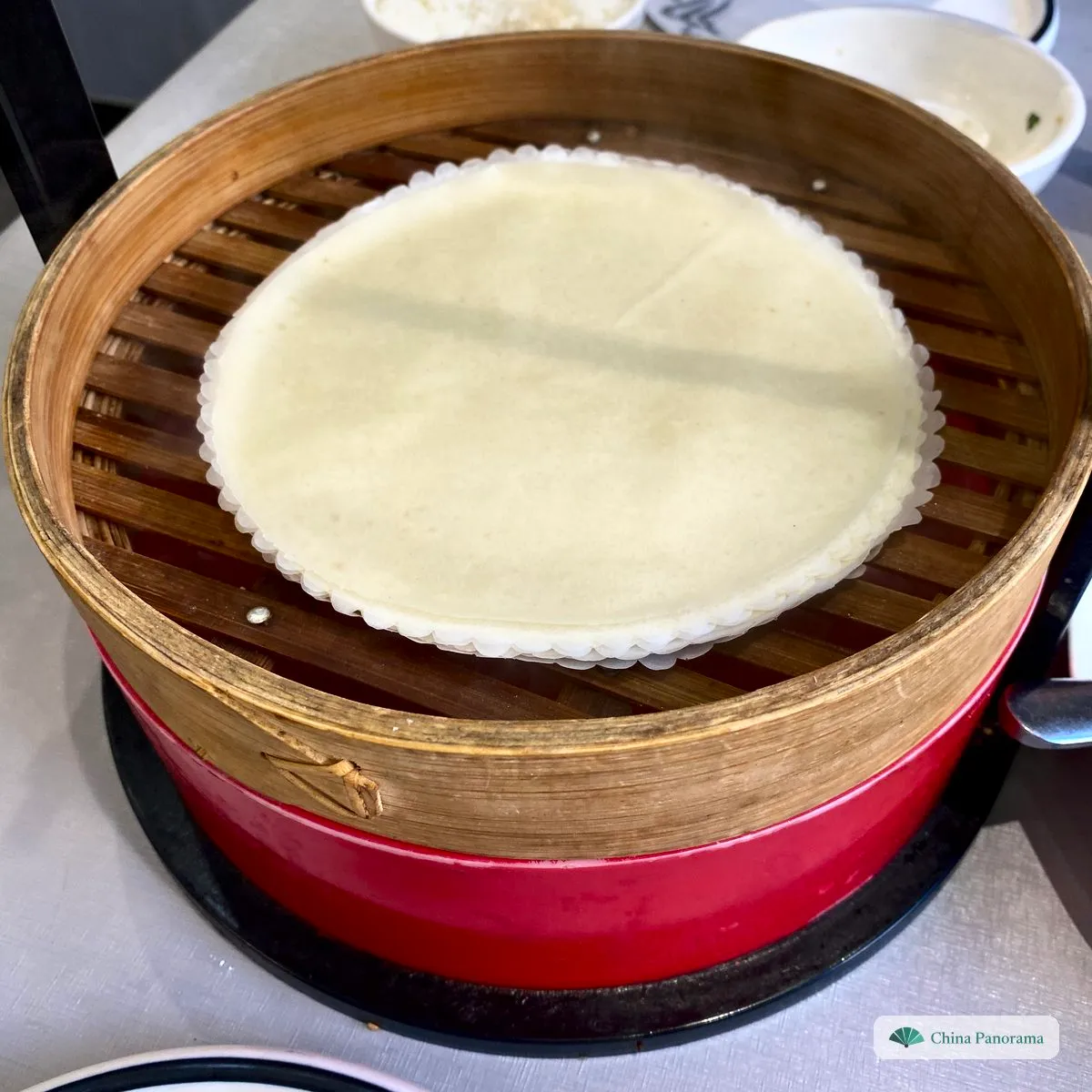
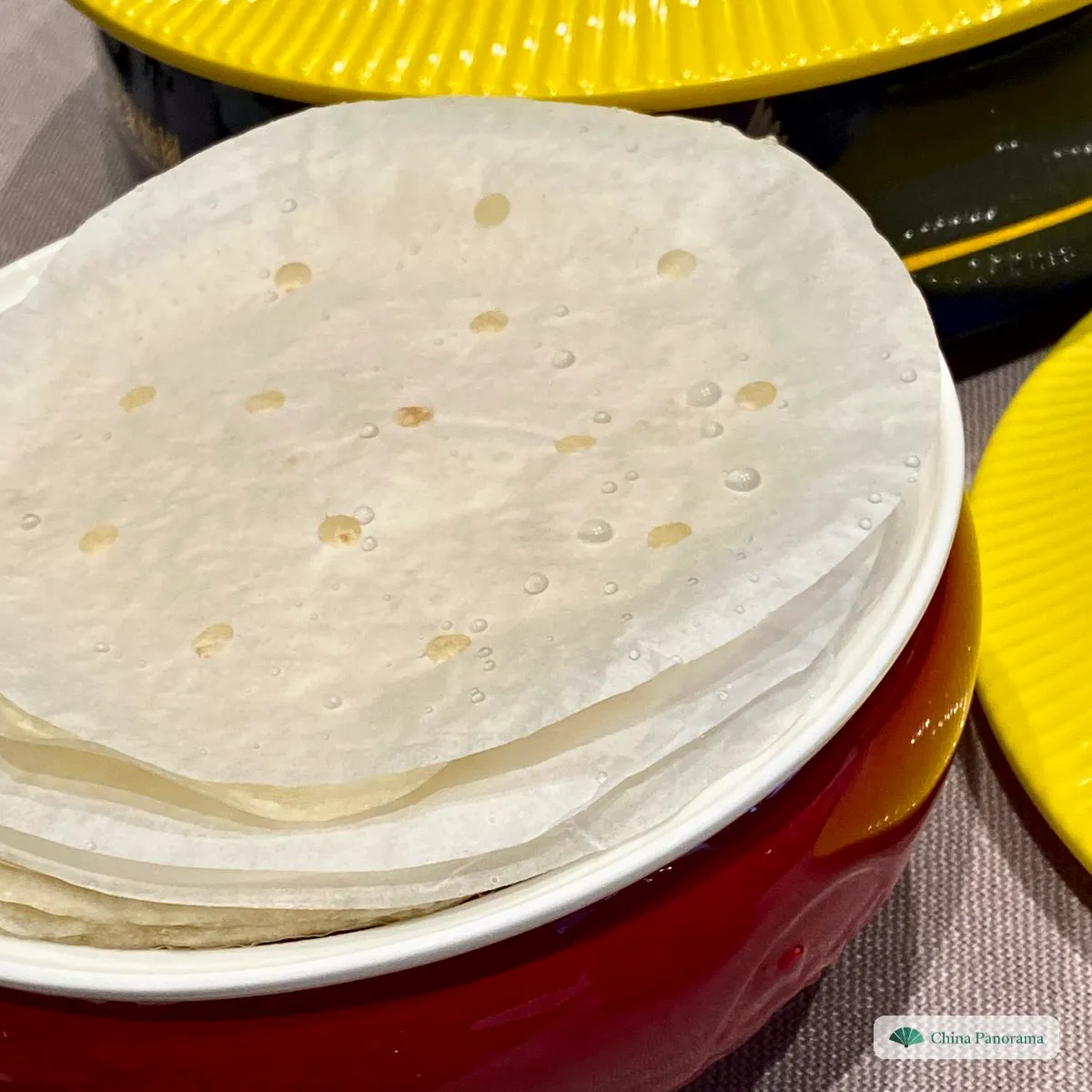
What always comes with the duck: pancakes, sweet bean sauce, scallion and cucumber. Often there is also sugar for the skin and red hawthorn strips. Two side platters and two baskets of pancakes from our own meals:
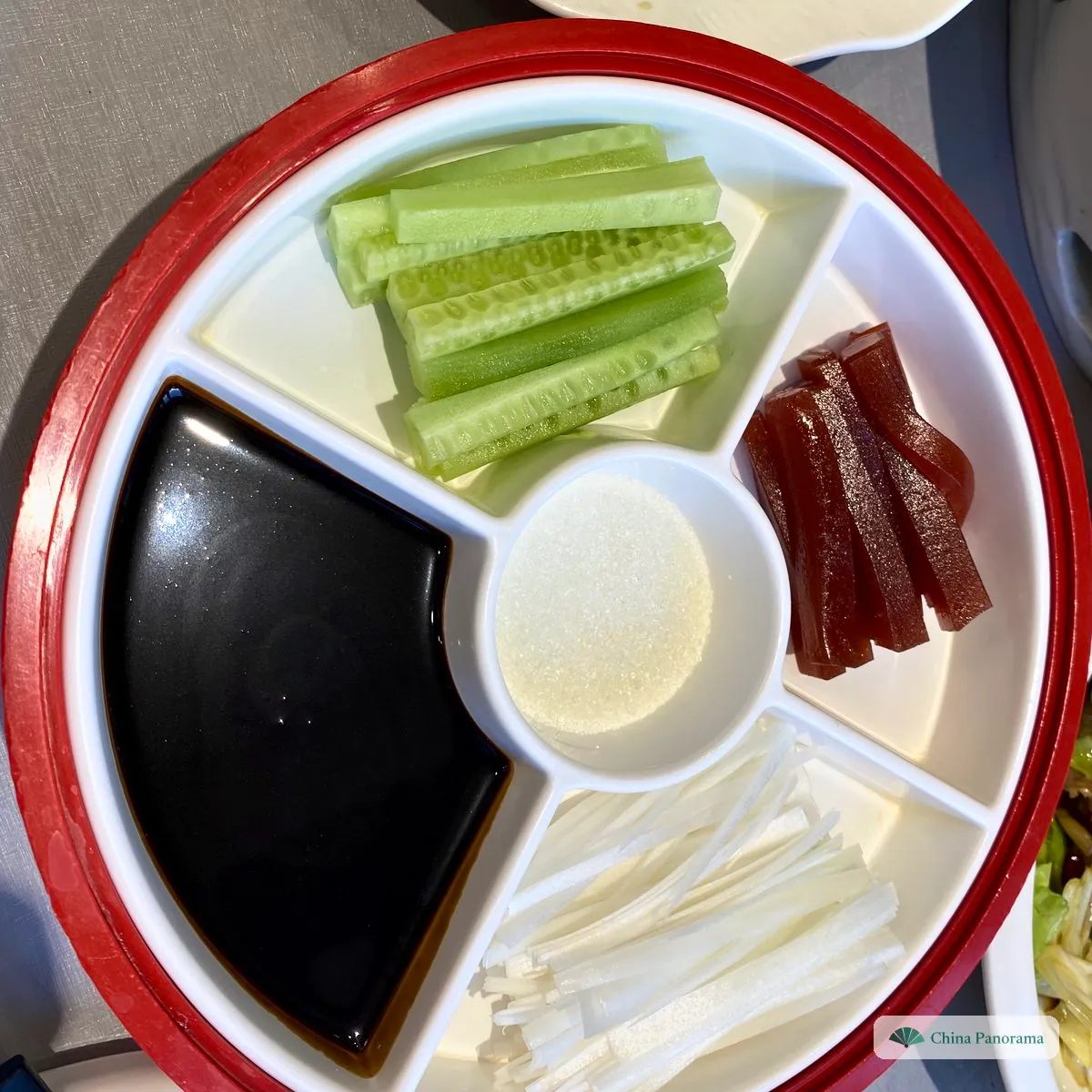
1Sweet bean sauce
甜面酱 tián miàn jiàng
Dark, salty-sweet, made from fermented wheat flour and soy. It goes into every roll.
Tap a number on the photo, or a name in the list.
How to eat Peking duck: the skin with sugar first
The sugar on the side platter does not go into the roll. It is for the first pieces the chef cuts: pure skin from the breast, without meat. You eat them on their own and before anything else, and only then come the slices and the rolls.
- 1
The chef cuts the skin first · 先片皮
Before the first slice of meat, the chef cuts a few pieces of pure skin off the breast, the crispest part of the duck, and lays them on a small plate.
- 2
Dip it in sugar · 蘸白糖
Pick up a piece with chopsticks and dip the skin side into the little dish of white sugar.
- 3
Eat it on its own · 入口即化
No pancake, no sauce. The skin cracks, the thin layer of fat melts and the sugar crunches. Only then come the slices and the rolls.
Not a fan of sugar? Just eat the skin plain. How it all happens at the table, you can play through below in the meal step by step.
How to roll Peking duck pancakes: the simulator
The simulator: take a pancake, fill it, fold it and roll it. It tells you when there is too much sauce or the roll is about to split, and after the first bite whether this is how they would do it in Beijing. The ingredient marked in green is the next step.
Fill
Fold and eat
- 1Take a pancake · 取饼Lay one pancake from the steamer flat on your plate or in your open hand.
- 2Spread the sauce · 抹酱Spread a little sweet bean sauce thinly down the middle. Or dip the duck briefly in the sauce instead.
- 3Two or three slices of duck · 放鸭片Lay them on the sauce with chopsticks, skin and meat together.
- 4Add scallion and cucumber · 加配菜A few strips of scallion and one or two cucumber batons, lengthwise.
- 5Fold and roll · 卷起Fold the bottom edge up first, then fold in one side and roll it up from that side. The top stays open.
- 6Eat it warm · 趁热吃Eat it with your hands, in two or three bites, while the skin is still crisp.
甜面酱tián miàn jiàng
Sweet bean sauce
Dark, salty-sweet, made from fermented wheat flour and soy.
鸭片yā piàn
Duck, skin and meat
Each slice has crisp skin on top and tender meat underneath.
葱丝cōng sī
Scallion
Fine white strips of thick Beijing leek-scallion, sharp and fresh.
黄瓜条huáng guā tiáo
Cucumber
Thin batons, cool and crunchy.
山楂条shān zhā tiáo
Hawthorn strips
Firm red jelly made from hawthorn fruit, sweet and sour. Not served everywhere.
Two shortcuts that are just as correct: dip the duck in the sauce instead of spreading it on the pancake. Or tuck duck, sauce and scallion into a split sesame bun (芝麻烧饼) if the restaurant offers them.
A Peking duck meal, step by step
From ordering, through the skin with sugar and the carving, to the question of what to do with the carcass. Play through your meal: at the end your order appears in one line of Chinese, full screen to show the waiter.
1 / 6点鸭diǎn yā
Order the duck
Order the duck right at the start, together with a few other dishes. You can order a whole duck or half a duck. Pancakes, sauce and the sides come with it.
一只烤鸭yì zhī kǎo yā
A whole duck
A whole duck feeds three to five people when there are two or three other dishes on the table.
2 / 6酥皮蘸糖sū pí zhàn táng
First the skin, with sugar
In good restaurants a chef wheels the whole duck to your table on a cart and shows it to you. The first thing he cuts off is pure skin from the breast, without meat. Dip a piece in the sugar and eat it on its own, before anything else.
Tried: The skin cracks, the little fat underneath melts, the sugar crunches. Almost like a dessert, and that is why it comes first.
Skipped: No problem. The skin also tastes good in the rolls, just not quite as crisp.
3 / 6片鸭piàn yā
Then the slices
Then he carves the rest of the duck into thin slices in front of you, each with skin and a little meat. It is part of the meal, and almost every guest takes photos.
4 / 6卷饼juǎn bǐng
Roll your pancakes
Now everyone rolls their own: pancake, sauce, duck, scallion and cucumber. Nobody rolls for the whole table, and you may use your hands.
Try it in the roll simulator above: pancake, sauce, two or three slices, scallion, cucumber, fold, roll.
5 / 6鸭架yā jià
What happens to the carcass?
After carving, the carcass is left with some meat on it. The waiter asks what the kitchen should do with it. If you say nothing, it is often just packed up or thrown away.
6 / 6给服务员看gěi fú wù yuán kàn
Your order to show
Everything you chose, in one line of Chinese. Show it to the waiter.
Phrases to show
Tap a card to show it full screen.
一只烤鸭
yì zhī kǎo yā
A whole Peking duck, please.
半只烤鸭
bàn zhī kǎo yā
Half a Peking duck, please.
再加一份饼
zài jiā yí fèn bǐng
Another portion of pancakes, please.
鸭架熬汤
yā jià áo tāng
Please make soup from the carcass.
鸭架椒盐
yā jià jiāo yán
Please fry the carcass with salt and pepper.
鸭架打包
yā jià dǎ bāo
Please pack up the carcass for me.
How ordering, sharing and paying work in a restaurant in general is in our guide to ordering in a restaurant.
The history of Peking duck
Roast duck was eaten in China long before it was called “Peking duck”. From the imperial court it became the food of the restaurants on Qianmen Street, then a meal for state guests and finally cultural heritage.
1330The first mention
The Yuan imperial court’s dietary manual, “Yinshan Zhengyao” (饮膳正要) by the court physician Hu Sihui, lists “roast duck” (烧鸭子). Beijing was already the capital then, under Mongol rule.
1416Bianyifang, as the story goesas the story goes
When the Yongle Emperor moved the capital from Nanjing to Beijing, cooks from the south came along. One of them is said to have opened a small poultry shop in 1416 that became Bianyifang. There, the duck is roasted in a closed oven.
1864Quanjude and the open oven
Yang Quanren opens a duck restaurant in Qianmen. A cook switches to the open, hanging oven: the duck hangs over a fire of fruitwood and is done in 25 to 40 minutes. This is the style most diners know today.
1873The duck travels to America
A trader brings a few white Peking ducks to Long Island near New York. The “Pekin” breed is now the most common duck on American farms, and in Germany the white farm duck is still called “Pekingente”.
from 1949A meal for state guests
Duck is on the menu at state banquets in Beijing. A meal at a duck restaurant becomes a fixed part of the programme for foreign visitors.
1985The modern duck
From a state-run duck restaurant founded in 1985, the chef Dong Zhenxiang makes Da Dong after 2002. His duck is leaner, the skin crisp and hardly fatty (酥不腻, sū bú nì), served like fine dining.
2008Intangible cultural heritage
Beijing’s duck-roasting craft joins China’s second national list of intangible cultural heritage, with both schools: the open oven (Quanjude) and the closed oven (Bianyifang).
Open oven or closed oven
The two schools of Peking duck differ above all in the oven:
挂炉guà lúOpen oven
Quanjude, most restaurants
The duck hangs from a hook in a brick oven without a door, over an open fire of fruitwood such as jujube, pear or apple. The cook turns it with a long pole so it browns evenly.
Result: Dark, glossy, crisp skin with a light smoky note.
焖炉mèn lúClosed oven
Bianyifang
The oven is heated, then the fire is put out. The duck cooks with the door shut in the remaining heat, without a flame.
Result: Paler skin, very juicy meat, no smoke.
Where to eat Peking duck in Beijing: four famous restaurants
The four names people in Beijing mention most: two old houses that stand for the two oven schools, and two younger ones. All have several branches. Tap what matters to you.
What matters to you? Tap what applies.
Tick a situation above and the option that fits best is marked.
Quanjude 全聚德
Since 1864 · open oven
The best-known name for Peking duck, with many branches across the city. The duck hangs in an open oven over fruitwood, the way most places do it today. Big, traditional dining halls.
- Founded
- 1864 by Yang Quanren
- Oven
- Open (挂炉), fruitwood
- Flagship
- Qianmen Street (前门大街), south of Tiananmen Square
- First visit, I want the classic: The name everyone in China connects with Peking duck.
- As much tradition as possible: Over 160 years old, and the school of the open oven.
- With a view of the Forbidden City: The flagship is on Qianmen Street, not at the Forbidden City.
- Less fatty, please: Classic duck with the full layer of fat under the skin.
- Upmarket, for a special evening: Traditional and lively rather than refined.
Bianyifang 便宜坊
Since 1416 (as the story goes) · closed oven
The oldest duck house in the city, by tradition from the Ming dynasty. The duck cooks in a closed oven in the remaining heat, without a flame. Paler skin, very juicy.
- Founded
- 1416, as the story goes
- Oven
- Closed (焖炉), remaining heat
- Flagship
- Xianyukou Lane (鲜鱼口) near Qianmen
- First visit, I want the classic: A classic too, but the other school: the closed oven.
- As much tradition as possible: Some 600 years, the oldest name for duck in Beijing.
- With a view of the Forbidden City: Near Qianmen, not at the Forbidden City.
- Less fatty, please: Juicy rather than crisp and fatty, no smoke.
- Upmarket, for a special evening: Traditional, not meant as fine dining.
Da Dong 大董
Since 2002 under chef Dong Zhenxiang · lean duck
The modern duck: leaner, the skin crisp and hardly fatty (酥不腻). Served like fine dining, with many small condiments. Pricier than the other three.
- Founded
- 1985 as a state-run duck restaurant, Da Dong since 2002
- Oven
- Its own round charcoal oven
- Branches
- Several in Beijing, booking is worth it
- First visit, I want the classic: Peking duck, but in a new form of its own.
- As much tradition as possible: A young house.
- With a view of the Forbidden City: The branches are not at the Forbidden City.
- Less fatty, please: This is what Da Dong is known for: crisp, not greasy.
- Upmarket, for a special evening: The most upmarket of the four, with fine-dining presentation.
Siji Minfu 四季民福
Modern chain · branch at the East Gate of the Forbidden City
A younger chain with Beijing cooking and duck, popular with locals. The “Gugong” branch is right next to the East Gate of the Forbidden City, and from some windows you look out at the wall and the corner tower.
- Gugong branch
- 11 Nanchizi Street (南池子大街11号), by Donghua Gate
- Oven
- Open (挂炉)
- Crowds
- Long queues in the evening, take a number
- First visit, I want the classic: Classic duck in a modern, friendly setting.
- As much tradition as possible: A young chain.
- With a view of the Forbidden City: The branch at the East Gate of the Forbidden City.
- Less fatty, please: Normal duck, but the rolls tend to be small and light.
- Upmarket, for a special evening: Well kept, but not fine dining.
Founding years and ovens from Chinese sources (ifeng, Xinhua, China Intangible Cultural Heritage, Jiemian, visitbeijing). Details in brown we have not checked on site. A whole duck usually costs 150 to 300 yuan, and you can also order half.
Where else to eat in Beijing and what to see is in our Beijing travel guide.
Peking duck vs crispy aromatic duck
If you know duck pancakes from a British Chinese takeaway, you may expect something else. The difference:
| Peking duck in Beijing 北京烤鸭 | Crispy aromatic duck | |
|---|---|---|
| Cooking | Roasted whole in an oven, the skin glazed and dried beforehand | Steamed or braised with five-spice, then deep-fried |
| Served | Carved at the table into thin slices, skin with meat | Shredded at the table with two forks |
| Eaten with | Wheat pancakes, sweet bean sauce, scallion, cucumber | Pancakes, hoisin sauce, spring onion, cucumber |
| The skin | Thin, glossy, glass-crisp, eaten first with sugar | Crisp from the fryer, mixed in with the meat |
In American Chinese restaurants “Peking duck” is closer to the original, often served with steamed buns as well as pancakes. Hoisin usually stands in for the bean sauce.
Allergens and diet
Every roll contains wheat (pancake and sauce) and soy (sauce). The duck itself is simple, only the glaze on the skin contains sugar or malt syrup.
Pancakes
- ACereals containing gluten· US: Wheat
Wheat flour, water, a little oil.
Sweet bean sauce
- ACereals containing gluten· US: Wheat
- FSoybeans· US: Soybeans
- NSesame (sometimes)· US: Sesame
Fermented wheat flour and soy. Hoisin sauce often also contains sesame.
The duck
- ACereals containing gluten (sometimes)· US: Wheat
The glaze is sugar or malt syrup. Malt syrup can be made from barley or wheat.
Sesame buns (if offered)
- ACereals containing gluten· US: Wheat
- NSesame· US: Sesame
Wheat dough with sesame.
These are estimates from how the dish is usually made, not a restaurant’s declaration. Every kitchen and every sauce brand is different – always tell the staff about an allergy. Chinese kitchens often fry in peanut oil, and chilli oil may be made with it too; we don’t repeat that for each dish.
Vegetarian, no pork, halal
Peking duck is meat, and ordinary restaurants have no vegetarian version. There is no pork involved, but the duck is not halal unless you eat at a Muslim restaurant (清真, qīng zhēn).
我对小麦过敏
wǒ duì xiǎo mài guò mǐn
I am allergic to wheat.
我对大豆过敏
wǒ duì dà dòu guò mǐn
I am allergic to soy.
不要葱
bú yào cōng
No scallion, please.
酱单独放
jiàng dān dú fàng
The sauce on the side, please.
More dishes explained: jiaozi, wontons, hot pot and xiao long bao.
FAQ
How many people does one Peking duck feed?
As part of a meal with two or three other dishes, a whole duck feeds three to five people. For two, half a duck is enough: you can order a whole one or a half.
Do you eat Peking duck with your hands?
Yes. You pick up the fillings with chopsticks, then roll and eat the pancake with your fingers. Everyone in Beijing does it that way, in smart restaurants too.
What is the sugar for?
For the skin on its own. The chef first cuts pieces of pure, crisp skin off the breast. You dip them in sugar and eat them before the slices and the rolls. Sugar does not go into the pancake.
Is Peking duck the same as crispy aromatic duck?
No. Crispy aromatic duck, a British takeaway favourite, is steamed with five-spice and then deep-fried, and shredded at the table with forks. Peking duck is roasted in an oven, carved into thin slices of skin and meat, and the skin is the point.
What sauce comes with Peking duck?
Sweet bean sauce (甜面酱, tián miàn jiàng): a dark, salty-sweet paste made from fermented wheat flour and soy. Outside China it is often hoisin sauce, in Beijing it is sweet bean sauce.
Is Peking duck gluten-free?
No. The pancakes are wheat, and the sauce contains wheat and soy. The skin with sugar or the duck without sauce is a way out, but ask about the glaze.
What happens to the rest of the duck?
The carcass (鸭架, yā jià) is left over. The kitchen makes it into soup, fries it with salt and pepper or packs it up for you. Say what you want, otherwise nothing is often done with it.
How much does Peking duck cost in China?
A whole duck usually costs 150 to 300 yuan, with pancakes, sauce and sides. You can also order half a duck.
What is Peking duck served with?
Thin wheat pancakes, sweet bean sauce, scallion and cucumber, often hawthorn strips too. Plus a little dish of sugar for the crisp skin, which you eat first on its own. Good other dishes are vegetables, and at the end a soup made from the carcass.
What is Peking duck called in Chinese?
Běijīng kǎoyā (北京烤鸭), without tones Beijing kaoya, or just kǎoyā (烤鸭). In Hong Kong and Guangdong menus often say 片皮鸭.
Photos and sources
All photos are our own. The price comes from our dish collection and is typical for a whole duck: usually 150 to 300 yuan. The history follows Chinese sources: the cookbook “Yinshan Zhengyao” (1330), reports by ifeng and Xinhua on Bianyifang and Quanjude, the intangible cultural heritage register (2008) and Jiemian on Da Dong. How much duck feeds how many people is a rule of thumb. Allergens are estimated from the usual recipe.
Changelog (1)
- 2026-11-06Page created, with our own photos. History and restaurants from Chinese sources, addresses and queues not checked on site.