China Panorama
China Panorama
Entry
Holidays
Flights
Food
Cities
Culture
Quiz
Last verified: 14 Nov 2026

Chinese Zodiac Dragon: Meaning, Personality, Years and 2027 Horoscope

The Dragon 龙 lóng is the fifth of the twelve Chinese zodiac animals and the only one that does not exist in nature. It is seen as confident, ambitious and blessed with luck, and unlike in European legend it is no monster in China but brings rain and blessings. The last Year of the Dragon was 2024, a Wood Dragon. The next one begins on 28 January 2036, a Fire Dragon. Below you will find every Dragon year, the Dragon’s five elements with what Chinese horoscope charts advise them, three jade dragons from the National Palace Museum in Taipei across more than 2000 years in order of age, the Dragon stamps of China Post and a number game with your life number, partner check included.

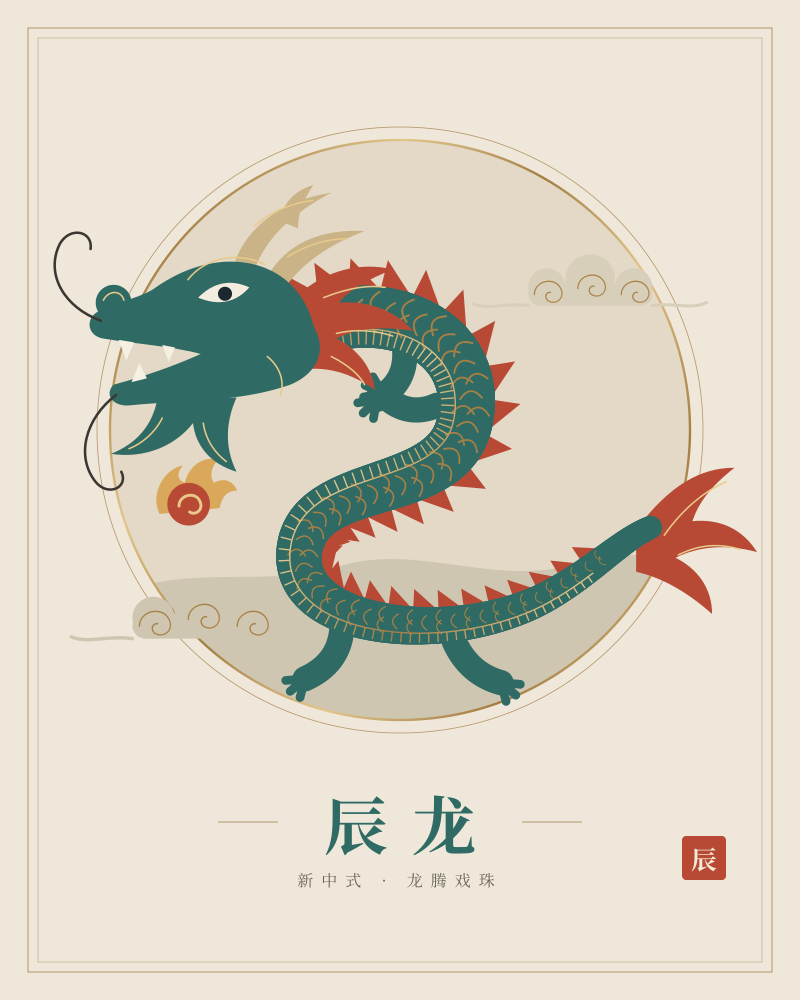
Illustration in new Chinese style: a blue-green, scaly dragon with golden horns, long whiskers and a red dorsal mane winds in an S-shape in front of a large pale circle and snaps at a red flaming pearl, small clouds around it, below the characters 辰龙 and a red seal

Profile: the Dragon in the Chinese zodiac

Character
龙 lóng
Earthly branch
辰 chén, number 5 of 12
Double hour
7 to 9 am
Direction
East-southeast
Element of the branch
Earth (Yang)
Month
Early April to early May
Best matches
Rat, Monkey, Rooster
Opposite
Dog

Each of the twelve earthly branches has an animal. The Dragon has the fifth, 辰 chén. It stands for the morning hours, for east-southeast and for late spring, and it belongs to the element Earth. It has nothing to do with the Western star sign, as the comparison of the Chinese and Western zodiac explains.

Meaning and personality of the Dragon

The dragon rises into the sky and dives into the sea, it makes rain and carries the emperor. What people say about those born in the Dragon’s sign comes from this image: greatness, luck and a certain taste for the big entrance. That is folk belief, not a personality test.

Strengths

  • confident, with lots of charisma
  • ambitious and full of energy
  • brave, takes on big tasks
  • generous and enthusiastic
  • seen as a lucky child

Weaknesses

  • proud, does not like admitting mistakes
  • impatient when things are not fast enough
  • likes to be in charge
  • demands a lot of itself and of others

The Dragon in love

In love the Dragon is seen as passionate, generous and romantic, but also as someone who wants to be admired and sets the tone. In the classical teaching the Rat, Monkey and Rooster suit it best, the Dog is its opposite. All twelve animals compared are further down, and in the life number game you can enter your partner’s birthday.

Dragon years: every year from 1928 to 2036

The Chinese year does not begin on 1 January but with the New Year festival between 21 January and 20 February. If you were born in a Dragon year in January or February, check the exact days: before New Year it is still the Rabbit.

YearBeginsEndsDragonStem and branch
192823 January 19289 February 1929Earth Dragon戊辰
19408 February 194026 January 1941Metal Dragon庚辰
195227 January 195213 February 1953Water Dragon壬辰
196413 February 19641 February 1965Wood Dragon甲辰
197631 January 197617 February 1977Fire Dragon丙辰
198817 February 19885 February 1989Earth Dragon戊辰
20005 February 200023 January 2001Metal Dragon庚辰
201223 January 20129 February 2013Water Dragon壬辰
202410 February 202428 January 2025Wood Dragon甲辰
2036next28 January 203614 February 2037Fire Dragon丙辰

New Year dates in China time, each checked against the astronomical new moon. The next Earth Dragon follows in 2048. All the other animals and a finder for any birthday from 1924 are in the overview of the twelve Chinese zodiac signs.

The Dragon’s five elements: Metal Dragon 2000, Water Dragon 2012, Wood Dragon 2024, Fire Dragon 1976, Earth Dragon 1988

The same Dragon comes back every 60 years, because the twelve animals combine with ten heavenly stems that give each year an element. So there are five kinds of Dragon: Metal, Water, Wood, Fire and Earth. The last digit of the year tells you which: 0 Metal, 2 Water, 4 Wood, 6 Fire, 8 Earth. The branch 辰 itself is Earth, Yang Earth to be precise. How the elements relate to each other is explained on the five elements page.

The cards also show what a popular Chinese horoscope chart advises each Dragon: which elements are meant to help it, what it should not get too much of, and which stones it should wear. Its starting point for 2026: the year 丙午 is fire, and fire gives rise to earth. So the Dragon gets a tailwind, and the year counts as one in which long preparation pays off. That is fortune-telling, not fixed tradition, but it shows well how people in China reckon with the five elements.

  • 木龙

    Wood Dragon1964 · 2024

    Stem and branch:
    甲辰
    How stem and branch fit:
    木克土, wood over earth: wood roots through earth
    Nayin:
    覆灯火 fù dēng huǒ, “fire of the covered lamp” (Fire)
    Colour of the element:
    青 blue-green

    Helpful, says the chart: water and wood 喜用神 水、木

    Better not: too much metal and earth 忌金土过重

    Suggested stones:

    • aquamarine or amazonite 海蓝宝 / 天河石: water feeds wood, helps you speak up and brings ideas
    • obsidian or black rutilated quartz 黑曜石 / 黑发晶: takes away bad energy, calms and makes you resilient
  • 火龙

    Fire Dragon1916 · 1976 · 2036

    Stem and branch:
    丙辰
    How stem and branch fit:
    火生土, fire over earth: fire feeds earth
    Nayin:
    沙中土 shā zhōng tǔ, “earth in the sand” (Earth)
    Colour of the element:
    赤 red

    Helpful, says the chart: wood and fire 喜用神 木、火

    Better not: too much cold metal and water 忌金水过寒

    Suggested stones:

    • red agate or garnet 红玛瑙 / 石榴石: strengthens the fire, gives drive and lifts low moods
    • amethyst or green phantom quartz 紫水晶 / 绿幽灵: wood feeds fire, brings patrons and helps you decide
  • 土龙

    Earth Dragon1928 · 1988 · 2048

    Stem and branch:
    戊辰
    How stem and branch fit:
    土土比和, earth over earth: twice as strong
    Nayin:
    大林木 dà lín mù, “wood of the great forest” (Wood)
    Colour of the element:
    黄 yellow

    Helpful, says the chart: fire and earth 喜用神 火、土

    Better not: too much metal and water 忌金水过旺

    Suggested stones:

    • a yellow crystal point 黄塔晶: steadies career and savings and gives a sense of security
    • red agate or amethyst 红玛瑙 / 紫水晶: fire feeds earth, helps with big decisions and against dithering
  • 金龙

    Metal Dragon1940 · 2000

    Stem and branch:
    庚辰
    How stem and branch fit:
    土生金, metal over earth: earth gives rise to metal
    Nayin:
    白蜡金 bái là jīn, “metal like white wax” (Metal)
    Colour of the element:
    白 white

    Helpful, says the chart: earth and metal 喜用神 土、金

    Better not: too much wood and fire 忌木火过旺

    Suggested stones:

    • a yellow crystal point 黄塔晶: thick earth feeds metal, gives footing, money and confidence
    • golden rutilated quartz or titanium quartz 金发晶 / 钛晶: strengthens the metal, brings patrons, honestly earned money and leadership
  • 水龙

    Water Dragon1952 · 2012

    Stem and branch:
    壬辰
    How stem and branch fit:
    土克水, water over earth: earth dams water
    Nayin:
    长流水 cháng liú shuǐ, “long-flowing water” (Water)
    Colour of the element:
    黑 black

    Helpful, says the chart: metal and water 喜用神 金、水

    Better not: too much dry earth and fire 忌土火过燥

    Suggested stones:

    • rock crystal or moonstone 白水晶 / 月光石: adds water, sharpens intuition and calms the mind
    • black rutilated quartz 黑发晶: takes away bad energy and keeps money together

Charts like this often name a second element too, the nayin 纳音 nàyīn. It comes from the teaching of the 60 pairs that fortune-tellers use and has vivid names such as “earth in the sand” for the Fire Dragon of 1976. When someone in China talks about the Fire Dragon, though, they almost always mean the element of the heavenly stem, the one in the card’s heading. The chart calls this element the “day master” 日主. That is loose: in real Bazi the day master comes from the day of birth, not the year, as the four pillars calculator shows. And the stones appear in no old text on the five elements, they are a business, not a tradition.

Dragon horoscope 2026 and 2027, and the Year of the Dragon 2036

2026: Year of the Horse

A year with a tailwind: the fire of the year 丙午 feeds the Dragon’s earth. Horoscope charts call it 火生土, “fire gives rise to earth”, and promise a year of quiet but steady progress, with patrons at work and peace in the family. Between the Dragon and the Horse themselves the classical teaching knows neither harmony nor conflict. The year lasts until 5 February 2027.

2027: Year of the Goat

A quiet year: between the Dragon and the Goat the classical teaching also knows neither harmony nor conflict. From 6 February 2027 to 25 January 2028 the fire of the year 丁未 again feeds the Dragon’s earth. More on the Year of the Fire Goat is on the Goat page.

2036: What colour is the Year of the Dragon?

Red. The next Dragon year is a Fire Dragon 丙辰 bǐngchén, and the colour of fire is 赤 chì, red. The last Dragon year, 2024, was a Wood Dragon and so green, which is why 2024 was often called the year of the “Green Dragon” in China.

If you are a Dragon yourself, 2036 is your own year, your 本命年 běnmìngnián. That means everyone turning 12, 24, 36, 48, 60, 72 or 84 in 2036. Your own year is traditionally seen as tricky, so many Dragons wear something red from 28 January 2036 to 14 February 2037: red socks, underwear or a red bracelet, ideally a gift from a partner or parents. How the New Year festival works is on the Chinese New Year 2027 page.

Game: what does your life number say about you as a Dragon?

On Chinese social media there are charts that combine the Dragon with the life number 生命数字 shēngmìng shùzì: nine Dragon types with core traits, love and work, and for each number two partner numbers that are meant to suit it best. The Dragon chart names no animals, only the numbers.

How do I work out my life number?

Write down your date of birth with all its digits, day and month with two digits, the year with four, and add up all the digits. If the sum still has two digits, add those up again, until only one is left. For 29 May 1976, so 29.05.1976, that means:

  1. All digits: 2 + 9 + 0 + 5 + 1 + 9 + 7 + 6 = 39
  2. Still two digits, so carry on: 3 + 9 = 12
  3. Once more: 1 + 2 = 3. The life number is 3.

You can leave out the zeros, they change nothing. Try it with your own birthday, then enter your partner’s:

Your birthday

✓ A Dragon. Born in the Year of the Fire Dragon 丙辰, which began on 31 January 1976.

Play along: add up all the digits until only one is left

  1. Step 1:1976052939
  2. Step 2:3912
  3. Step 3:123

Your life number is 3.

See another number:
3Dragon with life number 3The firework of ideas
Core traits
Bursting with energy and ideas, talks to everyone and is the centre of every group. Its head is full of wild notions.
In love
Romantic and full of feeling. It shows its love with surprises and ideas, and its emotions run rich and hot.
At work
Stage, advertising, design, jobs where you can be creative and show yourself.
Good match, says the chart:
And your partner?

The charts also name the numbers that suit each one best. Enter a second birthday:

Partner’s birthday

1+9+8+0+0+8+2+0 = 28 →2+8 = 10 →1+0 = 1

Partner’s life number: 1

The chart lists 1 as a good match for 3: it is steady enough to rein in its high spirits. And the other way round: the 1 chart lists your 3 too.

By the classical zodiac rules, Dragon and Monkey: Good match (三合 sānhé).

A game from Chinese social media, not a prediction. Where the life number comes from is explained below.

Where does the life number come from?

Not from China. The life number belongs to Western numerology, which invokes the Greek philosopher Pythagoras and became popular mostly in the 20th century. Chinese platforms have mixed it with the zodiac, much as Western horoscope books combine the animal with the star sign. Take the texts as a game, not a forecast. The same game exists for the Rat, Ox, Tiger, Rabbit, Snake, Horse, Goat, Monkey, Rooster, Dog and Pig.

All nine life numbers for the Dragon at a glance
  1. 1The born boss

    Core traits:
    Shows its strength openly, is full of confidence and has what it takes to lead. It has clear goals and a drive nobody needs to give it.
    In love:
    Leads in love too. It wants a partner who looks up to it and follows, and it plans the shared future of its own accord.
    At work:
    Founder, senior management, anything where new ground is broken and things change. That is where it shines.
    Best matches in the chart:
    the 3 and the 5
  2. 2The dragon with velvet paws

    Core traits:
    Strong and gentle at once: it has the dragon’s dignity and a fine, warm side. People matter to it, and it is good at bringing them together.
    In love:
    Tender and attentive. It looks for a relationship between equals with deep feelings and likes to care for the person it loves.
    At work:
    Human resources, public relations, customer service, anything where you talk, listen and balance.
    Best matches in the chart:
    the 6 and the 8
  3. 3The firework of ideas

    Core traits:
    Bursting with energy and ideas, talks to everyone and is the centre of every group. Its head is full of wild notions.
    In love:
    Romantic and full of feeling. It shows its love with surprises and ideas, and its emotions run rich and hot.
    At work:
    Stage, advertising, design, jobs where you can be creative and show yourself.
    Best matches in the chart:
    the 1 and the 7
  4. 4The reliable one

    Core traits:
    Calm and solid, works carefully and methodically, keeps to the rules and stays down to earth. It takes responsibility seriously, you can count on it.
    In love:
    Loyal and devoted to one person. It looks for a steady, grounded relationship where both feel safe.
    At work:
    Accounting, engineering, project management, anything that needs careful planning.
    Best matches in the chart:
    the 2 and the 9
  5. 5The dragon in the wind

    Core traits:
    Loves freedom and adventure, the ordinary bores it, and it has no fear of the unknown. It is easy-going and copes anywhere.
    In love:
    Wants freedom and equality, needs its own space and wants to explore life together with its partner.
    At work:
    Tour guide, extreme-sports coach, freelancing, work with lots of freedom and challenge.
    Best matches in the chart:
    the 1 and the 3
  6. 6The caring one

    Core traits:
    Kind-hearted and compassionate, likes to help and is devoted to family and friends. Its sense of responsibility is huge.
    In love:
    Looks after the partner down to the smallest thing and hopes the other takes family just as seriously.
    At work:
    Medicine and nursing, teaching, charity, jobs where you are there for others.
    Best matches in the chart:
    the 2 and the 4
  7. 7The seeker of truth

    Core traits:
    A sharp mind and great curiosity: it wants to get to the bottom of the unknown and of the truth, and stays cool and analytical while doing so.
    In love:
    Conversation matters more to it than gestures. It looks for a soulmate it can talk to deeply about everything.
    At work:
    Research, philosophy, data analysis, anything that needs deep thought.
    Best matches in the chart:
    the 3 and the 5
  8. 8The doer

    Core traits:
    Ambitious with a clear goal, energetic and decisive, with a strong head for business.
    In love:
    Wants a partner who backs its career plans and is itself a firm support for the other.
    At work:
    Business management, finance and investment, real estate.
    Best matches in the chart:
    the 2 and the 6
  9. 9The dragon with the big heart

    Core traits:
    Thinks of the whole world, has a strong sense of mission and much love for others. People like it, and it brings them together.
    In love:
    Looks for a partner who thinks just like it, to make something big and good happen together.
    At work:
    Charity, cultural exchange, education and training.
    Best matches in the chart:
    the 4 and the 6

The texts retell a popular Chinese chart in our own words.

Which signs are compatible with the Dragon? Matches and love

The classical teaching derives this from where the animals sit on the circle. Dragon, Rat and Monkey form a 三合 sānhé triangle, the water triangle 申子辰, Dragon and Rooster a 六合 liùhé pair. The Dog sits exactly opposite the Dragon. With the Rabbit it has a friction 害, with the Ox a break 破, and with itself a “self-punishment” 自刑. An old marriage rhyme about the six “harms” warns against the Rabbit:

龙兔泪交流

“Dragon and Rabbit: tears flow on both sides.”

  • Rat 鼠Good match (三合 sānhé)
  • Ox 牛Tension (破 pò)
  • Tiger 虎Neutral
  • Rabbit 兔Friction (害 hài)
  • Snake 蛇Neutral
  • Horse 马Neutral
  • Goat 羊Neutral
  • Monkey 猴Good match (三合 sānhé)
  • Rooster 鸡Good match (六合 liùhé)
  • Dog 狗Clash (冲 chōng)
  • Pig 猪Neutral

Tradition, not a forecast. In China some families still ask about it when planning a wedding, most couples take it lightly.

The Dragon in ancient China: thunder, rain and the emperor

The Dragon is the only mythical creature in the zodiac, yet in ancient China it was everywhere: in the sky, in the water and in the palace. Four images still shape how people in China see it:

辰The animal of spring thunder
The Dragon belongs to the branch 辰 chén: to the hour from 7 to 9 in the morning and to the third month of the year, early April to early May. The character dictionary Shuowen from the year 100 explains 辰 as “shaking”: in the third month the yang force stirs, thunder and lightning roll, and for farmers the season of field work begins.
青龙The Azure Dragon of the east
Besides the zodiac there are the four celestial animals. The Azure or Green Dragon 青龙 stands for the east and for spring, opposite the White Tiger in the west. In the sky seven lunar mansions make up its body, one of them is called “Horn”, another “Heart”.
龙王The Dragon King brings rain
For farmers the dragon was above all the lord of water and rain. Almost every village had a temple to the Dragon King 龙王, and in a drought people went there to pray. On the second day of the second lunar month “the dragon raises its head” 龙抬头: from then on it should rain, and many people get a haircut that day for luck.
真龙天子The emperor as the true dragon
From the Han dynasty on, the emperor called himself the “true dragon, Son of Heaven”. His face was the dragon face, his throne the dragon throne, his robe the dragon robe. Under the Ming and Qing, dragons with five claws were reserved for the imperial house alone. That is why the Dragon is still seen in China as the noblest of the twelve animals.

The Dragon in the museum: three jade dragons across 2000 years at the National Palace Museum in Taipei

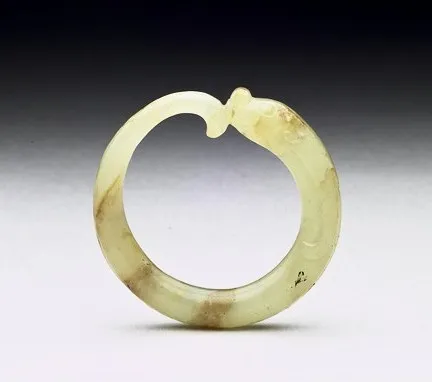
The National Palace Museum in Taipei holds much of the old imperial collection from Beijing. The museum explicitly releases its low-resolution photos into the public domain (CC0). Three jade dragons, in order of age, show how the image of the dragon changed: from a curving pendant worn at the belt, through a splendid striding dragon of the 11th century, to a small Qing ring.

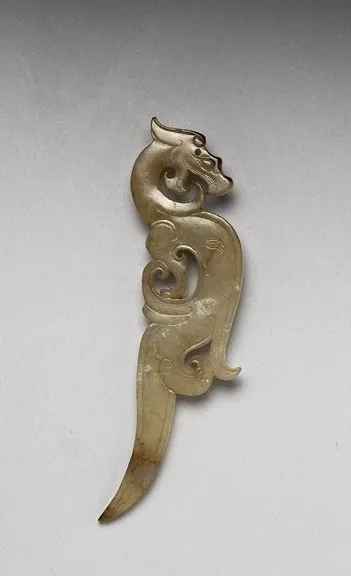
Narrow upright pendant of light brown, glossy jade on a grey ground: at the top a dragon head in profile with an eye, a curled snout and a mane sweeping back, below it a body pierced with S-curves and spirals that ends in a long, curved point. A fine incised line runs along the edge.

Late Warring States to early Western Han, 275 to 141 BC

A dragon for untying knots 玉龍紋觿

A xi 觿 xī started out as a tool: a pointed, horn-shaped piece worn at the belt to undo knots, as the character dictionary Shuowen already explains. The tool turned into an ornament. This one is just under ten centimetres long and carved as a dragon in profile: the head with a curled snout at the top, a body in S-curves below, and the tail as a long, curved point at the bottom.

A small hole is drilled between eye and ear, which is where the pendant hung. The white jade is shot through with brownish yellow, and a finely incised line runs along the edge. The museum counts it among the finest works of the Warring States period.

Jade xi pendant with dragon, China, late Warring States to early Western Han (275 to 141 BC). Jade, L. 9.9 cm, W. 2.4 cm. National Palace Museum, Taipei, 故玉004114N000000000, public domain (CC0).

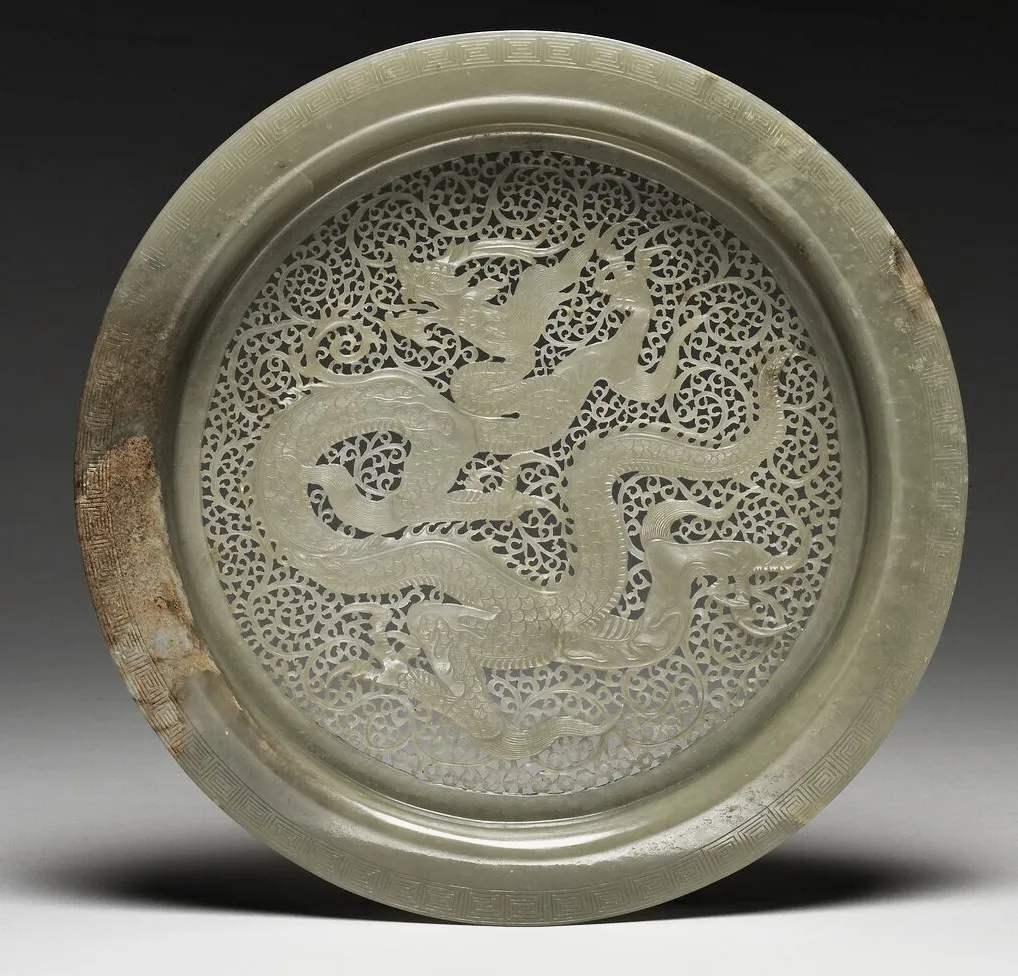
Round, shallow dish of grey-green jade on a dark grey ground, seen from slightly above: the broad rim has a meander band and large rust-brown patches on the left. In the centre a pierced lattice of fine scrolling tendrils, on it a slender dragon with a long neck, horns and mane, its scaly body winding like a ribbon, legs spread and claws out.

Northern Song or Liao, 11th century

A dragon among scrolling vines 玉龍紋盤

A jade dish, 26 centimetres across and barely more than two centimetres high. In the centre strides a dragon with a pointed snout, long horns and a thick mane, its body twisting like a fluttering ribbon. Every scale is engraved again with fine lines. Behind it the stone is pierced into a lattice of scrolling vines, set a little lower than the dragon so that it stands out. The back is carved almost exactly the same.

Count the toes: there are three, with claws as sharp as sickles. The five-clawed dragon later reserved for the emperor did not exist yet in this form. The museum dated the dish by comparison, for example with the dragons on the jade tablets that Emperor Zhenzong dedicated to the earth at his great sacrifice at Mount Tai in 1008, and with a silver box from the tomb of a Liao princess. It places it in the first half of the 11th century.

Jade plate with dragon, China, Northern Song or Liao dynasty (11th century). Jade, H. 2.2 cm, diam. 26.2 cm, foot 22.2 cm. National Palace Museum, Taipei, 故玉002251N000000000, public domain (CC0).

Small ring of pale yellow-green jade with rust-brown spots, standing upright on a grey ground that turns black at the top: the ring is the body of a dragon, its head with an upturned, curled nose sits at the top and the tail meets the head.

Qing dynasty, 1644 to 1911

A dragon as a ring 玉龍(十二生肖)

Less than three and a half centimetres across, of pale yellow-green jade with light brown spots. The dragon’s body is bent into a ring, head and tail touch, and the nose curls upwards. That is all it takes to recognise it.

The ring belongs to a set of twelve small animal figures that together make up the zodiac, numbered 故玉3658 to 3669 in the museum. A curiosity: the museum dates the dragon to the Qing, but the rabbit from the same set to the Jin to Yuan period, centuries earlier.

Jade dragon (Chinese zodiac), China, Qing dynasty (1644 to 1911). Jade, diam. 3.45 cm. National Palace Museum, Taipei, 故玉003662N000000000, public domain (CC0).

The Dragon in the Chinese language: eight idioms

In the language the dragon stands for greatness and success: parents hope their child becomes a dragon, a carp leaps over the Dragon Gate, and whoever dots the eyes of a painting brings it to life.

  • 画龙点睛

    huà lóng diǎn jīng · Paint the dragon, then dot its eyes.

    The painter Zhang Sengyou is said to have painted four dragons on a temple wall in the 6th century, without eyes. When he gave two of them pupils after all, they flew away. Today: the decisive final touch that brings a text or a speech to life.

  • 叶公好龙

    yè gōng hào lóng · Lord Ye loves dragons.

    Lord Ye had dragons everywhere, on belt hooks, cups and walls. When a real dragon came to visit, he ran off in terror. Today: someone who only claims to love something.

  • 望子成龙

    wàng zǐ chéng lóng · Hope that your son becomes a dragon.

    Parents who expect great things of their child: success, a rise in life, good exam results. Often said with a sigh about the pressure.

  • 鲤鱼跳龙门

    lǐ yú tiào lóng mén · The carp leaps over the Dragon Gate.

    A carp that gets past the rapids of the Dragon Gate on the Yellow River turns into a dragon. That is what passing the imperial exam was called, and today any big step up.

  • 龙马精神

    lóng mǎ jīng shén · The spirit of the dragon and the horse.

    Strength and vigour like a dragon horse. A popular New Year wish, especially for older people: stay hale and hearty!

  • 龙飞凤舞

    lóng fēi fèng wǔ · The dragon flies, the phoenix dances.

    First said of a splendid mountain landscape, today mostly of flamboyant handwriting, sometimes with a wink: hard to read.

  • 卧虎藏龙

    wò hǔ cáng lóng · Crouching tiger, hidden dragon.

    A place full of hidden talent. Known as the title of Ang Lee’s film from 2000. The tiger is also at home on the Tiger page.

  • 来龙去脉

    lái lóng qù mài · Where the dragon comes from and where the vein goes.

    From feng shui: the course of a mountain ridge, which is called a “dragon”. Today: the whole story of something, from beginning to end.

Dragons on Chinese stamps: from 1988 to the row over the 2012 dragon

In 1980 China Post issued its first zodiac stamp, the Monkey. The Dragon’s turn came ninth, in 1988. Since then there has been a new Dragon stamp every twelve years, the next one in 2036.

  • 1988

    戊辰年

    T.124, the first Dragon stamp, on 5 January 1988

  • 2000

    庚辰年

    Second round of zodiac stamps

  • 2012

    壬辰年

    Chen Shaohua’s “fierce” dragon

  • 2024

    甲辰年

    Two stamps by Wang Huming

The dragon of 2012 壬辰年

Hardly any zodiac design has been argued over so fiercely. When Chen Shaohua’s 陈绍华 design became known in early 2012, many felt the dragon with its gaping mouth and spread claws looked frightening. Others praised exactly that as strength. Chen had modelled it on the dragons of imperial robes and said a dragon that was too gentle would not match what most Chinese people imagine a dragon to be. The stamp came out unchanged on 5 January 2012.

Twelve years later, for the Wood Dragon of 2024, Wang Huming 王虎鸣 drew two stamps: a golden dragon modelled on a Nine-Dragon Wall and a dragon around a jade disc, an old lucky pattern. This time there was no row.

We do not have our own photo of a Dragon stamp yet. The zodiac stamps of other years are on the pages about the Ox stamp of 1985 and the Dog stamp of 1982.

True or false? Eight claims about the Dragon

Guess first, then read the answer.

  1. 1The Chinese dragon is an evil monster like the dragon of European legend.

    False

    Quite the opposite. In China the dragon 龙 lóng brings rain and good fortune, lives in rivers and seas and rises into the sky. It has no wings, breathes no fire and guards no treasure. It shares little more than the name with St George’s dragon.

  2. 2Only the emperor was allowed to wear dragons with five claws.

    True

    Under the Ming and Qing the five-clawed dragon was reserved for the imperial house. Officials wore a creature with four claws called 蟒 mǎng, “python”. Earlier there was no such rule: the dragon on the 11th-century jade dish further down has only three toes.

  3. 3Anyone born in January 2024 is a Wood Dragon.

    False

    Only from 10 February. That day the Year of the Wood Dragon began. Anyone born from 1 January to the day before still belongs to the Year of the Water Rabbit.

  4. 4More babies are born in Dragon years.

    True

    Many Chinese families see a Dragon child as lucky, and it shows in the statistics. In Singapore, for example, births rose clearly in 1988 and fell again in 1989, and Hong Kong saw a peak in 2012. The effect has become smaller, though.

  5. 5China has officially renamed the dragon “Loong”.

    False

    For the Year of the Dragon 2024, Chinese media and television used “Loong” noticeably often, to set the friendly Chinese dragon apart from the European “dragon”. There is no official rule, and dictionaries and everyday English still say “dragon”.

  6. 6The Dragon and the Dog are opposites.

    True

    The Dragon’s branch 辰 and the Dog’s branch 戌 sit exactly opposite each other on the circle, east-southeast against west-northwest. That is a “clash” 冲 chōng. Folk belief, not a forecast.

  7. 7The Dragon can “punish” itself.

    True

    The teaching of the earthly branches has a “self-punishment” 自刑 zìxíng, and 辰 is one of them, together with the Horse, Rooster and Pig. Two Dragons in the same horoscope count as too much of a good thing: they get in their own way.

  8. 8The life number is an old Chinese teaching.

    False

    It comes from Western numerology, which invokes Pythagoras. In China it became known mostly through social media. Old Chinese number lore such as the Hetu diagram 河图 works quite differently, and its legend even fits the Dragon: a dragon horse is said to have carried it out of the Yellow River.

More on the zodiac: the twelve Chinese zodiac signs and their years, heavenly stems and earthly branches, the Chinese lunar calendar and the zodiac in other Asian countries.

FAQ

Which years are Dragon years?

1928, 1940, 1952, 1964, 1976, 1988, 2000, 2012, 2024, 2036. Each year starts with Chinese New Year between 21 January and 20 February. If you were born in January or February before that day, you still belong to the previous year’s animal, the Rabbit.

When is the next Year of the Dragon?

2036. It begins on 28 January 2036 with Chinese New Year, is a Fire Dragon (丙辰) and lasts until 14 February 2037. The last Dragon year was 2024, a Wood Dragon.

Which Dragon am I if I was born in 1988?

An Earth Dragon (戊辰), if you were born between 17 February 1988 and 5 February 1989. Before that you are a Fire Rabbit. The other Dragons: Wood 1964 and 2024, Fire 1976 and 2036, Metal 1940 and 2000, Water 1952 and 2012.

What is the Dragon’s element?

Two answers are right. The branch 辰 itself always belongs to Earth, Yang Earth to be precise, the moist soil of late spring. On top of that every year gets its own element from its heavenly stem. So there is the Metal Dragon (1940, 2000), the Water Dragon (1952, 2012), the Wood Dragon (1964, 2024), the Fire Dragon (1976, 2036) and the Earth Dragon (1928, 1988). The last digit of your birth year tells you which one you are: 0 Metal, 2 Water, 4 Wood, 6 Fire, 8 Earth.

What are the personality traits of the Dragon?

In China the Dragon is said to be confident, ambitious, energetic and generous, with charisma and luck. Its weak spots are pride, impatience and a tendency to dominate others. That is folk belief, not a personality test.

Which signs are compatible with the Dragon?

In the classical teaching the Rat and Monkey (三合 sānhé) and the Rooster (六合 liùhé) are the best matches. The Dog is its opposite (冲 chōng), the Rabbit (害 hài) and the Ox (破 pò) are difficult. That is tradition, not a forecast.

What does the 2026 horoscope say for the Dragon?

A year with a tailwind, say Chinese horoscope charts: the fire of the year 丙午 feeds the Dragon’s earth 辰, “fire gives rise to earth”. They see 2026 as a year of quiet but steady progress, good for work, for patrons and for peace in the family. In the classical teaching of the animals, the Horse is neutral for the Dragon. The year lasts until 5 February 2027.

What does the 2027 horoscope say for the Dragon?

In the classical teaching the Year of the Goat from 6 February 2027 to 25 January 2028 is neutral for the Dragon: between 辰 and 未 there is neither harmony nor conflict. The fire of the year 丁未 again feeds the Dragon’s earth. Detailed yearly horoscopes with love, money and health are fortune-telling, there is no fixed tradition behind them.

What are the Dragon’s lucky numbers and colours?

Horoscope sites usually give the numbers 1, 6 and 7 and colours such as gold, silver and grey. There is no old Chinese source for this. What is certain: the branch 辰 belongs to Earth, whose colour in the five-element teaching is 黄 huáng, yellow, the emperor’s colour. The colour of a particular Dragon year comes from its heavenly stem, red for 2036 and green for 2024, for example.

Which jobs suit the Dragon?

Folk belief and horoscopes see the Dragon wherever you lead and are seen: business management, politics, law, stage and media. The Chinese life-number chart in the game above gives each number its own jobs, from senior management for the 1 to data analysis for the 7.

How do I work out my life number?

Add up all the digits of your date of birth until only one digit is left. Example 29 May 1976: 2 + 9 + 0 + 5 + 1 + 9 + 7 + 6 = 39, then 3 + 9 = 12, then 1 + 2 = 3. The life number comes from Western numerology, not from Chinese tradition.

Sources and status

The New Year dates come from our checked table, each recalculated against the astronomical new moon in China time. The life-number texts and the advice for the five Dragons retell two popular Chinese social-media charts in our own words. The Dragon illustration is our own. The three works from the National Palace Museum are in the public domain (CC0), the museum releases its low-resolution photos for any use. We only chose the crop and adjusted brightness and contrast slightly.

Changelog (1)
  • 2026-11-14Page created.