
China travel food guide · Nº 007
Stir-fried Eggplant with Green Peppers 青椒炒茄子
Stir-fried eggplant with green peppers (青椒炒茄子, qīng jiāo chǎo qié zi) is soft eggplant wok-fried with green peppers and a few dried chillies in savory soy sauce: a cheap, everyday home-style dish found all over China. Usually vegan, mildly spicy, no bones.
The dish card
Tap the Chinese name, the spicy or vegan line, or a yellow ? to show it full-screen to the staff.
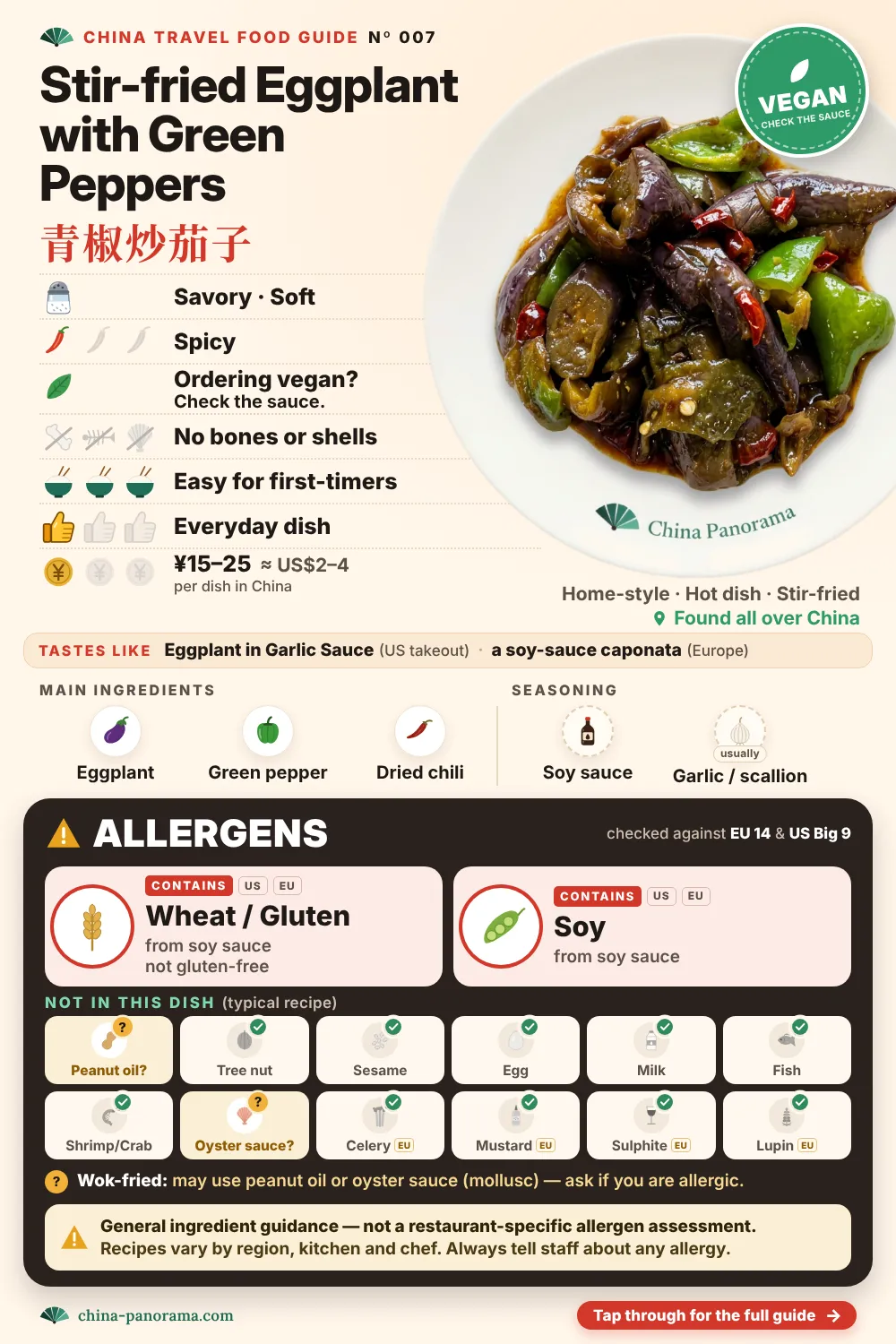 Partly edited with AI
How to order stir-fried eggplant with green peppers
Tick what you need right on the card, then tap the big first line to show it full-screen to the staff.
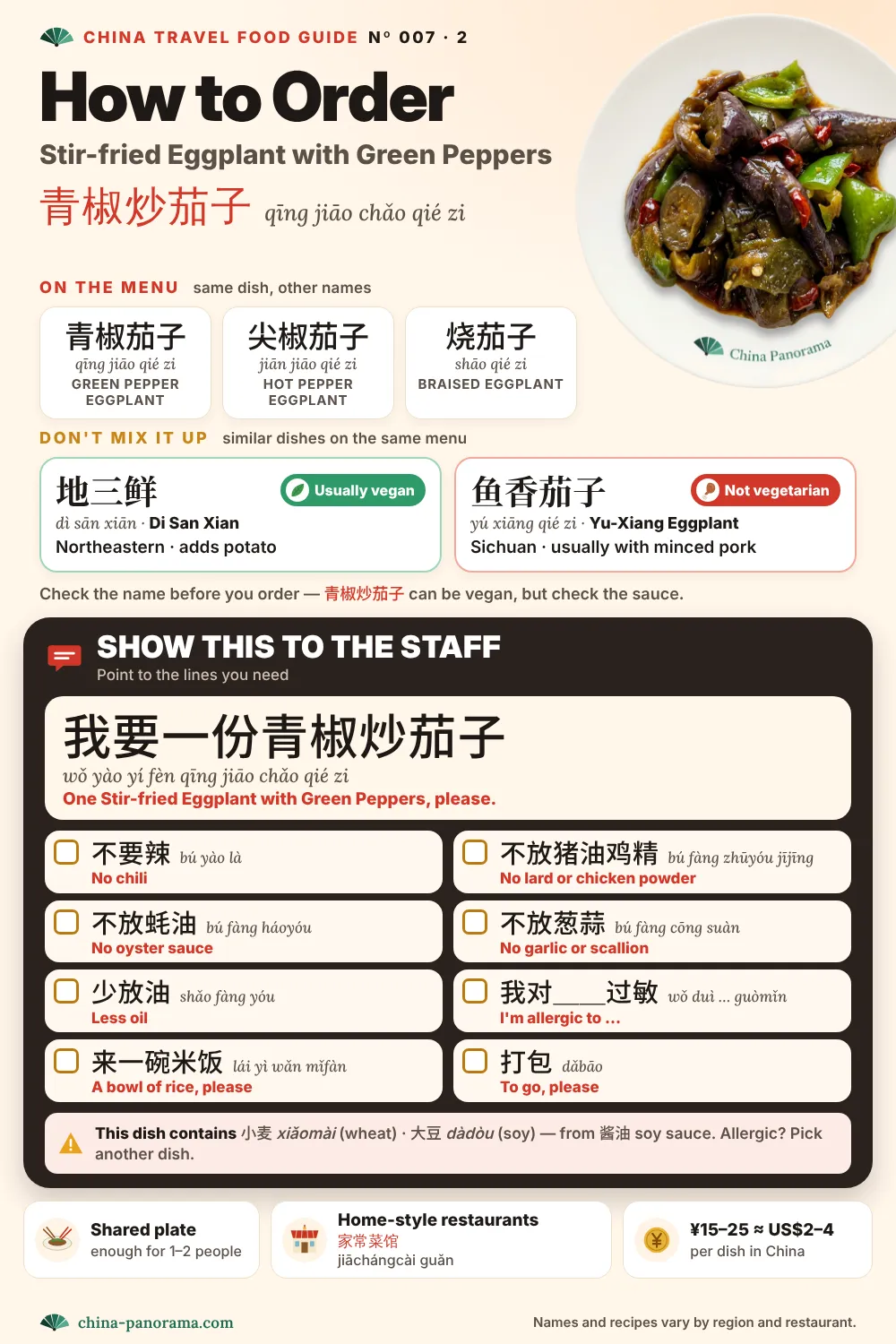
What is stir-fried eggplant with green peppers?
The name says exactly what is in it: 青椒 (qīng jiāo) green pepper, 炒 (chǎo) stir-fried, 茄子 (qié zi) eggplant. The eggplant, usually the long, thin-skinned Chinese eggplant, is cut into chunks or strips and fried until soft, then tossed in the wok with pieces of green pepper, a few dried chillies, garlic or scallion and soy sauce.
It is home-style cooking (家常菜, jiā cháng cài): what families cook at home, what small restaurants put on every menu and what canteens keep warm in a tray. There is no single recipe. Some kitchens add a splash of vinegar or a pinch of sugar; some use hot green chillies instead of mild peppers – then the menu says 尖椒 (jiān jiāo, hot pepper) instead of 青椒.
It costs about ¥15–25 (US$2–4) in an ordinary restaurant in a big city (2026).
Main ingredients
- 茄子qié ziEggplant
- 青椒qīng jiāoGreen pepper
- 干辣椒gān là jiāoDried chilli
Seasoning
- 酱油jiàng yóuSoy sauce
- 葱蒜cōng suànGarlic / scallionusually
What does it taste like?
Savory and salty from soy sauce, with a little heat from the dried chillies. The eggplant is soft, almost creamy, and soaks up the sauce and the oil; the green peppers keep a slight bite. It is a shared plate eaten with rice – on its own it is too salty.
Tastes like… Eggplant in garlic sauce from American Chinese takeout – the same soft, sauce-soaked eggplant, but plainer, without the sweet-sour glaze. In Europe, think of a soy-sauce caponata.
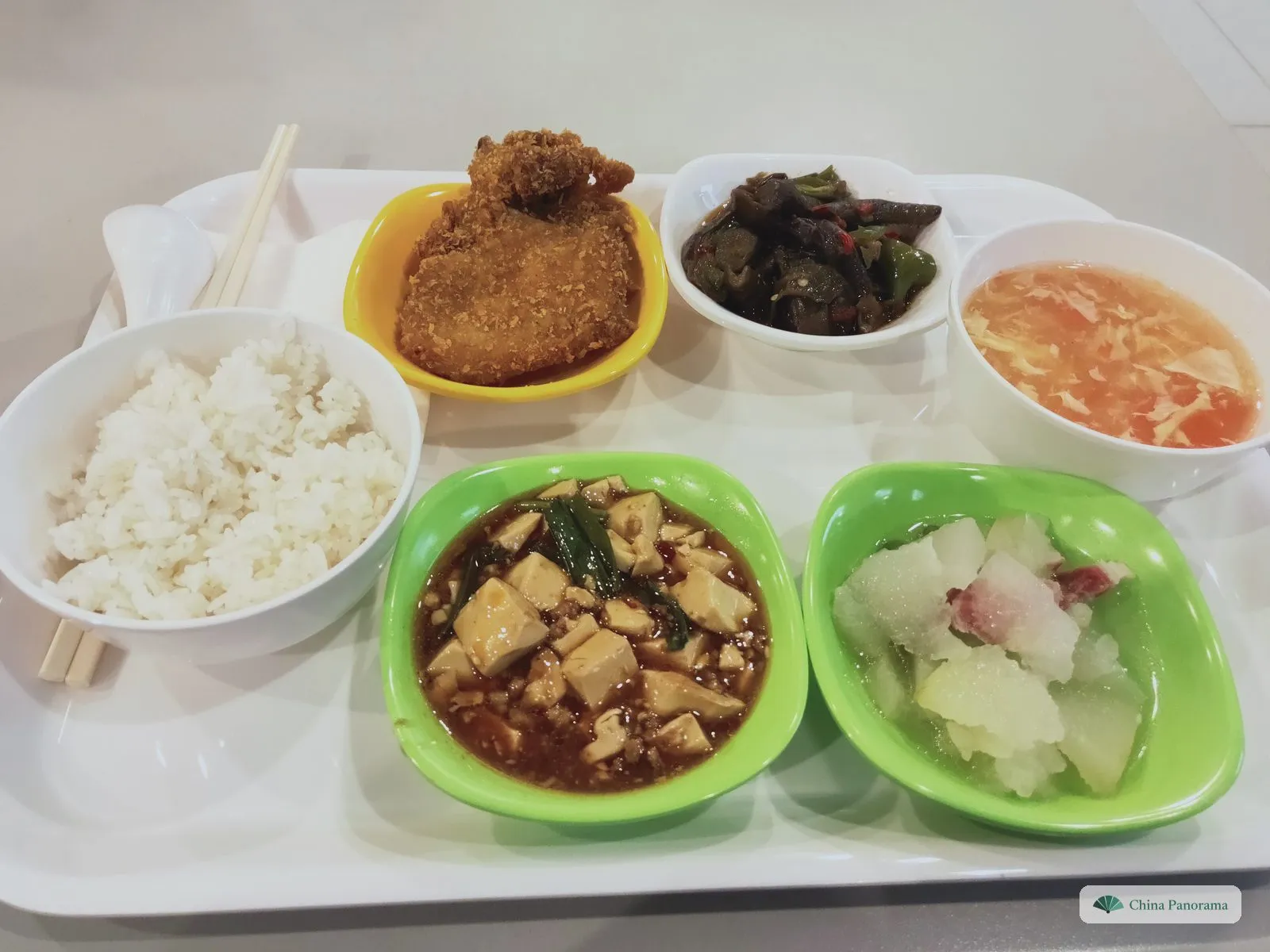
Allergens and diet
Stir-fried eggplant with green peppers contains wheat / gluten and soy, from the soy sauce. Wok-fried: the kitchen may use peanut oil or oyster sauce (a mollusc) – ask if you are allergic.
In the usual recipe
- ACereals containing gluten· US: Wheat
- FSoybeans· US: Soybeans
- EPeanuts (sometimes)· US: Peanuts
- RMolluscs (sometimes)
Sometimes: if the kitchen uses peanut oil or oyster sauce.
Not in this dish (typical recipe)
B shrimp / crab, C egg, D fish, G milk, H tree nuts, L celery, M mustard, N sesame, O sulphites, P lupin
These are estimates from how the dish is usually made, not a restaurant’s declaration. Every kitchen and every sauce brand is different – always tell the staff about an allergy. Chinese kitchens often fry in peanut oil, and chilli oil may be made with it too; we don’t repeat that for each dish.
Vegan, vegetarian, gluten-free
Vegan in the usual recipe – no meat, egg or dairy. But kitchens may fry in lard (猪油), add oyster sauce (蚝油) or chicken powder (鸡精). Say you are vegan and ask for none of them – tick the lines on the order card above.
Not gluten-free: the wheat comes from the soy sauce, and there is no version without it.
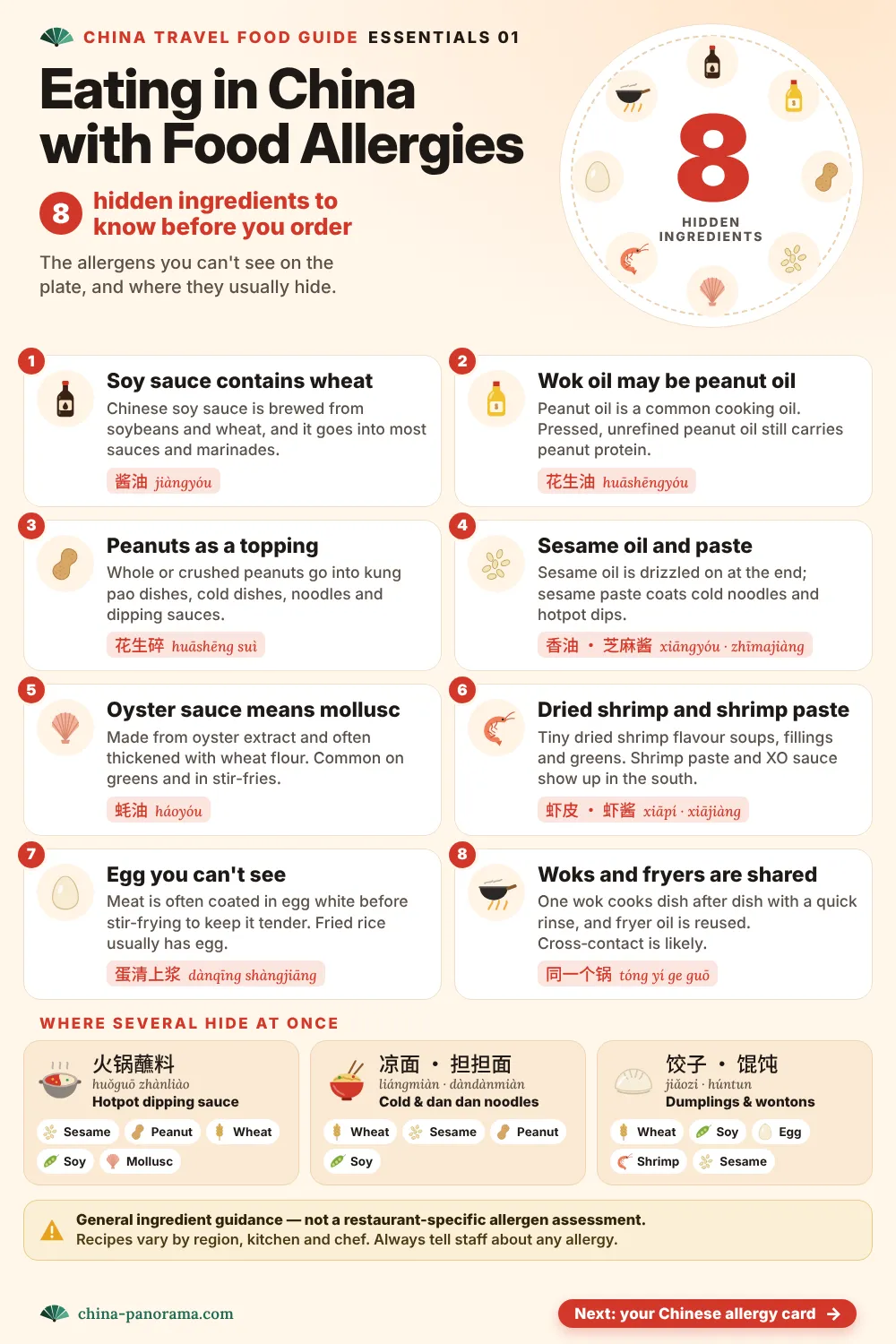
Eating in China with food allergies
Two cards that go with every dish in this guide. The first shows where allergens hide in Chinese cooking – tap an ingredient to ask about it in Chinese. The second is a Chinese allergy card for the staff: tick your allergens right on the card and it turns into one sentence, full-screen.
8 hidden ingredients to know before you order
Tap an ingredient to ask the staff about it in Chinese.
Show this to the staff: your Chinese allergy card
Tick your allergens on the card, then tap the big first line to show them full-screen to the staff. A question or the red line opens full-screen too.
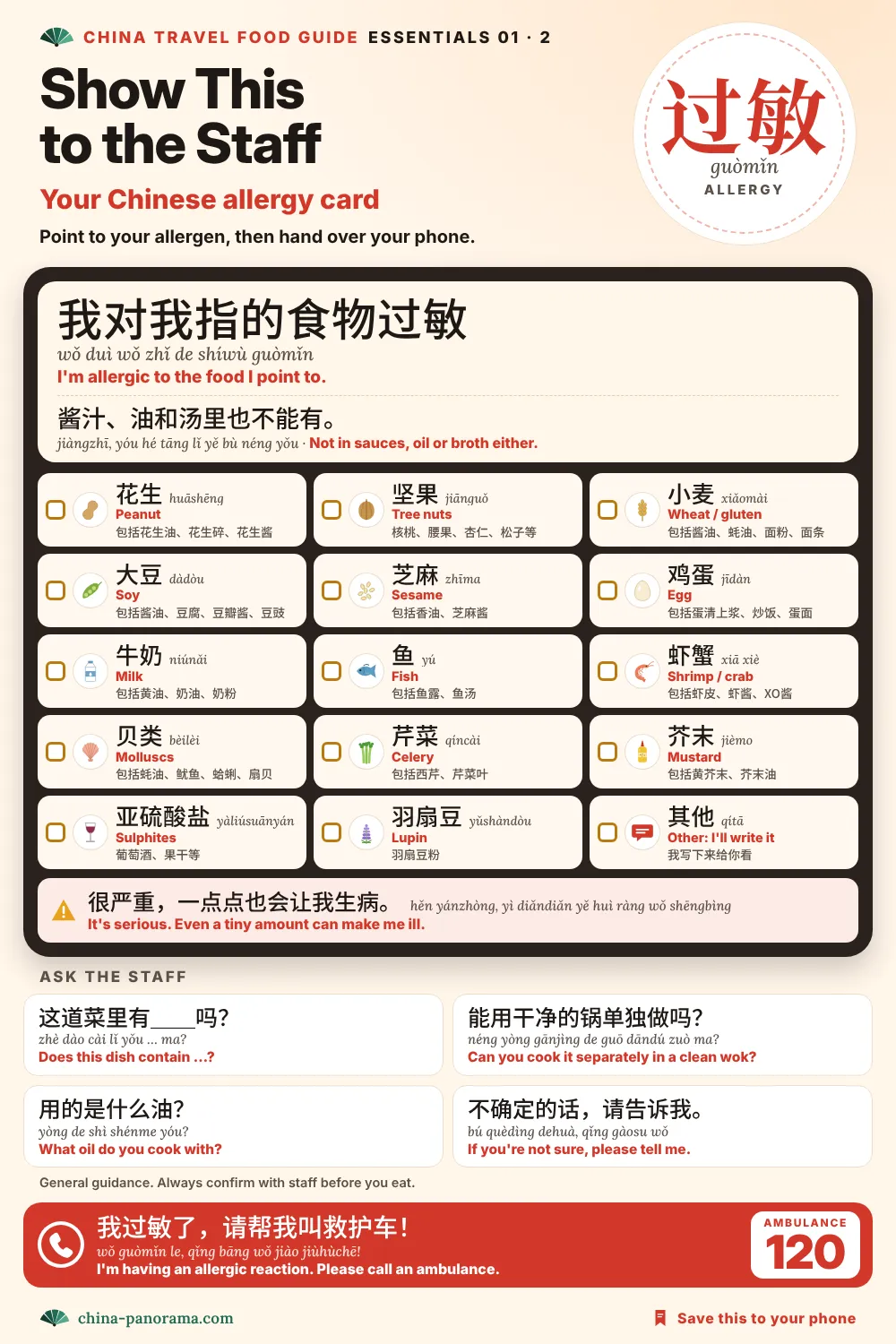
General ingredient guidance, not a restaurant’s allergen declaration. Recipes vary by region, kitchen and chef – always tell the staff about an allergy.
FAQ
Is stir-fried eggplant with green peppers vegan?
In the usual recipe, yes: eggplant, green peppers, dried chillies, garlic and soy sauce. But kitchens may fry in lard (猪油), add oyster sauce (蚝油) or chicken powder (鸡精). Say you are vegan and ask for 不放猪油鸡精 (no lard or chicken powder) and 不放蚝油 (no oyster sauce).
Is it gluten-free?
No. Chinese soy sauce is brewed from soybeans and wheat, and soy sauce is what seasons this dish. Without it, it would be a different dish – if you avoid gluten, pick another one and tell the staff.
Is it spicy?
Mildly. A few dried chillies go in, mostly for aroma, and green peppers are mild. Ask for 不要辣 (bú yào là) and the kitchen leaves the chillies out. 尖椒茄子 on a menu is made with hot green chillies and is hotter.
What is the difference between 青椒炒茄子 and yu-xiang eggplant (鱼香茄子)?
Yu-xiang eggplant is a Sichuan dish in a sauce of garlic, ginger, pickled chilli, sugar and vinegar – sweet, sour and garlicky – and it usually comes with minced pork, so it is not vegetarian. 鱼 means fish, but there is no fish in it. 青椒炒茄子 is plainer: soy sauce, green pepper, no meat.
Is it the same as eggplant in garlic sauce?
Close, but not the same. Eggplant in garlic sauce from American takeout comes from the Sichuan yu-xiang dish: sweeter, sourer and more garlicky, in a thick, glossy sauce. 青椒炒茄子 is salty and savory from soy sauce, with chunks of green pepper. The soft, sauce-soaked eggplant is the same.
How much does it cost in China?
About ¥15–25 (US$2–4) for a plate in an ordinary restaurant in a big city (2026). A canteen portion is smaller and cheaper.
Why is the eggplant so soft and oily?
Eggplant soaks up oil like a sponge, and many kitchens fry it in plenty of oil before it goes into the wok with the peppers – that is what makes it soft and creamy. If you’d like it lighter, ask for 少放油 (shǎo fàng yóu, less oil).
What is it called in Chinese?
青椒炒茄子, in pinyin qīng jiāo chǎo qié zi (typed without tones: qing jiao chao qie zi). Many menus shorten it to 青椒茄子. To order, show the staff the order card above, or tap the red Chinese name on the dish card.
More Chinese dishes
- Century egg and pork congee →
- Stir-fried tomato and egg →
- Fried rice in China →
- Chow mein in China →
- Chinese dumplings (jiaozi) →
- Canteen and fast-food walkthrough →
- QR-code ordering walkthrough →
Ordering in a restaurant, by QR code or in a canteen? Our restaurant walkthrough, the QR-code ordering walkthrough and the canteen walkthrough show each step.
Cards, photos and sources
The cards are our own. The dish photo on cards 1 and 2 is partly edited with AI; the other photo on this page is our own, unedited. Prices come from our dish library and are typical for an ordinary restaurant in a big city; dollar prices are rounded. Allergens are estimated from the usual recipe, checked against the 14 EU allergen groups and the 9 major US food allergens. Menu names, similar dishes and phrases are general knowledge – recipes vary by region, kitchen and chef.
Changelog (1)
- 2026-10-04Page created with 4 cards you can use on screen: the dish card, how to order it, and the Essentials cards on eating in china with food allergies.