
Chongqing
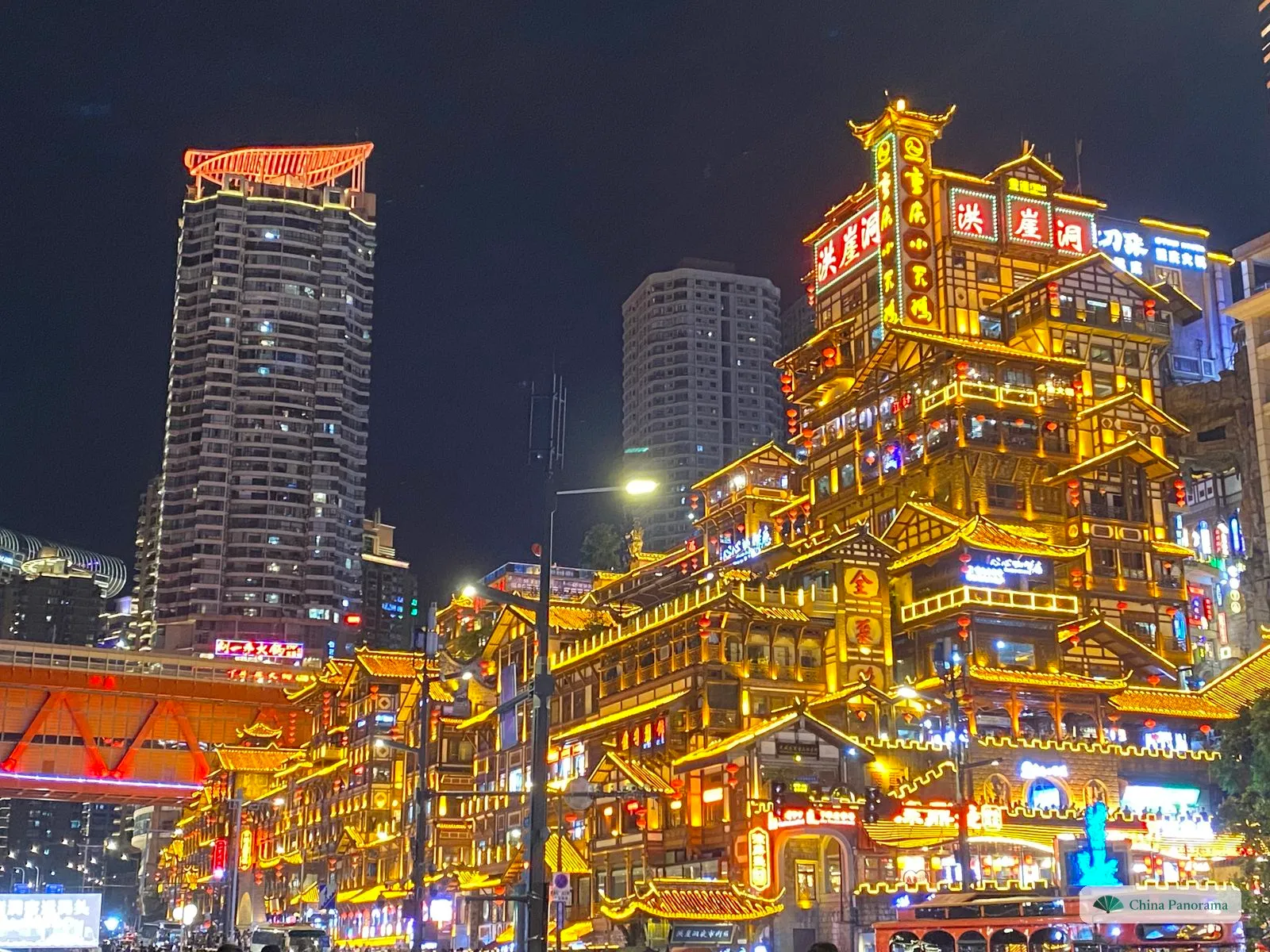
A city of 32 million on the hills where the Jialing flows into the Yangtze, China's capital in the war against Japan, with an administrative area the size of Austria: eleven-storey Hongyadong lit gold on its cliff, a monorail through a block of flats, hot pot — and almost no flat ground.
重庆 · Chóngqìng · municipality · 29.56° N, 106.57° E
Paying for the metro?
Unlike Beijing, Shanghai or Chengdu, we found no sign that the gates take foreign bank cards. Set up the transport code in Alipay before you arrive. The metro →
How long?
Two or three days: an evening at Chaotianmen and Hongyadong, a day for the centre, the museum and Liziba, a morning in Ciqikou. Each is a route below. The routes →
Where is Chongqing?
At 29.6° N, Chongqing is level with Lhasa, Cairo and New Orleans. It lies in the Sichuan Basin in south-west China, where the Jialing flows into the Yangtze, about 270 km east of Chengdu. Zhangjiajie is 380 km to the east and Xi’an 570 km to the north; Shanghai is 1,440 km downstream and Beijing 1,460 km away. Tap any city on the map to measure the distance.
Straight-line distances from Jiefangbei, rounded to the nearest 10 km — not travel distances.
Chongqing municipality is highlighted. Tap a city to measure the distance from Chongqing.
- Status
- Municipality重庆市 · since 1997
- Latitude
- 29.56° Nlevel with Lhasa
- Airport
- CKGJiangbei · Lines 3 and 10
- Rail transit
- 12 linestwo of them monorails
- Time zone
- UTC+8Beijing time
- City flower
- Camellia山茶花
How big is Chongqing? The size of Austria
The name covers two things. The municipality, shaded on the map above, covers 82,403 km², about as much as Austria; it had 32 million people in the 2020 census, many of them in villages and small towns. The city you will visit is the part round the two rivers, centred on the Yuzhong peninsula. Its two World Heritage Sites are day trips: the Dazu Rock Carvings 78 km to the west and the Wulong Karst 118 km to the east, in a straight line. Tap a place to see how far it is.
Tap a place on the map or in the list.
Jiangbei International Airport. Line 10 from Terminal 3, Line 3 from Terminal 2.
World Heritage since 1999: about 50,000 carved figures. A full day out. Details below ↓
World Heritage since 2007: the Three Natural Bridges. Better with a night there. Details below ↓
Straight-line distances from Jiefangbei, rounded — not travel distances.
What’s Chongqing weather like each month?
Hot and humid in summer — 36 °C by day in July — and damp, grey and cool in winter, at 11 °C by day in January, with fog on many mornings. Spring and autumn are short and pleasant. The basin keeps the air still and often hazy. The sun rises at 05:53 in June and sets at 17:57 in December. Tap a month for temperatures, daylight and what is on.
Scale in °C. Bars run from the average daily low to the average daily high. Source: monthly temperature data, last checked 2026-07-30.
Chongqing in October
Mild- Average high
- 23 °C
- Average low
- 17 °C
- Sunrise / sunset
- 06:54 – 18:24
- Daylight
- 11 h 30 min
On in Oct
- Golden Week crowds, 1–7 Oct
- River fog returns
How hot is Chongqing in summer?
Very: it is one of the Yangtze’s “three furnaces”, with Wuhan and Nanjing. July and August average 36 °C and 35 °C by day, the nights barely cool below 27 °C, and the air in the basin is damp and still. The city adapts by living at night — Hongyadong, the river fronts and the hot pot restaurants are fullest after dark — and so should you: museum and malls in the afternoon, the walk along the rivers after sunset.
June
30° / 23°
Sun 05:53–19:55 · 14 h 2 min
July
36° / 27°
Sun 06:03–19:56 · 13 h 53 min
August
35° / 26°
Sun 06:21–19:36 · 13 h 15 min
September
28° / 22°
Sun 06:38–19:00 · 12 h 23 min
Spring
March – MayThe best time: warm days, often grey.
March averages 20 °C by day, April 25 °C and May 27 °C. The sky over the Sichuan Basin is often a flat, hazy grey — our photographs of 1 May 2019 show a whole day of it — but the evenings are mild enough to sit out by the river, as on 28 April 2024, when it was still light at half past seven. May Day, 1–5 May, fills Hongyadong, Ciqikou and Jiefangbei to bursting.
What to wear: Light layers, comfortable shoes for the stairs, a thin jacket for the evening.
Summer
June – SeptemberOne of China's “furnaces”: 35–36 °C by day in July and August.
Chongqing is one of the Yangtze's “three furnaces”, with Wuhan and Nanjing: July averages 36 °C by day and 27 °C at night, in damp, still air in the basin, and heatwaves go higher. Do your sightseeing in the morning and after dark — the city lives at night anyway, on the river fronts and at the hot pot tables — and spend the afternoons in the museum, the malls or the metro.
What to wear: The lightest clothes you have, a hat, and water; air-conditioning inside is cold.
Autumn
October – NovemberMild and pleasant, with the fog season starting.
October averages 23 °C by day and November 17 °C. This is when the river fog that gave Chongqing the name “fog city” comes back: the city has more than 100 days of fog a year, thickest on autumn and winter mornings, when the towers of Jiangbeizui can disappear completely. Avoid Golden Week, 1–7 October.
What to wear: A jumper and a light jacket.
Winter
December – FebruaryRarely freezing, but damp, grey and cold indoors.
January averages 11 °C by day and 6 °C at night, and the sun is seldom seen through the fog and low cloud. Like everywhere south of the Yangtze, buildings have no central heating, so the damp cold follows you inside. It is the season when locals say hot pot tastes best.
What to wear: Warm layers you can keep on indoors, and a waterproof jacket.
April, at about 25 °C by day, and October, at 23 °C, are the months we would pick — outside the May Day and Golden Week holidays. For how Chongqing compares with the rest of the country month by month, see the best time to visit China.
Things to do in Chongqing
15 places, from Song-dynasty carvings to a skyway built in 2019. Three things first: why the floors do not add up, which of the old-looking places are really old, and what you are looking at from the piers, the riverside road and the street corner.
Why is Chongqing called an 8D city?
Because the street is not always on the ground floor. The city is built on steep hills between two rivers, so buildings have entrances on several levels, trains run through houses and stations lie deep under the hills. Four places on one scale, in storeys from the street you start on — guess first, then see.
Tap a column to jump to its card.
Storeys as given by the builders and the press; Hongyancun’s depth is reported, not official.
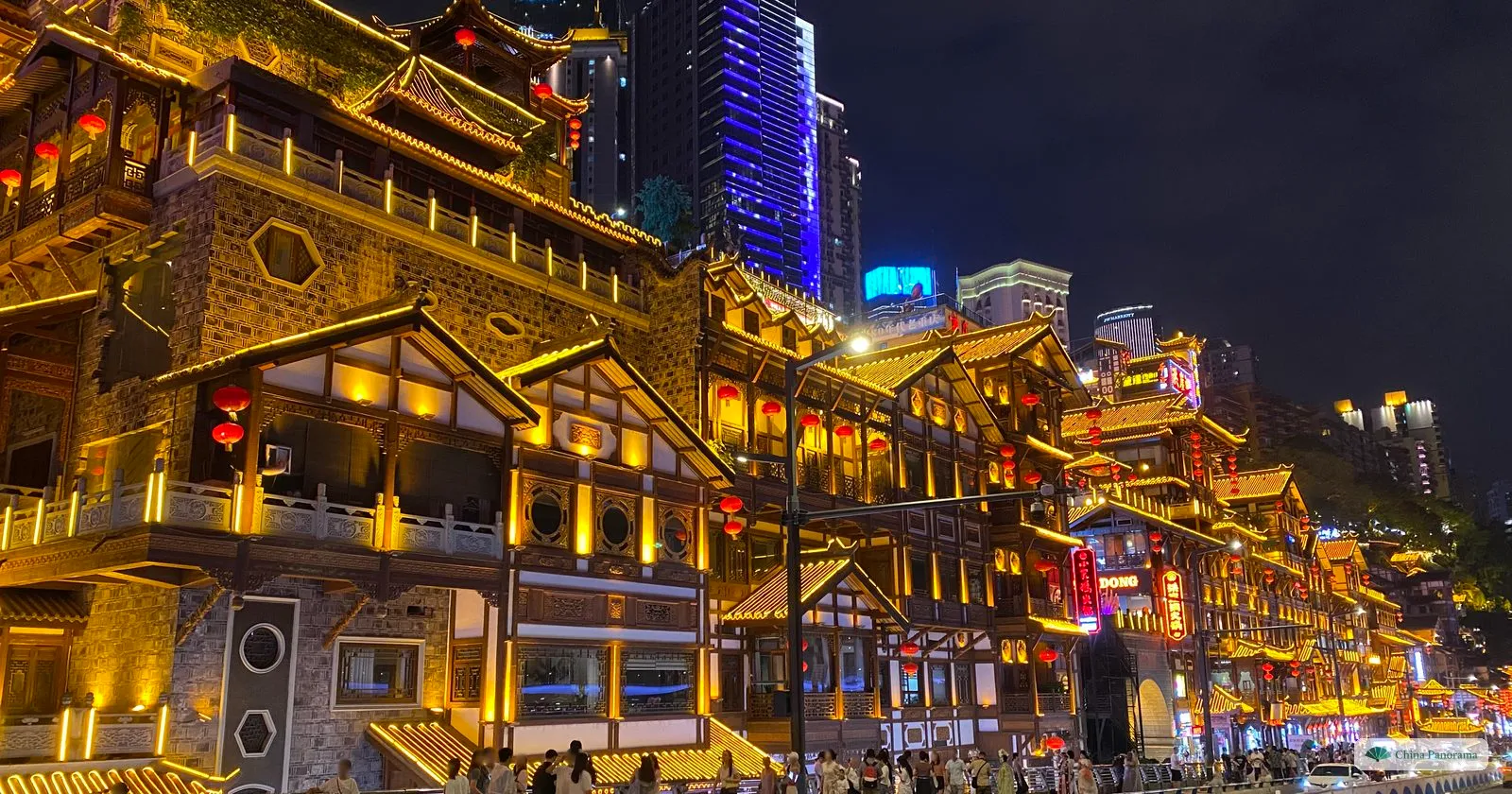
You walk into Hongyadong from the riverside road, on the 1st floor. On which floor do you come out onto a city street again?
The 11th: the top floor opens onto Cangbai Road, a street in the city centre, while the 1st floor opens onto Jiabin Road by the Jialing. The whole complex hangs on the cliff between the two.
Floor by floor
- Floors 1–11: four streets of shops, restaurants and bars
- 11th floor: Cangbai Road, the city centre
- 1st floor: Jiabin Road, by the river
Come in at the top and walk down — it is downhill all the way, and you end up on the riverside road with the view of the lit front.
Line 2 runs through a 19-storey residential building at Liziba. On which floors is the station?
Floors 6 to 8: the ticket hall on the 6th, the equipment on the 7th, the platform on the 8th. The station and the building were designed together, and the track’s pillars do not touch the building’s.
Floor by floor
- Floors 9–19: flats
- Floors 6–8: Line 2 — ticket hall, equipment, platform
- Floors 1–5: shops
- Ground floor: the street
Opened in 2004. The famous view of the train sliding out of the wall is from the viewing platform on the street below.
Hongtudi, where Lines 6 and 10 meet, was built as the deepest station in China. How far down is the platform?
About 94 m — roughly 31 storeys, as the builders put it in 2017. It had to go that deep to pass under air-raid tunnels and the foundations of the buildings above. Allow several minutes on the escalators.
Floor by floor
- Street level
- Escalators all the way down
- Platform: about 94 m down
Not a sight in itself, but you may change trains here; give yourself time.
Hongyancun, on Line 9, opened in January 2022 and went deeper still. How deep is it at its deepest point?
About 116 m, reported as some 39 storeys — deeper than Hongtudi, and reported as the deepest metro station in China. Line 5 has stopped here too since November 2023.
Floor by floor
- Street level
- Escalators and lifts
- Deepest point: about 116 m (reported)
The figure is from press reports, not from the operator.
Is Hongyadong old?
No — it opened in 2006, in the style of the stilt houses that once stood on the cliff. Chongqing was bombed heavily in the war against Japan and has been rebuilt again and again since, so most of what you see is recent; the oldest things are carvings in stone. Tap a name on the time line, or filter.
Tang and Song618–1279
about a century later
Ming and Qing1368–1912
The wartime capital1937–1946
The People’s Republicsince 1949
Filled dot: original. Ring: ruin. Square: built in our time.
Tap a name on the time line or a card.
- Originallate 9th–13th centuryabout 1,130 years old
The earliest from 650; most from the late 9th century to the 13th. A World Heritage Site since 1999.
 Original1064–1067about 960 years old
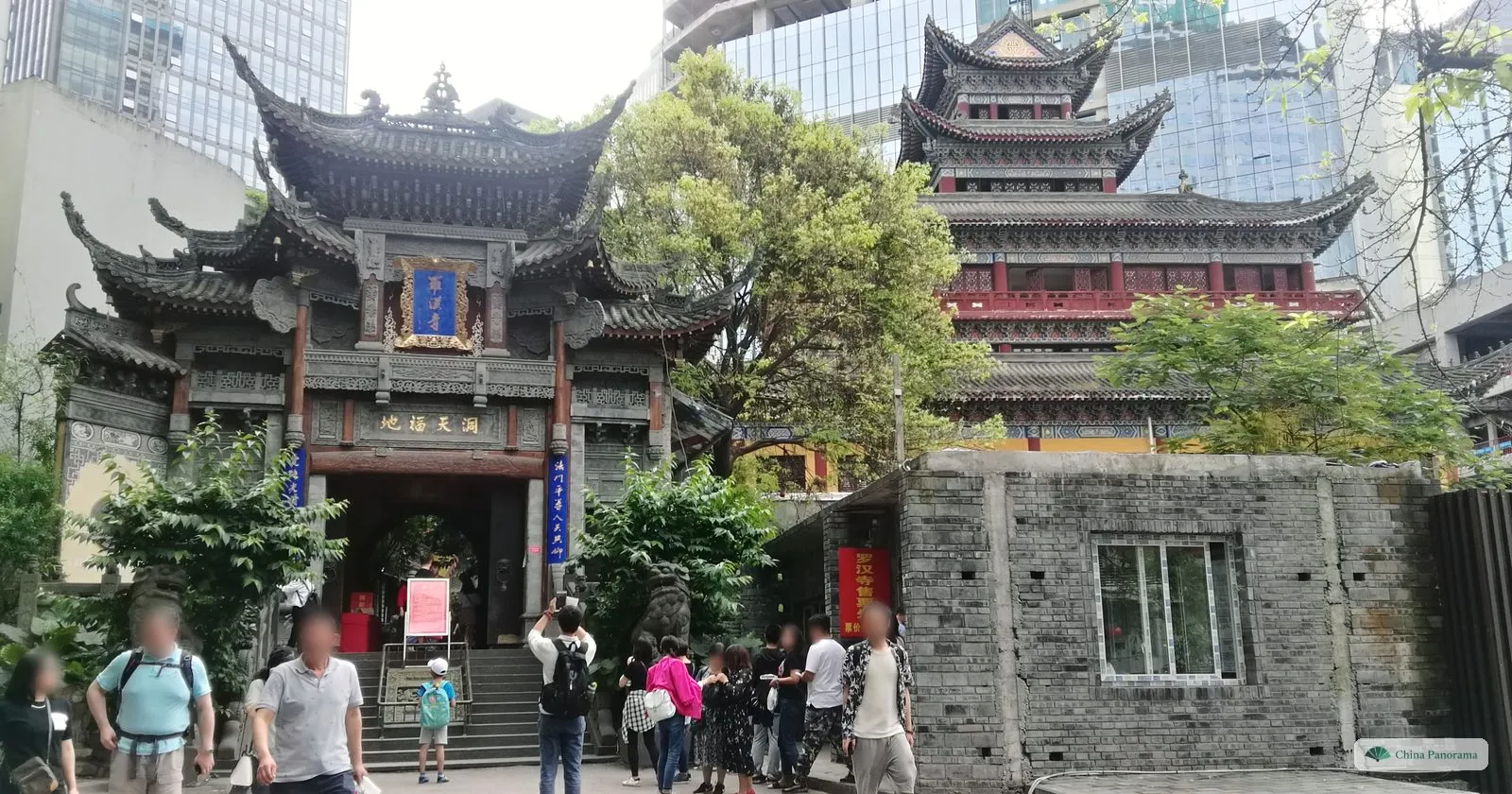
Founded in the Zhiping years of the Northern Song. The 400-odd carvings of the Ancient Buddha Rock are Song; the arhat hall was re-sculpted and reopened in 1986.
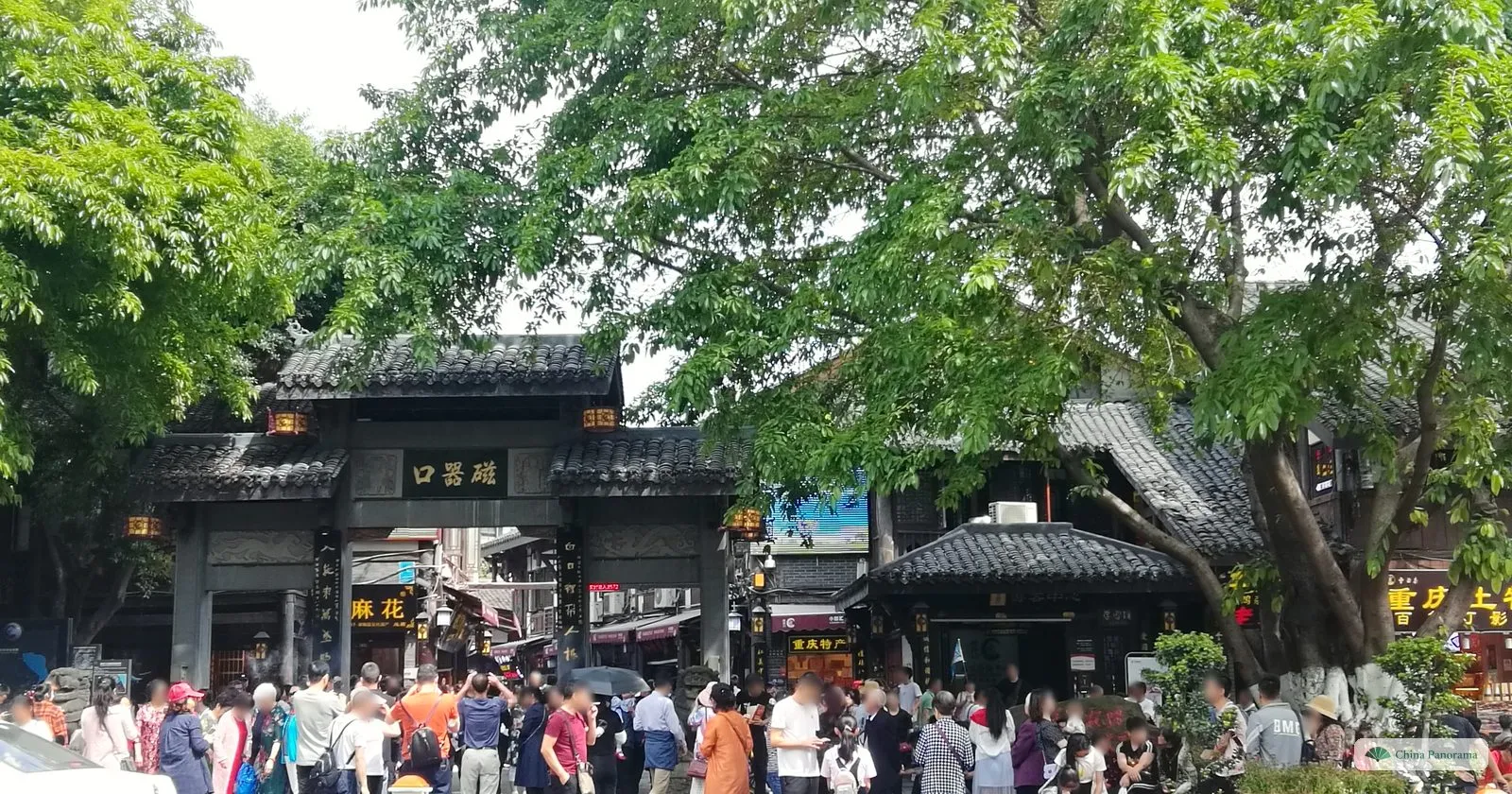 OriginalMing and Qingabout 630 years old
Named after the porcelain trade of the Qing. Its twelve lanes keep the old layout and many old houses, heavily restored for visitors.
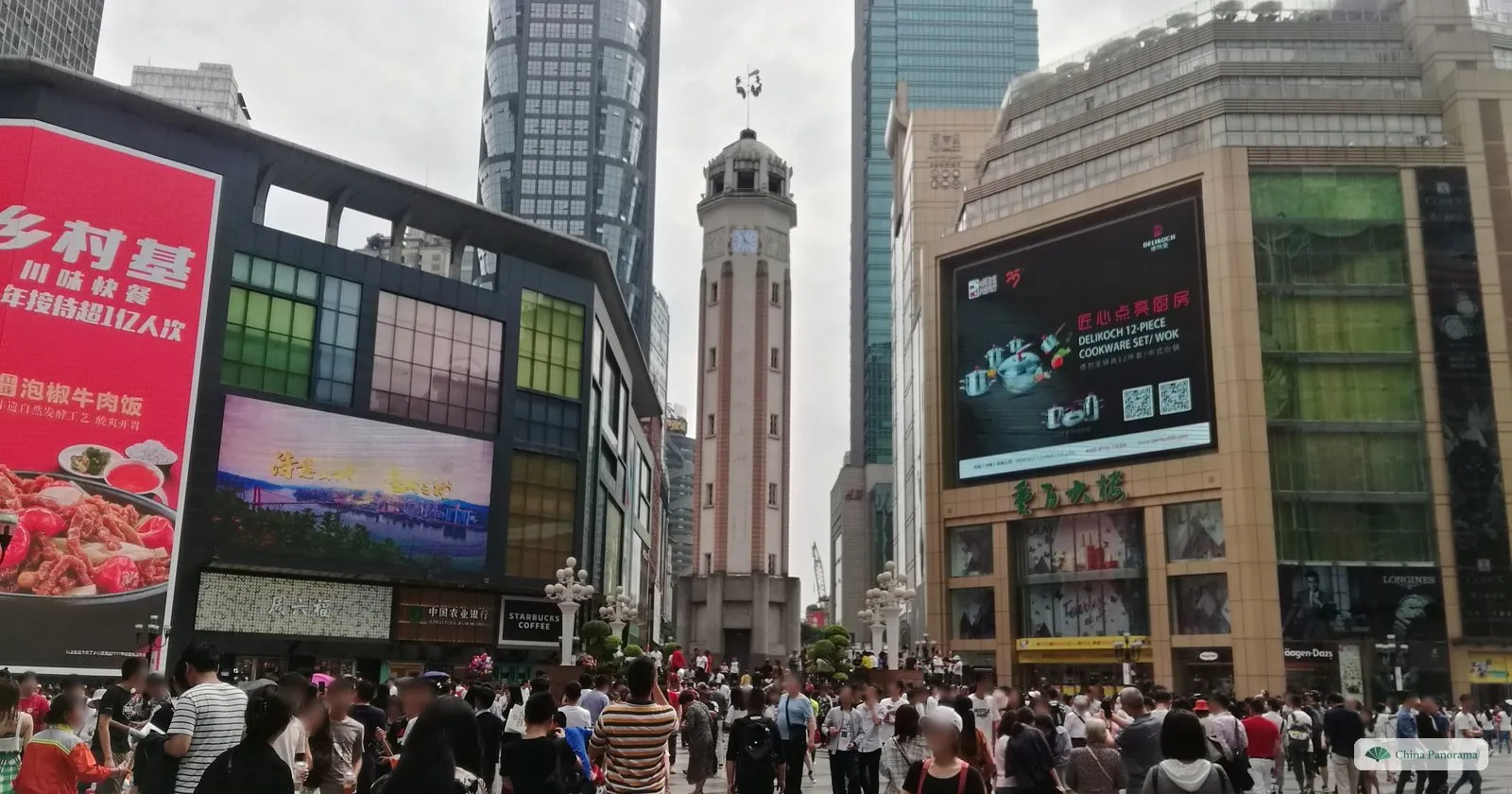 Original1947 (wooden tower 1941)79 years old
A wooden “Spirit Fortress” of December 1941, replaced in concrete in 1947 and renamed for the Liberation in 1950.
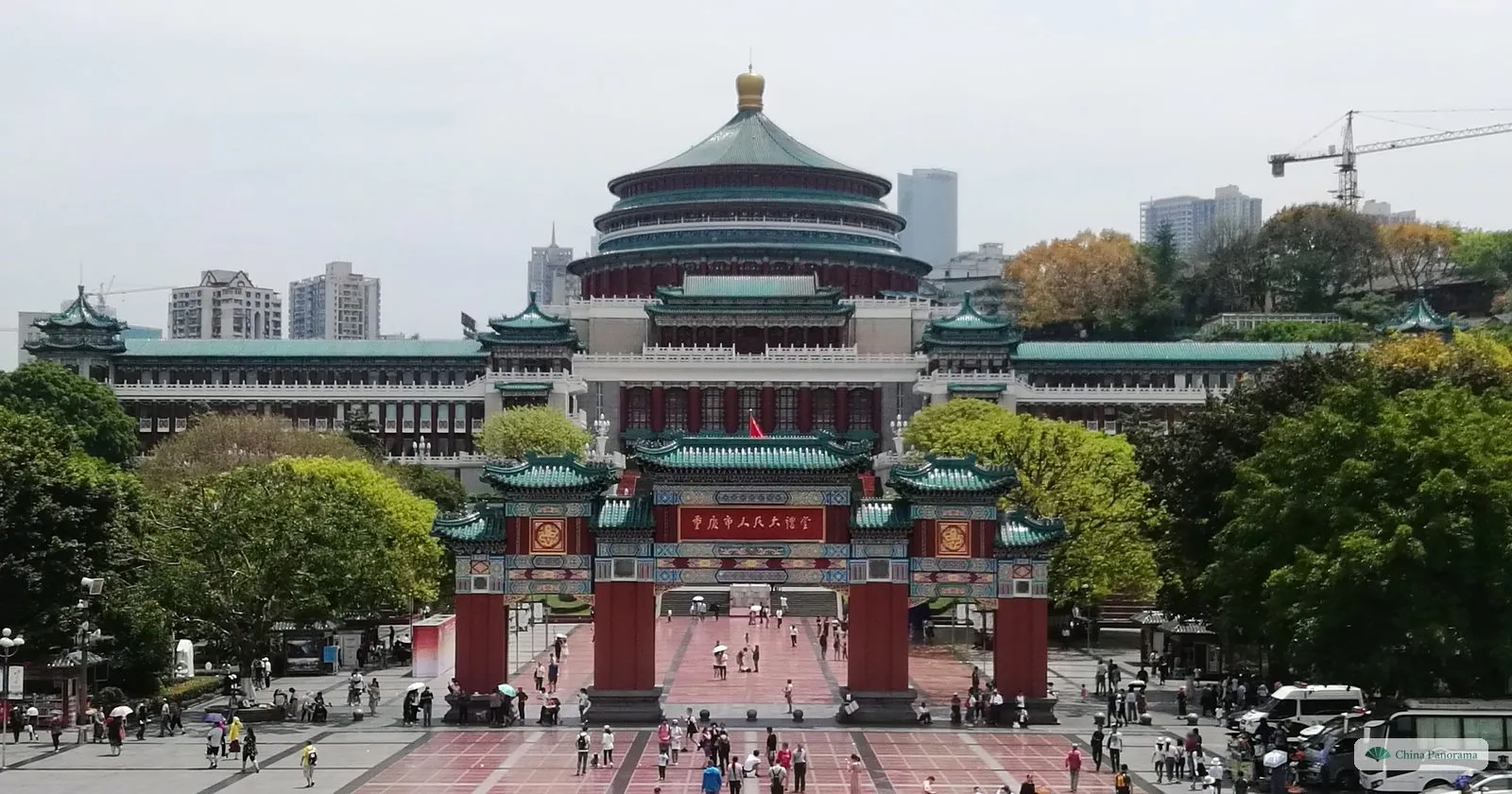 Built in our time195472 years old
Built 1951–1954 with green-glazed roofs that recall the Temple of Heaven.
- Built in our time198739 years old
Opened in October 1987, protected since 2010.
- Built in our time200422 years old
Opened with Line 2, the city’s first rail line.
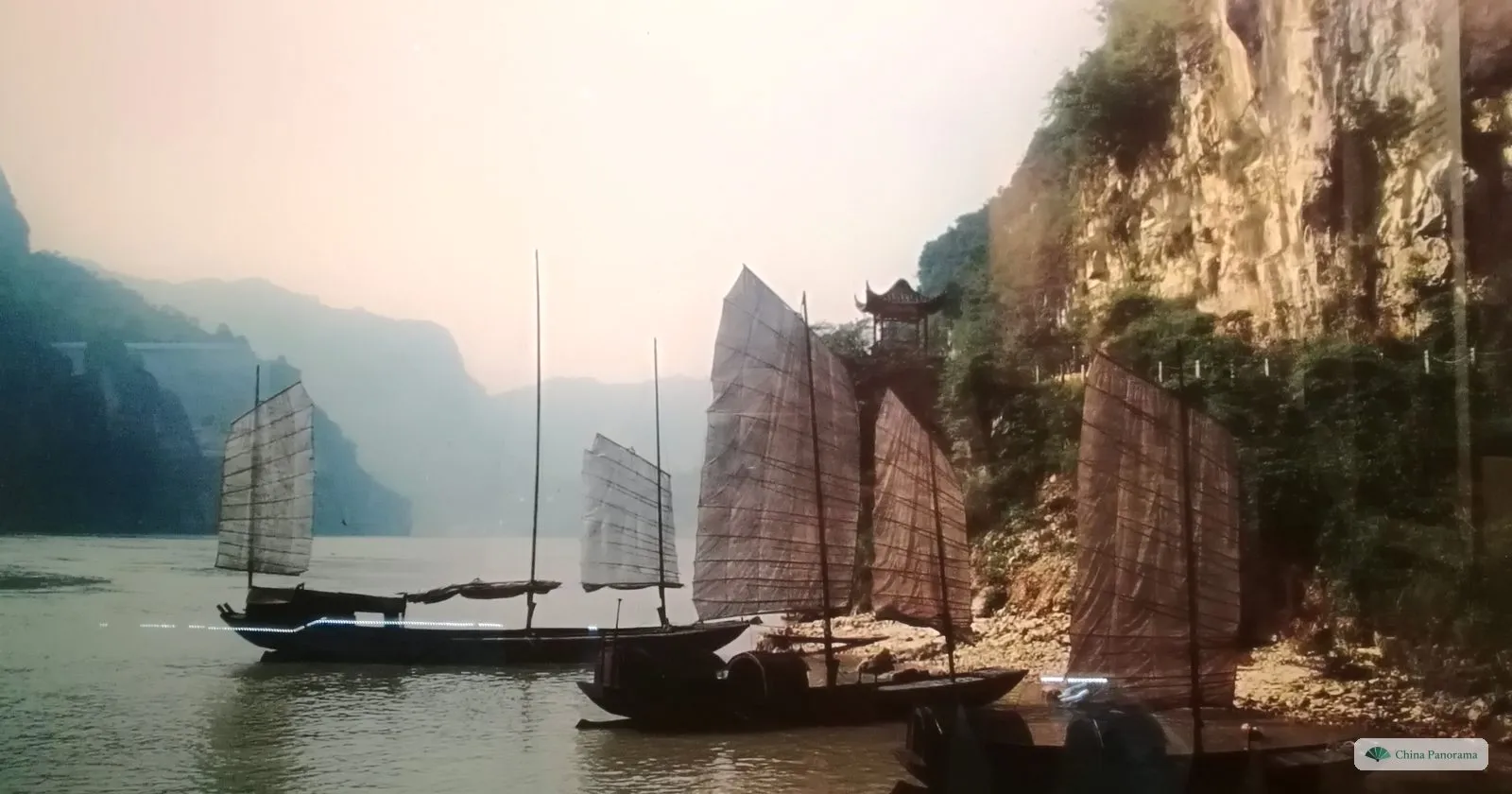 Built in our time200521 years old
Opened in June 2005, two years after the reservoir began to fill.
- Built in our time200620 years old
The real stilt houses on the cliff were cleared from 2005; the complex in their style opened on 29 September 2006.
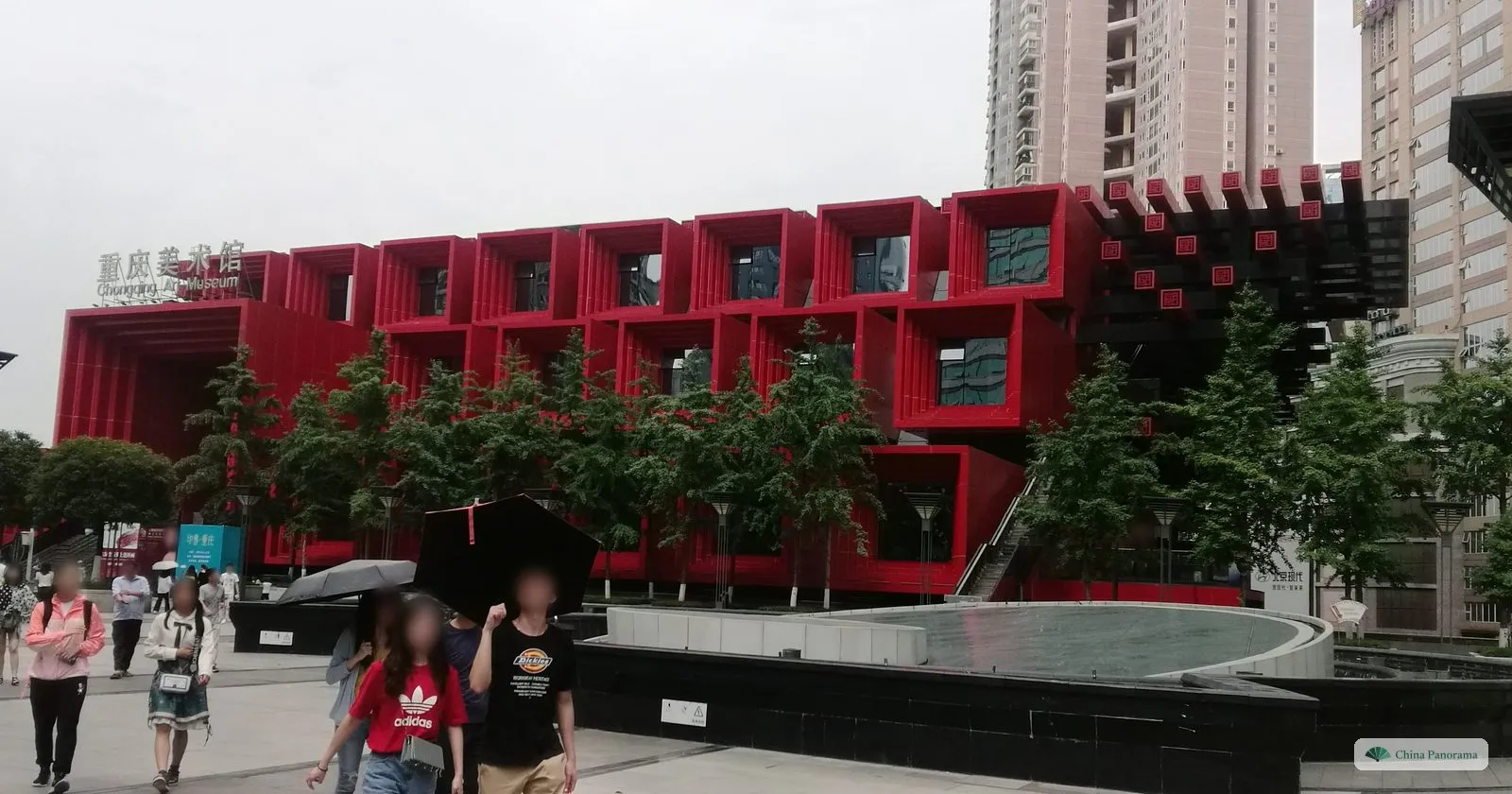 Built in our time201313 years old
Its beams take their form from the dougong brackets of Huguang Guild Hall.
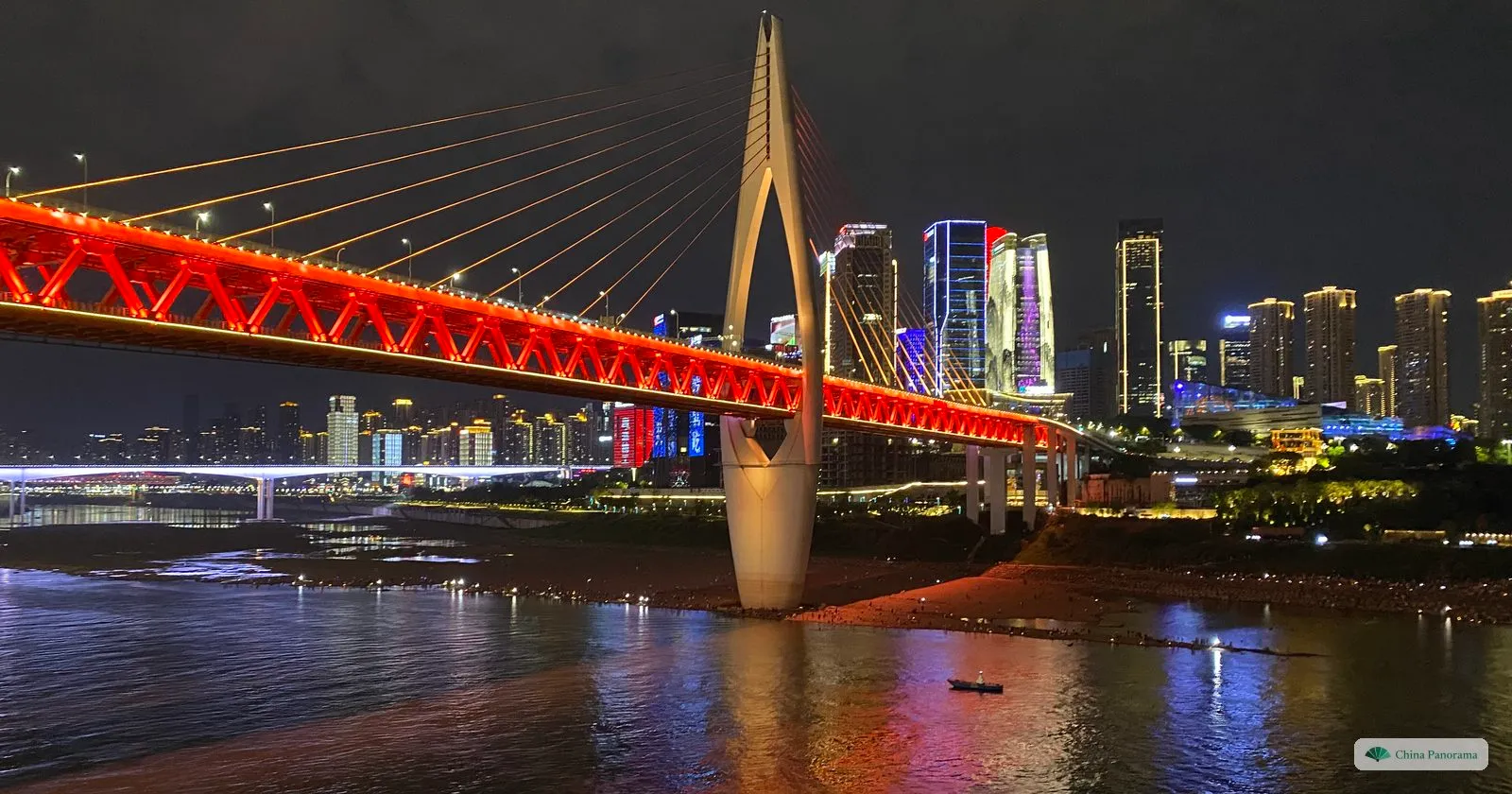 Built in our time201511 years old
Opened on 29 April 2015, in front of Hongyadong.
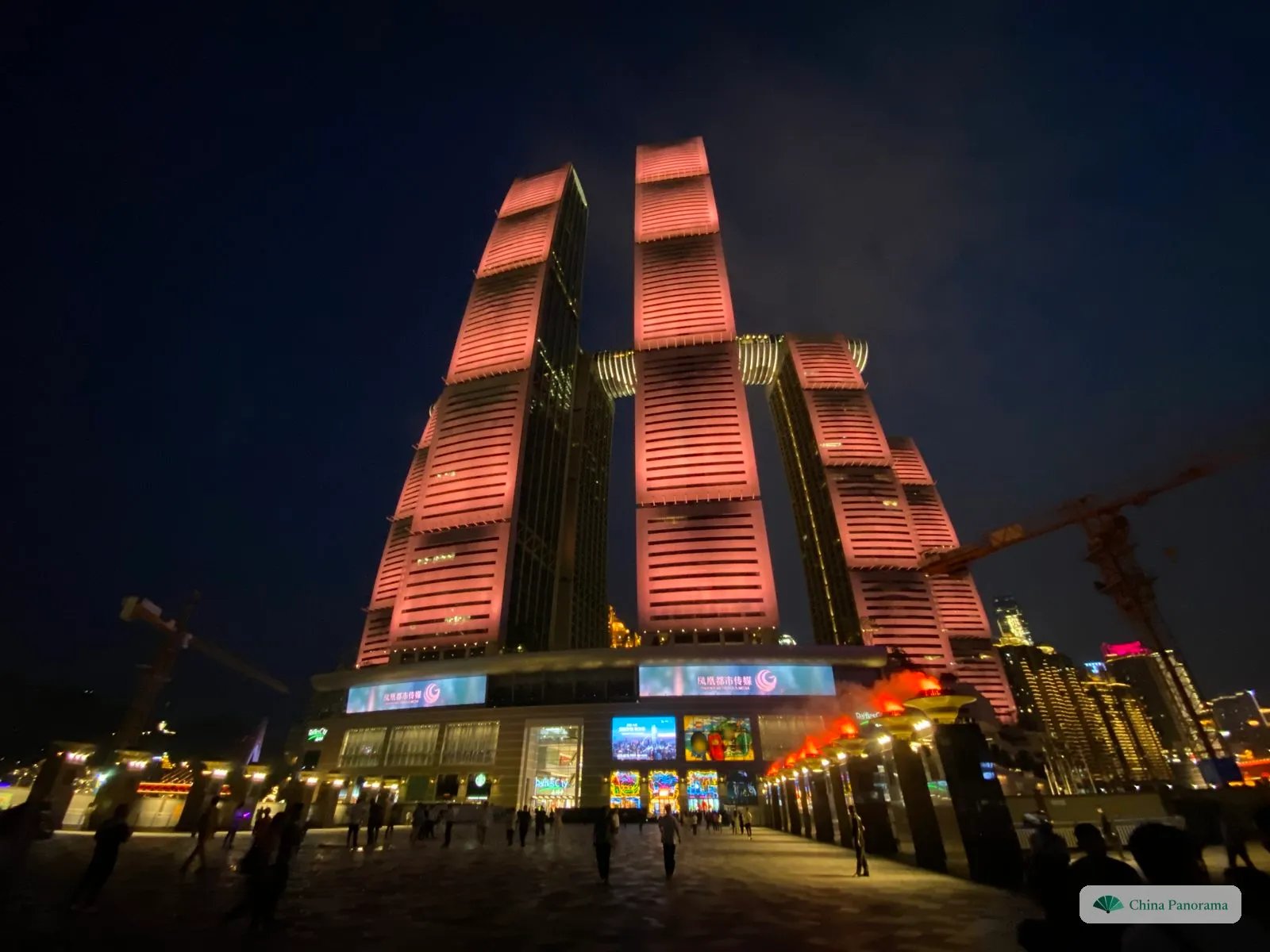 Built in our time20197 years old
Opened on 6 September 2019 where the two rivers meet.
- Built in our time20215 years old
Cleared, then rebuilt over nearly four years with some houses put back on their old sites; reopened in 2021.
What am I looking at?
The meeting of the rivers from the piers, the front of Hongyadong, the towers of Raffles City and a street sign on Cangbai Road. Tap a number on the photograph.
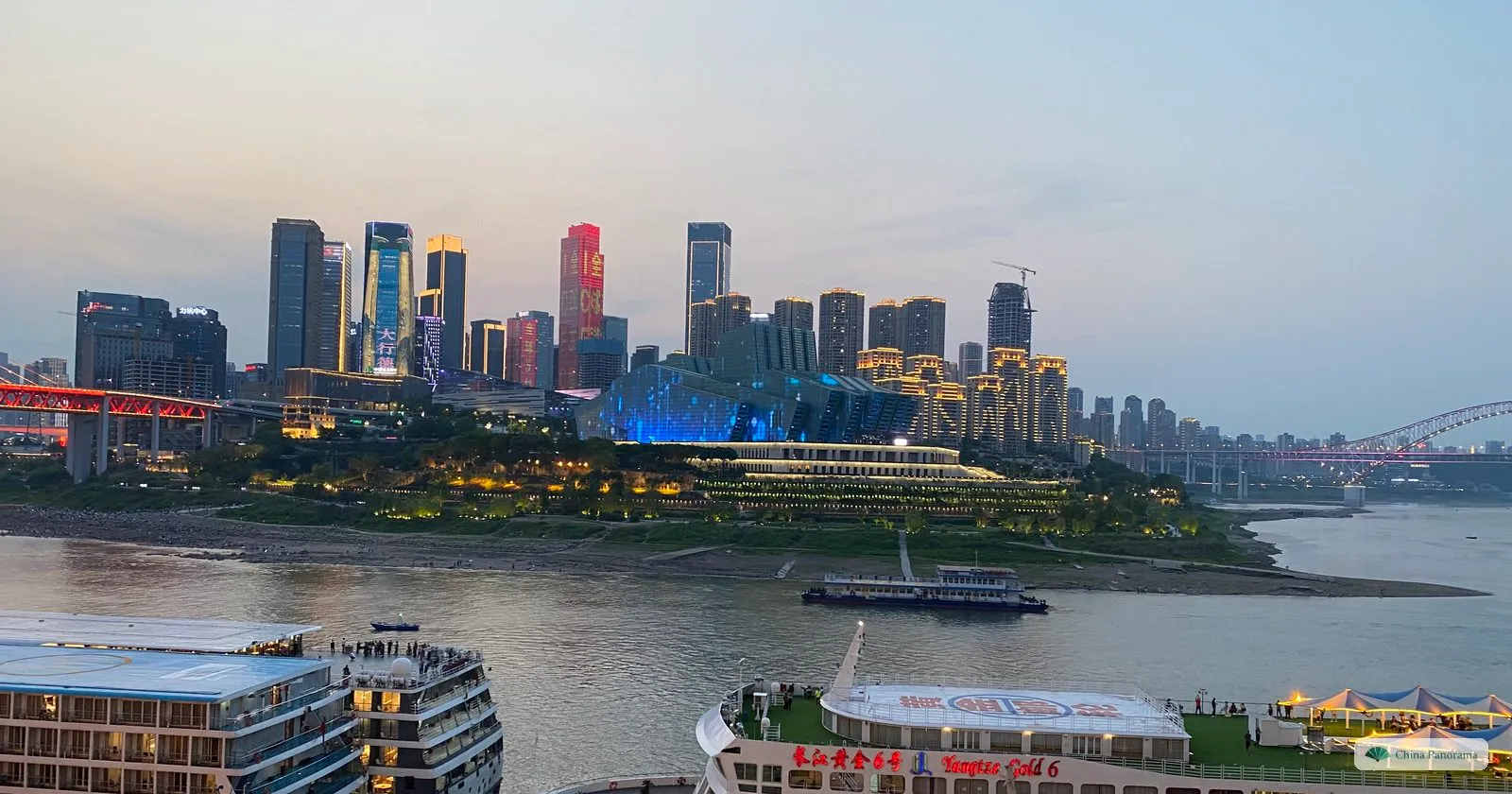
1The Jialing
嘉陵江 · Its last few hundred metres
The river in front of you is the Jialing, which comes down from the north and wraps round the north side of the Yuzhong peninsula — past Hongyadong — before it ends here.
Tap a number on the photo, or a name in the list.
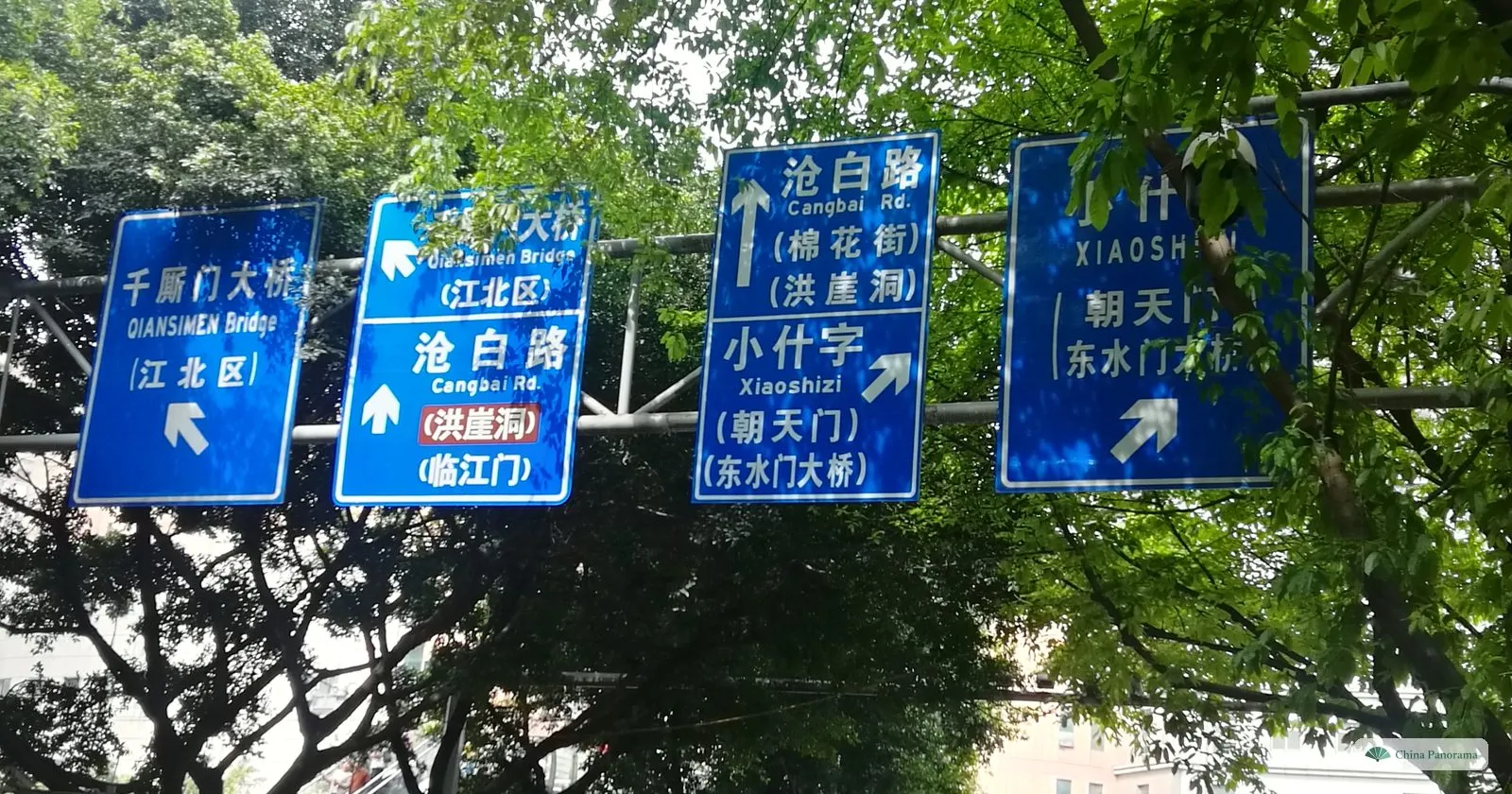
15 places in and around Chongqing
Filter by district, or by whether you need to be indoors — useful in the heat of a summer afternoon. For the food, see how to eat hot pot.
Hongyadong
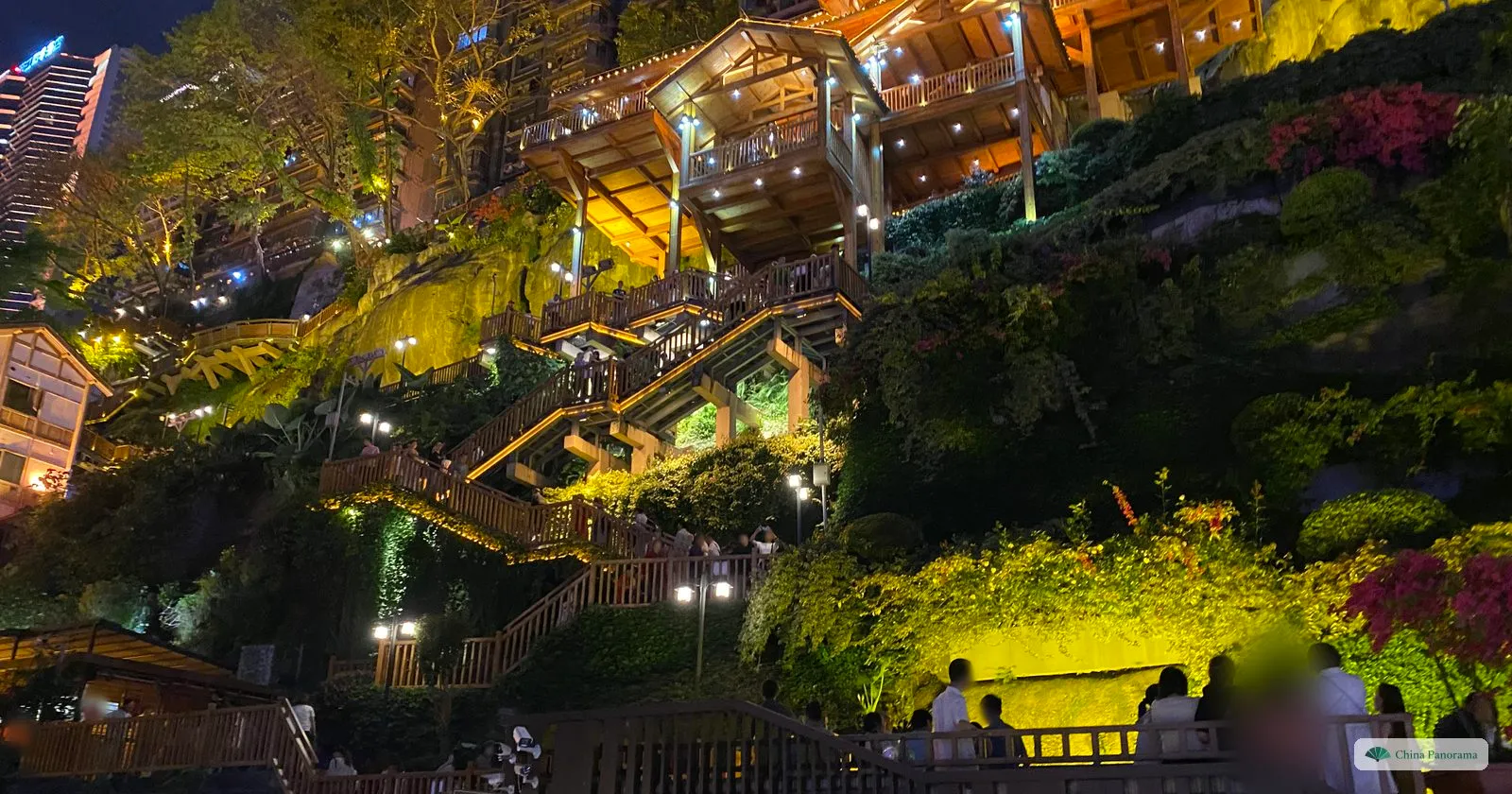
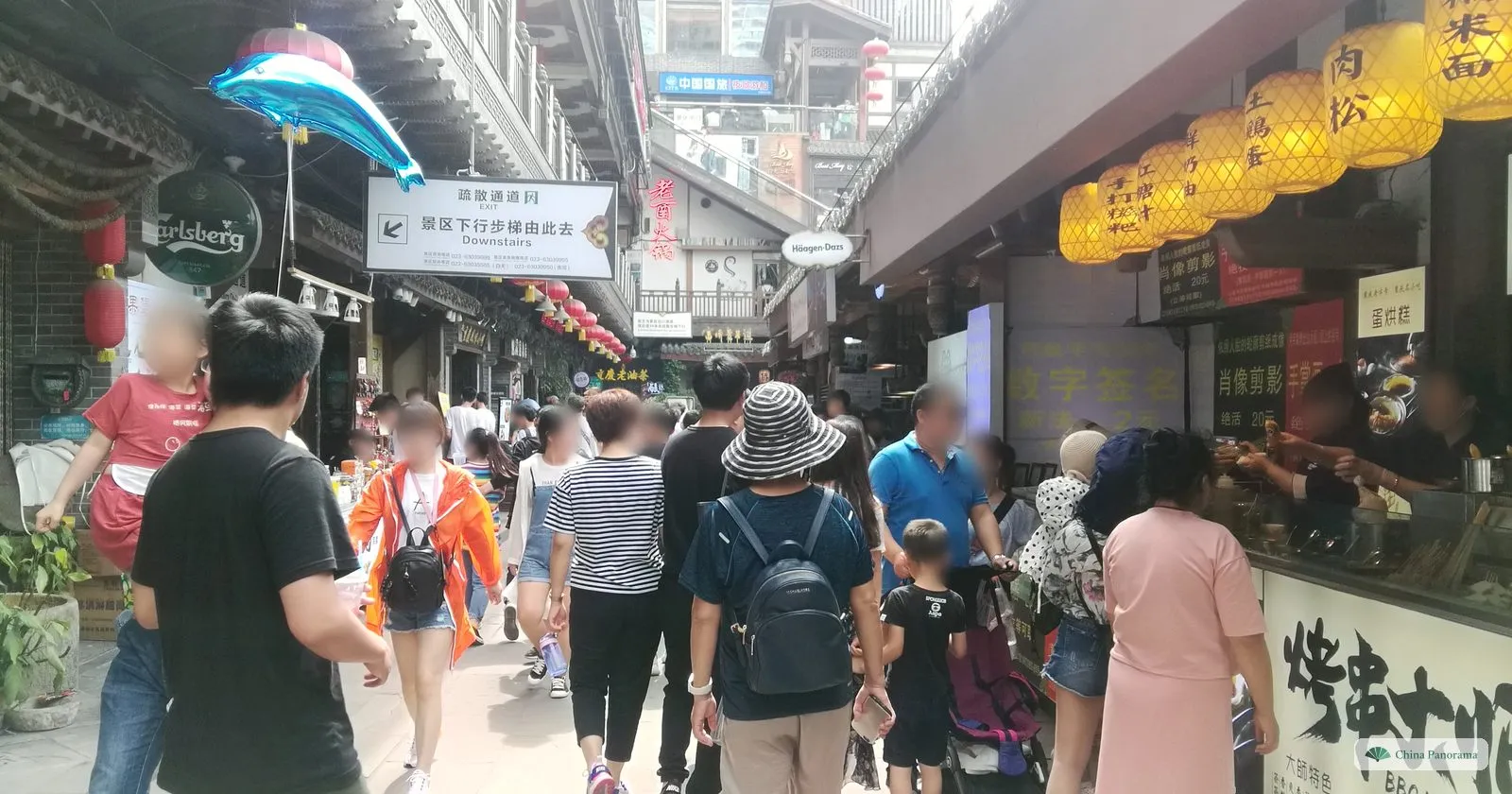
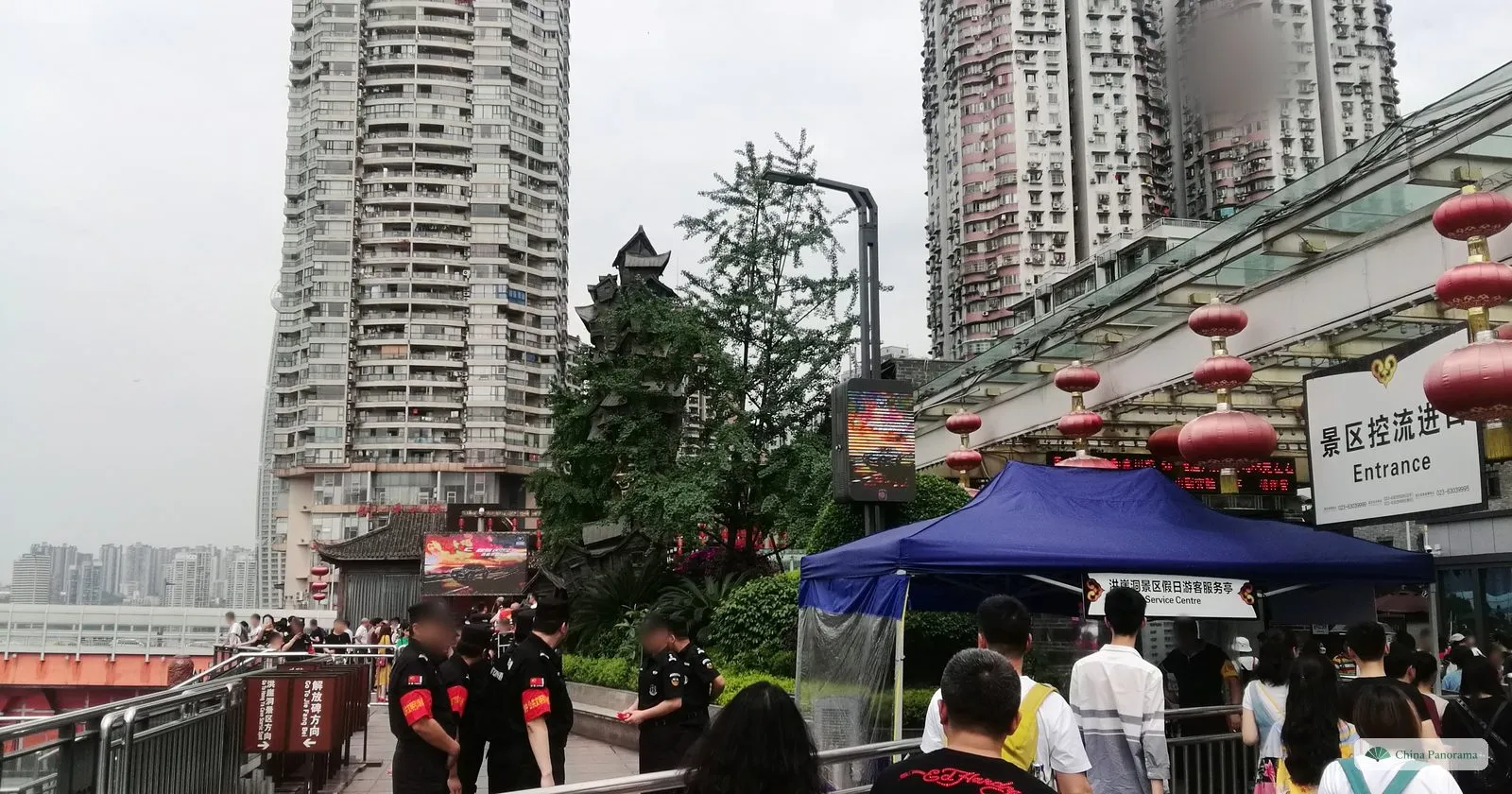
洪崖洞LandmarkYuzhong · 渝中区OutdoorsEleven floors of wooden balconies, upturned eaves and red lanterns stacked against the cliff on the Jialing side of the peninsula — the picture most people have of Chongqing. It looks old and is not: stilt houses (吊脚楼, diaojiaolou) once clung to this cliff, were cleared from 2005, and the complex in their style opened on 29 September 2006 as a shopping and food centre, with four streets of shops, restaurants and bars inside. The name is older than any of it: Hongyadong is a cave in the cliff near the old Hongya Gate, and the waterfall over it, “Hongya Dicui”, was one of the twelve classic views of Ba-Yu. Because of the cliff, the bottom floor opens on the riverside road and the top floor on a street in the city centre. After dark the whole front is lit gold, and it is often compared to the bathhouse in Spirited Away. We were here on a May Day afternoon in 2019, when police at the gate were letting people in in batches, and again at a quarter past eight on 28 April 2024.
Come in from the top, at Cangbai Road (11th floor), and walk down to the riverside road (1st floor) for the view of the front: Xiaoshizi station (Lines 1 and 6) or Linjiangmen (Line 2). The complex itself is free; on holidays a free reservation through its official WeChat account has been reported; it is busiest after dark. Shops keep their own hours.
- Entry
- Price not verified — check on site
- Opening hours
- Hours not verified — check on site
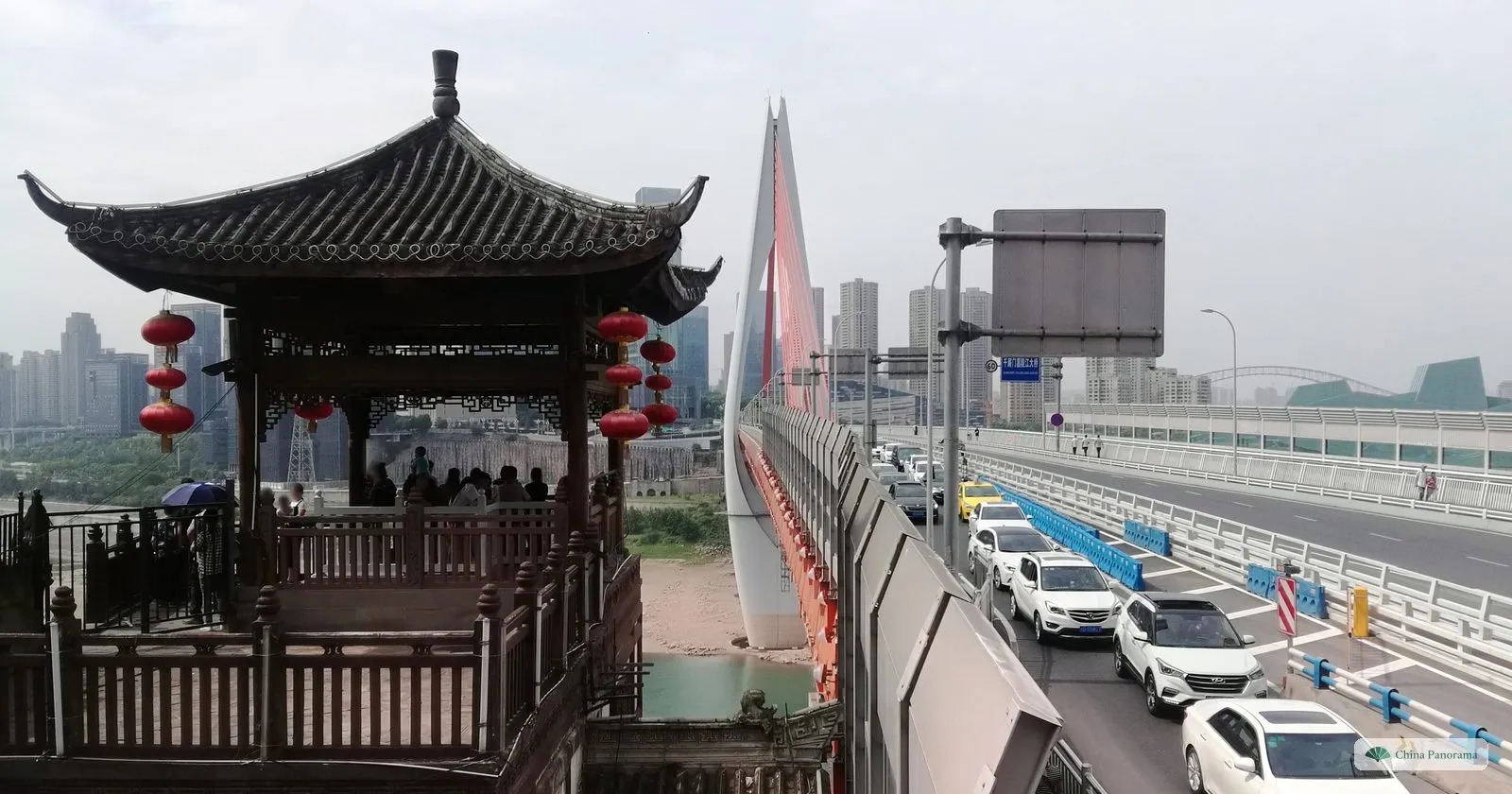
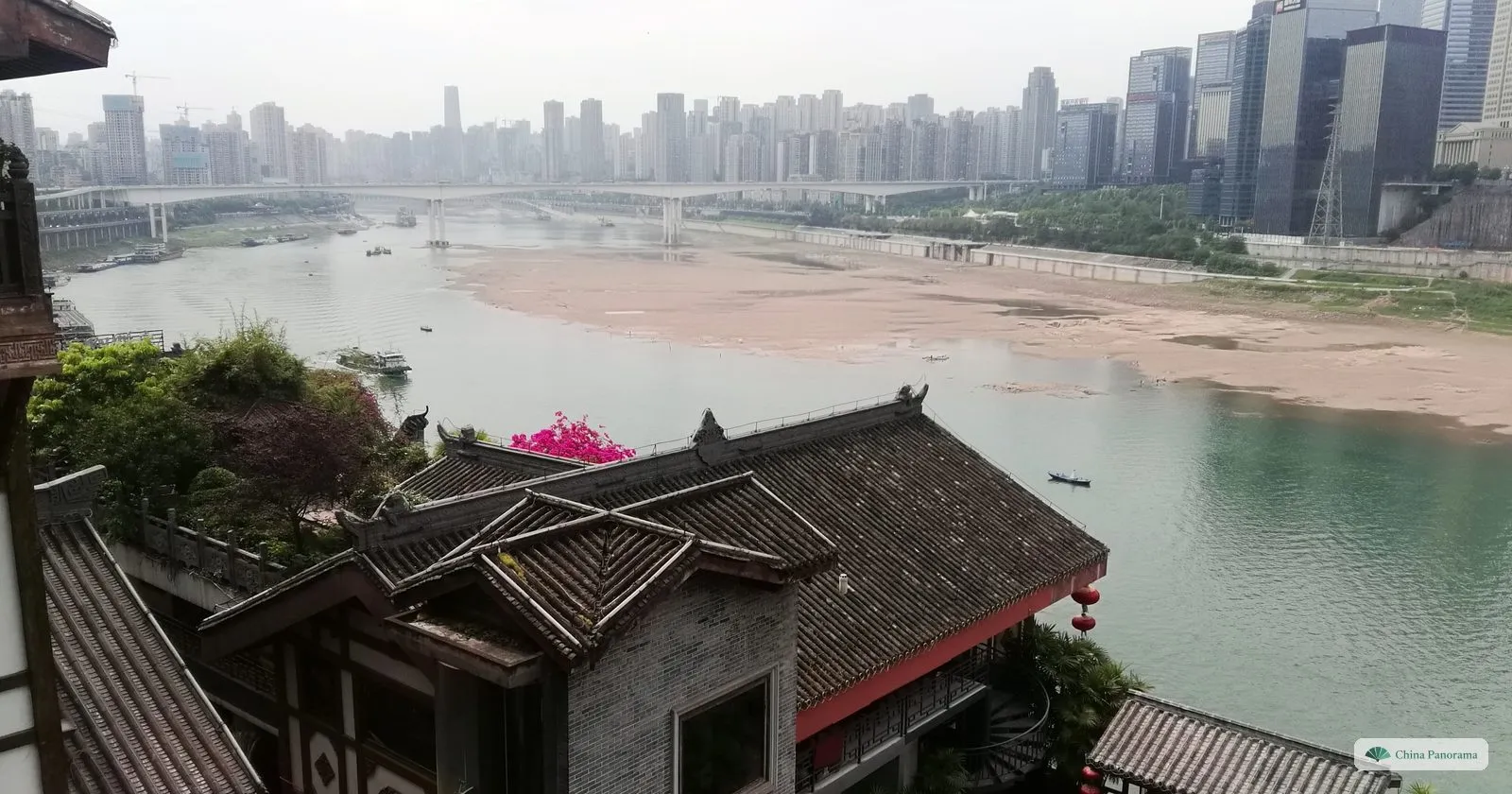
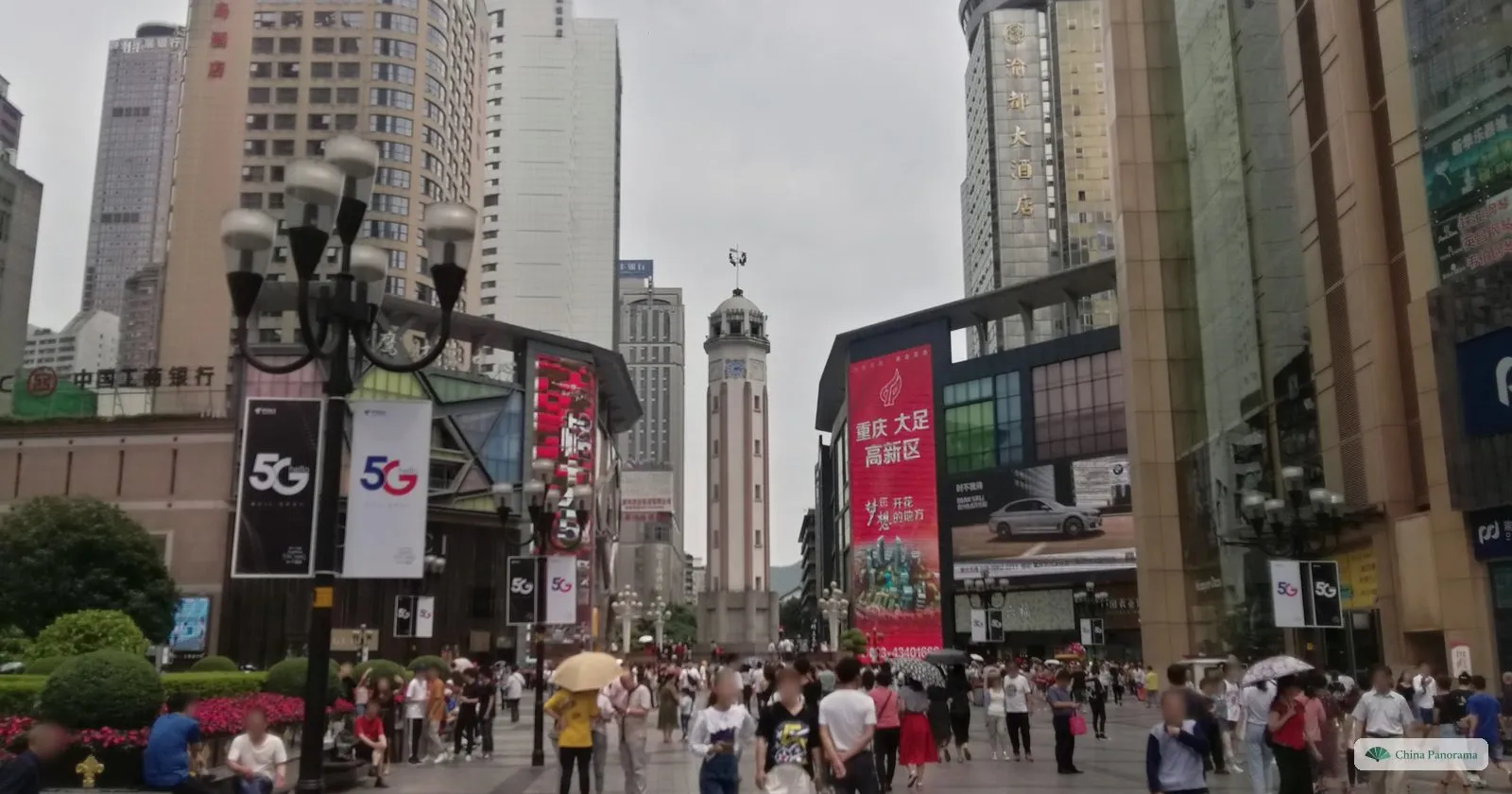
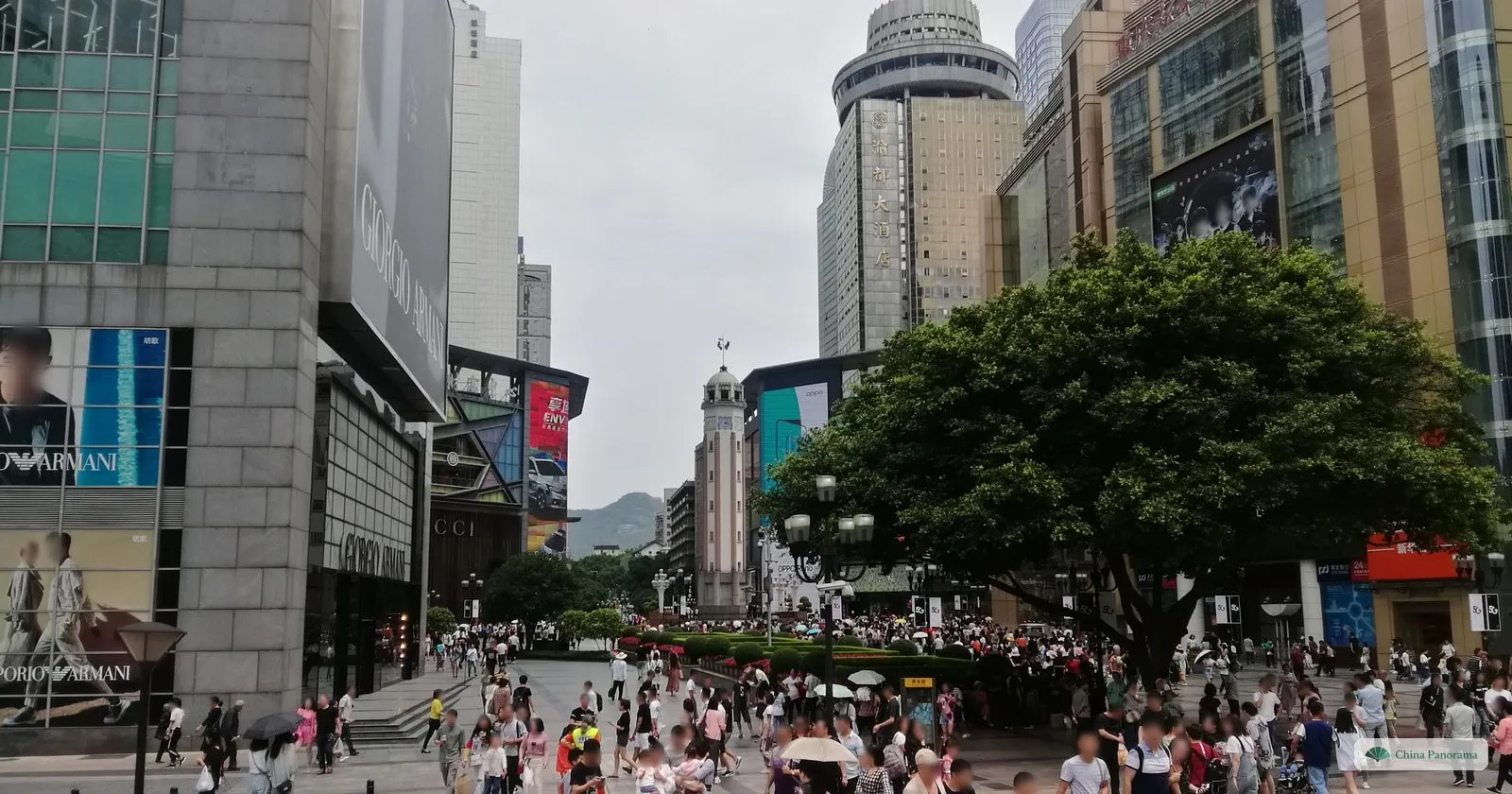
Jiefangbei (Liberation Monument)
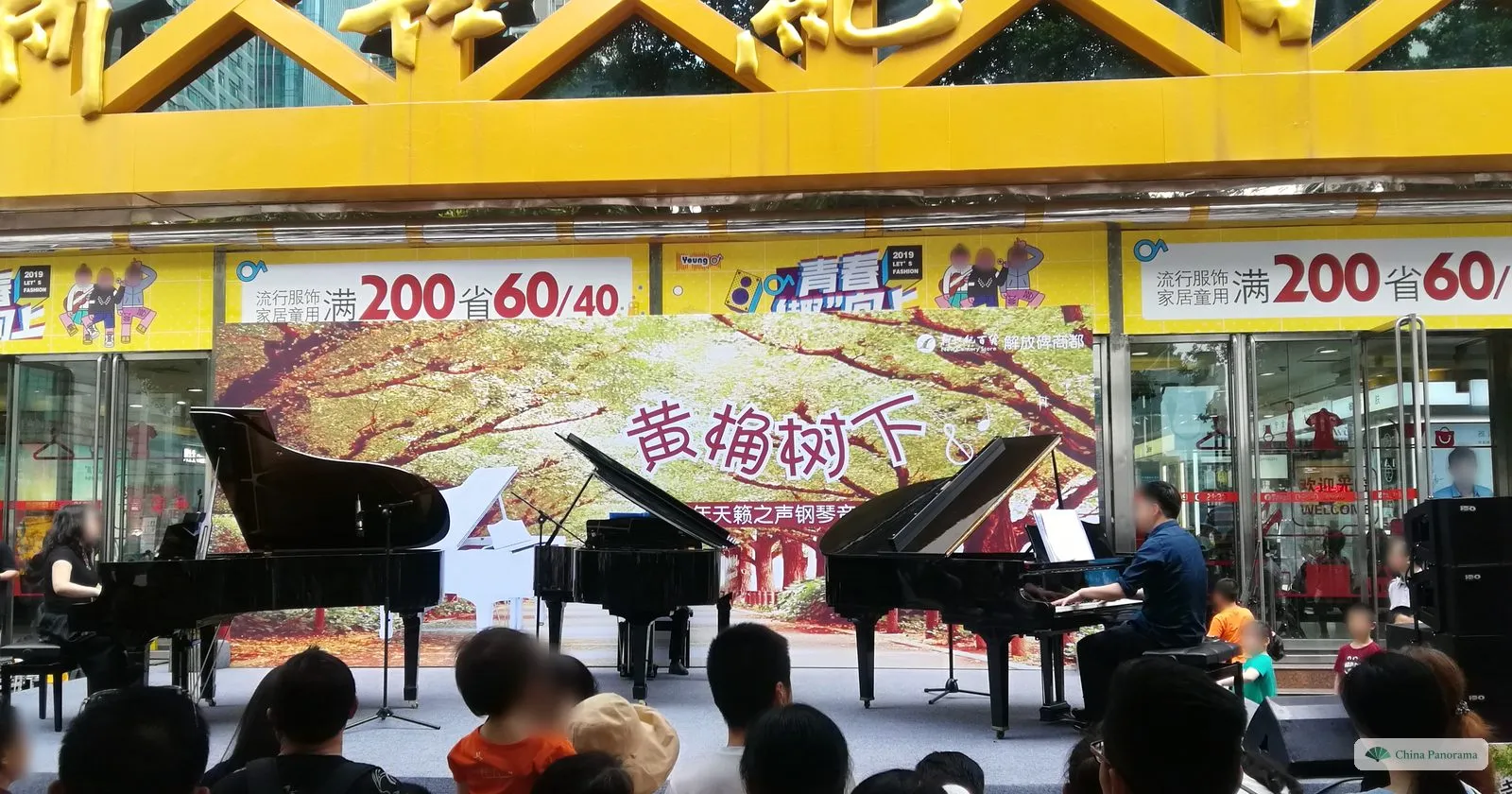
解放碑 · 人民解放纪念碑LandmarkYuzhong · 渝中区OutdoorsThe centre of the city is a clock tower 27.5 m high with eight sides, now standing in a canyon of department stores. Its history is the city's: in December 1941, when Chongqing was China's wartime capital, a wooden tower plastered with cement, the “Spirit Fortress”, was put up here on what was then the busiest street. It rotted and was pulled down; after the war a concrete monument to the victory over Japan replaced it in 1947, and in 1950 it was renamed the Monument to the People's Liberation, with an inscription by Liu Bocheng. Everyone calls it Jiefangbei, and the name covers the whole pedestrian shopping district around it. On 1 May 2019, the first day of the holiday, the streets were packed from wall to wall, and under the yellow arch of a department store four grand pianos were giving a free concert.
Jiaochangkou station (Lines 1 and 2) is at the south end of the pedestrian streets, Xiaoshizi (Lines 1 and 6) and Linjiangmen (Line 2) a few minutes from the other sides. The streets are free and open at all hours.
- Entry
- Free
- Opening hours
- Open at all hours
- LandmarkYuzhong · 渝中区Outdoors
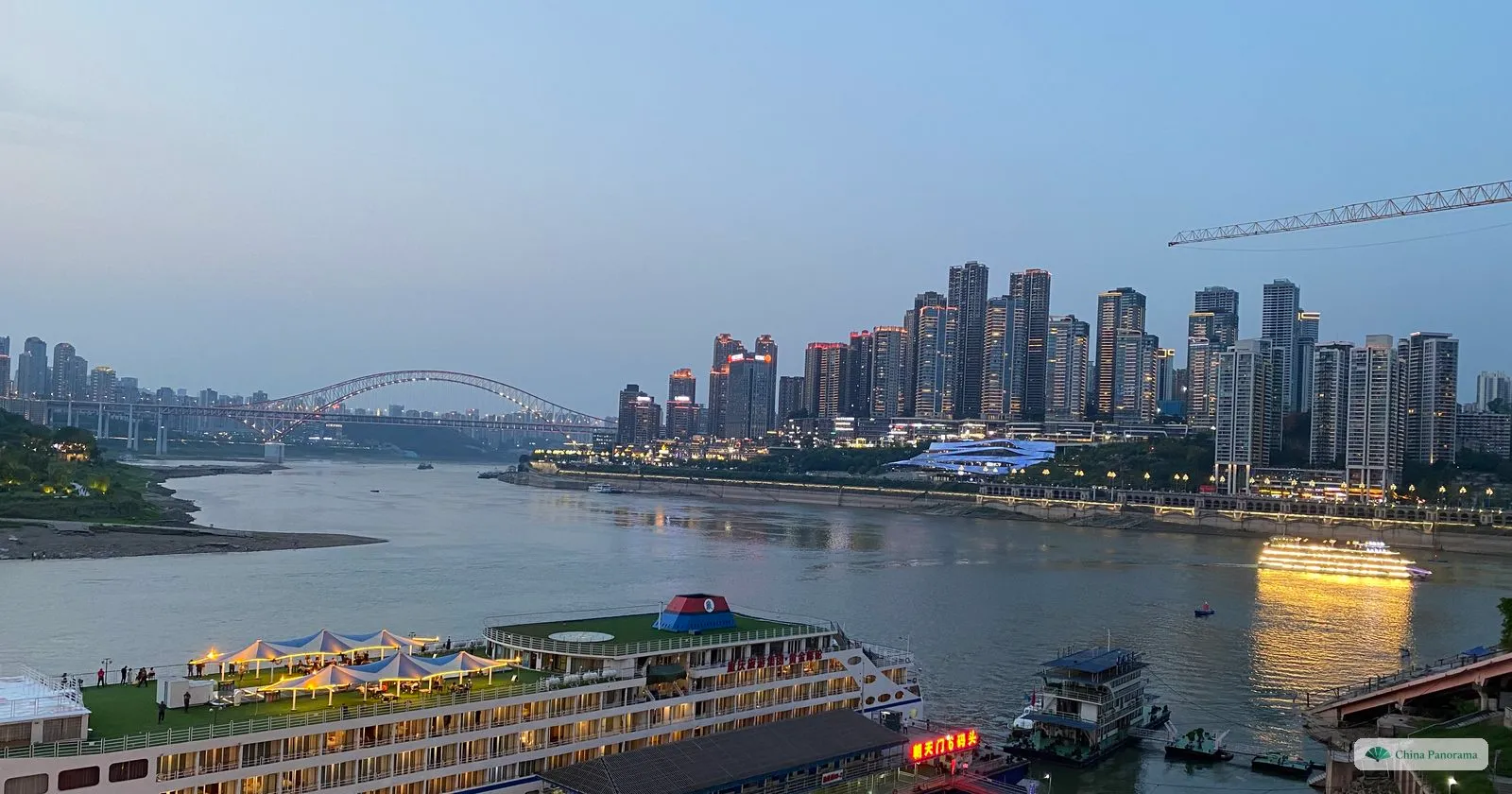
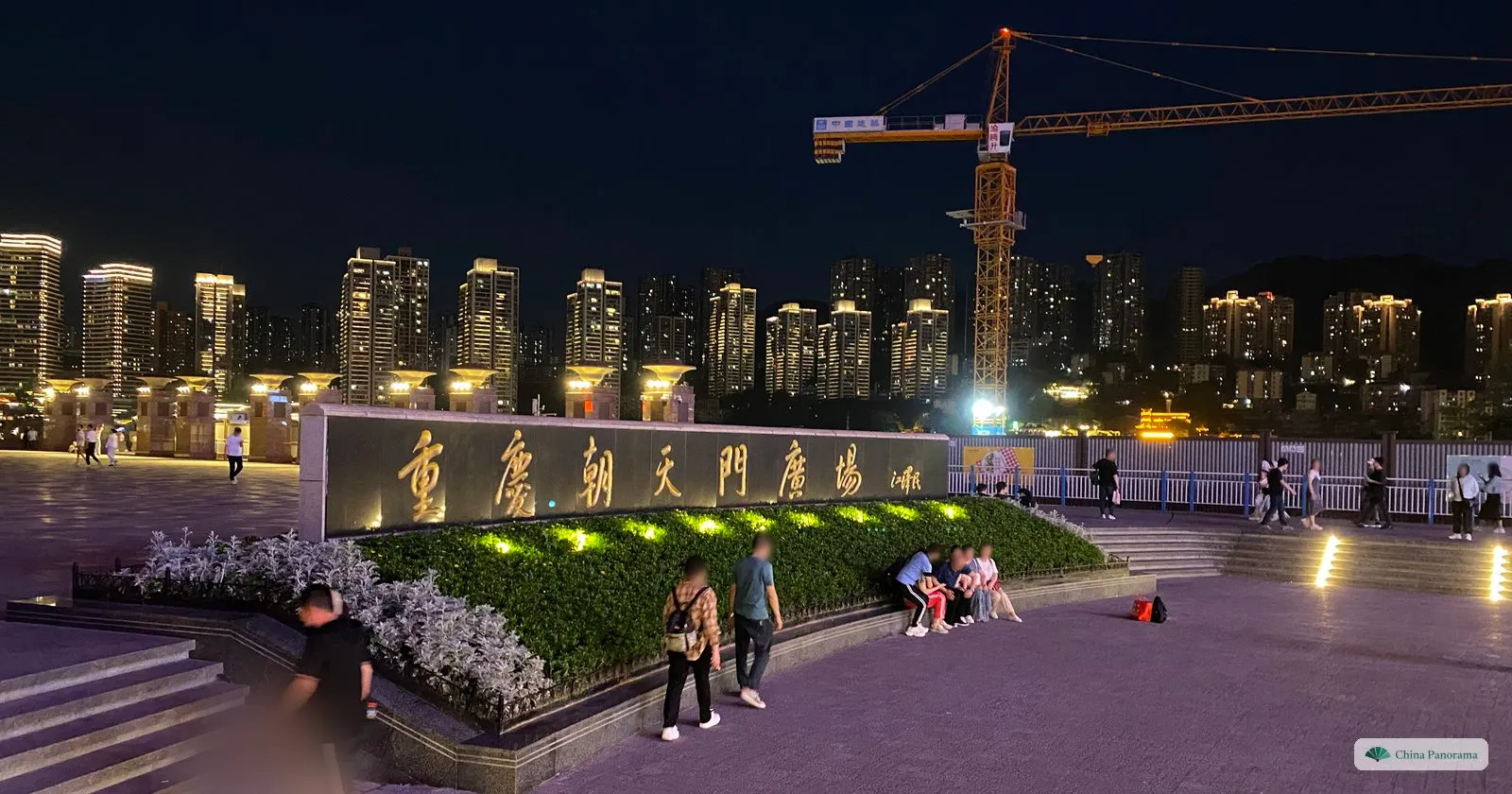
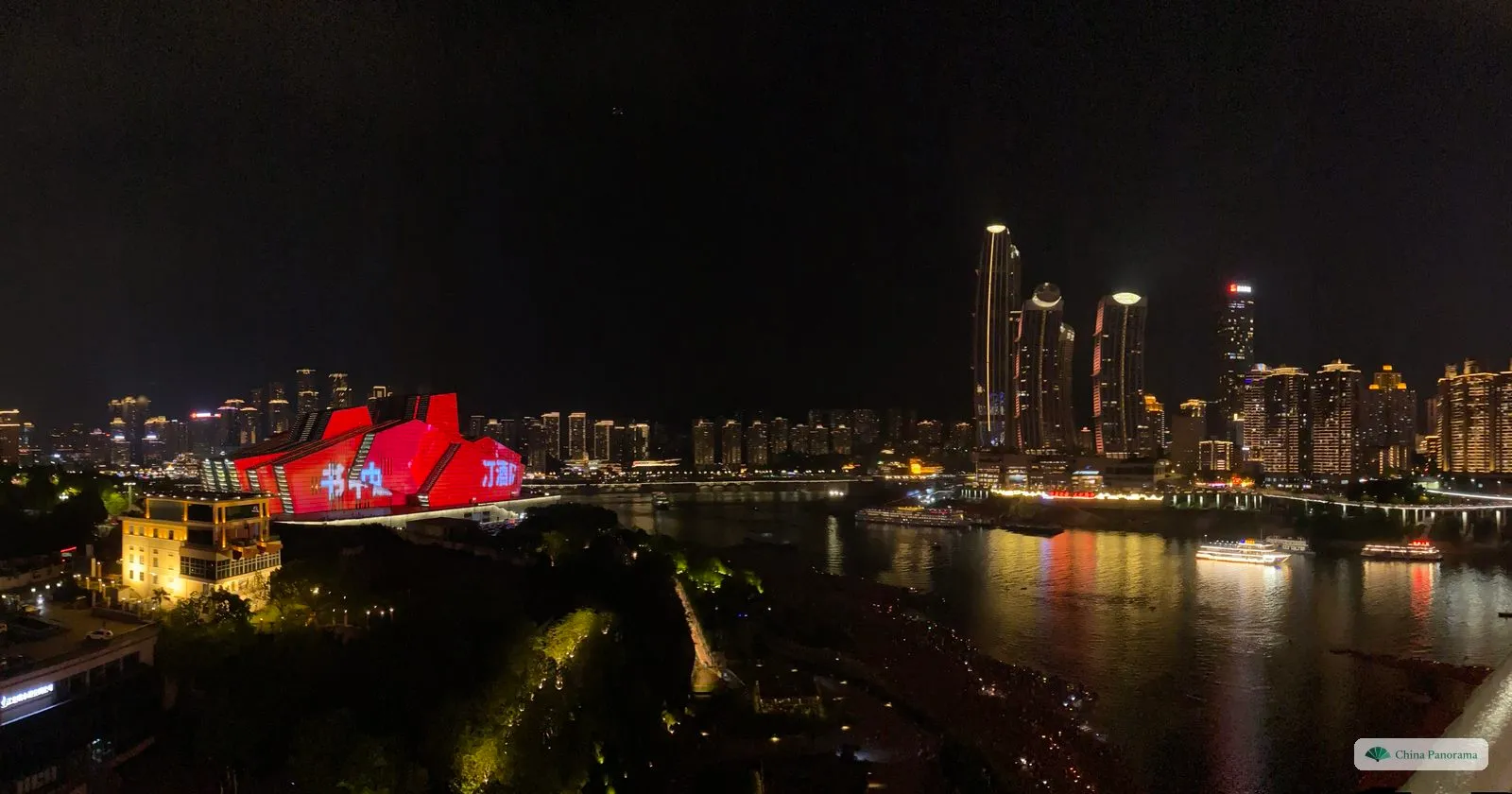
The eastern tip of the Yuzhong peninsula, where the Jialing flows into the Yangtze. Chongqing grew here because of the rivers, and the old city gate at the tip, Chaotianmen, has given its name to the piers below, where the Yangtze cruise ships tie up — our photographs show them at pier 8, with the towers of Jiangbeizui across the Jialing and the arch of the Chaotianmen Yangtze River Bridge downstream. On many days the two rivers have different colours where they meet. Above the piers is Chaotianmen Square, a terrace with the name carved in stone, and behind it the towers of Raffles City. At dusk on 28 April 2024 the square was full of people waiting for the lights to come on.
Chaotianmen station (Line 1) is under Raffles City; the square is in front of it. The square is free; we have not checked whether it closes at night. Yangtze cruises and river sightseeing boats leave from the piers below — we have not checked schedules or prices.
- Entry
- Free
- Opening hours
- Hours not verified — check on site
Qiansimen Bridge
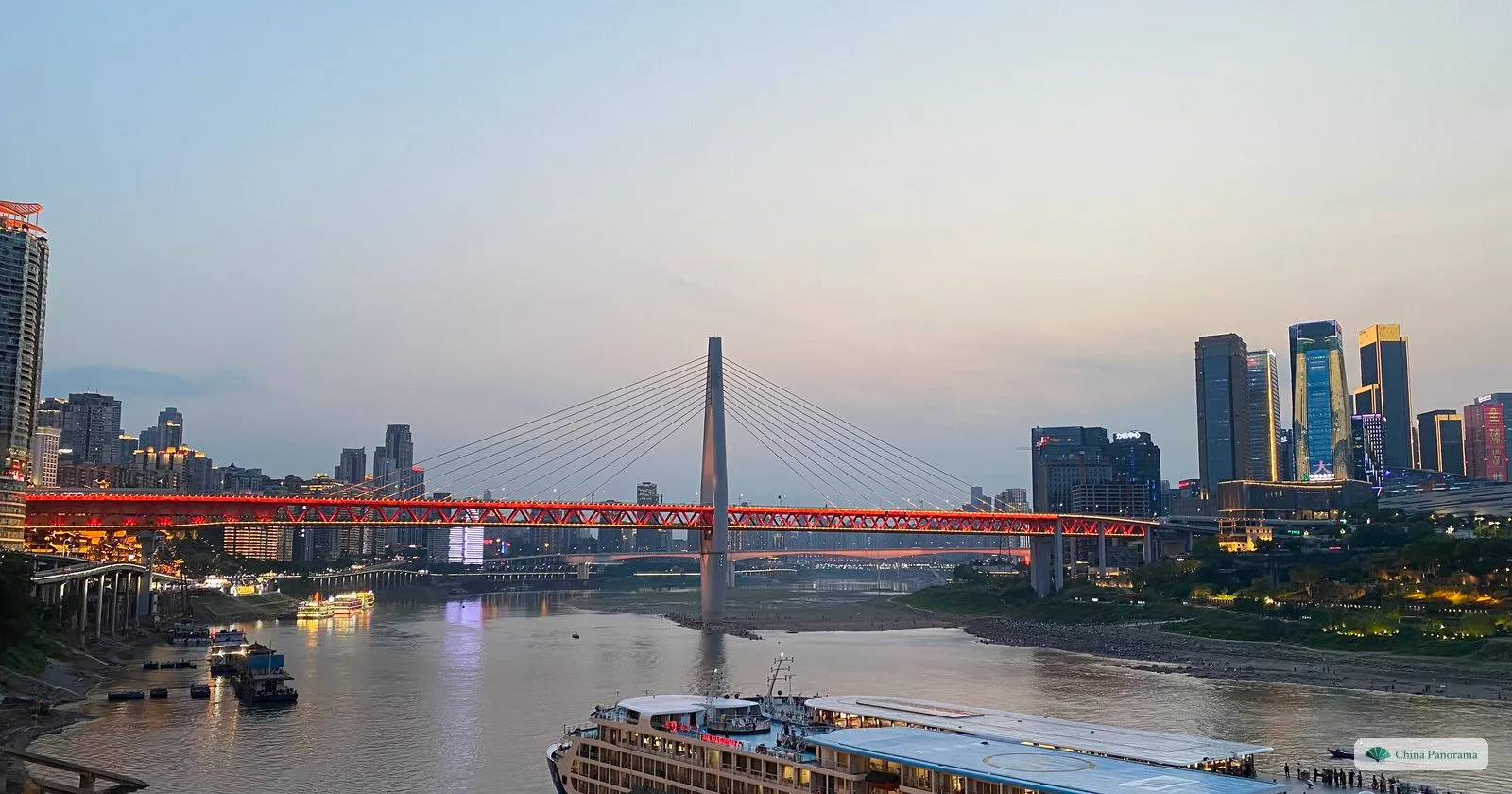
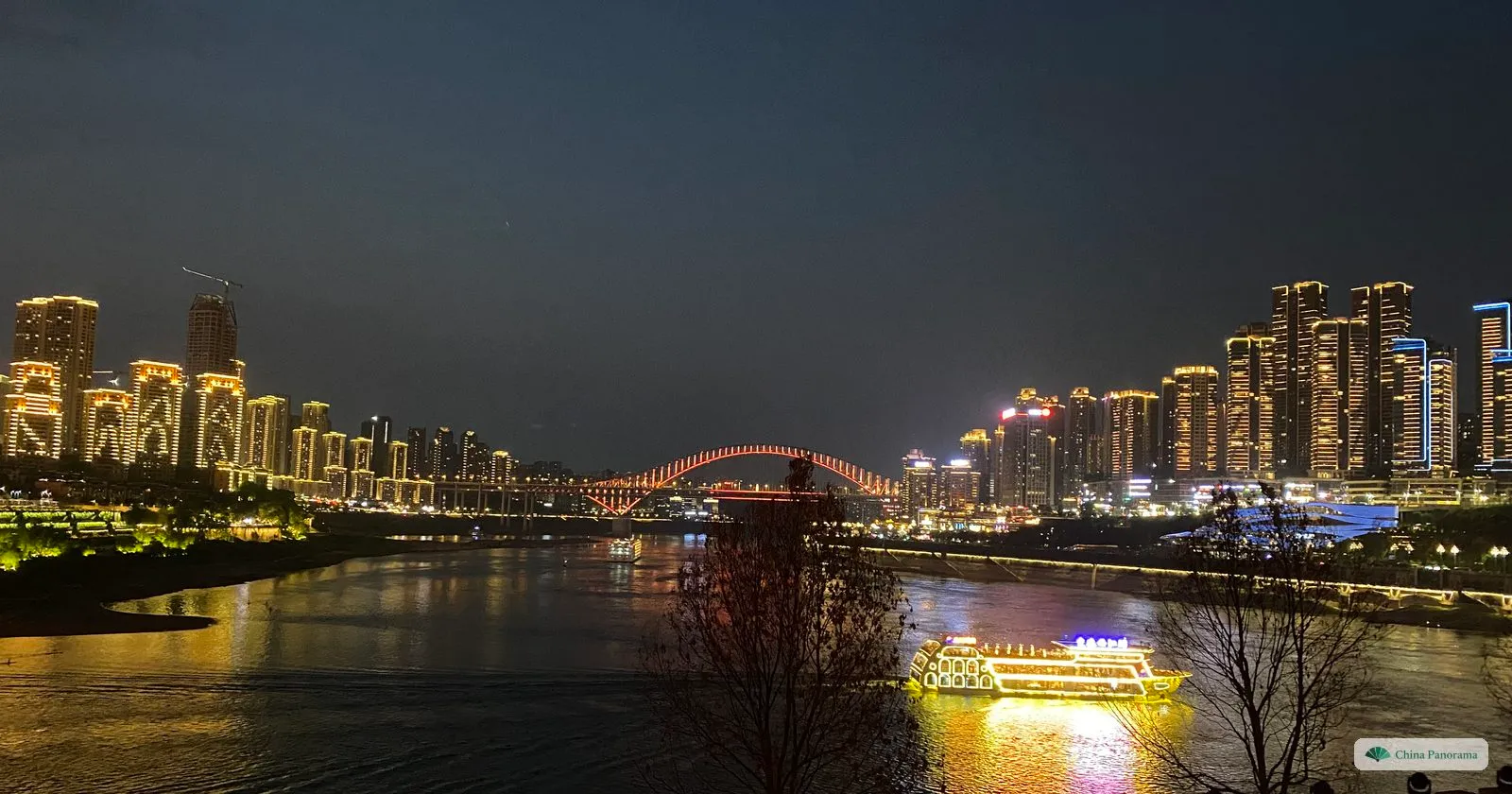
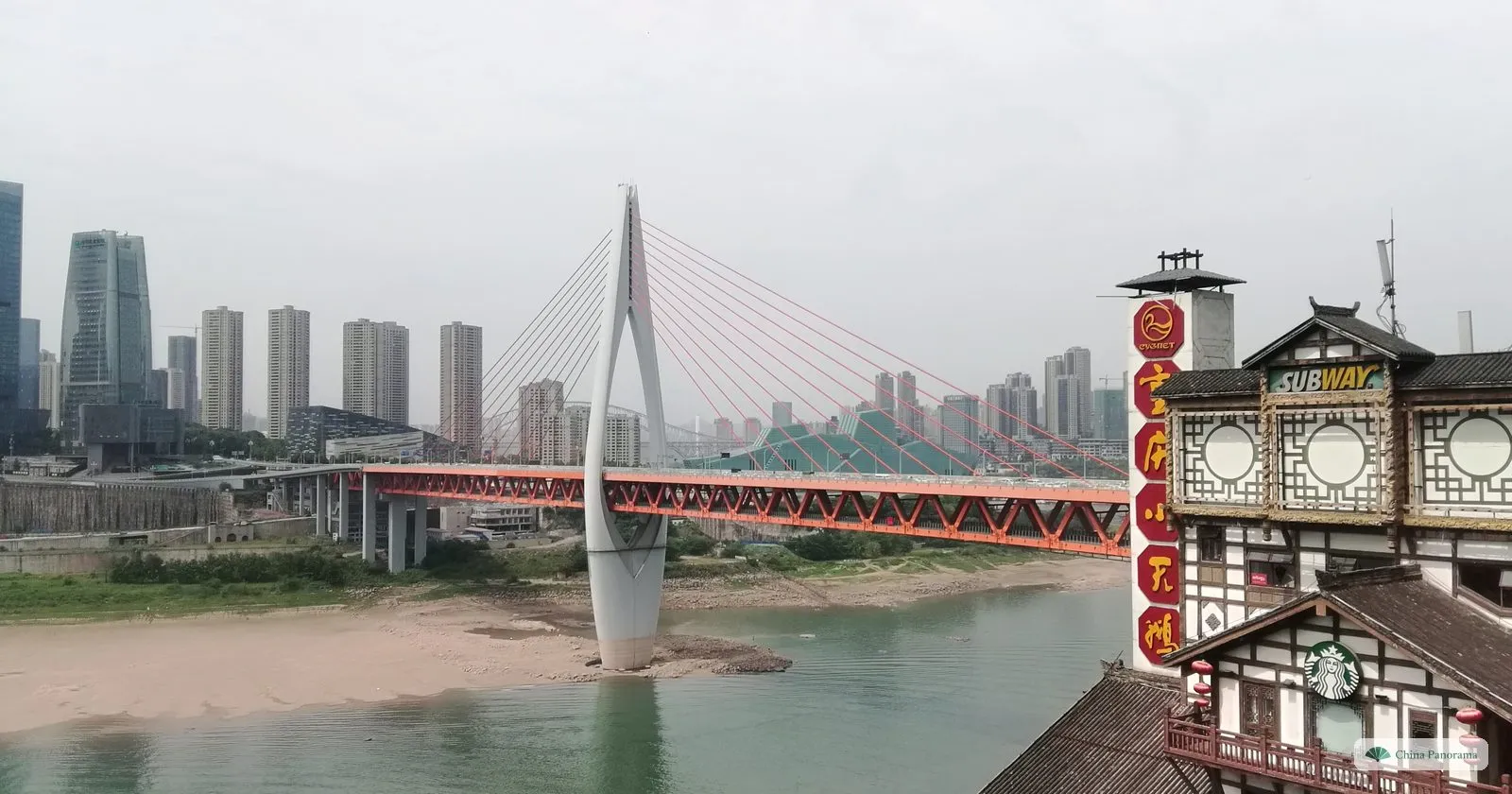
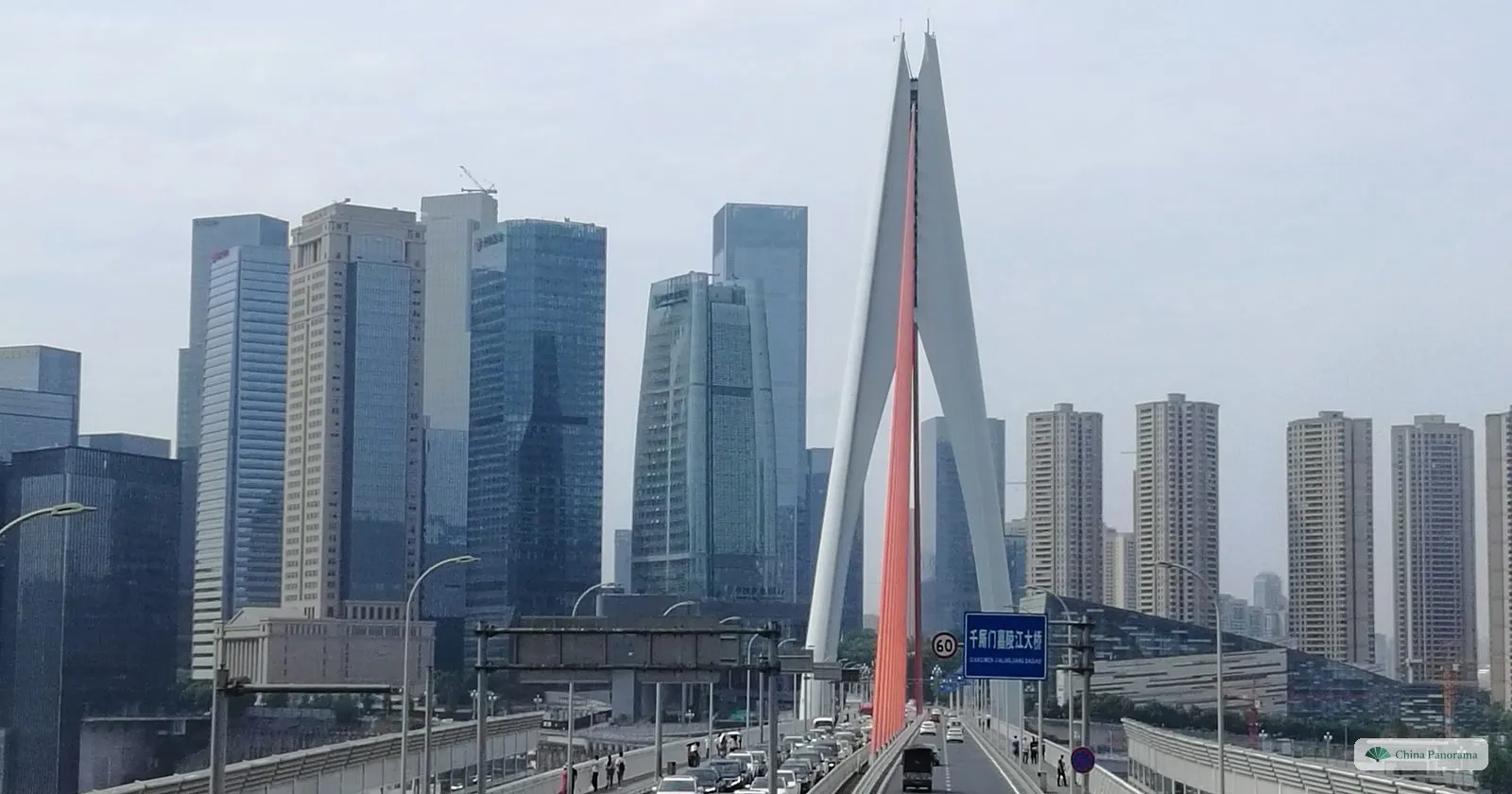
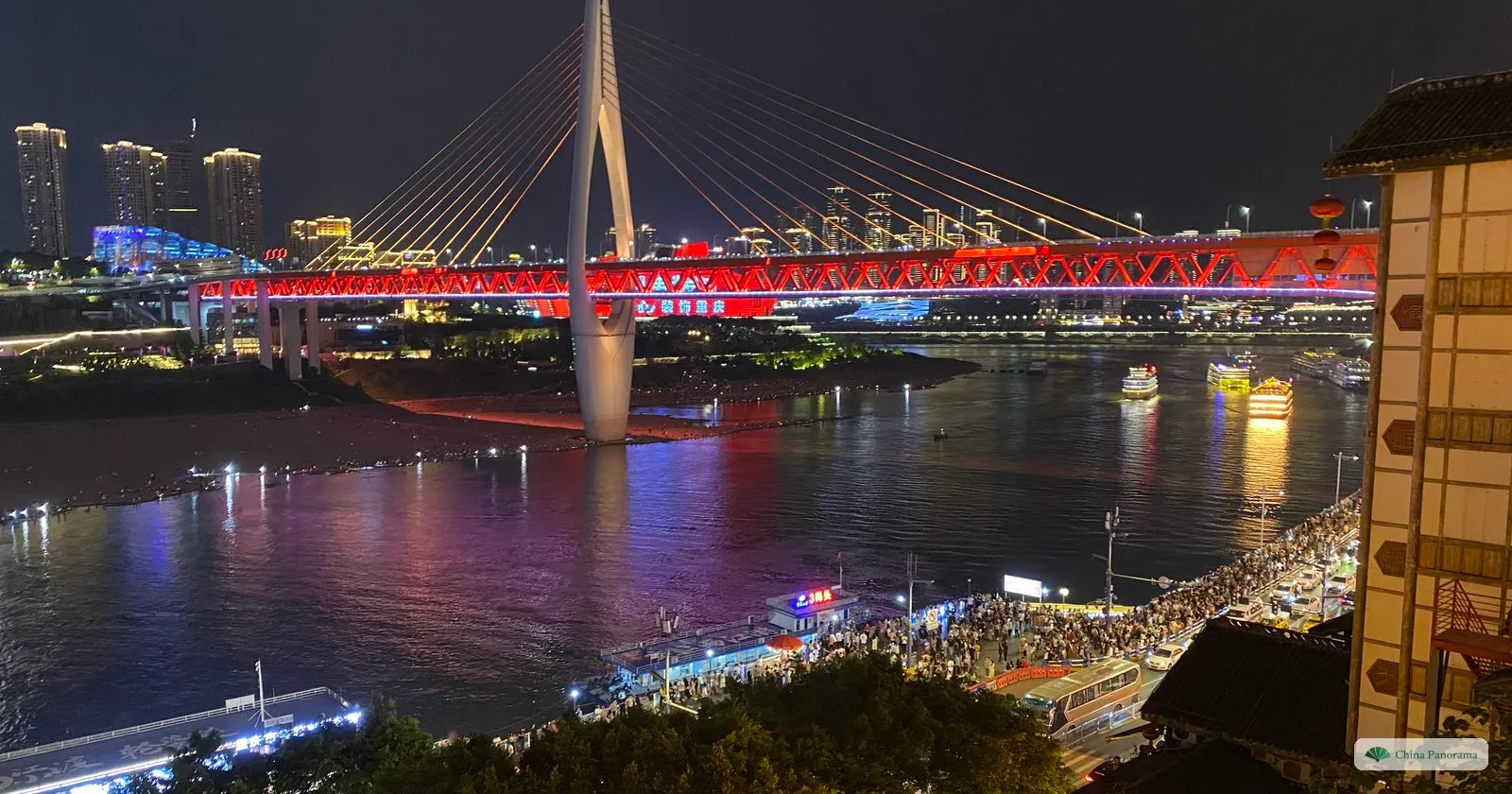
千厮门嘉陵江大桥LandmarkYuzhong · 渝中区OutdoorsThe single white tower and the red steel truss across the Jialing, right in front of Hongyadong. It opened on 29 April 2015: 720 m of main bridge with a main span of 312 m, carrying a four-lane road on the upper deck and Metro Line 6 on the lower one, between the Yuzhong peninsula and Jiangbeizui. There are footpaths on both sides, and walking out onto it after dark is one of the best free things to do in the city: Hongyadong lit up behind you, Raffles City at the tip of the peninsula and Jiangbeizui across the water. Our panorama is from the footpath at 20:53 on 28 April 2024.
The Yuzhong end is at Cangbai Road, a few minutes from the top of Hongyadong. Free and open at all hours; the footpaths are busy in the evening.
- Entry
- Free
- Opening hours
- Open at all hours
Raffles City Chongqing and The Crystal
重庆来福士 · 水晶连廊ArchitectureYuzhong · 渝中区IndoorsEight towers at the tip of the peninsula, designed by Moshe Safdie — the architect of Marina Bay Sands in Singapore — and opened on 6 September 2019. Two of them reach about 350 m; four of 250 m carry The Crystal, a glass skyway 300 m long laid across their tops, with an observation deck, gardens and restaurants inside. Their shape is meant to recall the sails of the boats that once filled the harbour below. At the bottom is a shopping mall over several levels and the Chaotianmen metro station.
Chaotianmen station (Line 1) is underneath. The observation deck in The Crystal charges admission; we have not checked the price or hours.
- Entry
- Price not verified — check on site
- Opening hours
- Hours not verified — check on site
Guotai Arts Center
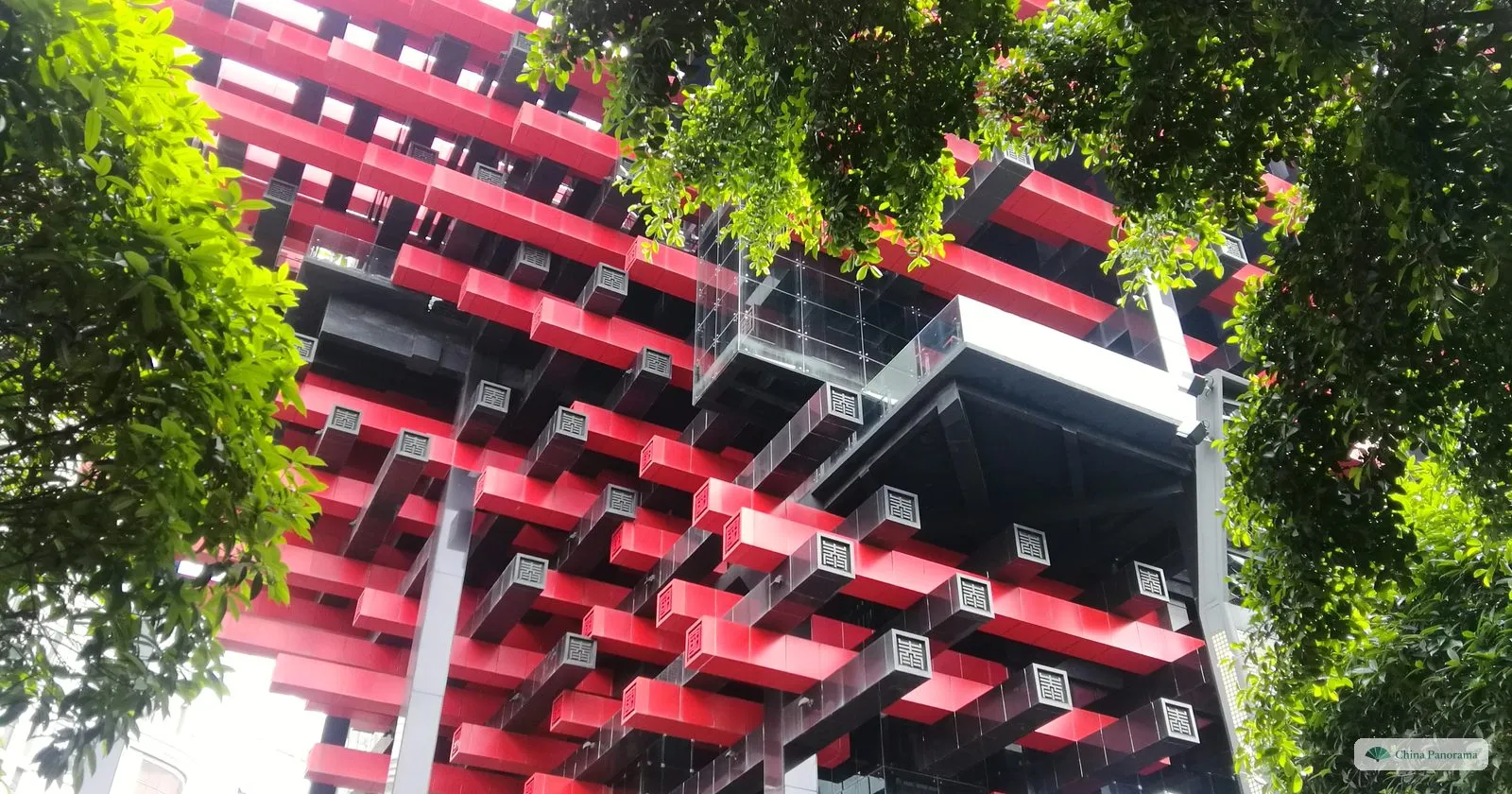
重庆国泰艺术中心ArchitectureYuzhong · 渝中区IndoorsA stack of red and black beams a few steps from Jiefangbei, sticking out in every direction. The architect, Cui Kai of the China Architecture Design Group, took the form from the interlocking wooden brackets (斗拱, dougong) under the roof of Huguang Guild Hall in Chongqing; it was designed in 2005 and completed in 2013. The beams are not only decoration: the red ones are part of the ventilation and the black ones hold water as a coolant. Inside are a theatre with 802 seats over three floors, a concert hall and a smaller stage, and the art museum of the city.
On the north side of the Jiefangbei pedestrian streets, about five minutes' walk from the monument. The square in front is free; we have not checked programmes, ticket prices or the museum's hours.
- Entry
- Price not verified — check on site
- Opening hours
- Hours not verified — check on site
- TempleYuzhong · 渝中区Outdoors
A Buddhist temple squeezed in among the towers of Xiaoshizi, founded in the Northern Song, in the Zhiping years (1064–1067), as Zhiping Temple. Its two treasures are a cliff more than 20 m long, the Ancient Buddha Rock, with more than 400 Buddhist figures carved in the Song dynasty, and a hall of 524 arhats (luohan), the enlightened disciples of the Buddha, each with a different face. The temple was badly damaged in the war against Japan and again in the Cultural Revolution; the arhat hall reopened on 1 May 1986 after two years of re-sculpting. The gate in our photograph is from 15:33 on 1 May 2019.
On Minzu Road, a few minutes from Xiaoshizi station (Lines 1 and 6) and about eight minutes' walk from Hongyadong. We have not checked the entry price or hours. It is a working temple: dress modestly and do not photograph people praying.
- Entry
- Price not verified — check on site
- Opening hours
- Hours not verified — check on site
Great Hall of the People
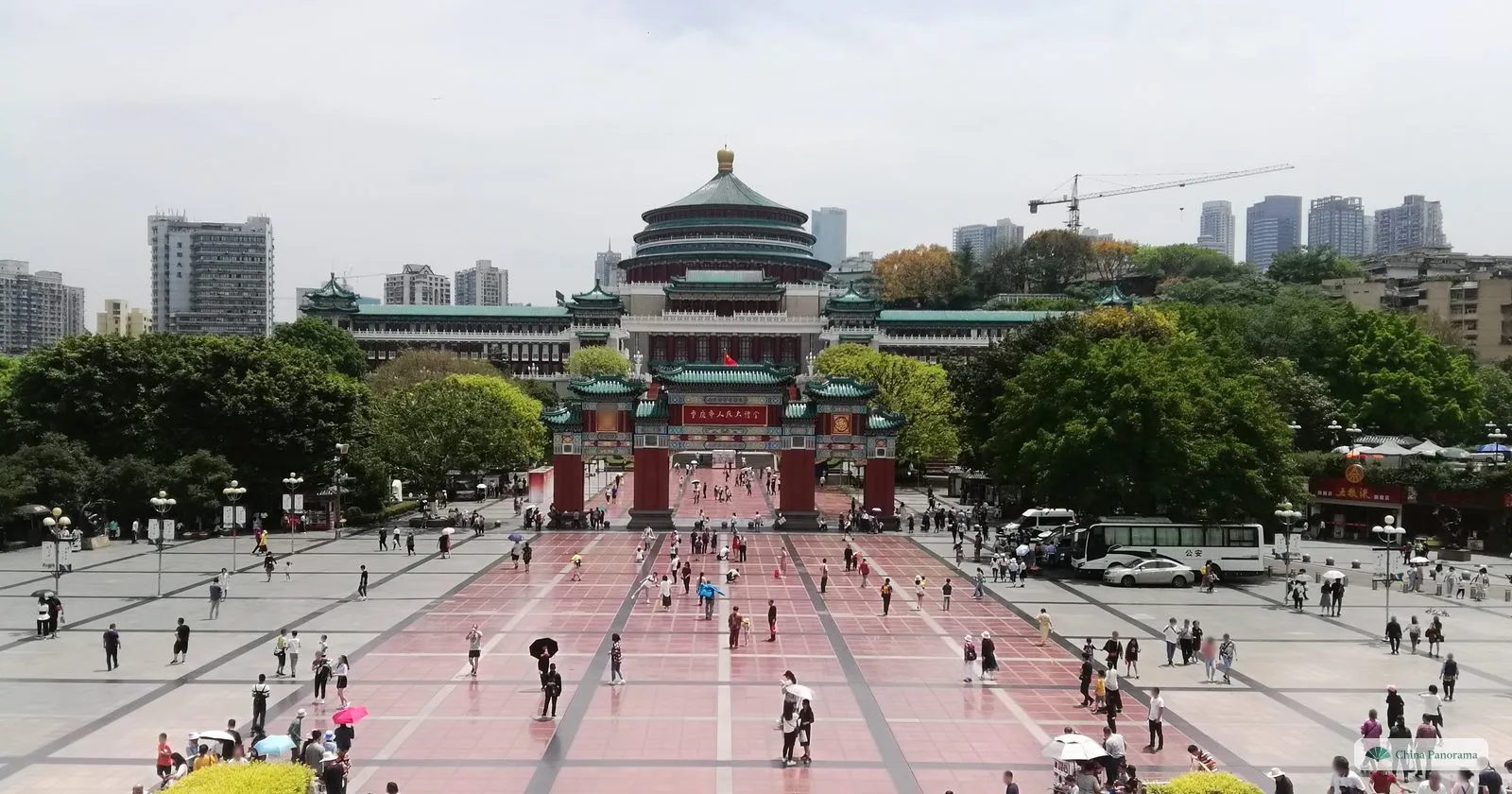
重庆市人民大礼堂ArchitectureYuzhong · 渝中区OutdoorsA palace of green-glazed roofs and red columns on the hill above People's Square, built between June 1951 and April 1954 under the leaders of the party's Southwest Bureau, Liu Bocheng, Deng Xiaoping and He Long. The middle is a round auditorium for 4,200 people under a dome 55 m high; with its triple roof the building is 65 m tall, and it recalls the Hall of Prayer for Good Harvests at the Temple of Heaven in Beijing. It is still the meeting place of the city's People's Congress. The classic view is ours: from the top of the museum steps across the square, at 12:15 on 1 May 2019.
Zengjiayan station (Lines 2 and 10). People's Square in front is free. We have not checked whether or when visitors can go inside the hall, or the price.
- Entry
- Price not verified — check on site
- Opening hours
- Hours not verified — check on site
China Three Gorges Museum
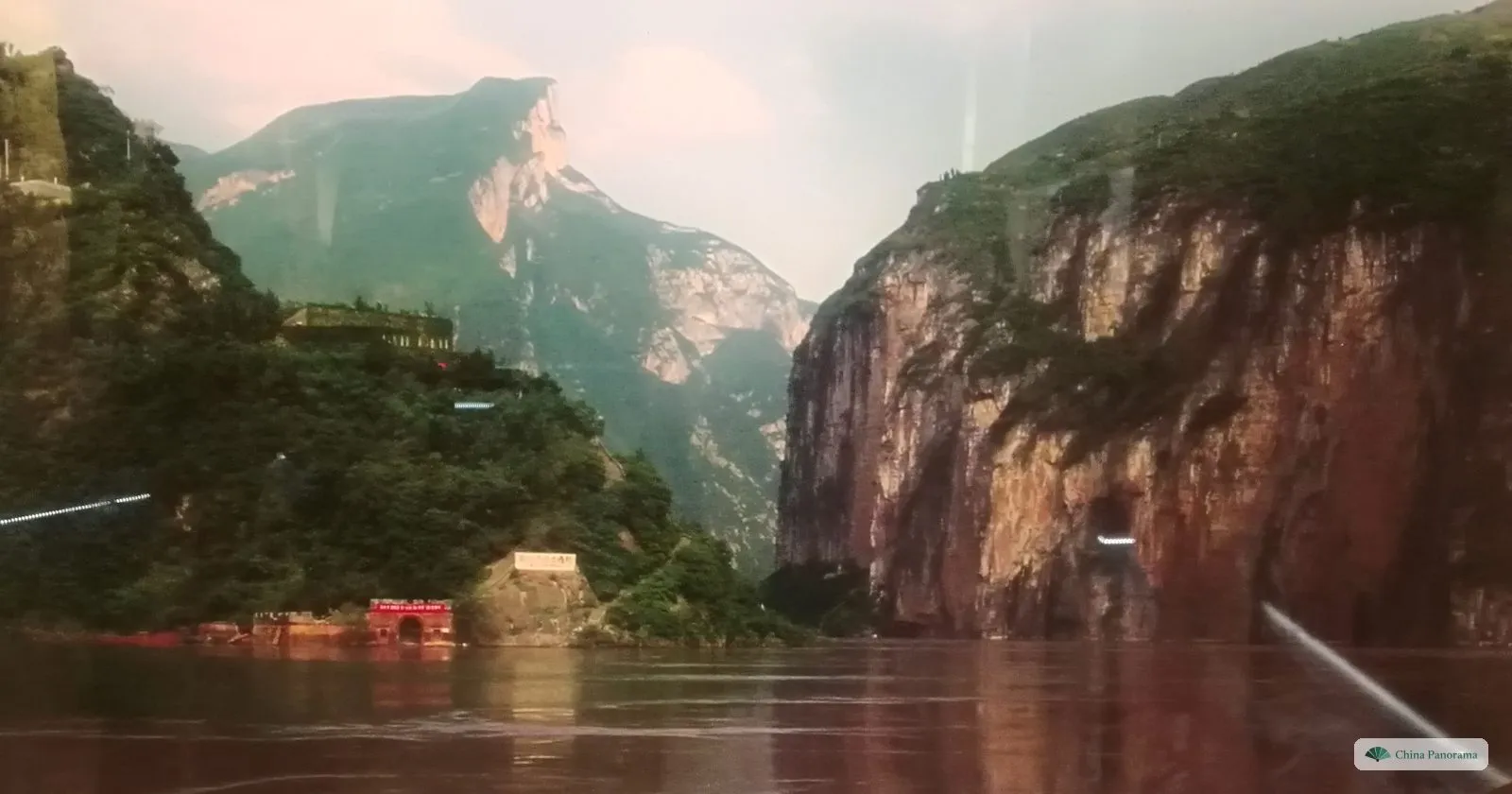
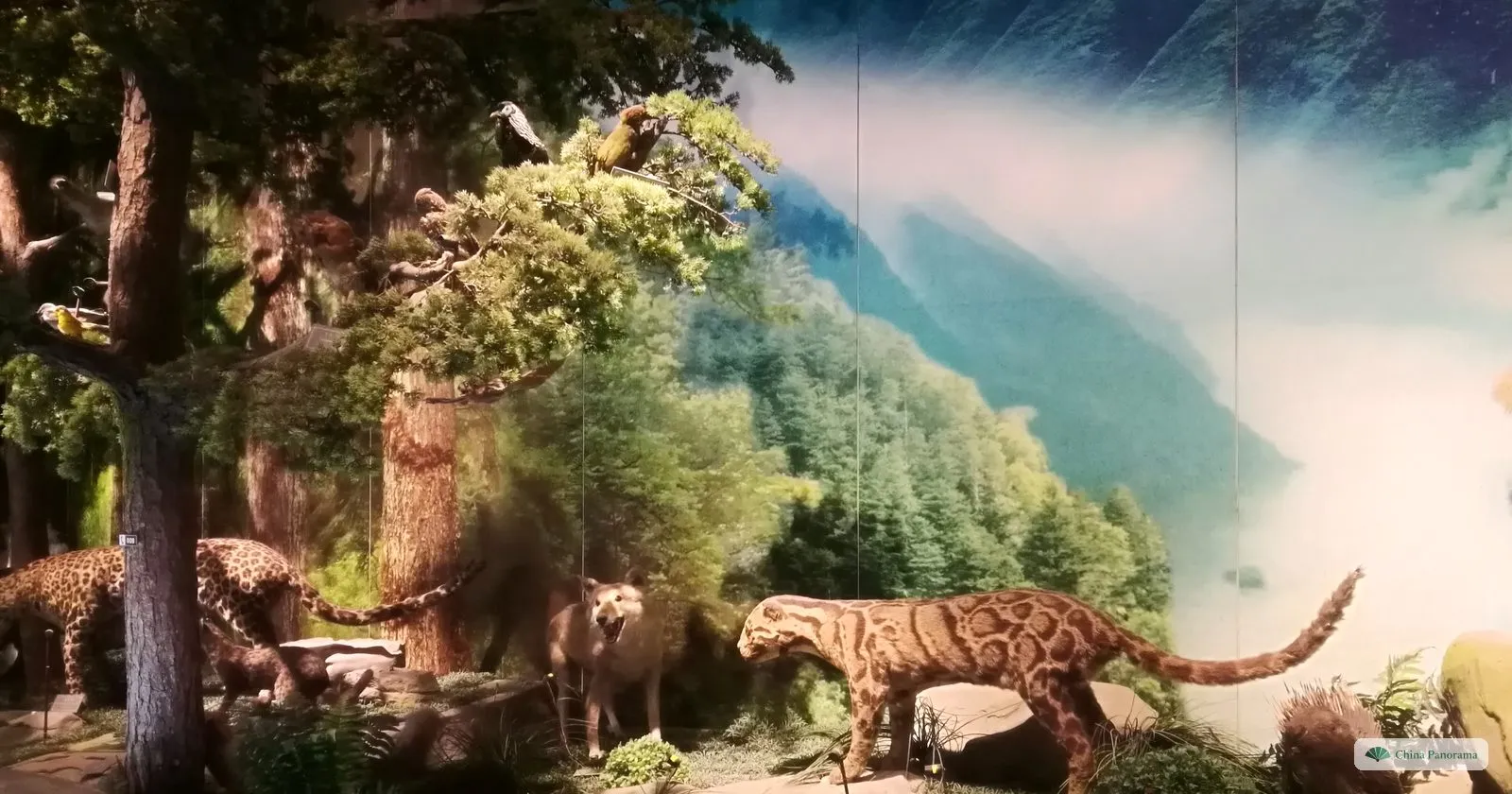
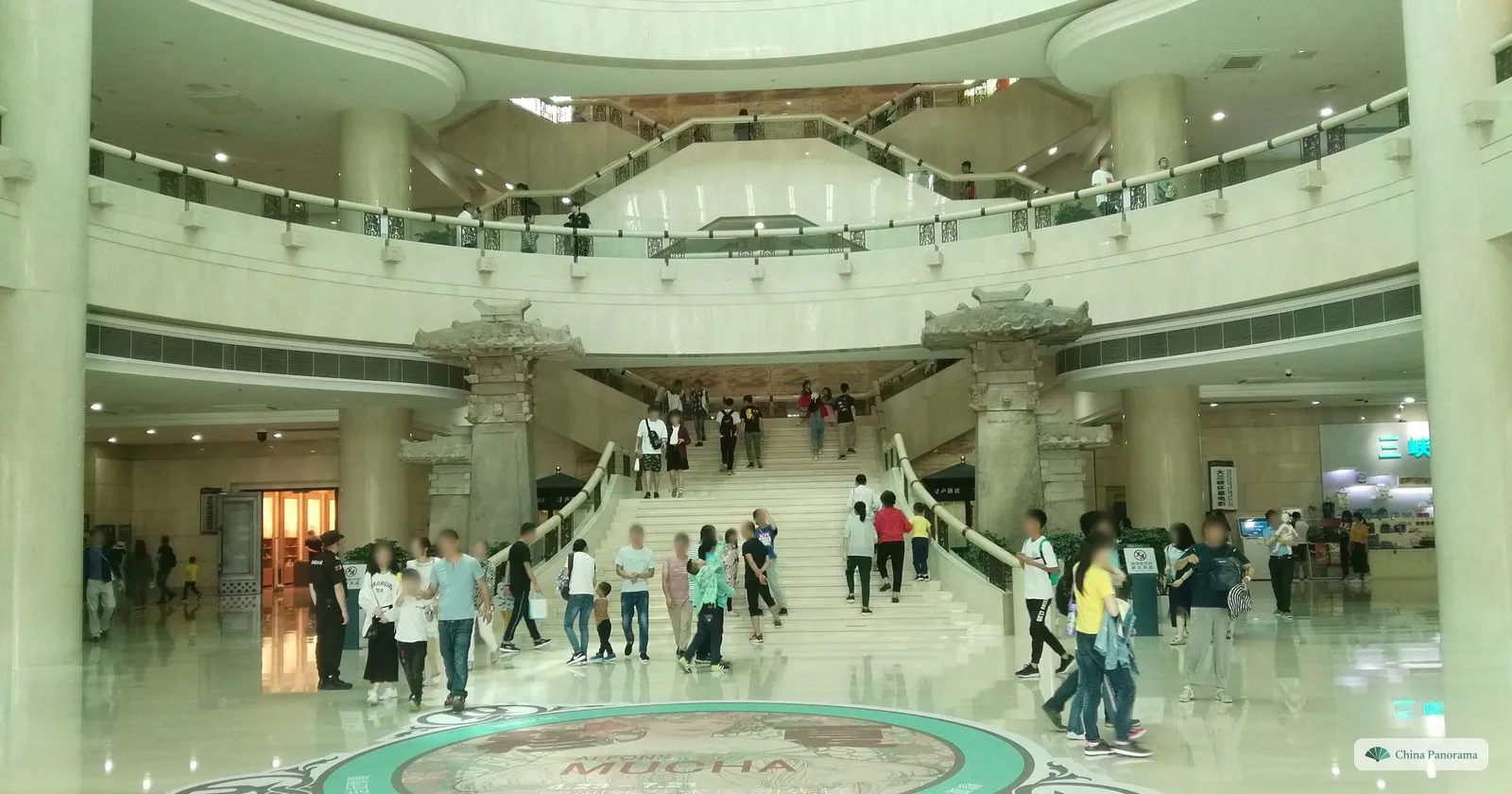
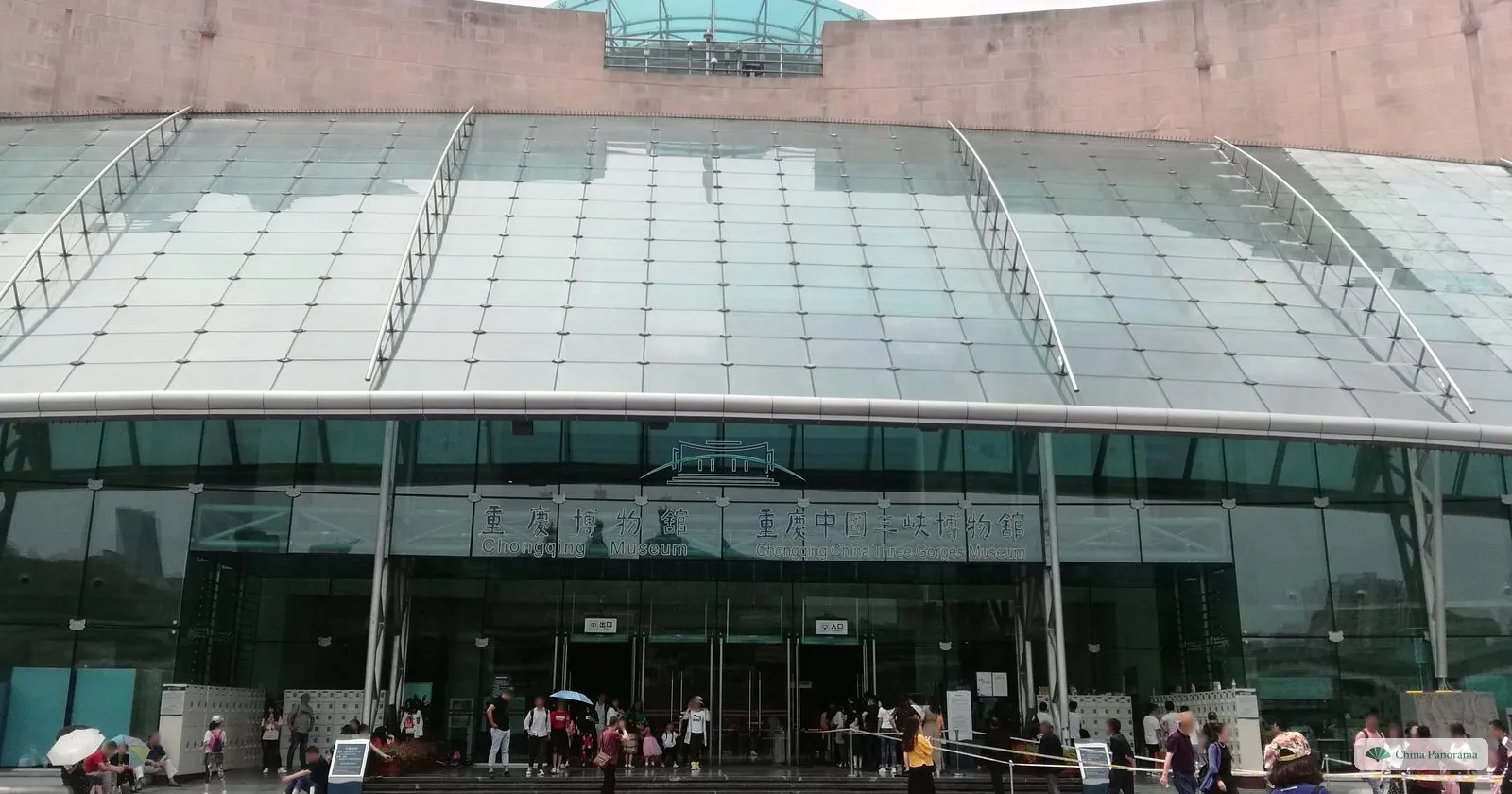
重庆中国三峡博物馆MuseumYuzhong · 渝中区IndoorsThe city museum, opposite the Great Hall across People's Square, opened on 18 June 2005 — the place to understand what the Three Gorges Dam drowned and what was saved from it. Its four main halls are the Magnificent Three Gorges, Ancient Ba-Yu, the Road of the City and the Years of the War of Resistance, when Chongqing was the capital; there are also galleries of painting, porcelain and coins, a 360° cinema and a panorama of the Japanese bombing of the city. Of more than 170,000 objects, over 3,000 graded national treasures come from excavations in the Three Gorges. Our photographs are from the dioramas of the gorges — sailing junks, a cliff road, clouded leopards — at about 12:50 on 1 May 2019.
Zengjiayan station (Lines 2 and 10), exit A. We have not checked whether entry is free, whether you need to reserve with your passport, or the opening hours.
- Entry
- Price not verified — check on site
- Opening hours
- Hours not verified — check on site
Ciqikou old town
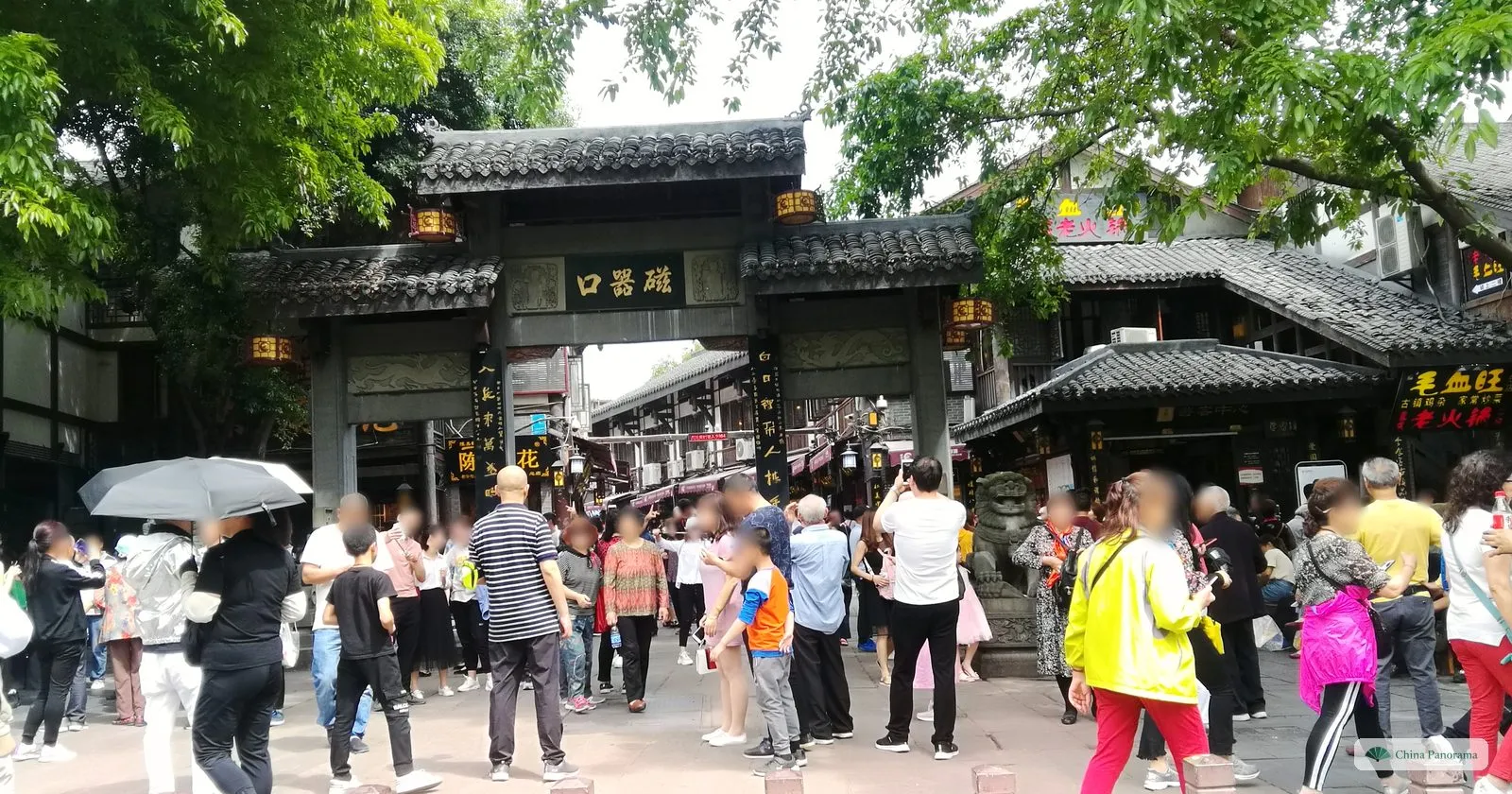
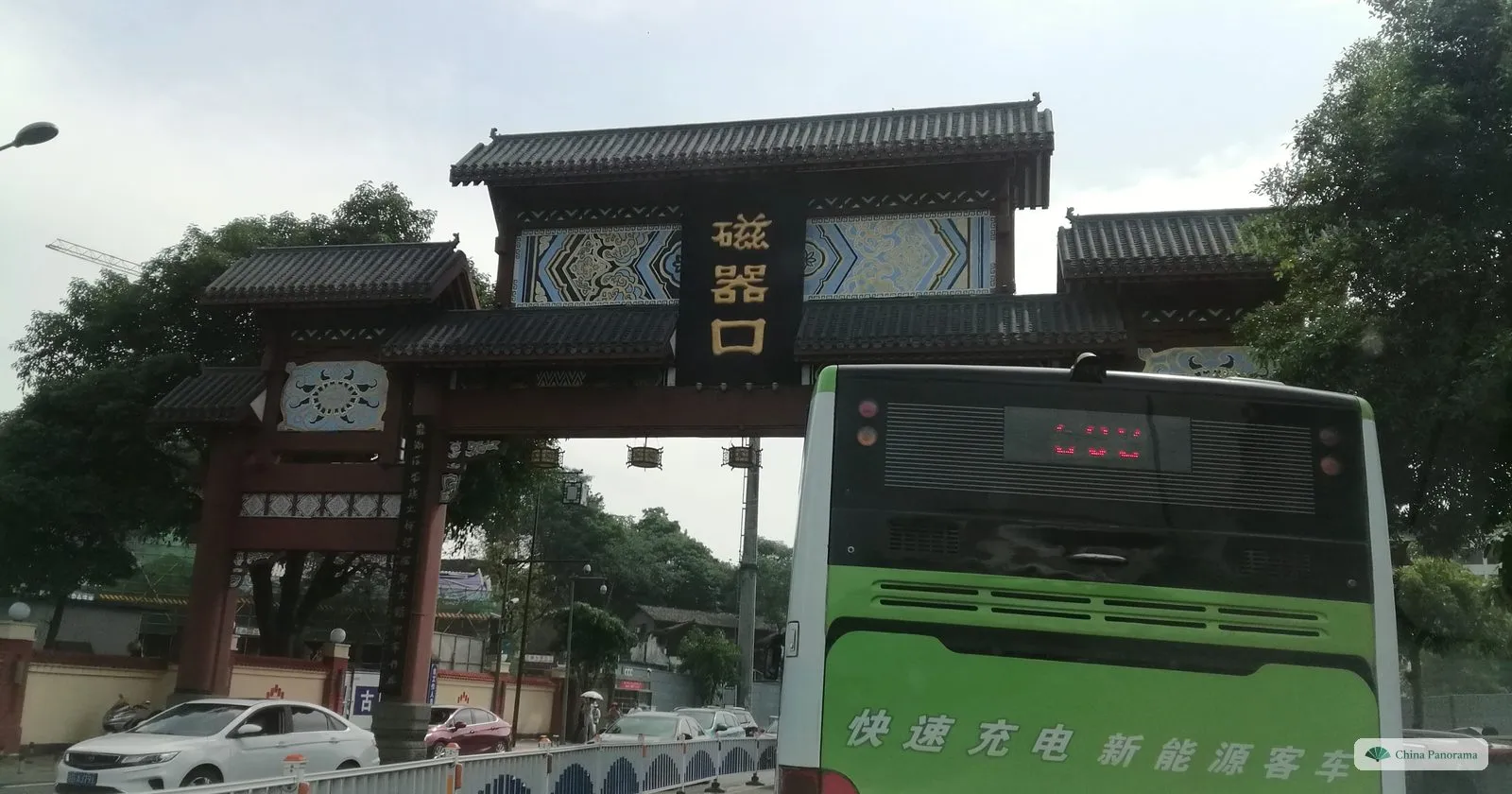
磁器口古镇StreetShapingba · 沙坪坝区OutdoorsA river port on the Jialing about 13 km west of the centre, with twelve lanes of flagstones and wooden houses in the style of the Ming and Qing. Its names tell its story. It was first Baiyan, after the temple on the white cliff above it; then Longyin, “the hidden dragon”, because the Ming emperor Jianwen is said to have hidden in that temple for four or five years after he lost his throne in 1402; and under the Qing, when porcelain became its trade, Ciqikou, “porcelain mouth” — written today with a homophone, 磁. In the war, painters and writers such as Xu Beihong, Guo Moruo and Ba Jin lived here. Today the lanes are a snack market: Chen's mahua, fried dough twists, and stalls of spicy food. At 10:30 on 1 May 2019 the crowd at the main gate was so dense it barely moved.
Ciqikou station (Line 1), then a few hundred metres downhill to the gate. The lanes are free and open at all hours. Come early in the morning or on a weekday: on holidays it is one of the most crowded places in the city.
- Entry
- Free
- Opening hours
- Open at all hours
- LandmarkYuzhong · 渝中区Outdoors
The most photographed metro station in China. Line 2, a monorail, runs straight through a 19-storey residential building on the slope above the Jialing: floors 1 to 5 are shops, floor 6 is the ticket hall, 7 holds the equipment, 8 is the platform, and floors 9 to 19 are flats. The station and the building were designed and built together; it opened in 2004, and the pillars that carry the track do not touch the building's own, so the trains do not shake it. The view is from a public viewing platform on the street below, where people wait for the next train to slide out of the wall.
Liziba station (Line 2), about 4 km west of Jiefangbei — ride through it, then go down to the viewing platform on Liziba Zhengjie. On holidays the police have closed the streets around it to traffic between about 08:00 and 19:00 (Golden Week 2026). We have not checked whether the platform is free or when it is open.
- Entry
- Price not verified — check on site
- Opening hours
- Hours not verified — check on site
- LandmarkYuzhong / Nan'an · 渝中区 · 南岸区Outdoors
A cable car across the Yangtze, opened on 24 October 1987 as everyday transport, when there were few bridges: 1,166 m from Xinhua Road in Yuzhong to Shangxinjie on the south bank, in about four to five minutes. Now that bridges cross the river everywhere it is mainly a ride for the view, of the river and the towers of Yuzhong, and the queues can be long. It has been a protected monument of the city since 2010.
The north station is on Xinhua Road, about ten minutes' walk from Xiaoshizi (Lines 1 and 6); the south station is near Shangxinjie (Loop Line and Line 6). It has been reported closed for about a month a year for maintenance. We have not checked fares or hours.
- Entry
- Price not verified — check on site
- Opening hours
- Hours not verified — check on site
Shibati
十八梯StreetYuzhong · 渝中区Outdoors“Eighteen steps”: the old stairway lane that linked the upper town on the ridge of the peninsula with the lower town by the Yangtze, named, the residents say, for the eighteen flights it was split into to ease the slope. Its houses were cleared, and after nearly four years of rebuilding, with buildings such as the old Salt Guild put back on their original sites at their original height, it opened again in 2021 as a district of restaurants, shops and a museum of old Chongqing. It is the easiest place to see how steep the city is.
From Jiaochangkou station (Lines 1 and 2), at the south end of the Jiefangbei pedestrian streets. We have not checked whether entry is free or the hours.
- Entry
- Price not verified — check on site
- Opening hours
- Hours not verified — check on site
- TempleDazu · 大足区Outdoors
A World Heritage Site since 1999, about 80 km west of the centre in a straight line: some 50,000 Buddhist, Taoist and Confucian figures carved into the cliffs between the 7th and the 13th century, most from the late 9th century on. The two main sites are Baodingshan, a horseshoe-shaped gorge lined with huge painted reliefs — the reclining Buddha, the thousand-armed Guanyin, scenes of the wheel of life and of hell — and Beishan, with smaller, finer niches. It is a full day out from the city.
Usually done as a day trip by train or bus to Dazu and then by local bus or taxi to the sites, or with a car and driver. We have not checked ticket prices, hours or transport.
- Entry
- Price not verified — check on site
- Opening hours
- Hours not verified — check on site
Wulong Karst
武隆喀斯特NatureWulong · 武隆区OutdoorsPart of the South China Karst World Heritage Site since 2007, about 120 km east of the centre in a straight line: the Three Natural Bridges (天生三桥), three huge limestone arches over a gorge, among the largest natural bridges in the world; the Furong Cave; and the Houping sinkholes. The area of the bridges covers about 36 km². Many visitors combine it with the grassland of Xiannüshan nearby.
A long day trip at least, better with a night in Wulong: by train or bus to Wulong, then by shuttle to the sites. We have not checked tickets, hours or transport.
- Entry
- Price not verified — check on site
- Opening hours
- Hours not verified — check on site
Entry prices and opening hours are marked unverified where we have not checked them against an official source. We would rather show a gap than a number we made up.
Routes, and how the city is laid out
The centre is the Yuzhong peninsula, a ridge between the Jialing to the north and the Yangtze to the south, with Jiefangbei in the middle and Chaotianmen at its tip. Everything else is across a river or out along one: Liziba 4 km to the west, Ciqikou 12 km, Chongqing North station 6 km to the north and the airport 20 km. Tap a place to see how far it is.
Tap a place on the map or in the list.
Line 2 through a block of flats. Details below ↓
The main high-speed station: North Square (Lines 4 and 10) and South Square (Loop Line, Lines 3 and 10).
The old river port on the Jialing. Line 1. Details below ↓
Open since June 2025, for the line towards Qianjiang and Zhangjiajie. Line 6.
High-speed and long-distance trains. Loop Line and Line 5.
Jiangbei International Airport. Line 10 from Terminal 3, Line 3 from Terminal 2.
Straight-line distances from Jiefangbei, rounded — not travel distances.
Three routes that don’t double back
An evening walk from Chaotianmen to Hongyadong as the lights come on, an afternoon round the centre of the peninsula, and a morning out west. They follow our photographs, with the time and distance between stops. On the peninsula, “walking” includes a lot of stairs.
An evening · about 3 km on foot
Raffles City and Chaotianmen
Walk 11 min· 800 m
Chaotianmen Square
Walk 18 min· 1.33 km
Hongyadong
Walk 8 min· 620 m
Qiansimen Bridge
4 stops · 37 min walking
An afternoon · about 2.5 km on foot
Jiefangbei
Walk 5 min· 360 m
Guotai Arts Center
Walk 5 min· 360 m
Hongyadong
Walk 8 min· 630 m
Luohan Temple
4 stops · 18 min walking
A morning · about 14 km by car, then 400 m on foot
Ciqikou old town
Taxi 14 min· 14.19 km
Great Hall of the People
Walk 5 min· 400 m
China Three Gorges Museum
3 stops · 5 min walking · 14 min by taxi
Stop by stop
At dusk: Chaotianmen, the bridge and Hongyadong
The walk to do on your first evening, timed for the lights: our evening of 28 April 2024, from the piers at Chaotianmen at 19:36, while it was still light, along the Jialing side of the peninsula to Hongyadong as it lit up, and out onto the Qiansimen Bridge at 20:53. Start about half an hour before sunset.
1Raffles City and Chaotianmen
来福士 · 朝天门Chaotianmen station. Look down at the piers and the meeting of the rivers; our photographs from above pier 8: 19:36. Raffles City lit up at 19:57.
- Entry
- Free
- Hours
- Not verified
Walk 11 min· 800 m
2Chaotianmen Square
朝天门广场The terrace at the tip of the peninsula, with its name in stone. We were here at 20:00, just after dark.
- Entry
- Free
- Hours
- Not verified
Walk 18 min· 1.33 km
3Hongyadong
洪崖洞West along the Jialing to the lit front of Hongyadong. Our photographs: 20:15 to 20:28, from the riverside road and from the terraces.
- Entry
- Free
- Hours
- Shops' hours vary
Walk 8 min· 620 m
4Qiansimen Bridge
千厮门嘉陵江大桥Up to Cangbai Road and out onto the footpath of the bridge, for Hongyadong, Raffles City and Jiangbeizui all at once. Our panorama: 20:53.
- Entry
- Free
- Hours
- Open at all hours
Easy add-ons: The Yangtze River Cableway starts on Xinhua Road, about ten minutes' walk south of Chaotianmen; the night boat tours of the two rivers leave from the piers below the square.
* Walking times and distances are computed from OpenStreetMap walking routes between the stops; the car leg is an OpenStreetMap driving time without traffic — allow about double at busy times. Walking routes on the peninsula include stairs. Clock times are from our own photographs (1 May 2019, 28 April 2024). Stops marked with a star have prices or opening hours we have not checked.
Getting there and around
By air
Chongqing Jiangbei International Airport (CKG) is about 20 km north of Jiefangbei in a straight line, about half an hour by car without traffic. Metro Line 10 runs from Terminal 3 and Line 3 from Terminal 2; for Jiefangbei change to Line 2 at Zengjiayan or Niujiaotuo. We have not checked the timetable or taxi fares.
Schedules and opening hours not yet verified against an official source.
By high-speed train
Chengdu, about 270 km to the west, is the most common connection, with frequent high-speed trains to Chongqing North and Chongqing West. The old Chongqing station at Caiyuanba, on the Yangtze below the centre, has been closed since June 2022 for rebuilding. We have not checked journey times against the 12306 timetable.
Schedules and opening hours not yet verified against an official source.
By river
Chongqing is the upstream end of the Yangtze cruises through the Three Gorges, which run between the piers at Chaotianmen and Yichang near the Three Gorges Dam over several days. We have not checked operators, schedules or prices.
Schedules and opening hours not yet verified against an official source.
Nonstop from Europe
Our flight list has nonstop routes to Chongqing from 6 European airports: Brussels, Budapest, London Heathrow, Madrid, Milan, Paris. From elsewhere, most travellers change in Beijing, Shanghai, Guangzhou or Chengdu. Airlines and frequencies →
Flight data checked 12 September 2026.
Three stations called Chongqing
Your train ticket will name one of these. They are far apart.
- Chongqing North 重庆北站The main high-speed station, about 6 km north of Jiefangbei. It has two sides with different metro lines: the North Square (Lines 4 and 10) and the South Square (Loop Line, Lines 3 and 10). Check which square your train leaves from.
- Chongqing West 重庆西站A large station about 15 km south-west of Jiefangbei, for high-speed and long-distance trains. Loop Line and Line 5.
- Chongqing East 重庆东站The newest, about 12 km south-east of Jiefangbei, open since 27 June 2025 for the high-speed line towards Qianjiang, Zhangjiajie and Xiamen. Line 6.
The metro, in short
How Chinese metros work →The city calls it rail transit (轨道交通), not metro, because two of its lines are monorails: Line 2, the oldest, which runs through the building at Liziba, and Line 3, from the airport through the centre to the south. In the hills the rest is tunnel, bridge and very deep stations. For a visitor four lines do most of the work: Line 1 runs west from Chaotianmen through Xiaoshizi and Jiaochangkou to Ciqikou; Line 2 from Jiaochangkou along the Jialing through Linjiangmen, Zengjiayan (Great Hall and Three Gorges Museum) and Liziba; Line 10 from the airport's Terminal 3 through Chongqing North to Zengjiayan; and Line 6 from Xiaoshizi across the lower deck of the Qiansimen Bridge.
- Lines
- 12incl. Loop and two suburban lines
- Fare
- 2–10 CNYfirst 6 km 2 CNY
- Network
- about 271 stationsabout 580 km (reported)
- Pay with
- Alipay / WeChat codeforeign cards at the gates: not confirmed
We found no official notice, as of October 2026, that the gates take contactless bank cards issued abroad, as they now do in Beijing, Shanghai, Guangzhou, Shenzhen and Chengdu; travel guides report that they do not, but that staffed ticket windows accept foreign cards for tickets. The transport code in Alipay or WeChat works at the gates, and machines sell single-journey tickets. We have not tested a foreign card ourselves.
Fares by distance: 2 CNY up to 6 km, 3 CNY up to 11 km, 4 CNY up to 17 km, 5 CNY up to 24 km, 6 CNY up to 32 km, 7 CNY up to 41 km, 8 CNY up to 51 km, 9 CNY up to 63 km. Beyond 63 km the fare is 10 CNY, the maximum. A ride across the centre, under 11 km, costs 2–3 CNY.
First and last trains differ by line and station; we have not checked them against the operator's timetable — look at the display in the station.
| Hongyadong, Qiansimen Bridge | Xiaoshizi 小什字 | Lines 1/6 |
| Hongyadong (top floor, Cangbai Road) | Linjiangmen 临江门 | Line 2 |
| Jiefangbei, Shibati | Jiaochangkou 较场口 | Lines 1/2 |
| Luohan Temple | Xiaoshizi 小什字 | Lines 1/6 |
| Chaotianmen, Raffles City | Chaotianmen 朝天门 | Line 1 |
| Great Hall of the People, Three Gorges Museum | Zengjiayan 曾家岩 | Lines 2/10 |
| Liziba (the train through the building) | Liziba 李子坝 | Line 2 |
| Ciqikou old town | Ciqikou 磁器口 | Line 1 |
| Yangtze River Cableway (south end) | Shangxinjie 上新街 | Lines Loop/6 |
| Airport, Terminal 3 | Jiangbei Airport T3 江北机场T3航站楼 | Line 10 |
| Airport, Terminal 2 | Jiangbei Airport T2 江北机场T2航站楼 | Lines 3/10 |
| Chongqing North station, North Square | Chongqing North Railway Station North Square 重庆北站北广场 | Lines 4/10 |
| Chongqing North station, South Square | Chongqing North Railway Station South Square 重庆北站南广场 | Lines Loop/3/10 |
| Chongqing West station | Chongqing West Railway Station 重庆西站 | Lines Loop/5 |
Station names are pinyin (Xiaoshizi, Jiaochangkou, Linjiangmen, Zengjiayan). Many stations are deep under the hills or high on the slopes, with long escalators and lifts: allow a few extra minutes to get from the street to the platform. Hongtudi (Lines 6 and 10) is about 94 m underground, Hongyancun (Lines 5 and 9) about 116 m.
Source and date: Fare bands: the fare scale of the city's rail transit as restated by the Chongqing Development and Reform Commission for the Line 6 east extension, Chongqing Daily, 23 March 2025. Network: Wikipedia, 12 lines in its table of lines in operation, 271 stations and about 580 km, with openings up to 10 February 2026 — its own totals differ slightly, so we mark them as reported. Foreign bank cards: no official notice found on 13 October 2026. Depth of Hongtudi and Hongyancun stations: press reports. First and last trains: not checked.
Chongqing is one of the cities we price up on the trip cost calculator, if you want to model a budget.
Before you go
Most European passports are visa-free for a short trip — under a one-sided waiver with an end date worth checking before you book:
- UK passport
Visa-free up to 30 days per trip, currently until 31 December 2026.
- EU passports
Dutch, German, French, Irish, Nordic and most other EU passports: visa-free up to 30 days, currently until 31 December 2026.
- US passport
No general waiver: a visa, or the 10-day visa-free transit if you travel on to a third country.
China’s 10-day visa-free transit applies at designated entry ports, for travellers continuing to a third country. Check your passport.
- Set up Alipay
You will need its transport code for the Chongqing metro gates.
- How to eat hot pot
Broths, spice levels, sauces and what to order — Chongqing’s own dish.
- The arrival card
Fill it in online, or practise the paper form, before you land.
- Pre-trip checklist
Payments, SIM, apps — the things to sort before you fly.
- Zhangjiajie
The sandstone pillars, 380 km east — often the next stop.
- Golden Week
Why 1–7 October is the worst week for Hongyadong and Ciqikou.
FAQ
What are the best things to do in Chongqing?
Walk from Chaotianmen, where the Jialing meets the Yangtze, to Hongyadong as the lights come on, and out onto the Qiansimen Bridge for the view back; ride Line 2 through the building at Liziba; see the Three Gorges Museum and the Great Hall of the People across the square from it; wander the lanes of Ciqikou early in the morning; and eat hot pot. With a spare day, go to the Dazu Rock Carvings or the Wulong Karst, both World Heritage Sites.
Is Chongqing worth visiting?
Yes, for two or three days. No other big Chinese city looks like it: towers on steep hills between two rivers, streets stacked on top of each other, bridges everywhere and the city lit up at night. It has fewer old monuments than Beijing or Xi’an, but the Three Gorges Museum, the wartime history and the food make up for it, and it is the starting point for Yangtze cruises.
How many days do you need in Chongqing?
Two to three. One evening for Chaotianmen, Hongyadong and the Qiansimen Bridge; a day for Jiefangbei, the Great Hall, the Three Gorges Museum and Liziba; a morning in Ciqikou. Add a day each for Dazu or Wulong.
Why is Chongqing called an 8D city?
Because the city is built on such steep hills that “ground floor” stops making sense. Hongyadong has a street at its 1st floor and another at its 11th; Line 2 runs through floors 6 to 8 of a 19-storey block of flats at Liziba; and some metro stations are dug almost 100 m into the hills — Hongtudi about 94 m, Hongyancun about 116 m. Map apps often get you to the right building on the wrong level.
When is the best time to see Hongyadong?
After dark, when the whole front is lit gold — but that is when everyone comes, and on holidays the entrances have been controlled. Go on a weekday, arrive at dusk, and come in from the top, at Cangbai Road on the 11th floor, walking down to the riverside road for the view of the front. Entry to the complex itself is free.
Do I need a visa for Chongqing?
Not for a short trip on a British, Irish, Dutch, German, French, Nordic or Australian passport: all are visa-free for up to 30 days per trip, under a one-sided waiver that currently runs until 31 December 2026. US passport holders have no general waiver; the 10-day visa-free transit applies only at designated entry ports and only if you travel on to a third country. Check your own passport on our visa check page.
Can I pay for the Chongqing metro with a credit card?
Not at the gates, as far as we can tell: we found no official notice, as of October 2026, that they take foreign bank cards, and travel guides say they do not. Staffed ticket windows are reported to accept foreign cards for tickets, and the transport code in Alipay or WeChat works at the gates. Fares run by distance, from 2 CNY for the first 6 km to 10 CNY.
How do I get from Chongqing airport to the city?
Take Metro Line 10 from Terminal 3, or Line 3 from Terminal 2, and change to Line 2 at Zengjiayan or Niujiaotuo for Jiefangbei. A taxi is about 20 km in a straight line and about half an hour without traffic. We have not checked the timetable or taxi fares.
When is the best time to visit Chongqing?
April, May, October and November: April averages 25 °C by day and October 23 °C. Summer is among the hottest in China, 36 °C by day in July, and winter is damp and grey at 11 °C, with fog on many mornings. Avoid May Day (1–5 May) and Golden Week (1–7 October), when Hongyadong and Ciqikou are packed.
How far is Chongqing from Chengdu?
About 270 km in a straight line. High-speed trains run frequently between the two cities, to Chongqing North and Chongqing West; we have not checked journey times against the timetable.
Is Chongqing a province?
No: it is one of China’s four municipalities directly under the central government, with Beijing, Shanghai and Tianjin, since it was separated from Sichuan on 14 March 1997. The municipality covers 82,403 km², about the size of Austria, and had 32 million people in the 2020 census — but most of that is countryside. The city most visitors see is the area round the two rivers.
Is Chongqing food very spicy?
Often, yes: Chongqing hot pot and noodles use both chilli and Sichuan pepper, which numbs the lips. You can ask for mild (微辣, wēi là) or a split pot with one spicy and one plain broth (鸳鸯锅, yuānyang guō). Our hot pot page explains how to order.
Can I take a Yangtze cruise from Chongqing?
Yes. Chongqing is the upstream end of the Three Gorges cruises, which leave from the piers at Chaotianmen and take several days to Yichang near the Three Gorges Dam. We have not checked operators, schedules or prices.
Sources and status
All photographs on this page are ours: Ciqikou, the Great Hall, the Three Gorges Museum, Jiefangbei, the Guotai Arts Center, Hongyadong by day and Luohan Temple on 1 May 2019, the first day of the May Day holiday; Chaotianmen, Raffles City, Hongyadong at night and the Qiansimen Bridge on the evening of 28 April 2024. The museum pictures are of its dioramas and painted panoramas. Faces of passers-by have been blurred. Data sources: Monthly temperature data, Chongqing; Chongqing (Wikipedia): area, 2020 census, municipality since 1997, wartime capital, fog, city flower; Hongyadong: opened 29 September 2006, 11 floors (Wikipedia, Chinese); Hongya Cave (Wikipedia); Jiefangbei: the Spirit Fortress of 1941, the 27.5 m monument (People's Daily, Chinese); Qiansimen Jialing River Bridge, opened 29 April 2015 (Wikipedia, Chinese); Chaotianmen Yangtze River Bridge, 552 m arch span, 2009 (Wikipedia, Chinese); Chongqing Grand Theatre, gmp, 2009 (Wikipedia, Chinese); Raffles City Chongqing (Wikipedia); Guotai Arts Center: designed 2005, completed 2013, the dougong form (Cui Kai studio, China Architecture Design Group); Guotai Arts Center: theatre with 802 seats (China Daily); Luohan Temple, Chongqing (China's Key Temples); Great Hall of the People, Chongqing (Wikipedia); China Three Gorges Museum: opened 18 June 2005, halls and collection (Wikipedia, Chinese); Ciqikou: names, the Jianwen emperor, twelve lanes (Wikipedia, Chinese); Liziba station: floors 1–5 shops, 6–8 rail, 9–19 flats (The Paper, Chinese); Traffic control at Liziba in Golden Week 2026 (Guangming Daily, Chinese); Yangtze River Cableway: 1987, 1,166 m (The Paper, Chinese); Shibati reopened, 2021 (Chongqing Daily, Chinese); Dazu Rock Carvings (Wikipedia); Wulong and the South China Karst, World Heritage 2007 (Chongqing Daily, Chinese); Chongqing Rail Transit (Wikipedia, Chinese); Chongqing rail transit fares by distance (Guangming Daily, after Chongqing Daily, Chinese); China's deepest metro station, Hongtudi, 94 m (China Daily); Chongqing East station opened 27 June 2025 (Xinhua, Chinese).
Changelog (1)
- 2026-10-13Page created, with our own photographs from 1 May 2019 and 28 April 2024. No entry price on this page could be checked against an official source on this date. Metro fares: the city’s published distance scale (March 2025); payment at the gates with foreign bank cards: no official notice found.