
- Type
- Loyal and brave like every Dog, and the 1 adds a strong urge to lead and go its own way. Like the big brother of the team: decides fast and opens new paths. Can be too self-centred and deaf to other views.
- Talents
- A born pioneer with lots of drive and inventiveness. Leads the way even on unknown ground and takes centre stage without trying.
- In love
- Likes to call the shots in love and protects the partner with all its heart. Now and then plays the boss, and the partner needs some patience.
- At work
- Your own business, management, anywhere a sharp eye and quick decisions carry a team to success.
Last verified: 12 Nov 2026
Chinese Zodiac Dog: Meaning, Personality, Years and the Year of the Dog 2030
The Dog 狗 gǒu is the eleventh of the twelve Chinese zodiac animals. It stands for loyalty, honesty and fairness, the friend who guards the house and never lets anyone down. The next Year of the Dog starts on 3 February 2030, a Metal Dog, and lasts until 22 January 2031. Below you will find every Dog year, the five Dogs by element, two dogs from a New York museum, the 1982 Dog stamp and a game with your life number.
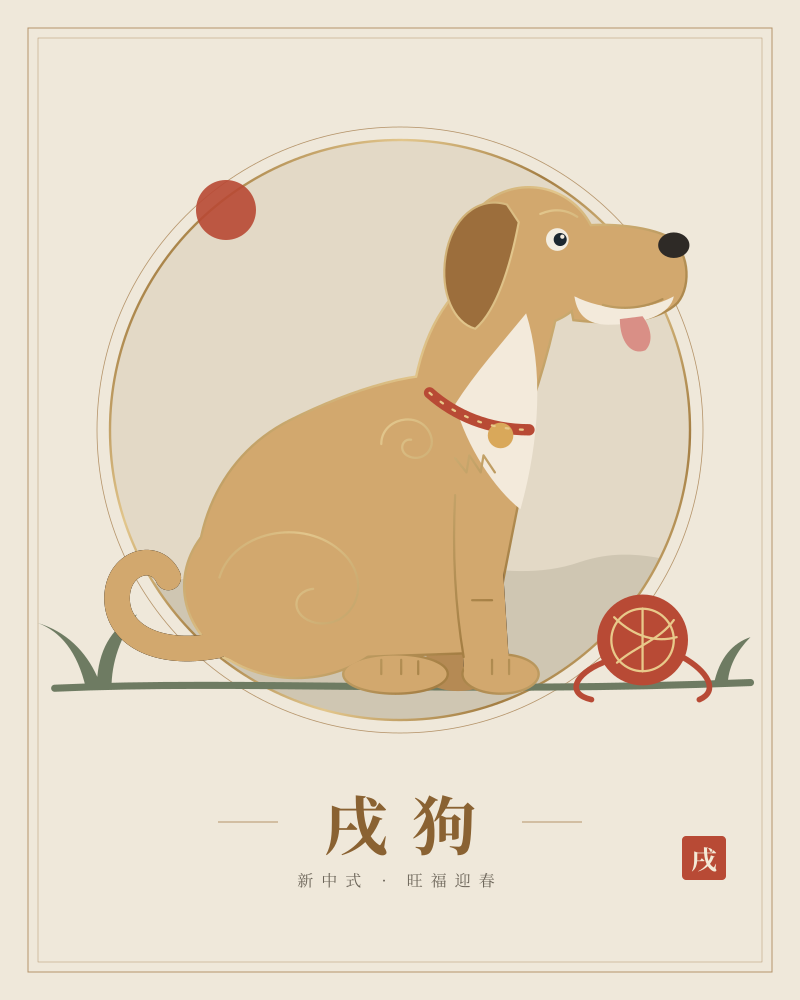
Profile: the Dog in the Chinese zodiac
- Character
- 狗 gǒu
- Earthly branch
- 戌 xū, number 11 of 12
- Double hour
- 7 to 9 pm
- Direction
- West-northwest
- Element of the branch
- Earth
- Month
- early October to early November
- Good match
- Tiger, Horse, Rabbit
- Opposite
- Dragon
Each of the twelve earthly branches has an animal. The Dog has the branch 戌 xū, which stands for late evening, the west-northwest and the end of autumn. It belongs to the element earth, and the time from 7 to 9 pm is still called 戌时 xūshí. Why the animal has nothing to do with your Western star sign is explained in the comparison of Chinese and Western zodiac.
Meaning and personality of the Chinese zodiac Dog
What people in China say about the Dog comes from the farmyard: it guards the house at night, stays with its people even when times are bad and barks at every stranger. Add the pun 汪 wāng, the bark, like 旺 wàng, to thrive. That is folk belief, not a personality test, but it explains why Dog people in China are thought of as loyal and reliable.
Strengths
- loyal, stands by friends and family
- honest and fair, hates injustice
- helpful and dutiful
- reliable, keeps its word
- brave when it comes to protecting others
Weaknesses
- distrustful of strangers
- stubborn when it feels in the right
- quick to worry
- can turn sharp when it smells injustice
The Dog in love
In love the Dog counts as one of the most faithful in the whole zodiac. It takes time to trust someone, but then stands by its partner whatever happens. Steadiness suits it better than grand gestures, and it finds dishonesty hard to forgive. By classical teaching the Tiger, Horse and Rabbit suit it best, the Dragon is its opposite. All twelve animals compared are further down.
The Dog woman and the Dog man
Chinese tradition does not distinguish the zodiac animal by gender. Horoscope sites like to describe the Dog woman as warm-hearted, direct and loyal, the friend you can call at night. They paint the Dog man as honest, protective and a little reserved, with a strong sense of justice. These are the same traits as above, just shared out differently.
Lucky numbers and colours
Many horoscope sites give the Dog the lucky numbers 3, 4 and 9 and the colours red, green and purple. There is no old Chinese source for that. The only fixed point: the branch 戌 belongs to earth, and the colour of earth in the five elements is yellow 黄 huáng. Which colour your birth year has is shown under the five Dogs.
Which years are Dog years? Every one from 1934 to 2030
The Chinese year does not start on 1 January but with the New Year festival, between 21 January and 20 February. If you were born in a Dog year in January or February, check the exact days: before New Year it is still the Rooster.
| Year | Starts | Ends | Dog | Stem and branch |
|---|---|---|---|---|
| 1934 | 14 February 1934 | 3 February 1935 | Wood Dog | 甲戌 |
| 1946 | 2 February 1946 | 21 January 1947 | Fire Dog | 丙戌 |
| 1958 | 18 February 1958 | 7 February 1959 | Earth Dog | 戊戌 |
| 1970 | 6 February 1970 | 26 January 1971 | Metal Dog | 庚戌 |
| 1982 | 25 January 1982 | 12 February 1983 | Water Dog | 壬戌 |
| 1994 | 10 February 1994 | 30 January 1995 | Wood Dog | 甲戌 |
| 2006 | 29 January 2006 | 17 February 2007 | Fire Dog | 丙戌 |
| 2018 | 16 February 2018 | 4 February 2019 | Earth Dog | 戊戌 |
| 2030next | 3 February 2030 | 22 January 2031 | Metal Dog | 庚戌 |
New Year dates in China time, each checked against the astronomical new moon. All the other animals and a finder for any birthday since 1924 are in the overview of the twelve Chinese zodiac signs.
The five Dogs: Metal Dog 1970, Water Dog 1982, Wood Dog 1994, Fire Dog 2006, Earth Dog 2018
The same Dog comes back every 60 years, because the twelve animals are joined by ten heavenly stems that give each year an element. So there are five kinds of Dog. You can tell the element from the last digit of the year: 0 metal, 2 water, 4 wood, 6 fire, 8 earth. How the elements fit together is explained on the page about the five elements.
 木狗
Wood Dog1934 · 1994
- Stem and branch:
- 甲戌
- How stem and branch get on:
- 木克土, wood over earth: wood drains the earth
- Nayin:
- 山头火 shān tóu huǒ, “fire on the mountain top” (fire)
- Colour of the element:
- 青 blue-green
 火狗
Fire Dog1946 · 2006
- Stem and branch:
- 丙戌
- How stem and branch get on:
- 火土相生, fire over earth: fire feeds earth
- Nayin:
- 屋上土 wū shàng tǔ, “earth on the roof” (earth)
- Colour of the element:
- 赤 red
 土狗
Earth Dog1958 · 2018
- Stem and branch:
- 戊戌
- How stem and branch get on:
- 土旺, earth over earth: twice as strong
- Nayin:
- 平地木 píng dì mù, “wood on the plain” (wood)
- Colour of the element:
- 黄 yellow
 金狗
Metal Dog1910 · 1970 · 2030
- Stem and branch:
- 庚戌
- How stem and branch get on:
- 土金相生, metal over earth: earth feeds metal
- Nayin:
- 钗钏金 chāi chuàn jīn, “metal of hairpins and bracelets” (metal)
- Colour of the element:
- 白 white
 水狗
Water Dog1922 · 1982 · 2042
- Stem and branch:
- 壬戌
- How stem and branch get on:
- 土克水, water over earth: earth dams water
- Nayin:
- 大海水 dà hǎi shuǐ, “water of the great sea” (water)
- Colour of the element:
- 黑 black
The branch 戌 is itself earth, a dry earth at the end of autumn which, by the teaching, stores fire: with the Tiger and the Horse the Dog forms the fire triangle. Chinese horoscope charts therefore look at how the year’s element fits in: in the Fire Dog fire feeds earth, which counts as harmonious, in the Wood Dog wood drains the earth, and in the Earth Dog the earth is twice as strong. Often they add a second element, the nayin 纳音 nàyīn. It comes from the teaching of the 60 pairs that fortune-tellers use and has vivid names such as “water of the great sea”. But when someone in China talks about a Water Dog, they almost always mean the element of the heavenly stem, the one in the table above.
The Dog in 2026, 2027 and 2030: Horse, Goat and the white Metal Dog
2026: Year of the Horse
The Horse and the Dog belong to the same triangle 三合, the fire triangle. The Year of the Horse, which lasts until 5 February 2027, is therefore seen as friendly to the Dog. Chinese horoscope charts also work with the elements: 丙午 is double fire, and fire feeds the earth of the branch 戌. They rate the year especially well for the Earth Dog (1958, 2018) and as harder work for the Metal Dog (1970), because fire melts metal.
2027: Year of the Goat
The Dog is in tension with the Goat: the teaching counts both in the “threefold punishment” 三刑 and in a break 破. Many Chinese almanacs therefore list the Dog in 2027 among the animals at odds with the year god 太岁 tàisuì, though less so than the Ox, which sits opposite the Goat. Those who believe in it wear something red from 6 February 2027 to 25 January 2028. More on the year of the Fire Goat is on the Goat page.
2030: What colour is the Year of the Dog?
White. Every year gets an element from its heavenly stem. In 2030 it is 庚 gēng, yang metal, and in the five elements metal has the colour white 白 bái. Because the earth of the branch 戌 feeds metal, 庚戌 counts as a well-matched pair. The last Dog, in 2018, was an Earth Dog and so yellow. Other “lucky colours” for 2030 you find online differ from site to site.
狗 or 犬? Two words for dog
In everyday speech people say 狗 gǒu, and that is also the name of the zodiac sign. The older word 犬 quǎn lives on in many idioms and in terms such as 警犬 jǐngquǎn, “police dog”, or in breed names such as 北京犬, the Pekingese. As part of a character it turns into 犭 and appears in almost all animal names, in 狗 itself, in 猫 “cat” or in 狮 “lion”.
If you are a Dog yourself, 2030 is your own year, your 本命年 běnmìngnián. That covers everyone turning 12, 24, 36, 48, 60, 72 or 84 in 2030. Your own year is traditionally seen as a tricky one, so many Dogs wear something red from 3 February 2030 to 22 January 2031: red socks, underwear or a red bracelet, ideally a gift from a partner or parents. How the New Year festival goes is shown on the page about Chinese New Year 2027.
Game: what does your life number say about you as a Dog?
Charts on Chinese social media link the Dog with the life number 生命数字 shēngmìng shùzì: nine Dog types with strengths, weaknesses, love and work. This is how you work out your number: add up all the digits of your date of birth until only one is left. For 29 July 1982 that is 2 + 9 + 0 + 7 + 1 + 9 + 8 + 2 = 38, then 3 + 8 = 11 and 1 + 1 = 2. Try it with your own birthday:
✓ A Dog. Born in the Year of the Water Dog 壬戌, which began on 25 January 1982.
Play along: add up all the digits until only one is left
- Step 1:1982072938
- Step 2:3811
- Step 3:112
Your life number is 2.
See another number:
- Type
- The Dog’s loyalty and the 2’s gentleness make this person the glue of any group. Works superbly with others, listens well and understands people. Sometimes leans too much on other people’s opinions and hesitates over decisions.
- Talents
- A fine feel for emotions, settles quarrels easily and keeps the team in harmony.
- In love
- Longs for a soulmate, loves sharing every little thing of the day and is a tender, attentive partner. Sometimes gives in too much and loses itself.
- At work
- Public relations, customer service, human resources, jobs with lots of contact with people.
- Type
- The Dog’s liveliness and the 3’s gift of expression make a little sun: full of enthusiasm, with lots of ideas and a lively way of telling them. Acts on impulse, though, and speaks before thinking.
- Talents
- Bursting with creativity, turns a grey day colourful and is the team’s ideas person.
- In love
- Romantic and passionate, always good for a surprise. But can revolve too much around itself and miss how the partner feels.
- At work
- Advertising, art and design, sales, jobs where ideas and a way with words count.
- Type
- The Dog’s groundedness and the 4’s care go well together: works clearly, step by step, and is very reliable. Sometimes too cautious and slow to try something new.
- Talents
- A strong organiser who untangles complicated things and keeps a team running smoothly.
- In love
- Values security and stability, gives the partner a firm footing, financially too, and stays loyally at their side. Everyday life can get a little dull.
- At work
- Project management, finance, logistics and administration, work that needs an eye for detail.
- Type
- The Dog’s courage meets the 5’s love of freedom: loves adventure, hates being tied down, thinks flexibly and always finds a new way. Can be too fickle to see things through.
- Talents
- Adapts in a flash, sees the chance in every change and happily breaks old habits.
- In love
- Needs lots of space and gives the partner plenty too. But loves freedom so much that the partner sometimes feels insecure.
- At work
- Sales, tourism, expeditions, jobs full of challenge and variety.
- Type
- The Dog’s loyalty and the 6’s sense of responsibility make a kind, helpful person who is there for family and friends and warms everyone around. Sometimes gives so much that its own needs come up short.
- Talents
- Great empathy: senses how others feel and cares for them just right. The team’s emotional anchor.
- In love
- Gives everything and looks after the partner in every way, the ideal companion. Just has to take care not to lose itself.
- At work
- Education, medicine, charity, jobs that need heart and responsibility.
- Type
- The Dog’s alertness and the 7’s research spirit make someone who loves to think, sees through a lot and looks for knowledge and truth. Sees what lies behind things, but can come across as cool and distant.
- Talents
- Analyses and researches in depth, digs into one field and becomes an expert in it.
- In love
- Looks for someone to have deep conversations with, a meeting of minds matters most. Can be too choosy and miss chances.
- At work
- Research, financial analysis, counselling, jobs that need thorough thinking.
- Type
- The Dog’s tenacity and the 8’s head for business make for ambition: pushes things through, decides, wants success and wealth and never loses sight of the goal. Can care too much about gain and neglect people.
- Talents
- An excellent business sense and a talent for leading, spots opportunities and takes a team to success.
- In love
- Wants a partner who understands and backs the work, likes to show love with gifts. But work often leaves too little time for the partner.
- At work
- Management, investment, your own business, anywhere big goals beckon.
- Type
- The Dog’s sincerity and the 9’s idealism make a kind, fair, helpful person with big goals who wants to do something for society. Can be too idealistic and then meet setbacks.
- Talents
- Inspires enthusiasm and kindness in others and moves the people around it by its own strength.
- In love
- Looks for a kindred spirit to pursue shared ideals with, and is understanding and generous in love.
- At work
- Charity work, education, cultural exchange, jobs that pass on hope.
A game from Chinese social media, not a prediction. Where the life number comes from is explained below.
Where does the life number come from?
Not from China. The life number belongs to Western numerology, which traces itself back to the Greek philosopher Pythagoras and became popular mainly in the 20th century. Chinese platforms have mixed it with the zodiac, much as Western horoscope books combine the animal with the star sign. Ancient Chinese number lore, such as the Hetu diagram 河图 on the five elements page, works quite differently. Take the texts as a game, not a forecast. The same game exists for the Rat, Ox, Tiger, Rabbit, Dragon, Snake, Horse, Goat, Monkey, Rooster and Pig.
All nine life numbers for the Dog at a glance
1The leader
- Type:
- Loyal and brave like every Dog, and the 1 adds a strong urge to lead and go its own way. Like the big brother of the team: decides fast and opens new paths. Can be too self-centred and deaf to other views.
- Talents:
- A born pioneer with lots of drive and inventiveness. Leads the way even on unknown ground and takes centre stage without trying.
- In love:
- Likes to call the shots in love and protects the partner with all its heart. Now and then plays the boss, and the partner needs some patience.
- At work:
- Your own business, management, anywhere a sharp eye and quick decisions carry a team to success.
2The mediator
- Type:
- The Dog’s loyalty and the 2’s gentleness make this person the glue of any group. Works superbly with others, listens well and understands people. Sometimes leans too much on other people’s opinions and hesitates over decisions.
- Talents:
- A fine feel for emotions, settles quarrels easily and keeps the team in harmony.
- In love:
- Longs for a soulmate, loves sharing every little thing of the day and is a tender, attentive partner. Sometimes gives in too much and loses itself.
- At work:
- Public relations, customer service, human resources, jobs with lots of contact with people.
3The little sun
- Type:
- The Dog’s liveliness and the 3’s gift of expression make a little sun: full of enthusiasm, with lots of ideas and a lively way of telling them. Acts on impulse, though, and speaks before thinking.
- Talents:
- Bursting with creativity, turns a grey day colourful and is the team’s ideas person.
- In love:
- Romantic and passionate, always good for a surprise. But can revolve too much around itself and miss how the partner feels.
- At work:
- Advertising, art and design, sales, jobs where ideas and a way with words count.
4The reliable one
- Type:
- The Dog’s groundedness and the 4’s care go well together: works clearly, step by step, and is very reliable. Sometimes too cautious and slow to try something new.
- Talents:
- A strong organiser who untangles complicated things and keeps a team running smoothly.
- In love:
- Values security and stability, gives the partner a firm footing, financially too, and stays loyally at their side. Everyday life can get a little dull.
- At work:
- Project management, finance, logistics and administration, work that needs an eye for detail.
5The adventurer
- Type:
- The Dog’s courage meets the 5’s love of freedom: loves adventure, hates being tied down, thinks flexibly and always finds a new way. Can be too fickle to see things through.
- Talents:
- Adapts in a flash, sees the chance in every change and happily breaks old habits.
- In love:
- Needs lots of space and gives the partner plenty too. But loves freedom so much that the partner sometimes feels insecure.
- At work:
- Sales, tourism, expeditions, jobs full of challenge and variety.
6The good soul
- Type:
- The Dog’s loyalty and the 6’s sense of responsibility make a kind, helpful person who is there for family and friends and warms everyone around. Sometimes gives so much that its own needs come up short.
- Talents:
- Great empathy: senses how others feel and cares for them just right. The team’s emotional anchor.
- In love:
- Gives everything and looks after the partner in every way, the ideal companion. Just has to take care not to lose itself.
- At work:
- Education, medicine, charity, jobs that need heart and responsibility.
7The thinker
- Type:
- The Dog’s alertness and the 7’s research spirit make someone who loves to think, sees through a lot and looks for knowledge and truth. Sees what lies behind things, but can come across as cool and distant.
- Talents:
- Analyses and researches in depth, digs into one field and becomes an expert in it.
- In love:
- Looks for someone to have deep conversations with, a meeting of minds matters most. Can be too choosy and miss chances.
- At work:
- Research, financial analysis, counselling, jobs that need thorough thinking.
8The doer
- Type:
- The Dog’s tenacity and the 8’s head for business make for ambition: pushes things through, decides, wants success and wealth and never loses sight of the goal. Can care too much about gain and neglect people.
- Talents:
- An excellent business sense and a talent for leading, spots opportunities and takes a team to success.
- In love:
- Wants a partner who understands and backs the work, likes to show love with gifts. But work often leaves too little time for the partner.
- At work:
- Management, investment, your own business, anywhere big goals beckon.
9The idealist
- Type:
- The Dog’s sincerity and the 9’s idealism make a kind, fair, helpful person with big goals who wants to do something for society. Can be too idealistic and then meet setbacks.
- Talents:
- Inspires enthusiasm and kindness in others and moves the people around it by its own strength.
- In love:
- Looks for a kindred spirit to pursue shared ideals with, and is understanding and generous in love.
- At work:
- Charity work, education, cultural exchange, jobs that pass on hope.
The texts give a widely shared Chinese chart in our own words.
Dog compatibility: which signs match the Dog?
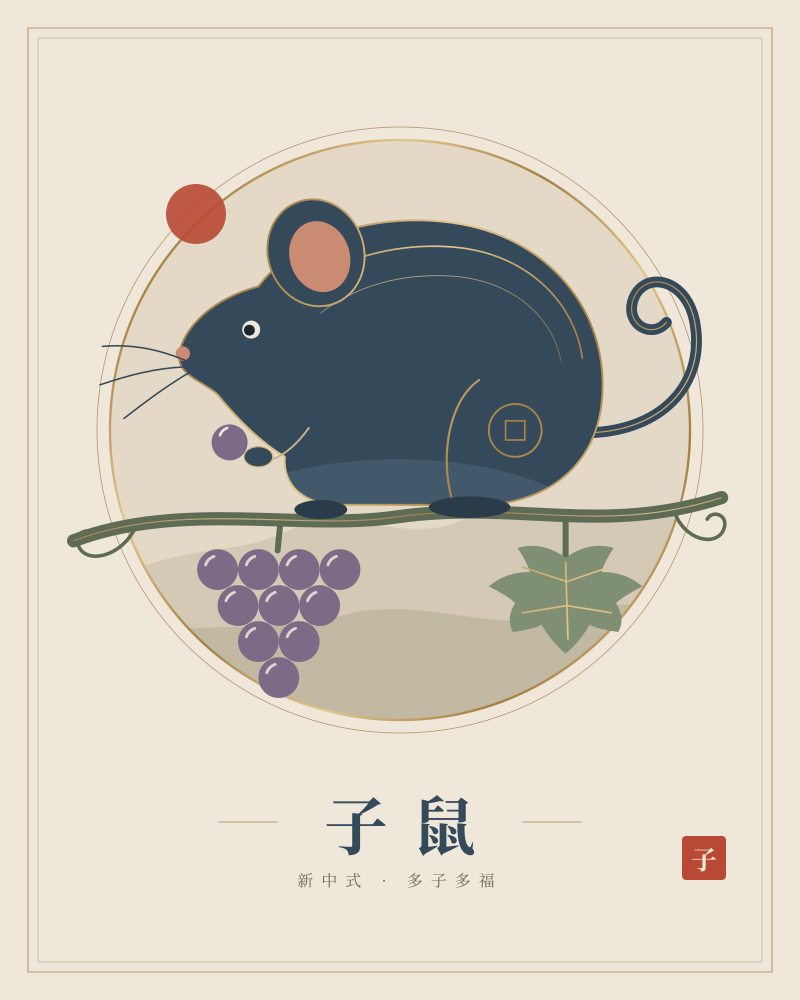
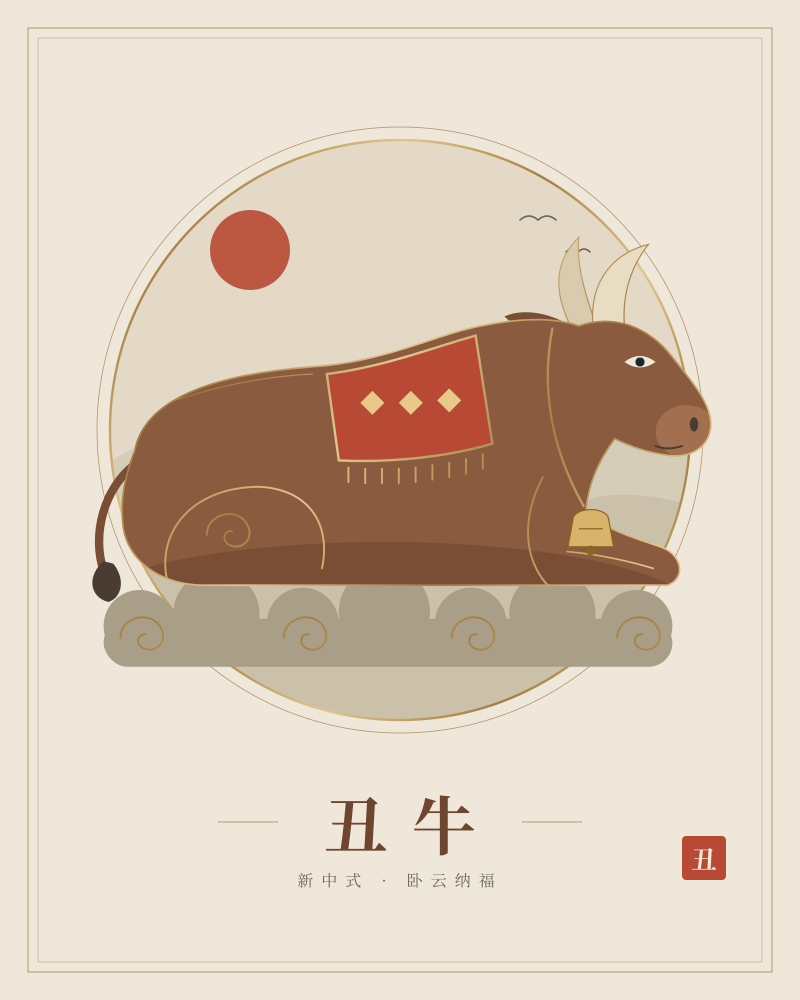
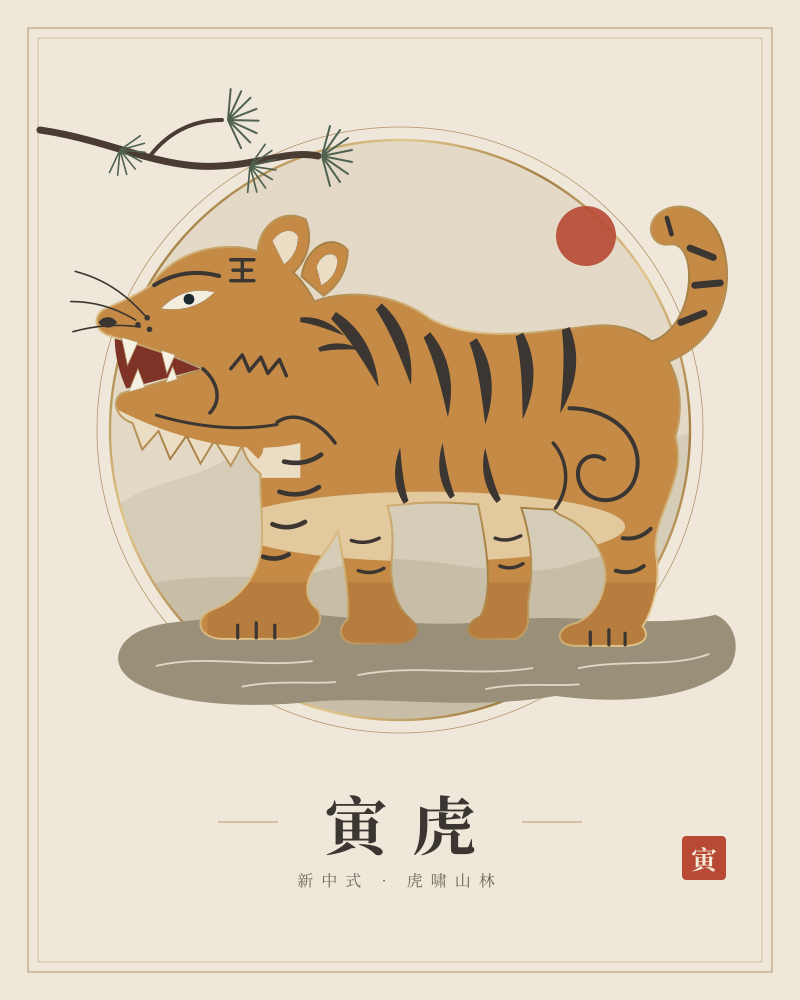
Classical teaching derives this from where the animals stand in the circle. Tiger, Horse and Dog form a triangle 三合 sānhé, the “fire triangle”, Rabbit and Dog a pair 六合 liùhé. The Dog shares the west and autumn 三会 sānhuì with the Monkey and the Rooster, yet with the Rooster of all animals it also has a friction 害. The Dragon sits exactly opposite. With the Ox and the Goat the Dog forms a “threefold punishment” 三刑, and with the Goat there is a break 破 on top. An old folk rhyme, also quoted on the Rooster page, warns:
金鸡遇犬泪交流
“When the golden rooster meets the dog, tears flow.”
 Rat 鼠Neutral
 Ox 牛Tension (刑 xíng)
 Tiger 虎Good match (三合 sānhé)
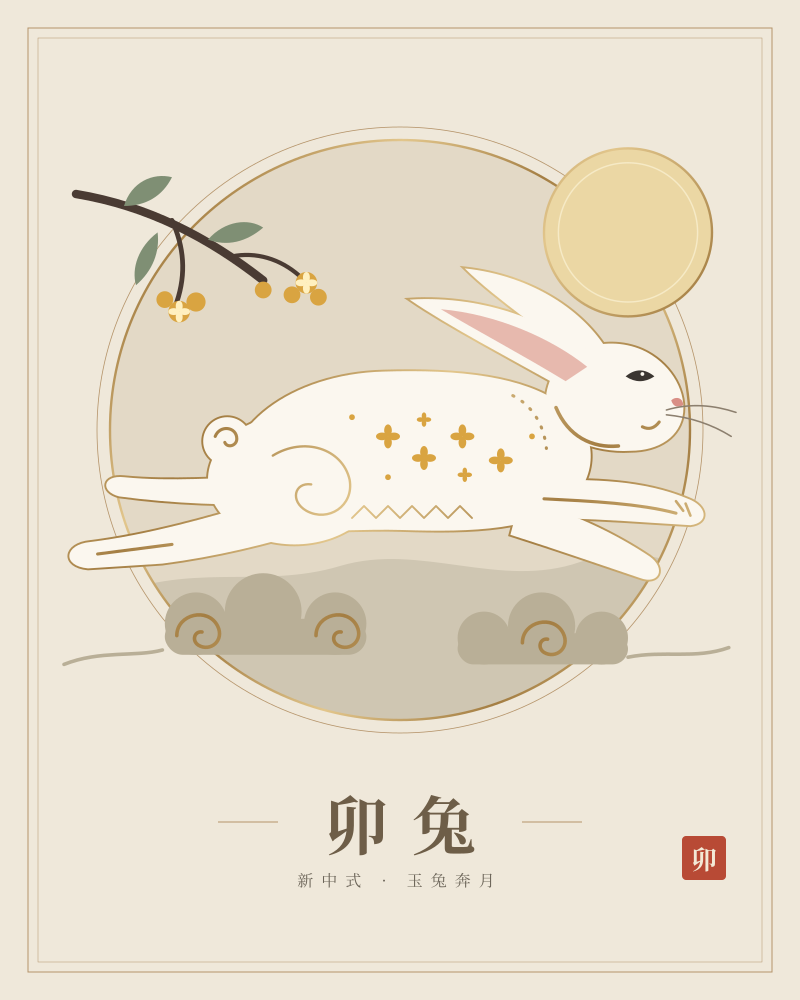 Rabbit 兔Good match (六合 liùhé)
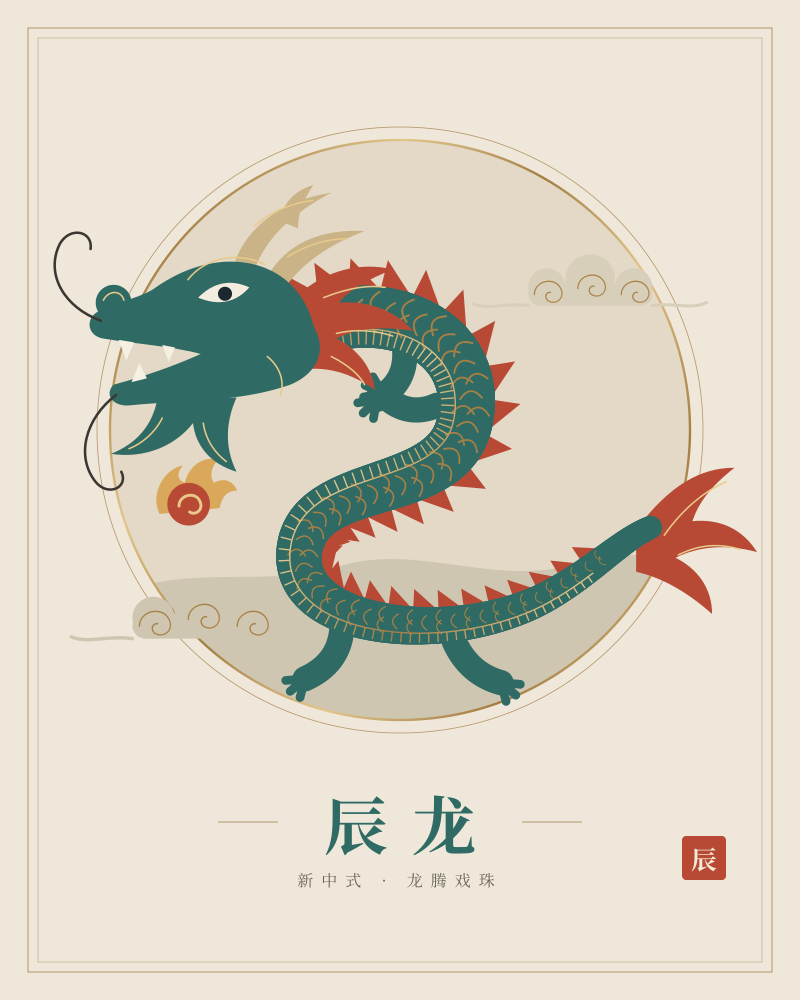 Dragon 龙Clash (冲 chōng)
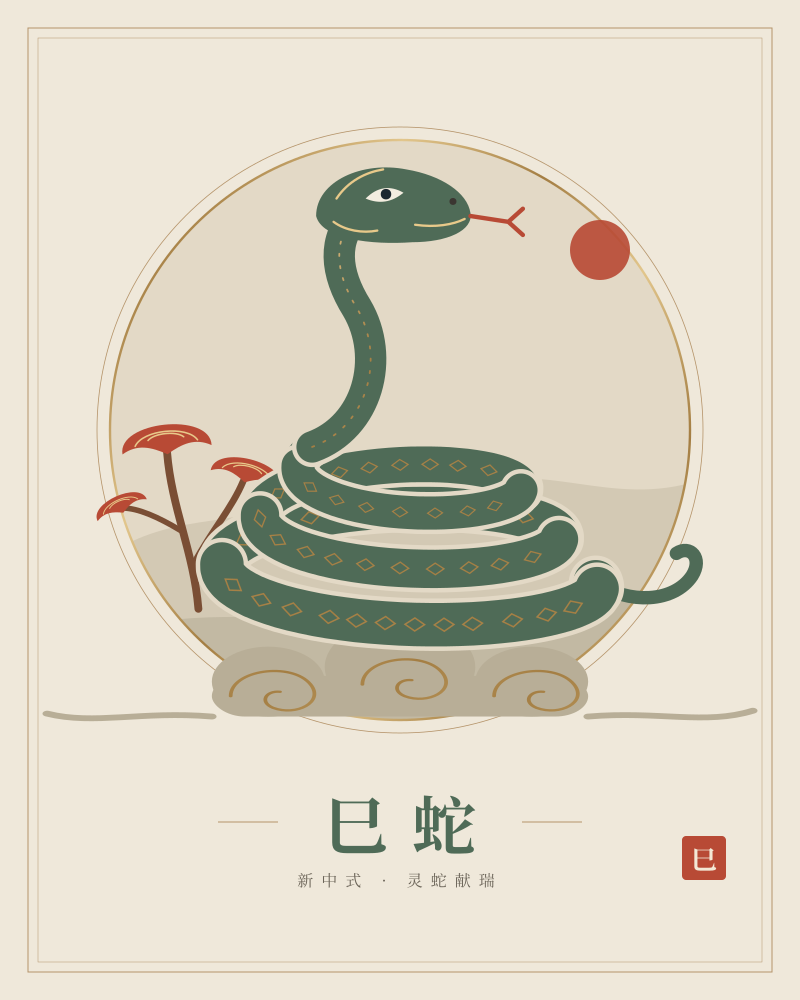 Snake 蛇Neutral
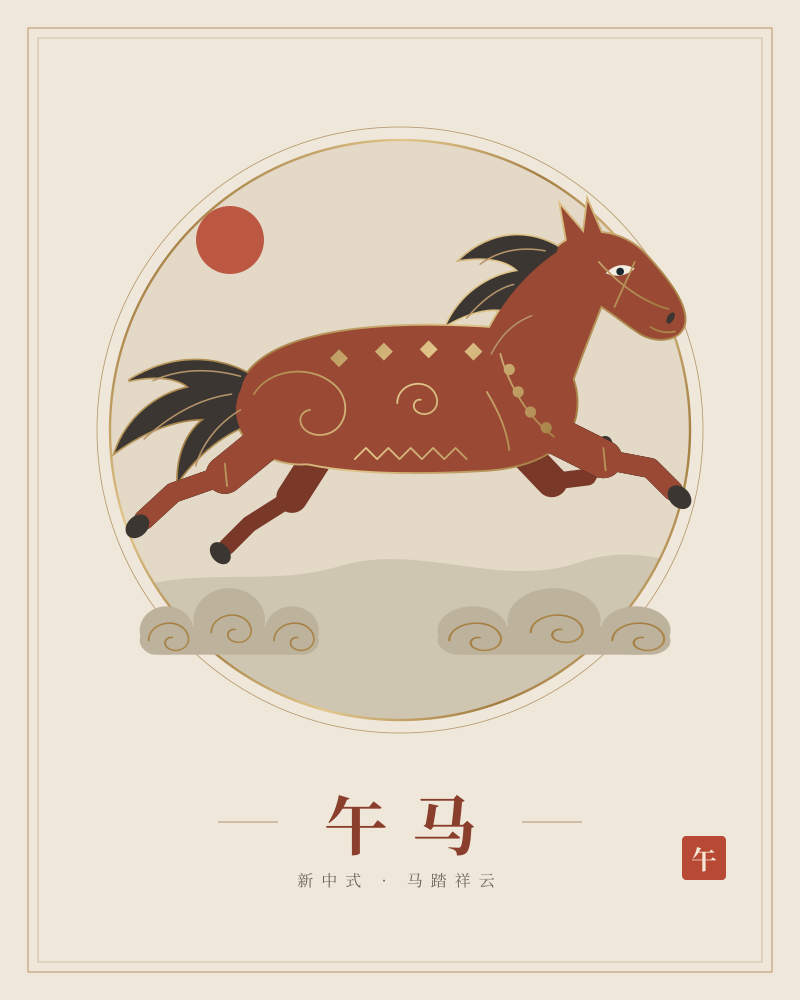 Horse 马Good match (三合 sānhé)
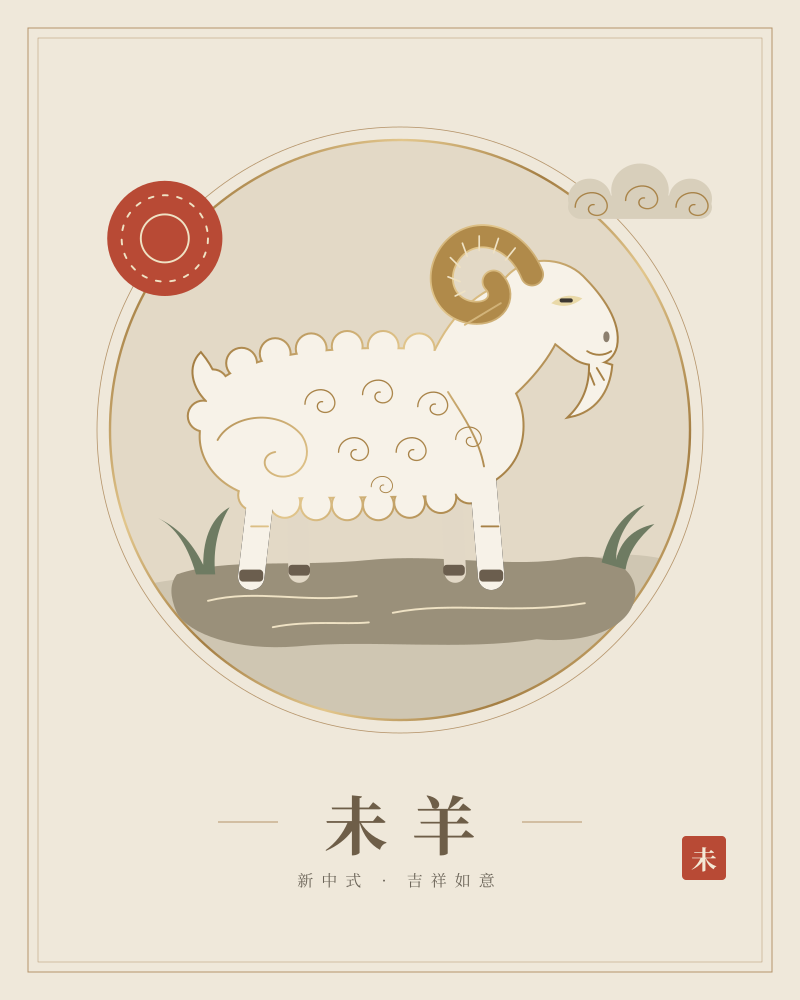 Goat 羊Tension (刑 xíng, 破 pò)
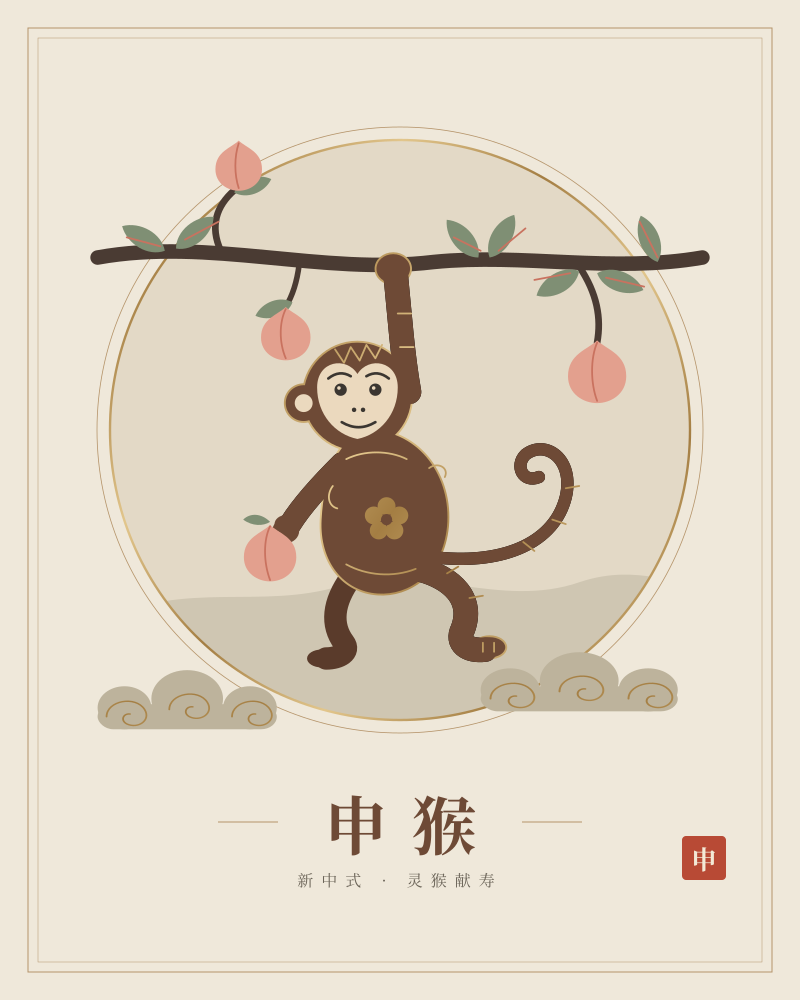 Monkey 猴Neutral
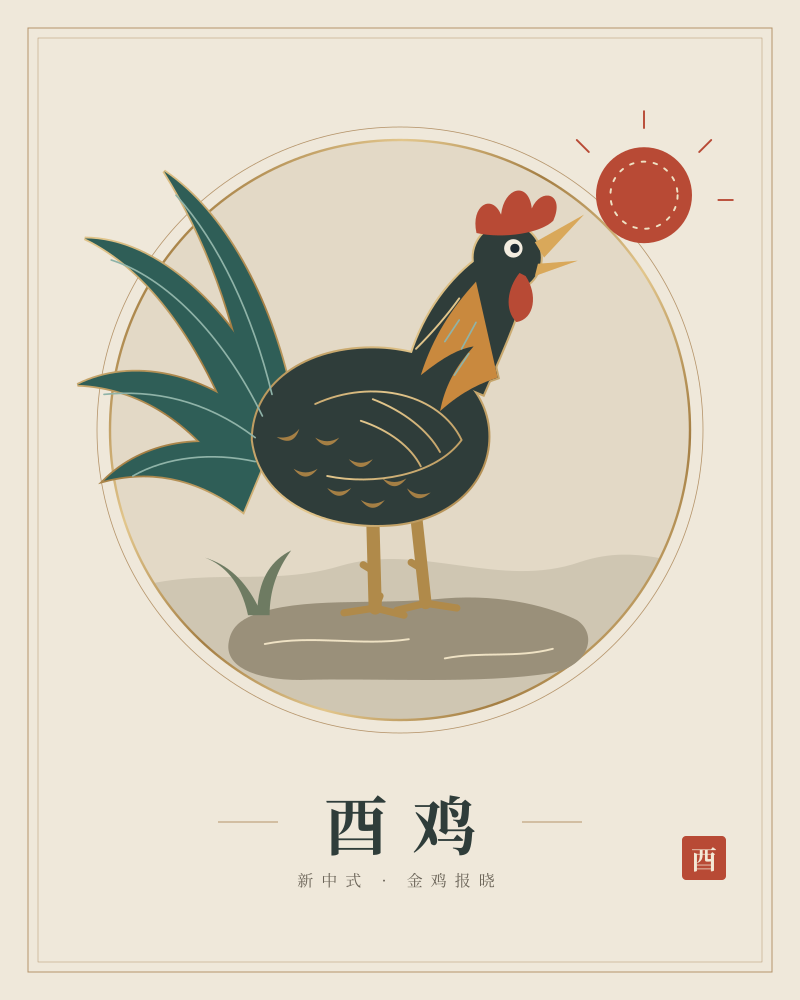 Rooster 鸡Friction (害 hài)
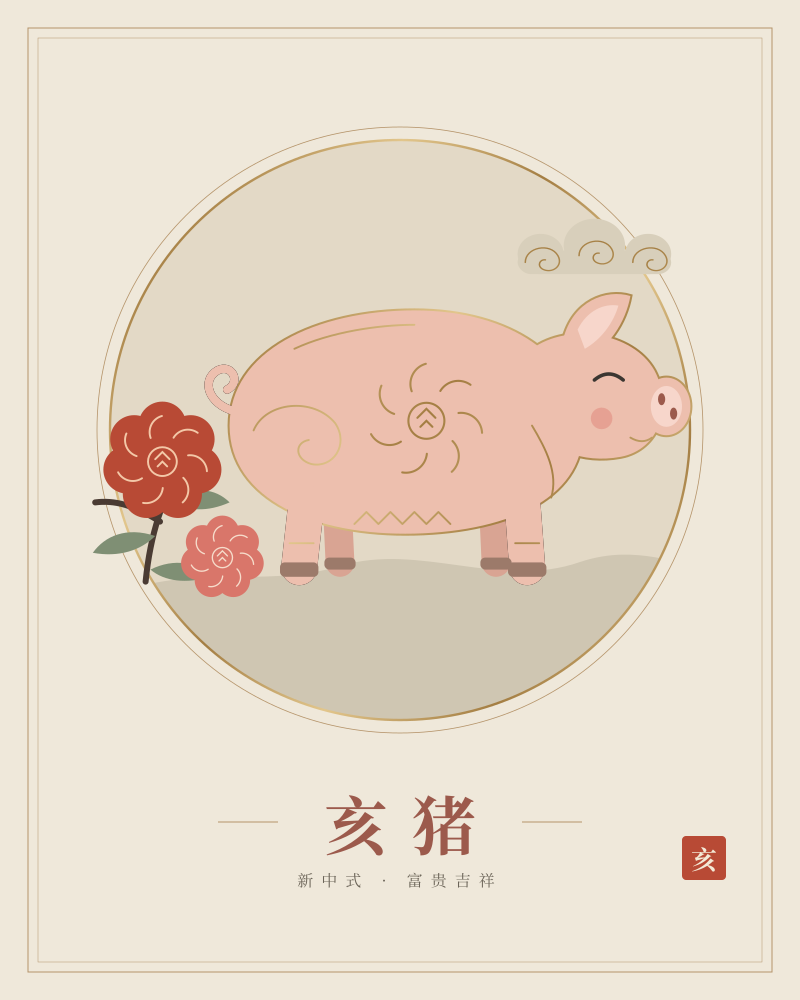 Pig 猪Neutral
Tradition, not a prediction. Some families in China still ask about it when planning a wedding, most couples take it lightly.
The Dog in ancient China: good luck, guard duty and a dog as ancestor
Dogs have lived with people in China for at least 9,000 years, as guards, hunting helpers and companions. Four ideas still shape how people see them:
- 旺A bark for good luck
- A dog barks 汪汪 wāngwāng in Chinese, and that sounds like 旺 wàng, “to thrive, to prosper”. In a Dog year people therefore wish each other 旺旺, and an old saying goes 狗来富: if a stray dog comes to you, wealth comes along with it. So you never chase it off the farm.
- 戌An axe for a character
- The character of the earthly branch, 戌 xū, originally showed a battle-axe with a broad blade. Its hour, 7 to 9 pm, is when it gets dark and the dog starts guarding the house. That is how people in China like to explain why the Dog got this place in the circle.
- 天狗The day of the dog and the heavenly dog
- The second day of the New Year belongs to the dog, after the chicken on the first. Its relative in the sky is less friendly: in folk belief the heavenly dog 天狗 tiāngǒu eats the sun or the moon during an eclipse. People drove it off with noise, with gongs, drums and pots.
- 盘瓠Panhu, the dog as an ancestor
- The Book of the Later Han from the 5th century tells of Panhu 盘瓠, the dog of the legendary Emperor Gaoxin: he brings back the head of an enemy general, is given the princess as his wife and moves with her to the mountains of the south. Their children are seen as the ancestors of peoples such as the Yao and the She, who still tell the story in songs and festivals.
The Dog in the museum: two pieces from the Metropolitan Museum
For the Year of the Dog 2018 the Metropolitan Museum of Art in New York showed “Celebrating the Year of the Dog”, from 19 January to 4 July, using only pieces from its own collection. Two dogs some 1,500 years apart show how differently the animal has been seen: as a guard dog for the tomb and as a man with a dog’s head. The museum has put both photos in the public domain.
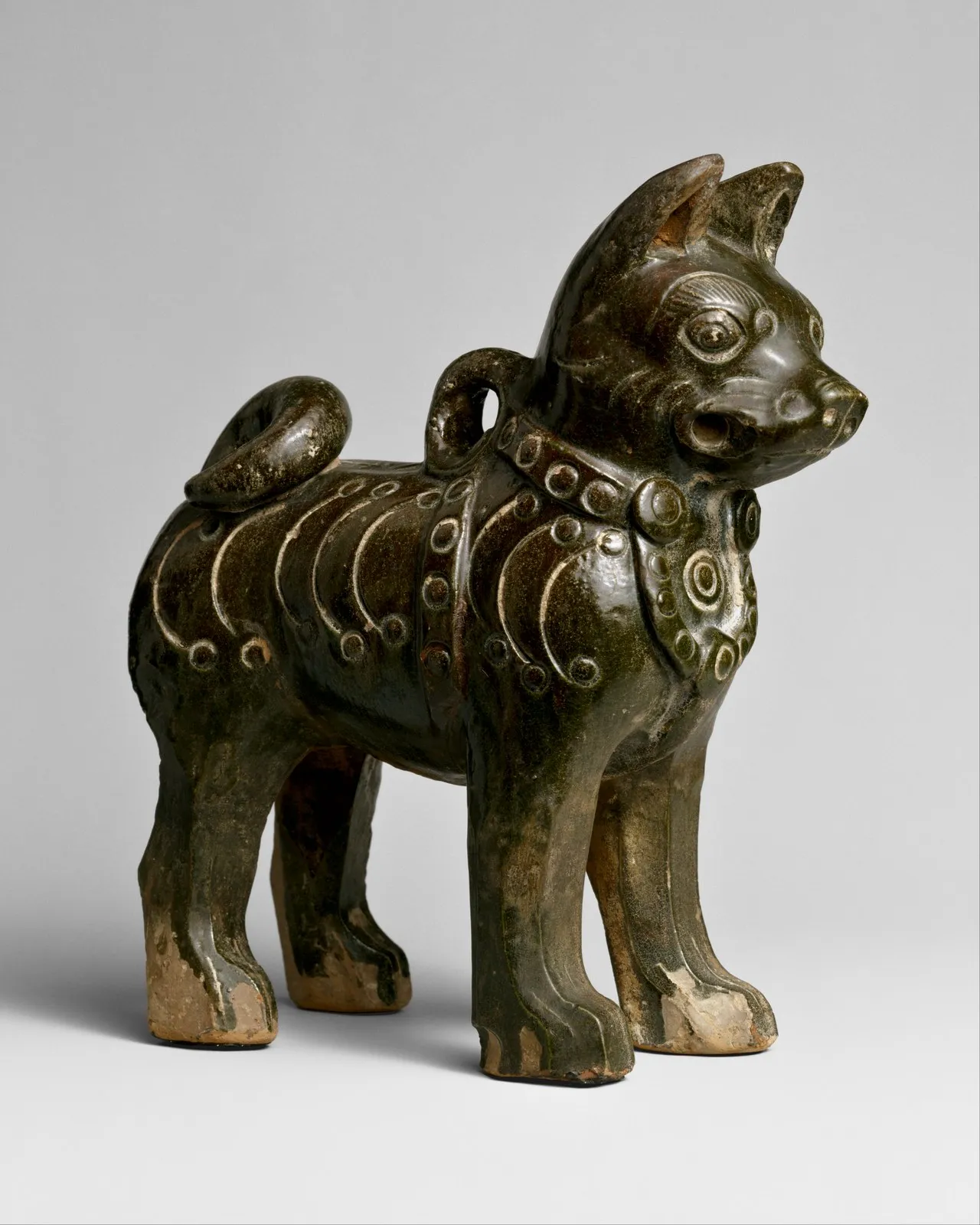
A guard dog for the tomb, Han dynasty 东汉绿釉陶狗
Almost 27 centimetres tall, this dog stands with its ears pricked and its mouth open, as if about to bark. It dates from the Eastern Han dynasty, which ruled from 25 to 220, and was on show in the New York exhibition of 2018. In Han times clay dogs were often placed in tombs: they were to keep the dead company and guard the house in the afterlife, like the real dogs in the yard.
The broad studded collar and the harness with rings show this was no street dog: the museum reads it as the dog of a wealthy owner. The dark green glaze is a lead glaze, of the kind Han potters liked to use for tomb goods. It stops at the paws, where you can see the pale clay.
Figure of a Dog, China, Eastern Han dynasty (25–220). Earthenware with dark green glaze, H. 26.7 cm, L. 24.1 cm. The Metropolitan Museum of Art, New York, Gift of Stanley Herzman, in memory of Adele Herzman, 1991, accession no. 1991.253.1, public domain (CC0). On view in gallery 207 (as of November 2026).
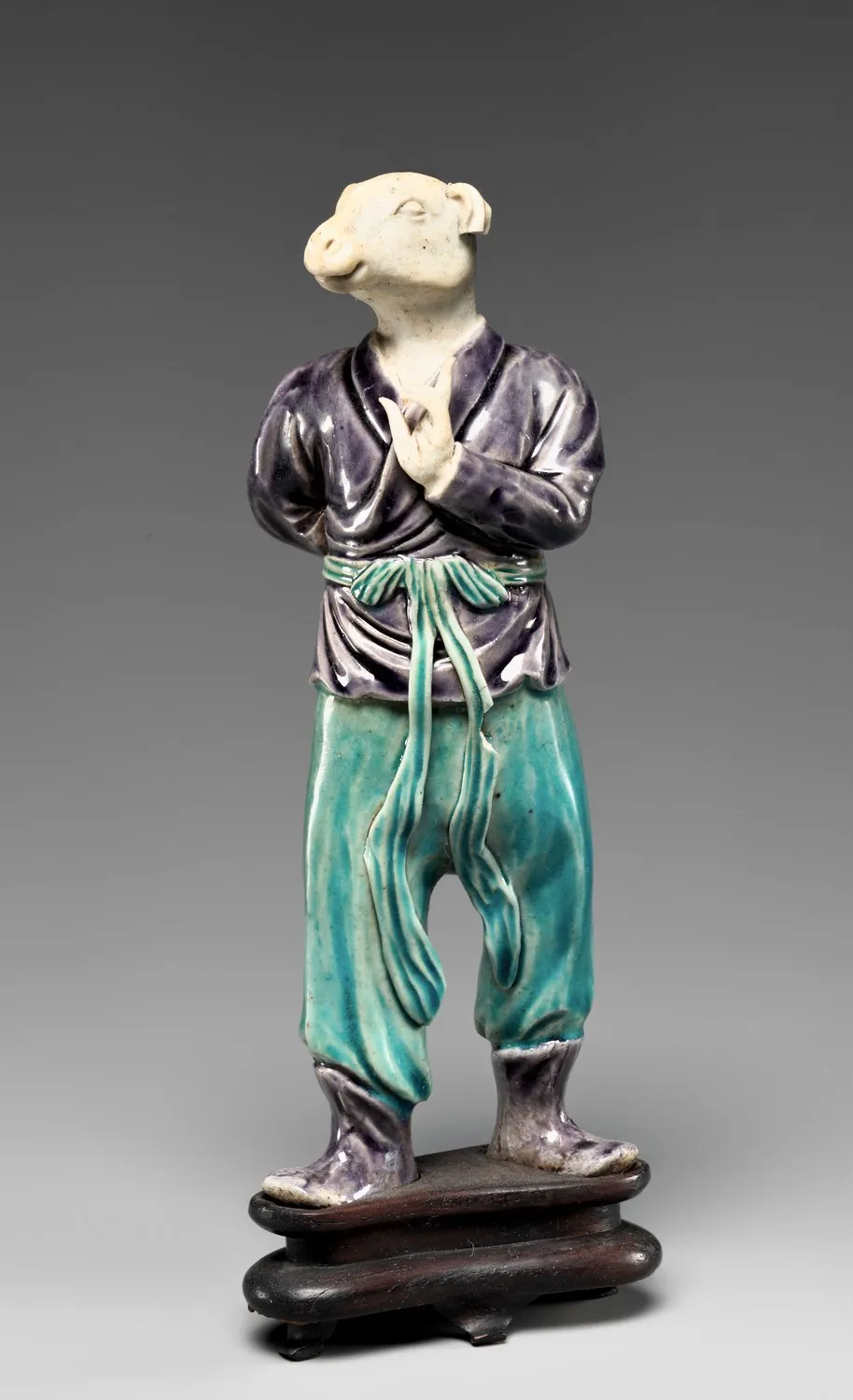
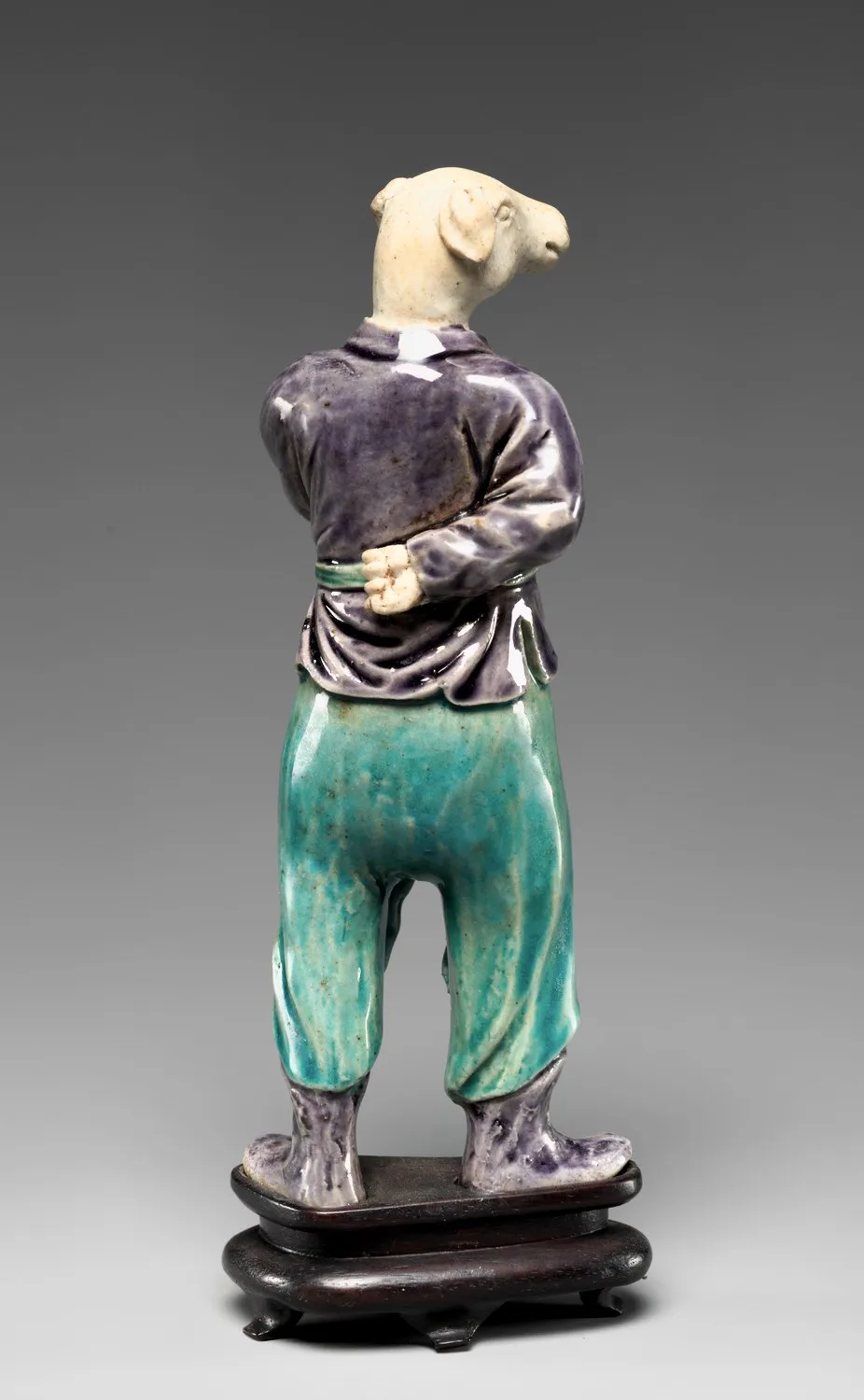
A dog as a man, around 1700 清康熙素三彩生肖狗俑
Just over 14 centimetres tall, this figure comes from the kilns of Jingdezhen under the Kangxi Emperor, who reigned from 1662 to 1722. The dog stands upright like a man, in a purple jacket, with a green sash, wide trousers and boots. One hand is held in front of the chest, the other behind the back, a polite, reserved pose.
The purple, green and yellow were painted on the unglazed, already fired body, a technique called 素三彩 sù sāncǎi in China, “three colours on the biscuit”. The figure belongs to the same zodiac set as the rat on the Rat page. The museum owns ten animals from it, only the Ox and the Horse are missing.
Zodiac figure: dog, China, Qing dynasty, Kangxi period, late 17th to early 18th century. Porcelain painted in enamels on the biscuit (Jingdezhen ware), H. 14.3 cm. The Metropolitan Museum of Art, New York, Gift of Birgit and Peter Morse, in memory of Betty and Sydney Morse, 1992, accession no. 1992.100.9, public domain (CC0). Not on view at present.
The Dog in the Chinese language: eight idioms
Loyal as the Dog is in the horoscope, it fares badly in many idioms: there it is often the henchman or the rabble. Only a few sayings praise it.
狗急跳墙
gǒu jí tiào qiáng · A desperate dog jumps over the wall.
Driven into a corner, anyone does something desperate. Like “a cornered rat will fight”, with the hint that you should not push anyone that far.
兔死狗烹
tù sǐ gǒu pēng · Once the hare is dead, the hunting dog is cooked.
From the Records of the Grand Historian: the adviser Fan Li warns a friend that the King of Yue will get rid of his helpers after victory. Today: once you are no longer needed, you are dropped.
画虎不成反类犬
huà hǔ bù chéng fǎn lèi quǎn · Fail to paint a tiger and you get a dog.
After a letter by General Ma Yuan in the 1st century to his nephews: aim at too lofty a model and you easily make a fool of yourself.
挂羊头卖狗肉
guà yáng tóu mài gǒu ròu · Hang up a goat’s head and sell dog meat.
Sell something other than what the sign says, false labelling. In the ancient Yanzi chunqiu it was still an ox head and horse meat.
白云苍狗
bái yún cāng gǒu · White cloud, grey dog.
After a poem by Du Fu: a cloud looks like a white robe one moment and like a grey dog the next. Today: the world changes fast and unpredictably.
鸡犬不宁
jī quǎn bù níng · Not even the chickens and dogs get any peace.
Great turmoil, everything upside down. After a 9th-century text by Liu Zongyuan about tax collectors terrifying a village.
犬马之劳
quǎn mǎ zhī láo · The toil of a dog and a horse.
A humble formula: I will serve you as faithfully as a dog or a horse. Still used in speeches and letters when offering help.
狗嘴里吐不出象牙
gǒu zuǐ lǐ tǔ bù chū xiàngyá · No ivory comes out of a dog’s mouth.
Nothing good can be expected from him, he only talks rubbish. A blunt everyday saying.
Two more sayings with dogs, 鸡鸣狗盗 “crow like a rooster, steal like a dog” and 一人得道,鸡犬升天 “when one man becomes immortal, even his chickens and dogs rise to heaven”, are on the Rooster page.
Dogs on Chinese stamps: the 1982 Dog stamp
China Post has issued a zodiac stamp every year since 1980. The series started with the Monkey, so the Dog is the third stamp of each round: 1982 壬戌年, 1994 甲戌年, 2006 丙戌年, 2018 戊戌年. The next one is due in 2030. The first Monkey stamp and the first Dog stamp are shown here side by side, as the picture on two New Year cards of the same kind.
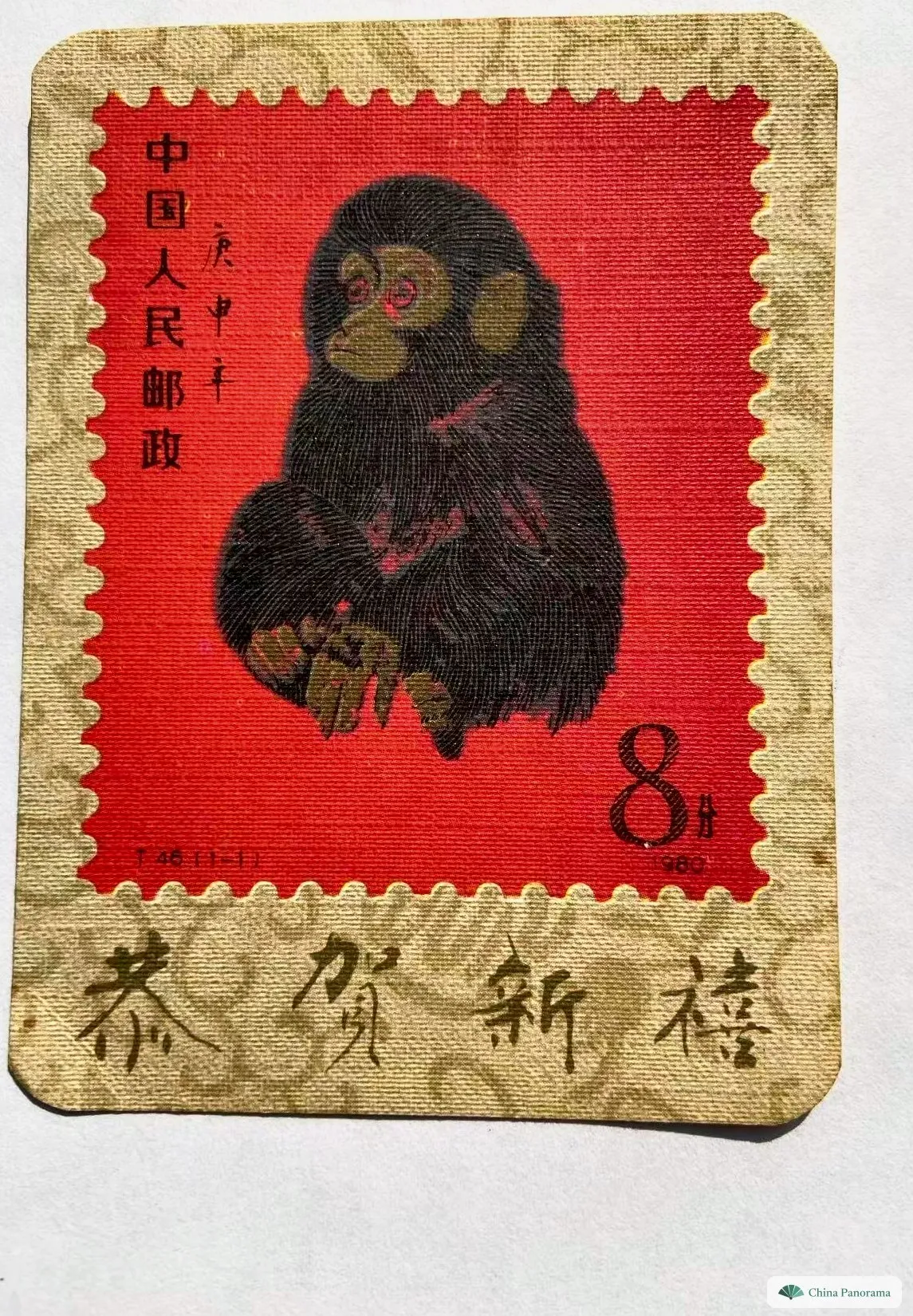
1980: the “Golden Monkey” 庚申年
This is the stamp that started the series: a black monkey with a golden face on a bright red ground, painted by Huang Yongyu 黄永玉, issued on 15 February 1980. Today it is the best-known stamp of the People’s Republic. More about it on the Monkey page.
New Year card with the design of stamp T.46 “Year of Gengshen” (1980, painting Huang Yongyu, design Shao Bailin). Photo: China Panorama.
1982: the blue dog 壬戌年
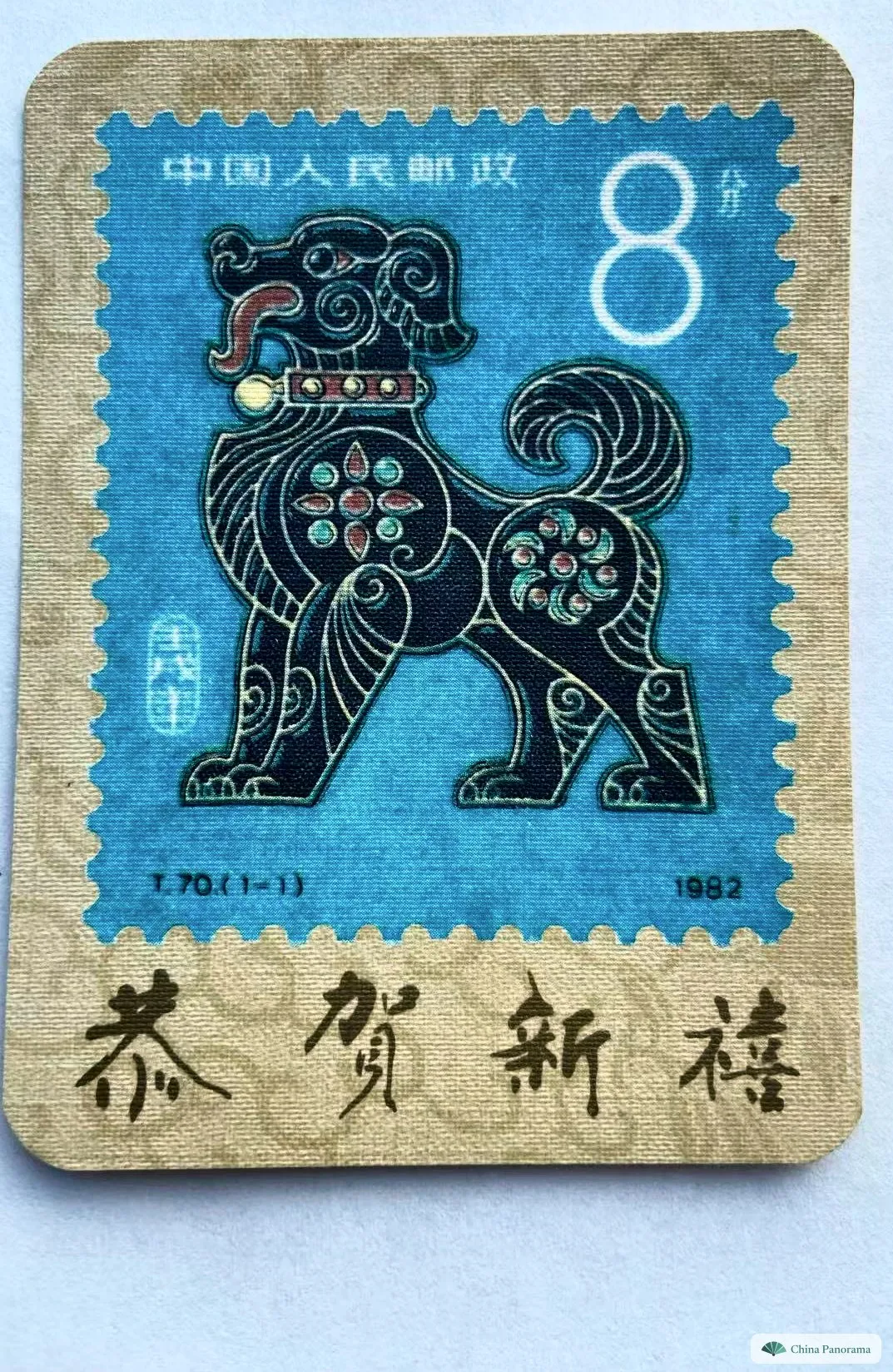
Stamp T.70 “Year of Renxu” came out on 5 January 1982 and cost 8 fen. On a light blue ground stands a dark dog with its head raised, a red tongue and a curled tail, round its neck a collar with a bell. Its body is decorated with fine light lines, swirls and flowers, more like a figure from folk art than a real dog.
It was designed by the painter Zhou Lingzhao 周令钊 and engraved by Gao Pinzhang 高品璋. Like the Monkey and the Rooster, it was printed by photogravure combined with engraving, in a run of just over 14 million. There was also a booklet with ten Dog stamps. Because forgers later cut whole blocks of four out of the booklet panes, collectors look closely at the perforations of this stamp.
New Year card with the design of stamp T.70 “Year of Renxu” (1982, design Zhou Lingzhao, engraving Gao Pinzhang). Photo: China Panorama.
The New Year cards
Neither photo shows the stamps themselves but cards that reprint the design large: with rounded corners, on paper with a linen texture, with printed perforations and the greeting 恭贺新禧 “Happy New Year” in brush script. Frame and lettering are the same, the cards clearly belong to one series. The details on the stamps are printed too: 中国人民邮政 “Chinese People’s Post”, the value of 8 fen, for the Dog the number T.70 (1-1) at the bottom, stamp 1 of 1, and the year 1982.
1994 甲戌年
Two stamps by Zhang Ermiao 张二苗: a lying clay toy dog, the kind sold at temple fairs, titled “Everyday family happiness”, and the character 狗 in seal script, “Good fortune and prosperity”.
2006 丙戌年
One stamp by Lü Shengzhong 吕胜中, who also designed the 2005 Rooster stamp, issued on 5 January 2006 at 80 fen. A detail for collectors: in the middle of each side sits a star-shaped perforation hole.
2018 戊戌年
Two stamps, again by Zhou Lingzhao, the designer of the first Dog stamp. He was 98 at the time and designed a dog once more, 36 years after his first.
Dogs from China: four breeds you know
Some of the best-known dog breeds in the West come from China. On a trip you will mostly meet small pet dogs in the cities, and in the countryside the “Chinese rural dog” 中华田园犬 zhōnghuá tiányuán quǎn, a short-haired, mostly yellowish landrace.
Pekingese 北京犬
Běijīng quǎn
The little lion dog was the palace dog of the emperors in Beijing. When British and French troops looted the Old Summer Palace in 1860, they took five Pekingese back to Europe. One went to Queen Victoria and was called “Looty”. In China the breed is known for short as 京巴 jīngbā. More about the city: Beijing.
Chow Chow 松狮犬
sōngshī quǎn
The name means “fluffy lion”. The breed from northern China is one of the oldest dog breeds in the world, with a feature that gives it away at once: a blue-black tongue.
Shar Pei 沙皮狗
shāpí gǒu
The name means “sand skin”, after the short, rough coat over its many wrinkles. The breed comes from southern China, from Guangdong province around Guangzhou.
Pug 巴哥犬
bāgē quǎn
The pug comes from China too, where short-nosed lapdogs lived at court more than a thousand years ago. In the 16th century Dutch traders brought it to Europe, where it soon became the fashion at royal courts.
True or false? Six claims about the Dog
Tap first, then read the answer.
1The first Chinese zodiac stamp with a dog came out in 1982.
True
On 5 January 1982 China Post issued stamp T.70 for the year Renxu 壬戌, the third zodiac stamp after the Monkey of 1980 and the Rooster of 1981. A new Dog stamp has followed every twelve years since, most recently in 2018.
2Anyone born in January 1982 is a Water Dog.
False
Only from 25 January. That day the year of the Water Dog began. Anyone born from 1 January up to the day before still belongs to the Year of the Metal Rooster.
3The second day of Chinese New Year is the “day of the dog”.
True
By an old custom each of the first days belongs to an animal: the first to the chicken, the second to the dog, then sheep, pig, ox and horse, until the seventh day belongs to humans. On the second day many married women still visit their parents with their family.
4In Chinese folk belief a dog eats the sun during a solar eclipse.
True
The heavenly dog 天狗 tiāngǒu swallows the sun or the moon, that is how people explained eclipses: 天狗食日, “the heavenly dog eats the sun”. People banged gongs and pots to chase it away.
5The character 戌 for the Dog’s earthly branch originally showed a dog.
False
On the ancient oracle bones 戌 is a battle-axe with a broad, curved blade. The animal only came later, when the twelve branches were given animals.
6The life number is an ancient Chinese teaching.
False
It comes from Western numerology, which traces itself back to Pythagoras. In China it became known mainly through social media. Ancient Chinese number lore such as the Hetu diagram 河图 works quite differently.
More on the zodiac: the twelve Chinese zodiac signs and their years, heavenly stems and earthly branches, the zodiac in other Asian countries, the animal before the Dog, the Chinese zodiac Rooster, and the animal after it, the Chinese zodiac Pig.
FAQ
Which years are Dog years?
1934, 1946, 1958, 1970, 1982, 1994, 2006, 2018, 2030. Each year starts with Chinese New Year, between 21 January and 20 February. If you were born in January or February before that day, you belong to the animal of the year before, the Rooster.
When is the next Year of the Dog?
2030. It starts on 3 February 2030 with Chinese New Year, is a Metal Dog (庚戌) and lasts until 22 January 2031. After that comes the Water Dog in 2042.
What colour is the Year of the Dog 2030?
White. The heavenly stem 庚 gēng gives 2030 the element metal, and the colour of metal is white. That is why people also speak of the white Dog. Other lucky colours on horoscope sites follow no fixed tradition.
Which Dog am I if I was born in 1982?
A Water Dog (壬戌), if you were born between 25 January 1982 and 12 February 1983. Before that you are a Metal Rooster. The other Dogs: Wood 1934 and 1994, Fire 1946 and 2006, Earth 1958 and 2018, Metal 1970 and 2030.
What is the personality of the Chinese zodiac Dog?
In China the Dog is said to be loyal, honest, fair and helpful, a friend you can rely on. Its weak sides are said to be distrust of strangers, stubbornness and a tendency to worry. That is folk belief, not a personality test.
Which signs are compatible with the Dog?
By classical teaching the Tiger and Horse (三合 sānhé) match best, plus the Rabbit (六合 liùhé). The Dragon is the opposite (冲 chōng), the Rooster (害 hài), Ox and Goat (刑 xíng) are difficult. That is tradition, not a prediction.
What do the Year of the Horse 2026 and the Year of the Goat 2027 mean for the Dog?
By the classical teaching of the twelve earthly branches the Dog forms a triangle 三合 with the Horse. The Year of the Horse, which lasts until 5 February 2027, is therefore seen as friendly to it. With the Goat, whose year starts on 6 February 2027, it is in tension: the teaching counts both in the “threefold punishment” 三刑 and in a break 破. Detailed yearly horoscopes about love, money and health are fortune-telling, with no fixed tradition behind them.
What are the Dog’s lucky numbers and colours?
Horoscope sites usually give the numbers 3, 4 and 9 and the colours red, green and purple. There is no old Chinese source for that. The only fixed point: the branch 戌 belongs to earth, whose colour in the five elements is yellow. The colour of a particular Dog year comes from its heavenly stem, 2030 for example is white.
How do I work out my life number?
Add up all the digits of your date of birth until only one digit is left. Example 29 July 1982: 2 + 9 + 0 + 7 + 1 + 9 + 8 + 2 = 38, then 3 + 8 = 11, then 1 + 1 = 2. The life number comes from Western numerology, not from Chinese tradition.
Sources and status
The New Year dates come from our checked table, each recalculated against the astronomical new moon in China time. The life-number texts give a widely shared Chinese social-media chart in our own words. The Dog illustration is our own, and so are the photos of the two cards. The two pieces from New York are in the public domain (CC0), the museum releases the photos for any use. We only adjusted the crop, brightness and contrast slightly.
- Wikipedia: Dog (zodiac), years and elements
- Wikipedia: Earthly Branches, branch 戌, hour and direction
- Wikipedia: 纳音, the 60 pairs and their nayin elements (Chinese)
- Wikipedia: 盘瓠, the legend of the dog Panhu (Chinese)
- Wikipedia: 天狗, the heavenly dog (Chinese)
- Shiji, 越王勾践世家: 狡兔死,走狗烹 (Chinese)
- Hou Han shu, chapter 24: Ma Yuan, 画虎不成反类狗 (Chinese)
- Liu Zongyuan, 捕蛇者说: 虽鸡狗不得宁焉 (Chinese)
- Zhongguo Shandong Wang 2018: the Dog stamps of 1982, 1994 and 2006, designers, print runs and forgeries (Chinese)
- Wikipedia: Pekingese, the palace dogs and “Looty”
- Wikipedia: Chow Chow
- Wikipedia: Shar Pei
- Wikipedia: Pug
- Wikipedia: Numerology, the life number and Pythagoras
- The Metropolitan Museum of Art: Celebrating the Year of the Dog, 2018
- The Metropolitan Museum of Art: Figure of a Dog, 1991.253.1, CC0
- The Metropolitan Museum of Art: Zodiac figure: dog, 1992.100.9, CC0
Changelog (1)
- 2026-11-12Page created.