
China travel food guide · Nº 006
Mapo Tofu 麻婆豆腐
Mapo tofu (麻婆豆腐, má pó dòu fu) is soft tofu simmered in a red sauce of chili bean paste, fermented black beans and minced beef or pork, finished with ground Sichuan pepper: a classic of Sichuan cooking from Chengdu, on menus all over China. Numbing and spicy, no bones – but it contains meat, so it is not vegetarian.
The dish card
Tap the red Chinese name, the numbing, spicy or vegetarian line, the meat, the Sichuan pepper or a yellow ? to show it full-screen to the staff.
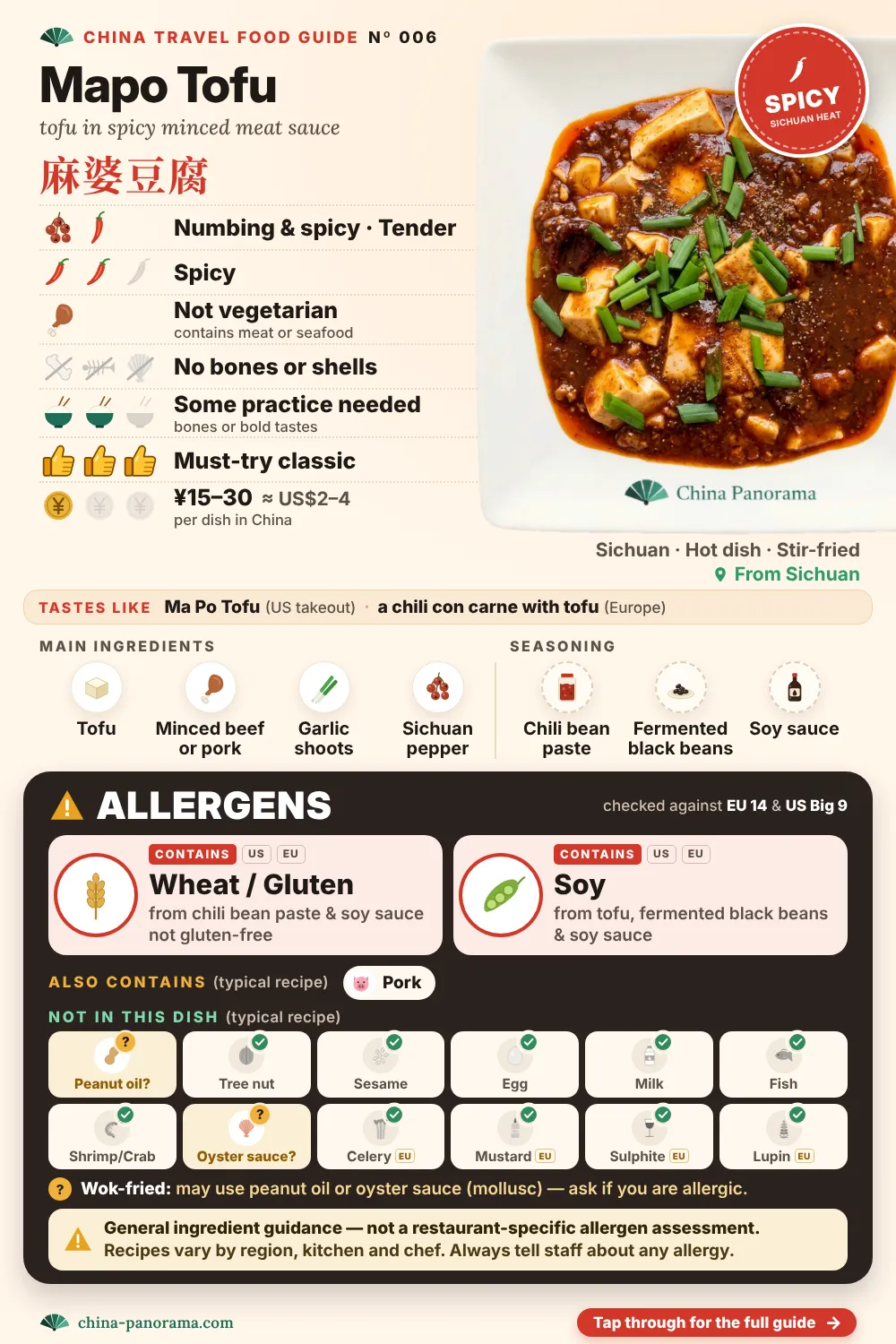 Partly edited with AI
How to order mapo tofu
Tick what you need right on the card, then tap the big first line to show it full-screen to the staff – there you can also pick how hot.
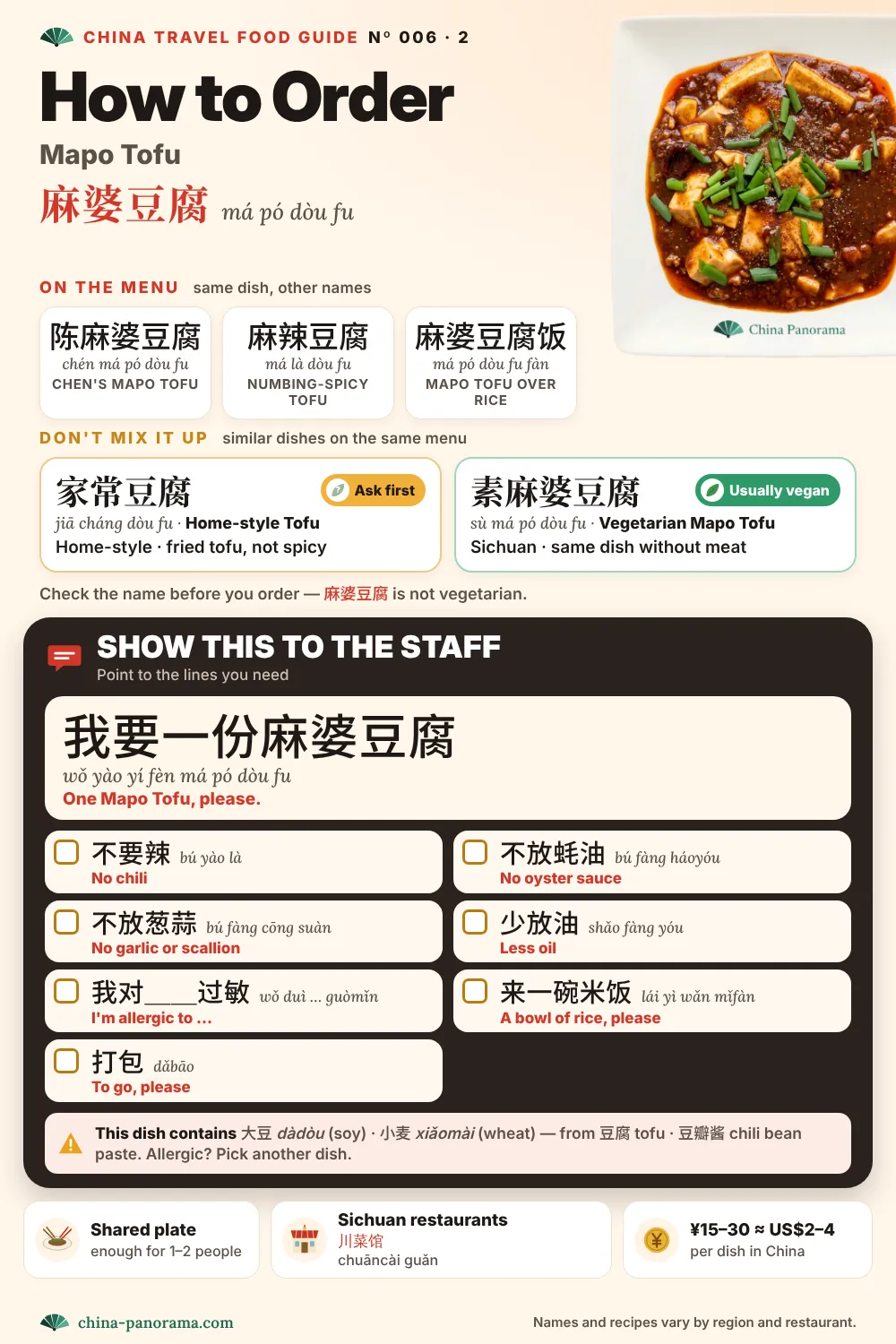
What is mapo tofu?
The name is a nickname: 麻 (má) here means pockmarked, 婆 (pó) old woman, 豆腐 (dòu fu) tofu – “pockmarked old woman’s tofu”. It goes back to a small restaurant in Chengdu in the 1860s, where the cook, a Mrs Chen with a pockmarked face, made it for porters and workers; a restaurant in Chengdu still trades under the name 陈麻婆豆腐. The 麻 also fits the taste: the same character means numbing, as in 麻辣. Minced beef – pork in many places today – is fried until crisp, chili bean paste (豆瓣酱) and fermented black beans (豆豉) go into the oil until it turns red, then soft tofu simmers in that sauce with a little stock. The sauce is thickened until it clings, and garlic shoots (蒜苗) and ground Sichuan pepper (花椒) go on top.
It is one of the best-known dishes of Sichuan cooking (川菜, chuān cài), and you find it all over China: in Sichuan restaurants (川菜馆, chuān cài guǎn), in home-style restaurants, in canteens and as a rice bowl (麻婆豆腐饭) in fast-food places. Chengdu cooks sum it up in eight words: 麻、辣、烫、香、酥、嫩、鲜、活 – numbing, spicy, piping hot, fragrant, crisp, tender, fresh and lively. Outside Sichuan it is often milder and made with pork, sometimes with little Sichuan pepper. On a menu, 陈麻婆豆腐 points to the Chengdu original, 麻辣豆腐 is the same idea, and 素麻婆豆腐 is mapo tofu without meat; 家常豆腐 looks similar on paper but is a different dish.
It costs about ¥15–30 (US$2–4) in an ordinary restaurant in a big city (2026).
Main ingredients
- 豆腐dòu fuTofu
- 肉末ròu mòMinced beef or pork
- 蒜苗suàn miáoGarlic shoots
- 花椒huā jiāoSichuan pepper
Seasoning
- 豆瓣酱dòu bàn jiàngChili bean paste
- 豆豉dòu chǐFermented black beans
- 酱油jiàng yóuSoy sauce
What does it taste like?
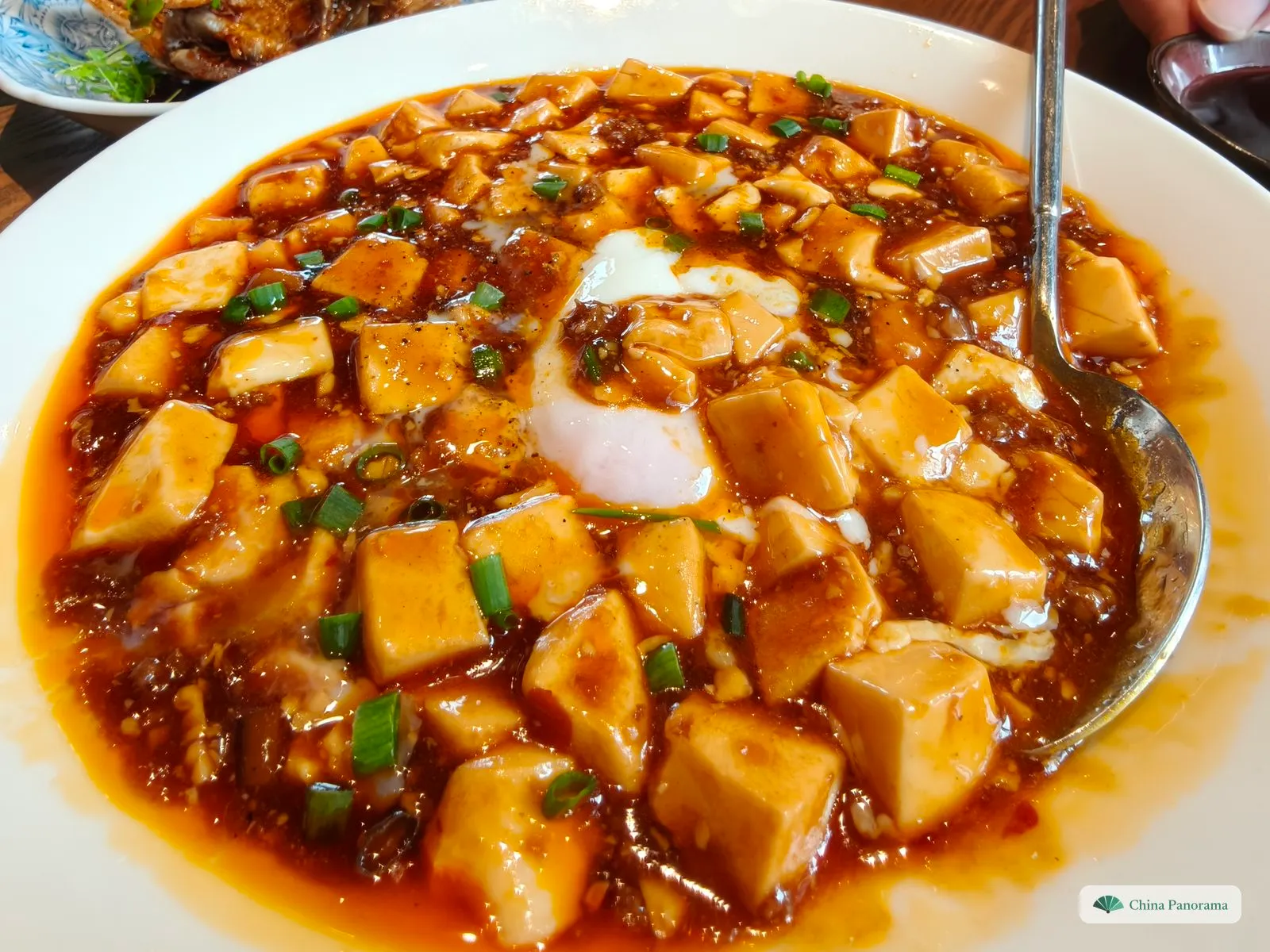
Hot in two ways at once: chili heat from the bean paste and the red oil, and a tingling, buzzing numbness on your lips from Sichuan pepper (花椒, huā jiāo) – together that is 麻辣 (má là), the taste of Sichuan. Under the heat it is salty and deeply savory from the fermented beans, with crisp bits of minced meat in the sauce. The tofu is soft and silky and takes on the sauce. It comes to the table bubbling hot and is eaten with plenty of plain rice.
Tastes like… Ma po tofu from American Chinese takeout – but in China it is hotter and oilier, and the Sichuan pepper really numbs, where takeout versions are often milder and sweeter. In Europe, think of a chili con carne with soft tofu instead of beans.
In a canteen (食堂, shí táng) there is often no menu to read: the dishes stand in trays behind glass, you point and get a small portion next to your rice. Mapo tofu is on almost every canteen counter in China – this is one of our trays.
Which one is mapo tofu? Tap it on the photo.
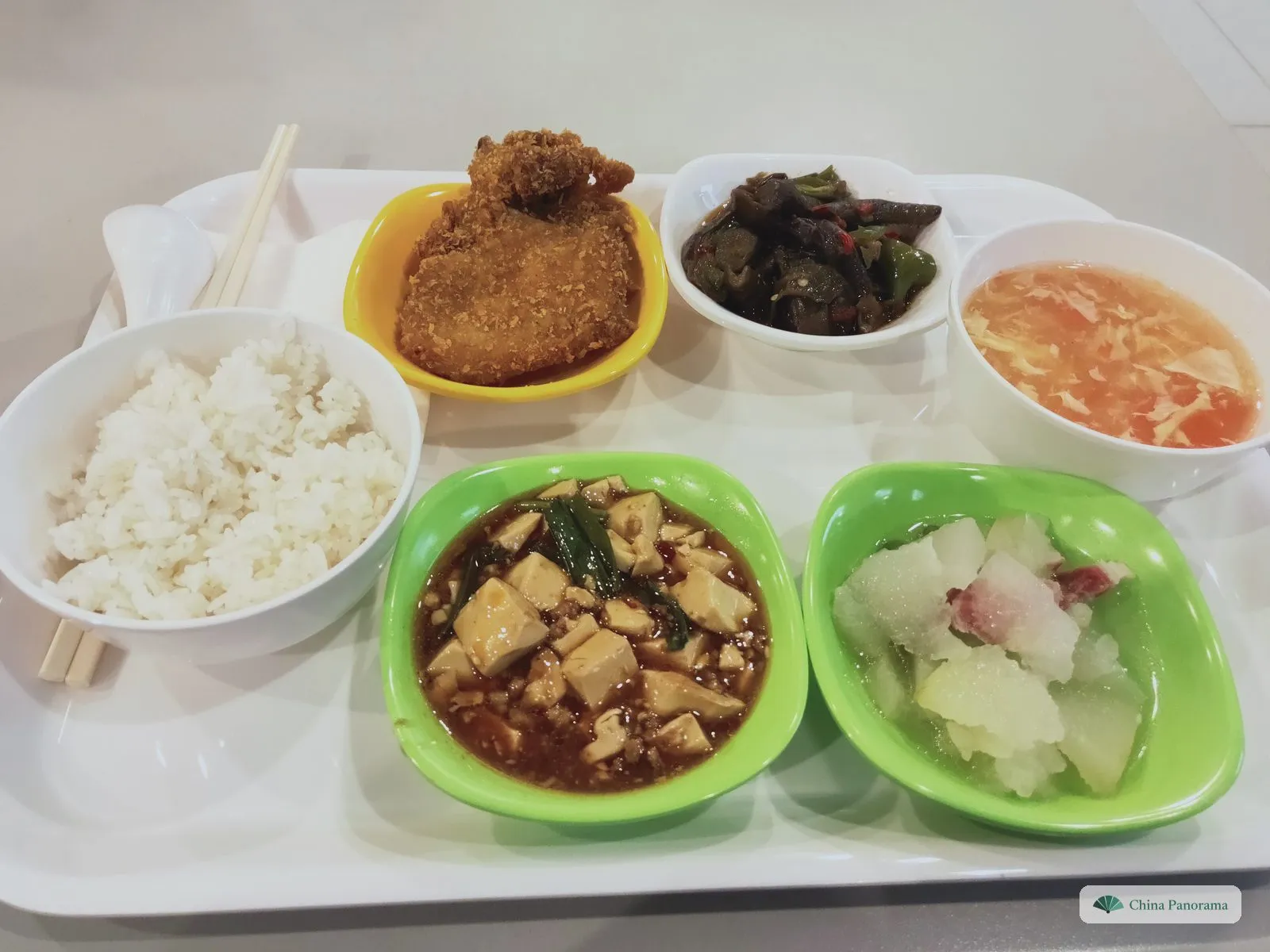
Mapo tofu is the green bowl at the bottom in the middle: soft white cubes in a red-brown sauce, with crumbs of minced meat and a few garlic shoots. A canteen portion is often milder than in a Sichuan restaurant – if you are unsure, point at it and ask 是麻婆豆腐吗? (shì má pó dòu fu ma?).
Allergens and diet
Mapo tofu contains wheat / gluten (from the chili bean paste and soy sauce) and soy (from the tofu, fermented black beans and soy sauce). It also contains minced beef or pork in the typical recipe. Wok-fried: the kitchen may use peanut oil or oyster sauce (a mollusc) – ask if you are allergic.
In the usual recipe
- ACereals containing gluten· US: Wheat
- FSoybeans· US: Soybeans
- EPeanuts (sometimes)· US: Peanuts
- RMolluscs (sometimes)
Sometimes: if the kitchen uses peanut oil or oyster sauce.
Not in this dish (typical recipe)
B shrimp / crab, C egg, D fish, G milk, H tree nuts, L celery, M mustard, N sesame, O sulphites, P lupin
These are estimates from how the dish is usually made, not a restaurant’s declaration. Every kitchen and every sauce brand is different – always tell the staff about an allergy. Chinese kitchens often fry in peanut oil, and chilli oil may be made with it too; we don’t repeat that for each dish.
Vegan, vegetarian, gluten-free
Not vegetarian: it is made with meat or seafood.
Not gluten-free: the wheat comes from the chili bean paste and soy sauce, and there is no version without it.
Here it is the minced meat: beef in the classic Chengdu recipe, pork in many restaurants elsewhere. If you avoid one of them, ask 肉末是牛肉还是猪肉? – tap the meat on the dish card. For a version without meat, look for 素麻婆豆腐 (sù má pó dòu fu, vegetarian mapo tofu) on the menu or ask for it with the vegetarian line on the dish card. Its sauce is usually vegan, but kitchens may still fry in lard (猪油) – say 我吃素 (wǒ chī sù, I’m vegetarian).
With a soy allergy there is nothing to adjust: tofu is made from soybeans, and so are the black beans and the soy sauce.
Eating in China with food allergies
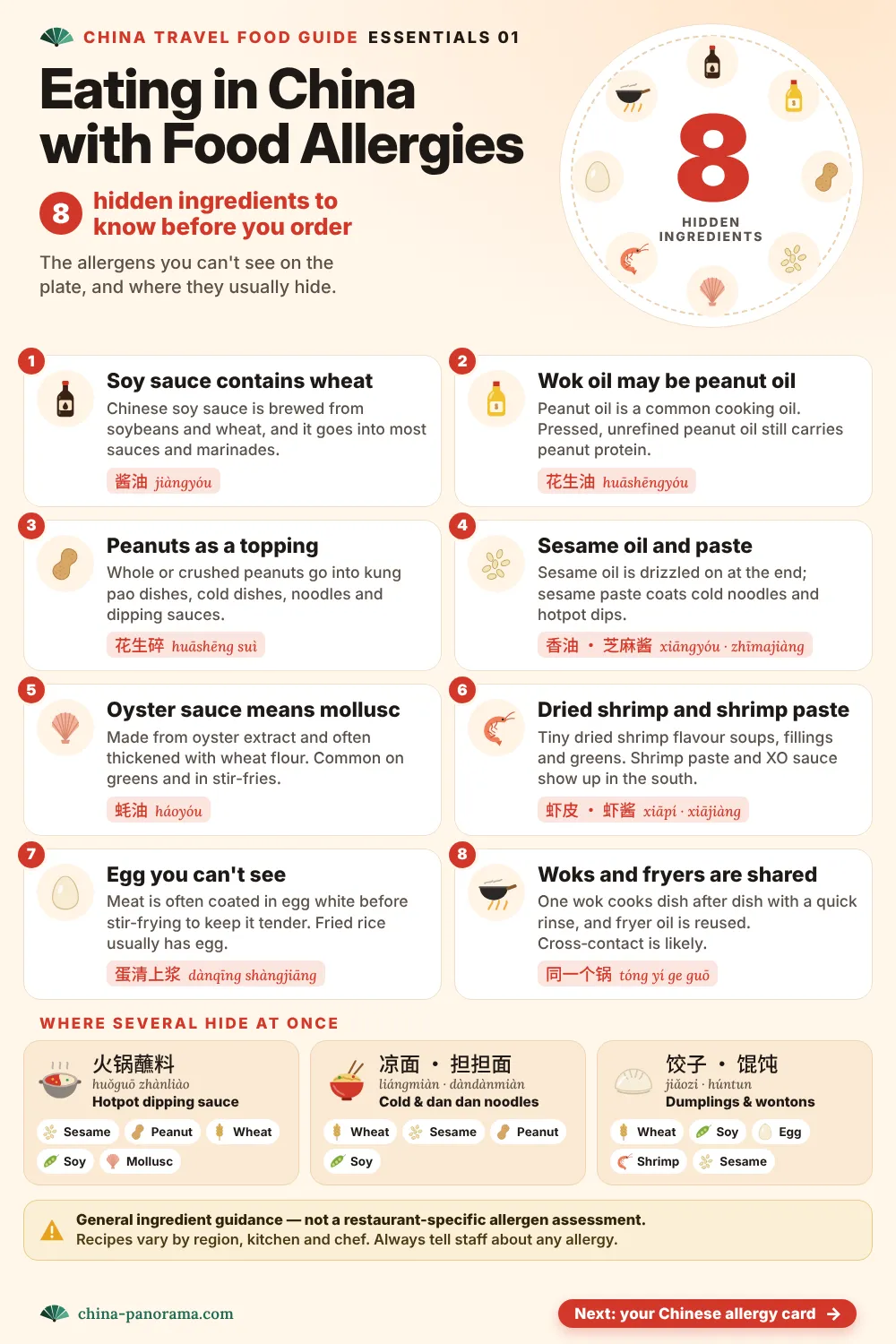
Two cards that go with every dish in this guide. The first shows where allergens hide in Chinese cooking – tap an ingredient to ask about it in Chinese. The second is a Chinese allergy card for the staff: tick your allergens right on the card and it turns into one sentence, full-screen.
8 hidden ingredients to know before you order
Tap an ingredient to ask the staff about it in Chinese.
Show this to the staff: your Chinese allergy card
Tick your allergens on the card, then tap the big first line to show them full-screen to the staff. A question or the red line opens full-screen too.
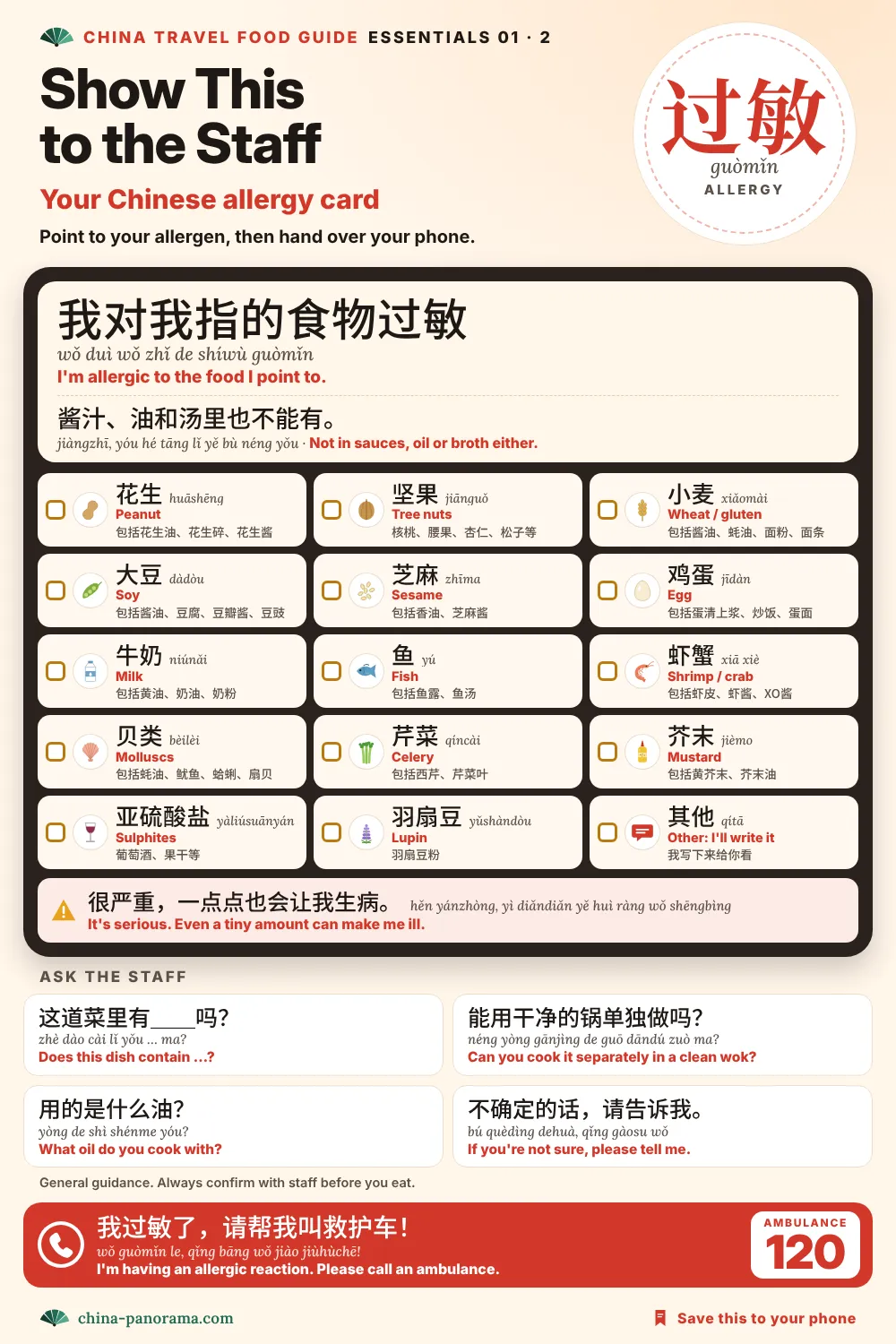
General ingredient guidance, not a restaurant’s allergen declaration. Recipes vary by region, kitchen and chef – always tell the staff about an allergy.
FAQ
Is mapo tofu vegetarian?
No: minced beef or pork goes into the sauce. Many restaurants also have 素麻婆豆腐 (sù má pó dòu fu, vegetarian mapo tofu) – the same dish without meat, sometimes with chopped mushrooms instead. It is usually vegan, but ask for no lard (猪油) if you are strict. Tap the “Not vegetarian” line on the dish card to ask for it in Chinese.
Is it gluten-free?
No. The chili bean paste (豆瓣酱) that makes the sauce red is made with wheat flour, and Chinese soy sauce is brewed with wheat. Both are what the dish tastes of – there is no version without them. If you avoid gluten, choose another dish and tell the staff.
How spicy is mapo tofu?
Properly spicy in Sichuan, often milder elsewhere. The heat is in the sauce itself – chili bean paste and chili oil – so 不要辣 (no chili) does not really work: you would get a different dish. Ask for 微辣 (wēi là, mildly spicy) instead; Sichuan restaurants also do 中辣 (zhōng là, medium) and 特辣 (tè là, extra hot). In the full-screen order card above you can pick the level.
What is the numbing feeling?
That is Sichuan pepper (花椒, huā jiāo), not chili: the dried husk of a small berry that makes your lips and tongue tingle and buzz for a few minutes. It is harmless, and it is the 麻 in 麻辣. If it is too much, ask for 少放花椒 (shǎo fàng huājiāo, less Sichuan pepper) – tap the numbing line on the dish card.
Is it the same as ma po tofu from American takeout?
Same dish, different strength. Takeout versions in the US are often milder, sweeter and thicker, with pork and little or no Sichuan pepper. In China, and above all in Sichuan, expect more chili oil, a real numbing buzz and often beef. The silky tofu in a red, savory sauce is the same.
What is the difference between 麻婆豆腐 and 家常豆腐?
家常豆腐 (jiā cháng dòu fu, home-style tofu) is a different dish: slices of tofu fried golden, then braised with vegetables and often a little meat in a milder sauce. 麻婆豆腐 has soft, unfried tofu in a hot, numbing sauce. Both are on many menus side by side – check the first two characters.
How much does it cost in China?
About ¥15–30 (US$2–4) for a plate in an ordinary restaurant in a big city (2026) – a shared dish for one or two people, with rice. In a canteen, or as a rice bowl (麻婆豆腐饭) in a fast-food place, it is cheaper.
Why is it called “pockmarked old woman’s tofu”?
麻 (má) can mean pockmarked, 婆 (pó) old woman. The story goes that in the 1860s a Mrs Chen with a pockmarked face cooked it in her small restaurant in Chengdu, and her customers named the dish after her. A restaurant in Chengdu still trades as 陈麻婆豆腐 (Chen’s mapo tofu) – a name you may also see on menus elsewhere.
What is it called in Chinese?
麻婆豆腐, in pinyin má pó dòu fu (typed without tones: ma po dou fu). In English it is written mapo tofu or ma po tofu. To order, show the staff the order card above, or tap the red Chinese name on the dish card.
More Chinese dishes
- Chinese hot pot →
- Chengdu, the home of mapo tofu →
- Sichuan and the 8 great Chinese cuisines →
- Stir-fried eggplant with green peppers →
- Century egg and pork congee →
- Stir-fried tomato and egg →
- Cantonese sweet and sour pork →
- Canteen and fast-food walkthrough →
- QR-code ordering walkthrough →
Ordering in a restaurant, by QR code or in a canteen? Our restaurant walkthrough, the QR-code ordering walkthrough and the canteen walkthrough show each step.
Cards, photos and sources
The cards are our own. The dish photo on cards 1 and 2 is partly edited with AI; the other photos on this page are our own, unedited. Prices come from our dish library and are typical for an ordinary restaurant in a big city; dollar prices are rounded. Allergens are estimated from the usual recipe, checked against the 14 EU allergen groups and the 9 major US food allergens. Menu names, similar dishes and phrases are general knowledge – recipes vary by region, kitchen and chef.
Changelog (1)
- 2026-10-05Page created with 4 cards you can use on screen: the dish card, how to order it, and the Essentials cards on eating in china with food allergies.