
Terracotta Army: what to look for in Xi’an兵马俑
The Terracotta Army, also known as the Terracotta Warriors, has guarded the tomb of Qin Shi Huang, China’s first emperor, who died in 210 BC, for more than 2,200 years. Farmers found it in 1974 while digging a well. It has been a World Heritage Site since 1987 and a top-level 5A scenic area since 2007.
Without explanation many people see only grey figures. With our photos from June 2024 this page shows the order in which to see the three pits, where the famous kneeling archer stands, how to tell officer, cavalryman and soldier apart and why the warriors were once painted.
In short
- 1Where: Lintong district, about 40 km east of Xi’an
- 2Entrance: 120 ¥ (≈ $17.73), with passport
- 3Open: 08:30–18:30 (16 Mar – 15 Nov), 08:30–18:00 (16 Nov – 15 Mar)
- 4Time: 2 to 3 hours for the three pits
- 5Don’t miss: the kneeling archer in Pit 2
Part of our page on Xi’an: weather, metro and all the city’s sights.
History of the Terracotta Army: the First Emperor and his warriors
Who was Qin Shi Huang?
Ying Zheng was king of Qin, a state in the west of China. By 221 BC he had conquered the six other kingdoms and was the first to rule a united China. He standardised script, measures, weights, coins and even the axle width of carts, and had older walls in the north joined into one long wall. His dynasty lasted only 15 years, but the empire he built remained. The word China is widely thought to come from the name Qin, pronounced roughly “chin”.
Why an army of clay?
The emperor planned his tomb as a copy of his empire for the afterlife: with palaces, stables, officials, acrobats and an army. The army stands 1.5 km east of the mound and faces east, towards the defeated kingdoms, as the direction is usually explained. The figures are life-size, and the weapons in their hands were real.
Who made them?
Potters from the court workshops and from the capital, Xianyang. Bodies, heads and hands were shaped separately, joined, finished by hand, fired and painted. Many figures carry an incised or stamped name, such as 宫疆 from a palace workshop or 咸阳衣 from a workshop in Xianyang. Qin law required makers to put their name on their work, so that poor work could be traced back.
And the tomb itself?
The mound has never been opened. Writing a good hundred years later, Sima Qian said over 700,000 people worked on the palace and the tomb, and that rivers and seas of mercury flowed inside. Measurements in the soil above the mound do show raised mercury levels. It will not be opened for now: what happened to the army’s colours shows how fast finds are lost in the air.
Timeline
259 BC
Ying Zheng is born
The future first emperor is born a prince of the state of Qin. China is split into seven kingdoms at war with each other.
246 BC
King at 13, work on the tomb begins
According to the historian Sima Qian, work on his tomb at Mount Li starts as soon as he takes the throne. Building goes on for almost 40 years.
221 BC
First Emperor of China
Qin defeats the last of the six other kingdoms. Ying Zheng calls himself 始皇帝, First Emperor, and standardises script, measures, weights and coins. Work on the tomb now grows enormous.
210 BC
Death on a journey, burial at Mount Li
The emperor dies on a tour of inspection in the east and is laid in his tomb. The clay army already stands in its pits, 1.5 km east of the mound.
206 BC
End of the Qin, fire in Pit 1
Only four years after the emperor, his dynasty falls. In Pit 1 the timber roof burns, the ceiling collapses and smashes the figures. Who started the fire is open: rebels under Xiang Yu, a ritual or spontaneous combustion.
March 1974
A well in Xiyang village
Farmers digging a well in a drought hit fragments and a clay head. Until then nobody knew about the army, and Sima Qian does not mention it either.
1 October 1979
The museum opens
The great hall with its arched steel roof now covers Pit 1, and digging goes on in full view of visitors.
1987
UNESCO World Heritage
The Mausoleum of the First Qin Emperor, army included, becomes World Heritage.
1994
Pit 2 opens to visitors
The hall over Pit 2 opens. This is where the kneeling archer and the other figures in the glass cases later come to light.
2007
Rated 5A
In the first group of the top level, together with nearby Huaqing Palace.
October 2026
Pit 2 redesigned
After six months of work the Pit 2 hall reopens, with projections of the battle order. Digging continues: two chariots came to light here in 2025.
The Terracotta Army in numbers
- 1974
- found by farmers digging a well
- 14,260 m²
- Pit 1, the largest
- ~6,000
- figures in Pit 1, estimated
- 160
- kneeling archers in Pit 2
- 1987
- UNESCO World Heritage
- 2007
- 5A, the top rating
The three pits of the Terracotta Army: which one first?
The army lies in three pits, each under its own hall. Pit 1 shows the mass, Pit 2 the branches of the army, Pit 3 the command. Choose how much time you have: the plan shows the route, with the minutes on the right. Tap a pit or the numbers in Pit 2.
Plan from above. Pit sizes to scale, positions from the published distances, the units inside Pit 2 simplified.
Only 1 hour · about 0 h 50 min
- 1Pit 1 from the front, part of one long side · 25 min
- 2Pit 2: the kneeling archer and the glass cases · 25 min
Skip Pit 3 and the tomb mound.
2 to 3 hours · about 1 h 55 min
- 1All the way round Pit 1, the restoration area at the back · 50 min
- 2Pit 3, the command post · 15 min
- 3Pit 2 with all the glass cases, last · 50 min
Leave the tomb mound for another visit.
Half a day or more · about 3 h 25 min
- 1All the way round Pit 1 · 50 min
- 2Pit 3 · 15 min
- 3Pit 2 with all the glass cases · 50 min
- 4Shuttle bus to Lishan Garden and the emperor’s tomb mound · 90 min
Huaqing Palace by Huaqingchi station fits on the way back.
Tap a pit
The four units of Pit 2
Minutes are our estimate at a normal pace without long waits. Add plenty of crowding on public holidays.
Pit by pit, in our photos
Our photos of late June 2024, in the order of the visit. We have no usable photo of Pit 3.
1 · 一号坑
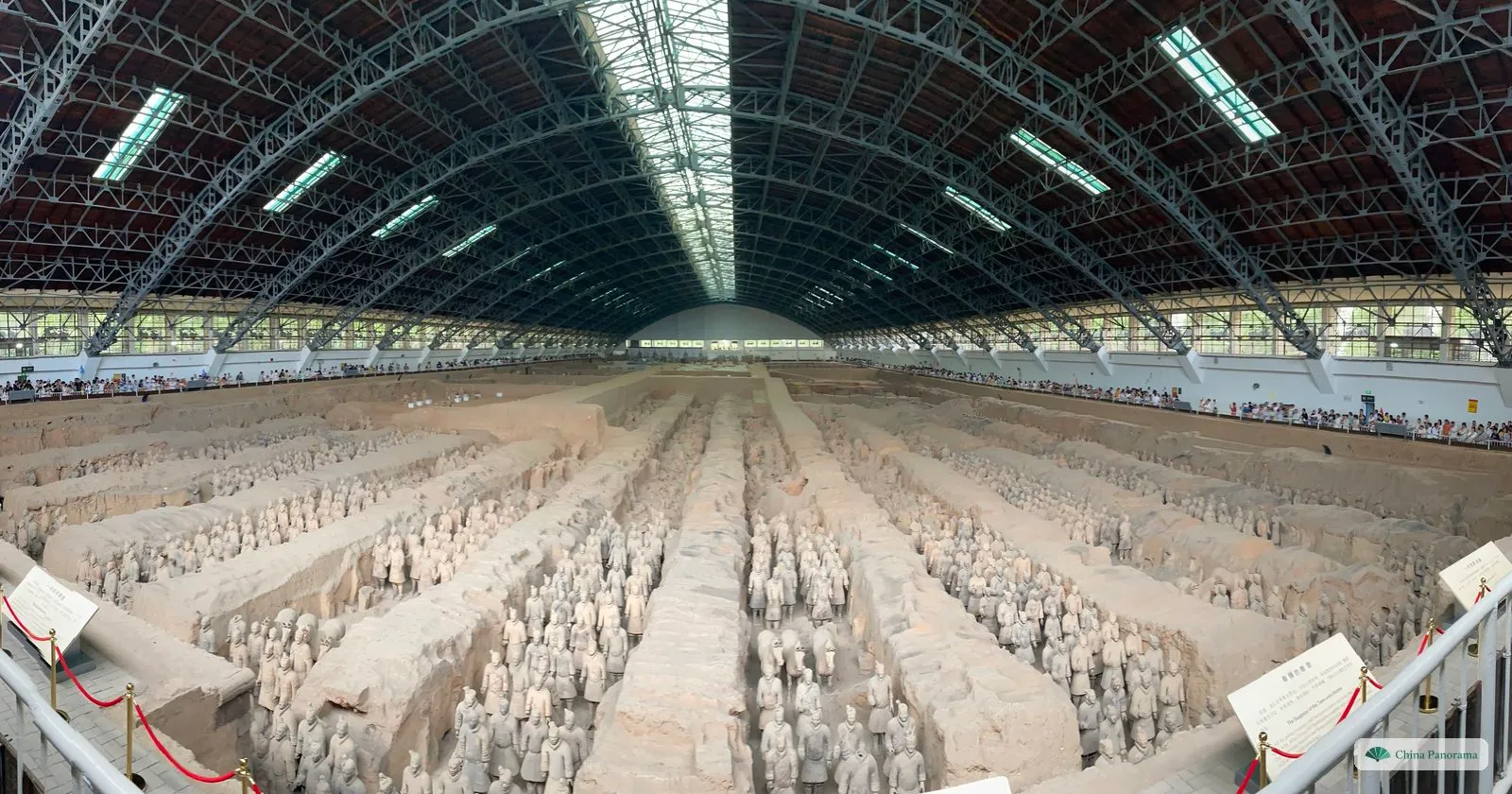
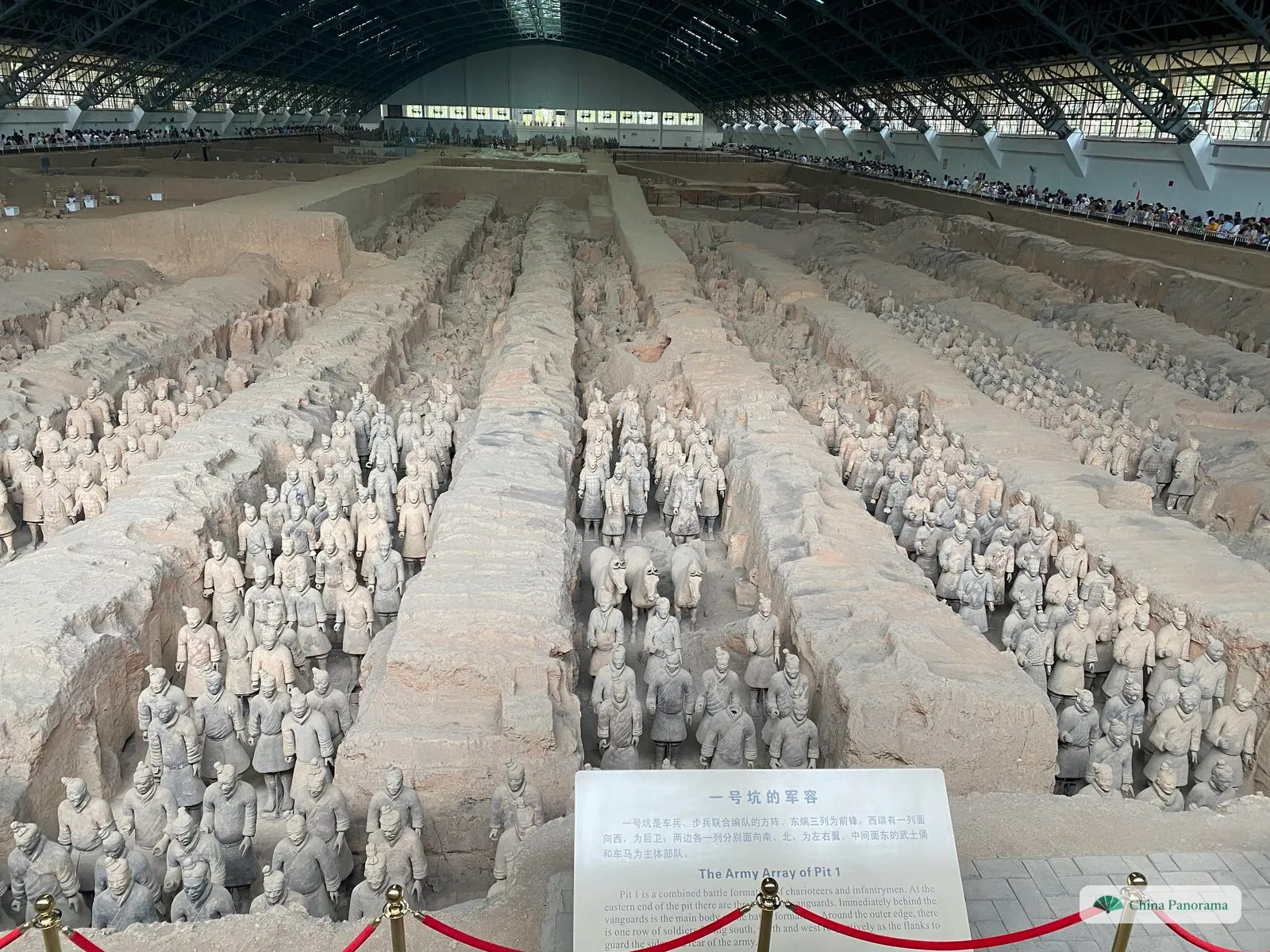
Pit 1, from the front
This is how you see the army as you come in: the vanguard without armour at the front, then the columns and four horses whose wooden chariot rotted long ago. It is tight at the information board by the railing and calmer further along the gallery.
2 · 过洞
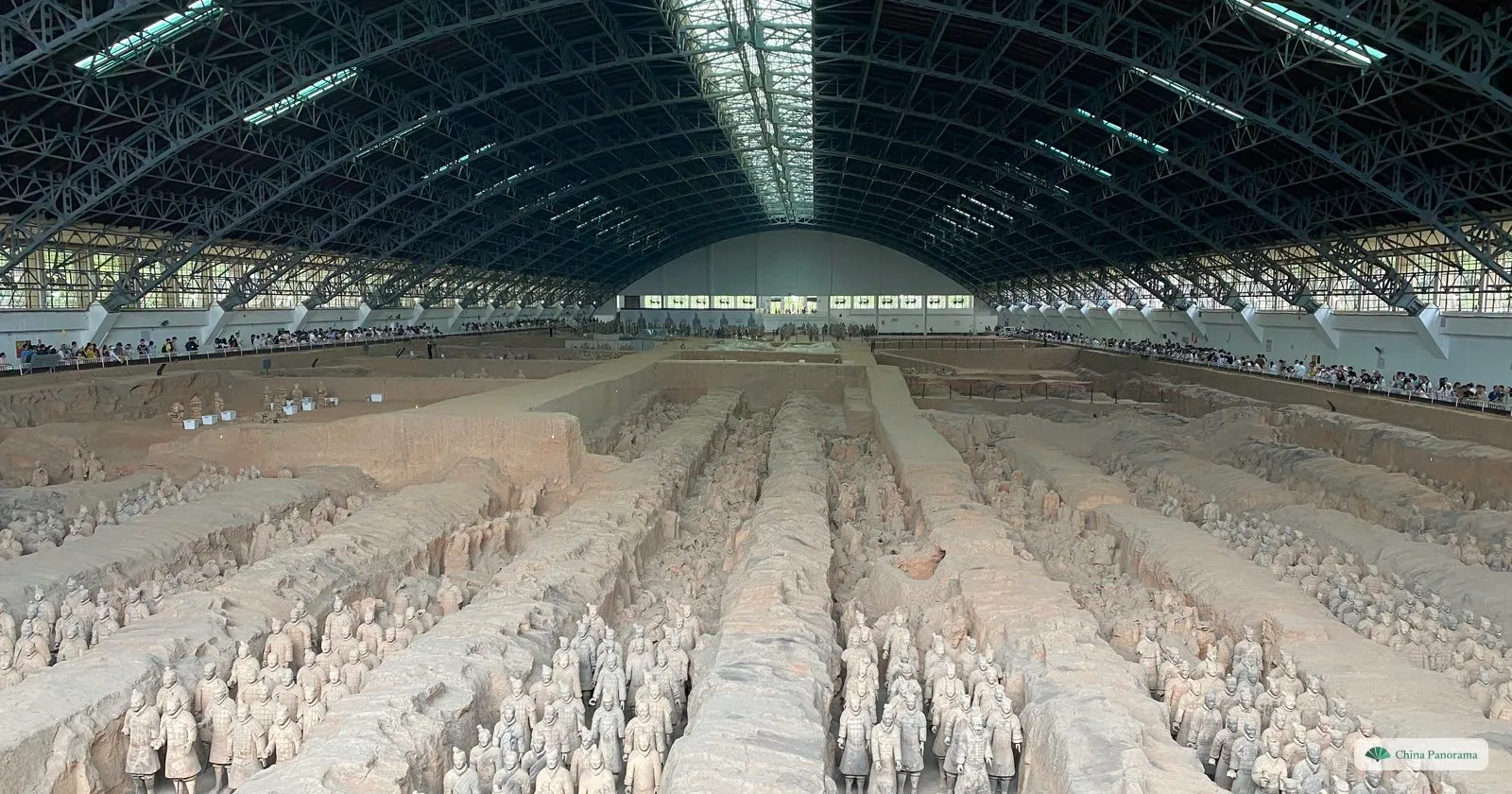
The corridors
The soldiers stand four abreast in eleven corridors. The walls between them once carried a roof of beams and mats under the earth. When it collapsed, the figures broke. Almost all of those standing today were pieced back together from fragments.
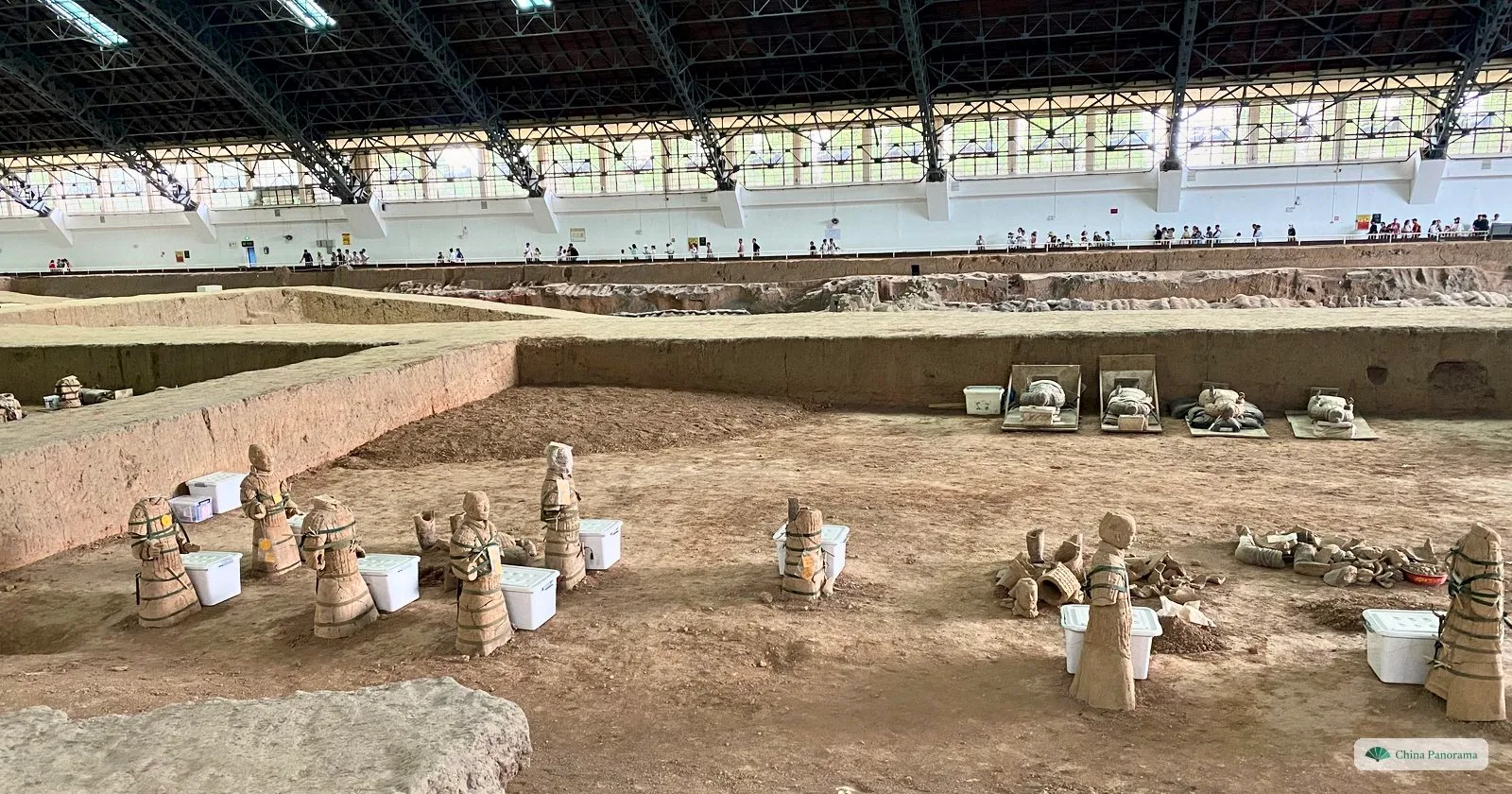
3 · 修复区
Back of Pit 1: the “hospital”
Here figures lie as they were found, held together with straps, fragments in white boxes. Restorers piece them together bit by bit. Many in China call this area the warriors’ hospital.
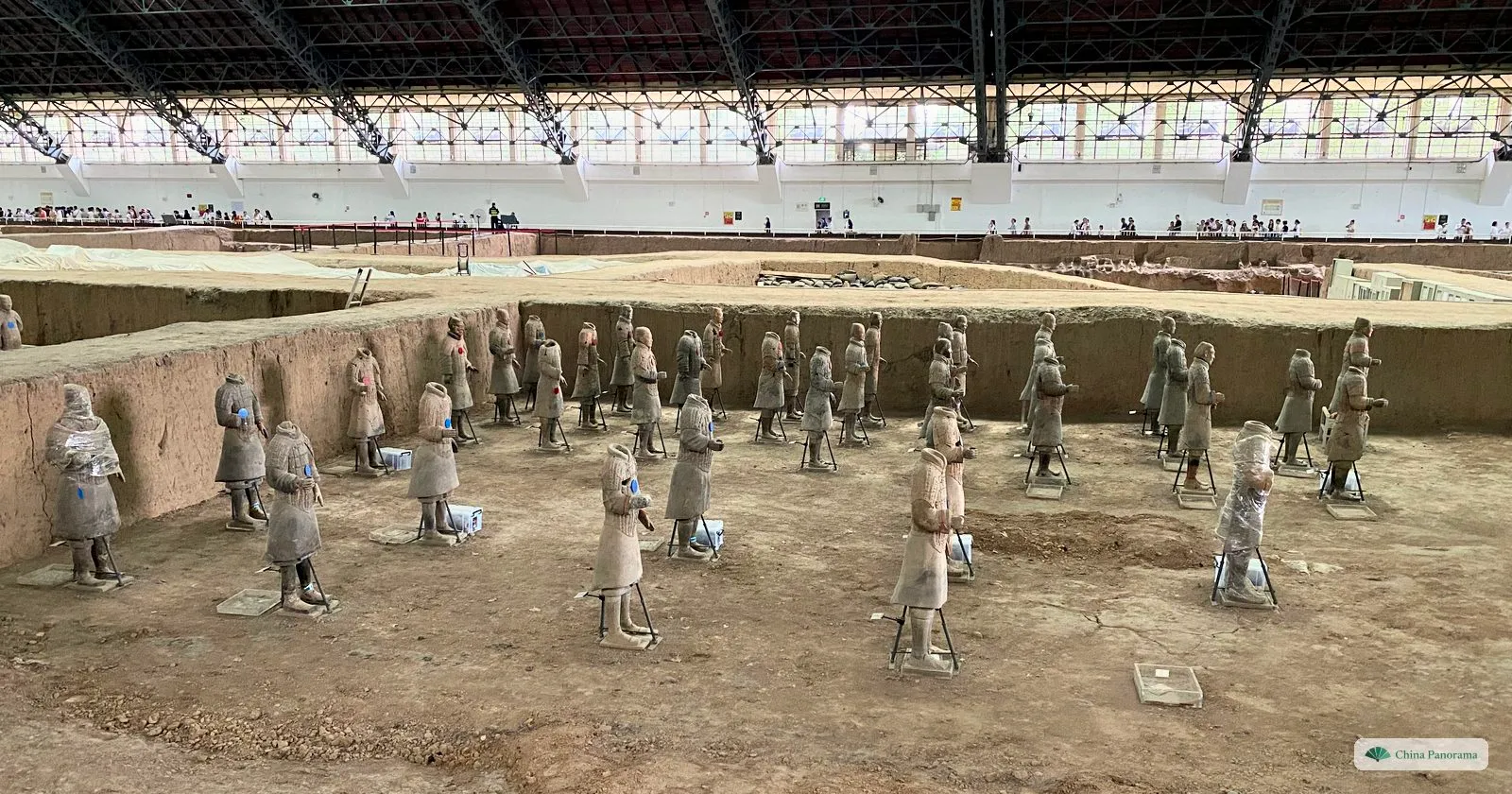
4 · 一号坑后部
Freshly reassembled
A few metres on, finished figures stand loosely spread out before they get their place in the ranks. From the gallery you see the faces closer here than at the front.
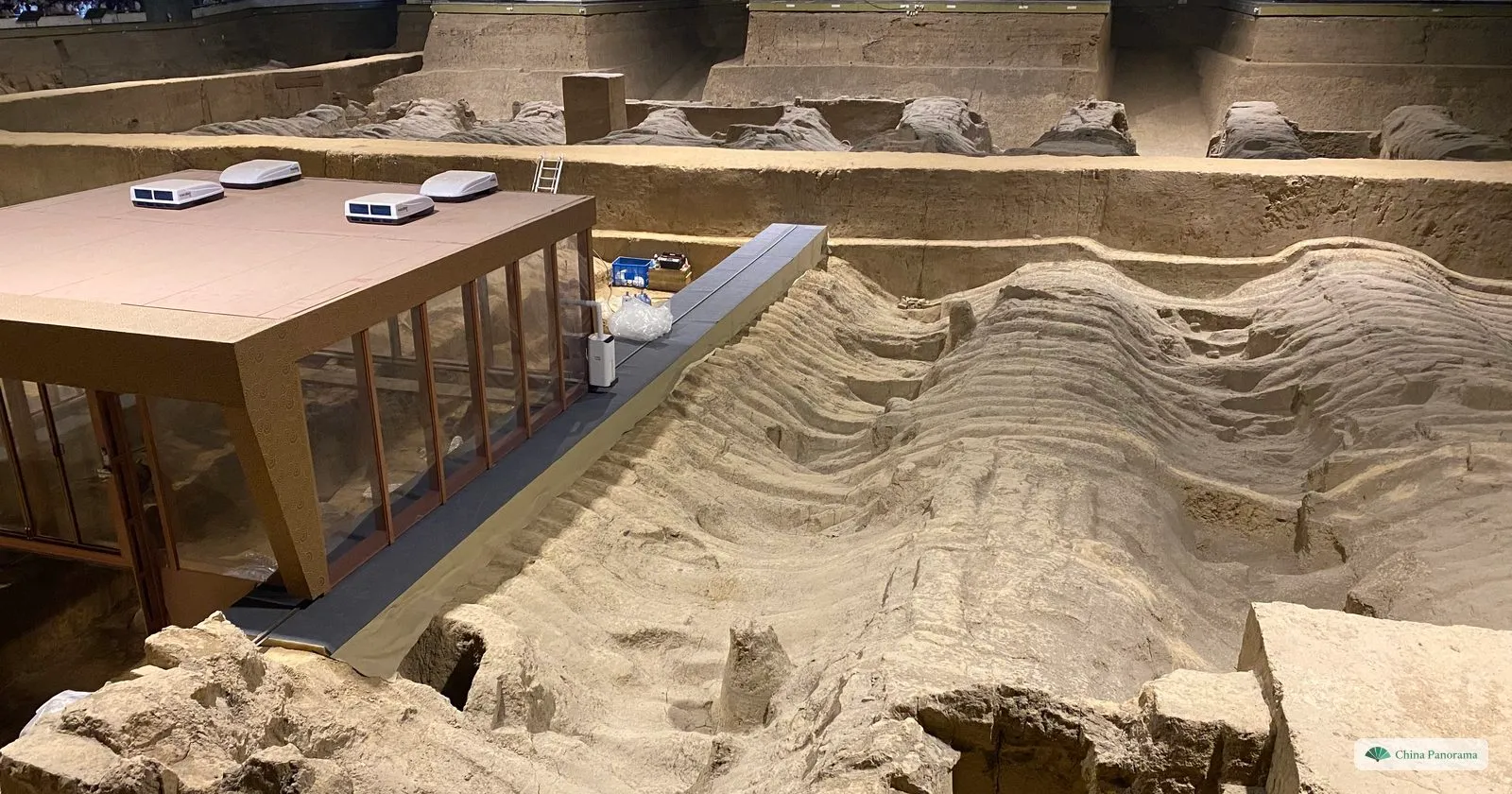
5 · 二号坑
Pit 2: the collapsed roof
Most of Pit 2 is still covered. The waves in the ground are the imprint of the roof beams, with the figures lying underneath. Archaeologists work in the glazed room on the left.
The kneeling archer: the star of Pit 2
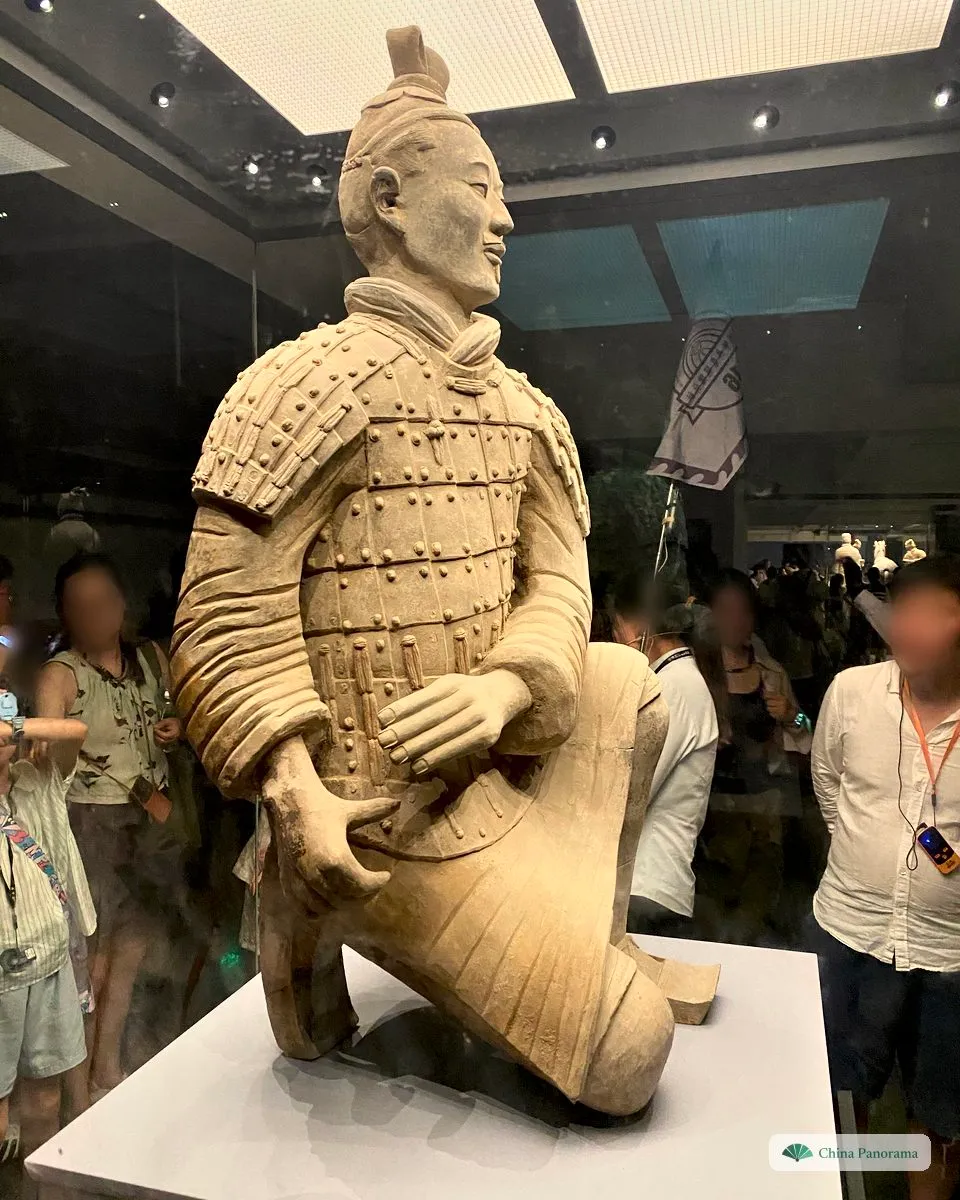
In Pit 2, 160 such archers kneel in eight files at the core of the crossbow unit, with 172 more standing around them. The one in the glass case, just to the left of the entrance when we visited in 2024, is said to be the only figure found whole that did not have to be pieced together.
He is easy to find: head for the biggest crowd. Even out of season people stand several rows deep round the case. Wait a moment, then walk all the way round, because the best part is at the back.
Three things to look for
- The sole of the right shoe, at the back: the stitches are denser at toe and heel.
- The armour: on the body upper lies over lower, on the shoulder lower over upper.
- Red traces on the plates of the back: the figure was once painted.
1Topknot
发髻 · to one side, not on top
The knot sits to one side of the head, with each braid plaited separately underneath. Ordinary soldiers wear no helmet or cap, only this hairstyle.
Tap a number on the photo, or a name in the list.
Who is who? Reading rank from the head
The figures are not all the same. Headgear gives away rank fastest, then the armour, last the pose and the hands. Guess first, then read on:
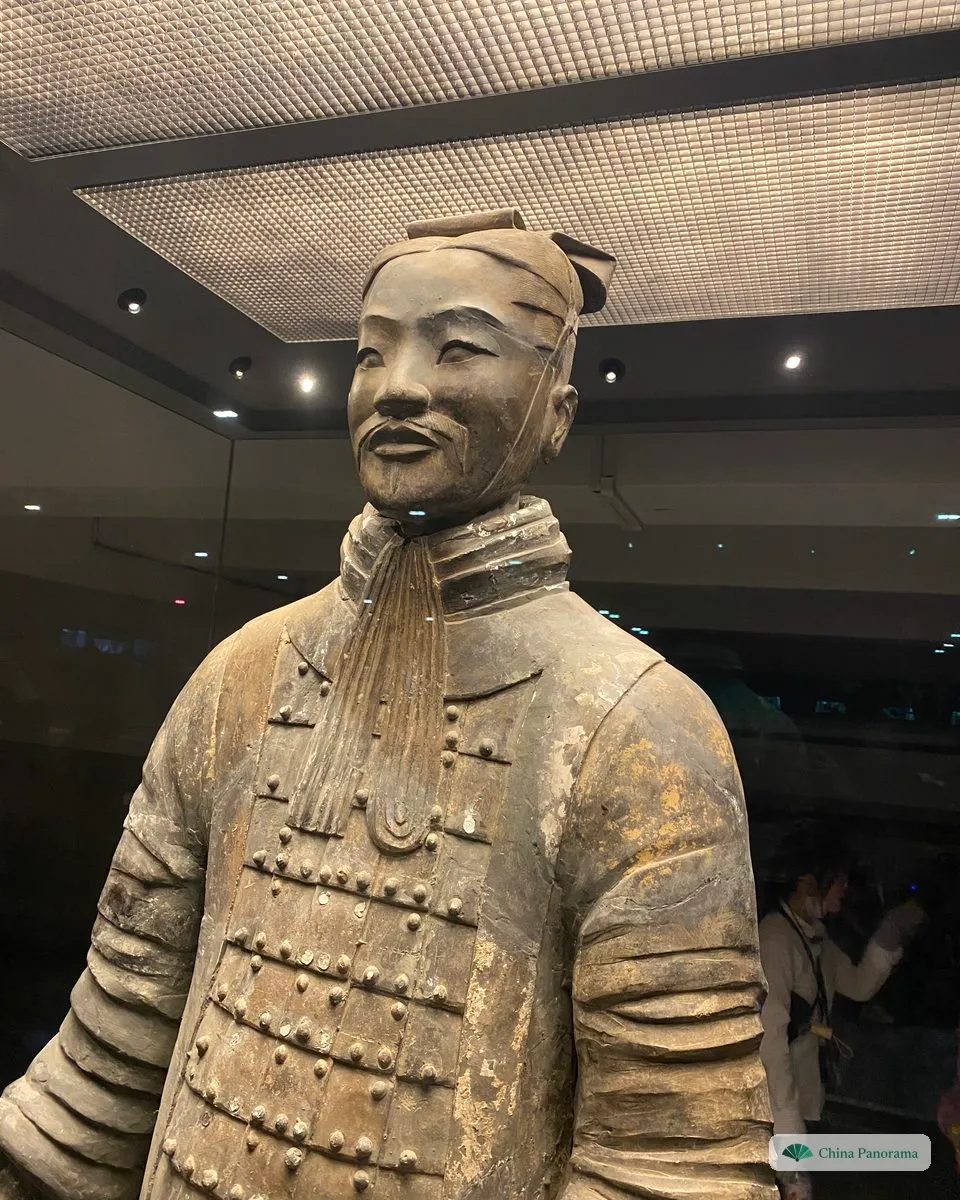
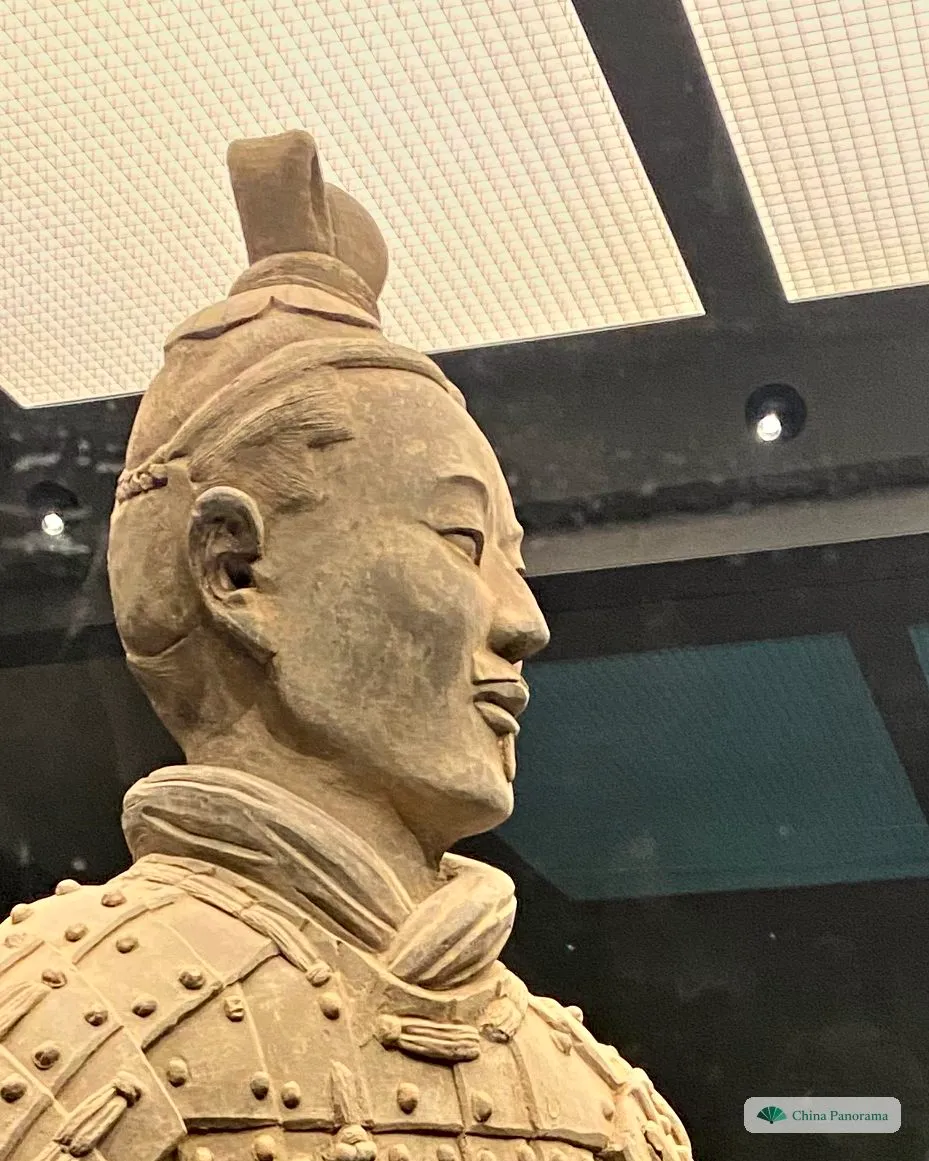 Photograph 1
General, officer, cavalryman or soldier?
Answer: Soldier
No cap, just a topknot on one side of the head: an ordinary soldier, here the kneeling archer from Pit 2.
Pit 2, June 2024
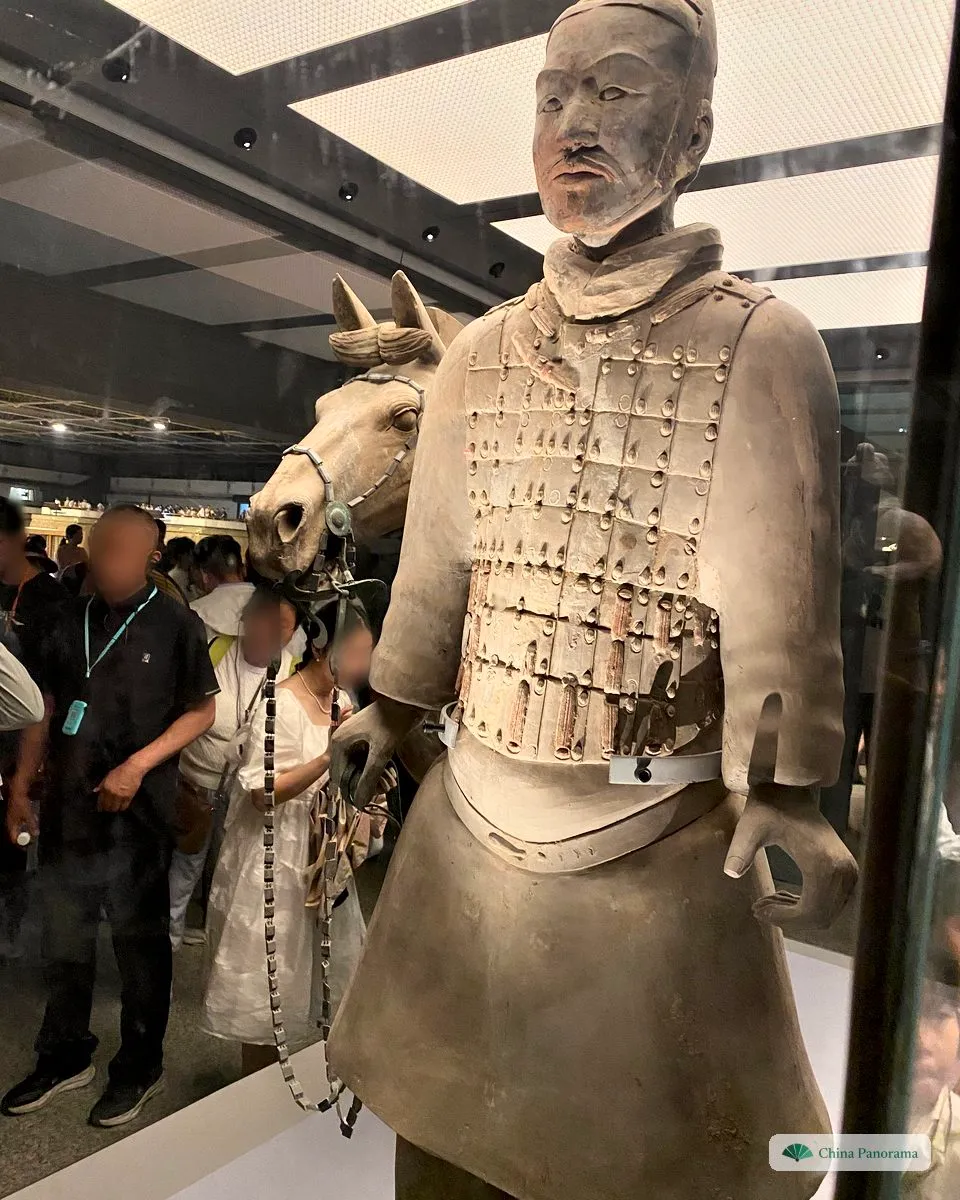
 Photograph 2
General, officer, cavalryman or soldier?
Answer: Officer
The long two-board cap and the breastplate with a smooth border: a middle-ranking officer.
Pit 2, June 2024
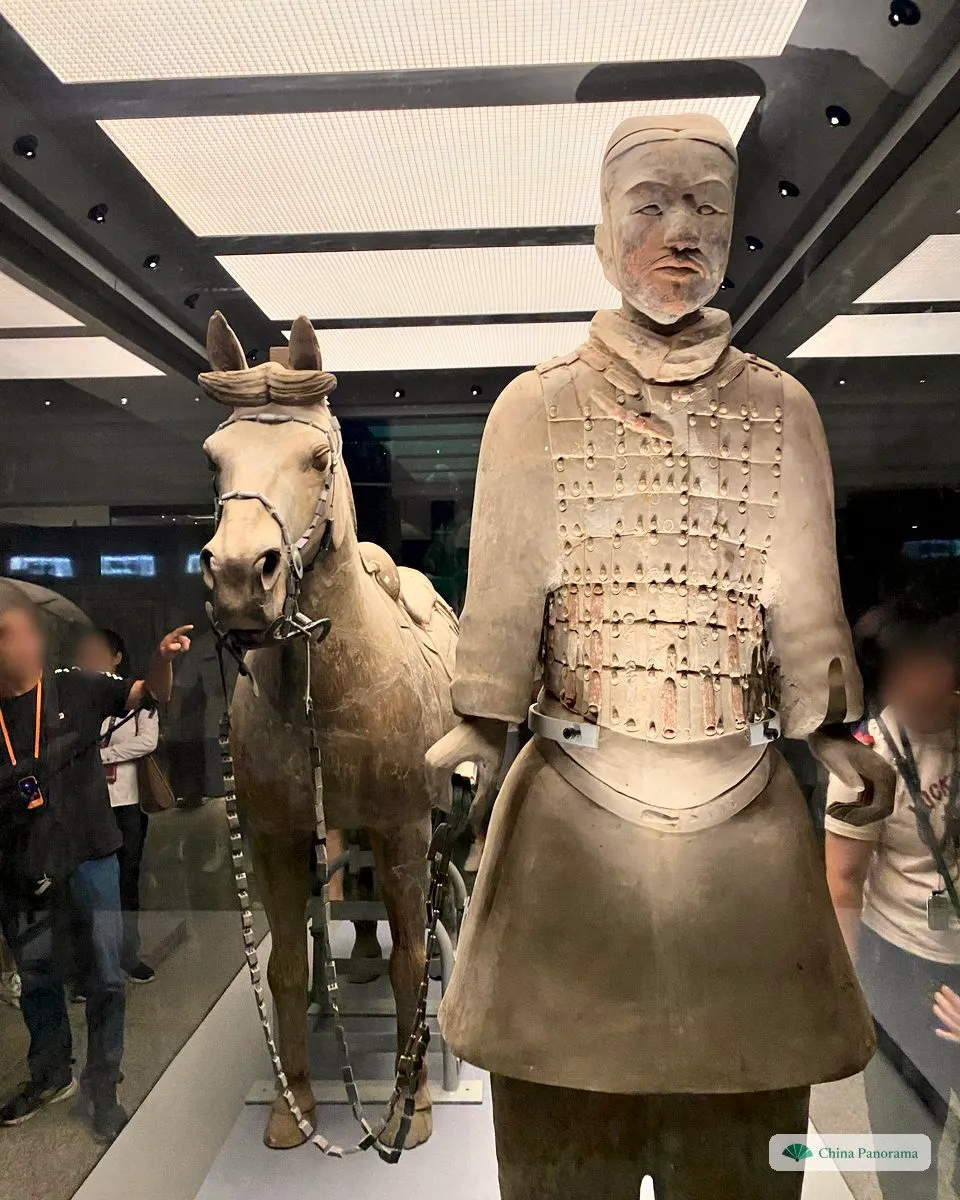
 Photograph 3
General, officer, cavalryman or soldier?
Answer: Cavalryman
A round cap tied under the chin, short armour without shoulder pieces and a horse on the rein: a cavalryman.
Pit 2, June 2024
General 将军俑
Head: tall cap shaped like a pheasant’s tail 鹖冠
Armour: fine plates, several knots
Officer 军吏俑
Head: long cap of one or two boards 长冠
Armour: breastplate with a border
Cavalryman 骑兵俑
Head: round cap tied under the chin 弁
Armour: short, no shoulder pieces
Soldier 士兵俑
Head: topknot only 发髻
Armour: large plates, or just a robe
And this is what it looks like up close. Tap the numbers:
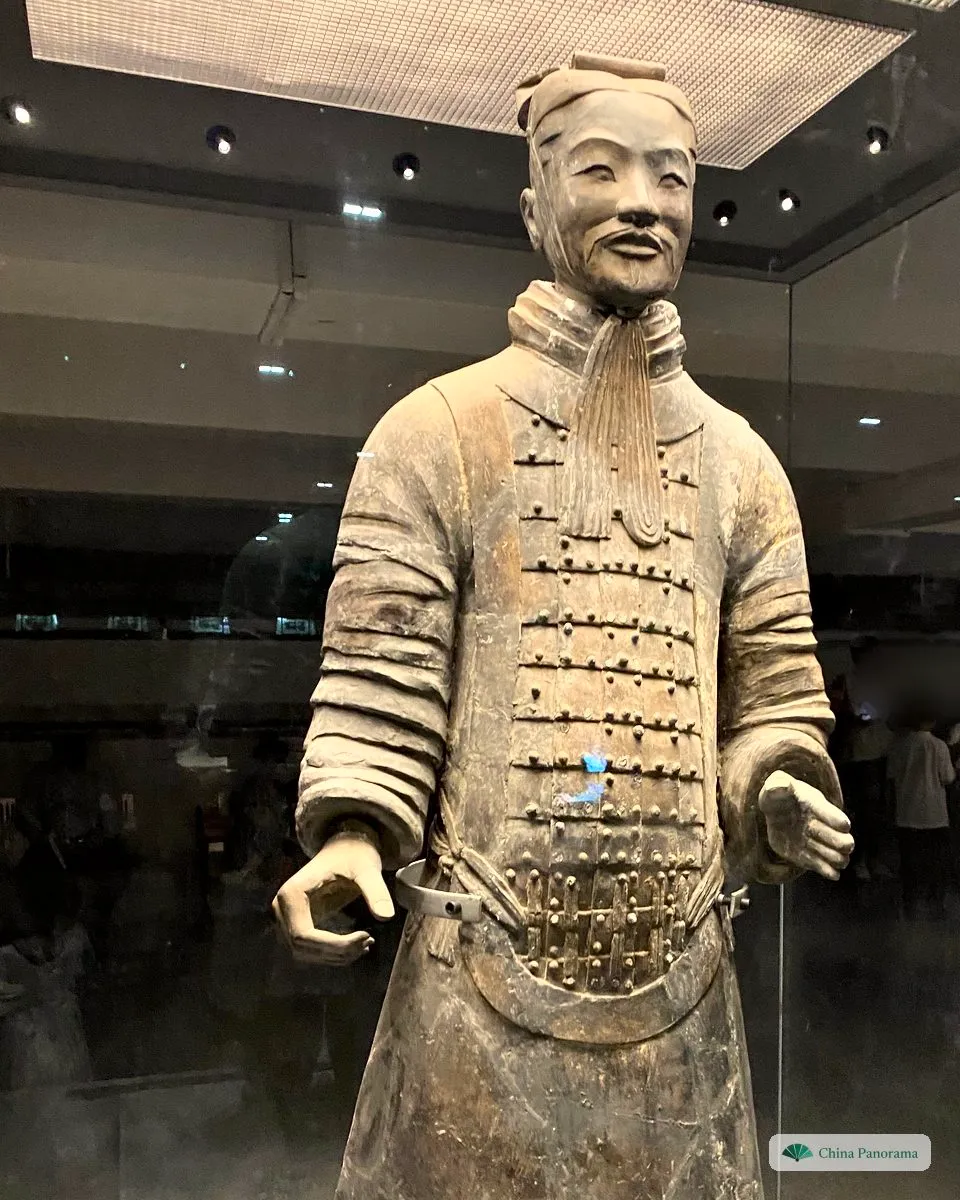
1Double-board cap
双板长冠 · the mark of rank
According to the museum’s label the long cap of two boards is worn by the middle-ranking officer. An ordinary soldier has only the topknot, a general a tall cap shaped like a pheasant’s tail.
Tap a number on the photo, or a name in the list.
We did not photograph a general. None was in the glass cases when we visited.
Why the Terracotta Warriors are no longer painted
The figures were once fully painted, faces in skin tones, robes red, green, blue and purple. But the paint was not on the clay itself. It sat on a coat of raw lacquer, and that is what doomed it. Drag the slider and see what happens after excavation:
Schematic, not to scale. The lacquer layer is a fraction of a millimetre thick.
What is at work
1Lacquer loses water
The paint is not on the clay itself: clay, then raw lacquer, then mineral paint. When the lacquer dries it shrinks, cracks and lifts, and the paint comes away with it.
2Oxidation
Some pigments containing iron or copper change in the air, turning darker or powdery.
3Temperature and humidity
Underground the climate was stable. When a figure is uncovered, temperature and humidity jump, which speeds up the lifting of lacquer and paint.
4Light
Ultraviolet light attacks the organic lacquer. In the early years of the excavation it was an important factor as well.
On site you see traces of paint best on the figures in the glass cases: on the cords of the cavalryman’s armour, on the back of the kneeling archer. Some figures online, such as “after 15 seconds” or “after 4 minutes”, we could not find in any reliable source. The museum speaks of a few minutes.
Plan your visit: tickets, getting there from Xi’an, opening hours
Tickets and opening hours
- Entrance
- 120 ¥ ≈ $17.73
- Open
- 08:30–18:30 (16 Mar – 15 Nov), 08:30–18:00 (16 Nov – 15 Mar)
- Tickets are sold online under your real name. Foreign visitors show the passport to buy and at the entrance.
- The ticket is reported to include Lishan Garden with the tomb mound, with a shuttle bus between the two.
Getting there from Xi’an
By metro: Line 1 or 6 east to Fangzhicheng, then Line 9 to Huaqingchi 华清池站. From there bus and taxi cover the last 8 km, about ten minutes by taxi. About an hour from the centre in all.
All routes, the metro and a day plan are on our page about Xi’an.
Five mistakes many people make
1Leaving the passport at the hotel
Tickets are in your name. Foreign visitors show the passport to buy and again at the gate.
2Arriving at midday
That is when the tour groups arrive. Come at opening time, all the more on public holidays.
3Starting with Pit 2
Pit 1 first for the big picture, then 3, then 2 with the glass cases. The visit builds up to the detail.
4Missing the kneeling archer
He stands in Pit 2, just left of the entrance when we visited. Head for the biggest crowd, then walk once round the case.
5Going without any explanation
Without background it is a lot of grey figures. An audio guide, a tour or this page on your phone makes the difference.
True or false?
1The figures were originally painted in bright colours.
True
True. Red, green, blue, purple, white and black lay on a coat of lacquer. Most of it was lost on excavation, and traces show on the armour in the glass cases.
2The colour disappeared only because of oxidation.
False
False. The main cause is the lacquer under the paint: it dries in the air, curls up and takes the paint with it. Oxidation, the change in climate and light add to it.
3Farmers found the army in 1974 while digging a well.
True
True. In March 1974 farmers in Lintong dug into pottery fragments. They lay at the edge of what became Pit 1.
4The emperor’s tomb has been opened and can be visited.
False
False. The burial chamber under the mound has never been opened. What you can see is the wooded mound in Lishan Garden.
5The soldiers held real weapons.
True
True. Bronze arrowheads, crossbow triggers, spears and swords were found in the pits. The wooden parts have rotted.
6Pit 1 has been fully excavated.
False
False. A large part is still underground, and digging and restoration continue at the back of the hall.
FAQ
How old is the Terracotta Army?
About 2,200 years. It was made for the tomb of Qin Shi Huang, the first emperor of China, who began building his tomb in 246 BC and died in 210 BC. It was rediscovered only in March 1974, when farmers dug a well.
How much time do I need for the Terracotta Army?
Plan 2 to 3 hours for the three pits, plus the journey of about an hour each way from central Xi’an. With the shuttle to the emperor’s tomb mound, make it half a day. If you only have an hour, see Pit 1 from the front and the glass cases in Pit 2.
Which pit should I see first?
Pit 1 first for the scale, then Pit 3, the small command post, then Pit 2 with the glass cases. The kneeling archer, the officer and the cavalryman are close up there, so the visit ends with the details.
Where is the kneeling archer?
In Pit 2. When we visited in 2024 he stood in a glass case just to the left after the entrance. The Pit 2 hall was redesigned in October 2026, so the case may have moved. It is the most crowded spot in the hall, even out of season. Walk once round the case: the stitched sole of his right shoe faces backwards.
How much is the ticket?
120 CNY (≈ $17.73). Tickets are sold online under your real name, and foreign visitors show their passport to buy and again at the entrance. Opening hours: 08:30–18:30 (16 Mar – 15 Nov), 08:30–18:00 (16 Nov – 15 Mar).
How do I get from Xi’an to the Terracotta Army?
It is in Lintong district, about 40 km east of the centre. Metro Line 9 runs to Huaqingchi station, then it is 8 km by bus or a ten-minute taxi ride. Details and other routes are on our Xi’an page.
Were the terracotta warriors painted?
Yes. Under the paint was a layer of raw lacquer. After excavation it dries within minutes, curls up and takes the paint with it. Traces of red, green and blue are still visible on some figures, for example on the armour of the cavalryman in Pit 2.
Is the Terracotta Army worth it?
Yes, if you know what to look at. Without background it is a lot of grey figures. With the order of the pits, the kneeling archer and the signs of rank in mind, it is one of the most impressive places in China.
Sources and status
We checked the ticket price and opening hours on 30 September 2026, as for our Xi’an page. Sizes and counts of the pits come from reports by Xinhua and other Chinese media. Figures for the units in Pit 2 differ a little between sources. Minutes in the visit planner are our estimate.
- Sima Qian, Shiji: Annals of the First Emperor, with the building of the tomb (Chinese)
- Beijing News: Pit 1 excavation and who set the fire, 2023 (Chinese)
- Chinese Academy of Social Sciences: maker’s names on Qin objects 物勒工名 (Chinese)
- Xinhua: Pit 2 hall redesigned, September 2026 (Chinese)
- UNESCO World Heritage: Mausoleum of the First Qin Emperor
- Wenhui Bao: Layout of Pit 2, crossbowmen, chariots and cavalry, 2015 (Chinese)
- Xinhua: Pit 2 excavation with two chariots, January 2026 (Chinese)
- Xinhua: Pit 1 with 14,260 m², 2023 (Chinese)
- The Paper: Pit 3, size and finds (Chinese)
- Sina: The museum’s conservator on the lacquer under the paint, 2020 (Chinese)
- Yangcheng Evening News: Paint changes within minutes, consolidation with polyethylene glycol, 2024 (Chinese)
- Metropolitan Museum: Kneeling Archer, with red paint on the armour ties
- Wikipedia: Terracotta Army
Changelog (1)
- 2026-11-10Page created, with the history and a timeline, our own photos of June 2024, a plan of the three pits with a visit planner, the kneeling archer to tap and a model of how the colours were lost.