
China travel food guide · Nº 002
Tomato and Egg Drop Soup 番茄蛋汤
Tomato and egg drop soup (番茄蛋汤, fān qié dàn tāng), also called tomato egg soup – or 西红柿鸡蛋汤 in northern China – is a light broth with soft tomato and thin ribbons of egg, finished with a few drops of sesame oil: the everyday soup of Chinese home cooking. Nearly every family makes it, and almost every home-style restaurant and canteen in the country has it, often as the one soup on a table of shared dishes. Vegetarian with egg if the broth is plain, not spicy, no bones.
The dish card
Tap the red Chinese name, the vegetarian line or the sesame box to show it full-screen to the staff.
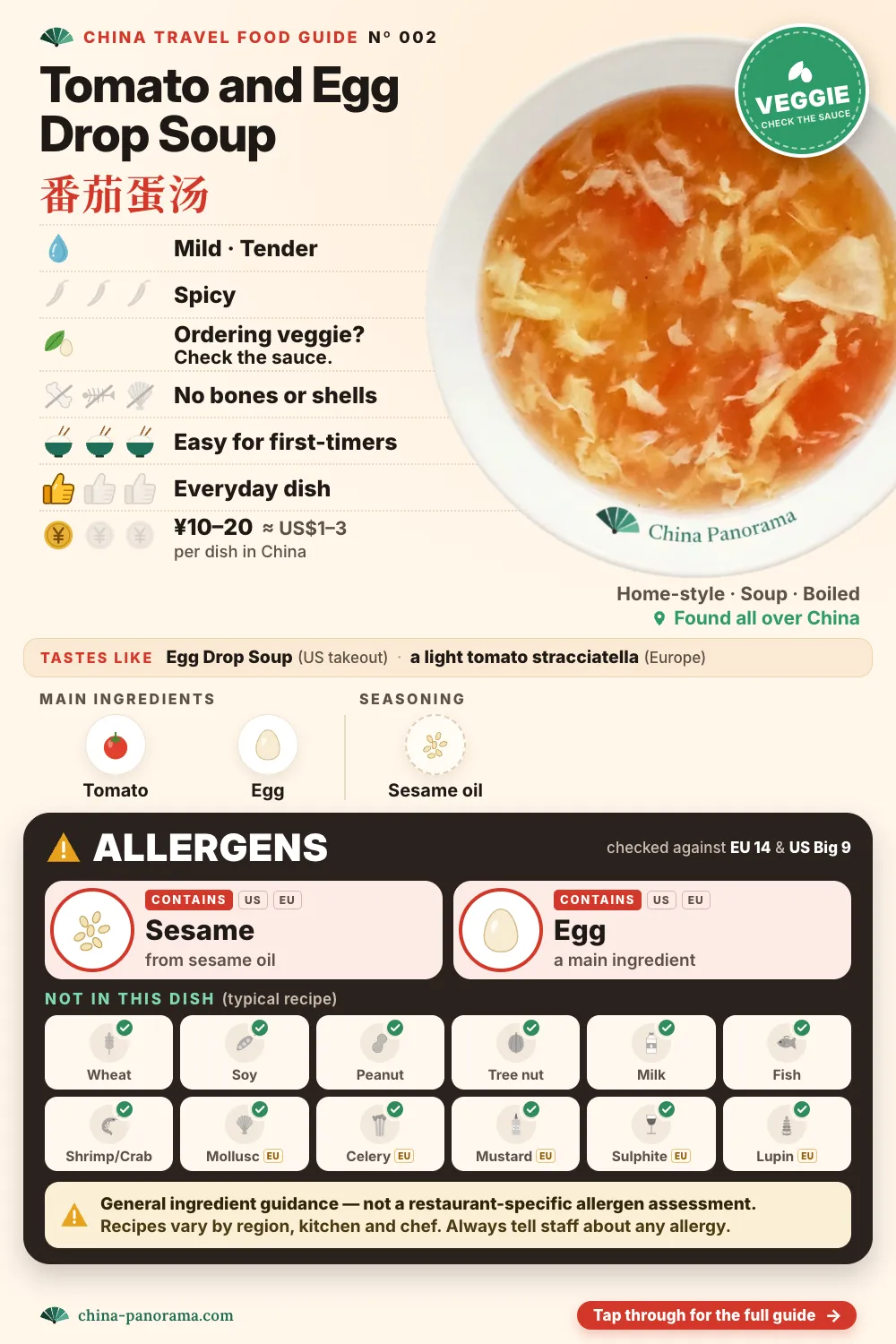 Partly edited with AI
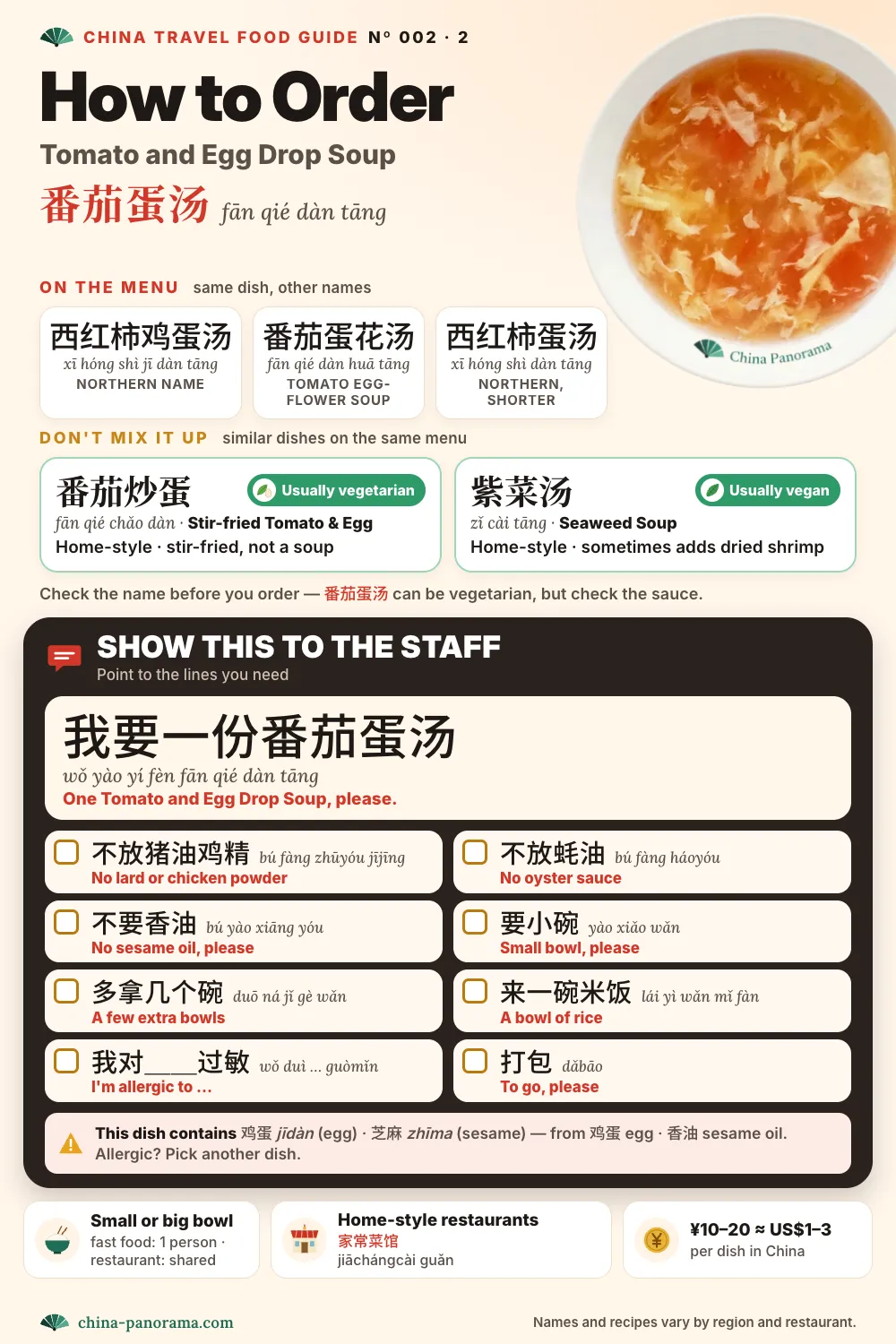
How to order tomato and egg drop soup
Tick what you need right on the card, then tap the big first line to show it full-screen to the staff.
What is tomato and egg drop soup?
The name lists what goes in: 番茄 (fān qié) tomato – literally “foreign eggplant” – 蛋 (dàn) egg, 汤 (tāng) soup. Tomato wedges are fried for a moment in a little oil until they soften and turn the oil red; water or a light stock goes in and boils for a few minutes; then beaten egg is poured in a thin stream while the soup is stirred, so it sets in soft ribbons – the 蛋花 (dàn huā), “egg flowers”, of the menu name 番茄蛋花汤. Salt, sometimes a spoon of starch so the egg floats, a few drops of sesame oil and chopped scallion on top. Ten minutes from start to bowl, which is why it is the soup every Chinese family knows how to make.
It is the default soup of Chinese home cooking (家常菜, jiā cháng cài). At home it rounds off a weeknight dinner of two or three dishes and rice. In home-style restaurants it is usually the cheapest soup on the menu and comes in a big bowl for the table, with a ladle and small bowls. In canteens and fast-food places it comes as a small bowl with a set meal (套餐, tào cān) – some keep a pot of thin soup by the counter for free. In the north the menu says 西红柿鸡蛋汤 (xī hóng shì jī dàn tāng): 西红柿, “western red persimmon”, is the northern word for tomato. Watch the middle of the name: 番茄炒蛋, with 炒 (chǎo, stir-fried), is the stir-fry, not the soup.
It costs about ¥10–20 (US$1–3) in an ordinary restaurant in a big city (2026).
Main ingredients
- 番茄fān qiéTomato
- 鸡蛋jī dànEgg
Seasoning
- 香油xiāng yóuSesame oil
What does it taste like?
Light, a little sour and a little sweet from the tomatoes, with soft, silky ribbons of egg and a nutty hint of sesame oil on top. The broth is thin – some cooks thicken it slightly with starch so the egg floats – and only lightly salted, because it is meant to go with stronger dishes and rice. Warm and plain in a good way: the taste of an ordinary Chinese dinner.
Tastes like… Egg drop soup from American Chinese takeout, but with tomato in it and a thinner, lighter broth – or an Italian stracciatella made with tomato instead of Parmesan.
In a canteen (食堂, shí táng) it comes as a small bowl next to the rice and two or three dishes you pointed at behind the glass. Nobody hands you a menu, so it helps to know it by sight – this is one of our trays.
Which one is tomato and egg drop soup? Tap it on the photo.
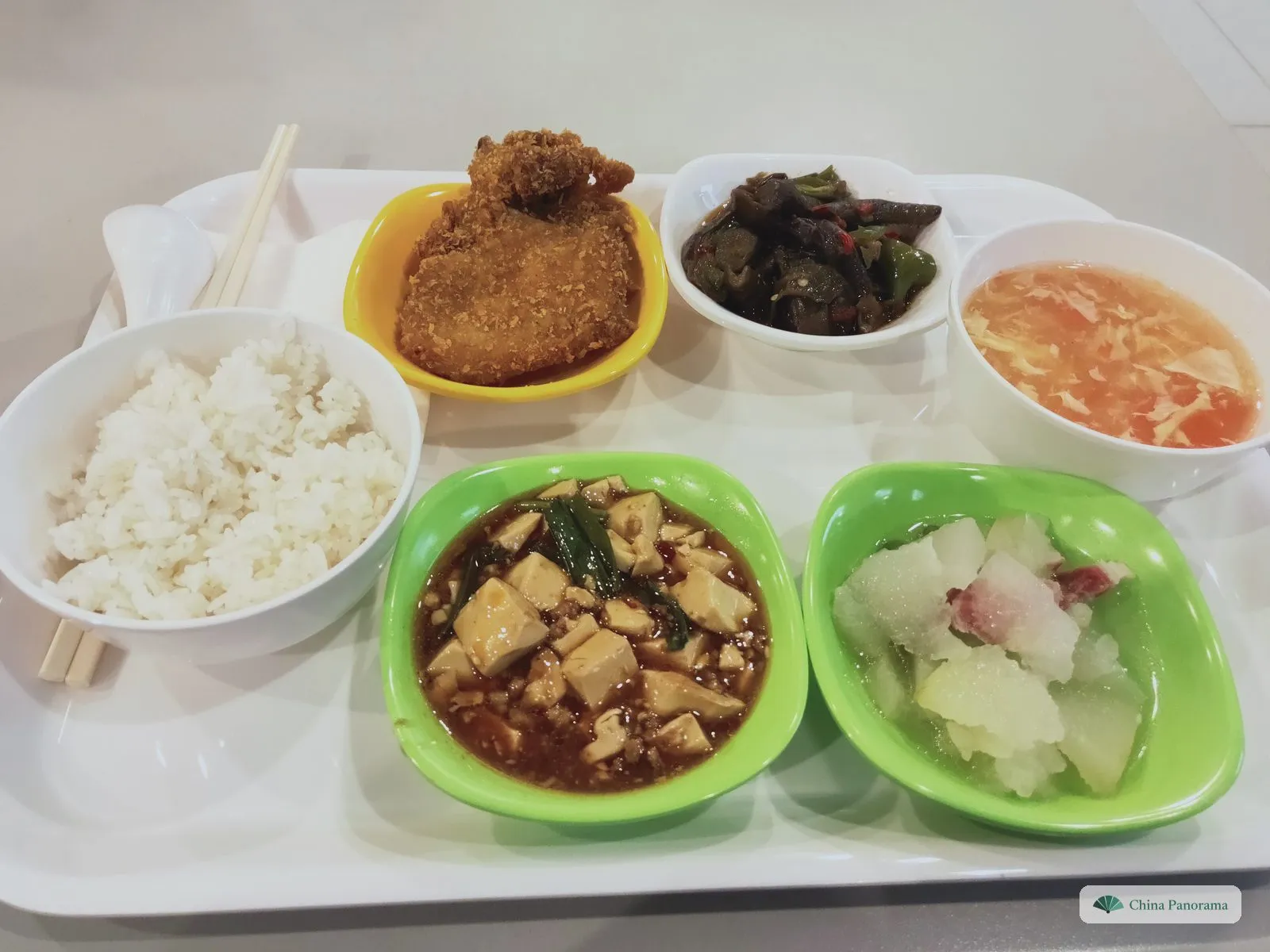
It’s the white bowl on the right: a thin orange-red broth with pale yellow ribbons of egg floating on top. A canteen version is often thinner than a restaurant’s – if you are unsure, point at it and ask 是番茄蛋汤吗? (shì fān qié dàn tāng ma?).
Don’t mix it up
Cheap everyday soups look alike in a canteen bowl. The order card above names seaweed soup; here are four soups you may meet on the same counter or menu, all in our own photos.
Which one is tomato and egg drop soup? Tap a photo.
紫菜汤Seaweed soup
番茄豆腐汤Tomato and tofu soup
番茄蛋汤Tomato and egg soup
酸辣汤Hot and sour soup
The orange-red one with pale ribbons of egg floating in a thin broth. The ribbons give it away: tomato and tofu soup has white cubes instead, seaweed soup is dark green, and hot and sour soup is brown and thick.
- 紫菜汤 (zǐ cài tāng, seaweed soup): Pale broth with dark green-black flakes of seaweed, sometimes with egg too (紫菜蛋花汤). Usually vegan, but some kitchens add tiny dried shrimp (虾皮) – ask if you avoid crustaceans.
- 番茄豆腐汤 (fān qié dòu fu tāng, tomato and tofu soup): The same tomato, but white cubes of tofu (soy) instead of egg ribbons, often with mushrooms. The one to pick if you don’t eat egg – ask about the stock.
- 酸辣汤 (suān là tāng, hot and sour soup): Also has egg ribbons, but it is brown and thick, with tofu and wood ear; sour from vinegar, hot from white pepper. Soy sauce brings soy and wheat, and it often has pork in it.
Our photos: seaweed soup in a canteen in Shanghai, 2018; tomato and tofu soup on a set-meal tray, 2025; tomato and egg soup in a canteen, 2018; hot and sour soup in a restaurant in Shanghai, 2020.
Two dishes and a soup
Chinese meals are shared: the dishes go in the middle, everyone has their own bowl of rice and takes from the plates. The rule of thumb many families use is one dish per person and a soup – 两菜一汤 (liǎng cài yì tāng, two dishes and a soup) for two, 三菜一汤 for three – with meat and vegetables mixed. Tomato and egg soup is the soup people add almost without thinking: cheap, mild and good next to anything. In a restaurant it comes as one big bowl for the table, with a ladle; in fast-food places and canteens everyone gets a small bowl of their own. In most of China it comes with the dishes and people sip it through the meal (in Guangdong soup often comes first), and some pour a ladle over their rice. Pick how many you are and what you’d like – the order builds itself in Chinese.
How many of you?
两菜一汤liǎng cài yì tāng· two dishes and a soup
Pick the dishesThat’s the table – take one off to swap.
Your order
我们两个人,要一份青椒炒茄子、一份宫保鸡丁,再来一份番茄蛋汤,两碗米饭。
wǒmen liǎng gè rén, yào yí fèn qīng jiāo chǎo qié zi, yí fèn gōng bǎo jī dīng, zài lái yí fèn fān qié dàn tāng, liǎng wǎn mǐfàn.
There are two of us. One eggplant with green peppers and one kung pao chicken, then a tomato and egg soup and two bowls of rice, please.
About ¥50–90 for the table, plus rice (2026).
At your table: A wheat / gluten, C egg, E peanut, F soy, N sesame. Allergic? Fill in the allergy card →
Meat and vegetables – 荤素搭配 (hūn sù dā pèi), the way a Chinese family orders.
Prices add up the typical range of each dish in our dish library, for an ordinary restaurant in a big city (2026); rice is extra, usually a few yuan a bowl. Allergens are from the usual recipes – kitchens vary, so always tell the staff about an allergy.
Allergens and diet
Tomato and egg drop soup contains egg (from the egg) and sesame (from the sesame oil). The sesame is a few drops of oil stirred in at the end: ask for 不要香油 (bú yào xiāng yóu) and most kitchens leave it out – with a serious sesame allergy, still tell the staff, because the soup is often made in a big pot ahead of time.
In the usual recipe
- CEggs· US: Eggs
- NSesame· US: Sesame
Not in this dish (typical recipe)
A wheat / gluten, B shrimp / crab, D fish, E peanut, F soy, G milk, H tree nuts, L celery, M mustard, O sulphites, P lupin, R molluscs
These are estimates from how the dish is usually made, not a restaurant’s declaration. Every kitchen and every sauce brand is different – always tell the staff about an allergy. Chinese kitchens often fry in peanut oil, and chilli oil may be made with it too; we don’t repeat that for each dish.
Vegan, vegetarian, gluten-free
Vegetarian in the usual recipe, with egg or dairy. Kitchens may still fry in lard (猪油), add oyster sauce (蚝油) or chicken powder (鸡精) – ask for none of them; the order card above has the lines.
The broth is the thing to check. At home it is plain water; restaurants may use chicken stock, chicken powder (鸡精) or a spoon of lard for flavour. Tick 不放猪油鸡精 on the order card, or tap the vegetarian line on the dish card – it asks for no meat stock as well.
Not vegan: the egg is in every spoonful. If you don’t eat egg, 番茄豆腐汤 (fān qié dòu fu tāng, tomato and tofu soup) or 番茄菌菇汤 (fān qié jūn gū tāng, tomato and mushroom soup) are often on the same menu – ask whether they are made with meat stock.
There is no wheat or soy in the usual recipe, so it is one of the easier soups if you avoid gluten. Some kitchens thicken it with starch – usually corn or potato starch, not wheat – and a few add a dash of oyster sauce, which is usually made with wheat: the order card has 不放蚝油 (bú fàng háoyóu, no oyster sauce).
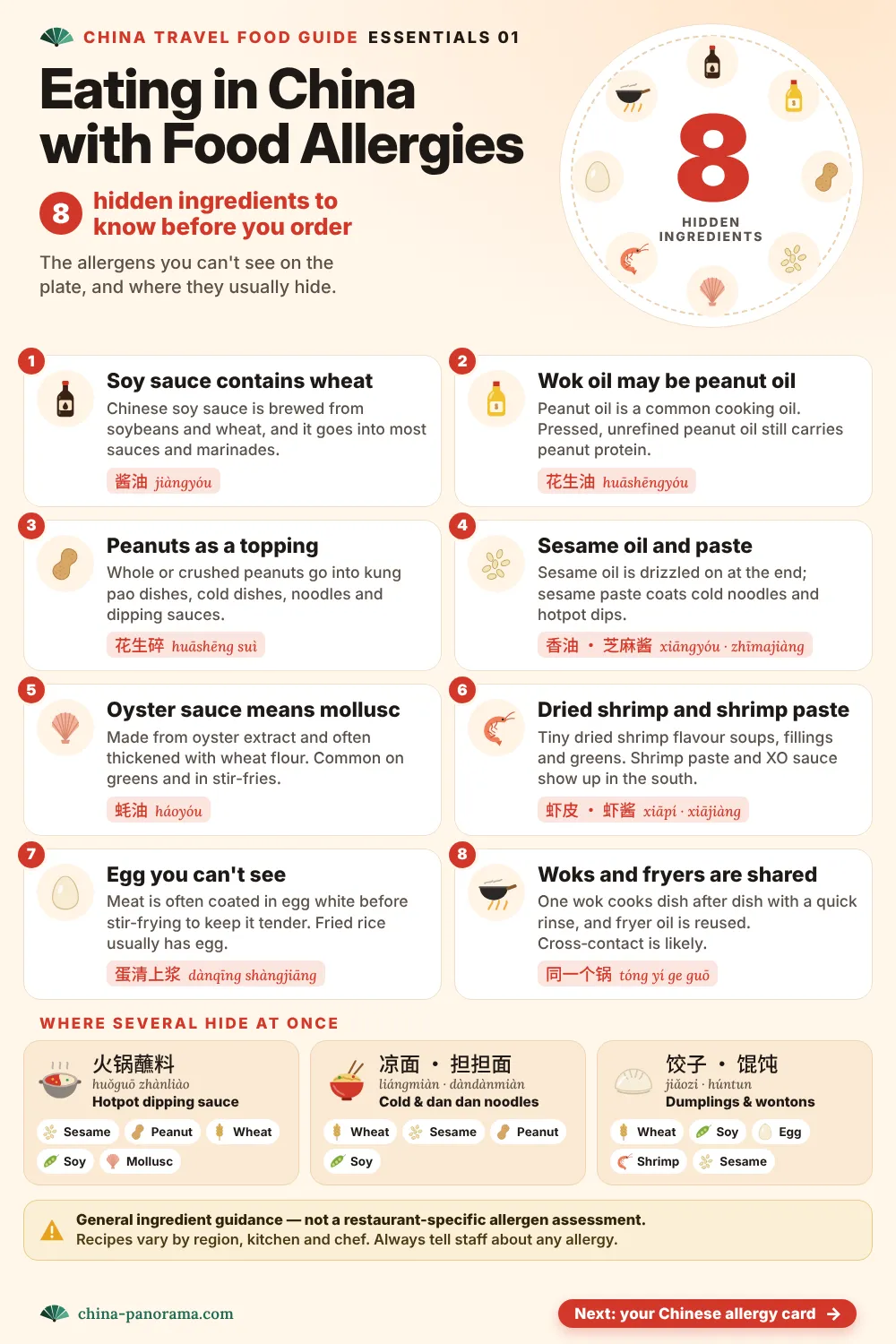
Eating in China with food allergies
Two cards that go with every dish in this guide. The first shows where allergens hide in Chinese cooking – tap an ingredient to ask about it in Chinese. The second is a Chinese allergy card for the staff: tick your allergens right on the card and it turns into one sentence, full-screen.
8 hidden ingredients to know before you order
Tap an ingredient to ask the staff about it in Chinese.
Show this to the staff: your Chinese allergy card
Tick your allergens on the card, then tap the big first line to show them full-screen to the staff. A question or the red line opens full-screen too.
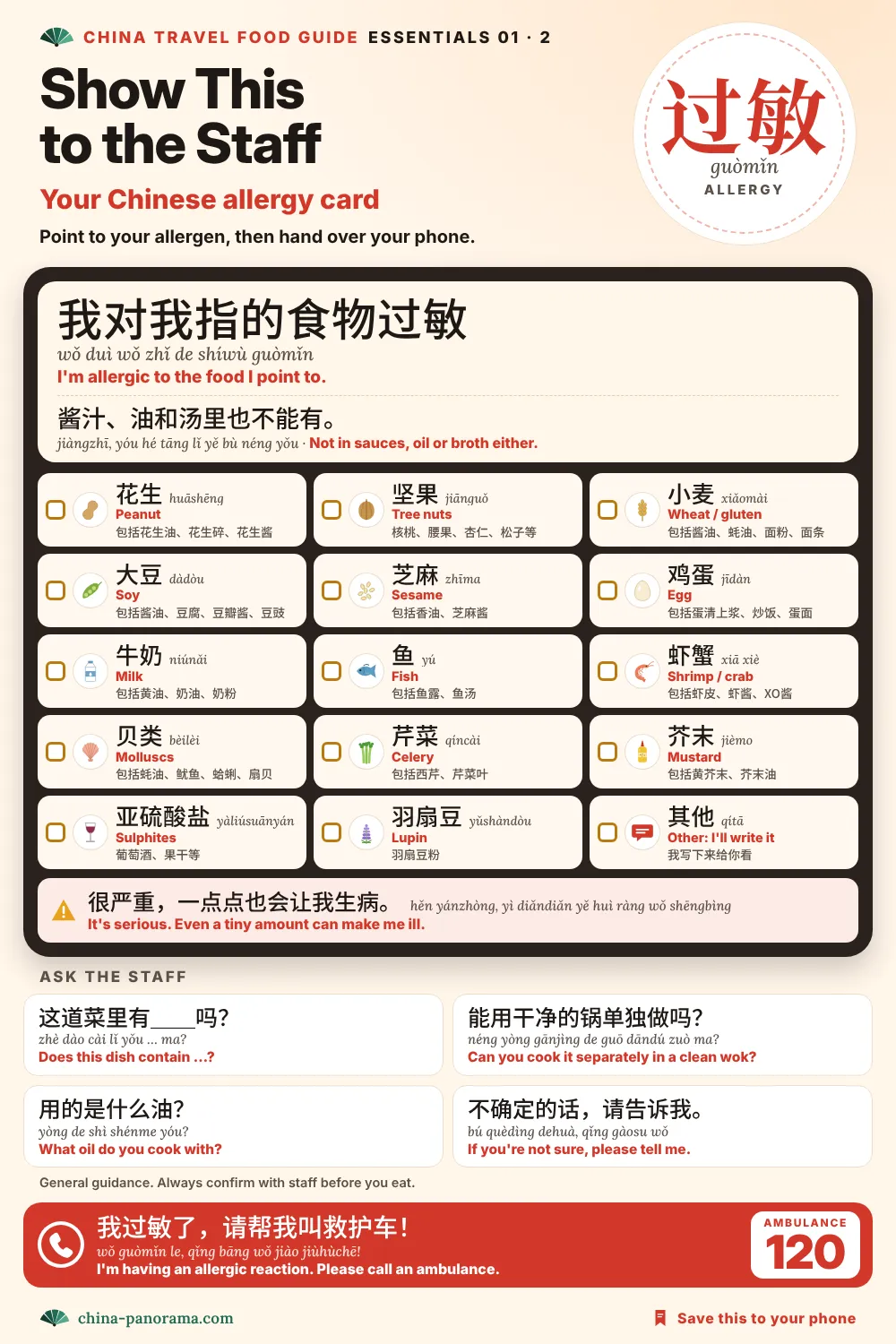
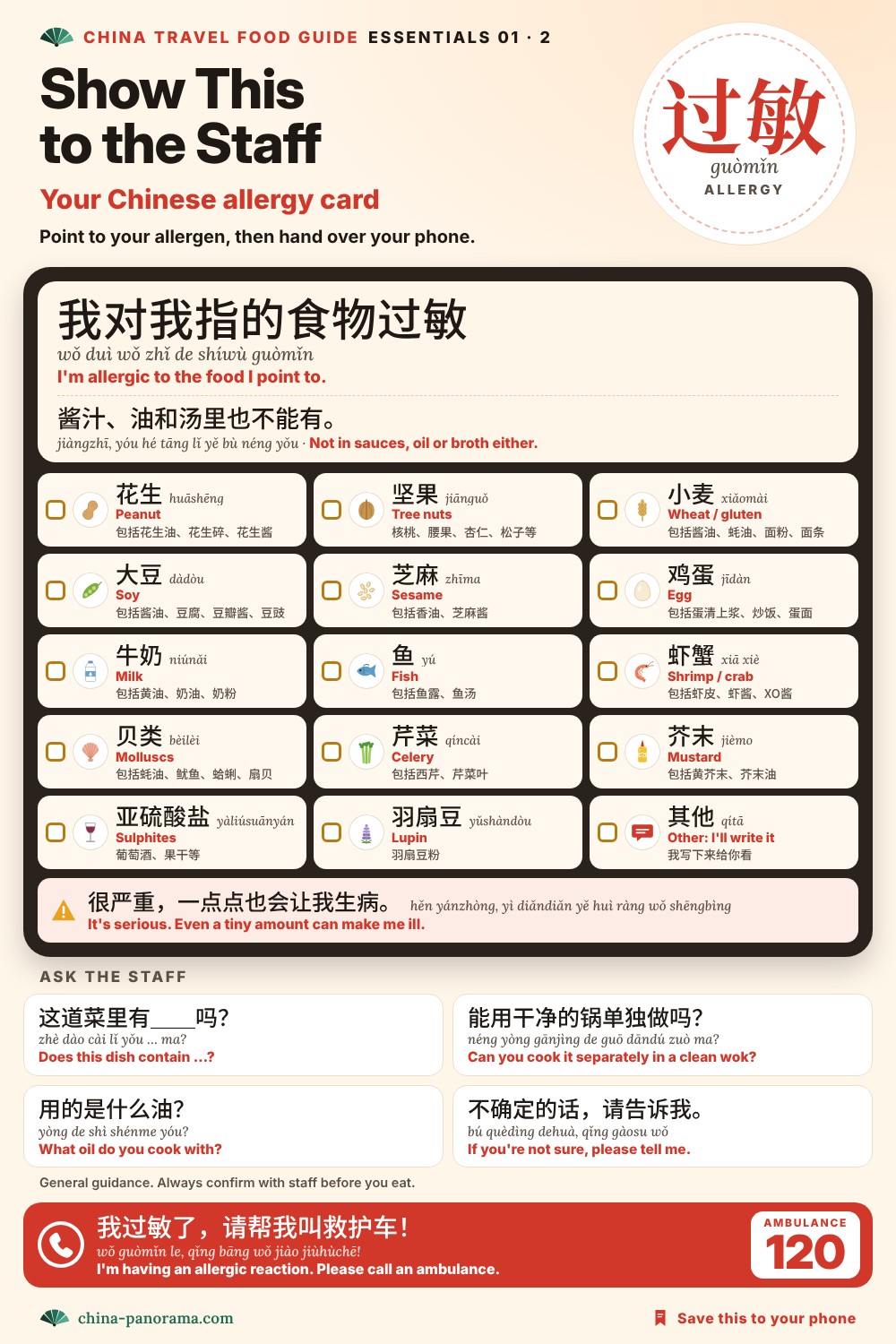
General ingredient guidance, not a restaurant’s allergen declaration. Recipes vary by region, kitchen and chef – always tell the staff about an allergy.
FAQ
Is tomato and egg drop soup vegetarian?
Usually, yes – with egg. At home it is tomato, egg, water, salt and a few drops of sesame oil. Restaurants sometimes use chicken stock instead of water, or add chicken powder (鸡精) or a spoon of lard (猪油), so ask for none of them: tick 不放猪油鸡精 on the order card, or tap the vegetarian line on the dish card, which also asks for no meat stock. It is not vegan – the egg is in every spoonful; tomato and tofu soup (番茄豆腐汤) is the egg-free choice on many menus.
Is it gluten-free?
In the usual recipe, yes: no soy sauce, flour or noodles. Some kitchens thicken the broth with starch – usually corn or potato starch, not wheat – and a few add a dash of oyster sauce, which is usually made with wheat; ask for 不放蚝油 (bú fàng háoyóu, no oyster sauce). If you react to traces, keep in mind that restaurant soup is often made in a big pot ahead of time.
Is it spicy?
No. Nothing hot goes in – at most a pinch of white pepper in some kitchens. It is one of the mildest things on a Chinese menu, the soup Chinese parents give small children, and the cooling sip between bites of a spicy Sichuan dish.
Is it the same as egg drop soup in American Chinese restaurants?
Same idea, different bowl. American egg drop soup is a yellow chicken broth thickened with cornstarch until it is almost silky, with ribbons of egg and often corn or peas. 番茄蛋汤 is thinner and lighter, orange-red from the tomatoes, a little sour, and at home made with water rather than stock. The closest thing to the American kind in China is 蛋花汤 (dàn huā tāng, egg-flower soup) or the thick sweetcorn soup 玉米羹 (yù mǐ gēng).
What is the difference between 番茄蛋汤, 番茄炒蛋 and 紫菜汤?
番茄炒蛋 (fān qié chǎo dàn) is the stir-fry: the same two ingredients cooked in a wok into soft chunks of egg in a little sauce – a dish, not a soup. 紫菜汤 (zǐ cài tāng) is seaweed soup, the other cheap everyday soup – usually vegan, but some kitchens add tiny dried shrimp (虾皮), so ask with a crustacean allergy. Read the name: 汤 (tāng) is soup, 炒 (chǎo) stir-fried, 紫菜 (zǐ cài) seaweed.
How much does it cost in China?
About ¥10–20 (US$1–3) for a big bowl to share in an ordinary home-style restaurant in a big city (2026) – usually the cheapest soup on the menu. In canteens and fast-food places a small bowl costs a few yuan or comes with a set meal, and some keep a pot of thin soup by the counter for free (免费汤, miǎn fèi tāng) – help yourself.
What is it called in Chinese?
番茄蛋汤, in pinyin fān qié dàn tāng (typed without tones: fan qie dan tang). In the north you will also see 西红柿鸡蛋汤 (xī hóng shì jī dàn tāng, typed: xi hong shi ji dan tang) – 西红柿 is the northern word for tomato – and on some menus 番茄蛋花汤, “tomato egg-flower soup”. In English it goes by tomato egg drop soup, tomato egg soup or Chinese tomato soup. To order, show the staff the order card above, or tap the red Chinese name on the dish card.
More Chinese dishes
- Stir-fried tomato and egg →
- Stir-fried eggplant with green peppers →
- Mapo tofu →
- Sweet and sour pork with pineapple →
- Wontons in China →
- Century egg and pork congee →
- Canteen and fast-food walkthrough →
- QR-code ordering walkthrough →
Ordering in a restaurant, by QR code or in a canteen? Our restaurant walkthrough, the QR-code ordering walkthrough and the canteen walkthrough show each step.
Cards, photos and sources
The cards are our own. The dish photo on cards 1 and 2 is partly edited with AI; the other photos on this page are our own, unedited. Prices come from our dish library and are typical for an ordinary restaurant in a big city; dollar prices are rounded. Allergens are estimated from the usual recipe, checked against the 14 EU allergen groups and the 9 major US food allergens. Menu names, similar dishes and phrases are general knowledge – recipes vary by region, kitchen and chef.
Changelog (1)
- 2026-10-08Page created with 4 cards you can use on screen: the dish card, how to order it, and the Essentials cards on eating in china with food allergies.