
Dunhuang
An oasis town at the western end of the Hexi Corridor, with a thousand years of Buddhist cave paintings at Mogao, dunes and a crescent-shaped spring at its edge, and the Han dynasty gates to the west.
敦煌 · Dūnhuáng · Gansu · 40.14° N, 94.66° E · about 1,100 m
Contains affiliate links · What does that mean?
Book Mogao ahead
No normal tickets are sold at the caves. Book on the official site with your passport: 238 CNY from April to November. Tickets and rules →
No photos in the caves
The murals may not be photographed. So we drew two of their motifs for you to look at before you go. Flying apsaras →
Dunhuang in brief: 2,100 years on the Silk Road
For a thousand years Dunhuang was the last Chinese garrison before the desert, where caravans, monks and armies passed between China and Central Asia. Local families, officials and merchants paid for caves to be painted at Mogao. When the sea routes took over, the town fell quiet, and the caves were nearly forgotten until 1900.
111 BC
Emperor Wu of the Han sets up the Dunhuang commandery, the westernmost of four along the Hexi Corridor. Yumen Pass and Yangguan guard the roads to the west. →
366
The first caves are cut at Mogao. Painting and carving go on for about a thousand years. →
8th–9th c.
The Tibetan Empire takes Dunhuang after the An Lushan rebellion weakens the Tang. In 848 the local general Zhang Yichao drives the Tibetans out.
1036
The Tanguts of the Western Xia take the city. The Library Cave at Mogao is walled up in the 11th century.
1725
After two centuries outside Chinese control, the Qing found the present city east of the ruined old town.
1900
On 25 June the Daoist abbot Wang Yuanlu finds the walled-up Library Cave, full of manuscripts. Aurel Stein (1907) and Paul Pelliot (1908) take thousands of them away. The largest collections are now in Beijing, London, Paris and Berlin.
1944
A national institute for Dunhuang art is founded to look after the caves. Since 1984 it has been the Dunhuang Academy.
1986–1987
Dunhuang becomes a national historic and cultural city (1986), the Mogao Caves become a World Heritage Site and the county becomes a city (1987).
2014–2015
Yumen Pass and the Xuanquan post station join the World Heritage List as part of the Silk Roads (2014). Mingsha Shan becomes a 5A scenic area and the area a UNESCO Global Geopark (2015).
World Heritage, 5A and other titles
UNESCO World Heritage
Mogao Caves, 1987
Listed for their murals and sculptures over a thousand years: 492 caves, about 45,000 m² of wall painting and more than 2,000 painted figures.
UNESCO World Heritage
Yumen Pass and Xuanquan, 2014
Two of the 33 sites of “Silk Roads: the Routes Network of Chang’an-Tianshan Corridor”: the Han pass 72 km north-west of the city, and the Han post station of Xuanquan about 60 km east, both in a straight line.
China 5A scenic area
Mingsha Shan and Crescent Spring, 2015
5A is the top grade of China’s national rating for tourist sites, from A to AAAAA, awarded by the Ministry of Culture and Tourism.
What 5A means →China 5A scenic area, proposed
Yangguan and Yumen Pass
On the ministry’s list of 17 sites proposed for 5A, published on 5 November 2026 for comment until 11 November. Not final yet.
UNESCO Global Geopark
Dunhuang, 2015
The dunes and the Crescent Spring are one of its areas, the Yadan landforms another.
National historic and cultural city
1986
On the State Council’s second list, of 8 December 1986, with Wuwei and Zhangye further east in Gansu.
Sources: UNESCO, the State Council notice of 1986, the Global Geoparks Network, the Jiuquan city government and the Ministry of Culture and Tourism for the titles, Wikipedia and the Dunhuang Academy for the history. All are listed under sources at the end of the page.
Where is Dunhuang?
In Gansu province, in China’s north-west, at the western end of the Hexi Corridor, the strip of oases between the mountains and the desert that the Silk Road followed. Jiayuguan, at the end of the Great Wall, is 310 km east, and Turpan 550 km north-west in a straight line. Dunhuang lies at 40.14° N, level with Beijing, Madrid and New York, but 1,850 km west of Beijing and about 1,100 m above sea level. Tap any city on the map to measure the distance.
Straight-line distances from central Dunhuang, rounded to the nearest 10 km — not travel distances.
Gansu is highlighted. Tap a city to measure the distance from Dunhuang.
- Province
- Gansu甘肃省
- Altitude
- about 1,100 moasis in the desert
- Mogao
- 25 kmby road, shuttle bus
- Airport
- DNH13 km east
- Metro
- Nonetaxis, car with driver
- Time zone
- UTC+8sunset 21:14 in June
The town, the dunes and Mogao
Tap a point for its distance from the centre. The city is small, but everything you came for is outside it.
Tap a place on the map or in the list.
The gate. The Crescent Spring is inside, about 15 to 20 minutes on foot. Details below ↓
Where the Mogao visit begins. The shuttle bus runs 16 km to the caves. Details below ↓
Airport DNH. Dunhuang station is 3 km west of it, 11 km from the centre.
The cliff. No private vehicles: shuttle bus only. Details below ↓
Straight-line distances from central Dunhuang, rounded — not travel distances.
West to the Han passes, east to Yulin
The passes and the Yadan landforms lie 60 to 130 km west in a straight line, in empty desert. They make one long day by car.
Tap a place on the map or in the list.
25 km by road. Visits start at the exhibition centre near the airport. Details below ↓
61 km by road, about an hour. The Western Thousand Buddha Caves are on the way, 31 km from the city. Details below ↓
94 km by road. 60 km on to Yangguan. Details below ↓
In Guazhou county, 168 km by road. Details below ↓
163 km by road, 72 km beyond Yumen Pass. Details below ↓
Straight-line distances from central Dunhuang, rounded — not travel distances.
What’s the weather like in Dunhuang each month?
Desert weather: about 35 °C by day in July and −15 °C at night in January, with big swings between day and night. Tap a month.
Scale in °C. Bars run from the average daily low to the average daily high. Source: monthly temperature data, last checked 2026-11-10.
Dunhuang in November
Cold- Average high
- 9 °C
- Average low
- -6 °C
- Sunrise / sunset
- 08:26 – 18:26
- Daylight
- 9 h 60 min
Spring
March – MayWarming fast, with the peak season from 1 April.
March reaches about 16 °C by day but still freezes at night, May about 28 °C. Mogao switches to its peak-season ticket and hours on 1 April. The caves close during sandstorms, with a refund, so keep a spare day.
What to wear: Layers, a windproof jacket and a scarf against sand.
Summer
June – AugustHot, dry and busiest.
Around 33 to 35 °C by day and about 19 °C at night in July. China's school holidays fill Mogao, so book as soon as tickets are released. See the dunes early or late.
What to wear: Loose long sleeves, a hat and sunglasses, and closed shoes for the sand.
Autumn
September – NovemberThe months we would pick.
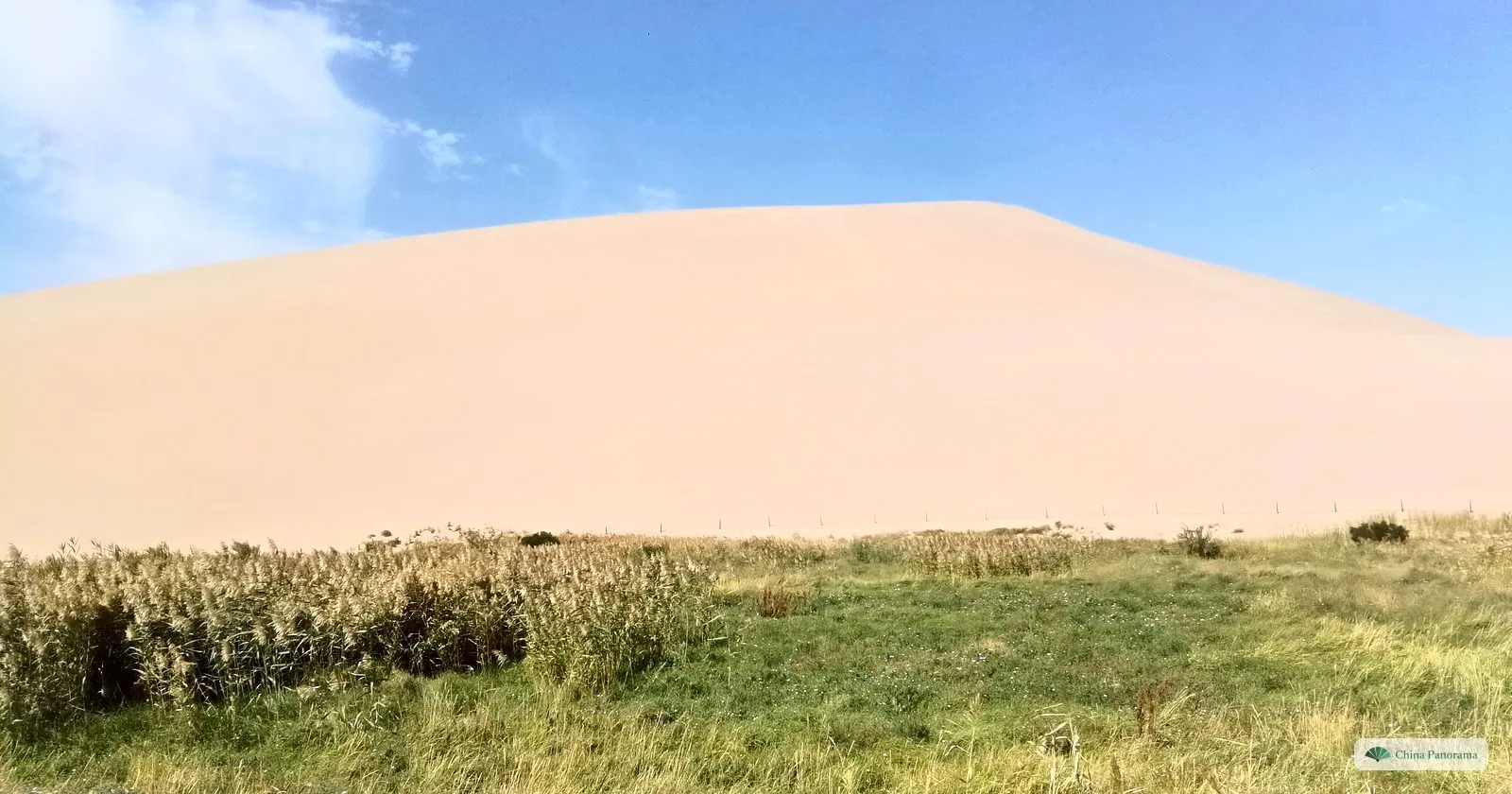
Our photographs are from 11 September: about 28 °C by day, blue sky, the reeds under the dunes turning gold. October drops to about 20 °C, outside Golden Week from 1 to 7 October. By November it is around 9 °C, still on the peak-season ticket until the 30th.
What to wear: Light clothes by day and a warm layer for the evening. Nights fall below freezing in November.
Winter
December – FebruaryCold, empty, and cheaper at Mogao.
January reaches about −1 °C by day and −15 °C at night. From 1 December to 31 March the normal Mogao ticket costs 140 CNY and includes 10 caves instead of 8. The dunes are quiet.
What to wear: A real winter coat, gloves and a hat. The caves are not heated.
How do I get Mogao Caves tickets?
Prices, hours and rules below are from the Dunhuang Academy, which runs the caves, read on 10 November 2026. Per person, per visit.
| Ticket | Peak season1 April – 30 November | Off-peak1 December – 31 March |
|---|---|---|
| Normal visit: films and caves正常参观 | 238 CNY · 8 caves | 140 CNY · 10 caves |
| Concession优惠票 | 148 CNY | 95 CNY |
| Emergency visit: caves only应急参观 | 100 CNY · 4 caves | 100 CNY · 4 caves |
| Emergency, concession应急 优惠票 | 55 CNY | 55 CNY |
| Special concession, either visit特种优惠票 | 20 CNY | 20 CNY |
| Open开放时间 | 08:00–18:00 | 09:00–17:30 |
| Tickets issued售票时间 | 08:00–15:30 | 09:00–15:00 |
The emergency visit (应急参观) is the fallback when normal tickets are gone. The official page lists who gets concessions, for example children from 4 to under 6 and people over 70 for the special concession, and children under 4 go free. It does not say whether this applies to foreign passports. The ID it names for foreigners is the Chinese permanent residence card. Booking is open from 07:00 to 22:00, and the ticket hotline is 400-8333-715.
1 · Book online
On the official site mgk.org.cn, with your passport number. Travel sites report releases 30 days ahead for normal and 7 days ahead for emergency tickets, at 08:00 Beijing time.
Release times reported, not confirmed officially.
2 · Exhibition centre first
Collect your ticket at the window with the original passport, 9 km east of the city. Keep the ticket slip: it is checked here and again at the caves. Large bags and pets stay in the free left luggage.
3 · Films, then the shuttle bus
The normal visit starts with the films. No private vehicles go to the cave area, and the official shuttle bus covers the 16 km.
4 · Caves with a guide
A guide opens the caves one by one. No photographs, no touching, no drones. We could not confirm on the official page whether English-language tours run or how to book them.
Source: Dunhuang Academy, Mogao Grottoes page, read 10 November 2026. The caves close in heavy rain and sandstorms, with a full refund.
How did the flying apsaras learn to fly?
The feitian (飞天) of Dunhuang have no wings. The painters showed flight with the body, the skirt and above all the ribbons, and over about 300 years, from the Northern Liang to the High Tang, those ribbons changed shape. Not in a straight line: the Early Tang ribbons of Cave 329 are described as rather flat. Press play or tap a period, and keep an eye on the ribbons.
Our schematic drawing after the written sources, not a copy of a mural. After the High Tang, the best-known figure is a dancer playing the pipa behind her back, in Cave 112 of the Middle Tang, and other caves.
Which caves your guide opens is not up to you, so you may see none of these. The guides choose from a rotating set of caves.
The baoxiang flower: a flower that does not exist
Look up in a Mogao cave and the ceiling is often a painted canopy with a great flower in the middle. It is neither lotus nor peony. Painters built the baoxiang hua (宝相花) from the best parts of several real flowers, starting from the lotus. Switch the layers off one by one to take it apart, then compare three real ceilings as the Dunhuang Academy describes them.
Take it apart: switch a layer off
- Lotus莲花The base. The earliest rosettes in the Dunhuang caves are simplified lotuses, the Buddhist flower of purity.
- Cloud scrolls卷云纹Curling clouds between the petals. In Cave 329, 14 curled lotus petals alternate with 14 cloud scrolls.
- Peony牡丹The fuller Tang flower, with cloud-like tips. The middle of the ceiling in Cave 320 is a “cloud-head peony”, which an article from the Dunhuang side calls a typical baoxiang flower.
- Pomegranate石榴A sign of many children. In Cave 217 a pomegranate scroll forms the first ring around the lotus.
- Honeysuckle scroll忍冬纹A leaf scroll found in the borders from the start: it is named on the Northern Liang ceiling of Cave 272, and it is still in the border of Cave 320.
- Layered shading叠晕Colour laid in bands from deep to pale, so that a flat petal looks layered. The article on Cave 320 describes blue, green and red shaded in this way. It is also called 退晕.
Three real ceilings at Mogao
Cave 329Early Tang
One of the finest painted ceilings at Mogao, according to the Dunhuang Academy. The well is pale blue, for the sky. In the middle a large lotus of 14 curled petals alternates with 14 cloud scrolls, and short white arcs run in waves in three rings over petals of blue, green and red. Apsaras circle the lotus, which we leave out here.
From the well outwards
- Scrolling vine 卷草纹
- Pearl roundels 联珠纹
- Hanging triangles 垂角纹
- Canopy drapery 帷幔
Dunhuang Academy, Cave 329
Cave 217705–709, High Tang murals
An eight-petalled lotus radiates from the centre, each petal built up in complex detail. Around the well, the first ring is a pomegranate scroll, the second rosettes that echo the lotus, the third fish scales and the outermost hanging triangles, mainly in blue-green and earth red.
From the well outwards
- Pomegranate scroll 石榴卷草纹
- Rosettes 团花纹
- Fish scales 鱼鳞纹
- Hanging triangles 垂角纹
Dunhuang Academy, Cave 217
Cave 320High Tang
The well holds a cloud-head peony rosette, with quarter rosettes in the four corners, on an earth-red ground coloured in blue and green and shaded in bands from deep to pale. The article on this cave calls it a typical baoxiang flower. Eight borders run outwards from it.
From the well outwards
- Interlocking lozenges 方胜纹
- Half rosettes 半团花
- Diamonds 菱形纹
- Rosettes, one whole and two halves 团花
- Honeysuckle 忍冬纹
- Downturned lotus petals 覆莲
- Hanging triangles 三角垂幔
- Tassels and drapery 流苏
Dunhuang Academy, Cave 320. The Paper, 28 February 2024 (from 书香敦煌)
Our schematic drawing after the written descriptions. Colours and proportions are simplified. The colours on the walls have darkened and faded over the centuries. Ours are a clean reading of the descriptions.
Things to do in Dunhuang
11 places: the caves and their visitor centre, the dunes and the spring at the edge of town, a museum and a night market, and the Han dynasty passes and painted caves further out.
What am I looking at?
Tap a number on the photograph.
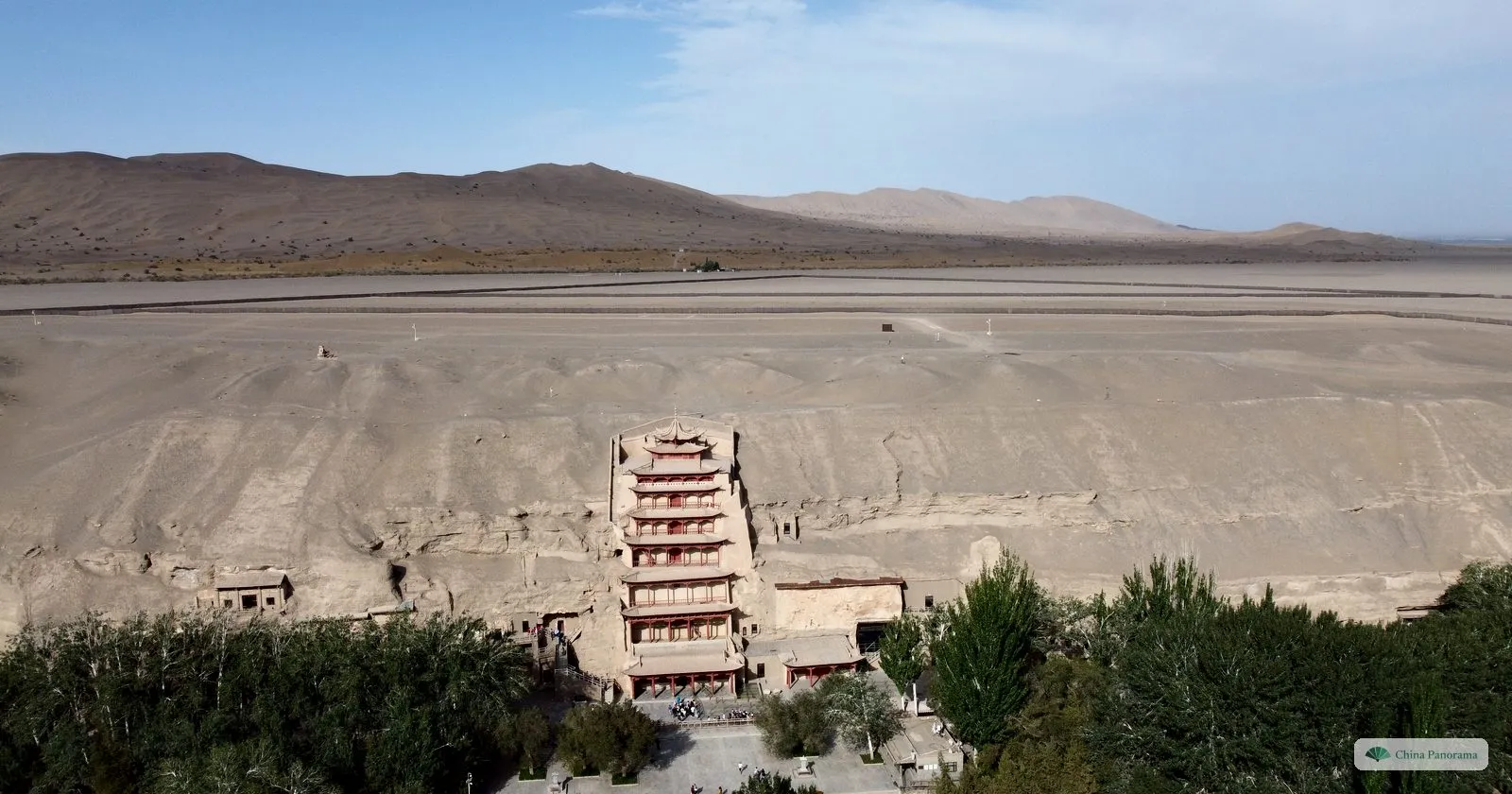
1The Nine-Storey Building
九层楼 · Cave 96
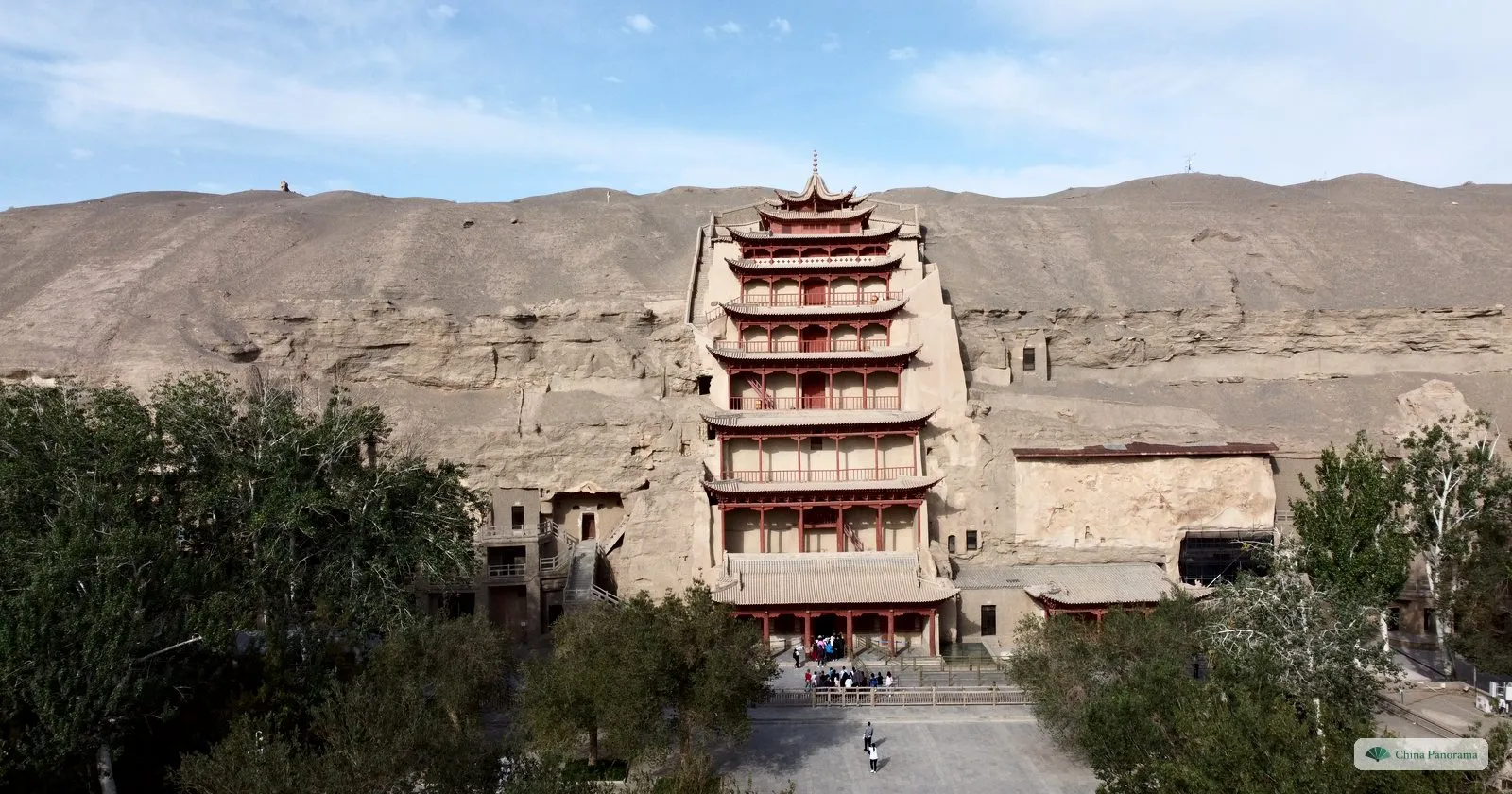
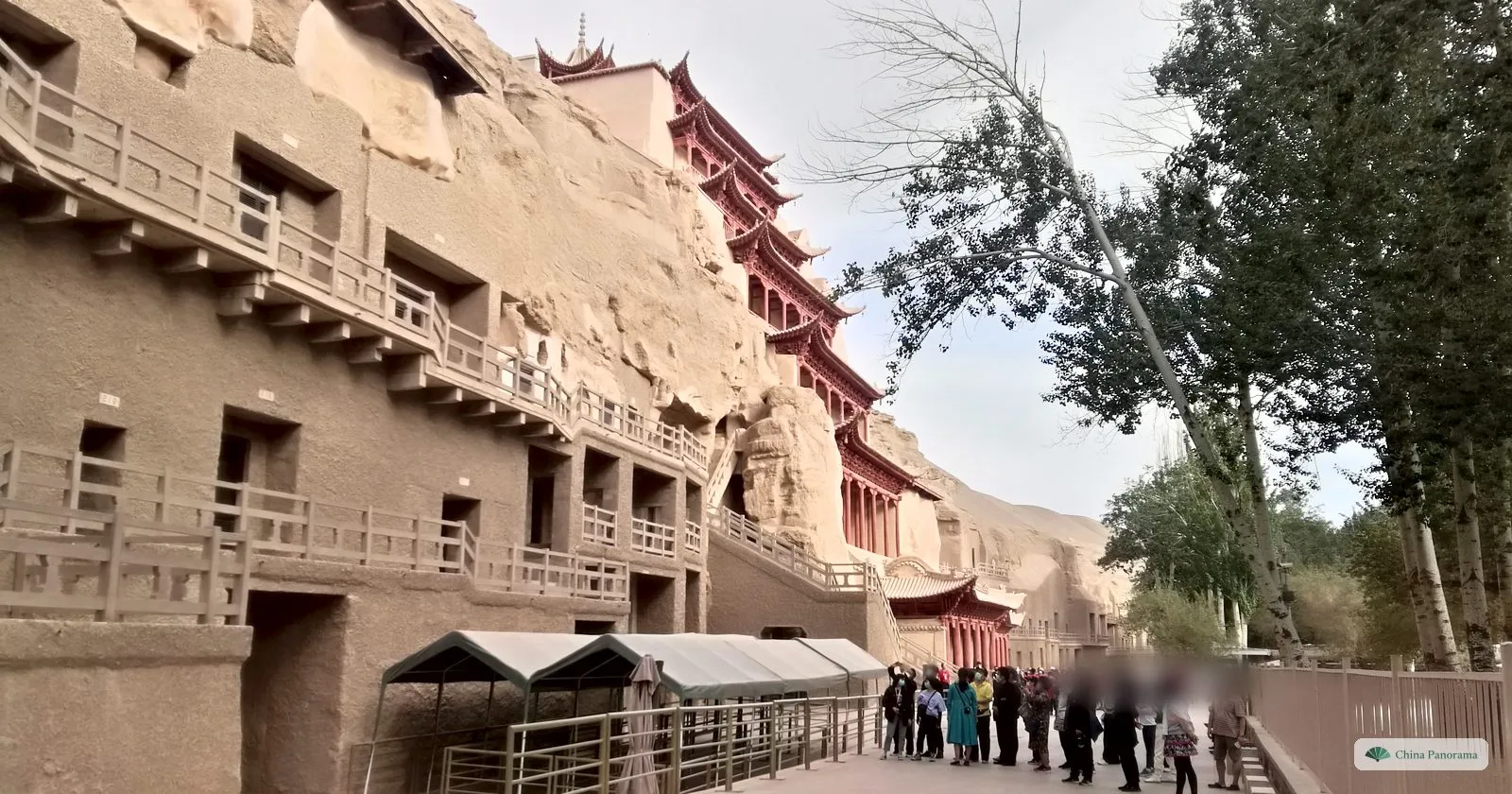
The façade covers Cave 96 and a giant seated Buddha. Sources give its height as 34.5 or 35.5 m, and the cave is usually dated to 695. It is the landmark of Mogao, and the picture on every ticket and poster.
Mogao below →Tap a number on the photo, or a name in the list.
11 places in and around Dunhuang
Mogao Caves
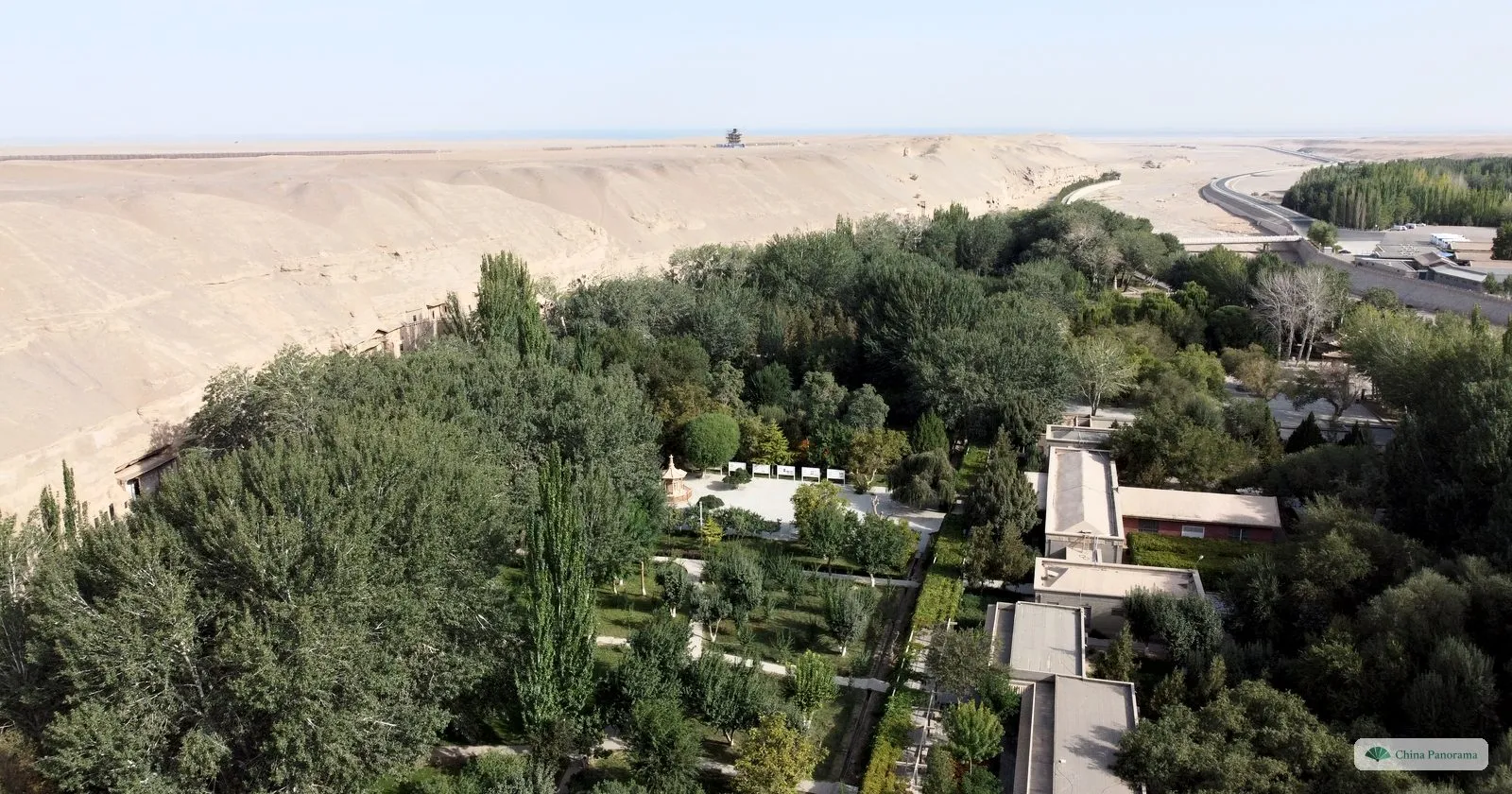
莫高窟TempleDunhuang · 敦煌IndoorsThe reason most people come. A cliff above the Daquan River valley, 17 km south-east of the city in a straight line, is honeycombed with Buddhist cave temples, painted and filled with clay figures over about a thousand years, from the 4th century on. UNESCO, which listed the caves in 1987, counts 492 of them with murals and sculptures, about 45,000 m² of wall paintings and more than 2,000 painted sculptures. The red nine-storey façade in every picture covers Cave 96 and its giant seated Buddha. Inside, the caves are dark and cool, and a guide unlocks one door after another and lights the walls with a torch. You cannot choose the caves, and you may not photograph them, which is why this page draws two of their motifs further up.
Book ahead on the official site, mgk.org.cn, and bring the passport you booked with. The normal visit starts at the Digital Exhibition Centre near the station, with the films, and a shuttle bus takes you on to the caves: no private vehicles go to the cave area. Large bags and drones may not be taken in, and there is free left luggage at the centre. The caves close in heavy rain and sandstorms, with a full refund. Official prices per person: 238 CNY in the peak season (films and 8 caves), 140 CNY in the off-peak season (films and 10 caves), and an emergency ticket at 100 CNY for 4 caves without the films.
- Entry
- 238 CNY · peak season, 1 April to 30 November, films and 8 caves. Off-peak 140 CNY with 10 caves, emergency ticket 100 CNY with 4 caves
- Opening hours
- 08:00–18:00 from 1 April to 30 November, 09:00–17:30 from 1 December to 31 March
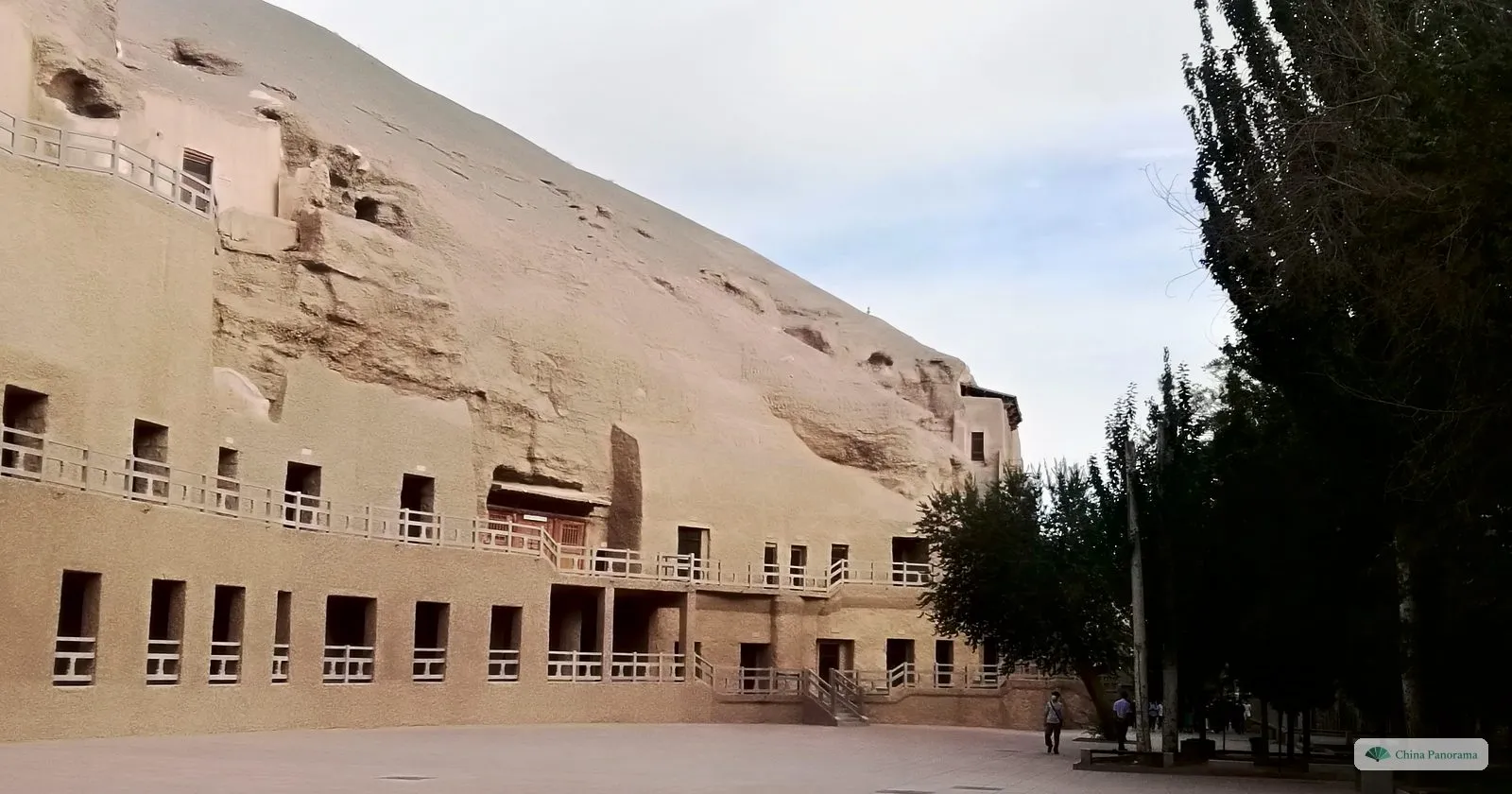
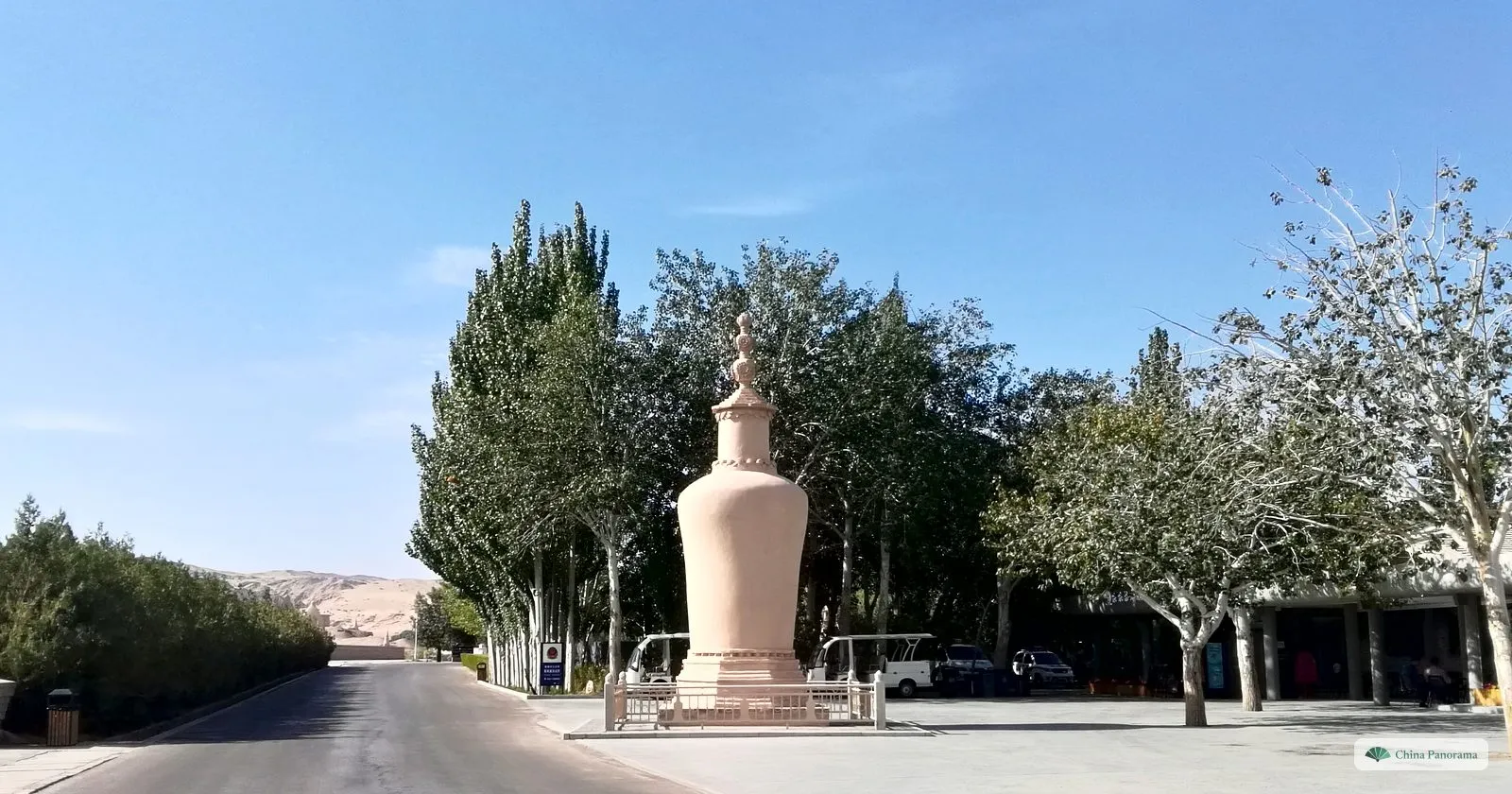
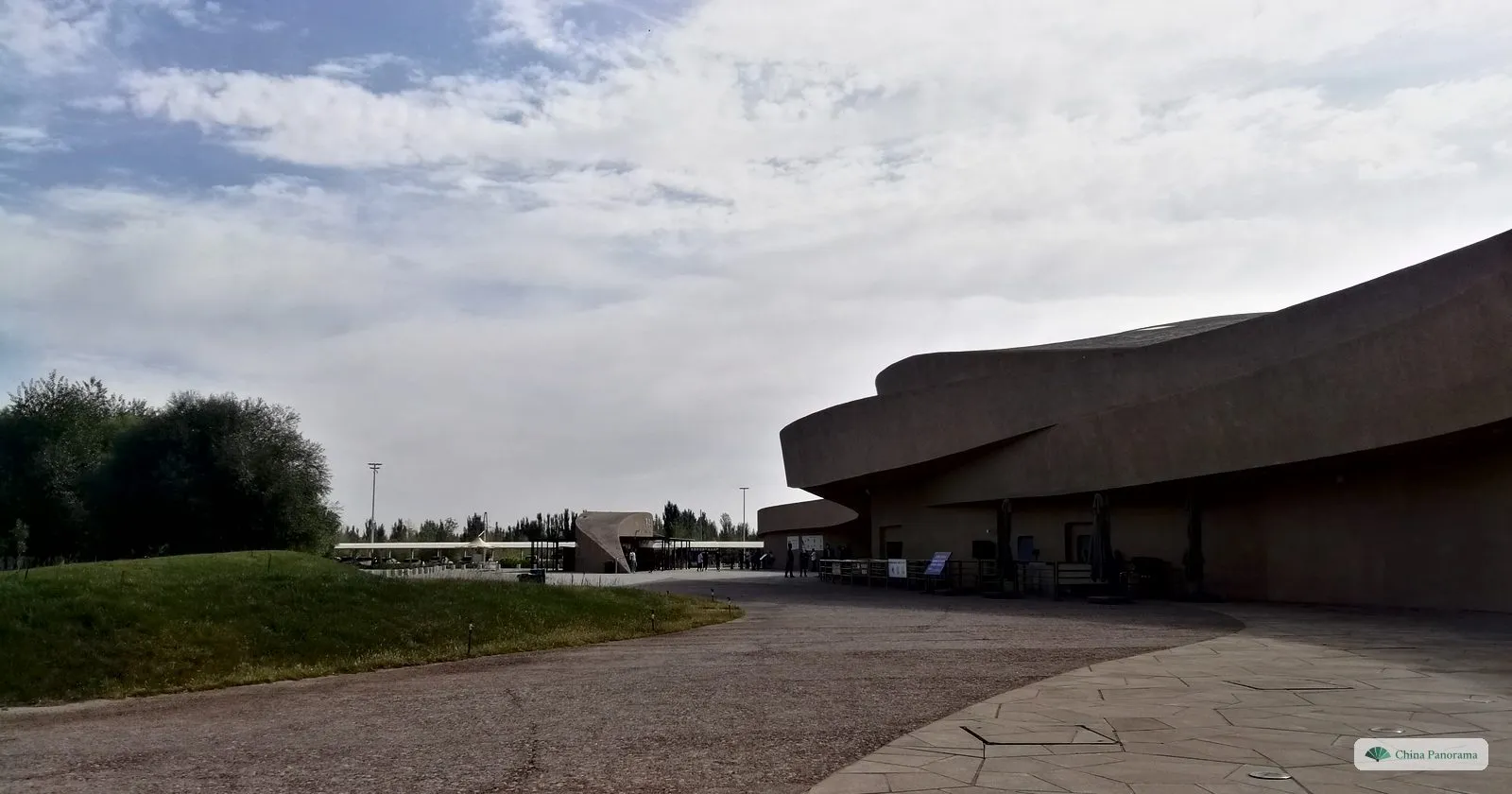
Mogao Digital Exhibition Centre
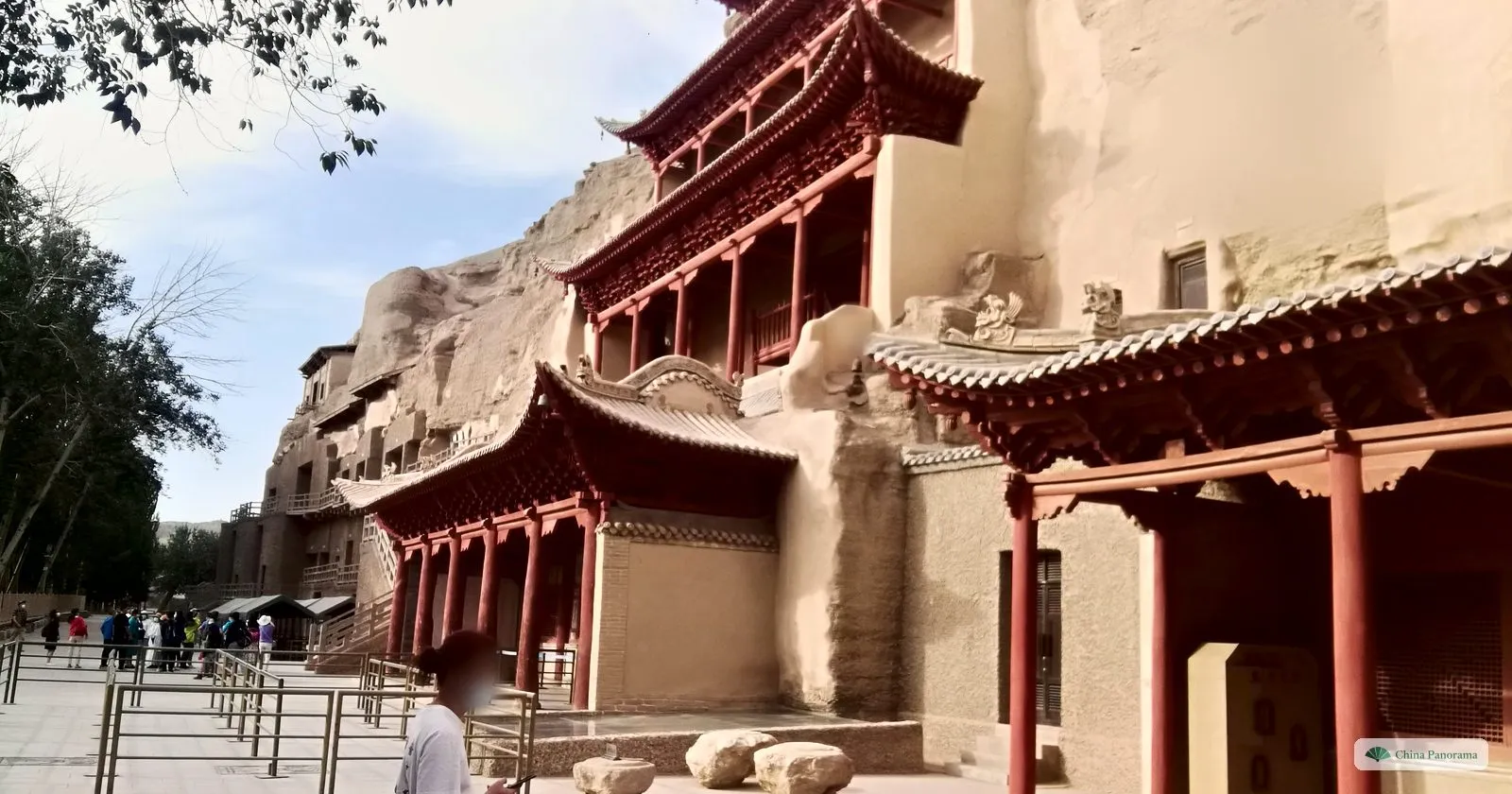
莫高窟数字展示中心MuseumDunhuang · 敦煌IndoorsWhere the normal Mogao visit begins: a long, curved, sand-coloured building on the plain near the airport and the station, 9 km east of the city. Here you see the films, which show caves you will not enter, before the shuttle bus takes you 16 km on to the cliff. Here you also collect your ticket, and you come back here at the end of the visit.
Collect your ticket at the window with the original passport and keep the printed ticket slip: it is checked here and again at the caves. 9 km from the city centre by road, about 10 minutes by taxi. We arrived at 07:40 and were back at 10:55 on 11 September 2021. Only the normal ticket includes the films. The emergency ticket covers the caves only.
- Entry
- 238 CNY · part of the normal Mogao ticket in the peak season, not sold separately on the official page
- Opening hours
- 08:00–18:00 from 1 April to 30 November, 09:00–17:30 from 1 December to 31 March
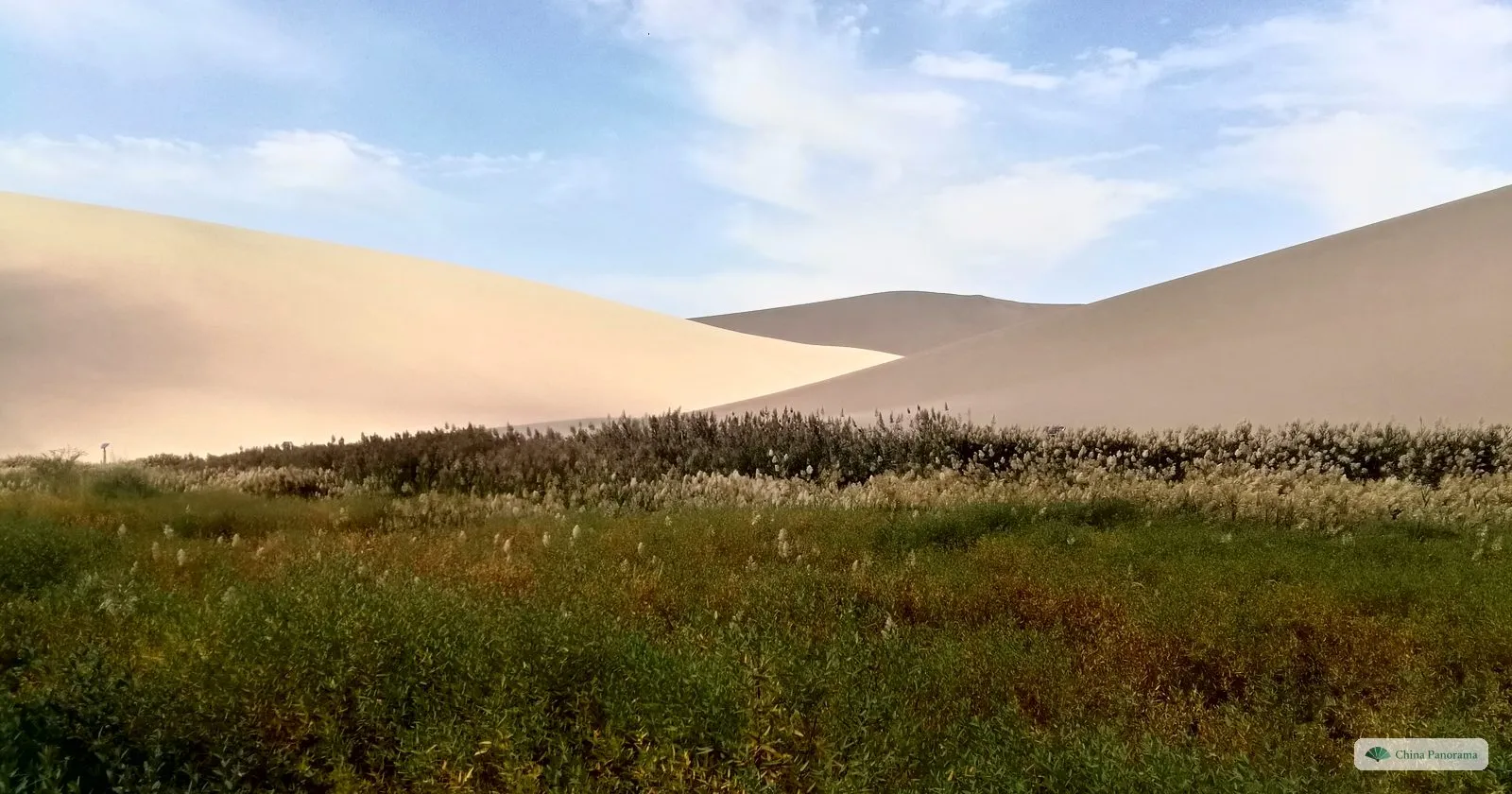 NatureDunhuang · 敦煌Outdoors
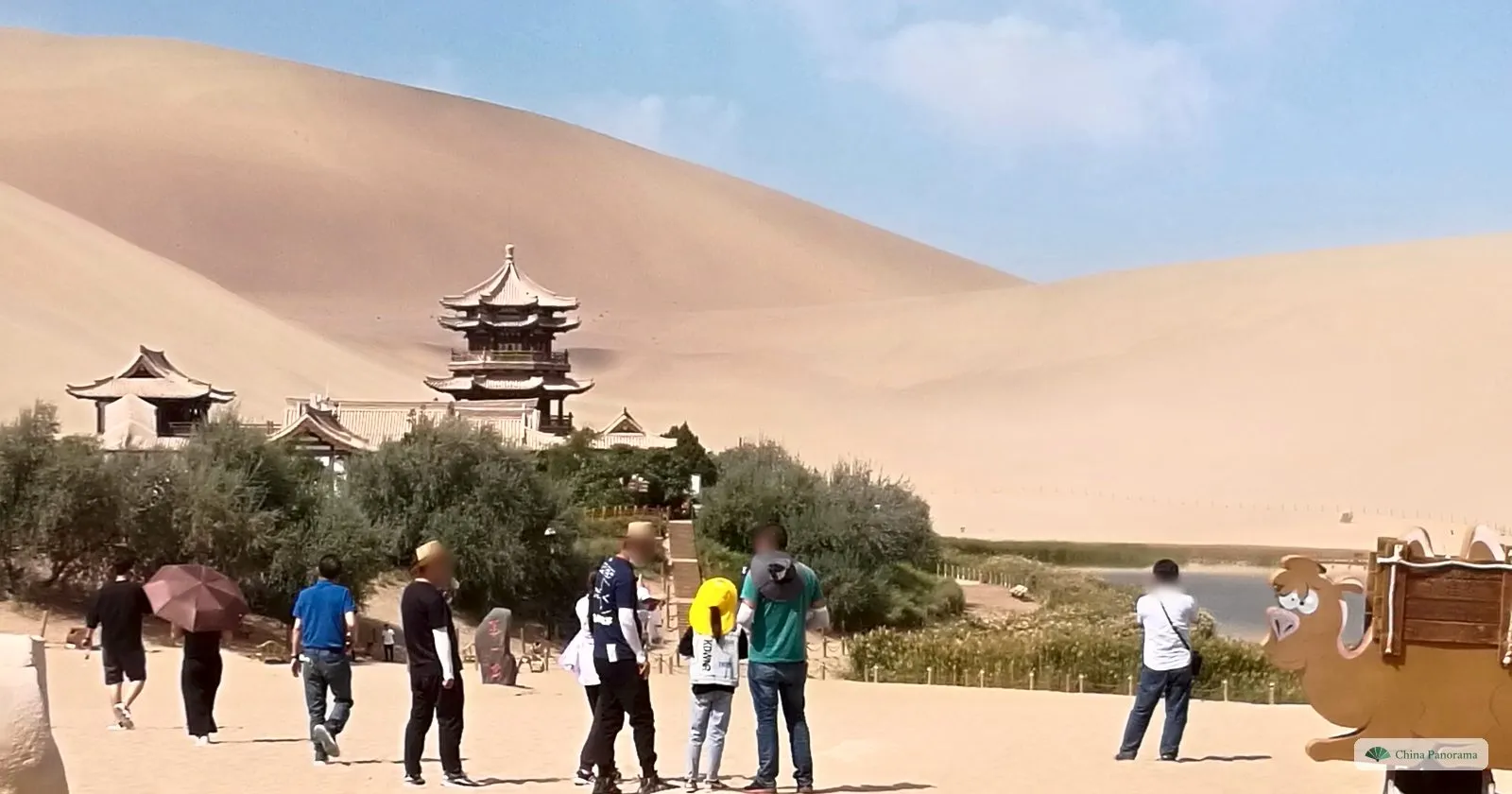
Real dunes, on the edge of town: the ridge starts 6 km south of the centre, and the dunes rise high above the reeds at their foot. The name means “mountain of singing sand”, after the sound sand makes when it slides. You can climb a dune on a ladder of wooden steps laid on the sand, ride a camel in a caravan, or simply walk. The stone at the entrance names it a geo-area of the Dunhuang UNESCO Global Geopark.
One ticket covers the dunes and the Crescent Spring. Travel sites report 110 CNY in the peak season and half that in winter, valid for re-entry over three days, and say tickets are now booked ahead under your real name, with no ticket window on site. We could not read an official notice, so check before you go. Camel rides and sand sledges are paid extra. It is bright and hot at midday: we were there from 11:38 to 12:49 in September. Morning and late afternoon are better for walking and for photographs.
- Entry
- Price not verified — check on site
- Opening hours
- Hours not verified — check on site
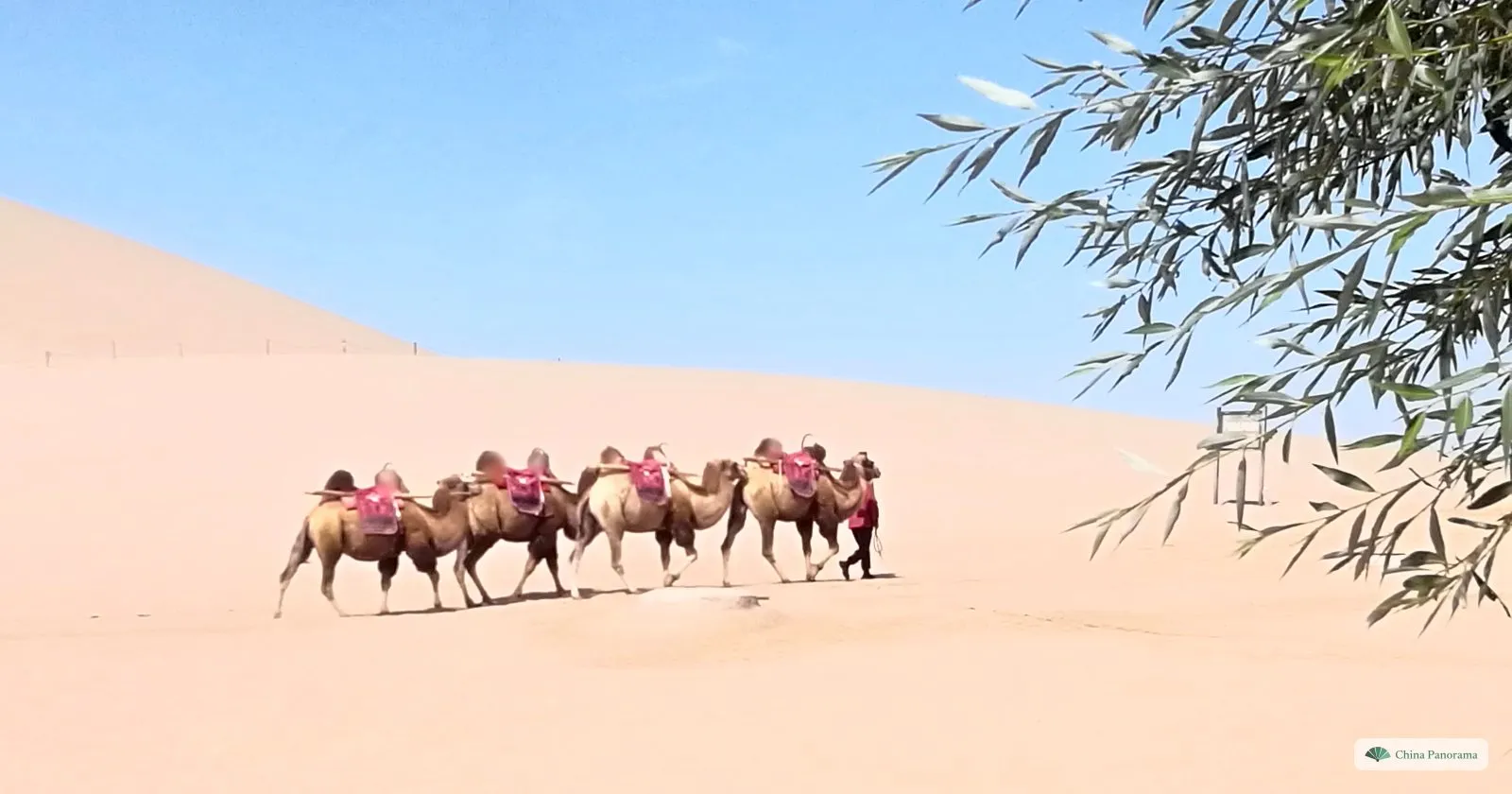
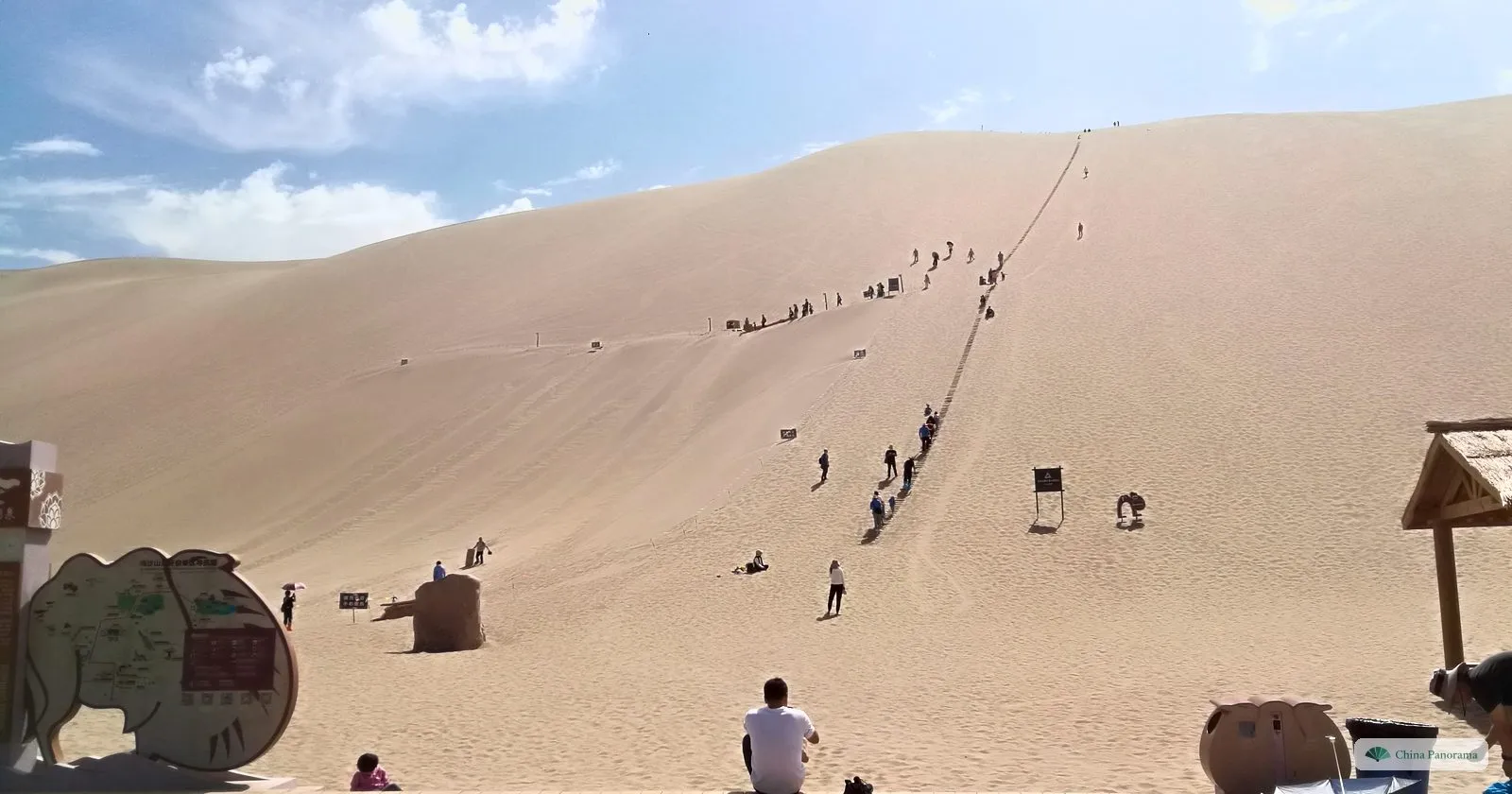
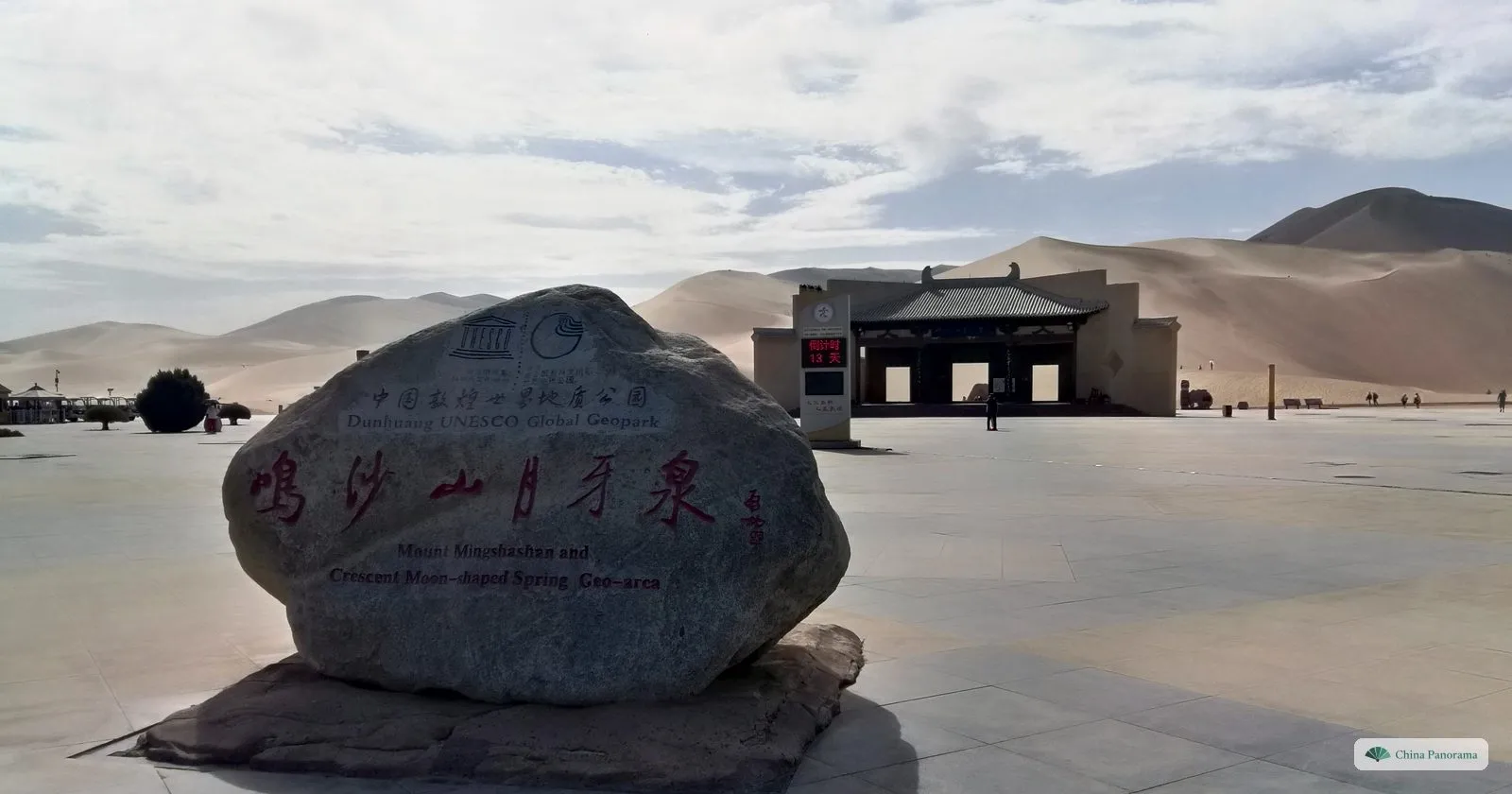
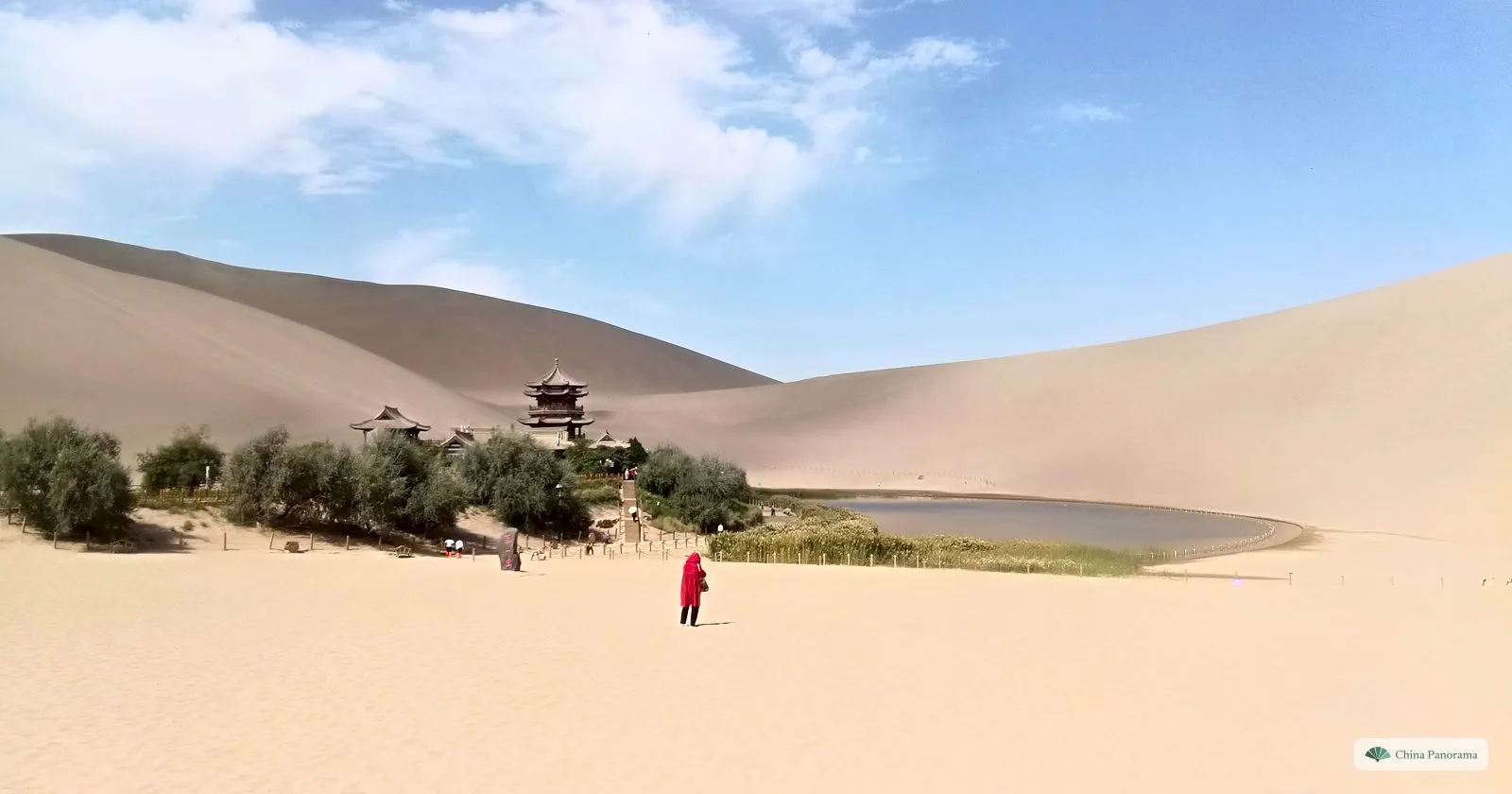 NatureDunhuang · 敦煌Outdoors
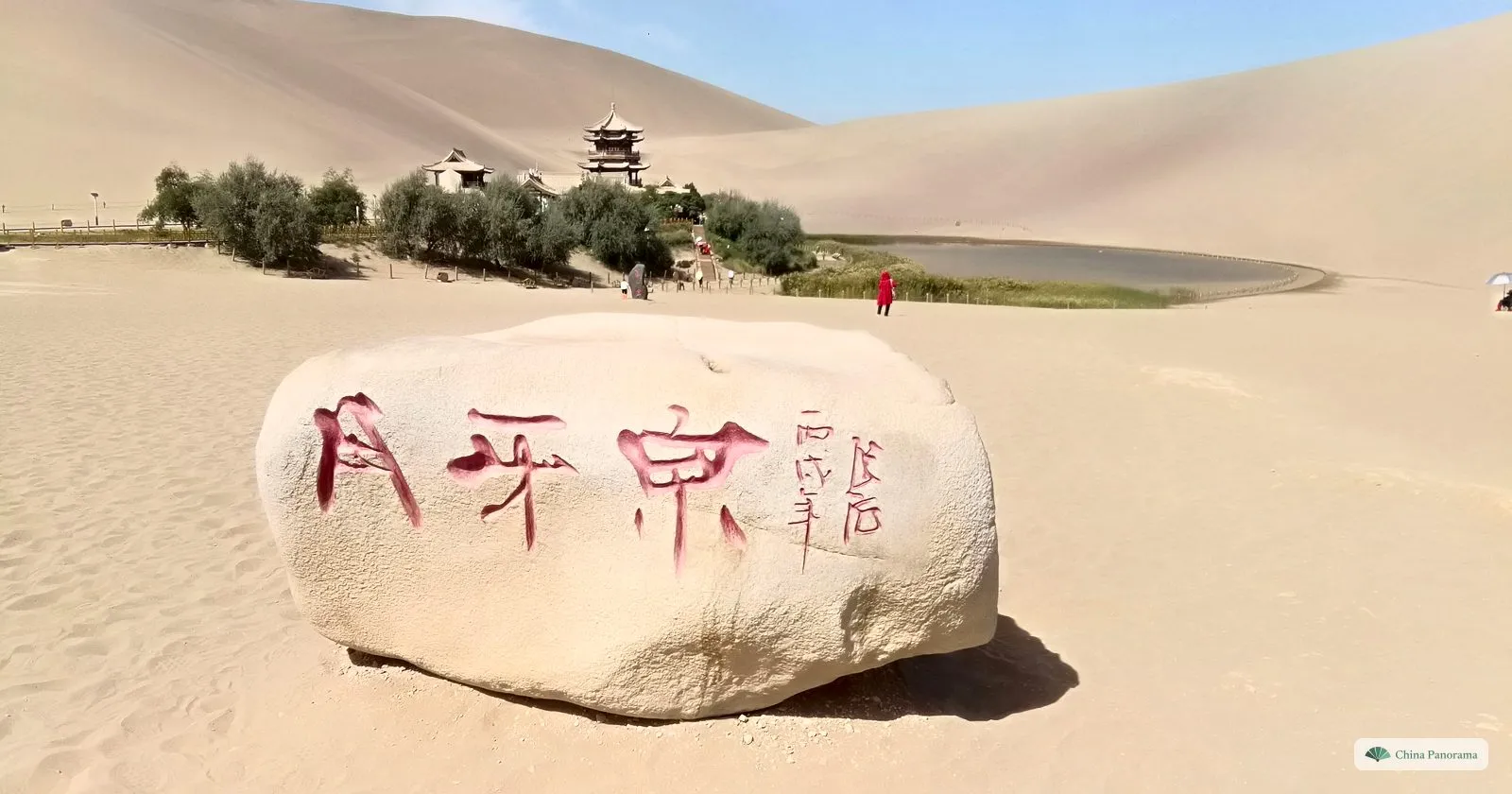
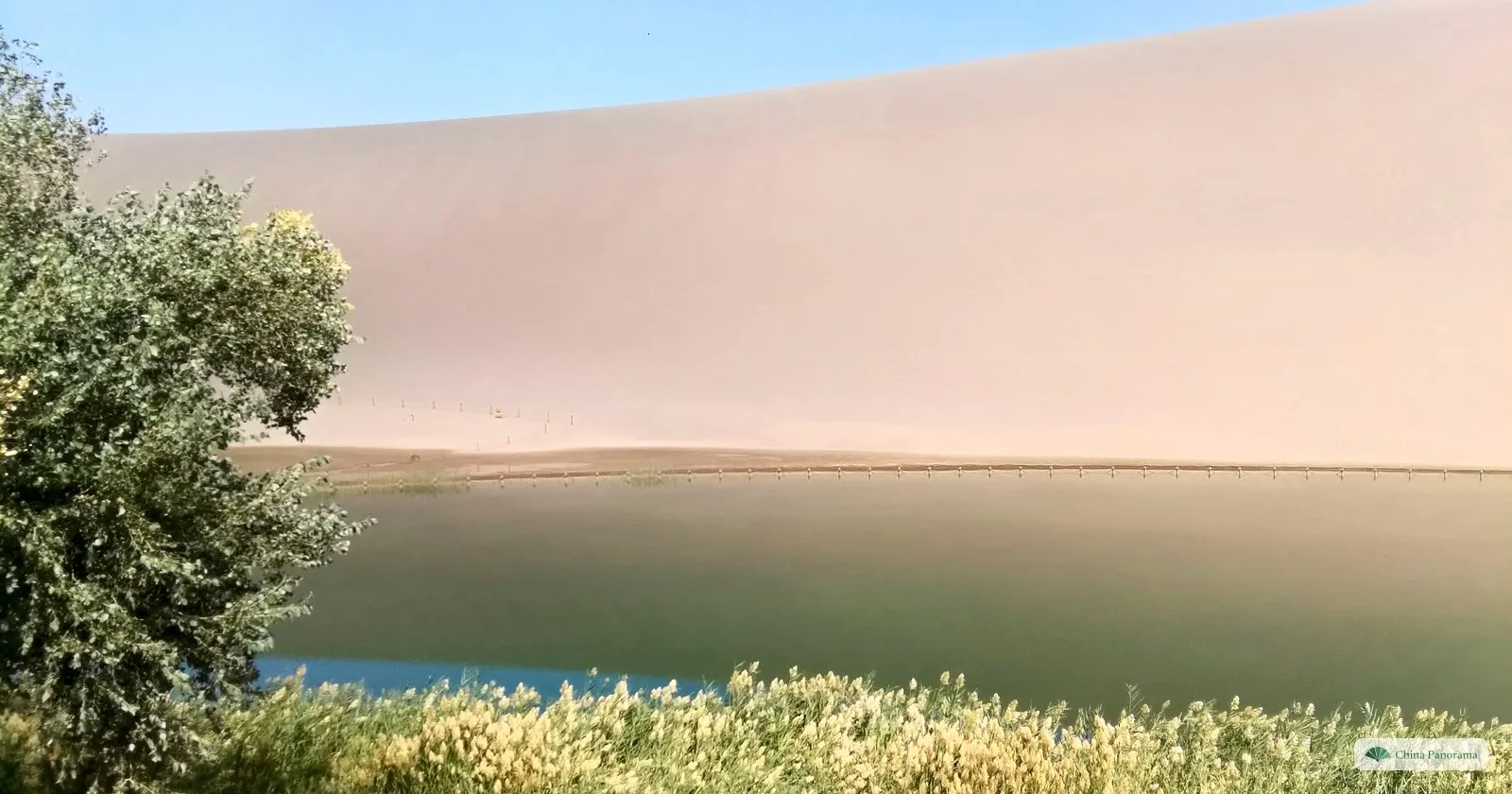
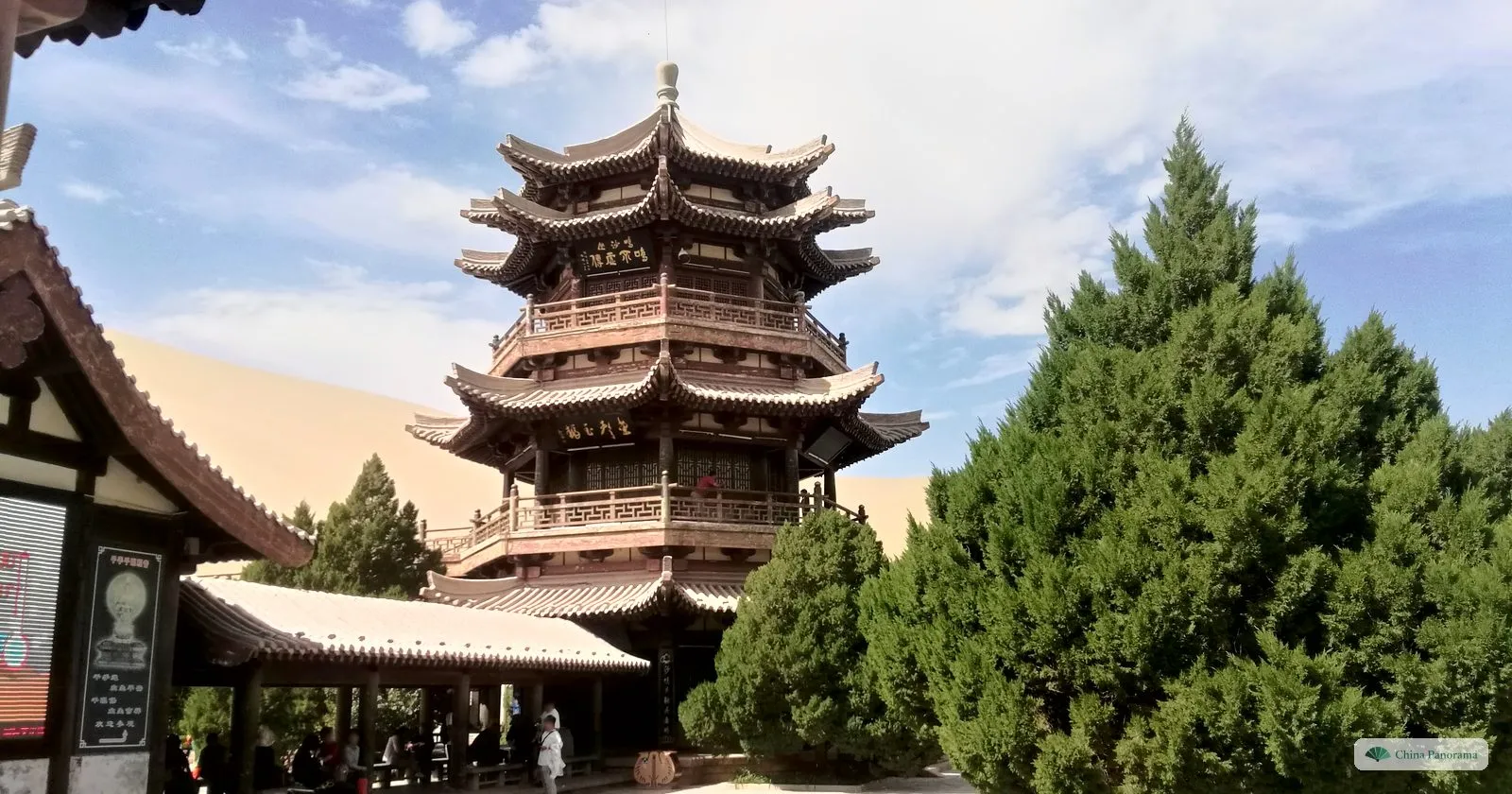
A pool shaped like a crescent moon, also known in English as Crescent Lake or Crescent Moon Spring, in a hollow between the dunes of Mingsha Shan, with willows, reeds and a group of pavilions on its bank. It is about 6 km from the centre, inside the same gate as the dunes, and it is the picture of Dunhuang that most Chinese visitors come for.
Same ticket and gate as Mingsha Shan. From the entrance it is about 15 to 20 minutes on foot across the sand, past the camel stations. The water is fenced, so you look at it from the path. We reached the stone with 月牙泉 on it at 12:09.
- Entry
- Price not verified — check on site
- Opening hours
- Hours not verified — check on site
Dunhuang Museum
敦煌博物馆MuseumDunhuang · 敦煌IndoorsThe city museum, 1.4 km south of the centre on the road towards Mingsha Shan. It tells the history of the oasis: the Han dynasty passes and the Great Wall, the Silk Road, and the documents from the Library Cave at Mogao. A good hour before or after the caves, and the obvious place to go when it is too hot outside.
We have not checked entry conditions or opening hours. Many Chinese public museums are free with a booking and closed on Mondays, but check before you go.
- Entry
- Price not verified — check on site
- Opening hours
- Hours not verified — check on site
- FoodDunhuang · 敦煌Outdoors
The evening market in the city centre, with food stalls, dried fruit and souvenirs. This is where people go after a day in the desert for lamb skewers, noodles and apricot juice.
In the centre, a few minutes on foot from most central hotels. Check the unit when prices are given per jin (500 g), as they often are for dried fruit. We have not checked opening times.
- Entry
- Price not verified — check on site
- Opening hours
- Hours not verified — check on site
- LandmarkWest of Dunhuang · 敦煌以西Outdoors
One of the two Han dynasty gates to the west, 57 km south-west of the city in a straight line. Little of the pass itself remains: a beacon tower on a ridge above the gravel, a museum and a reconstructed gate. Its fame is a Tang poem by Wang Wei, which says goodbye to a friend leaving for the west, “where beyond Yangguan you will have no old friends”.
61 km by road, about an hour by car, so most people combine it with Yumen Pass and the Yadan landforms in a long day by car. Tickets and booking are reported to be shared with Yumen Pass, and an official notice on travel sites gives the visitor centre's hours as 08:30 to 18:30 from 11 October 2025. We have not checked prices.
- Entry
- Price not verified — check on site
- Opening hours
- Hours not verified — check on site
Yumen Pass
玉门关LandmarkWest of Dunhuang · 敦煌以西OutdoorsThe “Jade Gate”, the northern of the two Han passes, 72 km north-west of the city in a straight line. A square rammed-earth fort stands alone on the gravel, and the same scenic area includes a stretch of the Han dynasty Great Wall made of layered earth and reeds, more than 2,000 years old, and the ruins of a large granary. The name comes from the jade that came this way from Central Asia.
94 km by road, about 1 hour 50 minutes by car. Distances inside the scenic area are covered by its own shuttle bus. There are no shops on the way, so take water. We have not checked the price.
- Entry
- Price not verified — check on site
- Opening hours
- Hours not verified — check on site
Yadan National Geopark
敦煌雅丹国家地质公园NatureWest of Dunhuang · 敦煌以西OutdoorsA field of wind-carved clay ridges, 128 km north-west of the city in a straight line, which locals call the “devil city” because of the noise the wind makes in it at night. Yardang is the geological term for these landforms, and the visitor shuttle stops at named shapes: a sphinx, a fleet of ships, a peacock. Like Mingsha Shan, it is part of the Dunhuang UNESCO Global Geopark.
163 km by road on OpenStreetMap, or 158 km according to the scenic area, about 2.5 to 3 hours each way, so it is a full day with Yumen Pass on the way. Visitors go round in the park's own shuttle bus. A travel booking site lists 120 CNY including the bus, and the park ran a half-price offer from December 2025 to March 2026. We could not confirm either with the park. Late afternoon is the classic time, for the light on the ridges.
- Entry
- Price not verified — check on site
- Opening hours
- Hours not verified — check on site
- TempleWest of Dunhuang · 敦煌以西Indoors
A much smaller group of painted Buddhist caves in the cliff of the Dang River, 31 km south-west of the city in a straight line, on the road towards Yangguan. They are looked after by the Dunhuang Academy, like Mogao, and are a quiet stop on the way to the pass.
33 km by road, about 35 minutes. We have not checked prices, hours or which caves are open.
- Entry
- Price not verified — check on site
- Opening hours
- Hours not verified — check on site
- TempleGuazhou · 瓜州Indoors
Painted Buddhist caves cut into both sides of a river canyon in Guazhou county, 108 km east of Dunhuang in a straight line. They are often called Mogao's sister site and are also managed by the Dunhuang Academy. Fewer visitors make the trip, which is the point for those who do.
168 km by road, about 2 hours 20 minutes each way. Easiest by car with a driver, or on the way between Dunhuang and Jiayuguan. We have not checked prices or hours.
- Entry
- Price not verified — check on site
- Opening hours
- Hours not verified — check on site
The Mogao prices and hours are official. Other entry prices and opening hours are marked unverified where we could not check them against an official source. We would rather show a gap than a number we made up.
Routes
Two days in Dunhuang
Day 1 · Mogao and the dunes
An early slot at the exhibition centre and the Mogao Caves, lunch and the museum in town, then Mingsha Shan and the Crescent Spring in the late afternoon. Dinner at the night market.
Day 2 · West by car, about 360 km
Out to Yangguan, north to Yumen Pass and the Han wall, on to the Yadan Geopark for the late light, and back after dark. About 6.5 hours of driving on OpenStreetMap, before any time at the sites. Take water and food.
Where to stay
The centre works for everything. It is small enough to walk to the night market and the museum, and Mingsha Shan (6 km south) and the Mogao exhibition centre (9 km east) are both about 10 to 15 minutes by taxi. If you want to be on the dunes at sunrise, a hotel on the southern edge of town, towards Mingsha Shan, saves part of the drive. When you book, check that the hotel takes foreign passports.
Our day
Our day, 11 September 2021 · 07:40 to 13:20
Digital Exhibition Centre
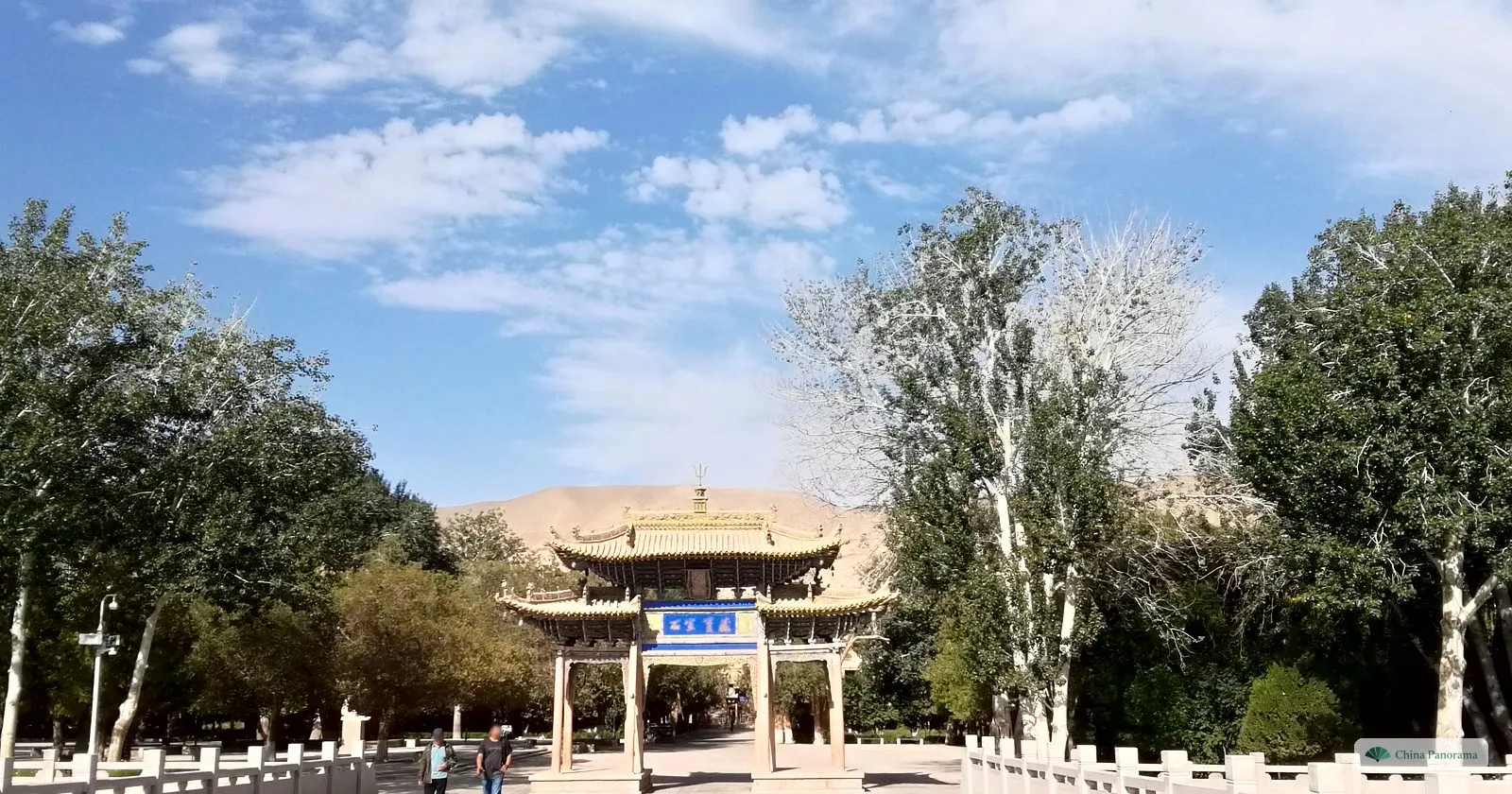
The Mogao gate
Walk 2 min· 100 m
The Nine-Storey Building
Walk 3 min· 200 m
Along the cliff
Walk 5 min· 400 m
Out through the archway
Taxi 20 min· 15.5 km
Mingsha Shan gate
Walk 8 min· 500 m
Camels on the dunes
Walk 12 min· 800 m
Crescent Spring
8 stops · 30 min walking · 20 min by taxi
Stop by stop
Mogao in the morning, the dunes at midday
What we did, by the clock times on our photographs. It works, but we would swap the second half: midday is the hottest and brightest time on the dunes, so go back to the city for lunch and the museum, and see Mingsha Shan in the late afternoon.
1Digital Exhibition Centre
莫高窟数字展示中心Ticket collection, security and the films. Ours: 07:40.
- Entry
- 238 CNY peak, 140 CNY off-peak (official)
- Hours
- 08:00–18:00, winter 09:00–17:30
2The Mogao gate
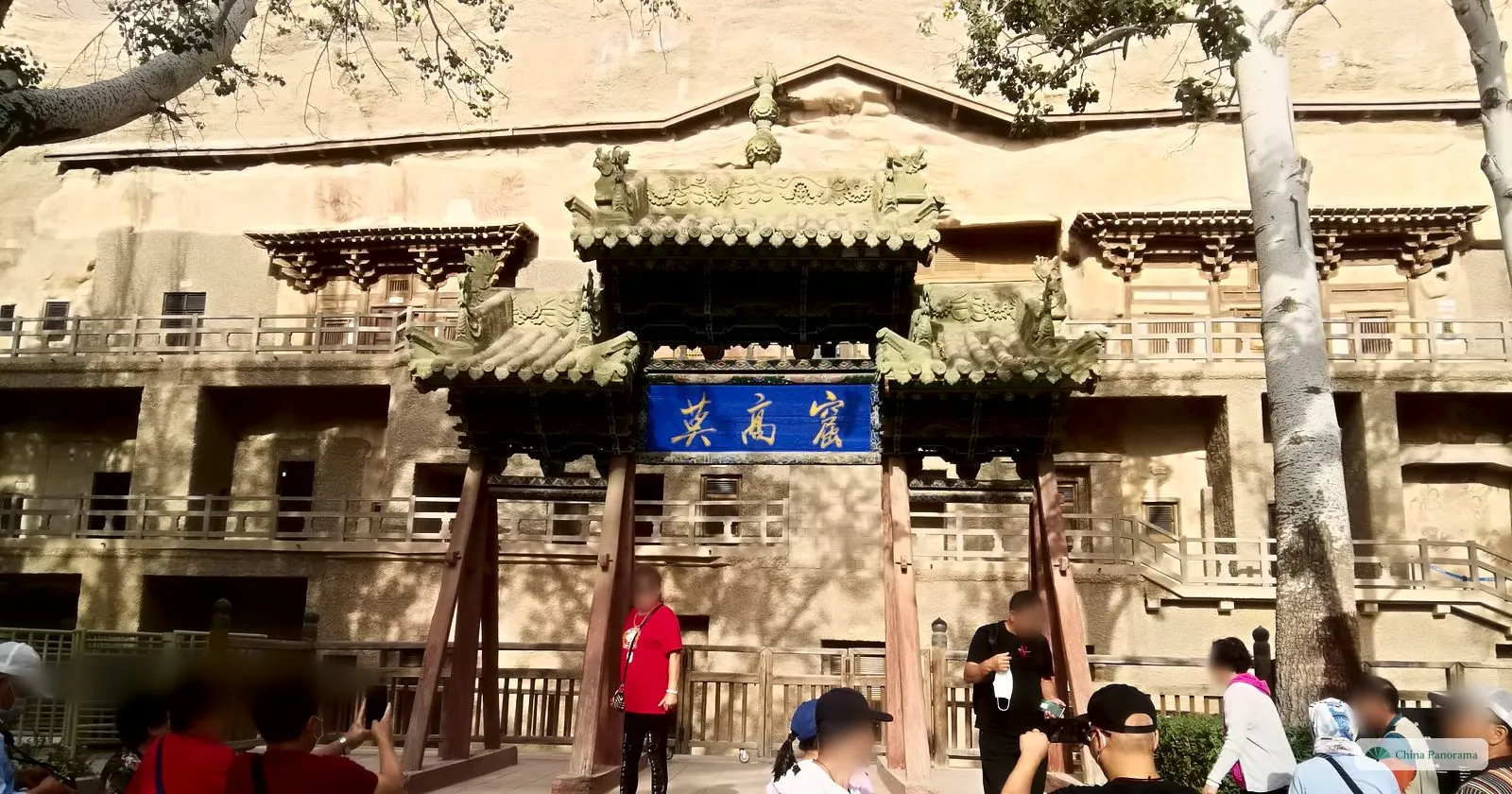
莫高窟牌坊The shuttle bus covers the 16 km to the caves. The blue board with 莫高窟 hangs on a gate in front of the cliff. Ours: 09:34.
- Entry
- 238 CNY peak, 140 CNY off-peak (official)
- Hours
- 08:00–18:00, winter 09:00–17:30
Walk 2 min· 100 m
The red façade over Cave 96. Ours: 09:40.
- Entry
- 238 CNY peak, 140 CNY off-peak (official)
- Hours
- 08:00–18:00, winter 09:00–17:30
Walk 3 min· 200 m
4Along the cliff
崖面栈道Groups wait for their guide, then go cave by cave. Ours: 09:48 to 10:03.
- Entry
- 238 CNY peak, 140 CNY off-peak (official)
- Hours
- 08:00–18:00, winter 09:00–17:30
Walk 5 min· 400 m
Back across the river to the bus. Ours: 10:26.
- Entry
- 238 CNY peak, 140 CNY off-peak (official)
- Hours
- 08:00–18:00, winter 09:00–17:30
Taxi 20 min· 15.5 km
6Mingsha Shan gate
鸣沙山月牙泉景区From the exhibition centre, where the bus dropped us at 10:55. Ours: 11:38.
- Entry
- Not verified
- Hours
- Not verified
Walk 8 min· 500 m
Caravans set off from the stations along the path. Ours: 11:53.
- Entry
- Not verified
- Hours
- Not verified
Walk 12 min· 800 m
8Crescent Spring
月牙泉The stone, the water and the pavilions. Ours: 12:09 to 12:32.
- Entry
- Not verified
- Hours
- Not verified
Easy add-ons: Back in the city by 13:20. The Shazhou Night Market fills the evening.
* Our own day on 11 September 2021: clock times from our photographs, taxi time and distance by OpenStreetMap routing, 10 November 2026, walking distances estimated from GPS. Mogao prices and hours are official, the rest are not verified.
Getting there and getting around
By air
Dunhuang Mogao International Airport (DNH) is 13 km east of the centre in a straight line, about 20 minutes by taxi. Flights are mostly domestic, with more in summer, so you will usually change planes in a Chinese hub such as Beijing, Shanghai or Xi'an. We have not checked current routes.
Schedules, prices and journey times not yet verified against an official source.
By train
Dunhuang station has direct trains to Lanzhou and further east, which travel sites put at 5 to 7 hours to Lanzhou. On the high-speed line between Lanzhou and Urumqi, the nearest station is Liuyuan South, 130 km away by road. Book on 12306 with your passport, and read the station name on the ticket.
Schedules, prices and journey times not yet verified against an official source.
By road
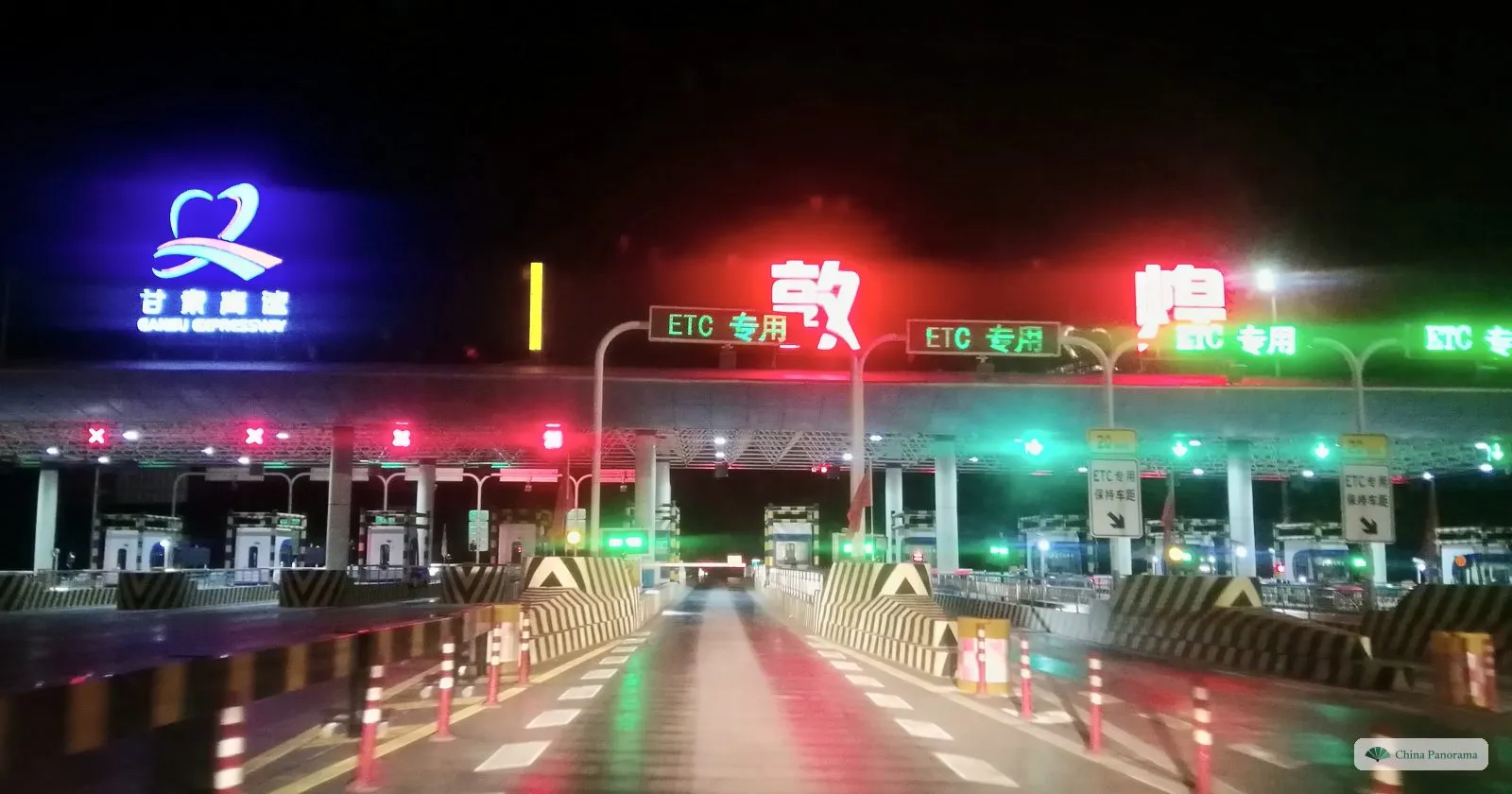
Jiayuguan to Dunhuang is 374 km, about 4 hours without stops on OpenStreetMap, on the G30 and then the road west through Guazhou. We drove it on 10 September 2021 and reached the toll plaza at Dunhuang at 20:59. As a foreign visitor you usually need a Chinese licence to drive yourself, so plan on a car with a driver.
Schedules, prices and journey times not yet verified against an official source.
The stations
- Dunhuang 敦煌站11 km east of the centre in a straight line, beside the airport and near the Mogao Digital Exhibition Centre. Trains start here, including D trains to Lanzhou, which travel sites put at 5 to 7 hours. It is a branch line, so check the station on your ticket.
- Liuyuan South 柳园南站On the Lanzhou–Xinjiang high-speed line, 127 km north-east of Dunhuang in a straight line and 130 km by road, about 1.5 hours by car. Useful from Turpan and Urumqi, but plan the transfer before you book.
No metro: how to get around
Dunhuang has no metro. The centre is small enough to walk, and the sights are spread out: Mingsha Shan 6 km south, the Mogao exhibition centre 9 km east, the passes and the Yadan landforms 60 to 160 km west. Most visitors use taxis in town and a car with a driver for the west.
- Mogao shuttle busNo private vehicles go to the cave area. The Digital Exhibition Centre is the first stop, and the official shuttle bus takes visitors the 16 km to the caves and back. It is part of the visit.
- TaxiCentre to Mingsha Shan: 6 km, about 10 minutes. Centre to the Mogao exhibition centre: 9 km, about 10 minutes. Airport: 15 km, about 20 minutes. Car times from OpenStreetMap without traffic. Travel sites report about 30 CNY from the airport by day. We have not checked fares.Not verified.
- Car with driver for the westYadan, Yumen Pass and Yangguan in one loop is about 360 km and 6.5 hours of driving on OpenStreetMap, before any time at the sites. Agree the price and the stops in writing first. Travel sites suggest 400 to 500 CNY a day, which we have not checked. Day tours by bus also run.Not verified.
Source and date: Mogao shuttle: Dunhuang Academy visitor rules, read 10 November 2026. Distances and car times: OpenStreetMap, 10 November 2026.
Before you go
Most European passports are visa-free for a short trip, under a one-sided waiver with an end date worth checking before you book. Gansu needs no separate permit.
- UK passport
Visa-free up to 30 days per trip, currently until 31 December 2026.
- EU passports
Dutch, German, French, Irish, Nordic and most other EU passports: visa-free up to 30 days per trip, currently until 31 December 2026.
- US passport
No general waiver: a visa, or the 10-day visa-free transit if you fly on to a third country.
Other passports: China’s 10 -day visa-free transit applies at designated entry ports, for travellers continuing to a third country. Check your passport.
- Visa-free extension status
Whether the waiver runs on past its current end date.
- Pre-trip checklist
Payments, SIM and apps. You will need a working phone to book Mogao.
- Chinese public holidays
When Mogao tickets sell out fastest.
- Medication and health
Which medicines you can bring into China.
- Turpan
The next oasis west, with ruined cities and karez tunnels, 550 km away.
- 5A scenic areas
What the rating means, and our other 5A pages, such as the Terracotta Army.
- Xi’an
Where the Silk Road began, at the other end of the corridor.
FAQ
Is Dunhuang a World Heritage Site?
Three places in and around it are. The Mogao Caves were listed in 1987, and Yumen Pass and the Han post station of Xuanquan were added in 2014 as part of the Silk Roads listing. Dunhuang has also been a national historic and cultural city since 1986.
Which 5A scenic areas does Dunhuang have?
Mingsha Shan and the Crescent Spring, rated 5A in 2015. The Yangguan and Yumen Pass tourist area is on the list proposed by the Ministry of Culture and Tourism on 5 November 2026, which was open for comment until 11 November.
How do I book tickets for the Mogao Caves?
On the official booking site, mgk.org.cn, with the passport you will bring. There is no normal ticket window at the caves. On the day you collect the ticket at the Digital Exhibition Centre with the original passport. Travel sites report that normal tickets are released 30 days ahead and emergency tickets 7 days ahead, at 08:00 Beijing time, which we could not confirm on an official page.
How much does the Mogao Caves ticket cost?
According to the Dunhuang Academy: 238 CNY for the normal visit from 1 April to 30 November (the films and 8 caves) and 140 CNY from 1 December to 31 March (the films and 10 caves). The emergency visit costs 100 CNY all year and covers 4 caves without the films.
Can I take photos inside the Mogao Caves?
No. The visitor rules forbid photographing, touching, writing on or carving the murals and sculptures inside the caves, and filming or live-streaming in the caves, cinemas and exhibition halls without permission. You can photograph the outside, the cliff and the Nine-Storey Building. Drones may not be taken into the cave area.
How far are the Mogao Caves from Dunhuang?
17 km south-east of the centre in a straight line and 25 km by road. You do not drive there yourself: the visit starts at the Digital Exhibition Centre, 9 km east of the centre, and an official shuttle bus covers the 16 km to the caves.
How many days do I need in Dunhuang?
Two at least: one for Mogao in the morning and Mingsha Shan late in the afternoon, and one long day by car for Yadan, Yumen Pass and Yangguan, about 360 km round trip. Add a third for the Yulin Grottoes or a spare day in case the caves close for a sandstorm.
When is the best time to visit Dunhuang?
September and October, outside Golden Week from 1 to 7 October, with about 28 °C and 20 °C by day. July and August are hot and the busiest. From December to March the normal Mogao ticket is cheaper and includes more caves, but January nights reach −15 °C.
What are the flying apsaras of Dunhuang?
Celestial beings, called feitian (飞天) in Chinese, who fly through the murals scattering flowers and playing music. They have no wings: the painters showed flight through the body and the long ribbons. Over about 300 years, from the Northern Liang to the High Tang, those ribbons changed from short, wide bands to long, swirling ones.
What is the baoxiang flower?
An imaginary flower, baoxiang hua (宝相花), built from the features of real ones: a lotus at its core, with peony, pomegranate, cloud scrolls and leaf scrolls added over time. You see it at the centre of the painted ceilings and in borders and halos at Mogao.
How do I get to Dunhuang?
Most visitors fly to Dunhuang Mogao International Airport (DNH), usually changing in Beijing, Shanghai or Xi’an. Trains run from Dunhuang station towards Lanzhou, and the high-speed line between Lanzhou and Urumqi stops at Liuyuan South, 130 km away by road. From Jiayuguan it is 374 km by road.
Do I need a visa?
British, Irish, Dutch, German, French, Nordic and Australian passports are visa-free for up to 30 days per trip, under a one-sided waiver that currently runs until 31 December 2026. US passport holders have no general waiver.
Sources and status
All photographs on this page are ours, from 10 and 11 September 2021, with clock times in Beijing time. Faces of passers-by have been blurred. The drawings of the apsaras and the ceilings are ours, made from the written descriptions, not copies of the murals. Mogao prices, hours and rules come from the Dunhuang Academy. For the other sights we could not read an official notice, so their prices are marked as reported. Data sources: Mogao Grottoes: tickets, hours and visitor rules (Dunhuang Academy, Chinese), read 10 November 2026, Official Mogao booking site (Chinese), Mogao Caves on the World Heritage List (UNESCO), Mogao Cave 329 (Dunhuang Academy, Chinese), Mogao Cave 217 (Dunhuang Academy, Chinese), Mogao Cave 320 (Dunhuang Academy, Chinese), Cave 320 ceiling and apsaras, 28 February 2024 (The Paper, from 书香敦煌, Chinese), Zhao Shengliang: notes on apsaras in Caves 257, 285, 305, 329 and 39, Dunhuang Research 2018 (catalogue, Chinese), Zhang Chunjia: the caissons of Caves 272 and 401, Dunhuang Research 2020 (catalogue, Chinese), Zhao Rong: the order of the three Northern Liang caves, Dunhuang Research 2022 (catalogue), Xu Ying: how the Dunhuang apsaras changed, Wenhui, 2 May 2021 (Chinese), Silk Roads: the Routes Network of Chang'an-Tianshan Corridor (UNESCO), State Council: second list of national historic and cultural cities, 8 December 1986 (CECC copy, Chinese), Members of the Global Geoparks Network, Mingsha Shan and Crescent Spring, 5A scenic area (Jiuquan city government, Chinese), Ministry of Culture and Tourism: 17 sites proposed for 5A, 5 November 2026 (Xinhua copy, Chinese), Dunhuang (Wikipedia), Library Cave (Wikipedia), History of the Dunhuang Academy (Chinese), Mogao Caves (Wikipedia), Yumen Pass (Wikipedia), Yangguan (Wikipedia), Crescent Lake (Wikipedia), Dunhuang Mogao International Airport (Wikipedia), Monthly temperature data, Dunhuang.
Changelog (1)
- 2026-11-10Page created, with our own photographs from 11 September 2021. Mogao prices, hours and rules from the Dunhuang Academy page as of 10 November 2026. Other prices and train times are quoted as reported and marked unverified.