
Wuhan
Three old towns where the Han River meets the Yangtze — Wuchang, Hankou and Hanyang — joined since 1927 into one city of some 13.7 million in the middle of China: the first bridge over the Yangtze, the Yellow Crane Tower, the treaty-port streets of Hankou, the uprising that ended the empire in 1911 — and hot dry noodles for breakfast.
武汉 · Wǔhàn · capital of Hubei · 30.55° N, 114.29° E
Paying for the metro?
Set up Alipay first: we could not confirm that Wuhan’s gates take foreign Visa or Mastercard cards, as Beijing’s and Shanghai’s do. The metro →
How long?
Two to three days: Wuchang and the bridge, East Lake and the museum, Hankou by night. Five routes below, with times from our photographs. The routes →
Where is Wuhan?
At 30.6° N, Wuhan is a little north of Cairo and New Orleans and level with Chengdu, 980 km to the west. It lies on the middle Yangtze in Hubei province, roughly halfway between Beijing and Guangzhou and between Shanghai and Chongqing — which is why China calls it the “thoroughfare of nine provinces”. Changsha is 290 km to the south and Nanjing 460 km down the Yangtze; Shanghai is 690 km to the east, Beijing 1,060 km to the north. Tap any city on the map to measure the distance.
Straight-line distances from the Yangtze River Bridge, rounded to the nearest 10 km — not travel distances.
Hubei province is highlighted. Tap a city to measure the distance from Wuhan.
- Province
- Hubei湖北省 · capital
- Latitude
- 30.55° Nlevel with Chengdu
- Airport
- WUHTianhe · 26 km north
- Metro
- 13 linesfrom 2 CNY
- Time zone
- UTC+8Beijing time
- City flower
- Plum blossom梅花 · tree: metasequoia
Wuchang, Hankou, Hanyang: one city, three towns
Two rivers cut Wuhan into three. The Yangtze separates Wuchang, the old walled seat of government on the south bank, from the other two; the Han River, flowing in from the north-west, separates Hankou, the trading town and treaty port, from Hanyang, the smallest. They were joined as Wuhan in 1927. We measure everything on this page from the middle of the 1957 bridge, which ties them together. Further out lie Tianhe airport 26 km north and Mulan Flower Town 78 km north, in a straight line.
Tap a place on the map or in the list.
The high-tech zone south of East Lake. Details below ↓
In Huangpi district; Line 2 into the city.
Theme park in northern Huangpi; about an hour by car, no metro. Details below ↓
Straight-line distances from the Yangtze River Bridge, rounded — not travel distances.
What’s Wuhan weather like each month?
Four sharp seasons: very hot and humid in summer — 34 °C by day in July — and damp and cold in winter, at 9 °C by day and 0 °C at night in January. Spring is mild but wet, autumn the best time to come. The sun rises at 05:20 in June and sets at 17:24 in December. Tap a month for temperatures, daylight and what is on.
Scale in °C. Bars run from the average daily low to the average daily high. Source: monthly temperature data, last checked 2026-07-30.
Wuhan in October
Mild- Average high
- 24 °C
- Average low
- 14 °C
- Sunrise / sunset
- 06:24 – 17:53
- Daylight
- 11 h 29 min
On in Oct
- Golden Week crowds, 1–7 Oct
- 10 October: anniversary of the Wuchang Uprising, 1911
How hot is Wuhan in summer?
Very: July and August both average 34–34 °C by day and 26–27 °C at night, in heavy, humid air — Wuhan is one of the cities China calls its “furnaces”, with Chongqing and Nanjing. June is the season of the plum rains. Walk the bridge and the riverbanks early, spend the afternoon in the Hubei Provincial Museum, and go to Jianghan Road after dark.
June
31° / 23°
Sun 05:20–19:26 · 14 h 6 min
July
34° / 27°
Sun 05:30–19:27 · 13 h 57 min
August
34° / 26°
Sun 05:49–19:06 · 13 h 17 min
September
29° / 21°
Sun 06:06–18:30 · 12 h 24 min
Spring
March – MayCherry blossom in March — and rain.
March averages 17 °C by day, April 24 °C and May 28 °C. From about mid-March the cherry trees of Wuhan University and East Lake flower, the most crowded fortnight of the year there. Spring is also wet: all three of our spring visits — 30 March 2021, 21 and 22 March 2023 — were in rain or drizzle, with the far bank of the Yangtze lost in mist. Qingming in early April and May Day (1–5 May) bring crowds.
What to wear: Layers and a good umbrella; shoes that can take wet pavements.
Summer
June – AugustOne of China's “furnaces”: 34 °C by day in July and August.
June brings the plum rains of the Yangtze valley and averages 31 °C. July and August both average 34 °C by day and 26–27 °C at night, in heavy humidity: Wuhan is one of the cities China calls its “furnaces”, with Chongqing and Nanjing. Locals eat late and swim in the Yangtze. Plan the bridge and the riverbanks for early morning, museums for the afternoon, Jianghan Road for the evening.
What to wear: The lightest clothes you own, a hat, water — and an umbrella for sun as much as rain.
Autumn
September – NovemberWarm into October; the best season to come.
September averages 29 °C by day, October 24 °C and November 16 °C. Our 25 September 2026 was hazy and hot: on the Wuchang riverbank people walked with umbrellas against the sun, and the haze softened the view of Hankou across the river. Avoid Golden Week, 1–7 October, when the Yellow Crane Tower and Hubu Alley are packed.
What to wear: Summer clothes in September, light layers in October, a jumper by November.
Winter
December – FebruaryDamp and near freezing, with no central heating.
January averages 9 °C by day and 0 °C at night, with occasional snow. Wuhan lies south of the Qinling–Huai River line, so buildings have no central heating and the damp cold follows you indoors. Plum blossom, the city flower, opens at East Lake from late winter.
What to wear: A warm coat and layers you can keep on indoors.
Late March, for the cherry blossom at about 17 °C, and October, at 24 °C, are the months we would pick — outside the May Day and Golden Week holidays. For how Wuhan compares with the rest of the country month by month, see the best time to visit China.
Things to do in Wuhan
17 places, from a treasury lane of the Ming to a tech district of the 2000s. Four things first: a quiz on the three towns, how old each sight really is, the 1957 bridge step by step, and what the photographs show — including a breakfast menu, decoded.
Hankou, Wuchang or Hanyang? Guess the town
Wuhan’s three towns still feel different: Hankou of banks and shopping streets, Wuchang of government and old lanes, Hanyang of hills and temples. Eight of our photographs — guess which town each was taken in, and see the clue that gives it away.
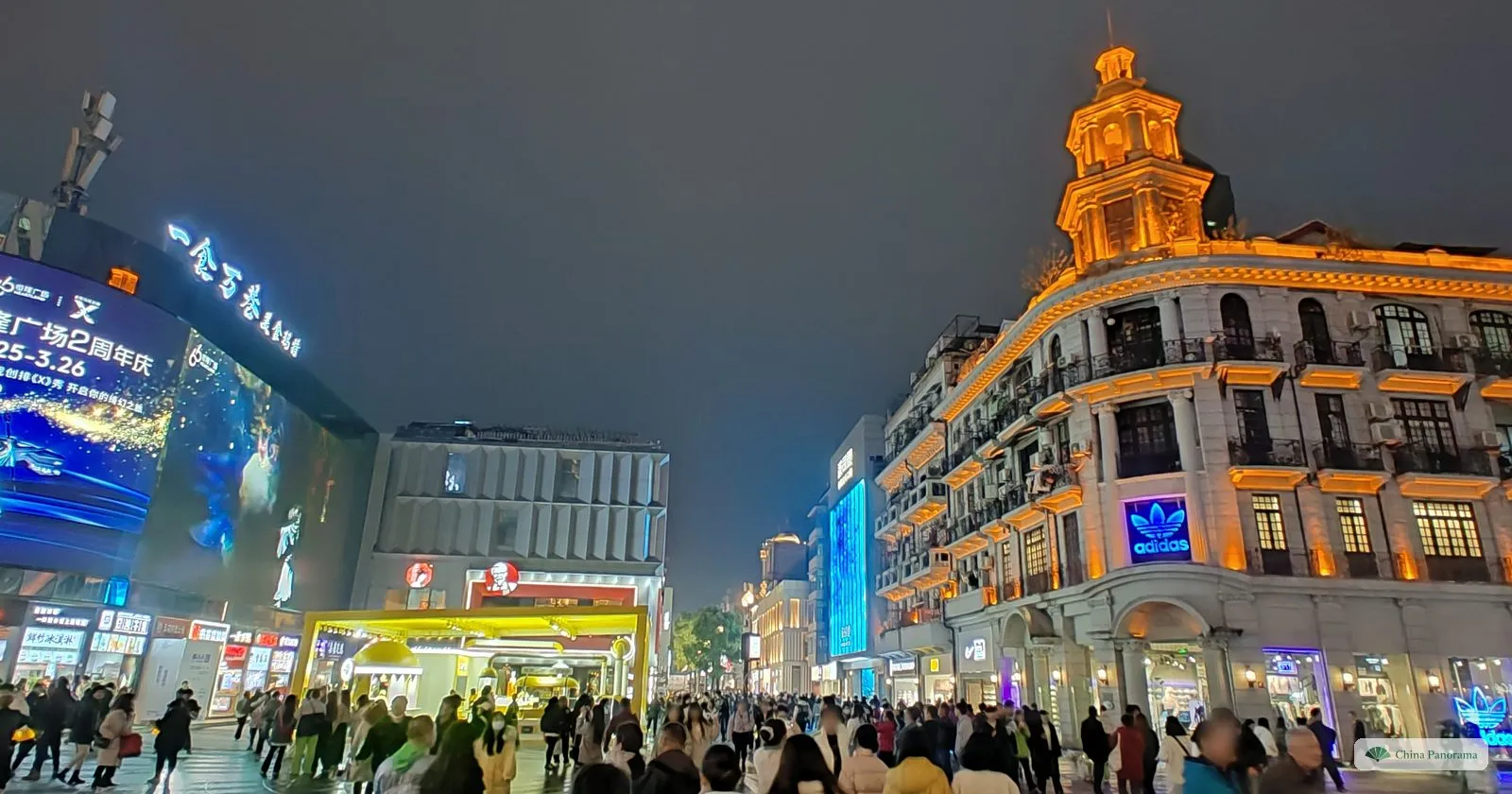 Photograph 1
Which of the three towns?
Answer: Hankou
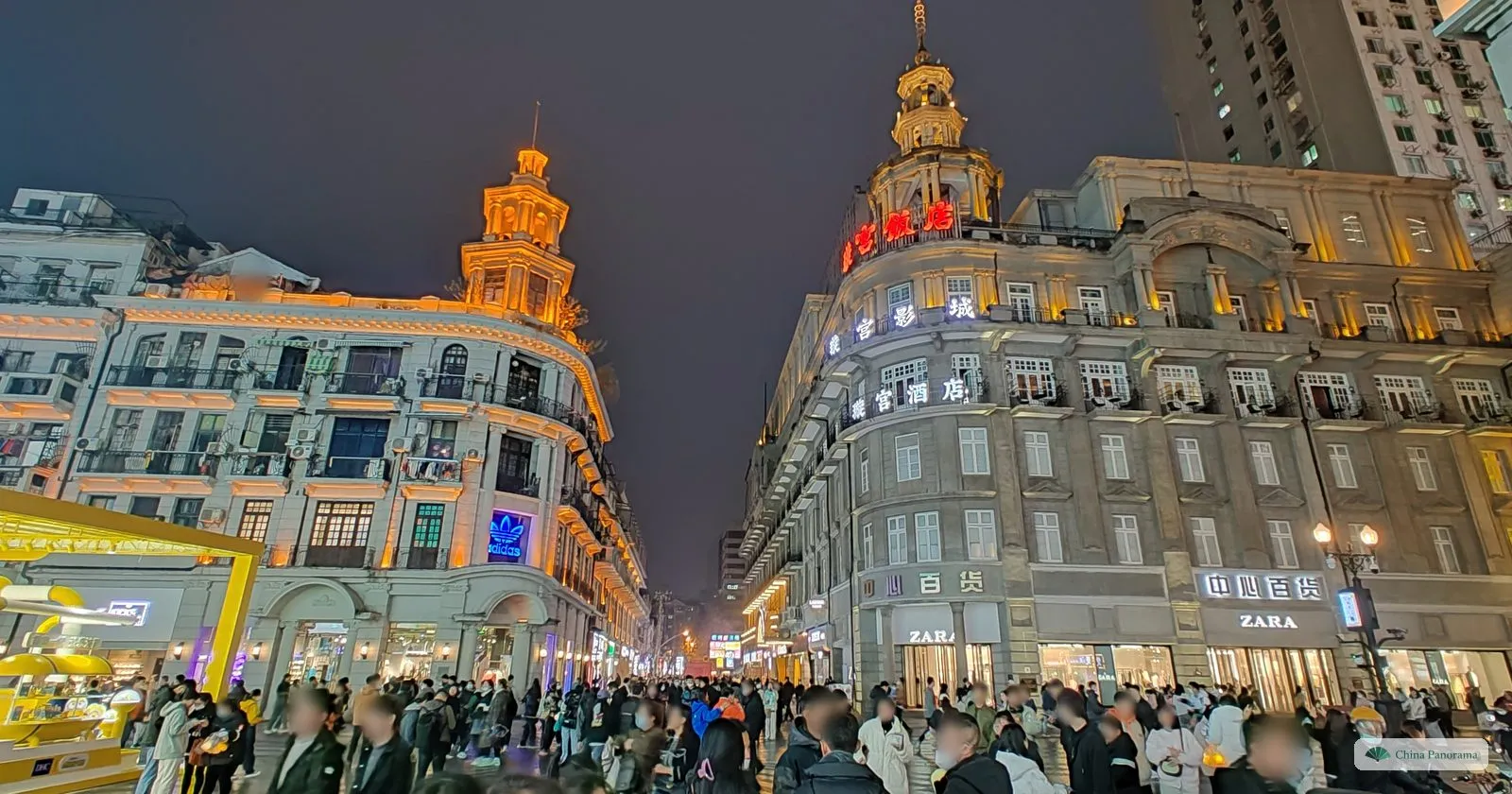
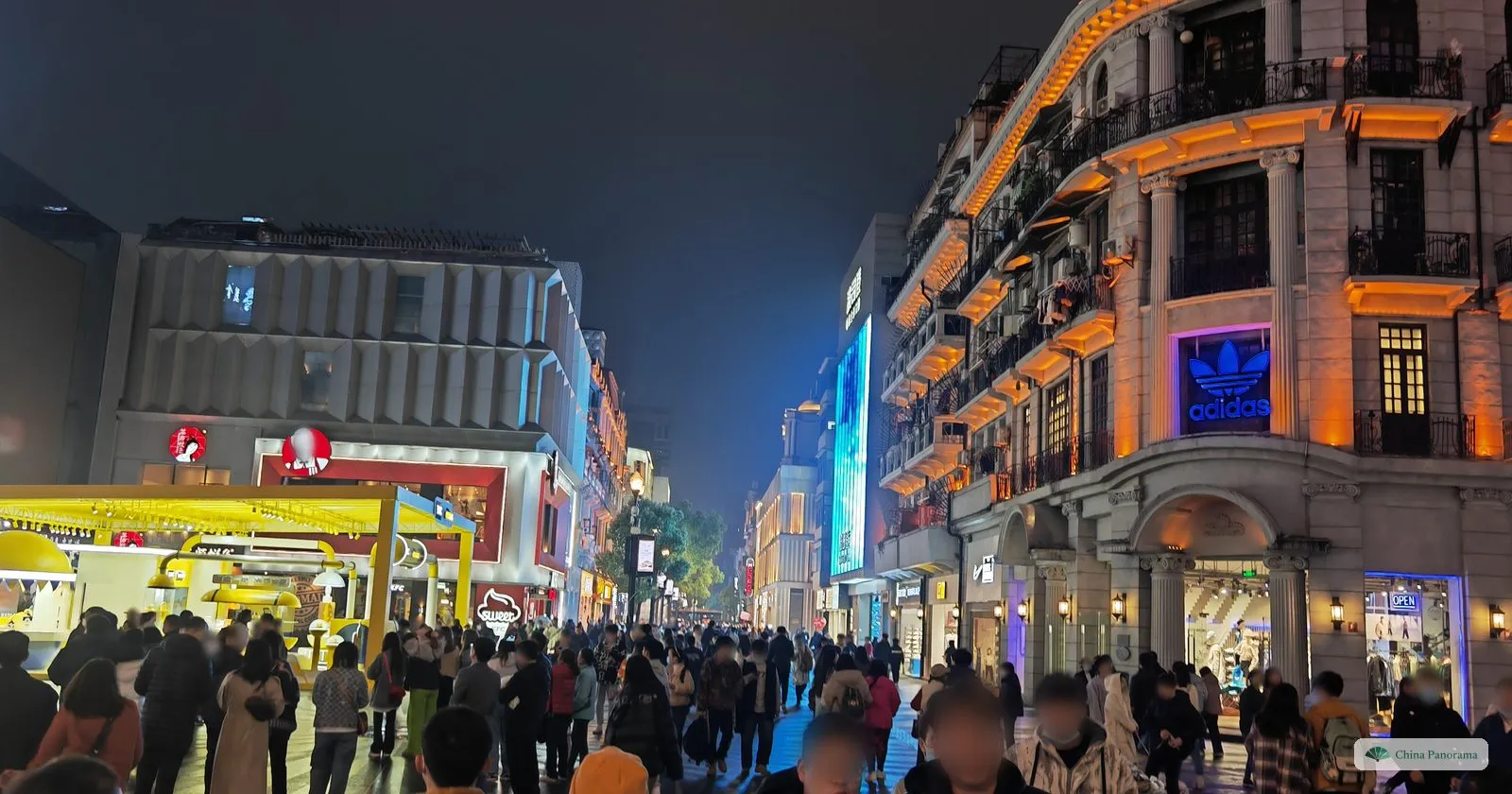
Corner towers, balconies and a European cornice: the treaty-port buildings of the 1920s. Foreign concessions were all in Hankou, on the north bank of the Yangtze.
Jianghan Road at the Zhongshan Avenue crossing, 18:50 on 21 March 2023.
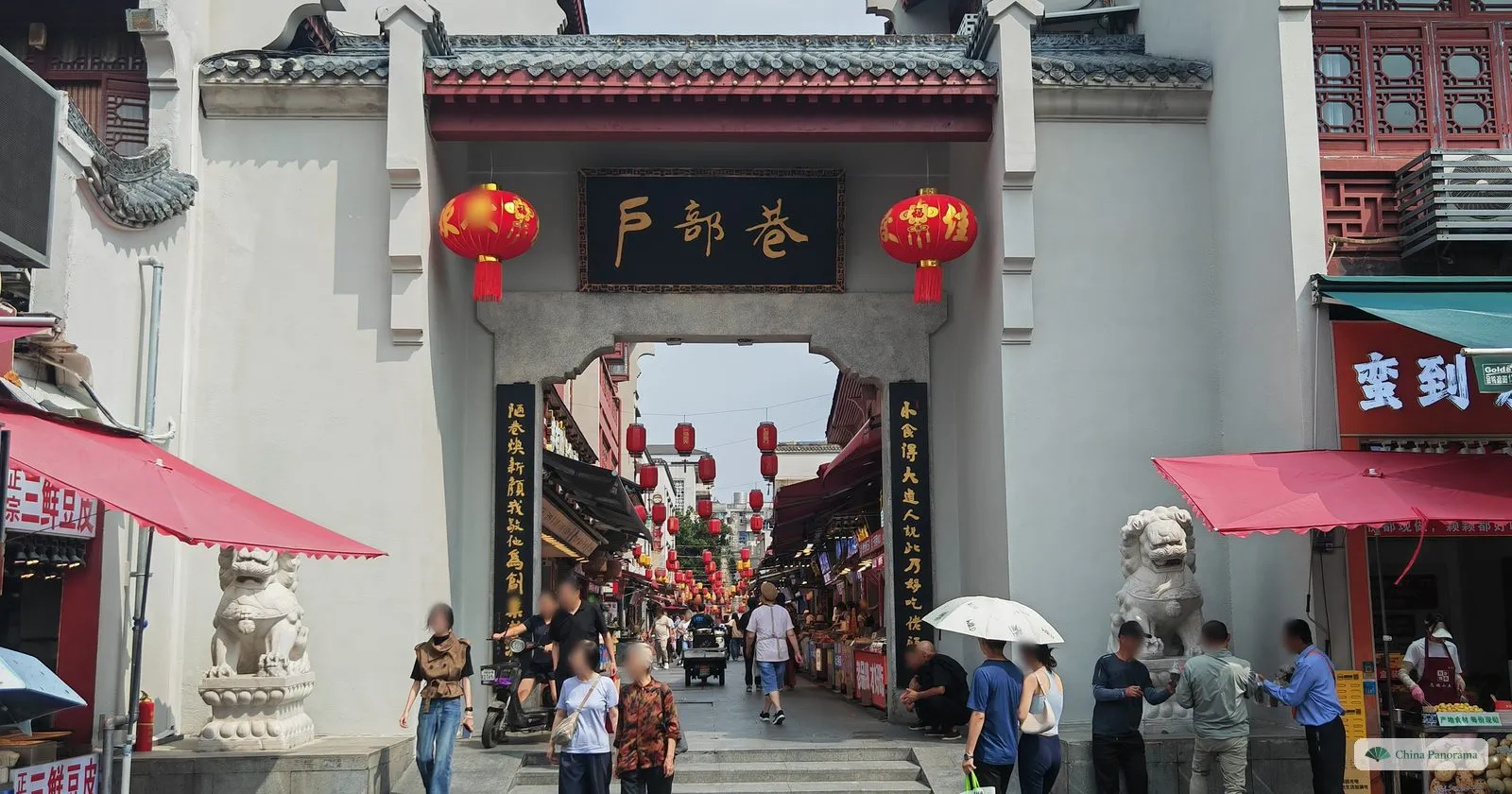 Photograph 2
Which of the three towns?
Answer: Wuchang
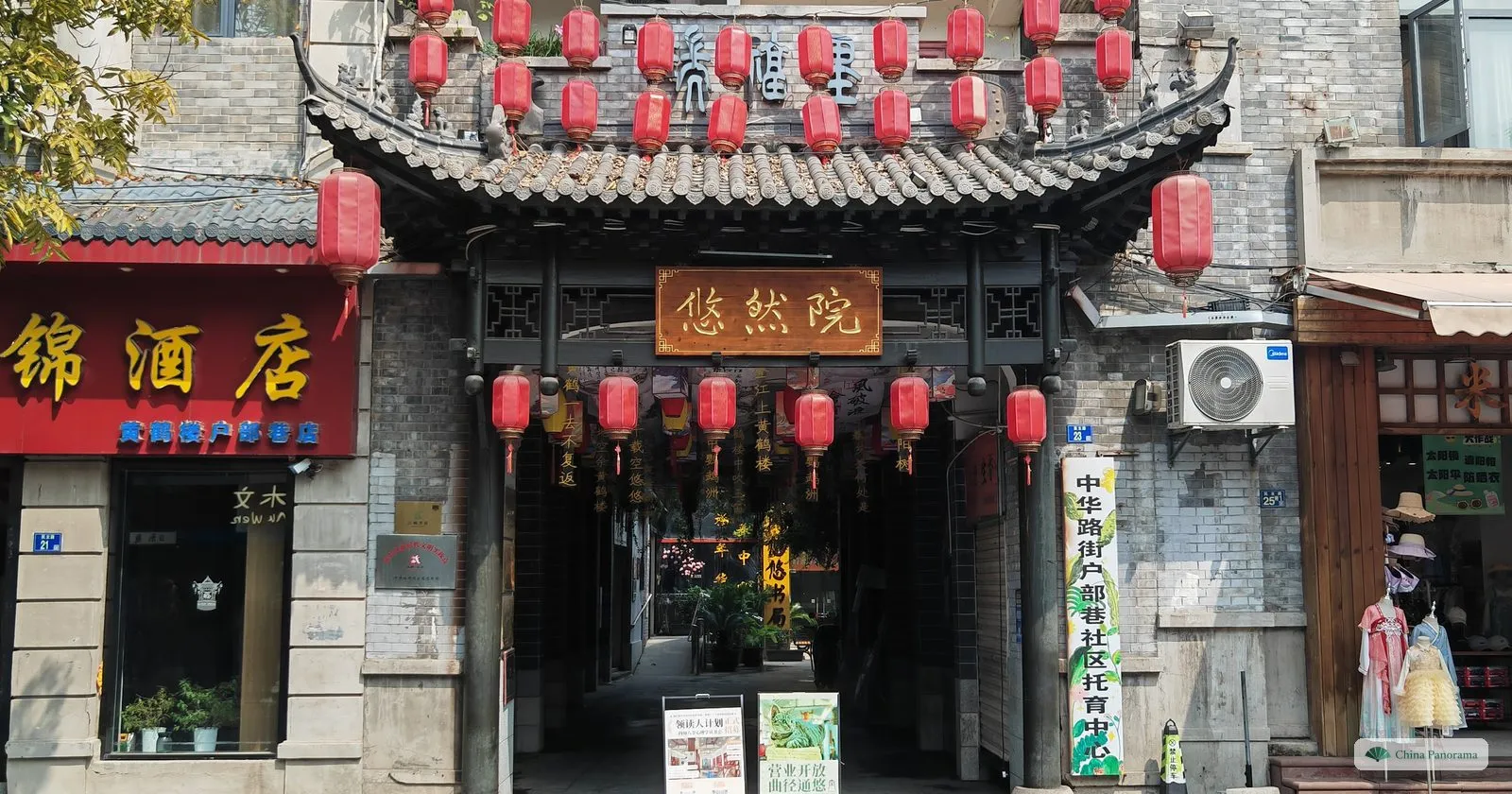
The plaque reads 戶部巷, Hubu Alley: the lane by the provincial treasury of the old walled city of Wuchang, the seat of government on the south bank.
The gate of Hubu Alley, 11:14 on 25 September 2026.
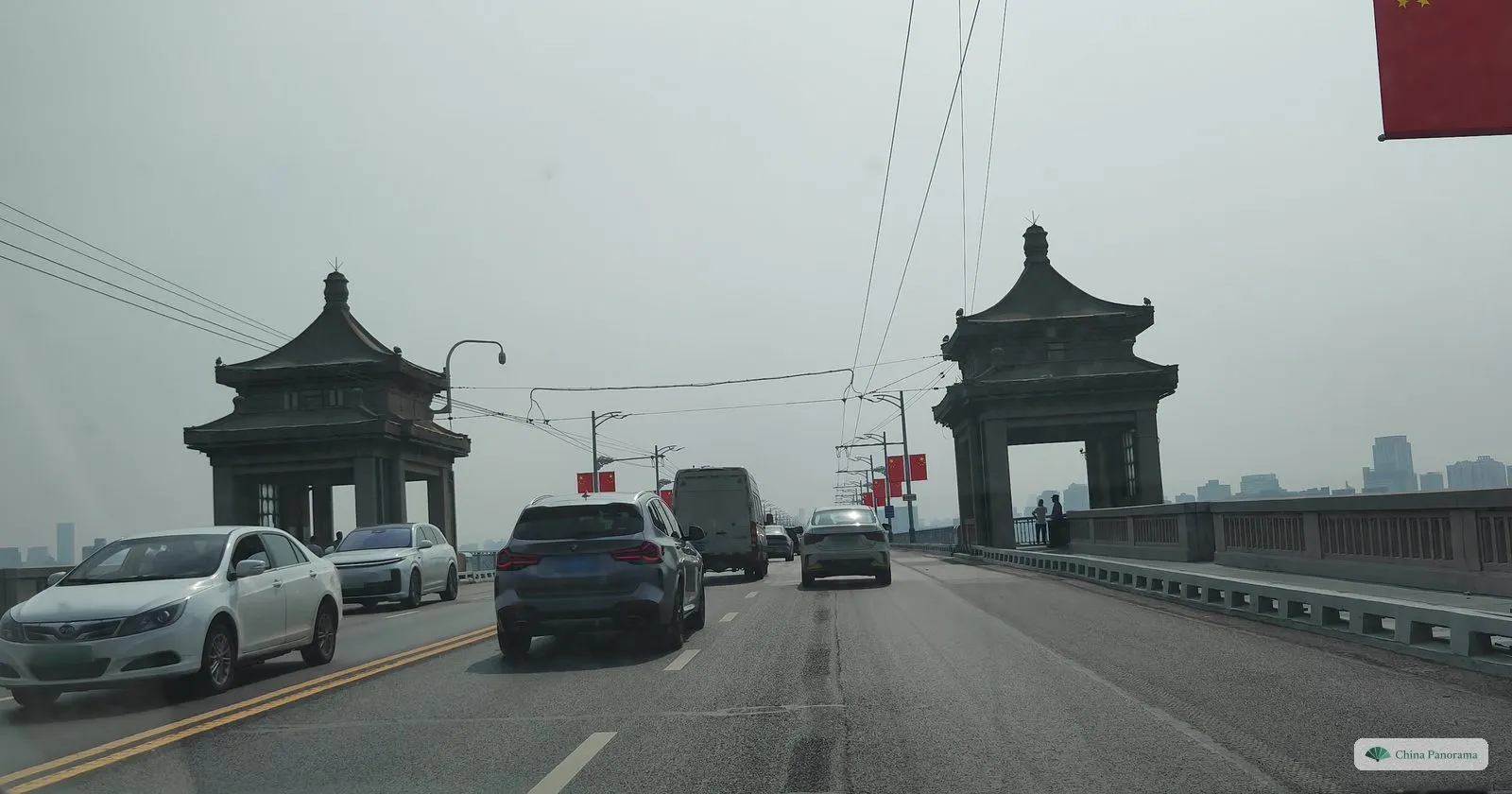 Photograph 3
Which of the three towns?
Answer: Hanyang
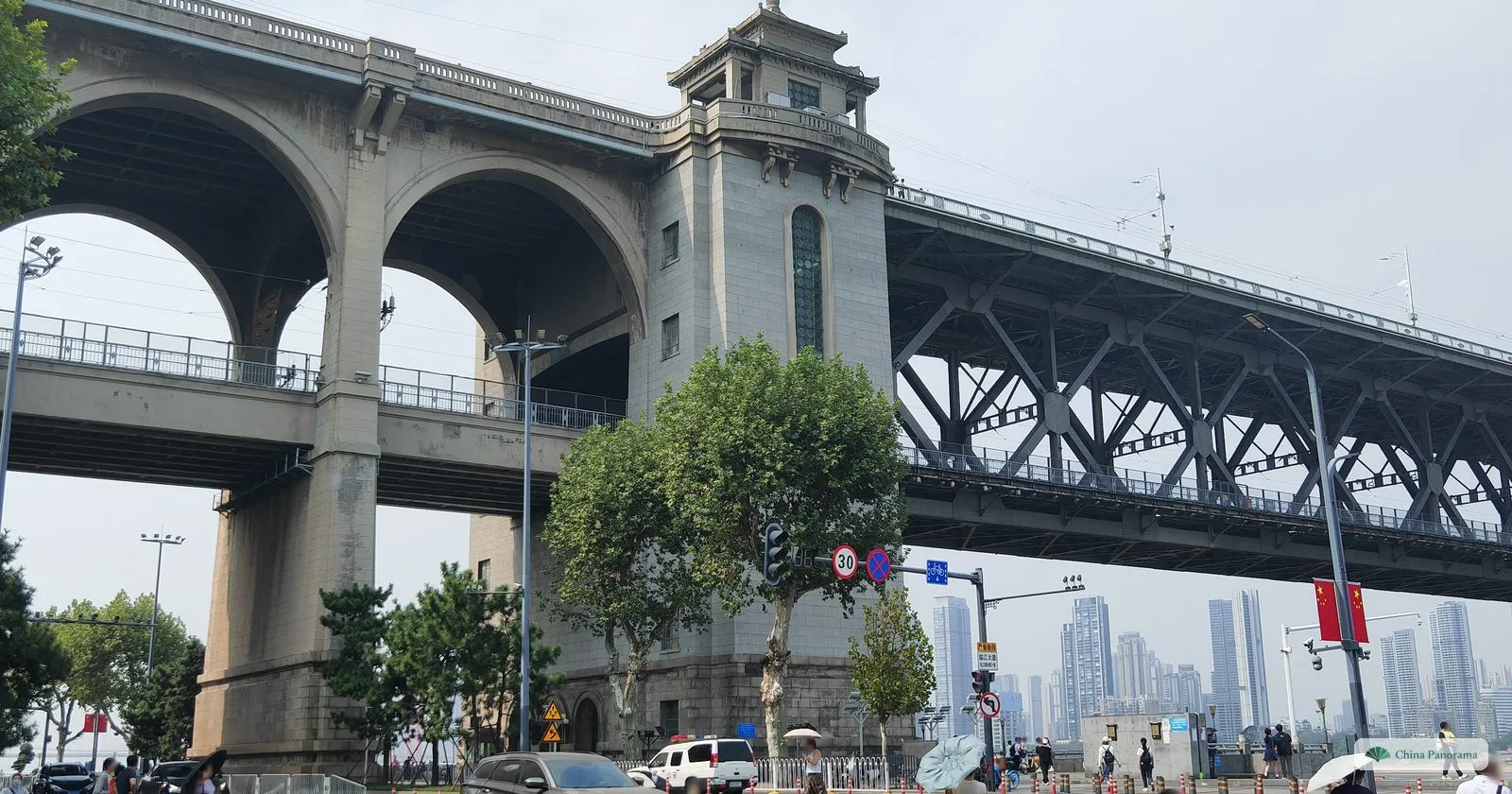
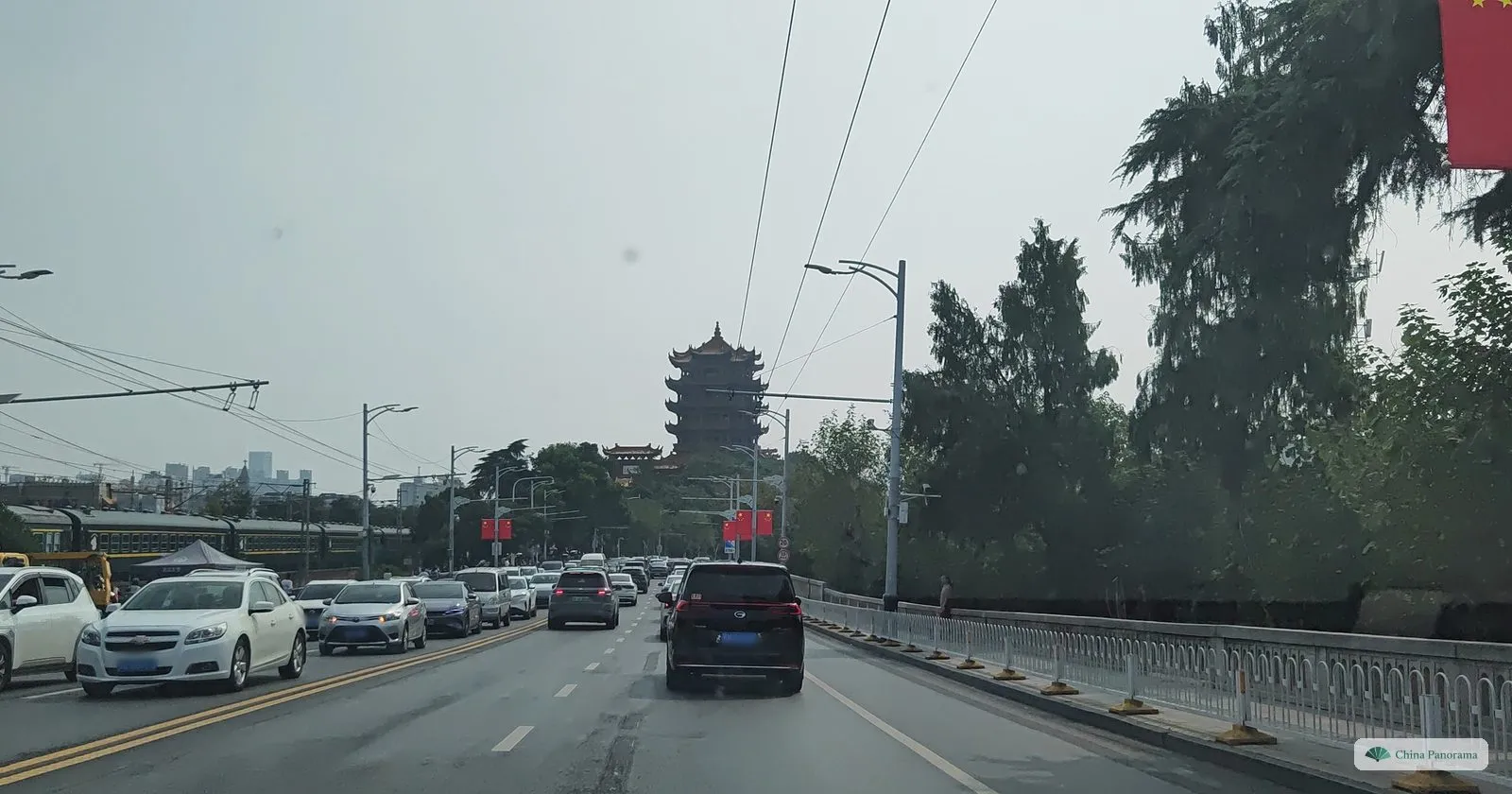
The two pavilion-topped towers stand at the ends of the 1957 Yangtze bridge. We were driving from Turtle Hill, on the Hanyang side — the phone stamped the photo “Hanyang district”.
Driving onto the Yangtze bridge, 10:04 on 25 September 2026.
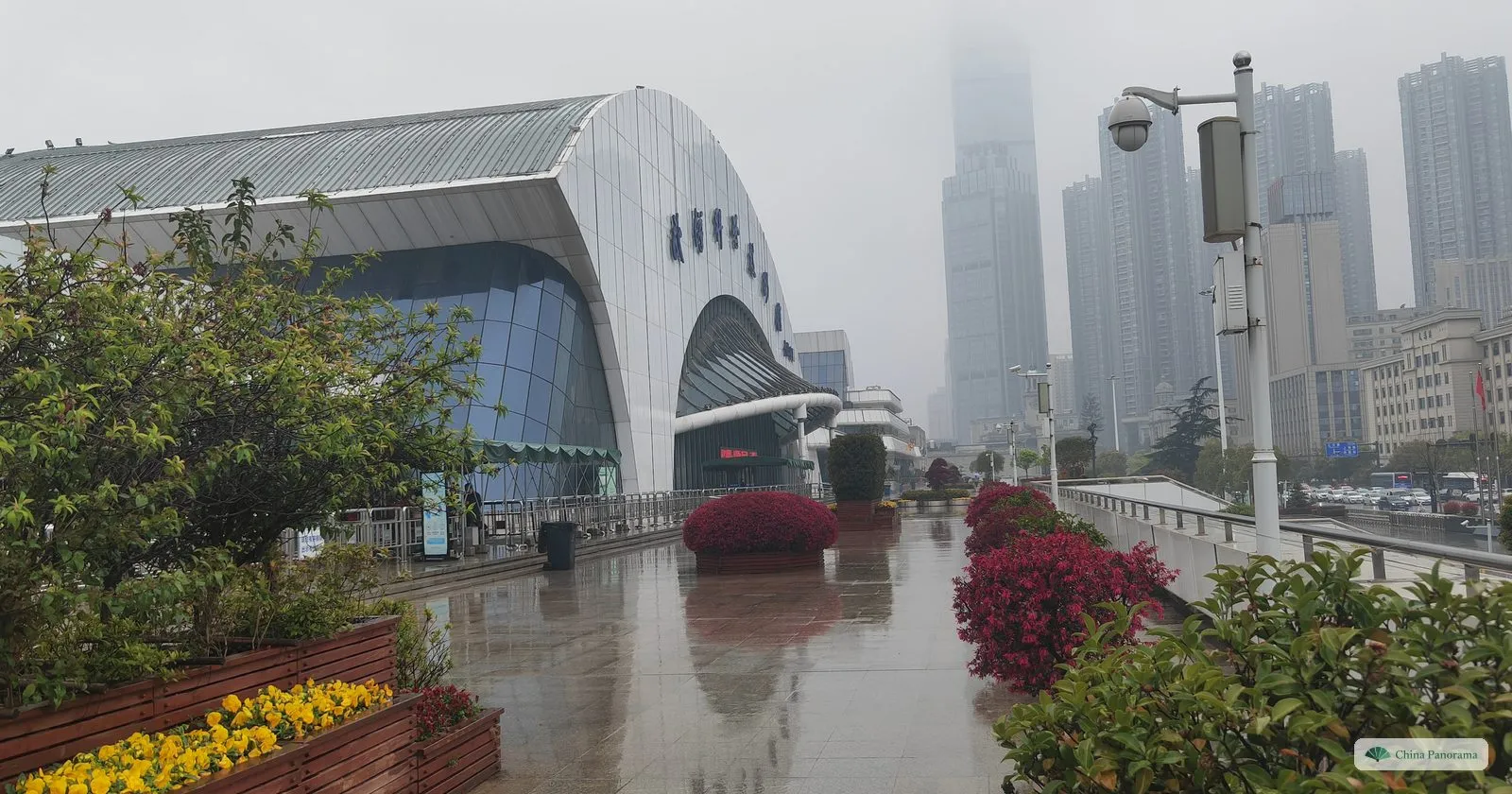 Photograph 4
Which of the three towns?
Answer: Hankou
The curved roof was the passenger terminal of Wuhan Port, where the Yangtze boats left from the Hankou Bund. Today it is the science museum.
The Wuhan Science and Technology Museum on Yanjiang Avenue, 08:54 on 22 March 2023.
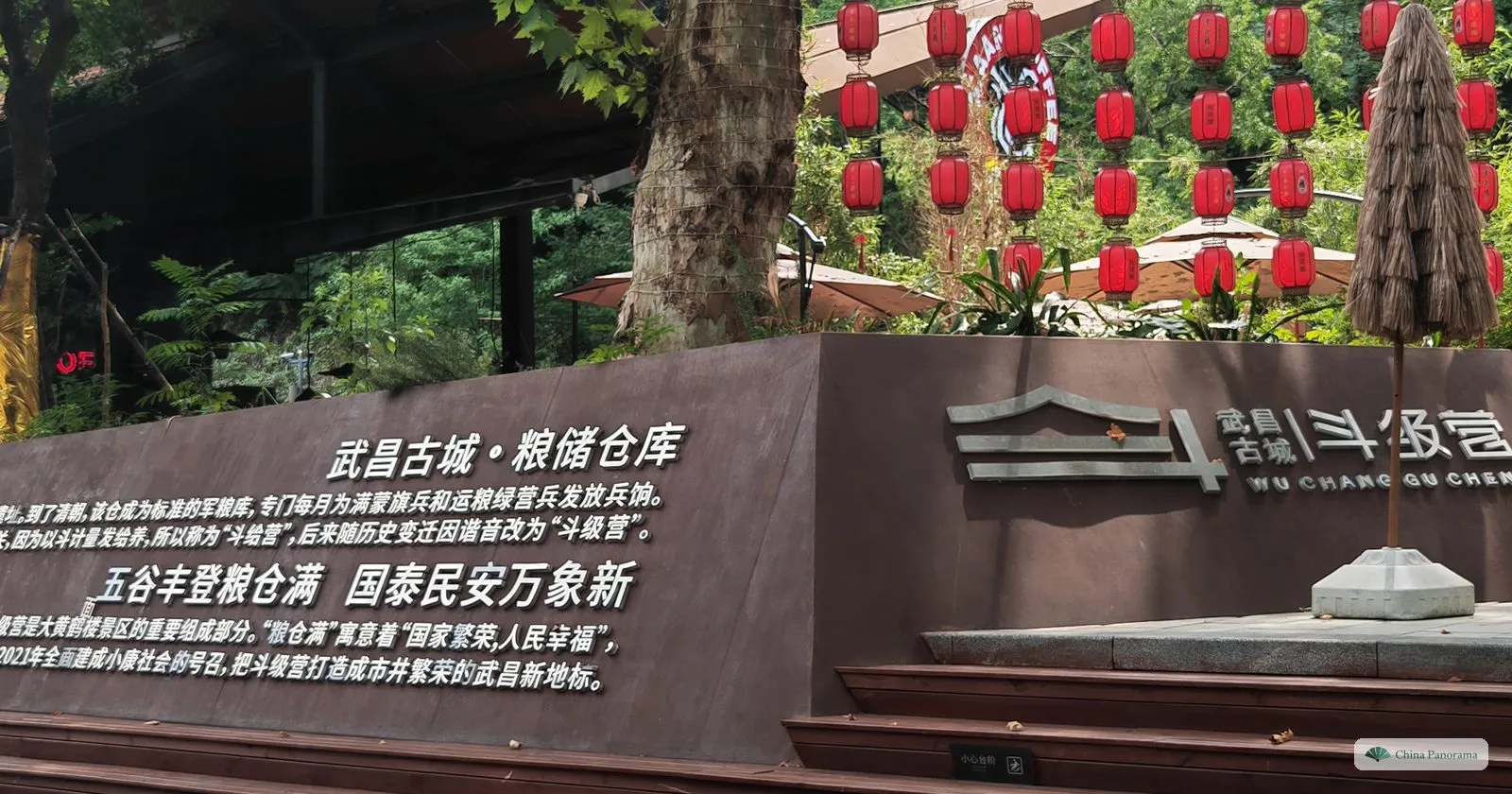 Photograph 5
Which of the three towns?
Answer: Wuchang
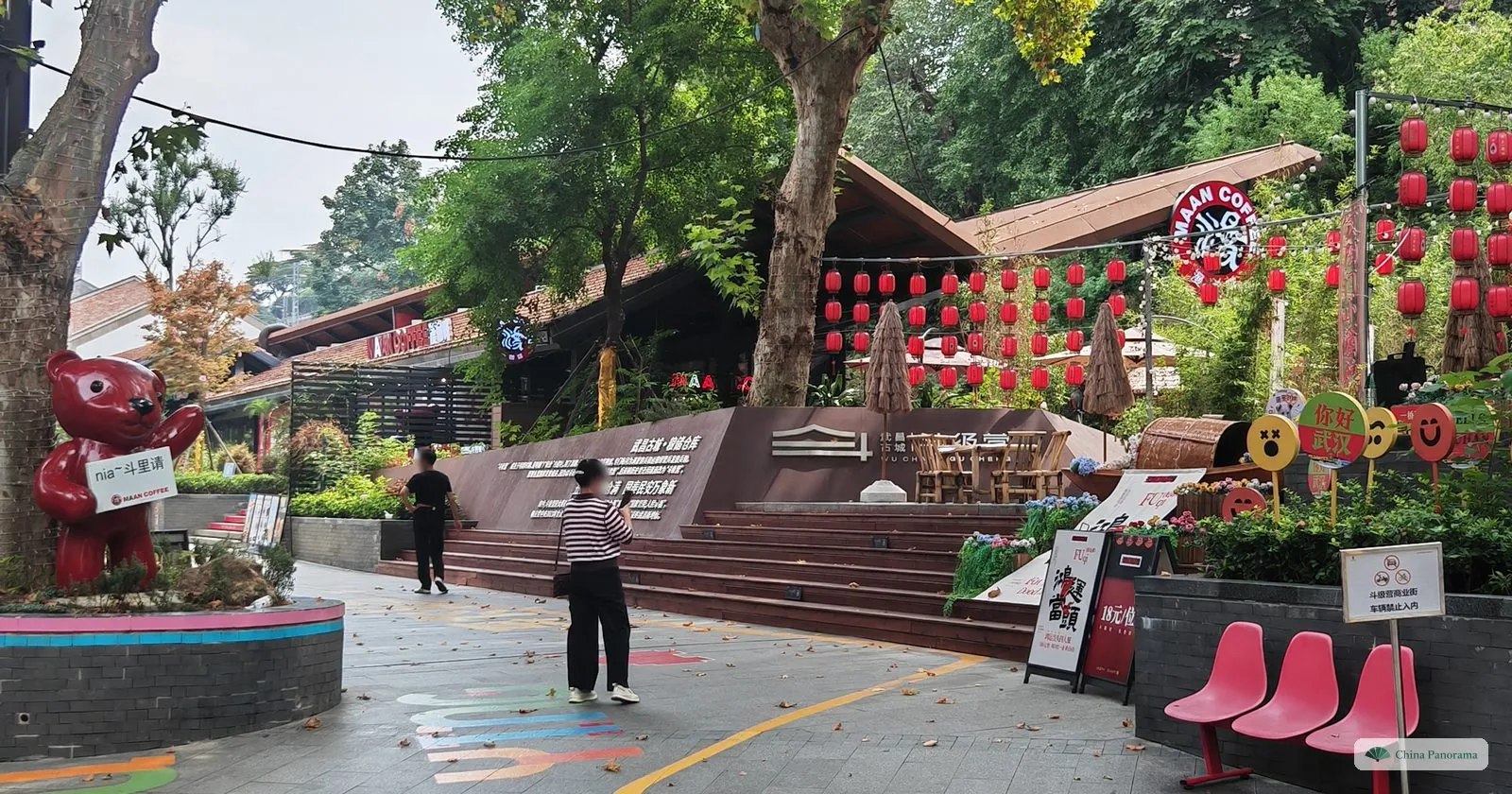
Read the sign: 武昌古城, “Wuchang old town”. It explains the lane’s name: a Qing granary where the garrison’s rations were measured out by the dou, a measure of grain.
The sign of Douji Ying, near Hubu Alley, 12:23 on 25 September 2026.
 Photograph 6
Which of the three towns?
Answer: Hankou
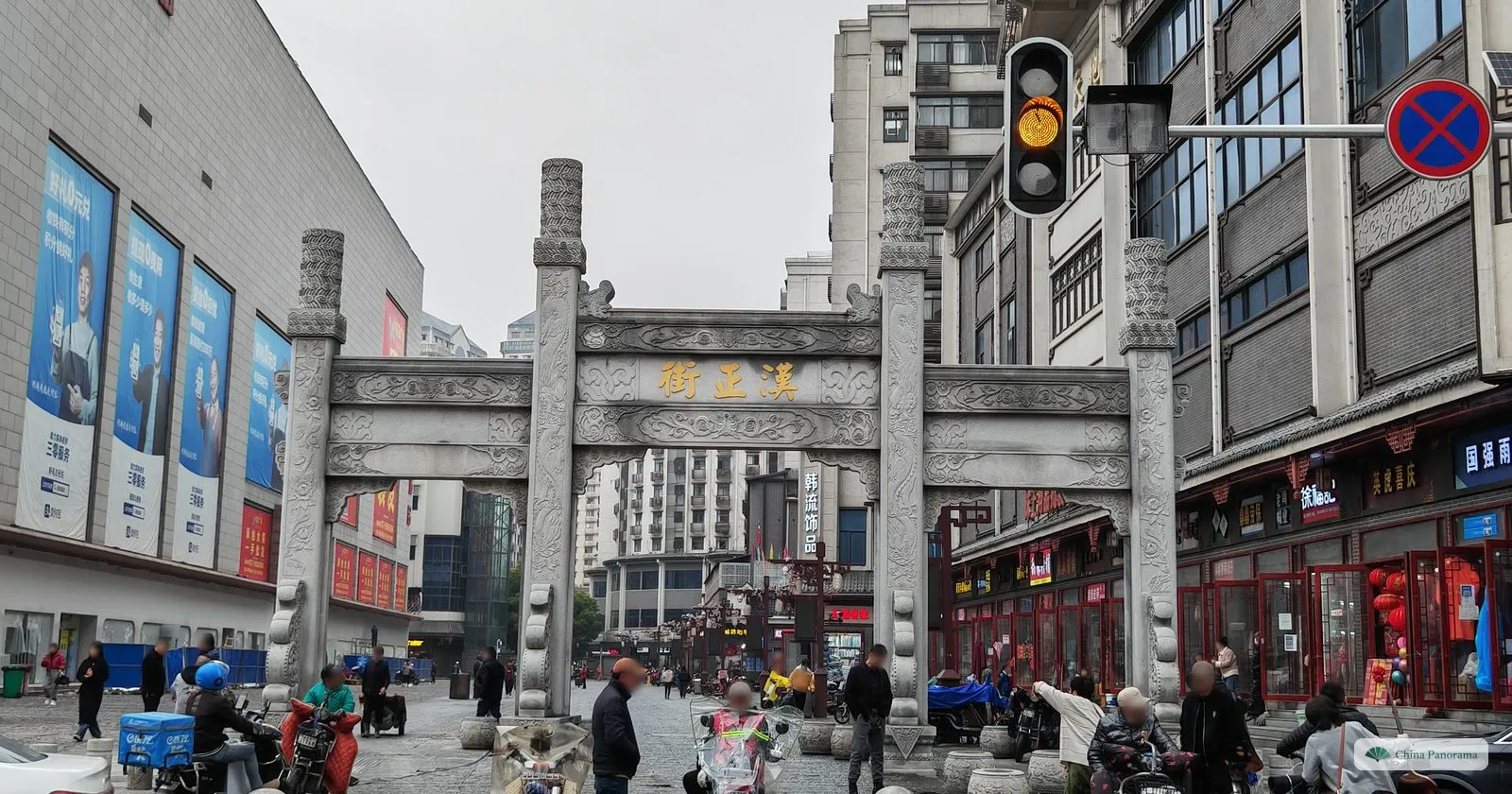
The gold characters read 漢正街, Hanzheng Street: the old market street on the north bank of the Han River, which Hankou grew out of.
The archway of Hanzheng Street, 16:59 on 21 March 2023.
 Photograph 7
Which of the three towns?
Answer: Wuchang
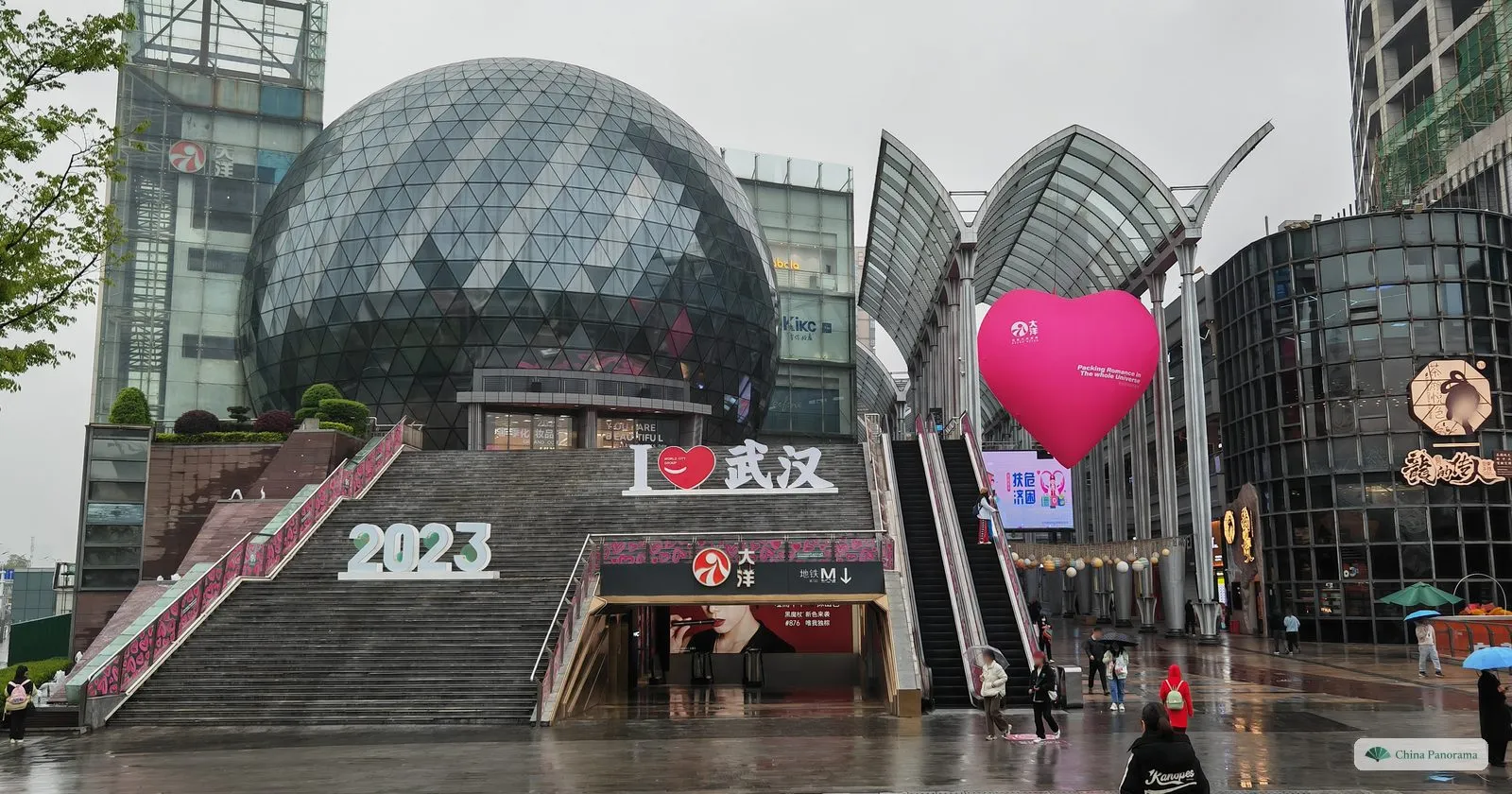
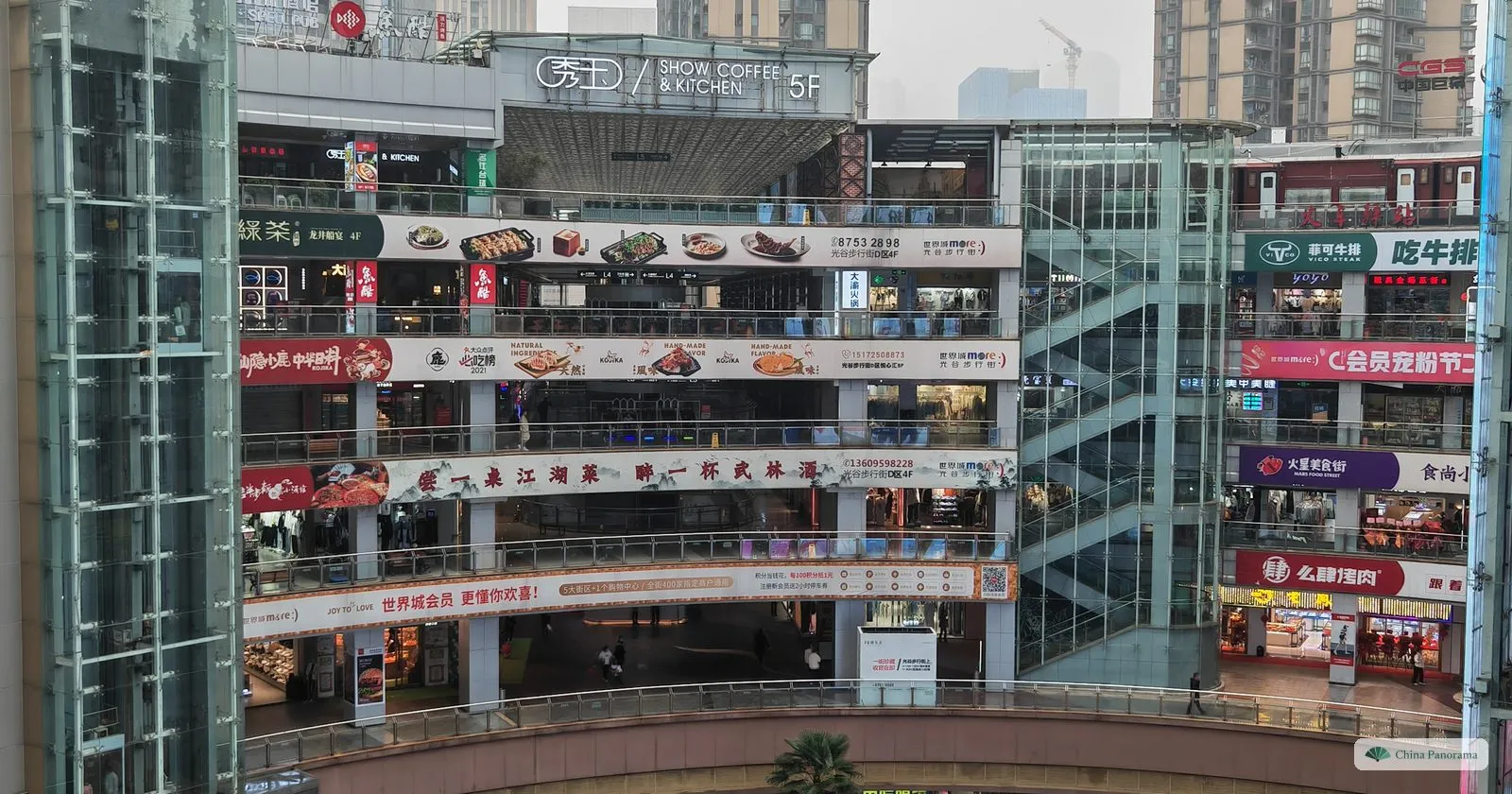
A trick question: Optics Valley is in Hongshan district, 11 km east of the bridge — but it is on the south bank of the Yangtze, the Wuchang side. Old Wuchang has grown east to swallow it.
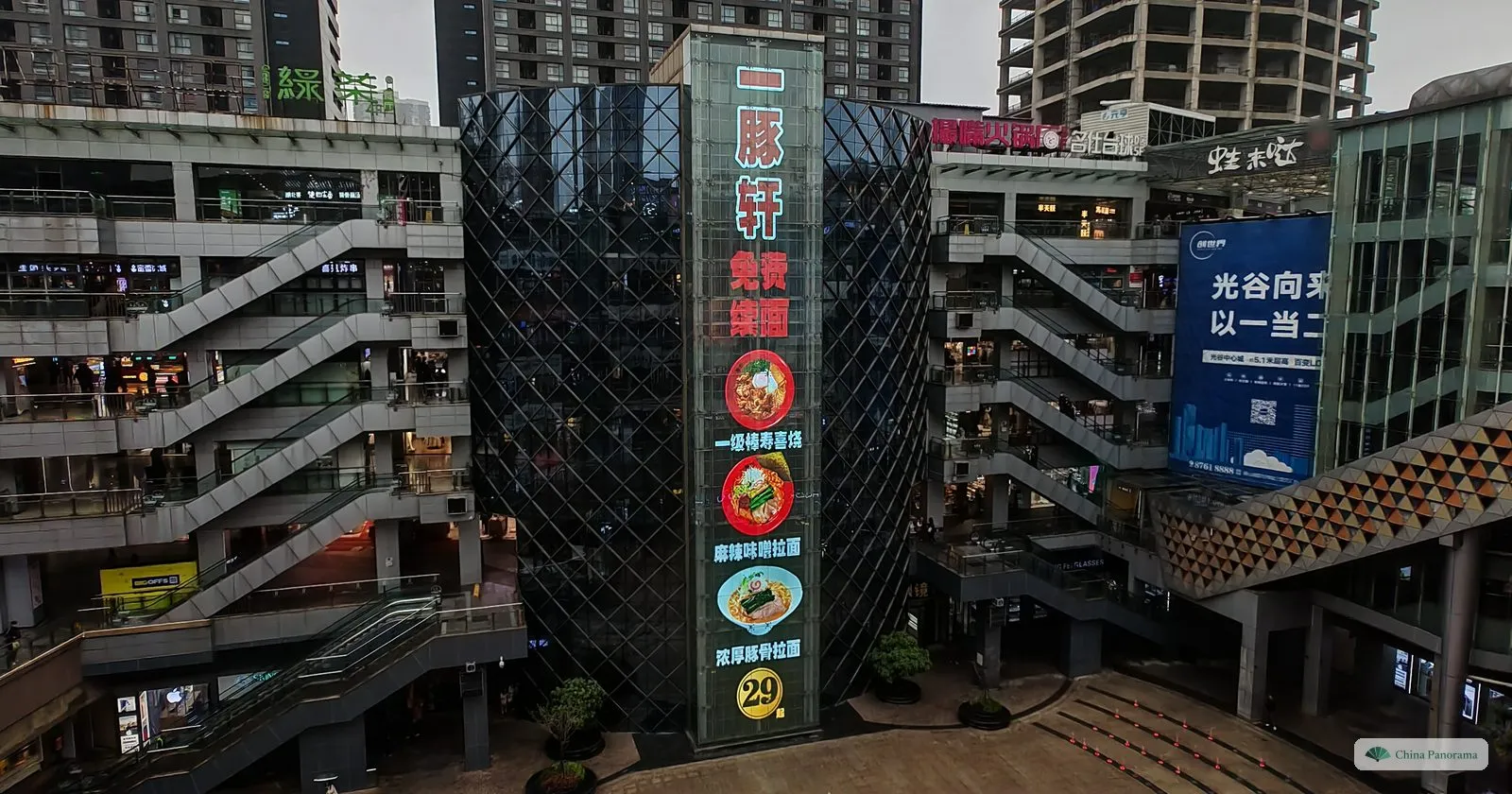
The World City pedestrian street at Optics Valley, 14:47 on 21 March 2023.
 Photograph 8
Which of the three towns?
Answer: Hankou
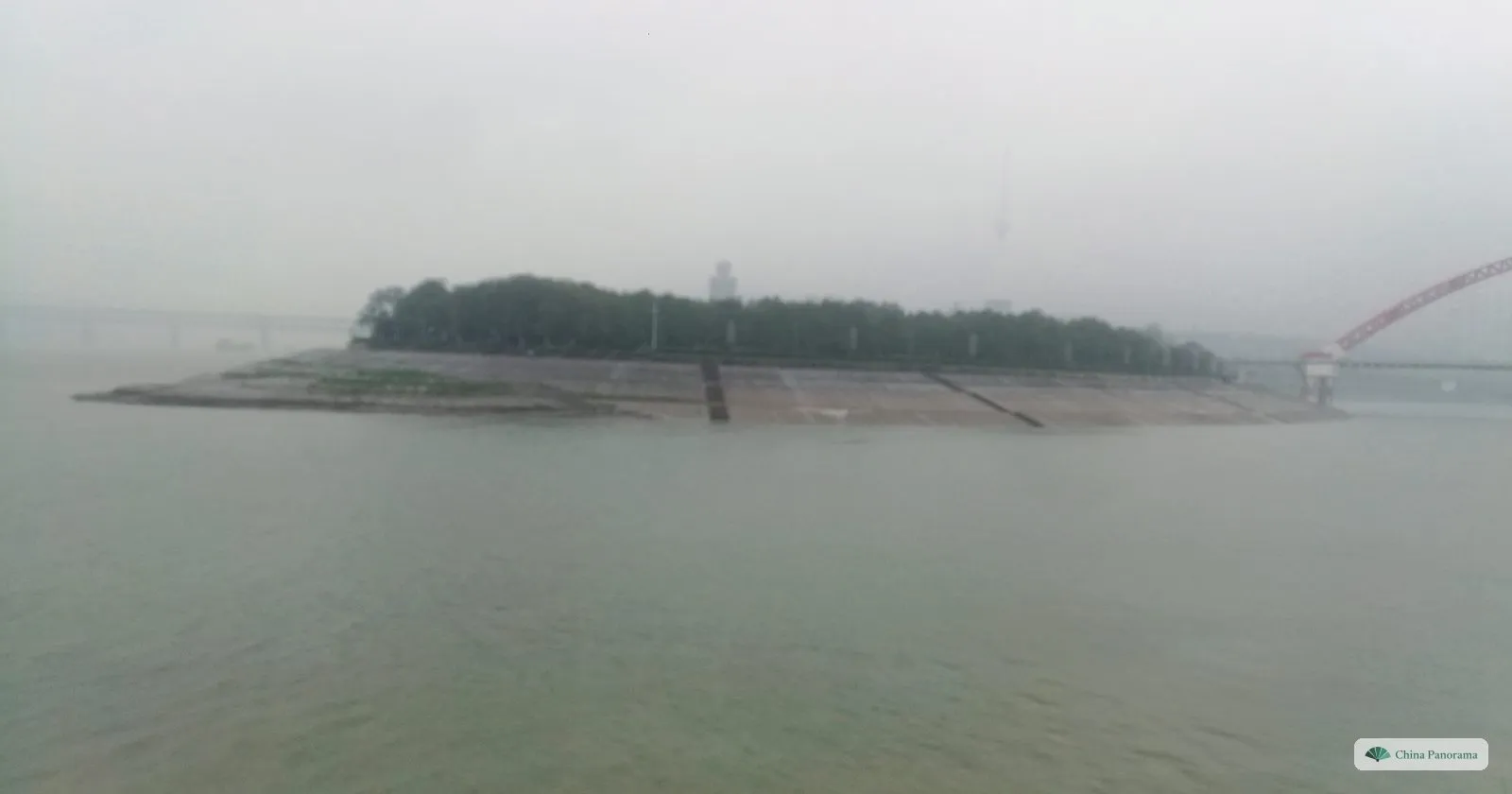
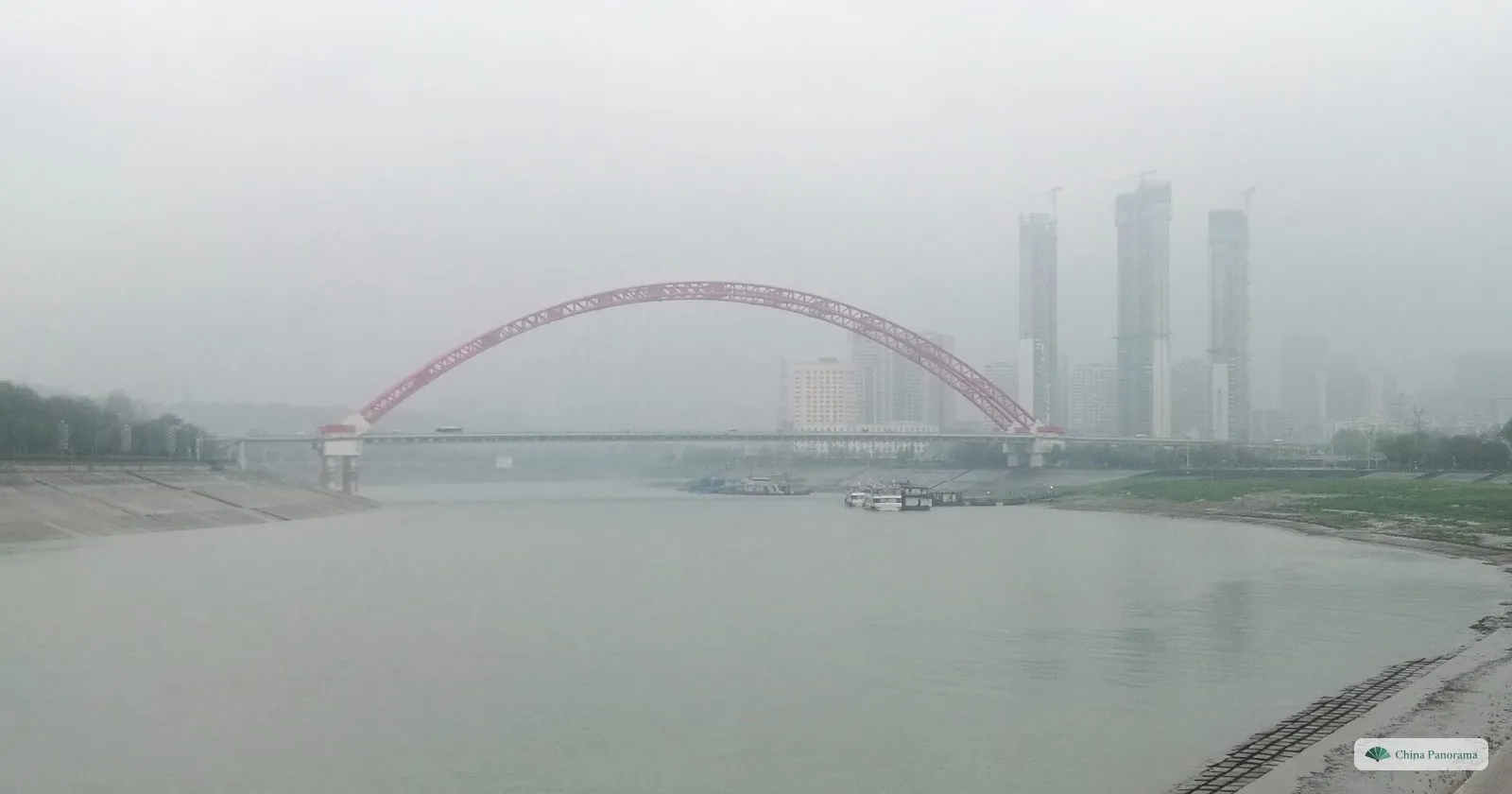
We stood on the tip of Hankou where the Han flows into the Yangtze. The green spit across the water is Nan’anzui, the tip of Hanyang; the red arch is the Qingchuan Bridge over the Han.
From Longwangmiao, 16:32 on 30 March 2021. Which town were we standing in?
How old is it really?
The Yellow Crane Tower was first recorded in 223 — and the one you climb was finished in 1985. Wuhan’s genuine old buildings are mostly from the treaty port and the years round the 1911 revolution; the old-looking food streets are recent. Tap a name on the time line, or filter.
Ming and Qing1368–1911
The treaty port1861–1938
1911 and the Republic1911–1949
The People’s Republicsince 1949
Filled dot: original. Ring: ruin. Square: built in our time.
Tap a name on the time line or a card.
- Originalfounded 1658about 370 years old
Founded by two monks from Zhejiang; the Hall of the 500 Arhats was rebuilt after 1852.
- Originalfrom 1901about 130 years old
Banks, hotels and stores of the 1910s–1930s, many of them still standing.
- Original1909–1910about 120 years old
Built for the provincial assembly; the revolutionaries’ seat after 10 October 1911.
- Original1924about 100 years old
Finished on 21 January 1924; for years the tallest building in Wuhan.
 Original192898 years old
Built as a store in 1928 and a hotel by 1931, at the Zhongshan Avenue crossing.
 Original1955–195769 years old
Opened on 15 October 1957; road above, railway below.
 Built in our timerebuilt 198541 years old
The last old tower burnt in 1884; this concrete one opened in June 1985, about 1 km from the old site.
- Original198640 years old
Completed in 1986 at the Hanyang end of the bridge.
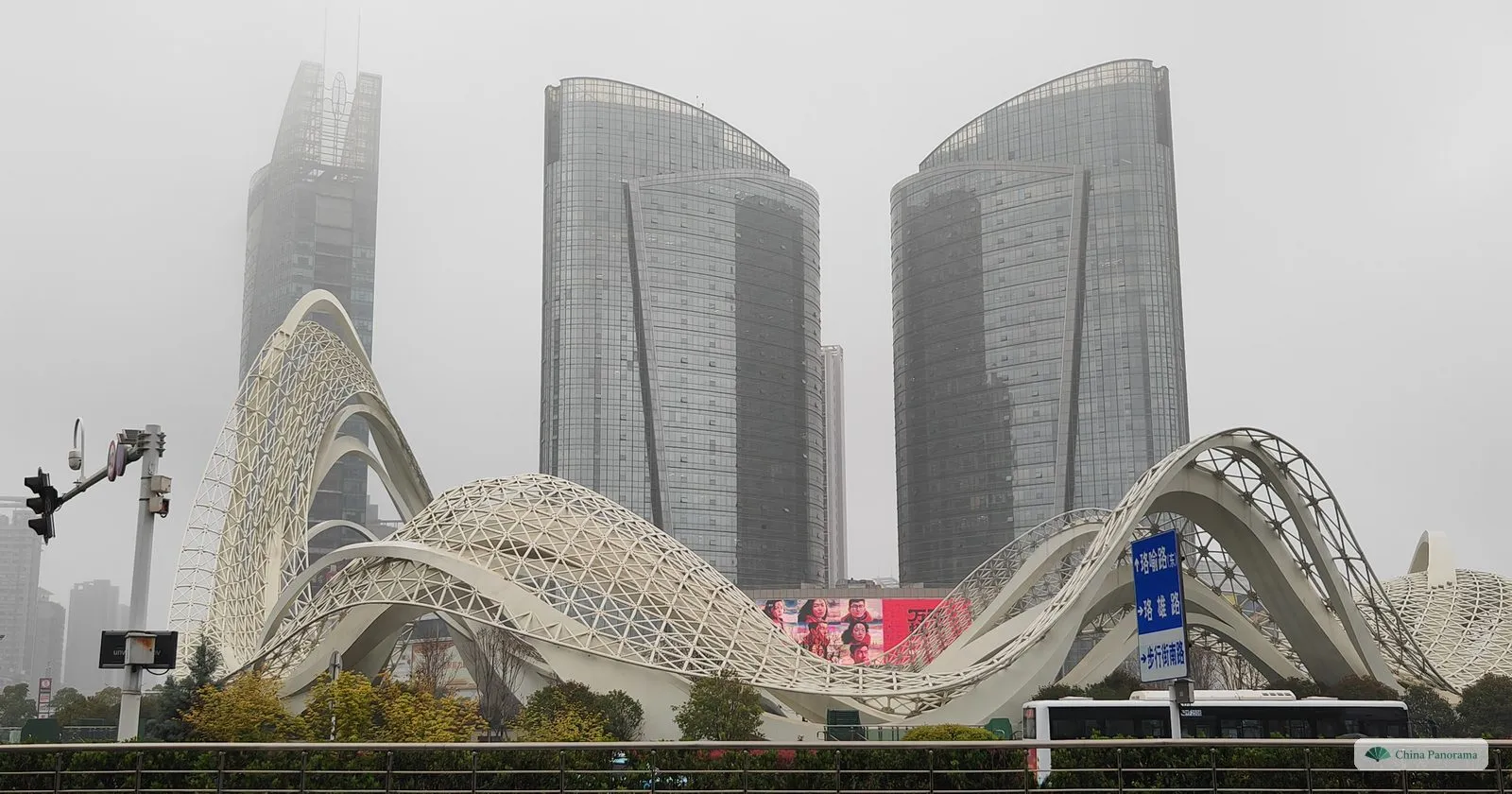 Built in our time200125 years old
Opened in 2001; the metro hub beneath was dug from 2014.
- Built in our timerebuilt 2002–200624 years old
Restored in a Ming–Qing style from 2002 and widened to 8 m in 2006.
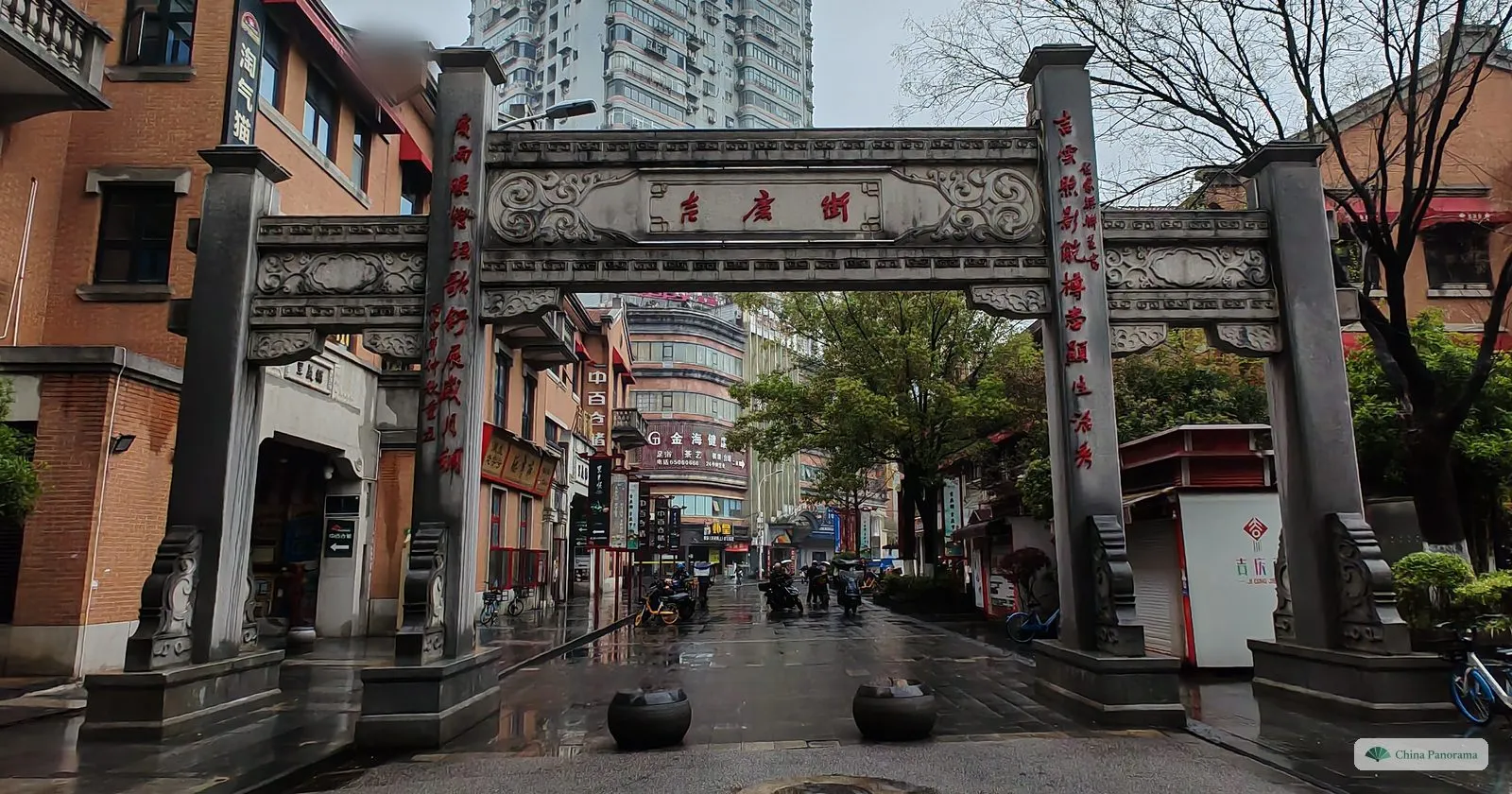 Built in our time201115 years old
The old supper street, moved and rebuilt in red brick; opened on 22 December 2011.
Across the Yangtze bridge on foot
The first bridge over the Yangtze is also a walk: about 1.5 km from the Wuchang end to Turtle Hill in Hanyang, on a pavement beside the traffic, with trains below. Tap a point on the line to see what is there.
Tap a stop on the line or a card.
- On the bridge1.7 km from the southern end
The road runs off the bridge into the side of the hill. The TV tower on top was finished in 1986; Guiyuan Temple is about 2 km further west.
Qintai (Line 6), about 1.7 km
- On the bridge1.4 km from the southern end
The tops of the bridgehead towers stand either side of the road: pavilions with upturned Chinese roofs on a bridge of Soviet-advised steel.
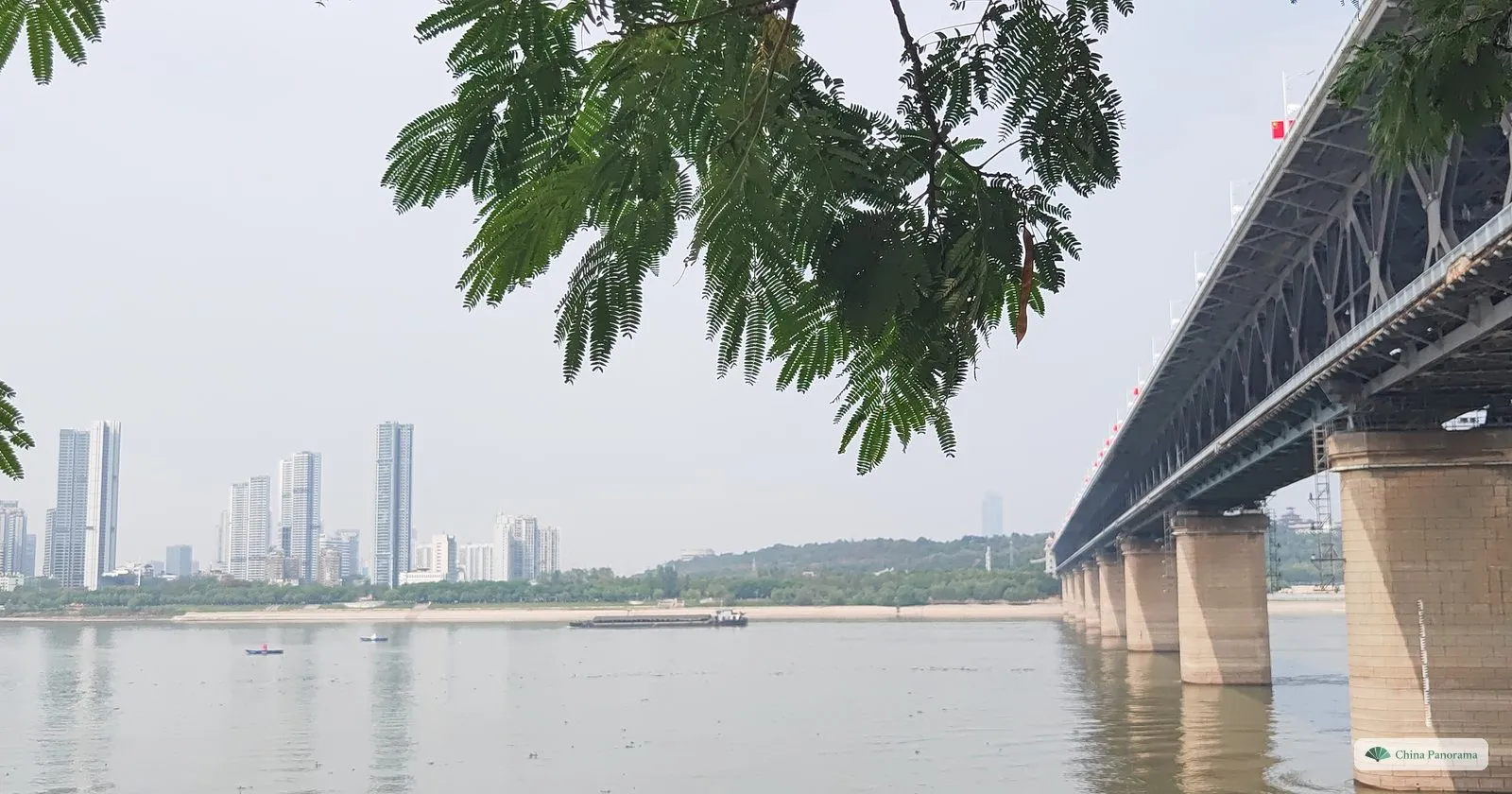 On the bridge0.8 km from the southern end
Eight piers, spans of up to 128 m. Trains rumble along the deck below you; downstream you see Hankou’s towers and the ferries crossing.
- On the bridge0.3 km from the southern end
Below it the riverside promenade passes under the approach arches; the Hanyangmen ferry piers are a few minutes north.
- Beside it0.1 km from the southern end
The bridge approach cuts through Snake Hill near the site of the old tower; the tower of 1985 stands on the hill about 900 m east of the bridgehead.
- On the bridge0.0 km from the southern end
Start here and walk north-west: about 1.5 km and 20 minutes to Turtle Hill. The pavements on each side are 2.25 m wide.
Simenkou Huanghelou (Line 5), about 800 m
What am I looking at?
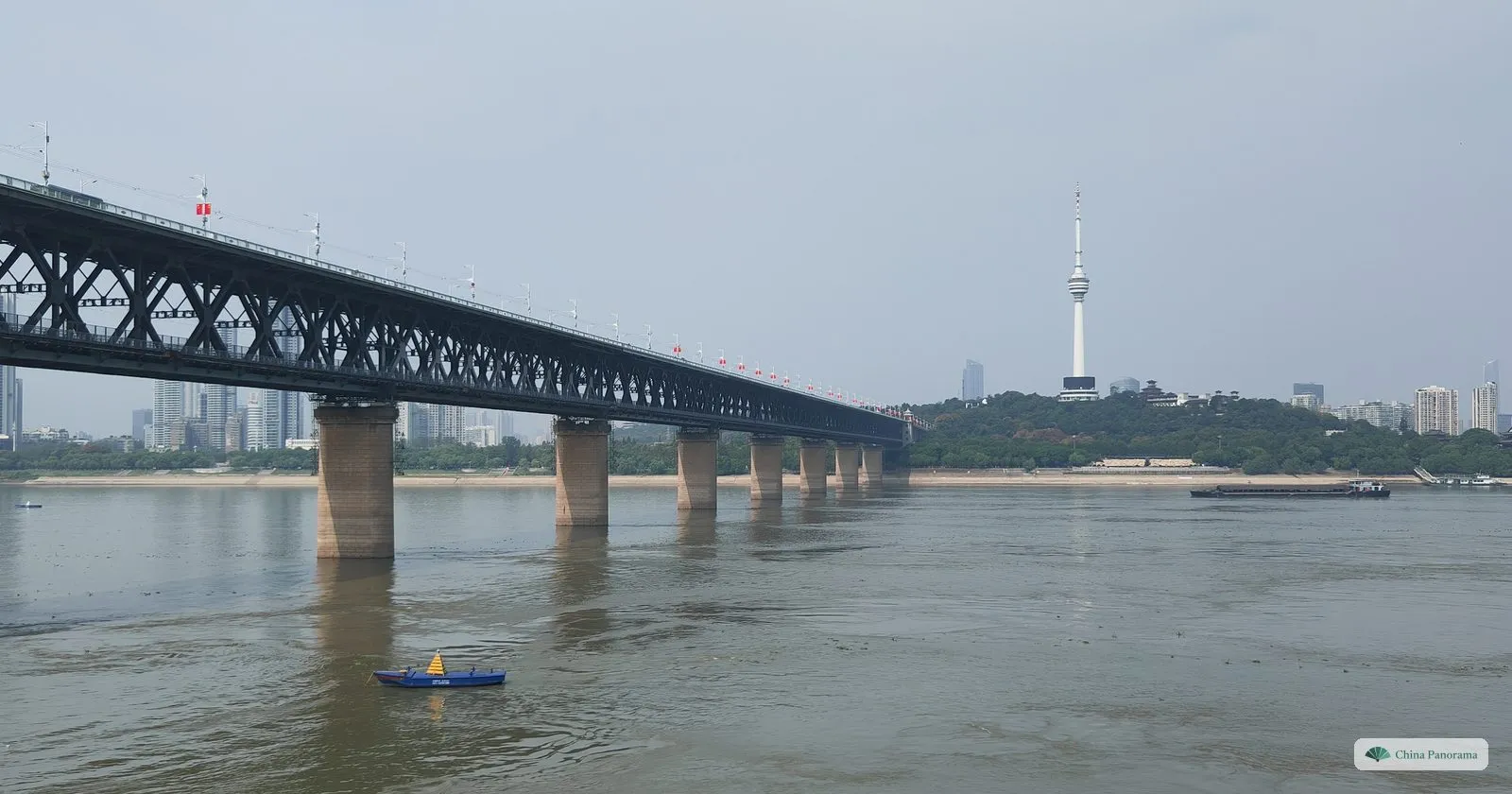
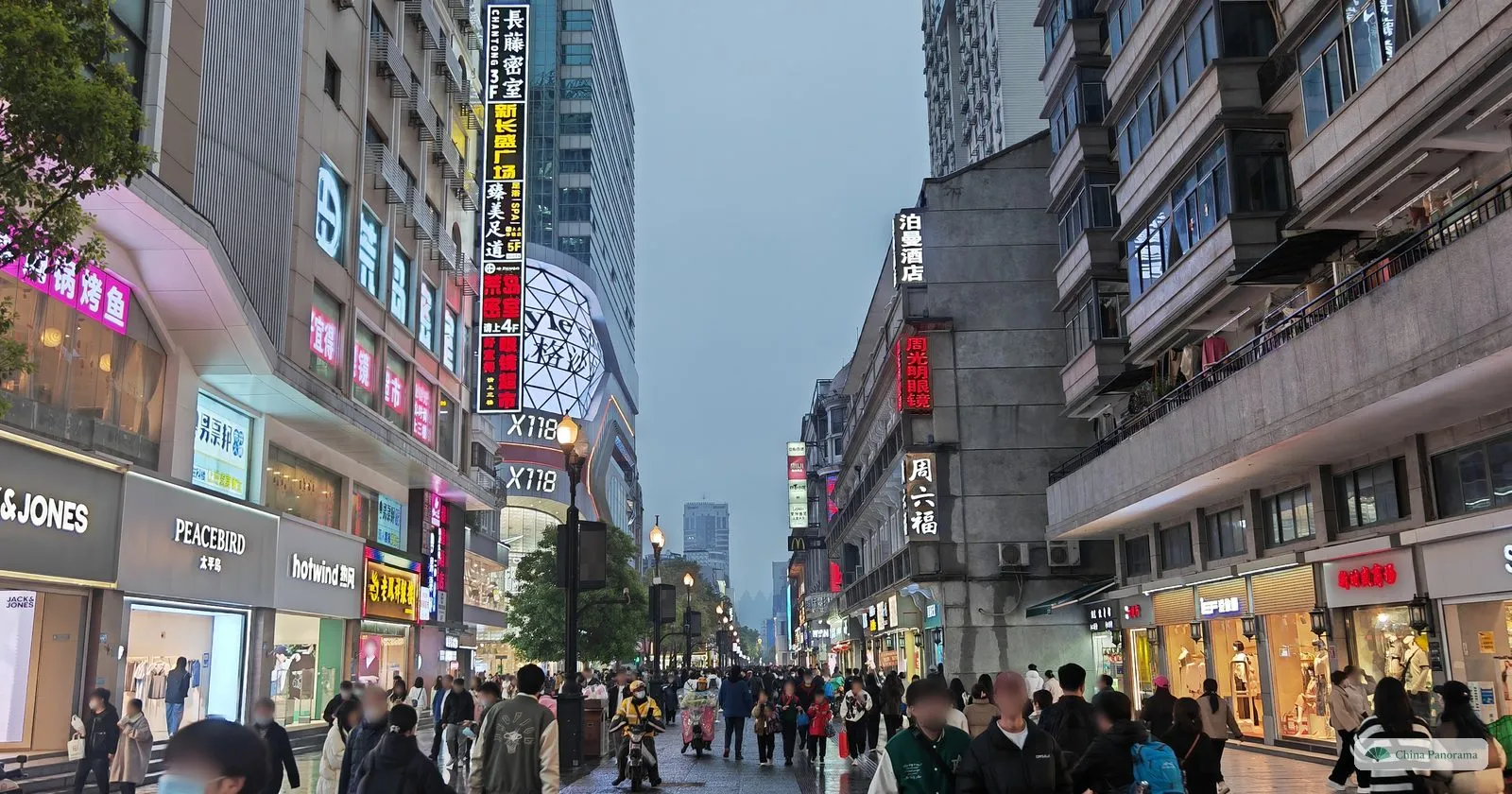
The bridge and Turtle Hill, a breakfast menu at Hubu Alley, the alley’s gate, the Jianghan Road crossing at night, the meeting of the Han and the Yangtze, and Optics Valley. Tap a number on the photograph.
1Road above, rail below
公铁两用桥 · Opened 15 October 1957
Cars and buses on the upper deck, a double-track railway inside the steel truss. Before 1957 the trains between Beijing and Guangzhou crossed here by ferry.
The bridge in the list below →Tap a number on the photo, or a name in the list.
17 places in and around Wuhan
Filter by type, or by whether you need to be indoors — useful on a wet March day or a 34-degree afternoon.
- LandmarkHanyang / Wuchang · 汉阳区 · 武昌区Outdoors
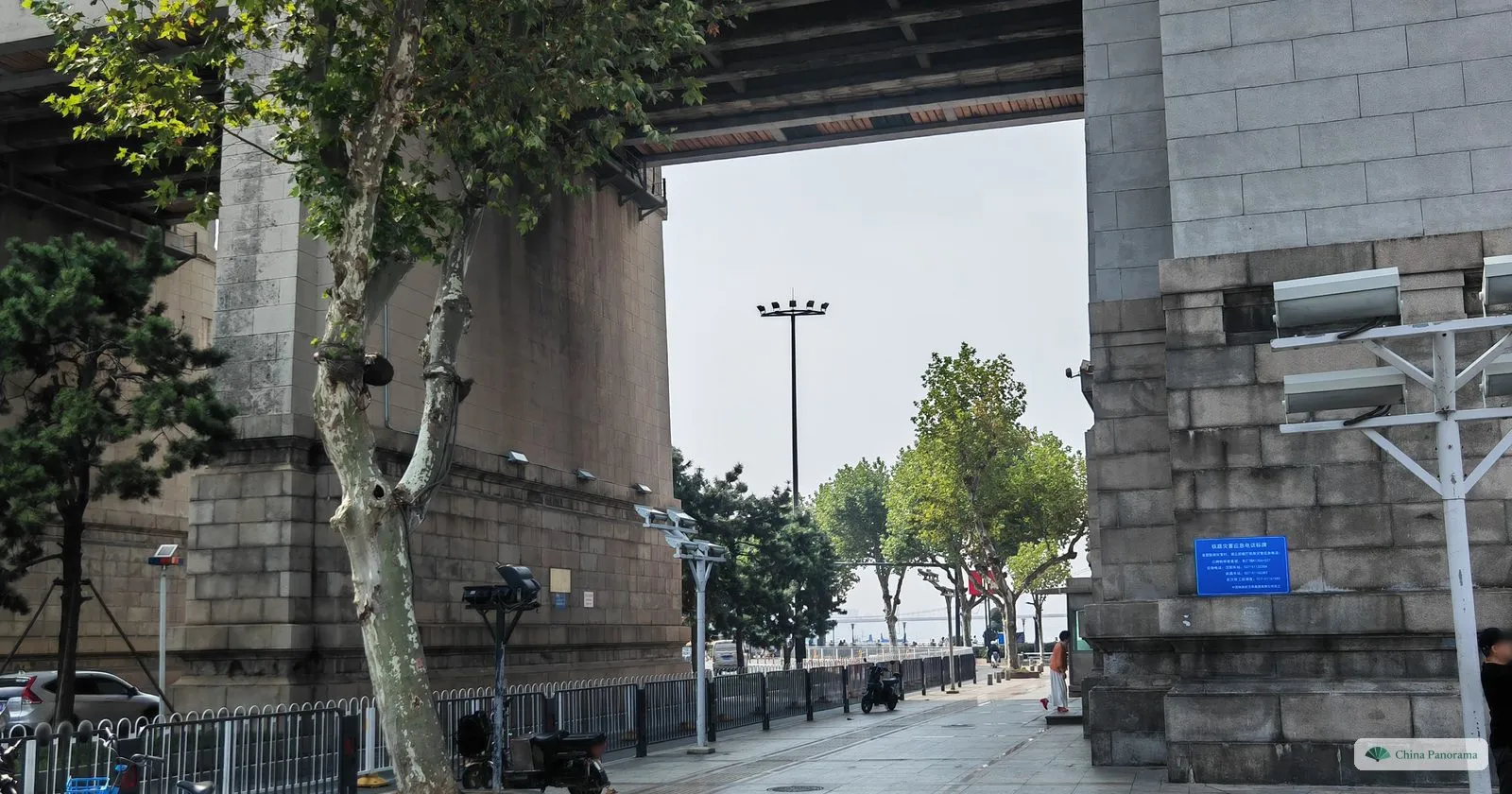
The first bridge ever built across the Yangtze, opened on 15 October 1957 after two years of work, with Soviet engineers led by Konstantin Silin advising. It joins Turtle Hill in Hanyang to Snake Hill in Wuchang: 1,670 m in all, the main bridge 1,156 m on eight piers and nine spans of up to 128 m. Cars run on the upper deck, trains on the lower; the road deck has a pavement 2.25 m wide on each side, so you can walk across. At each end stands a bridgehead tower 35 m high, topped by a pavilion with a Chinese roof. Until it opened, trains between Beijing and Guangzhou were ferried over the river; Mao Zedong's line “a bridge flies across, north to south, and the deep chasm becomes a thoroughfare” is about this bridge. We drove over it from Hanyang at 10:04 on 25 September 2026 and then walked the Wuchang bank beneath it.
The Wuchang end is about 800 m from Simenkou Huanghelou station (Line 5); the Hanyang end is below Turtle Hill, about 1.7 km from Qintai (Line 6). Walking across takes about 20 minutes (1.5 km). The bridge and its pavements are free; the riverbank promenade on the Wuchang side runs right under it.
- Entry
- Free
- Opening hours
- Open at all hours
- LandmarkWuchang · 武昌区Outdoors
Wuhan's emblem: a tower on Snake Hill above the Yangtze, first built in 223 under the kingdom of Wu as a watchtower, and the subject of Cui Hao's Tang poem that begins “The man of old has flown away on the yellow crane; all that is left here is the Yellow Crane Tower”. It was destroyed seven times and rebuilt or repaired ten times under the Ming and Qing; the last old tower burnt in 1884, and only its bronze finial survived. The city decided to rebuild it in October 1981, and the present tower opened in June 1985, about 1 km from the old site: five storeys, 51.4 m high plus a 5 m gourd-shaped finial, of reinforced concrete under yellow glazed tiles. You can see it from the Yangtze bridge as you drive into Wuchang.
Simenkou Huanghelou station (Line 5) is about 250 m from the tower's area. Entry is paid; we have not checked the current price, the hours or the booking rules. Hubu Alley is a ten-minute walk away.
- Entry
- Price not verified — check on site
- Opening hours
- Hours not verified — check on site
Hubu Alley
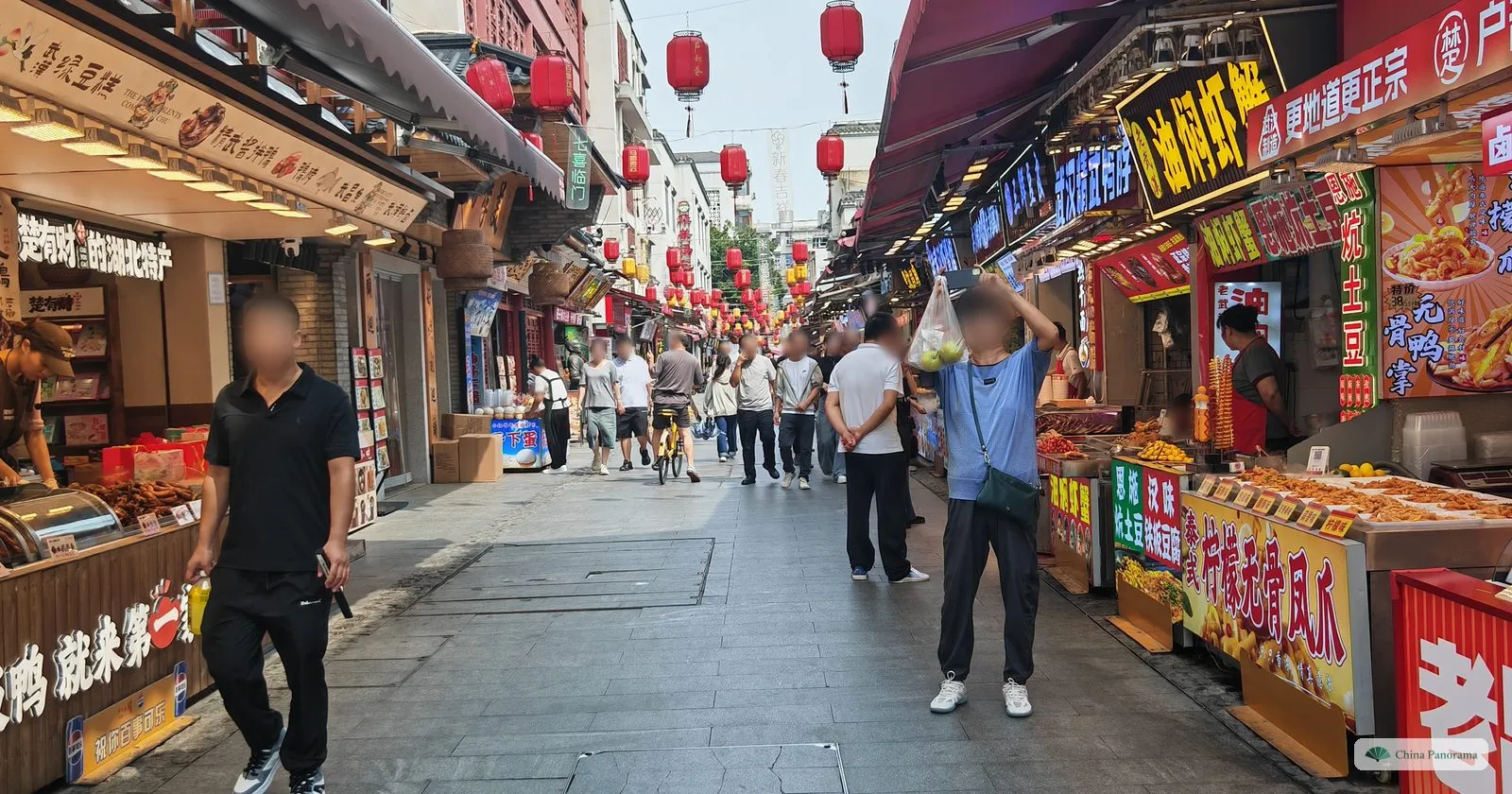
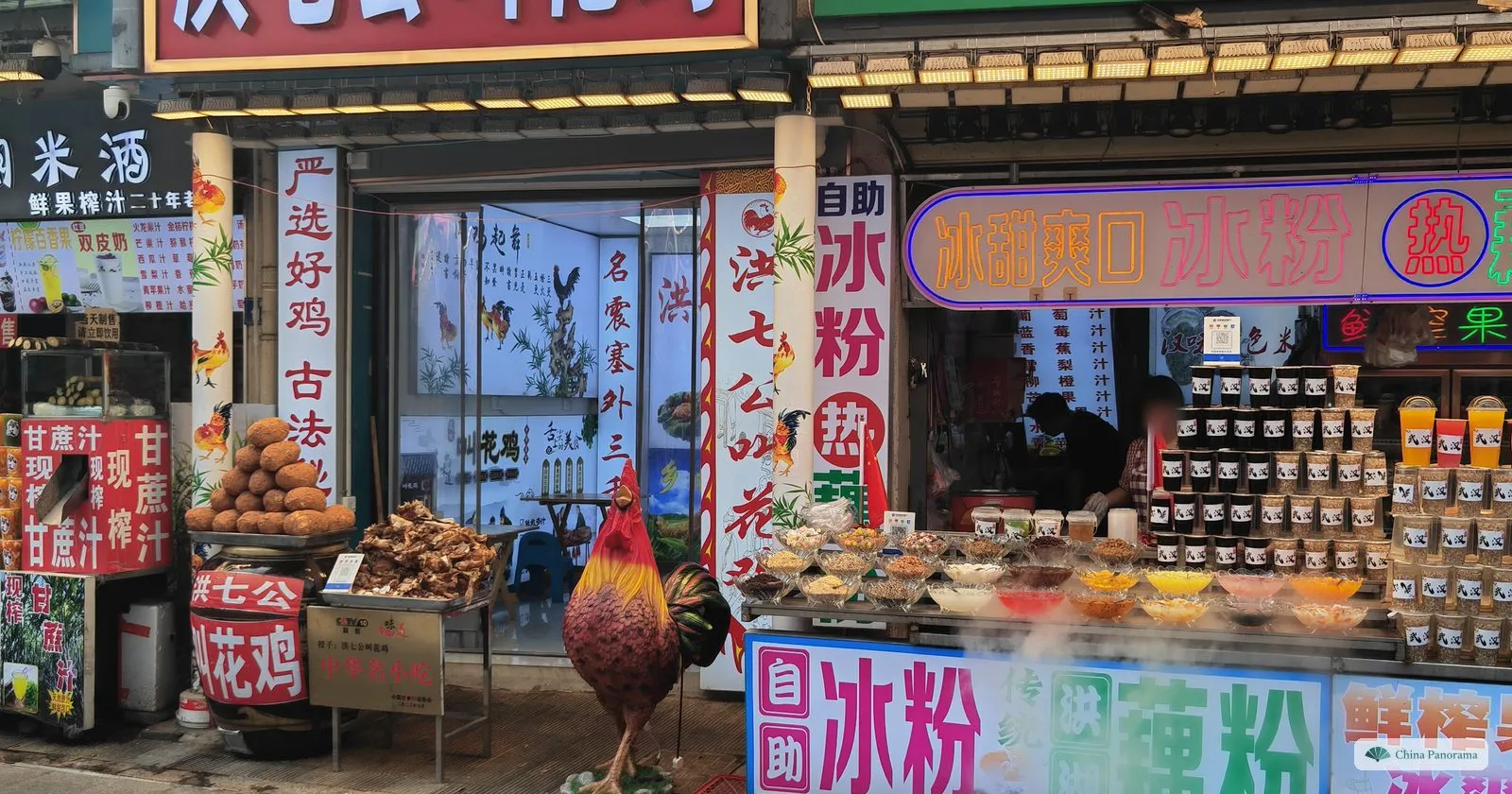
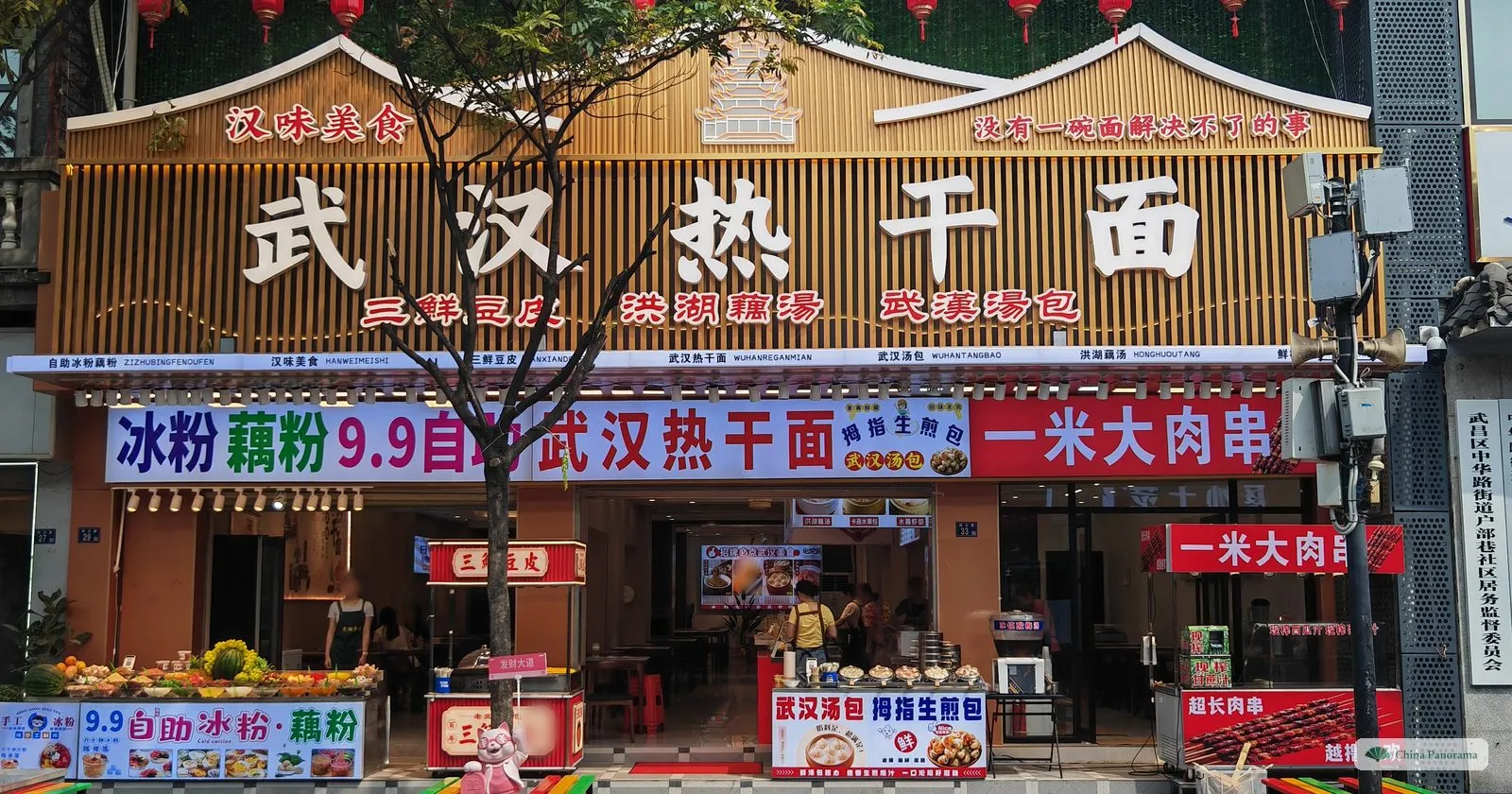
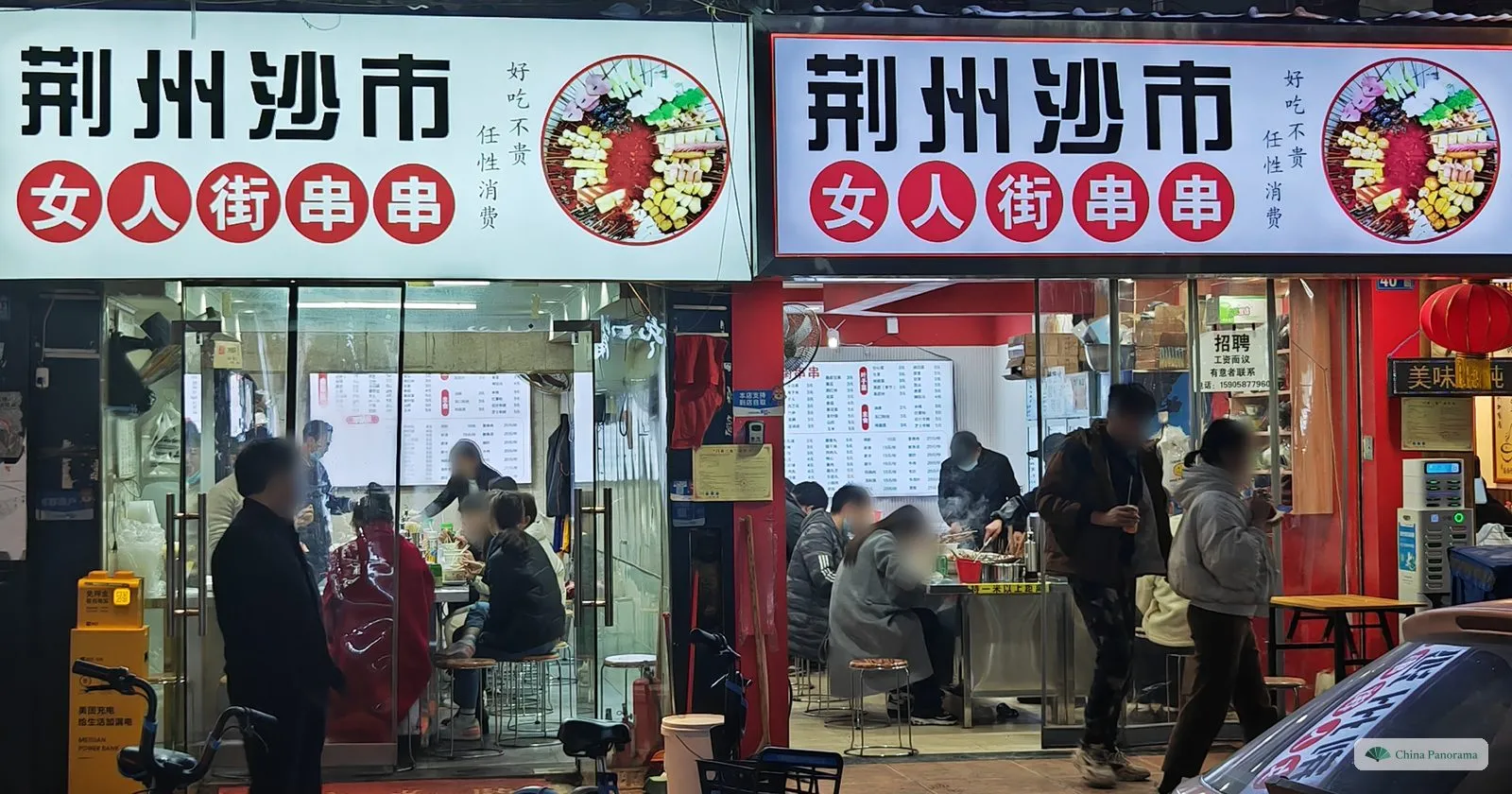
户部巷FoodWuchang · 武昌区OutdoorsWuhan's best-known breakfast street: a pedestrian lane of about 150 m in Wuchang, between Minzhu Road and Ziyou Road, named after the provincial treasury (hubu) that stood just west of it under the Ming and Qing. Close to the river wharves, it became a place for snack sellers; locals say “breakfast at Hubu Alley, supper at Jiqing Street”. The lane was restored in a Ming–Qing style from 2002 and widened from 3 to 8 m in 2006, so the buildings are new. Stalls sell hot dry noodles (reganmian), doupi (sticky rice and egg skin fried in a pan), mianwo (a ring-shaped rice and soy fritter), soup dumplings, stinky tofu and ice jelly. We came through at 11:14 on 25 September 2026, in the heat, with umbrellas up against the sun.
Simenkou Huanghelou station (Line 5) is about 400 m away; the Yellow Crane Tower and the Yangtze bridge are each a ten-minute walk. The lane is free and open at all hours; the stalls are busiest in the morning and at weekends.
- Entry
- Free
- Opening hours
- Open at all hours
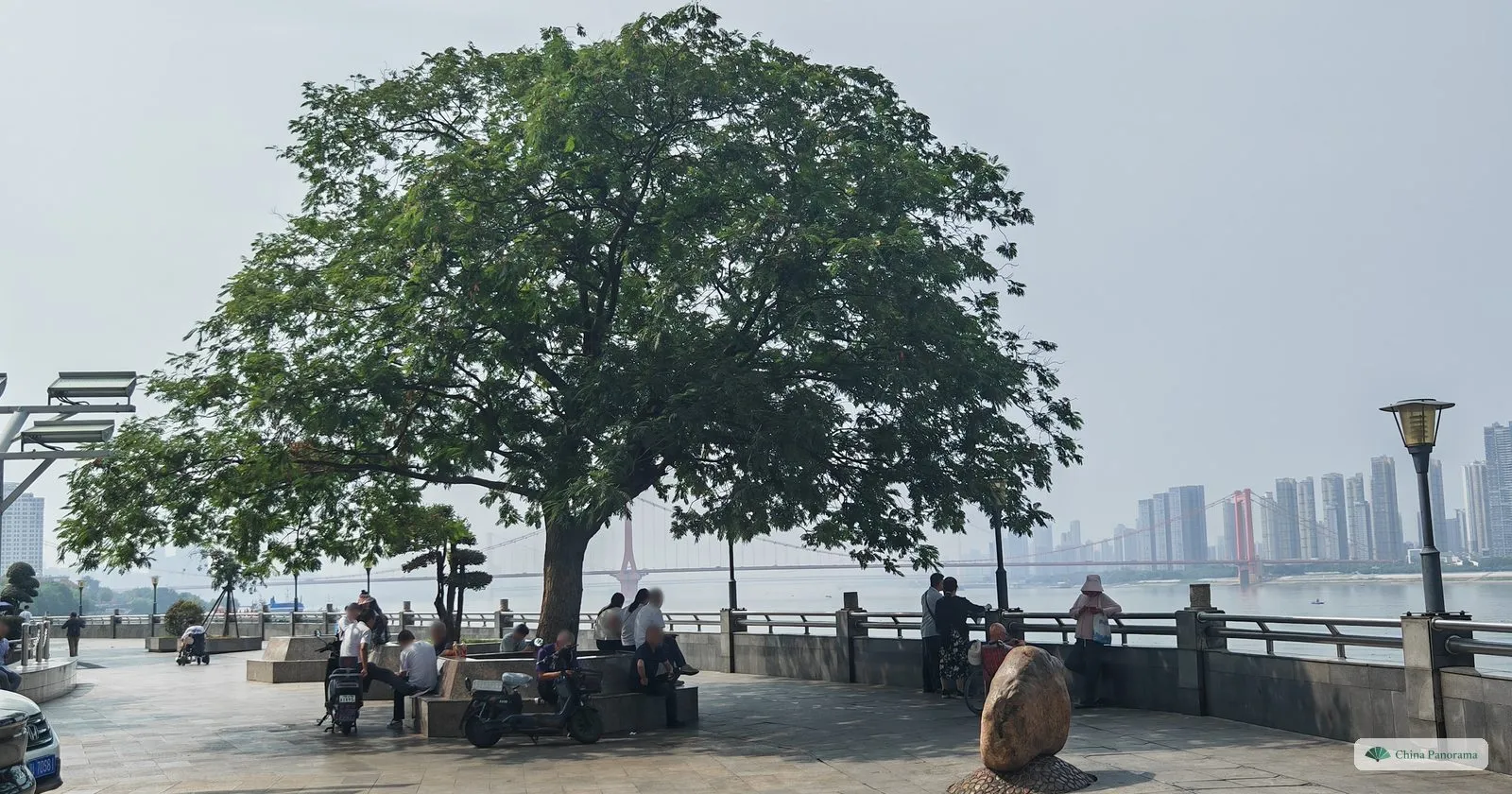
Wuchang riverside and Hanyangmen pier
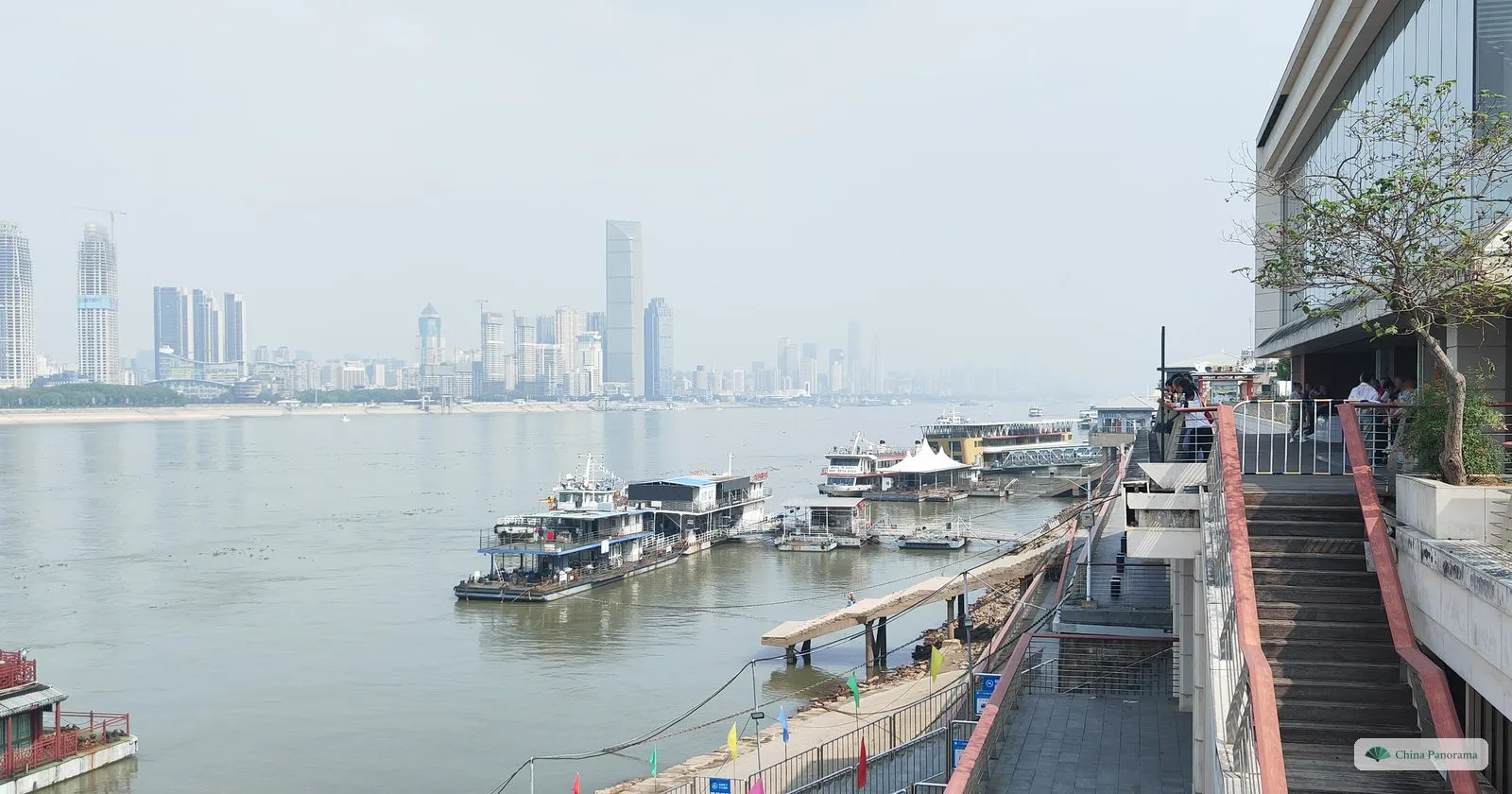
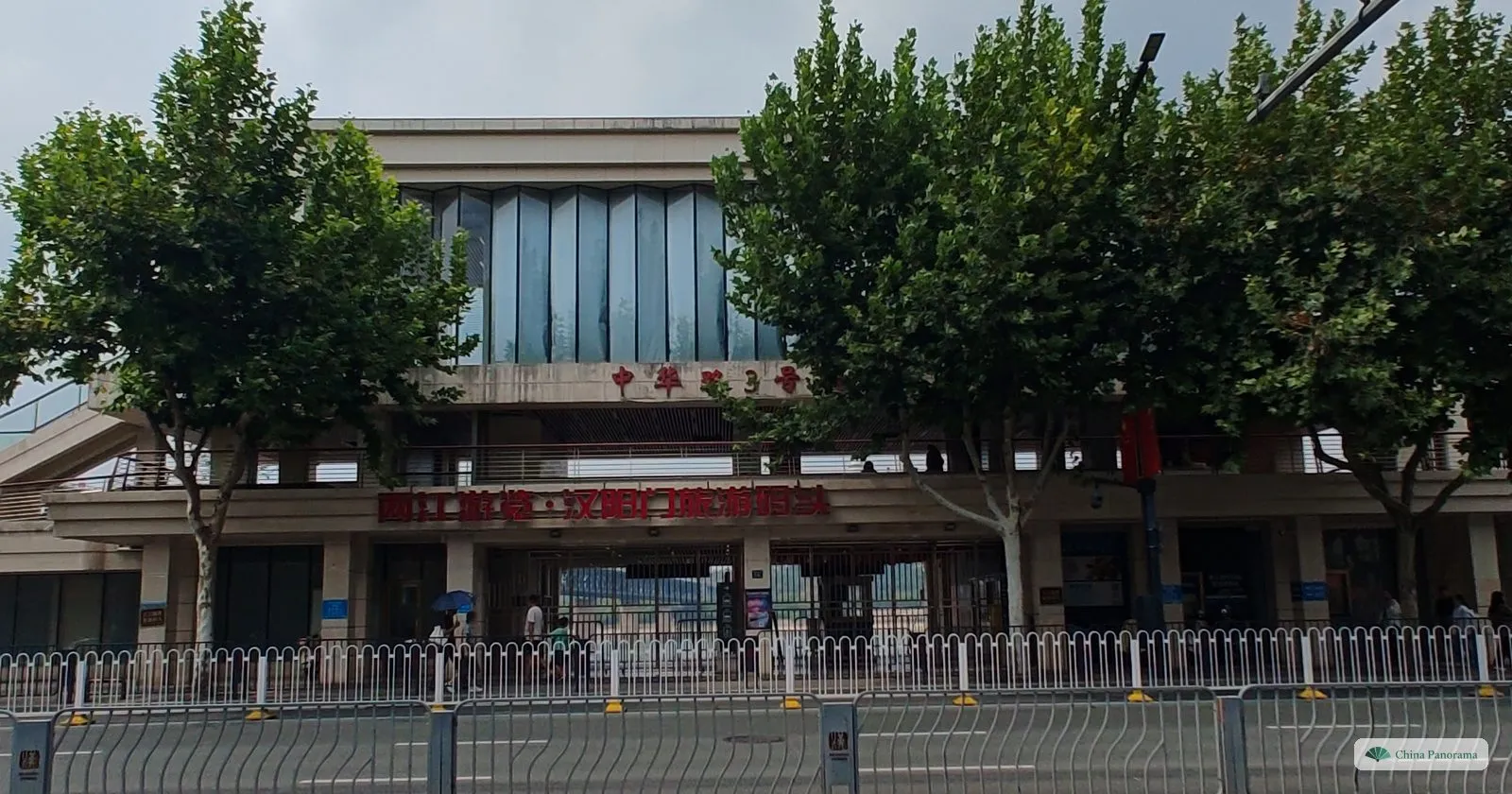
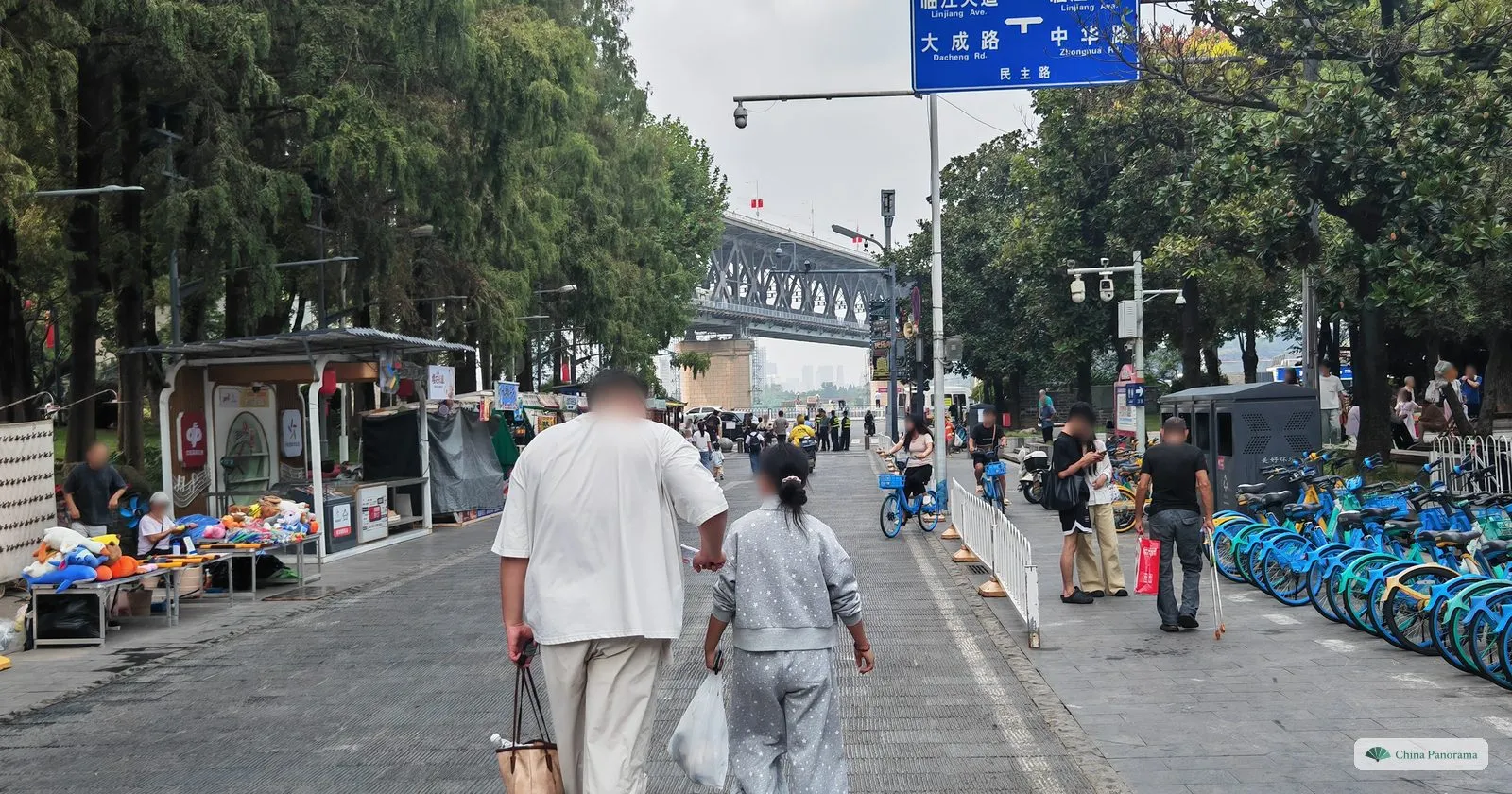
武昌江滩 · 汉阳门码头ParkWuchang · 武昌区OutdoorsA promenade along the Wuchang bank of the Yangtze, from the ferry piers at Hanyangmen and Zhonghua Road south to the foot of the Yangtze bridge. You look straight across the river to the towers of Hankou, and from under the bridge you see its piers march over to Turtle Hill and its TV tower in Hanyang. Old men play cards under the trees; river cruises and the cross-river ferries leave from the floating piers. We walked it from 10:34 to 10:51 on 25 September 2026, on a hazy, warm morning.
Simenkou Huanghelou station (Line 5) is about 800 m inland. The promenade is free and open at all hours. The ferry from Zhonghua Road No. 3 pier to Wuhanguan in Hankou has been reported at 1.5 CNY a crossing; we have not checked fares or timetables.
- Entry
- Free
- Opening hours
- Open at all hours
Red Building: Wuchang Uprising Memorial
辛亥革命武昌起义纪念馆 · 红楼Republic-era heritageWuchang · 武昌区IndoorsThe red-brick building at the southern foot of Snake Hill where the Qing dynasty began to fall. Built in 1909–1910 for the Hubei provincial assembly, it was taken by the revolutionaries after the Wuchang Uprising of 10 October 1911: on 11 October they proclaimed the Hubei Military Government here, with Li Yuanhong as military governor. Within weeks most provinces had broken with Beijing, and on 1 January 1912 the Republic of China was founded. The museum opened in 1981, for the 70th anniversary; 10 October is still celebrated as Double Tenth.
Pengliuyang station (Line 5) is about 500 m away, at Yuemachang square; the Yellow Crane Tower is just up the hill. We have not checked whether entry is free, the hours or the booking rules.
- Entry
- Price not verified — check on site
- Opening hours
- Hours not verified — check on site
Jianghan Road
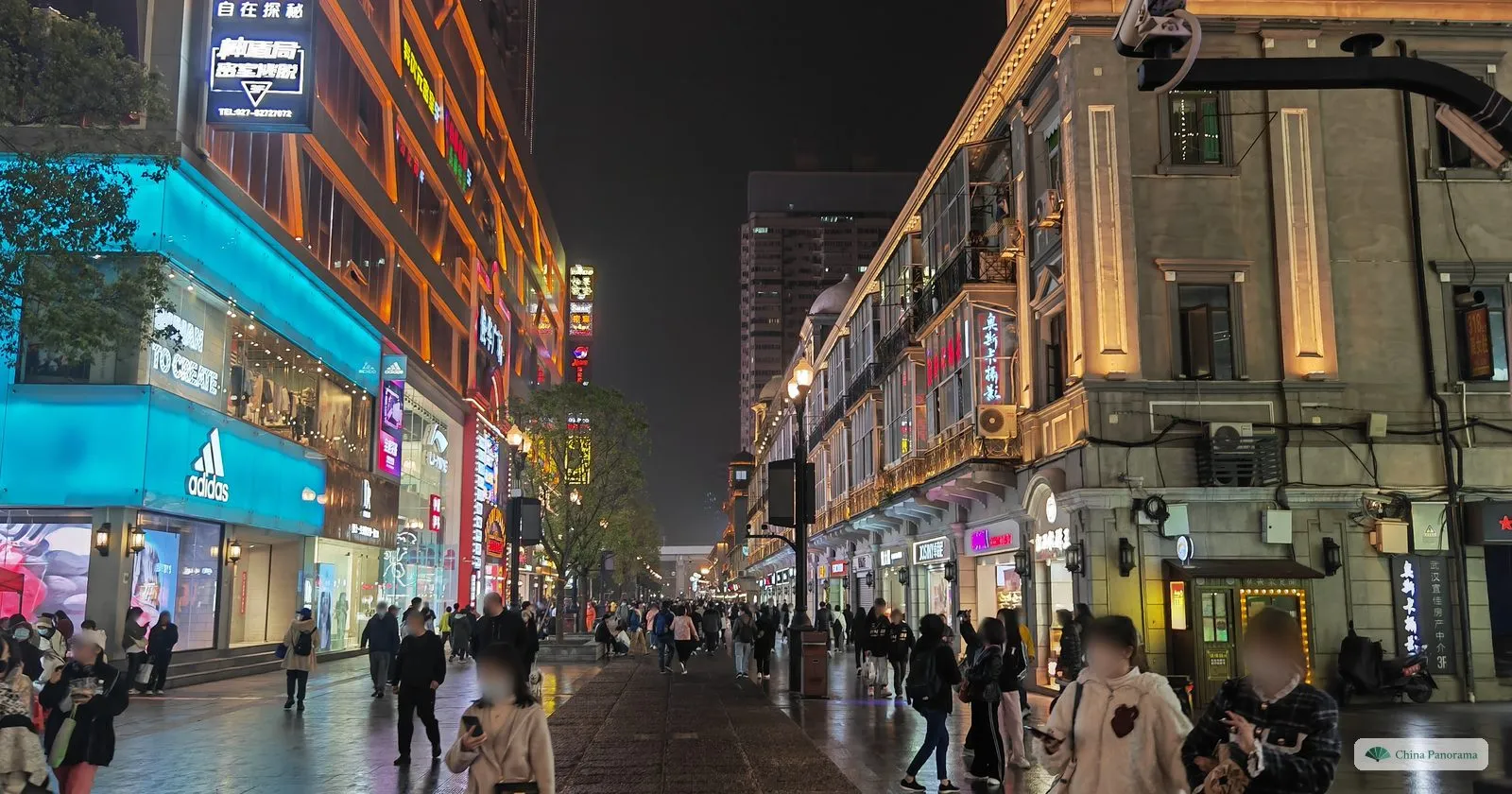
江汉路步行街Treaty-port heritageJianghan · 江汉区OutdoorsHankou's main shopping street, pedestrian since 22 September 2000 for 1,210 m from the riverfront to beyond Zhongshan Avenue. It began as a dirt lane; after Hankou opened as a treaty port in 1861 it ran along the edge of the British concession, and from 1901 it was the commercial seam between the Chinese town and the concessions. It took its present name in 1927, when the British concession was handed back, from the Jianghan Customs House at its river end. Banks, hotels and department stores of the 1910s–1930s line it, with towers on the corners; at the Zhongshan Avenue crossing the Xuangong Hotel, built in 1928 as a department store and a hotel by 1931, still carries its name in red neon. We came at dusk on Tuesday 21 March 2023, from 18:13 to 19:02, in a crowd.
Jianghan Road station (Lines 2 and 6) is at the Zhongshan Avenue crossing; Xunlimen (Lines 1 and 2) is at the north end. The street is free and open at all hours; the lights come on at dusk.
- Entry
- Free
- Opening hours
- Open at all hours
Jianghan Customs House
江汉关大楼 · 江汉关博物馆Treaty-port heritageJianghan · 江汉区IndoorsThe clock tower of the Hankou Bund, at the river end of Jianghan Road. Designed by Simpson of the British firm Sassoon & Co. and finished on 21 January 1924, it was the tallest building in Wuhan: a four-storey Renaissance block 45.85 m high with Corinthian columns and a five-storey clock tower. It served the Chinese Maritime Customs Service, then run by a British-led inspectorate. Since 2015 it has housed the Jianghan Customs House Museum, on the history of Hankou as a port.
On Yanjiang Avenue, about 600 m from Jianghan Road station (Lines 2 and 6). We have not checked the museum's entry rules, hours or closing day.
- Entry
- Price not verified — check on site
- Opening hours
- Hours not verified — check on site
- MuseumJiang'an · 江岸区Indoors
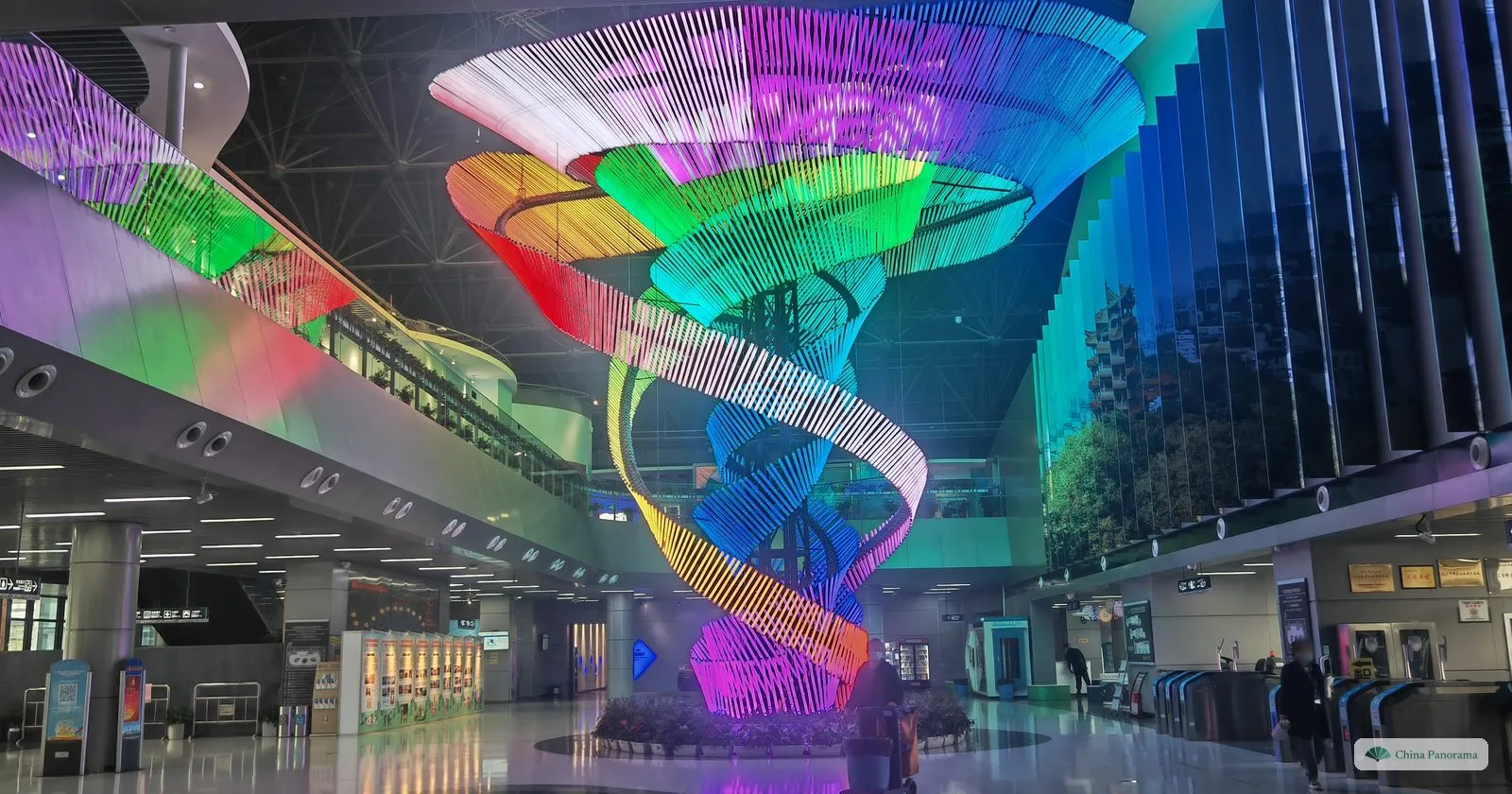
A science museum in the former Wuhan Port passenger terminal on Yanjiang Avenue, where the Yangtze passenger boats used to leave; the curved silver roof is the old terminal's. About 30,000 m² over three floors: halls on the universe, life and water, on light, information and transport, a maths hall and a children's hall, and ships outside. In the entrance hall a helix of coloured light tubes rises through the floors. From the terrace you look across the Yangtze to Wuchang. We spent 22 March 2023 here from 08:54 to 09:46, in the rain, with the far bank lost in fog.
On Yanjiang Avenue, about 700 m from Jianghan Road station (Lines 2 and 6). A 2022 report gives free entry with a timed booking, open Wednesday to Sunday 09:00–16:30 and closed on Mondays and Tuesdays; we have not checked this against the museum.
- Entry
- Price not verified — check on site
- Opening hours
- Hours not verified — check on site
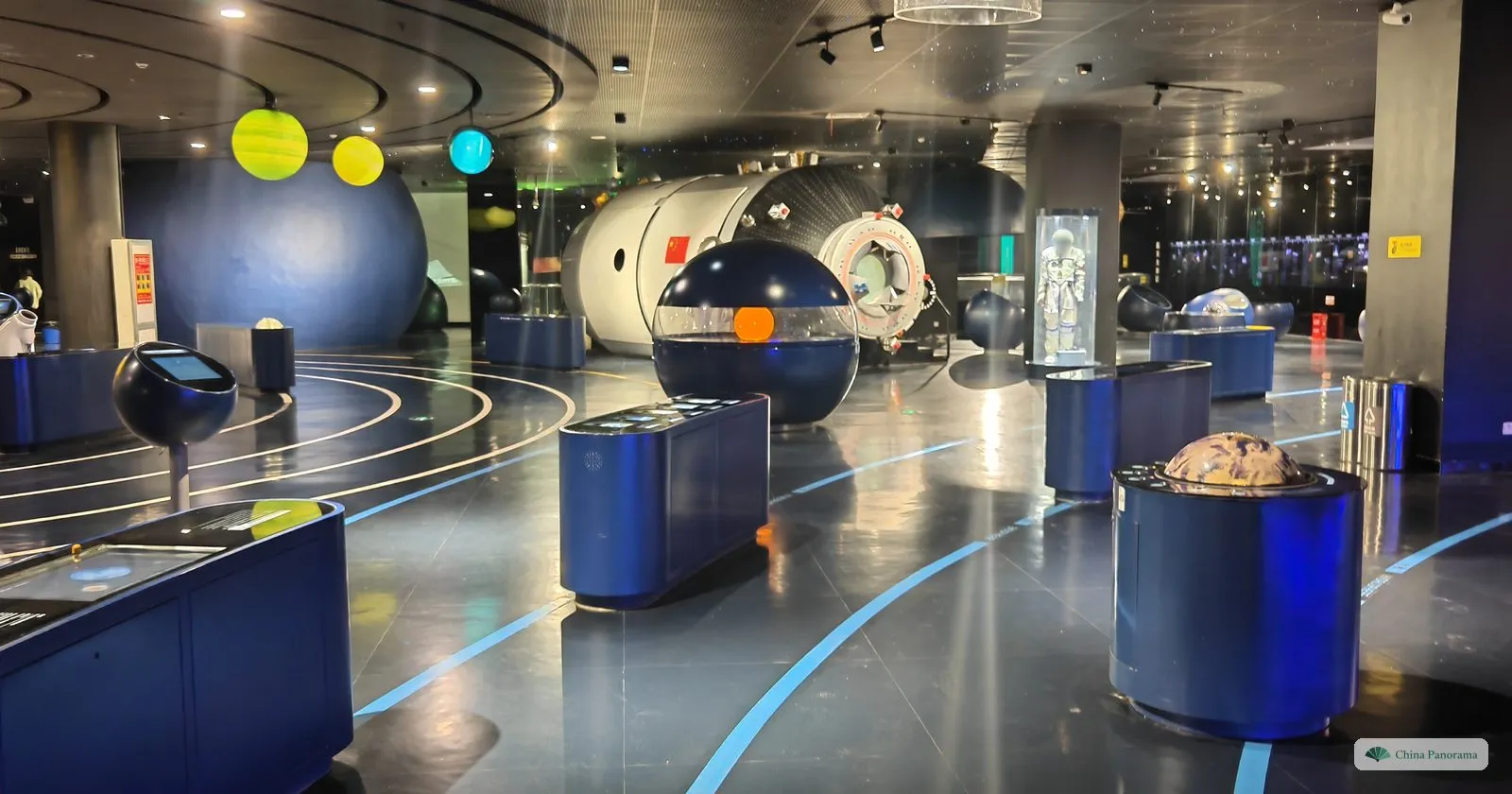
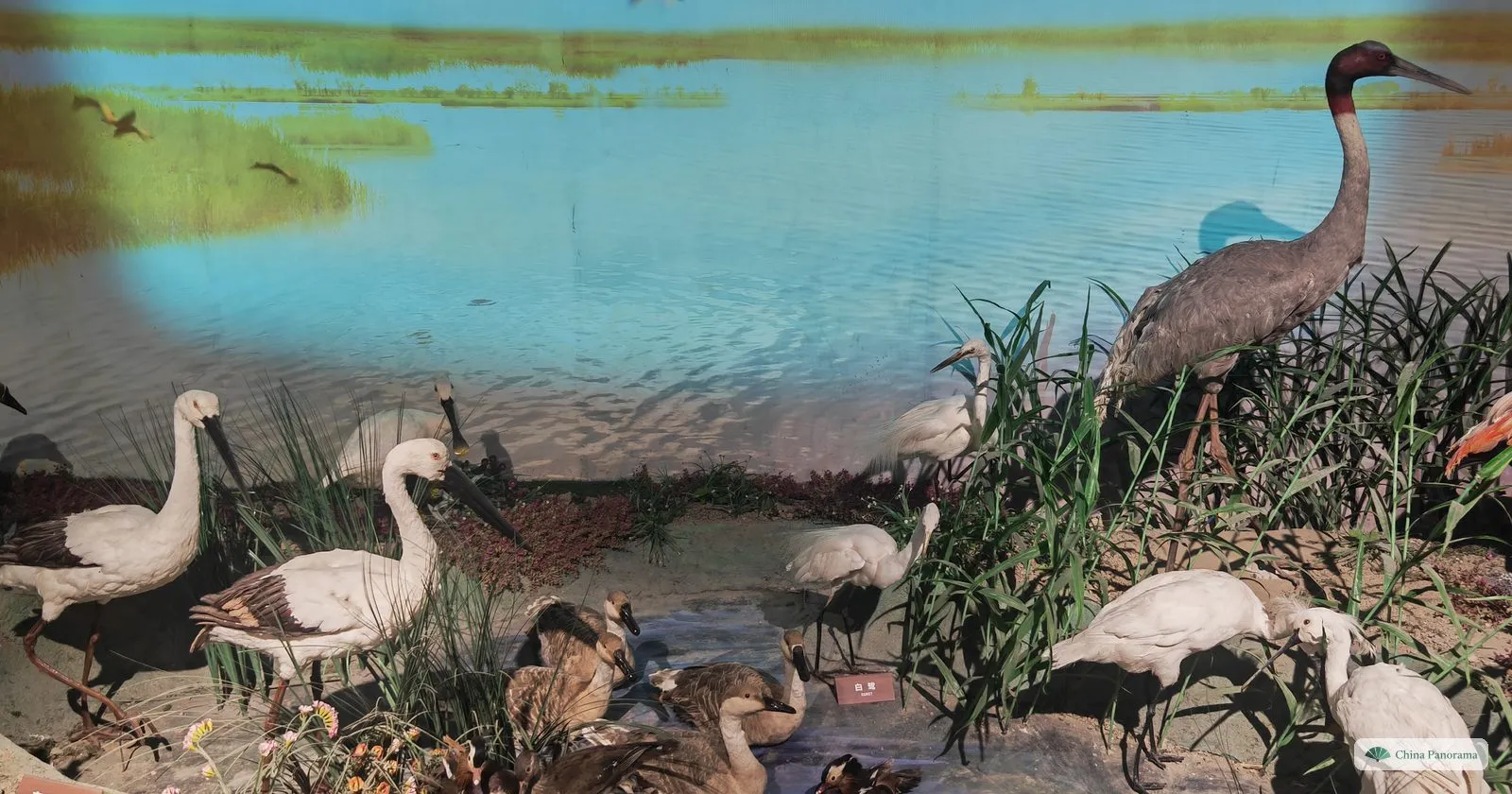
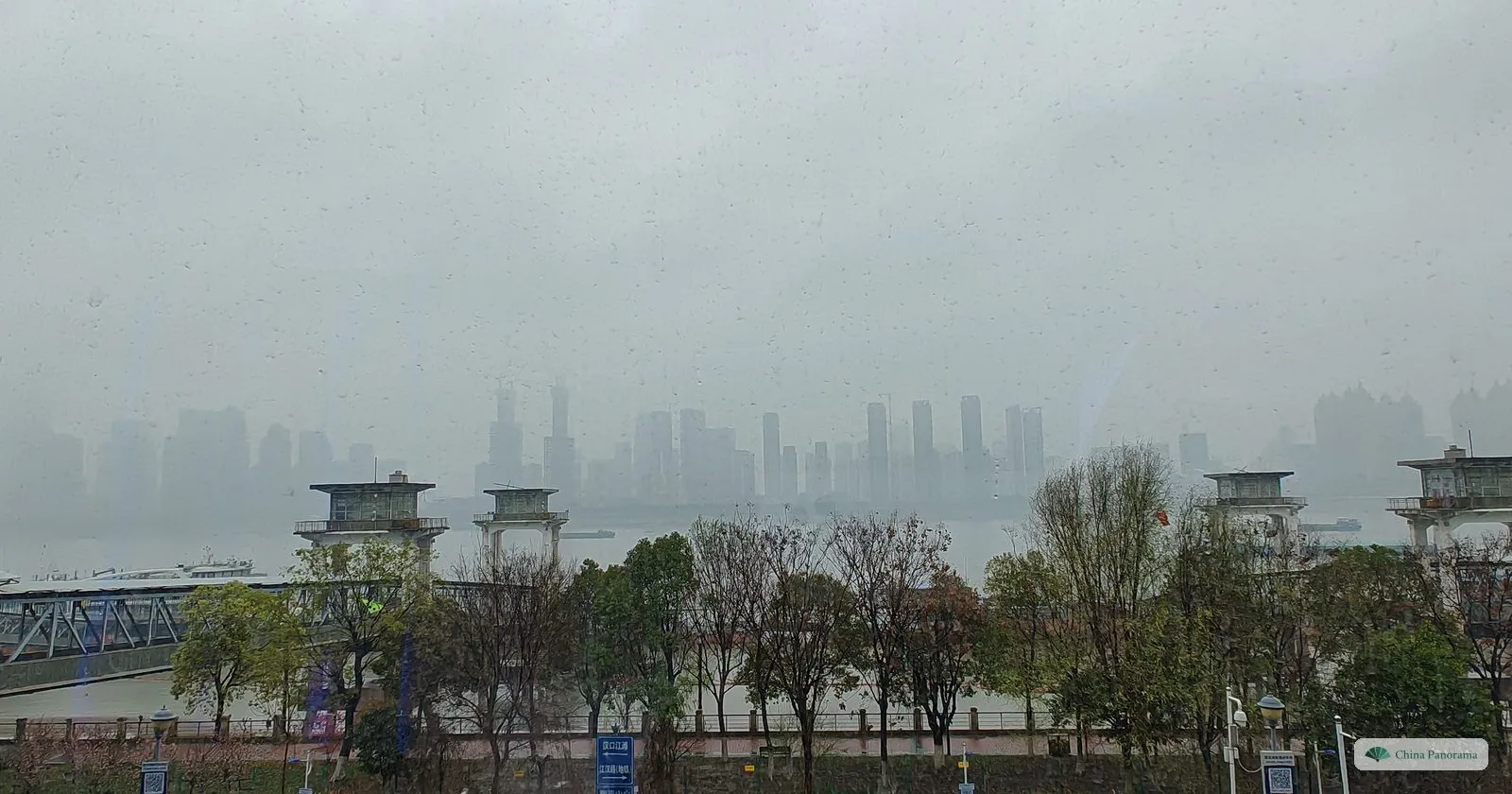
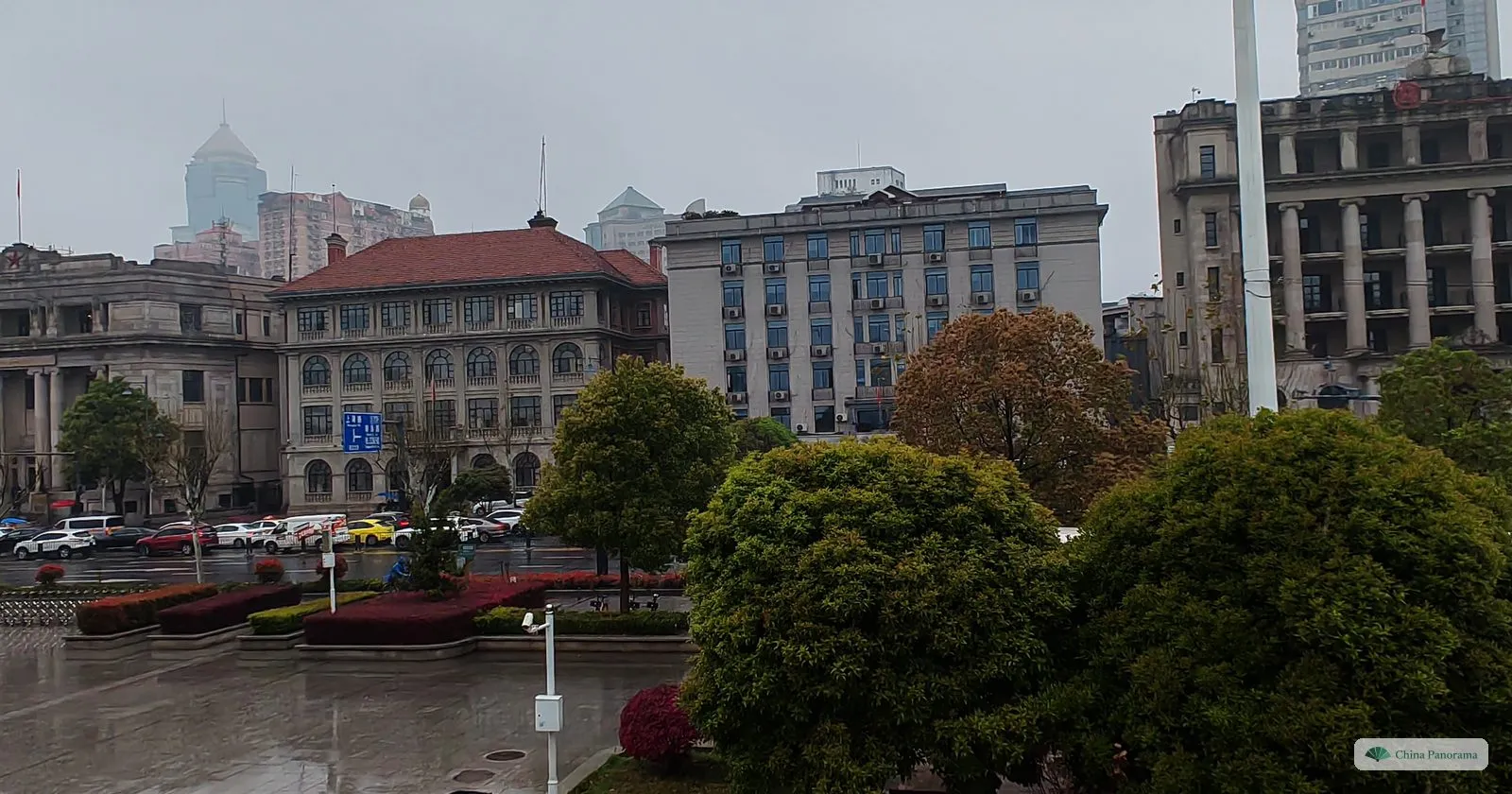
- FoodJiang'an · 江岸区Outdoors
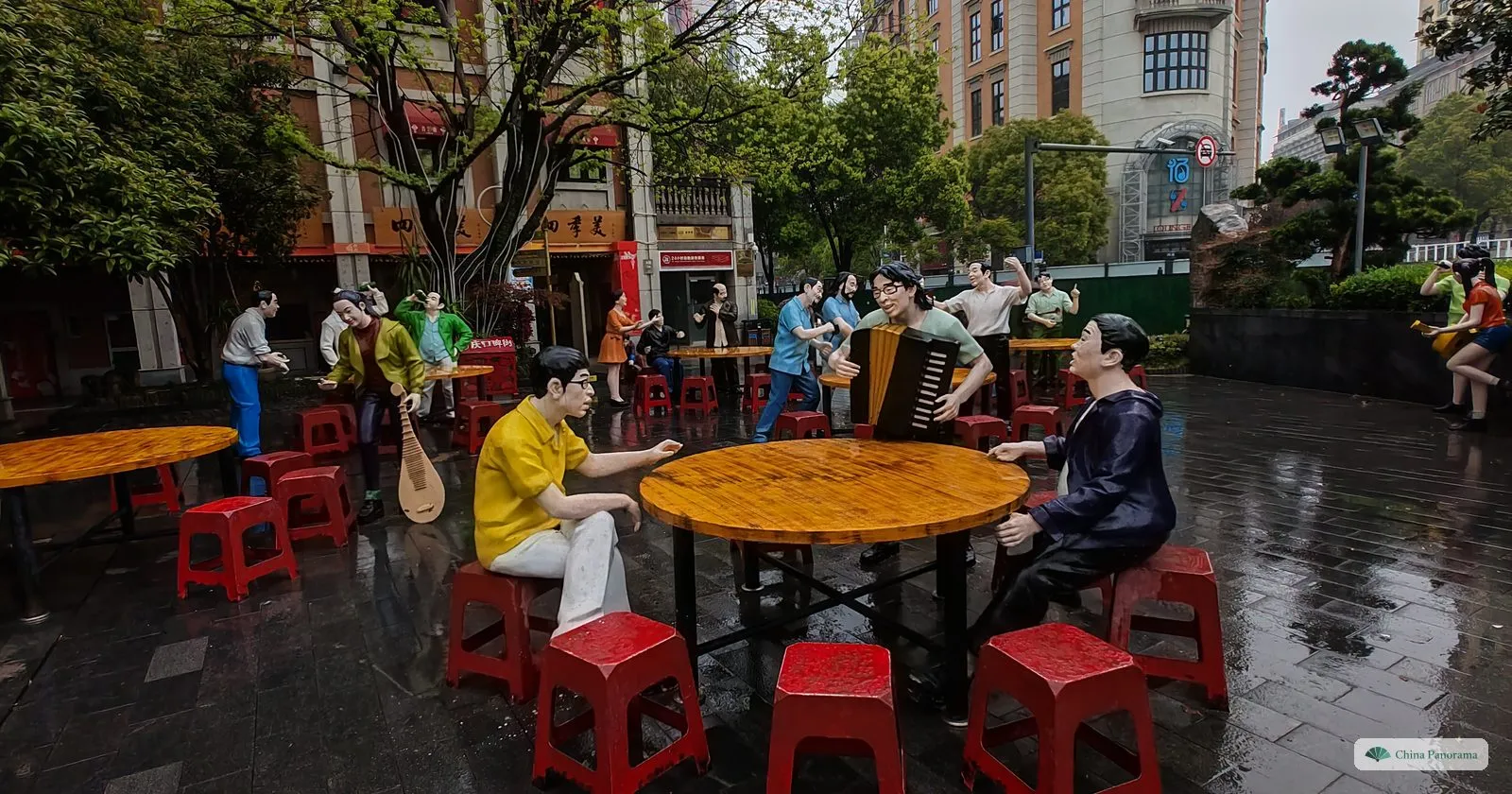
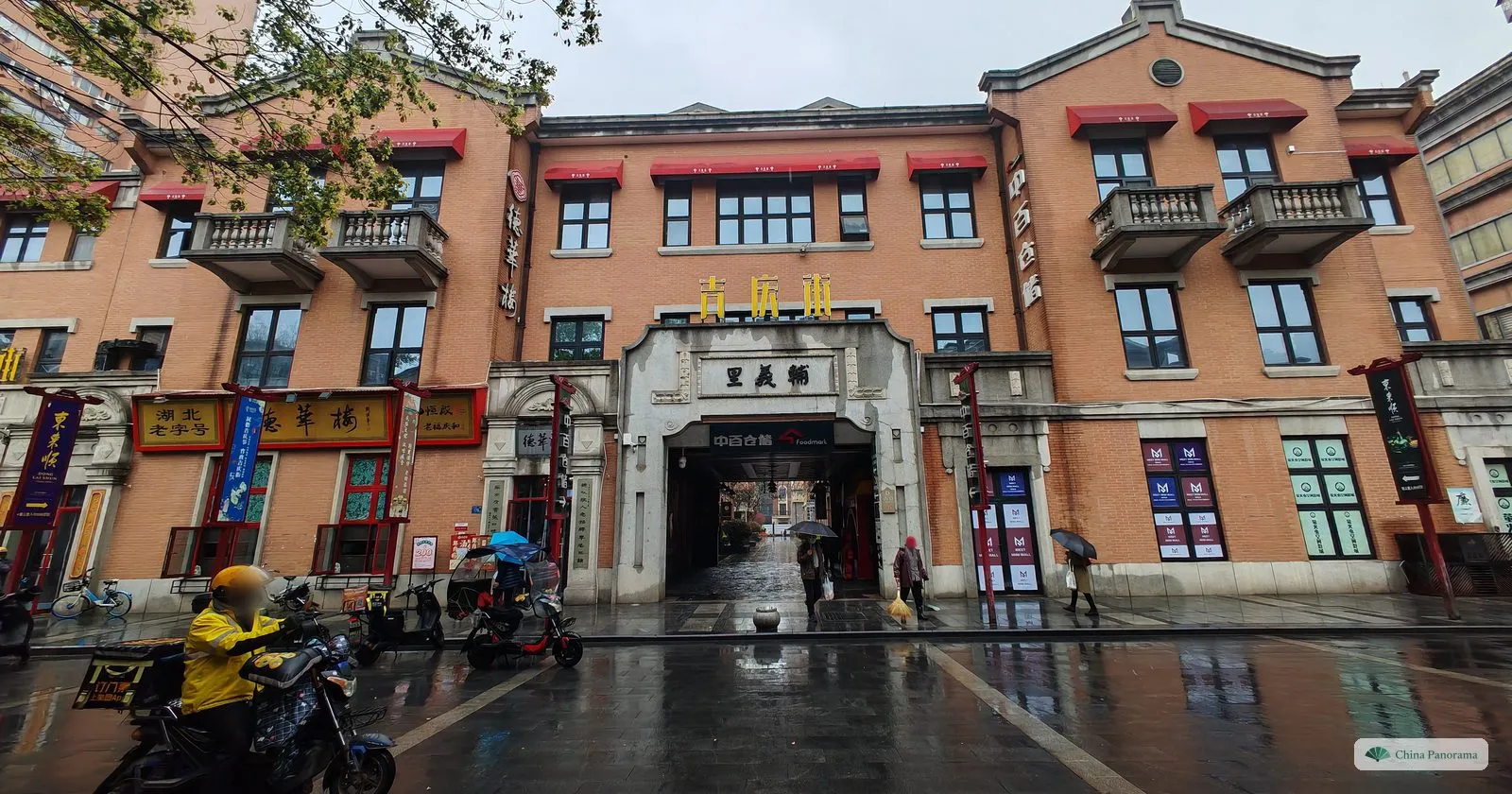
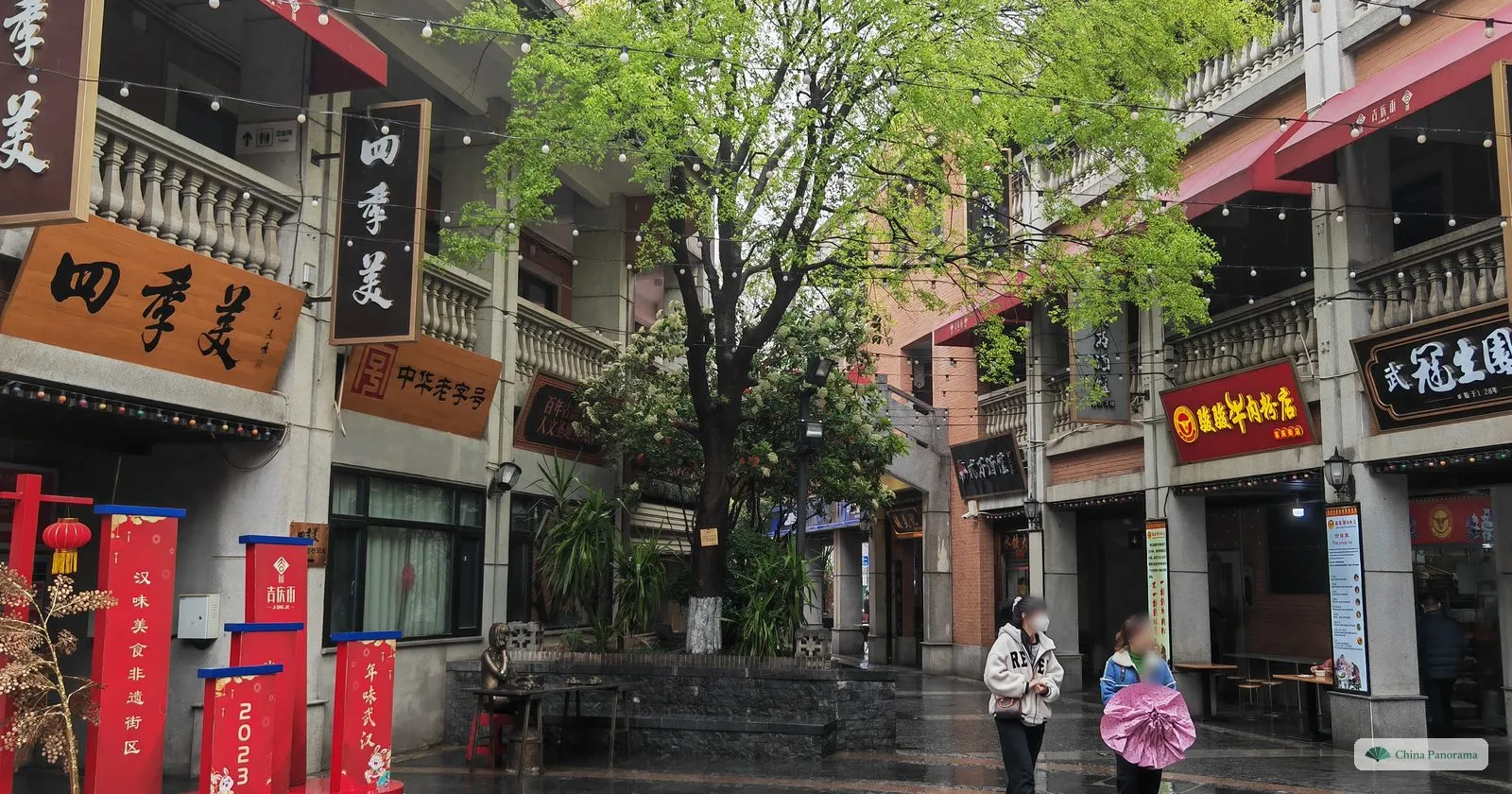
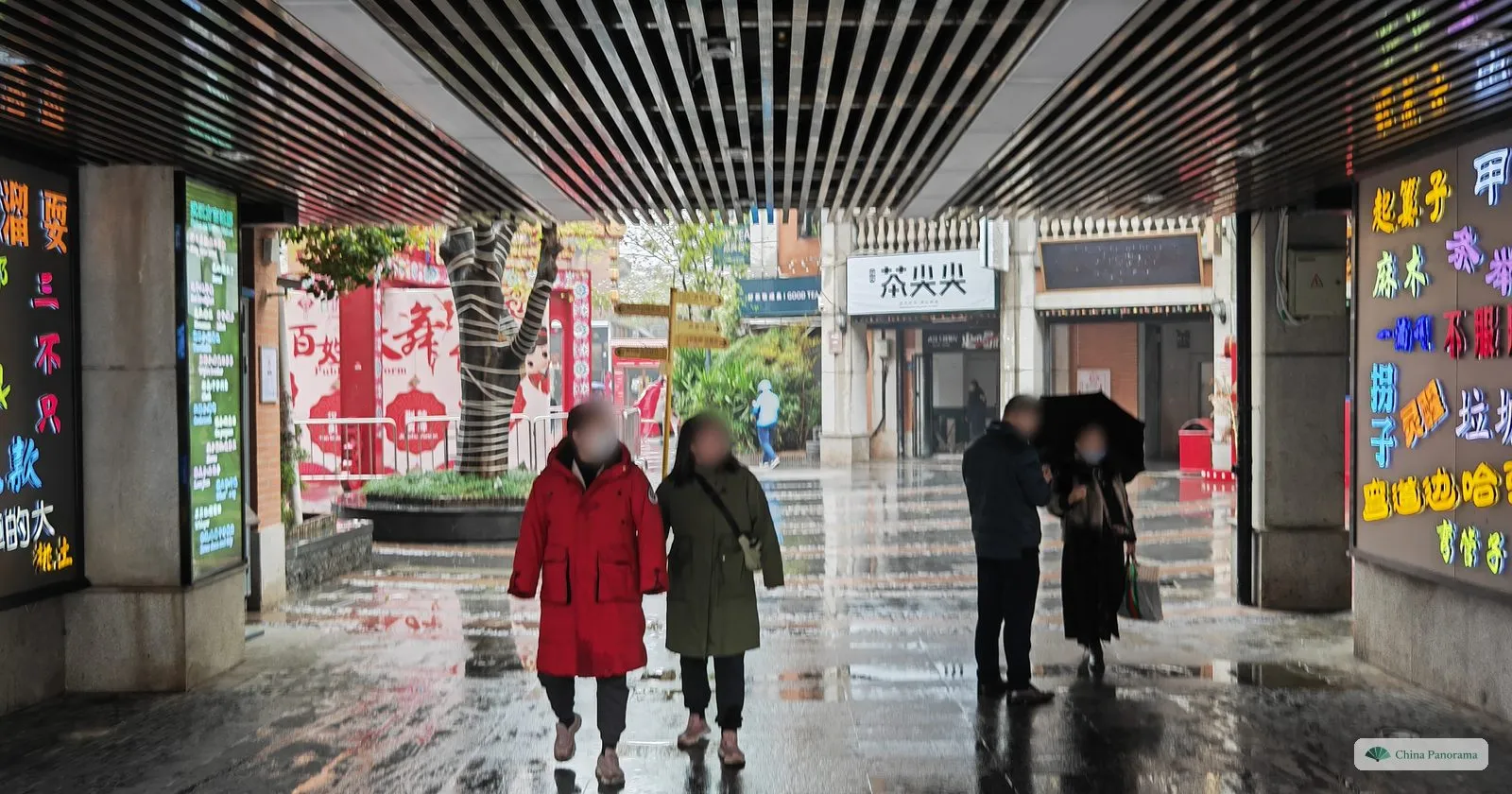
Hankou's old supper street, named in 1930, where restaurants put tables out on the pavement every evening and street musicians went from table to table. Chi Li's novella Life Show, filmed by Huo Jianqi, made it famous across China. When the Yangtze tunnel was built the street was cut off, and the city rebuilt it a short way off on Dazhi Road: the new “Jiqing folk street”, of red brick and red tiles in a Hankou style, opened on 22 December 2011. Bronze-coloured figures of musicians and diners sit at a table in the square; old Wuhan brands such as Sijimei, known for soup dumplings, have shops here. We came in the rain on the morning of 22 March 2023, 10:18 to 10:28 — at its best in the evening.
Xunlimen station (Lines 1 and 2) is about 450 m away; Jianghan Road is a ten-minute walk. The street is free and open at all hours; restaurants keep their own times.
- Entry
- Free
- Opening hours
- Open at all hours
- MarketQiaokou · 硚口区Outdoors
The street Hankou grew from. In the Ming the Han River changed course, a trading town formed on its new north bank, and its wharves joined up into one long street: by the Qing it was one of the town's two main streets, and from 1923 it has been called Hanzheng Street. About 3.2 km long and only 5–7 m wide, it is known as China's “first street under heaven” and in modern times became the great small-goods market of central China — clothes, household goods, porcelain, small appliances — though since 2010–2011 the city has planned to move the wholesale trade out to Hankou North. A stone archway with its name in gold marks the eastern end. We passed at 16:59 on 21 March 2023.
Hanzheng Street and Wusheng Road stations (both Line 6) are on it. The street is free; the shops keep their own hours.
- Entry
- Free
- Opening hours
- Hours not verified — check on site
Longwangmiao: where the Han meets the Yangtze
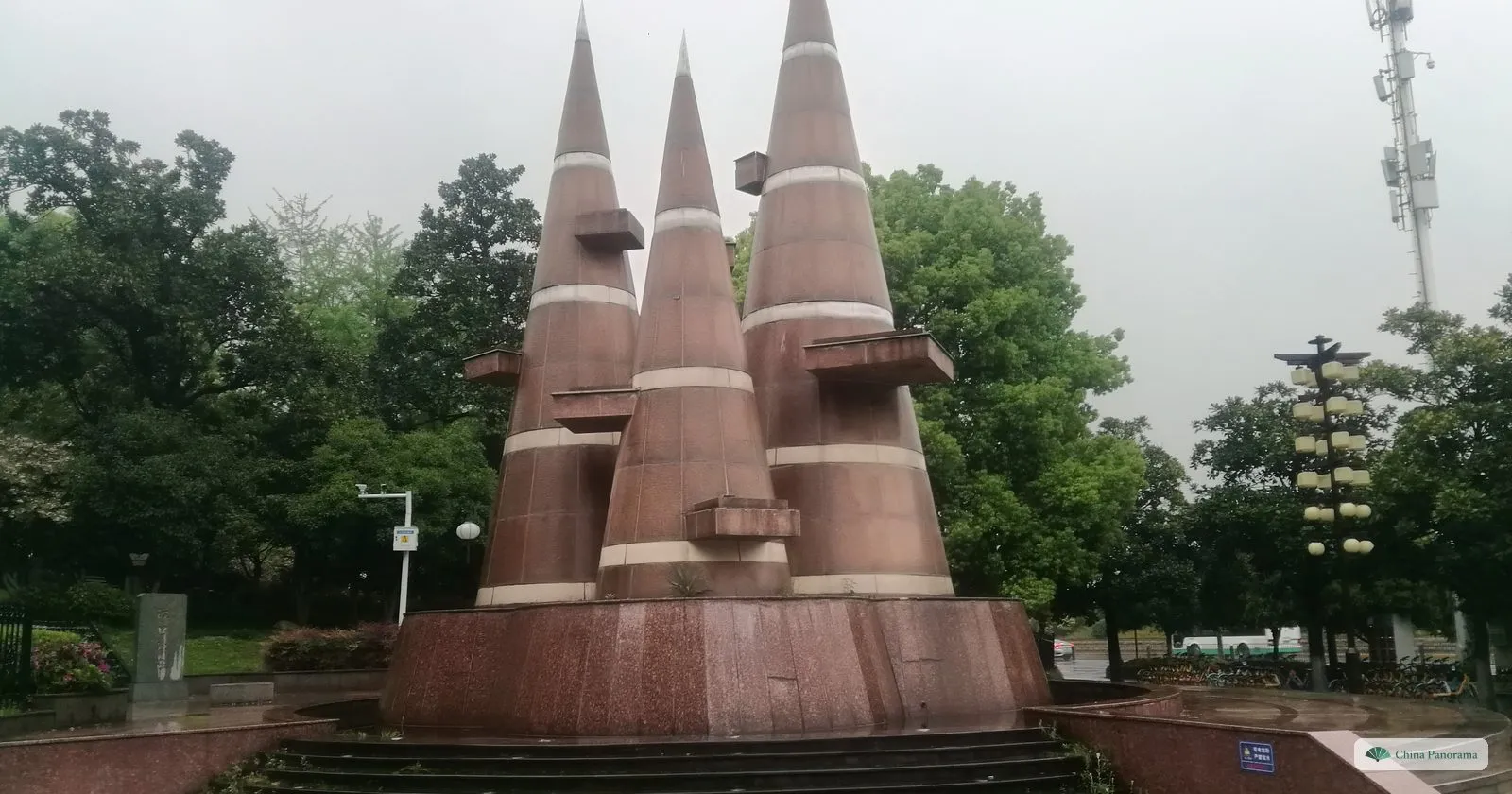
龙王庙 · 汉江与长江交汇处ParkJianghan · 江汉区OutdoorsThe point of Hankou where the Han River flows into the Yangtze, and the place to understand Wuhan's shape: the Yangtze divides Wuchang from the other two towns, the Han divides Hankou from Hanyang. Named after a Dragon King temple that stood here, it was a notorious danger point in the floods; today it is a small riverside park with a flood-control embankment and a monument of three granite cones. Across the Han lies Nan'anzui, the green tip of Hanyang, with the red arch of the Qingchuan Bridge over the Han beside it. We were here at 16:27 on a rainy 30 March 2021, with the far banks in mist.
Liuduqiao station (Line 6) is about 1.1 km away. The riverside park is free and open at all hours.
- Entry
- Free
- Opening hours
- Open at all hours
- TempleHanyang · 汉阳区Outdoors
A Buddhist temple in Hanyang, founded in 1658 by two monks from Zhejiang on the site of a Ming official's garden. It is best known for its Hall of the 500 Arhats, first built in the Daoguang era, destroyed in 1852 and rebuilt between 1895 and 1902; visitors walk the rows of seated figures, and a popular custom is to count arhats from any one of them up to your age and see what the figure you stop at says about the year ahead.
Zhongjiacun station (Lines 4 and 6) is about 750 m away. We have not checked the ticket price or hours. It is a working temple: dress modestly and do not photograph people praying.
- Entry
- Price not verified — check on site
- Opening hours
- Hours not verified — check on site
Hubei Provincial Museum
湖北省博物馆MuseumWuchang · 武昌区IndoorsOne of China's great museums, on the shore of East Lake: about 240,000 objects. Its star is the set of 65 bronze chime bells from the tomb of Marquis Yi of Zeng, excavated at Suizhou in 1978 — 2,400 years old and still in tune, each bell sounding two notes. Beside them, the sword of King Goujian of Yue, excavated in 1965 and still sharp, the Yunxian Man skull and a Yuan blue-and-white vase. The main building opened in 2007, the south wing in December 2021.
Shengbo Hubei Ribao station (Line 8), about 350 m, at 160 Donghu Road. Entry has been reported free with a booking; we have not checked the booking rules, the hours, the closing day or the times of the chime-bell concerts.
- Entry
- Price not verified — check on site
- Opening hours
- Hours not verified — check on site
- NatureWuchang / Hongshan · 武昌区 · 洪山区Outdoors
A lake of about 33 km² on the east side of Wuchang, six times the size of Hangzhou's West Lake and long China's largest lake inside a city. Its shores are divided into six scenic areas, among them Tingtao by the provincial museum and the wooded Moshan hill. The East Lake Greenway, opened on 28 December 2016 with a first section of 28.7 km, runs on causeways across the water; you can hire bikes along it. In March the lake's cherry and plum gardens and the campus of Wuhan University nearby are in flower.
Shengbo Hubei Ribao station (Line 8) is about 900 m from the Tingtao area. The lakeside paths and the greenway are free; some areas inside the scenic zone charge entry — we have not checked which, or the prices.
- Entry
- Price not verified — check on site
- Opening hours
- Hours not verified — check on site
- ArchitectureWuchang · 武昌区Outdoors
A campus on Luojia Hill, west of East Lake, with green-tiled buildings of the 1930s, and China's most famous cherry-blossom walk below its old dormitories. The trees flower from about the middle of March into early April, and the university then opens to the public by booking only: in 2025 the booking window ran from 12 to 28 March, at 20:00 each evening for visits three days ahead, with 20,000 places a day on weekdays and 40,000 at weekends, one booking per ID document, and no private cars on campus. Outside the blossom season the campus is not generally open to visitors.
Jiedaokou station (Lines 2 and 8) is near the main gate. Booking opens on the university's website and WeChat account; the rules change every year, so check them in early March.
- Entry
- Price not verified — check on site
- Opening hours
- Hours not verified — check on site
Optics Valley Square
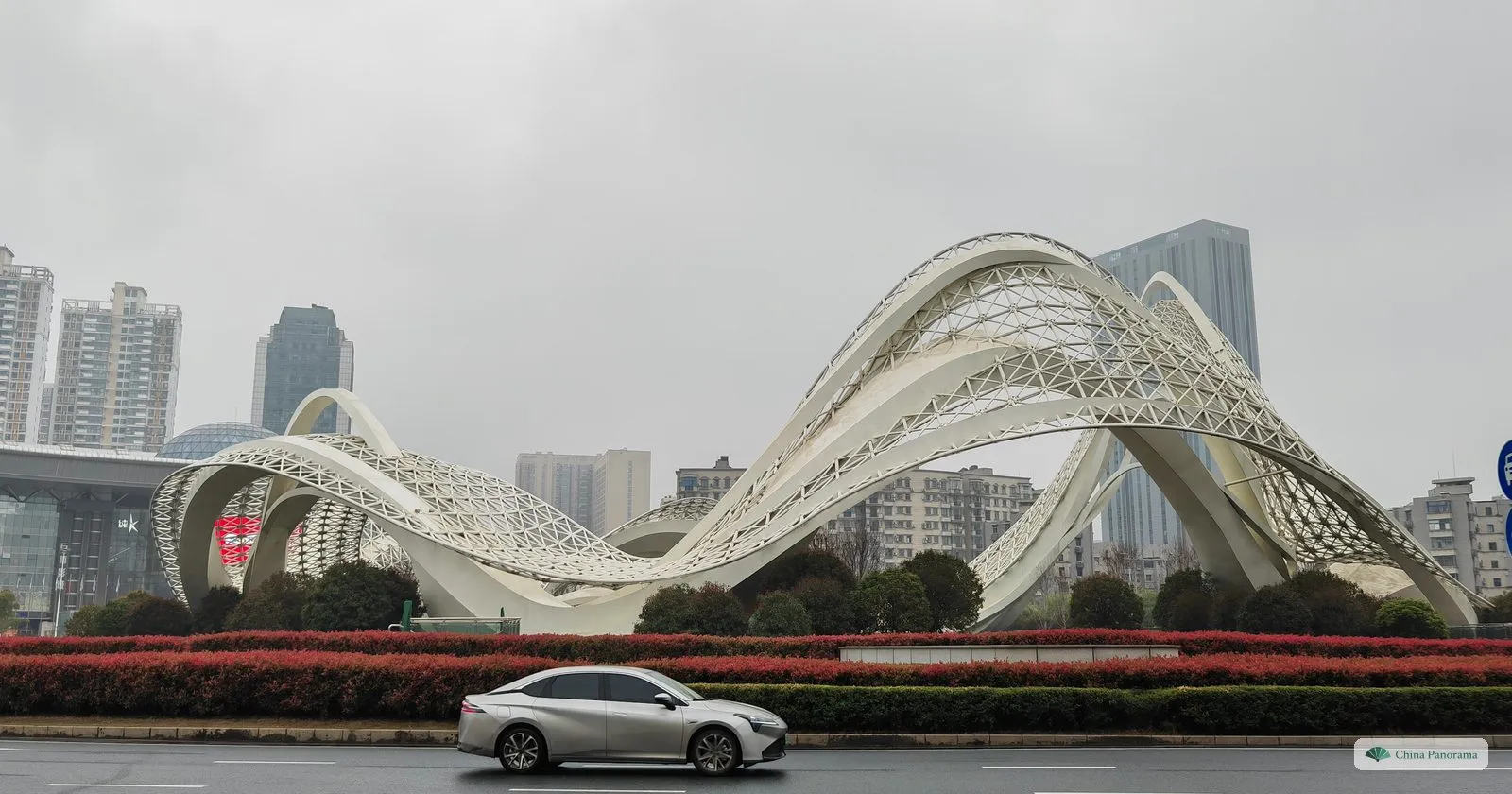
光谷广场 · 光谷步行街ArchitectureHongshan · 洪山区OutdoorsThe roundabout at the heart of Optics Valley, the East Lake High-tech Zone, named for its optical-fibre industry. The square opened in 2001 on a junction of six roads; beneath it, from 2014, the city dug a transport hub of 160,000 m² where three metro lines meet, and over the island now arches a white steel sculpture about 90 m across, reported as China's largest single steel public artwork. Next to it, the World City pedestrian street: a glass dome, shopping arcades and floor after floor of restaurants, busy with students from the universities around. We came on a rainy Tuesday afternoon, 21 March 2023, 13:45 to 15:11.
Optics Valley Square station (Lines 2 and 11) is underneath, about 11 km from the Yangtze bridge. The square and the street are free; shops and restaurants keep their own hours.
- Entry
- Free
- Opening hours
- Hours not verified — check on site
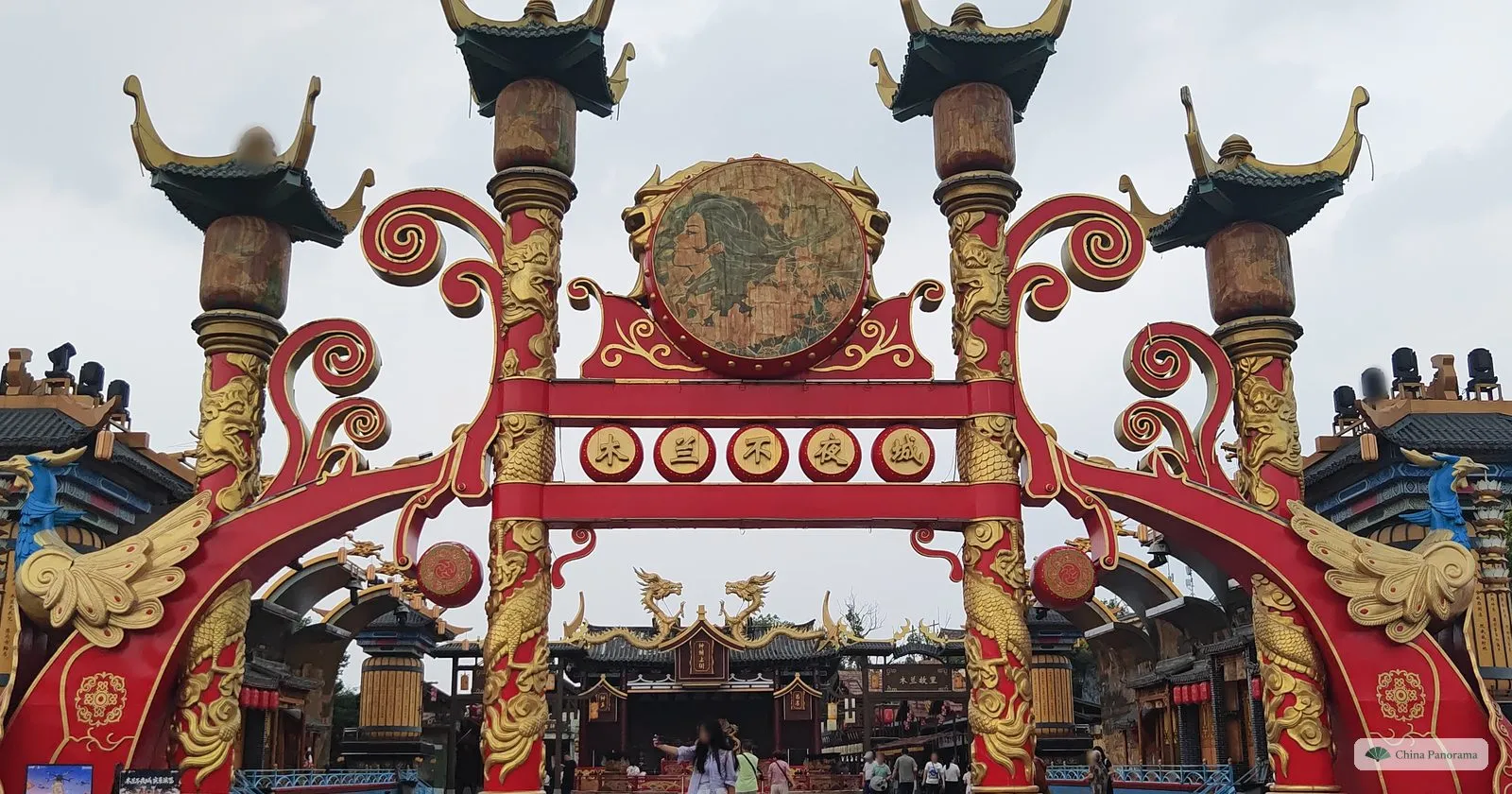
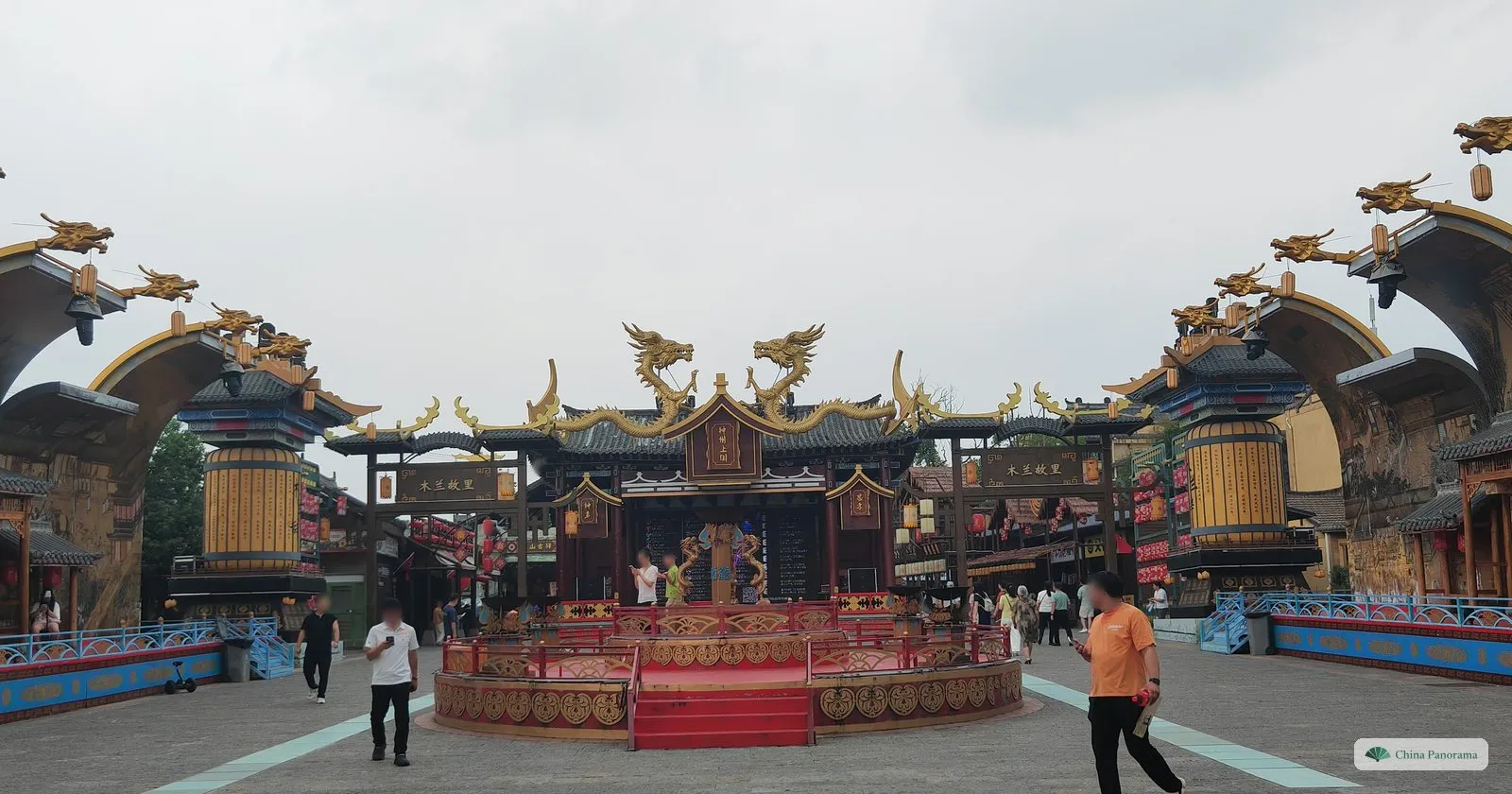
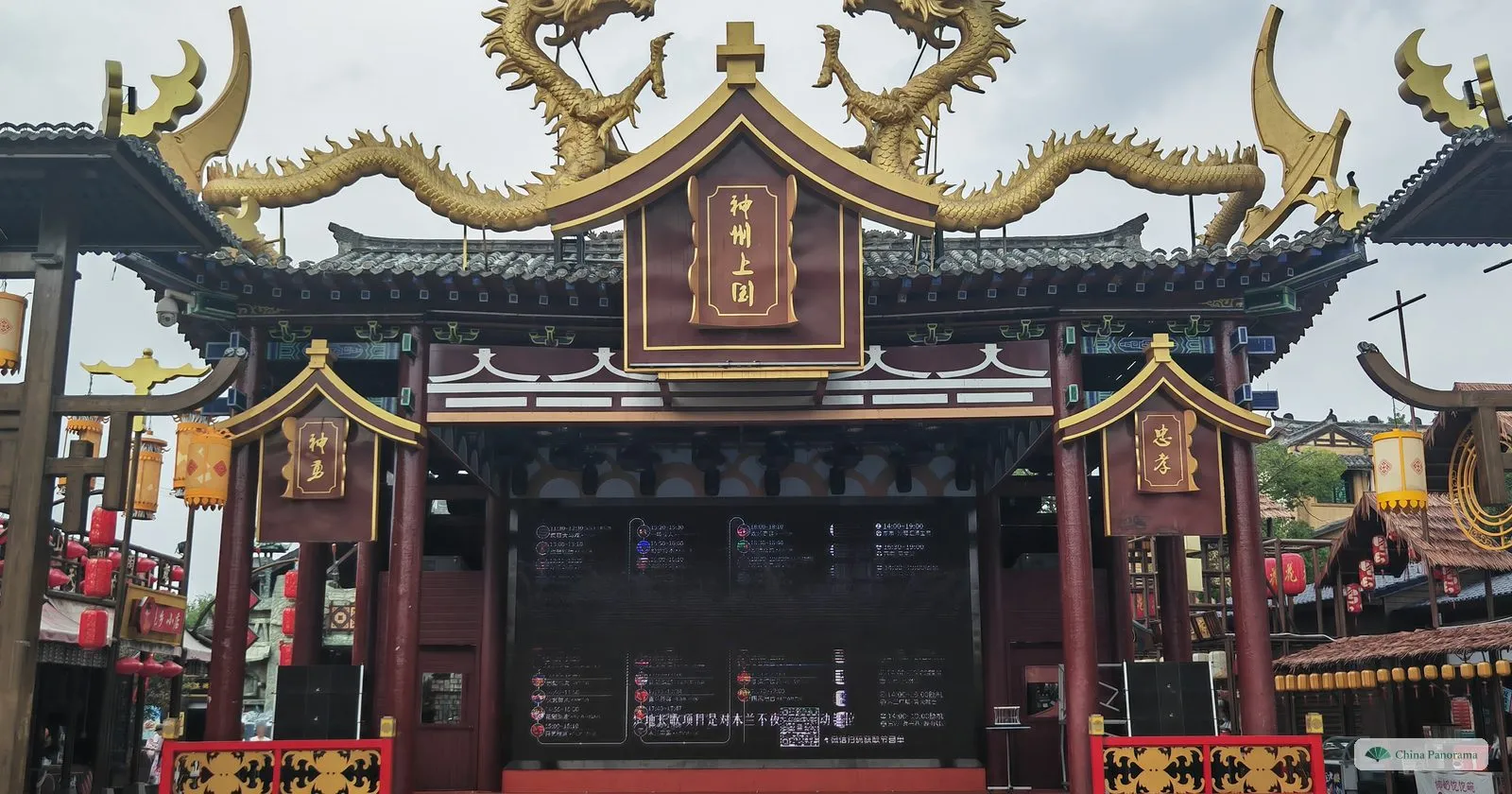
Mulan Flower Town (Huangpi)
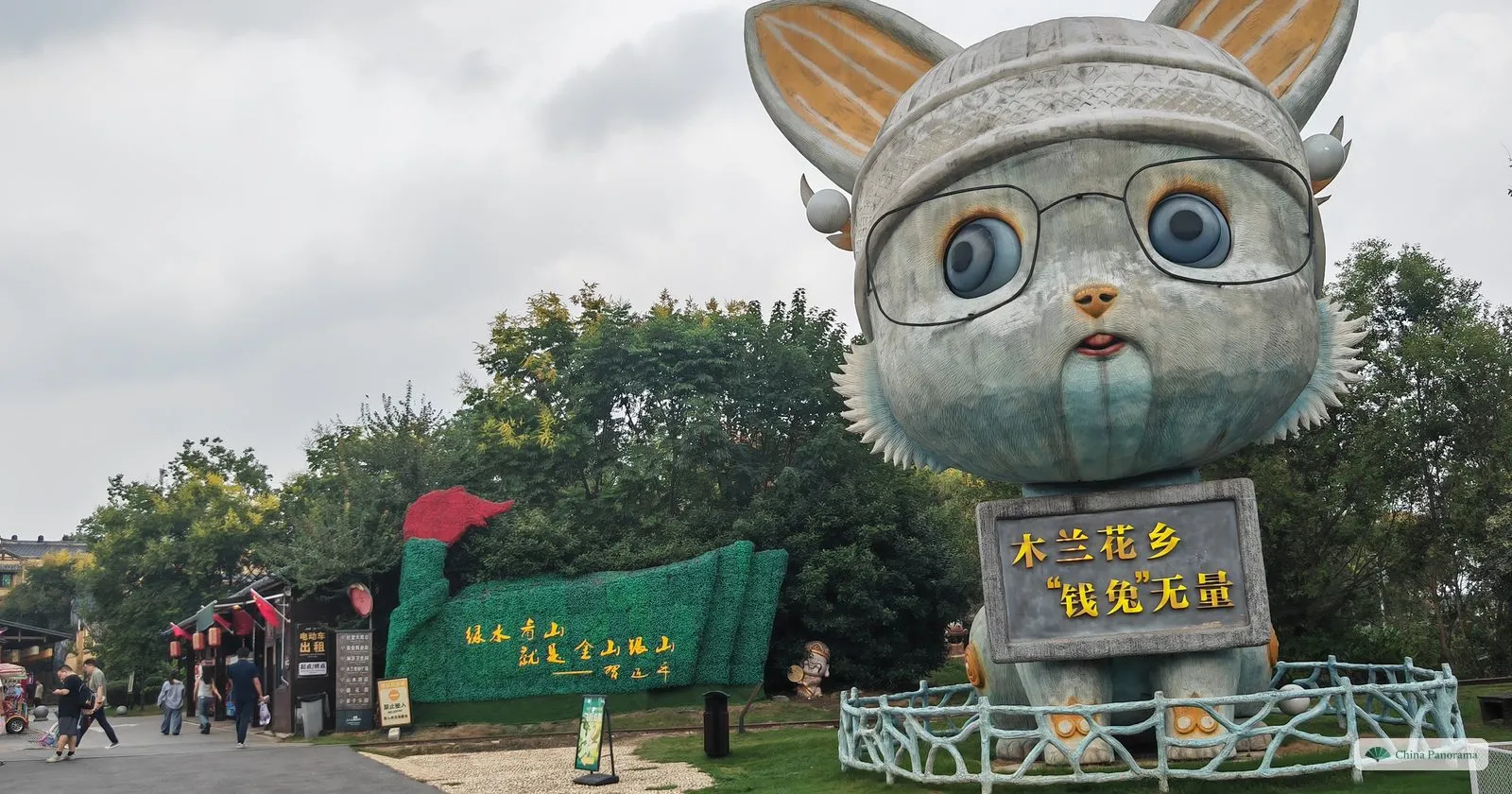
木兰花乡 · 木兰不夜城ParkHuangpi · 黄陂区OutdoorsA theme park in the countryside of Huangpi, the district in the far north of Wuhan, about 78 km from the Yangtze bridge in a straight line. It combines flower fields and a bird park with Mulan Night City, a new town of painted gates, dragon roofs and lantern lanes in a fantasy “ancient” style named after Hua Mulan, the heroine said to come from Huangpi. There are stage shows on the square, mounted performers, a circus under a big top and a flight-simulator cinema. Everything is new and made for photographs and families; come for a day out, not for history. We spent the afternoon of 25 September 2026 here, 15:08 to 16:06.
No metro: about 83 km by road from Hankou, roughly an hour by car without traffic. Ticket prices are sold through the park's own channels and travel platforms and vary with packages; we have not checked them, or the hours.
- Entry
- Price not verified — check on site
- Opening hours
- Hours not verified — check on site
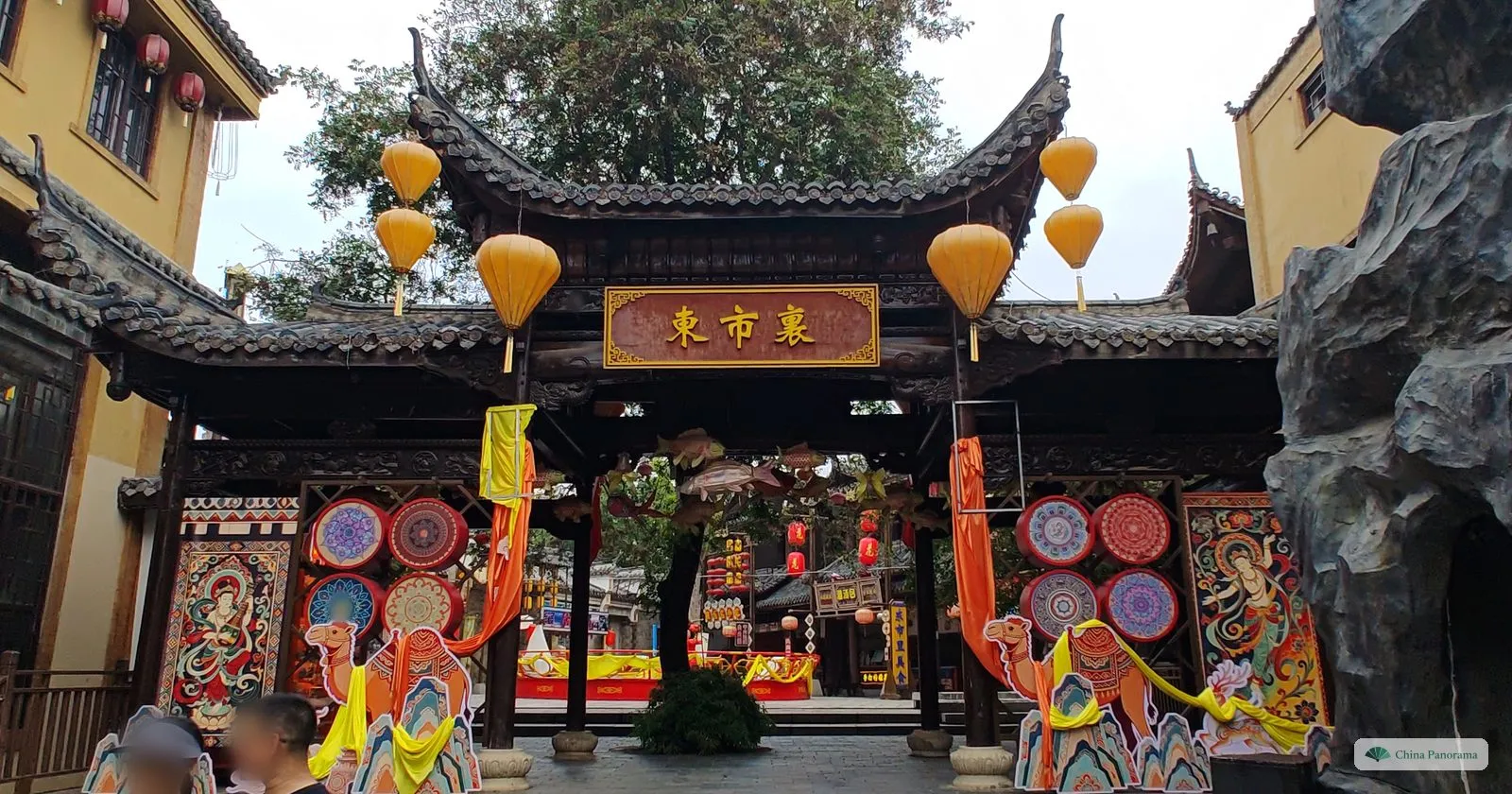
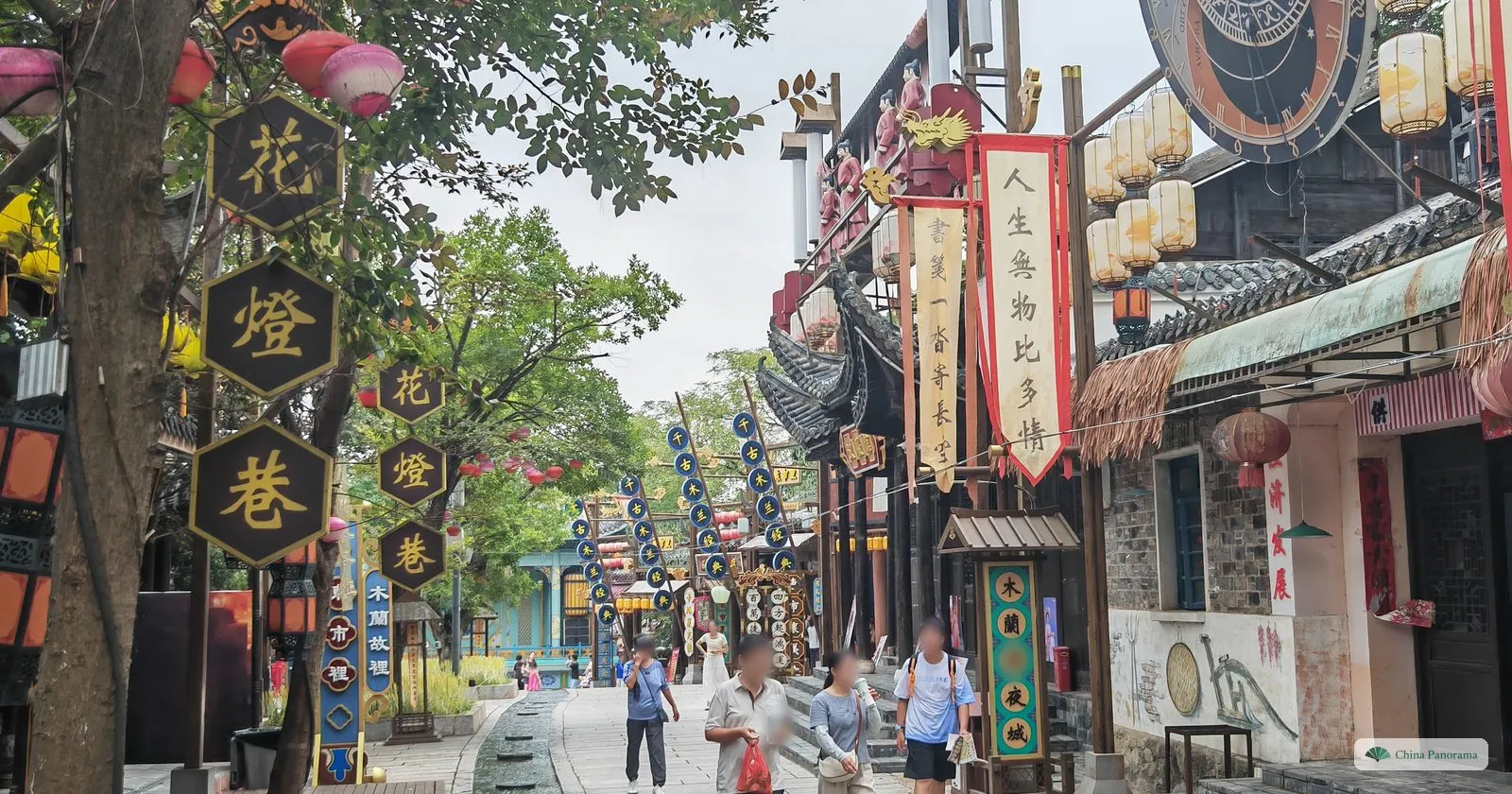
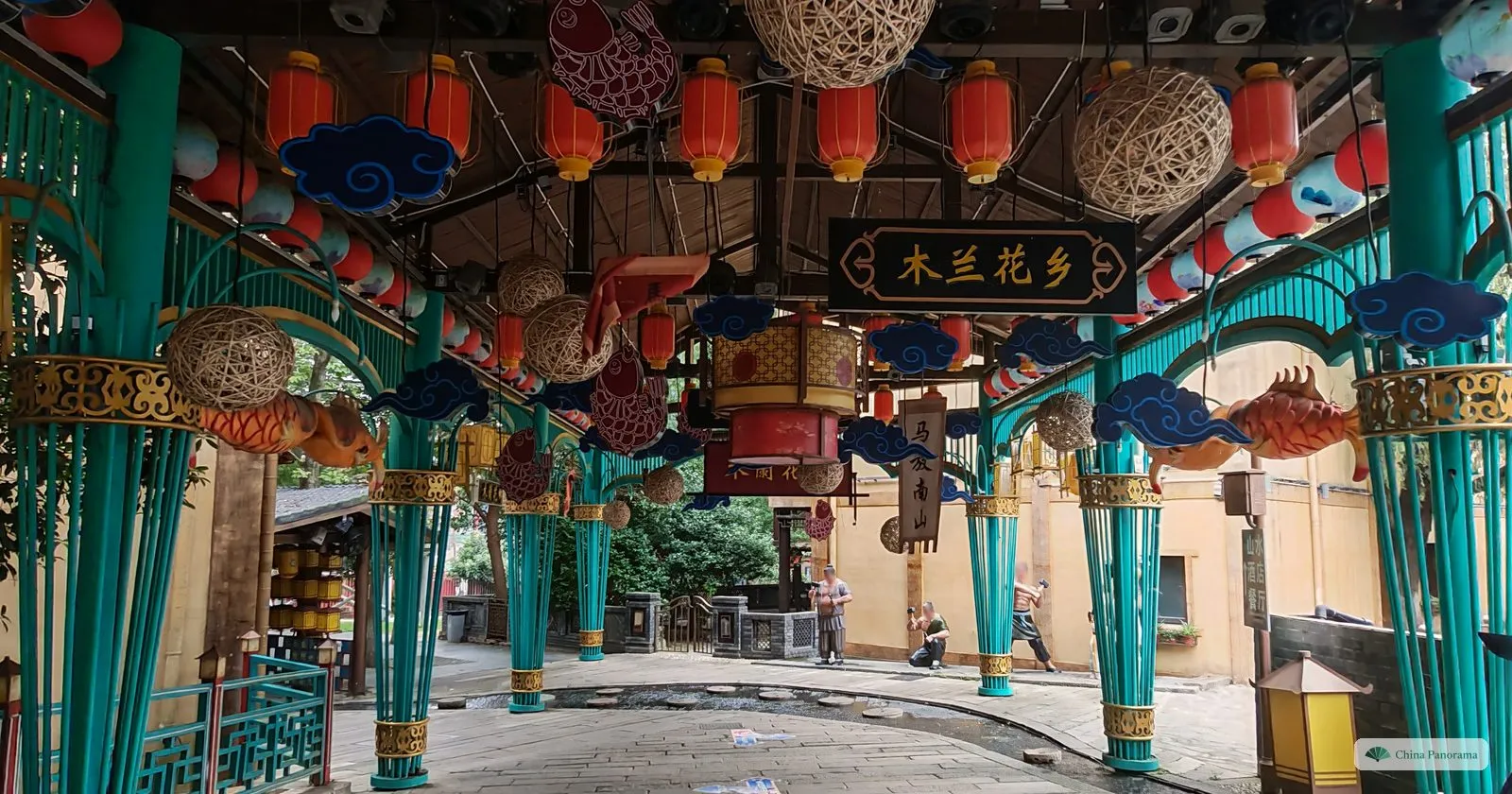
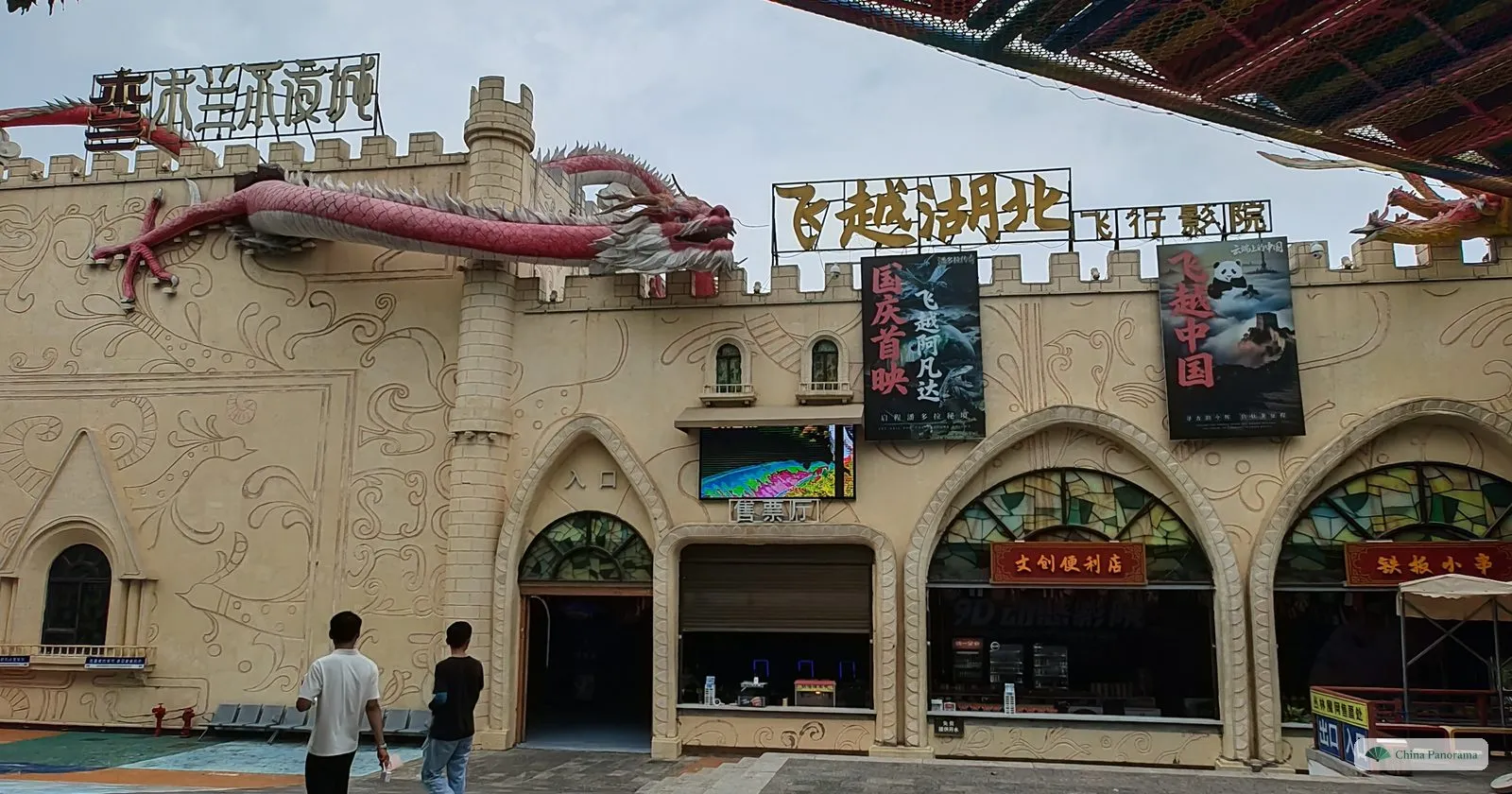
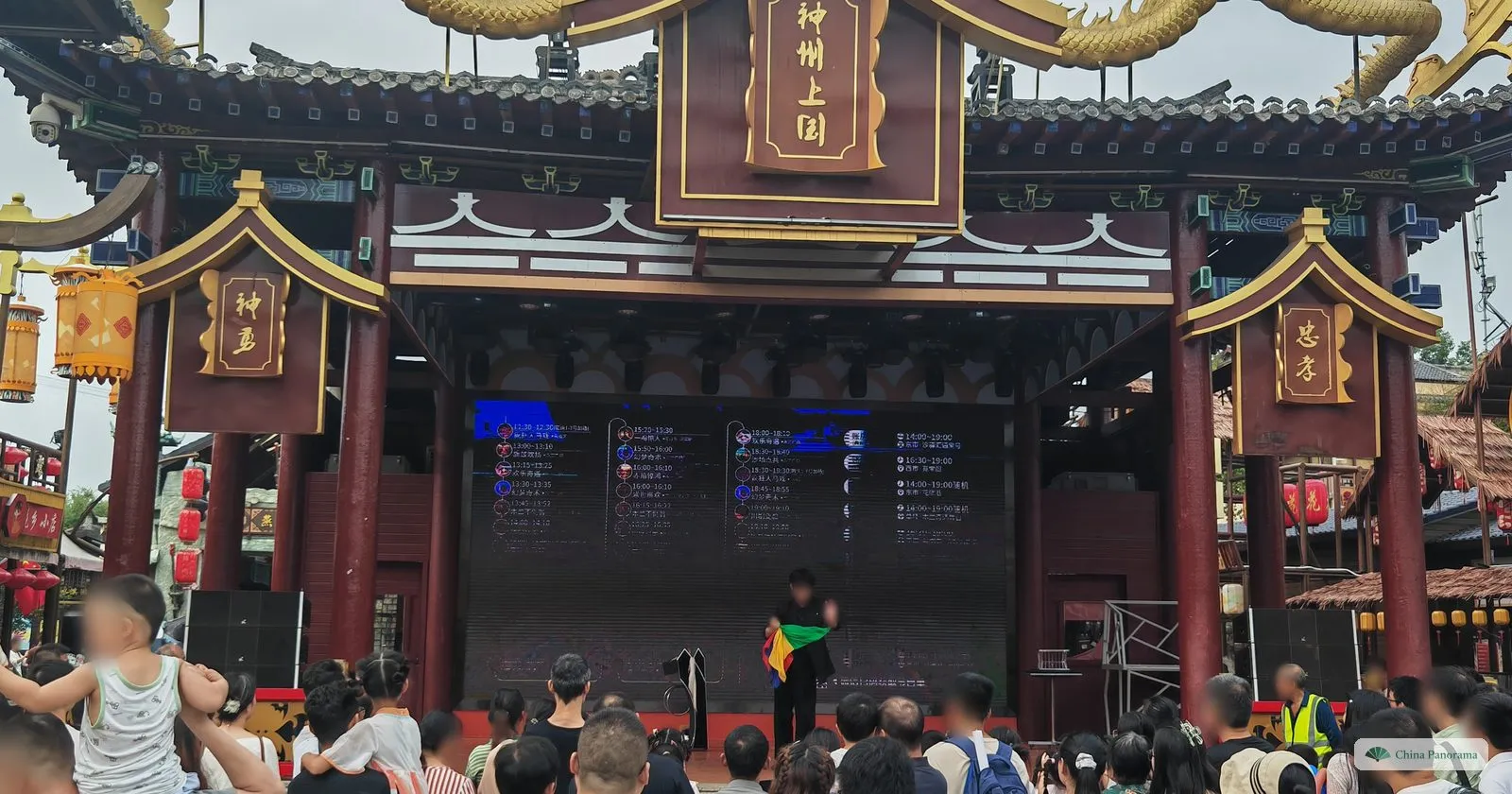
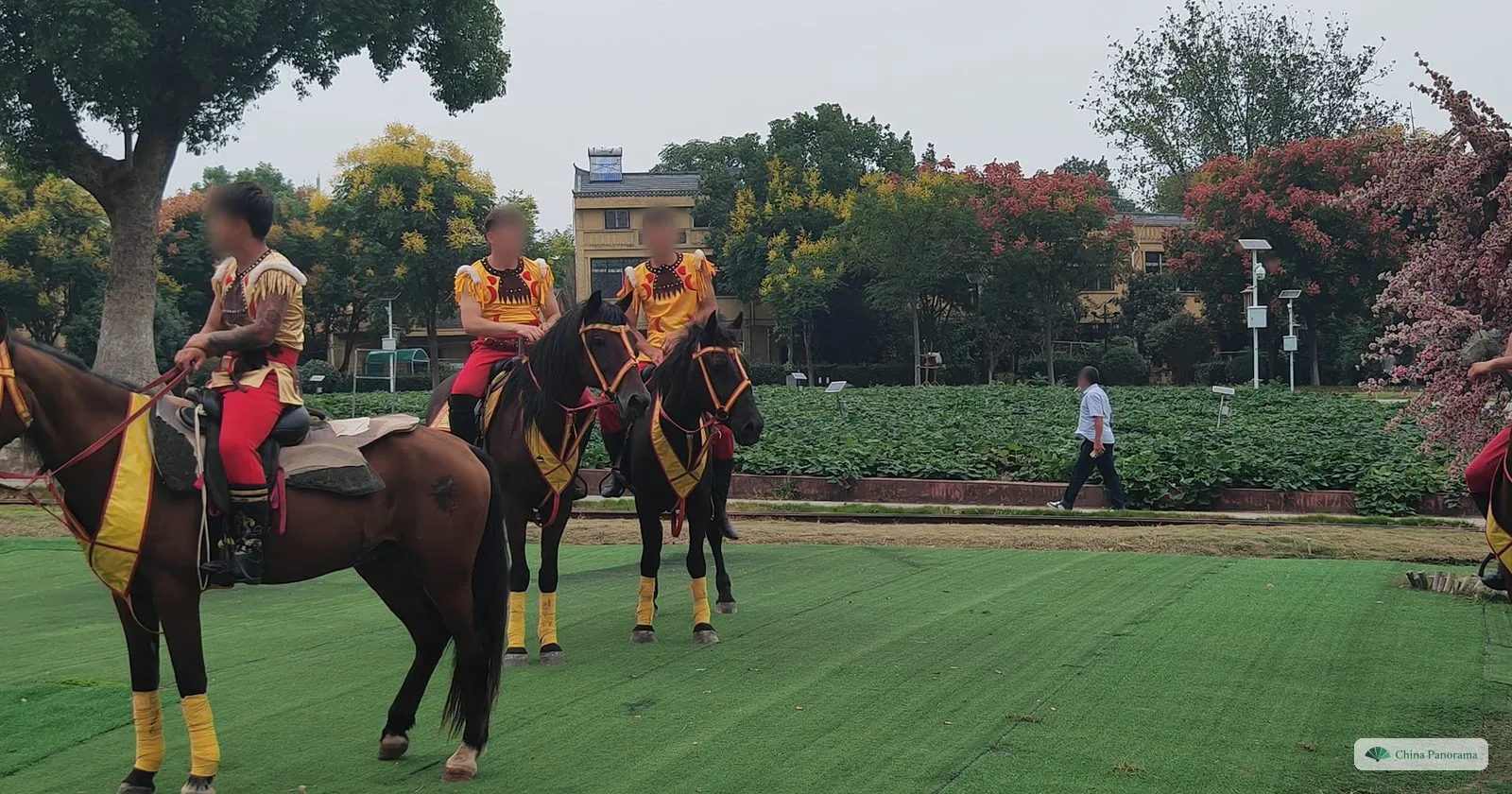
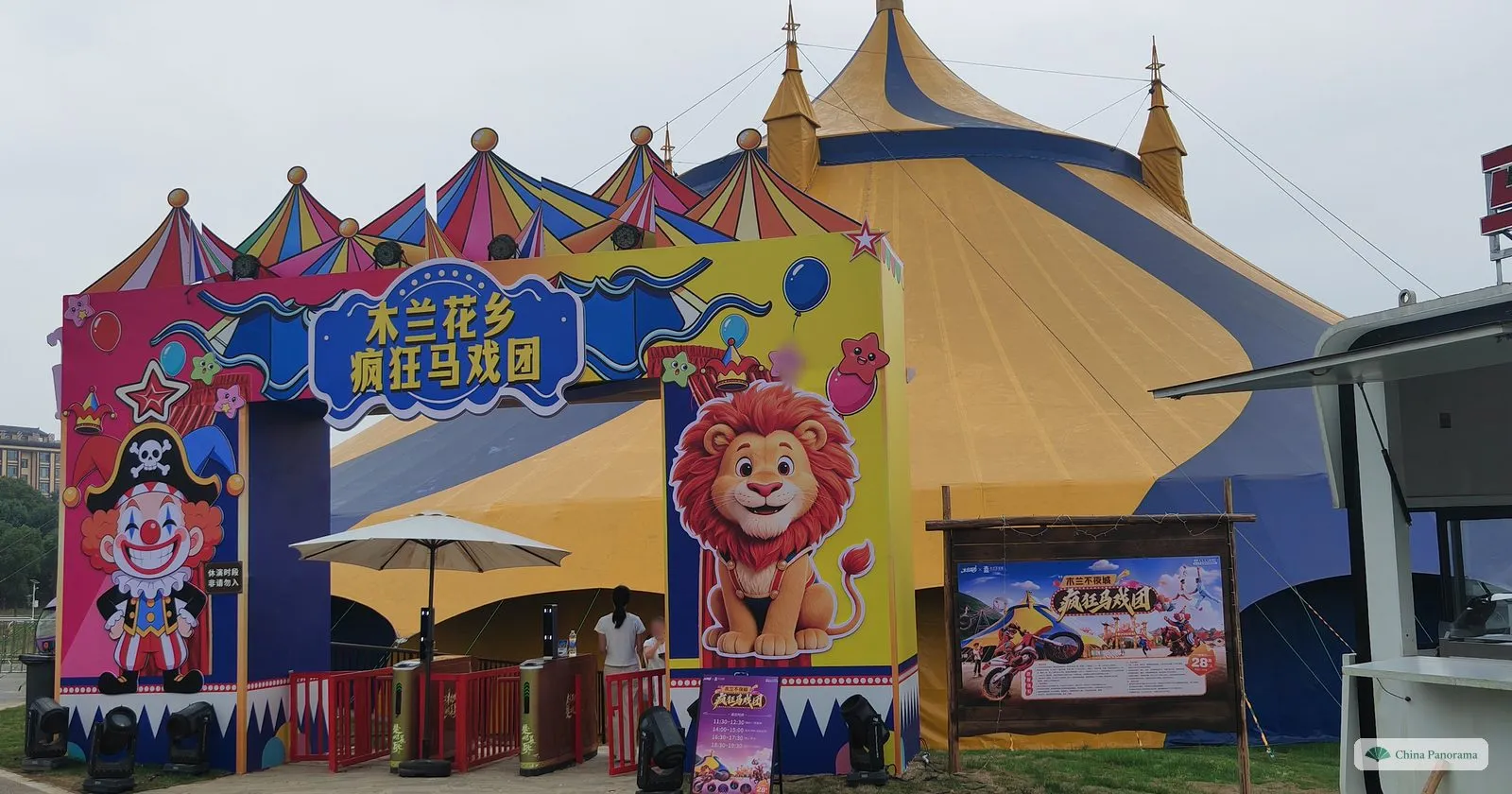
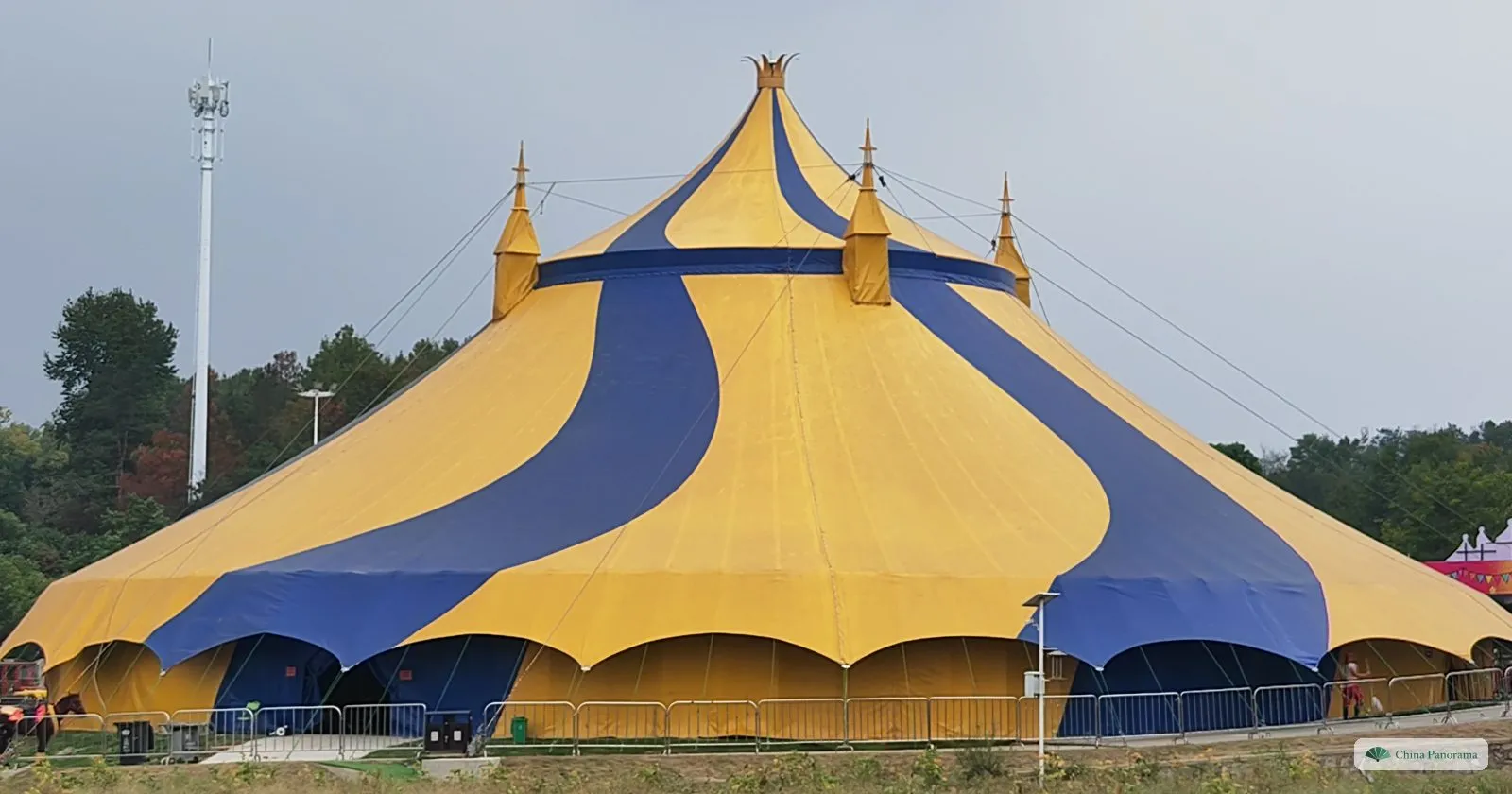
Entry prices and opening hours are marked unverified where we have not checked them against an official source. We would rather show a gap than a number we made up.
Ferry, bridge or metro: how to cross the Yangtze
Almost every day in Wuhan includes a crossing between Wuchang and Hankou. There are four ways to do it, and they suit different people. Tick what applies to you; the best match is marked, and each card says why.
What applies to you?
Tick a situation above and the option that fits best is marked.
The ferry 轮渡 · 武汉关—中华路
Wuhanguan (Hankou) ↔ Zhonghua Road (Wuchang)
A commuter boat straight across the Yangtze, from the Jianghan Customs House to the pier near Hubu Alley. Locals’ favourite way to see the skyline.
- Fare
- 1.5 CNY (reported, 2026)
- Hours
- about 06:30–20:00 (2024 timetable)
- Crossing
- under half an hour (reported)
- Lands
- Hubu Alley about 500 m away; the Customs House next to the Hankou pier
- I want to see the river: You are on the water, with Hankou’s Bund on one side and Wuchang on the other.
- As cheap as possible: The cheapest crossing there is, reported at 1.5 CNY.
- After 8 in the evening: The last boats leave around 20:00 by the 2024 timetable.
- It is raining, or very hot: The cabin is covered, but you walk to and from the piers.
- I have luggage: Steps and gangways at both piers.
- I am in a hurry: Quick if the piers are where you are going — the Customs House or Hubu Alley.
Walk the 1957 bridge 步行 · 武汉长江大桥
Wuchang ↔ Turtle Hill (Hanyang)
The first bridge over the Yangtze has a pavement on each side. About 1.5 km and 20 minutes, with trains rumbling beneath and the whole river spread out.
- Cost
- free
- Distance
- about 1.5 km, 20 minutes on foot
- Pavements
- 2.25 m wide on each side
- Connects
- Wuchang (near Hubu Alley) with Hanyang (Turtle Hill)
- I want to see the river: The best view of all: upstream and downstream, both banks and the TV tower.
- As cheap as possible: Free.
- After 8 in the evening: Possible at any hour — the bridge is a public road — but the view is better by day.
- It is raining, or very hot: No shelter at all, beside four lanes of traffic.
- I have luggage: Not with a suitcase: steps at both ends.
- I am in a hurry: Twenty minutes for the bridge alone, and it lands in Hanyang, not Hankou.
The metro 地铁 · 2号线等
Under the river
Line 2 runs under the Yangtze from Jianghan Road in Hankou to the Wuchang side; several other lines cross too. The quickest way between the three towns.
- Fare
- from 2 CNY, by distance
- Hours
- about 06:00 to 23:00 on the main lines
- Pay with
- Alipay or WeChat; foreign cards not confirmed
- Example
- Jianghan Road → Optics Valley Square on Line 2, no change
- I want to see the river: You see nothing of the river: it is a tunnel.
- As cheap as possible: A few yuan, by distance.
- After 8 in the evening: Main lines run until about 23:00.
- It is raining, or very hot: Underground and air-conditioned.
- I have luggage: Lifts and escalators at most stations; crowded at rush hour.
- I am in a hurry: No traffic, and it goes straight to Optics Valley, the airport and the stations.
Taxi or ride-hailing 出租车 · 网约车
Over one of the many bridges
Door to door, over whichever bridge the driver picks, from the 1957 bridge to the cable-stayed Erqi bridge of 2011.
- Fare
- by the meter or the app; not checked
- Hours
- at any hour
- Example
- Optics Valley → Jianghan Road: about 13 km in a straight line
- I want to see the river: A glimpse of the river from the bridge, through the window.
- As cheap as possible: The most expensive way across.
- After 8 in the evening: Available at any hour.
- It is raining, or very hot: Door to door, air-conditioned.
- I have luggage: The only comfortable choice with suitcases.
- I am in a hurry: Fast at night; at rush hour the bridges jam.
The ferry fare and hours are reports (amber): a 2026 news report for the fare, the 2024 timetable for the hours. Taxi fares are not checked.
Routes, and how the city is laid out
The old centre is the triangle round the confluence: Hubu Alley and the Yellow Crane Tower at the Wuchang end of the bridge, Jianghan Road 4 km away in Hankou, Hanzheng Street and Guiyuan Temple 3 km away on either side of the Han. East Lake and the Hubei Museum are 7 km east, Optics Valley 11 km, Wuhan station 14 km. Tap a place to see how far it is.
Tap a place on the map or in the list.
The old market street on the Han. Line 6. Details below ↓
Hanyang. Lines 4 and 6 to Zhongjiacun. Details below ↓
Closest to the Yellow Crane Tower. Lines 4 and 7.
Old Hankou. Within 1 km: the Customs House (3 km from the bridge), the science museum and Jiqing Street (4 km). Lines 2 and 6. Details below ↓
On the west shore of East Lake. Line 8. Details below ↓
The cherry blossom in March, by booking. Lines 2 and 8 to Jiedaokou. Details below ↓
Trains east and west. Line 2, also to the airport.
The high-tech zone. Lines 2 and 11. Details below ↓
High-speed trains on the Beijing–Guangzhou line. Lines 4, 5 and 19.
Straight-line distances from the Yangtze River Bridge, rounded — not travel distances.
Five routes that don’t double back
Over the bridge to Hubu Alley in the morning, Hanzheng Street and Jianghan Road into the evening, the science museum and Jiqing Street on a wet morning, an afternoon in Optics Valley, and a day out at Mulan Flower Town. They follow our photographs, with the time and distance between stops.
About 2½ hours · 1 km on foot after the bridge
The Yangtze bridge from Hanyang
Taxi 5 min· 5.2 km
Wuchang riverbank
Walk 1 min· 80 m
The Wuchang bridgehead
Walk 5 min· 390 m
Hubu Alley
Walk 3 min· 230 m
Lunch: Wuchang fish
Walk 1 min· 60 m
Douji Ying
Walk 3 min· 230 m
Zhonghua Road pier
7 stops · 13 min walking · 5 min by taxi
About 2 hours · 5 minutes by taxi, then 0.5 km on foot
Hanzheng Street
Taxi 5 min· 3.1 km
Jianghan Road at dusk
Walk 1 min· 90 m
Supper on a side street
Walk 3 min· 250 m
The Zhongshan Avenue crossing
Walk 2 min· 160 m
Back up Jianghan Road
5 stops · 6 min walking · 5 min by taxi
About 1½ hours · 1.3 km on foot
Wuhan Science and Technology Museum
Inside the museum
Walk 14 min· 1.01 km
Jiqing Street
Walk 2 min· 120 m
Sijimei
Walk 2 min· 140 m
The Jiqing Street archway
5 stops · 18 min walking
About 1½ hours · 1.6 km on foot
Optics Valley Square
Walk 11 min· 880 m
The glass dome
Walk 1 min· 90 m
Floors of food
Walk 1 min· 60 m
The atrium
Walk 7 min· 560 m
The towers
5 stops · 20 min walking
Half a day · about an hour each way by car
The gate of Mulan Night City
Walk 2 min· 100 m
The square and the stages
Walk 4 min· 150 m
East Market and the lantern lanes
Walk 10 min· 200 m
A stage show
Walk 4 min· 100 m
The riders and the big top
5 stops · 20 min walking · 64 min by taxi
Stop by stop
Morning: over the Yangtze bridge to Hubu Alley
Our 25 September 2026: over the bridge from Hanyang by car at 10:04, the Wuchang riverbank under the bridge from 10:34, Hubu Alley at 11:14, lunch at 11:57 and out to the ferry pier at 12:31. On foot, you can walk the bridge itself instead of driving — about 20 minutes.
Onto the road deck past the two pavilion-topped bridgeheads at 10:04; the Yellow Crane Tower appears ahead on Snake Hill at 10:07.
- Entry
- Free
- Hours
- Open at all hours
Taxi 5 min· 5.2 km
2Wuchang riverbank
武昌江滩Down to the promenade: the ferry piers at 10:38, the bridge and Turtle Hill across the river at 10:40, the piers from below at 10:44.
- Entry
- Free
- Hours
- Open at all hours
Walk 1 min· 80 m
3The Wuchang bridgehead
武昌桥头堡Back up to the road under the arches of the approach: the bridgehead tower at 10:49.
- Entry
- Free
- Hours
- Open at all hours
Walk 5 min· 390 m
4Hubu Alley
户部巷Inland along Minzhu Road; hot dry noodle shops at 11:00, the alley's gate at 11:14, through the stalls to 11:34.
- Entry
- Free
- Hours
- Open at all hours
Walk 3 min· 230 m
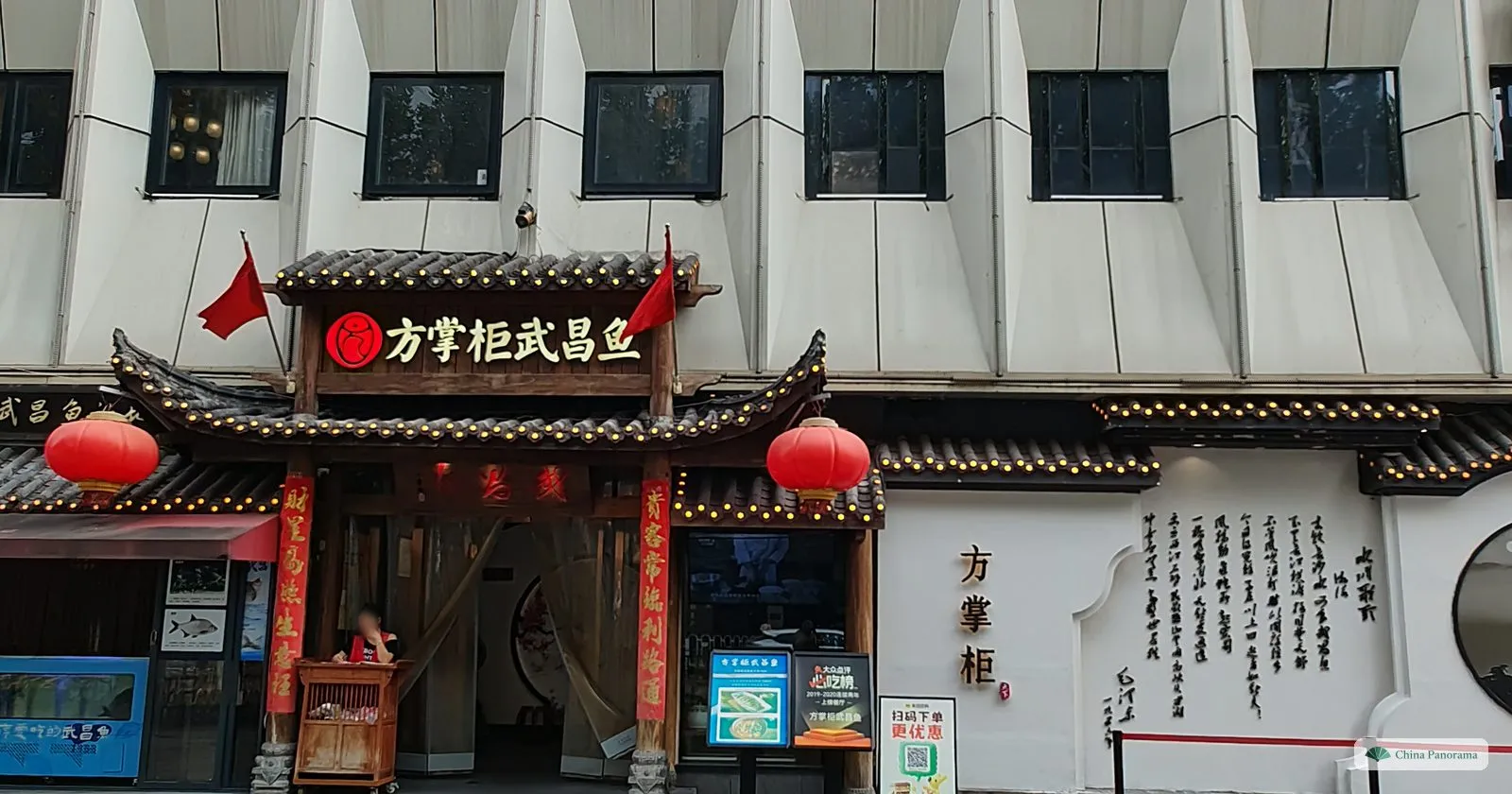
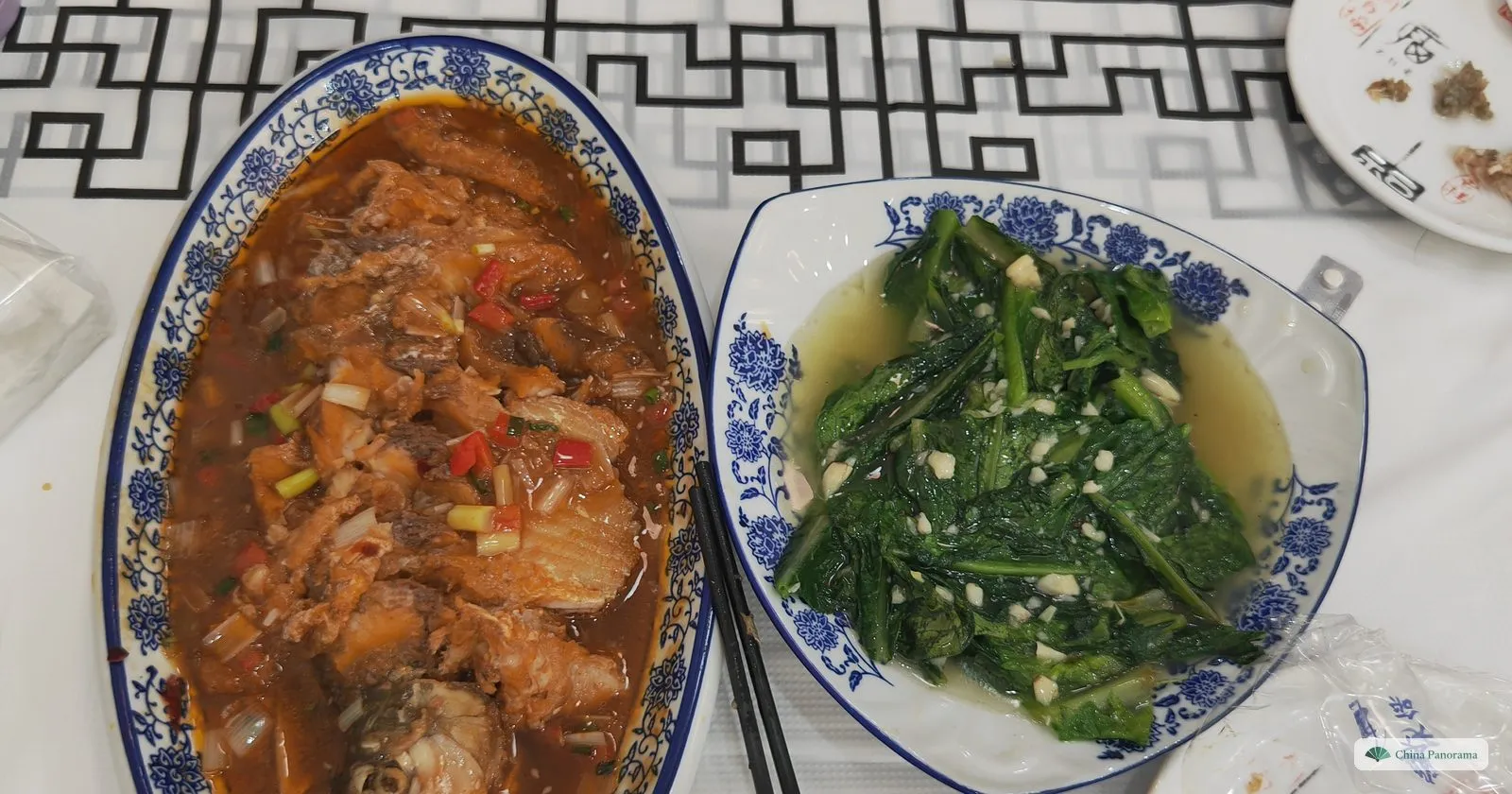
Braised Wuchang bream and greens at a restaurant at the end of the lane: 11:57.
- Entry
- —
- Hours
- —
Walk 1 min· 60 m
6Douji Ying
斗级营A lane of cafés behind a sign for the “Wuchang old town granary”: 12:16 to 12:28.
- Entry
- Free
- Hours
- Open at all hours
Walk 3 min· 230 m
7Zhonghua Road pier
中华路码头To the riverfront ferry terminal at 12:31, for the boat across to Hankou.
- Entry
- Reported 1.5 CNY
- Hours
- Not verified
Easy add-ons: The Yellow Crane Tower is about 600 m east of Hubu Alley, up on Snake Hill, and the Red Building of the 1911 uprising is at its southern foot — another two hours. Take the ferry from Zhonghua Road to Wuhanguan and you land at the Jianghan Customs House, at the end of Jianghan Road.
* Walking times and distances are computed from OpenStreetMap walking routes between the stops; inside Mulan Flower Town, where the router has no paths, the minutes are those between our photographs. Car legs are OpenStreetMap driving times without traffic — allow about double at busy times. Clock times are from our own photographs (21–22 March 2023 and 25 September 2026). Stops marked with a star have prices or opening hours we have not checked.
Getting there and around
By air
Wuhan Tianhe International Airport (WUH) is in Huangpi district, about 26 km north of the Yangtze bridge in a straight line (34 km by road). Metro Line 2 runs from the airport through Hankou station and Jianghan Road to Wuchang and Optics Valley. We have not checked journey times or taxi fares.
Schedules and opening hours not yet verified against an official source.
By high-speed train
Wuhan sits where China's north–south and east–west lines cross: Wuhan station is on the Beijing–Guangzhou high-speed line, Hankou station has trains east towards Shanghai and west towards Chongqing and Chengdu. Changsha is about 290 km away in a straight line, Shanghai about 690 km, Beijing about 1,060 km. Check which of the three stations your ticket names — they are up to 20 km apart. We have not checked journey times against the 12306 timetable.
Schedules and opening hours not yet verified against an official source.
Nonstop from Europe
Our flight list has nonstop routes to Wuhan from 1 European airport: London Heathrow. From elsewhere, most travellers fly to Beijing, Shanghai or Guangzhou and take the high-speed train. Airlines and frequencies →
Flight data checked 12 September 2026.
Three stations, three towns
Your train ticket will name one of these. Wuhan and Hankou stations are about 16 km apart.
- Wuhan 武汉站The big high-speed station in the north-east, about 14 km from the Yangtze bridge, on the Beijing–Guangzhou line. Lines 4, 5 and 19.
- Hankou 汉口站The main station on the Hankou side, about 9 km north-west of the bridge; many trains east to Shanghai and west to Chongqing and Chengdu. Line 2 (also to the airport).
- Wuchang 武昌站The old station of Wuchang, about 3 km from the bridge and closest to the Yellow Crane Tower. Lines 4 and 7, and 11 and 12 at the east square.
The metro, in short
How Chinese metros work →Thirteen lines, several of them crossing the Yangtze, so the metro is also the quickest way between the three towns. For a visitor: Line 2 runs from Tianhe airport and Hankou station through Jianghan Road, under the river to Wuchang and on to Jiedaokou (Wuhan University) and Optics Valley; Line 5 serves Wuchang's old town (Simenkou Huanghelou for the Yellow Crane Tower and Hubu Alley, Pengliuyang for the Red Building); Line 6 runs through Hankou and Hanyang (Hanzheng Street, Zhongjiacun for Guiyuan Temple); Line 8 goes to the Hubei Provincial Museum and East Lake; Line 4 links the Wuchang and Wuhan stations.
- Lines
- 13incl. the Yangluo line
- Fare
- from 2 CNYfirst 4 km
- Network
- about 335 stationsabout 553 km (reported)
- Pay with
- Alipay or WeChatforeign cards not confirmed
Pay with the metro ride code in Alipay or WeChat, or buy a single ticket at the machines. The operator lists UnionPay contactless cards at the gates; we found no report that Visa or Mastercard cards issued abroad work at the gates, as they now do in Beijing, Shanghai and Chengdu, and have not tested one — set up Alipay before you go.
Fares by distance: 2 CNY up to 4 km, 3 CNY up to 8 km, 4 CNY up to 12 km, 5 CNY up to 18 km, 6 CNY up to 24 km, 7 CNY up to 32 km, 8 CNY up to 40 km, 9 CNY up to 50 km. Beyond 50 km, 1 CNY more for every further 20 km or part of it. A trip may last at most 240 minutes from gate to gate. A ride from Jianghan Road across the river to Wuchang costs 2–3 CNY; out to Optics Valley, a few yuan more.
Wikipedia gives the first trains at about 06:00 on weekdays and 06:30 on holidays and the last at about 23:00 on the main lines (22:00–22:30 on Lines 16 and 19 and the Yangluo line); we have not checked this against the operator's timetable — look at the display in the station.
| Yellow Crane Tower, Hubu Alley | Simenkou Huanghelou 司门口黄鹤楼 | Line 5 |
| Yangtze River Bridge (Wuchang end, 800 m) | Simenkou Huanghelou 司门口黄鹤楼 | Line 5 |
| Red Building (Wuchang Uprising Memorial) | Pengliuyang 彭刘杨 | Line 5 |
| Hubei Provincial Museum, East Lake | Shengbo Hubei Ribao 省博湖北日报 | Line 8 |
| Wuhan University | Jiedaokou 街道口 | Lines 2/8 |
| Jianghan Road, Customs House, science museum | Jianghan Road 江汉路 | Lines 2/6 |
| Jiqing Street | Xunlimen 循礼门 | Lines 1/2 |
| Hanzheng Street | Hanzheng Street 汉正街 | Line 6 |
| Longwangmiao (1.1 km) | Liuduqiao 六渡桥 | Line 6 |
| Guiyuan Temple | Zhongjiacun 钟家村 | Lines 4/6 |
| Optics Valley Square | Optics Valley Square 光谷广场 | Lines 2/11 |
| Tianhe Airport (WUH) | Tianhe International Airport 天河机场 | Line 2 |
| Hankou station | Hankou Railway Station 汉口火车站 | Line 2 |
| Wuchang station | Wuchang Railway Station 武昌火车站 | Lines 4/7 |
| Wuhan station | Wuhan Railway Station 武汉火车站 | Lines 4/5/19 |
Stations are signed in Chinese characters and pinyin, and some names are long: the Yellow Crane Tower's station is Simenkou Huanghelou. Jianghan Road (Lines 2 and 6) is the interchange for old Hankou; Optics Valley Square is a vast underground hub where Lines 2 and 11 meet; Wuchang station has two metro stations, one on each square.
Source and date: Fare bands: in force since 1 February 2019, as given in the Chinese Wikipedia article on the Wuhan Metro (we found no current fare page on the operator's site to link). Lines, stations and length: the same article (13 lines, 335 stations, 553 km); Line 12 opened its first section on 1 May 2026 by the same article, while another section of it still speaks of commissioning — treat the totals as approximate. Payment methods: the same article; foreign bank cards: no report found, 19 October 2026. Stations for the sights: OpenStreetMap stations and route relations, 19 October 2026. First and last trains: not checked.
Before you go
Most European passports are visa-free for a short trip — under a one-sided waiver with an end date worth checking before you book:
- UK passport
Visa-free up to 30 days per trip, currently until 31 December 2026.
- EU passports
Dutch, German, French, Irish, Nordic and most other EU passports: visa-free up to 30 days, currently until 31 December 2026.
- US passport
No general waiver: a visa, or the 10-day visa-free transit if you travel on to a third country.
China’s 10-day visa-free transit applies at designated entry ports, for travellers continuing to a third country. Check your passport.
- Set up Alipay
For the metro, museum bookings and breakfast stalls that take no cards.
- Ordering food
How the QR-code menus and counter shops work, before you face Hubu Alley.
- Nanjing
The next big city down the Yangtze, 460 km away — another “furnace”.
- The arrival card
Fill it in online, or practise the paper form, before you land.
- Golden Week
Why 1–7 October is the worst week for the Yellow Crane Tower and Hubu Alley.
- Chinese metros
Tickets, transport codes and security checks, city by city.
FAQ
What are the best things to do in Wuhan?
Walk across the Wuhan Yangtze River Bridge of 1957, or take the 1.5-yuan ferry, and climb the Yellow Crane Tower on Snake Hill; eat hot dry noodles for breakfast in Hubu Alley; see the 2,400-year-old chime bells of Marquis Yi in the Hubei Provincial Museum and cycle the East Lake Greenway; walk Jianghan Road and the old Hankou Bund in the evening; visit the Red Building, where the 1911 revolution began. In late March, book a slot for the cherry blossom at Wuhan University.
Is Wuhan worth visiting?
Yes, for two or three days, especially if you are travelling between Beijing, Shanghai, Chongqing and Guangzhou: Wuhan sits in the middle, on the high-speed lines in all four directions. It has the first bridge over the Yangtze, the Yellow Crane Tower, one of China’s best provincial museums, the treaty-port streets of Hankou, a huge lake inside the city and some of the best street breakfasts in the country. It is not a city of old temples; most of what you see is 20th-century.
How many days do you need in Wuhan?
Two to three. One day in Wuchang — the Yellow Crane Tower, Hubu Alley, the bridge on foot and the Red Building; one for East Lake and the Hubei Provincial Museum, perhaps with Optics Valley; and an evening and a morning in Hankou, on Jianghan Road and the Bund. Add half a day for Mulan Flower Town if you have children with you. Our routes below follow our own days.
What are Wuchang, Hankou and Hanyang?
The three towns that make up Wuhan. The Yangtze and the Han River cut the city into three: Wuchang on the south bank of the Yangtze, the old seat of government; Hankou on the north bank and the north side of the Han, the trading town and treaty port; and Hanyang between the two rivers, the smallest. They were merged and named Wuhan on 1 January 1927. Railway stations and metro stations still carry the old names — Wuchang station and Hankou station are different stations.
Can you walk across the Wuhan Yangtze River Bridge?
Yes. The road deck of the 1957 bridge has a pavement 2.25 m wide on each side. From the Wuchang end, near Hubu Alley, to Turtle Hill in Hanyang it is about 1.5 km — 20 minutes on foot — with trains running on the deck below. There is no charge.
When is the cherry blossom at Wuhan University?
Usually from about mid-March into early April, at its peak in the last week of March. Visitors need a free booking made on the university’s website or WeChat account: in 2025 bookings opened each evening at 20:00 from 12 to 28 March, for visits three days later, with 20,000 places a day on weekdays and 40,000 at weekends, one booking per ID document. Bring the passport you booked with. The rules change each year — check them in early March.
Can I pay for the Wuhan metro with a credit card?
We cannot confirm it. Beijing, Shanghai and Chengdu now take Visa and Mastercard cards issued abroad at the gates; for Wuhan we found no such report, only UnionPay contactless cards. Use the metro ride code in Alipay or WeChat, or buy a single ticket at the machines. Fares run by distance, from 2 CNY for the first 4 km.
When is the best time to visit Wuhan?
Spring and autumn. March averages 17 °C by day and brings the cherry blossom, but also rain; April is 24 °C; October 24 °C. July and August are among the hottest in China, at 34 °C by day and 27 °C at night, and January is damp at 9 °C by day with no central heating. Avoid May Day (1–5 May) and Golden Week (1–7 October).
What should I eat in Wuhan?
Breakfast is the meal: hot dry noodles (热干面, règānmiàn) with sesame paste, doupi (豆皮, sticky rice under a skin of egg), mianwo (面窝, a crisp ring of rice batter) and soup buns, eaten at Hubu Alley or any street stall — Wuhan calls breakfast out guòzǎo. For lunch or dinner, braised Wuchang bream (武昌鱼) and lotus-root and pork-rib soup; in the evening, crayfish and skewers.
How do I get from Wuhan airport to the city?
Metro Line 2 runs from Tianhe International Airport (WUH), about 26 km north of the Yangtze bridge in a straight line, through Hankou station and Jianghan Road to Wuchang and Optics Valley. A taxi takes about 25 minutes without traffic (about 34 km by road). We have not checked journey times or fares.
Is the Yellow Crane Tower worth visiting?
For the view and the story, yes; for old architecture, no. The tower on Snake Hill is a concrete reconstruction finished in 1985, about 1 km from the site of the towers that burnt down time and again until 1884 — but from its upper floors you look over the Yangtze, the 1957 bridge and the towers of Hankou, and it is the setting of one of China’s best-known Tang poems. Combine it with Hubu Alley, ten minutes’ walk away, and a walk across the bridge. Entry is paid; we have not checked the current price or hours.
How far is Wuhan from Shanghai and Beijing?
In a straight line, about 690 km from Shanghai and 1,060 km from Beijing; Changsha is 290 km, Nanjing 460 km. Wuhan station is on the Beijing–Guangzhou high-speed line, and trains from Hankou station run east towards Shanghai. We have not checked journey times against the 12306 timetable.
Do I need a visa for Wuhan?
Not for a short trip on a British, Irish, Dutch, German, French, Nordic or Australian passport: all are visa-free for up to 30 days per trip, under a one-sided waiver that currently runs until 31 December 2026. US passport holders have no general waiver; the 10-day visa-free transit applies only at designated entry ports and only if you travel on to a third country. Check your own passport on our visa check page.
Sources and status
All photographs on this page are ours: Longwangmiao on 30 March 2021, in rain; Optics Valley, Hanzheng Street and Jianghan Road on 21 March 2023, the science museum and Jiqing Street on 22 March 2023, both wet days; the Yangtze bridge (partly from a moving car, through the windscreen), the Wuchang riverside, Hubu Alley and Mulan Flower Town on 25 September 2026. Faces of passers-by and number plates have been blurred. Data sources: Monthly temperature data, Wuhan; Wuhan (Wikipedia): population, the three towns, city flower and tree; Wuhan Yangtze River Bridge: dates, lengths, piers, pavements (Wikipedia, Chinese); Yellow Crane Tower: 223, 1884, 1981–1985, height (Wikipedia, Chinese); Hubu Alley: name, length, renovations of 2002–2006 (Wikipedia, Chinese); Jianghan Road: pedestrian street since 2000, history (Wikipedia, Chinese); Xuangong Hotel and Hôtel Terminus, Hankow (Dream of a City); Jianghan Customs House: 1924, architect, height (Wikipedia, Chinese); Jiqing Street (Wikipedia, Chinese); Jiqing Street reopens, 22 December 2011 (China News Service); Hanzheng Street (Wikipedia, Chinese); Wuhan Science and Technology Museum: the former port terminal, 2022 opening hours (Dahepiao); Optics Valley Square: 2001, the underground hub (Wikipedia, Chinese); Optics Valley Square sculpture (Media Architecture Biennale); Guiyuan Temple (Wikipedia, Chinese); Wuchang Uprising Memorial and the Red Building (Wikipedia, Chinese); Hubei Provincial Museum: collection, chime bells, south wing 2021 (Wikipedia, Chinese); East Lake: area, scenic areas, greenway (Wikipedia, Chinese); Wuhan University cherry blossom booking, 2025 (The Paper); Wuhan's 1.5-yuan ferry (People's Tribune, May 2026); Turtle Hill TV Tower (Wikipedia, Chinese); Erqi Yangtze River Bridge (Wikipedia, Chinese); Wuhan Tianhe International Airport (Wikipedia, Chinese); Wuhan Metro: lines, fares since 2019, payment (Wikipedia, Chinese).
Changelog (1)
- 2026-10-19Page created, with our own photographs from 30 March 2021, 21–22 March 2023 and 25 September 2026. No entry price on this page could be checked against an official source on this date. Metro: fares from the distance scale in force since February 2019; whether foreign bank cards work at the gates is not confirmed. Ferry fare and hours are reports.