
Heavenly stems and earthly branches: China’s 3,000-year-old time code
Where do the heavenly stems 天干 tiāngān and earthly branches 地支 dìzhī, together called ganzhi 干支, come from? The answer is written on a bone. On the shoulder blade of an ox from the late Shang dynasty, more than 3,000 years old, a scribe carved the complete table of all 60 pairs. China still counts its days exactly this way.
Ten stems and twelve branches make a cycle of 60, the sexagenary cycle. From it come the Year of the Fire Goat, the twelve double hours, the four pillars of Chinese fortune-telling and even the Chinese word for noon. In three minutes you will see how the system works, and you can work out your own eight characters.
In short
- 1Origin: days on Shang oracle bones, counted without a gap since 720 BC, years too from the Han dynasty
- 2Ten heavenly stems: five elements times yin and yang
- 3Twelve earthly branches: animal, double hour, month, direction and element in one chart
- 460 pairs: 10 times 12 would be 120, why there are only 60
- 5Four pillars and ten gods: how the old fortune-telling books read the characters
- 甲
- 乙
- 丙
- 丁
- 戊
- 己
- 庚
- 辛
- 壬
- 癸
- 子
- 丑
- 寅
- 卯
- 辰
- 巳
- 午
- 未
- 申
- 酉
- 戌
- 亥
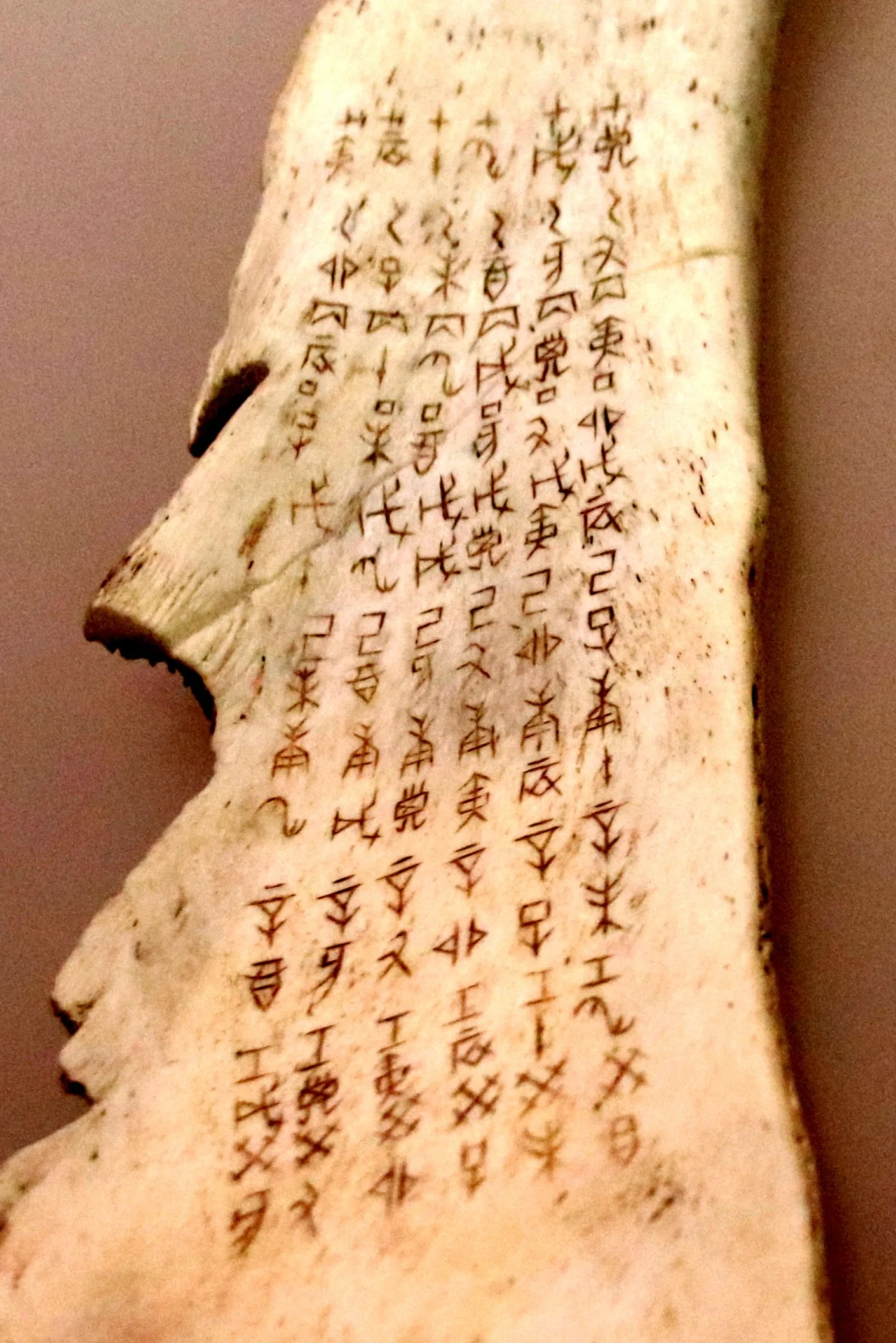
The table of the 60 pairs on an oracle bone
Read from right to left and top to bottom. There are six columns of ten pairs, and each column begins with the stem 甲. Top right is 甲子, the first column ends at the bottom with 癸酉, the second begins with 甲戌. A scribe probably made the table as a reference for naming the days correctly.
Table of the 60 pairs 干支表, ox scapula, late Shang, first half of the 11th century BC, Huáng 黄 diviner group under the last two Shang kings, catalogue 甲骨文合集 no. 37986. Photo: Gary Lee Todd, taken in 2018 at the Yinxu Museum in Anyang, cropped by Kanguole, Wikimedia Commons, public domain (CC0).
Where the heavenly stems and earthly branches come from: oracle bones to today
Stems and branches are older than any Chinese book. They appear in China’s oldest writing, and they have never been abolished since. Four stages:
13th to 11th century BC
Shang dynasty: the days
At Yinxu near Anyang, the last Shang capital, diviners consulted the ancestors for the king. They carved the question into ox bones and turtle shells, heated them and read the cracks. Almost every inscription begins with the day, written as a stem and a branch. The week had ten days, from 甲 to 癸, and on every 癸 day they asked whether the next ten days would pass without disaster: 旬亡祸 xún wáng huò.
720 BC
The Spring and Autumn Annals: no gap since
The chronicle of the state of Lu 春秋 notes for the third year of Duke Yin: “In the second month, on the day 己巳, the sun was eclipsed.” Count the 60-day cycle back from today and you land exactly on 己巳, 22 February 720 BC. The count of days has run on without a break ever since, for more than 2,700 years.
Han dynasty, 206 BC to AD 220
Years too
From the 2nd century BC the years were counted in the 60-cycle as well. The oldest evidence is a silk manuscript from the Mawangdui tomb, sealed in 168 BC. Under the Han the year count became routine in government. Months and double hours followed, and with them the four pillars of fortune-tellers.
Today
In the calendar and in history
Every Chinese wall calendar gives the day as a stem and a branch. 2026 is a 丙午 year, the Year of the Fire Horse, 2027 a 丁未 year, the Year of the Fire Goat. Events carry the name of their year, such as the 1911 Revolution 辛亥革命.
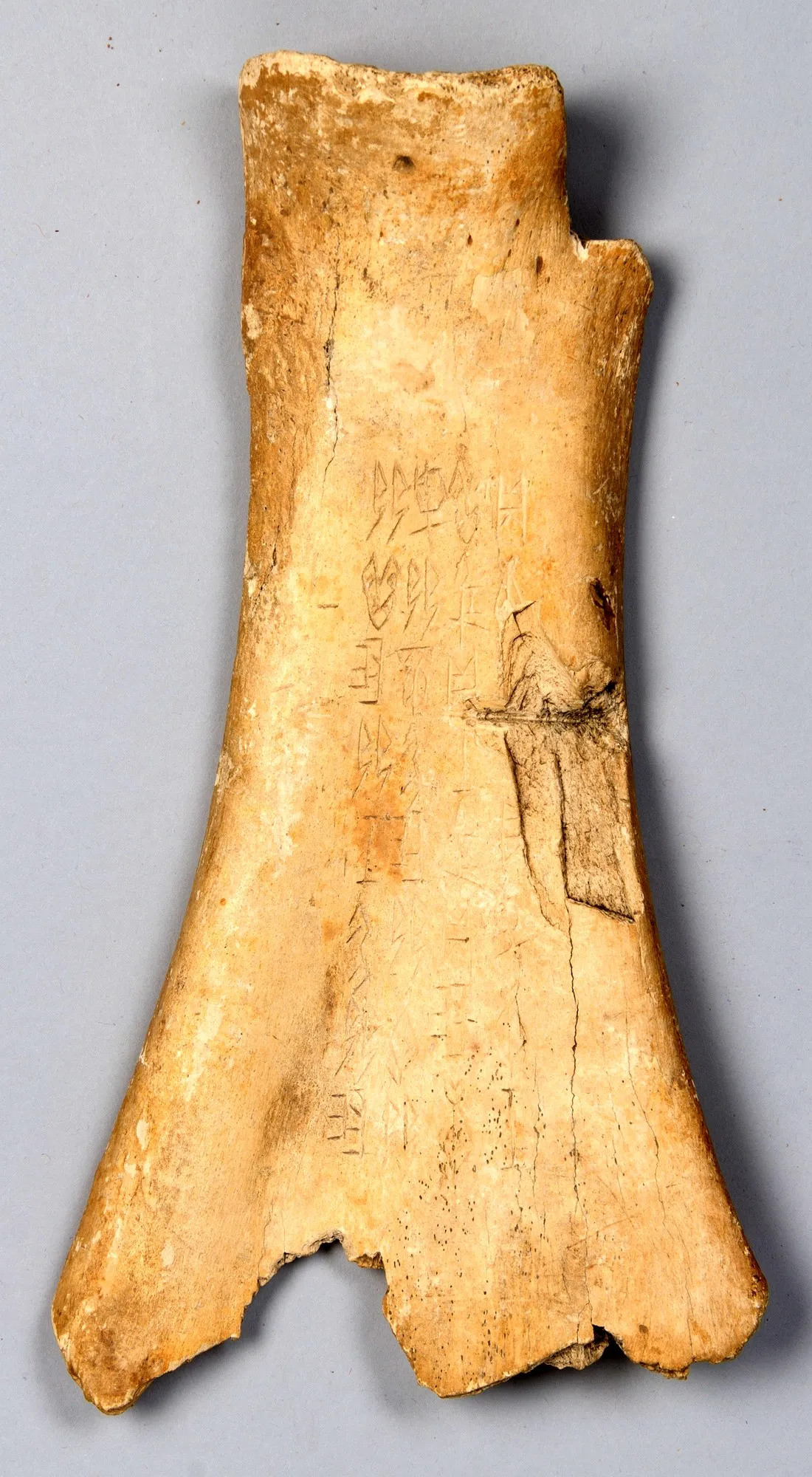
A Shang oracle bone in New York
This piece of bone is 23.5 centimetres long and came to the Metropolitan Museum of Art as a gift in 1967. The fine characters run in vertical columns from top to bottom. The museum does not give a reading of the inscription.
A typical oracle text begins like 癸酉卜,贞, “On the day 癸酉, divined, asked:”. Then comes the question to the ancestors, about rain, the harvest, a campaign or the next ten days. Without the day signs, these inscriptions could not be put in order today.
Oracle bone, Shang dynasty (ca. 1600–1046 BC). Inscribed bone, 23.5 × 12.7 cm. The Metropolitan Museum of Art, New York, Gift of Paul E. Manheim, 1967, accession no. 67.43.16, public domain (CC0).
The ten heavenly stems chart: element, yin and yang
The ten heavenly stems 天干 were first simply the names of the ten days of a week. Later each pair of stems was given one of the five elements: a yang stem, strong and outgoing, and a yin stem, soft and inward. Five times two makes ten. 甲 is the tall tree, 乙 the grass that bends in the wind, 丙 the sun, 丁 the flame of a candle. How the elements feed and check each other is on our page about the five elements.
| Stem | Element | Yin / yang | Image | Direction | Season |
|---|---|---|---|---|---|
| 甲jiǎ | 木 Wood | Yang | 参天之木 · tall tree | 东 east | 春 spring |
| 乙yǐ | 木 Wood | Yin | 花草之木 · flowers and grass | ||
| 丙bǐng | 火 Fire | Yang | 太阳之火 · the sun | 南 south | 夏 summer |
| 丁dīng | 火 Fire | Yin | 灯烛之火 · lamp and candle | ||
| 戊wù | 土 Earth | Yang | 城墙之土 · city wall, mountain | 中 centre | 长夏 late summer |
| 己jǐ | 土 Earth | Yin | 田园之土 · farmland | ||
| 庚gēng | 金 Metal | Yang | 刀斧之金 · axe and sword | 西 west | 秋 autumn |
| 辛xīn | 金 Metal | Yin | 珠玉之金 · jewels and jade | ||
| 壬rén | 水 Water | Yang | 江河之水 · rivers and sea | 北 north | 冬 winter |
| 癸guǐ | 水 Water | Yin | 雨露之水 · rain and dew |
The stem of your birth year: the last digit
You can tell the stem of a year from its last digit. For birthdays in January and February, use the year before if the Chinese year had not yet begun.
- Years ending in4甲
- Years ending in5乙
- Years ending in6丙
- Years ending in7丁
- Years ending in8戊
- Years ending in9己
- Years ending in0庚
- Years ending in1辛
- Years ending in2壬
- Years ending in3癸
Like A, B, C
In China the stems are still used like letters. A contract names its parties 甲方 jiǎfāng and 乙方 yǐfāng, party A and party B. A hospital of the highest grade is a 三甲医院 sānjiǎ yīyuàn, class 3, grade A.
Kings with day names
Shang kings were given a day name after death, the day of their sacrifices. That is why they are called Wu Ding 武丁, Pan Geng 盘庚 or Di Xin 帝辛, the last Shang king. 丁, 庚 and 辛 are heavenly stems.
The twelve earthly branches chart: animal, double hour, month and direction
The twelve earthly branches 地支 divide a circle into twelve, whether it is the day, the year or the horizon. Each branch has an animal, a double hour, a month, a compass direction and an element. If you know your Chinese zodiac sign, you already know your branch: the Horse is 午, the Goat 未.
| Branch | Animal | Element | Yin / yang | Double hour | Month | Begins in 2027 on | Direction |
|---|---|---|---|---|---|---|---|
| 子zǐ | 鼠 Rat | 水 Water | Yang | 23–1 | 十一月大雪 · 冬至 | 7 Dec | north |
| 丑chǒu | 牛 Ox | 土 Earth | Yin | 1–3 | 十二月小寒 · 大寒 | 5 Jan | north-northeast |
| 寅yín | 虎 Tiger | 木 Wood | Yang | 3–5 | 正月立春 · 雨水 | 4 Feb | east-northeast |
| 卯mǎo | 兔 Rabbit | 木 Wood | Yin | 5–7 | 二月惊蛰 · 春分 | 6 Mar | east |
| 辰chén | 龙 Dragon | 土 Earth | Yang | 7–9 | 三月清明 · 谷雨 | 5 Apr | east-southeast |
| 巳sì | 蛇 Snake | 火 Fire | Yin | 9–11 | 四月立夏 · 小满 | 6 May | south-southeast |
| 午wǔ | 马 Horse | 火 Fire | Yang | 11–13 | 五月芒种 · 夏至 | 6 Jun | south |
| 未wèi | 羊 Goat | 土 Earth | Yin | 13–15 | 六月小暑 · 大暑 | 7 Jul | south-southwest |
| 申shēn | 猴 Monkey | 金 Metal | Yang | 15–17 | 七月立秋 · 处暑 | 8 Aug | west-southwest |
| 酉yǒu | 鸡 Rooster | 金 Metal | Yin | 17–19 | 八月白露 · 秋分 | 8 Sept | west |
| 戌xū | 狗 Dog | 土 Earth | Yang | 19–21 | 九月寒露 · 霜降 | 8 Oct | west-northwest |
| 亥hài | 猪 Pig | 水 Water | Yin | 21–23 | 十月立冬 · 小雪 | 7 Nov | north-northwest |
The months are solar months. They begin not at the new moon but at one of the 24 solar terms 节气 jiéqì, when the sun reaches a set point on its path. The dates are for 2027, Beijing time, and shift by a day from year to year. The first month 正月 is the Tiger’s and begins at 立春 lìchūn, the start of spring. All 24 terms on one wheel are on our page about the Chinese lunar calendar.
Double hours and the word for hour
The day has twelve double hours 时辰 shíchen, each two of our hours long. The hour of the Rat 子时 begins at 11 pm, the noon hour 午时 runs from 11 am to 1 pm. Each double hour had a first half 初 chū and a second 正 zhèng. Half a double hour was called 小时辰, little double hour, and that became 小时 xiǎoshí, today’s word for hour.
Noon is 午
上午 shàngwǔ means morning, literally “before 午”, 下午 xiàwǔ afternoon, 中午 zhōngwǔ noon and 午饭 wǔfàn lunch. You will hear these words every day in China, on timetables, opening-hours signs and in every restaurant.
Ordered by direction, season and yin-yang
Through the five elements, stems and branches hang on the same orders. Earth has a special place: it is the centre and the passage between the seasons. That is why 辰, 未, 戌 and 丑, the earth branches, each stand at the end of a season.
| Direction | Stems | Branches |
|---|---|---|
| 东 east | 甲乙 | 寅卯 |
| 南 south | 丙丁 | 巳午 |
| 西 west | 庚辛 | 申酉 |
| 北 north | 壬癸 | 亥子 |
| 中 centre | 戊己 | 辰戌丑未 |
| Season | Stems | Branches |
|---|---|---|
| 春 spring | 甲乙 | 寅卯辰 |
| 夏 summer | 丙丁 | 巳午未 |
| 秋 autumn | 庚辛 | 申酉戌 |
| 冬 winter | 壬癸 | 亥子丑 |
| 四季 Transition | 戊己 | 辰未戌丑 |
| Yin and yang | Stems | Branches |
|---|---|---|
| 阳 Yang | 甲丙戊庚壬 | 子寅辰午申戌 |
| 阴 Yin | 乙丁己辛癸 | 丑卯巳未酉亥 |
The Chinese compass: 24 directions of 15 degrees
On the feng shui master’s compass 罗盘 luópán, stems and branches divide the horizon into 24 directions 二十四山. The twelve branches give the main directions, 子 is north and 午 south. Between them are eight stems and, for the corners, four trigrams from the Book of Changes: 乾, 坤, 艮 and 巽. 戊 and 己 are missing, because they belong to the centre, and the centre has no direction.
Because north is 子 and south is 午, the meridian, the north–south line, is called 子午线 zǐwǔxiàn in Chinese. Like old Chinese maps, the drawing has south at the top.
The sexagenary cycle 六十甲子: why there are only 60 pairs
Stem and branch run side by side like two gear wheels, one with 10 teeth and one with 12. Each day both move on by one: 甲子, 乙丑, 丙寅 and so on. After 10 steps the stem is back at 甲, but the branch is only at the eleventh, so 甲戌. Only after 60 steps are both back at the start, because 60 is the smallest number divisible by both 10 and 12.
Why not 10 times 12, which is 120? Because yang always meets yang and yin meets yin. 甲 and 子 are both yang, and since both always move together, a yang stem never sits beside a yin branch. So there is no 甲丑. Of 120 possible pairs, exactly half occur.
All 60 pairs and their years
Read column by column, each starting with 甲, as on the oracle bone above. 2026 and 2027 are highlighted. The years begin at Chinese New Year.
- 1甲子jiǎ zǐ19241984
- 2乙丑yǐ chǒu19251985
- 3丙寅bǐng yín19261986
- 4丁卯dīng mǎo19271987
- 5戊辰wù chén19281988
- 6己巳jǐ sì19291989
- 7庚午gēng wǔ19301990
- 8辛未xīn wèi19311991
- 9壬申rén shēn19321992
- 10癸酉guǐ yǒu19331993
- 11甲戌jiǎ xū19341994
- 12乙亥yǐ hài19351995
- 13丙子bǐng zǐ19361996
- 14丁丑dīng chǒu19371997
- 15戊寅wù yín19381998
- 16己卯jǐ mǎo19391999
- 17庚辰gēng chén19402000
- 18辛巳xīn sì19412001
- 19壬午rén wǔ19422002
- 20癸未guǐ wèi19432003
- 21甲申jiǎ shēn19442004
- 22乙酉yǐ yǒu19452005
- 23丙戌bǐng xū19462006
- 24丁亥dīng hài19472007
- 25戊子wù zǐ19482008
- 26己丑jǐ chǒu19492009
- 27庚寅gēng yín19502010
- 28辛卯xīn mǎo19512011
- 29壬辰rén chén19522012
- 30癸巳guǐ sì19532013
- 31甲午jiǎ wǔ19542014
- 32乙未yǐ wèi19552015
- 33丙申bǐng shēn19562016
- 34丁酉dīng yǒu19572017
- 35戊戌wù xū19582018
- 36己亥jǐ hài19592019
- 37庚子gēng zǐ19602020
- 38辛丑xīn chǒu19612021
- 39壬寅rén yín19622022
- 40癸卯guǐ mǎo19632023
- 41甲辰jiǎ chén19642024
- 42乙巳yǐ sì19652025
- 43丙午bǐng wǔ19662026now
- 44丁未dīng wèi19672027next
- 45戊申wù shēn19682028
- 46己酉jǐ yǒu19692029
- 47庚戌gēng xū19702030
- 48辛亥xīn hài19712031
- 49壬子rén zǐ19722032
- 50癸丑guǐ chǒu19732033
- 51甲寅jiǎ yín19742034
- 52乙卯yǐ mǎo19752035
- 53丙辰bǐng chén19762036
- 54丁巳dīng sì19772037
- 55戊午wù wǔ19782038
- 56己未jǐ wèi19792039
- 57庚申gēng shēn19802040
- 58辛酉xīn yǒu19812041
- 59壬戌rén xū19822042
- 60癸亥guǐ hài19832043
60 years: once round the circle
At 60 you have been once round the cycle and live through your birth year again. This is 花甲 huājiǎ, and the 60th birthday is a big celebration in China. In Japan it is 還暦 kanreki, “return of the calendar”, and the birthday person is given something red.
History named by years
Many events in Chinese history are named after their year in the cycle:
- 甲午1894First Sino-Japanese War 甲午战争
- 戊戌1898Hundred Days’ Reform 戊戌变法
- 庚子1900Boxer Rebellion, in Chinese 庚子事变
- 辛亥1911Revolution, end of the empire 辛亥革命
Earthly branch relations: 六合, 三合, 六冲 and more
Fortune-tellers set stems and branches in relation to each other, mostly by their place on the circle. Pairs that “combine” 合 hé count as harmonious, pairs that “clash” 冲 chōng as opposites. These rules decide which Chinese zodiac animals match. Pick a kind of relation and tap a branch.
Branches six steps apart sit directly opposite each other.
Tap a branch to see all its relations.
- 六合 six pairswith→ becomes Earth
- 三合 trineswith→ becomes Fire
- 三会 seasonswith→ becomes Fire
- 六冲 clasheswith
- 六害 harmswith
- 六破 breakswith
- 自刑 punishes itselfwithitself
The stems: five combinations and four clashes
天干五合: one yang and one yin stem each
- 甲 己Yang Wood + Yin Earth→ becomes Earth 土
- 乙 庚Yin Wood + Yang Metal→ becomes Metal 金
- 丙 辛Yang Fire + Yin Metal→ becomes Water 水
- 丁 壬Yin Fire + Yang Water→ becomes Wood 木
- 戊 癸Yang Earth + Yin Water→ becomes Fire 火
天干四冲: metal against wood, water against fire
- 甲 ⟷ 庚庚金克甲木 · Yang
- 乙 ⟷ 辛辛金克乙木 · Yin
- 丙 ⟷ 壬壬水克丙火 · Yang
- 丁 ⟷ 癸癸水克丁火 · Yin
戊 and 己 are not among the four clashes. Not every pair where one element controls the other counts.
The branches: every relation at a glance
六合 liùhé · six pairs
- 子丑Rat · OxEarth
- 寅亥Tiger · PigWood
- 卯戌Rabbit · DogFire
- 辰酉Dragon · RoosterMetal
- 巳申Snake · MonkeyWater
- 午未Horse · GoatEarth
三合 sānhé · trines
- 申子辰Monkey · Rat · DragonWater
- 亥卯未Pig · Rabbit · GoatWood
- 寅午戌Tiger · Horse · DogFire
- 巳酉丑Snake · Rooster · OxMetal
三会 sānhuì · seasons
- 寅卯辰Tiger · Rabbit · DragonWoodspring, east
- 巳午未Snake · Horse · GoatFiresummer, south
- 申酉戌Monkey · Rooster · DogMetalautumn, west
- 亥子丑Pig · Rat · OxWaterwinter, north
六冲 liùchōng · clashes
- 子午Rat · Horse
- 丑未Ox · Goat
- 寅申Tiger · Monkey
- 卯酉Rabbit · Rooster
- 辰戌Dragon · Dog
- 巳亥Snake · Pig
六害 liùhài · harms
- 子未Rat · Goat
- 丑午Ox · Horse
- 寅巳Tiger · Snake
- 卯辰Rabbit · Dragon
- 申亥Monkey · Pig
- 酉戌Rooster · Dog
六破 liùpò · breaks
- 子酉Rat · Rooster
- 丑辰Ox · Dragon
- 寅亥Tiger · Pig
- 卯午Rabbit · Horse
- 巳申Snake · Monkey
- 未戌Goat · Dog
三刑 sānxíng · punishments
- 寅巳申Tiger · Snake · Monkey无恩之刑 · ungrateful punishment
- 丑戌未Ox · Dog · Goat恃势之刑 · punishment of power
- 子卯Rat · Rabbit无礼之刑 · rude punishment
- 辰 午 酉 亥Dragon, Horse, Rooster, PigSelf-punishment 自刑
Two caveats from the teaching itself: a combination 合 does not mean the elements actually transform, the books set their own conditions for that. And some pairs appear in more than one list, 寅亥 for example is both 六合 and 六破. For 午未 some books give fire instead of earth. The names of the three punishments come from the 三命通会. All of this is tradition, not a forecast. Which zodiac animals match by these rules is on the animal pages, for example the Horse and the Goat.
BaZi calculator: your Four Pillars of Destiny 八字
Chinese fortune-tellers write a moment of birth as four pairs: year, month, day and hour. These are the four pillars 四柱 sìzhù, in English often the Four Pillars of Destiny, eight characters in all, hence the name BaZi 八字 bāzì. Tradition says that under the Tang, Li Xuzhong 李虚中 still worked with three pillars. In the 10th century Xu Ziping 徐子平 added the hour and made the stem of the birth day the centre, the “day master” 日主 rìzhǔ. The method is named 子平 zǐpíng after him.
渊海子平yuānhǎi zǐpíng
The “Deep Sea of Ziping” goes back to the Song dynasty and sums up Xu Ziping’s method: the four pillars, the ten gods, the relations of the branches. Almost every later book builds on it.
三命通会sānmìng tōnghuì
The “Complete Book of the Three Fates” was written by the Ming scholar Wan Minying 万民英 in the 16th century. It is the great reference work of fortune-tellers, with examples for every day and every hour. The names of the three punishments above come from it.
The calculator shows how the eight characters come about. Year and month do not change at Chinese New Year but at the solar terms: the year begins at 立春, around 4 February. The day changes at 11 pm with the hour of the Rat. We calculated the moments of the solar terms astronomically.
Your 8 characters: 乙丑 壬午 乙酉 辛巳
- Year年柱比肩 Shoulder to Shoulder乙yǐ · Wood yin丑chǒu · Ox偏财 Indirect Wealth
- Month月柱正印 Direct Seal壬rén · Water yang午wǔ · Horse食神 Eating God
- Day日柱Day master 日主乙yǐ · Wood yin酉yǒu · Rooster七杀 Seven Killings
- Hour时柱七杀 Seven Killings辛xīn · Metal yin巳sì · Snake伤官 Hurting Officer
Elements in your pillars
- 木Wood2
- 火Fire2
- 土Earth1
- 金Metal2
- 水Water1
All five elements are there.
- The month began with the solar term 芒种 on 5 June 1985 at 19:00.
- Summer time was in force. Day and hour are counted from standard time, 09:30.
We show the arithmetic, not a reading. Many fortune-tellers also use the true solar time at the place of birth, which can shift the hour. The calculator covers birthdays from 1924 to 2045.
The ten gods 十神 in BaZi: names for feeding and controlling
In the calculator each character carries a name such as 正官 or 食神. These are the ten gods 十神 shíshén. They have nothing to do with gods in a religious sense. They are names for the five relations of the elements, seen from the day master, each in a version with the same and one with the opposite polarity. Five times two makes ten again.
| Seen from the day master | Same polarity | Opposite polarity | What it stands for |
|---|---|---|---|
| same element | 比肩bǐjiān · Shoulder to Shoulder | 劫财jiécái · Rob Wealth | siblings, friends, rivals |
| I feed it | 食神shíshén · Eating God | 伤官shāngguān · Hurting Officer | expression, talent, enjoyment. In the old books also a woman’s children. |
| I control it | 偏财piāncái · Indirect Wealth | 正财zhèngcái · Direct Wealth | money and property. In the old books also a man’s wife. |
| it controls me | 七杀qīshā · Seven Killings | 正官zhèngguān · Direct Officer | superiors, the law, pressure. In the old books also a woman’s husband. |
| it feeds me | 偏印piānyìn · Indirect Seal | 正印zhèngyìn · Direct Seal | mother, learning, protection |
Why these names?
- 官 officer
- What controls me is like authority. When the control is too harsh it is called 七杀, “seven killings”: counted from the stem 甲, 庚 is the seventh.
- 伤官 hurting officer
- What I produce controls what controls me. For wood that is fire, and fire melts metal.
- 印 seal
- What feeds me is like the seal of office that supports the official. Hence 官印相生, officer and seal support each other.
- 财 wealth
- What I control I can take for myself. 劫财, “rob wealth”, is my own element reaching for the same wealth.
- 食神 eating god
- What I produce in turn feeds my wealth. So it stands for prosperity, enjoyment and a good living.
The ten gods for every day master
Find the row of your day stem. Each column shows which god every other stem is for you. For a branch, its main stem counts, for 子 that is 癸.
| Day master | 甲 | 乙 | 丙 | 丁 | 戊 | 己 | 庚 | 辛 | 壬 | 癸 |
|---|---|---|---|---|---|---|---|---|---|---|
| 甲 | 比肩 | 劫财 | 食神 | 伤官 | 偏财 | 正财 | 七杀 | 正官 | 偏印 | 正印 |
| 乙 | 劫财 | 比肩 | 伤官 | 食神 | 正财 | 偏财 | 正官 | 七杀 | 正印 | 偏印 |
| 丙 | 偏印 | 正印 | 比肩 | 劫财 | 食神 | 伤官 | 偏财 | 正财 | 七杀 | 正官 |
| 丁 | 正印 | 偏印 | 劫财 | 比肩 | 伤官 | 食神 | 正财 | 偏财 | 正官 | 七杀 |
| 戊 | 七杀 | 正官 | 偏印 | 正印 | 比肩 | 劫财 | 食神 | 伤官 | 偏财 | 正财 |
| 己 | 正官 | 七杀 | 正印 | 偏印 | 劫财 | 比肩 | 伤官 | 食神 | 正财 | 偏财 |
| 庚 | 偏财 | 正财 | 七杀 | 正官 | 偏印 | 正印 | 比肩 | 劫财 | 食神 | 伤官 |
| 辛 | 正财 | 偏财 | 正官 | 七杀 | 正印 | 偏印 | 劫财 | 比肩 | 伤官 | 食神 |
| 壬 | 食神 | 伤官 | 偏财 | 正财 | 七杀 | 正官 | 偏印 | 正印 | 比肩 | 劫财 |
| 癸 | 伤官 | 食神 | 正财 | 偏财 | 正官 | 七杀 | 正印 | 偏印 | 劫财 | 比肩 |
Where you meet stems and branches in China
In the calendar
Chinese tear-off calendars and the traditional almanac 黄历 huánglì give the stem and branch of every day, with what the day is good for 宜 and what to avoid 忌. Many couples choose their wedding date by it.
At the hospital
If you fall seriously ill in China, ask for a 三甲医院 sānjiǎ yīyuàn: class 3, grade 甲, the highest level. More on our page about health and medication.
In the Forbidden City
In front of the Hall of Supreme Harmony 太和殿 in Beijing’s Forbidden City stands a stone sundial 日晷 rìguǐ. The twelve double hours are carved into its face, and the shadow of the rod shows the hour. More about the city on our Beijing page.
In your animal’s year
Every twelve years the branch of your birth year comes back. This 本命年 běnmìngnián is thought to be a tricky year, and people wear something red. More on our page about Chinese New Year 2027.
True or false? Eight statements about stems and branches
1Since 10 times 12 is 120, there are 120 stem-branch pairs.
False
There are only 60. Stem and branch always move on together, so a yang stem always sits with a yang branch and a yin stem with a yin branch. 甲丑, for example, never occurs.
2China has counted its days in the 60-cycle without a gap for more than 2,700 years.
True
The Spring and Autumn Annals give the day 己巳 for a solar eclipse. Counting back from today, that is exactly 22 February 720 BC. Not a day has been dropped since.
3The twelve animals are older than the twelve earthly branches.
False
The branches are already on Shang oracle bones, more than 3,000 years ago. The oldest evidence for the animals is bamboo texts from the Qin period in the 3rd century BC.
4For the four pillars, the year begins at Chinese New Year.
False
Fortune-tellers begin the year at the solar term 立春, usually on 4 February. New Year follows the moon and falls between 21 January and 20 February. For everyday zodiac signs, New Year counts.
5The Chinese word for meridian comes from the earthly branches.
True
The meridian is 子午线 zǐwǔxiàn. 子 is the branch of the north, 午 that of the south, so it means the north–south line.
6A 三甲医院 is a third-class hospital, the lowest grade.
False
In the Chinese system class 3 is the highest, and 甲, the first stem, is the best grade. A 三甲医院 is a large hospital of the top level.
7The kings of the Shang dynasty had heavenly stems in their names.
True
After death they were given a day name, the day of their sacrifices: Wu Ding 武丁, Pan Geng 盘庚, Di Xin 帝辛. The stem stood for one day of the ten-day week.
8When two branches clash 冲, it brings bad luck.
No evidence
冲 is a fortune-teller’s category, not an observation. Even the old books never judge a single pair, only the whole horoscope, and there a clash can also set things in motion.
FAQ
What are the heavenly stems and earthly branches?
Two series of characters that China has used to count time for more than 3,000 years: ten heavenly stems 天干 from 甲 to 癸 and twelve earthly branches 地支 from 子 to 亥. Together they form 60 pairs that name days, years, months and hours.
Why are there 60 pairs and not 120?
Stem and branch always move on together. After 60 steps both are back at the start, because 60 is the smallest number divisible by 10 and 12. A yang stem only ever meets yang branches and a yin stem yin branches, so it is exactly half of 120.
Which pair is the year 2027?
2027 is a 丁未 year, pronounced dīng wèi. The stem 丁 belongs to the element Fire, the branch 未 to the Goat. That makes it the Year of the Fire Goat. 2026 is a 丙午 year.
What is BaZi?
八字 bāzì means “eight characters”: the year, month, day and hour of birth, each as a stem and a branch. Chinese fortune-tellers read the elements and the ten gods from them by the rules of 子平. The calculator on this page shows your eight characters.
How do I calculate my BaZi?
You need the date, time and place of birth. Year and month follow the solar terms, so the year begins at 立春 around 4 February. The day follows the running 60-day cycle, the hour the double hour, and summer time is taken off. The BaZi calculator on this page does this for birthdays from 1924 to 2045 and also shows the ten gods and the elements.
What is the day master in BaZi?
The day master 日主 rìzhǔ is the heavenly stem of your birth day. It stands for you. Every other character of the four pillars is read from it: what feeds it is the seal 印, what controls it the officer 官, what it controls is wealth 财. That is how the ten gods 十神 arise.
What do 六合, 三合 and 六冲 mean?
六合 are six pairs of branches that combine, such as 子 and 丑. 三合 are four triangles of branches four places apart, such as 申, 子 and 辰 for water. 六冲 are six pairs exactly opposite each other on the circle, such as 子 and 午. By these rules zodiac animals count as a good or a difficult match.
Does the year begin at Chinese New Year or on 4 February?
Both are used. For the everyday zodiac sign, Chinese New Year counts, which falls between 21 January and 20 February. For the four pillars of fortune-tellers, the year begins at the solar term 立春, usually on 4 February.
Where will I see stems and branches when travelling in China?
In the calendar, which gives the stem and branch of each day, at top-grade hospitals 三甲医院, in contracts with party 甲 and party 乙, in words like 上午 and 下午 for morning and afternoon, and on the sundial in Beijing’s Forbidden City.
Sources and status
We checked the day count against the record of the eclipse of 720 BC, calculated the solar terms with an astronomy library and compared them with a second, independent one. The calculator agrees with the widely used Chinese calendar library lunar on 3,000 random samples. Correspondences and relations follow the usual Chinese teaching. Where books differ, we say so.
- Wikimedia Commons: Heji 37986 Ganzhi table, with a description after Takashima 2015
- The Metropolitan Museum of Art: Oracle bone, 67.43.16
- Wikisource: 春秋左氏傳·隱公, third year: 己巳,日有食之 (Chinese)
- Wikisource: 三命通會 by Wan Minying (Chinese)
- Wikipedia: Sexagenary cycle, days on oracle bones and years from Mawangdui, 168 BC
- Wikipedia: Heavenly Stems
- Wikipedia: Earthly Branches
- Wikipedia: Four Pillars of Destiny
Changelog (1)
- 2026-11-06Page created, with the relations circle and a four pillars calculator.