
The Great Wall from Beijing
“The Great Wall” near Beijing is half a dozen separate places, an hour or more apart. We have walked three of them — Badaling, Juyongguan and Mutianyu — and spent a morning at the Ming Tombs on the way. This page is about choosing one, getting there, and what a full day looks like.
长城 · Chángchéng · 八达岭 · 居庸关 · 慕田峪 · 明十三陵
By train, or with bad knees
Badaling: its own railway station, the gentlest walkway — and the crowds.
By car, for space
Mutianyu: wooded hills, a cable car, fewer people.
Quiet, with the Ming Tombs
Juyongguan: closest to the city, steepest, emptiest.
Badaling, Juyongguan or Mutianyu?
Tick what matters to you and the section that fits best is marked. The comparison underneath is complete either way. Distances are straight lines from Tiananmen; driving times are without traffic.
What matters to you? Tick what applies.
Tick a box above and the section that fits best is marked.
Badaling 八达岭
The only one you can do by train, and the one to pick if walking steep steps is a problem. Expect crowds.
- From Tiananmen
- 60 km
- By car
- about 54 min without traffic
- By train
- Yes
- Crowds
- Very busy
- Walking
- Broad, moderate slopes
- Cable car
- Yes
- With the Ming Tombs
- Same direction
High-speed trains on the Beijing–Zhangjiakou line from Beijing North or Qinghe stop at Badaling Great Wall station; suburban line S2 stops at the separate Badaling station about 1 km away.
Juyongguan 居庸关
Closest to the city and to the Ming Tombs, and quiet — but the steepest of the three.
- From Tiananmen
- 51 km
- By car
- about 41 min without traffic
- By train
- No
- Crowds
- Quiet
- Walking
- Steep, tall steps
- Cable car
- Not verified
- With the Ming Tombs
- Same direction
No station at the pass.
Mutianyu 慕田峪
The best balance of scenery and space, with a cable car up and a toboggan down. On the other side of Beijing from the Ming Tombs.
- From Tiananmen
- 60 km
- By car
- about 67 min without traffic
- By train
- No
- Crowds
- Busy at weekends
- Walking
- Broad, moderate slopes
- Cable car
- Yes
- With the Ming Tombs
- Opposite side of the city
No railway; tour bus, or a taxi from Huairou.
Further out: Jinshanling, Simatai, Huanghuacheng
Jinshanling and Simatai, further out to the north-east, and Huanghuacheng, where the wall runs down into a reservoir, are the names that come up when people want a wilder or emptier wall. All three are a longer drive than the sections compared above.
Where they are
Badaling and Juyongguan are on the same expressway to the north-west, with the Ming Tombs a short detour off it. Mutianyu is on the other side, to the north-east — which is why it does not combine with the other two. Tap a place to see how far it is from the centre.
Tap a place on the map or in the list.
Changling, Dingling and the Sacred Way, in one valley. Details below ↓
The pass on the way to Badaling: steep and quiet. Details below ↓
A lake near Mutianyu. Details below ↓
The famous section, with its own railway station. Details below ↓
Wooded hills, a cable car and fewer people. Details below ↓
Straight-line distances from Tiananmen, rounded — not driving distances.
The three sections, in our photographs
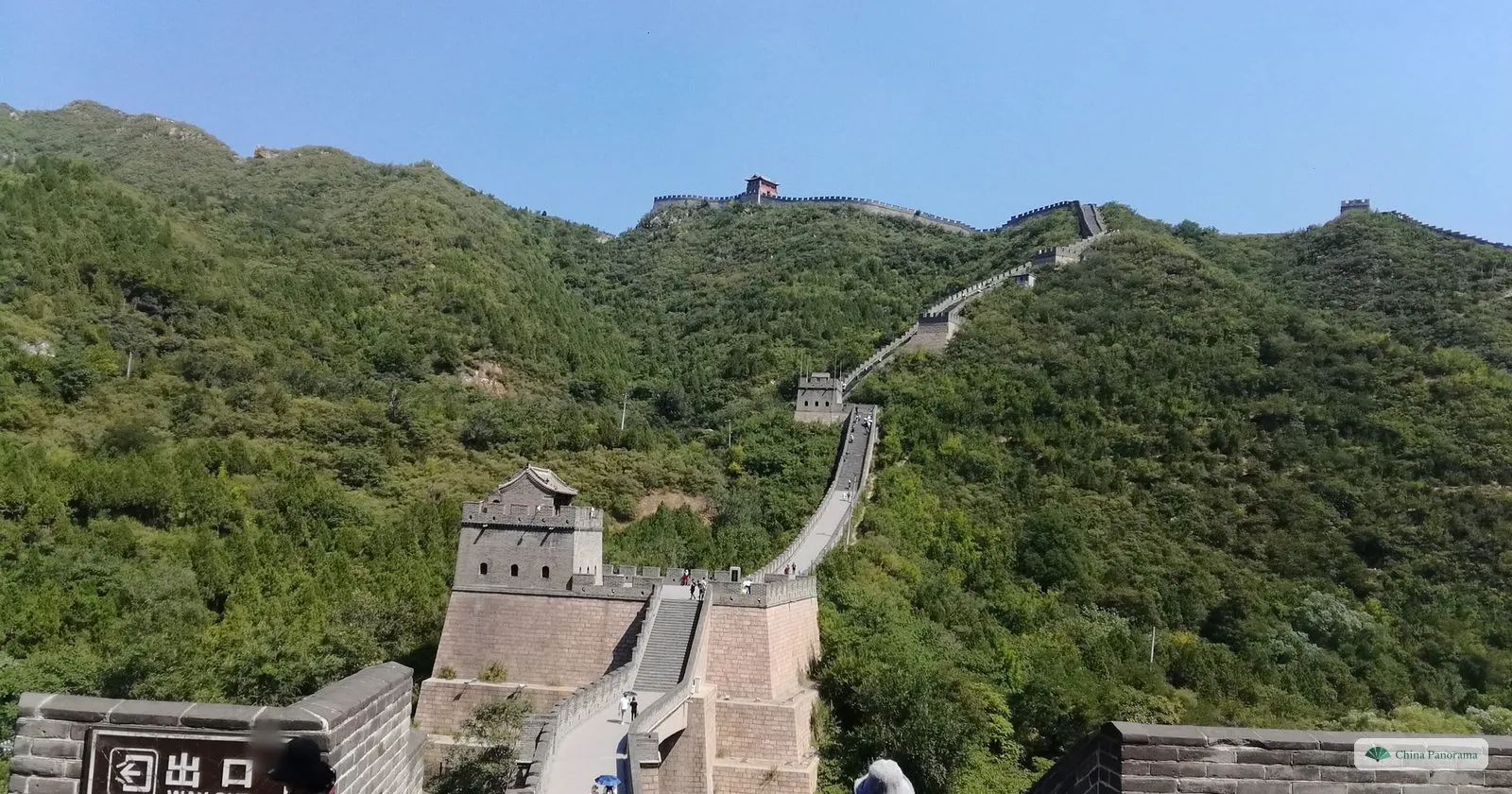
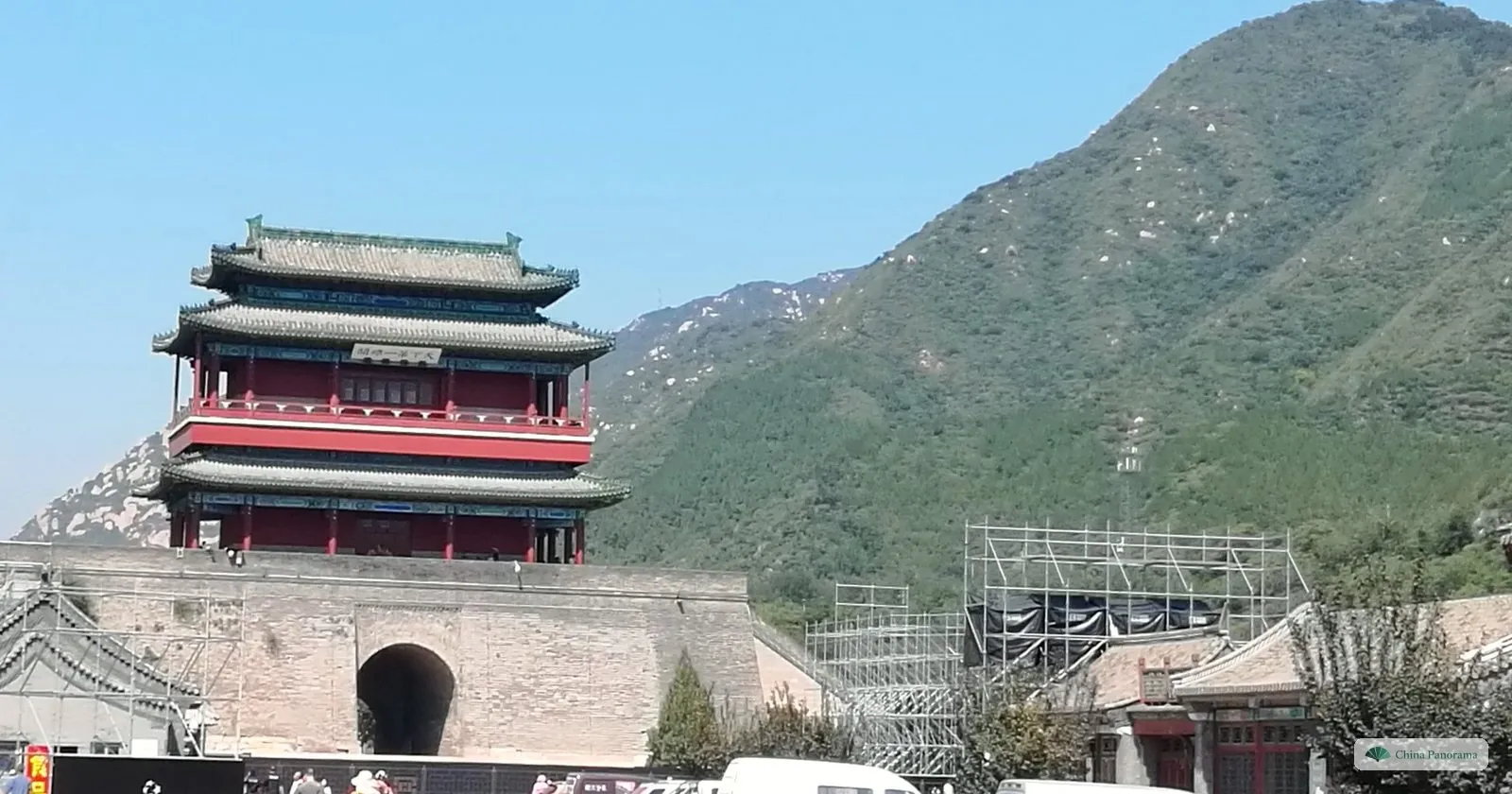
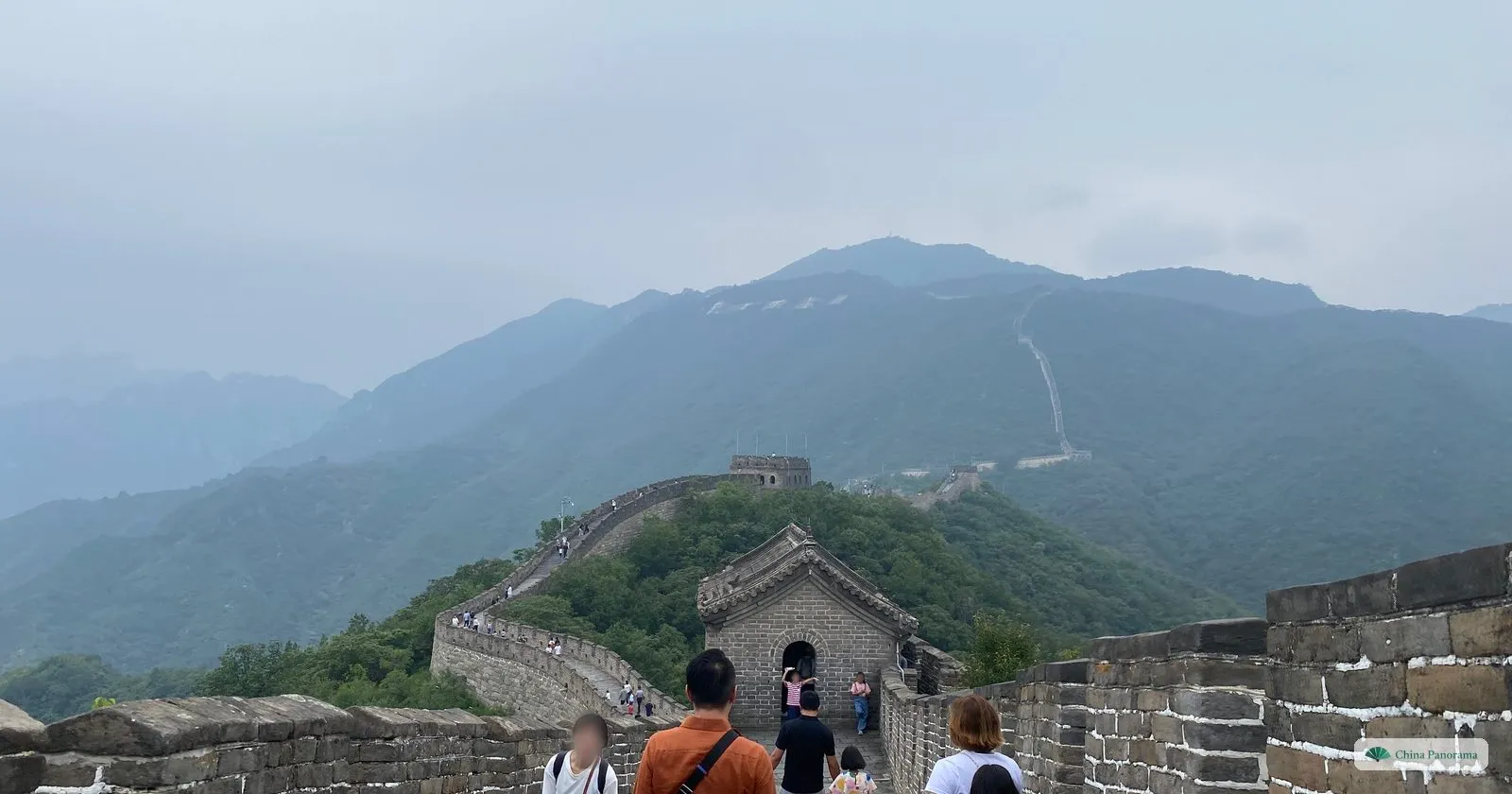
Badaling and Juyongguan on the same September Saturday; Mutianyu on a hazy summer day. The wall itself does not change from year to year — prices, booking rules and trains do, and those are dated below.
Badaling
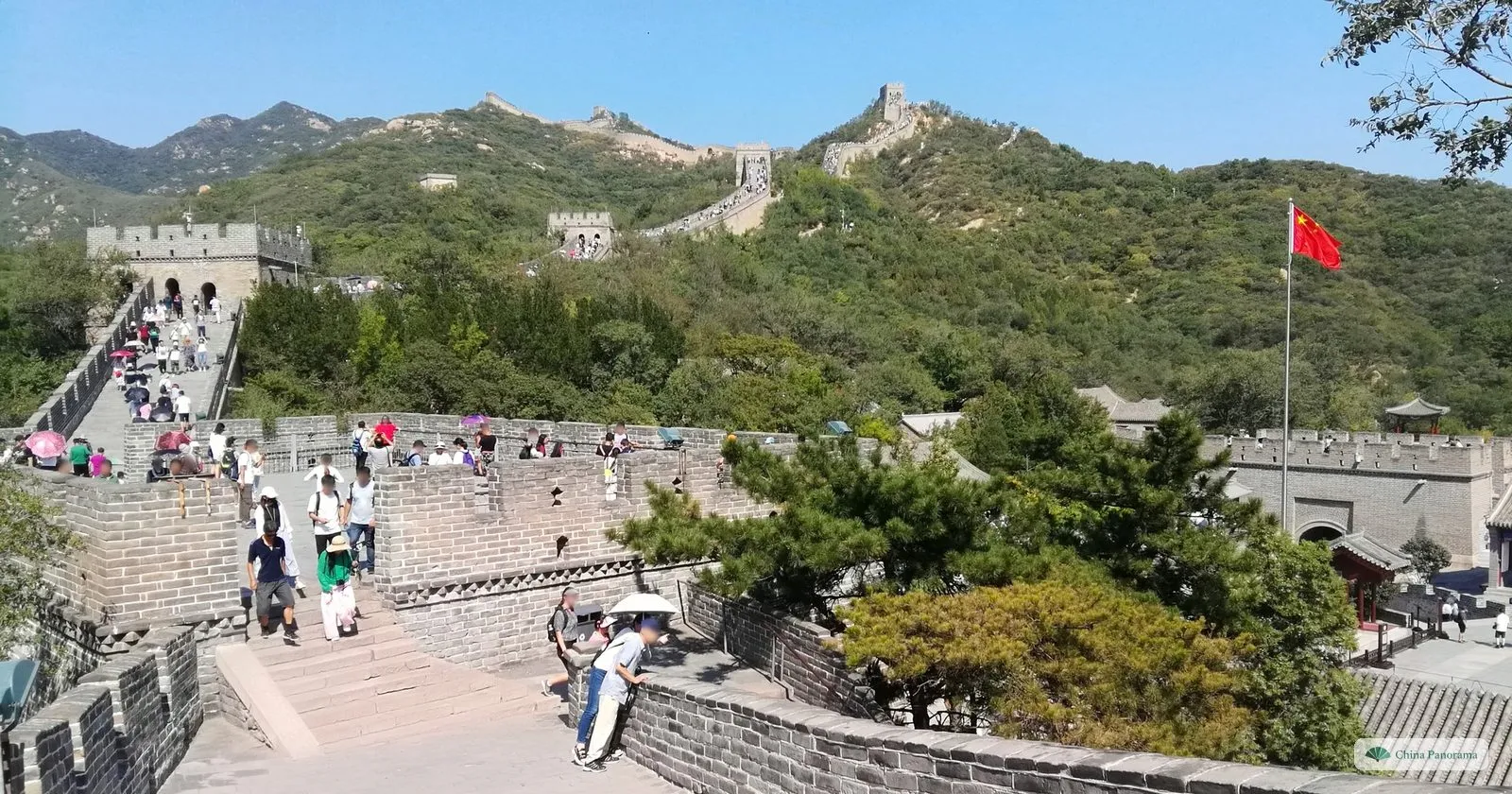
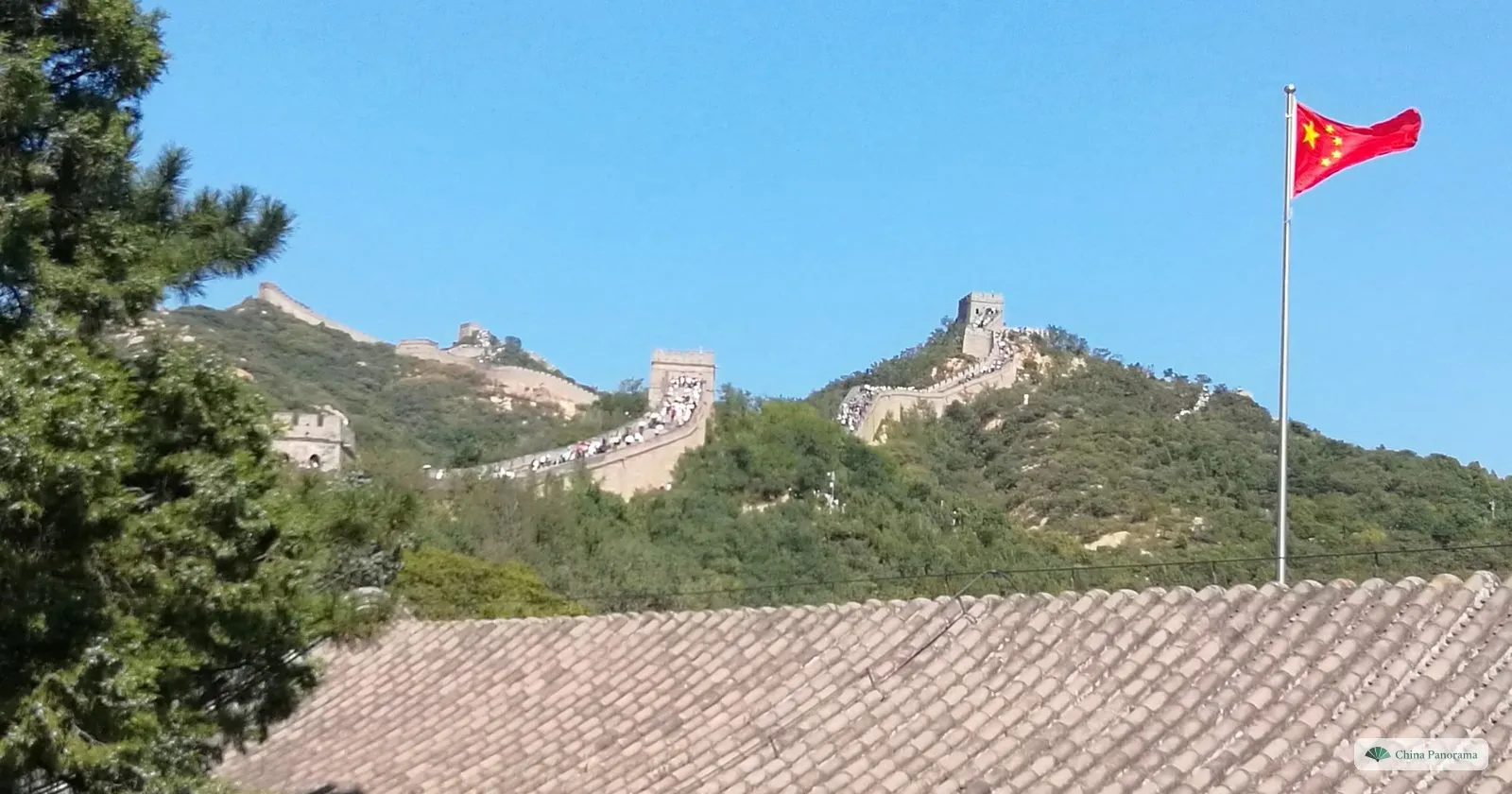
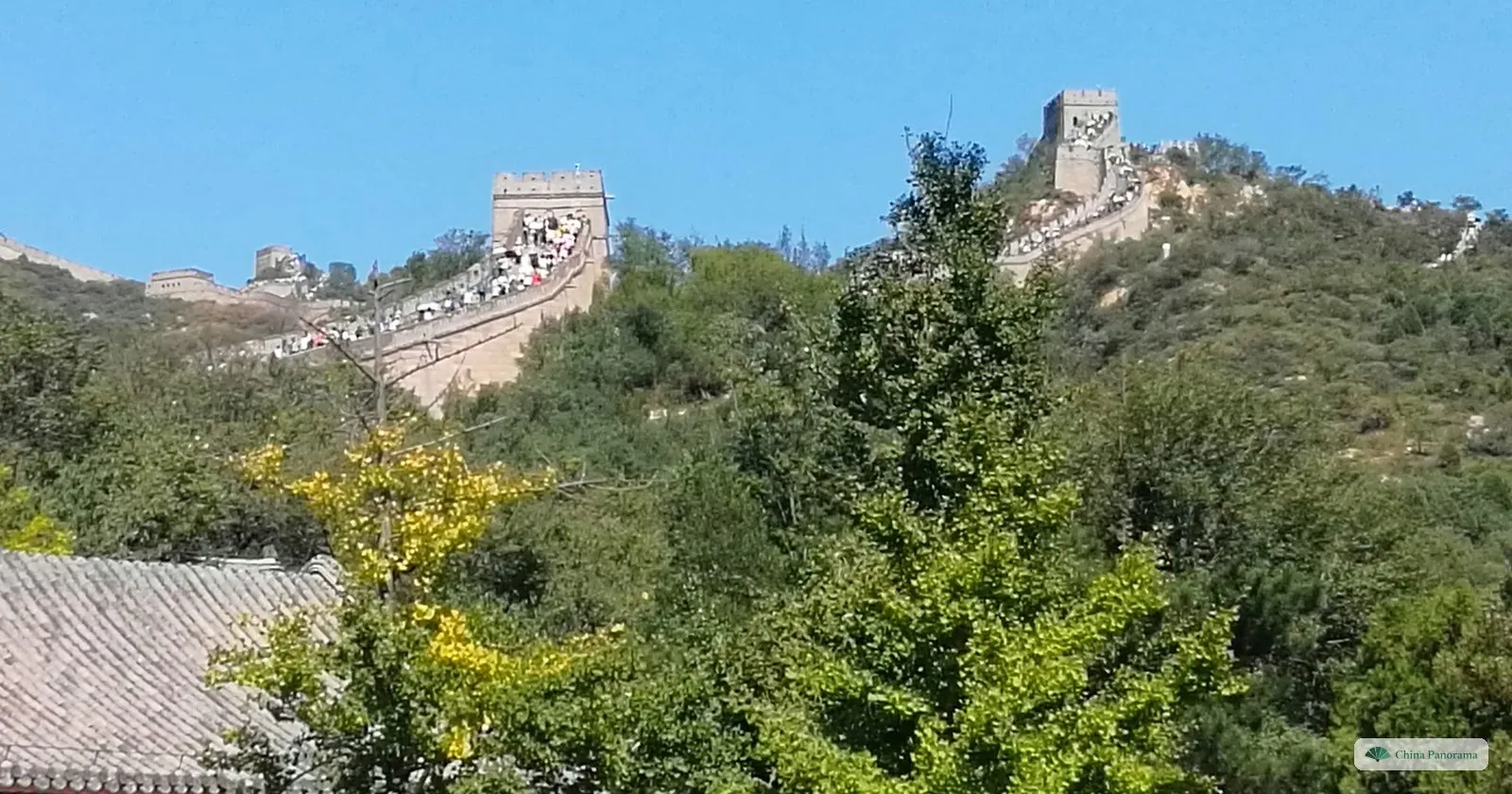
八达岭长城LandmarkYanqing · 延庆区OutdoorsThe section everyone has seen in photographs, and the most visited stretch of wall in the world: broad, fully restored, with towers marching up the ridges on both sides of a pass about 60 km north-west of the centre. It is also the easiest to reach, with its own high-speed railway station. The price is company — we were there on a Saturday in September and the first towers north of the gate were shoulder to shoulder. Walk on: past the third or fourth tower the crowd thins quickly.
Tickets are sold online only, by name and ID, up to seven days ahead; there is no ticket window. Whether the booking accepts a foreign passport without a Chinese phone number is something we have not been able to confirm. From November to March the wall opens 07:30–16:00 and costs 35 CNY.
- Entry
- 40 CNY · April – October; online only
- Opening hours
- 06:30–16:30 (April – October)
- LandmarkChangping · 昌平区Outdoors
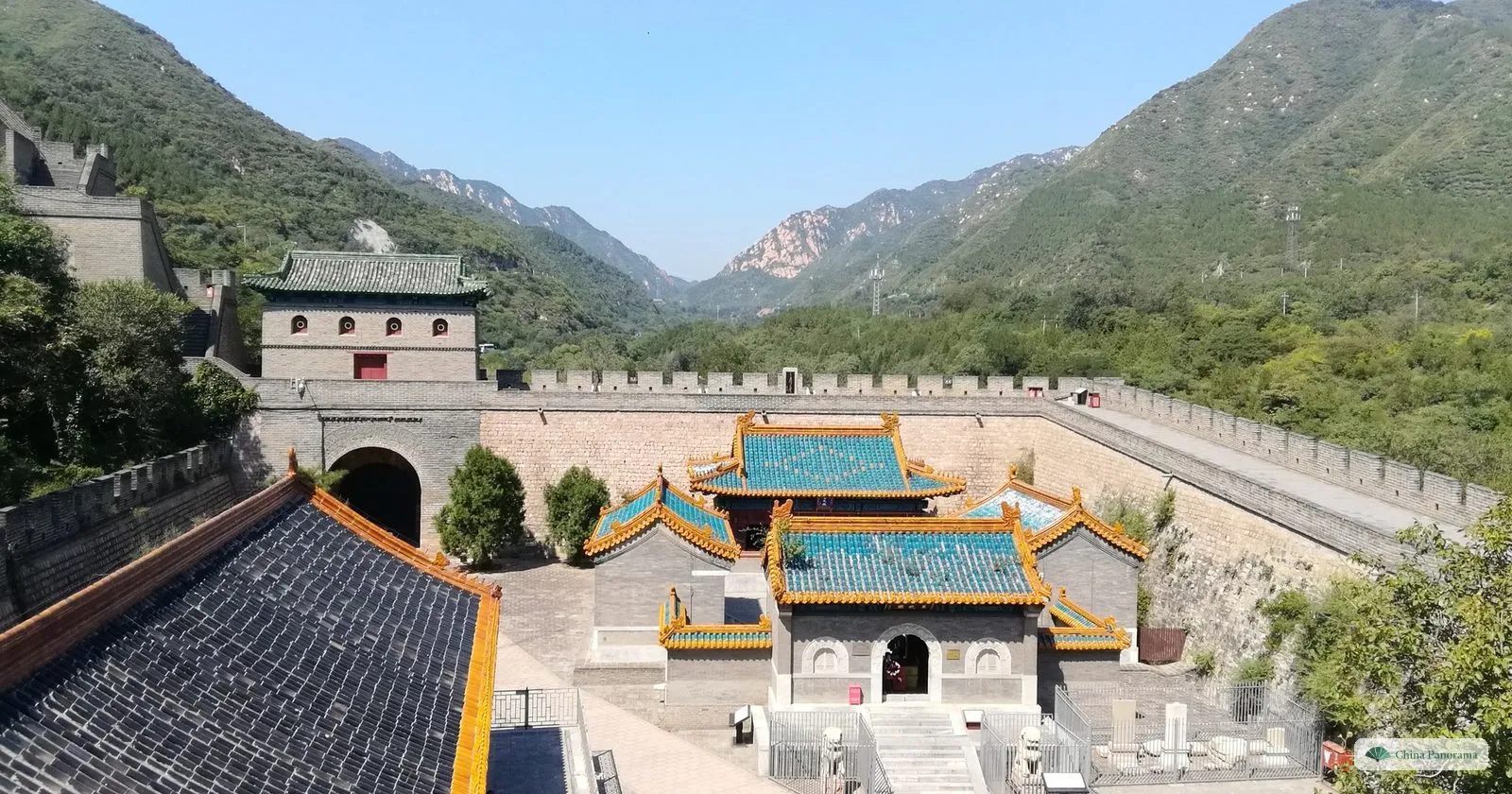
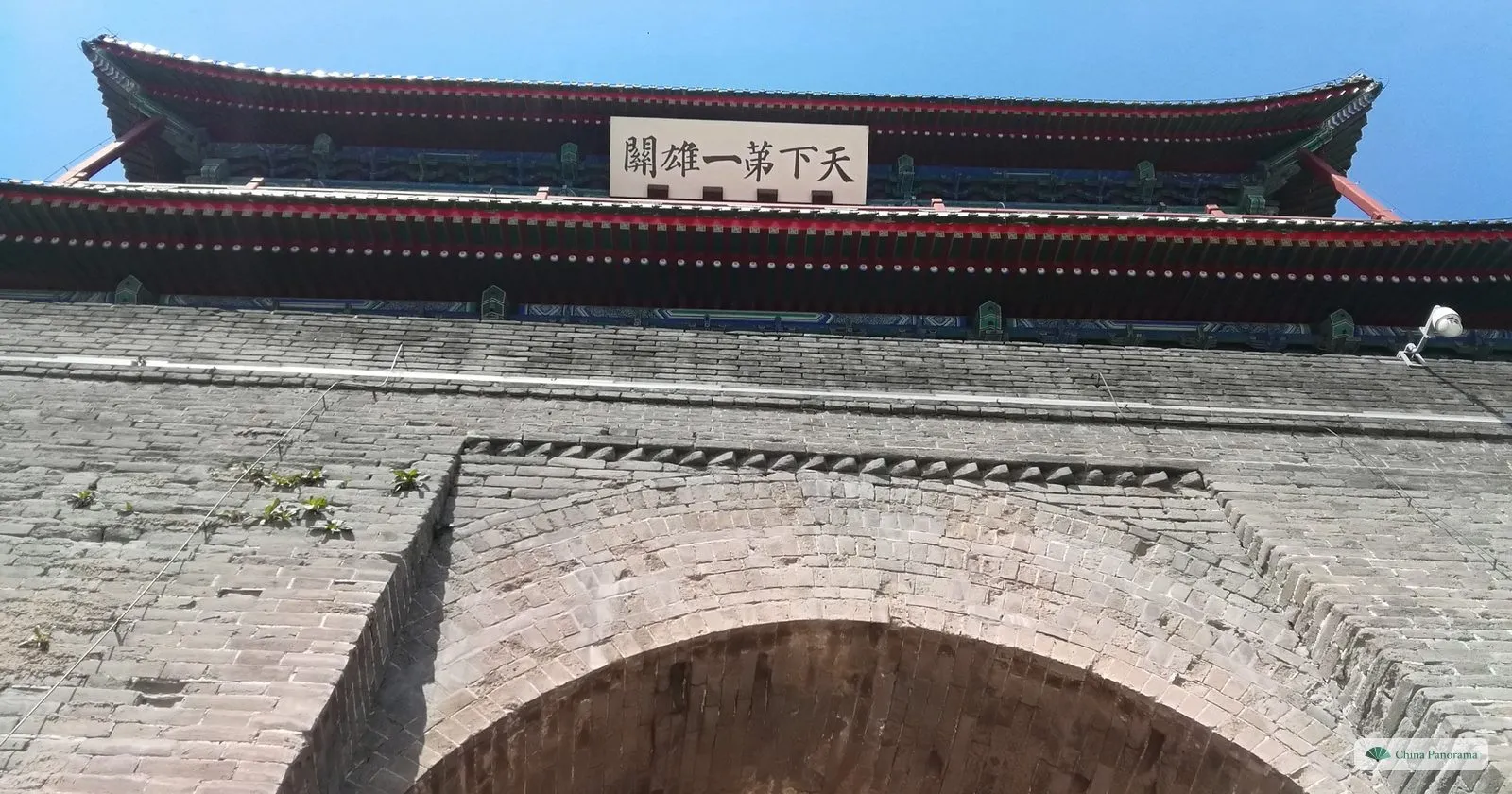
A fortress in a narrow valley, about 50 km from the centre and on the way to Badaling. The wall here is a loop: it climbs steeply out of the valley on both sides, with the gate towers, a temple and the old garrison buildings on the valley floor between. The gate carries the inscription 天下第一雄关, the first mighty pass under heaven. It is steeper than Badaling — long flights of tall, uneven steps — and much quieter: at midday on the same Saturday we had stretches of it to ourselves.
There is no railway station at the pass; people come by car, taxi or tour bus, and we have not checked the public buses. The valley floor, with the gate towers and temple, is worth the stop even if you do not climb.
- Entry
- Price not verified — check on site
- Opening hours
- Hours not verified — check on site
Mutianyu
慕田峪长城LandmarkHuairou · 怀柔区OutdoorsThe section most independent travellers now choose: restored like Badaling, but in wooded hills 60 km north-east of the centre and with fewer visitors, because no railway goes there. The wall runs along a ridge with watchtowers every few hundred metres; on the hillside opposite you can make out huge white characters laid out in stone. We were there on a hazy summer day.
Booking is by name and passport, up to 30 days ahead. A cable car and a chairlift go up to the wall, and a toboggan run comes down; each is charged on top of the entry ticket, and we have not checked the prices. Without a car, the usual way is a tour bus or a taxi from Huairou.
- Entry
- Price not verified — check on site
- Opening hours
- Hours not verified — check on site
Entry prices and opening hours are marked unverified where we have not checked them against an official source.
How to get there
By train — Badaling only
High-speed trains on the Beijing–Zhangjiakou line from Beijing North or Qinghe stop at Badaling Great Wall station; suburban line S2 stops at the separate Badaling station about 1 km away.
Beijing North is at Xizhimen, on subway Lines 2, 4 and 13. For the suburban line: Not the metro: suburban line S2 starts at Huangtudian (change from Line 13 at Huoying). Your credit card works here too.
Timetables, journey times and fares not yet verified — check 12306.
By car with a driver
How we went, and the only way to link several places in a day. Without traffic, OpenStreetMap puts Juyongguan at about 41 minutes from Tiananmen, Badaling at 54 and Mutianyu at 67. Agree the stops and the waiting time before you set off; we have not checked current prices for a day's hire.
By bus or tour
Public and tourist buses run to Badaling and Mutianyu, and every hotel sells day tours. Line numbers and departure points are not verified. If you book a tour, check which section it goes to and whether it includes shopping stops.
Booking the ticket
Badaling: Online only, real-name booking, no on-site ticket sales. Mutianyu: Real-name booking, one ticket per ID per day; ID card, permanent residence card or passport.
From our Golden Week data, checked 12 September 2026.
Are the Ming Tombs worth adding?
With a car, yes. The tombs of thirteen Ming emperors lie in one valley about 45 km north of the city, just off the road to Juyongguan and Badaling, and early in the morning you have them nearly to yourself. Three things are worth the stop: the Sacred Way, Changling and Dingling. The valley is part of the World Heritage listing of the imperial tombs of the Ming and Qing dynasties.
 Imperial heritageChangping · 昌平区Outdoors
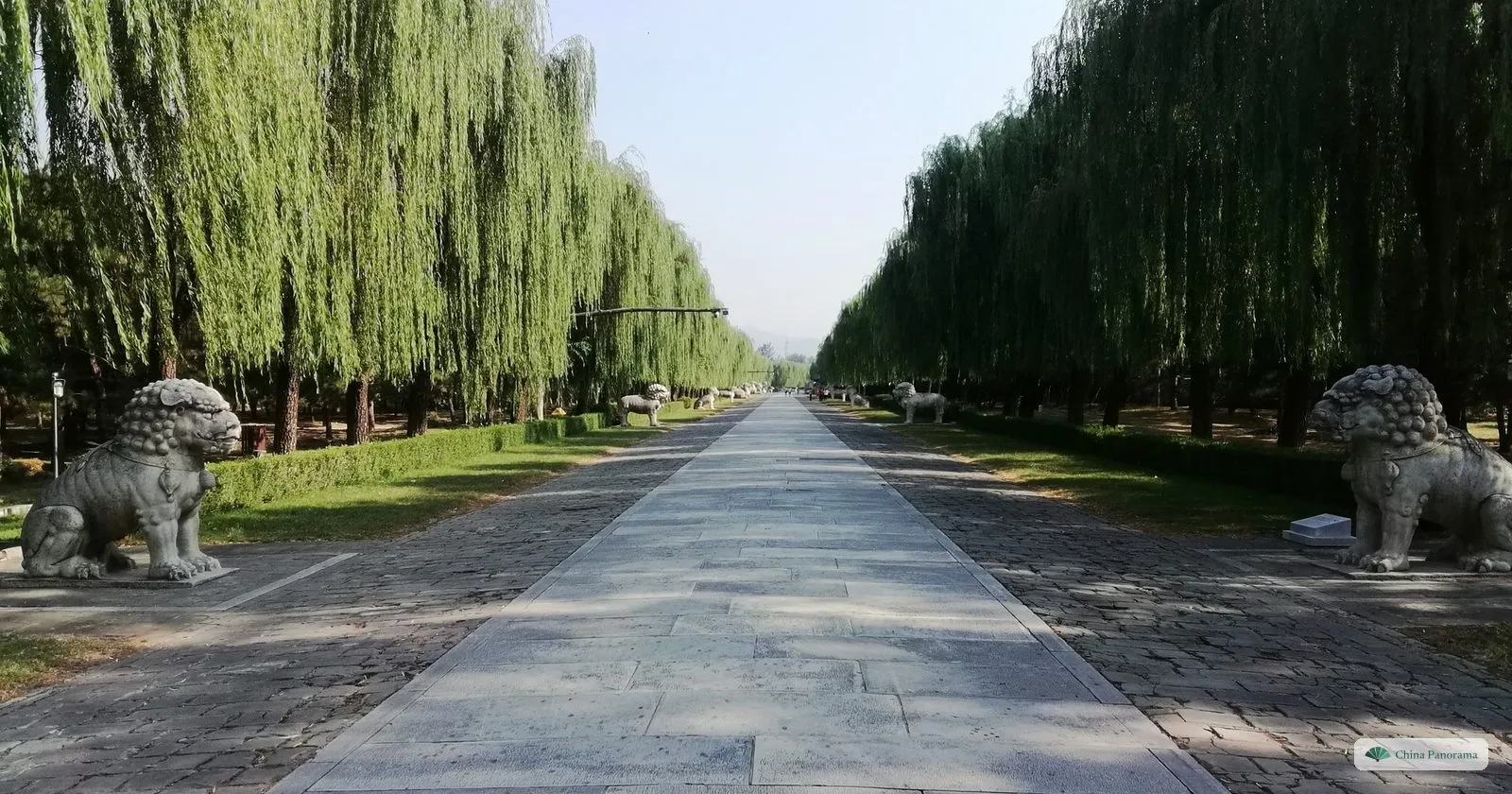
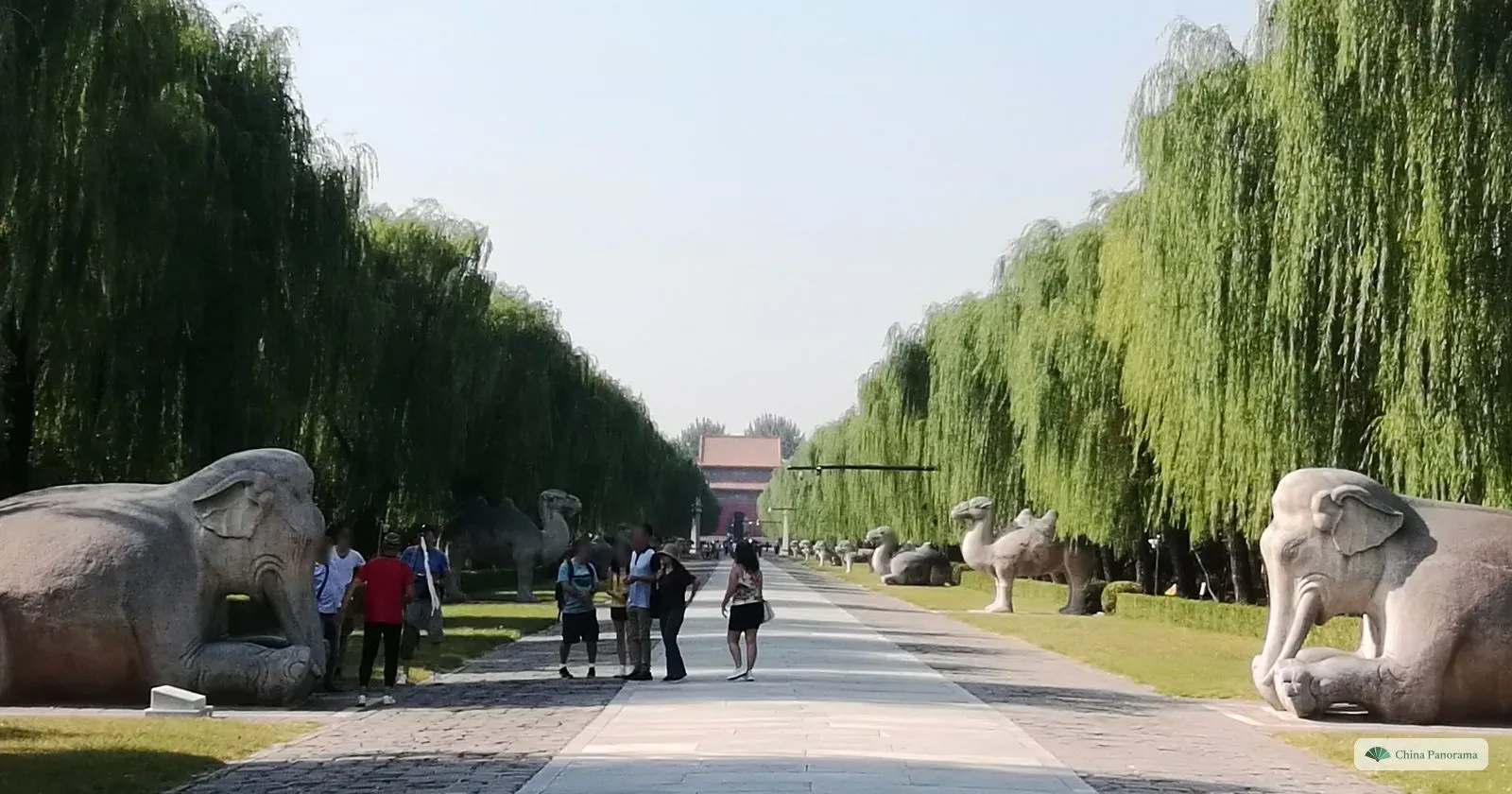
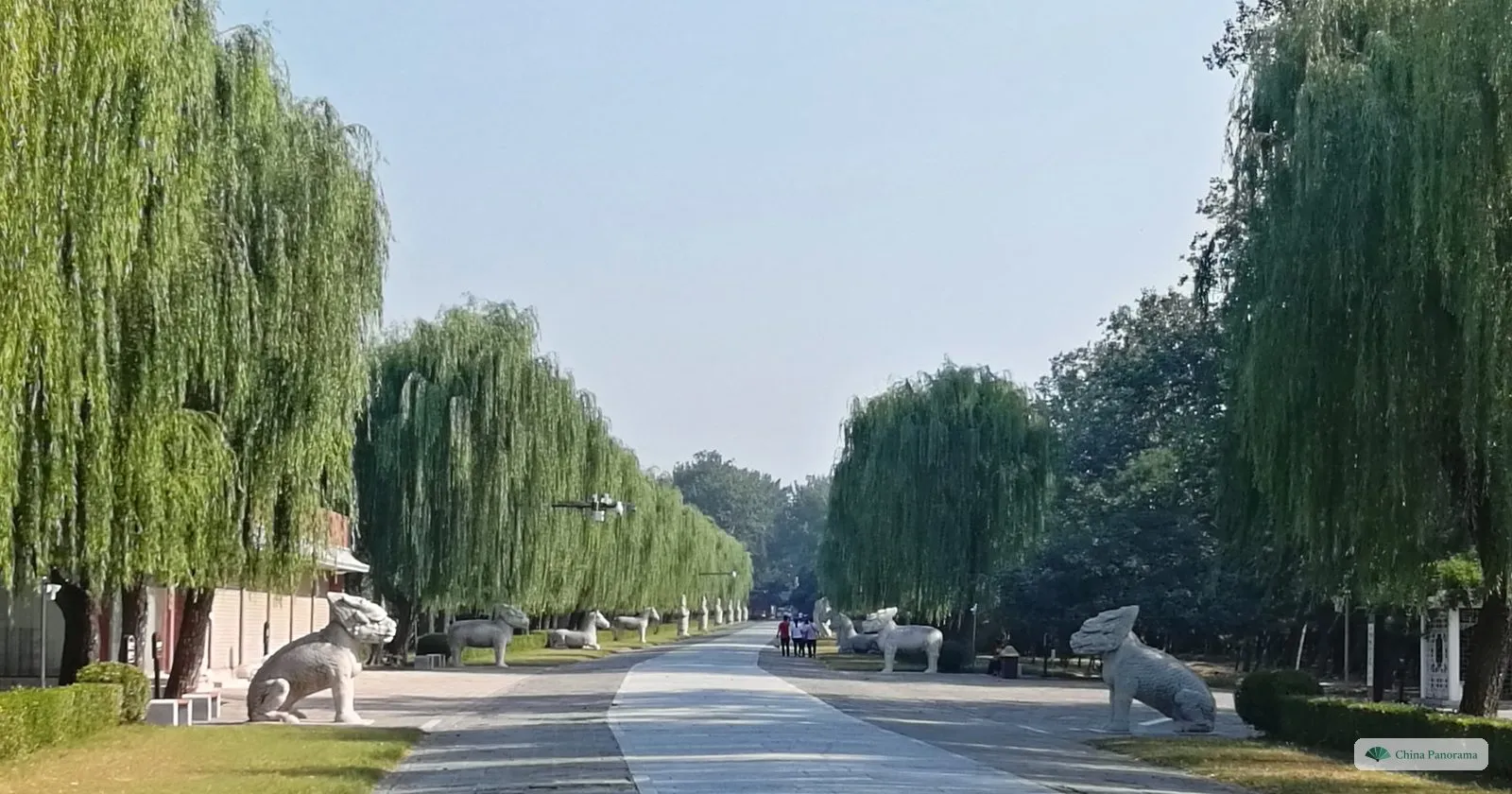
Thirteen emperors of the Ming dynasty are buried in a valley 45 km north of Beijing, and they all shared one approach road. It starts at the Great Red Gate, passes a pavilion housing a giant stele on a stone tortoise, and then runs for the best part of a kilometre between pairs of stone animals — lions, camels, elephants, horses and mythical beasts, each pair once standing and once kneeling — followed by generals and officials. Under the willows at nine in the morning it was the most peaceful place we found all day.
The Sacred Way has its own ticket and its own gates at both ends; it is several kilometres from the tombs themselves, so you need wheels between them. A combined ticket for the Sacred Way, Changling, Dingling and Zhaoling is reported at 135 CNY in peak season — we have not confirmed it.
- Entry
- Price not verified — check on site
- Opening hours
- Hours not verified — check on site
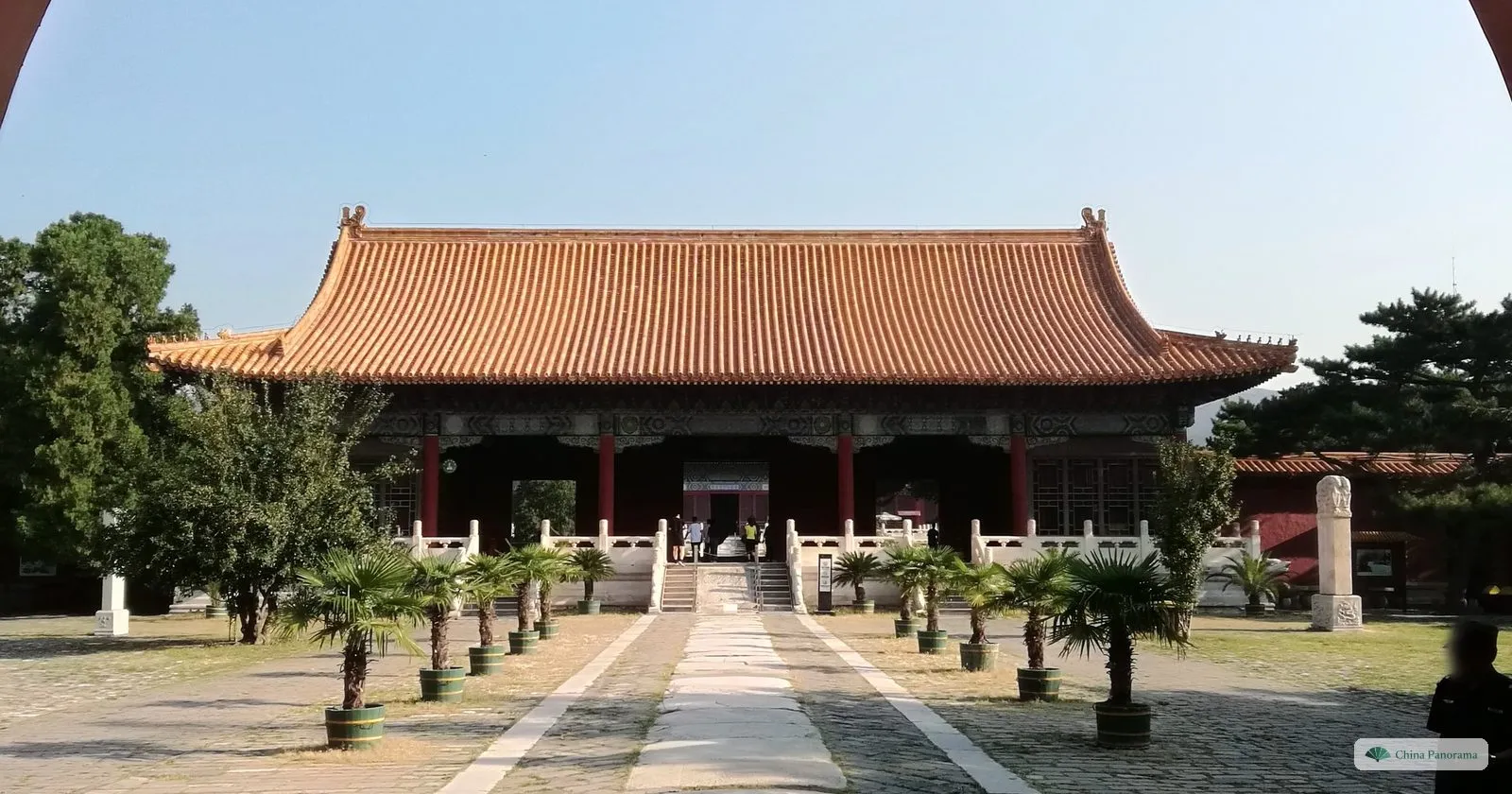 Imperial heritageChangping · 昌平区Outdoors
The first and largest of the thirteen tombs, built for the Yongle Emperor — the man who moved the capital to Beijing and built the Forbidden City. It is laid out like a palace: three courtyards in a row, and in the second the Hall of Eminent Favour, one of the biggest timber halls in China, its roof carried on columns each cut from a single trunk. Behind it a soul tower stands in front of the burial mound, which has never been opened.
We were at the gate at eight on a Saturday morning and shared the courtyards with a handful of people.
- Entry
- Price not verified — check on site
- Opening hours
- Hours not verified — check on site
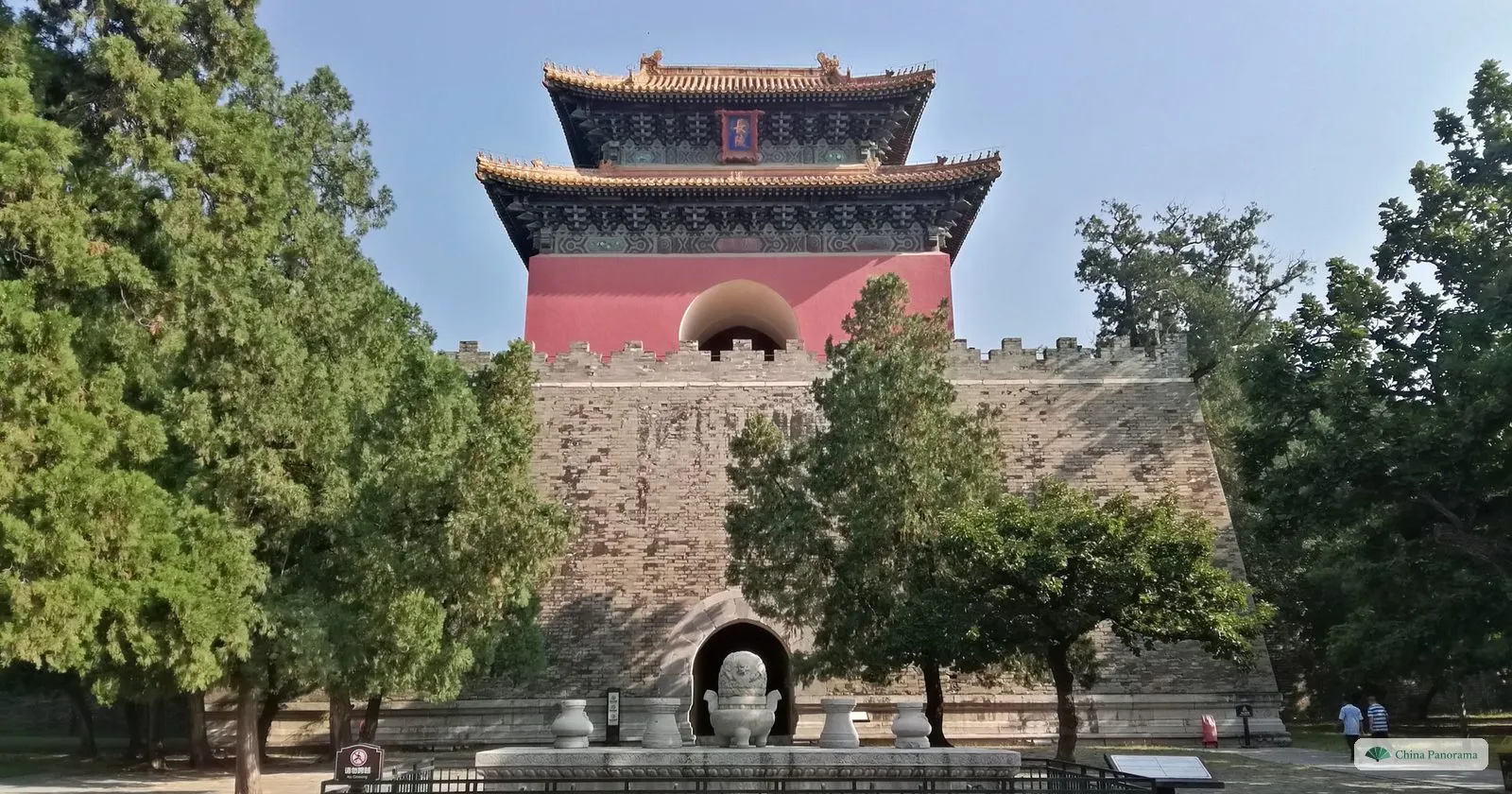
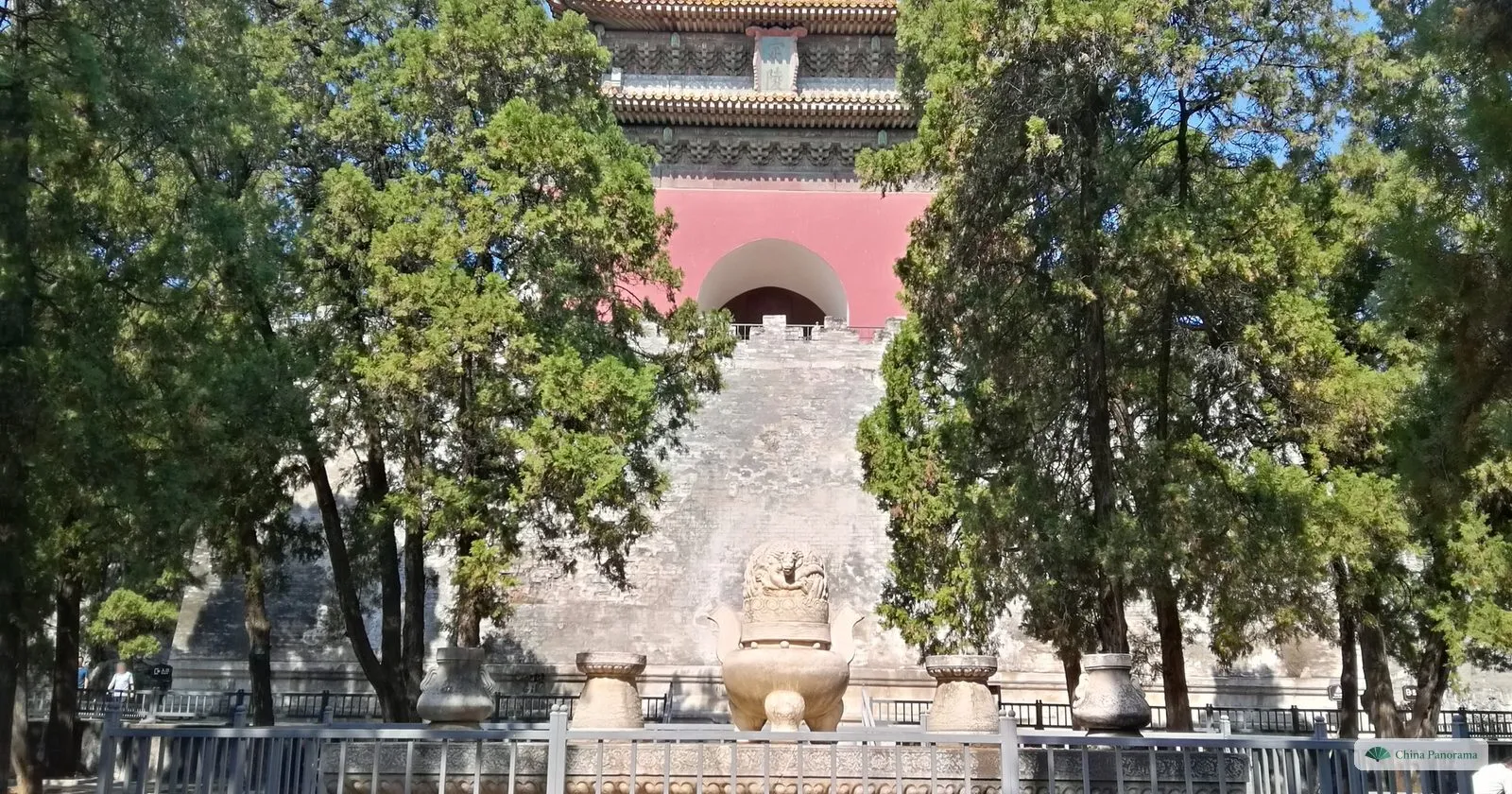 Imperial heritageChangping · 昌平区Outdoors
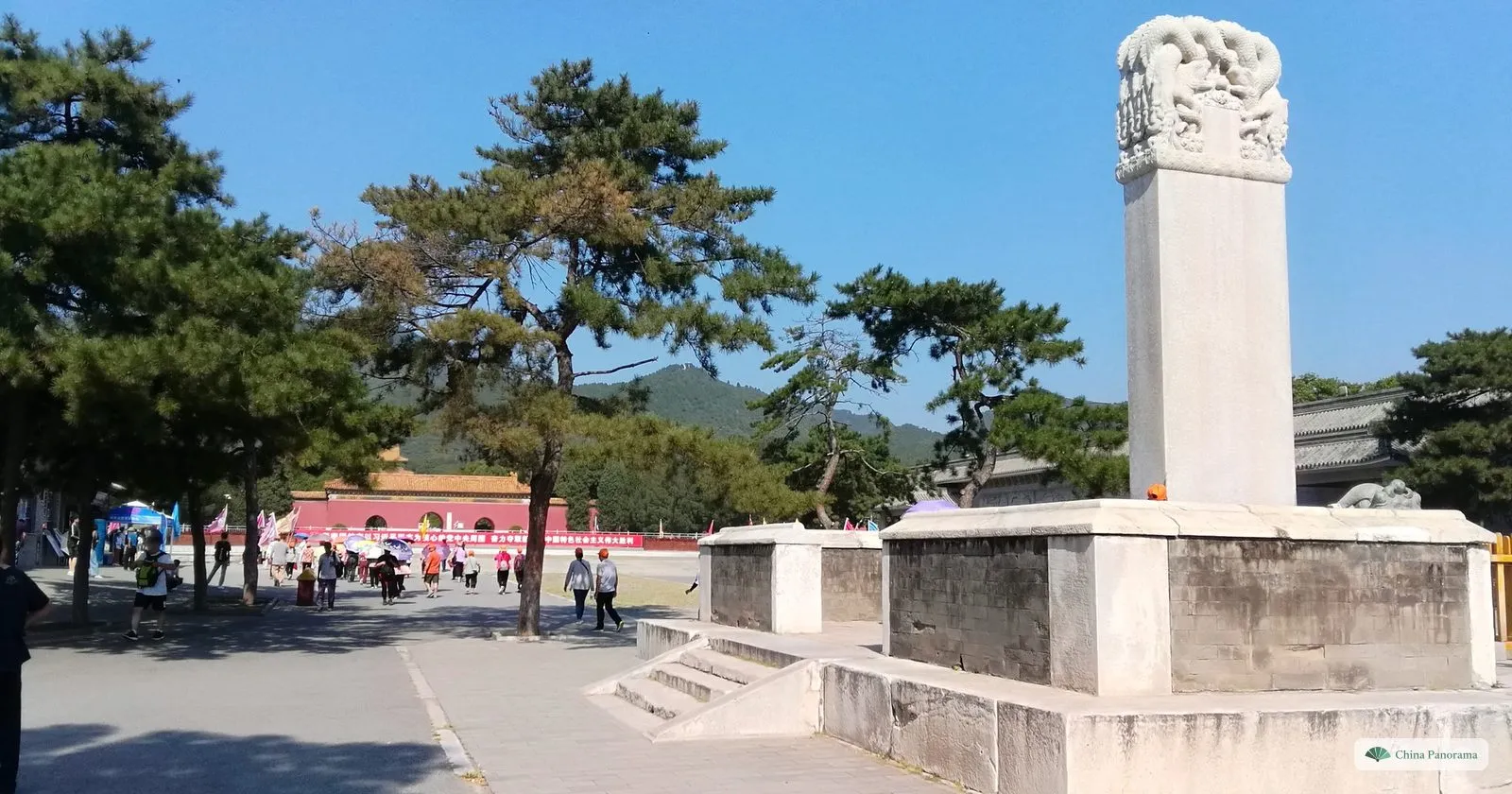
The tomb of the Wanli Emperor and the only one of the thirteen that has been excavated, in the 1950s: you can walk down into the underground palace, a series of stone vaults deep under the mound. Above ground the halls are gone, which leaves the soul tower, the stone altar in front of it and the wall around the mound standing among old cypresses. A tall stele with no inscription stands on the plaza outside.
A few minutes by car from Changling. The underground palace is many flights of stairs down and up.
- Entry
- Price not verified — check on site
- Opening hours
- Hours not verified — check on site
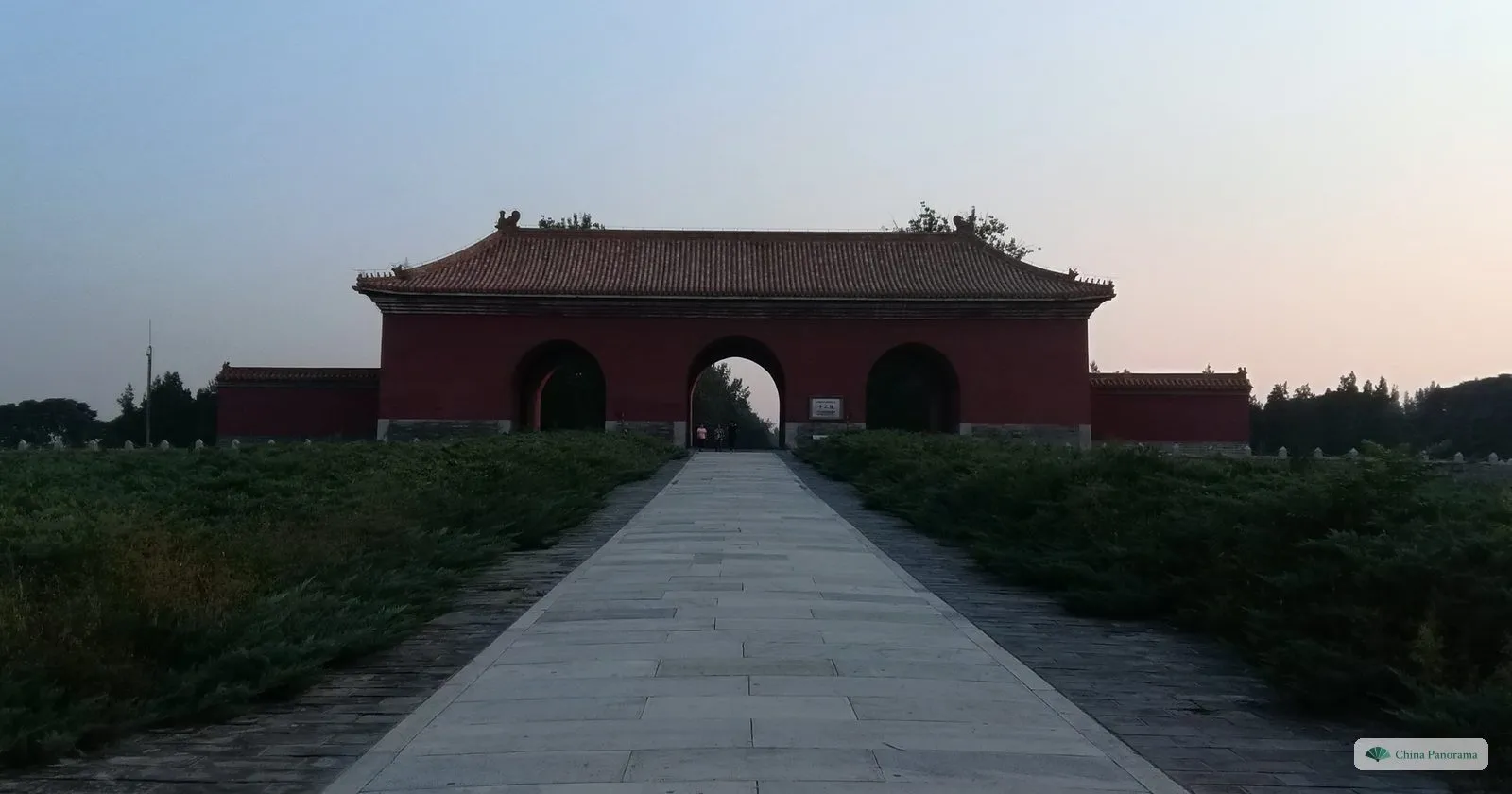 Imperial heritageChangping · 昌平区Outdoors
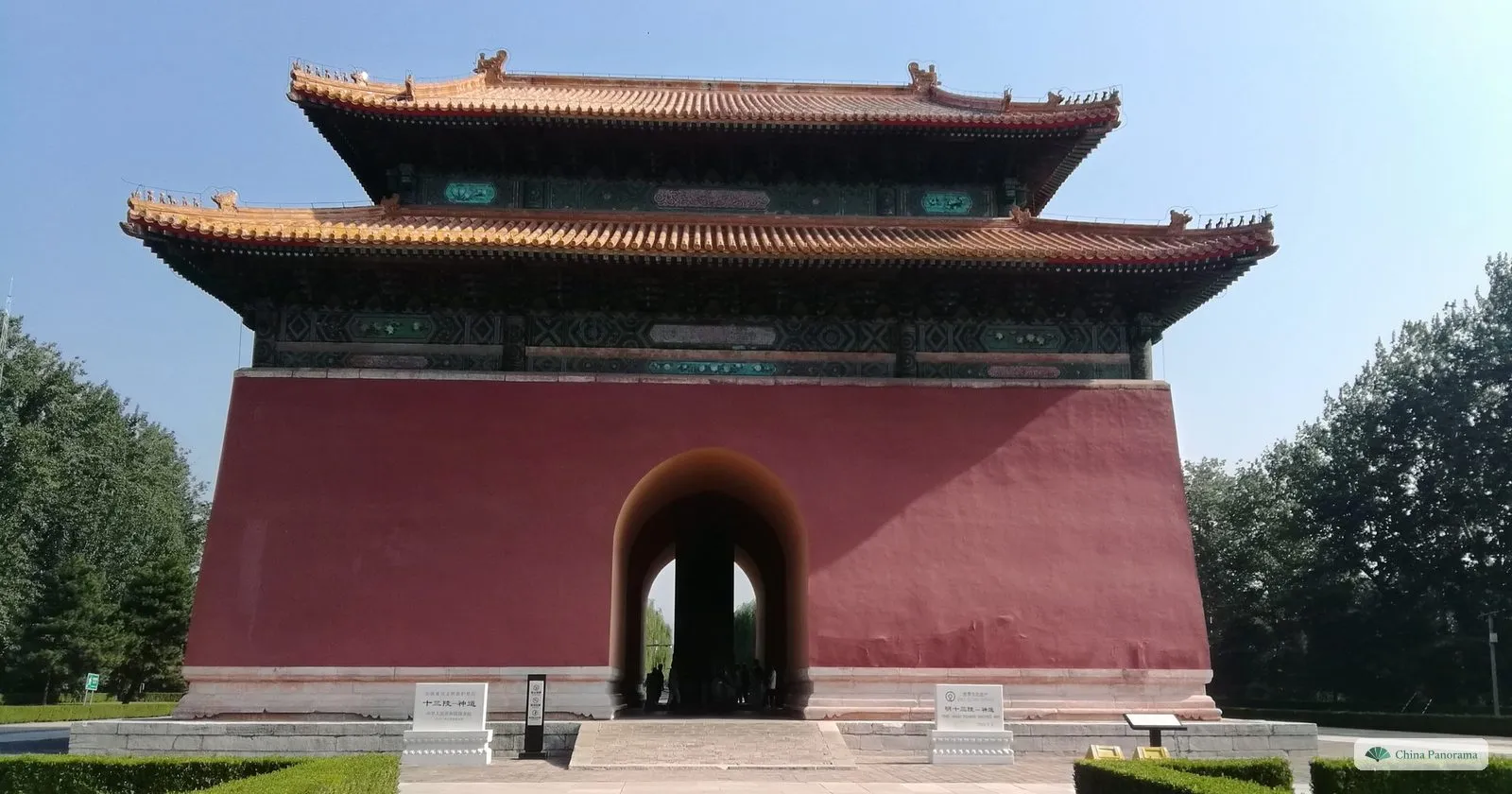
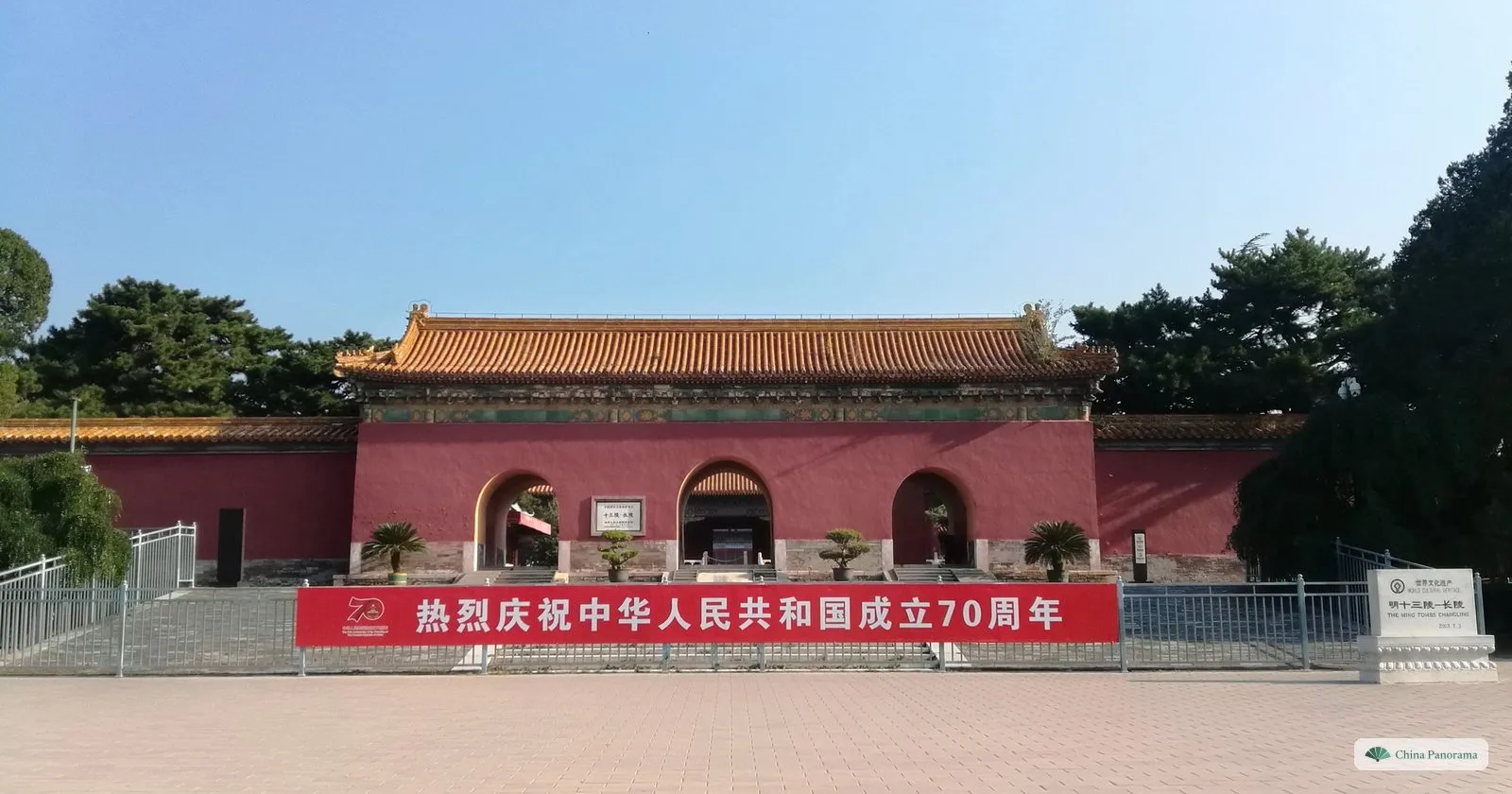
The front door of the whole tomb valley: a red gatehouse with three arches, standing on its own by the road. Everyone, the emperor included, had to dismount here. We were there at half past six, at first light, with the road empty.
It stands in the open and you can see it at any hour.
- Entry
- Free
- Opening hours
- Open at all hours
Ming Tombs Reservoir
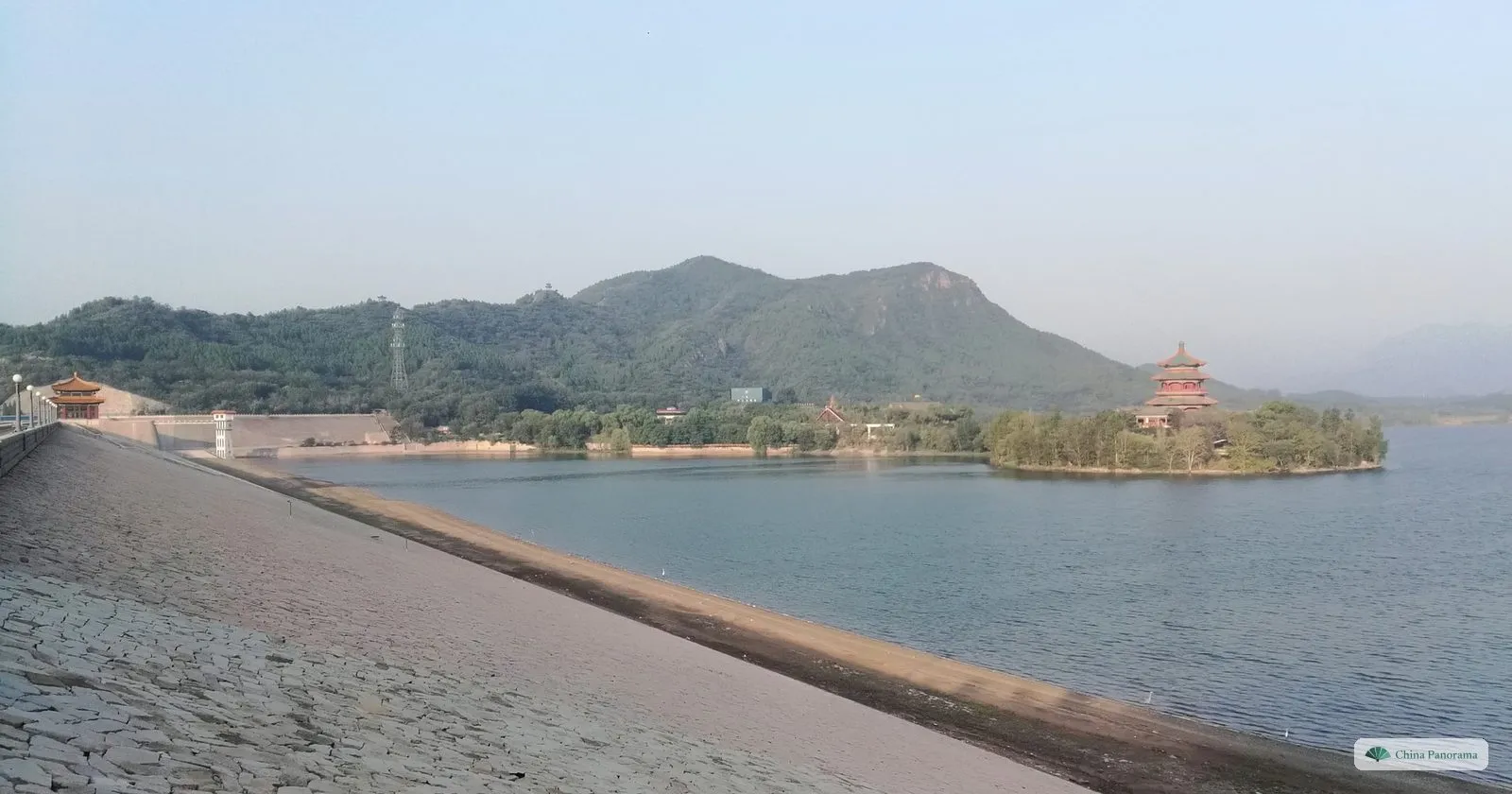
十三陵水库NatureChangping · 昌平区OutdoorsThe lake at the mouth of the tomb valley, held back by a dam built in 1958. From the dam road you look across the water to an island with a pagoda and the hills beyond. A ten-minute stop between the Great Red Gate and Changling.
Only by car.
- Entry
- Free
- Opening hours
- Open at all hours
Yanqi Lake
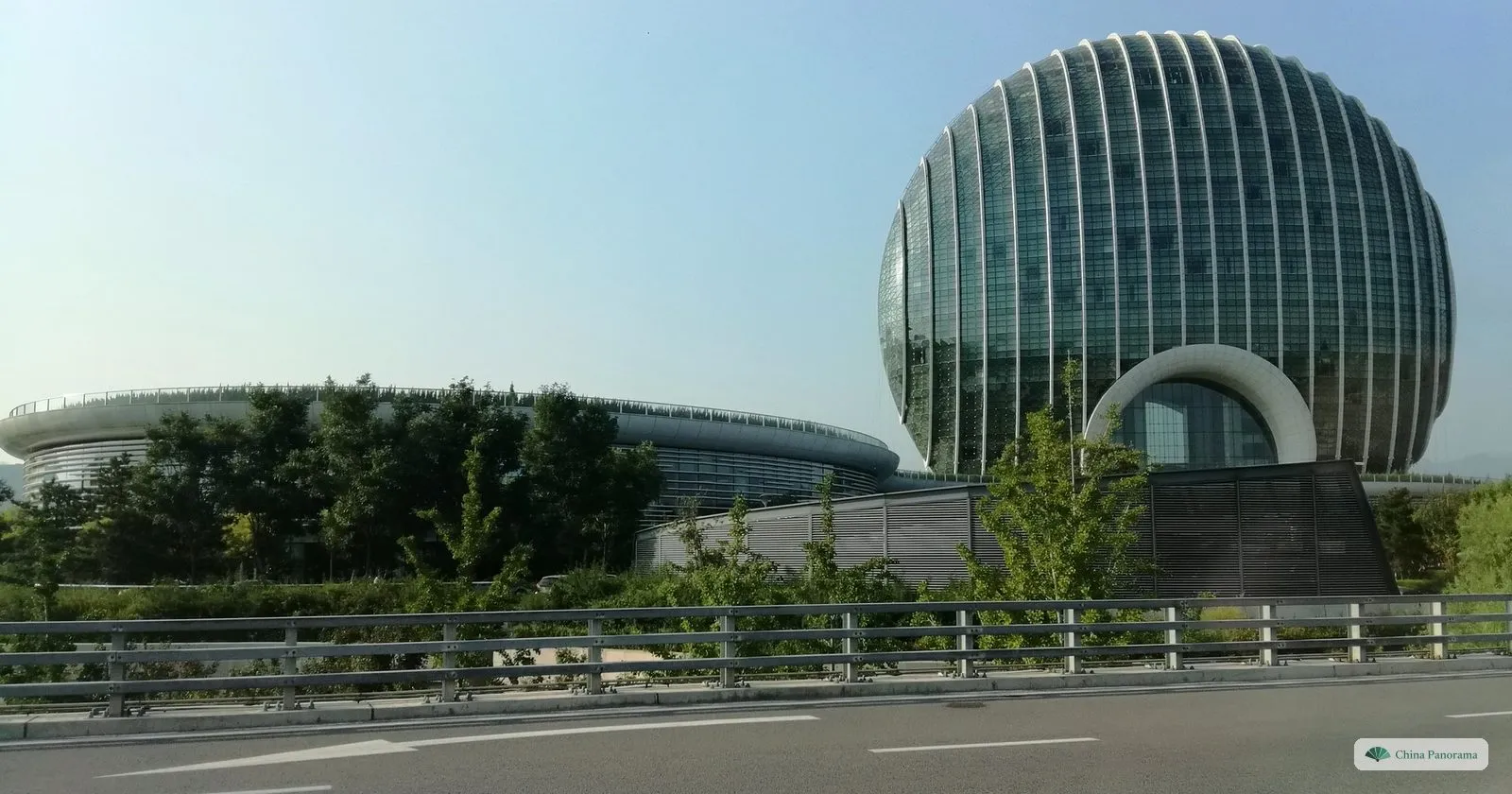
雁栖湖NatureHuairou · 怀柔区OutdoorsA lake in the hills of Huairou, near Mutianyu, developed for the APEC summit of 2014. What you notice from the road is the hotel: a glass disc about a hundred metres high, standing on edge by the water. It is an add-on if you are staying out that way, not a reason to come.
About 95 km by road from Badaling, which is why it makes more sense with Mutianyu.
- Entry
- Price not verified — check on site
- Opening hours
- Hours not verified — check on site
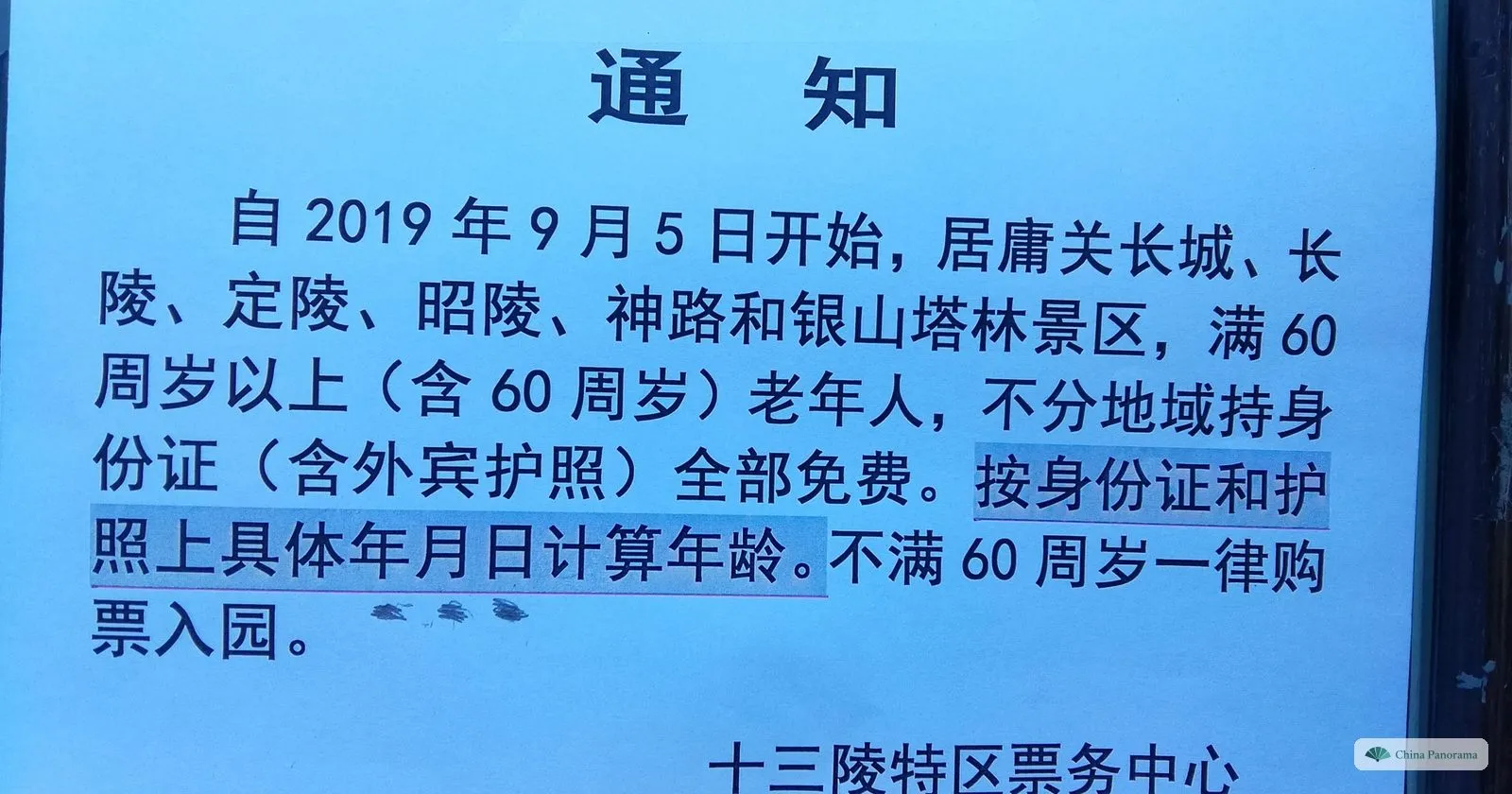
Over 60? Ask at the ticket window.
This notice hung at the Ming Tombs ticket office when we were there: from 5 September 2019, visitors aged 60 and over get in free at Juyongguan, Changling, Dingling, Zhaoling and the Sacred Way on showing ID — “including foreign visitors' passports”.
We have not confirmed that the rule still applies. Bring your passport and ask.
Our day, hour by hour
One long Saturday by car: the tombs at dawn, two sections of wall around midday, a lake at the end. The clock times are from our photographs. It is more than most people would want — drop the first and last stops and it becomes a comfortable day.
A long day by car · eight stops · about 160 km of driving between them
Great Red Gate
Taxi 9 min· 6.6 km
Ming Tombs Reservoir
Taxi 8 min· 6 km
Changling
Taxi 8 min· 6.4 km
Sacred Way
Taxi 9 min· 6.8 km
Dingling
Taxi 21 min· 25 km
Juyongguan
Taxi 13 min· 14.4 km
Badaling
Taxi 75 min· 95.1 km
Yanqi Lake
8 stops · 143 min by taxi
Stop by stop
Ming Tombs, Juyongguan and Badaling in one day
The day we did ourselves, on a Saturday in September, by car. Our clock times: the Great Red Gate at 06:30, the reservoir at 07:08, Changling from 08:01, the Sacred Way from 08:59, Dingling from 09:55 to 10:47, Juyongguan from 11:44 to 12:21, Badaling from 13:19 to 14:13, and Yanqi Lake at 16:31. Starting at dawn is what makes it work: the tombs are empty until nine, and you reach Badaling after the morning tour buses. The driving times below are without traffic.
Taxi 9 min· 6.6 km
2Ming Tombs Reservoir
十三陵水库A stop on the dam road while the ticket offices are still shut.
- Entry
- Free
- Hours
- Open at all hours
Taxi 8 min· 6 km
Taxi 8 min· 6.4 km
4Sacred Way
神路Back down the valley to walk between the stone animals.
- Entry
- Not verified
- Hours
- Not verified
Taxi 9 min· 6.8 km
Taxi 21 min· 25 km
6Juyongguan
居庸关长城The quiet wall. Climb one side of the loop or just see the pass from the valley floor.
- Entry
- Not verified
- Hours
- Not verified
Taxi 13 min· 14.4 km
7Badaling
八达岭长城The famous wall, after lunch.
- Entry
- 40 CNY (Apr–Oct), online only
- Hours
- 06:30–16:30 (Apr–Oct)
Taxi 75 min· 95.1 km
8Yanqi Lake
雁栖湖A long drive east through the hills. Skip it and go straight back to the city unless you are staying in Huairou.
- Entry
- Not verified
- Hours
- Not verified
Easy add-ons: Without a car: take the train to Badaling and leave the tombs and Juyongguan for another day — nothing public links them at a useful speed.
* Driving times and distances are OpenStreetMap routes without traffic — on a weekend or a public holiday the expressway to Badaling can take twice as long. The clock times are from our own photographs and include the time spent at each stop. Stops marked with a star have prices or opening hours we have not checked.
When to go
- Weather by month
Beijing's climate; the ridges are a few degrees cooler and windier.
- Golden Week 2026
1–7 October: daily caps and booking windows for Badaling and Mutianyu.
- School holidays
July and August weekends are the busiest outside the public holidays.
- Beijing
The Forbidden City, the Central Axis and the rest of the city.
FAQ
Which section of the Great Wall is best to visit from Beijing?
It depends on how you travel. Badaling (60 km) is the only one with a railway station and has the broadest, gentlest walkway — and the biggest crowds. Mutianyu (60 km) is just as well restored, sits in wooded hills and is calmer, but needs a car or a tour bus. Juyongguan (51 km) is the closest and the quietest, and the steepest. We have walked all three.
Badaling or Mutianyu?
Mutianyu, if you have a car, a driver or a seat on a tour bus: fewer people, greener hills, and a cable car up and a toboggan down. Badaling, if you want to go independently by train, if steep steps are a problem, or if you want to add the Ming Tombs, which lie in the same direction.
Badaling or Juyongguan?
They are on the same expressway, 14 km apart, so you can see both in one day — we did. Juyongguan is a fortress in a valley with the wall climbing steeply on both sides: dramatic, quiet and hard on the knees. Badaling is the wide, classic wall over rolling ridges, and busy. If you only have the legs for one climb, make it Badaling and stop at Juyongguan to look at the pass from below.
Can I get to the Great Wall by train?
To Badaling, yes. High-speed trains on the Beijing–Zhangjiakou line leave from Beijing North (at Xizhimen) and Qinghe and stop at Badaling Great Wall station. There is also the slower suburban line S2: Not the metro: suburban line S2 starts at Huangtudian (change from Line 13 at Huoying). Your credit card works here too. We have not checked current timetables or fares — look them up on 12306 before you go. Juyongguan and Mutianyu have no railway.
How far is the Great Wall from Beijing?
In a straight line from Tiananmen: Juyongguan about 51 km, Badaling 60 km, Mutianyu 60 km. By car without traffic that is about 41, 54 and 67 minutes; on a weekend morning, allow up to twice that.
Do I need to book Great Wall tickets in advance?
For Badaling, yes: Online only, real-name booking, no on-site ticket sales. Tickets open 7 days ahead and the wall has a daily cap of 65,000 visitors. For Mutianyu: Real-name booking, one ticket per ID per day; ID card, permanent residence card or passport. Booking opens up to 30 days ahead. For Juyongguan we have not checked.
Can I visit the Great Wall straight from the airport?
From Beijing Capital Airport, Mutianyu is the nearest section — both are in the north-east — and a car with a driver is the only practical way. Badaling is on the far side of the city. Either way, leave a wide margin for traffic on the way back.
Are the Ming Tombs worth visiting?
If you have a car, yes — at least the Sacred Way, an avenue of stone animals under willows, and Changling, with one of the largest timber halls in China. They are on the way to Juyongguan and Badaling and almost empty early in the morning. Without a car, they are awkward to combine with the wall and better left out.
Can I see the Great Wall and the Ming Tombs in one day?
Yes, by car, if you start early. We were at the Great Red Gate at 06:30, at Changling when it opened, walked the Sacred Way at nine, reached Juyongguan before noon and Badaling at 13:20 — the full timeline is above. Tours that do “wall and tombs” usually give the tombs an hour.
When is the Great Wall least crowded?
On weekdays outside the school and public holidays, early in the morning or in the last two hours before closing. The days to avoid are Golden Week (1–7 October), the May Day holiday and summer weekends. Winter is cold and windy on the ridges, but the wall is nearly empty.
Sources and status
All photographs on this page are ours. Juyongguan, Badaling, the Ming Tombs and Yanqi Lake were photographed on one day, 7 September 2019; Mutianyu in 2026. The stones have not changed since; everything that does change — prices, booking, trains — is dated separately or marked as not verified. Faces of passers-by have been blurred. Driving times and distances: OpenStreetMap routing, 30 September 2026. Data sources: Badaling: opening hours and prices (Visit Beijing); Badaling: online real-name booking, daily cap (Visit Beijing); Mutianyu: ticket booking (Huairou District Government); Beijing–Zhangjiakou high-speed railway: stations (Visit Beijing); Ming Tombs: sites and combined ticket (Visit Beijing).
Changelog (1)
- 2026-09-30Page created, with our own photographs of Juyongguan, Badaling, Mutianyu and the Ming Tombs. Badaling prices, hours and booking rules checked on this date; train timetables, Juyongguan, Mutianyu and Ming Tombs prices not yet verified.