
Shenzhen
A fishing-and-farming county across the river from Hong Kong in 1979, a city of about 18 million today: a cruise liner beached in Shekou, a 599 m tower, the world's biggest electronics market — and, between the towers, the villages that were here first.
深圳 · Shēnzhèn · Guangdong province · 22.55° N, 114.05° E
Coming from Hong Kong?
Shenzhen is on the mainland: you pass Hong Kong’s exit check and China’s entry check, and China’s visa rules apply. Luohu and Futian close at night; Huanggang is open 24 hours. The crossings →
How long?
One or two days: Futian and Luohu in a day — the central axis, Huaqiangbei, Dongmen, Lizhi Park — and Shekou for an evening. Each is a route below. The routes →
Where is Shenzhen?
Shenzhen is in the far south of China, directly north of Hong Kong: the Shenzhen River is the border, and the Civic Center is about 30 km from central Hong Kong. Guangzhou, the provincial capital, is 100 km up the Pearl River Delta to the north-west, and Macau 70 km across the estuary. Shanghai is 1,210 km away and Beijing 1,940 km. At 22.5° N, Shenzhen lies inside the tropics, about 100 km south of the Tropic of Cancer — level with Kolkata and a little south of Havana. It faces Hong Kong across the Shenzhen River, on the east side of the mouth of the Pearl River Delta. Tap any city on the map to measure the distance.
Straight-line distances from the Civic Center, rounded to the nearest 10 km — not travel distances.
Guangdong is highlighted. Tap a city to measure the distance from Shenzhen.
- Province
- Guangdong广东省 · since 1979
- Latitude
- 22.55° Ninside the tropics
- Airport
- SZXBao’an · Metro Line 11
- Metro
- 17 linesabout 640 km
- Time zone
- UTC+8same as Hong Kong
- City flower
- Bougainvillea簕杜鹃
What’s Shenzhen weather like each month?
Subtropical and humid, like Hong Kong: no real winter — 20 °C by day in January — a damp, grey spring, a long hot summer at 33 °C by day in July with storms and the odd typhoon, and a short, drier autumn that is the best time to come. The sun rises at 05:39 in June and sets at 17:42 in December. Tap a month for temperatures, daylight and what is on.
Scale in °C. Bars run from the average daily low to the average daily high. Source: monthly temperature data, last checked 2026-07-30.
Shenzhen in October
Warm- Average high
- 30 °C
- Average low
- 23 °C
- Sunrise / sunset
- 06:19 – 17:59
- Daylight
- 11 h 40 min
On in Oct
- Golden Week crowds, 1–7 Oct
How hot is Shenzhen in summer?
Four months above 30 °C by day, with nights that hardly drop below 28 °C. Do your walking in the morning and after sunset — Lizhi Park and Sea World are at their best then — and keep the afternoons for the air-conditioned halls of Huaqiangbei and the museums.
June
32° / 28°
Sun 05:39–19:09 · 13 h 30 min
July
33° / 28°
Sun 05:48–19:11 · 13 h 24 min
August
33° / 27°
Sun 06:01–18:57 · 12 h 56 min
September
32° / 26°
Sun 06:10–18:28 · 12 h 18 min
Spring
March – MayWarm, grey and damp.
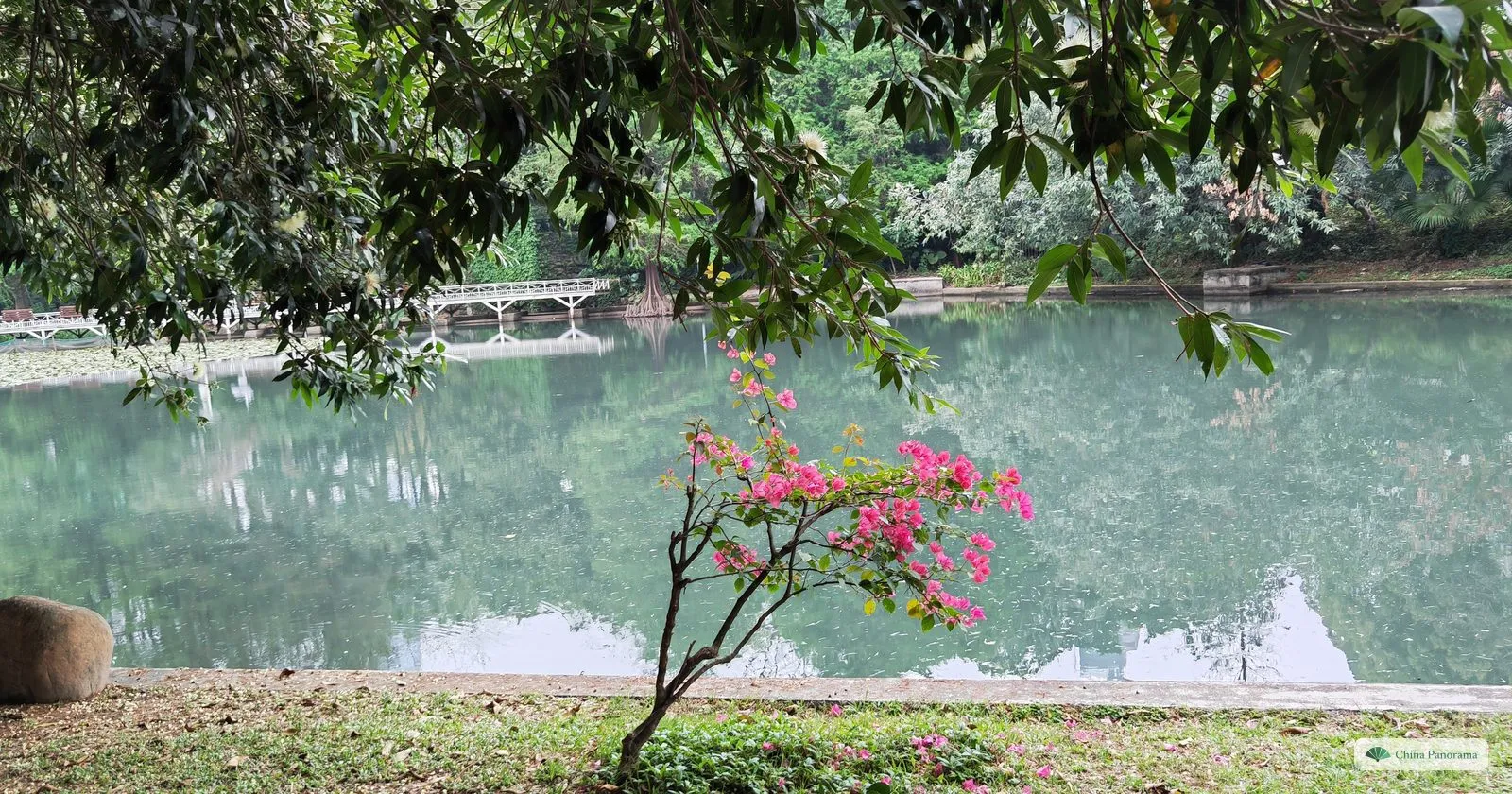
March averages 24 °C by day, April 28 °C and May 31 °C. Early spring brings huinantian, “the south wind returns”: warm, saturated air that condenses on cold walls and floors until they run with water. Our photographs of 3 April 2023 show the usual April sky, flat grey, with bougainvillea in flower along the lakes of Lizhi Park.
What to wear: Light layers and a rain jacket.
Summer
June – SeptemberHot, humid, stormy: 32–33 °C by day, 28 °C at night.
July and August average 33 °C by day and barely cool below 27–28 °C at night. Heavy afternoon showers are frequent, and typhoons can come in from the South China Sea between July and September, stopping ferries, closing parks and cancelling flights for a day or two. Spend the afternoons indoors — Huaqiangbei, the museums, a long lunch — and go out again after sunset.
What to wear: The lightest clothes you own, a hat, and an umbrella for sun and rain.
Autumn
October – NovemberThe best season: drier, sunnier, still warm.
October averages 30 °C by day and November 26 °C, with less rain and clearer skies than the rest of the year. Avoid Golden Week, 1–7 October, when the parks, Sea World and the border crossings are at their busiest.
What to wear: Summer clothes by day, a light layer for air-conditioning.
Winter
December – FebruaryMild by day, cool indoors.
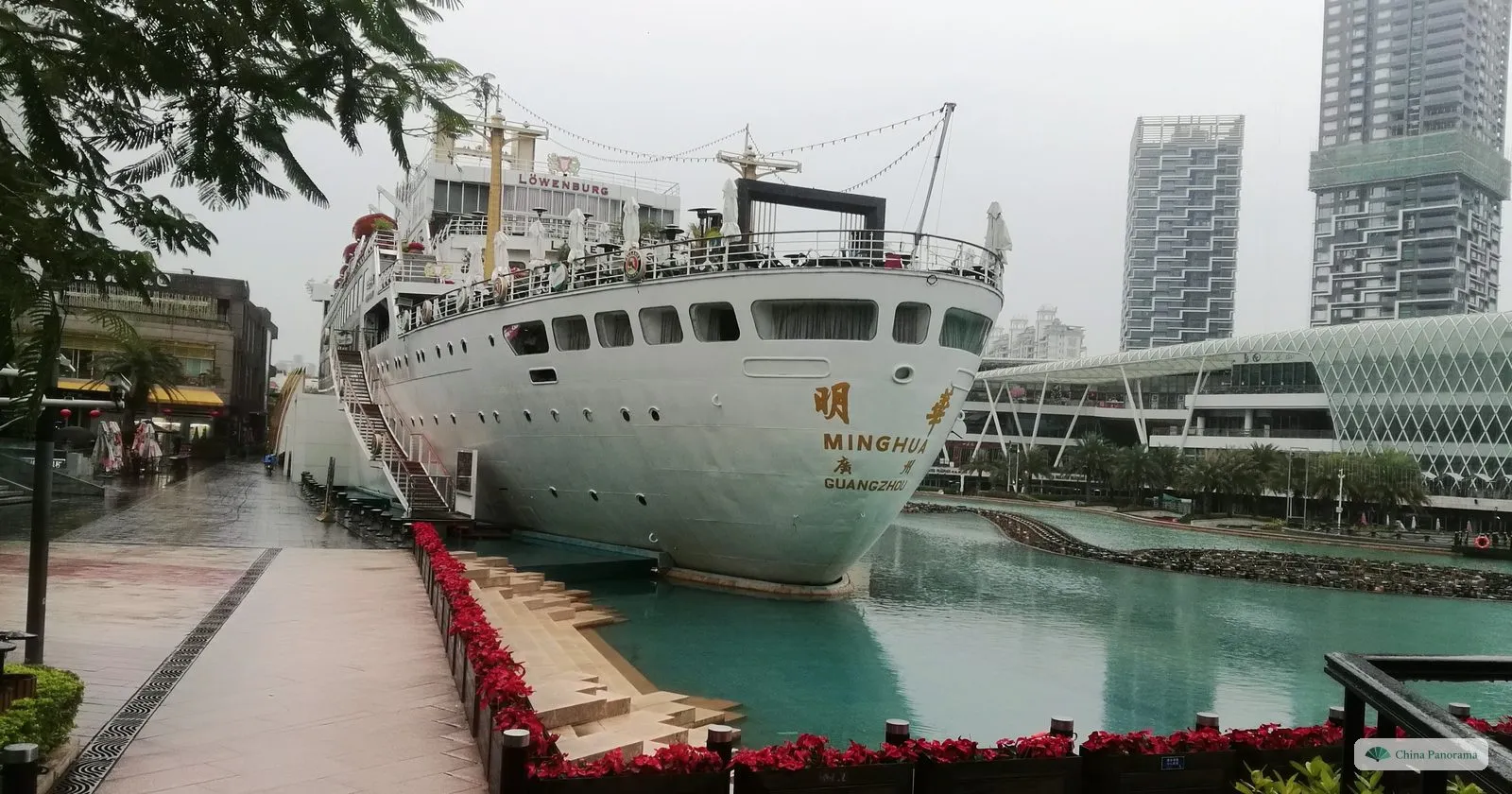
January averages 20 °C by day and 13 °C at night. But buildings have no central heating, so a cold, wet spell feels colder indoors than out — our photographs of 9 January 2018 are of a whole day of rain. Most people in Shenzhen come from other provinces, and many go home for the Spring Festival, so the city is noticeably emptier that week.
What to wear: A jumper and a rain jacket; a scarf for indoors.
October, at about 30 °C by day, and November, at 26 °C, are the months we would pick; April, at 28 °C, is warm but grey and damp. For how Shenzhen compares with the rest of the country month by month, see the best time to visit China.
Things to do in Shenzhen
17 places, from a Ming garrison town to a 599 m tower. Three things first: how new the city really is, what you are looking at on the front of a village hall and on the road signs, and how the new centre lines up along its axis.
Was Shenzhen really a fishing village?
Not quite. In 1979 it was Bao’an county: farming and fishing villages, market towns and two Ming fortresses, with the old market of Shenzhen at its heart. Almost everything you will see was built after the Special Economic Zone was declared on 26 August 1980 — but three places from the Ming still stand. Tap a name on the time line, or filter.
Ming dynasty1368–1644
more than 400 years later
The Special Economic Zonesince 1980
Filled dot: original. Ring: ruin. Square: built in our time.
Tap a name on the time line or a card.
- Ruin1394about 630 years old
Walled in 1394 and the county seat from 1573. Most of the walls are gone; the south gate, eight of the nine old streets and about 40 Qing-era buildings remain.
- Original1394about 630 years old
Built in 1394 against pirates and besieged for forty days in 1571. Walls, gates and lanes survive, and people still live inside.
- Originalover 500 years oldabout 530 years old
The last village inside the old Special Economic Zone that is more than 500 years old. The grid of lanes and the clan’s ancestral hall are to be kept after a citizens’ campaign in 2016.
- Built in our time198244 years old
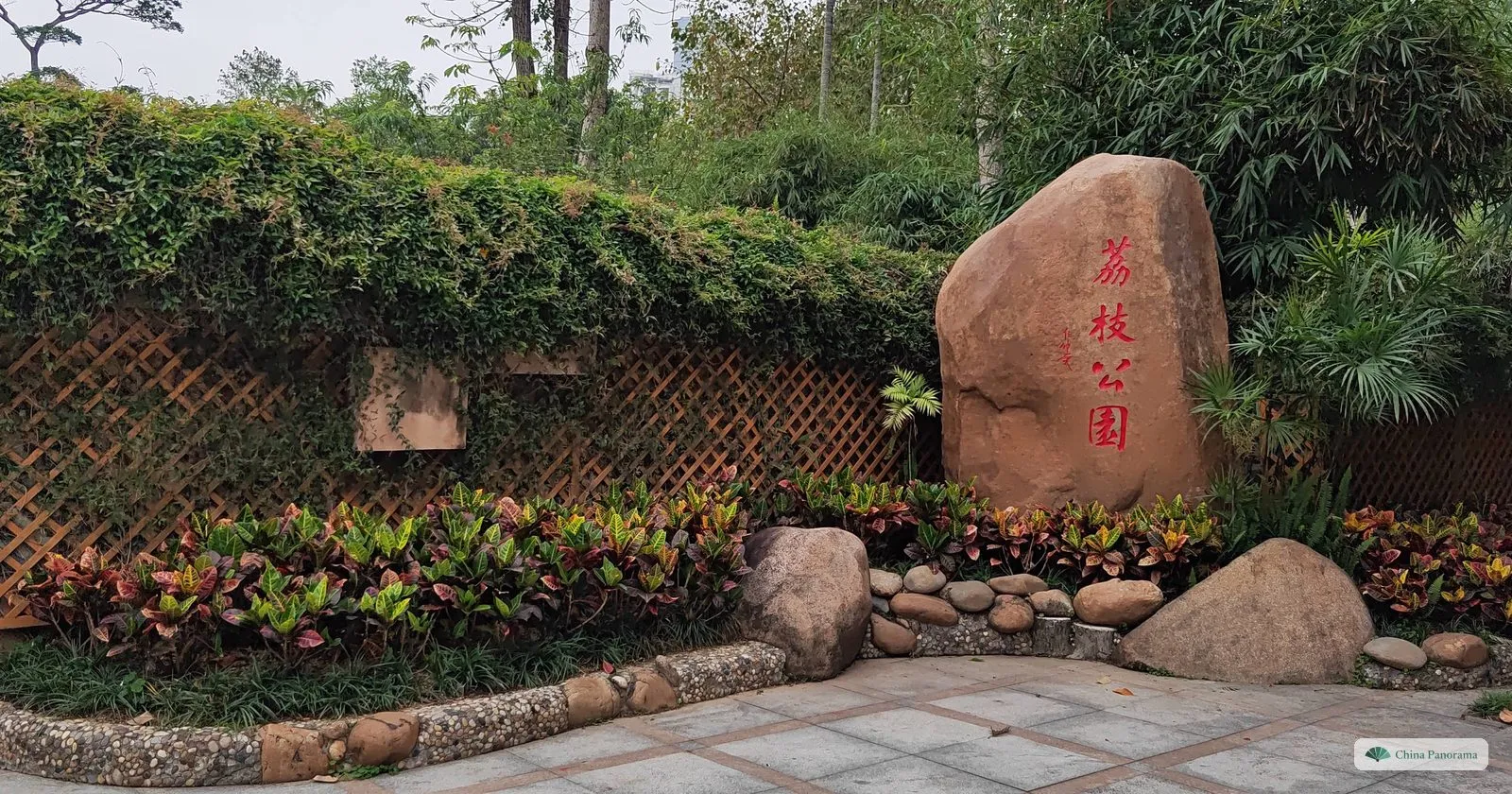
Laid out in 1982 around 589 old lychee trees — the trees are older than the park.
- Built in our time198343 years old
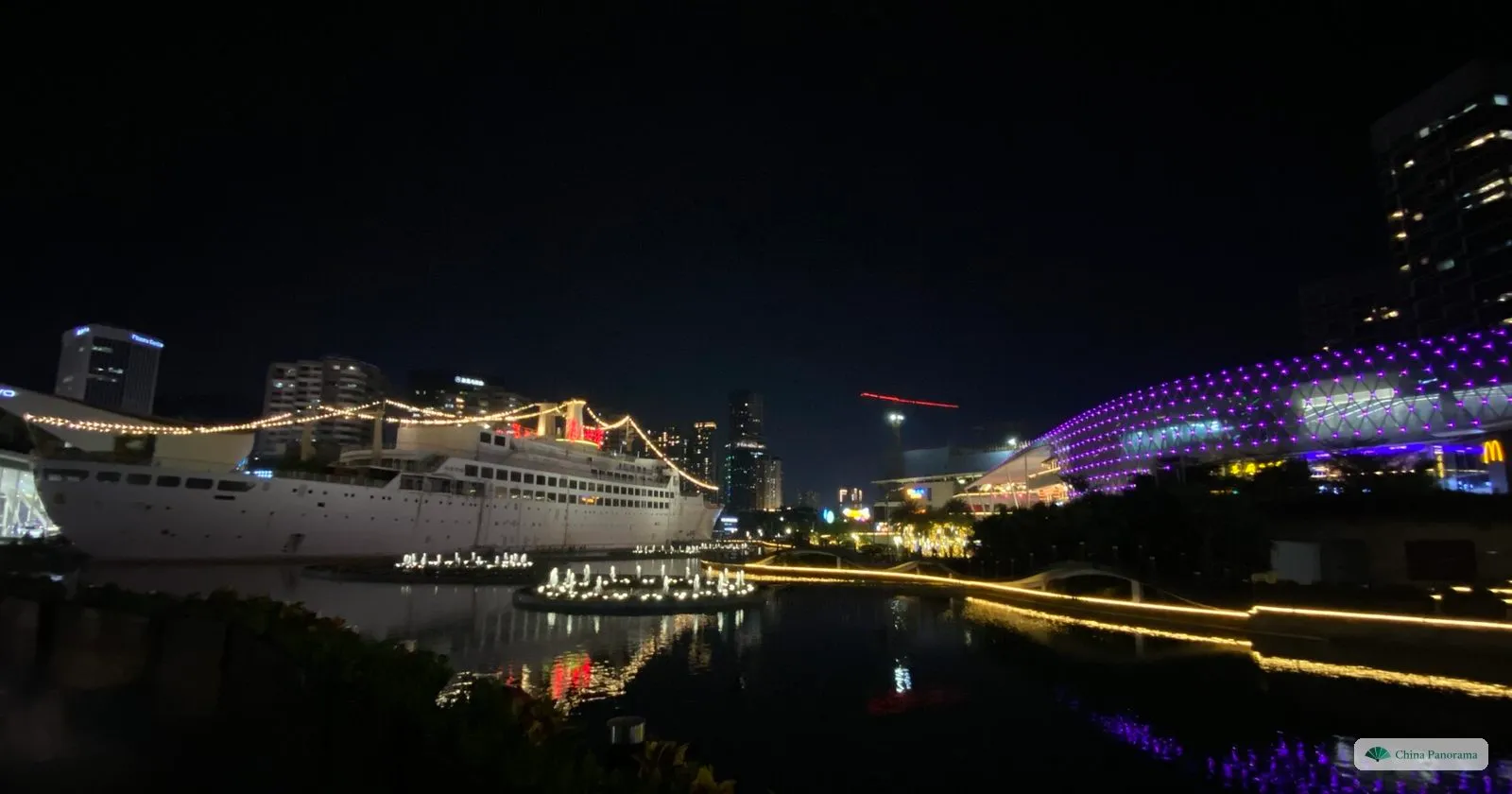
Built in France in 1962, moored in Shekou in August 1983 and opened as Sea World in January 1984.
- Built in our time199432 years old
Opened in June 1994, with a one-third-scale Eiffel Tower 108 m high.
 Built in our time199927 years old
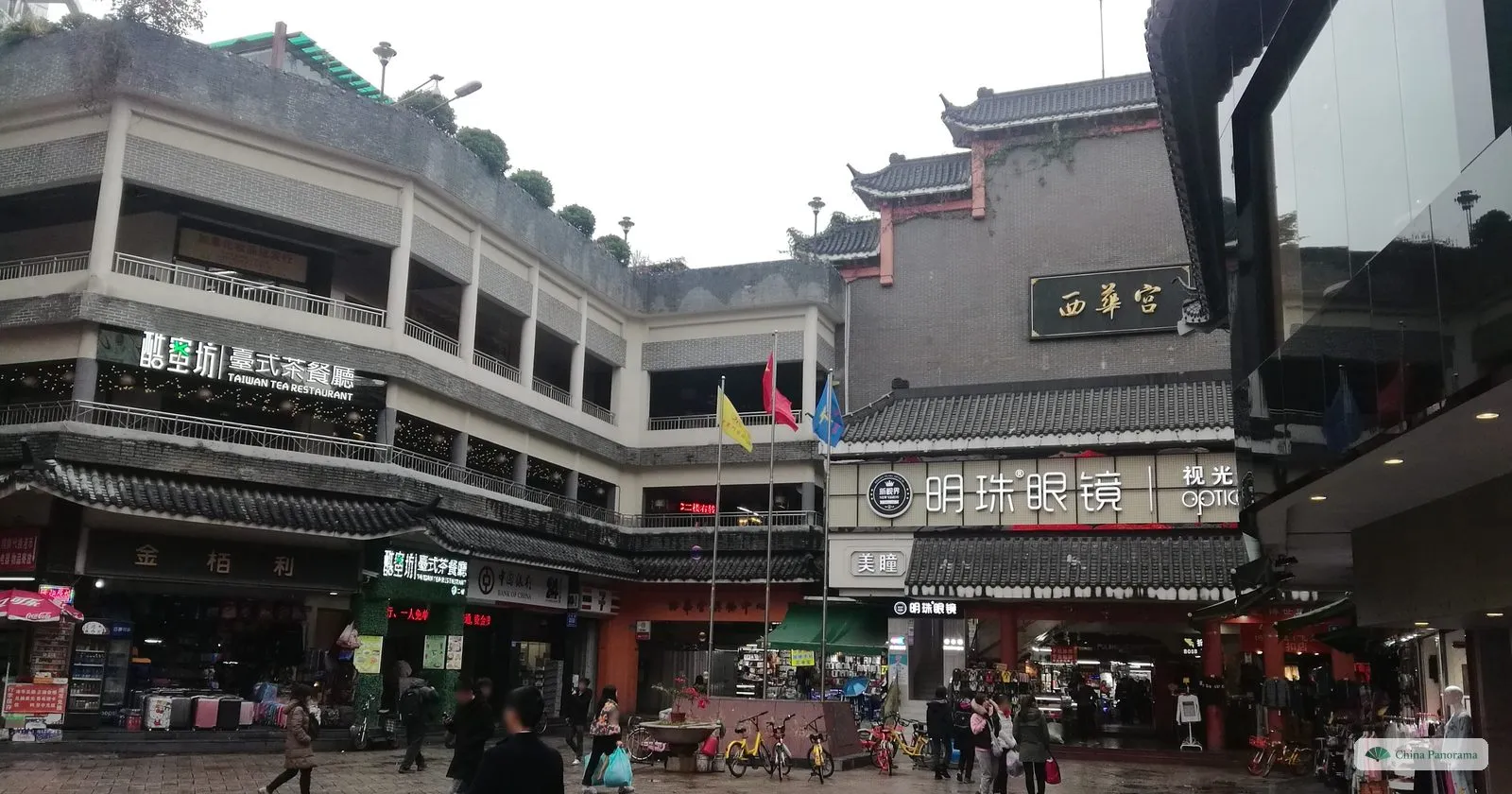
The market that gave Shenzhen its name dates from the Ming; what stands is mostly the shopping district completed in 1999 and renovated since.
 Built in our time200422 years old
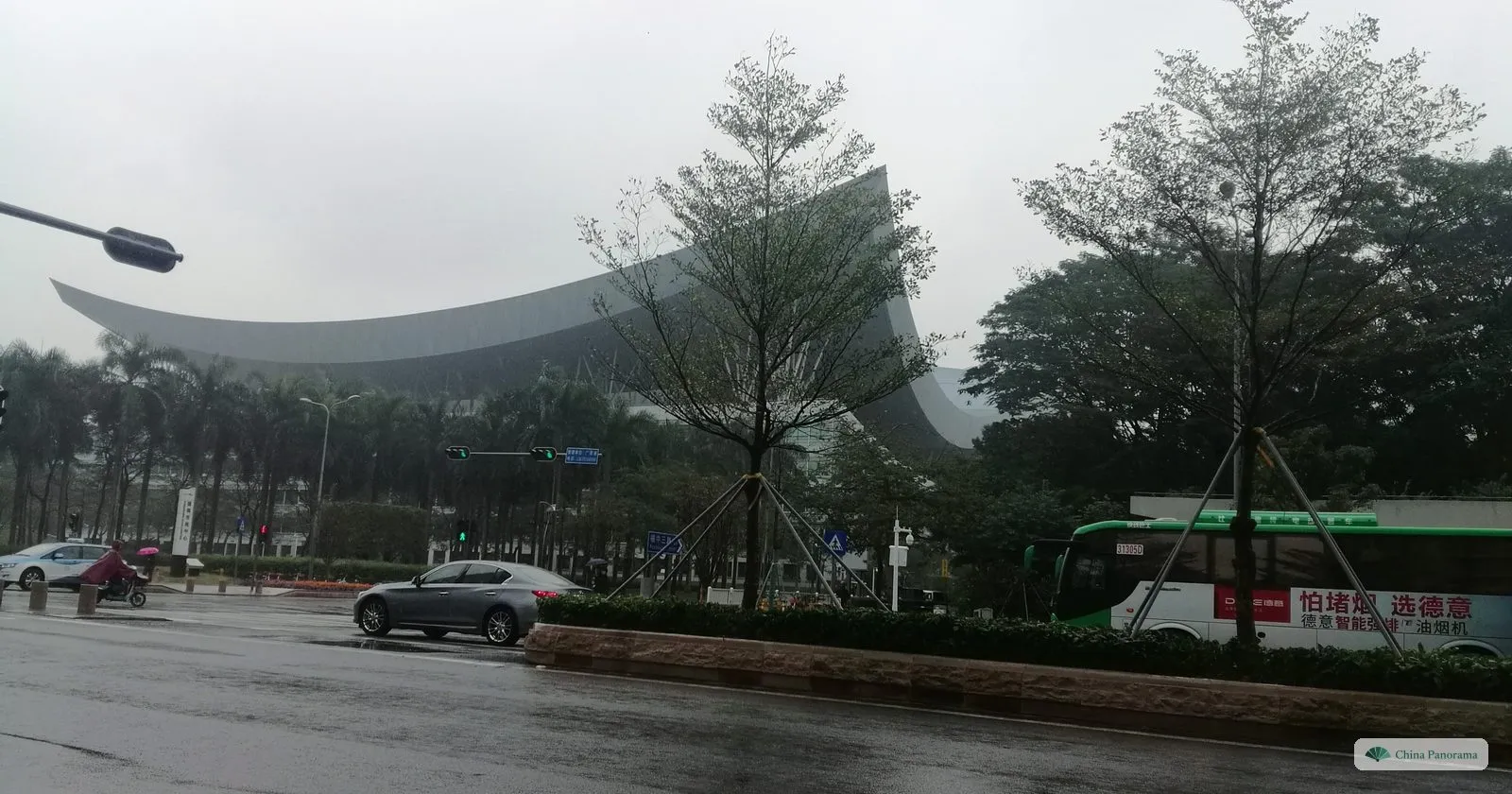
Opened in May 2004 in the middle of the new central axis of Futian.
 Built in our time20179 years old
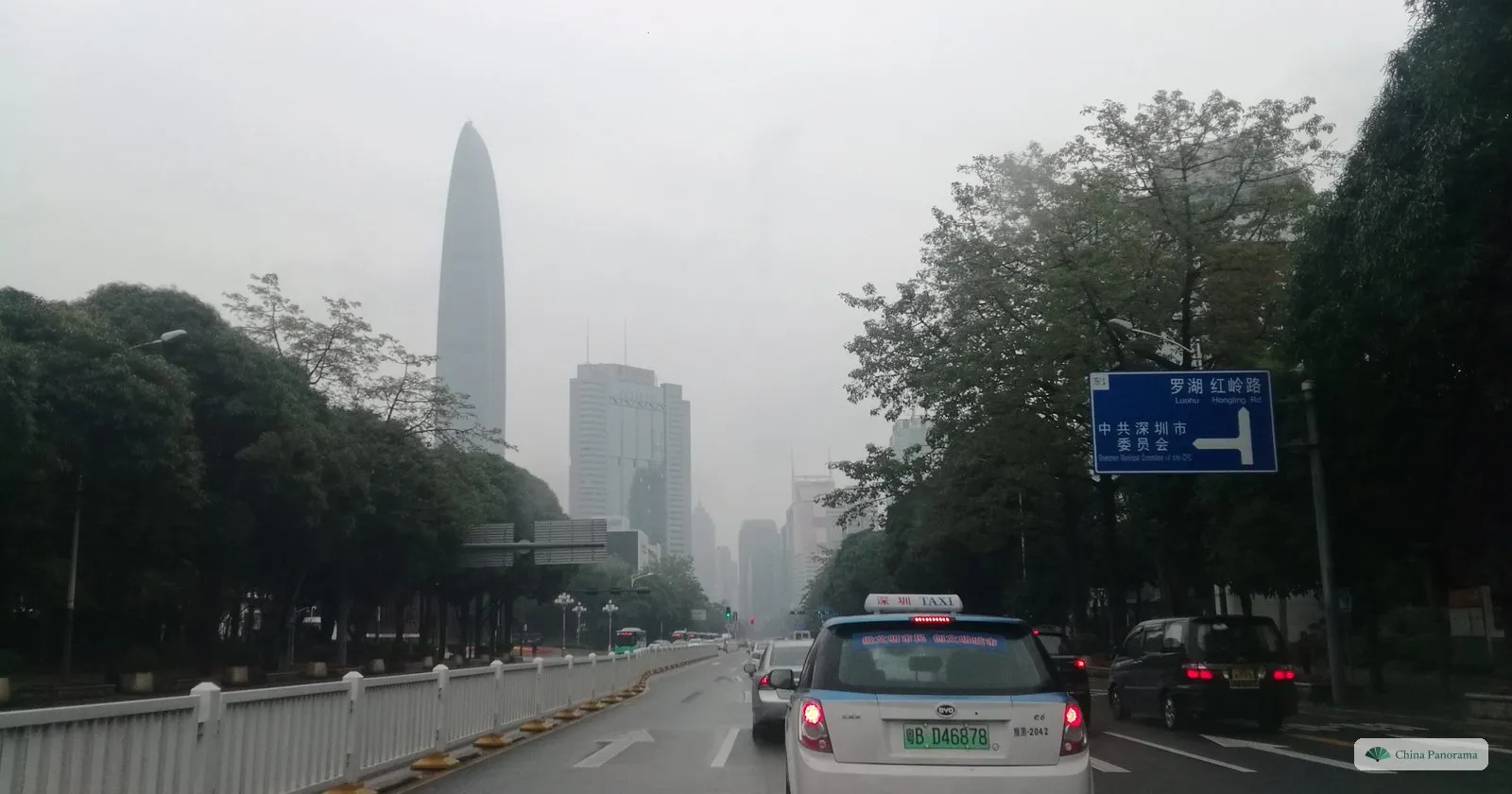
Completed in 2017, the same year Design Society opened in Shekou.
What am I looking at?
An ancestral hall that survived in an urban village, and the signs over Shennan Boulevard. Tap a number on the photograph.
1The roof ridge
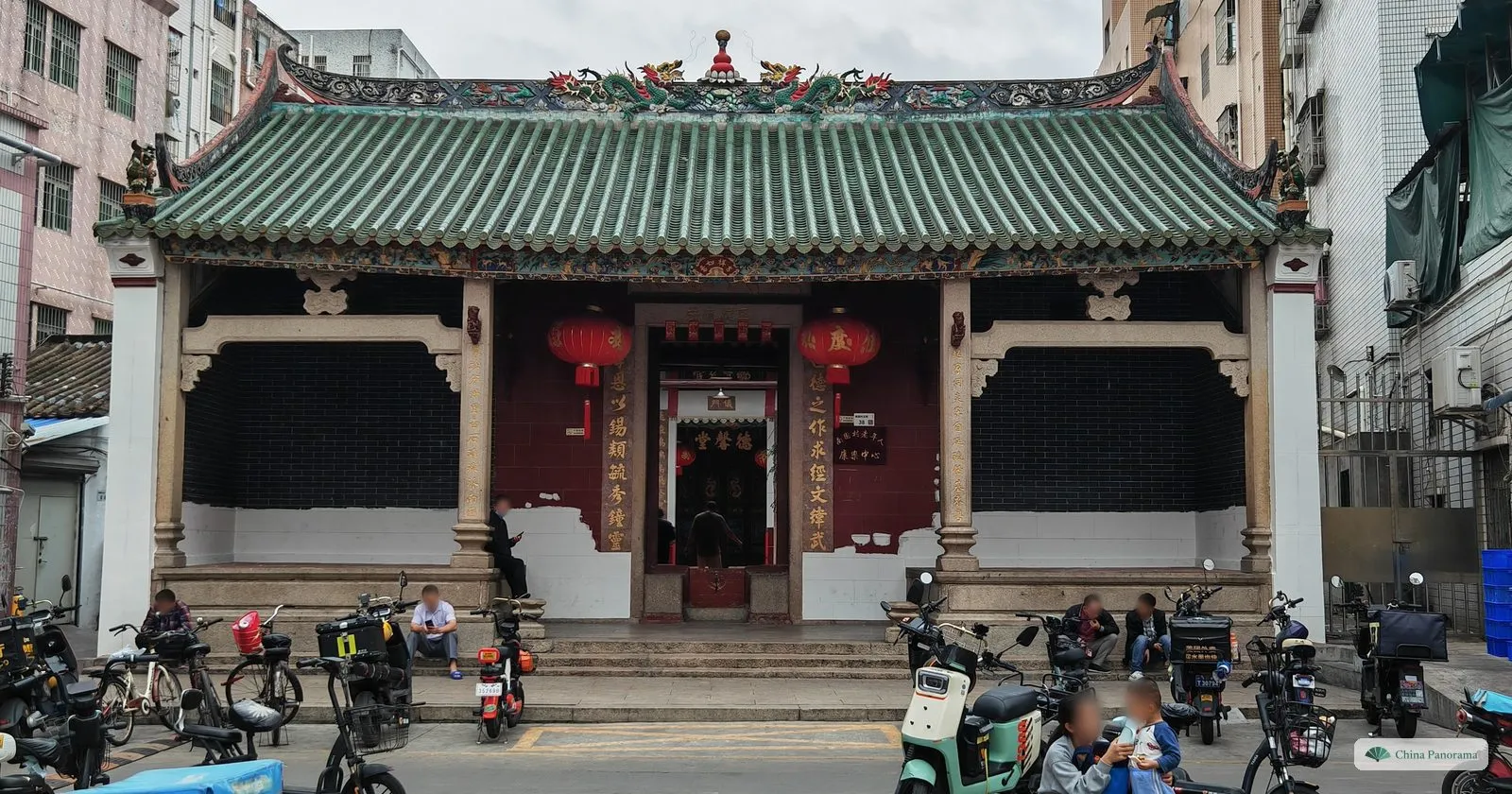
双龙戏珠 · Two dragons and a pearl
Two glazed ceramic dragons face a pearl in the middle of the ridge — a motif of luck found on temples and clan halls all over southern China. The roof itself is green-glazed tile.
Tap a number on the photo, or a name in the list.
Futian’s central axis, north to south
The new city centre was planned on one straight line, about 2.5 km long: from the Deng Xiaoping statue on top of Lianhuashan, down past the Children’s Palace, the library and the concert hall, under the wing roof of the Civic Center and across Shennan Boulevard to the Convention and Exhibition Center. The Ping An Finance Centre stands just to the west. Tap a stop on the line.
Tap a stop on the line or a card.
- On the axis2.5 km from the southern end
A 6 m bronze statue of Deng Xiaoping, unveiled in 2000, looks straight down the axis.
Children's Palace (Lines 3 and 4)
- On the axis1.8 km from the southern end
The Children’s Palace on the east side, the city library and the concert hall on the west, either side of the open lawns.
Children's Palace (Lines 3 and 4)
- On the axis1.4 km from the southern end
A roof 486 m long across the axis, with the Shenzhen Museum in the middle.
Civic Center (Lines 2 and 4)
- Beside the axis1.0 km from the southern end
An underground station under Shennan Boulevard, on the line between Guangzhou and Hong Kong West Kowloon.
Futian (Lines 2, 3 and 11)
- Beside the axis0.3 km from the southern end
The tallest building in the city, with its observation deck on the 116th floor.
Shopping Park (Lines 1 and 3)
- On the axis0.0 km from the southern end
The trade-fair halls close the axis to the south; the border crossings to Hong Kong are about 2 km beyond.
Convention and Exhibition Center (Lines 1 and 4)
17 places in and around Shenzhen
Filter by district, or by whether you need to be indoors — useful on a wet afternoon.
Sea World and the Minghua
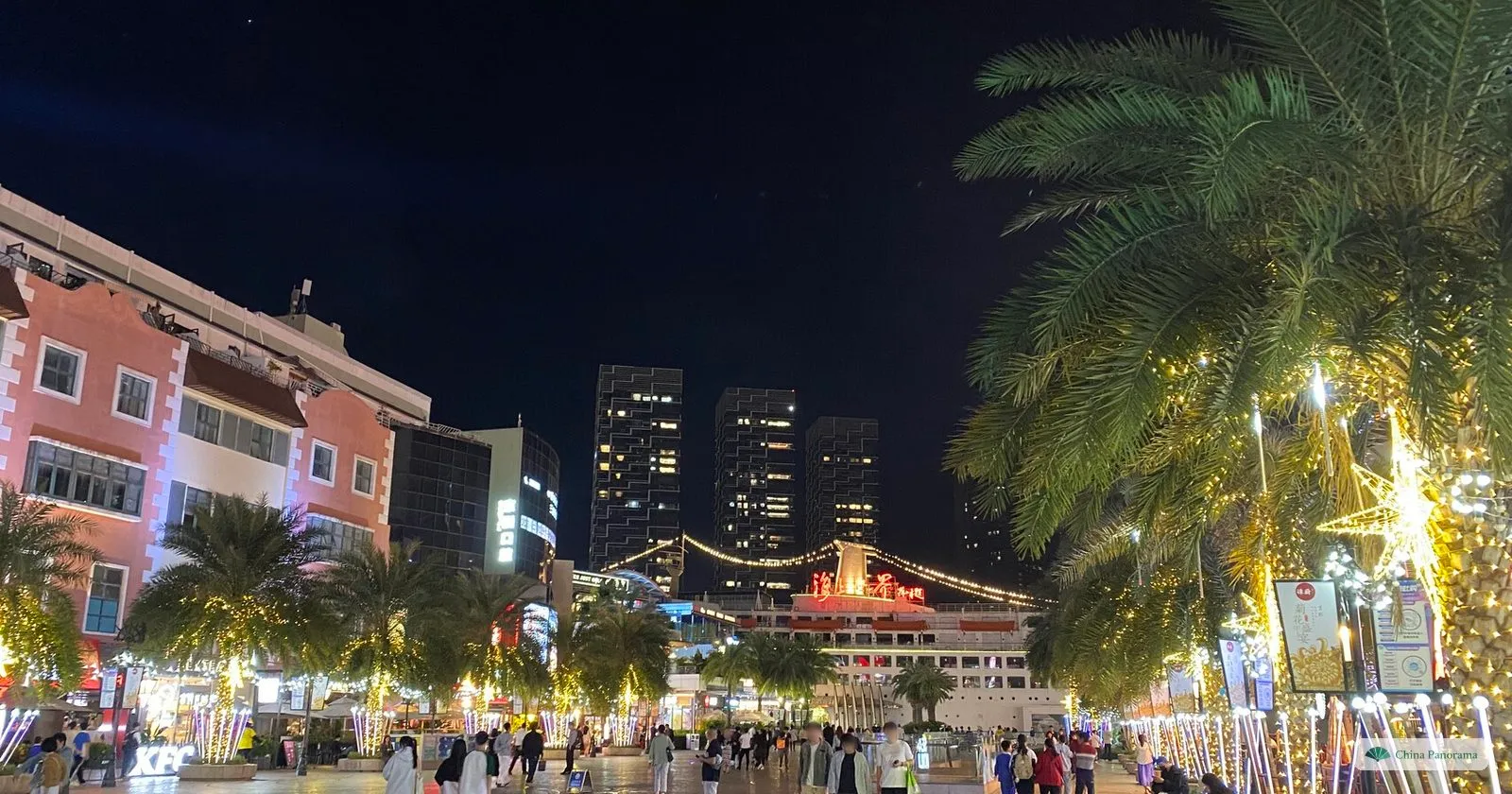
海上世界 · 明华轮LandmarkNanshan · 南山区OutdoorsThe heart of Shekou, the harbour district at the south-western tip of the city, is a cruise ship set in concrete. The Minghua was built in France in 1962 as the liner Ancerville, bought by China's state shipping line in 1973 and brought to Shekou in August 1983, where it was set on a permanent berth and turned into a hotel with restaurants and bars. Deng Xiaoping came on 26 January 1984 and wrote its name, 海上世界, “Sea World”, in his own hand — the name stuck to the whole district. Around the ship there is now a pedestrian plaza of restaurants, bars and shops around a lagoon, with a fountain show in the evening. We were here at a quarter to eight on a rainy morning in January 2018, when the plaza was empty, and again on an undated evening, when it was full and the ship was lit from bow to stern.
Sea World station (Lines 2 and 12) is at the plaza. The plaza is free and open at all hours; the bars and restaurants keep their own hours. The fountain show is reported for the evening; we have not checked the times.
- Entry
- Free
- Opening hours
- Open at all hours
Nüwa statue and seaside park
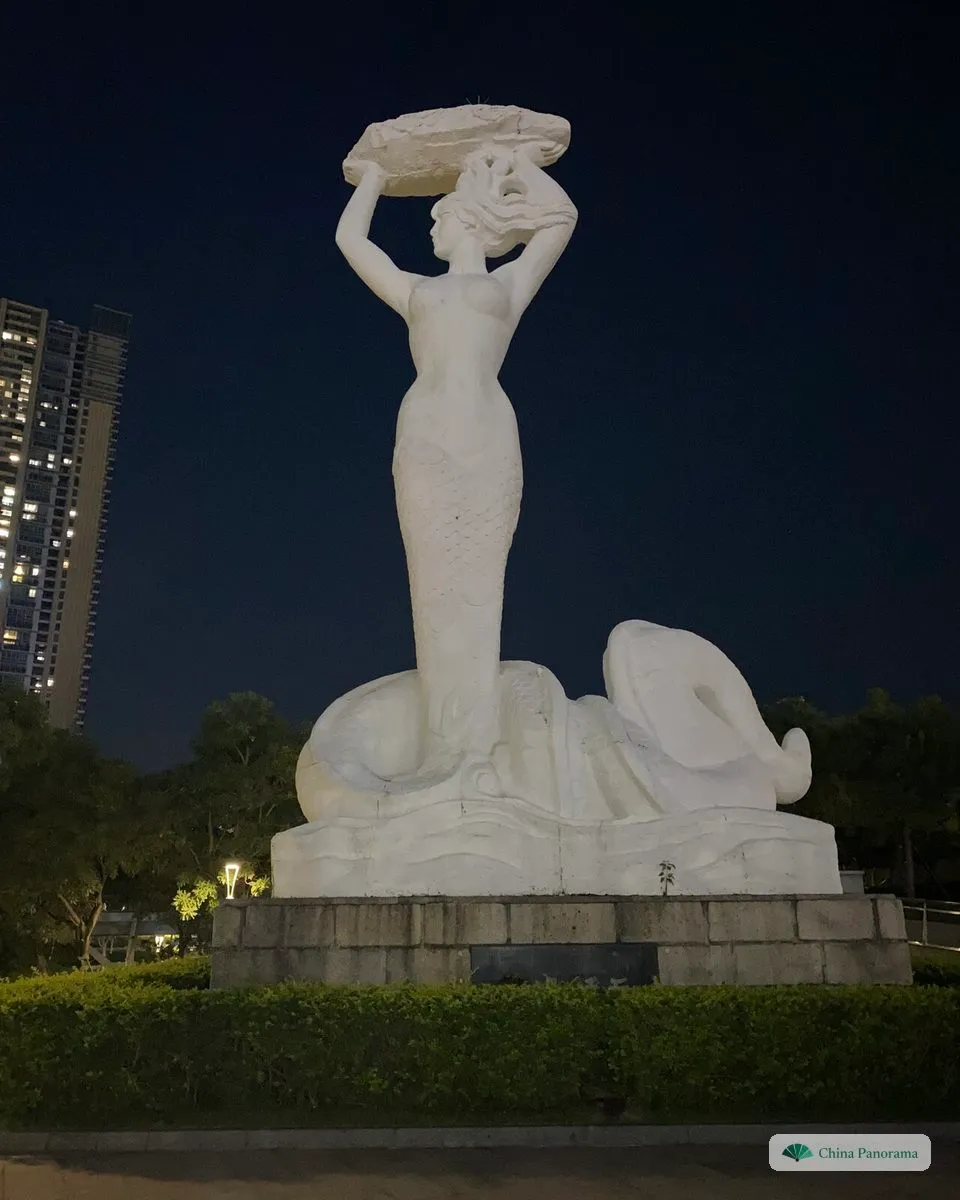
女娲补天像 · 女娲滨海公园ParkNanshan · 南山区OutdoorsA few hundred metres south of the Minghua, at the edge of the sea, stands a white statue of Nüwa, the goddess who in Chinese myth repaired the broken sky with a stone she melted in five colours: she holds the stone over her head, and her lower body coils into a serpent's tail, as the old pictures show her. The statue and the seaside promenade around it were added to Sea World in 1989. It is floodlit at night.
About five minutes' walk south of the Minghua, along Nüwa Road. We have not checked whether the park closes at night.
- Entry
- Price not verified — check on site
- Opening hours
- Hours not verified — check on site
Design Society (Sea World Culture and Arts Center)
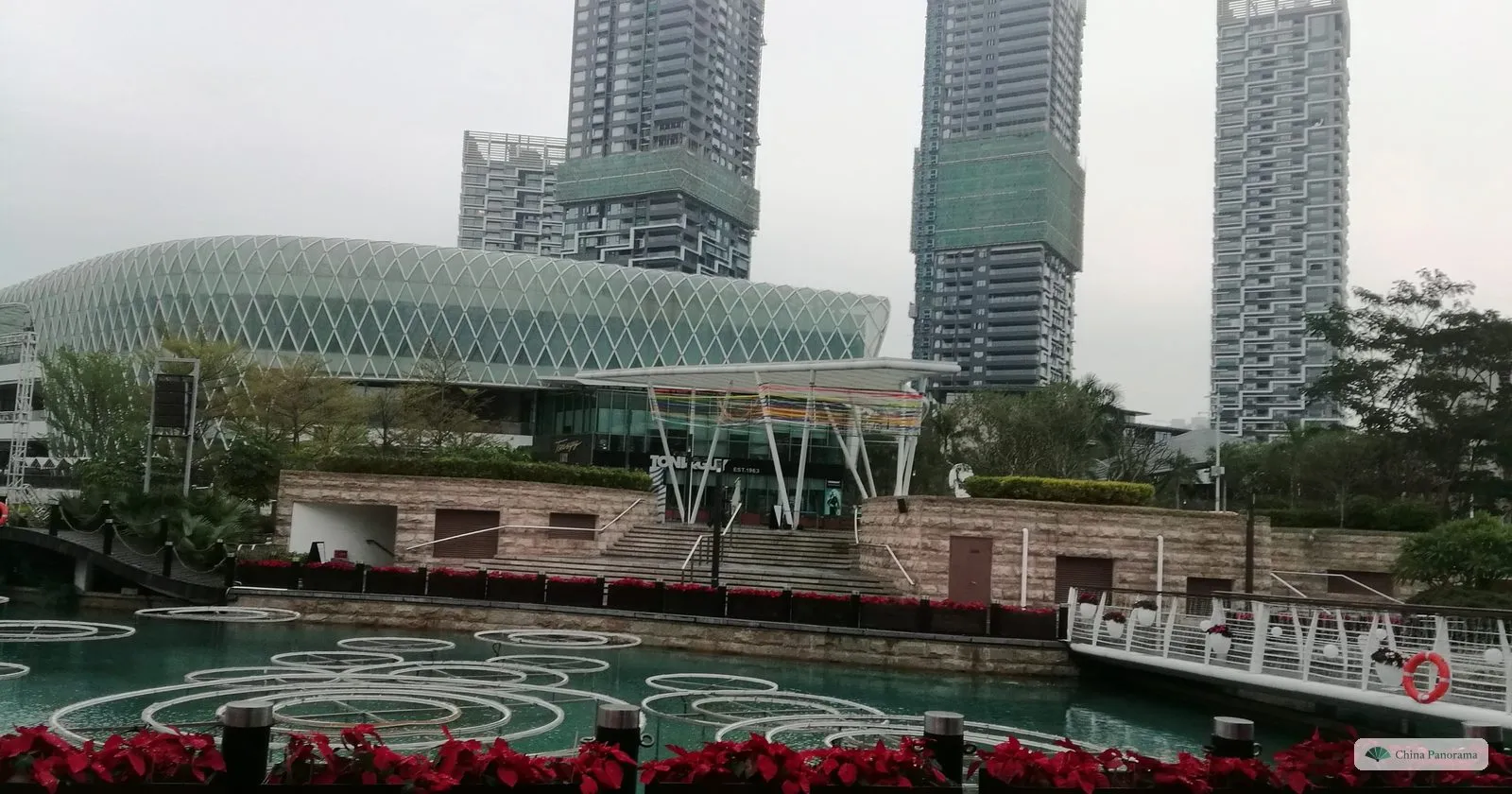
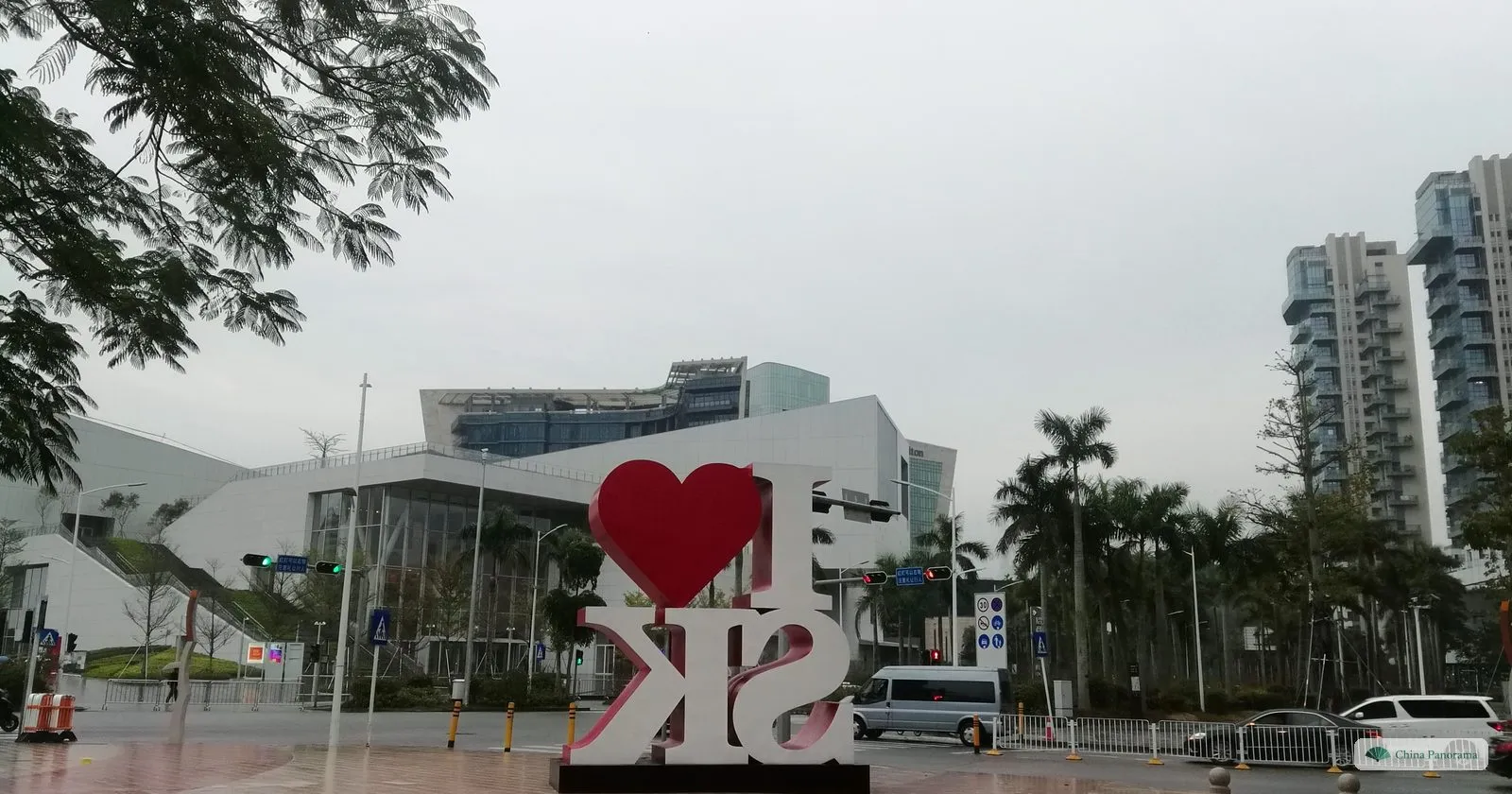
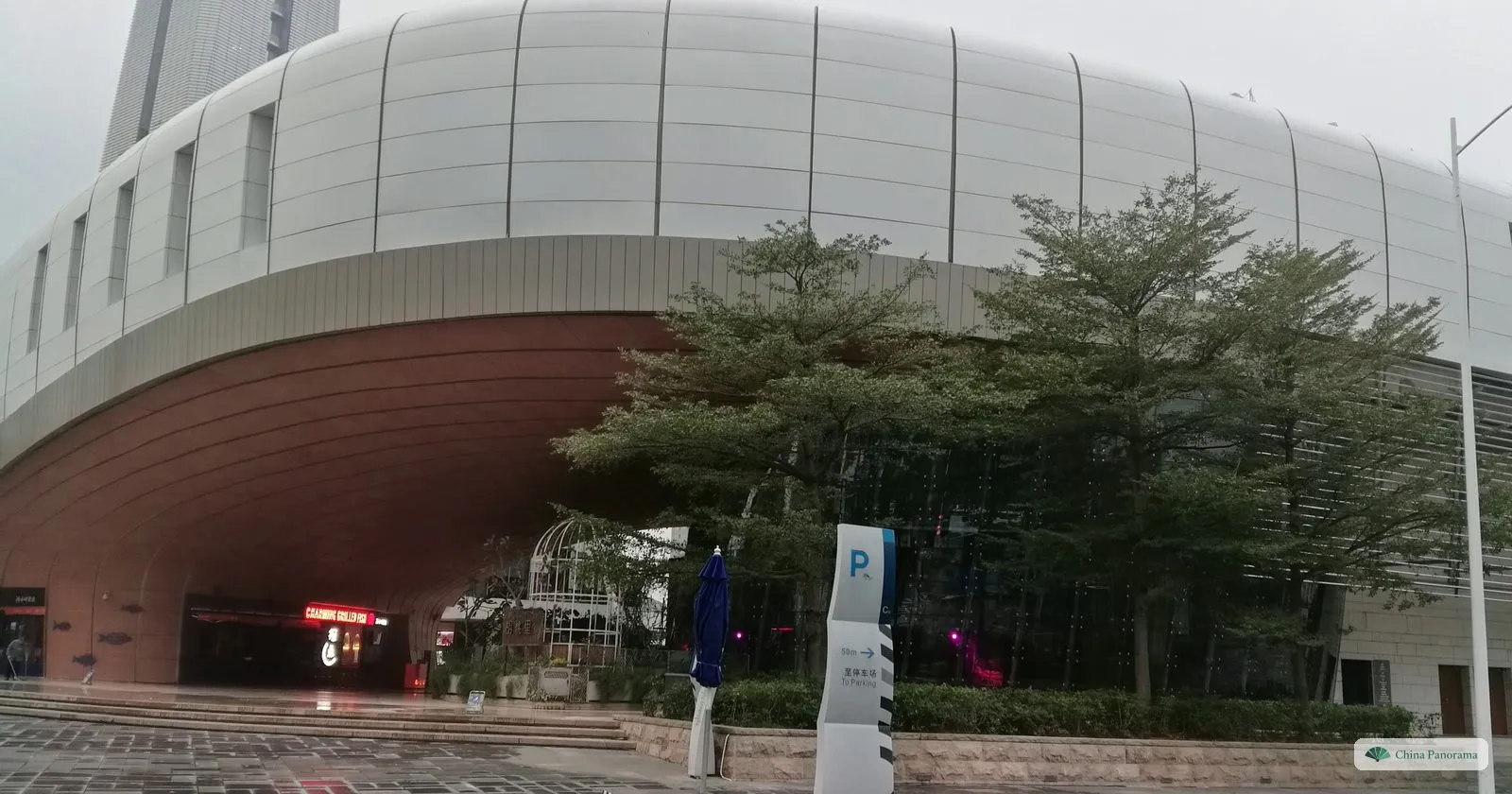
设计互联 · 海上世界文化艺术中心MuseumNanshan · 南山区IndoorsA white building of stacked, cantilevered boxes on the Shekou waterfront, designed by the Japanese architect Fumihiko Maki and opened on 2 December 2017. It is run by Design Society, which opened as China's first cultural hub devoted to design, and it was opened with a gallery developed together with the Victoria and Albert Museum in London — the first such partnership between a British museum and a Chinese one. Besides the galleries there are a theatre, a hall, shops and restaurants, and terraces looking over the bay. Our photograph is from five weeks after the opening, at twenty to eight on a wet January morning.
On Wanghai Road, about eight minutes' walk south of the Minghua. Exhibitions change and some are paid; we have not checked prices, hours or whether a booking is needed.
- Entry
- Price not verified — check on site
- Opening hours
- Hours not verified — check on site
Civic Center
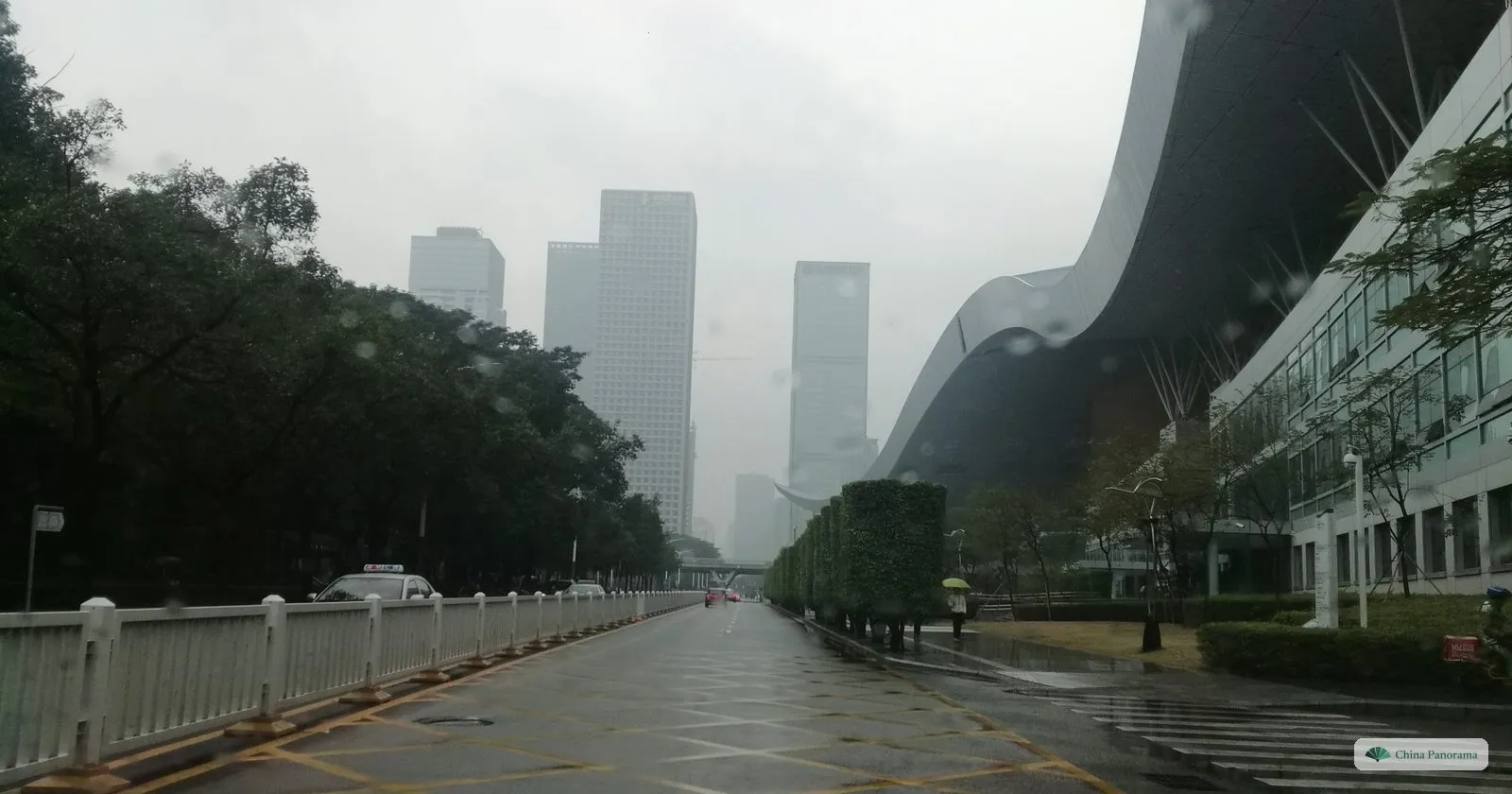
深圳市民中心ArchitectureFutian · 福田区IndoorsThe seat of the city government, at the middle of Futian's central axis, under a roof that looks like a bird spreading its wings: 486 m long, about 63,000 m² and around 9,000 tonnes of steel, resting on the blocks below. It was designed by the American-Chinese architect John M. Y. Lee and opened in May 2004. The west wing holds the city government, the east wing the People's Congress, and the middle is open to the public: the Shenzhen Museum, an exhibition hall and an auditorium. We drove past in steady rain at noon on 9 January 2018; the roof is so long that it only fits into a photograph from well down the road.
Civic Center station (Lines 2 and 4) is underneath. The square in front is free and open at all hours. We have not checked the Shenzhen Museum's hours or whether it needs a reservation.
- Entry
- Price not verified — check on site
- Opening hours
- Hours not verified — check on site
Lianhuashan Park
莲花山公园ParkFutian · 福田区OutdoorsA wooded hill of 150 hectares at the northern end of Futian's central axis, opened as a park in 1997. On the top stands a 6 m bronze statue of Deng Xiaoping, by the sculptor Teng Wenjing, unveiled in November 2000: he is shown striding out, after his remark that the steps of reform and opening up should be bigger. From the terrace beside it you look straight down the axis — the Children's Palace, the library and concert hall, the long roof of the Civic Center, and the towers of Futian behind it.
Children's Palace station (Lines 3 and 4) is near the south gate; the statue is on the top of the hill. We have not checked entry or opening hours.
- Entry
- Price not verified — check on site
- Opening hours
- Hours not verified — check on site
Ping An Finance Centre
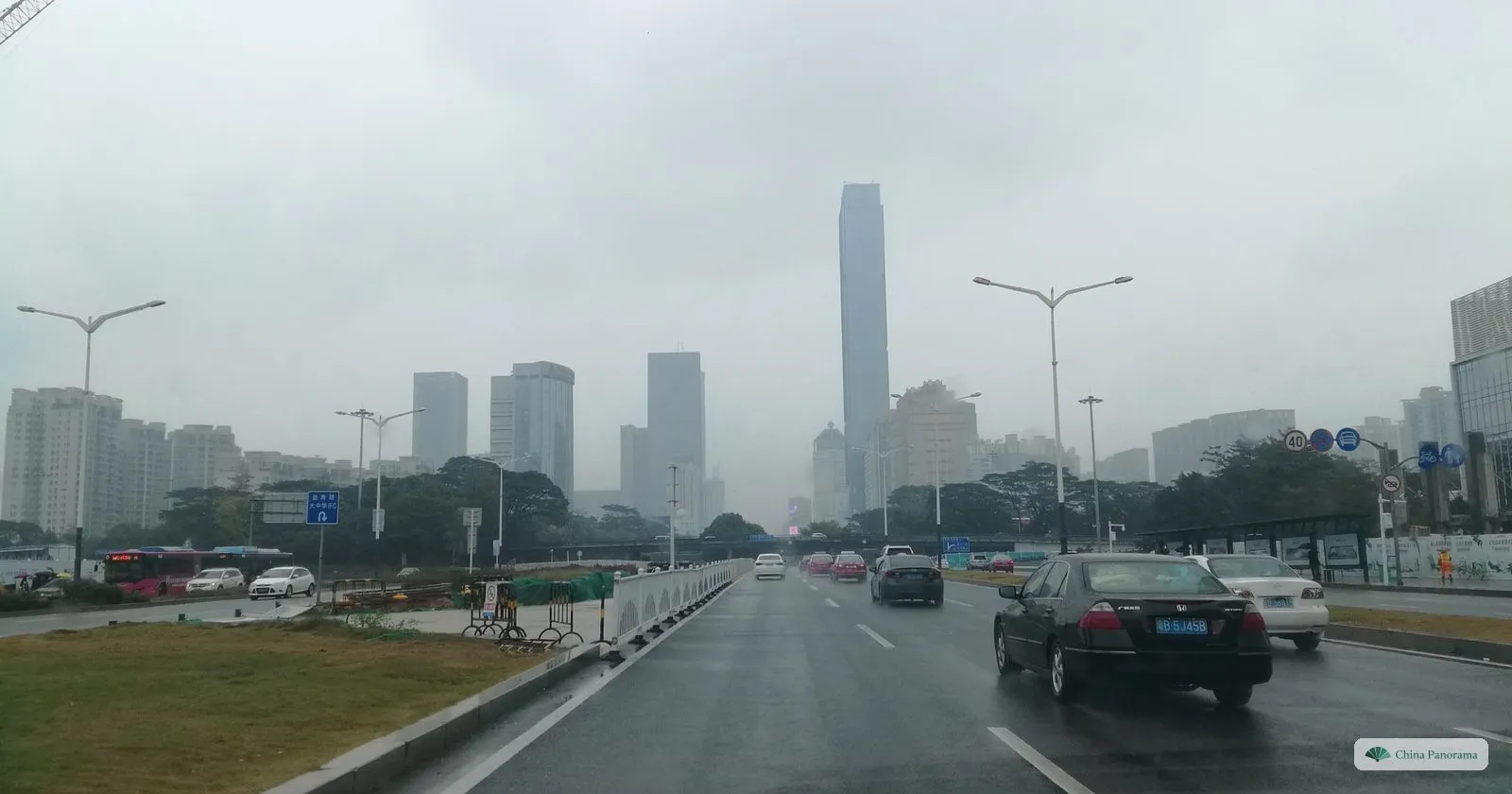
平安国际金融中心LandmarkFutian · 福田区IndoorsThe tallest building in Shenzhen, 599 m with 118 floors above ground, designed by Kohn Pedersen Fox and completed in 2017; it was topped out in April 2015. Its stone-clad ribs run up the full height and taper into a pointed crown. On the 116th floor, near the top, the Free Sky observation deck looks over Futian, across the border to the hills of Hong Kong's New Territories, and over the bay. Our photograph is from the road below at five past one on 9 January 2018, with the top already fading into the rain cloud.
Shopping Park station (Lines 1 and 3) connects to the basement. The deck charges admission; we have not checked the price or hours. On a cloudy day the top floors are often in cloud — look before you pay.
- Entry
- Price not verified — check on site
- Opening hours
- Hours not verified — check on site
 StreetFutian · 福田区Outdoors
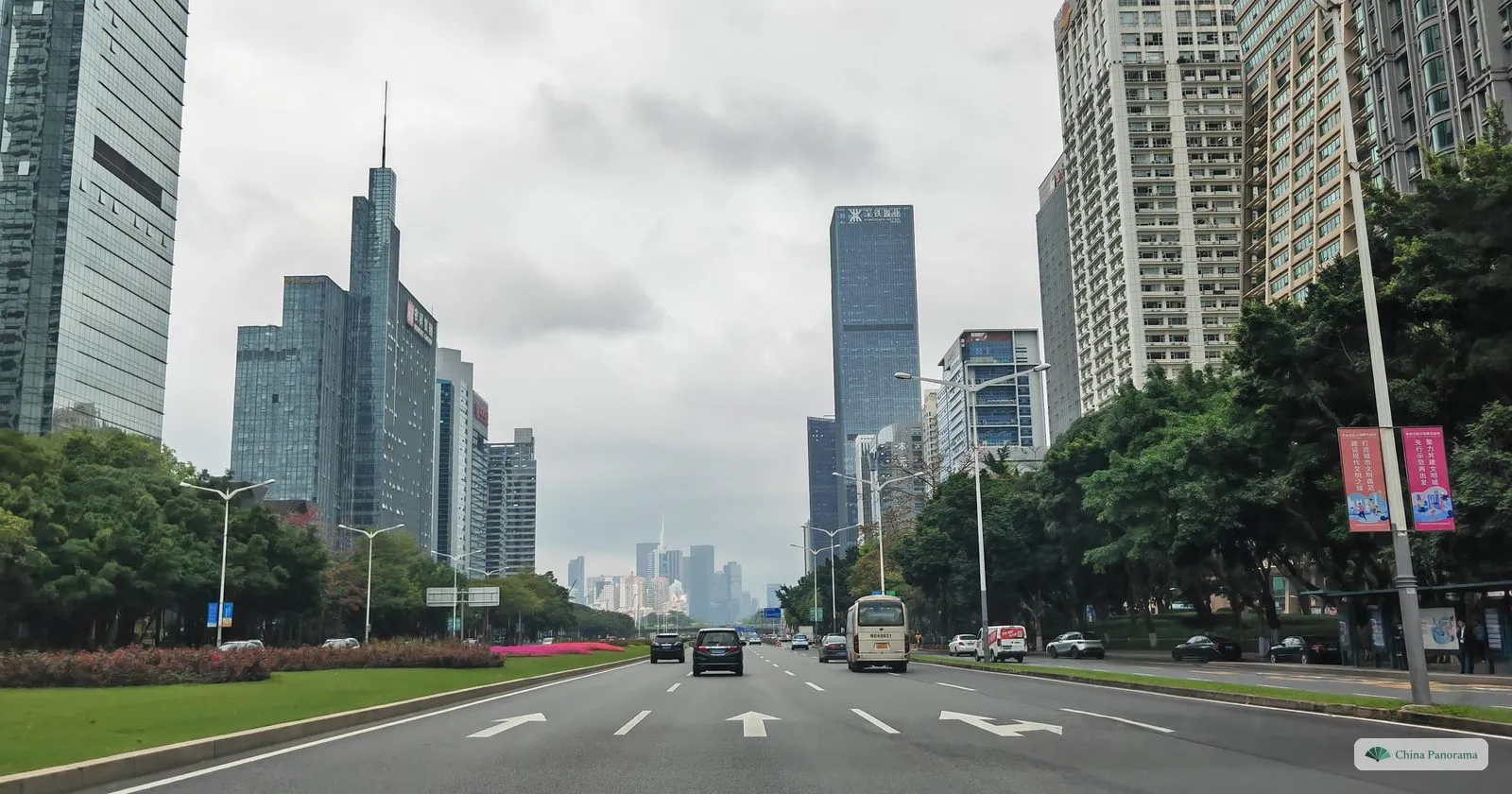
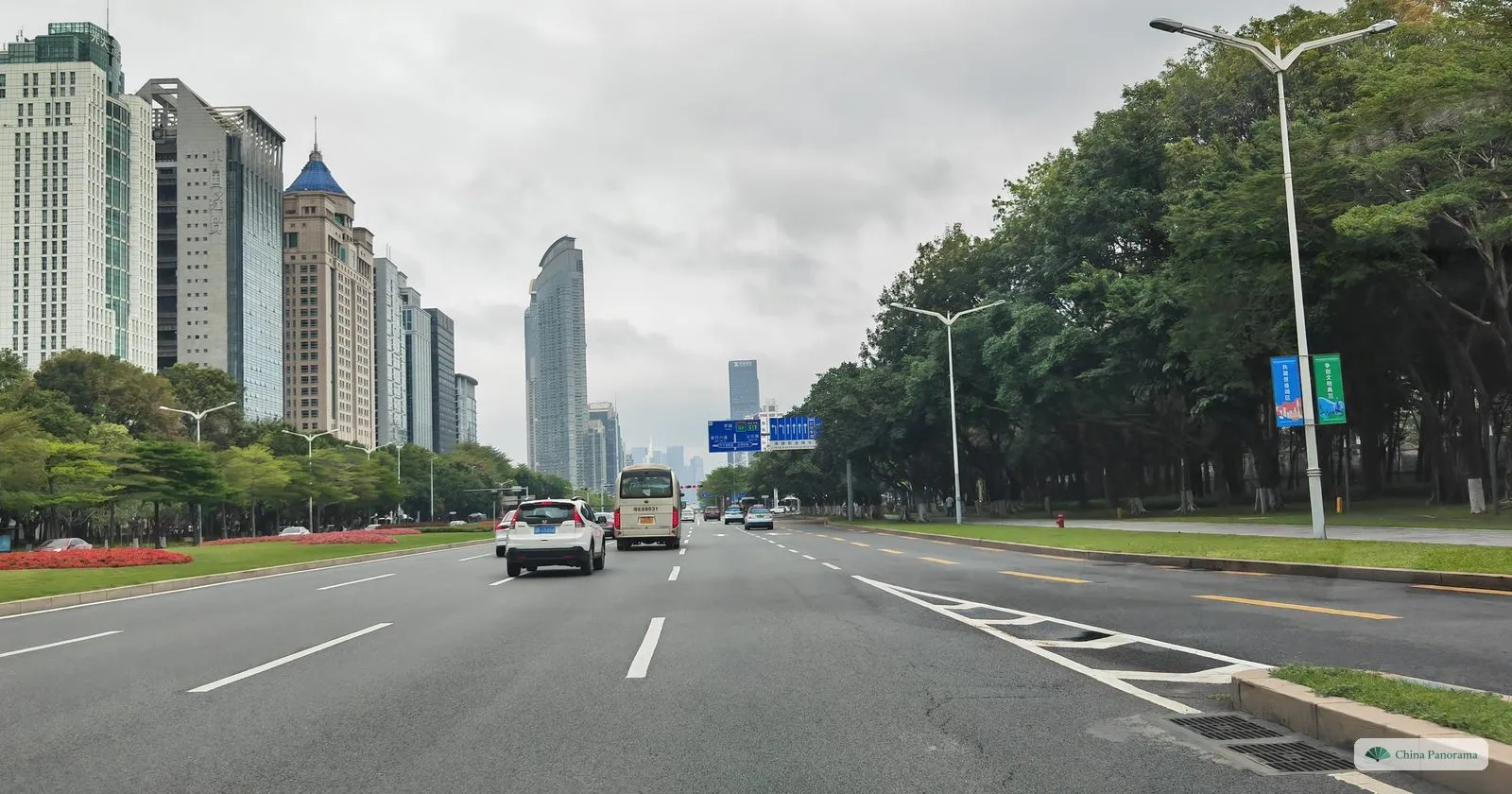
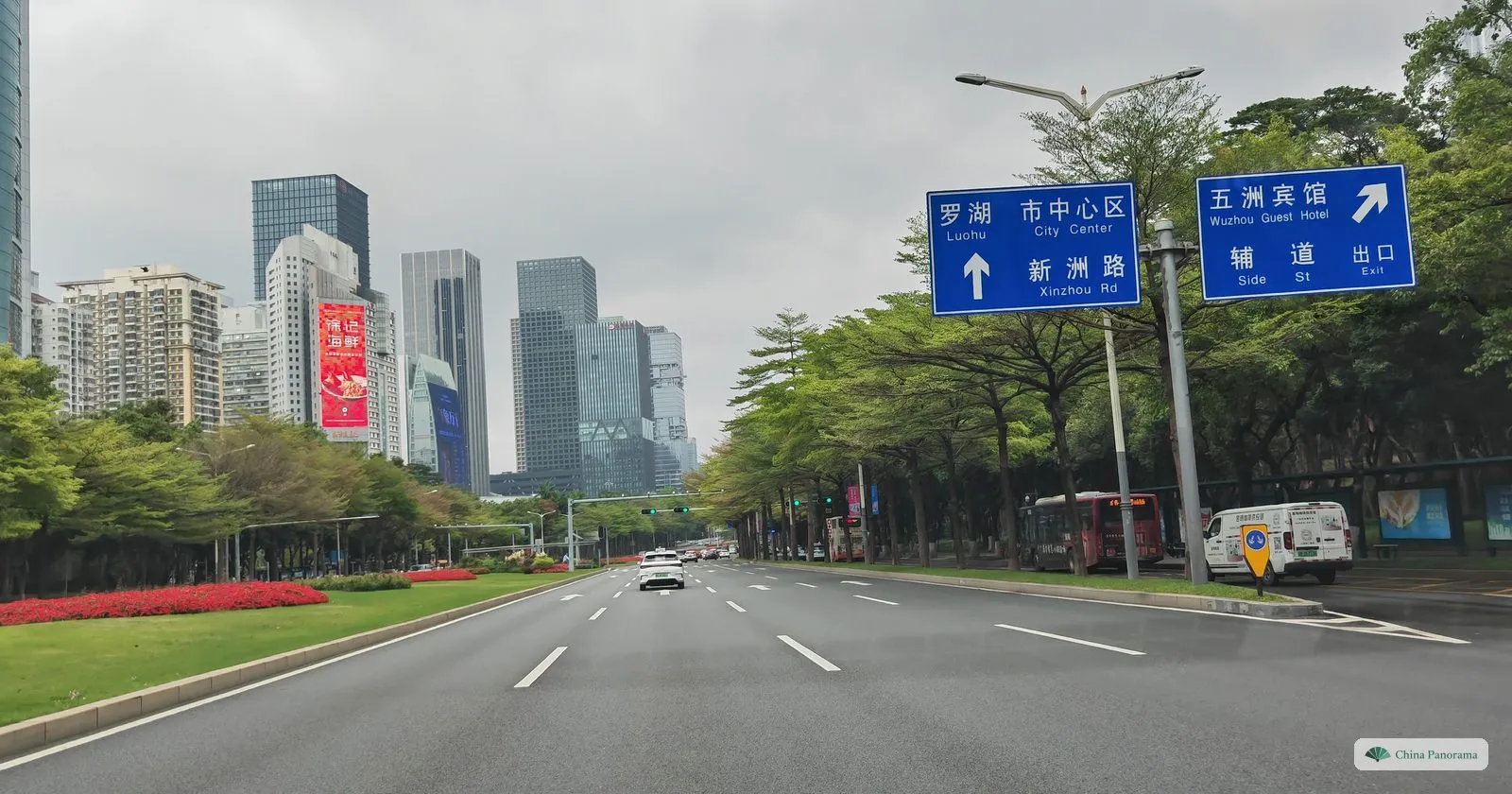
The city's main street runs west–east for 25.6 km from Nantou to Luohu, and its history is the city's in miniature. In 1980 it was a 2.1 km strip of asphalt, 7 m wide — the longest road in Shenzhen at the time. It was widened to 50 m between 1982 and 1984, ran through for 6.8 km by 1987, and reached its full length in 1994, with a road reserve 135 m wide and up to 350 m in the centre: the lanes are separated by broad planted strips. Metro Line 1 runs underneath most of it. The Ping An Finance Centre rises behind the towers of Futian. Our photographs are from a car heading east: in rain on 9 January 2018, and under grey cloud on 3 April 2023.
Metro Line 1 runs underneath from Luohu to Window of the World; ride it to see the stations, or take a taxi or bus along it to see the street. Free and open at all hours.
- Entry
- Free
- Opening hours
- Open at all hours
 ParkFutian · 福田区Outdoors
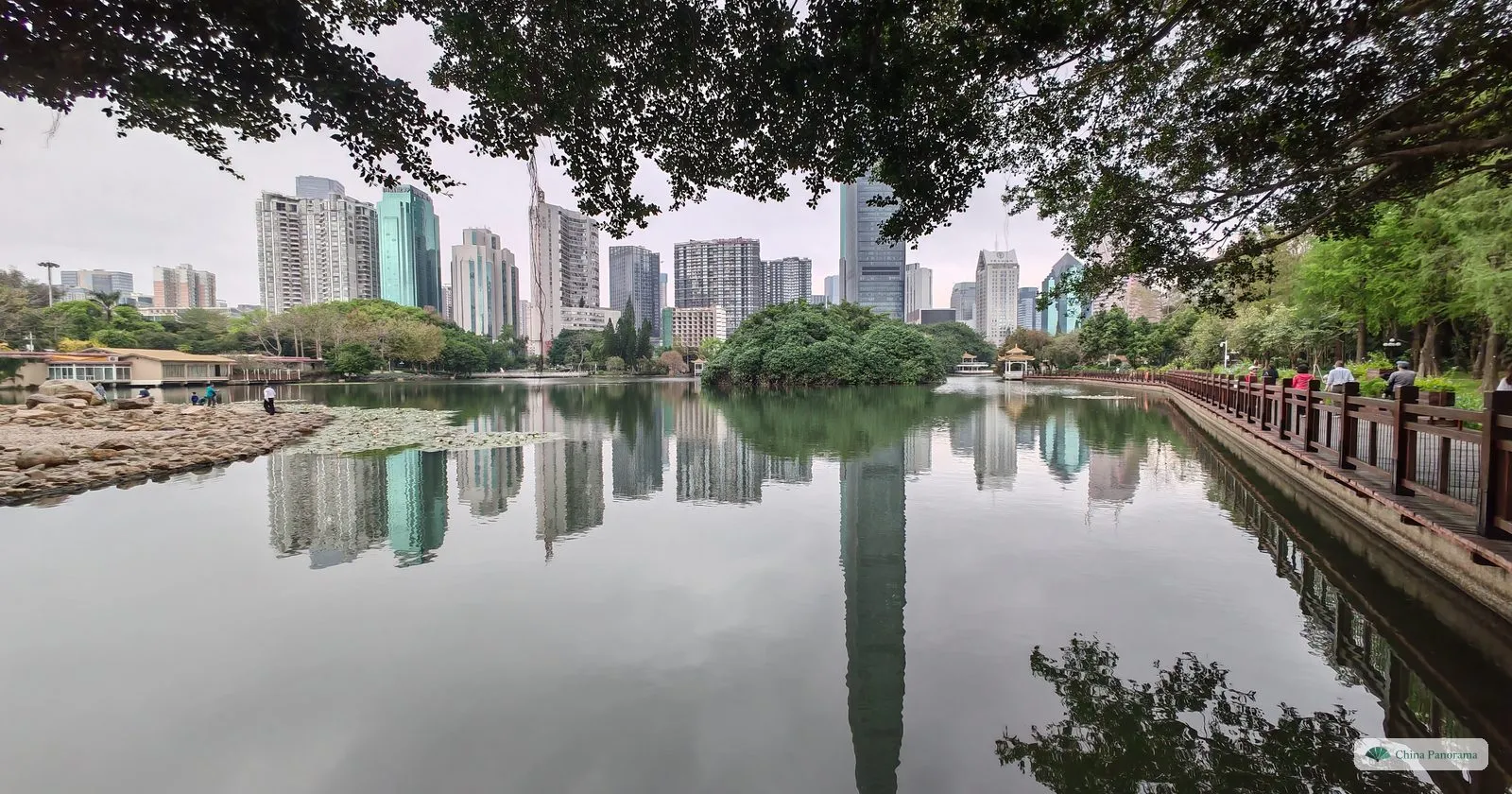
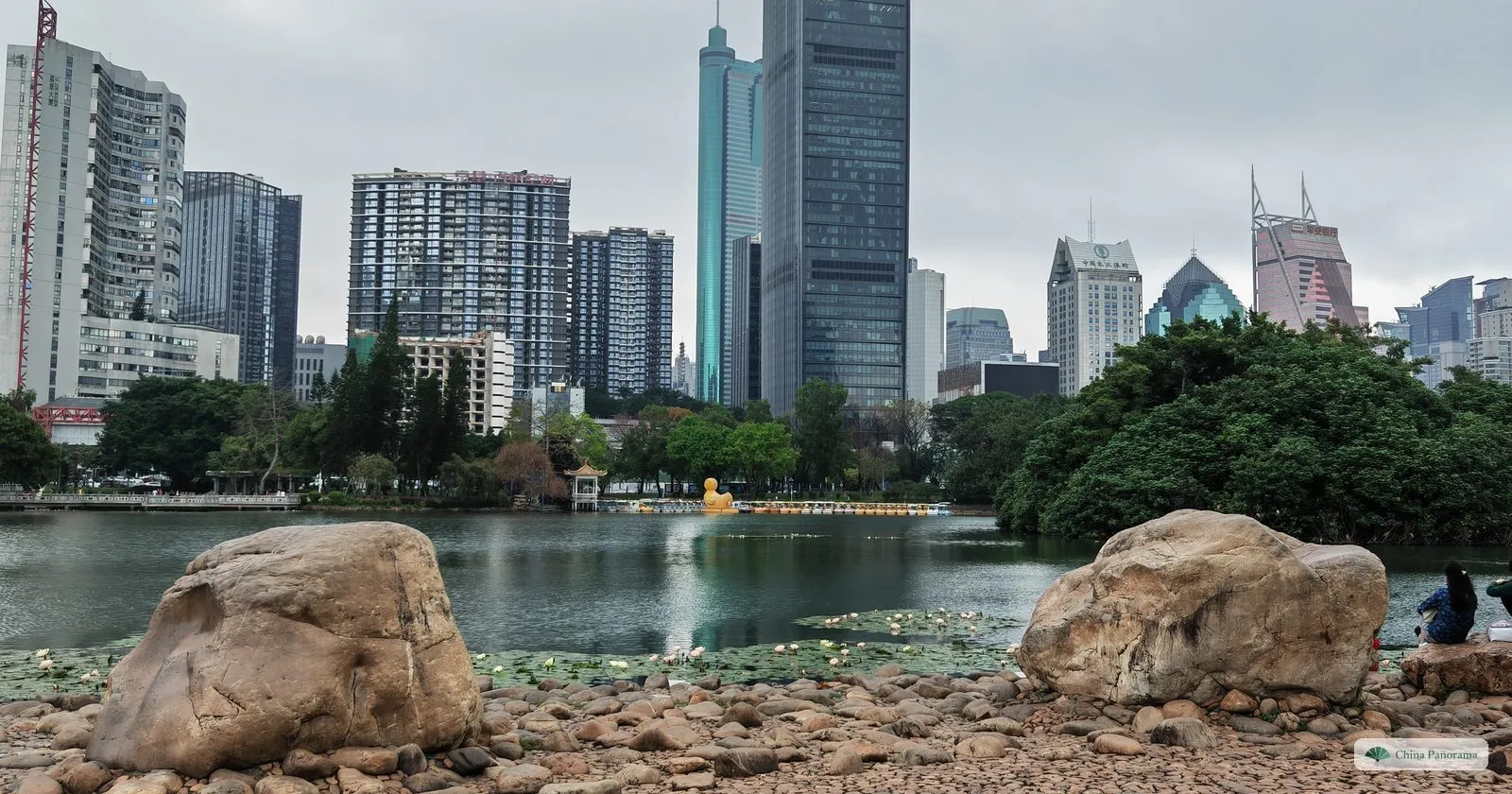
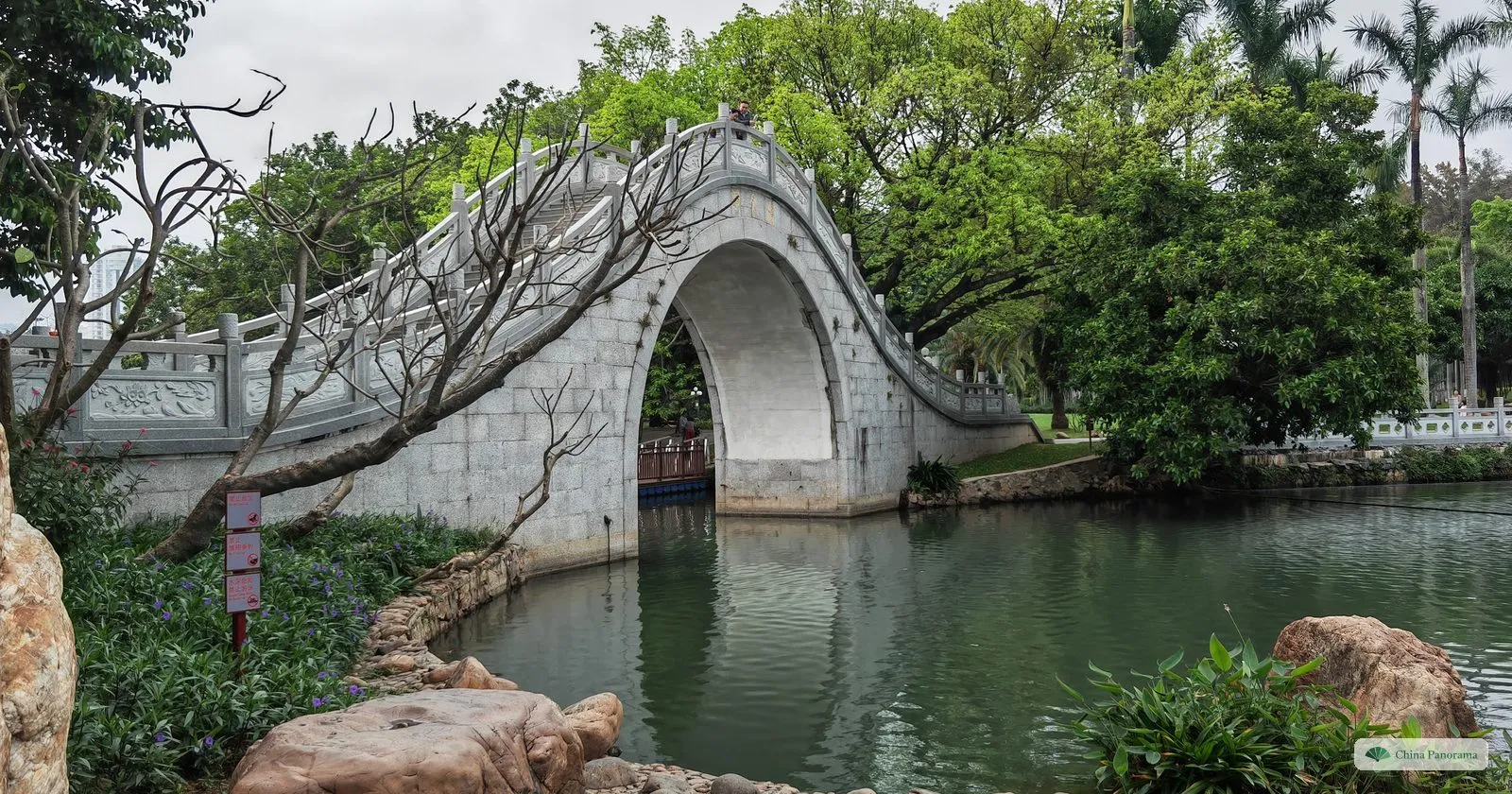
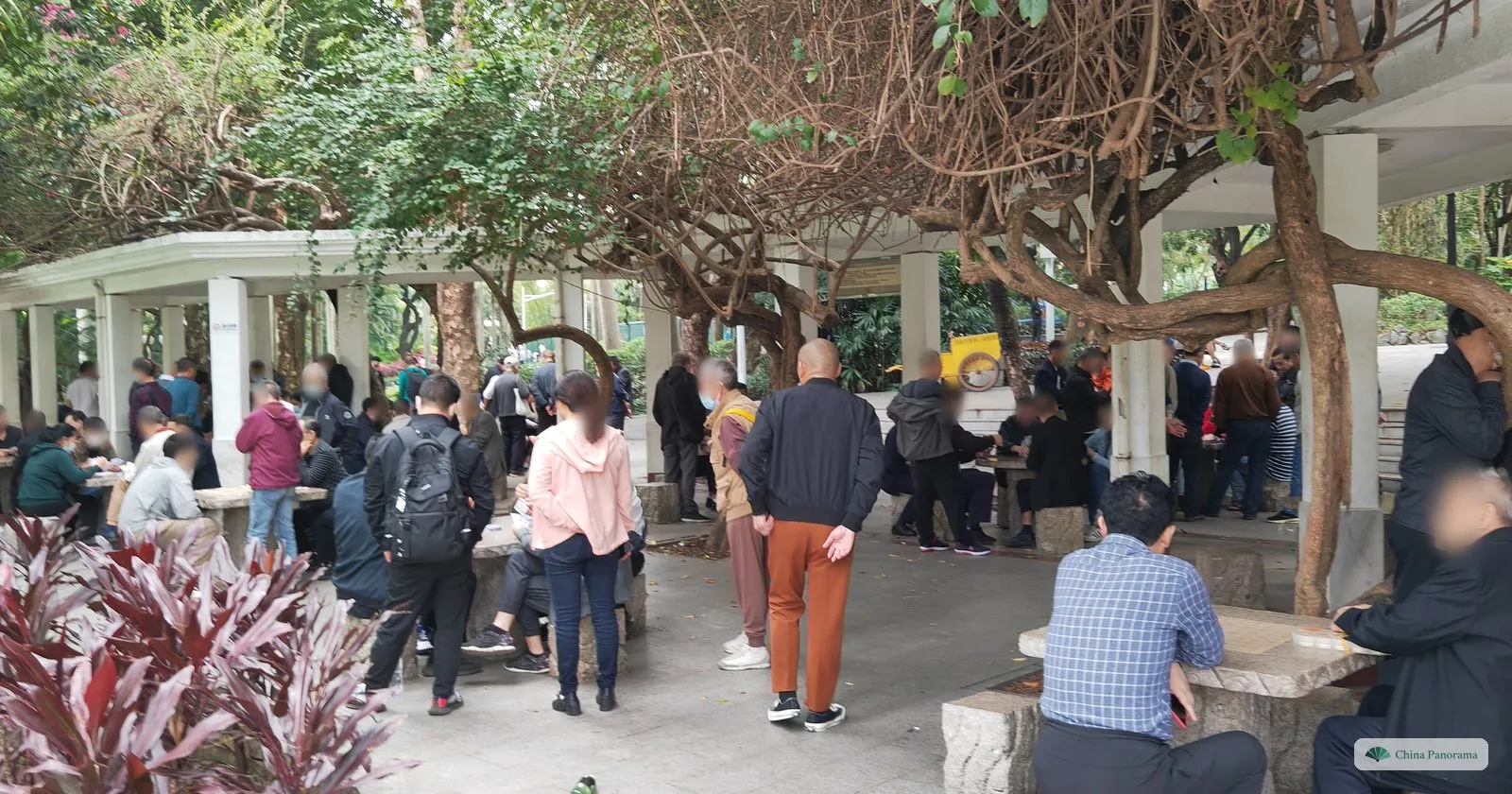
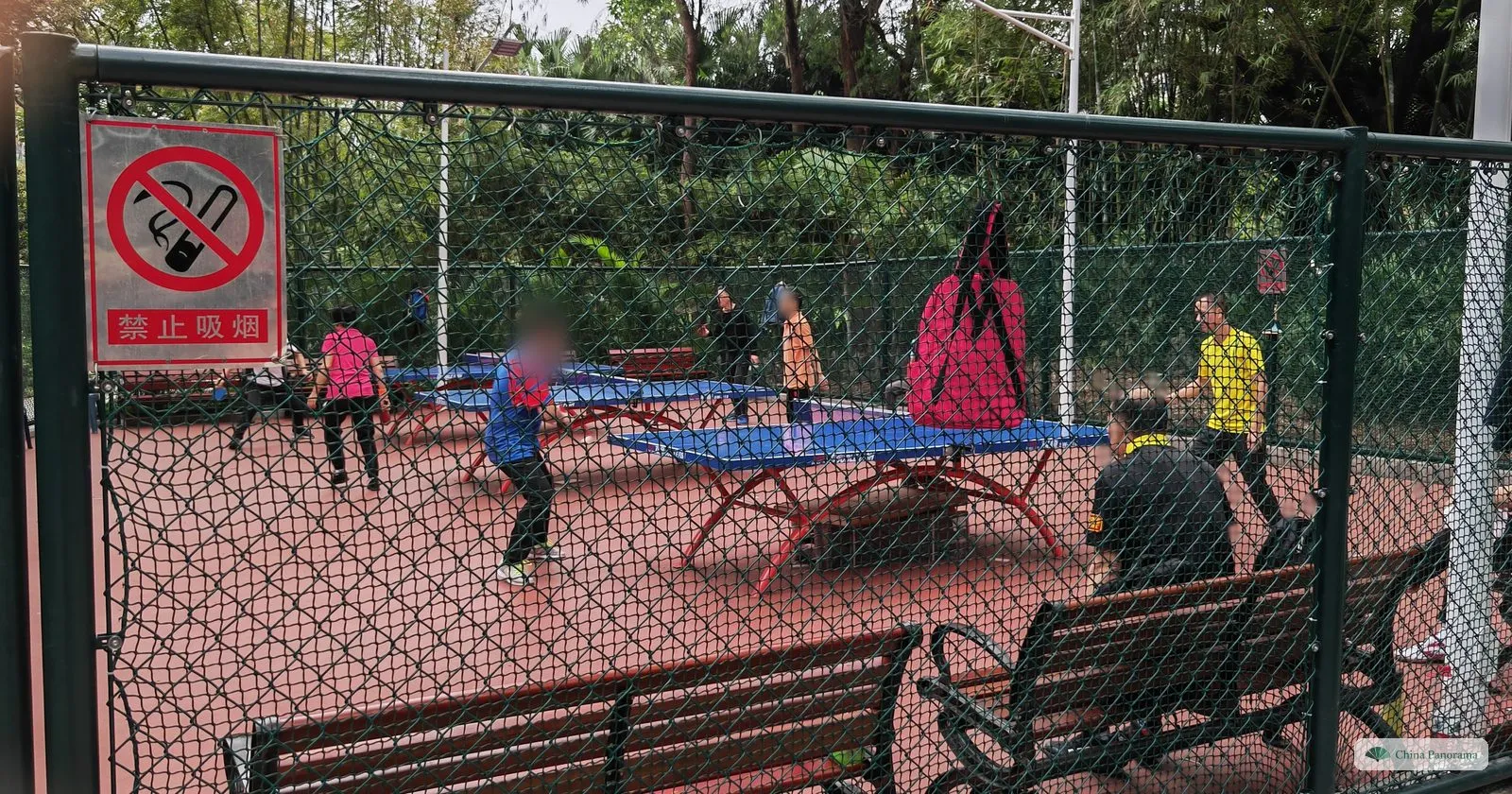
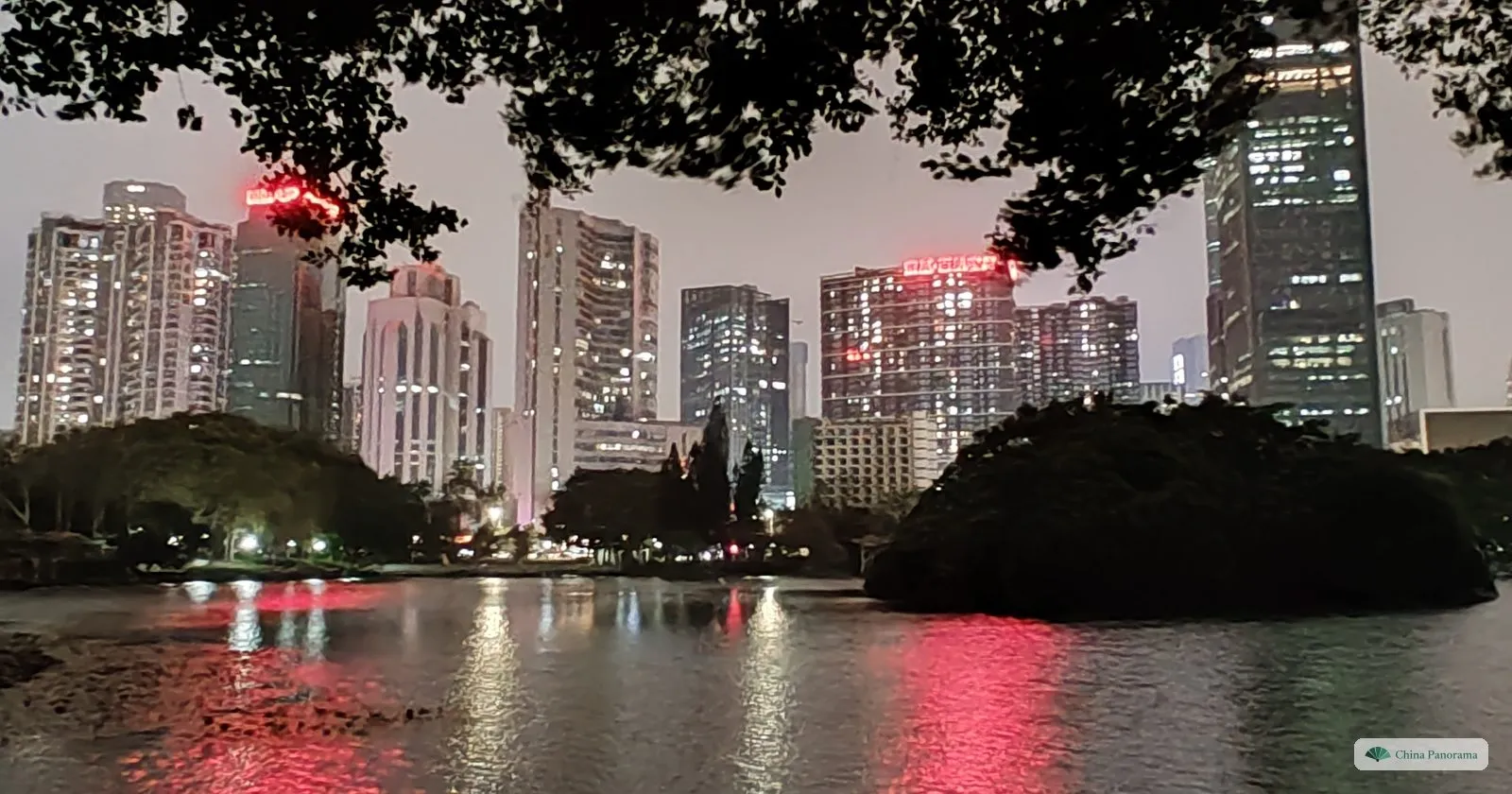
The first public park of the Special Economic Zone, laid out in 1982 around 589 old lychee trees and a low-lying paddy field, which became its lakes. It covers 28.8 hectares, 11 of them water, with 6.4 km of paths, pavilions, a stone moon bridge and causeways; the lychee was made Shenzhen's city tree in 1986. The view is the reason to come: the lakes mirror the towers of Futian and Luohu that rose all around it. On a Monday afternoon, 3 April 2023, the pavilions were crowded with people gathered round card games at the stone tables, the courts with table tennis players, and bougainvillea, the city flower, was in bloom along the water.
On Hongling Road, between Shennan Boulevard and Hongli Road; Grand Theater station (Lines 1 and 2) is near the south-east corner. We have not checked entry or opening hours.
- Entry
- Price not verified — check on site
- Opening hours
- Hours not verified — check on site
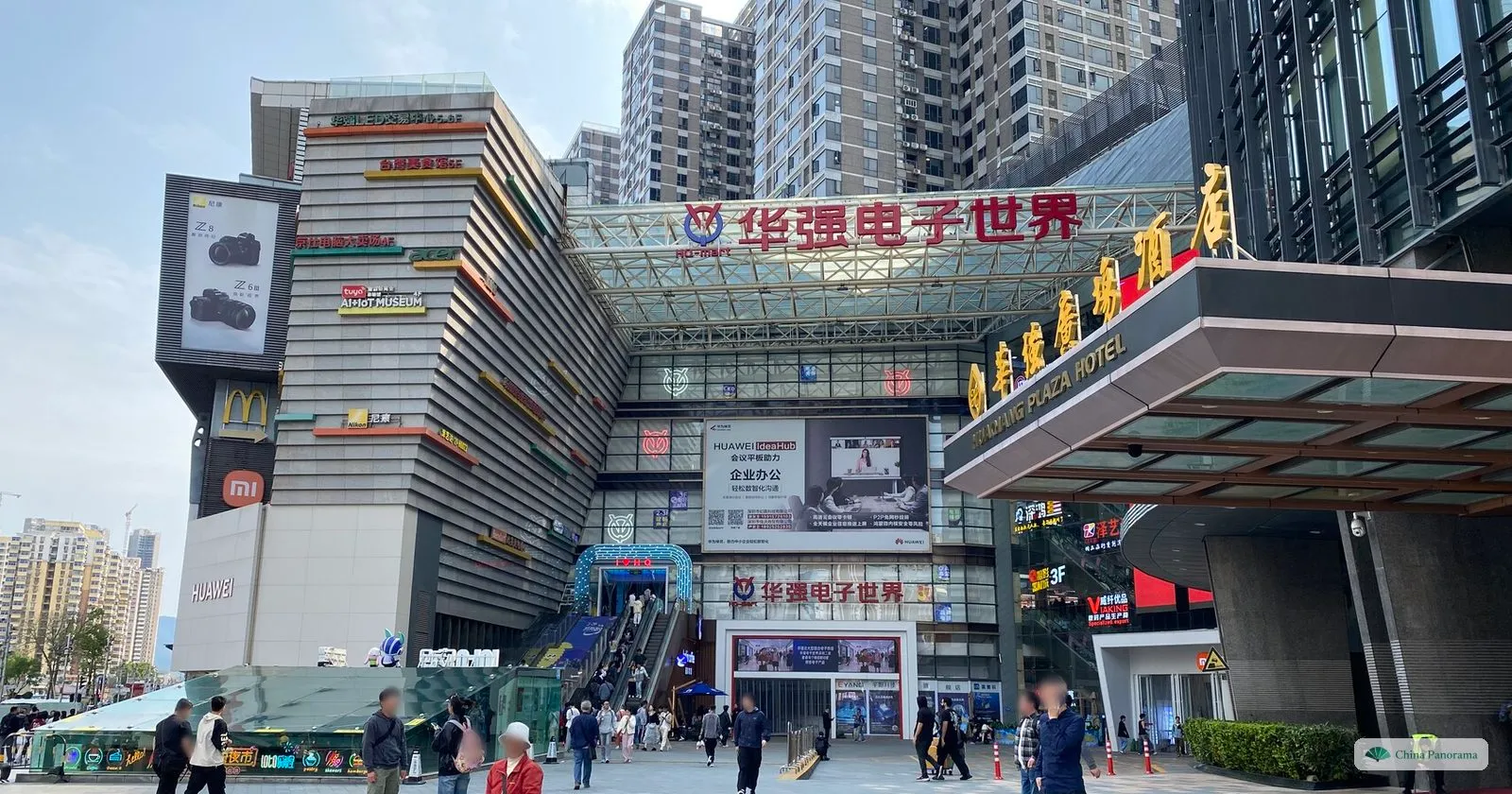 MarketFutian · 福田区Indoors
Often called the biggest electronics market in the world, it began as an industrial zone: in 1979 three state electronics factories were moved here from the mountains of northern Guangdong. In 1988 the first trading market for electronic components in China opened in the SEG building, and the rest followed — today more than 20 specialised markets, block after block of multi-storey halls divided into tiny stalls selling chips, cables, phone parts, drones, LED strips and every gadget you can imagine, wholesale and retail. Huaqiang Electronics World is one of the largest. After the metro was built underneath, the street reopened as a pedestrian zone in January 2017, and a museum of the street opened in December 2020.
Huaqiang North station (Lines 2 and 7) is under the street; Huaqiang Road (Line 1) is at its south end. The street is free and open at all hours; most halls open in the morning and close in the evening — we have not checked times. Test anything before you pay, and keep the receipt.
- Entry
- Free
- Opening hours
- Open at all hours
Dongmen old street
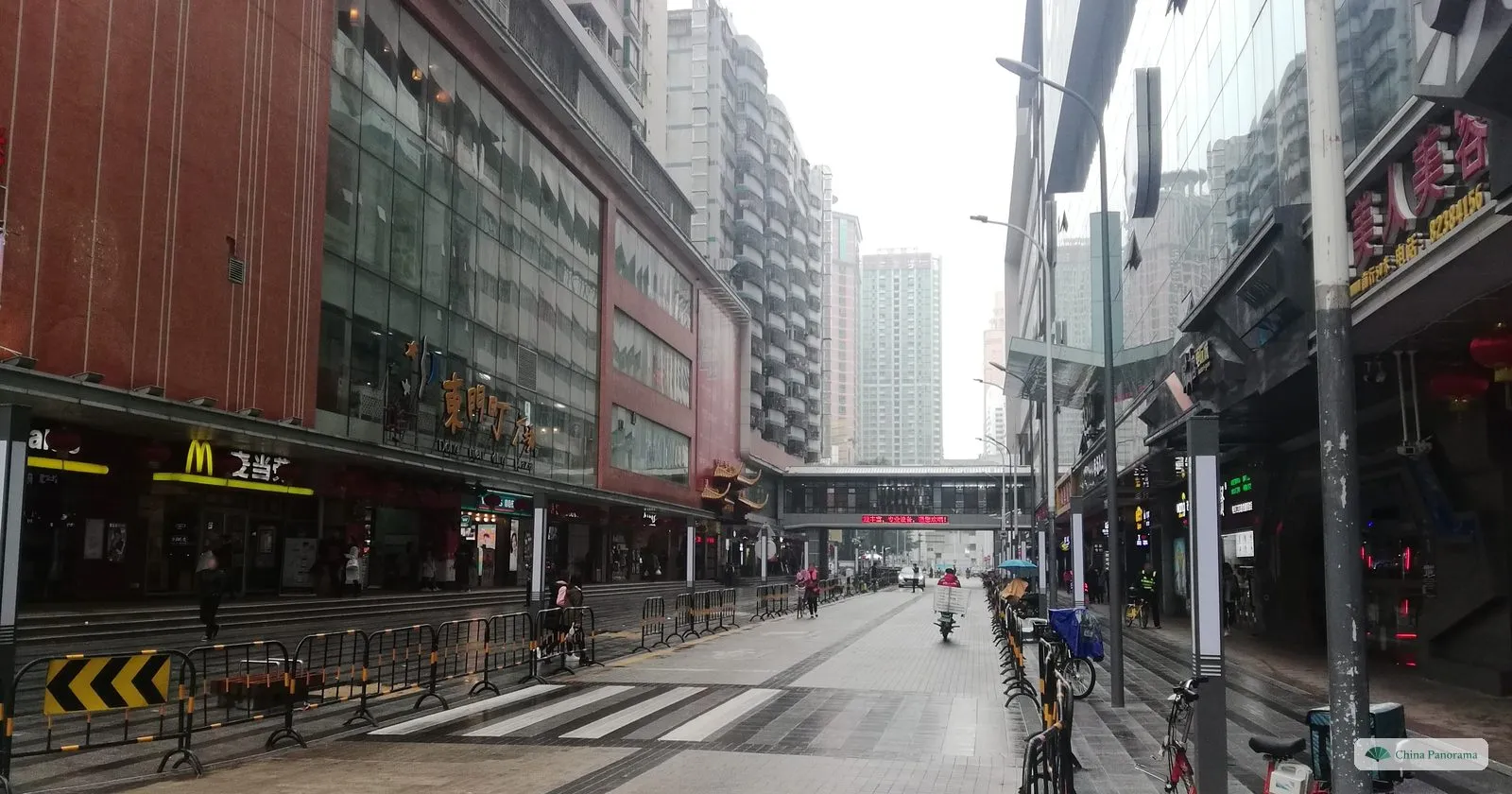
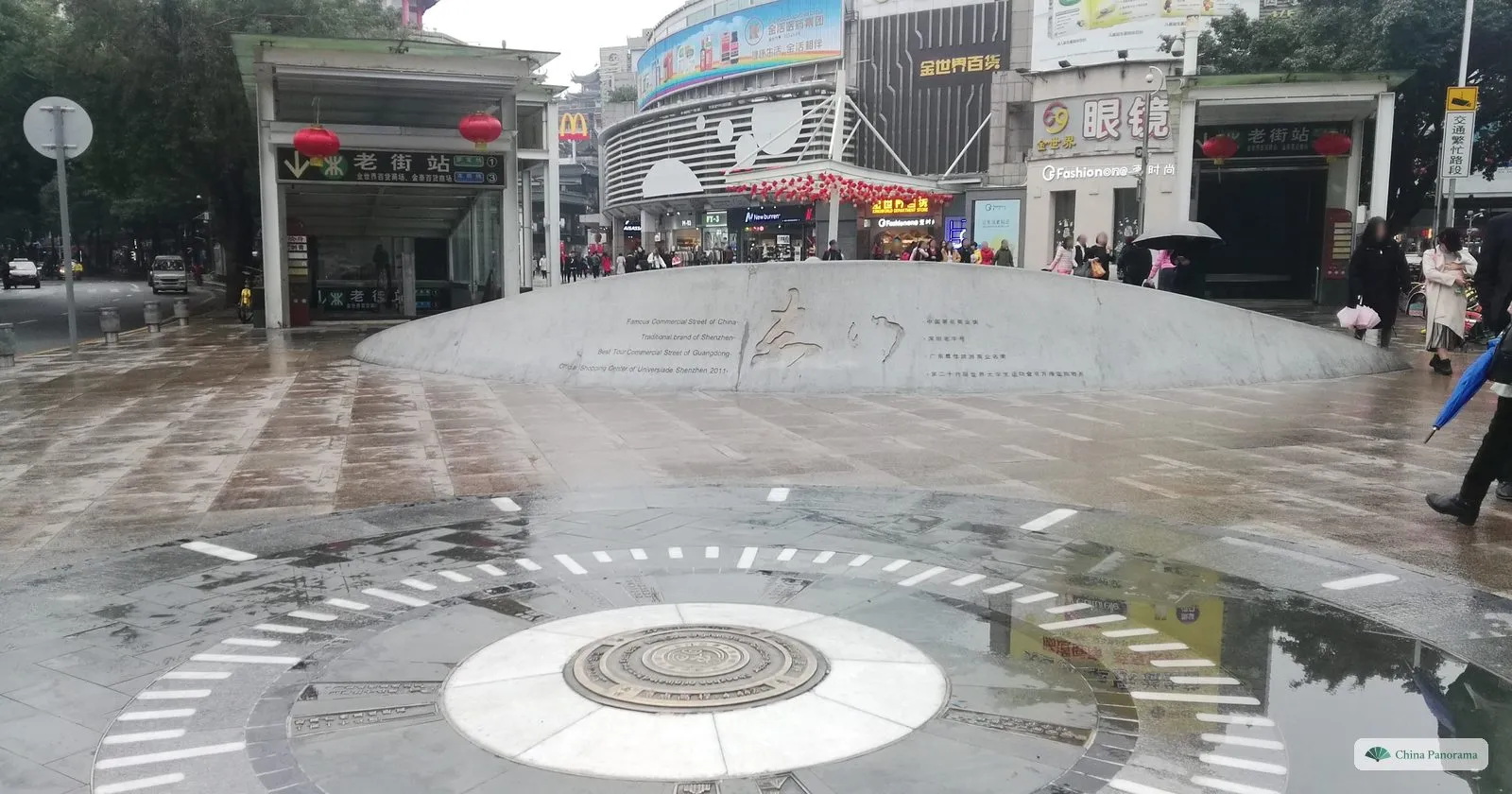
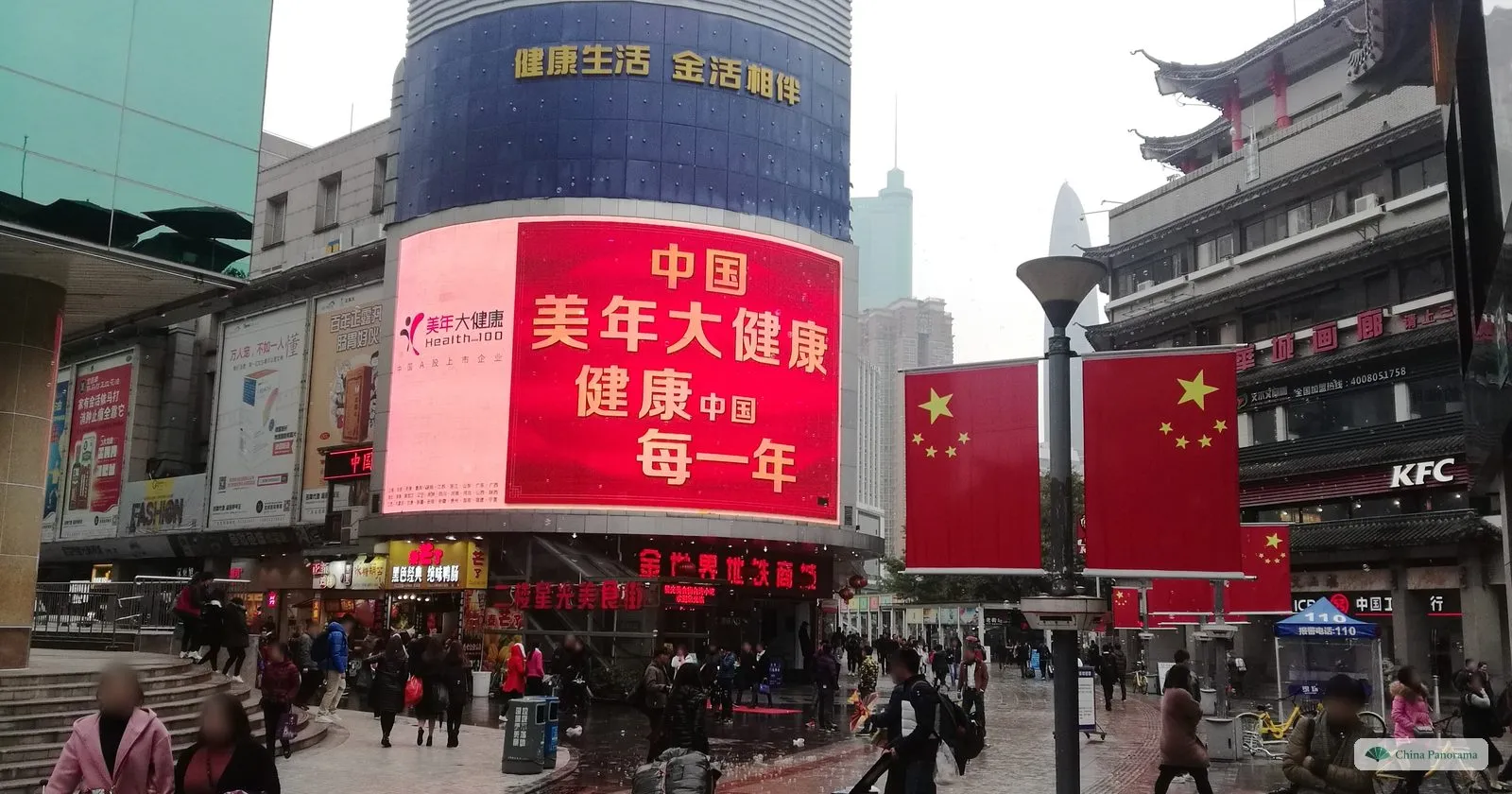
东门老街 · 深圳墟StreetLuohu · 罗湖区OutdoorsThis is where the name Shenzhen comes from. The villages around here — Chikan, Luohu, Getang and Hubei — held a market between them from the middle of the Ming dynasty, the Shenzhen Xu, “market of the deep ditch”, which grew into a busy market town under the Qing. When the city was founded in 1979 it took the market's name, and the market became “Dongmen old street”. Little of the old town survives: the area was rebuilt as a pedestrian shopping district, completed in 1999 and renovated again since. Among the malls you can still find a few old buildings, such as the grey-walled building under the plaque 西华宫, Xihua Palace, and the Siyue Academy, a clan hall in Renmin Road Second Lane. On a wet Tuesday afternoon in January 2018 the streets were busy anyway.
Laojie station (Lines 1 and 3) is in the middle of it. Free and open at all hours; the shops open around ten.
- Entry
- Free
- Opening hours
- Open at all hours
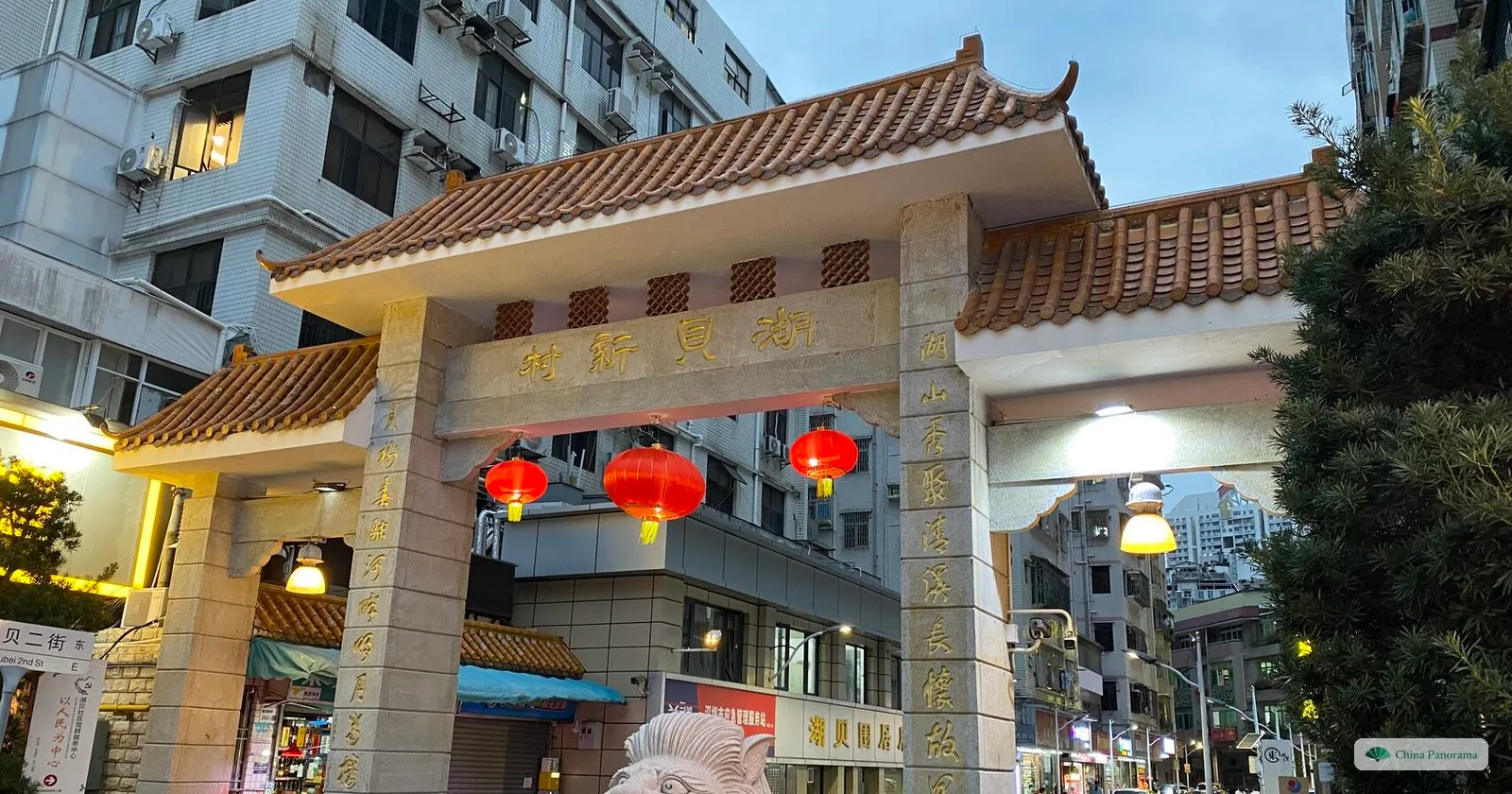 StreetLuohu · 罗湖区Outdoors
The last village inside the old Special Economic Zone that is more than 500 years old, a few minutes east of Dongmen. It was founded by the Zhang clan, who came from Dapeng in the east; the old core, the Nanfang, keeps its grid of three lanes running one way and eight the other, with the Huaiyue Zhang Ancestral Hall in the middle. Later, traders from the Chaoshan region rented the houses and made it a centre of the seafood trade. When a redevelopment plan threatened to clear it in 2016, a citizens' campaign, “Hubei 120”, collected signatures, and the city agreed to keep the ancestral hall and the lane pattern. A few hundred metres north-east is Hubei New Village, the newer part of the village, with a granite gate under tiled roofs and lanterns — that is the gate in our photograph.
Hubei station (Lines 2 and 5) is at the old village; Laojie (Lines 1 and 3) is about eight minutes' walk west. The lanes are free and open at all hours; it is a lived-in neighbourhood, not a museum.
- Entry
- Free
- Opening hours
- Open at all hours
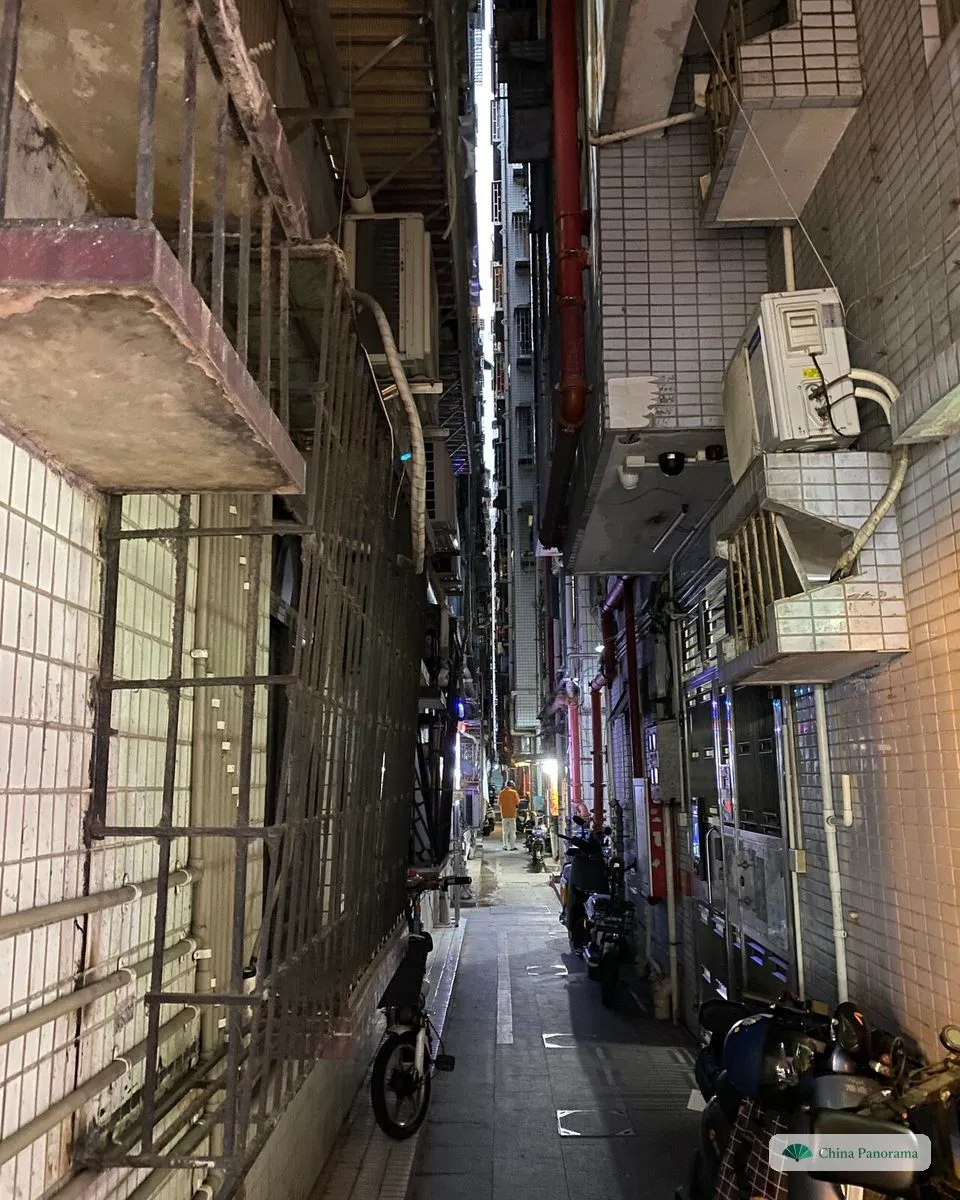
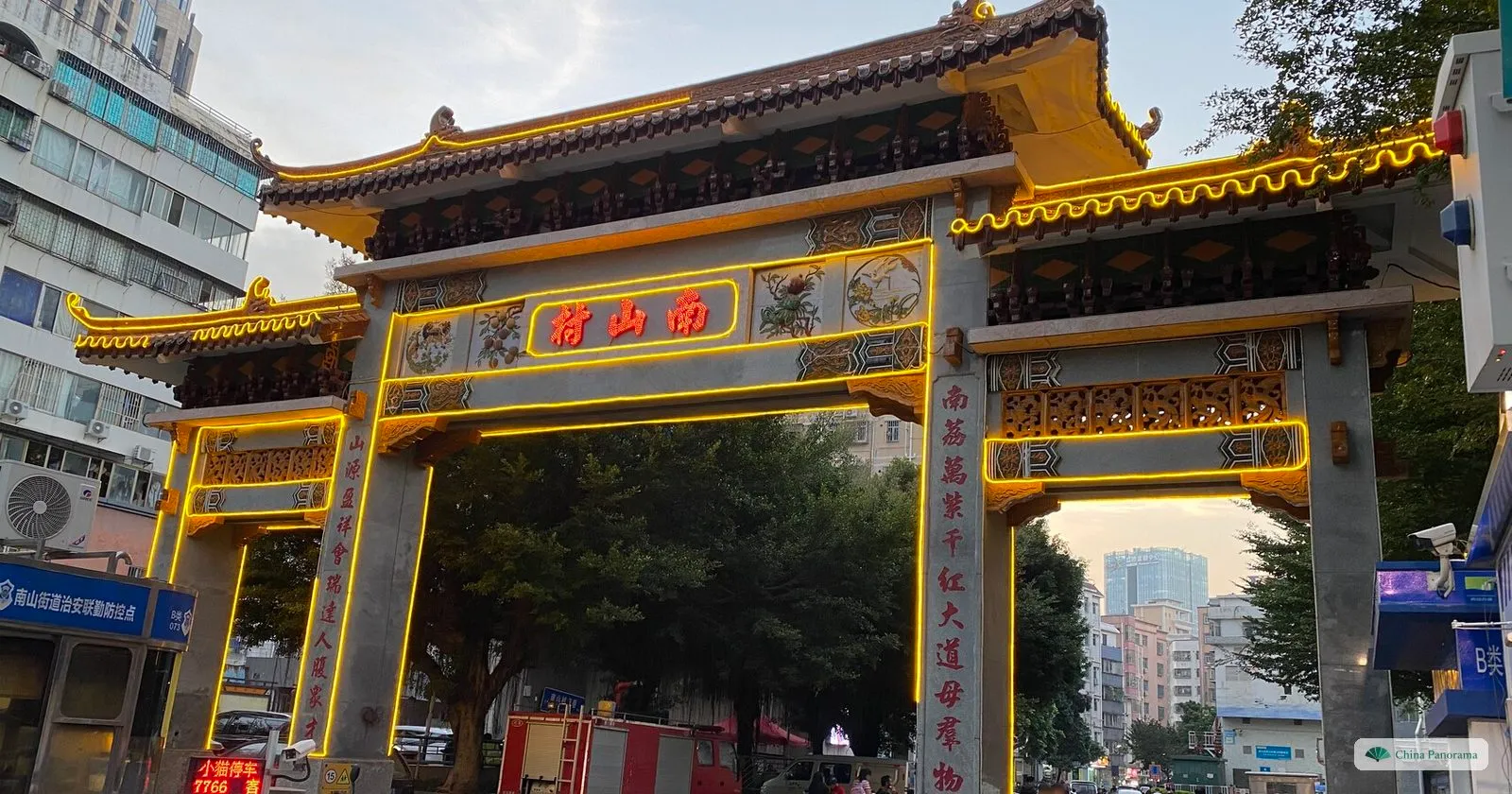
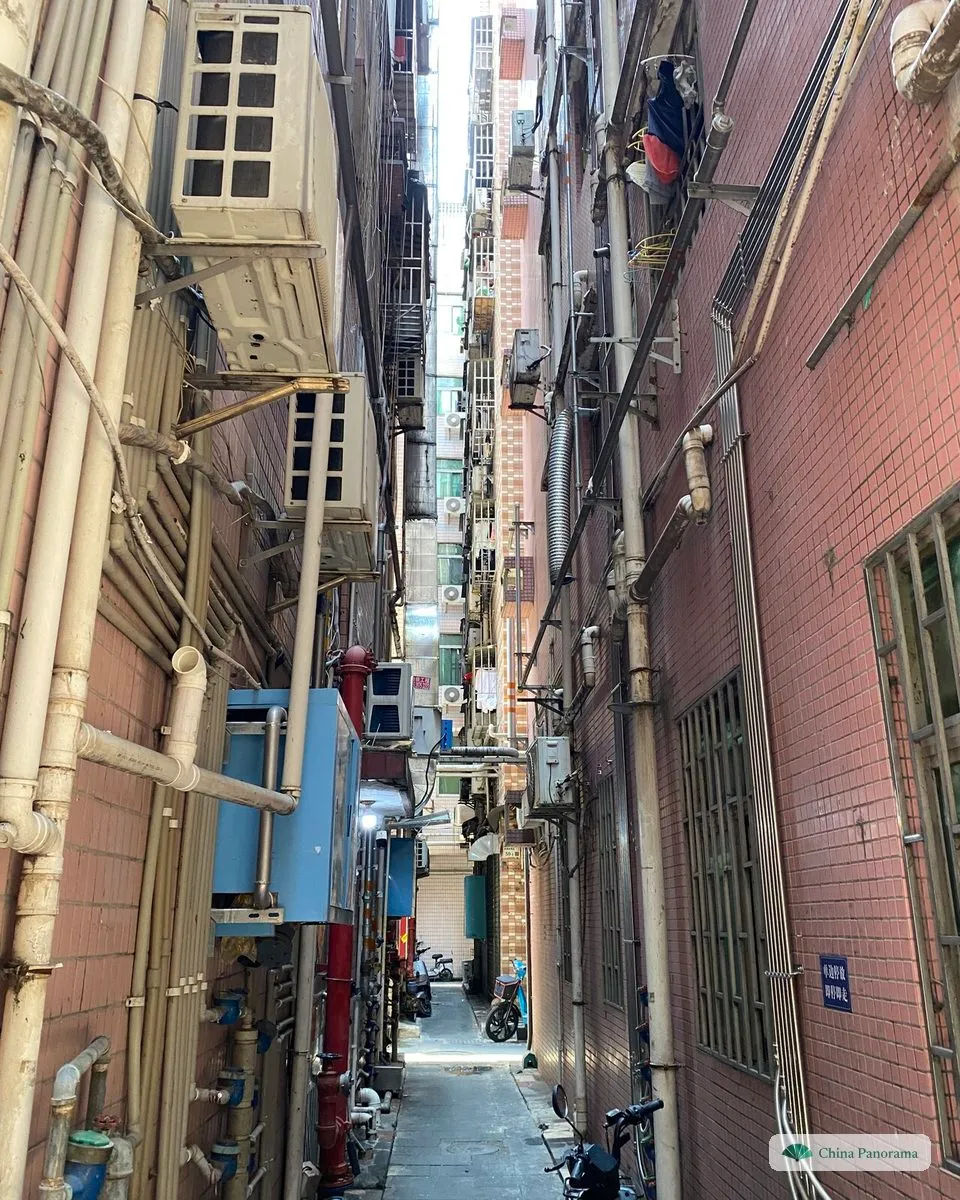 StreetCitywide · 全市Outdoors
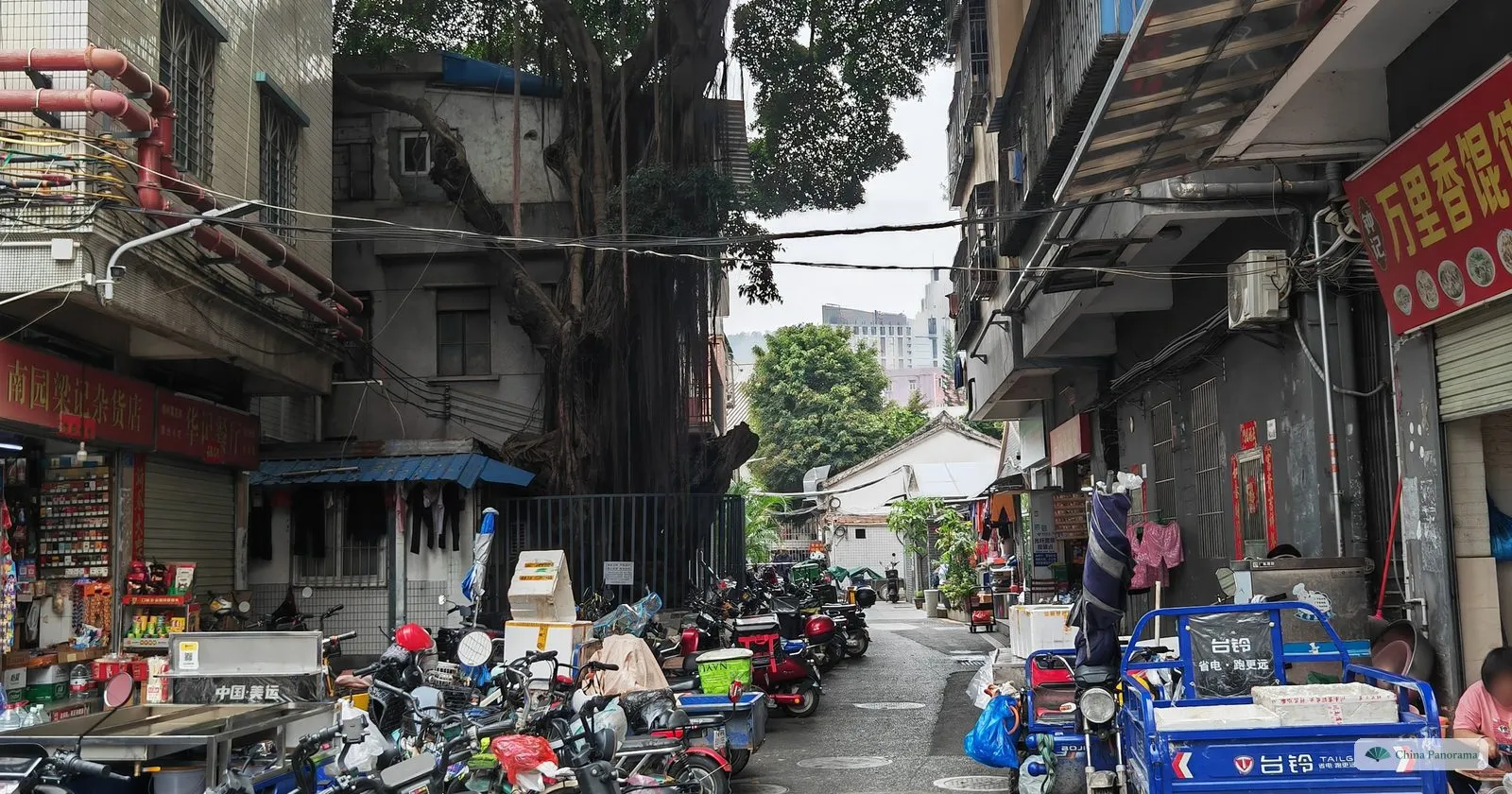
When Shenzhen grew over the farmland, the villages kept the ground their houses stood on. The villagers built upwards, six, eight, ten storeys of rented rooms, so close together that neighbours across the lane could shake hands from their windows — the city calls them “handshake buildings”. These urban villages housed the millions who came to work in the factories and still house much of the city's workforce, with cheap food stalls, barbers and corner shops on the ground floor. Many have been cleared; many remain, and each still has its old village gate, ancestral hall and banyan tree. Our photographs show lanes less than two metres wide between the blocks, by day and at dusk, and the gate of Nanshan Village, lit up at dusk.
There is one in almost every district; Hubei near Dongmen and Nanyuan near Nantou are two we walked through. People live here: keep your voice down, do not photograph into windows, and ask before photographing anyone.
- Entry
- Free
- Opening hours
- Open at all hours
Nanyuan village and Dexin Hall
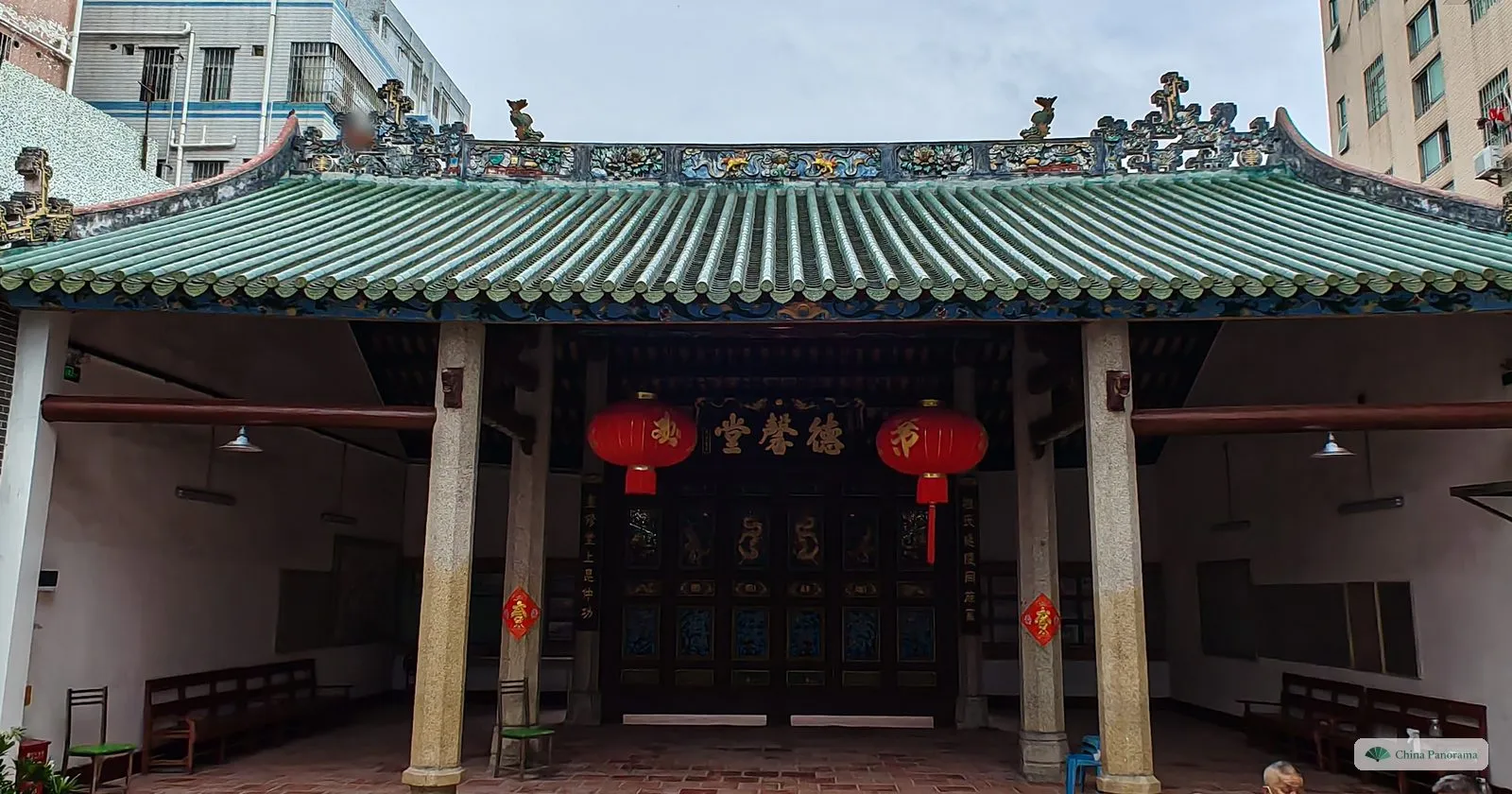
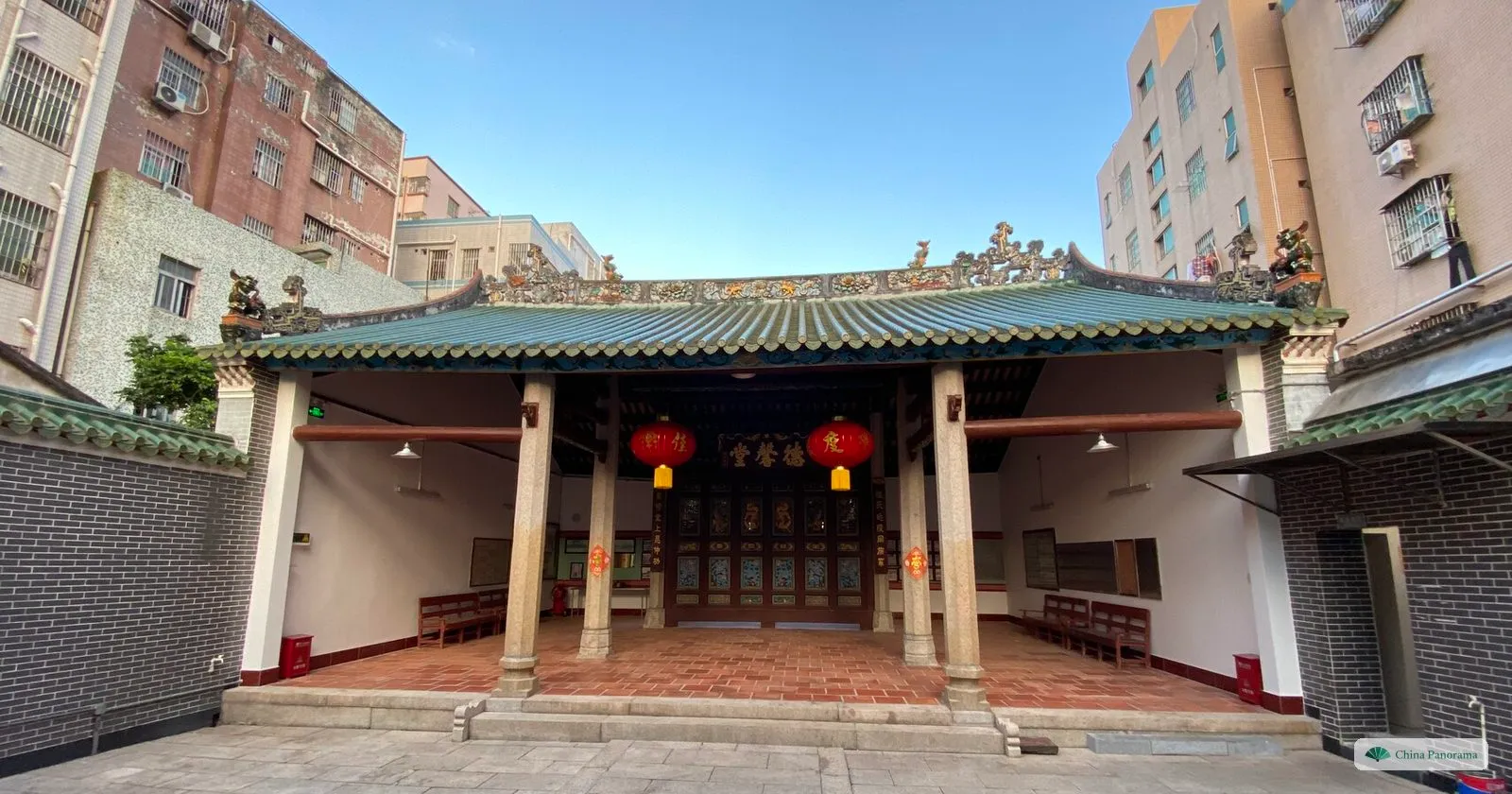
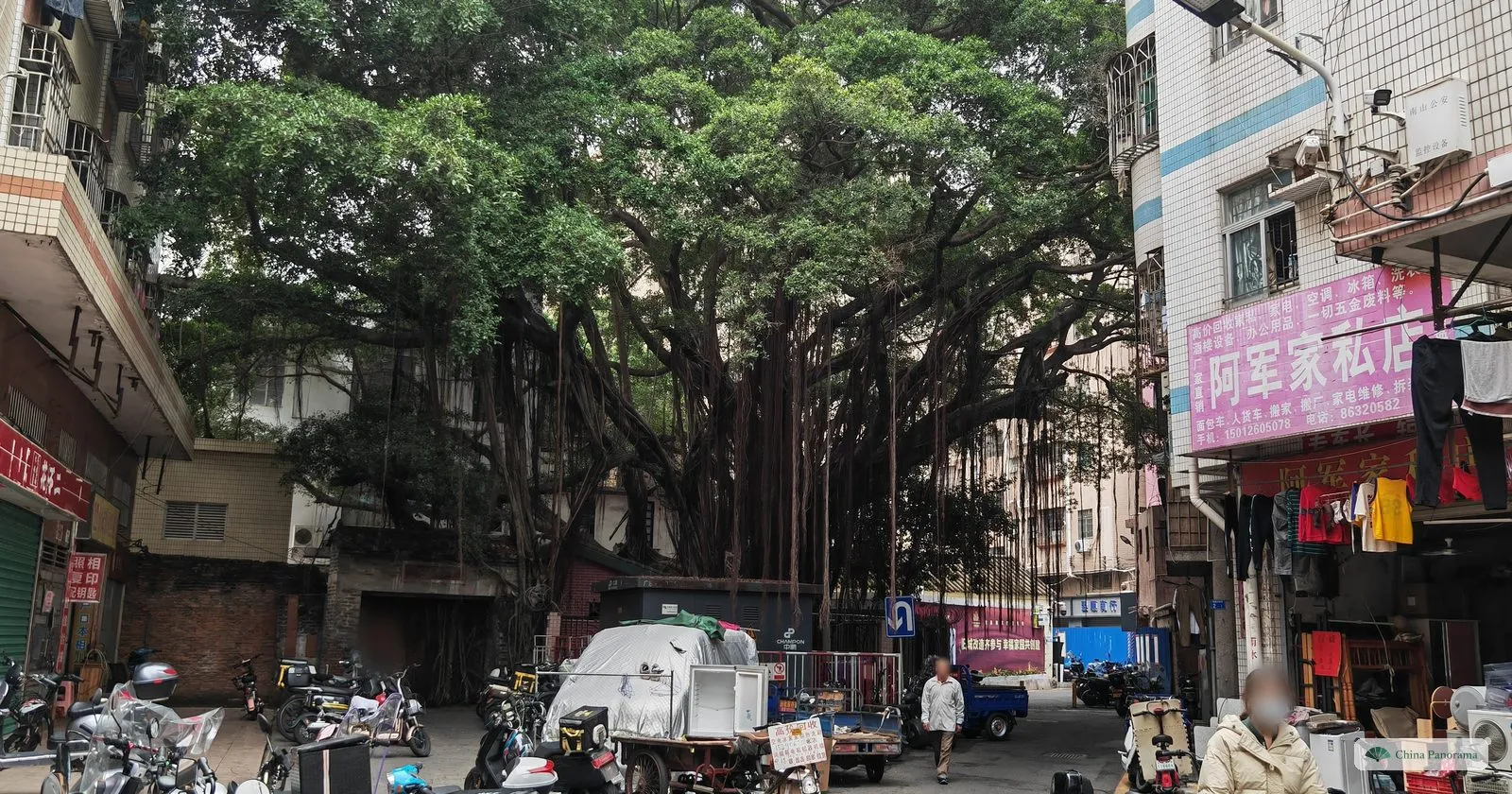
南园村 · 德馨堂ArchitectureNanshan · 南山区OutdoorsAn urban village in Nanshan, about 2 km south of the old walled town of Nantou, with its ancestral hall still standing among the rental blocks. Dexin Hall has a green-glazed tile roof with a ridge of ceramic dragons either side of a pearl, granite columns, walls of dark brick, and gilded couplets on the red door frame; the name 德馨堂, “Hall of Fragrant Virtue”, hangs over the inner hall. It is still in use: a sign by the door marks it as the village's recreation centre for the elderly, and on the afternoon of 3 April 2023 men sat on its steps, while the square in front served as a car park for scooters. A few lanes away a huge banyan tree spreads over the street.
In Nanshan district, between Nantou Ancient City and Shenzhen Bay; Nantou Ancient City station (Line 12) is about 2 km north. The lanes are free. The hall is a working village hall, not a museum: look in from the door and do not disturb the people inside.
- Entry
- Free
- Opening hours
- Open at all hours
- ArchitectureNanshan · 南山区Outdoors
Long before Shenzhen, this was the seat of government for the whole region, including what is now Hong Kong. The walled town was built in 1394 for the coastal defence of the early Ming; in 1573 the county of Xin'an was set up here and 7,608 families, 33,971 people, were moved in. Most of the walls are gone, and their stones went into more than 900 houses built inside them after 1980 — the old town became an urban village. The south gate survives, 10 m wide and 4.5 m high, as do eight of the nine original streets and about 40 buildings from the Qing dynasty and the early twentieth century. A renovation completed in 2020 turned the main streets into a district of museums, cafés and shops while people still live in the lanes behind.
Nantou Ancient City station (Line 12). We have not checked whether entry is free or the museums' hours.
- Entry
- Price not verified — check on site
- Opening hours
- Hours not verified — check on site
- LandmarkNanshan · 南山区Outdoors
A theme park of the world in miniature, opened on 18 June 1994 in the Overseas Chinese Town district: about 130 reproductions of famous sights, from the pyramids of Giza and Angkor Wat to the Taj Mahal and the Sydney Opera House. Its centrepiece is a one-third-scale Eiffel Tower, 108 m high, visible from far along Shennan Boulevard, and the glass pyramid of the Louvre serves as the entrance to the metro station. More than three million people a year still come. For a European visitor it is less a sight than a curiosity — an afternoon to see how China imagined the world in the 1990s.
Window of the World station (Lines 1 and 2) is at the gate. We have not checked ticket prices or hours.
- Entry
- Price not verified — check on site
- Opening hours
- Hours not verified — check on site
- MarketLonggang · 龙岗区Outdoors
An urban village in the north of the city where, from 1989, the painter Huang Jiang and a group of trained artists began copying oil paintings to order — Van Gogh, Dalí, Warhol — by the dozen a day. By 2014 about 7,000 artists worked here and some five million paintings a year went to Europe and the United States. The lanes are lined with open studios and galleries; you can watch copies being painted, commission a portrait from a photograph or buy original work, which has become more common since demand for copies fell.
Dafen station (Line 3). The lanes are free and open at all hours; the studios keep their own hours. Agree a price before you commission anything.
- Entry
- Free
- Opening hours
- Open at all hours
Dapeng Fortress
大鹏所城ArchitectureDapeng · 大鹏新区OutdoorsA garrison town on the coast of the Dapeng peninsula, about 50 km east of the centre, built in 1394 to defend the coast against pirates. In 1571 it held out against a siege of more than forty days by Japanese pirates with scaling ladders; in the Qing it was a naval base, and its commanders fought the British in the first skirmishes of the Opium War. The walls, gates and lanes of the town are still there, with the mansions of its generals, and people still live in it. It gave Shenzhen its nickname, Pengcheng, “the city of Peng”. It has been protected since 1983, by the province since 1989, and has housed a museum since 1996.
A half-day trip at least: well over an hour by bus or taxi from the centre, often combined with the beaches of the Dapeng peninsula. We have not checked the entry price, hours or bus routes.
- Entry
- Price not verified — check on site
- Opening hours
- Hours not verified — check on site
Entry prices and opening hours are marked unverified where we have not checked them against an official source. We would rather show a gap than a number we made up.
Routes and the Hong Kong border crossings
Shenzhen is long and thin, some 80 km from west to east along the border. The crossings to Hong Kong are close to the centre — Futian and Huanggang 3 km south of the Civic Center, Luohu 6 km south-east — while Shekou is 16 km to the west and the airport 28 km to the north-west. Tap a place to see how far it is.
Tap a place on the map or in the list.
Two border crossings side by side, to Lok Ma Chau: Futian 06:30–22:30 with Metro Lines 4 and 10, Huanggang open 24 hours (reported, June 2026).
The oldest crossing, at the end of Hong Kong’s East Rail line, next to Shenzhen station: 06:30–24:00 (reported). Metro Lines 1 and 9.
The main high-speed station, for Guangzhou, Changsha, Xiamen and Beijing. Metro Lines 4, 5 and 6.
The western crossing, by bridge to Hong Kong, for buses and cars: 06:30–24:00 (reported).
Sea World, the Minghua and Design Society; ferries to Hong Kong airport and Macau from the cruise centre just south. Details below ↓
Bao’an International Airport. Metro Line 11 from Futian, a little over half an hour.
Straight-line distances from the Civic Center, rounded — not travel distances. Border hours as reported in June 2026.
Four routes that don’t double back
Shekou, the new centre of Futian, old Luohu, and one long afternoon across the whole city by car. They follow our photographs, with the time and distance between stops; each runs in one direction.
A morning or an evening · about 1 km on foot
Design Society
Walk 8 min· 600 m
Sea World plaza and the Minghua
Walk 5 min· 350 m
Nüwa statue
3 stops · 13 min walking
Half a day · about 2 km on foot
Civic Center
Walk 28 min· 2.09 km
Ping An Finance Centre
2 stops · 28 min walking
An afternoon · a short taxi ride, then about 1 km on foot
Huaqiangbei
Taxi 7 min· 4.75 km
Dongmen old street
Walk 8 min· 580 m
Hubei old village
3 stops · 8 min walking · 7 min by taxi
An afternoon · about 23 km by car
Nanyuan village and Dexin Hall
Taxi 14 min· 15.54 km
Shennan Boulevard at Xinzhou Road
Taxi 9 min· 7.76 km
Lizhi Park
3 stops · 23 min by taxi
Stop by stop
Shekou: the ship, the museum and the goddess
The short walk round Sea World in Shekou. Our photographs are from 07:39 to 07:55 on a rainy morning, 9 January 2018, when everything was still shut, and from an undated evening, when the plaza was full and the ship and the statue were lit. Come in the late afternoon, see Design Society, and stay for dinner on the plaza.
1Design Society
设计互联Start at Maki's white building on Wanghai Road; the terraces look over the bay. Our photograph: 07:39.
- Entry
- Exhibitions vary
- Hours
- Not verified
Walk 8 min· 600 m
2Sea World plaza and the Minghua
海上世界 · 明华轮North to the lagoon and the beached liner. Our photograph of the ship: 07:53, with the plaza empty in the rain.
- Entry
- Free
- Hours
- Open at all hours
Walk 5 min· 350 m
3Nüwa statue
女娲补天像South down Nüwa Road to the sea and the white statue of the goddess, floodlit after dark.
- Entry
- Free
- Hours
- Not verified
Easy add-ons: The Shekou Cruise Center, about 1.5 km further south, has ferries to Hong Kong airport and Macau. Nantou Ancient City and Nanyuan village are about 6 km to the north-west.
* Walking times and distances are computed from OpenStreetMap walking routes between the stops; car legs are OpenStreetMap driving times without traffic — allow about double at busy times. Clock times are from our own photographs (9 January 2018, 3 April 2023). Stops marked with a star have prices or opening hours we have not checked.
Getting there from Hong Kong, and getting around
From Hong Kong
Most visitors arrive this way, through one of the land crossings. Luohu, at the end of the MTR East Rail line from Hong Kong, opens 06:30–24:00 and comes out at Luohu metro station and Shenzhen station; Futian, opposite Lok Ma Chau, opens 06:30–22:30 and comes out at Futian Checkpoint metro station; Shenzhen Bay, on the west side, opens 06:30–24:00 for buses and cars; Huanggang is open 24 hours. These hours are from a Hong Kong press report of June 2026, not from the border authority. High-speed trains from Hong Kong West Kowloon run to Futian and Shenzhen North, with border checks for both sides inside West Kowloon station. Hong Kong and the mainland have separate entry rules.
Schedules and opening hours not yet verified against an official source.
By air
Shenzhen Bao'an International Airport (SZX) is on the Pearl River estuary about 28 km north-west of the Civic Center, about half an hour by car without traffic. Metro Line 11, the airport express, takes a little over half an hour from Futian and has a business-class car at three times the standard fare; Line 1 ends at Airport East. We have not checked the timetable.
Schedules and opening hours not yet verified against an official source.
By high-speed train
Shenzhen North is on the high-speed lines to Guangzhou South, Changsha, Wuhan and Beijing and along the coast to Xiamen; Futian has trains to Guangzhou and Hong Kong. Guangzhou is about 100 km away. We have not checked journey times against the 12306 timetable.
Schedules and opening hours not yet verified against an official source.
By ferry
Ferries leave the Shekou Cruise Center, south of Sea World, for Hong Kong International Airport and Macau. We have not checked schedules or fares.
Schedules and opening hours not yet verified against an official source.
Nonstop from Europe
Our flight list has nonstop routes to Shenzhen from 8 European airports: Barcelona, Brussels, Budapest, Frankfurt, London Heathrow, Milan, Paris, Vienna. Many travellers fly to Hong Kong instead and cross by land. Airlines and frequencies →
Flight data checked 12 September 2026.
Three stations called Shenzhen
Your train ticket will name one of these. They are far apart.
- Shenzhen North 深圳北站The main high-speed station, about 8 km north of the Civic Center: trains to Guangzhou South, Changsha, Wuhan and Beijing, to Xiamen, and some to Hong Kong West Kowloon. Metro Lines 4, 5 and 6.
- Futian 福田站An underground high-speed station in the middle of Futian, on the line between Guangzhou and Hong Kong West Kowloon. Metro Lines 2, 3 and 11.
- Shenzhen 深圳站The old station in Luohu, next to the Luohu border crossing: trains on the old line to Guangzhou. Metro Line 1 (Luohu).
The metro, in short
How Chinese metros work →Seventeen lines, 432 stations and about 640 km. For a visitor four do most of the work: Line 1 runs under Shennan Boulevard from Luohu (border crossing and Shenzhen station) through Laojie (Dongmen), Grand Theater (Lizhi Park), Huaqiang Road, Shopping Park (Ping An Finance Centre) and Window of the World to the airport's east side; Line 2 runs from Sea World in Shekou through Window of the World, Futian, Civic Center and Huaqiang North to Hubei; Line 4 runs from Futian Checkpoint at the border through Civic Center and Children's Palace to Shenzhen North; and Line 11, the airport express, runs from Futian to the airport, with a business-class car.
- Lines
- 17Lines 2 and 8 run through
- Fare from
- 2 CNYfirst 4 km
- Network
- 432 stationsabout 640 km
- Pay with
- Contactless cardall gates since Sept 2026 · or Alipay / WeChat
Since 10 September 2026 every gate on all 17 lines takes contactless bank cards issued abroad — Visa, Mastercard, American Express, JCB and UnionPay: tap the card or the phone it is stored in on the reader, as you would in London. The transport code in Alipay or WeChat works too, and machines sell single-journey tokens. We have not tested a foreign card ourselves.
Fares by distance: 2 CNY up to 4 km, 3 CNY up to 8 km, 4 CNY up to 12 km, 5 CNY up to 18 km, 6 CNY up to 24 km. Beyond 24 km, 1 CNY more for every further 8 km. The business-class car on Line 11 costs three times the standard fare.
First and last trains differ by line and station; we have not checked them against the operator's timetable — look at the display in the station.
| Sea World, the Minghua, Nüwa statue, Design Society | Sea World 海上世界 | Line 2/12 |
| Window of the World | Window of the World 世界之窗 | Line 1/2 |
| Nantou Ancient City | Nantou Ancient City 南头古城 | Line 12 |
| Civic Center | Civic Center 市民中心 | Line 2/4 |
| Lianhuashan Park | Children's Palace 少年宫 | Line 3/4 |
| Ping An Finance Centre | Shopping Park 购物公园 | Line 1/3 |
| Huaqiangbei | Huaqiang North 华强北 | Line 2/7 |
| Lizhi Park | Grand Theater 大剧院 | Line 1/2 |
| Dongmen old street | Laojie 老街 | Line 1/3 |
| Hubei old village | Hubei 湖贝 | Line 2/5 |
| Dafen Oil Painting Village | Dafen 大芬 | Line 3 |
| Border crossing and Shenzhen station | Luohu 罗湖 | Line 1/9 |
| Border crossing to Lok Ma Chau | Futian Checkpoint 福田口岸 | Line 4/10 |
| High-speed trains to Hong Kong and Guangzhou | Futian 福田 | Line 2/3/11 |
| High-speed trains (main station) | Shenzhen North 深圳北站 | Line 4/5/6 |
| Airport | Airport 机场 | Line 11 |
Station names are mostly pinyin (Laojie, Gangxia, Houhai) with some in English (Window of the World, Shopping Park, Grand Theater, Civic Center, Children's Palace). Match the Chinese characters if in doubt.
Source and date: Foreign bank cards at all gates since 10 September 2026, 17 lines and 432 stations: Shenzhen municipal government, 14 September 2026. Fare bands: the city's published distance-based fare (first 4 km 2 CNY; 4–12 km 1 CNY per 4 km; 12–24 km 1 CNY per 6 km; beyond, 1 CNY per 8 km), as reported by Shenzhen Bendibao. Network length: Wikipedia, about 642 km as of June 2026. Station names and lines: the Wikipedia line articles, read on 6 October 2026. First and last trains: not checked.
Shenzhen is one of the cities we price up on the trip cost calculator, if you want to model a budget.
Before you go
Most European passports are visa-free for a short trip — under a one-sided waiver with an end date worth checking before you book:
- UK passport
Visa-free up to 30 days per trip, currently until 31 December 2026.
- EU passports
Dutch, German, French, Irish, Nordic and most other EU passports: visa-free up to 30 days, currently until 31 December 2026.
- US passport
No general waiver: a visa, or the 10-day visa-free transit if you travel on to a third country.
China’s 10-day visa-free transit applies at designated entry ports, for travellers continuing to a third country. Crossing from Hong Kong counts as entering the mainland, with its own border check. Check your passport.
- The arrival card
Fill it in online, or practise the paper form, before you queue at Luohu.
- Pre-trip checklist
Payments, SIM, apps — the things to sort before you cross.
- Guangzhou
The old Canton, 100 km up the delta: clan halls, morning tea, the Canton Tower.
- Golden Week in Hong Kong
When the border crossings are at their busiest in both directions.
- Theme parks
Window of the World, Happy Valley and Shenzhen’s other parks on the national map.
- How to order food
Scan-to-order menus are everywhere in Shenzhen’s restaurants.
FAQ
What are the best things to do in Shenzhen?
Walk round Sea World in Shekou, where a French liner of 1962 has been moored since 1983; look down Futian’s central axis from the Deng Xiaoping statue on Lianhuashan and go up the 599 m Ping An Finance Centre; lose an hour in the electronics halls of Huaqiangbei; and see the older city between the towers — the Dongmen market streets, the 500-year-old village of Hubei and an ancestral hall in an urban village. End the day at Lizhi Park, when the towers light up in the lake.
Is Shenzhen worth visiting?
Yes, for a day or two, especially if you are in Hong Kong anyway. Shenzhen is the place to see how fast China has built: a county of villages in 1979, a city of about 18 million now. It has few old monuments, but the new city is striking, the electronics markets are unique, and the urban villages show how it really grew.
How many days do you need in Shenzhen?
One to two. A day for Futian and Luohu — the central axis, Huaqiangbei, Dongmen and Lizhi Park; an evening or a morning in Shekou; and a second day for Nantou and the urban villages, Window of the World or Dafen. Dapeng Fortress and the beaches in the east need most of a day on their own.
How do I get from Hong Kong to Shenzhen?
Take the MTR East Rail line to Lo Wu or Lok Ma Chau and walk across at Luohu (06:30–24:00) or Futian (06:30–22:30); both come out at a Shenzhen metro station. Huanggang is open 24 hours and Shenzhen Bay, for buses, until midnight. High-speed trains from West Kowloon reach Futian and Shenzhen North, with both border checks done in West Kowloon. These hours are from a Hong Kong press report of June 2026; check before you travel. You go through two immigration checks, Hong Kong’s and the mainland’s.
What is Shenzhen famous for?
For its speed. It was declared China’s first Special Economic Zone in 1980 and grew from a county of villages into a city of about 18 million — the test bed for the market reforms of Deng Xiaoping, whose statue stands on Lianhuashan. Today it is known for technology and electronics, from the Huaqiangbei markets to the big tech companies headquartered here, for the 599 m Ping An Finance Centre, and as the gateway between Hong Kong and the mainland.
How do I get from Shenzhen airport to the city?
Metro Line 11, the airport express, runs from the airport to Futian in a little over half an hour, with a business-class car at three times the standard fare; Line 1 runs from Airport East along Shennan Boulevard. A taxi to the Civic Center is about 28 km in a straight line and roughly half an hour without traffic. We have not checked the timetable or taxi fares.
Do I need a visa for Shenzhen?
Not for a short trip on a British, Irish, Dutch, German, French, Nordic or Australian passport: all are visa-free for up to 30 days per trip, under a one-sided waiver that currently runs until 31 December 2026. US passport holders have no general waiver; the 10-day visa-free transit applies only at designated entry ports and only if you travel on to a third country. Crossing from Hong Kong counts as entering the mainland. Check your own passport on our visa check page.
Can I pay for the Shenzhen metro with a credit card?
Yes. Since 10 September 2026 every gate on all 17 lines accepts contactless Visa, Mastercard, American Express, JCB and UnionPay cards issued abroad, according to the city government; we have not tested one ourselves. The transport code in Alipay or WeChat works too. Fares run by distance, from 2 CNY for the first 4 km.
Can you go up the Ping An Finance Centre?
Yes: the Free Sky observation deck is on the 116th floor of the 599 m tower, with a view across the border to Hong Kong on a clear day. It charges admission; we have not checked the price or hours. The basement connects to Shopping Park metro station.
When is the best time to visit Shenzhen?
October and November: October averages 30 °C by day and November 26 °C, with less rain than the rest of the year. Summer is hot and humid, around 33 °C by day, with storms and the chance of a typhoon. Winter is mild — 20 °C by day in January — but cool indoors, as buildings have no central heating. Avoid Golden Week, 1–7 October.
How far is Shenzhen from Guangzhou?
About 100 km in a straight line. High-speed trains run from Shenzhen North and Futian to Guangzhou; we have not checked journey times. Hong Kong is about 30 km from the Civic Center and Macau about 70 km, across the estuary.
What is Huaqiangbei?
The electronics market district in Futian, often called the biggest in the world: more than 20 multi-storey halls of tiny stalls selling components, phone parts, drones and gadgets, wholesale and retail. It grew from factories moved here in 1979 and the first component market of 1988. Take Metro Line 2 or 7 to Huaqiang North.
Do people in Shenzhen speak Cantonese?
Less than in Guangzhou or Hong Kong. Most people in Shenzhen moved here from other provinces, so Mandarin is the everyday language of the city; Cantonese and Hakka are still spoken in the old villages. Signs and metro announcements are in Chinese and English.
Sources and status
All photographs on this page are ours: Shekou, the Civic Center, Shennan Boulevard, the Ping An Finance Centre and Dongmen on 9 January 2018, a day of steady rain, some taken from a car; Nanyuan village, Shennan Boulevard and Lizhi Park on 3 April 2023. The pictures of Sea World and the Nüwa statue at night, Huaqiangbei, the village gates, the urban-village lanes and the courtyard of Dexin Hall carry no date. Faces of passers-by have been blurred. Data sources: Monthly temperature data, Shenzhen; Shenzhen (Wikipedia): founding 1979, Special Economic Zone 26 August 1980, city flower and trees; Sea World and the Minghua: Ancerville, bought 1973, Shekou August 1983, Deng Xiaoping 26 January 1984, Nüwa statue 1989 (Wikipedia, Chinese); Design Society opens in Shekou, December 2017 (V&A); Shenzhen Civic Center: 486 m roof, opened 2004 (Wikipedia, Chinese); Lianhuashan Park (Wikipedia); Ping An Finance Centre (Wikipedia, Chinese); Shennan Boulevard, from 2.1 km in 1980 to 25.6 km in 1994 (Shenzhen Stories, Shenzhen government); Lizhi Park: 1982, 589 lychee trees, 28.8 ha (Shenzhen government, Chinese); Huaqiangbei (Wikipedia, Chinese); Dongmen old street and the Shenzhen market (Shenzhen Stories, Shenzhen government); Hubei old village and the “Hubei 120” campaign (The Paper, Chinese); Nantou (Wikipedia); Window of the World (Wikipedia); Dafen Village (Wikipedia); Dapeng Fortress (Wikipedia); Shenzhen Metro (Wikipedia); Shenzhen Metro: foreign bank cards at every gate from 10 September 2026 (Shenzhen government, Chinese); Shenzhen Metro fares by distance (Shenzhen Bendibao, Chinese); Opening hours of the Shenzhen border crossings, June 2026 (HK01, Chinese).
Changelog (1)
- 2026-10-06Page created, with our own photographs from 9 January 2018 and 3 April 2023 and undated iPhone pictures. No entry price on this page could be checked against an official source on this date; the border-crossing hours are from a press report. Metro payment by foreign bank card: checked against the city government notice of 14 September 2026.