
China travel food guide · Nº 009
Cantonese Honey-glazed Barbecued Pork (Char Siu) 蜜汁叉烧
Char siu (蜜汁叉烧, mì zhī chā shāo), Cantonese honey-glazed barbecued pork, is strips of pork shoulder marinated in a sweet soy and char siu sauce, roasted until the edges char, then brushed with honey or maltose so it shines red. It comes from Guangdong, and it is one of the best-known Cantonese dishes: you see it hanging in the windows of roast-meat shops (烧腊店), sliced over rice, and inside dim sum buns. Sweet first, then savory; not spicy, no bones, not vegetarian.
The dish card
Tap the red Chinese name, the vegetarian line, or Pork to show it full-screen to the staff.
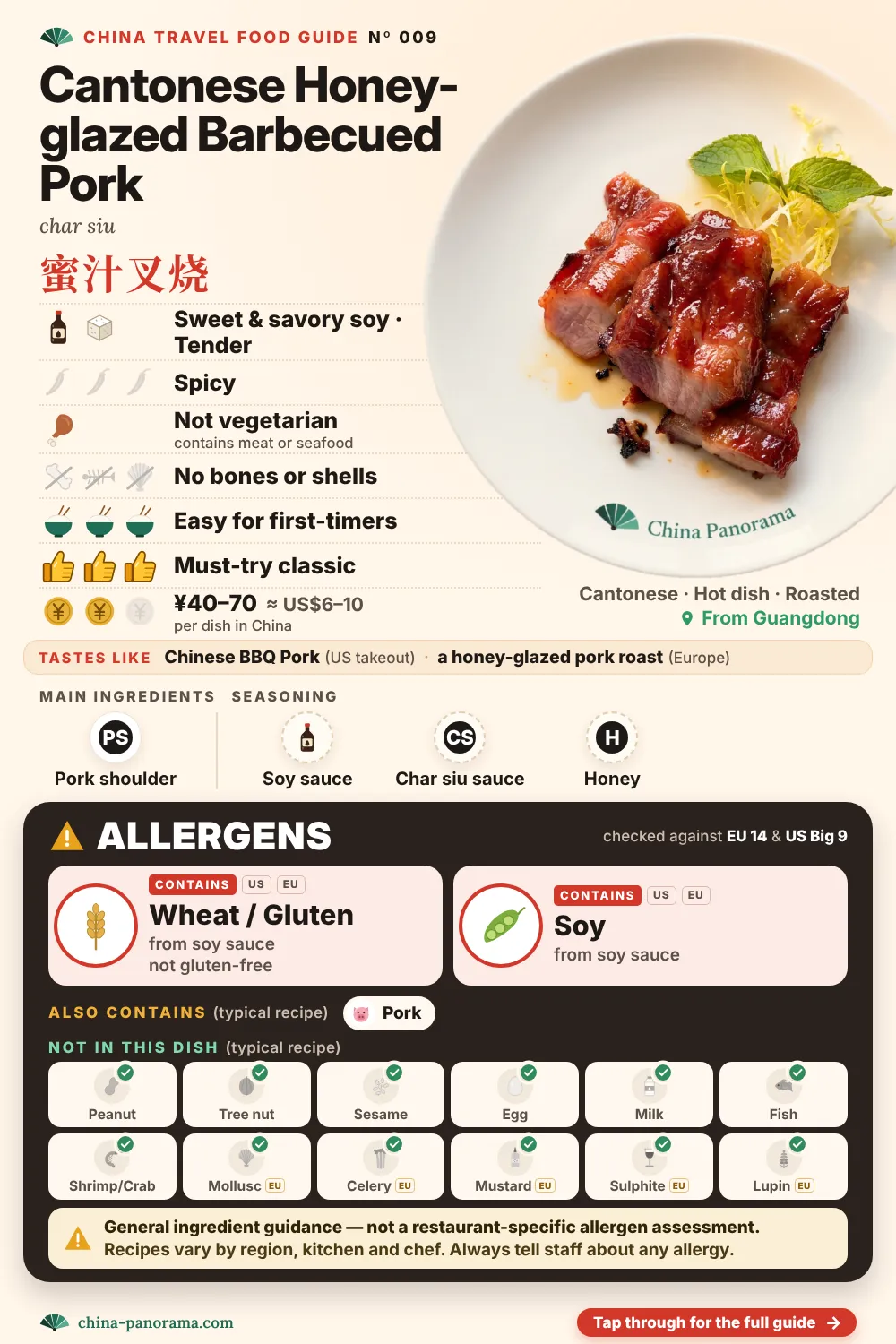 Partly edited with AI
How to order char siu
Tick what you need right on the card, then tap the big first line to show it full-screen to the staff.
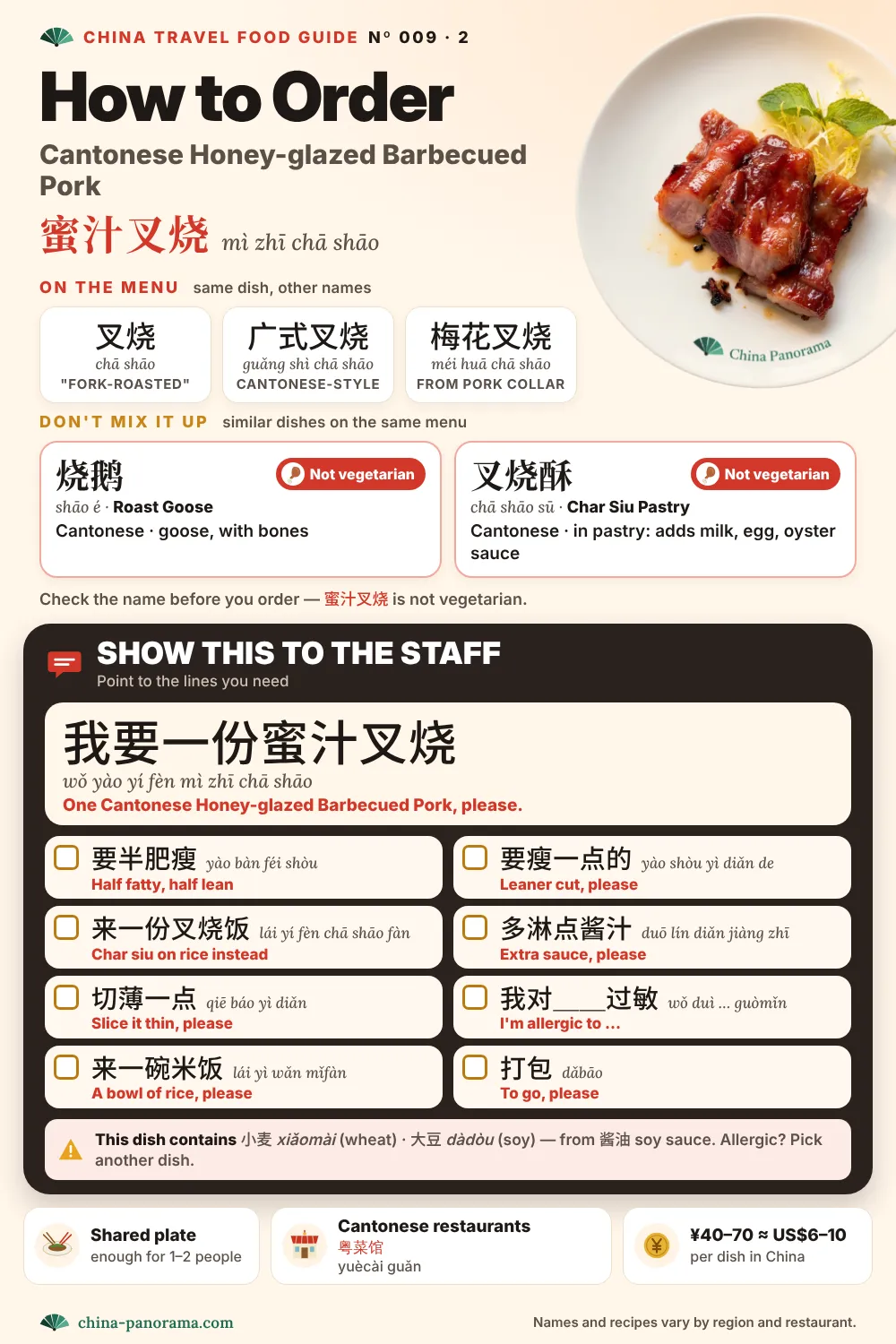
What is char siu?
The name is the recipe: 叉 (chā) is a fork, 烧 (shāo) is to roast – long strips of pork roasted on a fork over the fire, as it was done before ovens – and 蜜汁 (mì zhī) means honey sauce, the glaze. The usual cut is pork shoulder from the neck end, 梅花肉 (méi huā ròu), with thin streaks of fat that keep it juicy. The strips are marinated for hours in soy sauce, char siu sauce, sugar and five-spice, often with a splash of rose wine (玫瑰露酒, méi guī lù jiǔ), then hung in a hot oven and basted until the edges char. At the end they are brushed with honey or maltose (麦芽糖, mài yá táng), which gives the sticky shine. The red edge traditionally comes from red fermented bean curd (南乳, nán rǔ) or red yeast rice (红曲米, hóng qū mǐ); cheaper shops use food colouring, so a very bright pink-red is usually dye.
Char siu is Cantonese: from Guangdong, Hong Kong and Macau, and one of the dishes Cantonese cooking is known for abroad. At home it is part of 烧腊 (shāo là; siu mei in Cantonese), the roast meats you see hanging in a shop window – char siu, roast goose, roast duck, crackling pork belly – chopped to order on a thick wooden block. Most people eat it on rice (叉烧饭, chā shāo fàn) or next to another roast on the same plate (双拼, shuāng pīn, two-roast). It also goes into steamed dim sum buns (叉烧包, chā shāo bāo), flaky pastries (叉烧酥, chā shāo sū), fried rice and wonton noodle soup. On the menu, 蜜汁叉烧 tells you it is honey-glazed, 梅花叉烧 that it is the prized collar cut, half fat and half lean, and 广式叉烧 simply means Cantonese-style. Outside the south you find it in Cantonese restaurants (粤菜馆, yuè cài guǎn) and Hong Kong-style cafés (茶餐厅, chá cān tīng) all over China.
It costs about ¥40–70 (US$6–10) in an ordinary restaurant in a big city (2026).
Main ingredients
- 猪梅花肉zhū méi huā ròuPork shoulder
Seasoning
- 酱油jiàng yóuSoy sauce
- 叉烧酱chā shāo jiàngChar siu sauce
- 蜂蜜fēng mìHoney
What does it taste like?
Sweet – clearly sweeter than most Western roast pork, and that is the point: Cantonese cooking likes a sweet-savory balance, and char siu sits on the sweet end. The glaze is sticky and caramelised, a little smoky where it has charred, with soy sauce, five-spice and often fermented red bean curd underneath. Good char siu is tender and juicy, with a thin ribbon of fat; the leaner cuts are firmer. Not spicy at all. It is served warm or at room temperature, often with a little sweet sauce poured over.
Tastes like… Chinese BBQ pork from American Chinese takeout – the red-edged slices in fried rice and lo mein. In China it is juicier, stickier and sweeter, cut thicker and eaten on its own or on rice. In Europe, think of a honey-glazed pork roast, sliced while still warm.
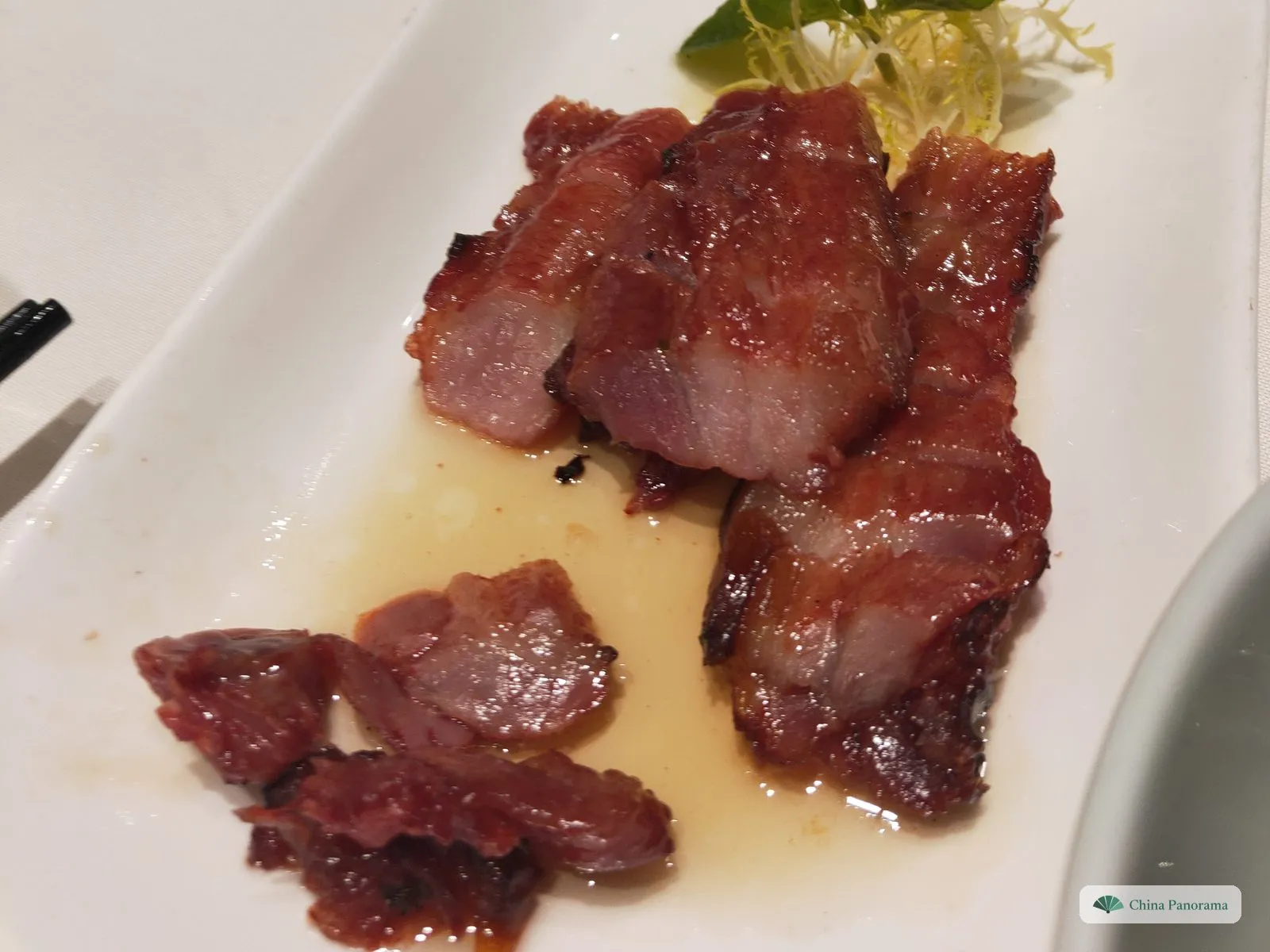
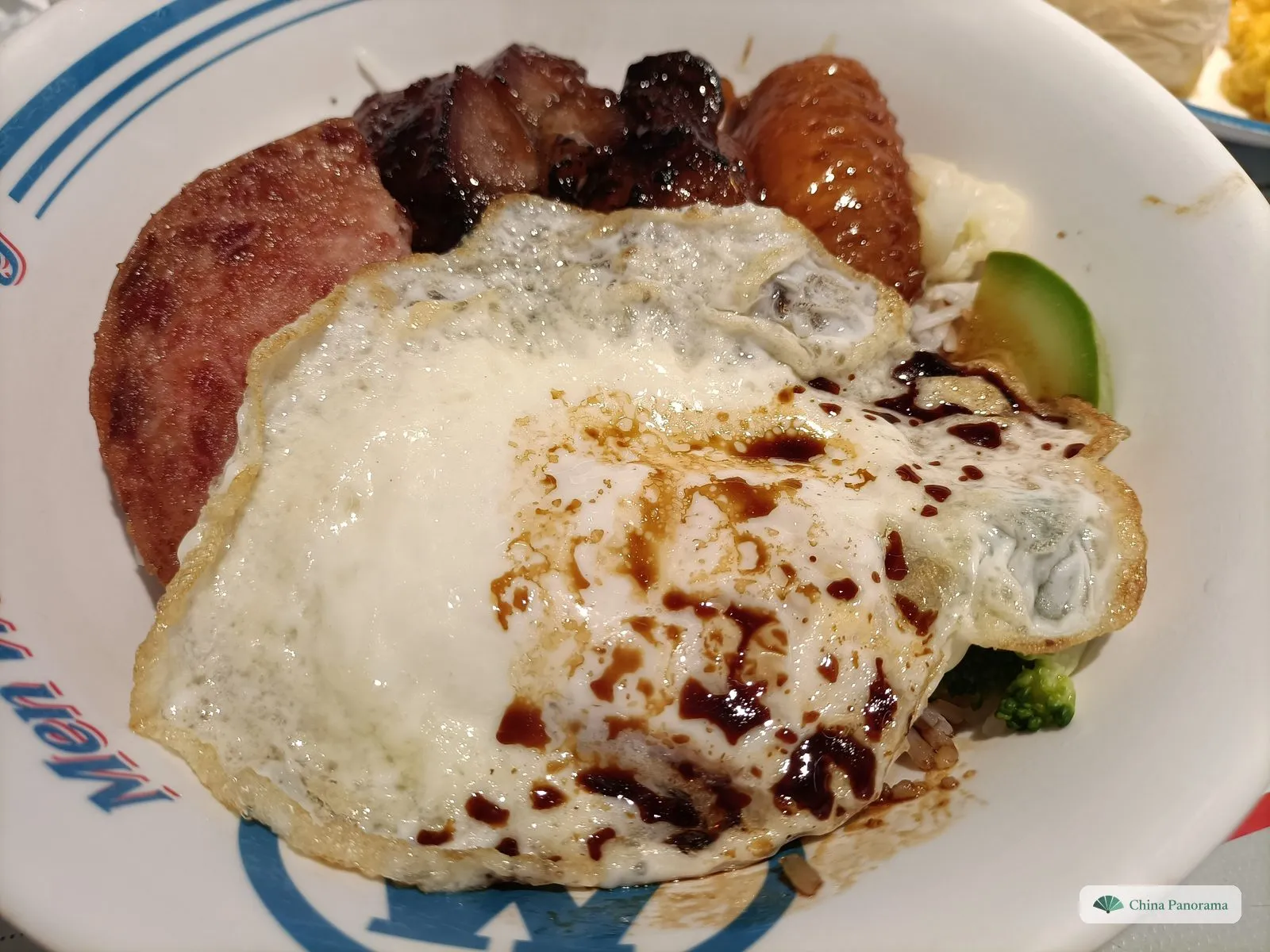
Char siu rarely comes alone at a Cantonese meal. This is a two-roast plate (烧味双拼, shāo wèi shuāng pīn) – the most common way to try two things at once.
Which one is char siu? Tap it on the photo.
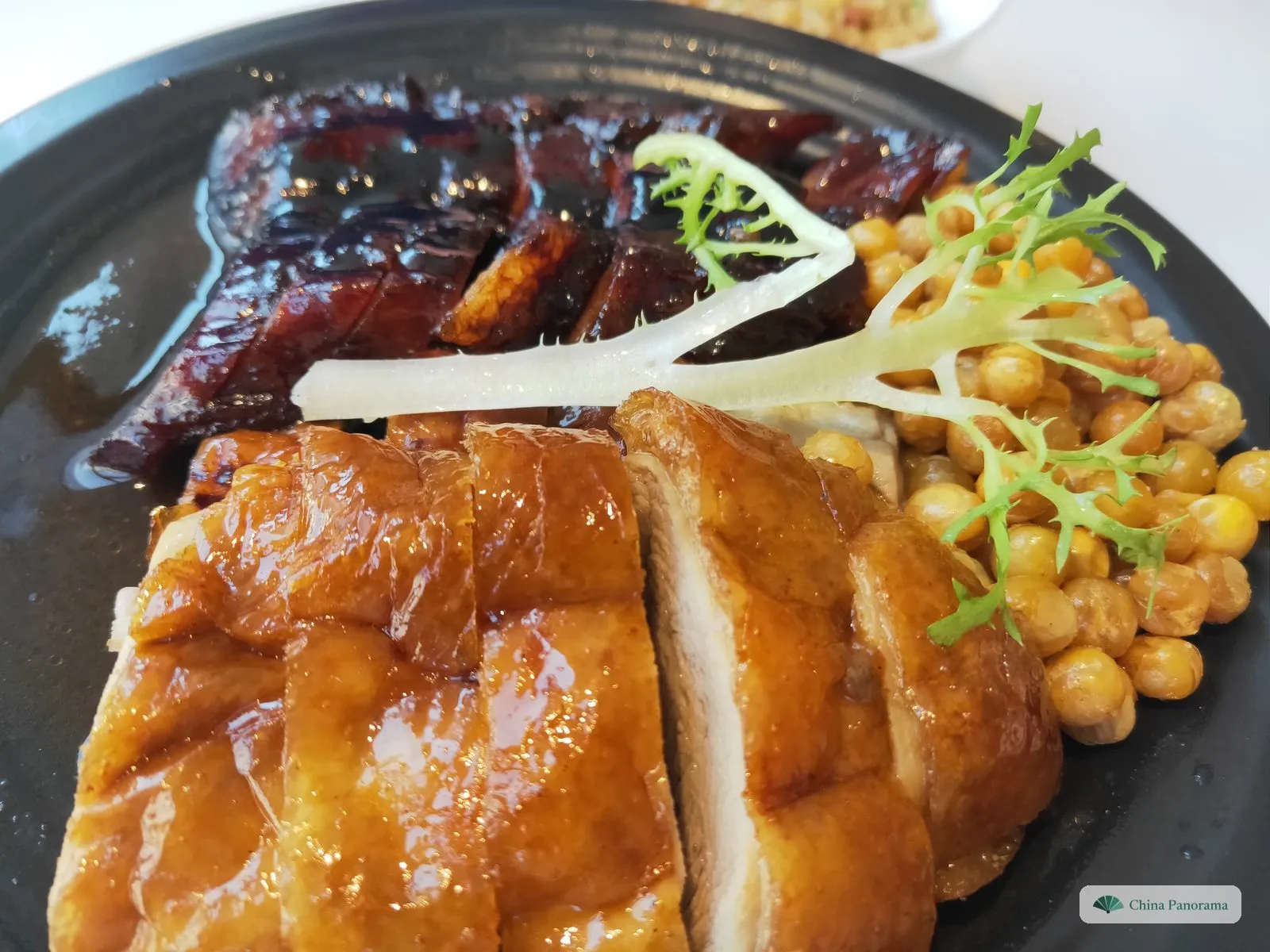
The dark, lacquered strips at the back: this kitchen glazes its char siu so heavily it looks almost black – the colour varies from shop to shop, the shape doesn’t. Char siu is skinless strips of pork; the golden slices in front, with a layer of crisp skin and fat, are roast goose.
Don’t mix it up
Card 2 names two dishes on the same Cantonese menu that are easy to mix up with char siu: roast goose from the same shop window, and char siu pastry from the dim sum menu. Which photo is char siu?
Which one is char siu? Tap a photo.
烧鹅Roast goose
蜜汁叉烧Char siu
叉烧酥Char siu pastry
Char siu is the plate of skinless strips of pork: red at the edges, pink inside, shiny with glaze.
- 烧鹅 (shāo é, roast goose): A whole bird with shiny golden-brown skin, chopped through the bone – so watch for small bones. Pricier than char siu, and served with sour plum sauce.
- 叉烧酥 (chā shāo sū, char siu pastry): Flaky triangles of puff pastry with chopped char siu inside – a dim sum snack, not a plate of meat. The pastry adds butter or lard, egg and often milk, and the filling usually oyster sauce.
Our own photos: char siu in Shanghai, 2019; roast goose in Shanghai, 2020; char siu pastries, 2014.
Order it at a roast-meat shop
In Guangdong and Hong Kong most char siu is sold at a roast-meat shop (烧腊店, shāo là diàn): the roasts hang in the window, you point, the cook chops it on a block and lays it on rice. One meat makes 叉烧饭 (char siu rice), two make a 双拼 (shuāng pīn, two-roast) and three a 三拼 (sān pīn). Pick your meats and how you want them – the Chinese builds itself – then show it to the staff.
In the windowPick one to 3 – tap again to take it off.
How?
Anything else?
Your order
我要一份叉烧饭
wǒ yào yí fèn chā shāo fàn
One plate of char siu on rice, please.
Which roasts a shop has varies – not every shop has all six, and not all do noodles. All roasts are chopped on the same block, so they touch each other: with an allergy, use the allergy card.
Allergens and diet
Char siu contains wheat / gluten and soy, from the soy sauce. It also contains pork in the typical recipe.
In the usual recipe
- ACereals containing gluten· US: Wheat
- FSoybeans· US: Soybeans
Not in this dish (typical recipe)
B shrimp / crab, C egg, D fish, E peanut, G milk, H tree nuts, L celery, M mustard, N sesame, O sulphites, P lupin, R molluscs
These are estimates from how the dish is usually made, not a restaurant’s declaration. Every kitchen and every sauce brand is different – always tell the staff about an allergy. Chinese kitchens often fry in peanut oil, and chilli oil may be made with it too; we don’t repeat that for each dish.
Vegan, vegetarian, gluten-free
Not vegetarian: it is made with meat or seafood.
Not gluten-free: the wheat comes from the soy sauce, and there is no version without it.
There is no pork-free char siu in the usual recipe – it is a pork dish by definition. If you don’t eat pork, the same counter has roast goose (烧鹅), roast duck (烧鸭) and poached chicken (白切鸡), but everything is chopped on the same block with the same cleaver. Tap Pork on the dish card to show 我不吃猪肉 (wǒ bù chī zhū ròu, I don’t eat pork).
Buddhist vegetarian restaurants (素食馆, sù shí guǎn) often make vegetarian char siu (素叉烧, sù chā shāo) from wheat gluten or soy, glazed the same way. It is meat-free, but even heavier on wheat and soy. Ask with 有素叉烧吗? (yǒu sù chā shāo ma?) – tap the vegetarian line on the dish card.
Recipes and bottled sauces vary. The marinade often has rose wine (most of the alcohol cooks off, not all), and some ready-made char siu sauces also list sesame paste or fermented bean curd. With a sesame allergy, ask – the allergy card below has the line.
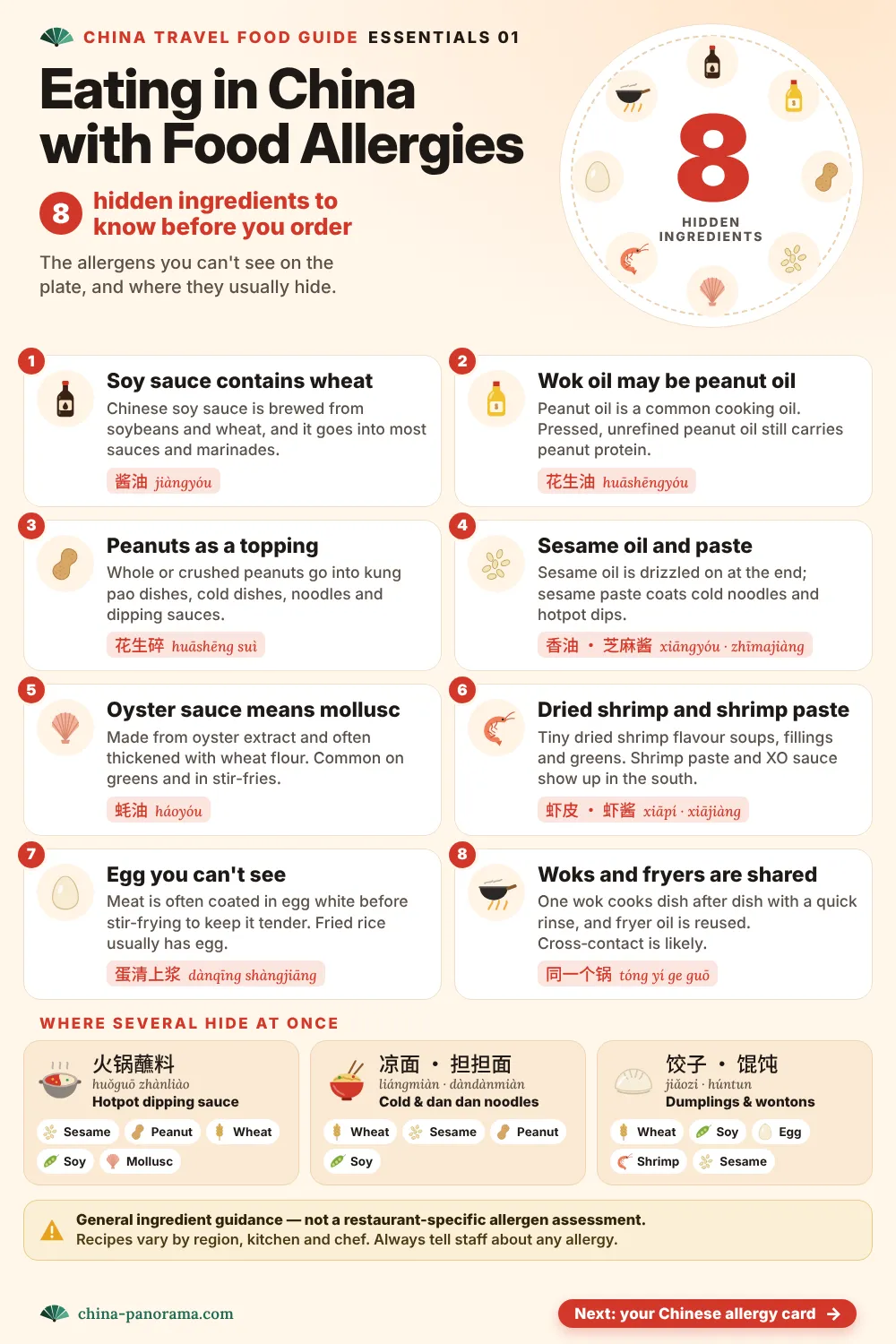
Eating in China with food allergies
Two cards that go with every dish in this guide. The first shows where allergens hide in Chinese cooking – tap an ingredient to ask about it in Chinese. The second is a Chinese allergy card for the staff: tick your allergens right on the card and it turns into one sentence, full-screen.
8 hidden ingredients to know before you order
Tap an ingredient to ask the staff about it in Chinese.
Show this to the staff: your Chinese allergy card
Tick your allergens on the card, then tap the big first line to show them full-screen to the staff. A question or the red line opens full-screen too.
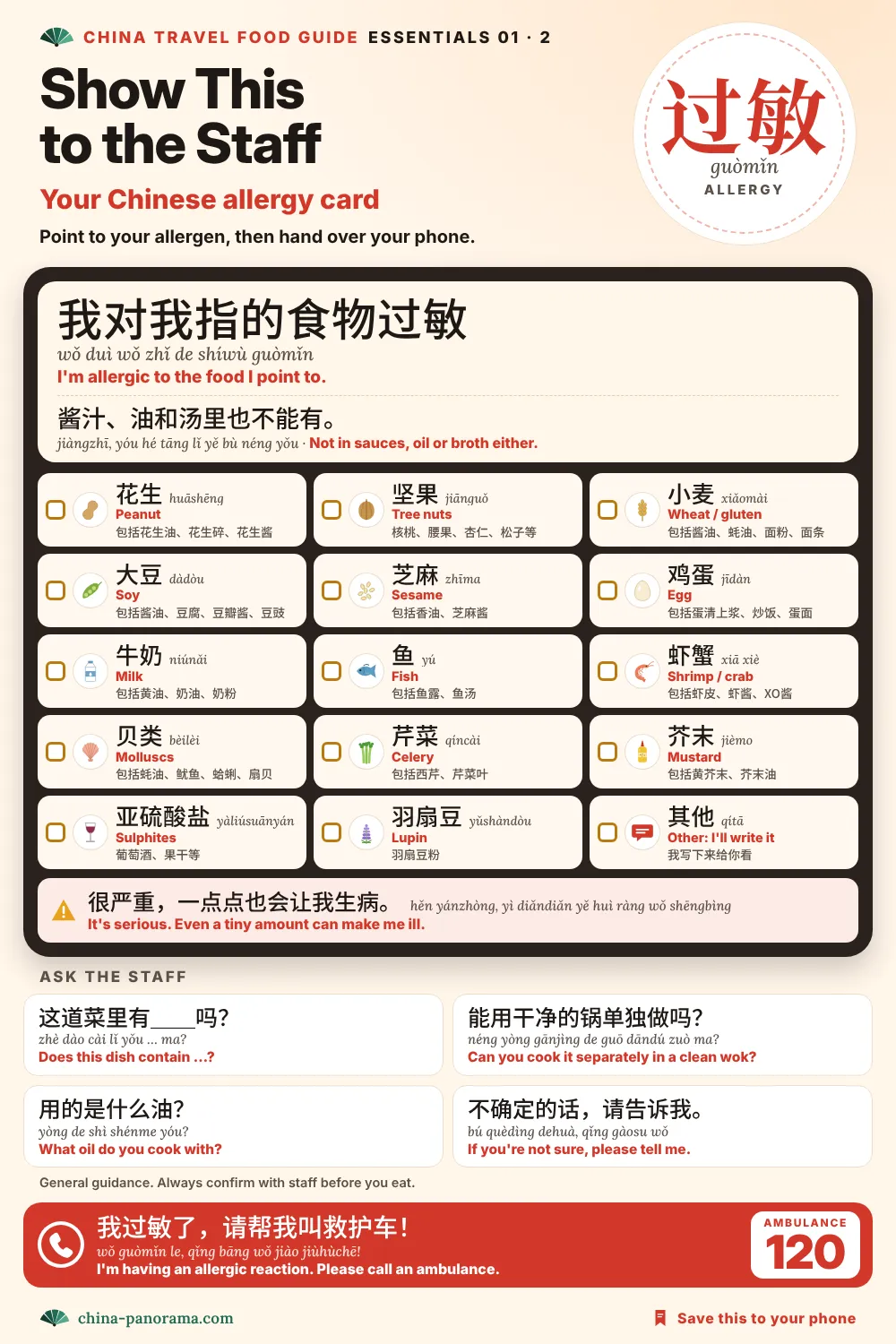
General ingredient guidance, not a restaurant’s allergen declaration. Recipes vary by region, kitchen and chef – always tell the staff about an allergy.
FAQ
Is char siu vegetarian?
No. It is pork – strips of pork shoulder, roasted and glazed. Buddhist vegetarian restaurants (素食馆) often make a vegetarian char siu (素叉烧, sù chā shāo) from wheat gluten or soy that looks and tastes much like it; ask with 有素叉烧吗? (yǒu sù chā shāo ma?). In an ordinary Cantonese restaurant there is no meat-free version.
Is it gluten-free?
No. The marinade is soy sauce and char siu sauce, and both are usually brewed with wheat. The glaze goes on last, so the wheat is on every slice. There is no gluten-free version in an ordinary shop.
Is it spicy?
No. Nothing hot goes in – char siu is one of the sweetest savory dishes on a Chinese menu: sweet and sticky outside, savory inside.
Why is char siu so sweet – and so red?
Cantonese cooking likes a sweet-savory balance, and char siu sits on the sweet end: sugar in the marinade, honey or maltose in the glaze. The red edge traditionally comes from red fermented bean curd (南乳) or red yeast rice (红曲米); many shops add food colouring, which is why some char siu is almost neon pink. A good one is dark red, a little charred at the tips, and juicy inside.
Is it the same as Chinese BBQ pork from takeout?
Yes, the same dish – Chinese BBQ pork is the takeout name for char siu. Abroad it is often a bright red ingredient in fried rice and lo mein; in China it is the main dish, cut thicker, juicier and stickier, and eaten on its own or on rice.
What is the difference between char siu, roast goose and char siu bao?
Char siu (叉烧) is roast pork, without skin or bones. Roast goose (烧鹅, shāo é) hangs in the same window: a whole bird with crisp golden skin, chopped through the bone. Char siu bao (叉烧包, chā shāo bāo) and char siu pastry (叉烧酥, chā shāo sū) are dim sum: chopped char siu in a sweet sauce, inside a fluffy steamed bun or flaky pastry – the bun and pastry add more wheat, and the pastry egg and milk. Test yourself in “Don’t mix it up” above.
How much does it cost in China?
About ¥40–70 (US$6–10) a plate in an ordinary restaurant in a big city (2026). A char siu rice plate at a roast-meat shop or Hong Kong-style café usually costs less. To take home, roast-meat shops sell it by weight: ask for 半斤 (bàn jīn, half a jin, 250 g).
What is it called in Chinese?
蜜汁叉烧, in pinyin mì zhī chā shāo (typed without tones: mi zhi cha shao). Most menus just say 叉烧 (chā shāo, cha shao) – in Cantonese that sounds like char siu, which is where the English name comes from; in Malaysia and Singapore it is spelled char siew. You may also see 广式叉烧 (Cantonese-style) or 梅花叉烧 (pork collar). In English: Cantonese BBQ pork, Chinese BBQ pork or barbecued pork. To order, show the staff the order card above, or tap the red Chinese name on the dish card.
More Chinese dishes
- Sweet and sour pork with pineapple →
- Century egg and pork congee →
- Chinese fried rice →
- Wontons in China →
- Xiaolongbao soup dumplings →
- Guangzhou city guide →
- Regional cuisines of China →
Ordering in a restaurant, by QR code or in a canteen? Our restaurant walkthrough, the QR-code ordering walkthrough and the canteen walkthrough show each step.
Cards, photos and sources
The cards are our own. The dish photo on cards 1 and 2 is partly edited with AI; the other photos on this page are our own, unedited. Prices come from our dish library and are typical for an ordinary restaurant in a big city; dollar prices are rounded. Allergens are estimated from the usual recipe, checked against the 14 EU allergen groups and the 9 major US food allergens. Menu names, similar dishes and phrases are general knowledge – recipes vary by region, kitchen and chef.
Changelog (1)
- 2026-10-08Page created with 4 cards you can use on screen: the dish card, how to order it, and the Essentials cards on eating in china with food allergies.