China Panorama
China Panorama
Entry
Holidays
Flights
Food
Cities
Newsletter
Last verified: 8 Oct 2026

China travel food guide · Nº 008

Sweet and Sour Pork with Pineapple 咕咾肉

Sweet and sour pork with pineapple (咕咾肉, gū lǎo ròu) is the Cantonese classic: bite-sized pieces of pork in a crisp batter, deep-fried and tossed in a glossy sweet-and-sour sauce with pineapple and green and red peppers. It comes from Guangdong – Hong Kong menus write 咕噜肉 (gu lou yuk in Cantonese) – and it is the original of the sweet and sour pork in Chinese takeouts abroad. In China you find it in Cantonese restaurants all over the country. Sweet first, then tangy; not spicy, no bones, not vegetarian.

The dish card

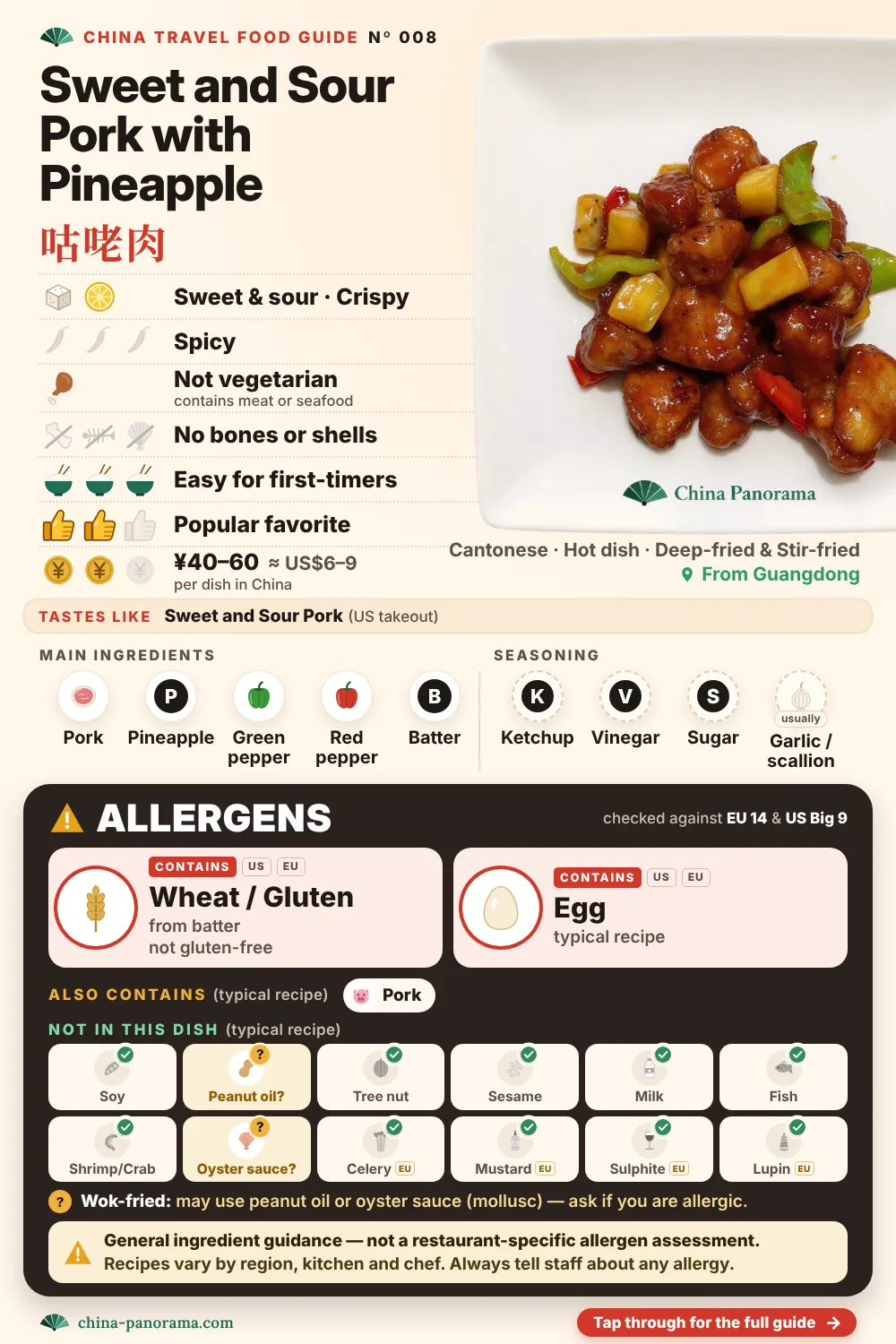
Tap the red Chinese name, the sweet & sour or the vegetarian line, Pineapple, Pork or a yellow ? to show it full-screen to the staff.

Dish guide card for Sweet and Sour Pork with Pineapple (咕咾肉): a photo of the dish, with icons showing it contains wheat / gluten & egg, not vegetarian, sweet & sour flavor, not spicy, no bones or shells, about ¥40–60.Partly edited with AI
Card 1

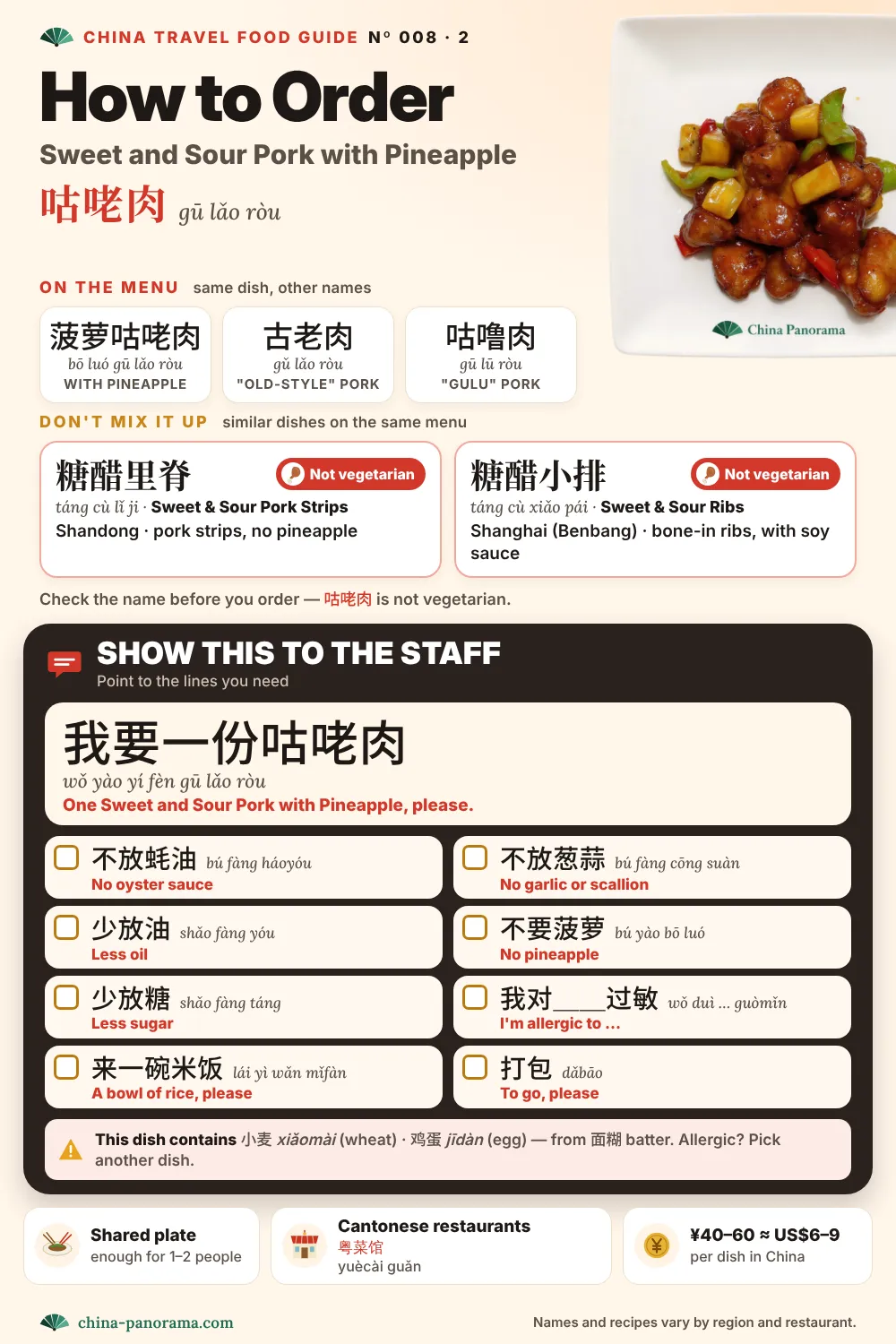
How to order sweet and sour pork with pineapple

Tick what you need right on the card, then tap the big first line to show it full-screen to the staff – that is also where you choose sweeter or more sour.

How to order Sweet and Sour Pork with Pineapple (咕咾肉) in China: other menu names (菠萝咕咾肉, 古老肉, 咕噜肉), similar dishes not to confuse (糖醋里脊, 糖醋小排), and a Chinese order card with phrases like no oyster sauce, no garlic or scallion and I'm allergic to.I’m allergic to … – fill in the blank with the allergy cardPartly edited with AI
Card 2

What is sweet and sour pork with pineapple?

The name is mostly sound: 咕咾 (gū lǎo) has no meaning of its own, and 肉 (ròu) is meat – here pork. The usual story is that it began as 古老肉 (gǔ lǎo ròu, “old-style pork”) and became 咕噜肉 (gū lū ròu) – 咕噜 is the sound of a rumbling stomach – because the two sound alike in Cantonese; nobody knows for sure. The method is the same everywhere: chunks of pork shoulder or loin are marinated, coated in a batter of egg and flour or starch, deep-fried – often twice, for crunch – and tossed for a few seconds in a thick sauce of sugar, vinegar and ketchup with pineapple and green and red pepper.

It is one of the best-known dishes of Cantonese cooking (粤菜, yuè cài) from Guangdong – at family dinners, at banquets and in every Cantonese restaurant (粤菜馆, yuè cài guǎn), in Guangzhou, Hong Kong and all over China. Cantonese emigrants took it abroad, which is how sweet and sour pork became a takeout classic in America and Europe. On a menu, 菠萝咕咾肉 (bō luó gū lǎo ròu) just spells out the pineapple (菠萝); 古老肉 and 咕噜肉 are the same dish. 糖醋里脊 (táng cù lǐ ji) and 糖醋小排 (táng cù xiǎo pái) are not: they are its cousins from Shandong and Shanghai – the quiz below shows them side by side.

It costs about ¥40–60 (US$6–9) in an ordinary restaurant in a big city (2026).

Main ingredients

  • 猪肉zhū ròuPork
  • 菠萝bō luóPineapple
  • 青椒qīng jiāoGreen pepper
  • 红椒hóng jiāoRed pepper
  • 面糊miàn húBatter

Seasoning

  • 番茄酱fān qié jiàngKetchup
  • 醋cùVinegar
  • 糖tángSugar
  • 葱蒜cōng suànGarlic / scallionusually

What does it taste like?

Sweet first, then sour – clearly sweeter than most Western palates expect. The sauce is sugar, rice vinegar and ketchup cooked until thick and shiny; some old-style kitchens add hawthorn or plum sauce for a fruitier sourness. The batter should stay crisp under the sauce and the pork juicy inside, while the pineapple adds fresh, juicy acidity and the peppers a little crunch. Not spicy at all. Eat it while it is hot: the longer it sits, the softer the batter gets.

Tastes like… Sweet and sour pork from American Chinese takeout – this is its Cantonese original. In China the pieces are usually smaller and the batter thinner and crisper, the sauce coats each piece instead of pooling on the plate, and pineapple is standard, not optional.

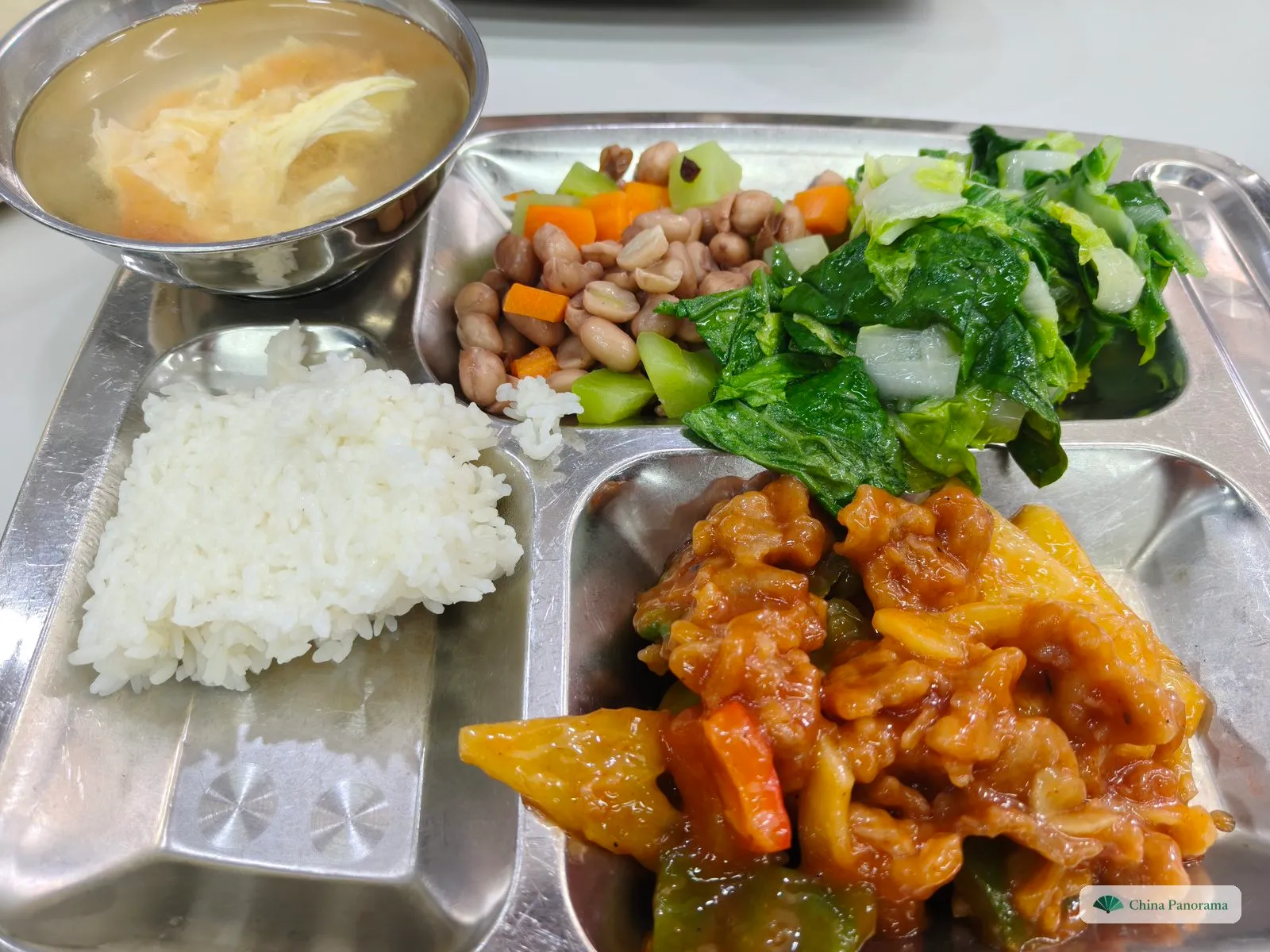
A steel canteen tray from above: sweet and sour pork with pineapple, green pepper and carrot in an orange sauce, a scoop of rice, peanuts with diced carrot and cucumber, lettuce, and a bowl of soup
In canteens and fast-food places it is cooked in big batches: softer and saucier, often with carrot added, and the batter no longer crisp. You still know it by the pineapple and the orange-red sauce. In a restaurant, a good 咕咾肉 crunches when you bite it.Sweet and sour pork in a canteen, with rice, peanuts with diced vegetables, lettuce and soup, 2026.

China’s sweet and sour family

糖醋 (táng cù, “sugar and vinegar”) is a flavor nearly every part of China cooks its own way: battered pork in the south and in the north, ribs in Shanghai and Chongqing, whole fish around the lower Yangtze. 咕咾肉 is Guangdong’s. Tap a place to see the local one.

广州 · Guangzhou, Guangdong

咕咾肉gū lǎo ròu

Sweet and sour pork with pineapple

This dish. Cantonese cooks fry the pork crisp and keep the sauce glossy and sweet, with pineapple and peppers; Hong Kong menus write 咕噜肉 (gu lou yuk in Cantonese). Cantonese emigrants took it to America and Europe, where it became the takeout classic.

Guangzhou city guide →

Local versions are general knowledge, not a restaurant test – recipes vary from kitchen to kitchen. Map: province borders as on our other China maps.

Don’t mix it up

Sweet and sour is a whole family in China – 糖醋 (táng cù), “sugar and vinegar” – and several members look alike in a menu photo. The order card above names two; here they are with a third from the northeast, all in our own photos.

Which one is sweet and sour pork with pineapple? Tap a photo.

  • 糖醋里脊Sweet and sour pork strips

  • 锅包肉Guobaorou

  • 咕咾肉Sweet and sour pork with pineapple

  • 糖醋小排Sweet and sour ribs

The one with pineapple: bite-sized pieces in a glossy sauce, with chunks of pineapple and green and red pepper – the pineapple gives it away. So does the name: 咕咾肉 and its menu names (菠萝咕咾肉, 古老肉, 咕噜肉) are this dish; a name starting with 糖醋 (táng cù) is a cousin.

  • 糖醋里脊 (táng cù lǐ ji, sweet and sour pork strips): Long, thin strips of pork tenderloin in a bright red-orange sauce – no pineapple, no peppers. From Shandong, and the usual sweet and sour pork in the north and in Beijing. Battered too: wheat and egg.
  • 锅包肉 (guō bāo ròu, guobaorou): Big, flat slices in a pale, very crunchy batter, with shreds of carrot and scallion under a light sugar-and-vinegar glaze. From Harbin in the northeast. Usually wheat and soy.
  • 糖醋小排 (táng cù xiǎo pái, sweet and sour ribs): Small pork ribs with the bones in, not battered, braised dark and sticky with soy sauce, sugar and vinegar. From Shanghai, often served cold as a starter. Wheat and soy from the soy sauce.

Our photos: sweet and sour pork strips on a set-meal tray, 2025; guobaorou at a family meal in Shanghai, 2021; sweet and sour pork with pineapple in a restaurant in Nanjing, 2021; sweet and sour ribs on a set-meal tray, 2025.

Allergens and diet

Sweet and sour pork with pineapple contains wheat / gluten and egg, from the batter. It also contains pork in the typical recipe. Wok-fried: the kitchen may use peanut oil or oyster sauce (a mollusc) – ask if you are allergic.

In the usual recipe

  • ACereals containing gluten· US: Wheat
  • CEggs· US: Eggs
  • EPeanuts (sometimes)· US: Peanuts
  • RMolluscs (sometimes)

Sometimes: if the kitchen uses peanut oil or oyster sauce.

Not in this dish (typical recipe)

    B shrimp / crab, D fish, F soy, G milk, H tree nuts, L celery, M mustard, N sesame, O sulphites, P lupin

    These are estimates from how the dish is usually made, not a restaurant’s declaration. Every kitchen and every sauce brand is different – always tell the staff about an allergy. Chinese kitchens often fry in peanut oil, and chilli oil may be made with it too; we don’t repeat that for each dish.

    Vegan, vegetarian, gluten-free

    Not vegetarian: it is made with meat or seafood.

    Not gluten-free: the wheat comes from the batter, and there is no version without it.

    There is no pork-free version in the usual recipe. Some Cantonese restaurants make the same dish with chicken; ask with 有不放猪肉的吗? (yǒu bú fàng zhū ròu de ma?) – tap Pork on the dish card.

    Vegetarian (Buddhist) restaurants sometimes have 素咕咾肉 (sù gū lǎo ròu), made with mushrooms, tofu or wheat gluten (面筋, miàn jīn) instead of pork – vegetarian, but often not gluten-free. Ask with 有素咕咾肉吗? (yǒu sù gū lǎo ròu ma?); the line is behind “Not vegetarian” on the dish card.

    Ketchup, sugar and vinegar add none of the 14 allergens in the usual recipe: the wheat and the egg both come from the batter, and without the batter it would not be 咕咾肉. So there is no gluten-free or egg-free way to order it – pick another dish.

    Eating in China with food allergies

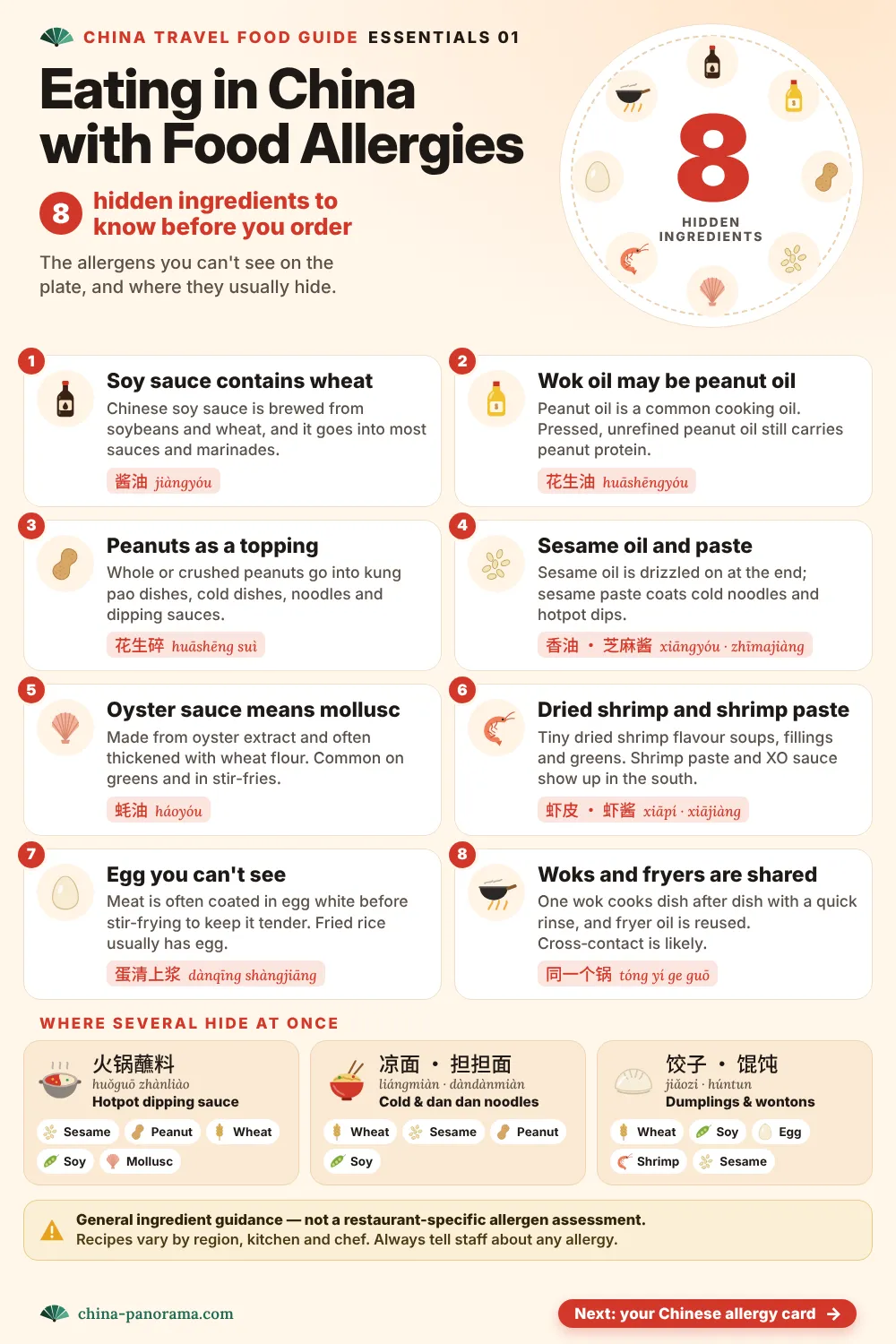
    Two cards that go with every dish in this guide. The first shows where allergens hide in Chinese cooking – tap an ingredient to ask about it in Chinese. The second is a Chinese allergy card for the staff: tick your allergens right on the card and it turns into one sentence, full-screen.

    8 hidden ingredients to know before you order

    Tap an ingredient to ask the staff about it in Chinese.

    Infographic: Eating in China with food allergies, 8 hidden ingredients. Soy sauce with wheat, peanut oil, peanut toppings, sesame oil and paste, oyster sauce, dried shrimp, egg white on meat and shared woks, plus hotpot dips, cold noodles and dumplings where several allergens hide.Next: your Chinese allergy card
    Card 3

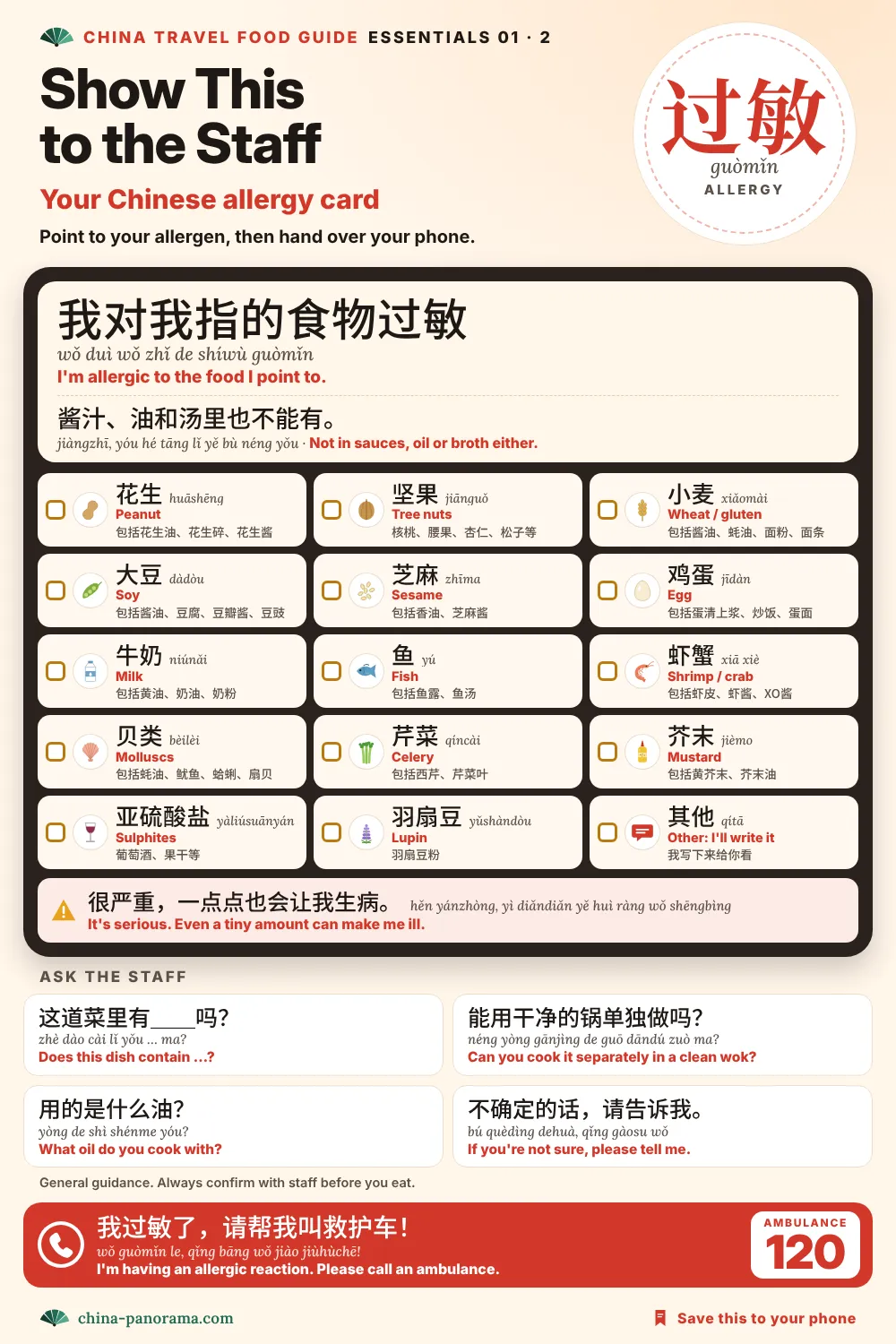
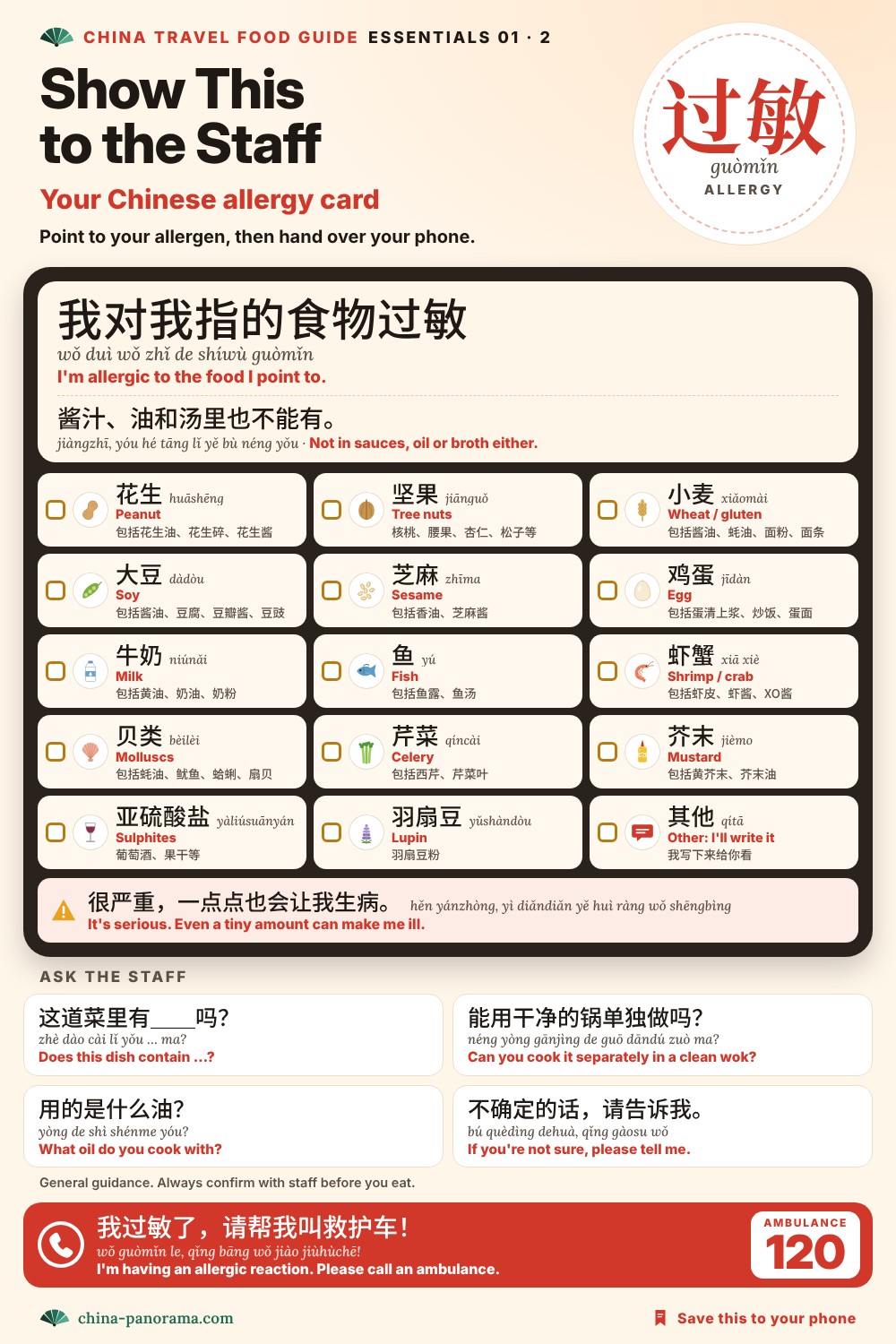
    Show this to the staff: your Chinese allergy card

    Tick your allergens on the card, then tap the big first line to show them full-screen to the staff. A question or the red line opens full-screen too.

    Chinese allergy card to show restaurant staff: the sentence I'm allergic to the food I point to in Chinese, 14 allergens with Chinese, pinyin and hidden sources, questions about clean woks and cooking oil, and an emergency line to call an ambulance on 120.Call 120, the ambulanceSave this card to your phone
    Card 4

    General ingredient guidance, not a restaurant’s allergen declaration. Recipes vary by region, kitchen and chef – always tell the staff about an allergy.

    FAQ

    Is it the same as sweet and sour pork from Chinese takeout?

    It is the original. Cantonese emigrants took 咕咾肉 abroad, and takeouts in America and Europe made it their own. In China the pieces are usually smaller, the batter thinner and crisper, and the sauce clings to each piece instead of filling the plate; pineapple and peppers are always in it. Some kitchens sour the sauce with hawthorn or plum sauce rather than only ketchup and vinegar.

    Is it spicy – and how sweet is it?

    Not spicy at all. It is sweet first, then sour, and in Guangdong clearly sweet – sweeter than many visitors expect. For less sugar, tick 少放糖 (shǎo fàng táng) on the order card. In its full-screen view you can also ask for it 酸一点 (suān yìdiǎn, a little more sour) or 甜一点 (tián yìdiǎn, a little sweeter), and for less sauce, which keeps the batter crisp.

    Is sweet and sour pork vegetarian?

    No: it is pork. Some vegetarian (Buddhist) restaurants make 素咕咾肉 (sù gū lǎo ròu) with mushrooms, tofu or wheat gluten instead – ask with 有素咕咾肉吗? (yǒu sù gū lǎo ròu ma?); the line is behind “Not vegetarian” on the dish card. If you only avoid pork, some Cantonese restaurants make it with chicken.

    Is it gluten-free?

    No. The pork is coated in a batter of flour and egg before it is fried, and there is no version without it. Some kitchens use only starch, but you can’t tell from the menu, and the frying oil is shared with other battered dishes. Egg is in the batter too.

    What is the difference between 咕咾肉, 糖醋里脊 and 锅包肉?

    All three are battered, fried pork in a sweet-and-sour sauce. 咕咾肉 is Cantonese: bite-sized chunks with pineapple and peppers in a glossy red-brown sauce. 糖醋里脊 (táng cù lǐ ji), from Shandong, is long strips of tenderloin in a bright red-orange sauce, without fruit. 锅包肉 (guō bāo ròu), from Harbin, is big flat slices in a very crunchy, pale batter with a light glaze. 糖醋小排 (táng cù xiǎo pái) are Shanghai ribs, with bones and soy sauce. Test yourself in “Don’t mix it up” above.

    How much does it cost in China?

    About ¥40–60 (US$6–9) a plate in an ordinary restaurant in a big city (2026) – one plate is enough for one or two people with rice. A canteen portion costs much less; smart Cantonese restaurants charge more.

    What is it called in Chinese?

    咕咾肉, in pinyin gū lǎo ròu (typed without tones: gu lao rou). Menus also say 菠萝咕咾肉 (bō luó gū lǎo ròu, with pineapple), 古老肉 (gǔ lǎo ròu) or 咕噜肉 (gū lū ròu, typed: gu lu rou) – gu lou yuk in Cantonese. In English it is sweet and sour pork, or pineapple pork. To order, show the staff the order card above, or tap the red Chinese name on the dish card.

    More Chinese dishes

    Ordering in a restaurant, by QR code or in a canteen? Our restaurant walkthrough, the QR-code ordering walkthrough and the canteen walkthrough show each step.

    Cards, photos and sources

    The cards are our own. The dish photo on cards 1 and 2 is partly edited with AI; the other photos on this page are our own, unedited. Prices come from our dish library and are typical for an ordinary restaurant in a big city; dollar prices are rounded. Allergens are estimated from the usual recipe, checked against the 14 EU allergen groups and the 9 major US food allergens. Menu names, similar dishes and phrases are general knowledge – recipes vary by region, kitchen and chef.

    Changelog (1)
    • 2026-10-08Page created with 4 cards you can use on screen: the dish card, how to order it, and the Essentials cards on eating in china with food allergies.