- Talents
- Outstanding at planning and organising, brings order to chaos quickly. Has ideas and carries them out, loves starting something from scratch and has a fine eye for beauty and detail.
- In love
- Likes to lead in a relationship, faithful and direct, no games. Sets high standards and wants an equal. Has to learn not to run everything and to accept imperfection.
- At work
- Leadership, your own business, design, anywhere you can carry a team along.
Chinese Zodiac Rooster: Meaning, Personality, Years and the Year of the Rooster 2029
The Rooster 鸡 jī is the tenth of the twelve Chinese zodiac animals and the only bird in the circle. It is said to be hard-working, punctual, honest and a little proud, after all it wakes the world every morning. The next Year of the Rooster begins on 13 February 2029, an Earth Rooster, and lasts until 2 February 2030. Below you will find every Rooster year, the five Roosters by element, three roosters from a New York museum, the 1981 Rooster stamp and a game with your life number, for your partner too.
Profile: the Rooster in the Chinese zodiac
- Character
- 鸡 jī
- Earthly branch
- 酉 yǒu, number 10 of 12
- Double hour
- 5 to 7 pm
- Direction
- West
- Element of the branch
- Metal
- Month
- early September to early October
- Good match
- Ox, Snake, Dragon
- Opposite
- Rabbit
Each of the twelve earthly branches has an animal. The Rooster has the branch 酉 yǒu, which stands for evening, the west and the middle of autumn. It belongs to the element Metal, and the hours from 5 to 7 pm are still called 酉时 yǒushí. Why the animal of your year has nothing to do with your Western star sign is explained in the comparison of the Chinese and Western zodiacs.
Meaning and personality of the Rooster
What people in China say about the Rooster comes from the farmyard: it crows on time every morning, keeps its hens together, wears its comb like a crown and never shies away from a fight. Add the pun 鸡 jī, chicken, like 吉 jí, luck. This is folk belief, not a personality test, but it explains why Rooster people in China are thought of as hard-working and thorough.
Strengths
- hard-working and punctual, an early riser
- observant, notices every detail
- honest and direct, says what it thinks
- orderly, likes to plan and keeps its word
- well-groomed, with a sense of beauty
Weaknesses
- a perfectionist, which is hardest on itself
- critical, sometimes fussy
- direct to the point of tactless
- a little proud and vain
The Rooster in love
In love the Rooster is said to be faithful, reliable and honest. It shows its feelings through deeds rather than big words and expects a lot, of its partner and of itself. Its criticism is well meant, but does not always go down well. In the classical teaching the Ox, the Snake and the Dragon suit it best, the Rabbit is its opposite. All twelve animals compared are further down.
The Rooster woman and the Rooster man
Chinese tradition makes no difference between men and women in the zodiac. Horoscope sites like to describe the Rooster woman as elegant, well organised and clear in her views, often the one who keeps track of everything in the family. They paint the Rooster man as ambitious, well-groomed and a little proud, with a weakness for recognition and clear arrangements. These are the same traits as above, just shared out differently.
Lucky numbers and lucky colours
Many horoscope sites give the Rooster the lucky numbers 5, 7 and 8 and the colours gold, brown and yellow. There is no old Chinese source for this. What is fixed: the branch 酉 belongs to Metal, and in the five elements the colour of Metal is white 白 bái. Which colour your own year has is shown under the five Roosters.
Which years are Rooster years? Every year from 1933 to 2041
The Chinese year does not start on 1 January but at the New Year festival, between 21 January and 20 February. If you were born in January or February of a Rooster year, check the exact days: before New Year it is still the Monkey.
| Year | Begins | Ends | Rooster | Stem and branch |
|---|---|---|---|---|
| 1933 | 26 January 1933 | 13 February 1934 | Water Rooster | 癸酉 |
| 1945 | 13 February 1945 | 1 February 1946 | Wood Rooster | 乙酉 |
| 1957 | 31 January 1957 | 17 February 1958 | Fire Rooster | 丁酉 |
| 1969 | 17 February 1969 | 5 February 1970 | Earth Rooster | 己酉 |
| 1981 | 5 February 1981 | 24 January 1982 | Metal Rooster | 辛酉 |
| 1993 | 23 January 1993 | 9 February 1994 | Water Rooster | 癸酉 |
| 2005 | 9 February 2005 | 28 January 2006 | Wood Rooster | 乙酉 |
| 2017 | 28 January 2017 | 15 February 2018 | Fire Rooster | 丁酉 |
| 2029next | 13 February 2029 | 2 February 2030 | Earth Rooster | 己酉 |
| 2041 | 1 February 2041 | 21 January 2042 | Metal Rooster | 辛酉 |
New Year dates in China time, each checked against the astronomical new moon. All the other animals and a finder for any birthday from 1924 are in the overview of the twelve Chinese zodiac signs.
The five Roosters: Metal Rooster 1981, Water Rooster 1993, Wood Rooster 2005, Fire Rooster 2017, Earth Rooster 2029
The same Rooster returns every 60 years, because the twelve animals are paired with ten heavenly stems that give each year an element. So there are five kinds of Rooster. You can tell the element from the last digit of the year: 1 Metal, 3 Water, 5 Wood, 7 Fire, 9 Earth. How the elements work together is explained on the page about the five elements.
木鸡
Wood Rooster1945 · 2005
- Stem and branch:
- 乙酉
- How stem and branch get on:
- 金木相战, wood over metal: metal cuts wood
- Nayin:
- 泉中水 quán zhōng shuǐ, “water in the spring” (Water)
- Colour of the element:
- 青 blue-green
火鸡
Fire Rooster1957 · 2017
- Stem and branch:
- 丁酉
- How stem and branch get on:
- 火金相克, fire over metal: fire melts metal
- Nayin:
- 山下火 shān xià huǒ, “fire at the foot of the mountain” (Fire)
- Colour of the element:
- 赤 red
土鸡
Earth Rooster1909 · 1969 · 2029
- Stem and branch:
- 己酉
- How stem and branch get on:
- 土金相生, earth over metal: earth feeds metal
- Nayin:
- 大驿土 dà yì tǔ, “earth of the great post road” (Earth)
- Colour of the element:
- 黄 yellow
金鸡
Metal Rooster1921 · 1981 · 2041
- Stem and branch:
- 辛酉
- How stem and branch get on:
- 金旺, metal over metal: twice as strong
- Nayin:
- 石榴木 shí liú mù, “pomegranate wood” (Wood)
- Colour of the element:
- 白 white
水鸡
Water Rooster1933 · 1993
- Stem and branch:
- 癸酉
- How stem and branch get on:
- 金水相生, water over metal: metal feeds water
- Nayin:
- 剑锋金 jiàn fēng jīn, “metal of the sword’s edge” (Metal)
- Colour of the element:
- 黑 black
The branch 酉 is Metal itself, the purest of the twelve: it stands in the west, in the middle of autumn. So Chinese horoscope charts look at how the element of the year fits it: with the Earth Rooster, earth feeds metal, which counts as harmonious, with the Wood Rooster, metal cuts wood, and with the Metal Rooster the metal is twice as strong. Charts often add a second element, the nayin 纳音 nàyīn. It comes from the fortune tellers’ lore of the 60 pairs and has picturesque names such as “metal of the sword’s edge”. But when people in China talk about a Metal Rooster, they almost always mean the element of the heavenly stem, the one in the table above.
Year of the Rooster 2029: the yellow Earth Rooster
What colour is the Year of the Rooster 2029?
Yellow. Every year gets an element from its heavenly stem. In 2029 it is 己 jǐ, yin earth, and in the five elements earth has the colour yellow 黄 huáng. Because earth feeds the metal of the branch 酉, 己酉 counts as a well-matched pair. The last Rooster, 2017, was a Fire Rooster and so red. Other “lucky colours” for 2029 that you find online differ from site to site.
Rooster or chicken? 鸡
The Chinese word 鸡 jī means chicken in general. Pictures and stamps, though, nearly always show a cock, often as the “golden rooster” 金鸡 jīnjī that announces the morning 金鸡报晓. That is why the sign is usually called the Rooster in English, and the “Year of the Chicken” and the “Year of the Rooster” are the same year.
If you are a Rooster yourself, 2029 is your own year, your 本命年 běnmìngnián. That means everyone turning 12, 24, 36, 48, 60, 72 or 84 in 2029. Your own year is traditionally seen as a tricky one, so many Roosters wear something red from 13 February 2029 to 2 February 2030: red socks, underwear or a red bracelet, ideally a gift from a partner or parents. How the New Year festival goes is shown on the page about Chinese New Year 2027.
Game: what does your life number say about you as a Rooster?
On Chinese social media there are charts that link the Rooster with the life number 生命数字 shēngmìng shùzì: nine Rooster types with talents, love, work and the numbers that suit them best. This is how you work out your number: add up all the digits of your date of birth until only one is left. For 28 September 1981 that means 2 + 8 + 0 + 9 + 1 + 9 + 8 + 1 = 38, then 3 + 8 = 11 and 1 + 1 = 2. Try it with your own birthday, and then with your partner’s:
✓ A Rooster. Born in the Year of the Metal Rooster 辛酉, which began on 5 February 1981.
Play along: add up all the digits until only one is left
- Step 1:1981092838
- Step 2:3811
- Step 3:112
Your life number is 2.
- Talents
- Articulate and empathetic, sees exactly what others need. Expresses things well, mediates skilfully, knows the etiquette and understands people.
- In love
- Affectionate and attentive, loves sweet words and quick replies and quietly does a lot for the partner. Sometimes loses itself in the relationship and has to learn to make its own decisions.
- At work
- Human resources, copywriting, consulting, customer care, jobs where communication counts.
- Talents
- Can talk and can act, turns ideas into reality fast and has a feel for fashion. Strong on stage, in design and in creating social media content, with natural charm.
- In love
- Funny and romantic, cares about atmosphere and looks and likes to be praised. Loses interest once the novelty wears off and has to learn to commit to one person.
- At work
- Social media, design, stage and entertainment, marketing, wherever creativity and expression count.
- Talents
- Organises and delivers like few others, breaks tangled projects into clear steps and sets up rules and routines. Works thoroughly rather than rashly and inspires trust.
- In love
- Looks for a steady, lasting relationship and does not fall for someone easily. Once in love, though, all in. Sometimes plans so much that romance suffers, and has to learn to live with uncertainty.
- At work
- Project management, data analysis, administration, finance, where care and stamina bring results.
- Talents
- Strong at negotiating and with people, settles into new places fast and makes friends easily. Has a nose for the new and grabs the chance when things are in flux.
- In love
- Wants a free, romantic relationship and hates being tied down. Drawn to interesting people, but shies away from promises. Has to learn to take responsibility and balance freedom and closeness.
- At work
- Sales, public relations, travel blogging, freelancing, anything that keeps moving.
- Talents
- Observant, good for others and with good taste. Mends and improves things, whether a quarrel between people or everyday chores, and is very good with money.
- In love
- Faithful and there for partner and family, cares about small things and sincerity. Can become too critical and start rows that way. Has to learn to accept imperfection and to love itself first.
- At work
- Education, charity work, financial advice, beauty and skin care, jobs with care and heart.
- Talents
- Top-class at analysis and research, with sharp intuition, sees through things quickly. Thinks things through, gets to the bottom of mistakes and strives for perfection in its field.
- In love
- Head over heart. Does not fall in love easily and needs a long time to trust. Shows feelings too rarely and has to learn to open up and balance reason and romance.
- At work
- Market research, strategy, research and development, counselling.
- Talents
- A strong leader with a head for business, keeps the big picture and leads a team to success. Handles a lot of pressure and turns even a hard situation around.
- In love
- Wants an equal partner to build something with. Responsible but not very romantic. Puts so much into work that love comes up short, and has to learn to balance work and life.
- At work
- Your own business, management, finance, sales management.
- Talents
- Has charisma and can organise, knows lots of people and rallies them around a goal. Burns for charity and culture and thinks further ahead than most.
- In love
- Generous and sincere, looks for a meeting of minds, gives a lot to the partner and wants a steady, lasting relationship. Sometimes dreams too much and has to learn to focus on love and the moment.
- At work
- Education, charity work, culture, high-level consulting, counselling.
And your partner?
The charts also name the numbers that suit each one best. Enter a second birthday:
1+9+8+5+0+3+1+4 = 31 →3+1 = 4
Partner’s life number: 4
The chart lists 4 as a good match for 2: it gives stability and a reliable order.
By the classical zodiac rules, Rooster and Ox: Good match (三合 sānhé).
A game from Chinese social media, not a prediction. Where the life number comes from is explained below.
Where does the life number come from?
Not from China. The life number belongs to Western numerology, which claims the Greek philosopher Pythagoras as its father and became popular mainly in the 20th century. Chinese platforms have mixed it with the zodiac, much as Western horoscope books combine your animal with your star sign. Ancient Chinese number lore, such as the Hetu diagram 河图 on the five elements page, works quite differently. Take the texts as a game, not a forecast. The same game exists for the Rat, Ox, Tiger, Rabbit, Dragon, Snake, Horse, Goat, Monkey, Dog and Pig.
All nine life numbers for the Rooster at a glance
1The pioneer
- Talents:
- Outstanding at planning and organising, brings order to chaos quickly. Has ideas and carries them out, loves starting something from scratch and has a fine eye for beauty and detail.
- In love:
- Likes to lead in a relationship, faithful and direct, no games. Sets high standards and wants an equal. Has to learn not to run everything and to accept imperfection.
- At work:
- Leadership, your own business, design, anywhere you can carry a team along.
- Good match:
- 5 and 8
2The bridge builder
- Talents:
- Articulate and empathetic, sees exactly what others need. Expresses things well, mediates skilfully, knows the etiquette and understands people.
- In love:
- Affectionate and attentive, loves sweet words and quick replies and quietly does a lot for the partner. Sometimes loses itself in the relationship and has to learn to make its own decisions.
- At work:
- Human resources, copywriting, consulting, customer care, jobs where communication counts.
- Good match:
- 4 and 9
3The performer
- Talents:
- Can talk and can act, turns ideas into reality fast and has a feel for fashion. Strong on stage, in design and in creating social media content, with natural charm.
- In love:
- Funny and romantic, cares about atmosphere and looks and likes to be praised. Loses interest once the novelty wears off and has to learn to commit to one person.
- At work:
- Social media, design, stage and entertainment, marketing, wherever creativity and expression count.
- Good match:
- 6 and 7
4The builder
- Talents:
- Organises and delivers like few others, breaks tangled projects into clear steps and sets up rules and routines. Works thoroughly rather than rashly and inspires trust.
- In love:
- Looks for a steady, lasting relationship and does not fall for someone easily. Once in love, though, all in. Sometimes plans so much that romance suffers, and has to learn to live with uncertainty.
- At work:
- Project management, data analysis, administration, finance, where care and stamina bring results.
- Good match:
- 3 and 6
5The free spirit
- Talents:
- Strong at negotiating and with people, settles into new places fast and makes friends easily. Has a nose for the new and grabs the chance when things are in flux.
- In love:
- Wants a free, romantic relationship and hates being tied down. Drawn to interesting people, but shies away from promises. Has to learn to take responsibility and balance freedom and closeness.
- At work:
- Sales, public relations, travel blogging, freelancing, anything that keeps moving.
- Good match:
- 3 and 9
6The good soul
- Talents:
- Observant, good for others and with good taste. Mends and improves things, whether a quarrel between people or everyday chores, and is very good with money.
- In love:
- Faithful and there for partner and family, cares about small things and sincerity. Can become too critical and start rows that way. Has to learn to accept imperfection and to love itself first.
- At work:
- Education, charity work, financial advice, beauty and skin care, jobs with care and heart.
- Good match:
- 1 and 9
7The analyst
- Talents:
- Top-class at analysis and research, with sharp intuition, sees through things quickly. Thinks things through, gets to the bottom of mistakes and strives for perfection in its field.
- In love:
- Head over heart. Does not fall in love easily and needs a long time to trust. Shows feelings too rarely and has to learn to open up and balance reason and romance.
- At work:
- Market research, strategy, research and development, counselling.
- Good match:
- 9 and 2
8The entrepreneur
- Talents:
- A strong leader with a head for business, keeps the big picture and leads a team to success. Handles a lot of pressure and turns even a hard situation around.
- In love:
- Wants an equal partner to build something with. Responsible but not very romantic. Puts so much into work that love comes up short, and has to learn to balance work and life.
- At work:
- Your own business, management, finance, sales management.
- Good match:
- 1 and 5
9The idealist
- Talents:
- Has charisma and can organise, knows lots of people and rallies them around a goal. Burns for charity and culture and thinks further ahead than most.
- In love:
- Generous and sincere, looks for a meeting of minds, gives a lot to the partner and wants a steady, lasting relationship. Sometimes dreams too much and has to learn to focus on love and the moment.
- At work:
- Education, charity work, culture, high-level consulting, counselling.
- Good match:
- 5 and 7
The texts give a widely shared Chinese chart in our own words. The chart only names the matching numbers for each one, the short reasons in the game are our own, taken from the chart’s own texts.
Which signs are compatible with the Rooster? Matches and love
The classical teaching derives this from where the animals stand in the circle. Ox, Snake and Rooster form a triangle 三合 sānhé, the “metal triangle”, Dragon and Rooster a pair 六合 liùhé. The Rooster shares the west and autumn with the Monkey and the Dog 三会 sānhuì, yet the Dog of all animals also counts as difficult. The Rabbit stands right opposite the Rooster, and a break 破 links it with the Rat. And two Roosters “punish themselves” 自刑: too much perfectionism at once. An old folk rhyme warns against the Dog:
金鸡遇犬泪交流
“When the golden Rooster meets the Dog, the tears will flow.”
Rat 鼠Tension (破 pò)
Ox 牛Good match (三合 sānhé)
Tiger 虎Neutral
Rabbit 兔Clash (冲 chōng)
Dragon 龙Good match (六合 liùhé)
Snake 蛇Good match (三合 sānhé)
Horse 马Neutral
Goat 羊Neutral
Monkey 猴Neutral
Dog 狗Friction (害 hài)
Pig 猪Neutral
Tradition, not a prediction. Some families in China still ask about it when planning a wedding, most couples take it lightly.
The Rooster in ancient China: luck, virtue and a picture on the door
For thousands of years the chicken has been the farm animal that opens the day. Four ideas still shape how people in China look at the Rooster:
- 吉A chicken for luck
- 鸡 jī, chicken, sounds almost like 吉 jí, “luck”. So a big rooster 大鸡 is also “great luck” 大吉. And because the comb 冠 guān sounds like 官 guān, “office”, a rooster next to a cockscomb flower stands for 官上加官, “office upon office”, a wish for a fine career.
- 五德The five virtues
- In the Han shi waizhuan of the 2nd century BC the adviser Tian Rao tells his lord why the chicken has five virtues: the comb on its head stands for learning 文, the spurs for martial strength 武, standing up to the enemy is courage 勇, calling the others when it finds food is kindness 仁, and crowing on time is reliability 信.
- 鸡日The day of the chicken
- New Year’s Day belongs to the chicken, the second day to the dog, the third to the sheep and so on, until on the seventh day it is the turn of humans. The festival calendar Jingchu suishi ji from the 6th century describes sticking a painted chicken on the door on New Year’s Day, with a reed rope above it and peach-wood charms beside it: all spirits feared it.
- 酉A wine jar for a sign
- The character of the earthly branch, 酉 yǒu, first showed a wine jar with a narrow neck. That is why it still sits in 酒 “alcohol”, 醋 “vinegar” and 醉 “drunk”. Its hour, 5 to 7 pm, is the time when the chickens go back to the coop.
The Rooster in the museum: three pieces from the Met
The Metropolitan Museum of Art in New York holds many chickens from China. Three of them show how differently the Rooster has been portrayed over a thousand years: as a family scene on an imperial cup, as the companion of an official and as a splendid incense burner. The museum has put all three photos in the public domain.


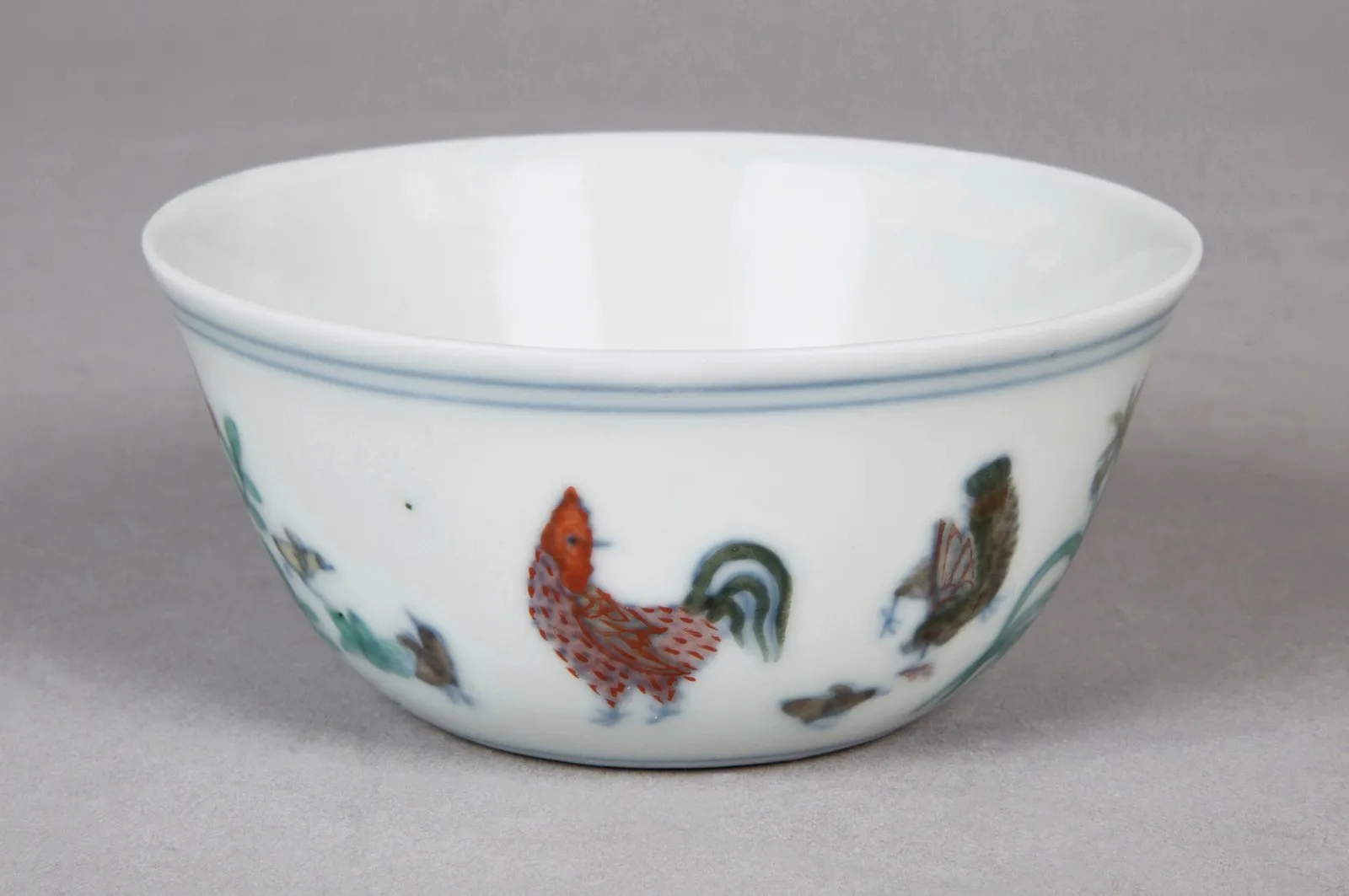
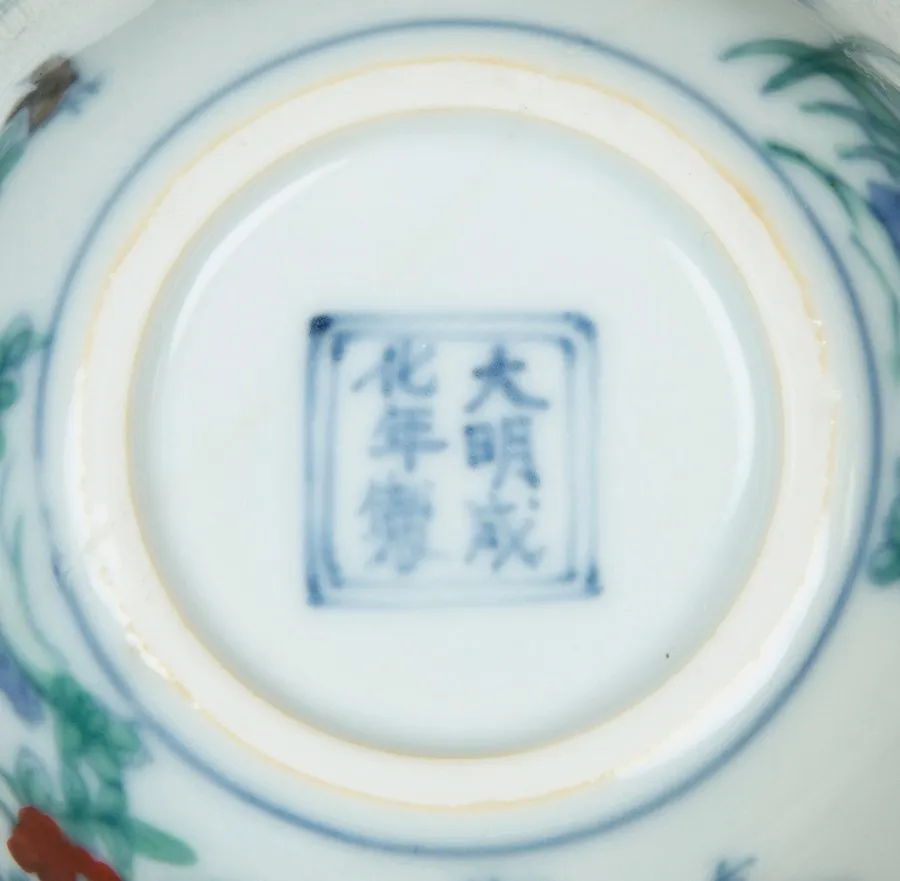
The Chenghua chicken cup 成化斗彩鸡缸杯
This cup is only 4.1 centimetres tall, fired in the imperial kilns of Jingdezhen under the Ming emperor Chenghua, who reigned from 1465 to 1487. On one side a rooster struts, next to it a hen pecks with her chicks, on the other side a second chicken family follows, with rocks and flowers in between. The museum reads the picture as a wish for the family: raising the young well secures the future of the house.
The technique is called 斗彩 dòucǎi, “contending colours”. First the outlines were painted in cobalt blue under the glaze and the cup was fired, then the areas were filled in with coloured enamels on top of the glaze and fired a second time, at a lower heat. Under the foot is the reign mark in blue, 大明成化年制, “made in the Chenghua reign of the Great Ming”.
The Qing emperors already had such cups copied. Another one became famous when it sold at Sotheby’s in Hong Kong in April 2014 for 281 million Hong Kong dollars, about 36 million US dollars at the time and a world record for Chinese porcelain. The buyer, the Shanghai collector Liu Yiqian, drank tea from it right after the sale, which caused quite a stir in China.
Chicken cup, China, Ming dynasty, Chenghua mark and period (1465–1487). Porcelain painted in underglaze blue and overglaze enamels (Jingdezhen), H. 4.1 cm, diam. 8.3 cm. The Metropolitan Museum of Art, New York, Purchase, Mrs. Richard E. Linburn Gift, 1987, 1987.85, public domain (CC0). On view in gallery 221 (as of November 2026).

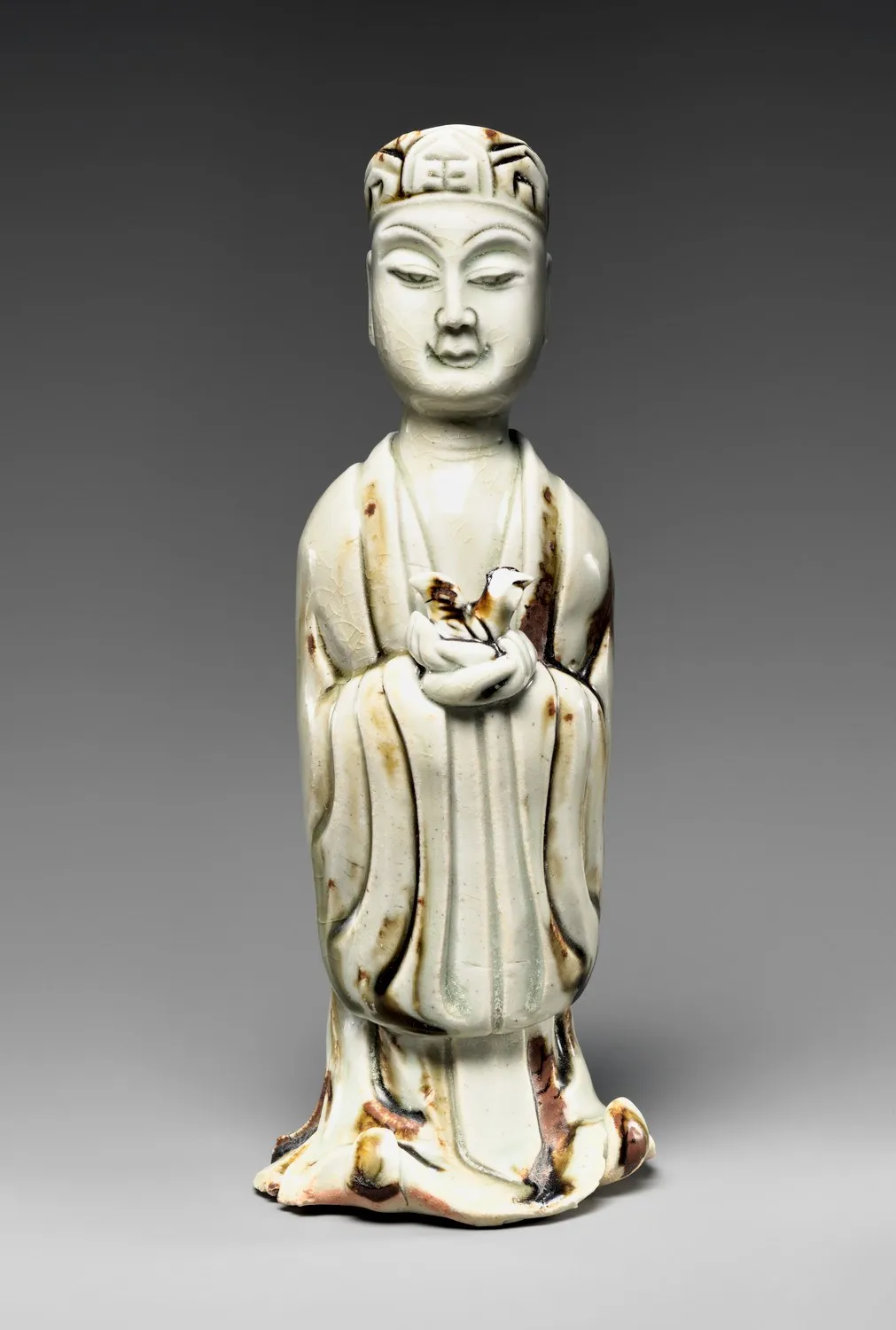
An official with a rooster, 11th century 青白瓷生肖俑
Expect a rooster and you find a man: an official in a cap and a wide robe holds a small rooster to his chest. In the Tang and Song dynasties the zodiac animals were often shown like this, as people carrying their animal. Such figures belonged to sets of twelve.
The figure is qingbai porcelain 青白瓷, “bluish white”, as it was fired in Jingdezhen in the 11th century. The brown spots come from iron dabbed onto the glaze on purpose.
Chinese zodiac figure of a rooster, China, Northern Song dynasty, 11th century. Qingbai porcelain with brown iron splash (Jingdezhen), H. 21.4 cm. The Metropolitan Museum of Art, New York, Charlotte C. and John C. Weber Collection, Gift of Charlotte C. and John C. Weber, 1994, 1994.605.54, public domain (CC0). Not on view at the moment.


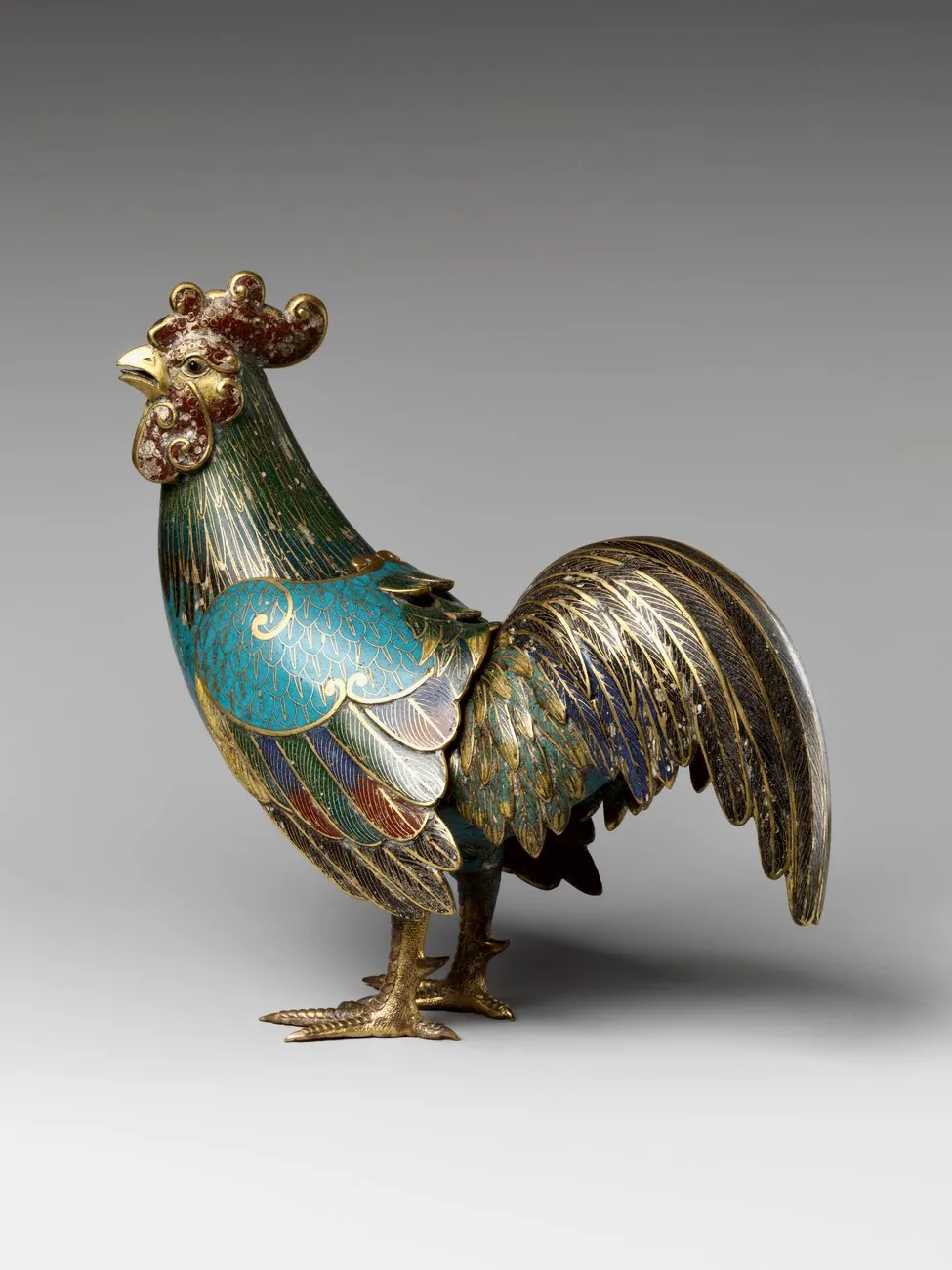
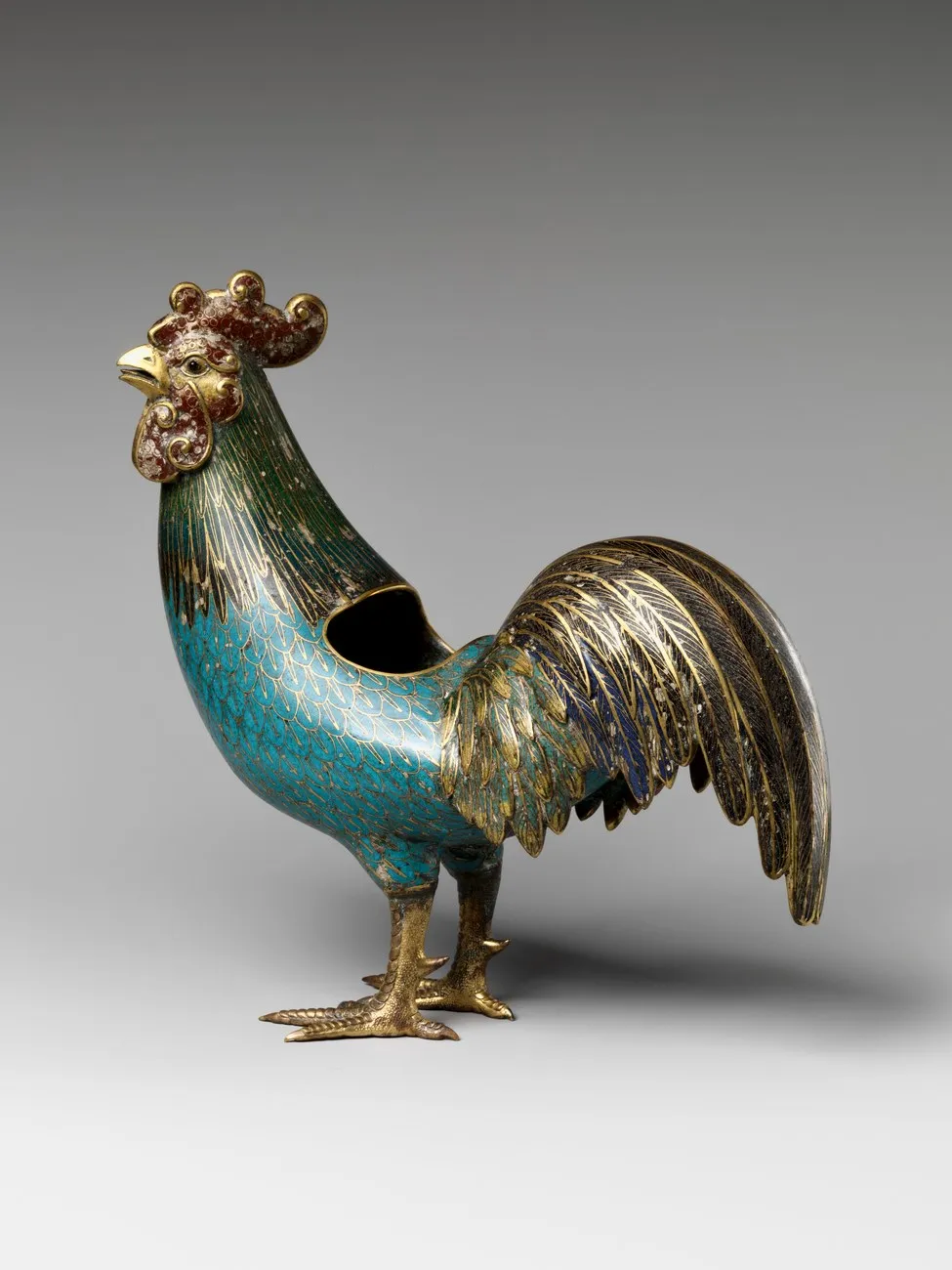
A rooster for incense, 18th century 掐丝珐琅公鸡香炉
This 21-centimetre rooster dates from the reign of the Qianlong emperor, who ruled from 1736 to 1795. It is an incense burner: lift off the wing and the hollow body opens, and the incense went in there.
The technique is cloisonné 掐丝珐琅 qiāsī fàláng: fine strips of wire are soldered onto the metal body, the little cells between them are filled with coloured glass paste and fired. Then the surface is ground smooth and the visible metal gilded. That is how every single feather is made.
Incense burner in the shape of a rooster, China, Qing dynasty, Qianlong period, second half of the 18th century. Cloisonné enamel, H. 21 cm. The Metropolitan Museum of Art, New York, Gift of Edward G. Kennedy, 1929, 29.110.41, public domain (CC0).
The Rooster in the Chinese language: eight idioms
Sometimes hard-working, sometimes petty, sometimes just a side dish: in idioms the chicken is an everyday animal. Every schoolchild in China knows the first one.
闻鸡起舞
wén jī qǐ wǔ · Hear the rooster and take up the sword.
From the history of the Jin dynasty: young Zu Ti jumped up in the middle of the night whenever a rooster crowed and practised with his sword. Today: rise early and work hard on yourself.
鹤立鸡群
hè lì jī qún · A crane standing among chickens.
To stand out from the crowd. That is how people described the scholar Ji Shao in the 3rd century.
呆若木鸡
dāi ruò mù jī · As stiff as a wooden rooster.
Today: dumbstruck. In the Zhuangzi it was praise: a fighting cock was trained for 40 days until it stood as calm as if carved from wood, and no other cock dared to take it on.
鸡鸣狗盗
jī míng gǒu dào · Crow like a rooster, steal like a dog.
From the Records of the Grand Historian: Lord Mengchang escapes from Qin because one of his men steals a fur coat “like a dog” and another crows like a rooster, so the guards open the city gate before dawn. Today: petty, dubious tricks.
一人得道,鸡犬升天
yì rén dé dào, jī quǎn shēng tiān · When one man becomes immortal, even his chickens and dogs rise to heaven.
After the legend of Prince Liu An, whose animals licked up the rest of his elixir. Today: whoever rises takes family and friends along, in other words nepotism.
鸡飞蛋打
jī fēi dàn dǎ · The hen flies off and the egg breaks.
Lose everything, both at once.
鸡毛蒜皮
jī máo suàn pí · Chicken feathers and garlic skins.
Trifles, petty stuff.
杀鸡焉用牛刀
shā jī yān yòng niú dāo · Why use an ox knife to kill a chicken?
After the Analects of Confucius, where it is still 割鸡, “to carve a chicken”. In English: use a sledgehammer to crack a nut.
One more well-known saying with a chicken, 杀鸡儆猴 “kill the chicken to warn the monkey”, is on the page about the Chinese zodiac Monkey.
Roosters on Chinese stamps: the 1981 Rooster stamp
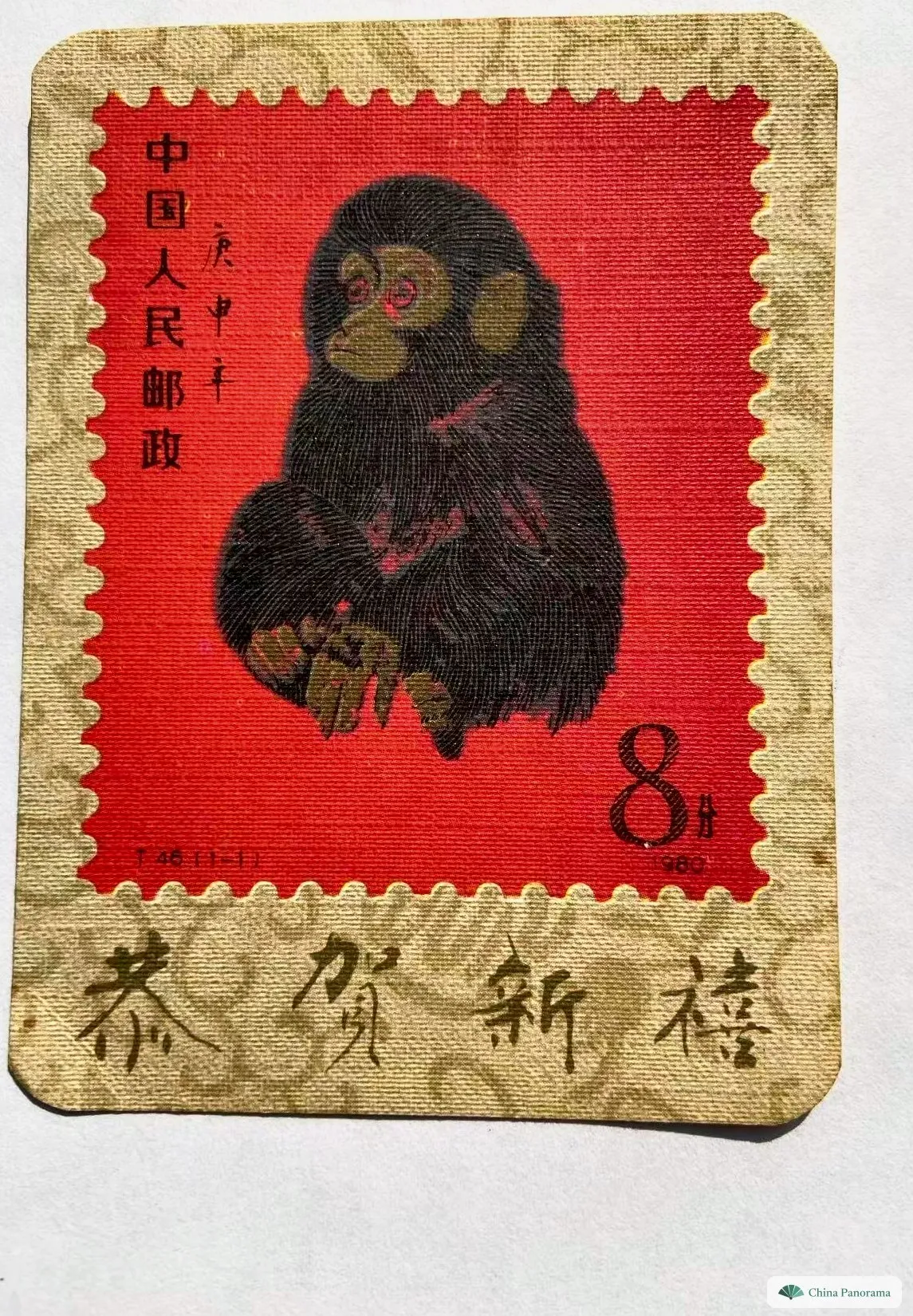
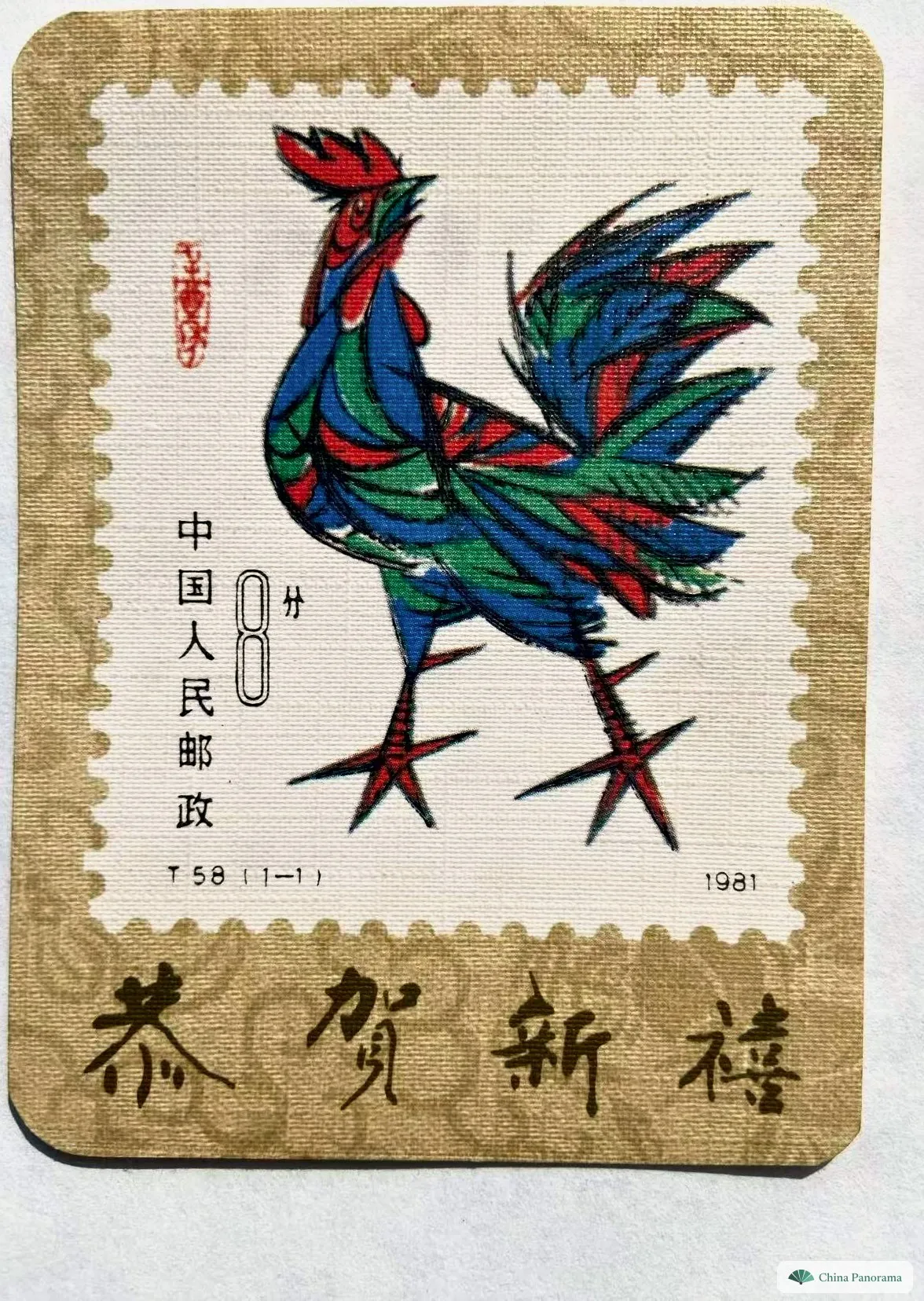
China Post has issued a zodiac stamp every year since 1980. The series began with the Monkey, so the Rooster is the second stamp in every round: 1981 辛酉年, 1993 癸酉年, 2005 乙酉年, 2017 丁酉年. The next one comes in 2029. The first two stamps are side by side here, as pictures on two New Year cards of the same kind.

1980: the “Golden Monkey” 庚申年
This stamp started the series: a black monkey with a golden face on a bright red ground, painted by Huang Yongyu 黄永玉, issued on 15 February 1980. Today it is the best-known stamp of the People’s Republic. More about it is on the Chinese zodiac Monkey page.
New Year card with the design of the T.46 “Gengshen Year” stamp (1980, painting Huang Yongyu, design Shao Bailin). Photo: China Panorama.

1981: the colourful Rooster 辛酉年
The T.58 “Xinyou Year” stamp came out on 5 January 1981 and cost 8 fen. A rooster stretches its head and crows into the morning, its plumage built from patches of red, blue and green set side by side, more poster than nature study. In China the picture brings to mind the idiom 闻鸡起舞: get up at the first cockcrow and get going.
The picture was painted by Zhang Ding 张仃, a painter and designer who had also worked on the national emblem of the People’s Republic. Cheng Chuanli 程传理 designed the stamp and Sun Hongnian 孙鸿年 engraved it. Like the Monkey, it was printed in photogravure and engraving combined. Next to the famous Monkey, the Rooster is overshadowed among collectors and far cheaper to buy.
New Year card with the design of the T.58 “Xinyou Year” stamp (1981, painting Zhang Ding, design Cheng Chuanli, engraving Sun Hongnian). Photo: China Panorama.
The New Year cards
Neither photo shows the stamp itself, but cards that reprint the design large: with rounded corners, on linen-textured paper, with printed perforations and the greeting 恭贺新禧 “Happy New Year” in brush script. Frame and lettering are styled alike, so the cards clearly belong to the same series. The details on the stamps are printed along with them: 中国人民邮政 “Chinese People’s Post”, the value 8 fen, and on the Rooster the number T58 (1-1) at the bottom, meaning stamp 1 of 1, and the year 1981.
1993 癸酉年
Two stamps after paper cuts by Cai Lanying 蔡兰英, a 74-year-old farmer from Xianxian 献县 in Hebei: a crowing rooster with spread wings, and the character 鸡 in seal script framed by peony, lotus, chrysanthemum and plum blossom, the flowers of the four seasons.
2005 乙酉年
One stamp by Lü Shengzhong 吕胜中 in the style of ink painting: a colourful rooster with a peony at its tail above a red sun. Together, sun and rooster form the character 酉, the Rooster’s earthly branch.
2017 丁酉年
Two stamps by Han Meilin 韩美林, who also designed the mascots of the 2008 Beijing Olympics: a proud rooster, and a hen with two chicks, a chicken family just like the one on the Chenghua cup.
Chicken on the plate: four dishes for your trip
Chicken is on every menu in China, usually on the bone and chopped small. Four dishes you are sure to meet on a trip, and if you prefer eggs, try the tomato and egg stir-fry:
Kung pao chicken 宫保鸡丁
gōngbǎo jīdīng
Diced chicken with peanuts, dried chillies and Sichuan pepper, sweet, sour and hot. Named after Ding Baozhen 丁宝桢, a 19th-century governor of Sichuan whose honorary title was 宫保 gōngbǎo. On every menu, above all in Chengdu.
White cut chicken 白切鸡
báiqiējī
A whole chicken, gently poached, cooled and chopped into pieces, served with ginger and spring onion oil. Simple, juicy, on the bone. South China’s favourite chicken, especially in Guangzhou.
Big plate chicken 大盘鸡
dàpánjī
Chicken, potatoes and peppers, braised hot and served on a huge platter. At the end wide noodles go into the sauce. A dish for the whole table, from Xinjiang, for example in Ürümqi.
Phoenix claws 凤爪
fèngzhǎo
Chicken feet, fried and then steamed in black bean sauce, a dim sum classic. On menus the chicken likes to become a phoenix 凤 fèng, which sounds finer. You can try them in any teahouse in Shenzhen.
True or false? Six claims about the Rooster
Guess first, then read the answer.
1China’s first zodiac stamp with a rooster came out in 1981.
True
On 5 January 1981 China Post issued the T.58 stamp for the Xinyou 辛酉 year, the second zodiac stamp after the Monkey of 1980. Since then a new Rooster stamp has come every twelve years, most recently in 2017.
2Anyone born in January 1981 is a Metal Rooster.
False
Only from 5 February. That day began the Year of the Metal Rooster. Anyone born from 1 January up to the day before still belongs to the Year of the Metal Monkey.
3The first day of Chinese New Year is the “day of the chicken”.
True
By an old custom each of the first days belongs to an animal: the first to the chicken, the second to the dog and so on up to the seventh, the “day of humans” 人日. A festival calendar from the 6th century already mentions sticking a painted chicken on the door on New Year’s Day.
4The Chenghua chicken cup is still the most expensive Chinese porcelain ever sold.
False
It was: in April 2014 one of these cups fetched 281 million Hong Kong dollars in Hong Kong, a world record. In October 2017 a Song dynasty Ru ware brush washer beat it with just over 294 million Hong Kong dollars.
5The character 酉 for the Rooster’s branch did not originally show a chicken at all.
True
On the old oracle bones 酉 is a wine jar. That is why it still sits in characters to do with wine and fermenting, such as 酒 “alcohol”, 醋 “vinegar” and 醉 “drunk”. The animal only came later, when the twelve branches were given animals.
6The life number is an ancient Chinese teaching.
False
It comes from Western numerology, which claims Pythagoras as its father. In China it became known mainly through social media. Ancient Chinese number lore such as the Hetu diagram 河图 works quite differently.
More on the zodiac: the twelve Chinese zodiac signs and their years, heavenly stems and earthly branches, the zodiac in other Asian countries, the animal before the Rooster, the Chinese zodiac Monkey, and the one after it, the Chinese zodiac Dog.
FAQ
Which years are Rooster years?
1933, 1945, 1957, 1969, 1981, 1993, 2005, 2017, 2029, 2041. Each year starts at Chinese New Year, between 21 January and 20 February. If you were born in January or February before that day, you still belong to the previous year’s animal, the Monkey.
When is the next Year of the Rooster?
2029. It begins on 13 February 2029 with Chinese New Year, is an Earth Rooster (己酉) and lasts until 2 February 2030. After that comes the Metal Rooster in 2041.
What colour is the Year of the Rooster 2029?
Yellow. The heavenly stem 己 jǐ gives 2029 the element Earth, and the colour of Earth is yellow. That is why people also speak of the yellow Rooster. Other lucky colours from horoscope sites follow no fixed tradition.
Which Rooster am I if I was born in 1981?
A Metal Rooster (辛酉), if you were born between 5 February 1981 and 24 January 1982. Before that you are a Metal Monkey. The other Roosters: Wood 1945 and 2005, Fire 1957 and 2017, Earth 1969 and 2029, Water 1933 and 1993.
Is the sign the Rooster or the Chicken?
Both are right. The Chinese word 鸡 jī means chicken in general, cock and hen alike. In English “Rooster” has become the usual name, in German “Hahn”. If you read about the Year of the Chicken, it is the same year.
What is the Rooster’s personality?
In China the Rooster is said to be hard-working, punctual, observant, honest and orderly, and proud of its looks. Its weak spots are perfectionism, knowing better and a sharp tongue. This is folk belief, not a personality test.
Which signs are compatible with the Rooster?
In the classical teaching the Ox and the Snake (三合 sānhé) match best, along with the Dragon (六合 liùhé). The Rabbit is the opposite (冲 chōng), the Dog (害 hài) and the Rat (破 pò) count as difficult. This is tradition, not a prediction.
What do the Year of the Horse 2026 and the Year of the Goat 2027 bring the Rooster?
In the classical teaching of the twelve earthly branches the Rooster is neutral to both animals: to the Horse, whose year lasts until 5 February 2027, and to the Goat, whose year begins on 6 February 2027. They are neither pairs nor opposites. So neither year is the Rooster’s own year or one it needs to be wary of. Its own year only comes in 2029. Detailed yearly horoscopes about love, money and health are fortune telling, with no fixed tradition behind them.
What are the Rooster’s lucky numbers and colours?
Horoscope sites usually list the numbers 5, 7 and 8 and the colours gold, brown and yellow. There is no old Chinese source for this. What is fixed: the branch 酉 belongs to Metal, whose colour in the five elements is white. The colour of a particular Rooster year comes from its heavenly stem, 2029 for example is yellow.
How do I work out my life number?
Add up all the digits of your date of birth until only one digit is left. Example 28 September 1981: 2 + 8 + 0 + 9 + 1 + 9 + 8 + 1 = 38, then 3 + 8 = 11, then 1 + 1 = 2. The life number comes from Western numerology, not from Chinese tradition.
Sources and status
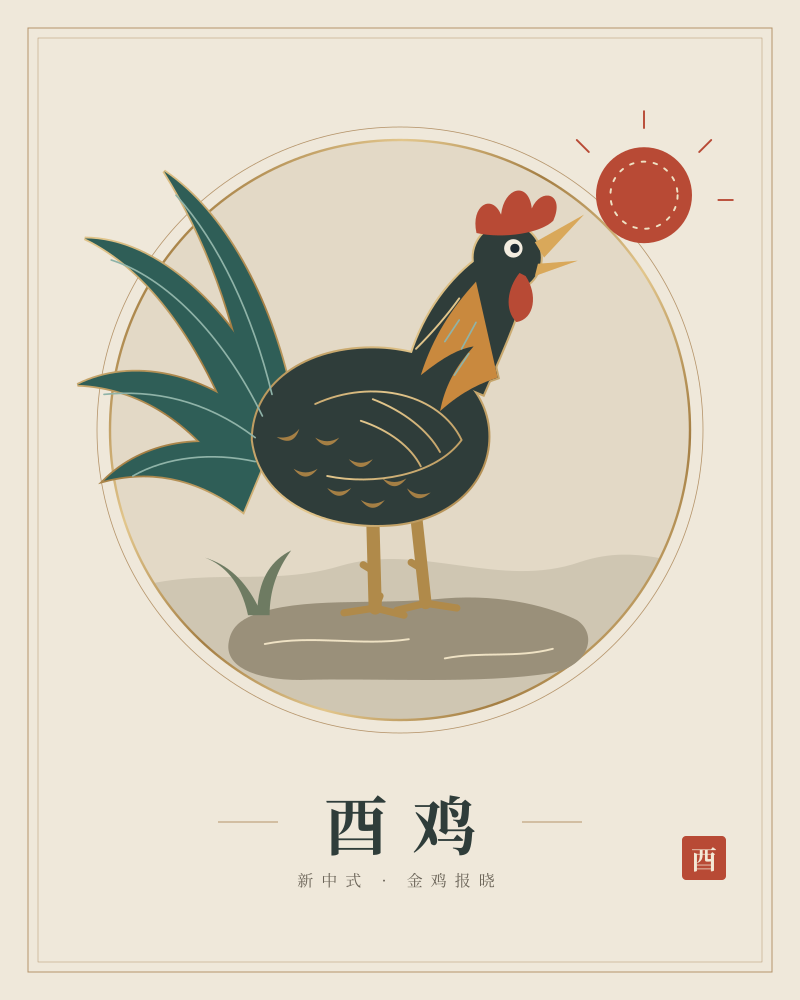
The New Year dates come from our checked table, each one recalculated against the astronomical new moon in China time. The life number texts give a widely shared Chinese social media chart in our own words. The Rooster illustration is our own, and so are the photos of the two cards. The three pieces from New York are in the public domain (CC0), and the museum releases the photos for any use. We only adjusted the crop, brightness and contrast slightly.
- Wikipedia: Rooster (zodiac), years and elements
- Wikipedia: Earthly Branches, branch 酉, hour and direction
- Wikipedia: 纳音, the 60 pairs and their nayin elements (Chinese)
- Han shi waizhuan, book 2: Tian Rao and the five virtues of the chicken (Chinese)
- Chuxue ji, book 4, quoting the Jingchu suishi ji: 帖畫雞戶上 (Chinese)
- Jin shu, book 62: Zu Ti and 闻鸡起舞 (Chinese)
- Zhuangzi, 达生: the fighting cock like wood (Chinese)
- Shiji, 孟尝君列传: 鸡鸣狗盗 (Chinese)
- Shishuo xinyu, 容止: Ji Shao like a crane among chickens (Chinese)
- Analects, 阳货: 割鸡焉用牛刀 (Chinese)
- Renmin Zhoukan 2017: every Rooster stamp from 1981 to 2017, artists and designs (Chinese)
- Renmin Zhengxie Wang: issue dates of the Rooster stamps (Chinese)
- China News 2014: the chicken cup, Liu Yiqian and the tea (Chinese)
- The Paper 2017: a Ru ware brush washer breaks the chicken cup’s record (Chinese)
- Wikipedia: Doucai, the “contending colours” technique
- Wikipedia: Numerology, the life number and Pythagoras
- The Metropolitan Museum of Art: Chicken cup, 1987.85, CC0
- The Metropolitan Museum of Art: Chinese zodiac figure of a rooster, 1994.605.54, CC0
- The Metropolitan Museum of Art: Incense burner in the shape of a rooster, 29.110.41, CC0
Changelog (1)
- 2026-11-12Page created.