
Canteens and Fast Food in China: Take a Tray, Point, Pay at the Till
The easiest hot meal in China if you can’t read a menu: the dishes stand on the counter, you take what looks good, and a cashier adds it up. Nobody takes an order and there is nothing to scan – but there is a routine that nobody explains, because everybody knows it. Do it once here first: nine steps at a real canteen – 苏客饭堂 (Suke Canteen) on Zhonghua Road in Nanjing – where lunch for two cost us ¥40.
What you need: Alipay or WeChat on your phone with an international card linked, or cash in small notes. The apps are easier to set up at home – they are on the China travel checklist.
Practise a canteen meal: nine steps, one tray
Tap the numbered dots for a translation. In step 4 you fill a tray from the shop’s real price board, in step 6 you practise paying with a payment code, and step 9 takes the receipt apart line by line – without ordering anything. Photos are marked as real; the practice screens are simplified versions of what you will see.
Step 1 of 9
Walk in and read the routine
进店 · jìn diàn
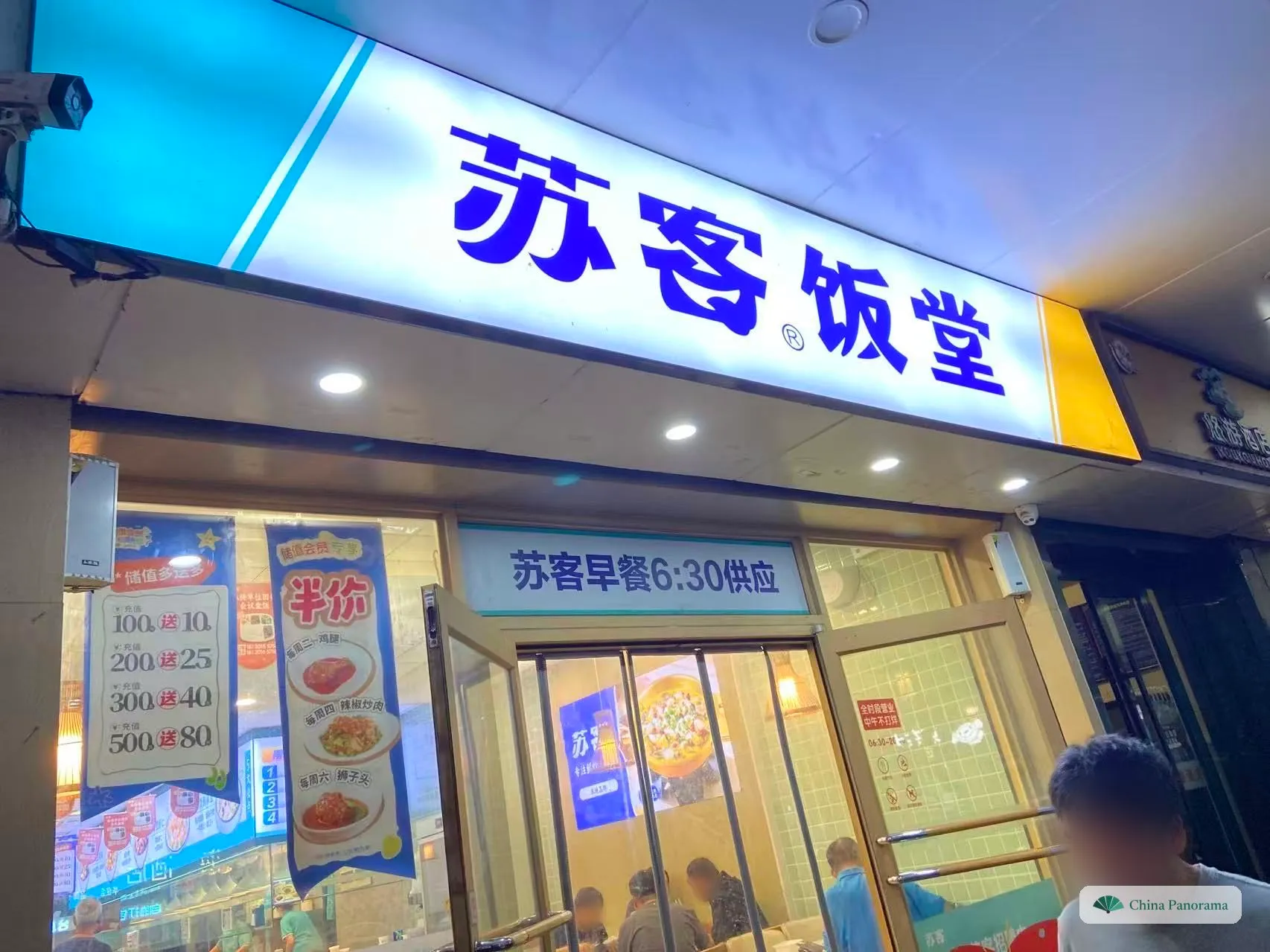
In a canteen-style fast-food place you can eat without reading a menu: the food stands in front of you, you point at it, and you pay at a till. Look for 饭堂 (fàn táng), 食堂 (shí táng) or 快餐 (kuài cān) on the sign. There is no waiter and nothing to scan.
Tap the numbered dots in the photo. Then switch to “Inside”.
Tap dot 1 – the lit sign above the counter – to zoom in.
The sign reads: 1 取托盘 take a tray · 2 点餐 choose your food · 3 买单 pay · 4 用餐 eat.
Banners about 充值 (top-up), 储值 (prepaid balance) and 会员 (members) are loyalty offers for regulars. You can ignore all of them.
Step 2 of 9
Check the prices
看价格 · kàn jià gé
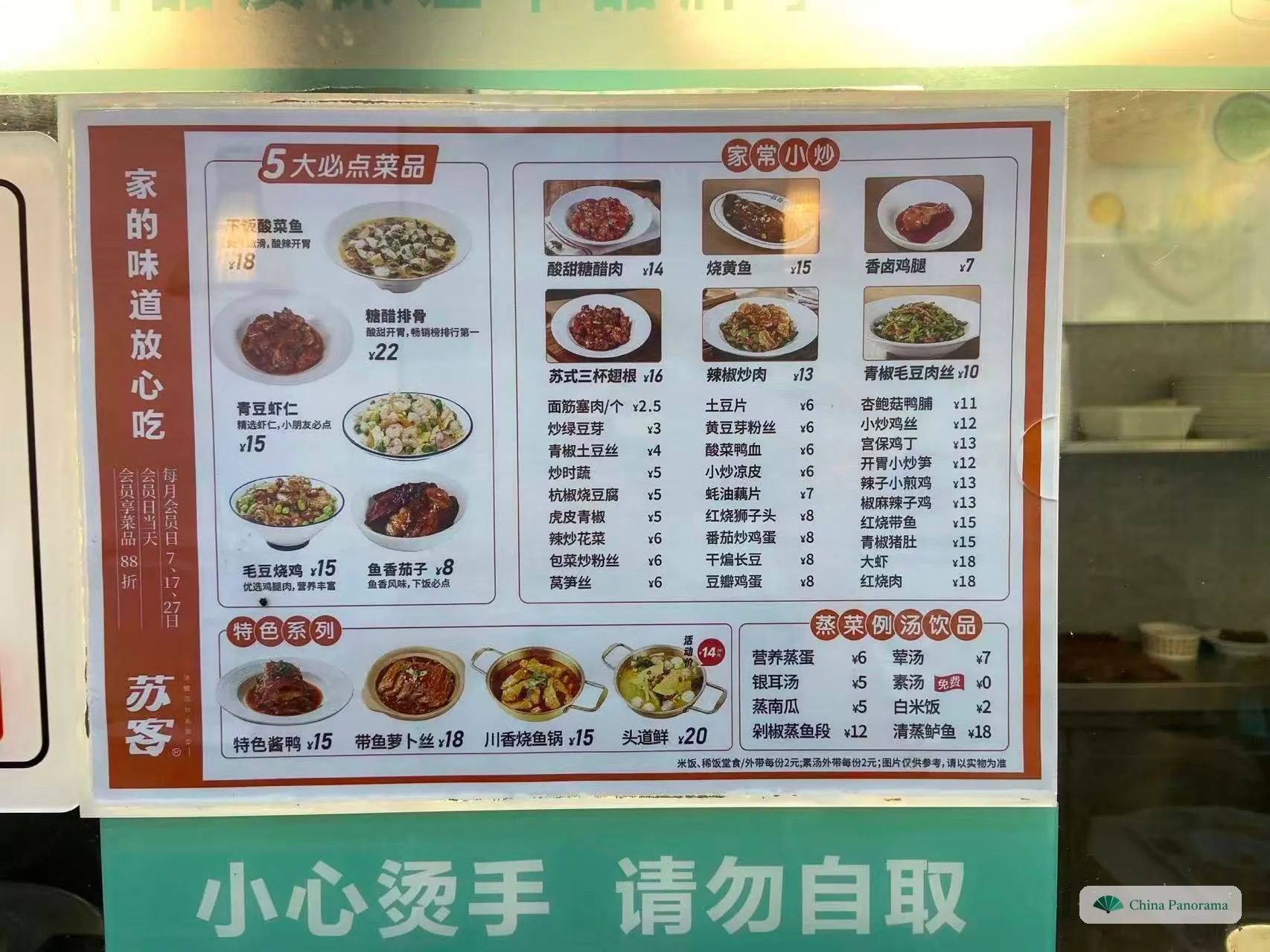
The price board hangs by the counter. Every dish has one price in yuan, for one plate. At this canteen vegetable dishes cost ¥3–8 and most meat and fish dishes ¥10–18; a bowl of rice is ¥2 and the plain soup is free.
Zoom into a part of the board and tap the dots for a translation. All 51 dishes are translated below the walkthrough.
Quick check: 素汤 has a red tag next to it that says 免费. What does it mean?
The plates and pans on the counter carry no labels and no prices. The board gives you the range; the exact total comes at the till.
Step 3 of 9
Take a tray
取托盘 · qǔ tuō pán
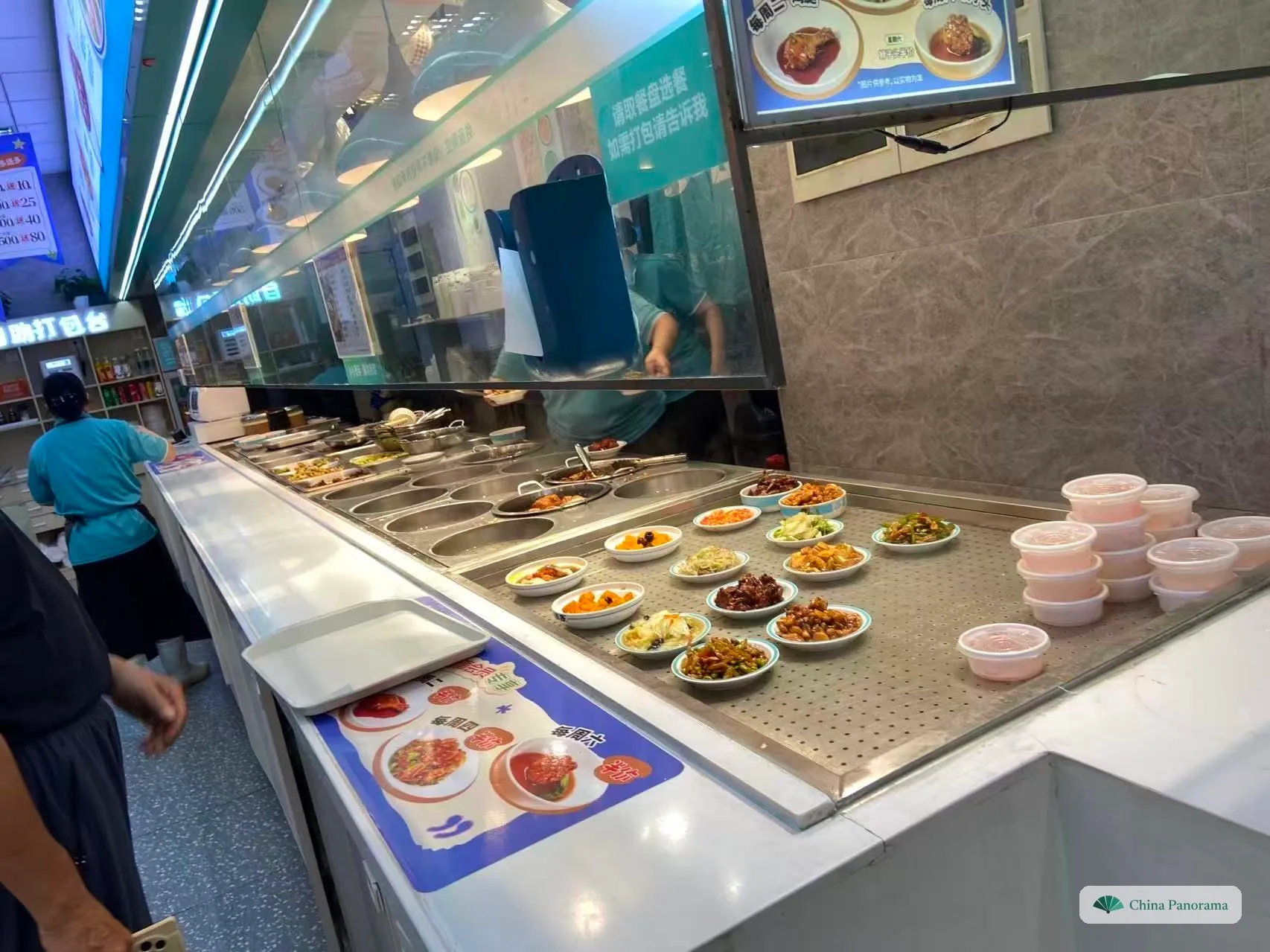
Trays wait at the start of the counter. Take one and slide it along as you go. The sign on the glass spells it out: 请取餐盘选餐 – please take a tray and choose your food.
Tap the numbered dots in the photo.
Eating in is the default. For takeaway say 打包 (dǎ bāo) before anything is plated – the second line of the sign asks you to.
我要打包。Wǒ yào dǎ bāo.
I’d like it to take away.
Step 4 of 9
Choose your dishes
点餐 · diǎn cān
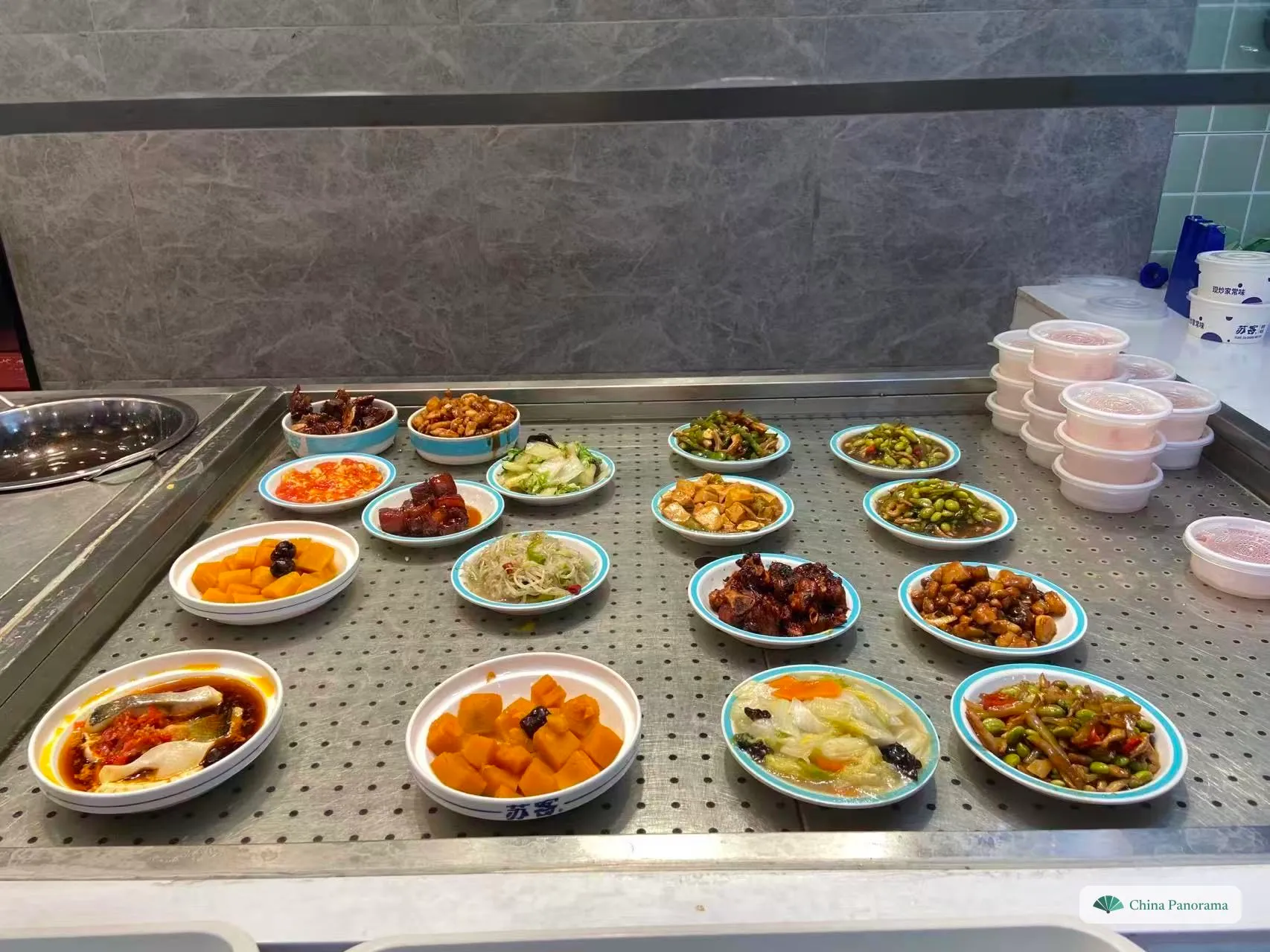
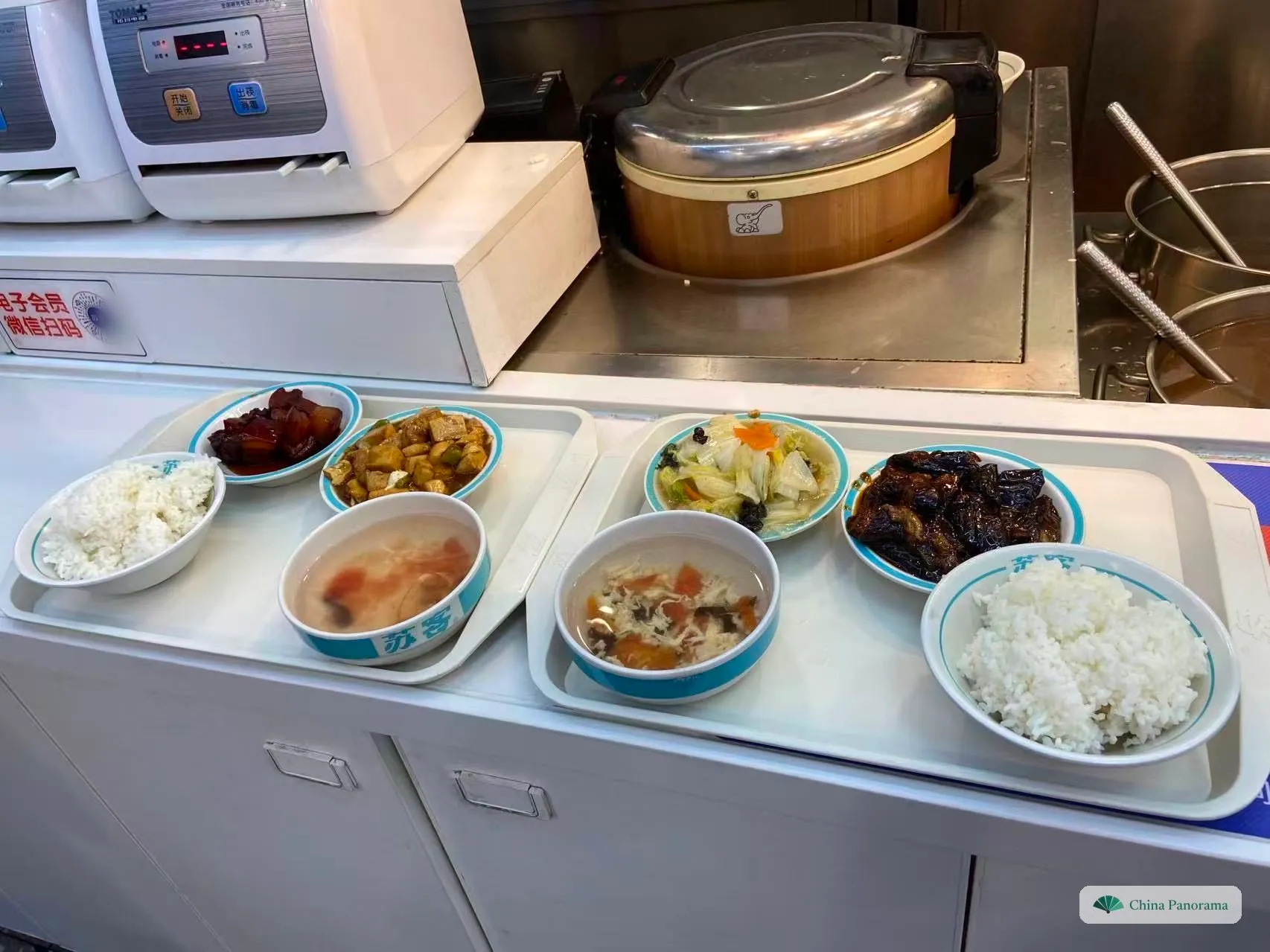
First come the ready-plated dishes: take the plates you want and put them on your tray. Then the hot pans behind the glass. The sign there says 请勿自取, don’t help yourself, so point and say 这个 (zhège, “this one”): the staff fill a plate and hand it over. One plate is one portion; two or three plus rice make a meal.
Tap the dots: these are dishes we can name for certain – they are on our receipt or unmistakable.
Tap the numbered dots in the photo.
Interactive – fill your tray: every dish on the price board, translated, with its real price. Add what you would take and watch the total: it is what the cashier will ask for in step 6, and it prints on your receipt in step 9.
Your tray is empty.
鱼香茄子¥8
“Fish-fragrant” aubergine – no fish, a garlicky sweet-and-sour chilli sauce
炒绿豆芽¥3
Stir-fried mung bean sprouts
青椒土豆丝¥4
Shredded potato with green pepper
炒时蔬¥5
Stir-fried seasonal vegetables
杭椒烧豆腐¥5
Tofu braised with mild green chillies
虎皮青椒¥5
Blistered “tiger-skin” green peppers
辣炒花菜¥6
Spicy stir-fried cauliflower
包菜炒粉丝¥6
Cabbage with glass noodles
莴笋丝¥6
Shredded celtuce (stem lettuce)
土豆片¥6
Sliced potato
黄豆芽粉丝¥6
Soybean sprouts with glass noodles
小炒凉皮¥6
Stir-fried liangpi (wide starch noodles)
蚝油藕片¥7
Lotus root in oyster sauce
干煸长豆¥8
Dry-fried long beans
开胃小炒笋¥12
Stir-fried bamboo shoots
蒸南瓜¥5
Steamed pumpkin
番茄炒鸡蛋¥8
Scrambled egg with tomato
豆瓣鸡蛋¥8
Egg with broad beans
营养蒸蛋¥6
Steamed egg custard
糖醋排骨¥22
Sweet-and-sour pork ribs
酸甜糖醋肉¥14
Sweet-and-sour pork
辣椒炒肉¥13
Pork stir-fried with chillies
青椒毛豆肉丝¥10
Shredded pork with green pepper and edamame
面筋塞肉/个¥2.50
Gluten puff stuffed with pork, per piece
红烧狮子头¥8
Braised “lion’s head” pork meatball
青椒猪肚¥15
Pork tripe with green pepper
红烧肉¥18
Red-braised pork belly
毛豆烧鸡¥15
Braised chicken with edamame
香卤鸡腿¥7
Soy-braised chicken drumstick
苏式三杯翅根¥16
Suzhou-style “three-cup” chicken drumettes
酸菜鸭血¥6
Duck blood curd with pickled greens
杏鲍菇鸭脯¥11
Duck breast with king oyster mushroom
小炒鸡丝¥12
Stir-fried shredded chicken
宫保鸡丁¥13
Kung pao chicken
辣子小煎鸡¥13
Pan-fried chicken with chillies
椒麻辣子鸡¥13
Chicken with chillies and numbing Sichuan pepper
特色酱鸭¥15
Soy-braised duck, house style
下饭酸菜鱼¥18
Fish with pickled mustard greens, sour and a little spicy
青豆虾仁¥15
Shrimp with green peas
烧黄鱼¥15
Braised yellow croaker
红烧带鱼¥15
Braised hairtail (ribbonfish)
大虾¥18
Large prawns
带鱼萝卜丝¥18
Hairtail with shredded radish
川香烧鱼锅¥15
Sichuan-style braised fish pot
剁椒蒸鱼段¥12
Steamed fish with chopped chillies
清蒸鲈鱼¥18
Steamed sea bass
头道鲜¥20
“Toudaoxian”, the house soup pot – the board adds a promotional price of ¥14
银耳汤¥5
Sweet white-fungus soup
荤汤¥7
Soup with meat
素汤free
Plain soup of the day – free when you eat in
白米饭¥2
Plain rice
这个。Zhège.
This one.
这是什么?Zhè shì shénme?
What is this?
这里面有肉吗?Zhè lǐmiàn yǒu ròu ma?
Is there meat in this?
这个辣吗?Zhège là ma?
Is this spicy?
我不吃猪肉。Wǒ bù chī zhūròu.
I don’t eat pork.
A vegetable dish is not automatically vegetarian: lard, stock or a little minced pork are common. If it matters, ask – or show the question on your phone.
Step 5 of 9
Add rice and soup
米饭 · 汤 · mǐ fàn · tāng
At the end of the counter stand the rice cooker and the soup pots – on the staff’s side, so you ask. Rice is 米饭 (mǐ fàn), ¥2 a bowl here; soup is 汤 (tāng). The plain soup of the day, 素汤 (sù tāng), costs nothing when you eat in, so it never shows up on the receipt.
Tap the numbered dots in the photo.
白米饭¥2
Plain rice
素汤free
Plain soup of the day – free when you eat in
荤汤¥7
Soup with meat
Your tray is empty.
一碗米饭。Yì wǎn mǐfàn.
One bowl of rice.
一碗汤。Yì wǎn tāng.
One bowl of soup.
不要汤。Bú yào tāng.
No soup.
Want more rice later? This canteen has a self-service rice station in the dining room (自助加饭台).
Step 6 of 9
Pay at the till
买单 · mǎi dān
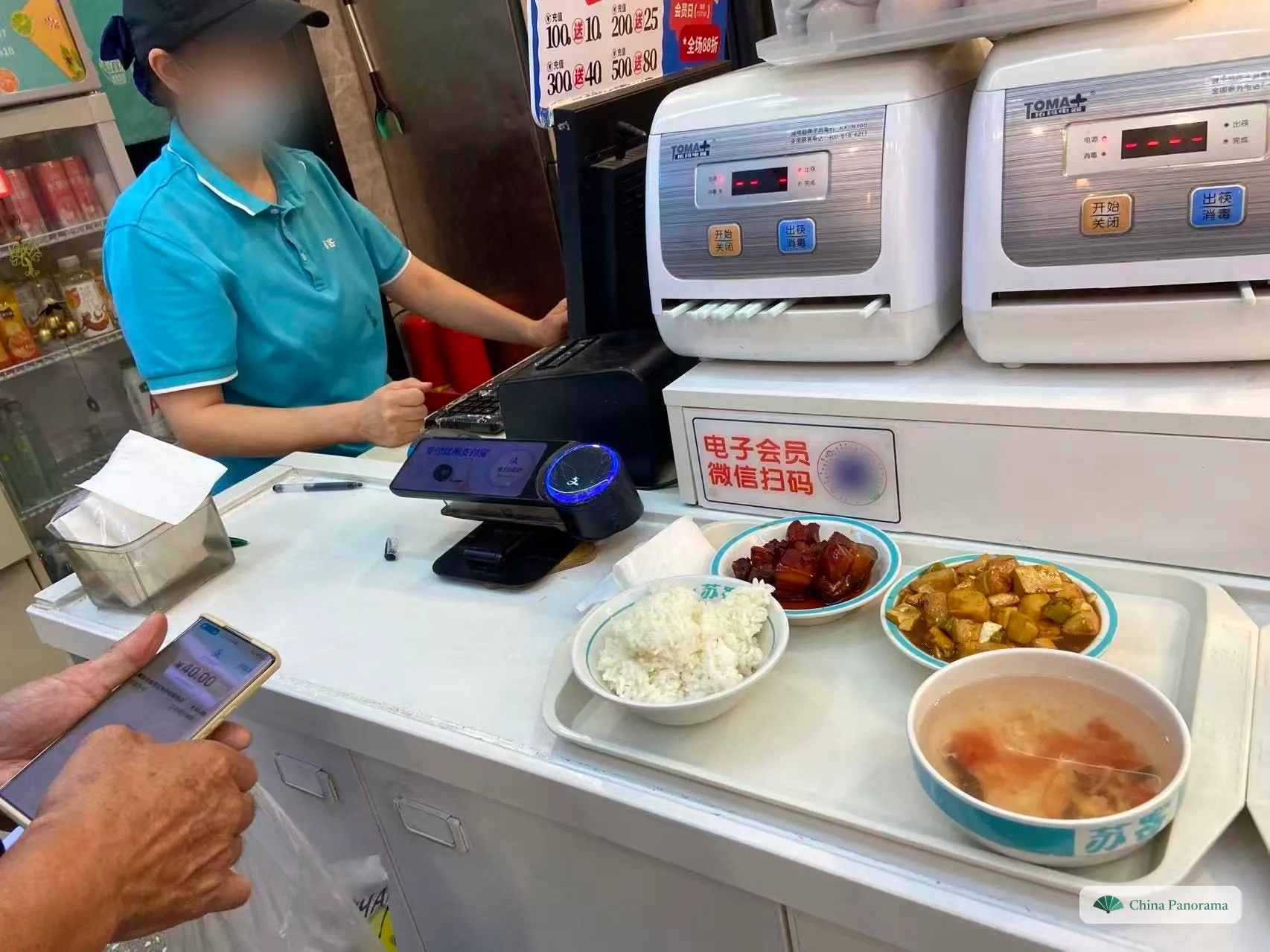
The till is at the far end of the counter. Put your tray down: the cashier looks at the plates, keys them in and tells you the total. You pay now, before you sit down – with Alipay or WeChat Pay, or in cash.
The cashier says – for our lunch for two, ¥40.00:
四十块sì shí kuài
块 (kuài) is the everyday word for yuan. Didn’t catch it? The amount is on the till’s display.
Tap the numbered dots in the photo. Then try “Practise paying”.
At a till the shop scans you: open your payment code (付款码 fù kuǎn mǎ) and hold it up to the scanner. Nothing to type – the till sends the amount.
Tap 收付款 (Pay / Receive) at the top of the Alipay home screen.
Whoever scans your payment code can charge it, so open it at the till, not in the queue. If a payment doesn’t go through, nothing is lost – try again, switch between Alipay and WeChat Pay, or pay in cash.
Step 7 of 9
Take chopsticks and a spoon
拿筷子 · ná kuài zi
Right next to the till stand two chopstick dispensers: machines that sterilise the chopsticks and push a few out of a slot. Pull out a pair, and take a spoon for the soup.
Knives and forks are not put out in a canteen like this. If you need one, you have to ask – and not every place has them. A spoon gets you through most of these dishes.
Tap the dots, then try the phrases: “Show to staff” fills your screen with the Chinese.
有叉子吗?Yǒu chāzi ma?
Do you have a fork?
有刀叉吗?Yǒu dāochā ma?
Do you have a knife and fork?
请给我一个勺子。Qǐng gěi wǒ yí ge sháozi.
A spoon, please.
有餐巾纸吗?Yǒu cānjīnzhǐ ma?
Do you have napkins?
Step 8 of 9
Find a seat and eat
用餐 · yòng cān
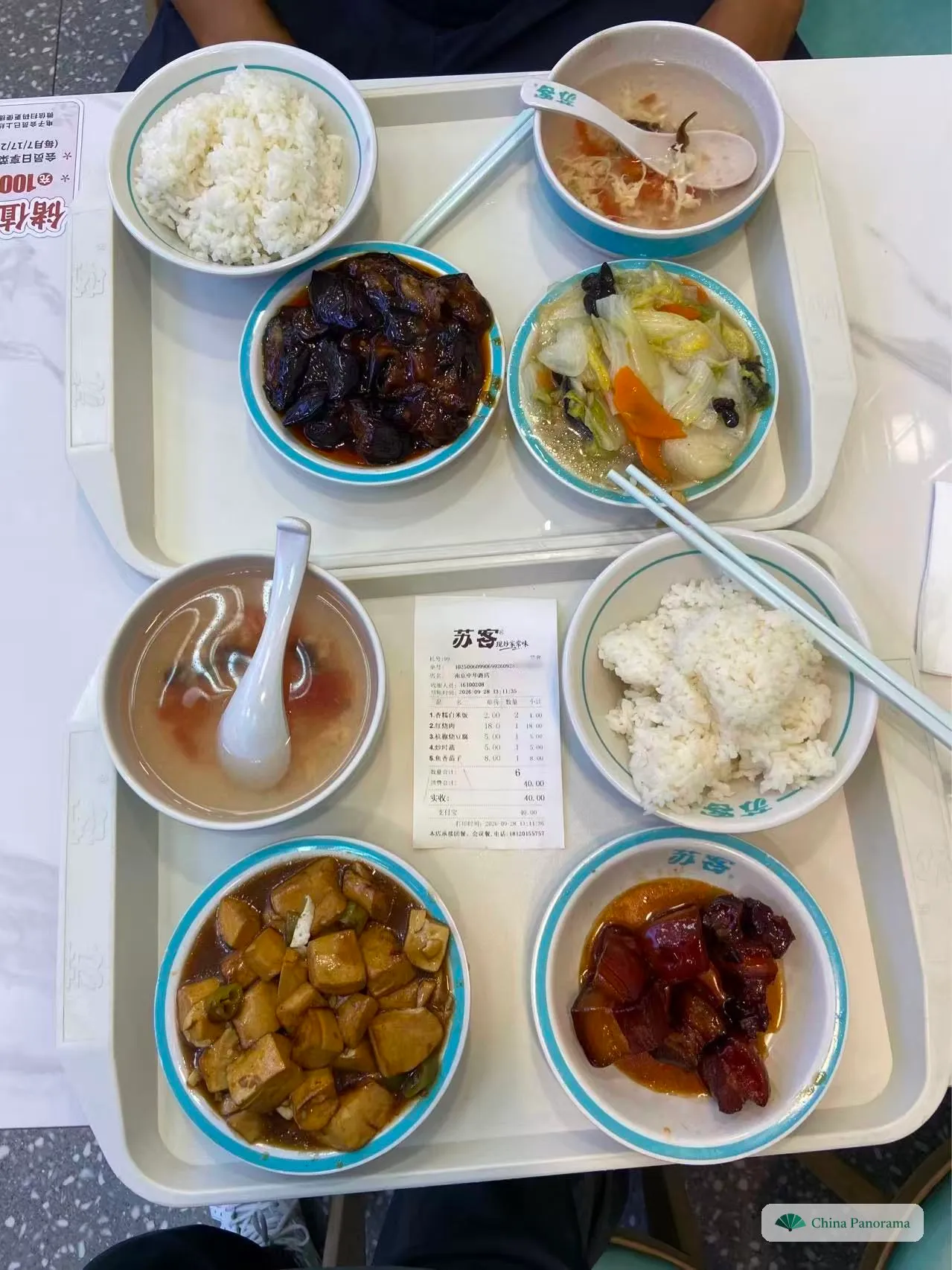
Carry your tray to any free table – nobody seats you. This was our lunch for two: two bowls of rice, four dishes and two free soups, ¥40 altogether.
Tap the dots to see what is on the trays.
Still hungry? The self-service rice station is marked 自助加饭台. Too much? Pack it up yourself at 自助打包台.
When you have finished, do what the others do with their trays: some canteens have a return rack (餐具回收处 cān jù huí shōu chù), in others the staff clear the tables.
Step 9 of 9
Read the receipt
看小票 · kàn xiǎo piào
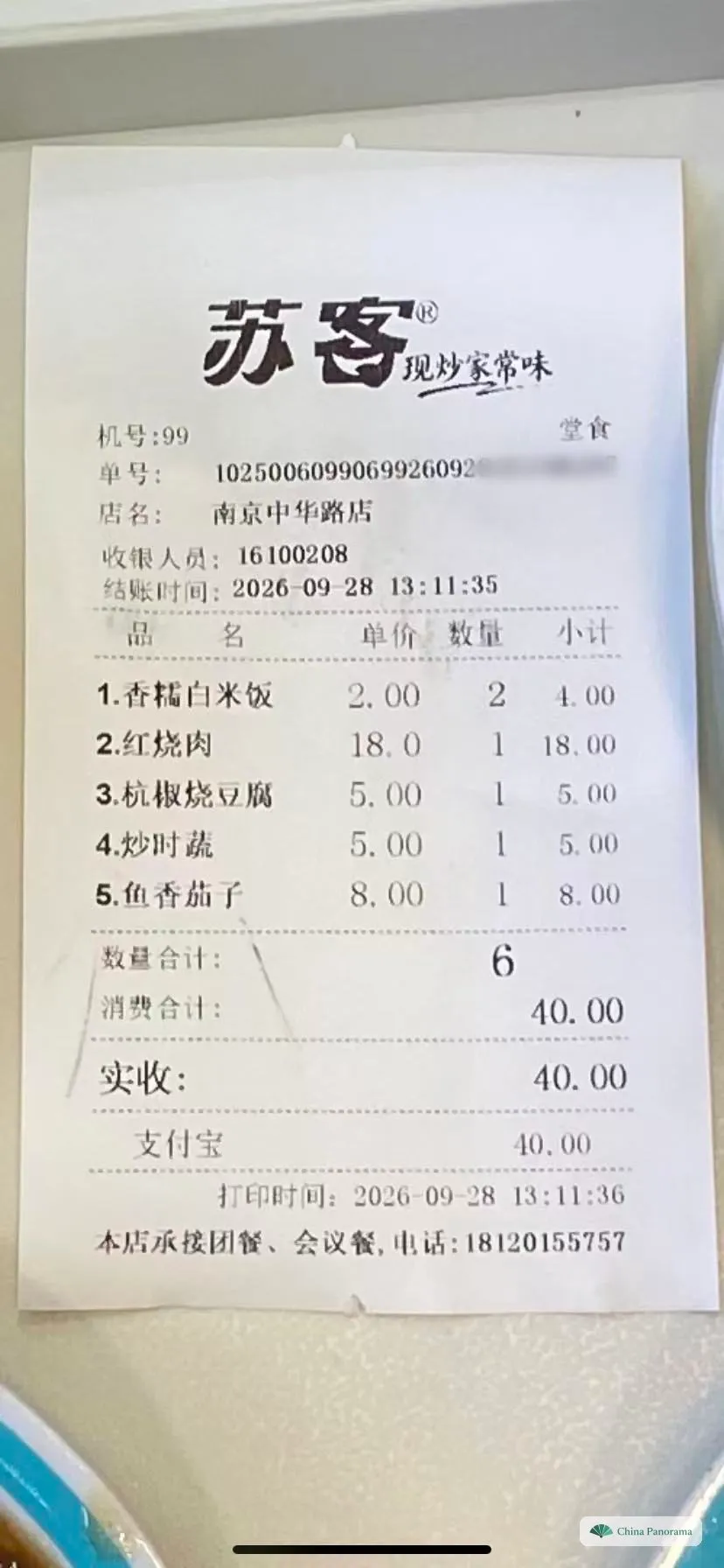
The slip the cashier hands you is a 小票 (xiǎo piào). It lists every plate with unit price, quantity and line total, then the sum and how you paid. There is no tax line, no service charge and no tip: the plates add up to ¥40.00, and ¥40.00 is what we paid.
Tap the dots next to each line. Three parts: header, items, totals.
No tray of your own yet – this one shows our lunch for two. Fill a tray in step 4 to print your own.
Switch to Chinese only and see whether you can still read it – a real receipt has no translation.
Quick check: on our receipt, which line tells you how the meal was paid for?
A 小票 is not an official tax invoice. If you need one for expenses, ask at the till for a 发票 (fā piào).
Photos: our own, taken at lunchtime on 28 September 2026. Faces and the shop’s membership QR code are blurred. Dish names and prices are read off the shop’s price board and our receipt; they will change.
How a Chinese canteen works: the nine steps
- 1
Walk in and read the routine · 进店
Look for 饭堂 (fàn táng), 食堂 (shí táng) or 快餐 (kuài cān) on the sign. There is no waiter and nothing to scan; a sign inside lists the routine: take a tray, choose, pay, eat.
- 2
Check the prices · 看价格
A board by the counter lists every dish with its price in yuan per plate. At this canteen vegetable dishes cost ¥3–8, most meat and fish dishes ¥10–18, a bowl of rice ¥2, and the plain soup is free.
- 3
Take a tray · 取托盘
Trays wait at the start of the counter. Take one and slide it along as you go. For takeaway say 打包 (dǎ bāo) before anything is plated.
- 4
Choose your dishes · 点餐
Take the ready-plated dishes you want. For the hot pans behind the glass, point and say 这个 (zhège, “this one”) – the staff fill a plate. One plate is one portion.
- 5
Add rice and soup · 米饭 · 汤
At the end of the counter, ask for rice – 米饭 (mǐ fàn), ¥2 a bowl here – and soup, 汤 (tāng). The plain soup of the day cost nothing.
- 6
Pay at the till · 买单
The cashier looks at your tray, keys in each plate and tells you the total. Pay with Alipay or WeChat Pay – show your payment code or tap – or in cash, before you sit down.
- 7
Take chopsticks and a spoon · 拿筷子
Chopsticks come out of a dispenser next to the till; take a spoon for the soup. Knives and forks are not put out – ask: 有叉子吗? (Yǒu chāzi ma?)
- 8
Find a seat and eat · 用餐
Sit wherever there is room; nobody seats you. This canteen has a self-service station for more rice and another for packing up leftovers.
- 9
Read the receipt · 看小票
The receipt lists every plate with unit price, quantity and line total, then the sum and how you paid. No tax line, no service charge, no tip.
How to read a Chinese restaurant receipt
This is the receipt for that lunch – a 小票 (xiǎo piào), printed at the till. Every line, from top to bottom. What is not on it matters as much: no tax line, no service charge, no tip. The plates add up to ¥40.00 (消费合计), and ¥40.00 is what was paid (实收). The two free soups are not listed at all.
| Chinese | Pinyin | Meaning, and what our receipt says |
|---|---|---|
| 苏客 · 现炒家常味 | Sū kè · xiàn chǎo jiā cháng wèi | Shop brand and slogan – “Suke – freshly stir-fried home cooking” |
| 机号 | jī hào | Till number – 99 |
| 堂食 | táng shí | Eaten inA takeaway receipt says 外带 (wài dài) or 打包 (dǎ bāo). |
| 单号 | dān hào | Order numberAn internal number. You only need it if something has to be corrected. We blurred the last ten digits. |
| 店名 | diàn míng | Branch – 南京中华路店 – Nanjing, Zhonghua Road branch |
| 收银人员 | shōu yín rén yuán | Cashier – A staff number |
| 结账时间 | jié zhàng shí jiān | Time of payment – 2026-09-28 13:11:35Dates run year-month-day. |
| Chinese | Pinyin | Meaning, and what our receipt says |
|---|---|---|
| 品名 | pǐn míng | Item |
| 单价 | dān jià | Unit price |
| 数量 | shù liàng | Quantity |
| 小计 | xiǎo jì | Line totalUnit price × quantity. |
| 香糯白米饭 | xiāng nuò bái mǐ fàn | Rice – 2 × ¥2.00 = ¥4.00 |
| 红烧肉 | hóng shāo ròu | Red-braised pork belly – ¥18.00 |
| 杭椒烧豆腐 | háng jiāo shāo dòu fu | Tofu braised with mild green chillies – ¥5.00 |
| 炒时蔬 | chǎo shí shū | Stir-fried seasonal vegetables – ¥5.00 |
| 鱼香茄子 | yú xiāng qié zi | “Fish-fragrant” aubergine – ¥8.00 |
| Chinese | Pinyin | Meaning, and what our receipt says |
|---|---|---|
| 数量合计 | shù liàng hé jì | Number of items – 6Two bowls of rice and four dishes. The two free soups are not counted. |
| 消费合计 | xiāo fèi hé jì | Total – ¥40.00 |
| 实收 | shí shōu | Amount received – ¥40.00What you actually paid. With a discount it would be lower than the total above. |
| 支付宝 | Zhī fù bǎo | Paid with Alipay – ¥40.00WeChat Pay shows as 微信支付, cash as 现金 (xiàn jīn). |
| 打印时间 | dǎ yìn shí jiān | Time printed – 2026-09-28 13:11:36 |
| 本店承接团餐、会议餐 | běn diàn chéng jiē tuán cān, huì yì cān | Advertising – “We cater for groups and meetings”, with a phone number |
A 小票 is not an official tax invoice. If you need one for expenses, ask at the till for a 发票 (fā piào).
A Chinese canteen price board, translated
All 51 dishes on this canteen’s board, section by section as they are printed, with the price for one plate. Other canteens cook other dishes, but these names come up everywhere – and the price levels give you an idea of what a canteen meal costs.
5大必点菜品 wǔ dà bì diǎn cài pǐnFive must-order dishes
- 下饭酸菜鱼Fish with pickled mustard greens, sour and a little spicy¥18
- 糖醋排骨Sweet-and-sour pork ribs¥22
- 青豆虾仁Shrimp with green peas¥15
- 毛豆烧鸡Braised chicken with edamame¥15
- 鱼香茄子“Fish-fragrant” aubergine – no fish, a garlicky sweet-and-sour chilli sauce¥8
家常小炒 jiā cháng xiǎo chǎoHome-style stir-fries
- 酸甜糖醋肉Sweet-and-sour pork¥14
- 烧黄鱼Braised yellow croaker¥15
- 香卤鸡腿Soy-braised chicken drumstick¥7
- 苏式三杯翅根Suzhou-style “three-cup” chicken drumettes¥16
- 辣椒炒肉Pork stir-fried with chillies¥13
- 青椒毛豆肉丝Shredded pork with green pepper and edamame¥10
- 面筋塞肉/个Gluten puff stuffed with pork, per piece¥2.50
- 炒绿豆芽Stir-fried mung bean sprouts¥3
- 青椒土豆丝Shredded potato with green pepper¥4
- 炒时蔬Stir-fried seasonal vegetables¥5
- 杭椒烧豆腐Tofu braised with mild green chillies¥5
- 虎皮青椒Blistered “tiger-skin” green peppers¥5
- 辣炒花菜Spicy stir-fried cauliflower¥6
- 包菜炒粉丝Cabbage with glass noodles¥6
- 莴笋丝Shredded celtuce (stem lettuce)¥6
- 土豆片Sliced potato¥6
- 黄豆芽粉丝Soybean sprouts with glass noodles¥6
- 酸菜鸭血Duck blood curd with pickled greens¥6
- 小炒凉皮Stir-fried liangpi (wide starch noodles)¥6
- 蚝油藕片Lotus root in oyster sauce¥7
- 红烧狮子头Braised “lion’s head” pork meatball¥8
- 番茄炒鸡蛋Scrambled egg with tomato¥8
- 干煸长豆Dry-fried long beans¥8
- 豆瓣鸡蛋Egg with broad beans¥8
- 杏鲍菇鸭脯Duck breast with king oyster mushroom¥11
- 小炒鸡丝Stir-fried shredded chicken¥12
- 宫保鸡丁Kung pao chicken¥13
- 开胃小炒笋Stir-fried bamboo shoots¥12
- 辣子小煎鸡Pan-fried chicken with chillies¥13
- 椒麻辣子鸡Chicken with chillies and numbing Sichuan pepper¥13
- 红烧带鱼Braised hairtail (ribbonfish)¥15
- 青椒猪肚Pork tripe with green pepper¥15
- 大虾Large prawns¥18
- 红烧肉Red-braised pork belly¥18
特色系列 tè sè xì lièHouse specials
- 特色酱鸭Soy-braised duck, house style¥15
- 带鱼萝卜丝Hairtail with shredded radish¥18
- 川香烧鱼锅Sichuan-style braised fish pot¥15
- 头道鲜“Toudaoxian”, the house soup pot – the board adds a promotional price of ¥14¥20
蒸菜例汤饮品 zhēng cài lì tāng yǐn pǐnSteamed dishes, soups, drinks
- 营养蒸蛋Steamed egg custard¥6
- 银耳汤Sweet white-fungus soup¥5
- 蒸南瓜Steamed pumpkin¥5
- 剁椒蒸鱼段Steamed fish with chopped chillies¥12
- 荤汤Soup with meat¥7
- 素汤Plain soup of the day – free when you eat infree
- 白米饭Plain rice¥2
- 清蒸鲈鱼Steamed sea bass¥18
The small print at the bottom of the board: rice and rice porridge cost ¥2 a portion, eaten in or taken away; the plain soup costs ¥2 to take away; “pictures are for reference only”. A vegetable dish is not automatically vegetarian – lard, stock or a little minced pork are common.
Chinese words you will see in a canteen
Canteen signs are almost always in Chinese only, but they use the same handful of words. Screenshot this list before the trip.
| Chinese | Pinyin | Meaning |
|---|---|---|
| 饭堂 · 食堂 | fàn táng · shí táng | Canteen |
| 快餐 | kuài cān | Fast food |
| 取托盘 | qǔ tuō pán | Take a tray |
| 点餐 | diǎn cān | Choose your food |
| 买单 | mǎi dān | Pay |
| 用餐 | yòng cān | Eat |
| 米饭 · 汤 | mǐ fàn · tāng | Rice · soup |
| 免费 | miǎn fèi | Free of charge |
| 半价 | bàn jià | Half price – usually for members only |
| 请勿自取 | qǐng wù zì qǔ | Please don’t help yourself: staff serve this |
| 自助 | zì zhù | Self-service |
| 筷子 · 勺子 · 叉子 | kuài zi · sháo zi · chā zi | Chopsticks · spoon · fork |
| 付款码 | fù kuǎn mǎ | Payment code – the one you show at a till |
| 小票 · 发票 | xiǎo piào · fā piào | Receipt · official tax invoice |
FAQ
How does a canteen or fast-food restaurant in China work?
Take a tray, put the ready-plated dishes you want on it or point at the hot pans, add rice and soup, and pay at the till at the end of the counter before you sit down. Nobody takes an order and there is nothing to scan.
How much does a meal in a Chinese canteen cost?
At the canteen we photographed in Nanjing in September 2026, vegetable dishes cost ¥3–8 a plate, most meat and fish dishes ¥10–18, a bowl of rice ¥2, and the plain soup nothing. Lunch for two – four dishes, two bowls of rice and two soups – came to ¥40.
How do I pay at a till with Alipay or WeChat?
Open your payment code – 收付款 on the Alipay home screen, or 收付款 in the ⊕ menu of WeChat – and hold it up to the scanner. The till sends the amount, so you type nothing. Cash works too.
Do canteens in China have knives and forks?
They put out chopsticks and spoons. For a fork you have to ask – 有叉子吗? (Yǒu chāzi ma?) – and not every place has one. A soup spoon gets you through most canteen dishes.
Is there a tip or service charge on a Chinese canteen receipt?
No. Our receipt lists the plates, the total (消费合计) and the amount received (实收), and the two are the same: no tax line, no service charge. Tipping is not expected.
What if I don’t have Alipay or WeChat?
Pay in cash at the till. Canteen meals are cheap, so carry small notes – a cashier may not have change for a ¥100 note.