
Kunming
The “City of Eternal Spring”: Yunnan's capital, 1,890 m up on the shore of Lake Dianchi, with mild days all year — 17 °C in January, 25 °C in July. Gateway to Dali, Lijiang, Xishuangbanna and, by train, Laos; and an hour from the Stone Forest, a World Heritage maze of limestone pinnacles.
昆明 · Kūnmíng · capital of Yunnan · 25.04° N, 102.71° E · about 1,890 m
Paying for the metro?
Set up Alipay first: Kunming’s ticket machines take Visa, but we could not confirm that the gates take foreign cards, as Beijing’s and Shanghai’s do. The metro →
How long?
Two days: the Stone Forest, then Daguan Park, the old centre and Lake Dianchi. Then on to Dali, Lijiang or Laos.Where next →
Where is Kunming?
At 25.0° N, Kunming is level with Dubai and a little south of Luxor and Miami — tropical latitudes. What keeps it cool is height: at about 1,890 m it is higher than St. Moritz. It lies in the far south-west of China, on the Yunnan–Guizhou Plateau, about 300 km from the border with Vietnam and 440 km from Laos, in a straight line. Guiyang is 430 km to the east, Chengdu and Chongqing 630 km to the north; Guangzhou is 1,090 km away, Beijing 2,090 km. Tap any city on the map to measure the distance.
Straight-line distances from the Jinma and Biji arches, rounded to the nearest 10 km — not travel distances.
Yunnan province is highlighted. Tap a city to measure the distance from Kunming.
- Province
- Yunnan云南省 · capital
- Altitude
- about 1,890 mhigher than St. Moritz
- Airport
- KMGChangshui · 25 km NE
- Metro
- 6 linesfrom 2 CNY
- Time zone
- UTC+8Beijing time
- City flower
- Camellia山茶花
The city, the lake and the Stone Forest
Kunming fills the plain at the north end of Lake Dianchi, with the Western Hills along the lake’s west shore. We measure everything on this page from the Jinma and Biji arches in the old centre. Changshui airport is 25 km north-east, the high-speed station Kunming South 24 km south-east, and the Stone Forest 67 km out, in a straight line.
Tap a place on the map or in the list.
High-speed trains, including to Shilin West and Laos. Lines 1 and 4.
Metro Line 6 into the city.
Shilin Yi Autonomous County; about 85 km by road. The Naigu Stone Forest is 9 km further north-east. Details below ↓
High-speed station for the Stone Forest, about 20 km from the gate; bus 99 or taxi.
Straight-line distances from the Jinma and Biji arches, rounded — not travel distances.
What’s Kunming weather like each month?
Mild all year: 17 °C by day in January, 25 °C in July — the warmest and coolest months are only 10 degrees apart. Nights are cool, 3 °C in January. Most rain falls from June to September; winter and spring are dry and sunny. The sun rises at 06:19 in June and 07:46 in December — late, because Kunming is far west of Beijing but on Beijing time. Tap a month for temperatures, daylight and what is on.
Scale in °C. Bars run from the average daily low to the average daily high. Source: monthly temperature data, last checked 2026-07-30.
Kunming in October
Mild- Average high
- 22 °C
- Average low
- 13 °C
- Sunrise / sunset
- 07:07 – 18:43
- Daylight
- 11 h 37 min
On in Oct
- Golden Week crowds, 1–7 Oct
Why is it spring all year? How high is Kunming?
Kunming is as far south as Guangzhou is, give or take two degrees — and Guangzhou averages 34 °C in July. The difference is height: air cools by roughly 6.5 °C for every 1,000 m, and Kunming sits about 1,890 m up. So July in Kunming is 25 °C, 9 degrees cooler than Guangzhou, while January days are 17 °C against Guangzhou’s 19 °C. Guess which is higher, then tap any place for its air and the temperature at which water boils there.
Tap a place on the scale for its air and its boiling point.
Kunming 昆明
1,890 mThe city on this page
The city centre; Lake Dianchi is at 1,886 m
- Air pressure
- 80 %
- Water boils at
- 93.6 °C
80 % of sea level — so about 20 % less oxygen in every breath. Tea and noodles cook cooler; pasta takes longer.
Altitudes: Wikipedia (Kunming 1,892 m, rounded; Dali, Lijiang, Shangri-La, Jinghong, Vientiane, Lhasa) and standard reference heights for the Alpine places. Air pressure from the standard atmosphere; boiling points computed from it.
Which is higher: the city of Kunming or the Swiss resort of St. Moritz?
Kunming 1,890 m · St. Moritz 1,822 m
Kunming is 68 m higher than St. Moritz.
Kunming, just. A city of eight million sits higher than one of Europe’s best-known mountain resorts — which is why it has no hot season, even at a tropical latitude.
Lijiang’s old town or the top of the Zugspitze?
Lijiang 2,400 m · Zugspitze 2,962 m
Zugspitze is 562 m higher than Lijiang.
The Zugspitze. But Lijiang, a likely next stop, is already 500 m above Kunming: if you are going on to Shangri-La, Lijiang is a good place to get used to the height.
Dali, on Lake Erhai, or Davos?
Dali 1,975 m · Davos 1,560 m
Dali is 415 m higher than Davos.
Dali, by about 400 m. Like Kunming it sits on a high lake plain, with mild days all year and cool nights.
Shangri-La or the Zugspitze?
Shangri-La 3,160 m · Zugspitze 2,962 m
Shangri-La is 198 m higher than Zugspitze.
Shangri-La, by about 200 m. At this height altitude sickness is possible: headaches and breathlessness on the first day are common. Go up gradually and drink plenty of water.
Jinghong in Xishuangbanna or Munich?
Jinghong 558 m · Munich 519 m
Jinghong is 39 m higher than Munich.
Jinghong, by a few dozen metres only. It lies 1,300 m below Kunming, in the Mekong valley — which is why it is tropical and Kunming is not.
Spring
March – MayDry, sunny and the warmest days of the year.
March averages 22 °C by day, April 25 °C and May 26 °C — before the rains, so the sun is strong and the air clear. Nights are still cool: 9 °C in March, 12 °C in April. The cherry trees on Yuantong Hill flower from about late February into March; the jacaranda on Jiaochang Middle Road and elsewhere turns the streets violet from late April to mid-May. Our photos are from 16–17 April 2019: grey and mild in the Stone Forest, warm and hazy at the lake, a still, golden morning at Daguan Park. Qingming in early April and May Day (1–5 May) bring crowds to the Stone Forest.
What to wear: Light clothes by day, a jumper for the evening, sunscreen and a hat — the sun at 1,890 m burns.
Summer
June – AugustThe rainy season, and still only 25–26 °C.
While Chongqing and Wuhan bake at 34 °C, Kunming averages 25–26 °C by day and 18 °C at night from June to August. This is the rainy season: showers and thunderstorms most afternoons, green hills, and the Torch Festival of the Yi in the sixth lunar month, usually in July or early August. Mornings are often clear.
What to wear: Light layers and a good umbrella; shoes that can take wet stone in the Stone Forest.
Autumn
September – NovemberThe rain eases off; clear and mild by November.
September averages 25 °C by day, October 22 °C and November 20 °C; nights fall from 17 °C to 8 °C. The rains thin out through October. Avoid Golden Week, 1–7 October, when the Stone Forest and the trains to Dali and Lijiang are packed. The gulls return to Lake Dianchi in late autumn.
What to wear: Layers: T-shirt weather at noon, a fleece after dark.
Winter
December – FebruarySunny days, cold nights, and the gulls.
January averages 17 °C by day — warmer than a Munich June morning — but only 3 °C at night, and buildings have little or no heating. The sky is mostly clear and dry. This is the season of the black-headed gulls at Haigeng and Green Lake, from about November to March.
What to wear: A warm jacket for mornings and evenings, sunglasses for the day, and warm clothes for indoors at night.
There is no bad month. We would pick March–April, dry and 25 °C, or late October, after the rains — outside the May Day and Golden Week holidays. For how Kunming compares with the rest of the country month by month, see the best time to visit China.
Things to do in Kunming
20 places, from a 9th-century pagoda to 307-metre towers, and from limestone 270 million years old to a flower market that changes every night. Four things first: a quiz on Kunming’s three kinds of water, how old each sight really is, the Stone Forest step by step, and what our photographs show — including a 180-character poem.
Stone Forest, Lake Dianchi or Daguan Park? Guess the water
Nearly every photograph we took in Kunming has water in it: ponds among the limestone pinnacles, the great lake, the garden ponds of Daguan Park. Eight of them — guess which is which, and see the clue that gives it away.
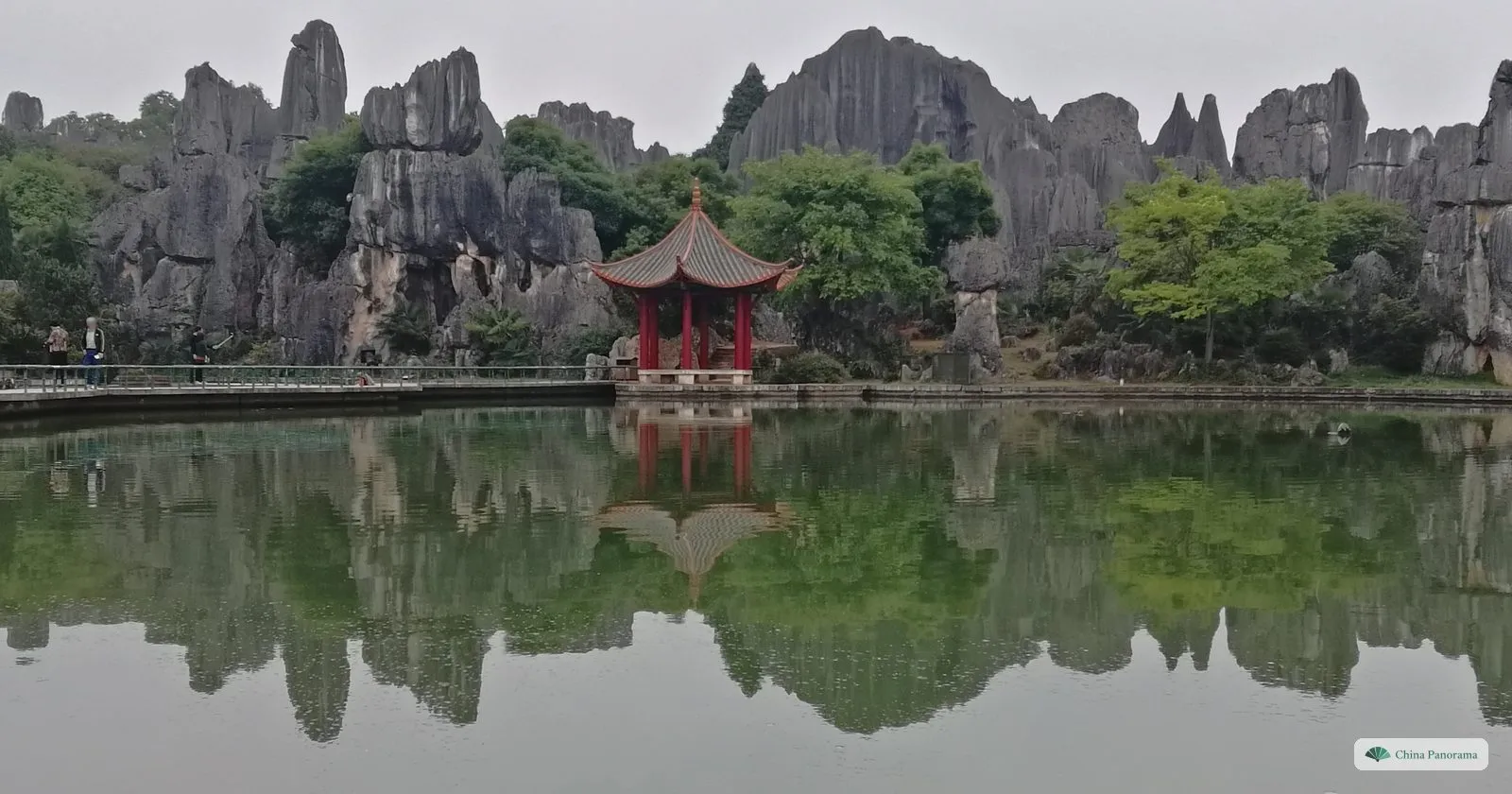 Photograph 1
Where was this taken?
Answer: Stone Forest
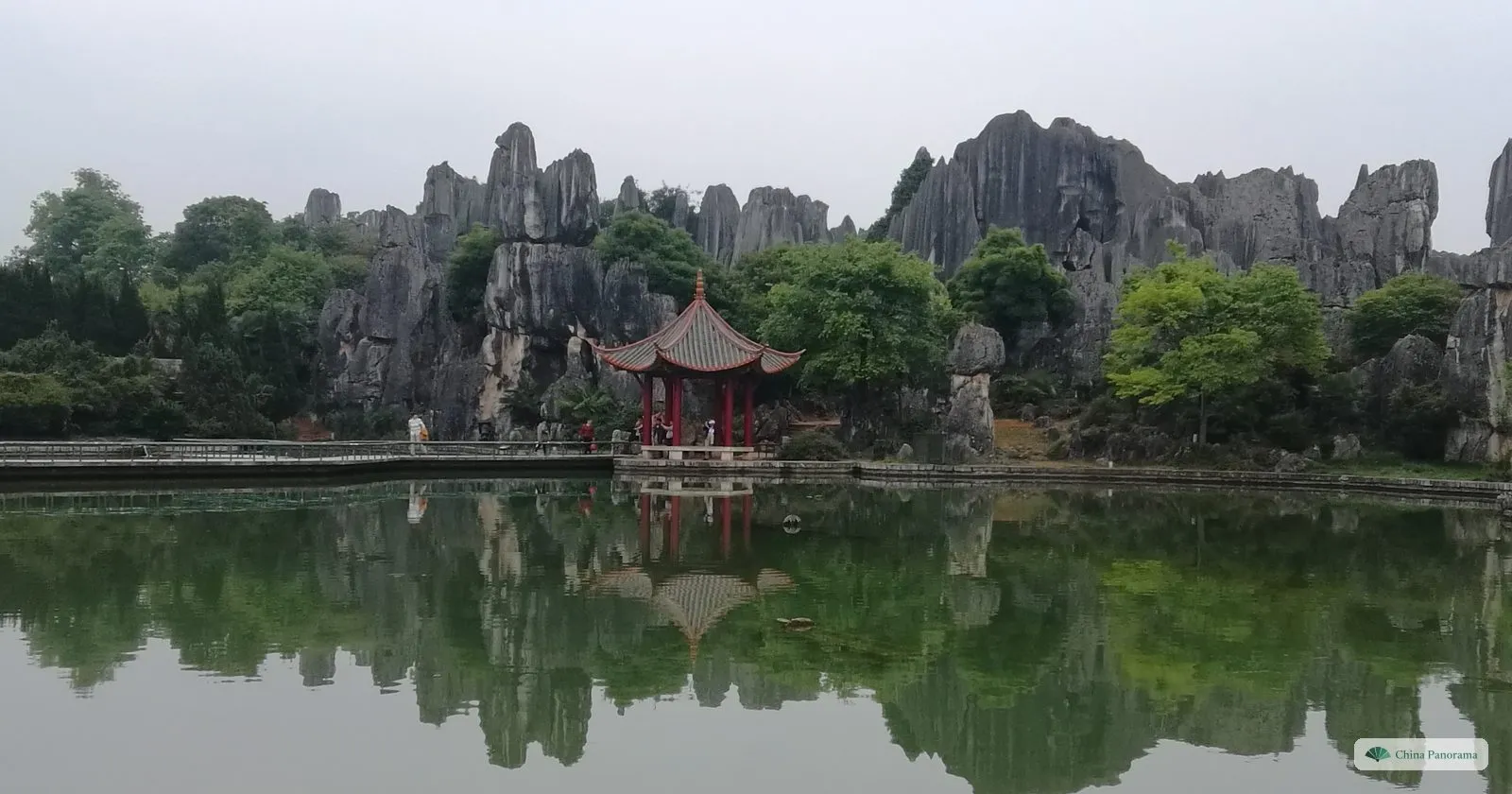
The grey pinnacles behind the pavilion give it away: a pond in the Lesser Stone Forest, 67 km from the city. Ponds were dug among the rocks; on a still morning they double the skyline.
10:25 on 16 April 2019.
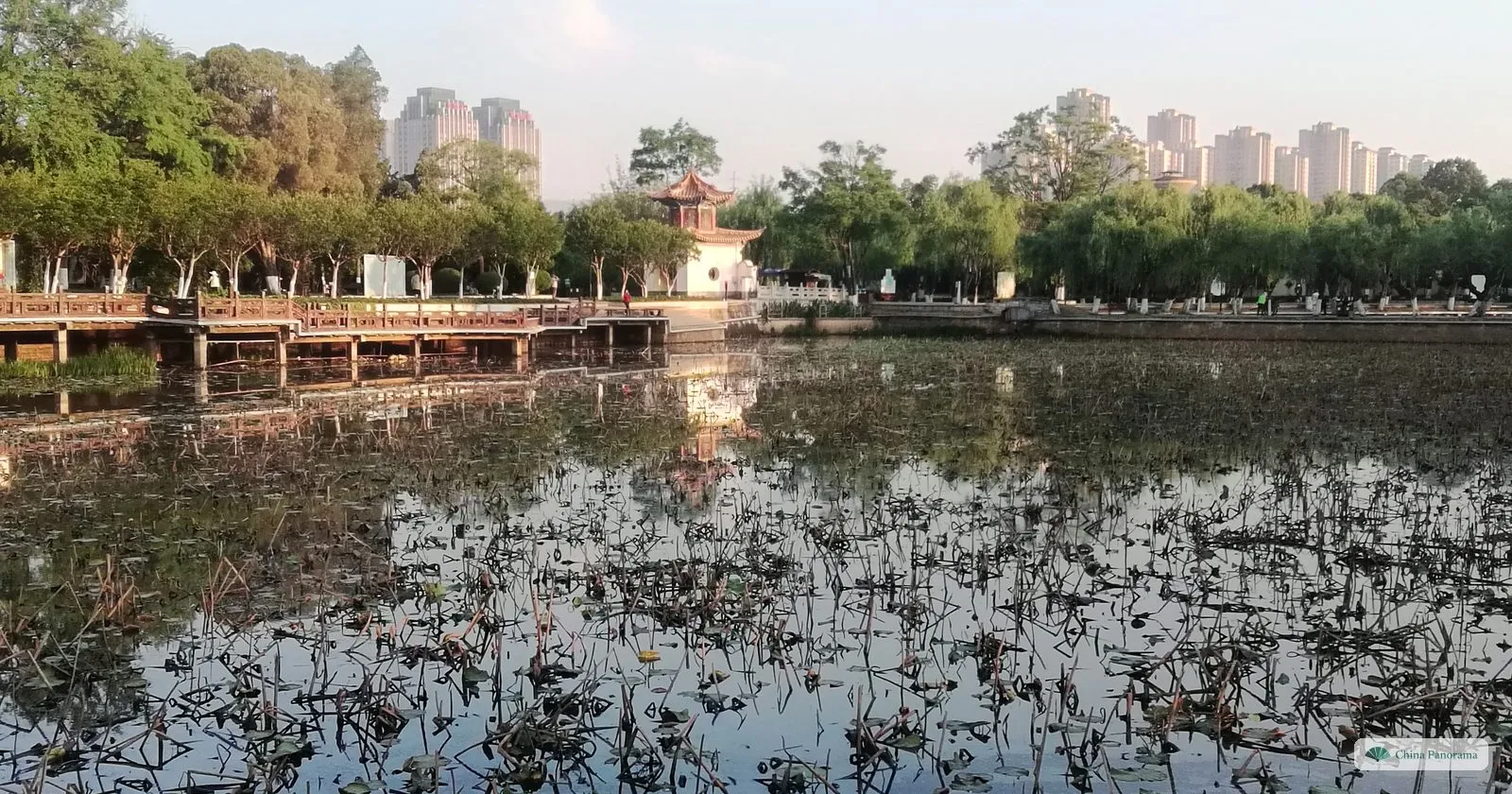 Photograph 2
Where was this taken?
Answer: Daguan Park
Lotus stems, a little white pavilion and apartment blocks just behind the trees: a pond in Daguan Park, in the city. Dianchi itself is far too big and open for lotus beds like this.
07:30 on 17 April 2019.
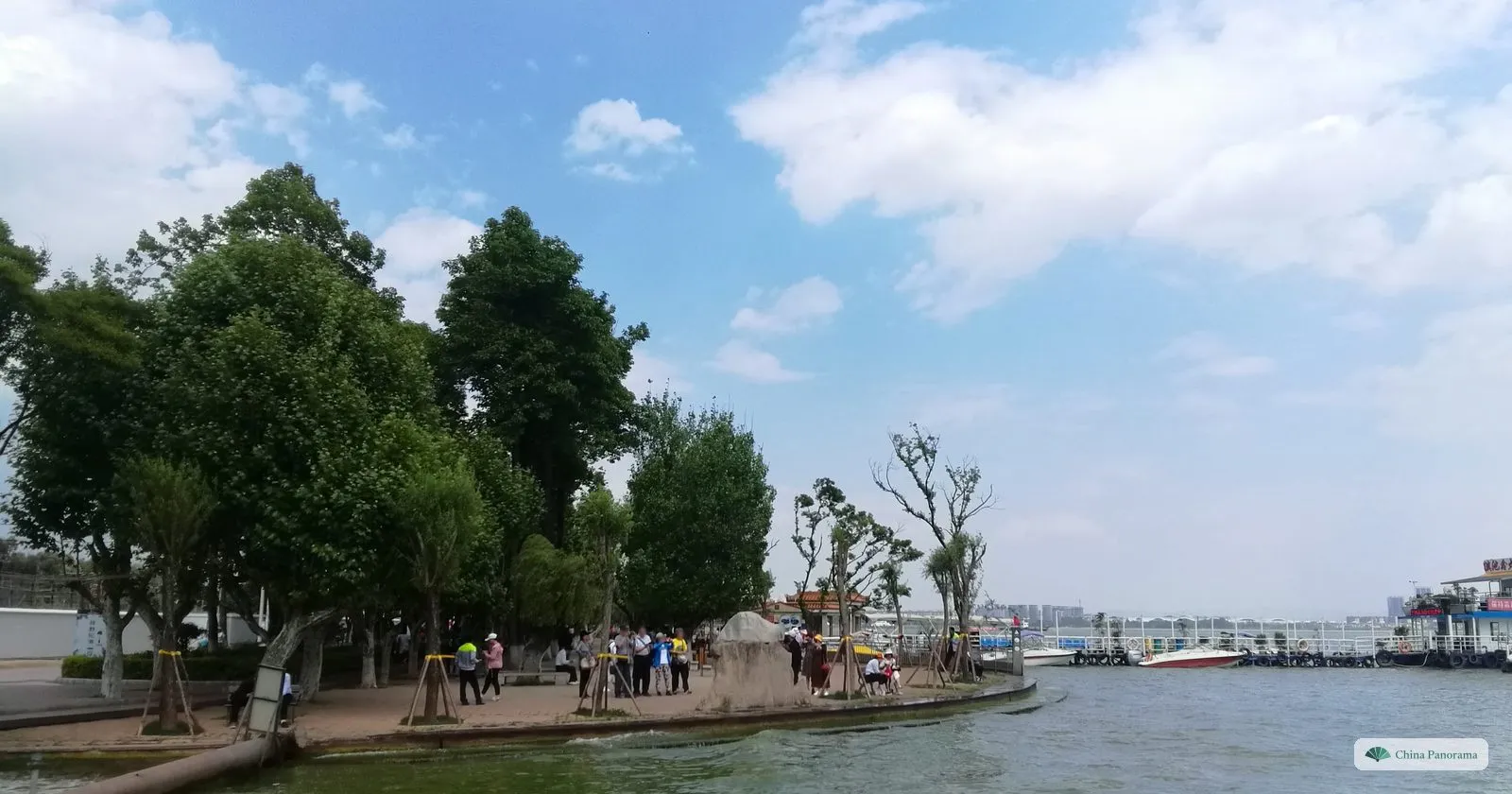 Photograph 3
Where was this taken?
Answer: Lake Dianchi
Speedboats, a long pier and water to the horizon: the shore of Lake Dianchi at Haigeng Park. The lake is about 40 km long.
15:30 on 16 April 2019.
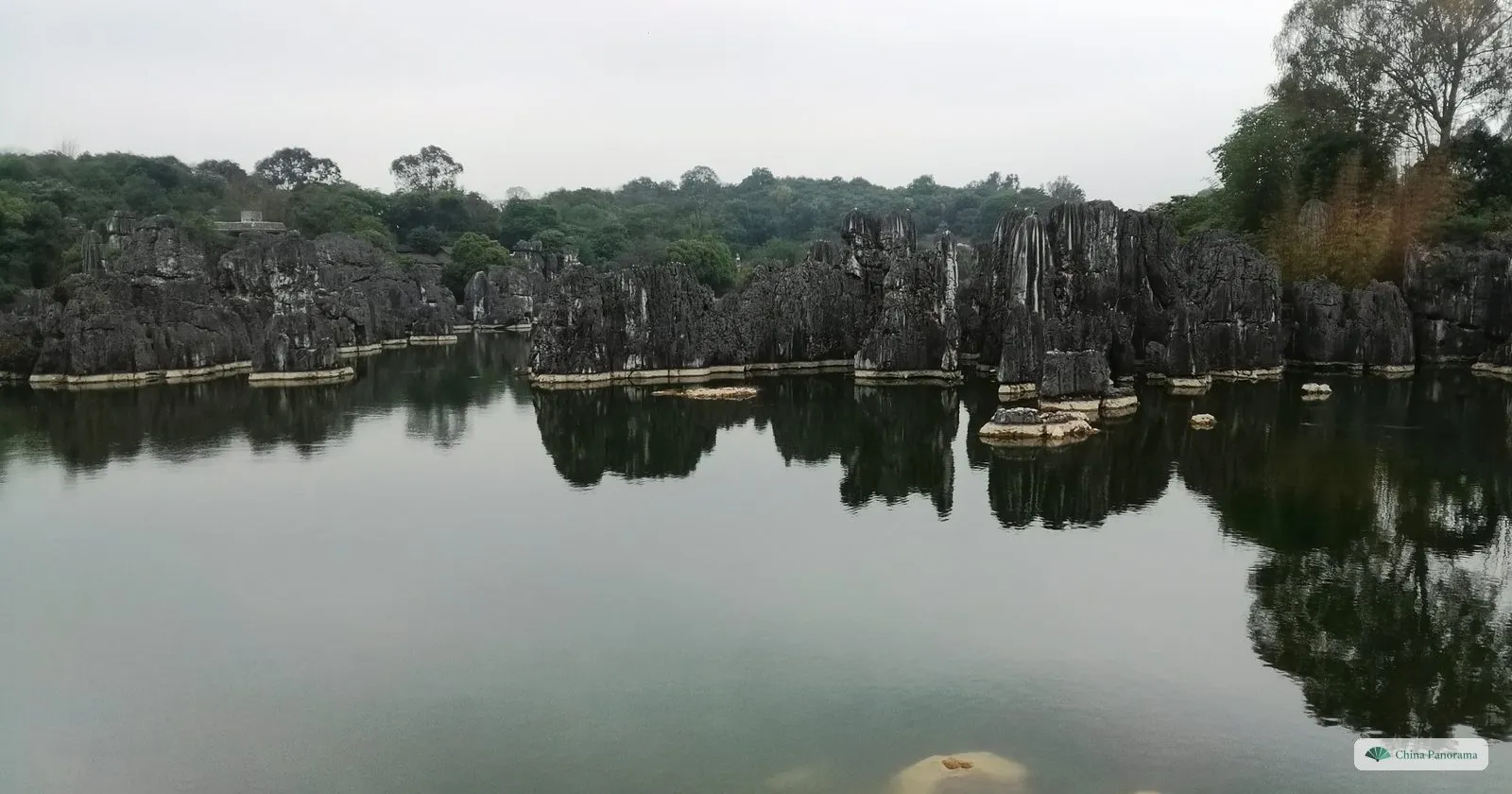 Photograph 4
Where was this taken?
Answer: Stone Forest
Look at the far shore: not trees but a long reef of grey limestone. This is the lake just inside the Stone Forest’s gate.
09:14 on 16 April 2019.
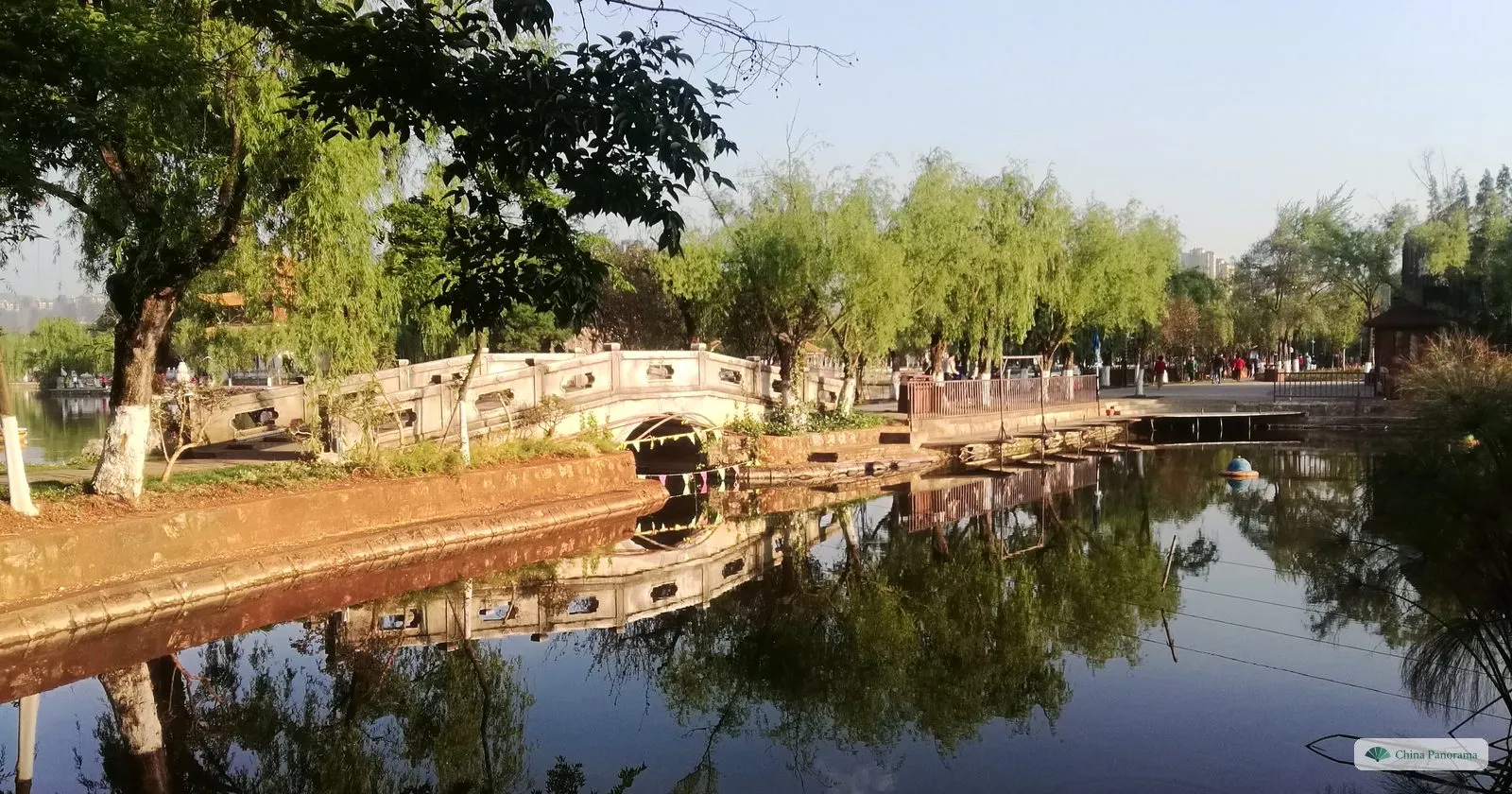 Photograph 5
Where was this taken?
Answer: Daguan Park
A white humpbacked bridge, willows and a canal as still as glass in the low morning sun: the waterways of Daguan Park, laid out as a garden from 1696.
07:46 on 17 April 2019.
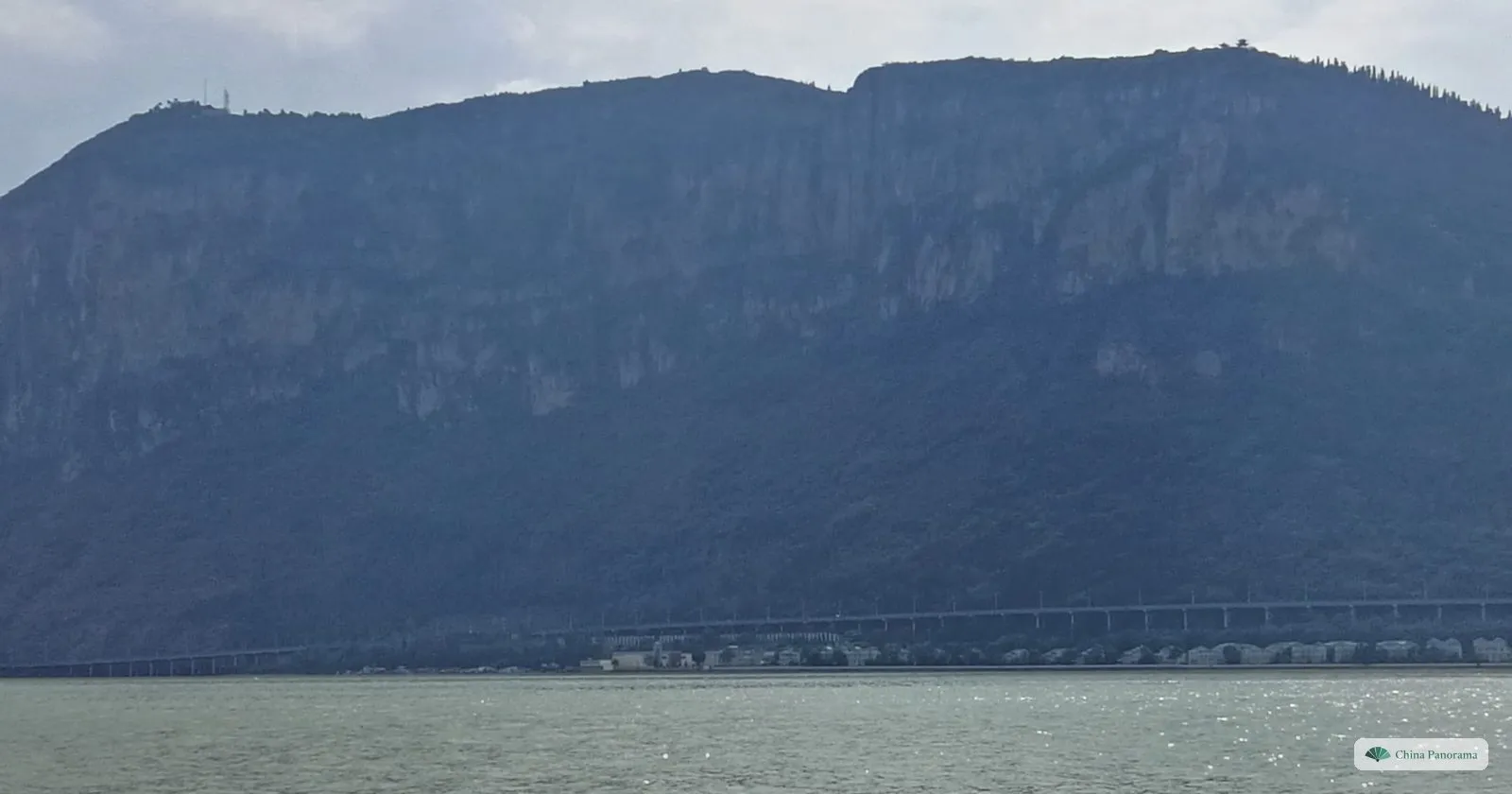 Photograph 6
Where was this taken?
Answer: Lake Dianchi
Cliffs dropping into wide water: the Western Hills seen across Lake Dianchi from Haigeng. The Dragon Gate is cut into these cliffs.
15:32 on 16 April 2019.
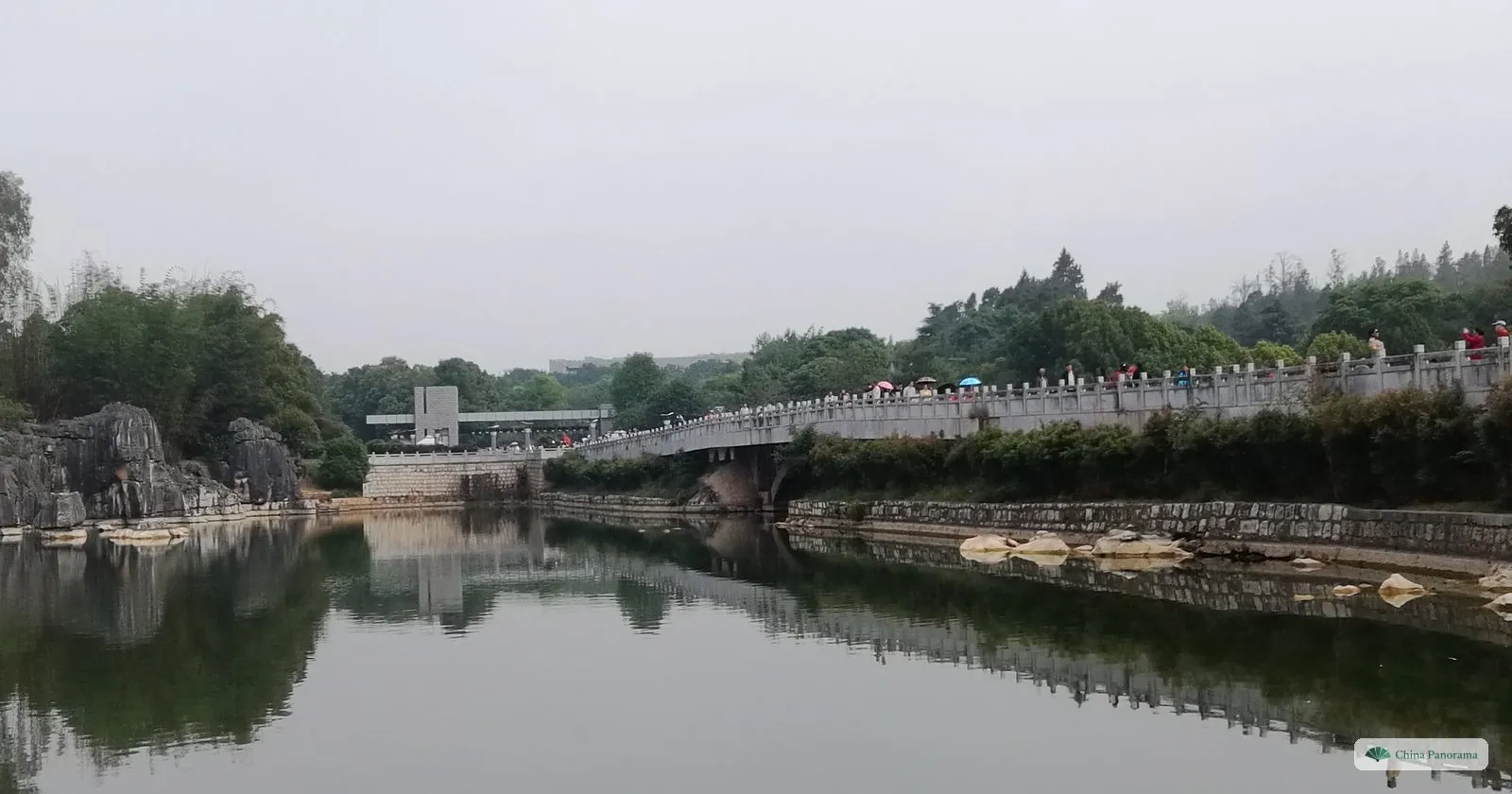 Photograph 7
Where was this taken?
Answer: Stone Forest
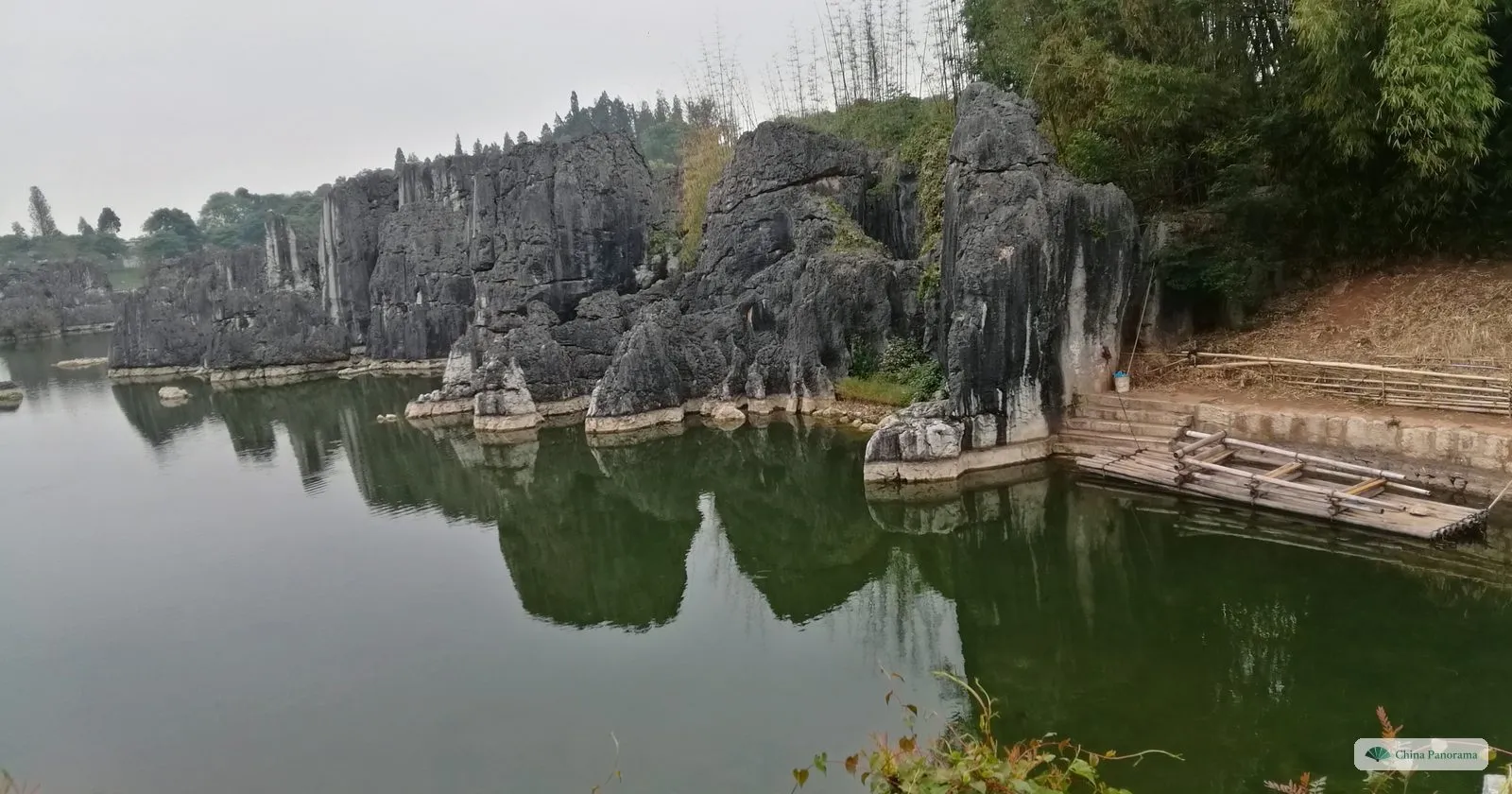
It looks like a city park, but the rocks at the water’s edge on the left are limestone: this is the lake by the Stone Forest’s exit, on the way back to the visitor centre.
10:45 on 16 April 2019. A trick question.
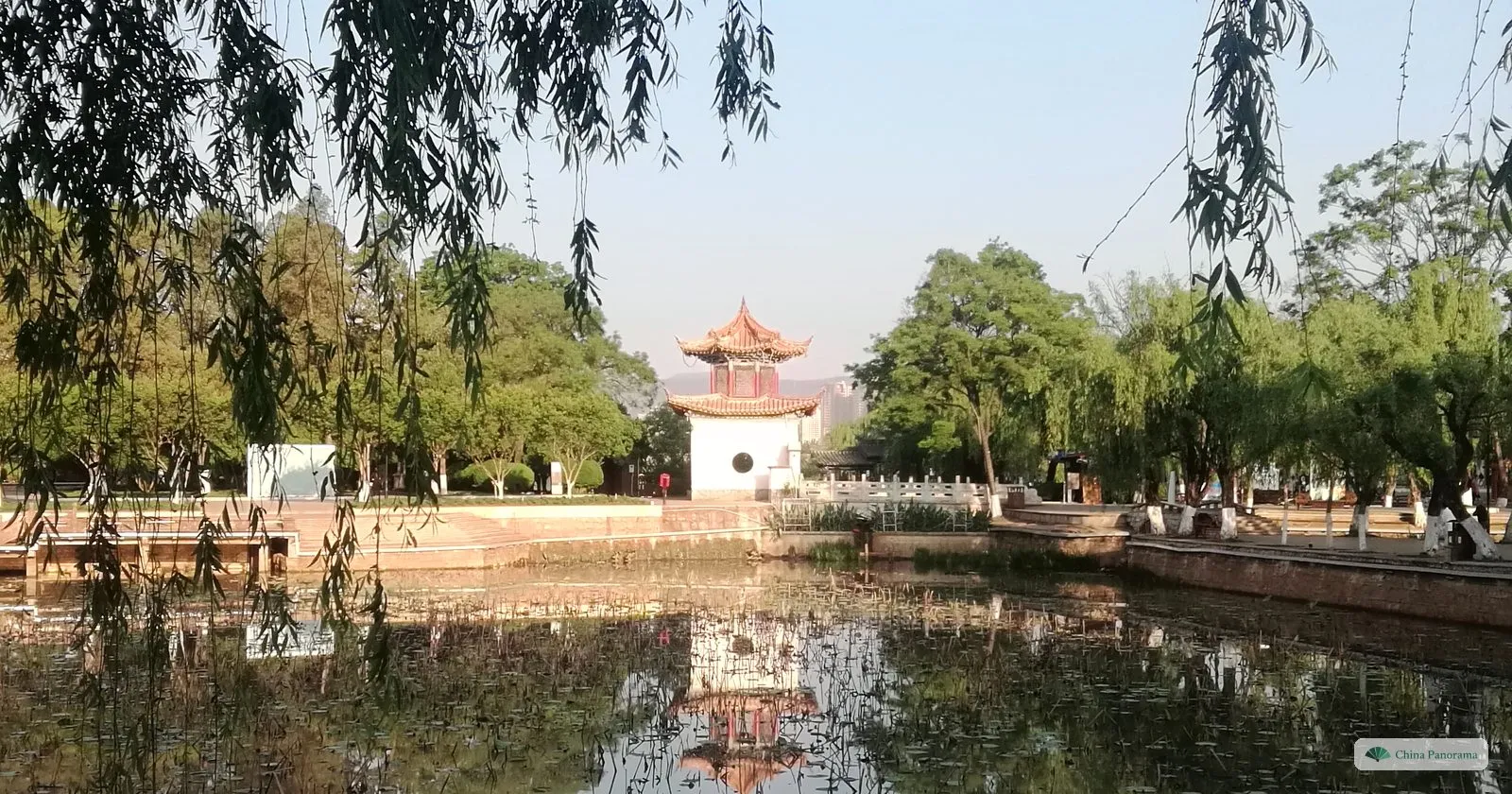 Photograph 8
Where was this taken?
Answer: Daguan Park
Another pavilion — but with willows, a white base and no rock in sight. Daguan Park, ten minutes before we left by the main gate.
07:50 on 17 April 2019.
How old is it really?
The Jinma and Biji arches are a Ming design — and were built in 1999. Kunming’s genuinely old buildings are two Nanzhao pagodas and a handful of Qing ones; much else has been rebuilt after rebellions, earthquakes and the Cultural Revolution. Tap a name on the time line, or filter.
Nanzhao kingdom737–902
Dali kingdom, Yuan
Ming and Qing1368–1911
20th century1912–1999
Our centurysince 2000
Filled dot: original. Ring: ruin. Square: built in our time.
Tap a name on the time line or a card.
- Original824–859about 1,170 years old
Built when Kunming was Tuodong, eastern capital of the Nanzhao kingdom.
- Originalfrom 1781about 250 years old
A Daoist, Wu Laiqing, and his helpers began the path and grottoes in 1781; the work took decades.
- Originalrebuilt 1882about 140 years old
The 9th-century pagoda fell in the earthquake of 1833; this one was built in its old style in 1882.
- Original1883 (first 1696)about 140 years old
First built in 1696, raised to three storeys in 1828; the tower you see dates from 1883.
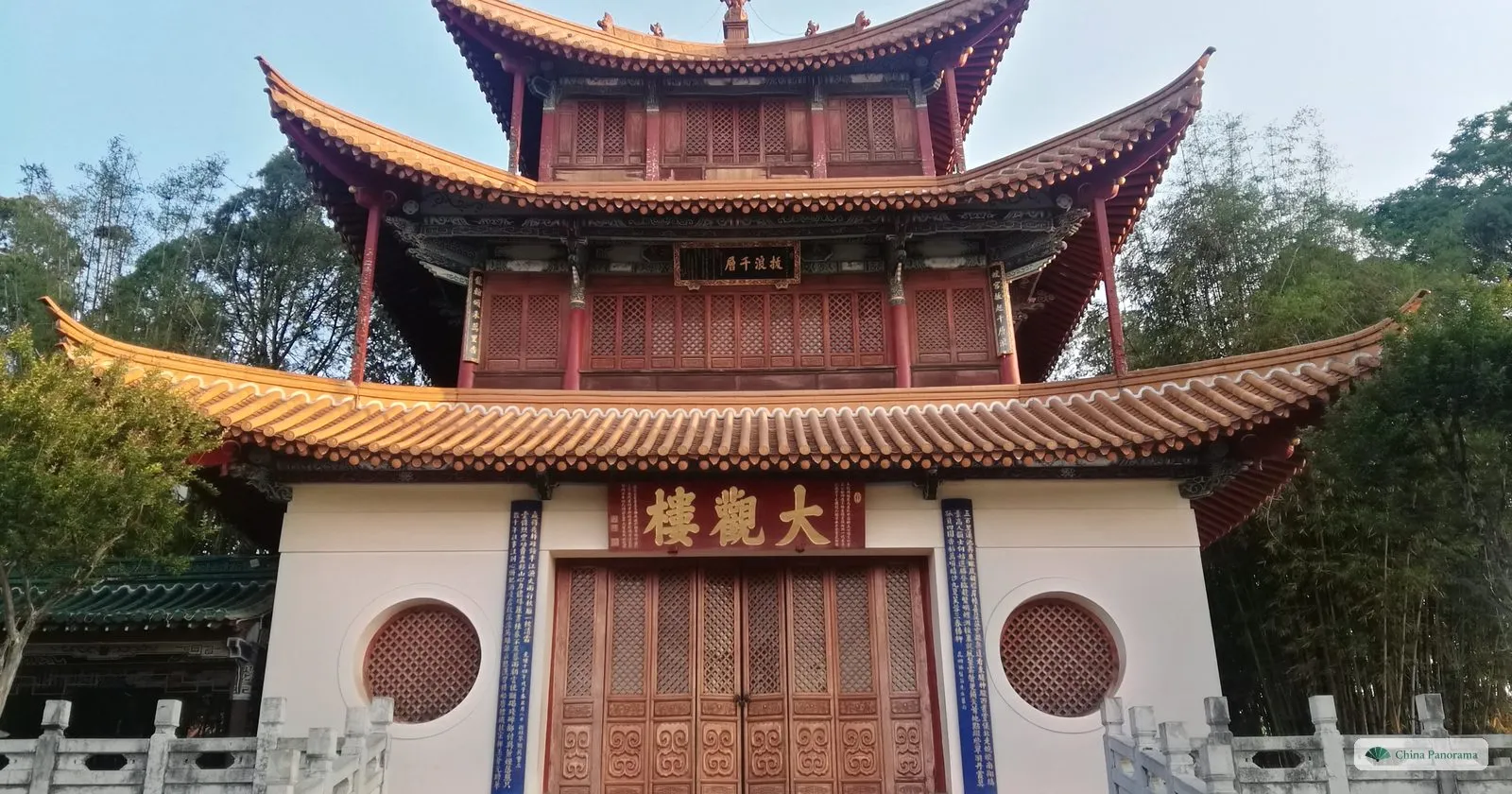 Original1888about 140 years old
Written in the Qianlong era, lost in 1857; the boards on the tower were carved in Zhao Fan’s hand in 1888.
- Original1909about 120 years old
An officers’ school whose cadets fought in 1911 and 1915; now a museum by Green Lake.
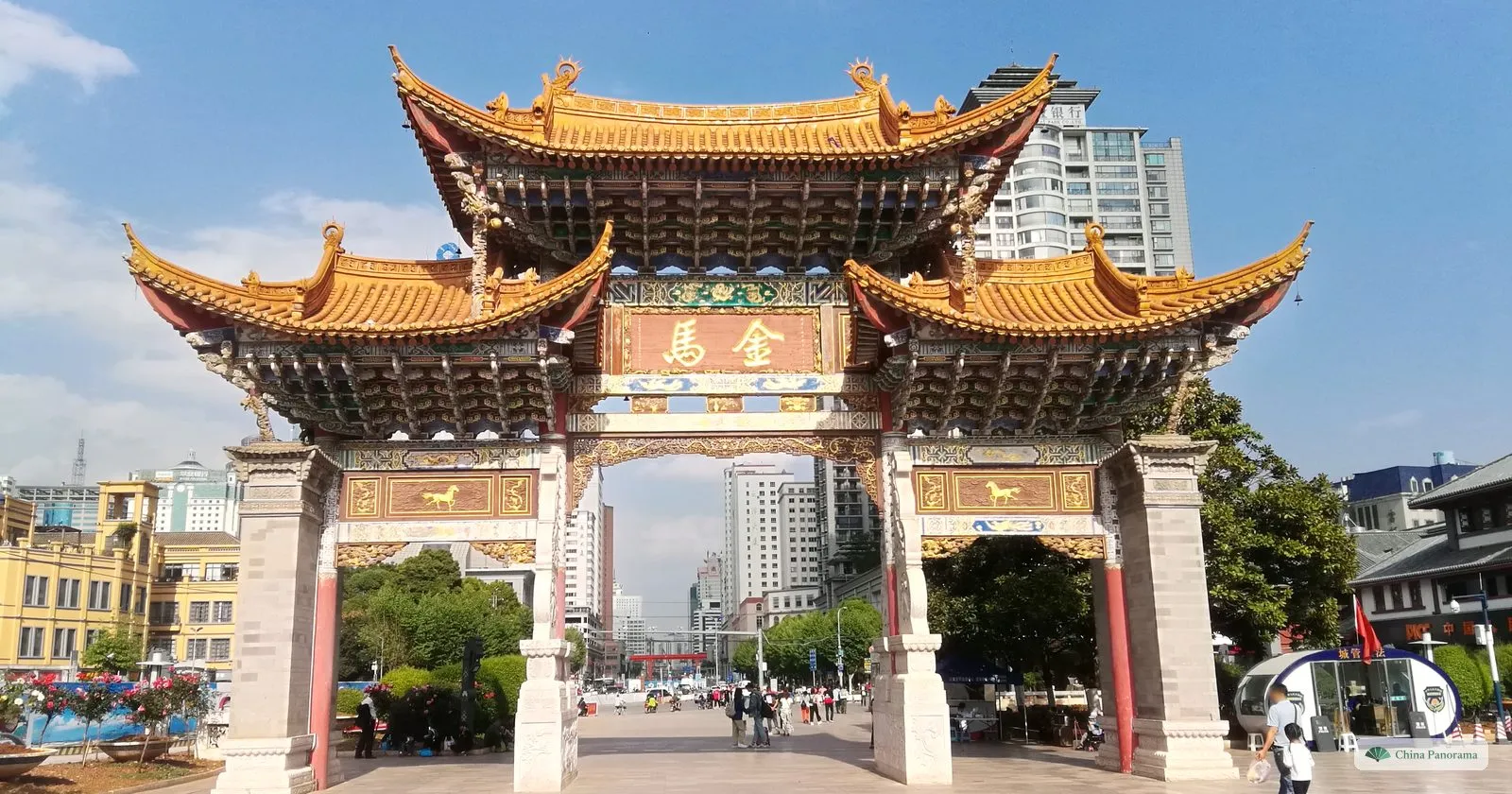 Built in our timerebuilt 1998–199927 years old
First built in the 1420s–1430s, pulled down in the Cultural Revolution; the present arches are 25 years old.
- Built in our time201214 years old
Opened on 28 June 2012, 25 km north-east of the centre; Metro Line 6 opened the same day.
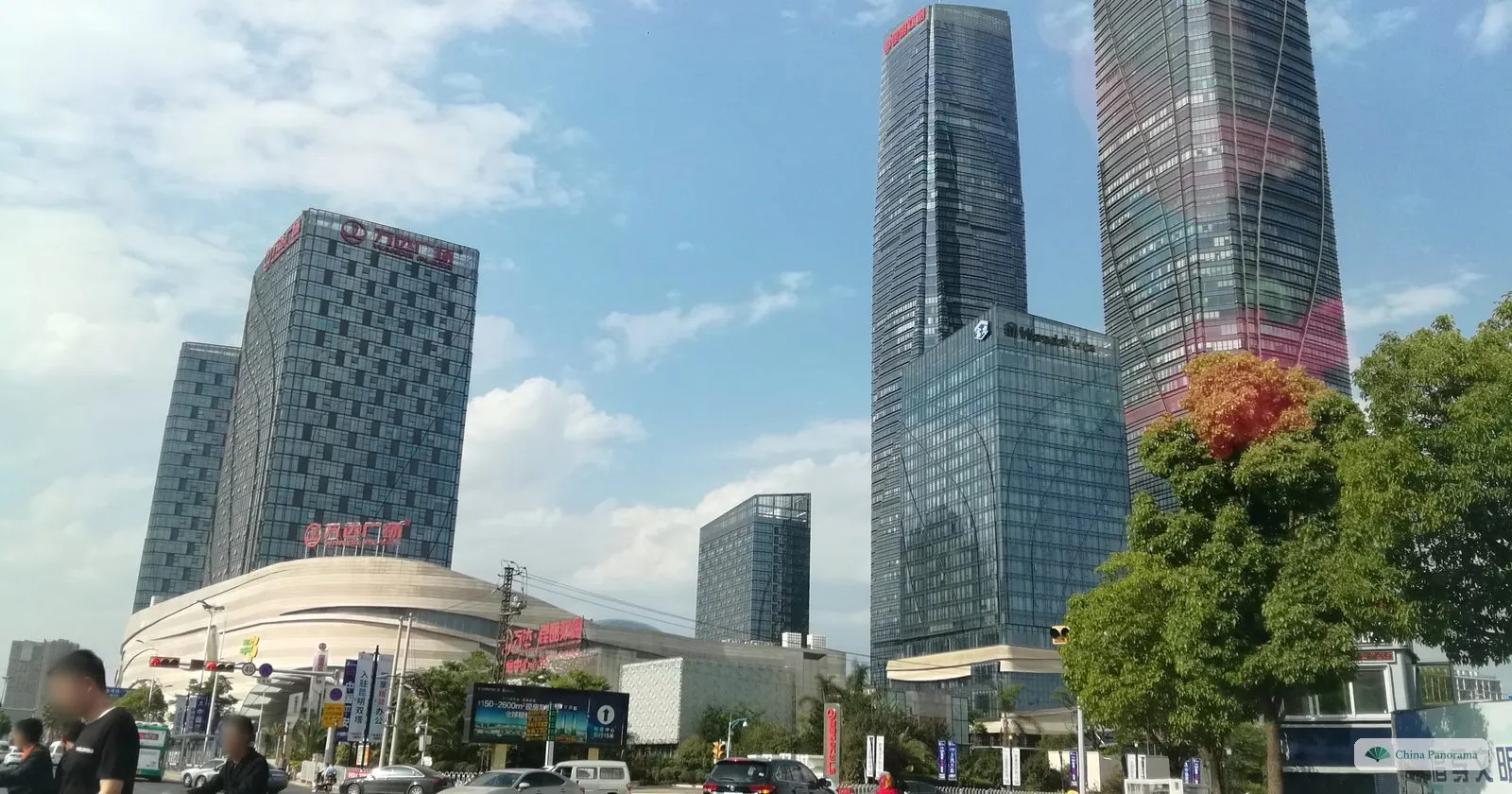 Built in our time201511 years old
Topped out in January 2015; for years the tallest buildings in Yunnan.
The Stone Forest on foot, step by step
Our walk through the Greater and Lesser Stone Forest on 16 April 2019, from the gate at 08:59 to the exit at 10:50: about 2.5 km between our photographs, more on the winding paths. Tap a point on the line to see what is there.
Tap a stop on the line or a card.
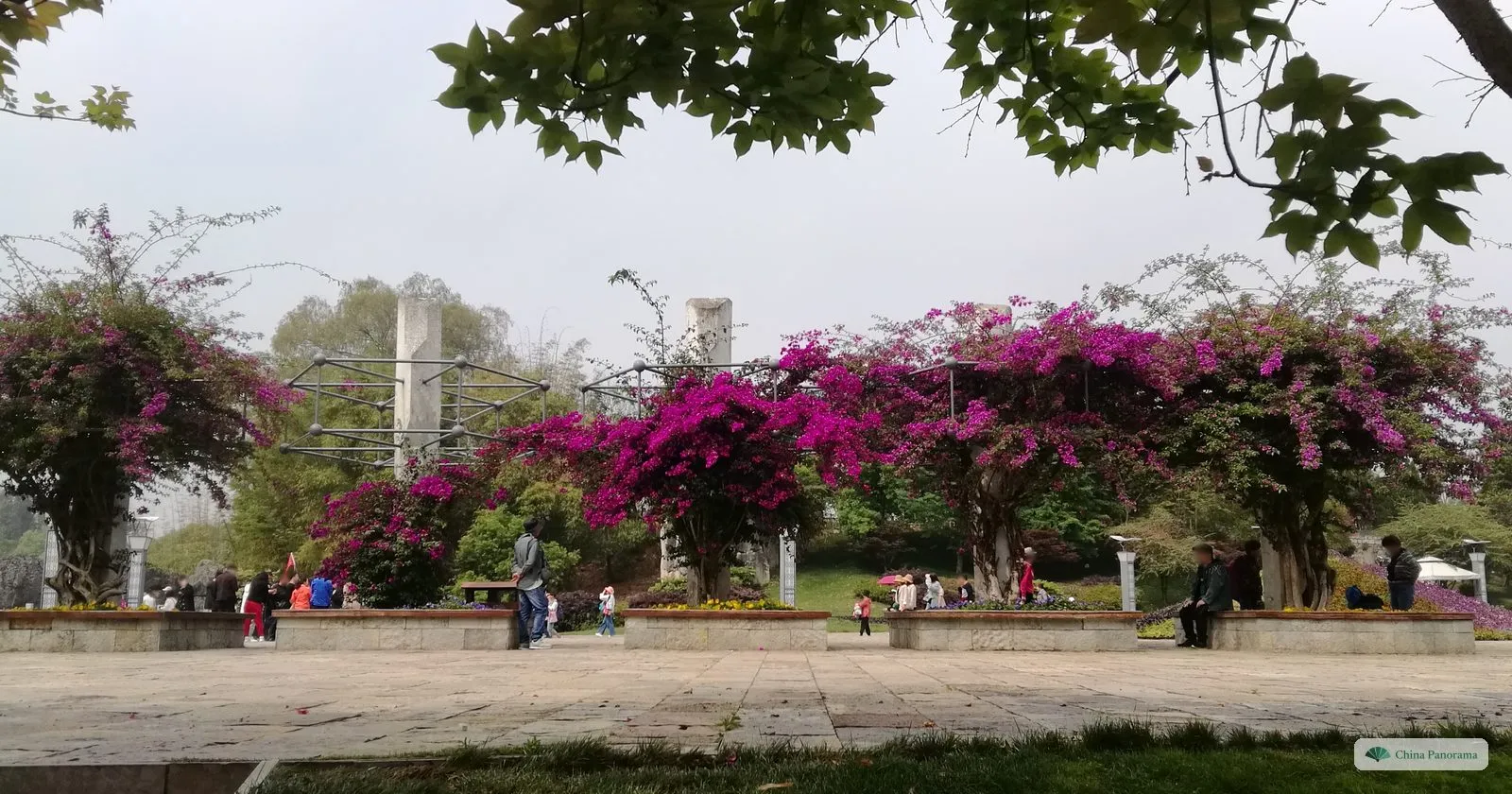 On our path2.5 km from the gate
A square of flowering bougainvillea, then the path out to the visitor centre and the car parks, about 1.6 km north.
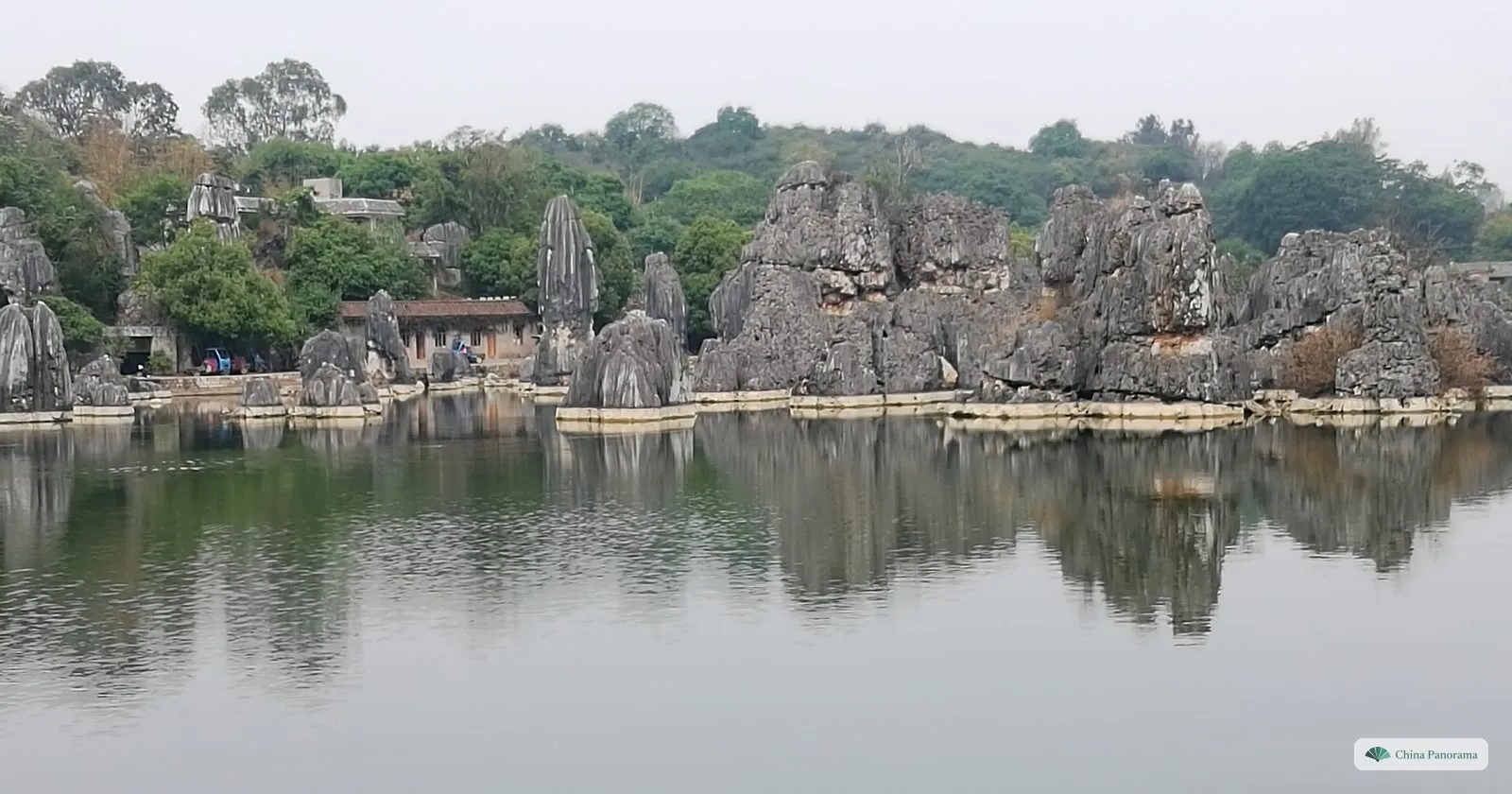 On our path2.2 km from the gate
A last lake with rock reefs along the shore and a long balustraded bridge.
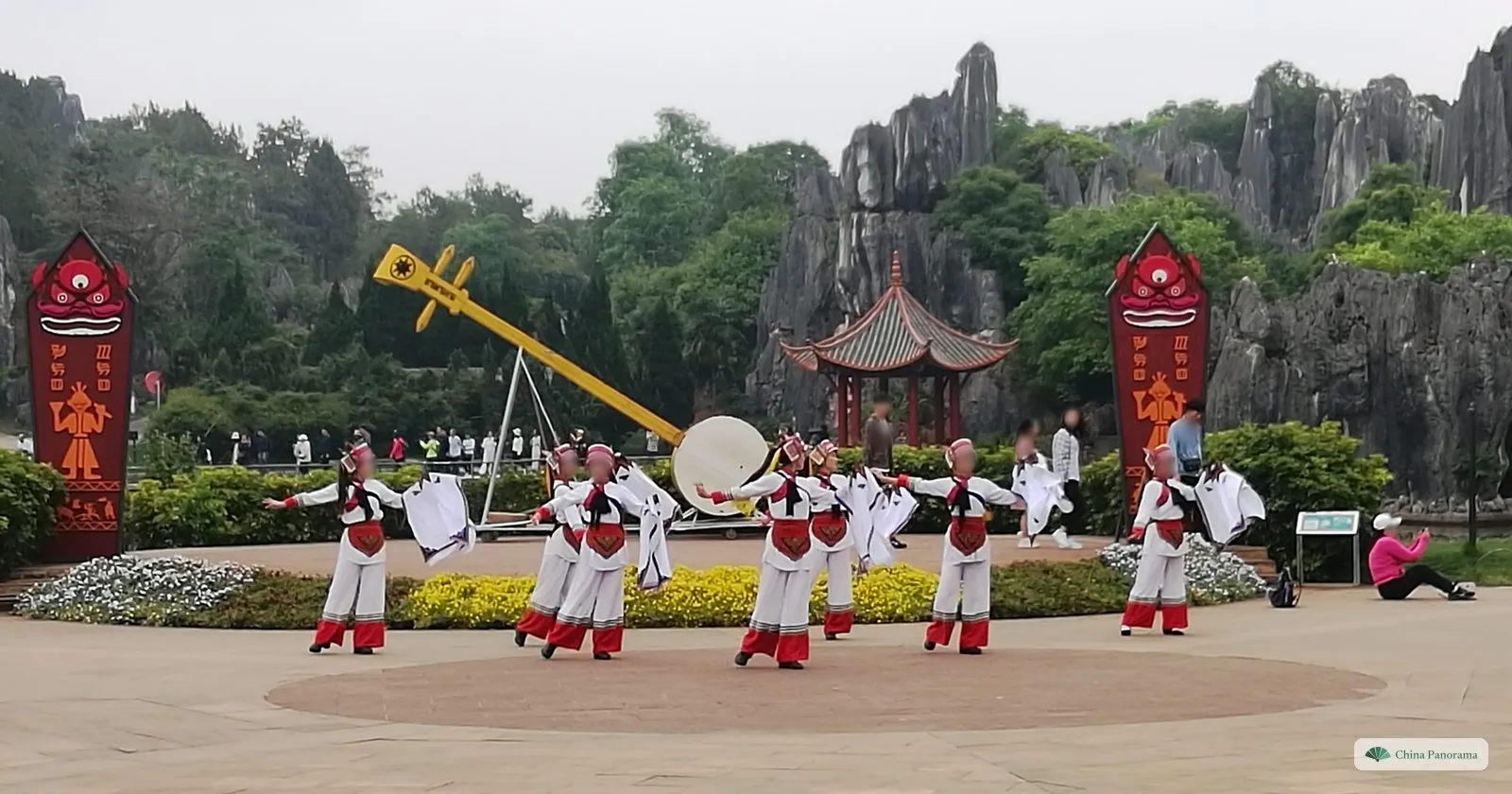 On our path1.8 km from the gate
Dancers in Sani costume beside a giant model of the three-stringed sanxian lute.
- On our path1.7 km from the gate
Still ponds with a red pavilion and the whole grey skyline in the water.
- Just off it1.6 km from the gate
A pinnacle said to look like Ashima, the heroine of the Sani legend, with a basket on her back. It stands just east of the ponds.
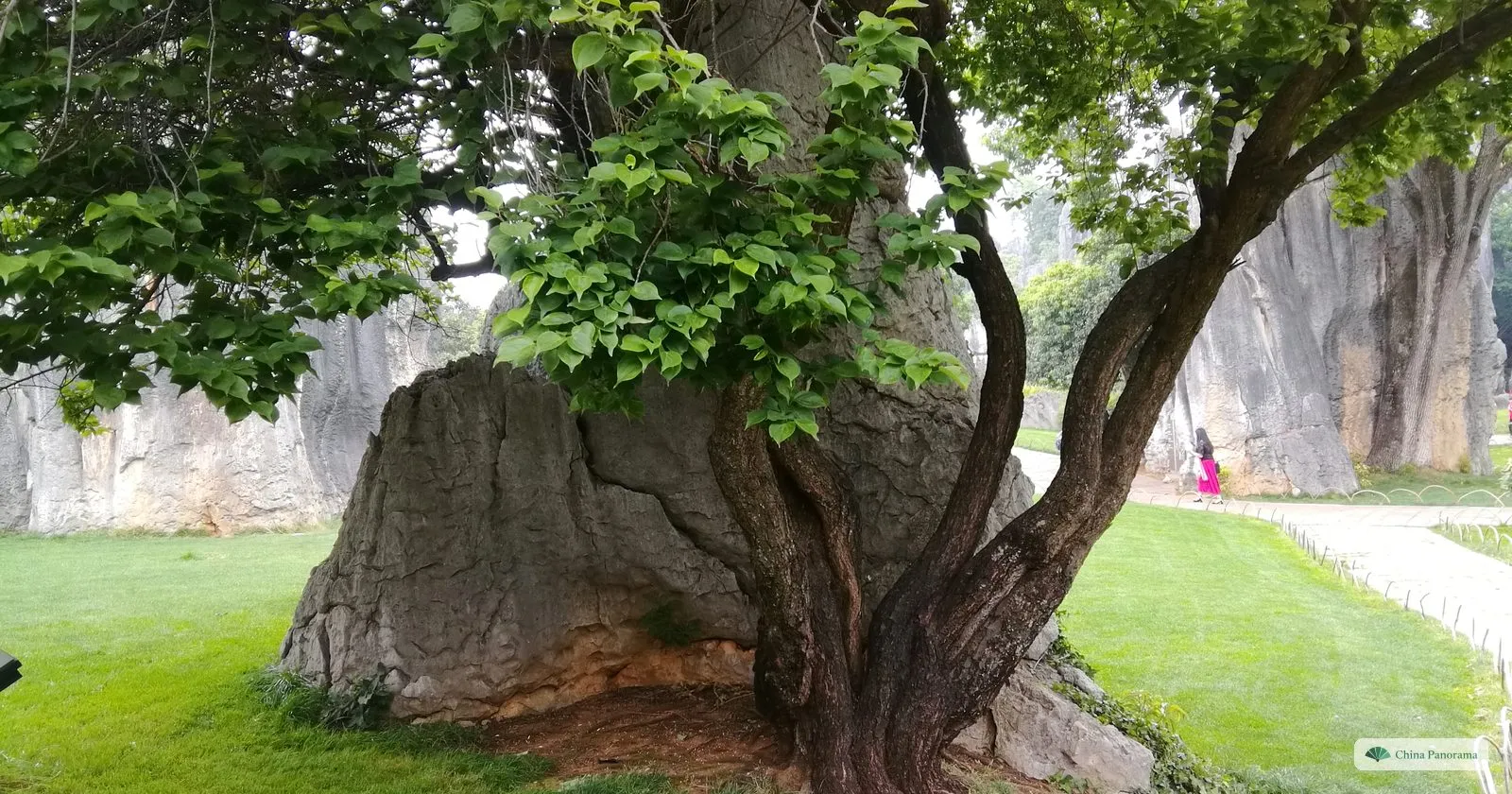 On our path1.3 km from the gate
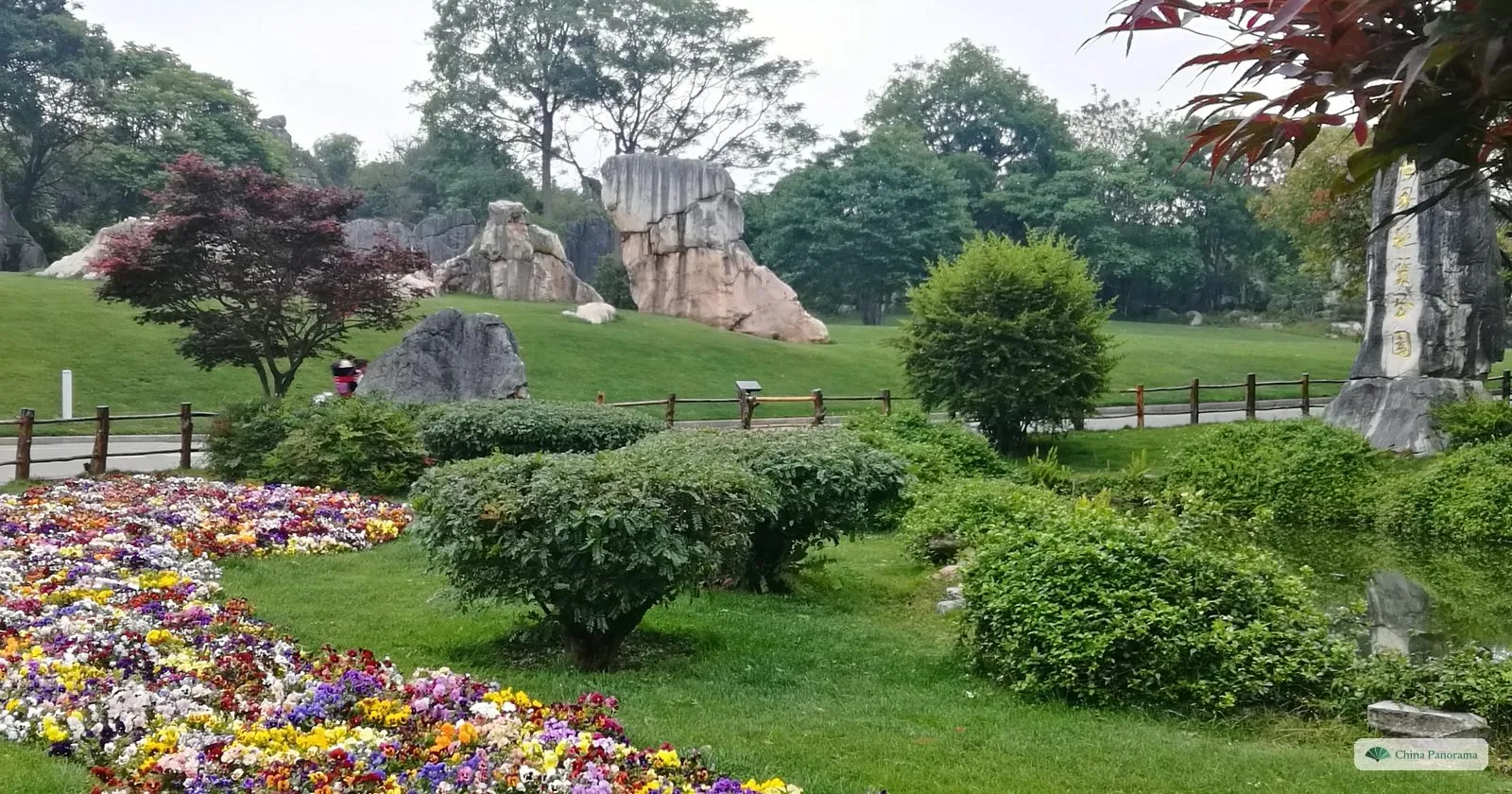
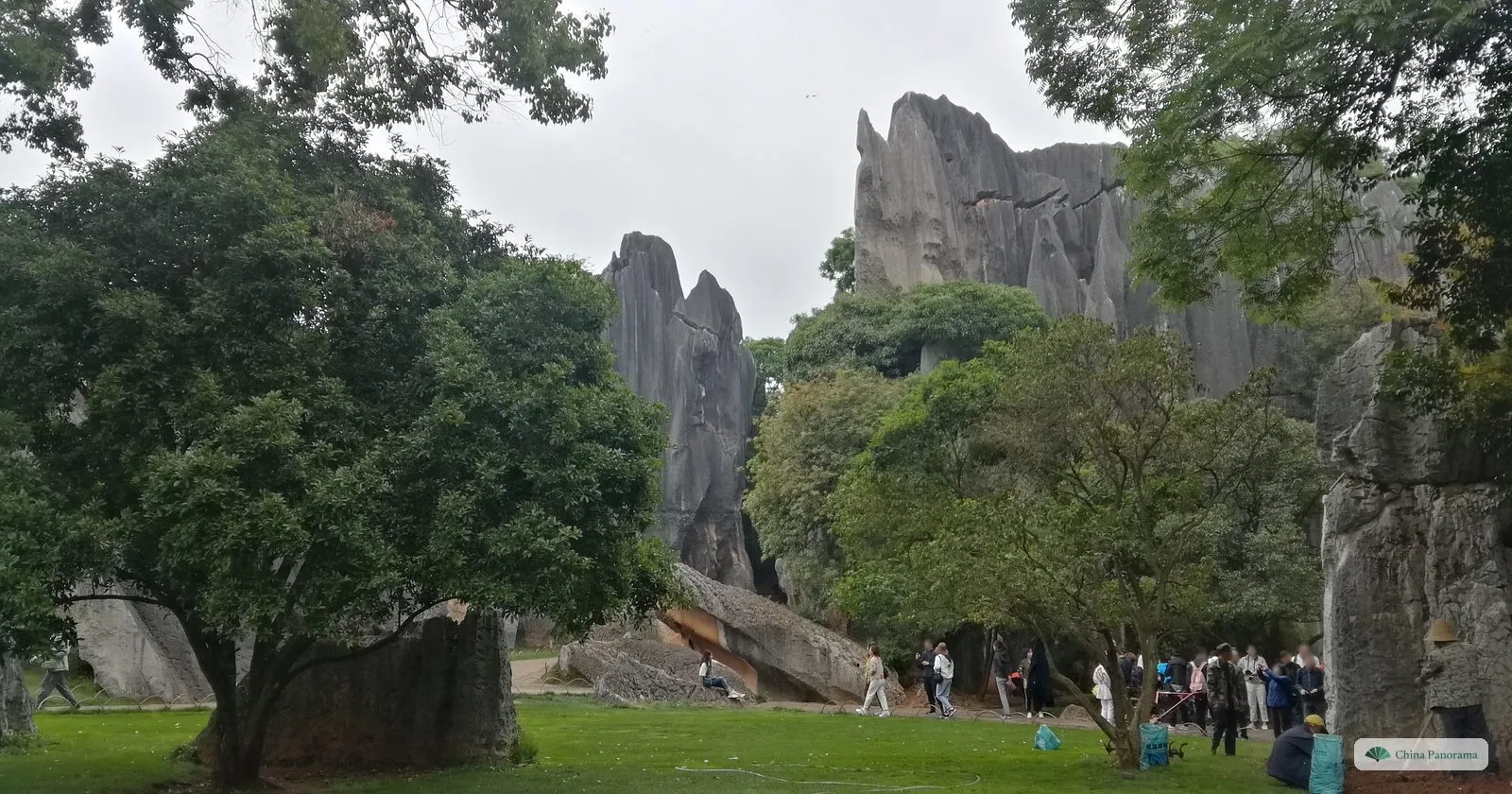
Out of the narrow paths onto lawns with single rocks, and a tree growing out of a boulder.
 On our path1.1 km from the gate
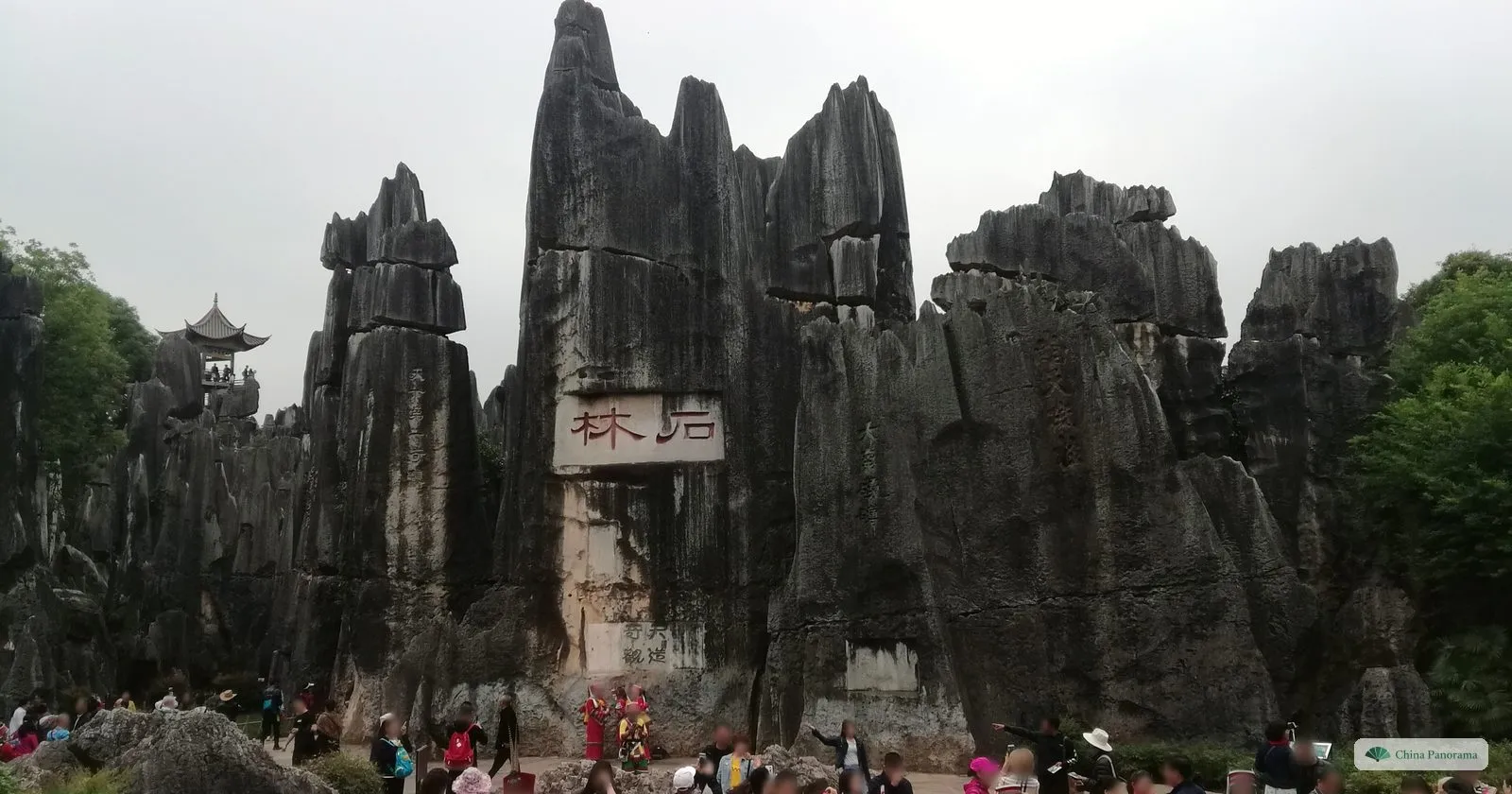
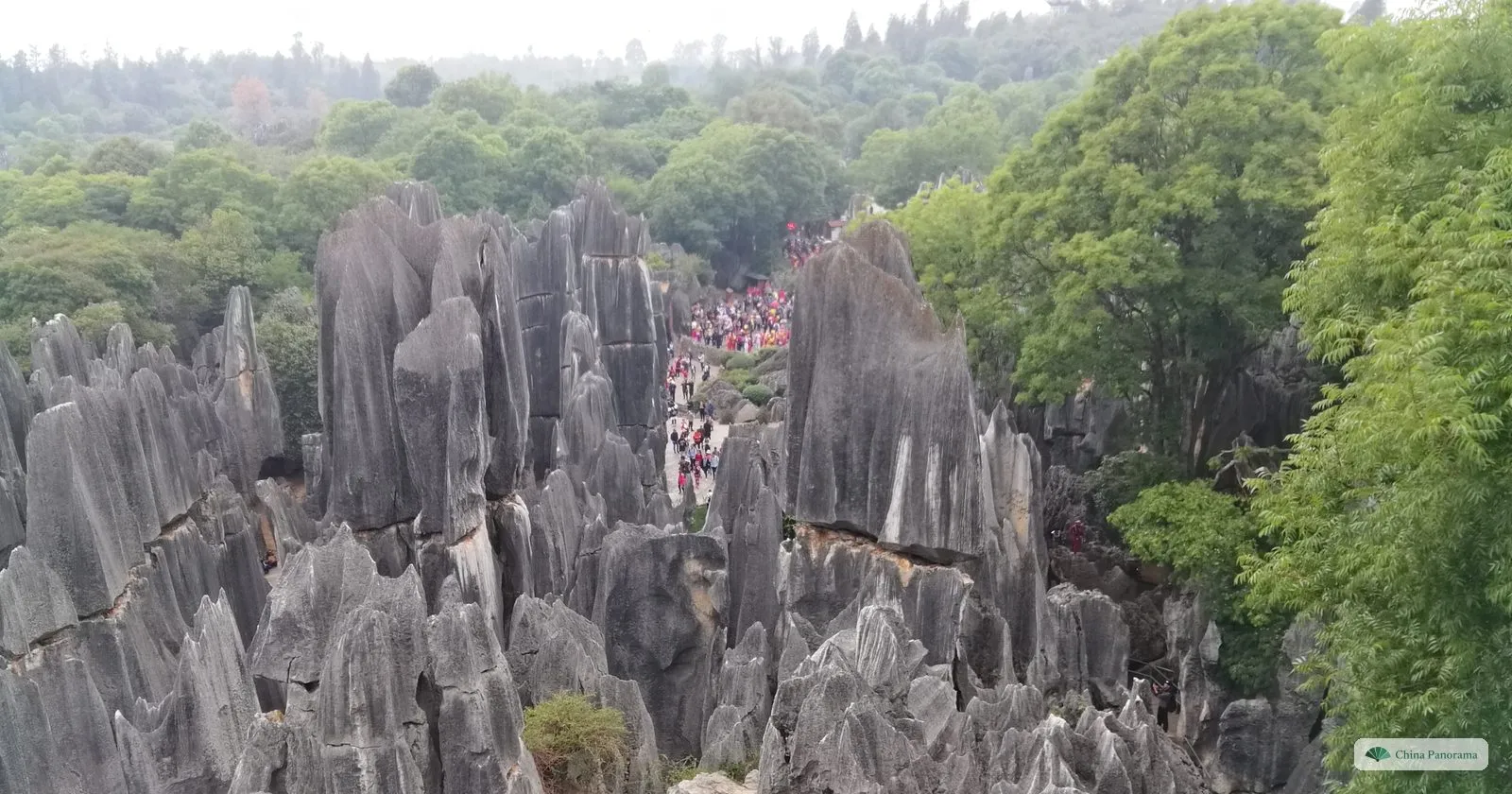
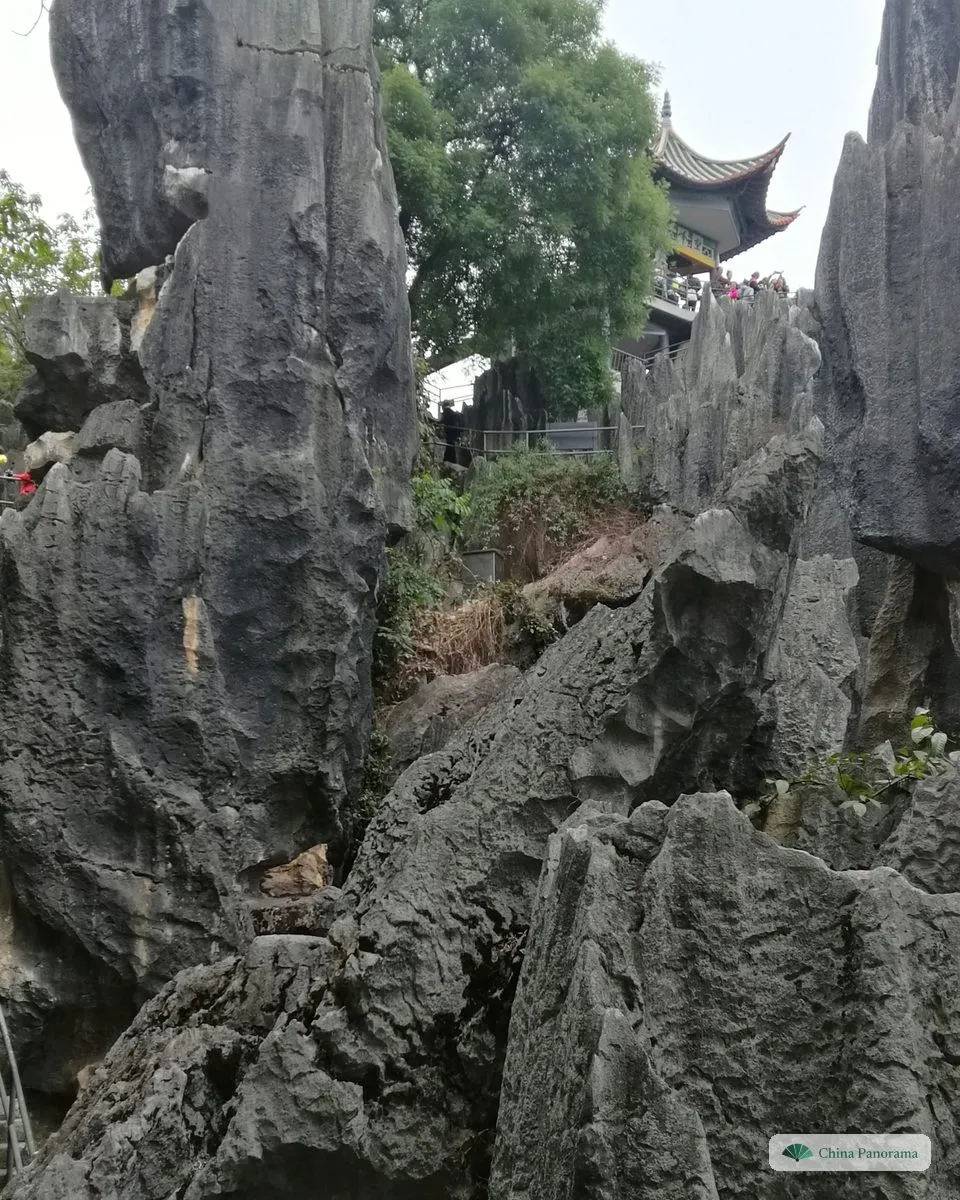
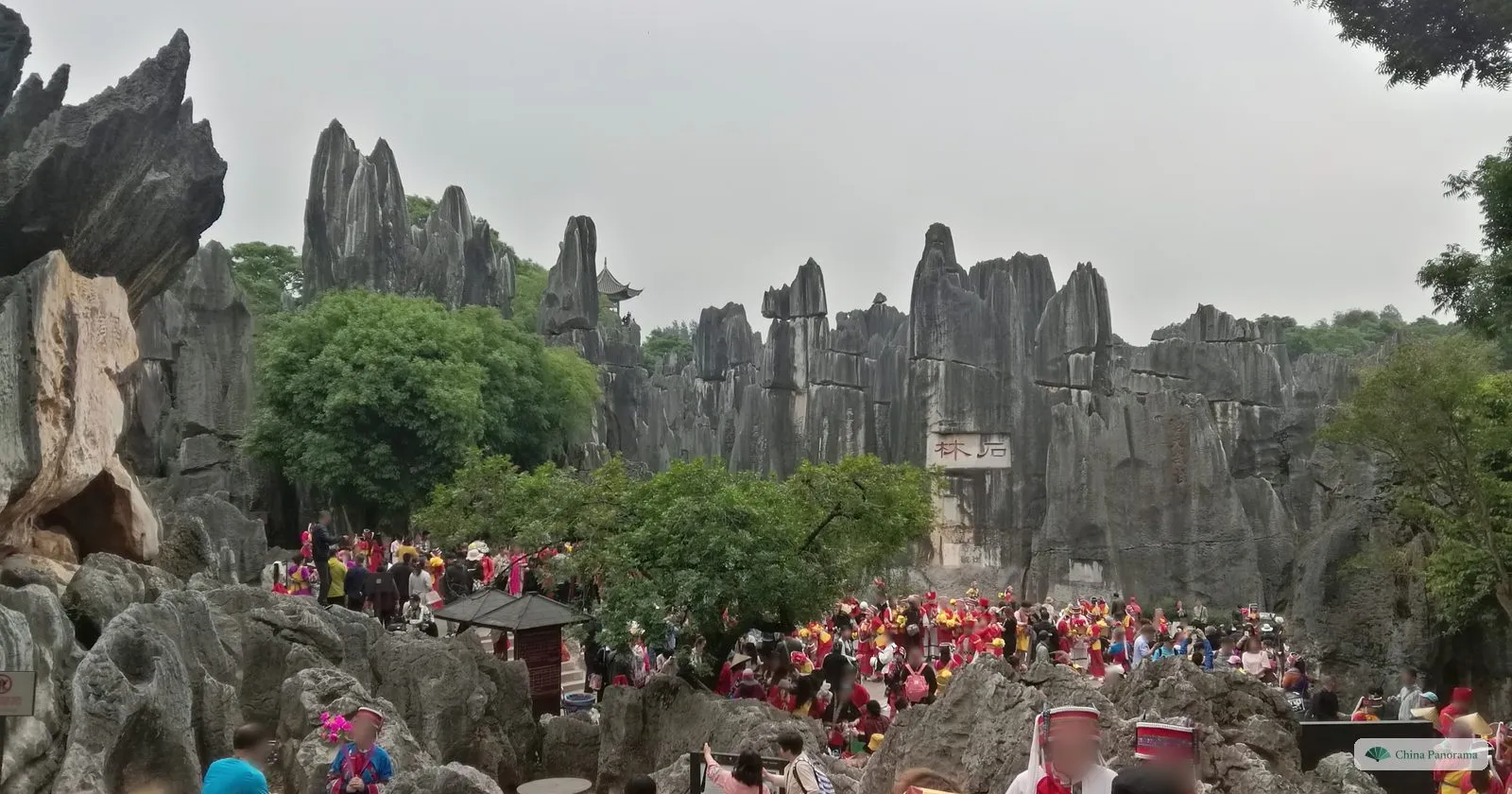
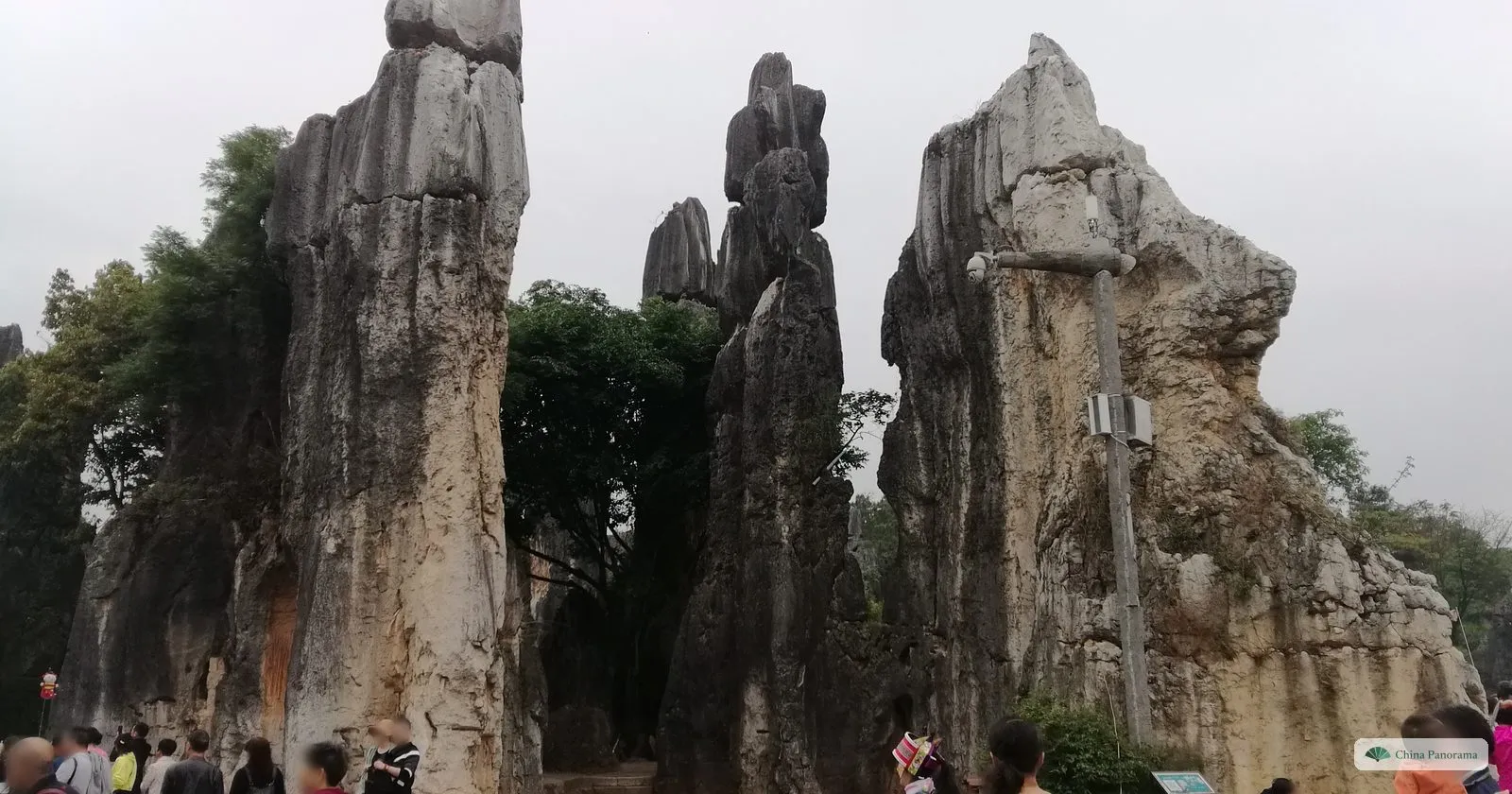
Two red characters on a pinnacle, named in 1931 — the busiest spot of all, so come before 09:30. Beside it the Sword Peak Pond, a single blade of rock in a narrow pool; then steep steps up through the clefts to a terrace above the pinnacles, the view on this page’s “What am I looking at?” photo.
 On our path0.5 km from the gate
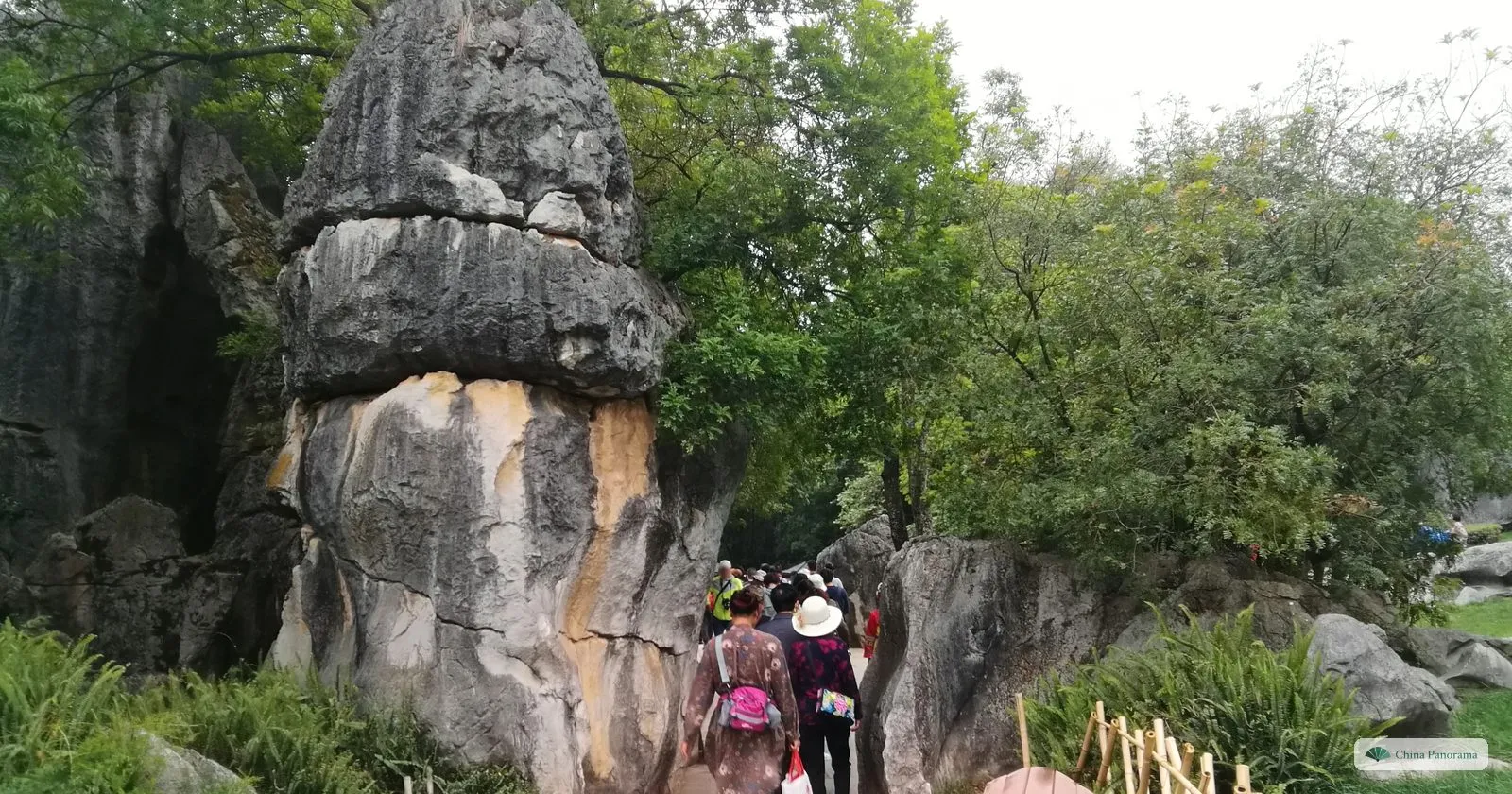
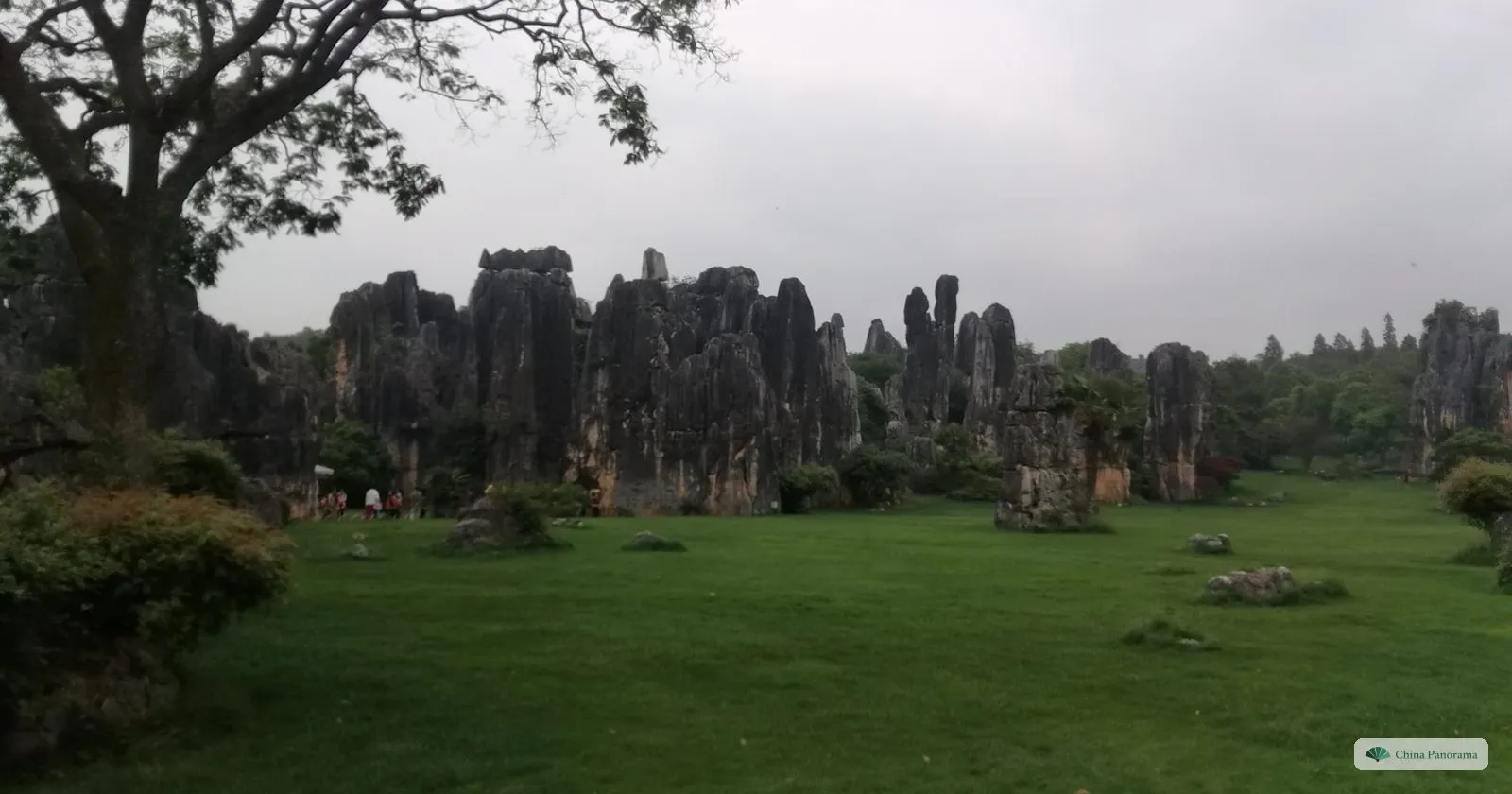
Pinnacles stand in a lake along the path south from the gate. Further on, where the path enters the pinnacles, a weathered boulder balances on a narrower column.
 On our path0.0 km from the gate
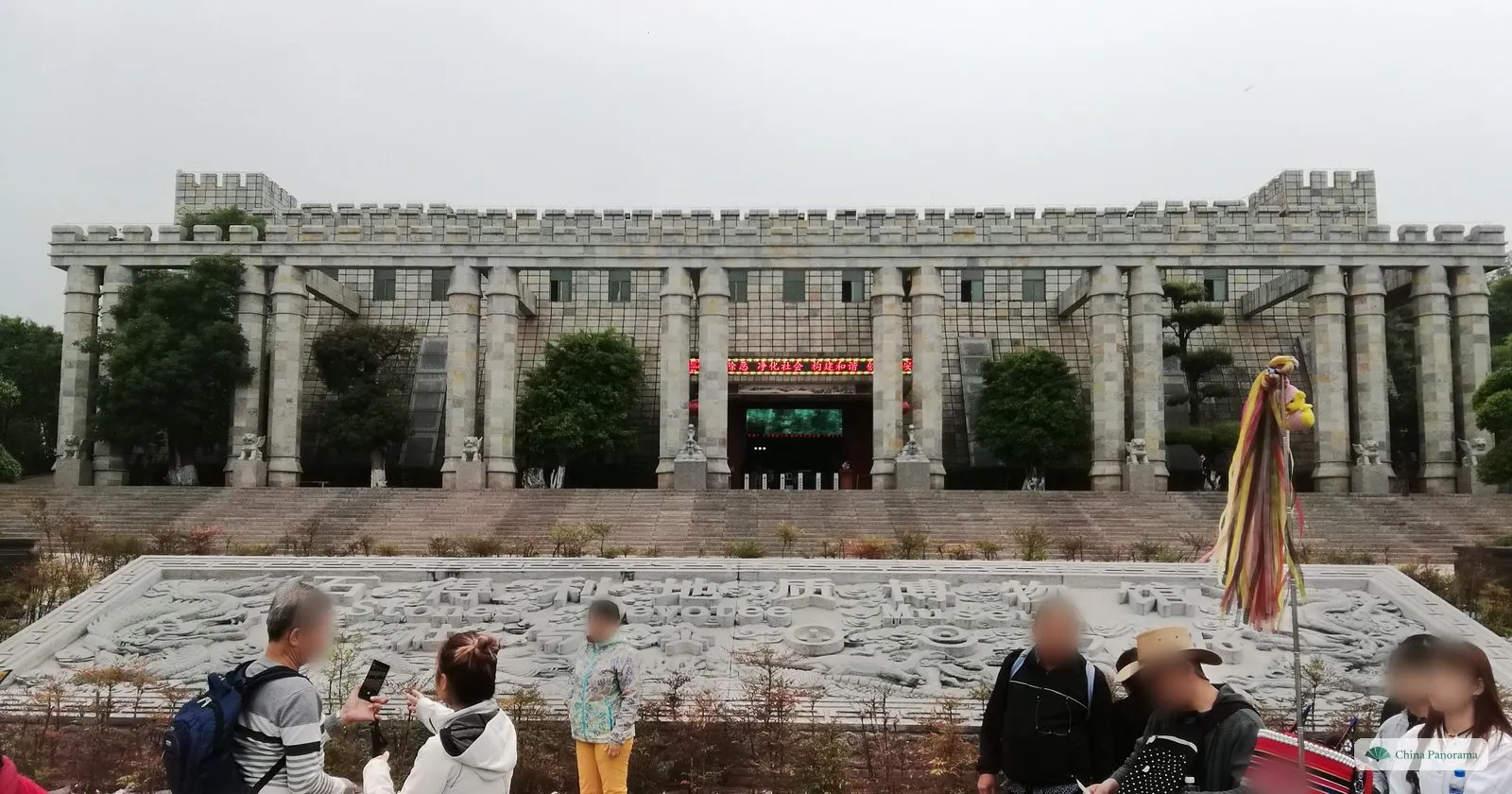
The shuttle from the visitor centre stops here, beside the karst geology museum. Start early and walk south.
What am I looking at?
The long couplet on Daguan Tower, the pinnacles from above, the “Shilin” inscription, the Jinma arch, the Western Hills across Lake Dianchi, and Daguan Park at sunrise. Tap a number on the photograph.
1Daguan Tower
大觀樓 · Read right to left
The plaque reads, from the right, 大觀樓: “tower of the grand view”. Old plaques run right to left.
Daguan Tower in the list below →Tap a number on the photo, or a name in the list.
20 places in and around Kunming
Filter by type, or by whether you need to be indoors — useful on a wet July afternoon.
 NatureShilin Yi Autonomous County · 石林彝族自治县Outdoors
Grey limestone pinnacles up to some 30 m high, packed so close that the paths squeeze between them: a karst landscape about 67 km east-south-east of central Kunming, in the county of the Yi people that took its name from it. The rock was laid down on the floor of a shallow sea in the Permian, more than 270 million years ago; rain, slightly acid, then cut it into blades and needles along its joints — you can see the vertical grooves on every rock. The area has been a national scenic area since 1982, and in 2007 it was inscribed on the World Heritage List as part of the South China Karst. In the Greater Stone Forest the paths lead past the two red characters 石林, “stone forest”, cut into a pinnacle: the name was given in 1931 by Yunnan's governor Long Yun; the original calligraphy was destroyed in the Cultural Revolution and the present characters were assembled from an ancient stele. Beyond them, narrow passages, the Sword Peak Pond and stairs up to a viewpoint over a sea of grey points. We walked it on the morning of 16 April 2019, from 08:59 to about 10:00, in a crowd that thinned only inside the narrow paths.
About 85 km by road from central Kunming, roughly an hour by car without traffic. The ticket has been reported at 130 CNY (travel-agency guides, 2025), covering the Greater and Lesser Stone Forests and three smaller areas plus the karst museum; the electric shuttle from the visitor centre to the gate has been reported at 25 CNY. Hours reported as 07:30–18:30 from March to October and 08:00–18:00 from November to February. We have not checked any of this with the scenic area. Ways to get there: see “Getting to the Stone Forest” on this page.
- Entry
- Price not verified — check on site
- Opening hours
- Hours not verified — check on site
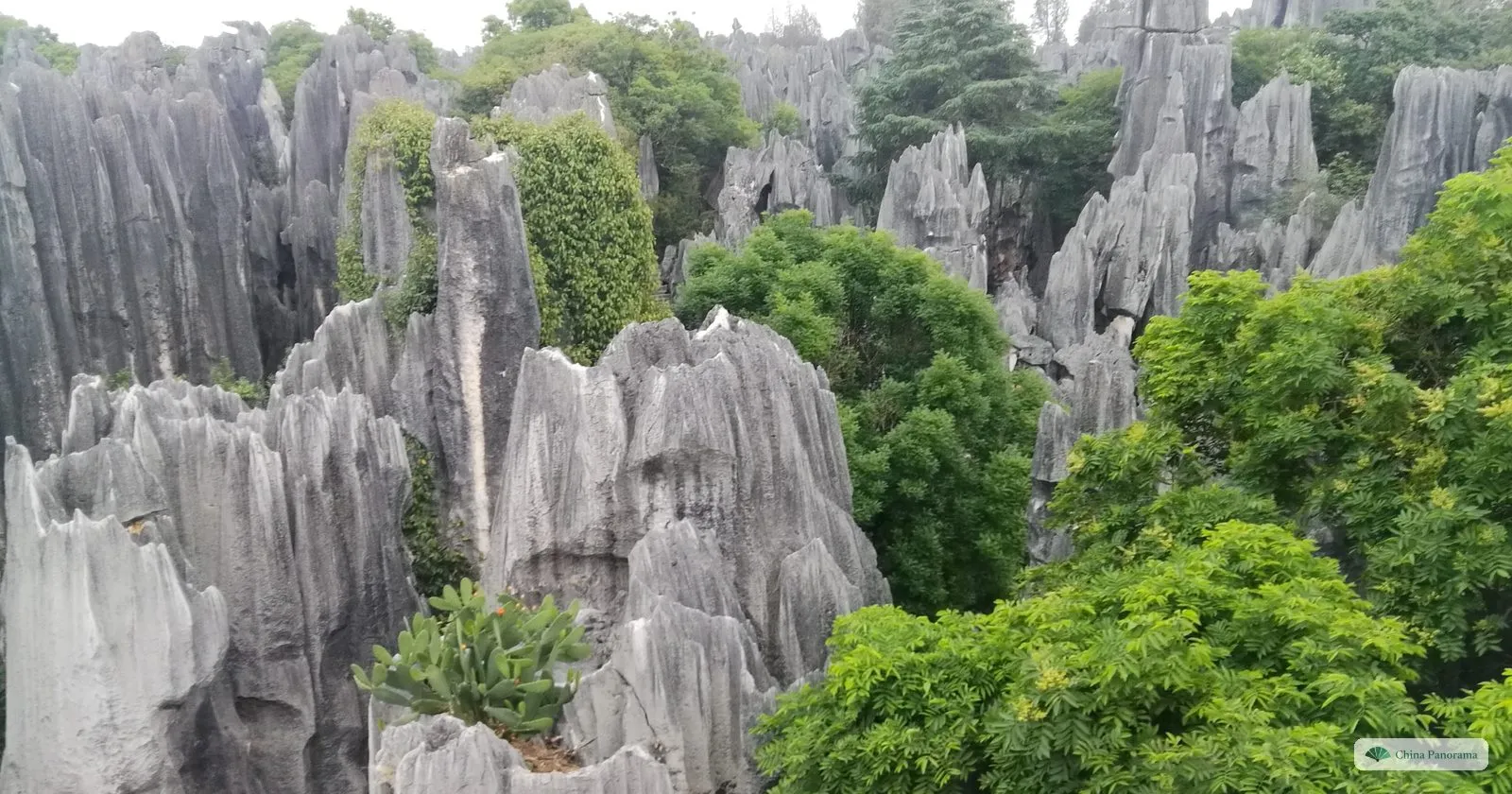
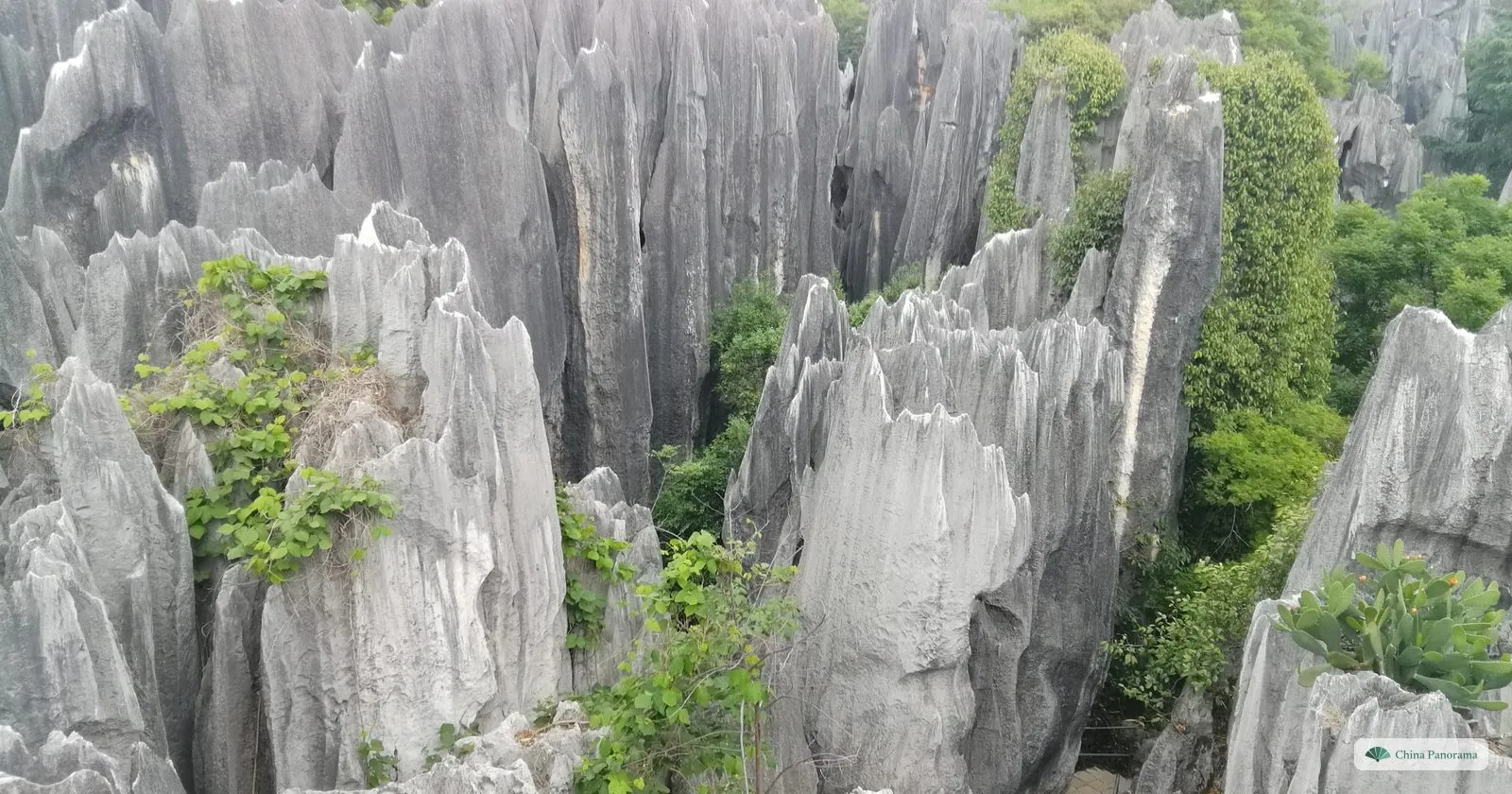
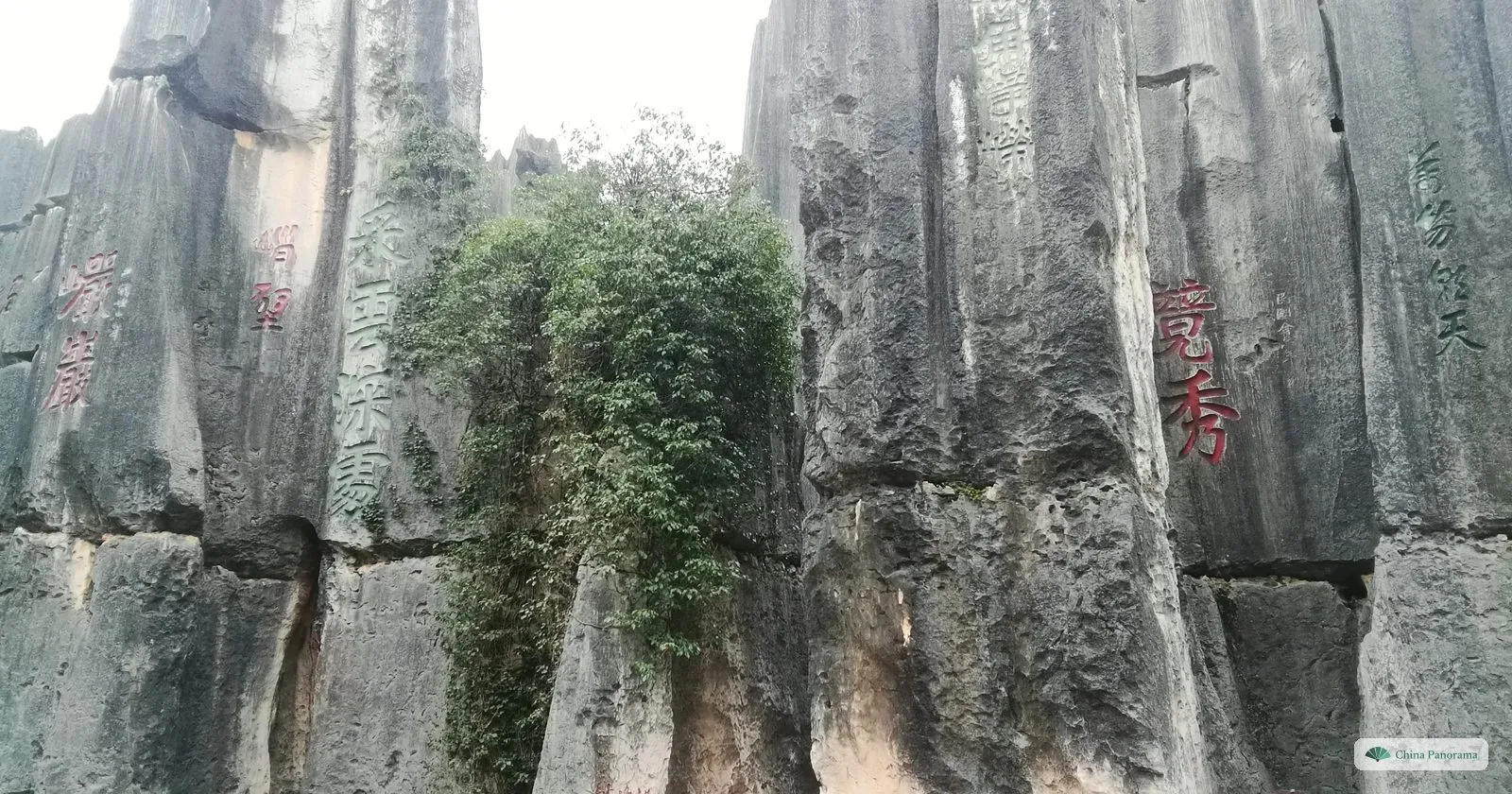
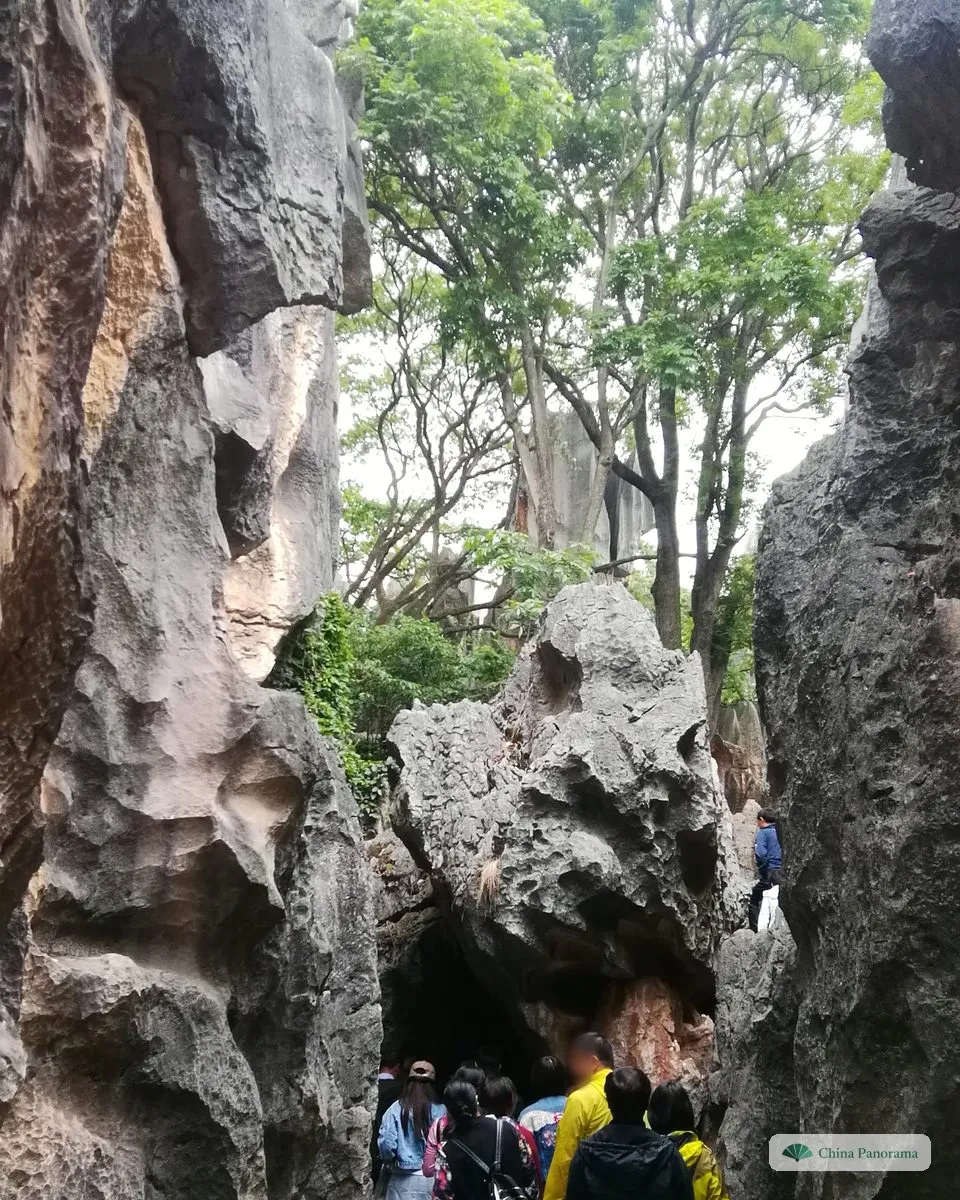

- NatureShilin Yi Autonomous County · 石林彝族自治县Outdoors
The gentler half of the Stone Forest, a few hundred metres east of the Greater one: single pinnacles and clumps of rock stand on mown lawns and around still ponds with red pavilions, and on a calm morning the whole grey skyline is mirrored in the water. Here stands the Ashima Rock, named after the heroine of the Sani, a branch of the Yi people: a girl who, in the legend, was forbidden to marry the man she loved and turned to stone. On a square nearby, dancers in the white, red and black costume of the Sani perform beside a giant model of a sanxian, the three-stringed lute of their “big sanxian” dance. On the 24th day of the sixth lunar month the Yi celebrate their Torch Festival, with dancing and wrestling. We were here from 10:00 to 10:45 on 16 April 2019, in grey weather.
Part of the same ticket as the Greater Stone Forest (reported 130 CNY, not checked). The way out to the visitor centre passes a lake with stone pillars rising from the water and a bridge.
- Entry
- Price not verified — check on site
- Opening hours
- Hours not verified — check on site
Lake Dianchi and Haigeng Park
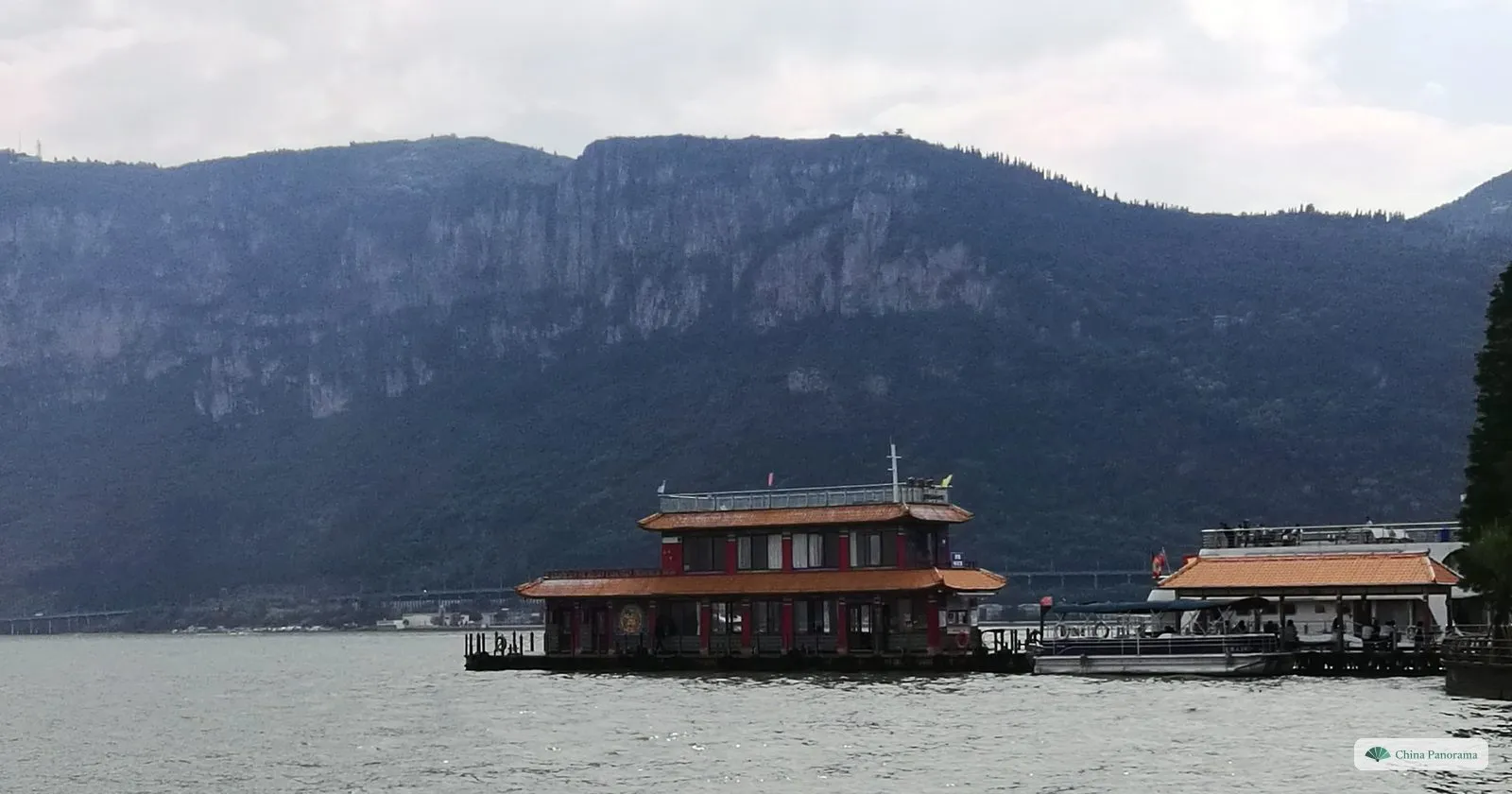
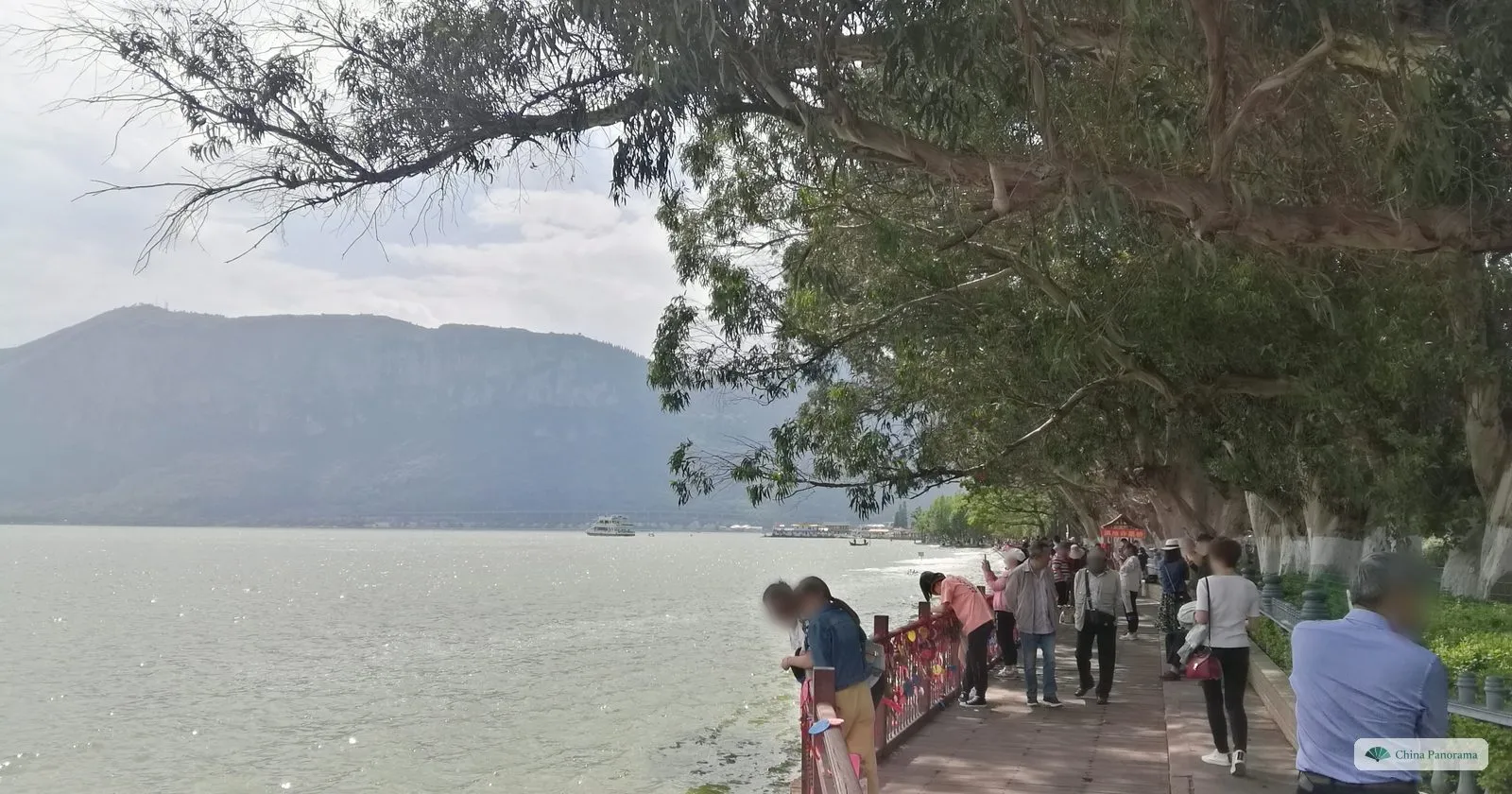
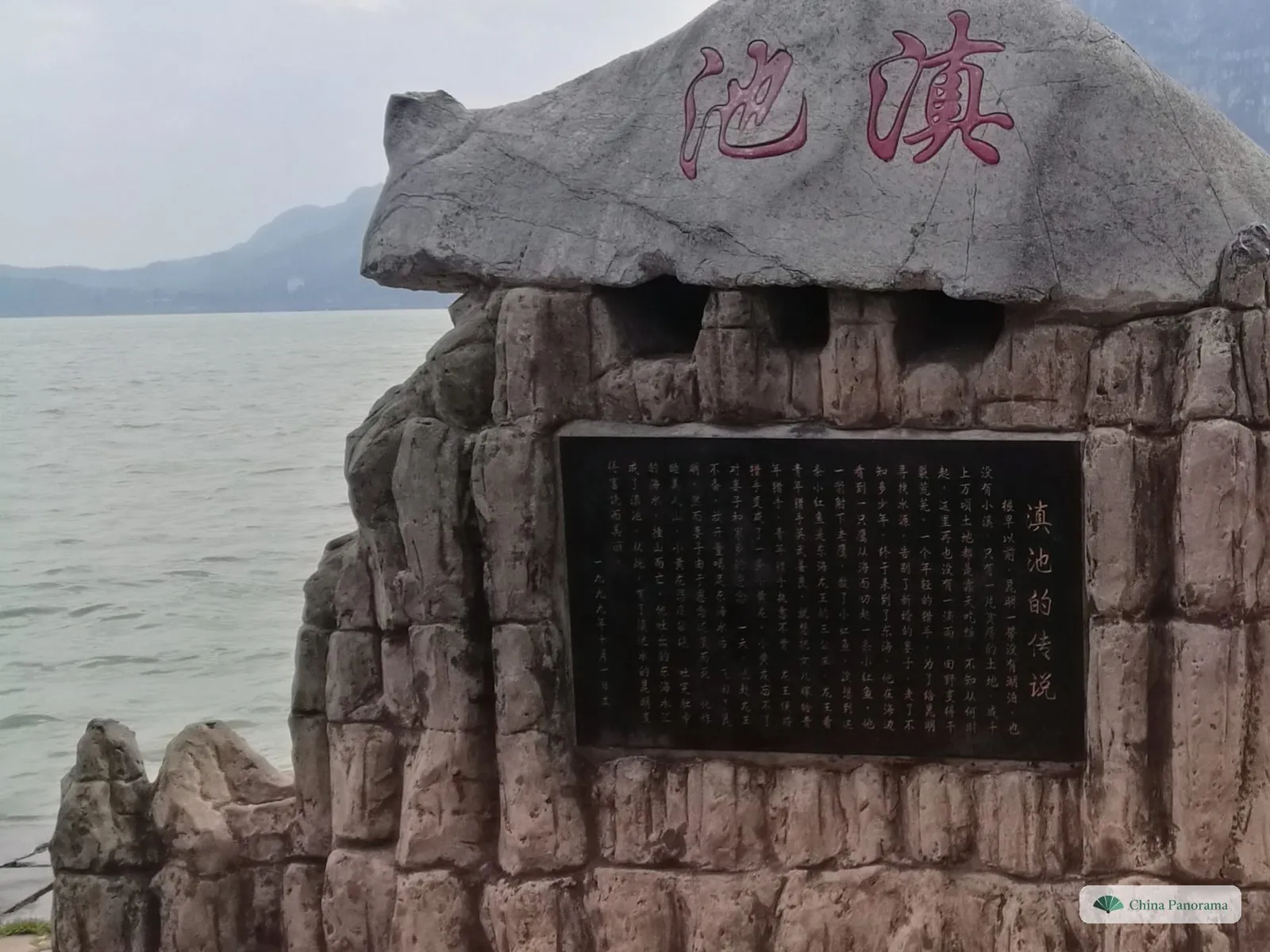
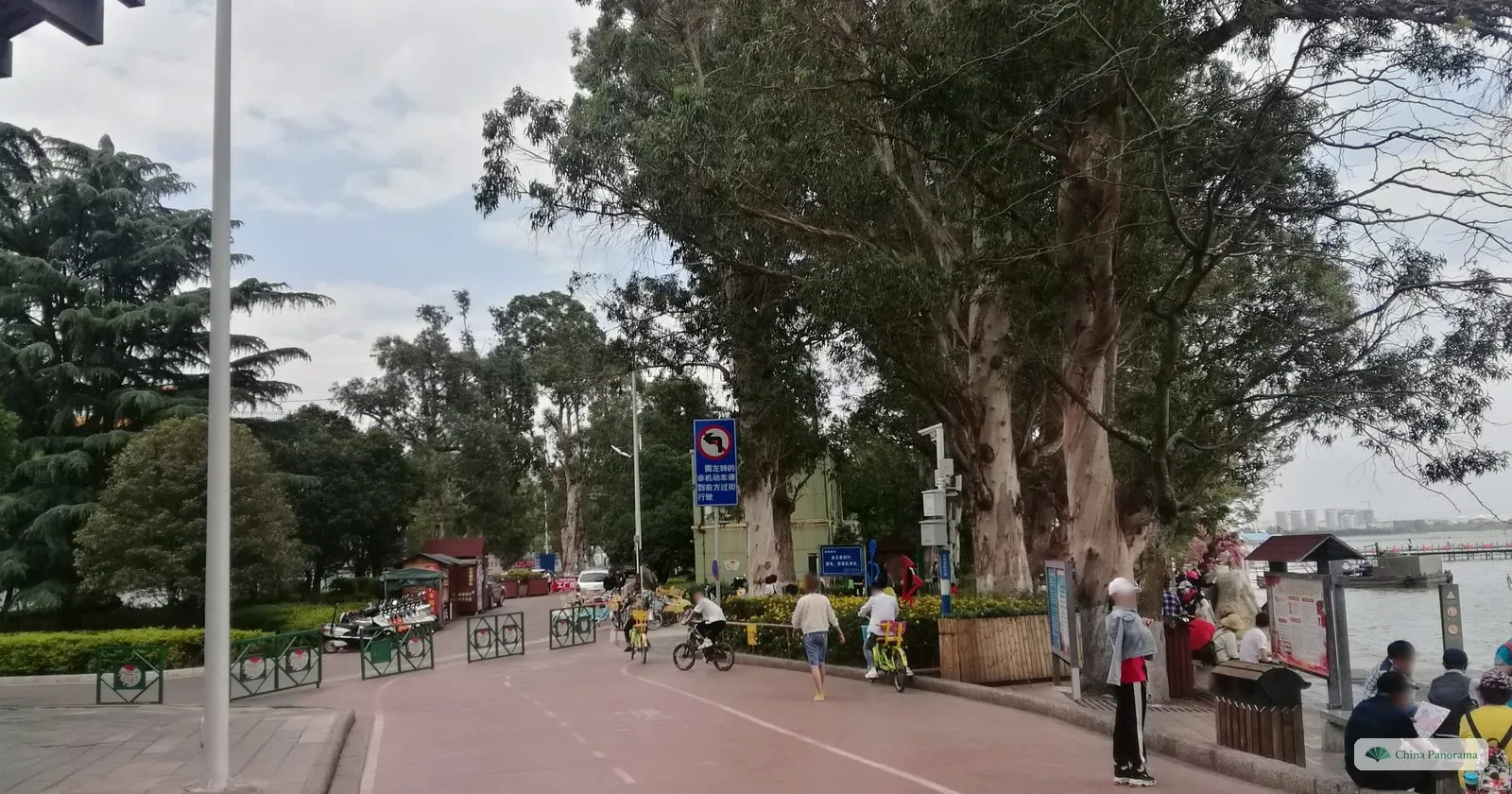
滇池 · 海埂公园NatureXishan · 西山区OutdoorsKunming's lake, at 1,886 m: about 40 km long and up to 7 km wide, the largest lake in Yunnan and the sixth-largest freshwater lake in China. A causeway, the Haigeng embankment, cuts off the small northern part, the Caohai. At Haigeng, on the east shore, a promenade under old eucalyptus trees runs along the water, with boats and a floating restaurant at the piers; straight across the lake the Western Hills drop to the water in grey cliffs. Every winter since 1985, black-headed gulls from Siberia and Central Asia have come to Kunming, roughly from late autumn to March, and the Haigeng embankment is where people feed them. A stone by the water is carved with the lake's name and the legend of how it was made. The lake has suffered badly from algae and pollution since the 1970s; it has improved since the cleanup of 2007–2011, but it is not for swimming. We walked here from 15:05 to 16:12 on 16 April 2019, on a warm, hazy afternoon; the gulls had left.
Haigeng is about 10 km south-west of the Jinma and Biji arches; Yuhucun station (Line 5) is about 2 km from the park, the Yunnan Ethnic Village on the way. For the embankment, where the gulls are fed, Yinghai Road (Line 5) is about 1.3 km from its north end. The promenade and the embankment are free and open at all hours. Boat trips leave from the piers; we have not checked prices.
- Entry
- Free
- Opening hours
- Open at all hours
- NatureXishan · 西山区Outdoors
The ridge along the west shore of Lake Dianchi, about 35 km long and up to 2,511 m high, which from the city looks like a woman lying on her back — hence its other name, the Sleeping Beauty. Its old name, Jade Rooster Hill (Biji Shan), is the one on the Biji arch in town. On the cliff face high above the lake, a Daoist named Wu Laiqing and his helpers began in 1781 to cut a path, steps and grottoes into the rock, a task that took decades: the Dragon Gate, with the Sanqing Pavilion, once a Yuan-dynasty villa turned into a Daoist temple. Lower down are the Huating and Taihua temples and the tomb of Nie Er, who wrote the music of China's national anthem.
Western Hills Park station (Line 3) is at the foot; from there buses and a cable car go up towards the Dragon Gate, about 3.5 km in a straight line. A second cable car crosses the lake from the Haigeng side. Entry to the Dragon Gate section and the cable cars are paid; we have not checked prices or hours.
- Entry
- Price not verified — check on site
- Opening hours
- Hours not verified — check on site
Daguan Tower and Daguan Park
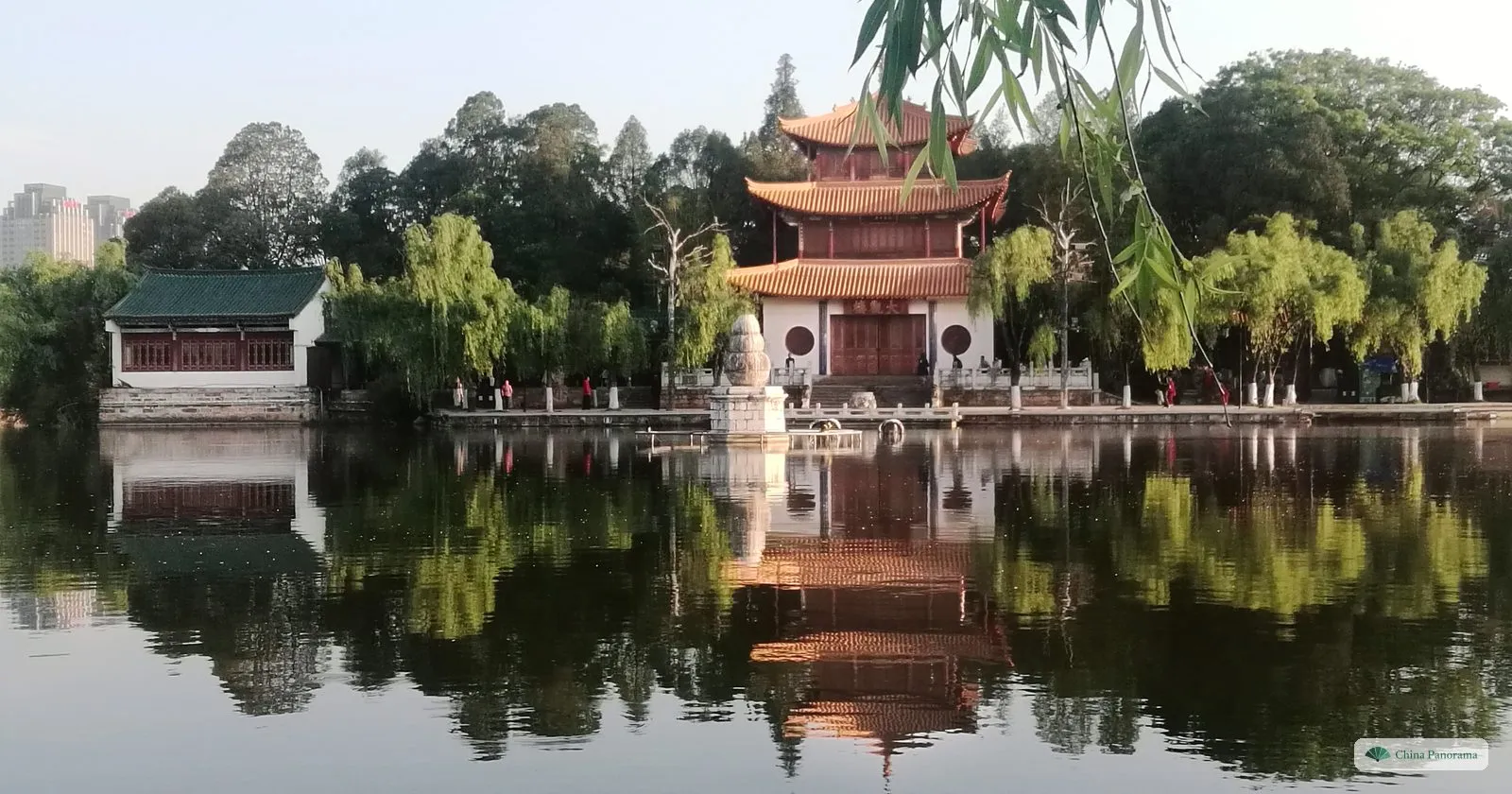
大观楼 · 大观公园LandmarkXishan · 西山区OutdoorsA three-storey tower on the north shore of Lake Dianchi, first built in 1696 when Yunnan's governor had ponds dug and pavilions put up on the spot, then called Jinhuapu. It was raised to three storeys in 1828, burnt in the Hui rebellion in 1857, rebuilt in 1866 and again, after a flood, in 1883 — the tower you see. On its front hang the two halves of the “longest couplet under heaven”, 180 characters written in the Qianlong era by the poet Sun Ran: the right-hand half describes the lake and the four mountains around it, the left-hand half two thousand years of Yunnan's history; the boards are the 1888 version, carved in the hand of Zhao Fan. Above the door, a plaque reads 拨浪千层, “a thousand layers of waves”, after an inscription by the Xianfeng emperor. The park around it, 47.8 hectares and half of it water, is Kunming's largest: willow causeways, lotus ponds, arched bridges and a great rockery. We came at 07:10 on 17 April 2019, as the low sun lit the tower and the water was still.
About 3.7 km west of the Jinma and Biji arches; Fuhai station (Line 5) is about 1.9 km away, so most visitors take a taxi or a bus. Visitors in 2025–2026 report free entry to the park; older guides give 20 CNY for the tower. Hours are reported variously as 07:00–19:00 or 09:00–17:00. We have not checked any of this.
- Entry
- Price not verified — check on site
- Opening hours
- Hours not verified — check on site
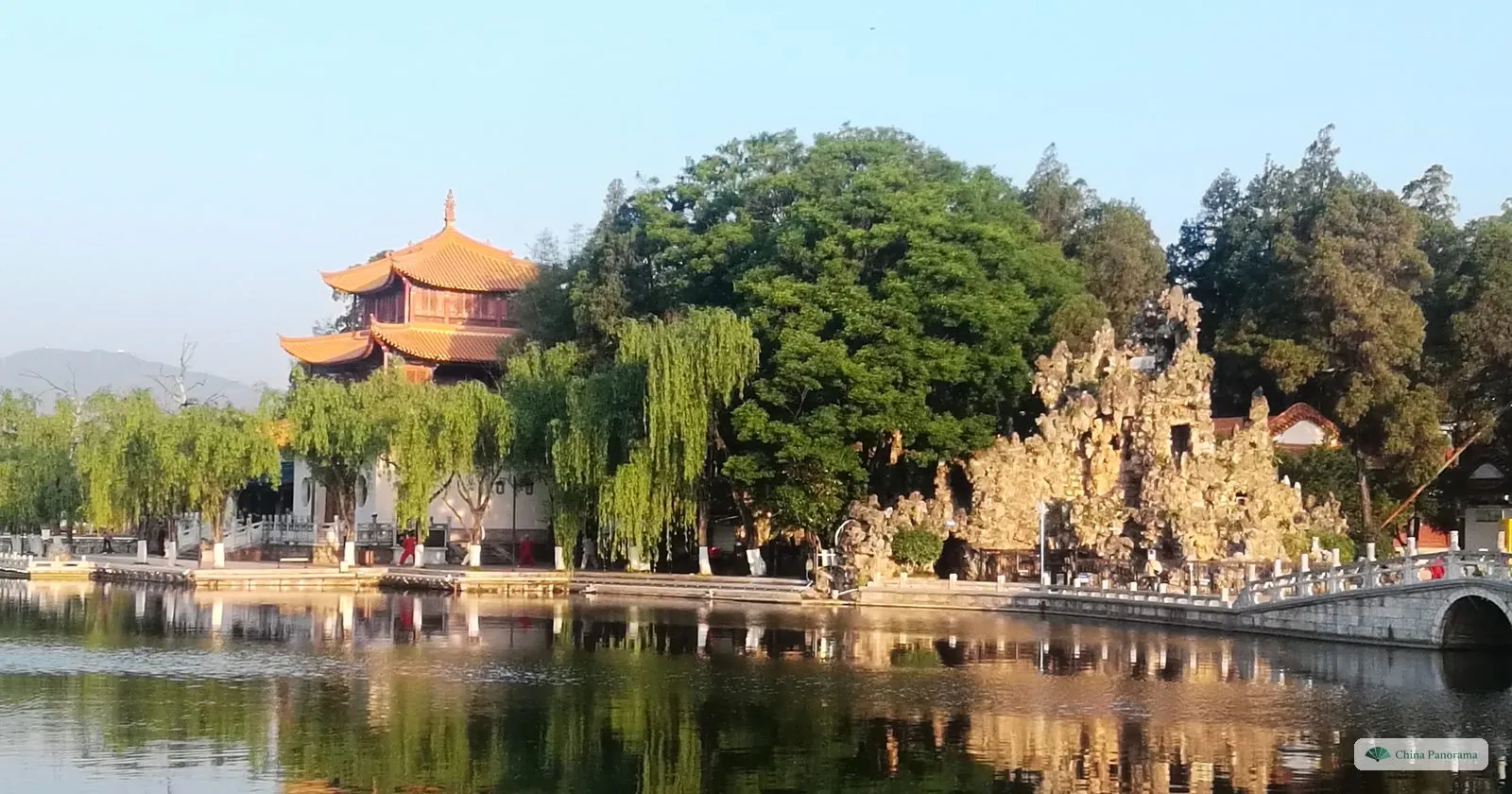
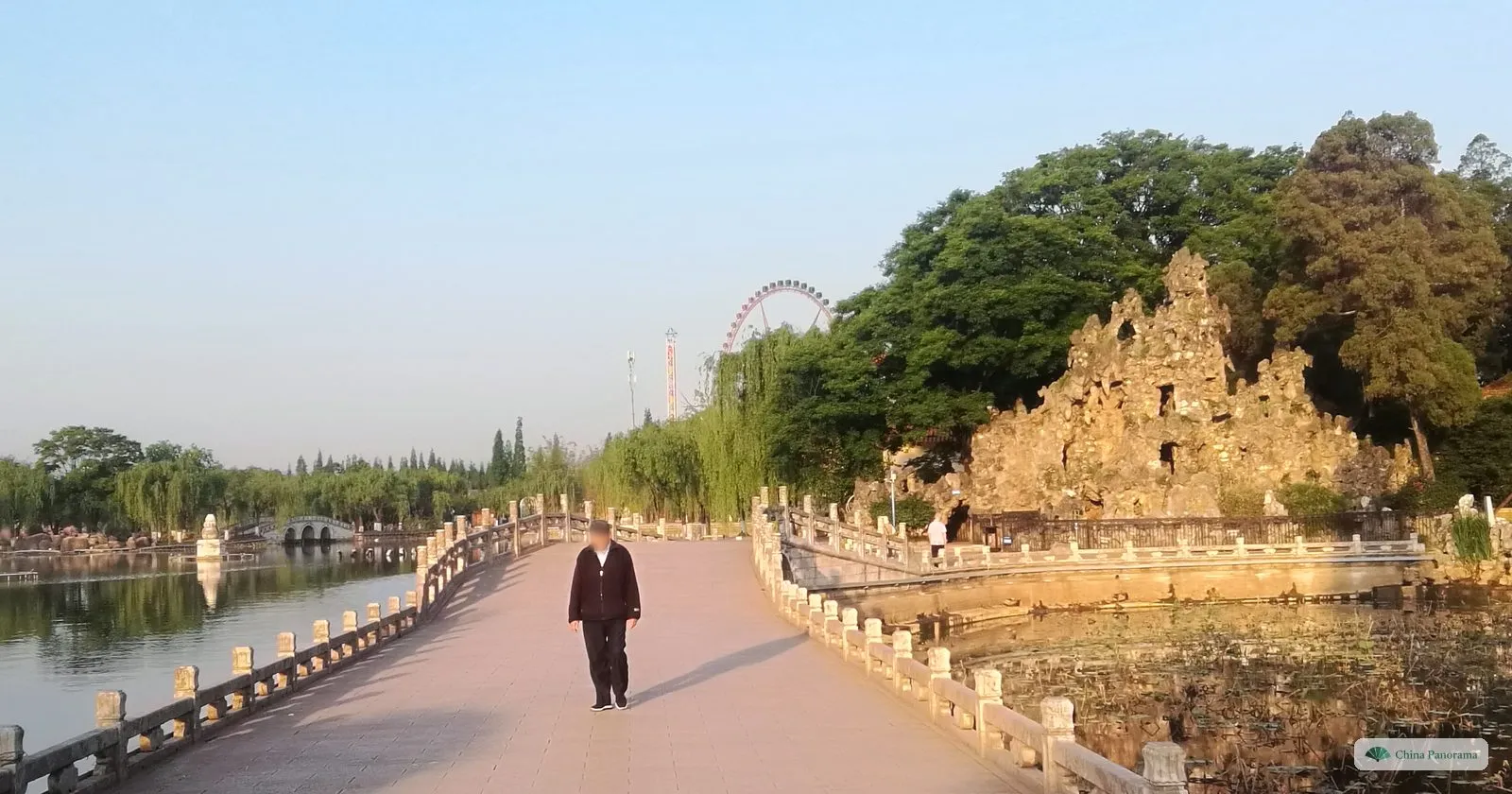
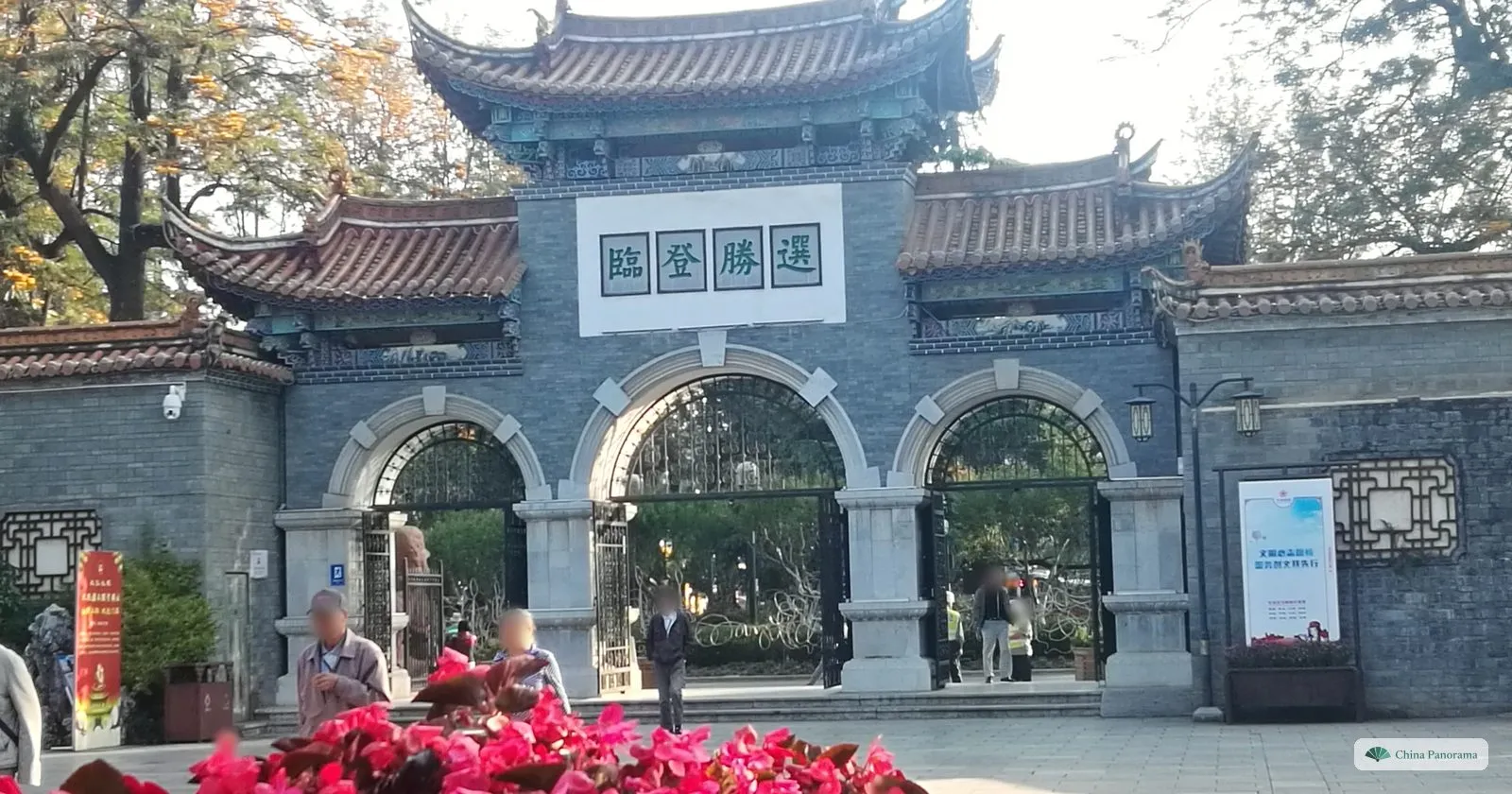
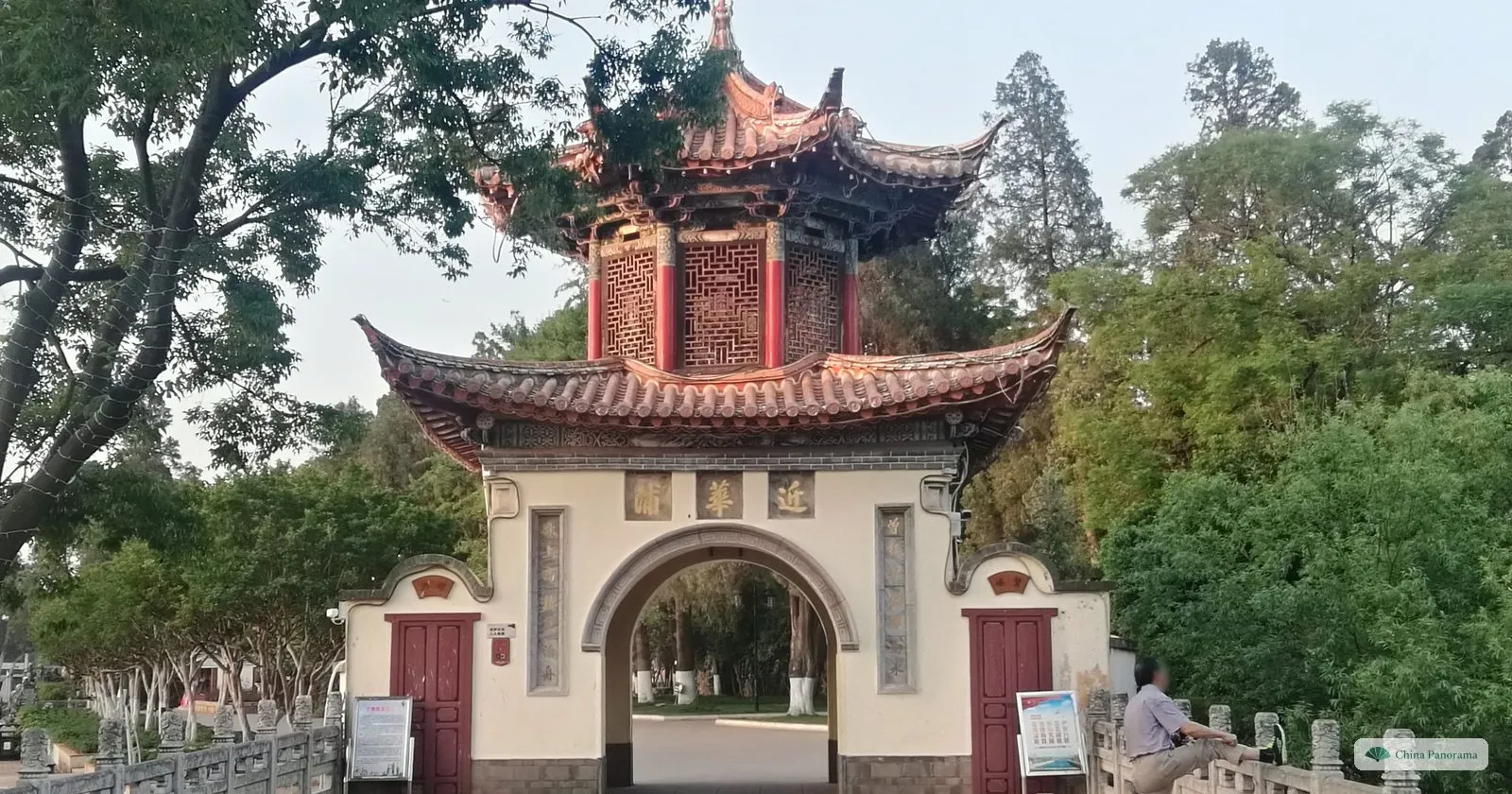

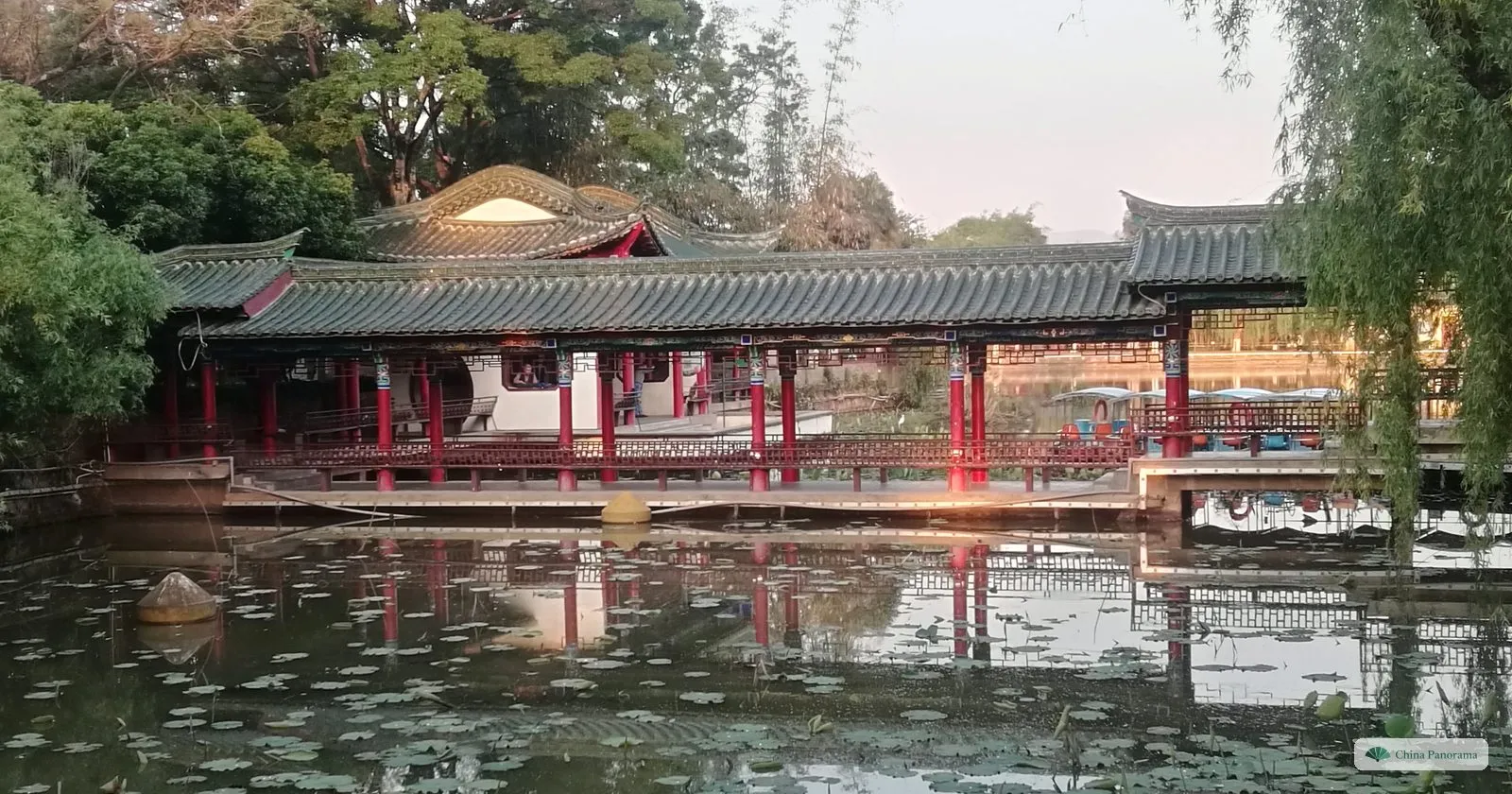
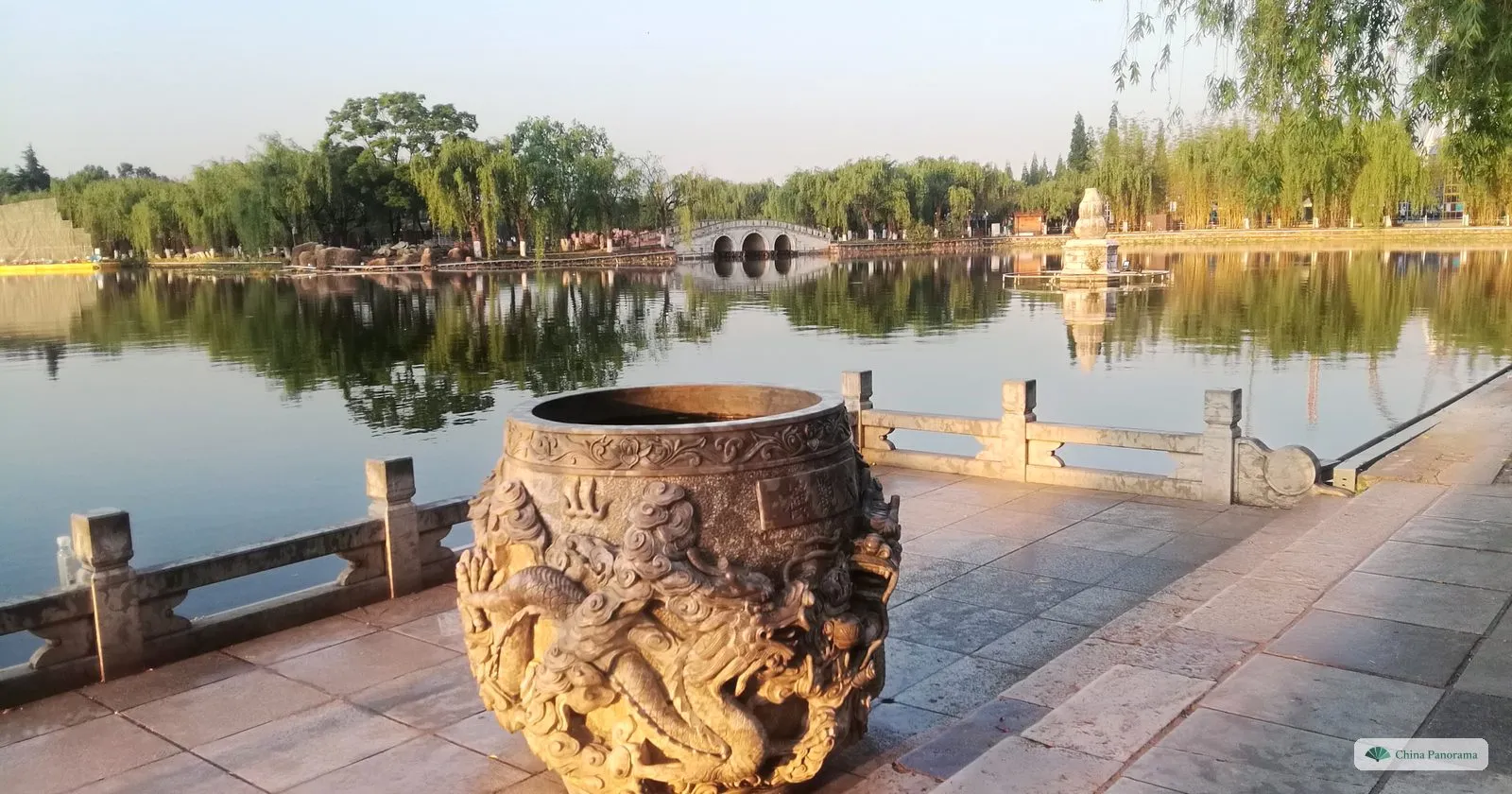
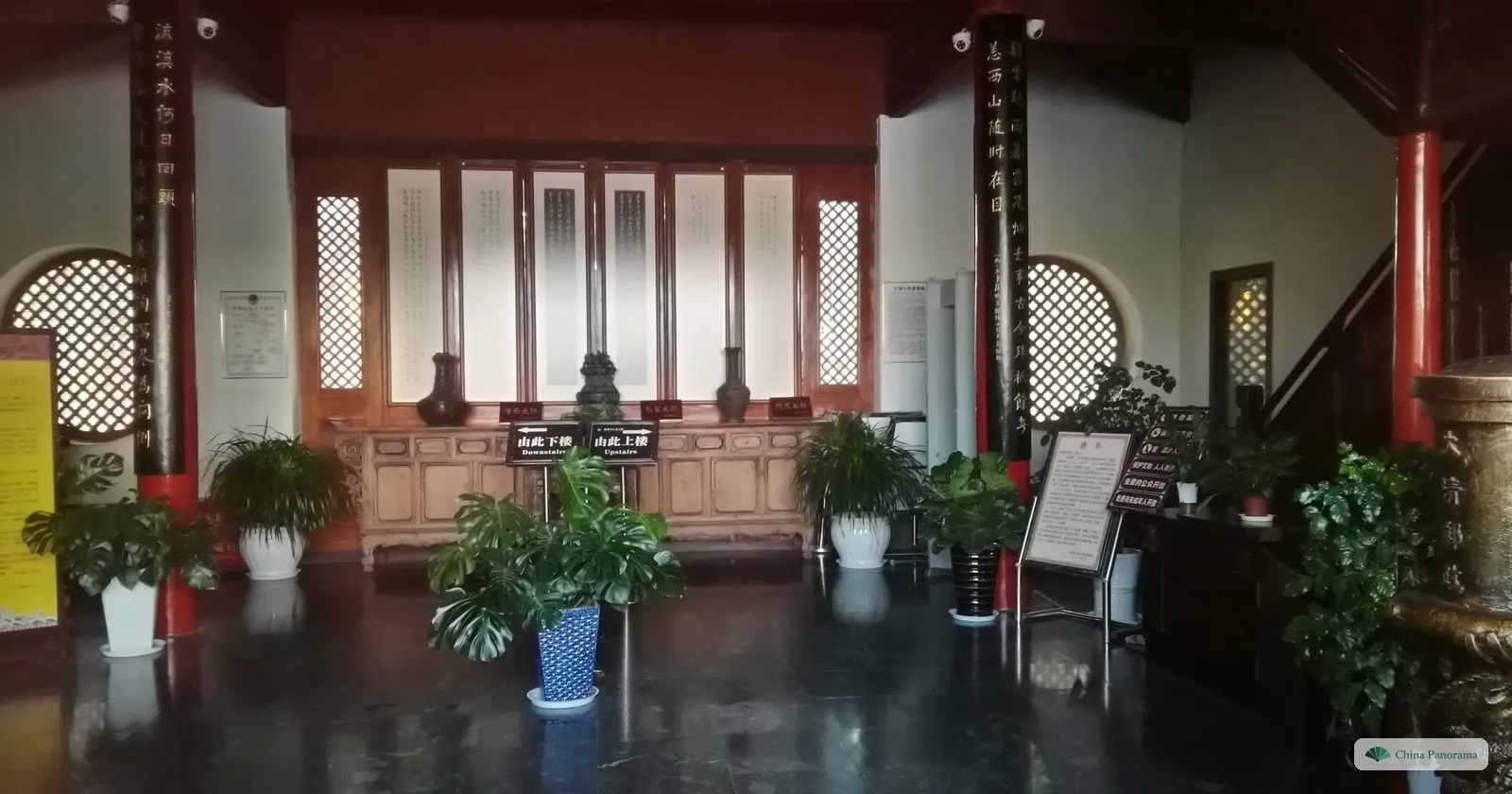
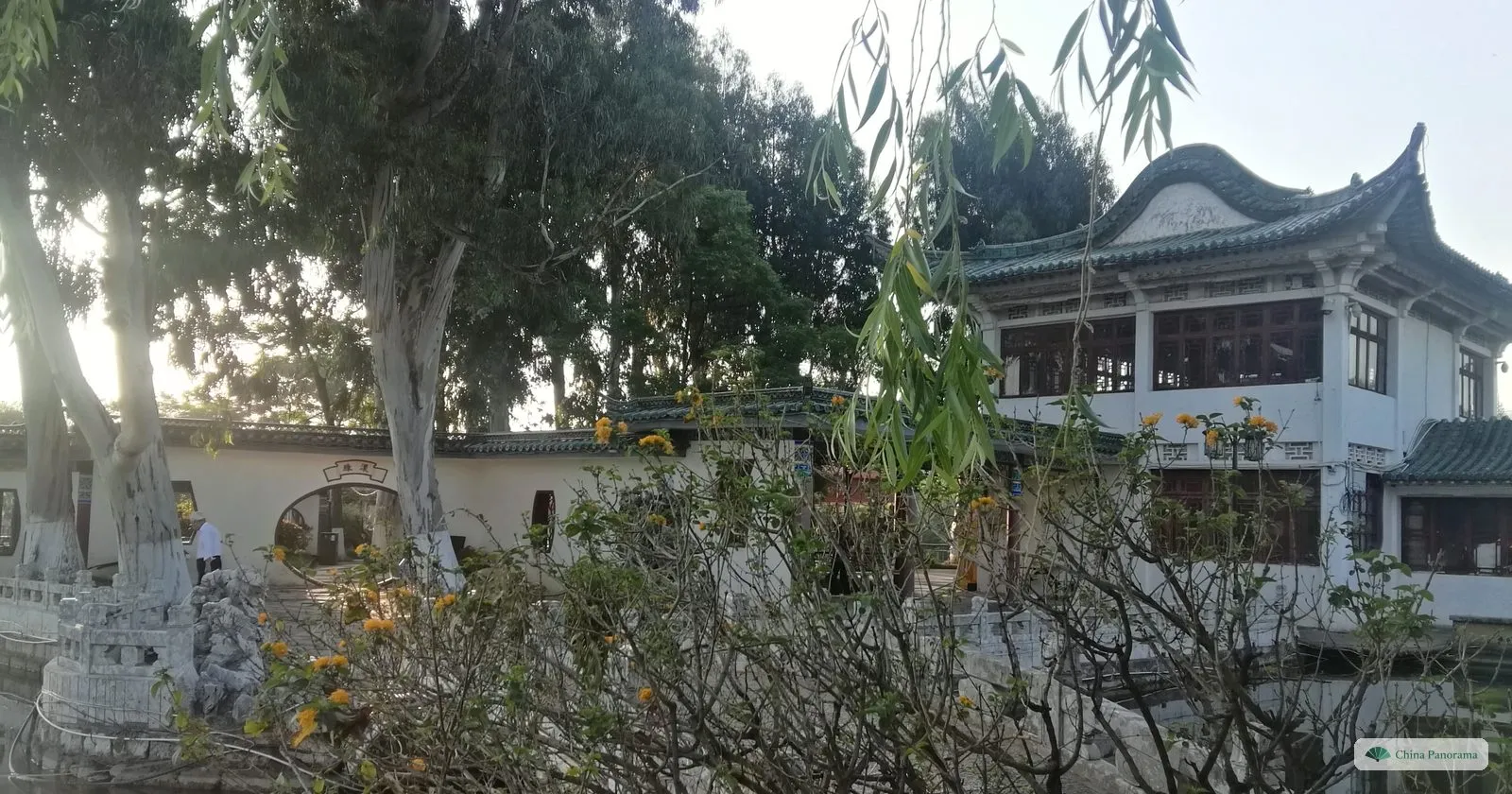
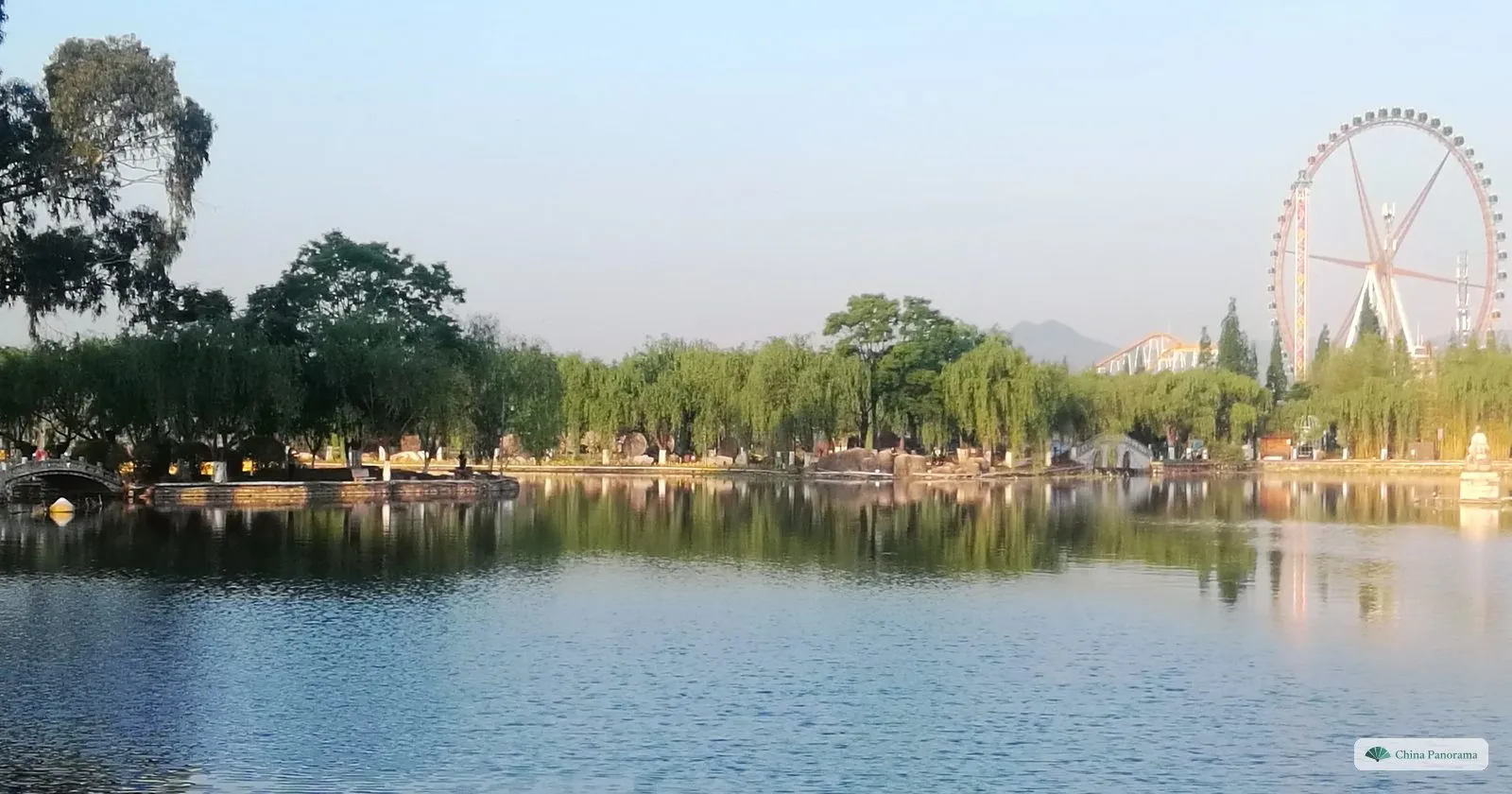
- LandmarkXishan · 西山区Outdoors
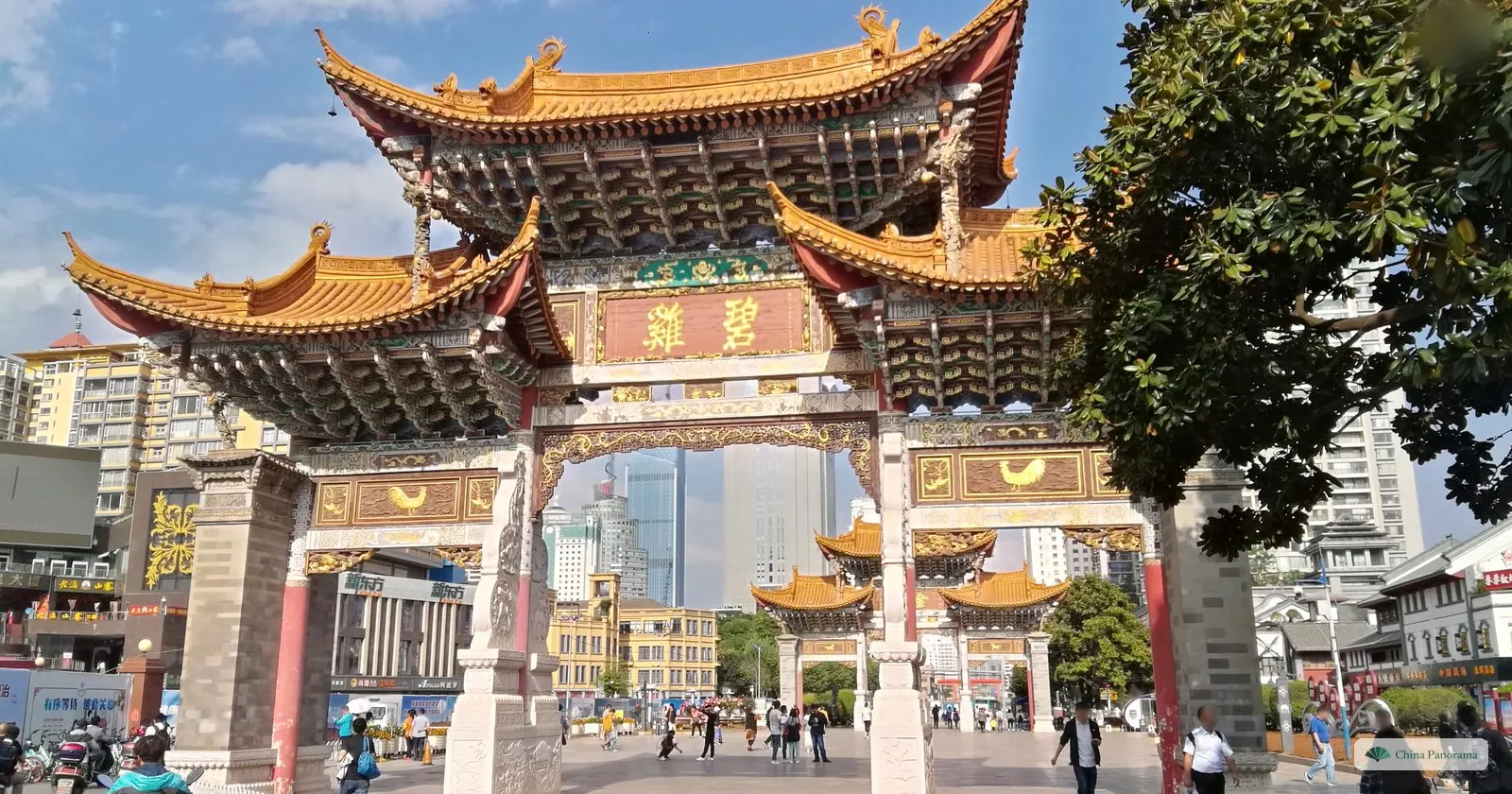
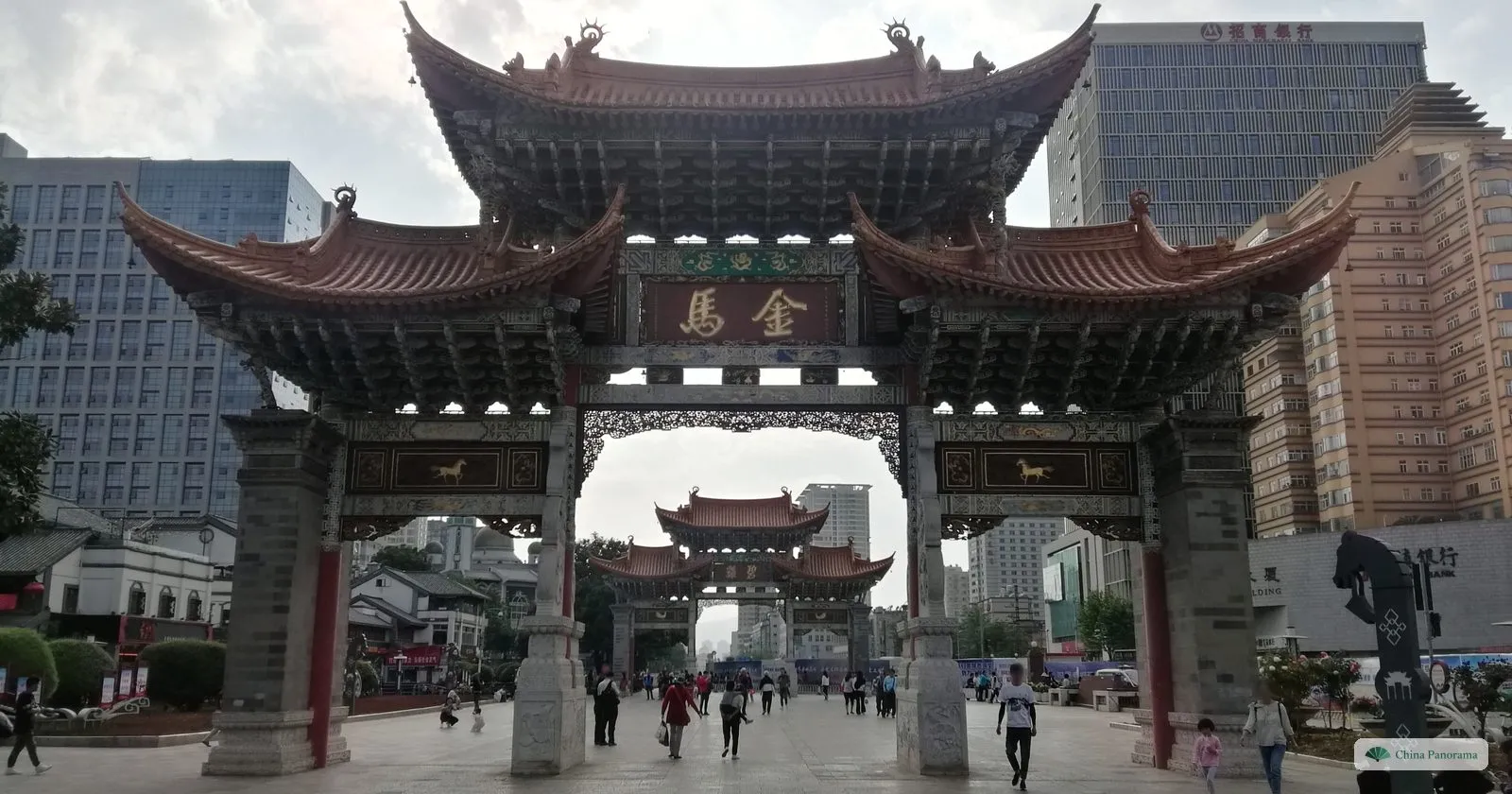
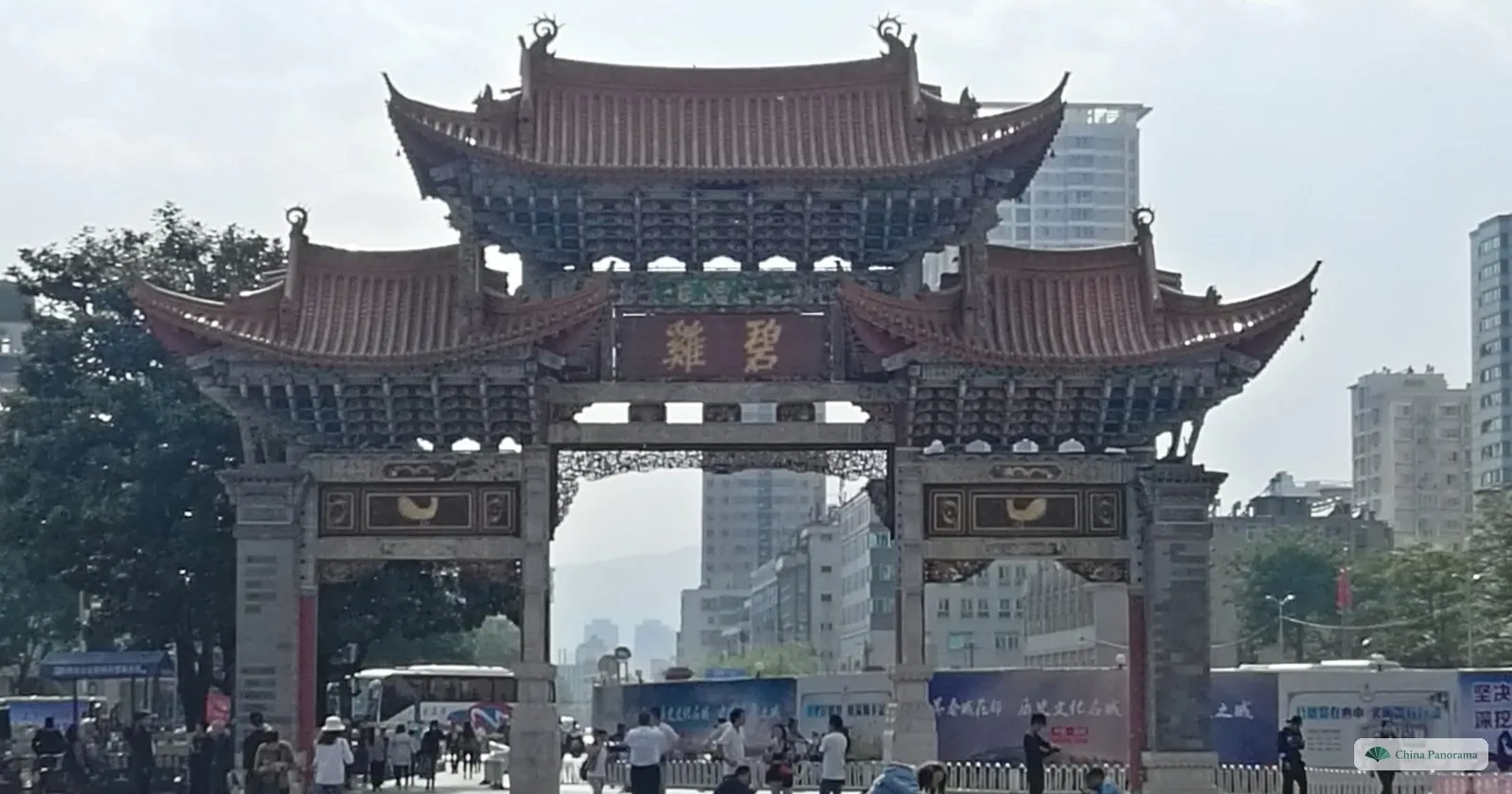
Two painted wooden archways about 12 m high and 18 m wide, a few dozen metres apart at the south end of Jinbi Road, the old north–south axis of the city: the Golden Horse (Jinma) arch to the east, the Jade Rooster (Biji) arch to the west, named after the hills east and west of Lake Dianchi. First put up in the Ming, in the Xuande era (1426–1435), they were destroyed and rebuilt in 1687, destroyed again in 1857 and rebuilt in 1884, then pulled down in the Cultural Revolution; the arches you see were rebuilt in 1998–1999, when Jinbi Road was widened. Legend says that at a rare alignment of sun and moon the shadows of the two arches reach towards each other — “gold and jade in mutual glory”. The Nanzhao-era East and West Temple pagodas stand a few hundred metres south. We were here from 16:56 to 17:00 on 16 April 2019.
Wuyi Road station (Lines 3 and 5) is about 600 m north; Tangzixiang (Lines 2 and 6) about 1 km. The arches stand in a pedestrian square, free and open at all hours; the surrounding blocks are a shopping street.
- Entry
- Free
- Opening hours
- Open at all hours
East and West Temple Pagodas
东寺塔 · 西寺塔TempleXishan · 西山区OutdoorsTwo square brick pagodas of the 9th century, when Kunming was Tuodong, the eastern capital of the Nanzhao kingdom: the West Pagoda was built between 824 and 859 and still stands; the East Pagoda, of the same years, fell in the earthquake of 1833 and was rebuilt in its Tang-era style in 1882. They stand a few hundred metres apart south of the Jinma and Biji arches, among new shopping streets, and are the oldest structures in the city centre.
The West Pagoda is about 500 m south-west of the Jinma and Biji arches, an 8-minute walk; the East Pagoda is close by on Shulin Street. We have not checked whether the pagoda grounds charge entry, or their hours.
- Entry
- Price not verified — check on site
- Opening hours
- Hours not verified — check on site
- ParkWuhua · 五华区Outdoors
A small lake in the old city, laid out as a park with causeways, willows and pavilions on islands; locals come to dance, sing and play cards. In winter the black-headed gulls fly in from Lake Dianchi and are fed from the bridges — the scene on half the postcards of Kunming. Around it lie the yellow Yunnan Army Academy, Yunnan University's old campus and the lanes of the former Southwest Associated University quarter.
Huashan West Road station (Line 5) is about 550 m away; the Jinma and Biji arches are 1.8 km south. We have not checked whether the park charges entry or its hours.
- Entry
- Price not verified — check on site
- Opening hours
- Hours not verified — check on site
Yunnan Army Academy
云南陆军讲武堂Republic-era heritageWuhua · 五华区IndoorsA long yellow two-storey quadrangle on the west side of Green Lake, founded in 1909, in the last years of the Qing, to train officers for the new army. Many of its cadets went on to fight in the 1911 revolution and in the National Protection War of 1915–1916, which began in Yunnan against Yuan Shikai's attempt to make himself emperor; Zhu De, later commander of the Red Army, studied here. Today it is a museum.
Huashan West Road station (Line 5) is about 700 m away. We have not checked the museum's entry rules, hours or closing day.
- Entry
- Price not verified — check on site
- Opening hours
- Hours not verified — check on site
- TempleWuhua · 五华区Outdoors
Kunming's main Buddhist temple, first founded more than 1,200 years ago under the Nanzhao. Unusually, you walk down into it: the main hall stands at the bottom of a hollow, in the middle of a pond crossed by bridges and an octagonal pavilion. Behind it, a hall in the Thai style was added in the 1980s for a statue of the Buddha given by Thailand.
Yuantong Hill station (Line 5) is about 400 m away. It is a working temple: dress modestly and do not photograph people praying. We have not checked the entry price or hours.
- Entry
- Price not verified — check on site
- Opening hours
- Hours not verified — check on site
- ParkXishan · 西山区Outdoors
A park of about 126 hectares on the shore of Lake Dianchi near Haigeng, with villages built in the styles of Yunnan's peoples — Dai bamboo houses, Bai courtyards, Naxi, Yi and Tibetan buildings — and dances and shows through the day. Yunnan is home to 25 of China's 55 recognised minorities; this is the quickest, if very staged, way to see their architecture side by side.
Yuhucun station (Line 5) is about 1 km away; Haigeng Park is next door to the south. Entry is paid; we have not checked the price or hours.
- Entry
- Price not verified — check on site
- Opening hours
- Hours not verified — check on site
Dounan Flower Market
斗南花卉市场MarketChenggong · 呈贡区IndoorsAsia's largest market for cut flowers, by the account of China's state news agency: halls of roses, carnations, lilies and dried flowers in Chenggong, on the east side of Lake Dianchi, sold by the bunch for very little. Behind it, at the Kunming International Flower Auction Trading Center, buyers bid on screens in a Dutch-style descending auction, a few seconds per lot; the flowers go out the same day across China and abroad.
Jingui Street station (Line 4) is about 300 m away; Dounan (Lines 1 and 4) a little further. About 16 km south-east of the Jinma and Biji arches. The market is free to walk; stalls keep their own hours.
- Entry
- Free
- Opening hours
- Hours not verified — check on site
Xishan Wanda twin towers
西山万达广场双塔ArchitectureXishan · 西山区OutdoorsNew Kunming: two glass towers 307 m high (by the developer's main-roof figure; reports with the spire give about 318 m) above a shopping mall in Xishan district, 2.8 km south-west of the Jinma and Biji arches. Their steel cores topped out in January 2015; for years they were the tallest buildings in Yunnan. We passed at 16:41 on 16 April 2019, on the way back from the lake.
Kunming Railway Station (Line 1) is about 1.5 km away. The square and the mall are free; shops keep their own hours.
- Entry
- Free
- Opening hours
- Hours not verified — check on site
- FoodWuhua · 五华区Outdoors
The lanes of old Kunming, a few hundred metres north-east of the Jinma and Biji arches: Nanqiang Street, running from Huguo Road to Sanshi Street, is the old town's food street in the evening, and around it more than ten restored streets — Guanghua, Jingxing, Wenming — make up the quarter known as Kunming Old Street, with two-storey wooden shophouses, tea houses and the old bird-and-flower market. On Guanghua Street stands Victory Hall, built after 1945 to mark the end of the war against Japan.
Wuyi Road station (Lines 3 and 5) is about 350 m from Wenming Street; Dongfeng Square (Lines 2 and 3) is close to Nanqiang Street. The streets are free and open at all hours; shops and stalls keep their own hours, busiest after dark.
- Entry
- Free
- Opening hours
- Open at all hours
- FoodGuandu · 官渡区Outdoors
Kunming's best-known night market, in the Shuangqiao neighbourhood of Guandu district, about 4 km south-east of the centre between Guanxing Road and Baohai Road: lanes of grills, rice-noodle stalls, fruit and snacks that fill up after dark. It reopened after a rebuild at the end of 2024; stalls are reported to open around 18:00 and run until about 03:00.
Rixin Road station (Line 1) is about 400 m away, Fude (Line 1) about 450 m. Free to walk; the hours are reports, not checked.
- Entry
- Free
- Opening hours
- Hours not verified — check on site
Guandu Ancient Town and the Vajra Pagoda
官渡古镇 · 妙湛寺金刚塔TempleGuandu · 官渡区OutdoorsAn old lakeside town about 10 km south-east of the centre, named after the landing where boats carrying officials once put in on the north shore of Lake Dianchi. Its treasure is the Vajra Pagoda of Miaozhan Temple, built in 1457–1458 and damaged by an earthquake in 1666: a square stone platform carrying five stone stupas, a national key cultural relic and one of the earliest stone pagodas of this vajra-throne type in China. The lanes around it are restored, with temples, a market and stalls selling Guandu baba, a flatbread with sesame, peanut or bean-paste filling.
Xingyao Road station (Line 1) is about 1.1 km away; the Yunnan Provincial Museum is about 1 km south. Visitors report free entry to the lanes; we have not checked the pagoda's or the temples' entry rules.
- Entry
- Price not verified — check on site
- Opening hours
- Hours not verified — check on site
Yunnan Provincial Museum
云南省博物馆MuseumGuandu · 官渡区IndoorsThe province's museum, founded in 1951; its new building on Guangfu Road in Guandu opened on 18 May 2015, with about 16,500 m² of galleries. The core is the bronze culture of the ancient Dian kingdom around Lake Dianchi — among the treasures the Ox and Tiger bronze table and a Western Han cowrie container topped by four oxen and a gilded rider — and the Buddhist art of the Dali kingdom, such as a gilded silver garuda set with pearls.
New Asia Athletics Park station (Line 1) is about 1.6 km away; Guandu Ancient Town about 1 km north. Wikipedia gives free entry with your ID or passport, Tuesday to Sunday 09:00–17:00, closed on Mondays; we have not checked this with the museum.
- Entry
- Price not verified — check on site
- Opening hours
- Hours not verified — check on site
- ParkWuhua · 五华区Outdoors
A hill park in the north of the old city, home to the Kunming Zoo, and the city's best-known place for blossom: an area of about 100 by 200 m planted with Yunnan cherry, Japanese cherry and weeping crabapple, which flower together from about late February into March — the “Yuantong blossom tide”. In 2025 China's state news agency reported full bloom on 21 March.
Yuantong Hill station (Line 5) is at the gate; Yuantong Temple is about 400 m south. Entry is paid (the zoo); we have not checked the price or hours, and the bloom moves with the weather from year to year.
- Entry
- Price not verified — check on site
- Opening hours
- Hours not verified — check on site
Jiaochang Middle Road and the jacaranda
教场中路 · 蓝花楹StreetWuhua · 五华区OutdoorsA residential road in the north of the city that turns violet every spring: both sides are lined with jacaranda trees, which Kunming's broadcaster gives as in full flower from late April to mid-May (the season can stretch from mid-April into early June). In 2026 the district organised a viewing period from 25 April to 24 May. It is a street people live on — expect crowds with cameras at weekends.
Sujiatang station (Line 4) is about 600 m away; about 4 km north-west of the Jinma and Biji arches. Free and open at all hours.
- Entry
- Free
- Opening hours
- Open at all hours
- NatureYuxi · Chengjiang · 玉溪市 · 澄江市Outdoors
The clear lake south of Kunming, in the neighbouring prefecture of Yuxi: 212 km² at 1,721 m, up to 155 m and on average 76 m deep — China's third-deepest freshwater lake after Tianchi on Changbai Mountain and Kanas — with the largest volume of water of any lake in Yunnan. Its water has been rated Class I, the best grade, unlike Dianchi's. Divers reported suspected man-made structures on its bed in 1992; whether they are a sunken town is still debated.
About 55 km by road from central Kunming to Chengjiang on the north shore, roughly 40 minutes without traffic (OpenStreetMap); no metro or direct train to the lakeshore, so most visitors drive or join a tour. The shore is free; beaches and resorts may charge — not checked.
- Entry
- Price not verified — check on site
- Opening hours
- Hours not verified — check on site
Entry prices and opening hours are marked unverified where we have not checked them against an official source. We would rather show a gap than a number we made up.
How to get from Kunming to the Stone Forest
The Stone Forest is 67 km from the city centre in a straight line, about 85 km by road. There are four ways to get there, and they suit different people. Tick what applies to you; the best match is marked, and each card says why.
What applies to you?
Tick a situation above and the option that fits best is marked.
High-speed train + bus 99 高铁 · 昆明南 → 石林西 + 99路
Kunming South → Shilin West, then a local bus
The fastest public option: about 20 minutes on the train, then a bus or taxi from Shilin West station to the scenic area’s visitor centre, about 20 km.
- Train
- 18–24 min, 18–25 CNY, first about 07:43 (reported)
- Bus 99
- about 30 min, 10 CNY (reported)
- Taxi instead
- about 15 min, 20–40 CNY (reported)
- Getting to Kunming South
- Metro Line 1 or 4; about 24 km from the centre
- As cheap as possible: Cheap, even with the metro ride out to Kunming South.
- No changes, please: Metro, train, then a bus: three changes.
- I want to be there before the crowds: An early train can have you at the gate around 09:00.
- I don’t read Chinese: Trains are signed in English; book on 12306 or Trip.com with your passport. The bus is the hard part.
- I also want Naigu or other sights nearby: Fine for the main Stone Forest; Naigu is a further 9 km by taxi.
Direct bus from the East Coach Station 东部汽车客运站 → 石林
One bus, door to car park
Buses run from Kunming’s East Coach Station (Metro Lines 3 and 6) straight to the scenic area’s car park, about 85 km.
- Fare
- 34 CNY (reported, date unclear)
- Departures
- every 30 minutes, about 08:00–18:00 (reported)
- Distance
- about 85 km by road; about an hour by car without traffic
- As cheap as possible: The cheapest way, by the reported fare.
- No changes, please: One bus from the metro station to the car park.
- I want to be there before the crowds: The first buses are reported around 08:00, so you arrive mid-morning with the tour groups.
- I don’t read Chinese: Tickets and signs at the coach station are mostly in Chinese.
- I also want Naigu or other sights nearby: It goes to the Stone Forest only.
Taxi, ride-hailing or a hired car 打车 · 包车
Door to door
How we went: about an hour each way on the expressway. A car for the day lets you add the Naigu Stone Forest or other sights around Shilin.
- Distance
- about 85 km, 62 min without traffic (OpenStreetMap)
- Price
- by the app or agreed for the day; not checked
- Booking
- DiDi in Alipay, or through your hotel
- As cheap as possible: The most expensive way, unless you are three or four.
- No changes, please: Picked up at your hotel, dropped at the gate.
- I want to be there before the crowds: Leave at 07:30 and walk in at opening time.
- I don’t read Chinese: DiDi in Alipay has an English interface and translates messages to the driver.
- I also want Naigu or other sights nearby: The only easy way to add Naigu or other sights the same day.
A day tour 一日游
Bus, guide and ticket in one
Agencies and hotels sell day trips that include transport and the ticket. Cheap group tours in Yunnan are known for long stops at shops; read what is included.
- Price
- varies widely; not checked
- Language
- most group tours are in Chinese; English tours cost more
- As cheap as possible: Group tours can be cheap — because of the shopping stops.
- No changes, please: Nothing to organise.
- I want to be there before the crowds: Tours pick up from several hotels and arrive with all the other tours.
- I don’t read Chinese: Only if you book an English-speaking tour.
- I also want Naigu or other sights nearby: Some combine the Stone Forest with Jiuxiang caves or Naigu.
Train and bus times and fares are reports from travel agencies and travellers (amber), not checked against 12306 or the coach station. The road distance and driving time are from OpenStreetMap, without traffic.
Routes, and how the city is laid out
The old centre — the arches, the pagodas, Green Lake, Yuantong Temple — fits inside 3 km. Daguan Park is 4 km west on the shore of the lake, Haigeng 10 km south-west, the Dragon Gate 12 km across the water, Dounan 16 km south-east. Tap a place to see how far it is.
Tap a place on the map or in the list.
Daguan Tower on the north shore of the lake. Fuhai (Line 5), 1.9 km. Details below ↓
From about 18:00 (reported). Rixin Road (Line 1). Details below ↓
Buses to the Stone Forest. Lines 3 and 6.
The lakeside promenade; the Yunnan Ethnic Village is 1 km north. Yuhucun (Line 5). Details below ↓
The Vajra Pagoda of 1457–1458; the Yunnan Provincial Museum is 1 km south. Xingyao Road (Line 1). Details below ↓
On the cliffs above the west shore. Western Hills Park (Line 3), then bus or cable car. Details below ↓
Asia’s largest cut-flower market. Jingui Street (Line 4). Details below ↓
High-speed trains, including to Shilin West and Laos. Lines 1 and 4.
Metro Line 6 into the city.
Straight-line distances from the Jinma and Biji arches, rounded — not travel distances.
Three routes that don’t double back
A morning in the Stone Forest, an afternoon on Lake Dianchi ending at the arches, and an early morning at Daguan Tower. They follow our photographs, with the time and distance between stops.
About 2 hours inside · 2.5 km on foot, more on the winding paths
The gate and the karst museum
Walk 13 min· 500 m
Stone Forest Lake
Walk 17 min· 620 m
The “Shilin” inscription
Walk 16 min
Narrow paths and the viewpoint
Walk 13 min· 160 m
The lawns
Walk 25 min· 370 m
Ponds of the Lesser Stone Forest
Walk 6 min· 80 m
The sanxian dance
Walk 13 min· 390 m
The lake by the exit
8 stops · 103 min walking
About 2 hours · 15 minutes by taxi between the two
Haigeng promenade
Walk 22 min· 600 m
The Western Hills across the water
Walk 1 min· 20 m
The Dianchi stone
Taxi 11 min· 8.3 km
Xishan Wanda twin towers
Taxi 4 min· 4.4 km
The Jinma arch
Walk 1 min· 60 m
The Biji arch
6 stops · 24 min walking · 15 min by taxi
About 45 minutes · under 1 km on foot
The Jinhuapu gate
Walk 2 min
Lotus ponds and boats
Walk 9 min· 170 m
Daguan Tower
Walk 4 min· 70 m
The causeway and the rockery
Walk 5 min
The tower across the water
Walk 16 min· 250 m
The main gate
6 stops · 36 min walking
Stop by stop
A morning in the Stone Forest
Our 16 April 2019: the visitor centre at 08:48, the shuttle to the gate, in at 08:59; the lake at 09:12, the “Shilin” inscription at 09:29, the narrow paths and the viewpoint until 09:46; the lawns at 10:00, the ponds of the Lesser Stone Forest at 10:25, the dancers at 10:31 and the lake by the exit at 10:44. Come early: by 09:30 the square below the inscription was packed with tour groups.
Off the shuttle at the gate building, beside the karst geology museum: 08:59.
- Entry
- Reported 130 CNY
- Hours
- Reported 07:30–18:30 (Mar–Oct)
Walk 13 min· 500 m
Pinnacles standing in still water along the path south: 09:12.
- Entry
- Reported 130 CNY
- Hours
- Reported 07:30–18:30 (Mar–Oct)
Walk 17 min· 620 m
3The “Shilin” inscription
石林题刻 · 石林胜景Past a rock balanced on a rock, into the Greater Stone Forest: the two red characters at 09:29, Sani women in costume posing for photos below.
- Entry
- Reported 130 CNY
- Hours
- Reported 07:30–18:30 (Mar–Oct)
Walk 16 min
4Narrow paths and the viewpoint
剑峰池 · 观景台Through the clefts by the Sword Peak Pond and up the steps: the view over the pinnacles at 09:46.
- Entry
- Reported 130 CNY
- Hours
- Reported 07:30–18:30 (Mar–Oct)
Walk 13 min· 160 m
5The lawns
草坪Down and out onto open lawns with single rocks and a tree growing out of a boulder: 09:59.
- Entry
- Reported 130 CNY
- Hours
- Reported 07:30–18:30 (Mar–Oct)
Walk 25 min· 370 m
East through the Lesser Stone Forest to the ponds with the red pavilion and its reflection: 10:25.
- Entry
- Reported 130 CNY
- Hours
- Reported 07:30–18:30 (Mar–Oct)
Walk 6 min· 80 m
Sani dancers in white and red beside the giant sanxian lute: 10:31.
- Entry
- Reported 130 CNY
- Hours
- Reported 07:30–18:30 (Mar–Oct)
Walk 13 min· 390 m
North across the lawns to a lake with pinnacles in the water and a long bridge: 10:44; the exit at 10:50.
- Entry
- Reported 130 CNY
- Hours
- Reported 07:30–18:30 (Mar–Oct)
Easy add-ons: The Naigu Stone Forest, about 9 km north-east, is part of the World Heritage listing: darker, dolomite rock and far fewer people. The ticket is reported to include it; we have not been there or checked.
* Inside the Stone Forest and Daguan Park the minutes are those between our photographs (they include stops), and distances are straight lines between the photos' GPS points — the paths wind, so you will walk further. Car legs are OpenStreetMap driving times without traffic; allow about double at busy times. Clock times are from our own photographs, 16–17 April 2019. Stops marked with a star have prices or opening hours we have not checked.
Where to stay in Kunming
Kunming is spread out: the old centre, the lake at Haigeng, Guandu and the high-speed station in Chenggong are 10–24 km apart. Which area suits you depends on what you plan to do. Tick what applies; the best match is marked.
What applies to you?
Tick a situation above and the option that fits best is marked.
Old centre: Nanping Street and Green Lake 南屏街 · 翠湖
Between Dongfeng Square and Green Lake
The arches, the Old Street quarter, Green Lake, Yuantong Temple and the Army Academy are all within about 2 km. Lines 2, 3 and 5 meet here.
- Metro
- Dongfeng Square (2/3), Wuyi Road (3/5), Huashan West Road (5)
- To Kunming South
- Line 2 to South Ring Road, then Line 1; about 24 km
- To the airport
- Line 6 from Tangzixiang, 1 km away
- First visit: I want to walk to the sights: Most of the city sights are a walk away.
- I want street food in the evening: Nanqiang Street and the Old Street quarter are on the doorstep.
- Early high-speed train (Stone Forest, Dali, Laos): One change to Kunming South; allow about an hour.
- Early flight: Line 6 to the airport starts at Tangzixiang, nearby.
- Lake Dianchi and the winter gulls: Haigeng is 10 km away.
- Somewhere quieter: The busiest part of the city.
Around Kunming station 昆明站
2.5 km south-east of the arches
Hotels of every kind round the old railway station. Line 1 runs from here straight to Kunming South without a change; Shuangqiao night market is two stops away.
- Metro
- Kunming Railway Station (Line 1)
- To Kunming South
- Line 1, no change
- Night market
- Shuangqiao, about 1.5 km
- First visit: I want to walk to the sights: The old centre is 2.5 km north: a walk, or one metro ride.
- I want street food in the evening: Shuangqiao night market is close.
- Early high-speed train (Stone Forest, Dali, Laos): Line 1 goes straight to the high-speed station.
- Early flight: Change to Line 6 at South Ring Road and Tangzixiang.
- Lake Dianchi and the winter gulls: Far from the lake.
- Somewhere quieter: Station areas are busy day and night.
Haigeng, by Lake Dianchi 海埂 · 滇池
10 km south-west, on the shore
Hotels near Haigeng Park and the Yunnan Ethnic Village, with the lake and the Western Hills in front. In winter the gulls are on the embankment.
- Metro
- Yuhucun or Yinghai Road (Line 5), 1–2 km
- To the centre
- Line 5 to Wuyi Road
- To the Western Hills
- cable car across the lake (prices not checked)
- First visit: I want to walk to the sights: Everything else is a metro or taxi ride away.
- I want street food in the evening: Few evening food streets nearby.
- Early high-speed train (Stone Forest, Dali, Laos): The far side of the city from Kunming South.
- Early flight: The far side of the city from the airport.
- Lake Dianchi and the winter gulls: On the shore, close to the gull-feeding embankment.
- Somewhere quieter: Lakeside parks rather than traffic.
Guandu: the old town and the museum 官渡古镇
10 km south-east
The restored lanes of Guandu Ancient Town and the Yunnan Provincial Museum, with Line 1 running on to Kunming South.
- Metro
- Xingyao Road (Line 1), about 1 km
- To Kunming South
- Line 1, no change
- Evening
- stalls in the old town
- First visit: I want to walk to the sights: The museum and the old town are on foot; the city centre is 10 km away.
- I want street food in the evening: Snack stalls in the lanes of the old town.
- Early high-speed train (Stone Forest, Dali, Laos): Line 1 to Kunming South, no change.
- Early flight: Two changes to Line 6.
- Lake Dianchi and the winter gulls: Near the lake’s north-east shore, but not at the gull spots.
- Somewhere quieter: Quieter than the centre at night.
Chenggong: Dounan and Kunming South 呈贡 · 斗南
16–24 km south-east, the new city
The new district by the high-speed station and the flower market: new hotels, wide roads, few sights.
- Metro
- Lines 1 and 4: Dounan, Jingui Street, Kunming South Railway Station
- To the old centre
- about 45 minutes by metro (estimate)
- Flower market
- Dounan, on the spot
- First visit: I want to walk to the sights: The city sights are 16–24 km away.
- I want street food in the evening: Malls rather than old food streets.
- Early high-speed train (Stone Forest, Dali, Laos): Next to Kunming South — the easiest early start.
- Early flight: The airport is on the other side of the city.
- Lake Dianchi and the winter gulls: Near the east shore of the lake, but far from Haigeng.
- Somewhere quieter: New and quiet in the evening.
Metro connections from OpenStreetMap, 20 October 2026; the journey time from Chenggong to the centre is our estimate. No hotel prices: we have not checked any.
Where to go after Kunming
Most visitors use Kunming as the start of a Yunnan trip. From Kunming South, trains run west to Dali and Lijiang, north-west on to Shangri-La, south to Xishuangbanna and across the border to Laos. They differ most in two things: how far they are, and how high. Tick what applies to you.
What applies to you?
Tick a situation above and the option that fits best is marked.
Dali 大理
Old town between Lake Erhai and the Cang Mountains
A walled old town of the Bai people, the Three Pagodas, and cycling along Lake Erhai. The easiest next stop.
- Train
- about 2 hours from Kunming (reported)
- Altitude
- 1,975 m — about the same as Kunming
- Distance
- 270 km west, straight line
- I only have 2–3 more days: Two hours away: two days are enough.
- I want an old town: A walled old town, rebuilt and busy but real in its grid and gates.
- I want high mountains: The Cang Mountains rise above 4,000 m behind the town, with a cable car.
- It is winter and I want warmth: Sunny by day, cold at night — like Kunming.
- Altitude worries me: No higher than Kunming.
- I am going on to South-East Asia: A detour away from the border.
Lijiang 丽江
The Naxi old town under Jade Dragon Snow Mountain
The canal-lined old town of the Naxi, a World Heritage Site, and the glaciers of Jade Dragon Snow Mountain. Often combined with Dali.
- Train
- fastest about 3 hours from Kunming (reported)
- Altitude
- 2,400 m
- Distance
- 320 km north-west, straight line
- January
- 15 °C by day, 0 °C at night
- I only have 2–3 more days: Possible in two days, better in three or four.
- I want an old town: The best-known old town in Yunnan — and the most crowded.
- I want high mountains: Jade Dragon Snow Mountain, 5,596 m, is right above the town.
- It is winter and I want warmth: Clear but cold, freezing at night.
- Altitude worries me: 500 m higher than Kunming: noticeable, rarely a problem.
- I am going on to South-East Asia: In the far north-west, away from the border.
Shangri-La 香格里拉
Tibetan Yunnan
A Tibetan town on a high plateau, with the great Songzanlin monastery. Since 2023 a railway runs on from Lijiang.
- Train
- fastest about 4½ hours from Kunming, via Lijiang (reported)
- Altitude
- 3,160 m — higher than the Zugspitze
- Distance
- 430 km north-west, straight line
- I only have 2–3 more days: Too far and too high to rush.
- I want an old town: The old town of Dukezong was largely rebuilt after a fire in 2014.
- I want high mountains: High grassland, monasteries and snow peaks.
- It is winter and I want warmth: Well below freezing at night.
- Altitude worries me: At 3,160 m altitude sickness is possible. Go up via Lijiang, and ask your doctor if you have heart or lung problems.
- I am going on to South-East Asia: The opposite direction.
Xishuangbanna 西双版纳 · 景洪
Tropical Yunnan on the Mekong
Rainforest, Dai villages and Buddhist temples in the Mekong valley; the capital, Jinghong, is at 558 m.
- Train
- about 3½ hours from Kunming (reported)
- Altitude
- 558 m
- Distance
- 390 km south, straight line
- I only have 2–3 more days: Three and a half hours away: two days work.
- I want an old town: Temples and Dai villages rather than an old town.
- I want high mountains: Hills and rainforest, not high peaks.
- It is winter and I want warmth: The warm option: tropical even in January.
- Altitude worries me: Lower than Munich.
- I am going on to South-East Asia: On the railway to Laos.
Laos by train 中老铁路 · 昆明—万象
Kunming South to Luang Prabang and Vientiane
Since 13 April 2023 international trains run from Kunming South across the border to Laos, with Luang Prabang and Vang Vieng on the way. China’s exit check is at Mohan, Laos’s entry check at Boten.
- To Vientiane
- about 10–10½ hours including the border (reported)
- Trains
- two pairs a day since July 2025 (reported)
- Tickets
- on 12306 with your passport; collect the paper ticket at the station
- Laos visa
- in 2023 Boten’s railway port issued no visa on arrival — arrange one beforehand
- I only have 2–3 more days: A day on the train each way.
- I want an old town: Luang Prabang’s old town is a World Heritage Site.
- I want high mountains: Karst hills around Vang Vieng, not high peaks.
- It is winter and I want warmth: The dry season is the best time in Laos.
- Altitude worries me: Vientiane is at 174 m.
- I am going on to South-East Asia: The overland route into South-East Asia.
Train times are reported fastest times (news reports 2025–2026), not checked against 12306; altitudes from Wikipedia. The Laos visa rule is from a 2023 report — check the current rules before you travel.
Tap a place on the map or in the list.
1,975 m. About 2 hours by train (reported).
2,400 m. About 3 hours by train (reported).
558 m. About 3½ hours by train (reported).
3,160 m. About 4½ hours by train via Lijiang (reported).
China’s exit check for the trains to Vientiane.
Straight-line distances from Kunming, rounded — not travel distances.
If you go to Dali: the Erhai loop
Lake Erhai, below the Cang Mountains, is about 42.6 km long and up to 9 km wide, at about 1,974 m. The classic day out from Dali is the loop round it — about 133 km on the shore roads, clockwise from the old town by the west shore to Xizhou, round the north end to Shuanglang and down the east shore. Along much of the shore runs a 129 km ecological corridor for walking and cycling. Tap a point on the line.
Tap a stop on the line or a card.
- On the loop132.9 km from the old town
North from Xiaguan along the west shore road, about 17 km, to where you started.
- On the loop115.7 km from the old town
Lakeside park in Xiaguan, the modern city of Dali, at the southern tip of Erhai.
- On the loop98.2 km from the old town
A resort of white houses stepped up the hillside above the east shore, built to look like a Greek island; made for photographs.
- On the loop92.8 km from the old town
Luoquan Temple, its pagoda and the Tianjing Pavilion on a point of the east shore; Jinsuo Island lies just offshore to the south.
- On the loop77.1 km from the old town
Wase is an old market town on the east shore; just south of it, Xiao Putuo is a rock in the lake carrying a small temple, reached by a short causeway.
- On the loop64.0 km from the old town
A lakeside town of guesthouses and cafés looking west across Erhai to the Cang Mountains; Nanzhao Fengqing Island lies offshore.
- On the loop51.2 km from the old town
The road rounds the top of the lake here, about 42.6 km from its southern tip.
- On the loop36.1 km from the old town
Courtyard houses of the Bai people’s merchant families, protected as a national group of historic buildings; rice and wheat fields run down to the lake.
- On the loop19.6 km from the old town
A Bai village on the west shore with a waterside pavilion; the lakeside path curves through the water here in an S, a favourite photo spot.
- On the loop7.3 km from the old town
The nearest point of the shore to the old town, about 2 km east of its walls; Caicun pier is 3 km further north.
- On the loop0.0 km from the old town
The walled old town between the Cang Mountains and the lake. The Three Pagodas of Chongsheng Temple stand about 2 km north-west; a cable car climbs the Cang Mountains.
Kilometres along the shore roads, cumulative, from the OpenStreetMap cycling route (20 October 2026). By car the route takes the expressway in places and comes to about 153 km. The lake figures are from Chinese Wikipedia; the corridor from People’s Daily (2021).
Getting there and around
By air
Kunming Changshui International Airport (KMG), opened in 2012, lies about 25 km north-east of the centre in a straight line, 33 km by road (about 45 minutes without traffic). Metro Line 6 runs from the terminal into the city, where it meets Line 2 at Tangzixiang. KMG handled about 50 million passengers in 2025, tenth in mainland China, with many flights to South-East Asia. We have not checked journey times or taxi fares.
Schedules and opening hours not yet verified against an official source.
By high-speed train
High-speed trains leave from Kunming South: east to Guiyang, Guangzhou and Shanghai, west to Dali and Lijiang, south to Xishuangbanna and, since April 2023, across the border to Vientiane in Laos. Kunming is about 1,090 km from Guangzhou in a straight line and 2,090 km from Beijing, so from Europe most travellers fly in. We have not checked journey times against the 12306 timetable.
Schedules and opening hours not yet verified against an official source.
From Europe
Our flight list currently has no nonstop route from Europe to Kunming. Most travellers fly to Beijing, Shanghai, Guangzhou or Chengdu and change to a domestic flight. Airlines and frequencies →
Flight data checked 12 September 2026.
Two stations
Check which one your ticket names: they are about 22 km apart.
- Kunming South 昆明南站The high-speed station in Chenggong, about 24 km south-east of the arches: trains to Shilin West (Stone Forest), Dali, Lijiang, Xishuangbanna, Laos and the rest of China. Lines 1 and 4.
- Kunming 昆明站The old main station in the city, 2.5 km south-east of the arches; mostly conventional and overnight trains. Line 1.
The metro, in short
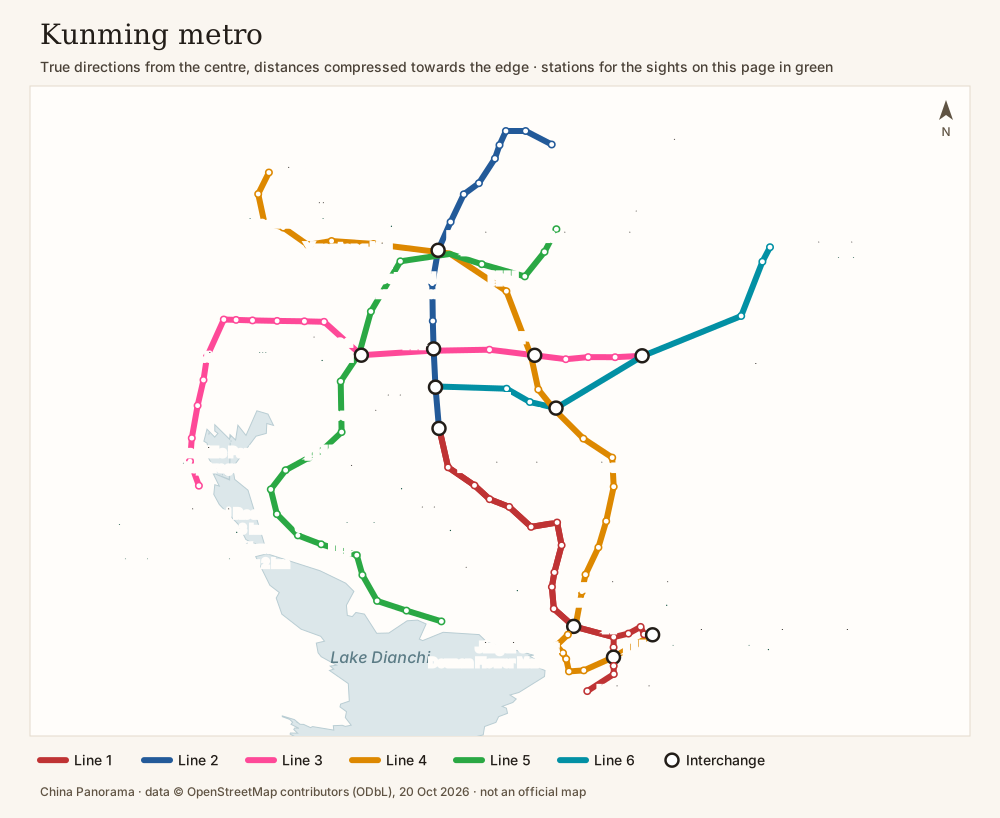
How Chinese metros work →Six lines. For a visitor: Line 6 runs from Changshui airport into the city (Tangzixiang); Line 1 serves Kunming station and, on its branch, Kunming South for the high-speed trains; Line 3 runs east–west from the East Coach Station (buses to the Stone Forest) through Dongfeng Square and Wuyi Road to the foot of the Western Hills; Line 5 runs north–south through the old city — Yuantong Hill, Huashan West Road for Green Lake, Wuyi Road for the Jinma and Biji arches — and on towards Lake Dianchi; Line 4 reaches Dounan and the flower market.
- Lines
- 6Lines 1 to 6
- Fare
- from 2 CNYfirst 4 km
- Network
- about 114 stationsabout 184 km (reported)
- Pay with
- Alipay or WeChatforeign cards at gates not confirmed
Pay with the metro ride code in Alipay or WeChat, or buy a single ticket at the machines, which take cash, Alipay, WeChat, UnionPay and Visa cards. We found no report that Visa or Mastercard cards issued abroad work at the gates themselves, as they now do in Beijing, Shanghai, Chengdu and Guangzhou, and have not tested one — set up Alipay before you go.
Fares by distance: 2 CNY up to 4 km, 3 CNY up to 8 km, 4 CNY up to 13 km, 5 CNY up to 19 km, 6 CNY up to 26 km, 7 CNY up to 34 km, 8 CNY up to 43 km, 9 CNY up to 53 km, 10 CNY up to 63 km. The published table ends at 63 km (10 CNY). From Wuyi Road to Kunming South is a few yuan; from the airport into the city, more.
We found no network-wide timetable to link; Wikipedia gives only Line 6, at about 06:20 to 22:20. Look at the display in the station, and do not count on a late train back from the airport.
| Jinma and Biji arches, West Pagoda | Wuyi Road 五一路 | Lines 3/5 |
| Old Street quarter, Nanqiang Street | Wuyi Road 五一路 | Lines 3/5 |
| Green Lake, Yunnan Army Academy | Huashan West Road 华山西路 | Line 5 |
| Yuantong Temple, Yuantong Hill (cherry blossom) | Yuantong Hill 圆通山 | Line 5 |
| Jiaochang Middle Road (jacaranda, 600 m) | Sujiatang 苏家塘 | Line 4 |
| Daguan Park (1.9 km) | Fuhai 福海 | Line 5 |
| Haigeng embankment, the gulls (1.3 km) | Yinghai Road 迎海路 | Line 5 |
| Yunnan Ethnic Village (1 km), Haigeng (2 km) | Yuhucun 渔户村 | Line 5 |
| Western Hills (foot of the hills) | Western Hills Park 西山公园 | Line 3 |
| Shuangqiao night market (400 m) | Rixin Road 日新路 | Line 1 |
| Guandu Ancient Town (1.1 km) | Xingyao Road 星耀路 | Line 1 |
| Yunnan Provincial Museum (1.6 km) | New Asia Athletics Park 新亚洲体育城 | Line 1 |
| Dounan Flower Market | Jingui Street 金桂街 | Line 4 |
| Xishan Wanda towers (1.5 km) | Kunming Railway Station 昆明火车站 | Line 1 |
| Changshui Airport (KMG) | Kunming Airport 机场中心 | Line 6 |
| Kunming South station (high-speed trains) | Kunming South Railway Station 昆明南火车站 | Lines 1/4 |
| Kunming station | Kunming Railway Station 昆明火车站 | Line 1 |
| East Coach Station (buses to the Stone Forest) | East Coach Station 东部汽车站 | Lines 3/6 |
Stations are signed in Chinese characters and pinyin, with English names on the newer lines. Interchanges a visitor will use: Dongfeng Square (Lines 2 and 3), Wuyi Road (3 and 5), Tangzixiang (2 and 6), Dounan and Kunming South Railway Station (both 1 and 4).
Source and date: Fare bands, lines, stations (114) and length (184.1 km), and payment at the ticket machines: the Chinese Wikipedia article on the Kunming Metro, 20 October 2026 (we found no fare page on the operator's site to link). Foreign bank cards at the gates: no report found, 20 October 2026. Stations for the sights and interchanges: OpenStreetMap stations and route relations, 20 October 2026. First and last trains: only Line 6, from the same article.
Before you go
Most European passports are visa-free for a short trip — under a one-sided waiver with an end date worth checking before you book:
- UK passport
Visa-free up to 30 days per trip, currently until 31 December 2026.
- EU passports
Dutch, German, French, Irish, Nordic and most other EU passports: visa-free up to 30 days, currently until 31 December 2026.
- US passport
No general waiver: a visa, or the 10-day visa-free transit if you travel on to a third country.
China’s 10-day visa-free transit applies at designated entry ports, for travellers continuing to a third country. Check your passport. If you leave by train for Laos, you need a Laos visa as well.
- Set up Alipay
For the metro gates, DiDi to the Stone Forest and the flower stalls at Dounan.
- Ordering food
How the QR-code menus and counter shops work, before your first bowl of rice noodles.
- Chengdu
The next big city to the north, 630 km away — pandas and Sichuan food.
- The arrival card
Fill it in online, or practise the paper form, before you land.
- Golden Week
Why 1–7 October is the worst week for the Stone Forest and the trains to Dali.
- Chinese metros
Tickets, transport codes and security checks, city by city.
FAQ
Why is Kunming called the City of Eternal Spring?
Because its days hardly change through the year: about 17 °C by day in January and 25 °C in July — a range of only 10 degrees. Kunming lies at a tropical latitude, 25° N, but about 1,890 m up; air cools by roughly 6.5 °C for every 1,000 m, so the height takes the heat out of summer, while the low latitude keeps winter days mild. Guangzhou, at almost the same latitude but at sea level, averages 34 °C in July.
What are the best things to do in Kunming?
Spend a morning in the Stone Forest, a World Heritage maze of limestone pinnacles an hour from the city; walk the shore of Lake Dianchi at Haigeng, with the Western Hills across the water, and go up to the Dragon Gate cut into their cliffs; read the 180-character couplet on Daguan Tower early in the morning; see the Jinma and Biji arches and the Nanzhao pagodas in the old centre; feed the gulls at Green Lake in winter; and buy flowers by the armful at Dounan. Kunming is also the starting point for Dali, Lijiang, Xishuangbanna and the train to Laos.
How many days do you need in Kunming?
Two, or three with the Western Hills: one for the Stone Forest (a long half-day), one for the city — Daguan Park in the morning, the arches and Green Lake, Lake Dianchi in the afternoon. Most visitors then move on to Dali or Lijiang. Our three routes below follow our own days.
How do I get from Kunming to the Stone Forest?
By high-speed train from Kunming South to Shilin West (reported 18–24 minutes), then bus 99 or a taxi to the scenic area; by direct bus from the East Coach Station (reported every 30 minutes); or by taxi or hired car, about 85 km and an hour each way. The ticket has been reported at 130 CNY and the shuttle inside at 25 CNY. We have not checked fares, times or prices — our picker above compares the four ways.
Is the Stone Forest worth it?
Yes, if you go early. The Greater Stone Forest is spectacular but very crowded by mid-morning; the narrow paths and the viewpoint are best before 09:30. The Lesser Stone Forest, with its lawns and ponds, is calmer. Allow half a day for the visit itself and two hours for the journey there and back.
Does the altitude in Kunming cause problems?
Rarely. At about 1,890 m the air pressure is 80 % of sea level and water boils at about 93.6 °C; some visitors feel breathless on stairs or sleep badly the first night. The sun is strong — use sunscreen even on cloudy days. Altitude sickness becomes a real risk higher up, in Shangri-La at 3,160 m.
When is the best time to visit Kunming?
Any time, which is the point of Kunming. March to May is dry and sunny, 25 °C by day in April; June to September is the rainy season but still only about 25 °C; October is 22 °C; winter days are 17 °C and sunny, with cold nights (3 °C) and the gulls at Lake Dianchi. Avoid May Day (1–5 May) and Golden Week (1–7 October) for the Stone Forest.
When are the seagulls in Kunming?
Black-headed gulls from Siberia and Central Asia have wintered in Kunming every year since 1985, roughly from late autumn to March. The places to see them are the Haigeng embankment on Lake Dianchi and Green Lake in the city, where people feed them from the bridges.
Can I take the train from Kunming to Laos?
Yes. Since 13 April 2023 international trains run from Kunming South to Vientiane, about 10–10½ hours including border checks, stopping at Luang Prabang and Vang Vieng; a second daily pair was added in July 2025. You exit China at Mohan and enter Laos at Boten, getting off with all your luggage at both. Tickets are bought with your passport on 12306 and collected at the station. Arrange your Laos visa before you travel: in 2023 Boten’s railway port did not issue visas on arrival.
Can I pay for the Kunming metro with a credit card?
At the ticket machines, yes: they take Visa and UnionPay cards as well as cash, Alipay and WeChat. At the gates we found no report that foreign Visa or Mastercard cards work, as they do in Beijing, Shanghai, Chengdu and Guangzhou. Use the metro ride code in Alipay or WeChat. Fares run by distance, from 2 CNY for the first 4 km.
How do I get from Kunming airport to the city?
Metro Line 6 runs from Changshui International Airport (KMG), about 25 km north-east of the centre in a straight line, to Tangzixiang, where you change to Line 2. A taxi takes about 45 minutes without traffic (33 km by road). We have not checked journey times or fares; Wikipedia gives Line 6 hours as about 06:20 to 22:20.
What is the long couplet of Daguan Tower?
A pair of matching poems of 90 characters each, written by the poet Sun Ran in the 18th century and called the longest couplet under heaven. The right-hand half describes Lake Dianchi and the four mountains around it; the left-hand half reviews two thousand years of Yunnan’s history. The boards on the tower today were carved in the hand of Zhao Fan in 1888.
When do the jacarandas bloom in Kunming?
From about late April to mid-May, by the account of Kunming’s broadcaster; the season can stretch from mid-April into early June. The best-known street is Jiaochang Middle Road in Wuhua district, near Sujiatang station (Line 4). The cherry blossom comes earlier: Yuantong Hill, by the station of the same name on Line 5, flowers from about late February into March.
Where should I stay in Kunming?
For a first visit, in the old centre between Nanping Street, Dongfeng Square and Green Lake: most city sights are on foot, three metro lines meet there and Line 6 to the airport starts nearby. Near Kunming station if you have an early high-speed train, as Line 1 runs straight to Kunming South. By the lake at Haigeng for the gulls in winter; in Chenggong next to Kunming South if you only pass through. Our picker above compares five areas.
Where can I eat out in the evening in Kunming?
Nanqiang Street and the lanes of the Old Street quarter in the centre, near Wuyi Road station; Shuangqiao night market in Guandu district, reported open from about 18:00 to 03:00, near Rixin Road on Line 1; and the stalls of Guandu Ancient Town, known for Guandu baba, a filled flatbread.
How long is the Erhai loop at Dali?
About 133 km on the shore roads, by the OpenStreetMap cycling route from Dali old town clockwise through Xizhou, Shuanglang, Wase and the Luoquan peninsula to Xiaguan and back. Along much of the shore runs the Erhai ecological corridor, 129 km of paths whose main works were completed in 2021. Allow a full day by car, two or three by bike.
Do I need a visa for Kunming?
Not for a short trip on a British, Irish, Dutch, German, French, Nordic or Australian passport: all are visa-free for up to 30 days per trip, under a one-sided waiver that currently runs until 31 December 2026. US passport holders have no general waiver; the 10-day visa-free transit applies only at designated entry ports and only if you travel on to a third country. Check your own passport on our visa check page.
Sources and status
All photographs on this page are ours, taken on 16 April 2019 (the Stone Forest in the morning, Lake Dianchi and the Jinma and Biji arches in the afternoon) and at sunrise on 17 April 2019 (Daguan Park). Faces of passers-by have been blurred. The metro map is ours, drawn from OpenStreetMap data. Data sources: Monthly temperature data, Kunming; Kunming (Wikipedia): population, elevation, history, East and West pagodas, Yuantong Temple; Stone Forest: age, sections, World Heritage 2007 (Wikipedia); Shilin scenic area: 1982, 1931 inscription, Torch Festival (Wikipedia, Chinese); South China Karst (UNESCO World Heritage Centre); Stone Forest ticket, shuttle and hours as reported in 2025 (travel agency guide, Chinese); Daguan Tower: 1696, rebuilds, the long couplet and its text (Wikipedia, Chinese); Jinma and Biji arches: dates and dimensions (Wikipedia, Chinese); Lake Dianchi: area, altitude, Haigeng, pollution (Wikipedia, Chinese); Western Hills: extent, height, Sleeping Beauty (Wikipedia, Chinese); The gulls' first winter in Kunming, 1985 (Xinhua, November 2025); Dounan, Asia's largest cut-flower market, and the auction (Xinhua, February 2025); Yunnan Provincial Museum: 1951, new building 2015, collection, hours (Wikipedia, Chinese); Fuxian Lake: area, depth, altitude, water quality (Wikipedia, Chinese); Yuantong Hill cherry blossom in full bloom, March 2025 (Xinhua); Jacaranda on Jiaochang Middle Road, April 2026 (Guangming); Guandu Ancient Town and the Vajra Pagoda of Miaozhan Temple (Ctrip, Chinese); Lake Erhai: area, length, width, altitude (Wikipedia, Chinese); The 129 km Erhai ecological corridor (People’s Daily, 30 March 2021); Kunming Xishan Wanda Plaza twin towers (Wikipedia); Kunming Changshui International Airport: opening, passengers 2025 (Wikipedia, Chinese); Kunming Metro: lines, fares, payment (Wikipedia, Chinese); China–Laos railway international passenger trains from 13 April 2023 (China News Service); A second Kunming–Vientiane train pair, July 2025 (China Daily); Lijiang–Shangri-La railway: fastest times (China News Service, April 2025).
Changelog (1)
- 2026-10-20Page created, with our own photographs from 16–17 April 2019. No entry price on this page could be checked against an official source on this date; the Stone Forest ticket and shuttle prices are travel-agency reports. Metro: fares from the distance table on Chinese Wikipedia; whether foreign bank cards work at the gates is not confirmed. Train times to Shilin West, Dali, Lijiang, Shangri-La, Xishuangbanna and Vientiane are reports.