
Ningde
The home town of CATL, the world’s biggest maker of electric-car batteries — and of white tea, a granite mountain by the sea and the bamboo-pole mudflats of Xiapu, on the coast of north-east Fujian.
宁德 · Níngdé · Fujian province · 26.67° N, 119.54° E
No airport
Ningde has no airport of its own. Fly to Fuzhou (FOC), 83 km away, or to Wenzhou for Taimushan — then train or car. The sights are spread over a prefecture the size of a sixth of Austria. Getting there →
How long?
Three days: the city and Sandu’ao Bay, the Xiapu mudflats at sunrise and sunset, and Taimu Mountain with its tea hills.Planning the days →
Where is Ningde?
Ningde is on the coast of north-east Fujian, the province facing Taiwan across the strait, about 70 km north of the provincial capital, Fuzhou, and 540 km south of Shanghai. Xiamen is 280 km to the south-west, Guangzhou 750 km and Beijing 1,500 km away. The region is called Mindong, “eastern Fujian”. At 26.7° N, Ningde lies level with Jaipur and with West Palm Beach in Florida, and a degree south of the Canary Islands. Tap any city on the map to measure the distance.
Straight-line distances from the city centre, rounded to the nearest 10 km — not travel distances.
Fujian is highlighted. Tap a city to measure the distance from Ningde.
- Province
- Fujian福建省
- Latitude
- 26.67° Nlevel with Jaipur
- Airport
- NoneFOC Fuzhou · 83 km
- Metro
- Nonetrains, buses, taxis
- Time zone
- UTC+8
- Geopark
- 2010Taimushan, Baishuiyang
City or prefecture: which Ningde?
Ningde is two things. The city proper — Jiaocheng District, with CATL, the railway station and the government — fills a plain at the head of Sandu’ao Bay. And Ningde is a prefecture of 13,452 km² with eight counties and county-level cities, and it is there that most of the sights are: the Xiapu mudflats 56 km to the north-east, Taimu Mountain 84 km and Fuding 93 km along the coast, and Baishuiyang 66 km inland. Tap a place to see how far it is from the city.
Tap a place on the map or in the list.
Beiqi, the best-known sunrise spot over the bamboo-pole farms, on the edge of Xiapu town; Xiapu station is about 5 km away. Details below ↓
The shallow river over a flat rock bed, in the mountains of Pingnan County: about 126 km and two hours by road. Details below ↓
Fuzhou Changle International (FOC), the nearest airport: about 108 km and 79 minutes by road to the city.
The tourist centre in Taimushan town, start of the visit to the granite mountain; tea terraces all round, and Taimushan station 6 km away. Details below ↓
The town of Fuding, home of the white tea, and its station on the line north to Wenzhou. Details below ↓
Straight-line distances from Ningde city government, rounded — not driving distances.
What’s the weather like in Ningde each month?
Subtropical and humid: 15 °C by day in January, 36 °C in July, no snow in the city, and typhoons from July to September. The sun rises at 05:08 in June and sets at 17:11 in December. The figures are for the city; the upper paths on Taimu Mountain, at up to about 900 m, are some 5 °C cooler. Tap a month for temperatures, daylight and what is on.
Scale in °C. Bars run from the average daily low to the average daily high. Source: monthly temperature data, last checked 2026-10-16.
Ningde in October
Mild- Average high
- 27 °C
- Average low
- 20 °C
- Sunrise / sunset
- 06:00 – 17:35
- Daylight
- 11 h 34 min
On in Oct
- Golden Week crowds, 1–7 Oct
- Laver season begins on the Xiapu pole grids
When to come for the tea, the mudflats — and when not to
Ningde’s calendar is set by harvests and storms more than by temperature. Green is the main season, pale green its edges.
| What | Jan | Feb | Mar | Apr | May | Jun | Jul | Aug | Sept | Oct | Nov | Dec |
|---|---|---|---|---|---|---|---|---|---|---|---|---|
| White-tea pickingSpring buds and young leaves | March: yes | April: yes | May: partly | |||||||||
| Laver on the Xiapu polesThe classic mudflat photographs | January: yes | February: partly | October: yes | November: yes | December: yes | |||||||
| Kelp harvest and dryingXiapu shore | April: yes | May: yes | June: yes | |||||||||
| Typhoon seasonBoats and coast roads can stop | July: yes | August: yes | September: yes | |||||||||
| Holiday crowdsSpring Festival, May Day, school holidays, Golden Week | February: partly | May: partly | July: yes | August: yes | October: partly |
Harvest months are typical, not fixed: they shift with the weather from year to year. Typhoon tracks change daily — follow the warnings when you are there.
Spring
March – MayTea time: green hills, hazy coast.
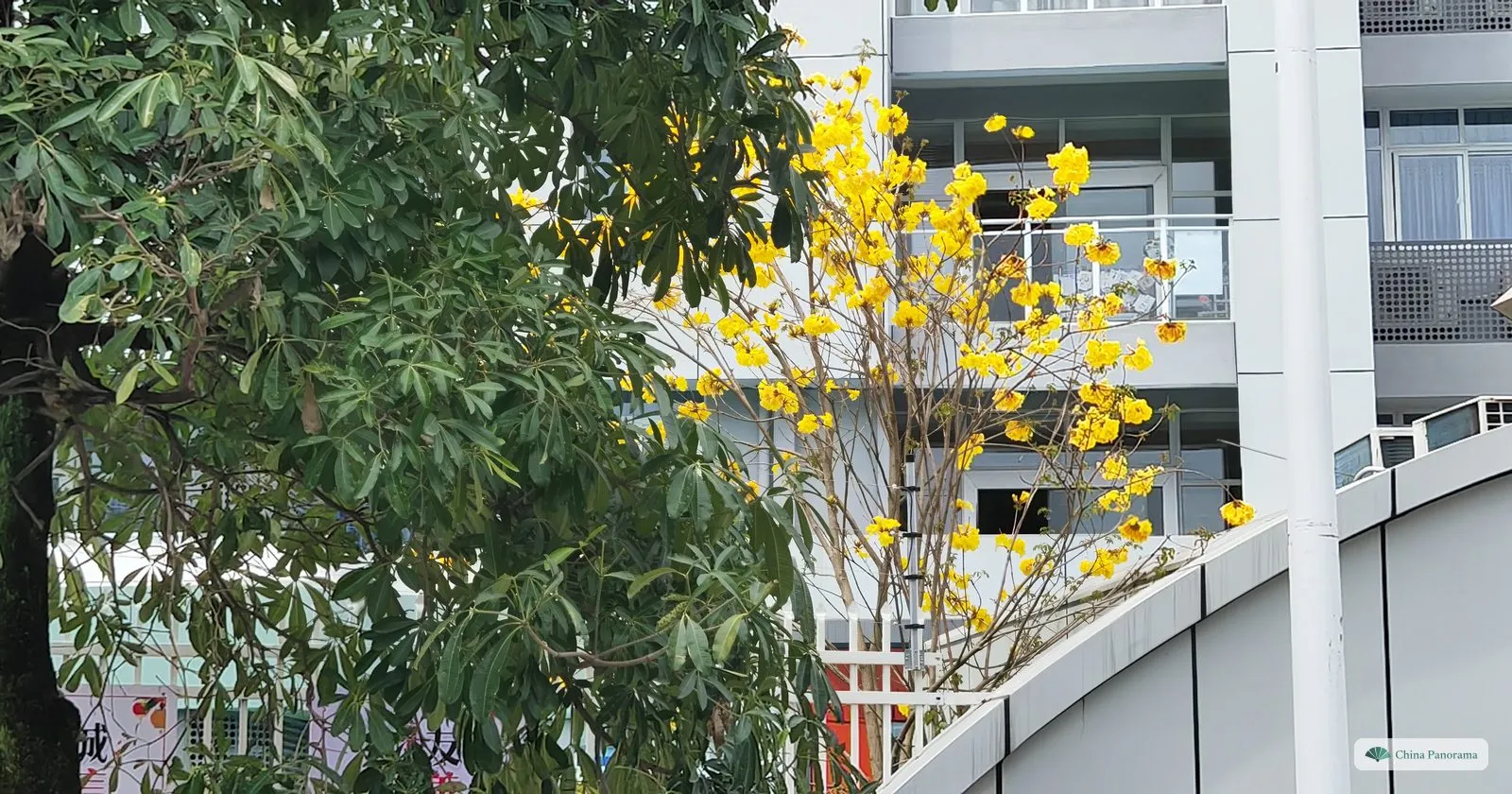
March averages 19 °C by day in the city, April 24 °C and May 28 °C. Spring is the tea season: the first buds, for Silver Needle, are picked early, and by April the terraces round Taimu Mountain are bright green and clipped. It is also the haziest time by the sea — on our photographs of 7 April 2023 the islands fade into it — and from May the plum rains set in. Qingming, around 5 April, and May Day, 1–5 May, are holidays.
Photograph: a golden trumpet tree in flower near Jingtai Mountain, Ningde, at 13:04 on 7 April 2023.
What to wear: Layers and a light rain jacket; good shoes for the steps of Taimushan.
Summer
June – AugustHot, humid, and typhoon season.
June averages 31 °C by day, July 36 °C and August 34 °C, with nights around 25–27 °C. Typhoons come in off the Pacific from July into September and can stop boats, fish-farm trips and coast roads for a day or two. Up on Taimu Mountain it is a few degrees cooler and the rock paths are shaded; Baishuiyang is at its busiest, with families wading. July and August are the Chinese school holidays.
What to wear: Light clothes, sun protection, a rain jacket — and an eye on the typhoon warnings.
Autumn
September – NovemberThe best season, and the start of laver season.
September is still hot at 32 °C by day, with the last typhoons; October averages 27 °C and November 22 °C, and the air is clearer than in spring. From October the laver is growing on the bamboo-pole grids of the Xiapu mudflats, the season most photographers come for. Avoid Golden Week, 1–7 October.
What to wear: Summer clothes in September; a light jacket for evenings by November.
Winter
December – FebruaryMild days, cool nights, unheated rooms.
January averages 15 °C by day and 8 °C at night; it does not snow in the city. The laver harvest on the Xiapu flats goes on into February. Buildings in southern China have little heating, so it feels colder indoors than the figures suggest. The Spring Festival, whose date follows the lunar calendar, fills the trains.
What to wear: A warm jacket and a jumper for indoors.
October and November, at about 27 °C and 22 °C by day, are the months we would pick — clear air, no typhoons, the laver back on the mudflats. April, at 24 °C, is the tea month. For how Ningde’s neighbours compare month by month, see the best time to visit China.
Things to do in Ningde
8 places and things: Taimu Mountain and the tea hills round it, the city under Jingtai Mountain, CATL’s lake, the Xiapu mudflats, Baishuiyang, the fish farms of Sandu’ao and Fuding’s famous snack. First, three ways in: a quiz, four photographs to read, and the white tea.
Where in Ningde is this?
The city centre, CATL’s lake 7 km out, and Taimushan 80 km up the coast look like three different countries. Six of our photographs from one afternoon — can you tell which is which?
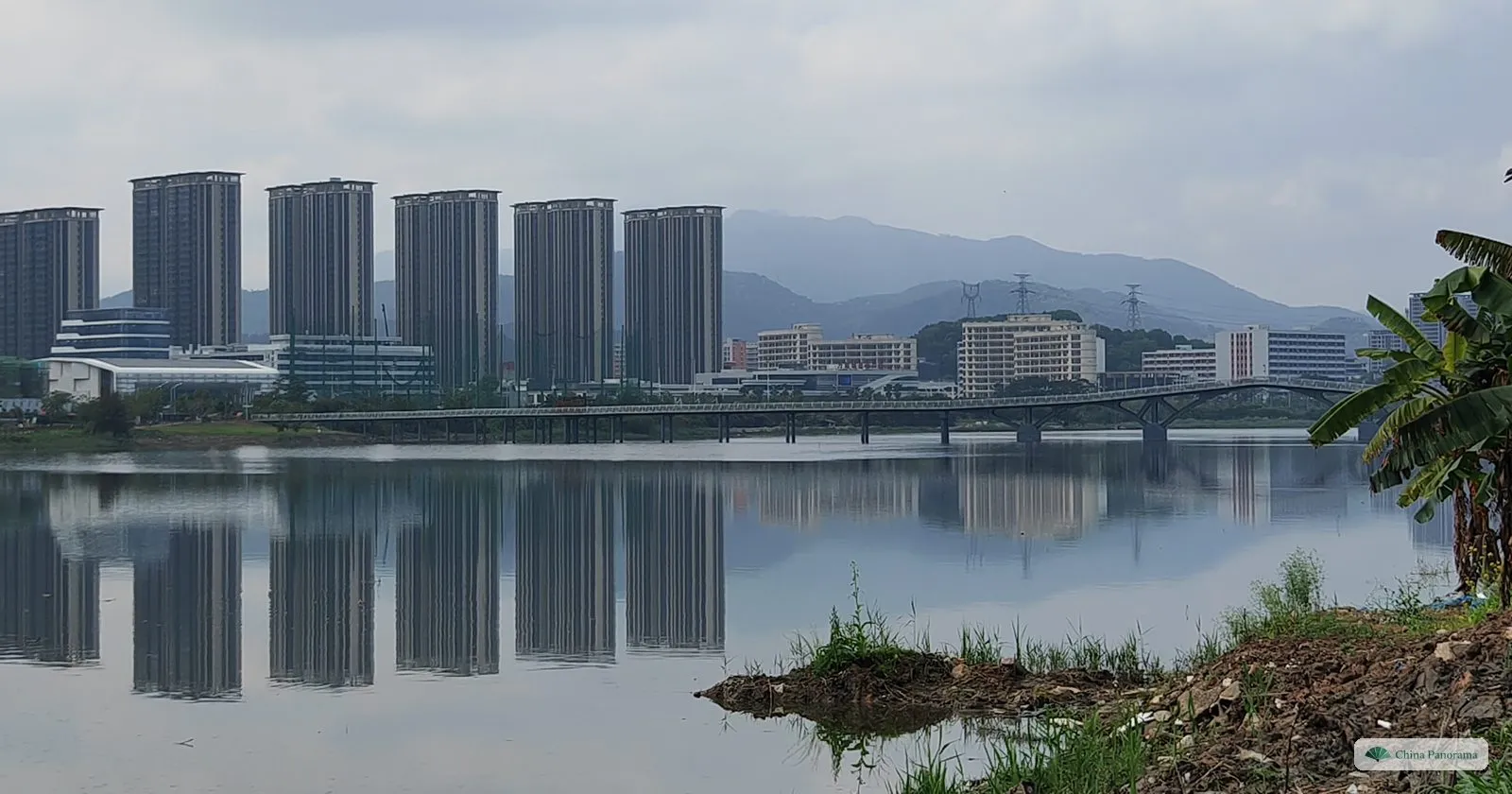 Photograph 1
Where in Ningde was this taken?
Answer: CATL’s lake
Still water, a row of identical new tower blocks and a road bridge: the south end of Chijian Lake, on the edge of the industrial district that has grown round CATL since 2011.
Chijian Lake, 14:28 on 7 April 2023.
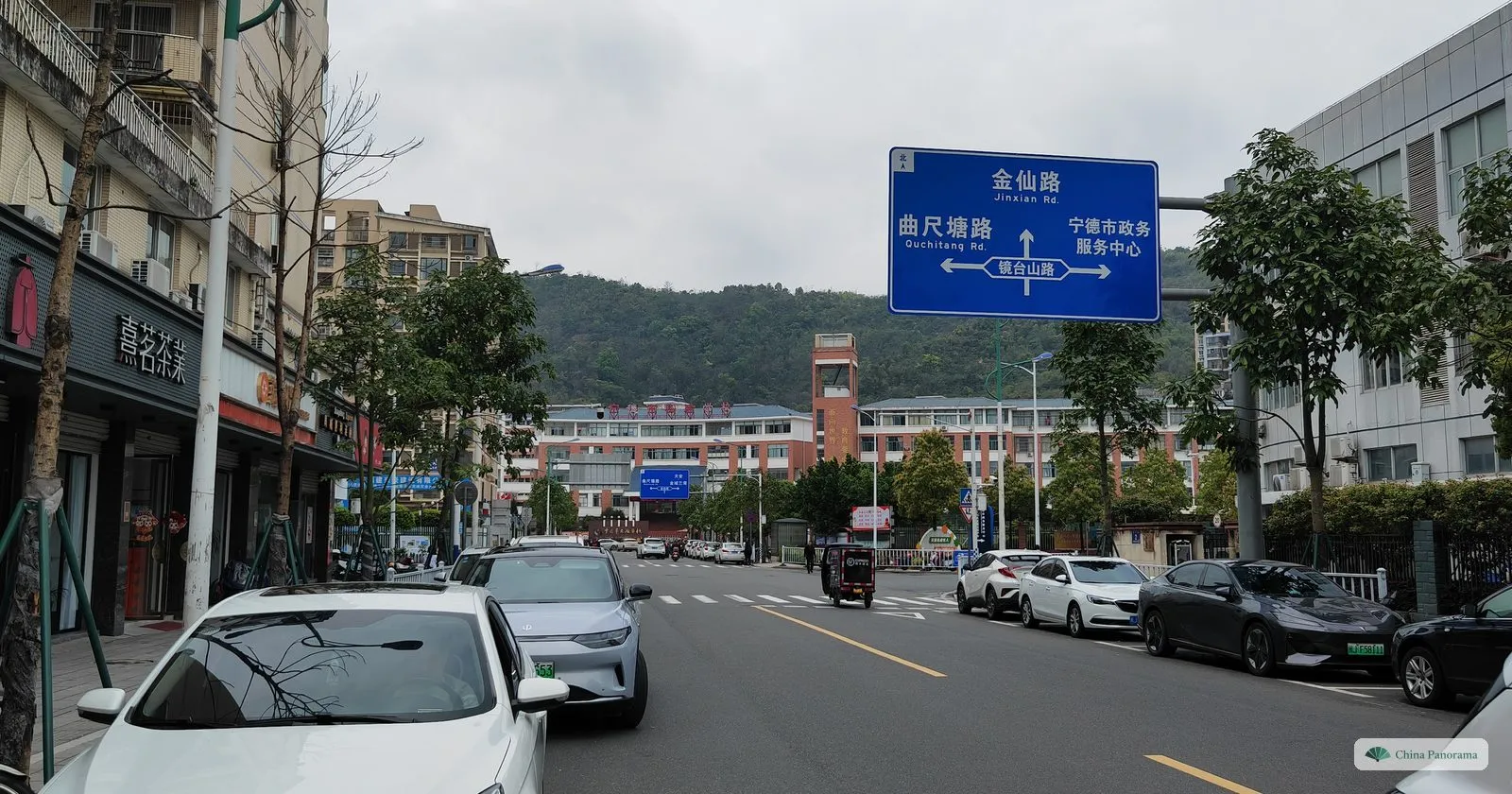 Photograph 2
Where in Ningde was this taken?
Answer: City centre
Read the blue sign: on the right it points to 宁德市政务服务中心, the Ningde city government service centre. Shops, a school and a wooded hill straight behind — the centre is squeezed between hills.
Near Jingtai Mountain, 12:59 on 7 April 2023.
 Photograph 3
Where in Ningde was this taken?
Answer: Taimushan
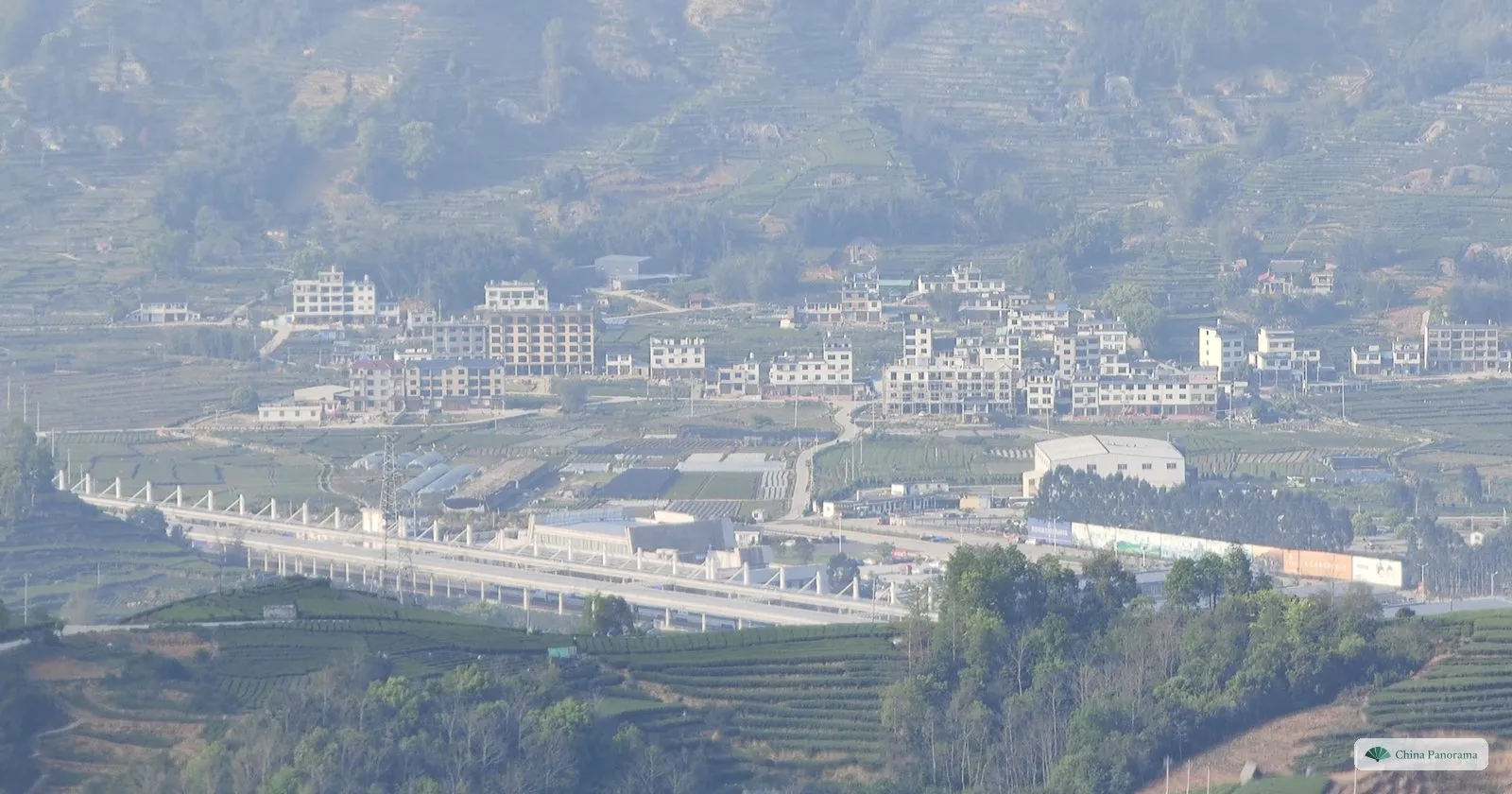
A high-speed station on a viaduct, surrounded by terraced tea: Taimushan station on the Wenzhou–Fuzhou line, in the tea hills below Taimu Mountain.
From the road up to Taimushan, 16:36 on 7 April 2023.
 Photograph 4
Where in Ningde was this taken?
Answer: CATL’s lake
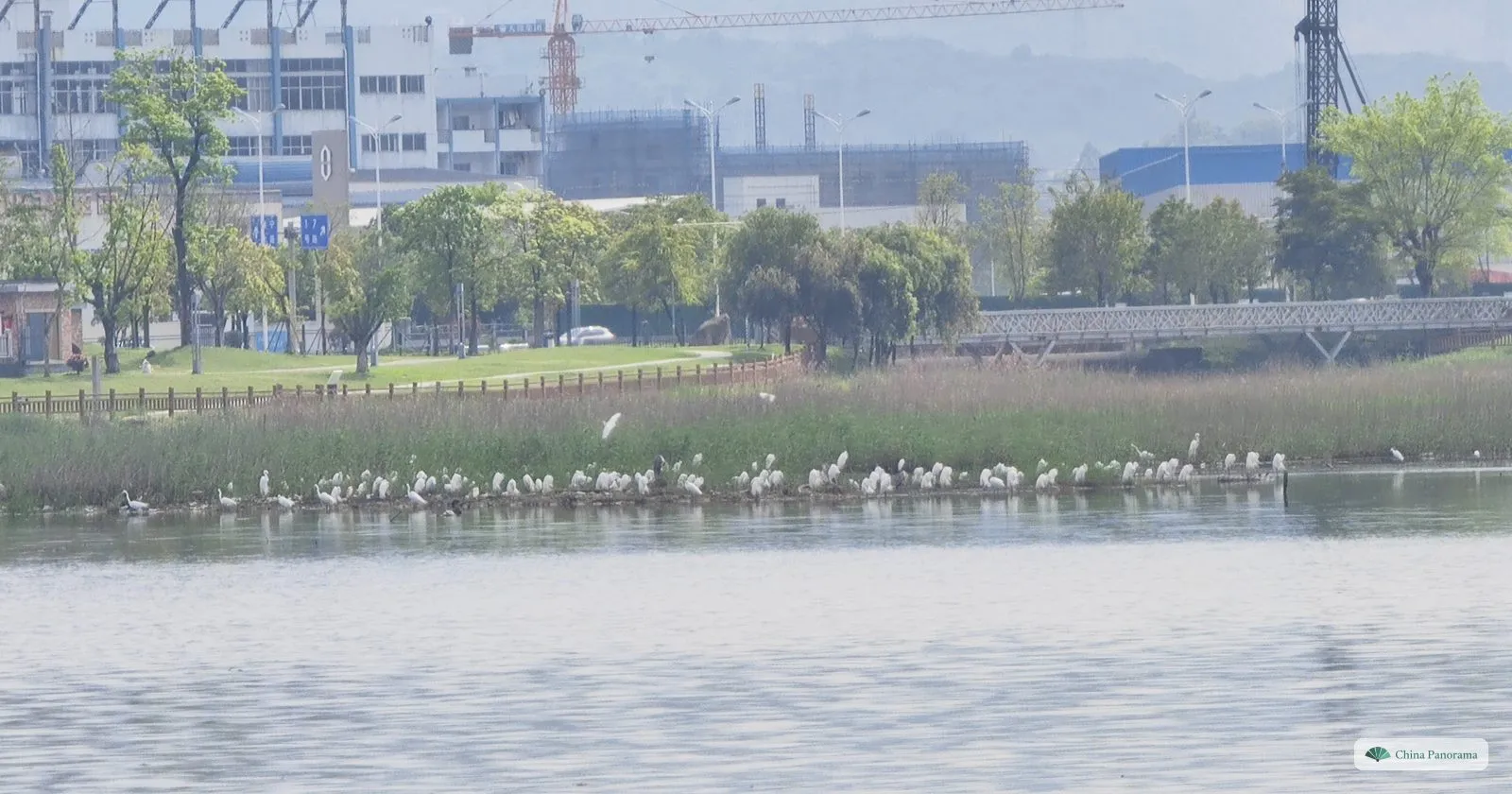
Egrets in the reeds, a lattice footbridge across the water — and grey factory halls and cranes right behind: the bird life of Chijian Lake lives next door to the battery plants.
Chijian Lake, 14:28 on 7 April 2023.
 Photograph 5
Where in Ningde was this taken?
Answer: Taimushan
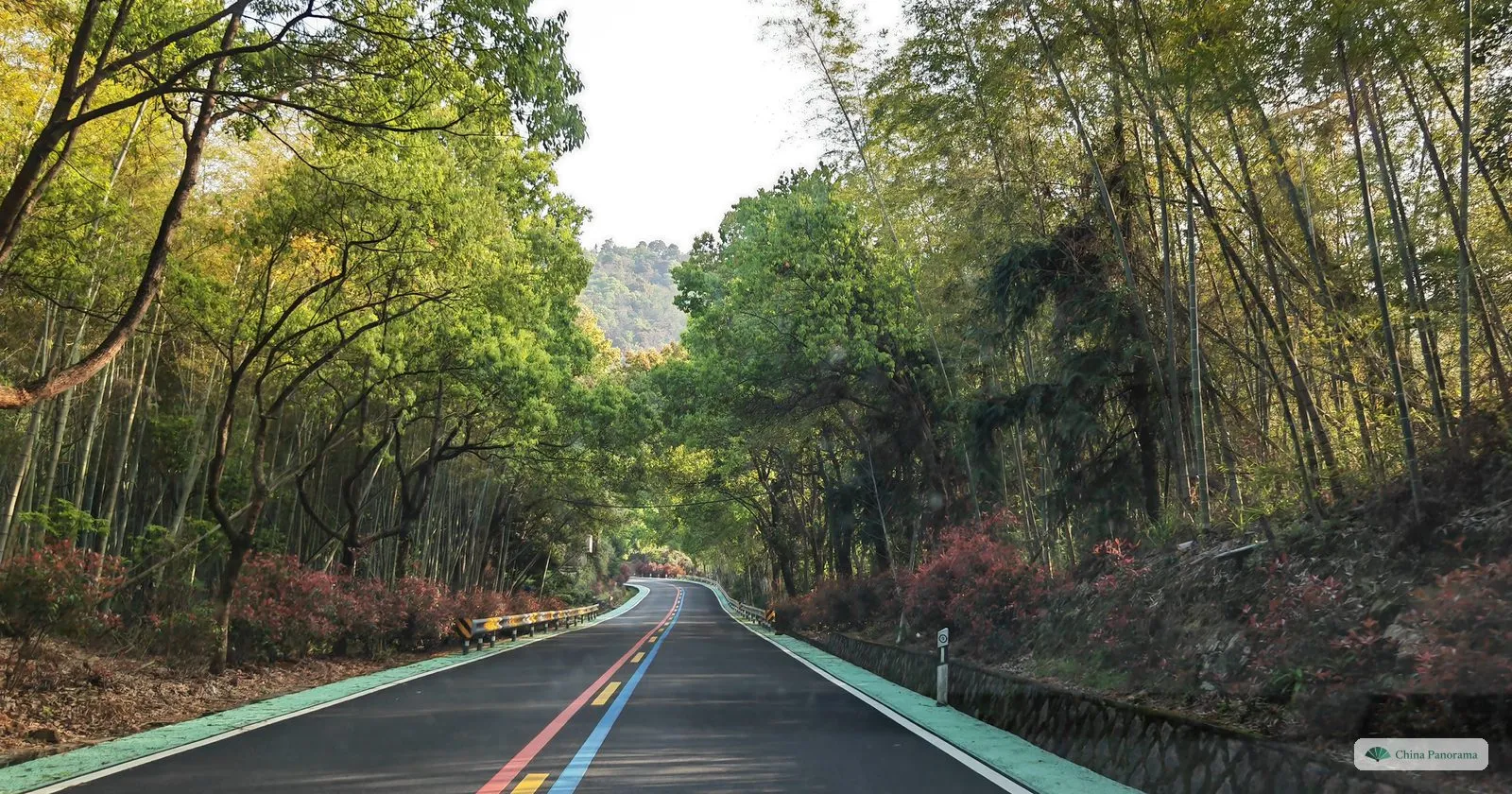
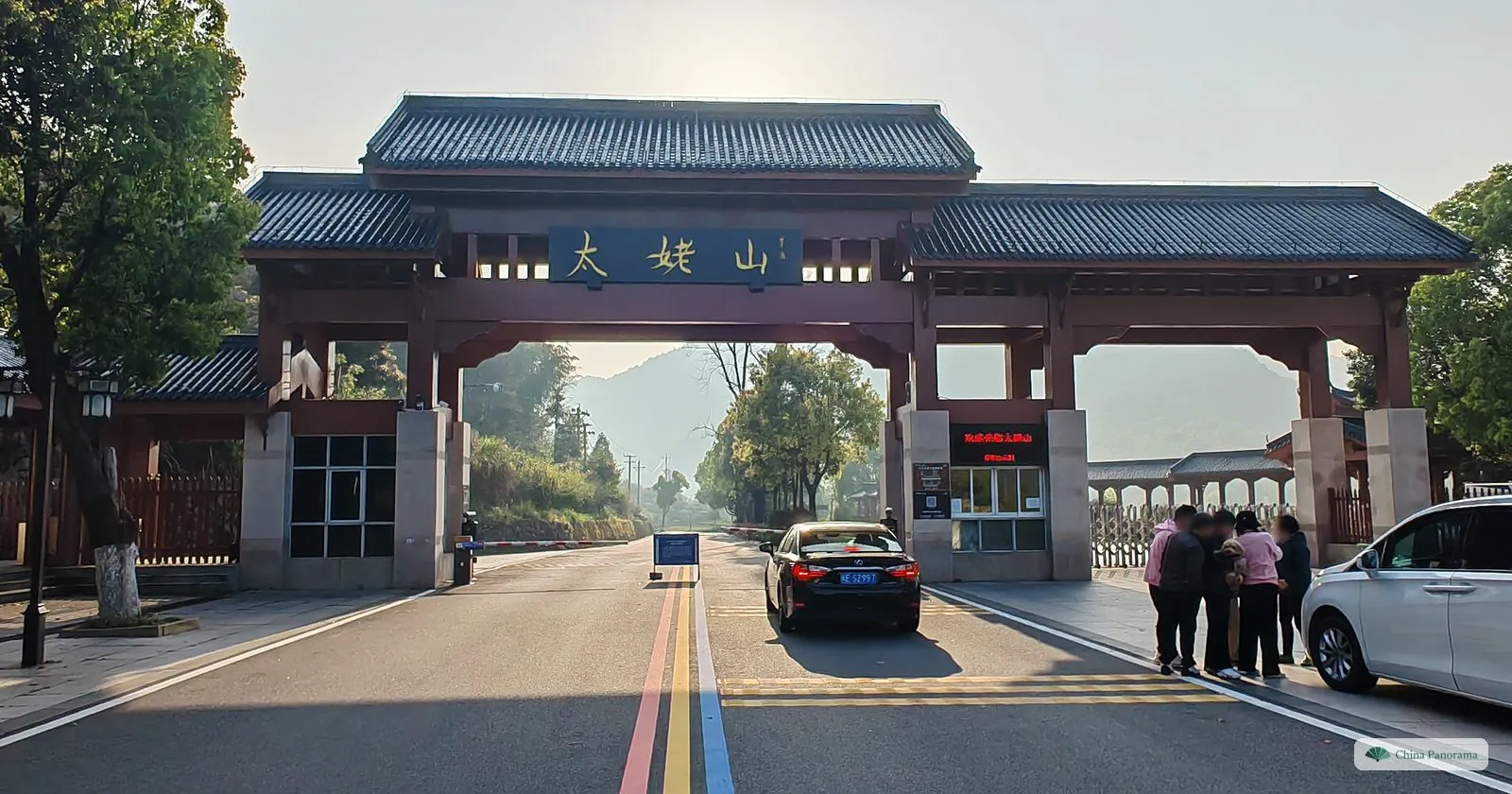
The red and blue lines down the middle of the road are painted on the scenic roads round Taimushan — the same stripes run through the gate of the scenic area. Bamboo and red new leaves: April in the hills.
On the road up to Taimushan, 16:32 on 7 April 2023.
 Photograph 6
Where in Ningde was this taken?
Answer: Taimushan
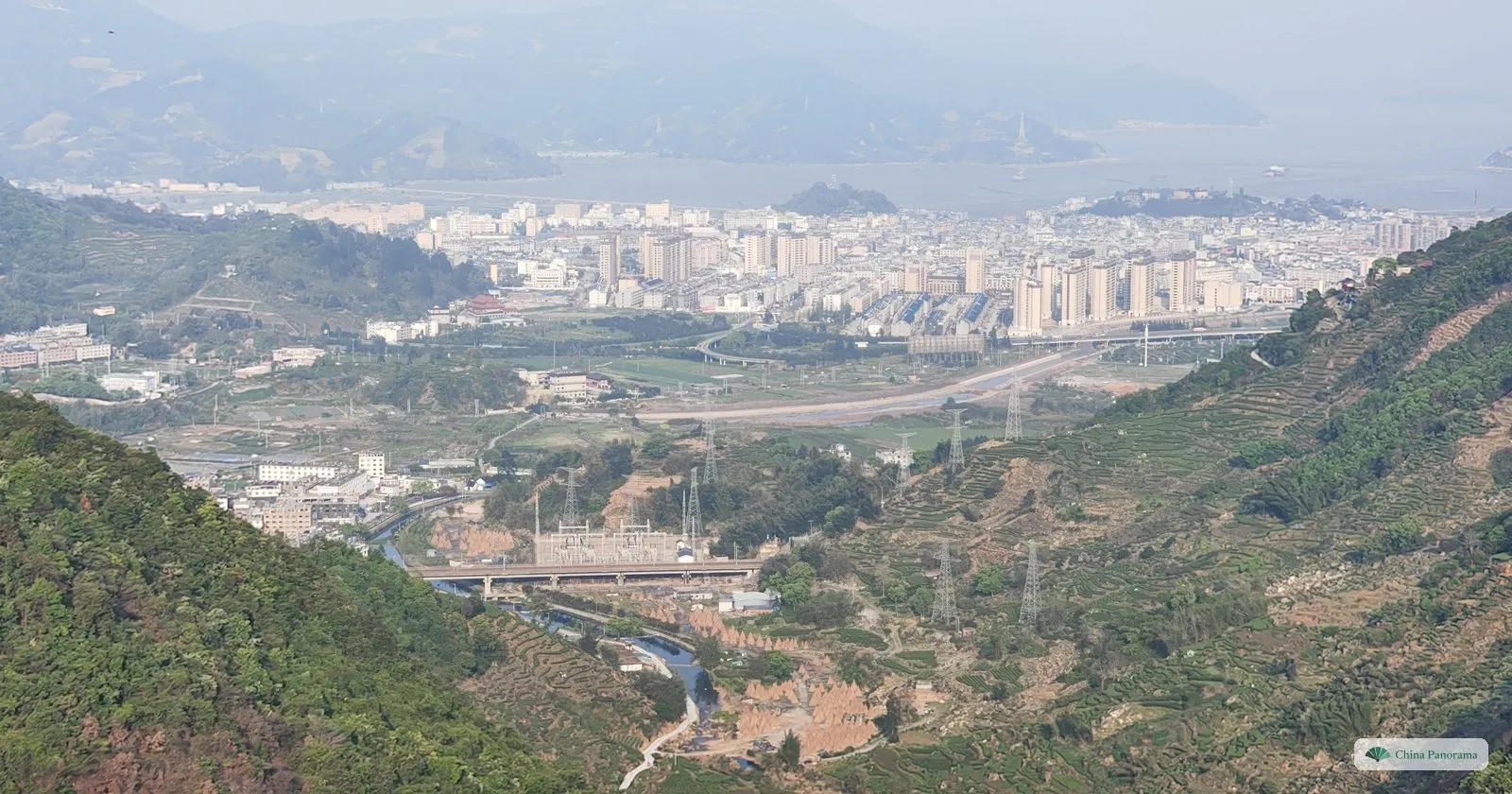
Tea terraces on the slopes in the foreground and a bay with small islands behind the town: this is the coast below Taimu Mountain, about 80 km north-east of the city.
From the road up to Taimushan, 16:38 on 7 April 2023.
What am I looking at?
Tap a number on the photograph.
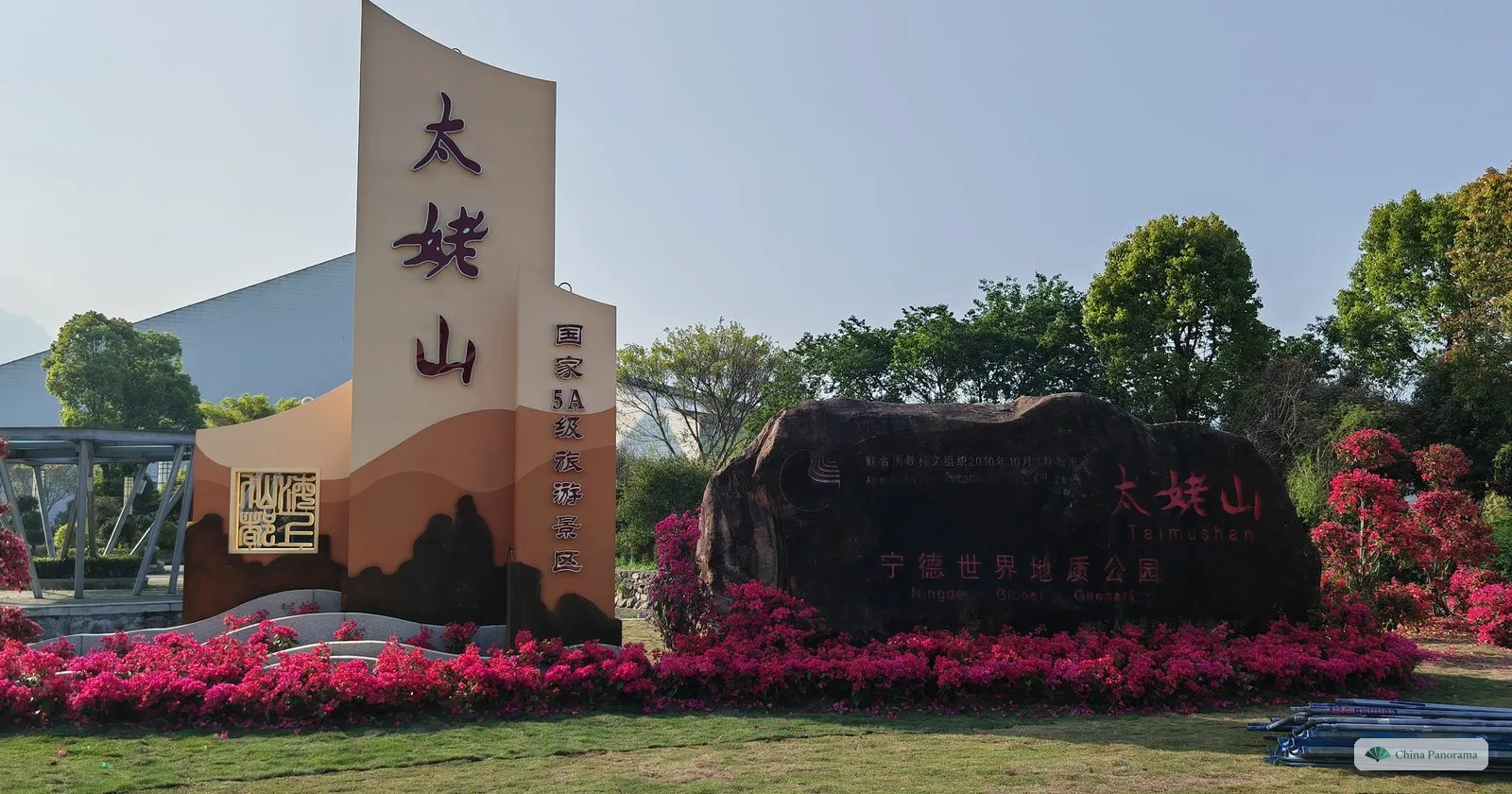
1Taimushan
太姥山 · Tàimǔ Shān
The name the whole coast round Fuding is known by. 姥 is an old word for an old woman, and the mountain is named after a goddess of local legend; Chinese myth also made it a meeting place of the deities of the East China Sea.
Taimu Mountain in the list below →Tap a number on the photo, or a name in the list.
Fuding white tea: which grade is which?
In a tea shop in Fuding you will be offered four names at four prices. The difference is which part of the tea shoot is picked — and white tea is defined as much by what is not done to it. Tap a grade, then a tea.
Silver Needle 白毫银针
- Plucked
- The bud alone
- Bushes
- Big-bud cultivars: Fuding Dabai, Fuding Dahao (or Shuixian)
- Looks like
- Single plump buds, silver with white down — the needles of the name.
- In the cup
- The palest and most delicate: a light, sweet, almost honeyed cup.
Picked first, in early spring, and the dearest.
White Peony 白牡丹
- Plucked
- One bud and one or two leaves
- Bushes
- The same big-bud cultivars as Silver Needle
- Looks like
- Buds and young leaves together, silver and green, loosely curled like a dried flower.
- In the cup
- Fuller than Silver Needle, floral, still light.
Between the buds and the leaves, in looks and in price.
Gongmei (“tribute eyebrow”) 贡眉
- Plucked
- Tender shoots: a small bud and two or three leaves
- Bushes
- Not the big-bud cultivars: old local bushes grown from seed
- Looks like
- Smaller buds, more leaf, greyish green.
- In the cup
- Stronger and fruitier than the bud grades.
A step down in price from White Peony.
Shoumei (“longevity eyebrow”) 寿眉
- Plucked
- Tender shoots or leaves — mostly leaf, little or no bud
- Bushes
- Any of the bushes, often the later, larger leaves
- Looks like
- Dark olive leaves with some stalk; often pressed into round cakes.
- In the cup
- The strongest and cheapest; it deepens and sweetens as it ages, and white tea is kept for years.
The everyday grade, and the one sold in cakes.
Why white tea is white: the steps it skips
| Step | White tea | Green tea | Oolong | Black tea |
|---|---|---|---|---|
| Wither 萎凋Spread out on racks to wilt and lose water, for hours or days. | ● yes | — | ● yes | ● yes |
| Heat (“kill-green”) 杀青Pan, drum or steam heat stops the leaf’s own enzymes — that is what keeps green tea green. | — | ● yes | ● yes | — |
| Roll 揉捻Rolled or twisted to break the cells and shape the leaf. | — | ● yes | ● yes | ● yes |
| Oxidise 氧化Left in the air so the broken leaf darkens and turns malty. | ◐ partly | — | ◐ partly | ● yes |
| Dry 干燥Dried with gentle heat until it keeps. | ● yes | ● yes | ● yes | ● yes |
- White tea: Only withered and dried. A little oxidation happens slowly during the long withering — nothing is done to speed it.
- Green tea: Heated straight after picking, so it never oxidises.
- Oolong: Partly oxidised, then heated to stop it — Fujian’s other great tea, from the Wuyi Mountains and Anxi.
- Black tea: Fully oxidised. In Chinese it is “red tea”, 红茶, after the colour in the cup.
Grades as defined in China’s national standard for white tea, GB/T 22291-2017. Process: withering and drying only, “no firing, no rolling”, as in the national intangible heritage listing of the Fuding white-tea craft (2011).
8 places in and around Ningde
Filter by district: Fuding for Taimushan and the tea, Jiaocheng for the city.
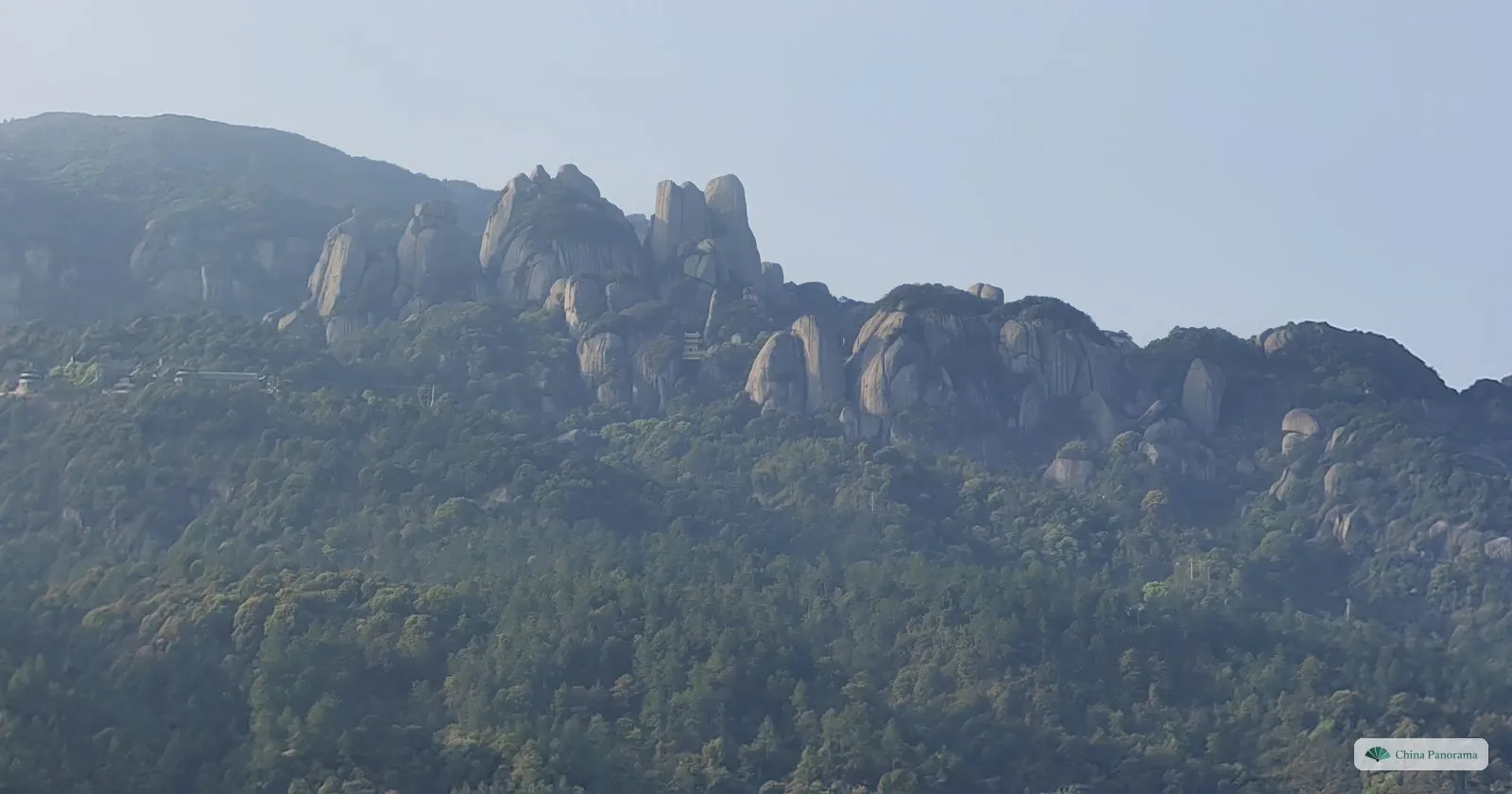 NatureFuding · 福鼎市Outdoors
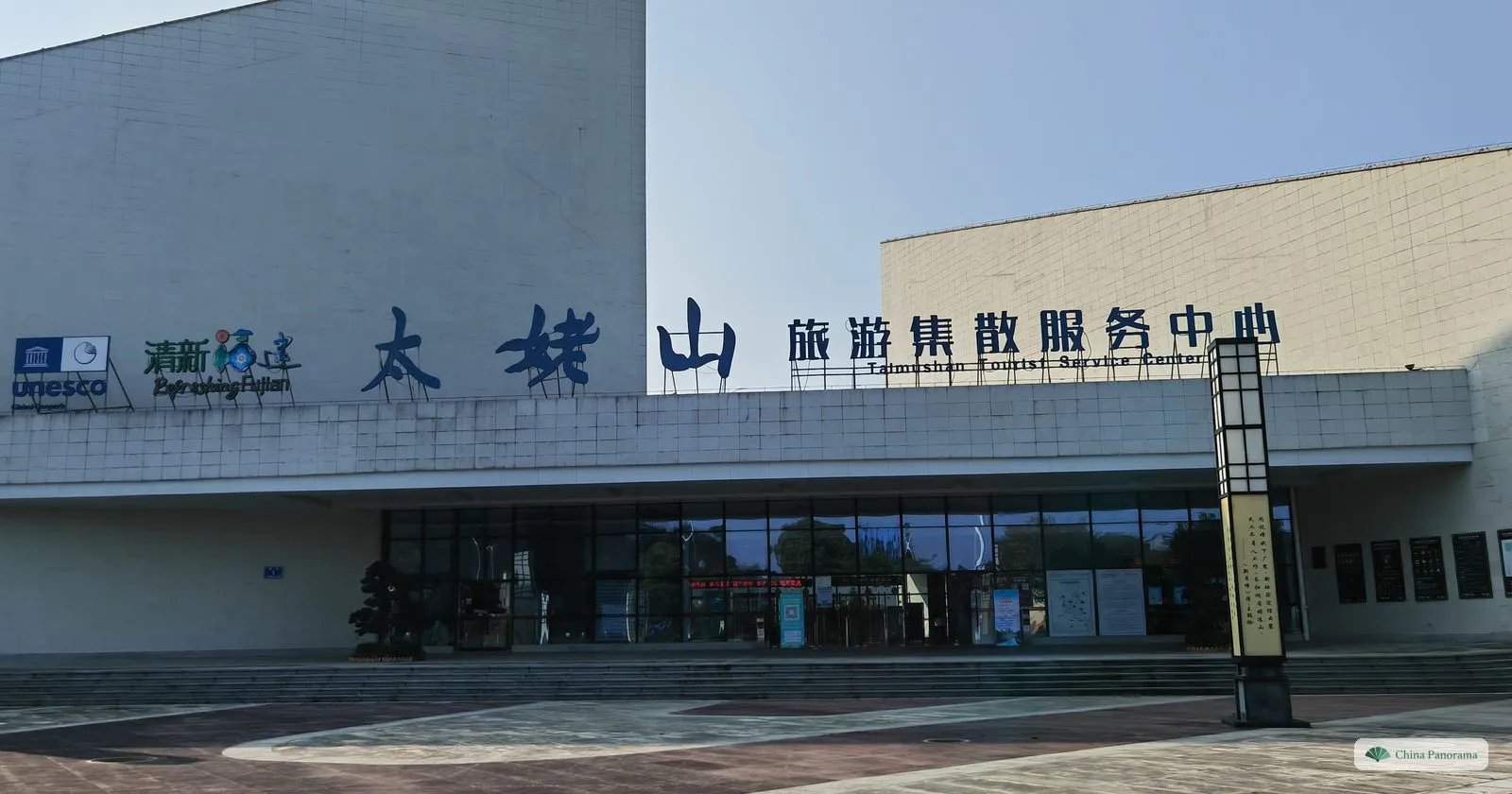
A granite mountain by the sea, about 80 km north-east of Ningde city in Fuding. A sign the length of a bus outside the tourist centre calls it “the most beautiful mountain by the sea in China”. Weathering has worked the granite into rounded towers, stacked boulders, and clefts and caves narrow enough to squeeze through; from the upper paths you look over tea hills to the islands of the East China Sea. The highest point is usually given as 917.3 m (Wikipedia says 900 m). Daoist and Buddhist temples sit among the rocks, and the mountain’s old title, “the immortals’ capital on the sea”, is on the seal beside its name at the entrance. Taimushan is one of three parts of the Ningde Global Geopark, which joined the UNESCO-backed Global Geoparks Network on 3 October 2010 — the date is carved on a stone at the tourist centre — and it has been a national 5A scenic area since 2013. We saw the peaks from the scenic-area road at ten to five on 7 April 2023, in a spring haze.
Visits start at the Taimushan Tourist Service Centre in Taimushan town, the former Qinyu: tickets, and the scenic area’s buses up the mountain road. It is about 6 km by road from Taimushan railway station, 7 minutes by taxi without traffic on OpenStreetMap. A gate on the mountain road, at about 460 m, is where we stopped at 16:53. Booking sites list entry at around 140 CNY; we have not checked the price, the bus fare or the opening hours. Allow most of a day for the paths among the rocks: there are a great many steps, and some clefts are tight.
- Entry
- Price not verified — check on site
- Opening hours
- Hours not verified — check on site
Fuding white tea country
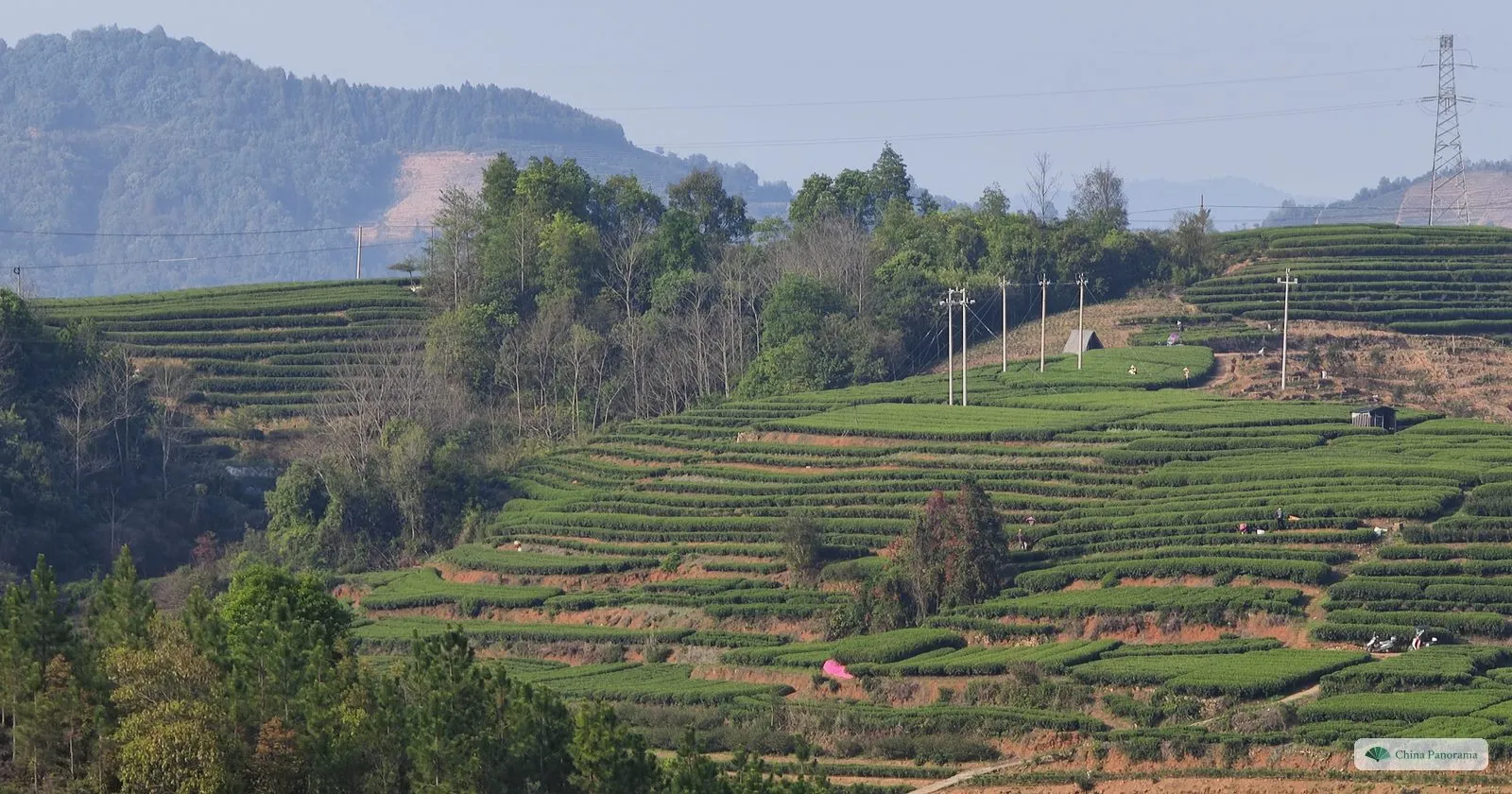
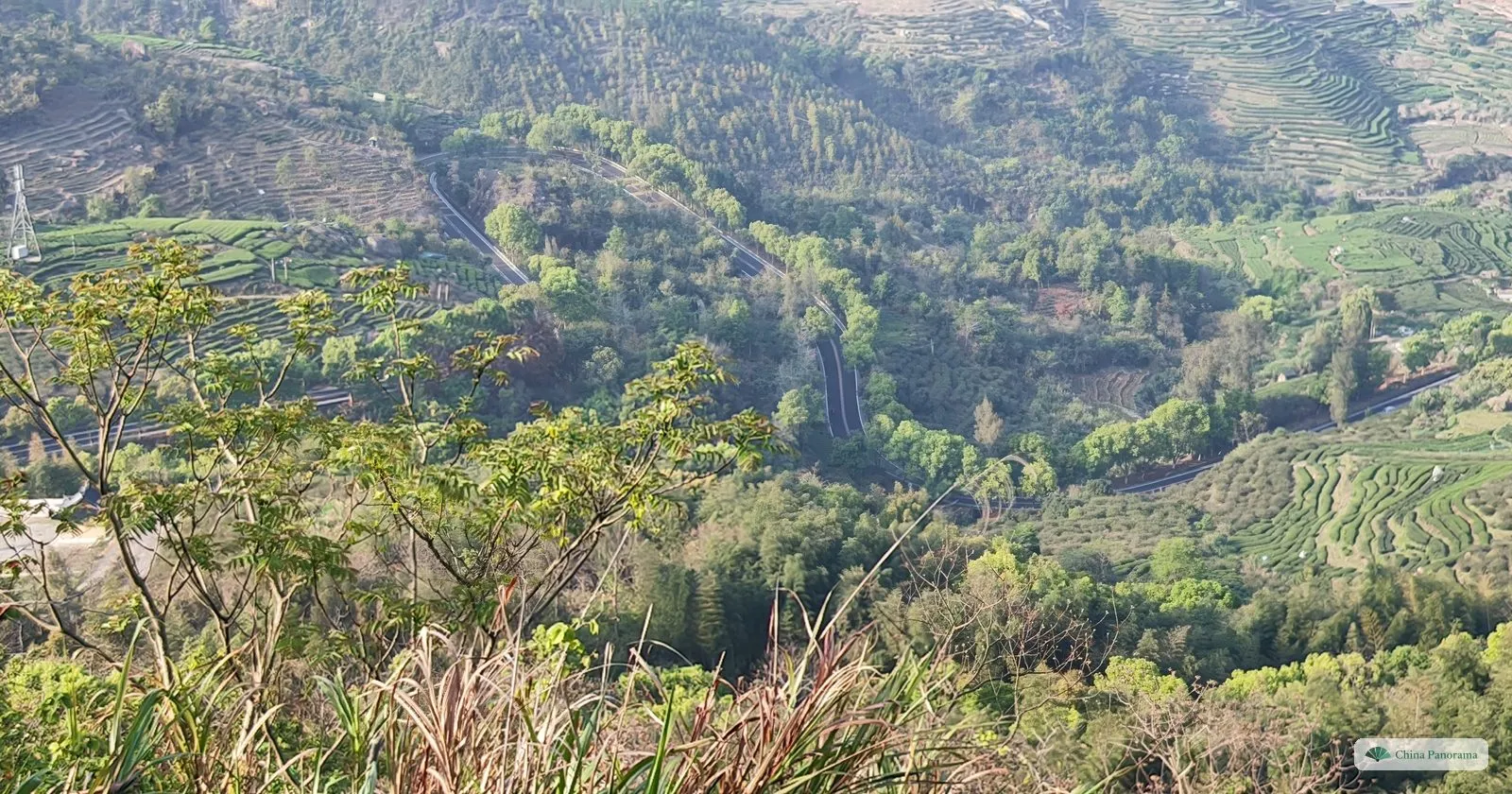
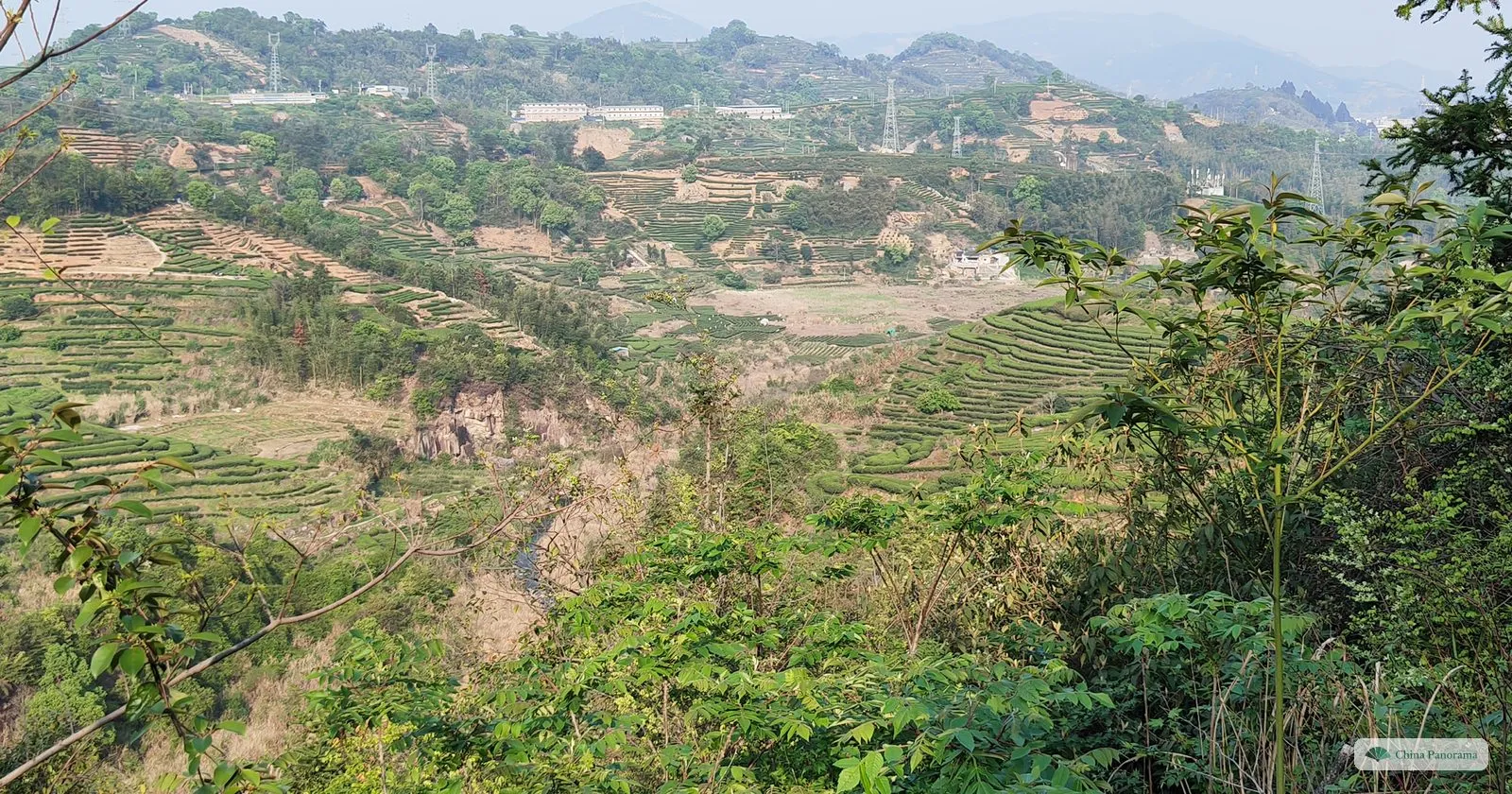
福鼎白茶 · 茶园NatureFuding · 福鼎市OutdoorsThe hills around Taimu Mountain are terraced for tea almost to the top: on the road up you pass slope after slope of clipped bushes in rows. This is the home of Fuding white tea. The local cultivars, Fuding Dabai and Fuding Dahao, grow plump buds covered in white down, and white tea is the least handled of all Chinese teas — the leaves are withered and dried, and that is all: no pan-firing, no rolling. The craft of making it has been on China’s national list of intangible cultural heritage since 2011. Its story here is older. Zhou Lianggong, writing in the 17th century, recorded that “Taimushan of old had Green Snow Bud, now called Baihao”, and white-tea making in Fuding is dated from bushes propagated in 1857 and spread from 1875. Four grades are sold, from buds alone to whole leaves — the picker below shows which part of the shoot each one is.
The tea gardens line the roads around Taimu Mountain; you see them from any car or bus, and our photographs are from the road up from Taimushan town between 16:26 and 16:35 on 7 April 2023. Tea shops in Fuding and Taimushan town sell by grade and by year. Prices range enormously and we have not checked any; buy where you can taste first.
- Entry
- Free
- Opening hours
- Open at all hours
 ParkJiaocheng · 蕉城区Outdoors
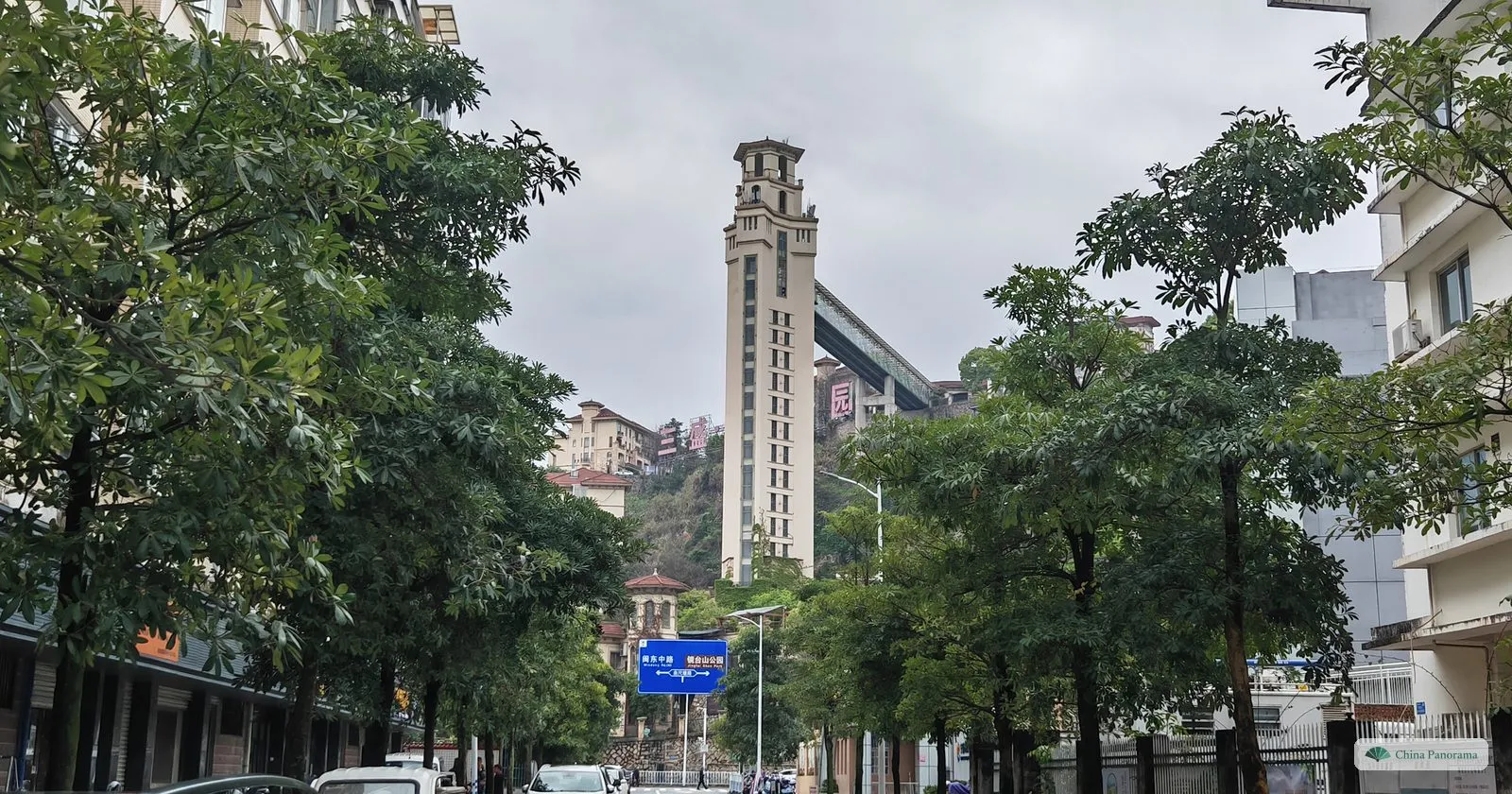
Ningde’s centre fills a narrow plain between steep green hills and the head of Sandu Bay, and Jingtai Mountain, about 246 m high, rises directly behind the city government on Mindong Middle Road. Jingtai Mountain Park covers the hill with paths to viewpoints over the city and the bay. At its foot, where we stood at one o’clock on 7 April 2023, a slender cream tower about twenty storeys high is joined to the slope by a long covered footbridge, and blue signs point to the park and to Mindong Road. The streets around are an ordinary, busy Chinese city: tea shops, schools, the city’s government service centre, and in April golden trumpet trees in flower.
The park rises behind the city government in the centre. Ningde railway station is about 4 km away, 6 minutes by taxi without traffic on OpenStreetMap. Entry to the park is free; we have not checked whether its paths close at night.
- Entry
- Free
- Opening hours
- Hours not verified — check on site
CATL headquarters and Chijian Lake
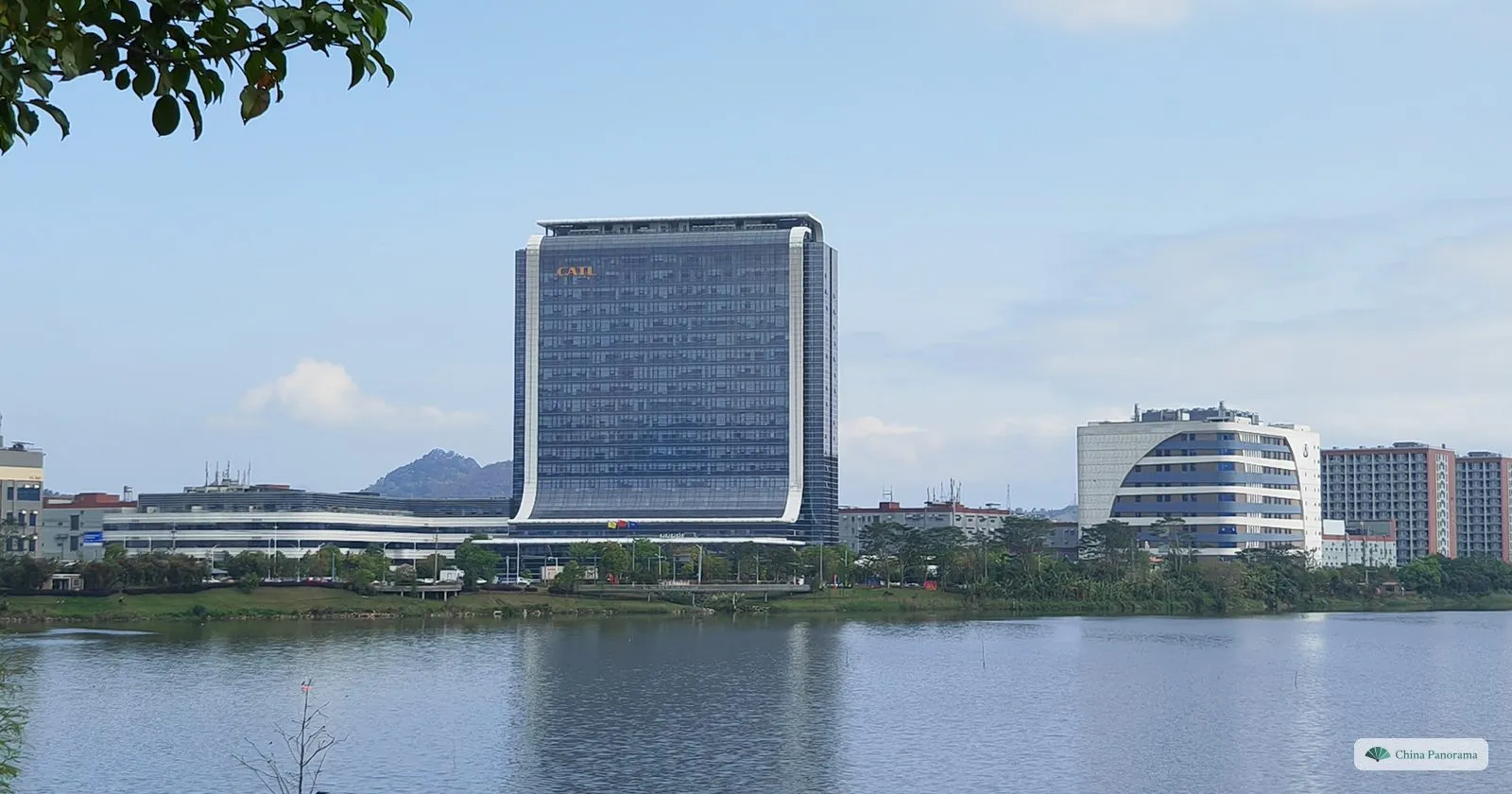
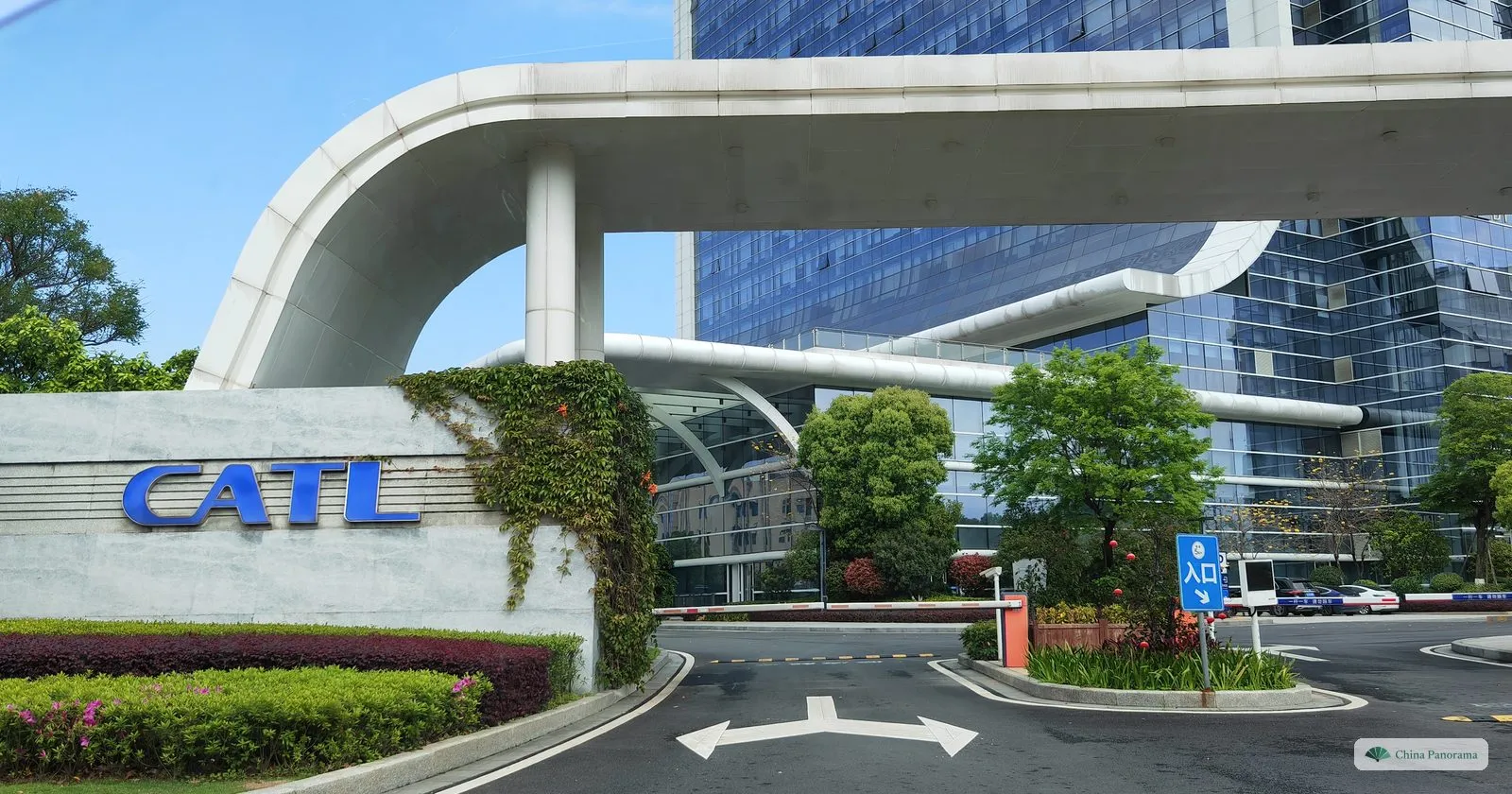
宁德时代 · 赤鉴湖LandmarkJiaocheng · 蕉城区OutdoorsThe reason the world has heard of Ningde. Contemporary Amperex Technology — CATL, in Chinese 宁德时代, “the Ningde era” — was founded here in 2011 by Robin Zeng as a spin-off of the battery maker ATL. In 2017 it led the world in sales of battery systems for electric cars for the first time, and in 2024 it supplied 37.9 per cent of all the electric-vehicle batteries installed worldwide, by SNE Research’s count; Tesla, BMW, Mercedes-Benz and Volkswagen are among its customers. In German-speaking countries it is known for its plant at Arnstadt in Thuringia, announced in 2018. The head office is a cluster of glass towers about 7 km north-east of the city centre, on the east shore of Chijian Lake. The lake, about 1.9 km long, is a public park with a footbridge across it; on 7 April 2023 a flock of egrets stood in the reeds below the factory halls. The campus itself is not open to visitors: you see it from the lake and the road.
About 9 km by road from Jingtai Mountain in the centre, 12 minutes by taxi without traffic on OpenStreetMap. The park round the lake is free; we have not checked whether it closes at night. We know of no visitor centre or tours at CATL.
- Entry
- Free
- Opening hours
- Hours not verified — check on site

Xiapu mudflats
霞浦滩涂NatureXiapu County · 霞浦县OutdoorsThe coast of Xiapu County, about 55 km north-east of Ningde city, is one of China’s best-known places for landscape photography. Its tidal flats and shallow bays are farmed for laver (nori) and kelp, so that at low tide the water is ruled with lines of bamboo poles, floats and nets, with fishing boats threading between them; at sunrise and sunset the wet mud shines and the poles draw patterns that photographers come for by the coachload. Beiqi village, on the edge of Xiapu town, is the classic sunrise spot; Dongbi, further east, is known for sunsets over the farms. The look changes with the harvest: laver grows on the pole grids from autumn into winter, roughly October to February, and kelp is harvested and hung up to dry from April to June.
Xiapu station is on the Wenzhou–Fuzhou railway; Beiqi is about 5 km from it. From Ningde city it is about 67 km by road, 55 minutes by car without traffic on OpenStreetMap. Everything depends on the tide and the hour, so look up a tide table before you go — a car with a driver is the practical way to be at Beiqi before dawn. Some viewpoints are reported to charge a small fee; we have not checked them. July to September is typhoon season.
- Entry
- Price not verified — check on site
- Opening hours
- Hours not verified — check on site
Baishuiyang
白水洋NaturePingnan County · 屏南县OutdoorsA river that runs, for a stretch, over one flat bed of rock with no stones or sand on it, so shallow that you can walk across it — reports put the water at ankle depth in most places. The largest of its three sections covers 40,000 m². In summer it fills with families wading in the current. Baishuiyang is one of the three parts of the Ningde Global Geopark, in the mountains of Pingnan County, about 66 km north-west of Ningde city in a straight line; Yuanyang Stream, downstream, is named after the mandarin ducks that winter there.
About 126 km by road from Ningde city, two hours by car without traffic on OpenStreetMap; there is no railway to it. Prices and opening hours vary between booking sites and we have not checked them. Wear shoes you can get wet: the rock is slippery in places.
- Entry
- Price not verified — check on site
- Opening hours
- Hours not verified — check on site
- FoodJiaocheng · 蕉城区Outdoors
Ningde city lies on a bay with a narrow mouth and a wide, deep, island-sheltered basin behind it: Sandu’ao. Far out on it float whole villages of fish farms — rafts of nets and plank walkways with huts on them — where large yellow croaker is raised. Ningde is China’s yellow-croaker capital: in 2025 it produced 222,000 tonnes, about 80 per cent of the national output, according to the city’s fisheries bureau — “eight of every ten yellow croakers on China’s tables come from these waters”. In the city’s restaurants it comes steamed, braised or in soup.
Sandu town is on Sandu Island, about 13 km east of the city centre; boats cross from the mainland piers. Some floating villages are reported to serve fish to visitors and to run boat trips; we have not checked how, when or at what price. On a menu, look for 大黄鱼 (dà huángyú).
- Entry
- Price not verified — check on site
- Opening hours
- Hours not verified — check on site
- FoodFuding · 福鼎市Indoors
The snack that carries Fuding’s name all over China, from Shanghai side streets to station food courts: lean pork pounded with sweet-potato starch into a paste, pulled off in ragged pieces straight into boiling broth, and served in that broth with vinegar and pepper. The slices are springy, the soup sharp and light. In Ningde and Fuding you find it in small shops on every main street.
Look for the characters 福鼎肉片 (Fúdǐng ròupiàn) on the shop sign. A bowl is cheap; we have not checked prices.
- Entry
- Price not verified — check on site
- Opening hours
- Hours not verified — check on site
Entry prices and opening hours are marked unverified where we have not checked them against an official source. We would rather show a gap than a number we made up.
Routes and planning
Three days in Ningde
The coast railway links the city, Xiapu and Taimushan; the mudflats at dawn and Baishuiyang need a car. This is one way to divide it:
Day 1 · The city and the bay
Up Jingtai Mountain for the view, out to Chijian Lake and CATL, and in the afternoon by boat onto Sandu’ao Bay and its fish farms — then yellow croaker for dinner.
Day 2 · Xiapu, sunrise to sunset
By car to Beiqi before dawn for the mudflats at sunrise, a rest in the middle of the day, and Dongbi for the sunset. Check the tide table first.
Day 3 · Taimu Mountain and the tea
By train to Taimushan station, up Taimu Mountain from the tourist centre, and back through the tea hills — with a bowl of Fuding meat slices and a tasting of white tea in town.
Boat trips, scenic-area buses, prices and opening hours are not verified; distances are from OpenStreetMap.
Our afternoon by car: the city to Taimushan
The routes in our photographs, both from 7 April 2023: the city centre and CATL’s lake in the early afternoon, then about 100 km up the coast expressway to Taimushan for the late afternoon. Each runs in one direction, with the driving time between stops.
An early afternoon · about 9 km by car
Jingtai Mountain
Taxi 12 min· 9.3 km
Chijian Lake and CATL
2 stops · 12 min by taxi
A late afternoon · about 25 km by car
Taimushan Tourist Service Centre
Taxi 17 min· 17.9 km
Tea terraces on the road up
Taxi 14 min· 7.1 km
Taimushan gate
3 stops · 31 min by taxi
Stop by stop
Ningde city: Jingtai Mountain to CATL’s lake
Our early afternoon of 7 April 2023, under a grey sky that cleared at the lake: the centre at the foot of Jingtai Mountain, then out to Chijian Lake, where CATL’s head office stands on the far shore. A walk round the lake fills an hour.
1Jingtai Mountain
镜台山The hill behind the city government, with a park and paths over it. The tower and its footbridge stand at the foot. Our photographs: 12:59 to 13:04.
- Entry
- Free
- Hours
- Not verified
Taxi 12 min· 9.3 km
2Chijian Lake and CATL
赤鉴湖 · 宁德时代North-east past the railway to the lake. Egrets in the reeds at the south end, the CATL gate and towers on the east shore, and the view back across the water from the north-west corner. We were there from 14:28 to 14:44.
- Entry
- Free (the park)
- Hours
- Not verified
Easy add-ons: Ningde railway station is about 4 km from the centre, between the two stops. Sandu’ao and its fish farms are a separate half day, from the piers east of the city.
* Driving times and distances are computed from OpenStreetMap car routes between the stops, without traffic — allow more at busy times. Clock times are from our own photographs of 7 April 2023. Stops marked with a star have prices or opening hours we have not checked.
Getting there and getting around
By air
Ningde has no airport. The nearest is Fuzhou Changle (FOC), 83 km in a straight line: about 108 km by road to Ningde city, 79 minutes without traffic on OpenStreetMap. For Taimushan and Fuding, Wenzhou Longwan (WNZ) in Zhejiang is closer — about 123 km by road to the Taimushan tourist centre, 93 minutes. An airport for Ningde is at the planning stage: a site at Xiabaishi in Fu’an had not been approved in April 2026.
Schedules and journey times not yet verified against an official timetable.
By high-speed train
The Wenzhou–Fuzhou railway, open to passengers since 28 September 2009, runs along the coast at up to 250 km/h: Fuzhou South to Ningde is 92 km of line, Ningde to Wenzhou South 206 km, with trains on from Wenzhou towards Hangzhou and Shanghai. Since 27 September 2020 the Quzhou–Ningde line has also linked Ningde inland to Zhejiang. A second, faster coast line, the Wenzhou–Fuzhou high-speed railway, is under construction and planned to open around 2030. We have not checked journey times; look them up on 12306.
Schedules and journey times not yet verified against an official timetable.
From Fuzhou airport
By taxi or car straight up the coast expressway, about 108 km. Or by airport bus or taxi into Fuzhou and on by train from Fuzhou South or Fuzhou station. We have not checked airport bus times.
Schedules and journey times not yet verified against an official timetable.
Nonstop from Europe
Our flight list has no nonstop route from Europe to Fuzhou. It does have nonstop flights to Wenzhou, the nearer airport for Taimushan, from Madrid, Milan, Rome. Otherwise, change at a hub such as Shanghai or Beijing. Airlines and frequencies →
Flight data checked 12 September 2026.
Four stations on the coast line
Pick the one nearest what you came for.
- Ningde 宁德站For the city: about 4 km east of the centre. High-speed trains on the coast line between Fuzhou and Wenzhou, and the Quzhou–Ningde line inland, opened in 2020.
- Xiapu 霞浦站For the mudflats: Beiqi, the best-known sunrise spot, is about 5 km away.
- Taimushan 太姥山站For Taimu Mountain: in the tea hills, about 6 km by road from the tourist centre in Taimushan town.
- Fuding 福鼎站For the town of Fuding, the white-tea capital, and trains north to Wenzhou.
No metro: how to get around
Ningde has no metro, and its sights are spread over a prefecture of 13,452 km² — about a sixth of Austria. The city has buses and taxis; between the towns, the coast railway is the quick way, and for the mudflats at dawn or a day at Taimushan a car with a driver is the practical one.
- Along the coast by trainNingde, Fu’an, Xiapu, Taimushan and Fuding stations are all on the Wenzhou–Fuzhou line, which runs at up to 250 km/h: by the line’s own kilometre posts, Ningde to Taimushan is 93 km. We have not checked timetables or fares; look them up on 12306.Not verified.
- Taxis and ride-hailingIn the city and from the stations to the sights. From Taimushan station to the tourist centre is about 6 km, 7 minutes without traffic; from Ningde station to the centre about 4 km, 6 minutes (OpenStreetMap).Not verified.
- Car with a driverThe usual way to reach the Xiapu viewpoints before sunrise, Baishuiyang in the mountains (no railway), or several stops in one day. Ningde city to the Taimushan tourist centre is about 103 km by road, 76 minutes without traffic.Not verified.
- Taimushan scenic-area busesFrom the tourist service centre up the mountain road to the paths among the rocks. Fares and times not checked.Not verified.
- In townCity buses and taxis. The centre round Jingtai Mountain is walkable; Chijian Lake and CATL are 9 km out.Not verified.
Source and date: Railway line and kilometre posts: Wikipedia (Wenzhou–Fuzhou railway). Distances and driving times: OpenStreetMap, 16 October 2026. Nothing in this block was checked against an operator.
Before you go
Most European passports are visa-free for a short trip — under a one-sided waiver with an end date worth checking before you book:
- UK passport
Visa-free up to 30 days per trip, currently until 31 December 2026.
- EU passports
Dutch, German, French, Irish, Nordic and most other EU passports: visa-free up to 30 days, currently until 31 December 2026.
- US passport
No general waiver: a visa, or the 10-day visa-free transit if you fly on to a third country.
China’s 10-day visa-free transit applies at designated entry ports, for travellers continuing to a third country. Check your passport.
- Pre-trip checklist
Payments, SIM, apps — and the railway app for the coast line.
- How to order food
Seafood restaurants often sell by weight: point at the tank, then check the price per jin.
- Regional cuisines
Fujian cooking: light, soupy, seafood-heavy — the opposite of Sichuan.
- Mountains, lakes and rivers
Where Taimu Mountain sits among China’s other great landscapes.
- School holidays
July and August: Baishuiyang and Taimushan at their fullest.
- Golden Week 2026
1–7 October: the busiest week of the year on the coast.
FAQ
Is Ningde worth visiting?
Not for the city itself, which is a busy modern prefecture town, but for what is around it: Taimu Mountain, a granite mountain by the sea with a 5A rating; the tea hills of Fuding, where white tea comes from; the bamboo-pole mudflats of Xiapu, one of the most photographed coasts in China; and the river over flat rock at Baishuiyang. If you are interested in electric cars, it is also the home town of CATL. Allow three days, and a car with a driver for some of it.
What is Ningde famous for?
Four things. CATL, the world’s largest maker of electric-car batteries, founded here in 2011. White tea: Fuding, part of Ningde, is where Silver Needle and White Peony come from. Large yellow croaker: Ningde farms about 80 per cent of China’s output in the sheltered bay of Sandu’ao. And its coast — Taimu Mountain and the Xiapu mudflats.
Does Ningde have an airport?
No. The nearest airport is Fuzhou Changle (FOC), 83 km away in a straight line and about 108 km by road to the city — 79 minutes without traffic. For Taimushan and Fuding, Wenzhou Longwan (WNZ) is closer, about 123 km by road. An airport for Ningde is at the planning stage, with its site not yet approved in April 2026.
How do I get from Fuzhou to Ningde?
By high-speed train on the Wenzhou–Fuzhou line, from Fuzhou South or Fuzhou station to Ningde: 92 km of line from Fuzhou South. Or by car on the coast expressway, about 108 km from the airport. We have not checked the timetable; look it up on 12306.
Can you visit CATL in Ningde?
Not as a tourist: we know of no visitor centre or public tours, and the campus is fenced and gated. You can see the head office from Chijian Lake, a public park on the opposite shore, about 7 km north-east of the city centre.
How many days do you need for Ningde?
Three: a day in the city and on Sandu’ao Bay, a day for the Xiapu mudflats at sunrise and sunset, and a day for Taimu Mountain and the tea hills round it. Baishuiyang, two hours inland, is a fourth.
When is the best time to photograph the Xiapu mudflats?
From October to February, when laver grows on the bamboo-pole grids — the classic pictures. From April to June the kelp is harvested and dried along the shore. Whatever the month, the light depends on the tide: check a tide table and aim for low tide near sunrise or sunset. July to September is typhoon season.
What is the difference between Silver Needle and White Peony?
Which part of the shoot is picked. Silver Needle (白毫银针) is the bud alone, covered in white down; White Peony (白牡丹) is one bud with one or two leaves. Both come from the big-bud cultivars of Fuding. Gongmei and Shoumei are mostly leaf. All four are only withered and dried — no pan-firing, no rolling — which is what makes white tea white.
How high is Taimu Mountain, and how long does it take?
The highest point is usually given as 917.3 m (Wikipedia has 900 m). The visit starts at the tourist centre in Taimushan town, from where the scenic area’s buses run up the mountain road; then it is steps and paths among the granite. Allow most of a day. Booking sites list entry at around 140 CNY; we have not checked it.
When is the best time to visit Ningde?
October and November, at 27 °C and 22 °C by day, after the typhoons and with clear air; or April, at 24 °C, for the tea hills at their greenest, if you do not mind haze. July averages 36 °C by day and brings typhoons; January is mild at 15 °C. Avoid Golden Week, 1–7 October.
Is Xiapu part of Ningde?
Yes. Ningde is a prefecture-level city of 13,452 km² — about a sixth of Austria — with one urban district and eight counties and county-level cities, Xiapu, Fuding (with Taimu Mountain) and Pingnan (with Baishuiyang) among them. The city proper, where CATL is, is Jiaocheng District.
Do I need a visa for Ningde?
Not for a short trip on a British, Irish, Dutch, German, French, Nordic or Australian passport: all are visa-free for up to 30 days per trip, under a one-sided waiver that currently runs until 31 December 2026. US passport holders have no general waiver; the 10-day visa-free transit applies only at designated entry ports and only if you fly on to a third country. Check your own passport on our visa check page.
Sources and status
All photographs on this page are ours, from one afternoon, 7 April 2023: the centre of Ningde at the foot of Jingtai Mountain from 12:59 to 13:04; Chijian Lake and CATL from 14:28 to 14:44; Taimushan, its tea terraces and the gate of the scenic area from 16:07 to 16:53. Faces of passers-by have been blurred. Places are identified from the writing in the frame and the phone’s GPS; where the GPS was only a mobile-network fix, we say so. Data sources: Monthly temperature data, Ningde; Ningde (Wikipedia); Mount Taimu (Wikipedia); Taimu Mountain (Fujian Provincial Government); White tea craft (Fuding white tea), national intangible cultural heritage, 2011 (China Intangible Cultural Heritage Network, Chinese); CATL (Wikipedia); Global EV battery market share 2024: CATL 37.9% (CnEVPost, SNE Research data); Ningde’s large yellow croaker: 222,000 tonnes in 2025, about 80% of China’s output (China Daily, August 2026, Chinese); Baishuiyang and Yuanyangxi (China Daily for the Chinese government); Wenzhou–Fuzhou railway (Wikipedia); Ningde railway station and the Quzhou–Ningde railway (Wikipedia); Wenzhou–Fuzhou high-speed railway under construction, planned to open in 2030 (HK01, Chinese); New airports for Putian, Zhangzhou and Ningde: Ningde site not yet approved (Hubei Daily, April 2026, Chinese).
Changelog (1)
- 2026-10-16Page created, with our own photographs from 7 April 2023. No entry price on this page could be checked against an official source on this date: the figures we found are quoted as reported and marked unverified.