
Hangzhou
Zhejiang's capital, 170 km south-west of Shanghai, built along West Lake: a World Heritage lake of causeways, pagodas and temples in the hills, walkable in a day. Capital of the Southern Song in the 12th and 13th centuries, the end of the Grand Canal, home of Longjing tea, and today the city of Alibaba and the 2023 Asian Games.
杭州 · Hángzhōu · capital of Zhejiang · 30.26° N, 120.16° E
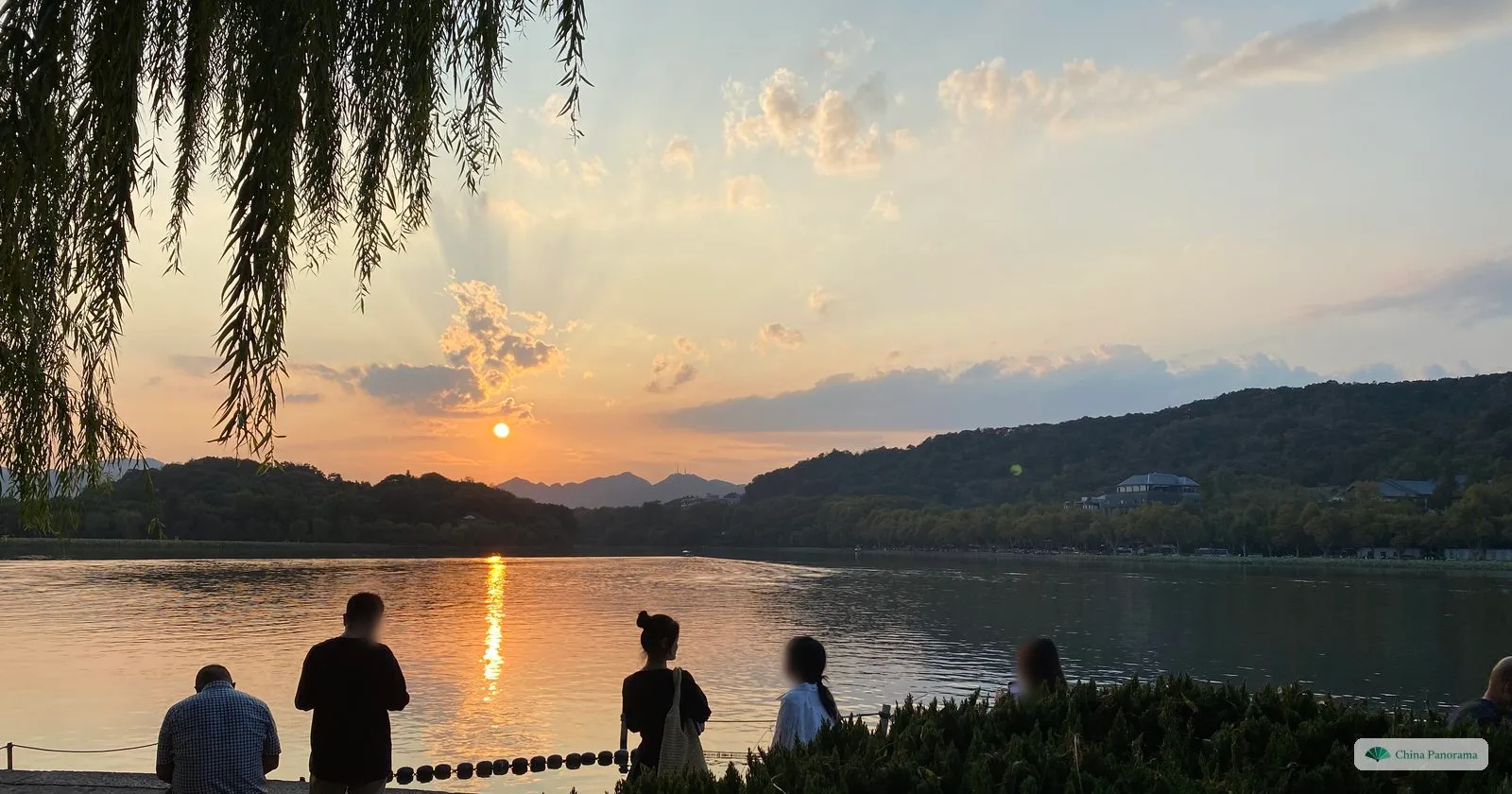
Going to Lingyin?
It is free since 1 December 2025, but you book a time slot in Alipay or WeChat at least a day ahead.How it works →
How long?
Two days: West Lake on foot (12.1 km round), then Lingyin and the pagodas. A third for the old town, the canal and the tea hills. The walking map →
Where is Hangzhou?
At 30.3° N, Hangzhou is level with Cairo and New Orleans, and further south than any city in Europe. It lies on the east coast of China at the head of Hangzhou Bay, where the Qiantang River meets the sea, in the Yangtze delta with Shanghai, Suzhou and Nanjing. Shanghai is 170 km away in a straight line, under an hour by high-speed train. Suzhou is 120 km to the north-east, Nanjing 240 km to the north-west and Huangshan 190 km to the west. Beijing is 1,130 km away. Tap any city on the map to measure the distance.
Straight-line distances from Hubin on West Lake, rounded to the nearest 10 km — not travel distances.
Zhejiang province is highlighted. Tap a city to measure the distance from Hangzhou.
- Province
- Zhejiang浙江省 · capital
- West Lake
- 6.4 km²12.1 km round on foot
- Airport
- HGHXiaoshan · 26 km E
- Metro
- 12 linesfrom 2 CNY
- Time zone
- UTC+8Beijing time
- City flower
- Sweet osmanthus桂花
The lake, the hills and the city
The city lies on the east side of West Lake, and the hills on the other three. We measure everything on this page from Hubin, on the east shore. Lingyin is 6 km west, Six Harmonies Pagoda 7 km south on the Qiantang River, the Grand Canal at Dadou Road 6 km north and Hangzhou East station 6 km north-east, in a straight line. Xiaoshan airport is 26 km east, across the river. Tap a place to see how far it is.
Tap a place on the map or in the list.
The Asian Games stadium. Lines 3 and 10. Details below ↓
The new business district on the river. Citizen Center (Lines 4 and 7). Details below ↓
Feilai Feng and Lingyin, free with a booked slot. No metro. Details below ↓
The canal street. Xiangji Temple (Line 3). Details below ↓
High-speed trains to Shanghai and beyond. Lines 1, 4, 6 and 19.
The tea village in the hills. Bus or taxi. Details below ↓
On the Qiantang River, by the 1937 bridge. Details below ↓
The canal’s arrival in Hangzhou. East Gongchen Bridge (Line 5). Details below ↓
Straight-line distances from Hubin on West Lake, rounded — not travel distances.
Walking round West Lake: our map
12.1 km round by the two causeways, about 3 hours without stops. Pick a walk, tap a numbered stop, or press “Walk it” to see how far each stop is.
Swipe the map sideways to see all of it.
Our loop round the lake
Clockwise from Hubin · 12.1 km · 4 November 2023
Walked: 0.0 of 12.1 km · 0 min (at 4 km/h, without stops)
- Next
- +0.5 km · 8 min
The walk we did: south along the east shore, up Leifeng Pagoda, north along the Su Causeway, over Gushan and back along the Bai Causeway at sunset. We set off at 10:55 and were back at Hubin at 18:23, with long stops.
Tap a numbered stop on the map, or drag the slider to walk the route.
Our loop round the lake
12.1 km · 3 h 02 min
- 10.0
- 20.5
- 32.0
- 43.7
- 54.7
- 65.0
- 75.8
- 87.1
- 98.2
- 108.4
- 119.3
- 129.7
- 1310.6
- Finish12.1
The two causeways
5.6 km · 1 h 24 min
- 10.0
- 20.9
- 31.4
- 42.2
- 52.5
- 63.5
- 74.8
- 85.6
- Finish5.6
The outer loop by the Yanggong Causeway
14.1 km · 3 h 32 min
- 10.0
- 21.8
- 32.3
- 42.7
- 53.6
- 66.2
- 76.8
- 87.9
- 98.3
- 109.3
- 1110.2
- 1211.0
- 1312.7
- Finish14.1
Our own map from OpenStreetMap data (© OpenStreetMap contributors, ODbL), 26 October 2026. Routes and distances from the OpenStreetMap foot router. They include the short detours to each stop. Times are at 4 km/h without stops. Clock times are those of our photographs on 4 November 2023.
On foot, by boat, by cart or by bike?
Walking is the classic way, but not the only one. Tick what applies to you: the best match is marked, and each card says why.
What applies to you?
Tick a situation above and the option that fits best is marked.
Walk the whole loop 环湖步行
12.1 km by the two causeways
All the way round on foot, as on our map: about three hours without stops, a full day with Leifeng Pagoda and long breaks.
- Distance
- 12.1 km (OpenStreetMap)
- Time
- about 3 h at 4 km/h, without stops
- Cost
- Free, apart from Leifeng Pagoda
- I only have half a day: Possible in four hours, but you will rush past everything.
- I can’t walk far: Twelve kilometres on flat paths, with no shortcuts across the water except boats.
- I want to go onto the islands: The islands are only reached by boat. Add one from a pier on the way.
- It is July or August: At 35 °C, a full loop in the sun is hard work. Go at dawn.
- Sunset or early-morning photos: Start at dawn on the Su Causeway, end at sunset on the Bai Causeway.
- I want to avoid the crowds: The causeways are packed at weekends, the Yanggong Causeway much less.
Half the lake on foot 白堤 · 苏堤
5.6 km, Broken Bridge to Leifeng
The Bai Causeway, Gushan and the Su Causeway, then a bus, taxi or cart back. The best of the lake in half a day.
- Distance
- 5.6 km, one way
- Back
- Buses and taxis on Nanshan Road at Leifeng
- I only have half a day: About 1½ hours of walking, plus stops.
- I can’t walk far: Still 5–6 km. Shorten it by starting at Gushan.
- I want to go onto the islands: There are piers on Gushan and on the Su Causeway.
- It is July or August: The causeways have shade from willows, but little else.
- Sunset or early-morning photos: Both causeways, end at Leifeng for the view from the top.
- I want to avoid the crowds: This is the route everyone takes.
A boat to Three Pools 游船 · 三潭印月
From Hubin, the Broken Bridge, Gushan or the Su Causeway
Pleasure boats cross to Xiaoyingzhou, the island of the three stone pagodas, and back. Smaller hand-rowed boats can be hired at the piers for a slow trip.
- Price
- not checked
- Time
- about an hour on the island
- I only have half a day: Combine with the Bai Causeway for a full half day.
- I can’t walk far: Sitting down, and the island is small.
- I want to go onto the islands: The only way onto the islands.
- It is July or August: A breeze on the water, but little shade on the island.
- Sunset or early-morning photos: The view of the three pagodas from the island, and of the hills from the water.
- I want to avoid the crowds: The island is busy, the rowing boats quiet.
The sightseeing carts 环湖观光车
Electric carts round the shore
Open electric carts run round the lake and along the Su Causeway, and you can get on and off at stops. A rest for tired legs.
- Price
- by the stop or the loop, not checked
- Paying
- usually Alipay or WeChat at the cart
- I only have half a day: Round the lake in about an hour with a few stops.
- I can’t walk far: The easiest way round.
- I want to go onto the islands: Carts don’t go to the islands. Change to a boat at a pier.
- It is July or August: Shade and a breeze, while you rest.
- Sunset or early-morning photos: You stop where the cart stops.
- I want to avoid the crowds: Queues at the main stops at weekends.
A bike round the outer loop 骑行 · 杨公堤
14.1 km by the Yanggong Causeway
Shared bikes are unlocked with the Alipay app (Hellobike and others). The outer loop by the Yanggong Causeway is wider and quieter than the inner one.
- Distance
- 14.1 km (walking route, OpenStreetMap)
- Price
- by the app, not checked
- Note
- cycling on the Bai and Su Causeways may be restricted at busy times
- I only have half a day: Round the outer loop in about an hour and a half with stops.
- I can’t walk far: Easier than walking, but you still pedal 14 km.
- I want to go onto the islands: Leave the bike at a pier if you want a boat.
- It is July or August: Better than walking, but still hot in the sun.
- Sunset or early-morning photos: Stop where you like.
- I want to avoid the crowds: The Yanggong Causeway and the western lakes are the calm side.
Distances from the OpenStreetMap walking routes on our map. Boat, cart and bike prices are not checked (amber), and rules for bikes on the causeways change at busy times.
What’s Hangzhou weather like each month?
Four clear seasons: 9 °C by day in January with nights near freezing, 24 °C in April, 35 °C in July and August with nights of 27 °C, 24 °C in October. The plum rains come from about mid-June, and summer is humid. The sun rises at 04:57 in June and 06:48 in December. Tap a month for temperatures, daylight and what is on at the lake.
Scale in °C. Bars run from the average daily low to the average daily high. Source: monthly temperature data, last checked 2026-07-30.
Hangzhou in October
Mild- Average high
- 24 °C
- Average low
- 16 °C
- Sunrise / sunset
- 06:00 – 17:30
- Daylight
- 11 h 29 min
On in Oct
- Golden Week crowds, 1–7 Oct
- Osmanthus round the lake
In December the city hosts badminton’s season finale: the BWF World Tour Finals, 9–13 December 2026, at the Olympic Sports Center across the river.
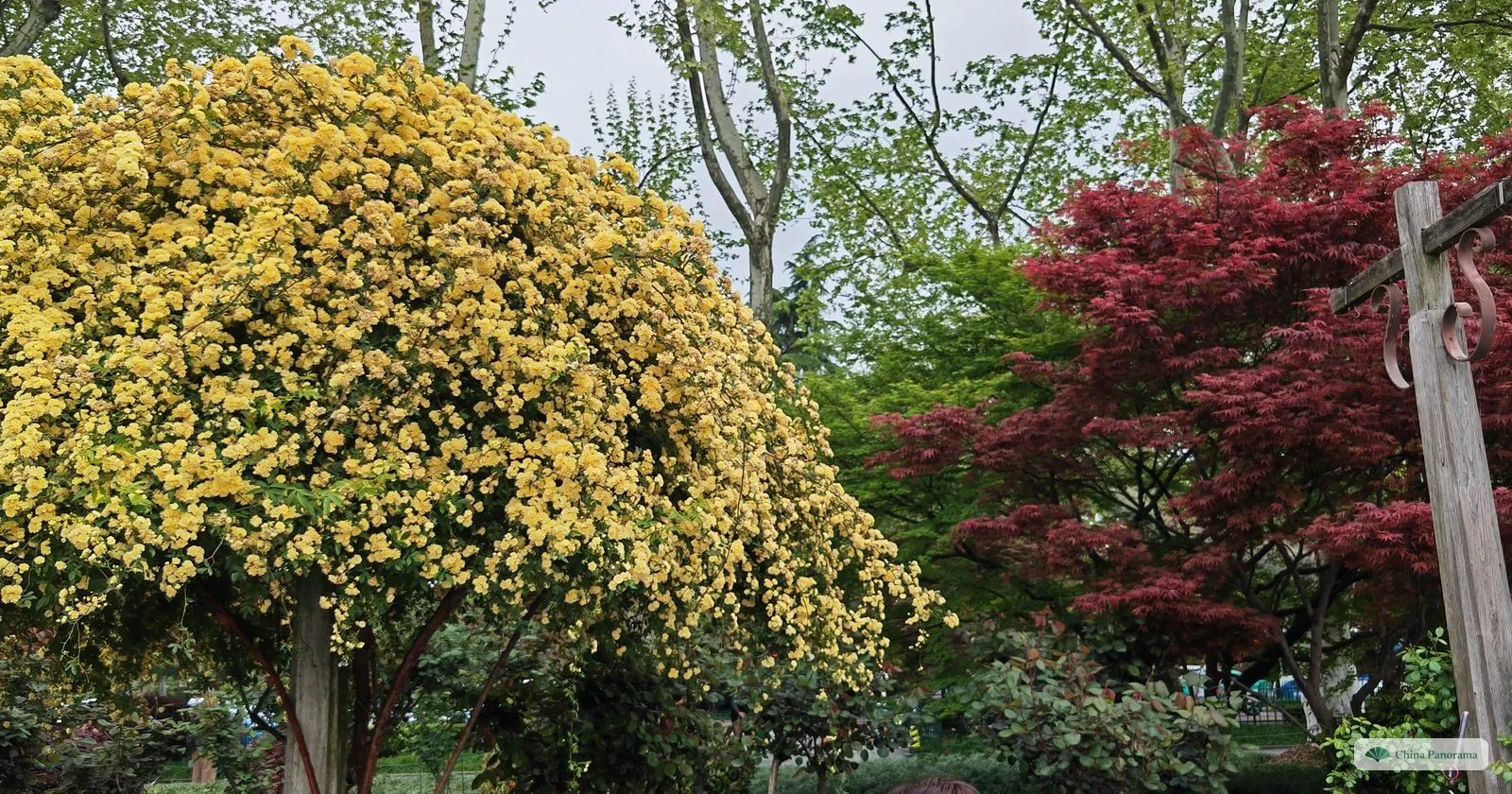
Spring
March – MayBlossom on the causeways, new tea in the hills.
March averages 17 °C by day, April 24 °C and May 28 °C. Peach and cherry blossom line the Su and Bai Causeways in March and early April, the banksia roses on Beishan Road follow in April, and the first Longjing tea is picked before the Qingming festival in early April. It is the busiest season at the lake, with weekend crowds and the May Day holiday (1–5 May). Our photos are from 10–11 April 2023.
What to wear: Layers and a light rain jacket: showers are common, and mornings can be cool.
Summer
June – AugustPlum rains, then 35 °C and lotus on the lake.
From about mid-June to early July the plum rains bring weeks of grey, humid drizzle. Then July and August average 35 °C by day and 27 °C at night, among the hottest months of any big city in eastern China. The lotus is in flower at Quyuan Fenghe and along the Bai Causeway in July and August. Walk the lake at dawn or after sunset, and spend the middle of the day indoors.
What to wear: Light clothes, a hat, an umbrella against both sun and rain, and water.
Autumn
September – NovemberOsmanthus in the air, the best walking weather.
September averages 29 °C by day, October 24 °C and November 18 °C. In late September and October the sweet osmanthus, Hangzhou's city flower, scents the whole lake, especially round Manjuelong in the southern hills. November is clear and mild, with sunsets behind the western hills from the Bai Causeway. Avoid Golden Week, 1–7 October, when the lake and the causeways are packed. Our walk round the lake was on 4 November 2023.
What to wear: T-shirt at noon in September and October, a jacket for November evenings.
Winter
December – FebruaryDamp and chilly, quiet, and sometimes snow on the Broken Bridge.
January averages 9 °C by day and 2 °C at night, often grey and damp. Indoor heating is weak south of the Yangtze. The lake is at its quietest, apart from Chinese New Year. A few times a winter it snows, and then everyone comes to see “Lingering Snow on the Broken Bridge”. Plum blossom on Gushan and at Lingfeng in February. Our winter photos are from 14 January 2018.
What to wear: A warm, waterproof jacket and warm clothes for indoors.
We would pick the first half of April or the last two weeks of October, outside the May Day and Golden Week holidays. For how Hangzhou compares with the rest of the country month by month, see the best time to visit China.
Things to do in Hangzhou
24 places: the lake and its causeways, the temples in the western hills, two pagodas, the old town of the Southern Song, the Grand Canal and the new city on the river. Four things first: a quiz on Hangzhou’s three kinds of water, how old each sight really is, the Lingyin valley step by step, and what our photographs show.
West Lake, the Grand Canal or the Qiantang River? Guess the water
Hangzhou has three waters: the lake, the canal that runs from Beijing, and the wide tidal river. Eight of our photographs — guess which is which, and see the clue that gives it away.
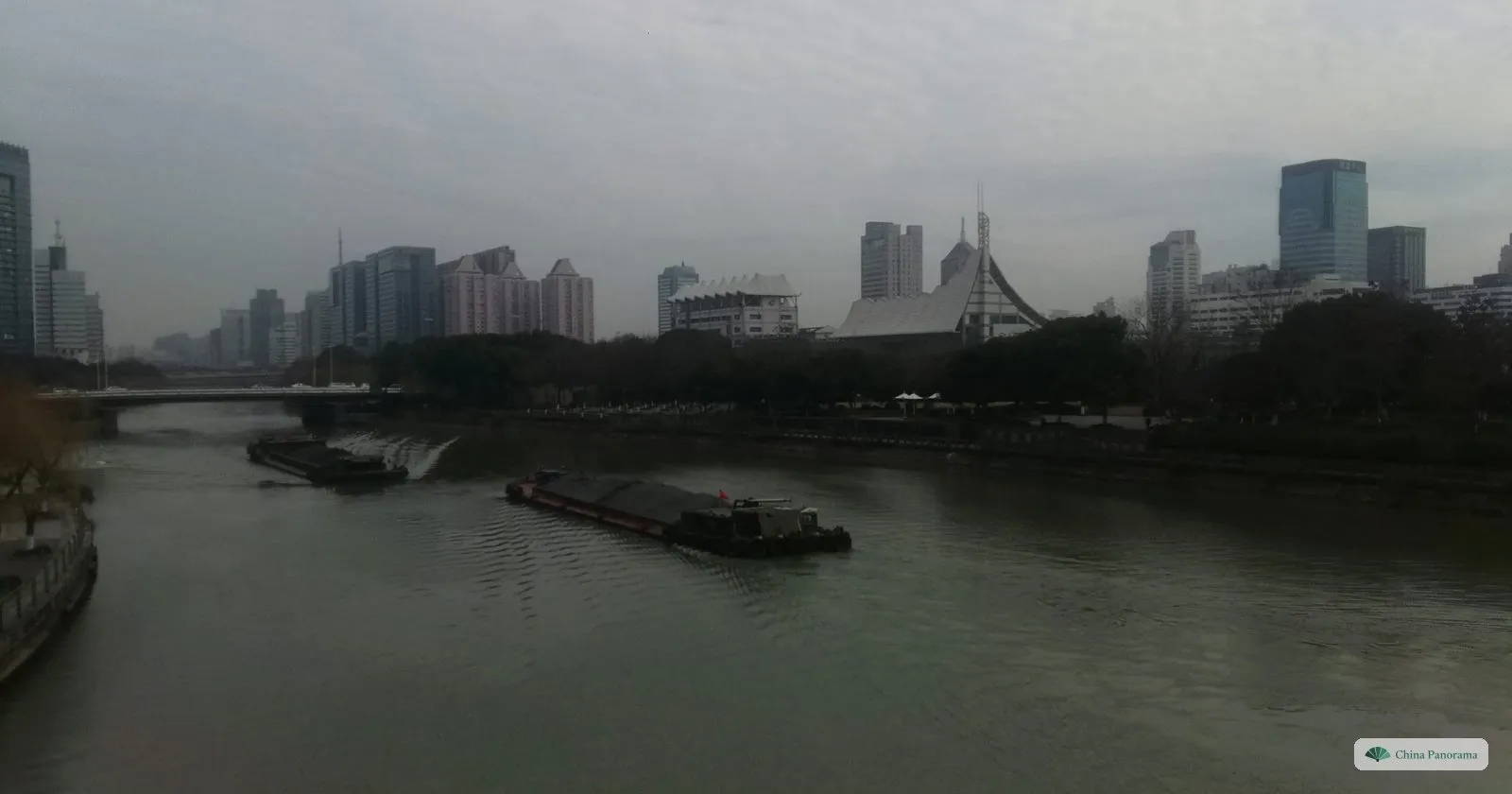 Photograph 1
Which water is this?
Answer: Grand Canal
Cargo barges are the giveaway: no freight moves on West Lake. The Grand Canal is still a working waterway right through the city.
13:04 on 14 January 2018, near Wulin Gate.
 Photograph 2
Which water is this?
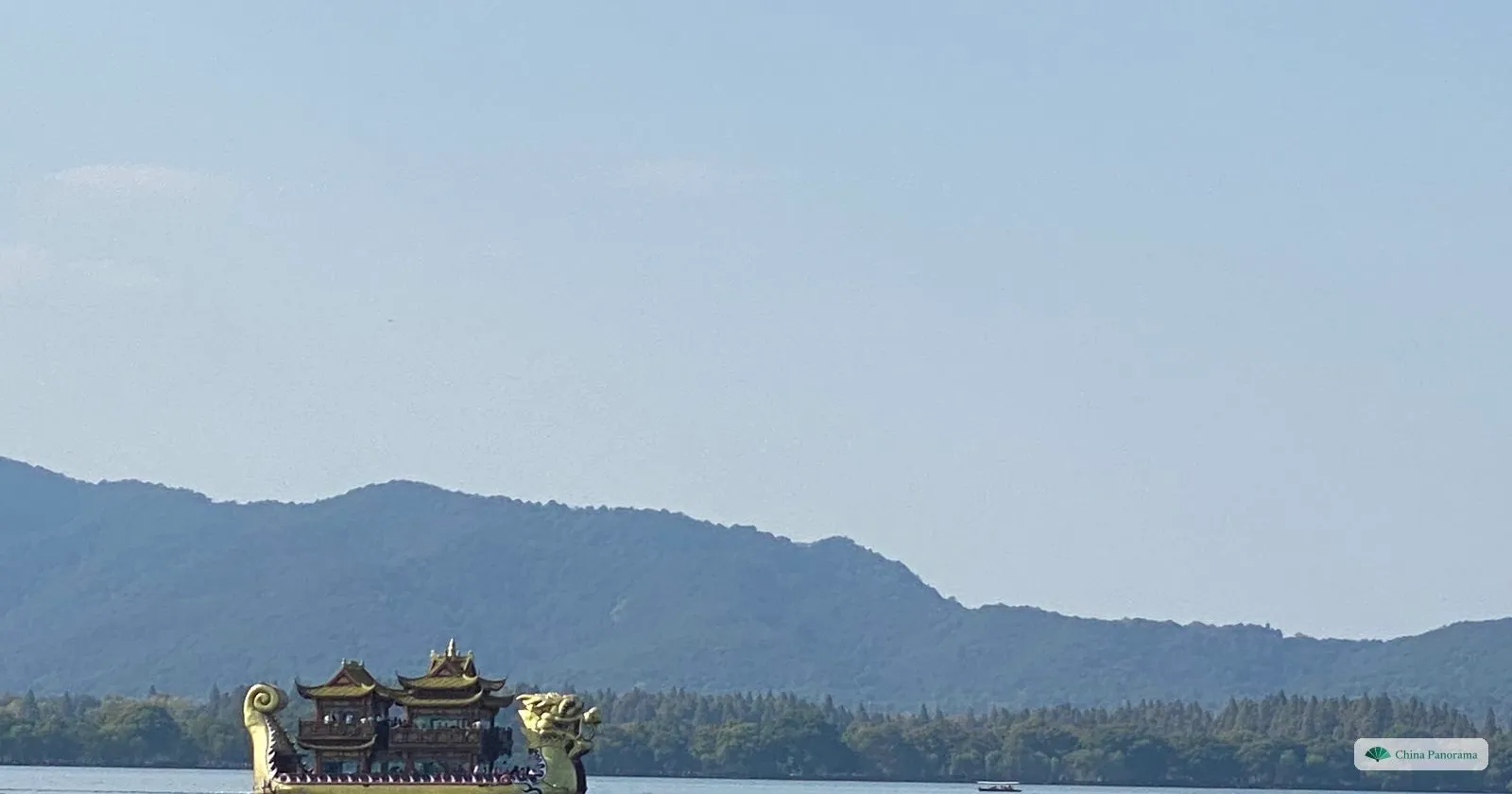
Answer: West Lake
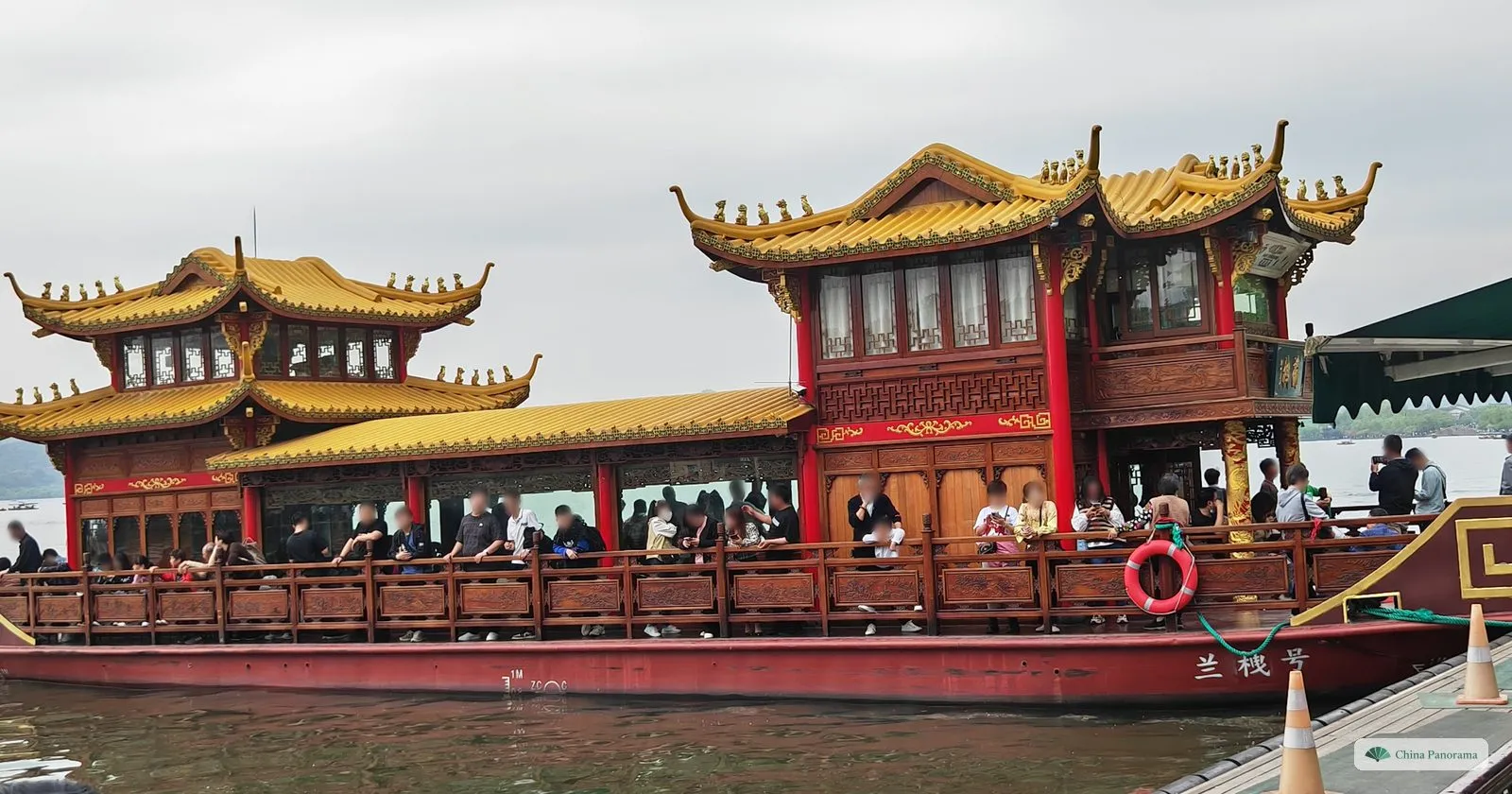
A golden dragon boat for sightseers, and hills right behind: West Lake, seen from the east shore towards the western hills.
12:52 on 4 November 2023.
 Photograph 3
Which water is this?
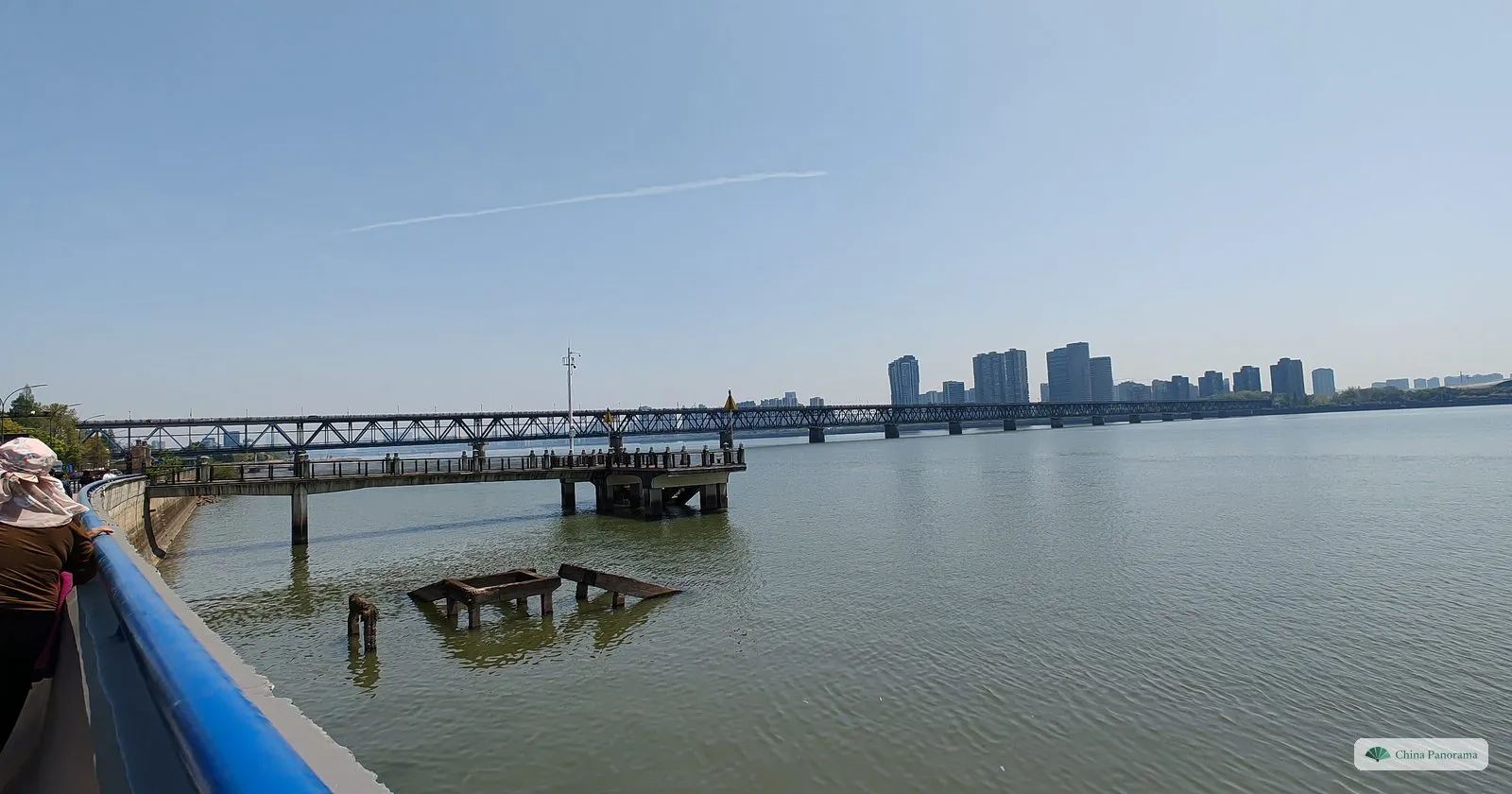
Answer: Qiantang River
Far too wide for the canal, and West Lake has no steel bridges. This is the Qiantang River below Six Harmonies Pagoda, with the double-decker bridge of 1937.
11:48 on 10 April 2023.
 Photograph 4
Which water is this?
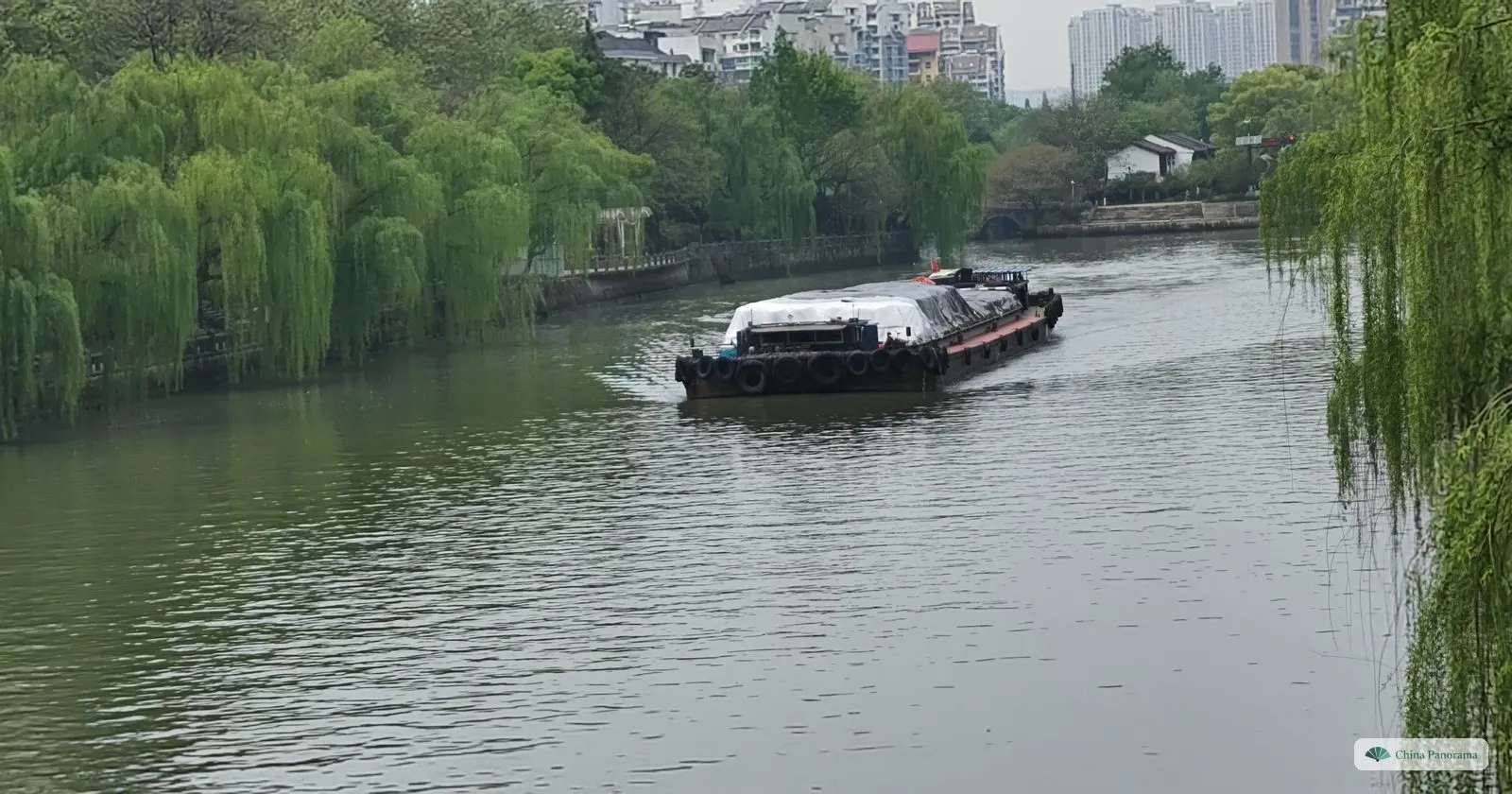
Answer: Grand Canal
Willows, calm green water — it could be the lake. But the banks are straight and parallel, and a barge is coming: the Grand Canal at Dadou Road.
12:31 on 11 April 2023.
- Photograph 5
Which water is this?
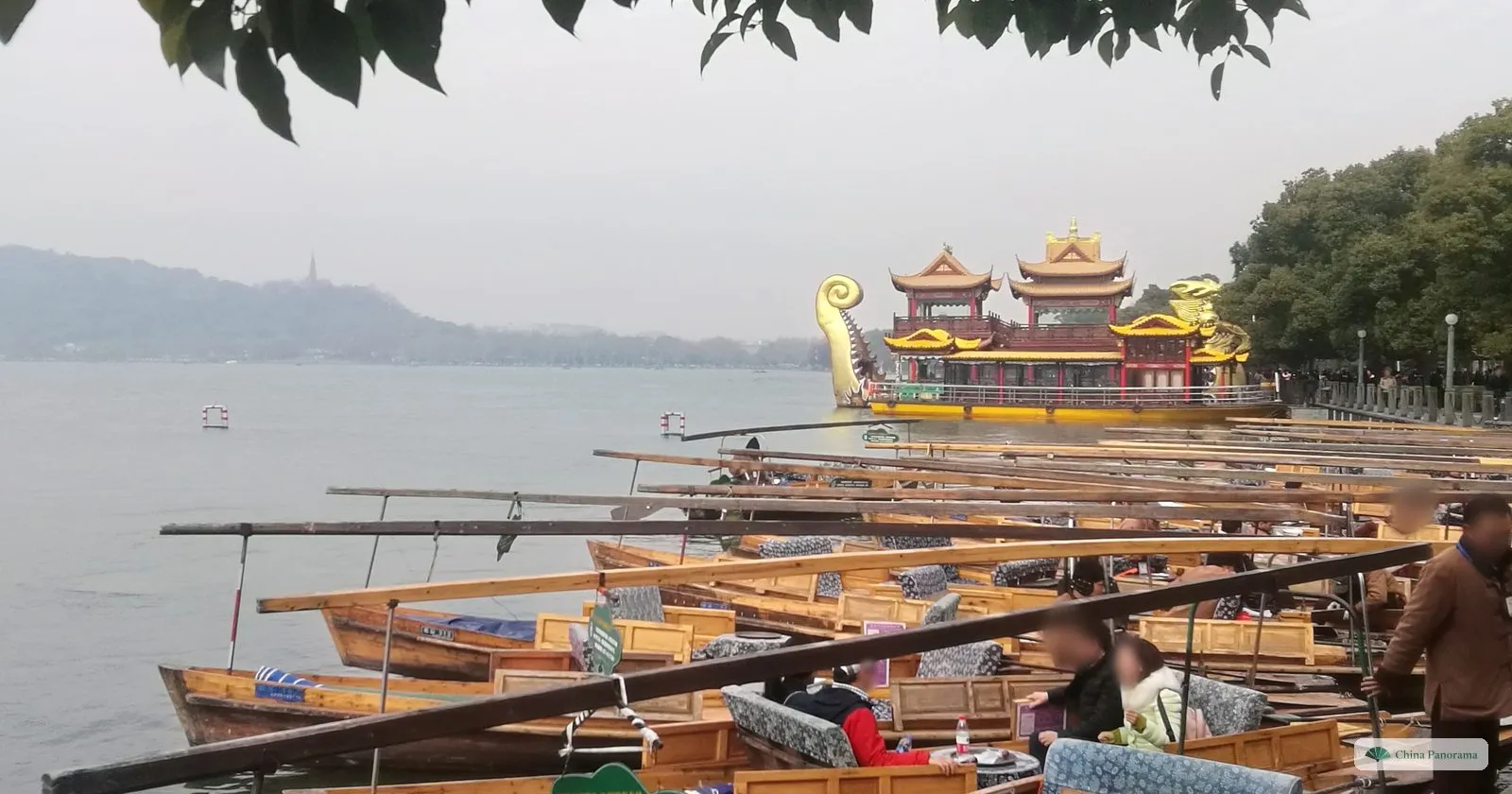
Answer: West Lake
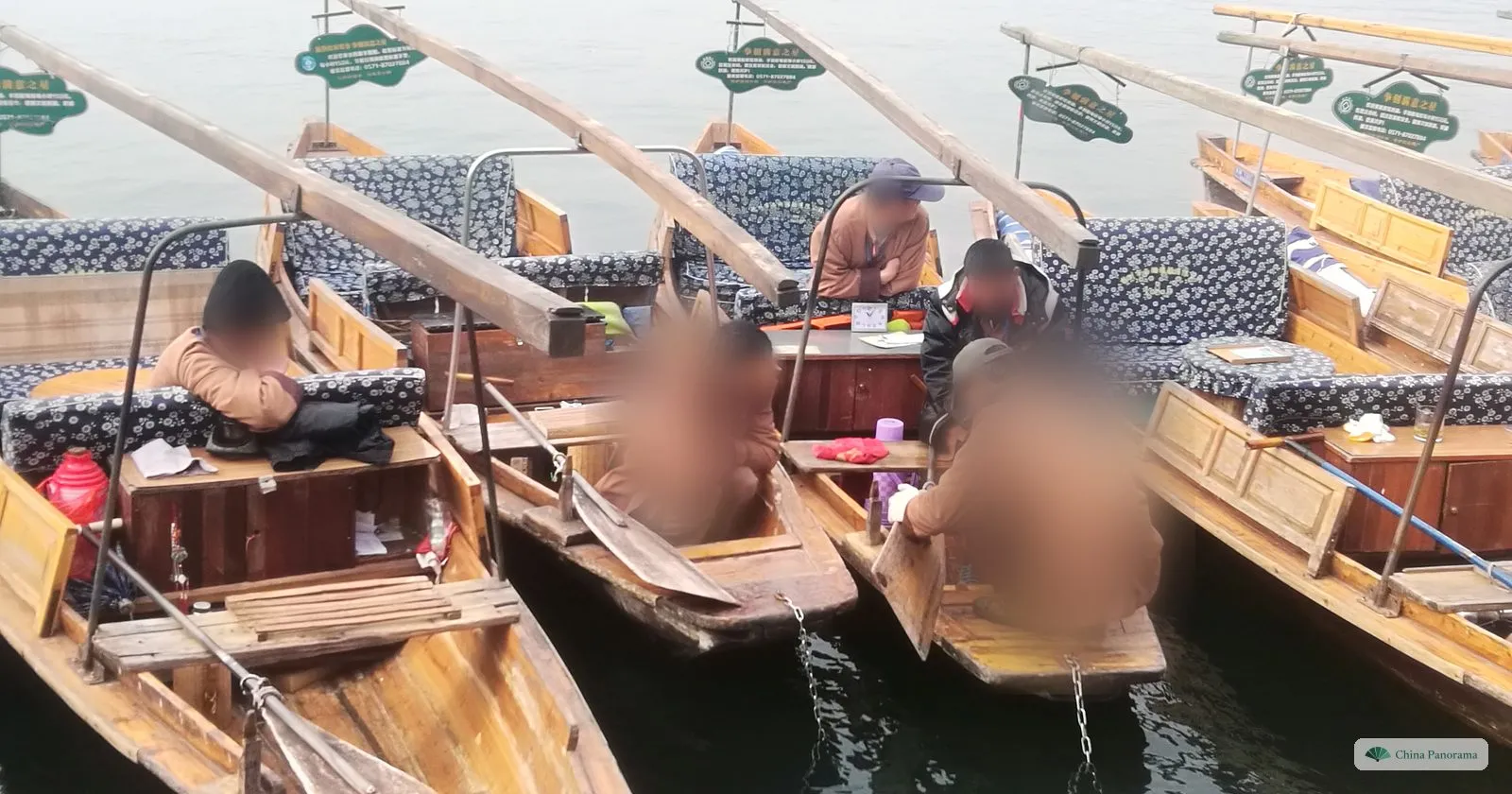
Rows of hand-rowed boats waiting for visitors, and on the hill in the haze a thin pagoda: Baochu Pagoda above West Lake, seen from Hubin.
11:06 on 14 January 2018.
 Photograph 6
Which water is this?
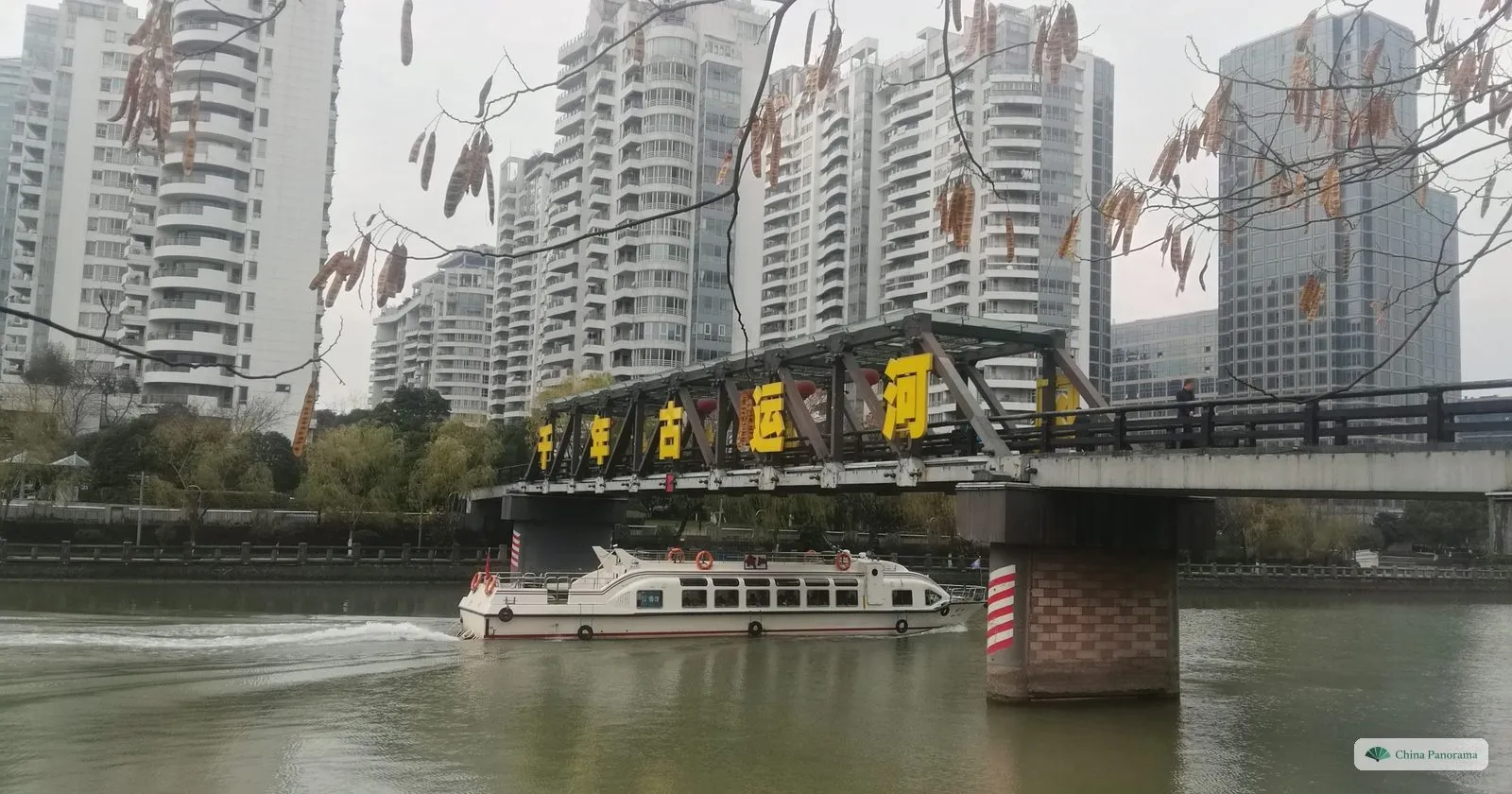
Answer: Grand Canal
The yellow characters on the bridge read 千年古运河, “the thousand-year-old canal”: the Grand Canal at Wulin Gate, where the water buses leave.
12:52 on 14 January 2018.
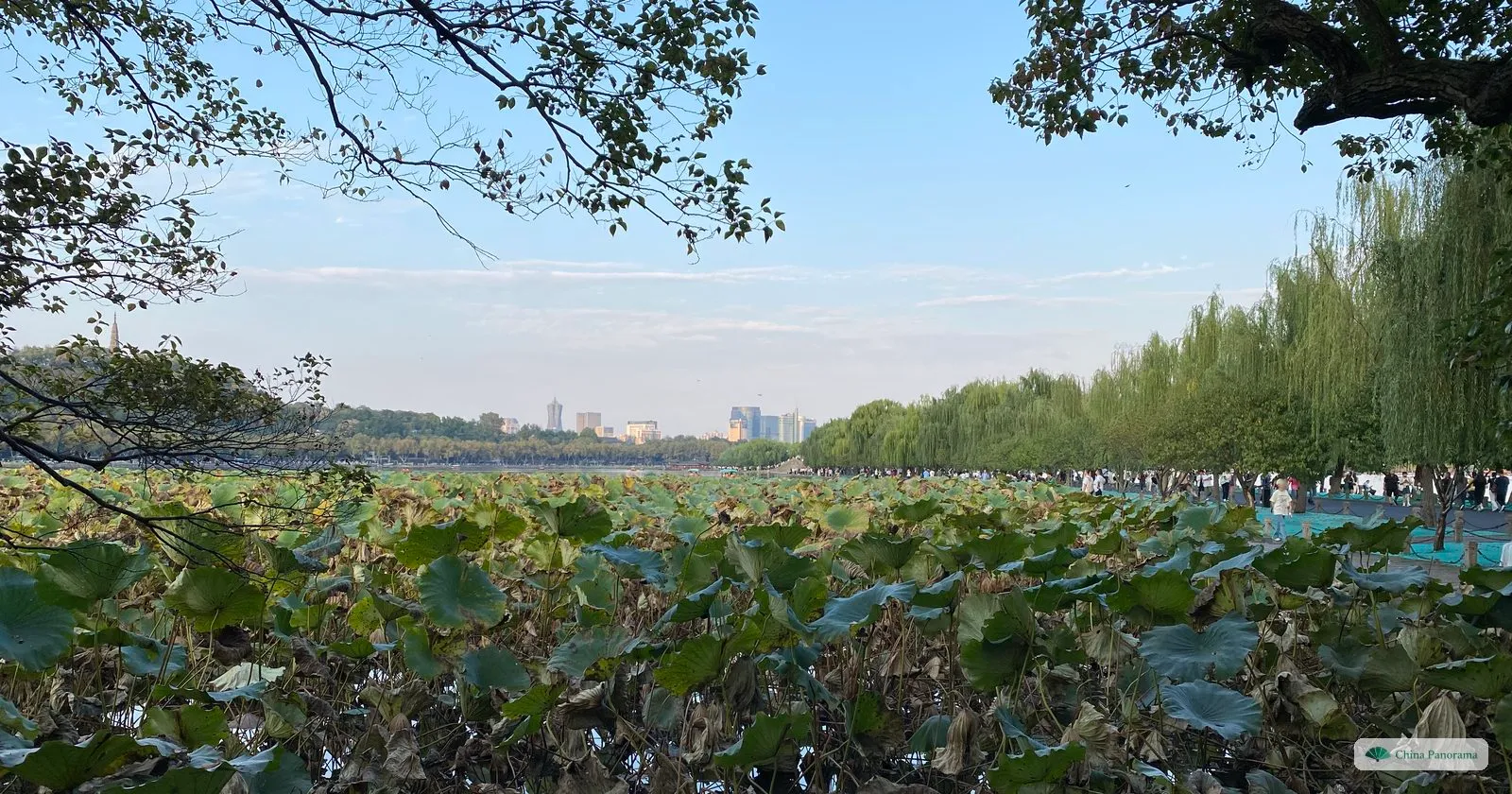 Photograph 7
Which water is this?
Answer: West Lake
City towers behind, so it could be the canal. But canals have no lotus beds: this is the North Inner Lake, the part of West Lake behind Gushan, in autumn.
16:19 on 4 November 2023. A trick question.
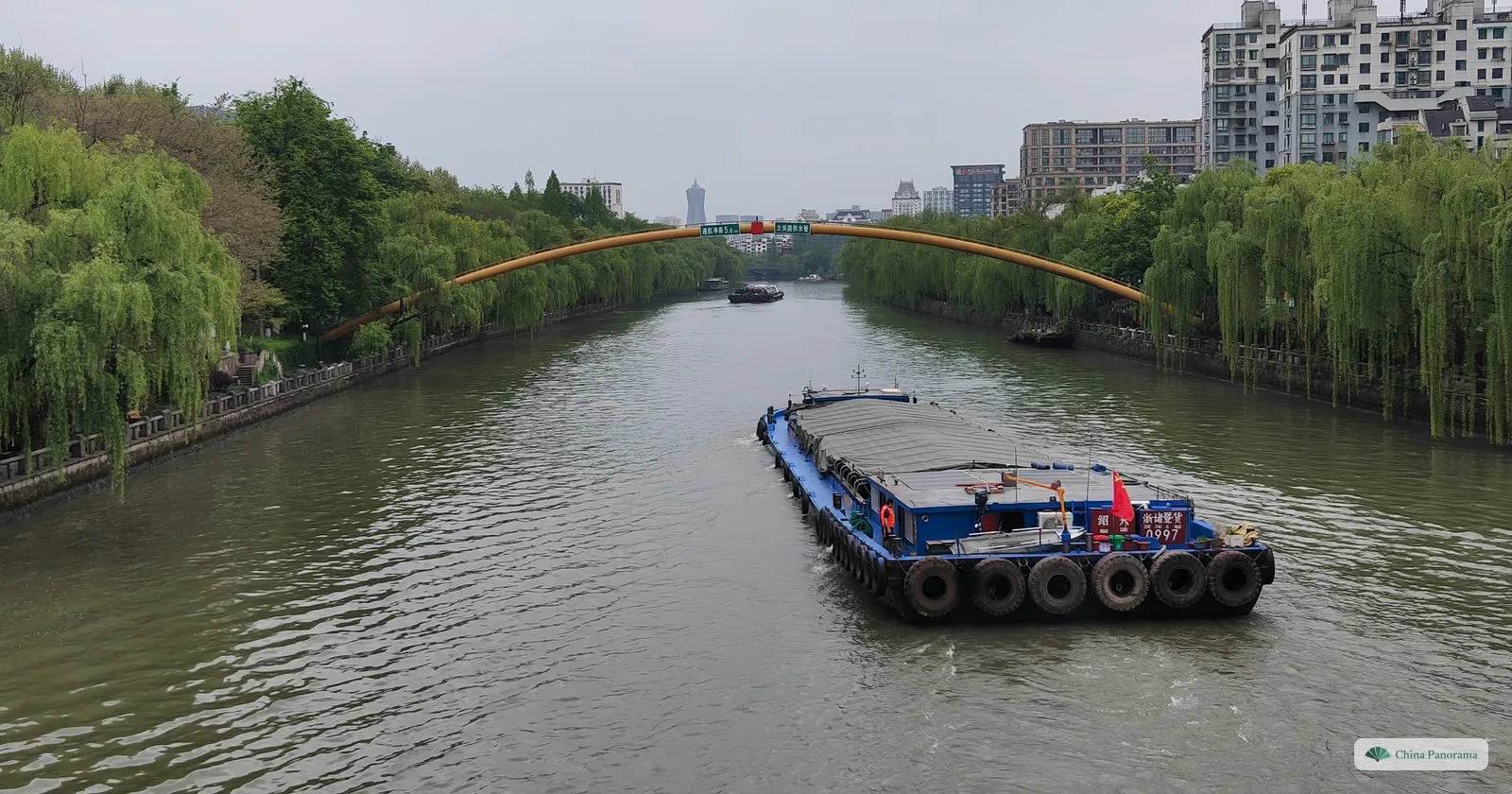 Photograph 8
Which water is this?
Answer: Grand Canal
A straight channel all the way to the horizon, with a loaded barge in the middle: the Grand Canal, looking along it from a bridge at Dadou Road.
12:37 on 11 April 2023.
How old is it really?
Leifeng Pagoda, the famous one, was built in 2002. Six Harmonies Pagoda across the hills still has its brick core of 1163, and the carvings of Feilai Feng are up to a thousand years old. Tap a name on the time line, or filter.
Wuyue and Northern Song907–1127
Southern Song capital1127–1279
Yuan
Ming and Qing1368–1911
20th century1912–1999
Our centurysince 2000
Filled dot: original. Ring: ruin. Square: built in our time.
Tap a name on the time line or a card.
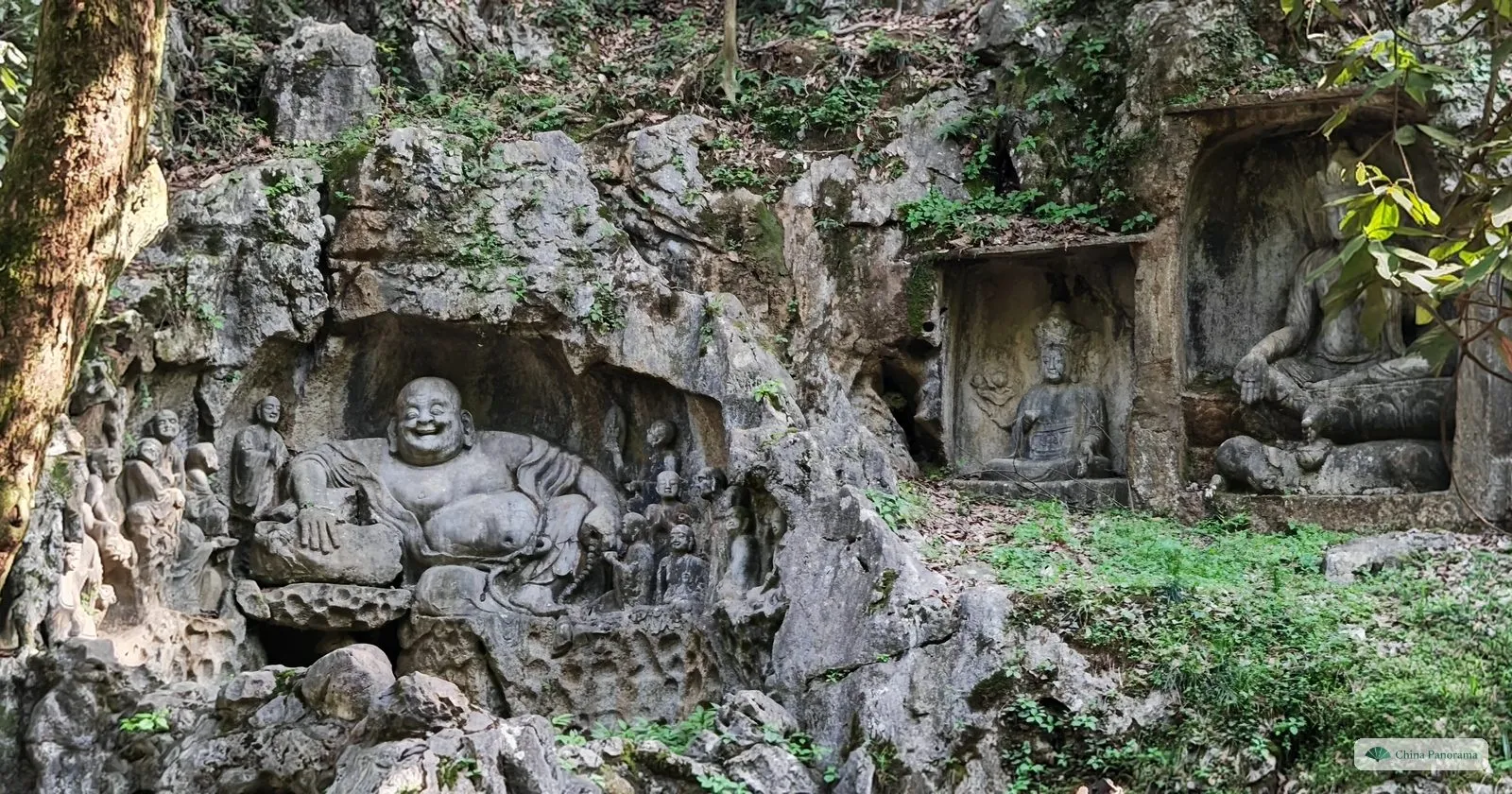 Original10th–14th c.about 1,030 years old
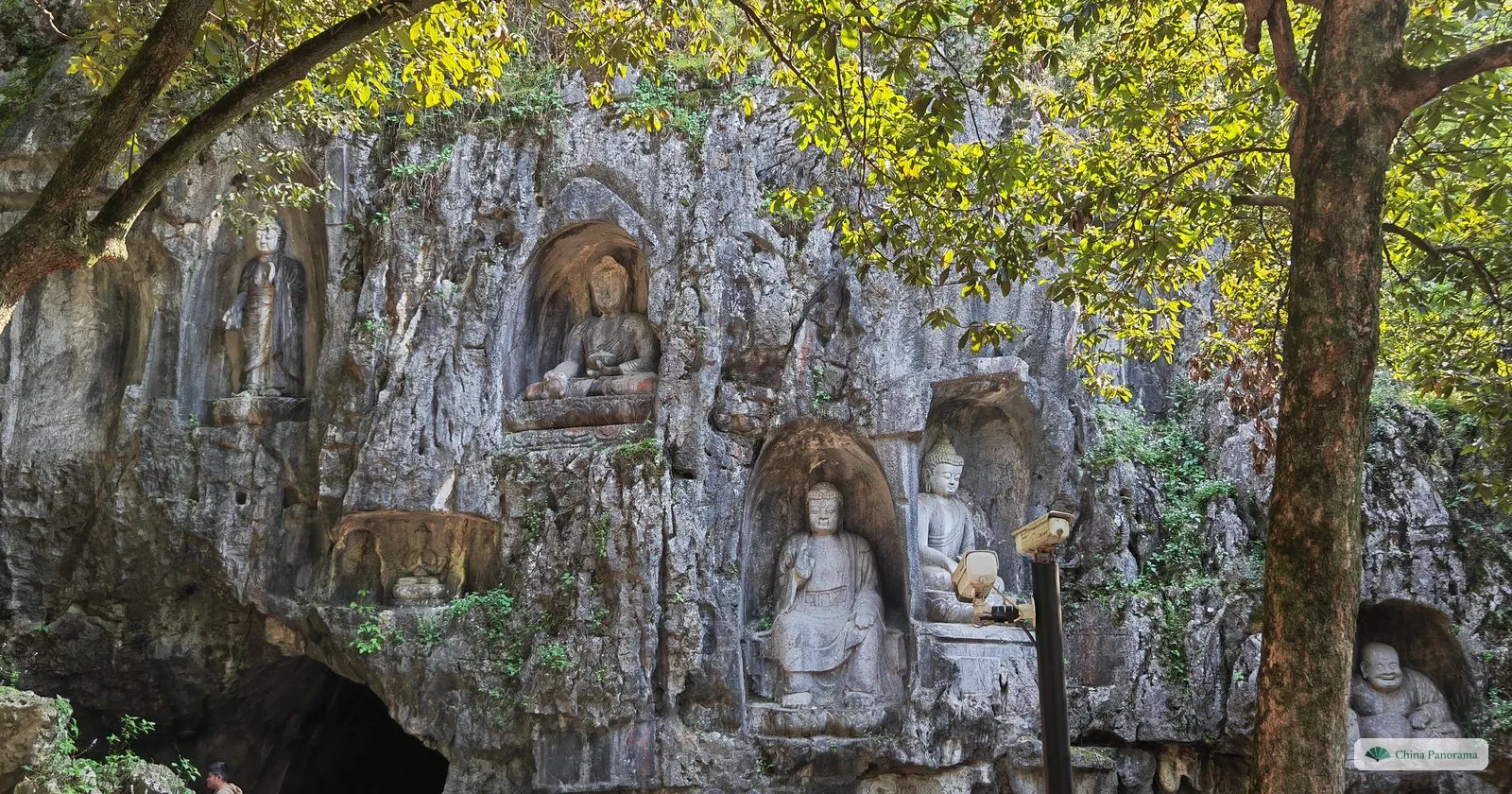
More than 470 figures cut into the rock from the Five Dynasties to the Yuan, the laughing Buddha among them.
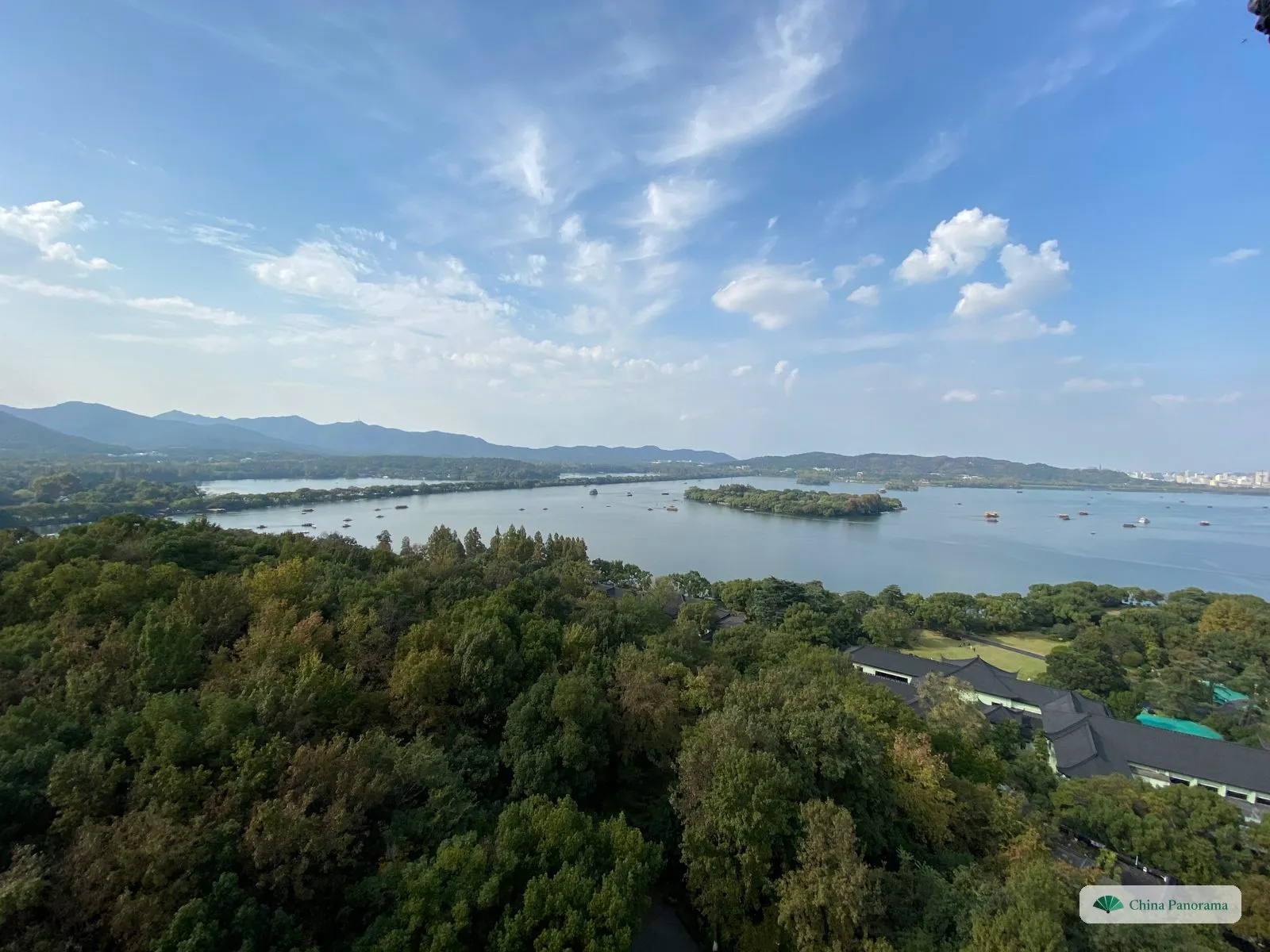 Original1089about 940 years old
Su Shi’s embankment across the lake. The trees and bridges have been renewed many times, the line is his.
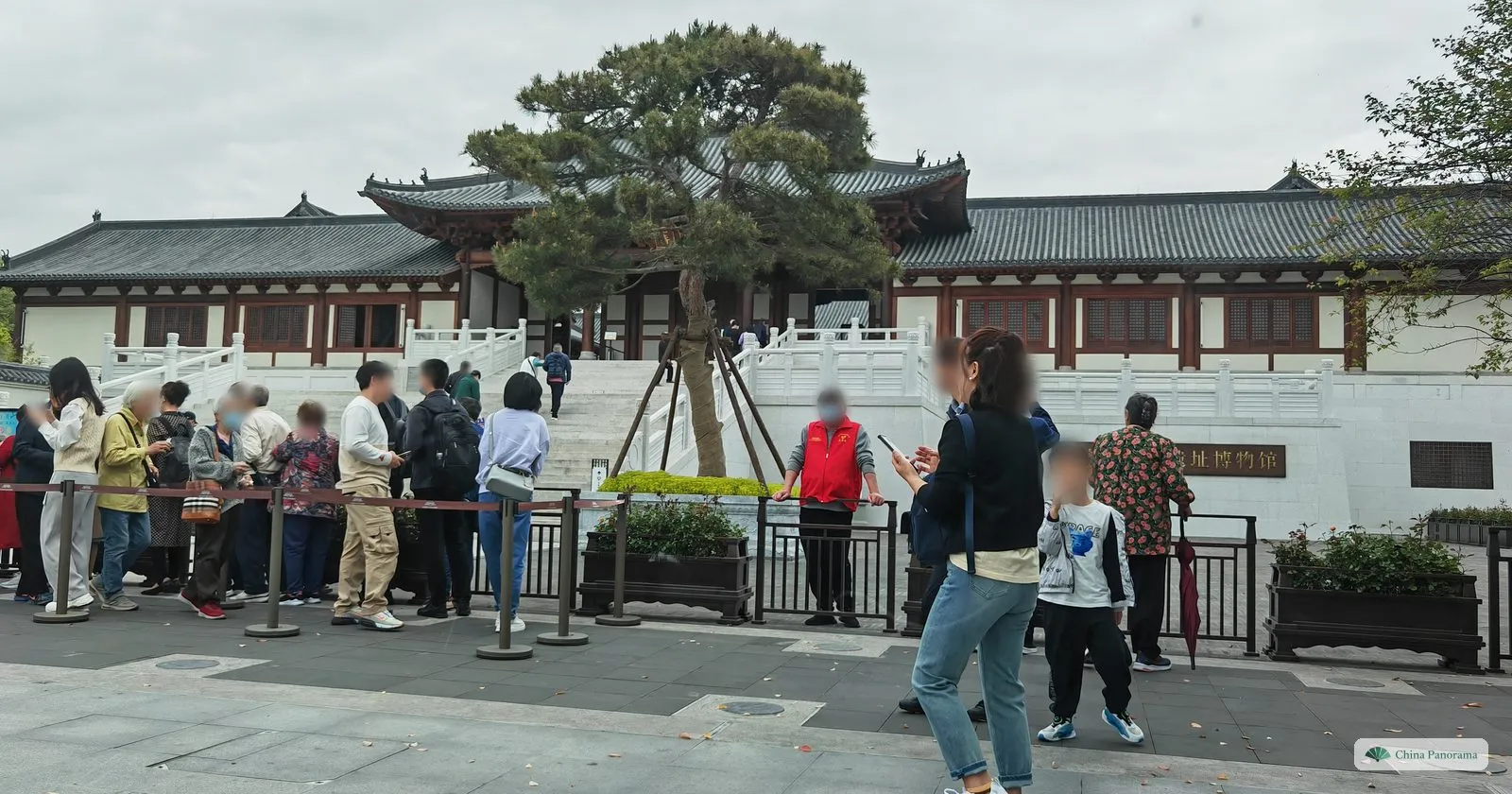 Ruinfrom 1162about 860 years old
Foundations of the palace where Gaozong lived after he gave up the throne, dug up between 1984 and 2020.
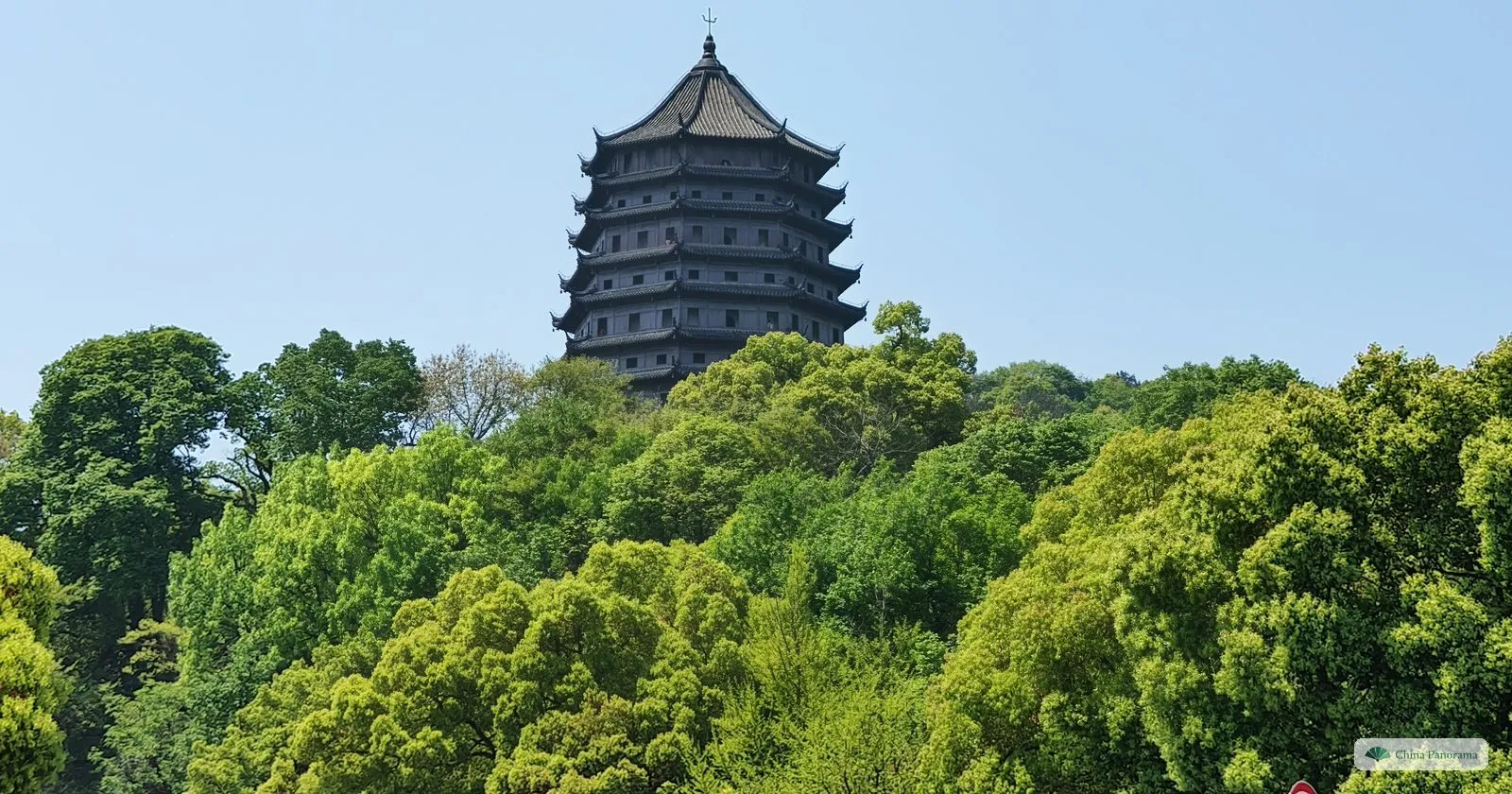 Originalbrick core 1163about 860 years old
The brick tower you climb is Southern Song. The wooden eaves wrapped round it are from 1900.
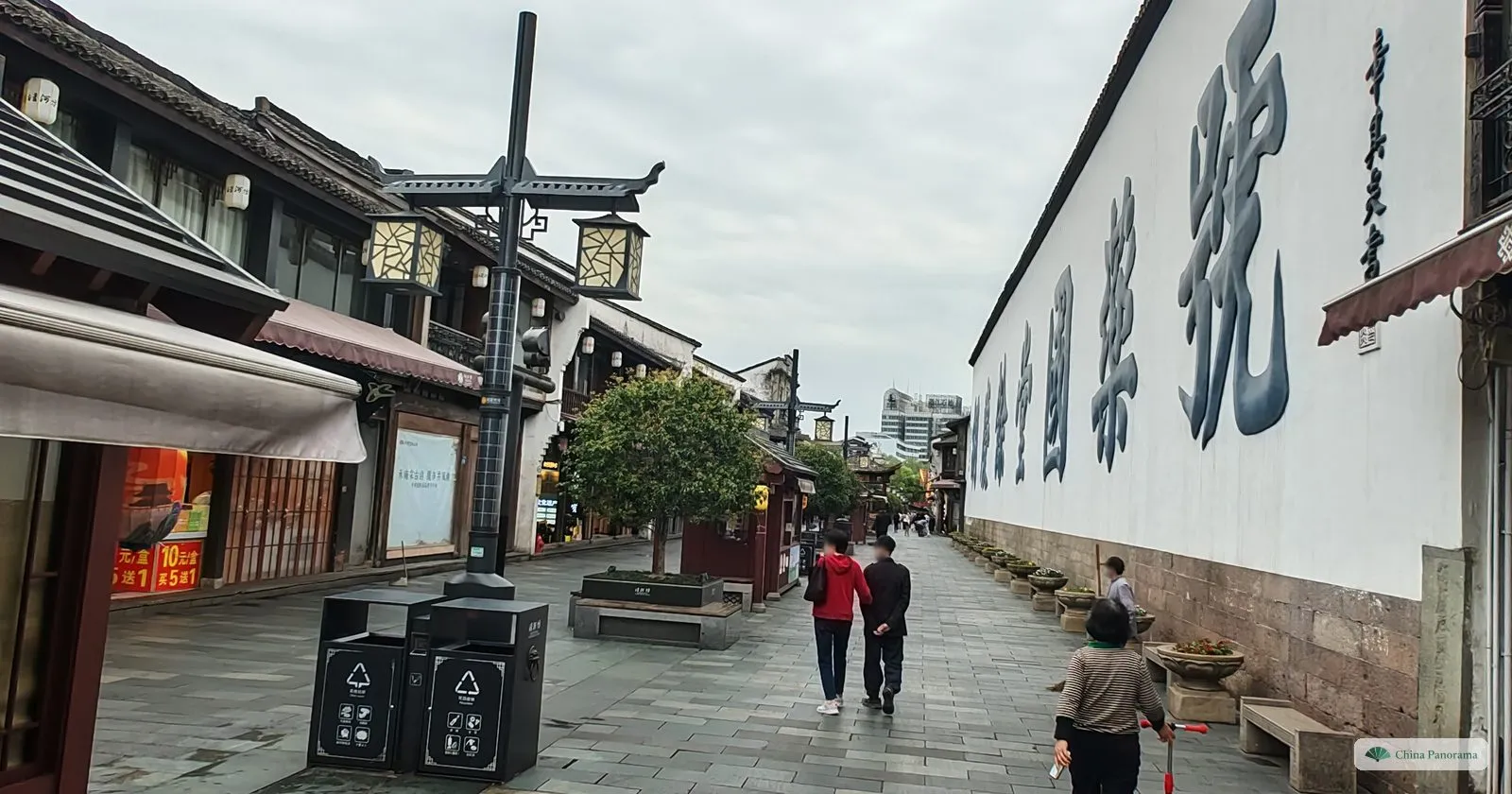 Original1874about 150 years old
Hu Xueyan’s pharmacy, its courtyards and its giant wall advertisement.
- Original1885 (first 1631)about 140 years old
Three stone arches over the Grand Canal, first built in 1631 and rebuilt in 1885.
- Original193789 years old
Opened to trains on 26 September 1937, blown up by Chinese troops on 23 December, repaired by 1953.
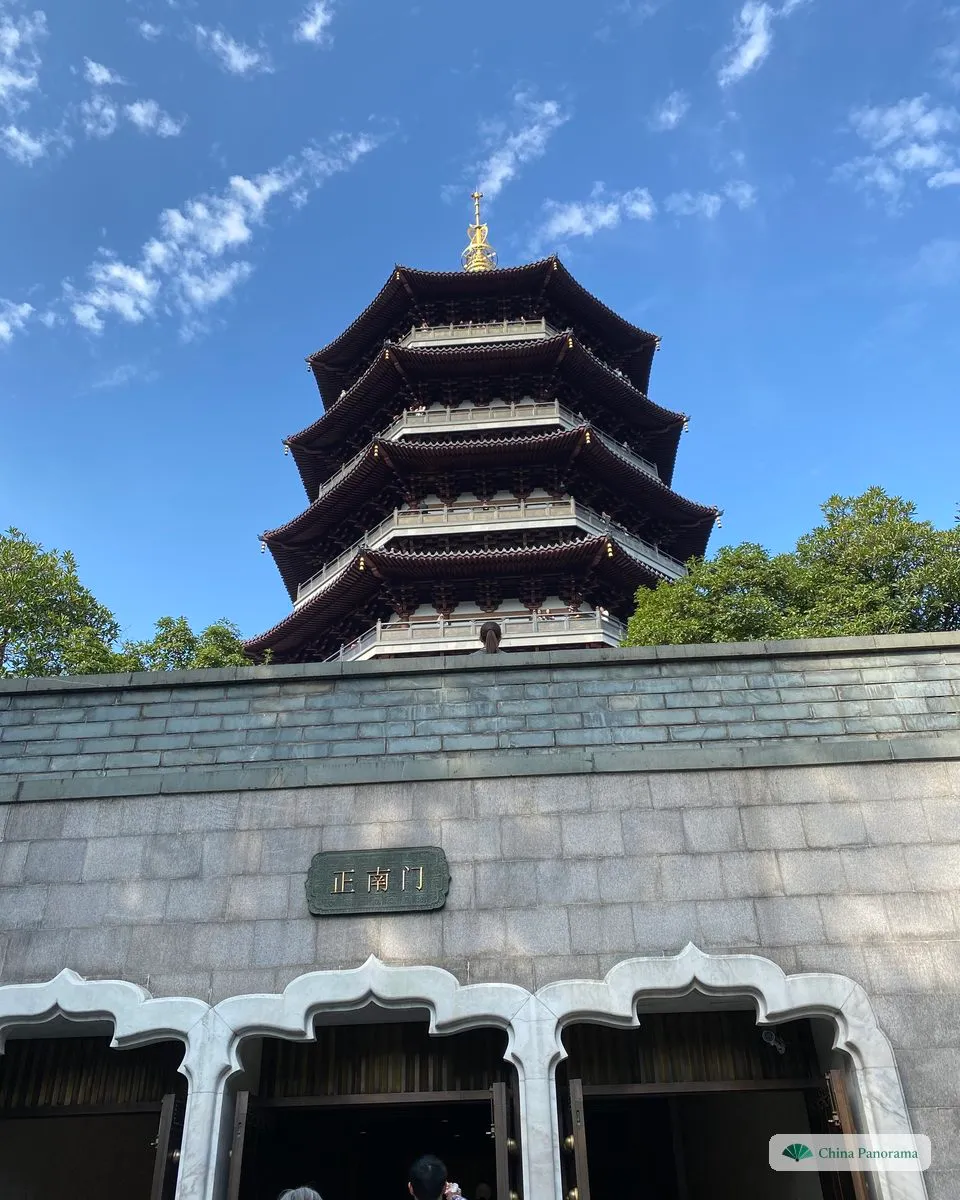 Built in our time2002 (first 975)24 years old
Steel and copper over the ruined brick base of 975, which you can see inside.
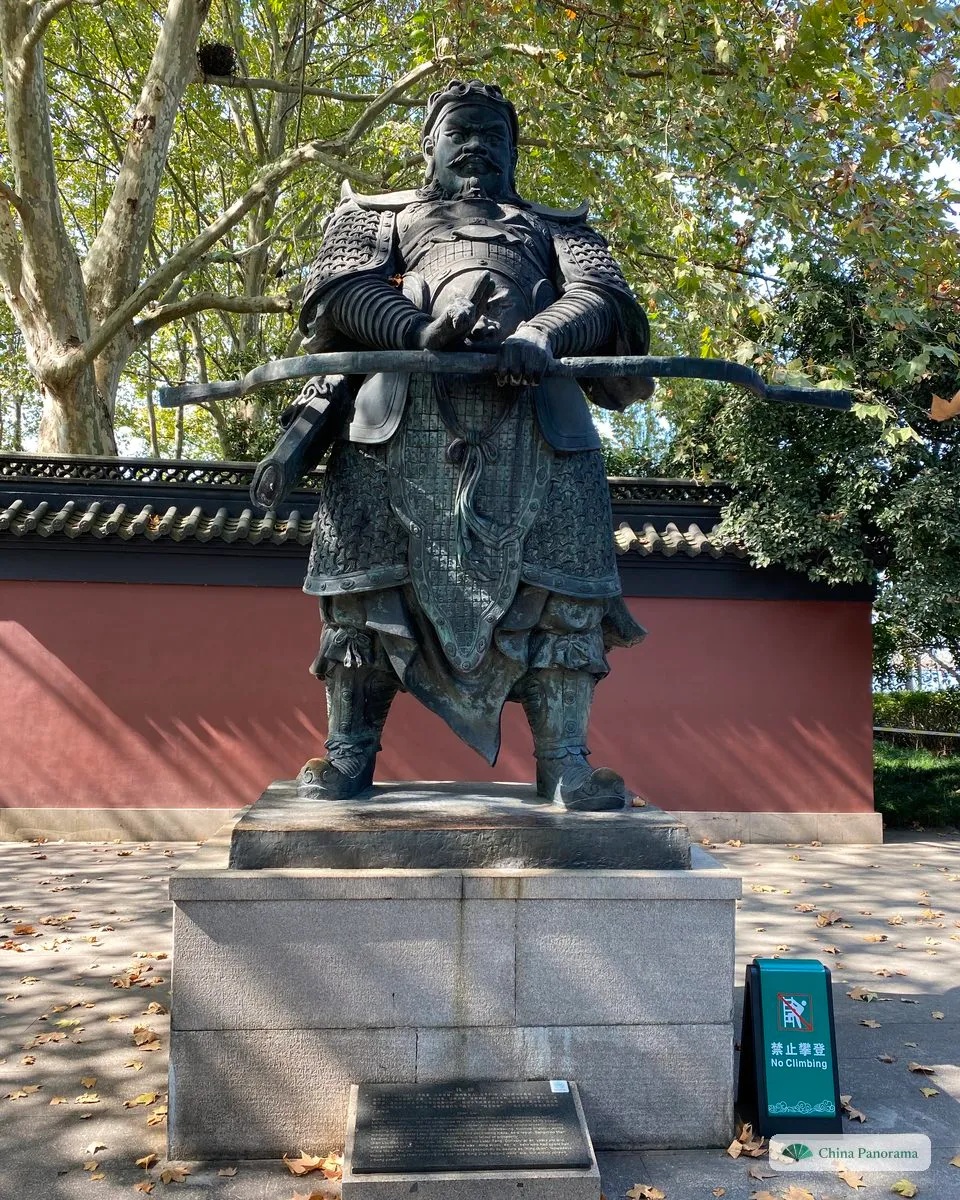 Built in our time2003 (first 1077)23 years old
The memorial hall to the king of Wuyue was rebuilt in 2003.
- Built in our time20224 years old
The museum hall over the ruins opened on 22 November 2022.
The Lingyin valley on foot, step by step
Our walk on 10 April 2023, from the gate at 14:52 past the carvings of Feilai Feng to Yongfu Temple at 15:35: about 0.8 km between our photographs, more on the winding paths. Taoguang Temple is 400 m further up. Tap a point on the line.
Tap a stop on the line or a card.
- On our path1.3 km from the gate
About 400 m further up through bamboo and tea, a small temple with a view back over the lake on a clear day.
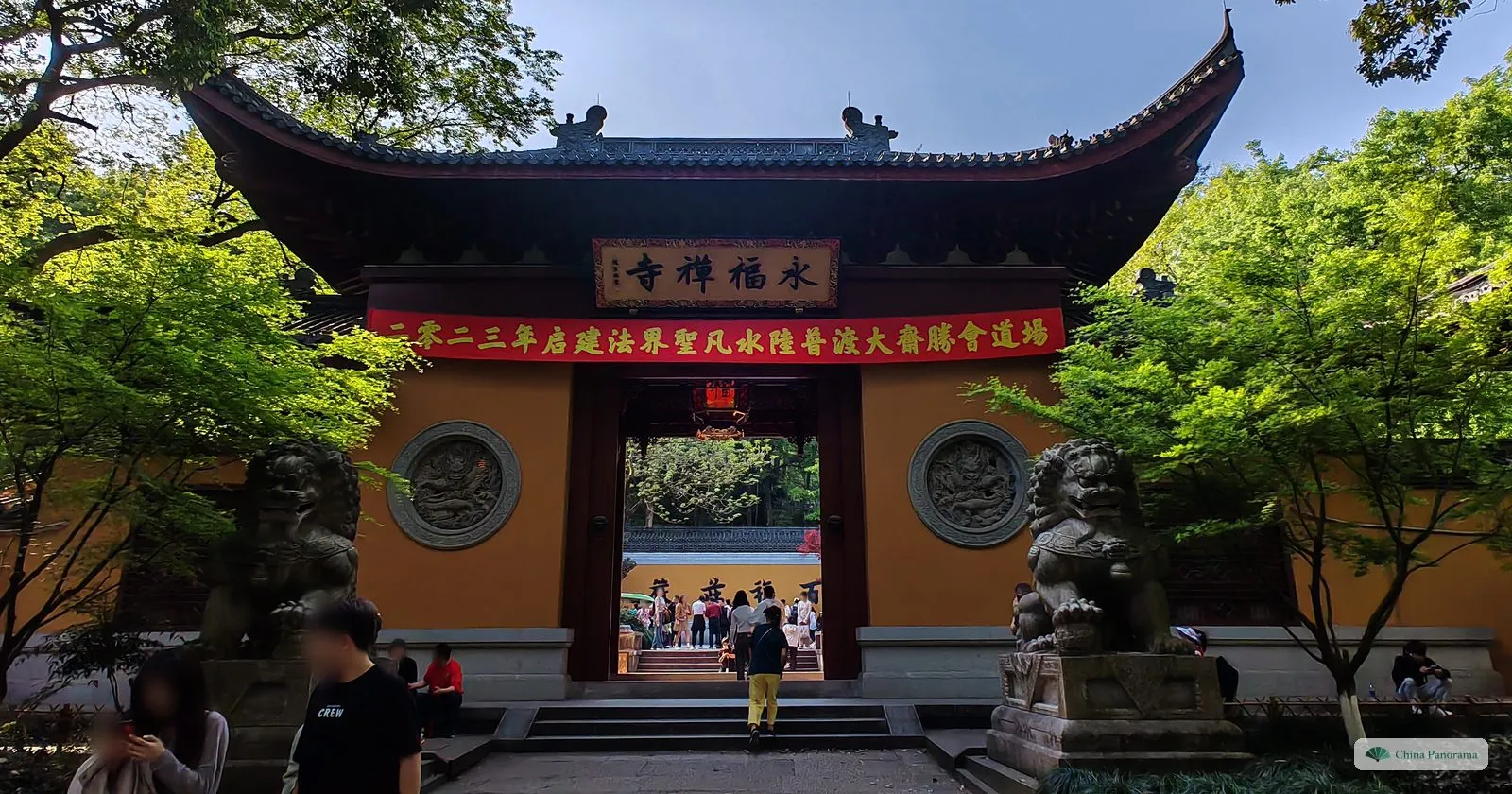 On our path0.8 km from the gate
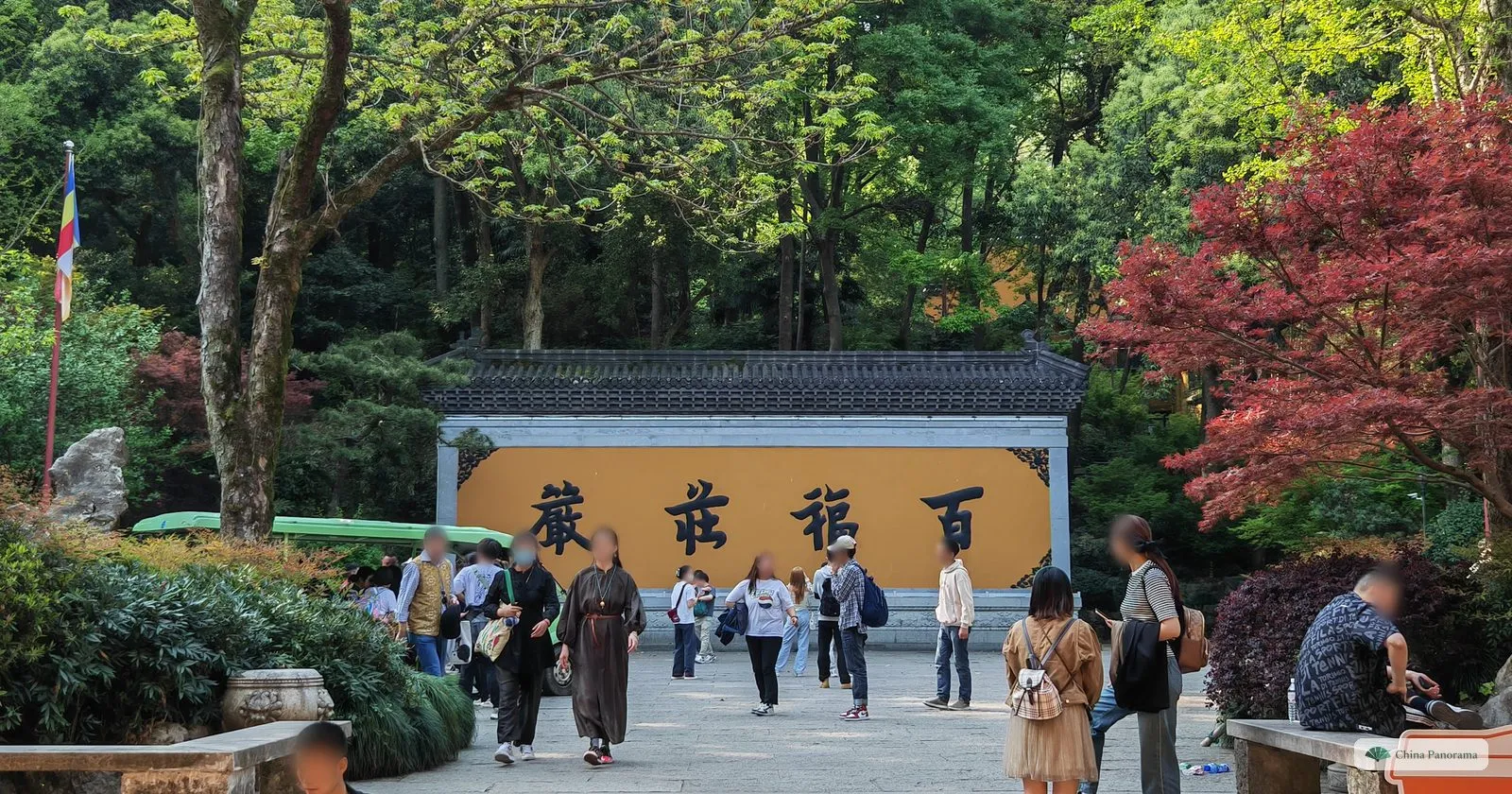
Terraced halls among maples, and the screen wall 百福庄严 at the foot.
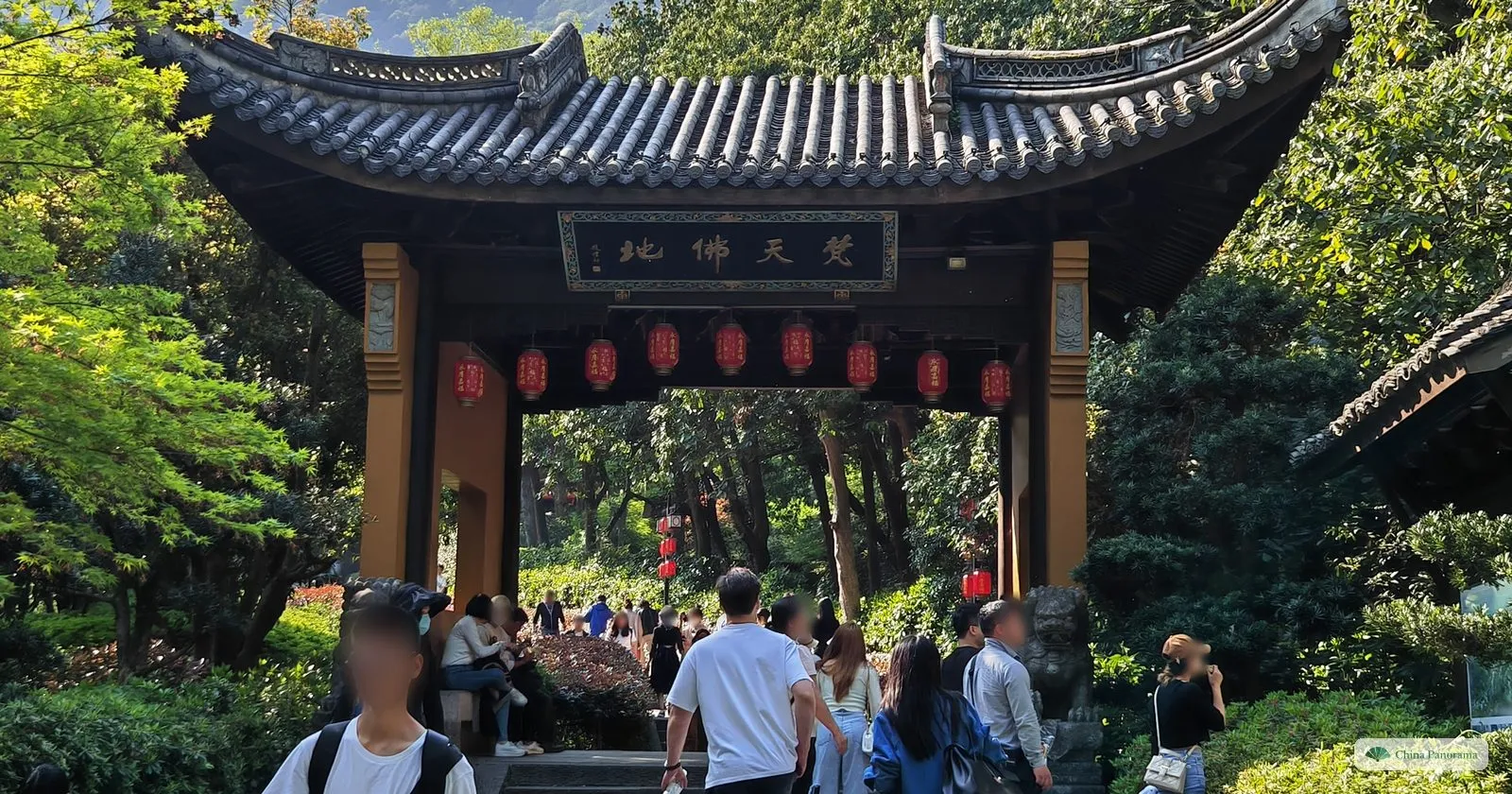 On our path0.7 km from the gate
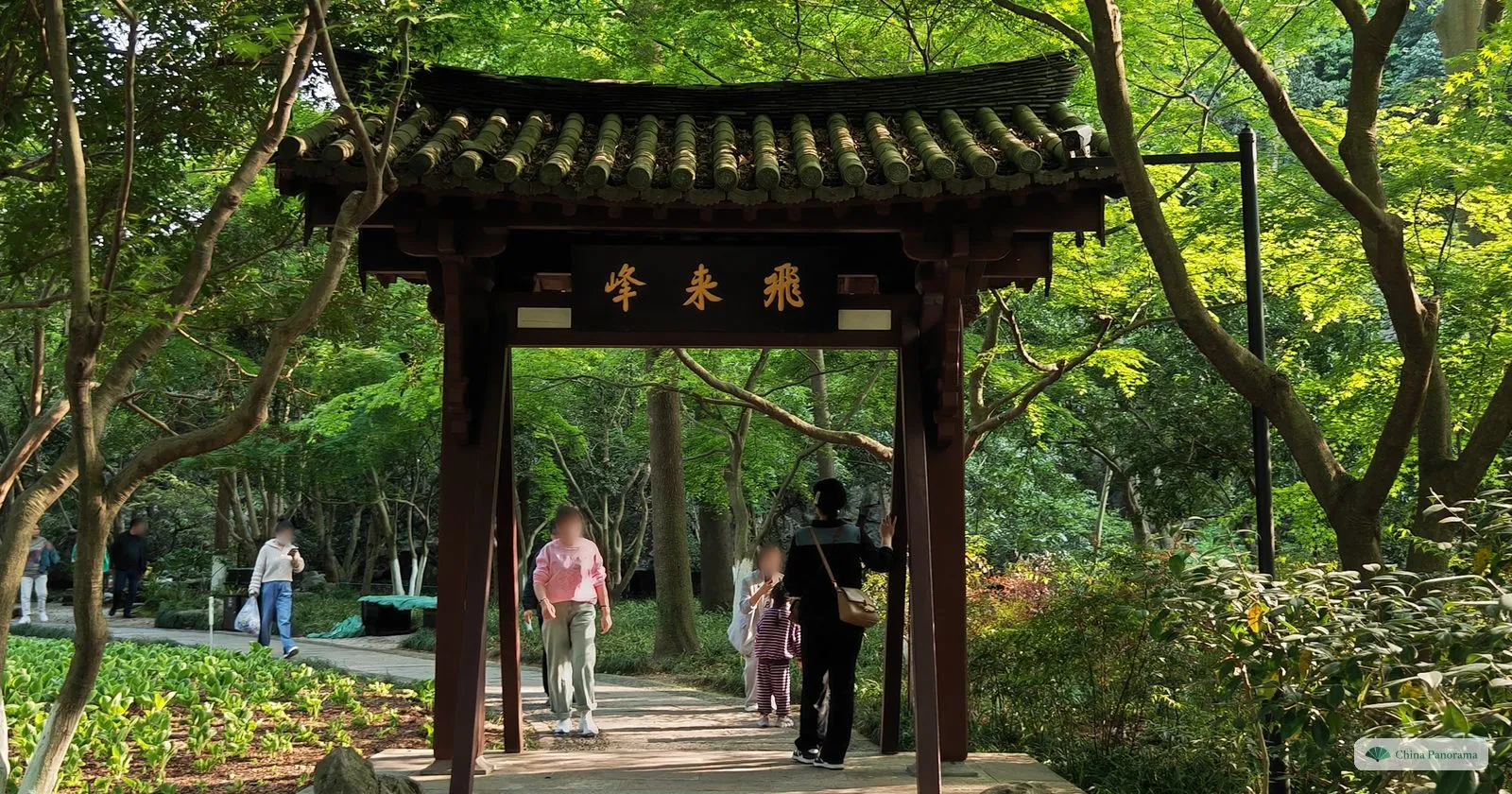
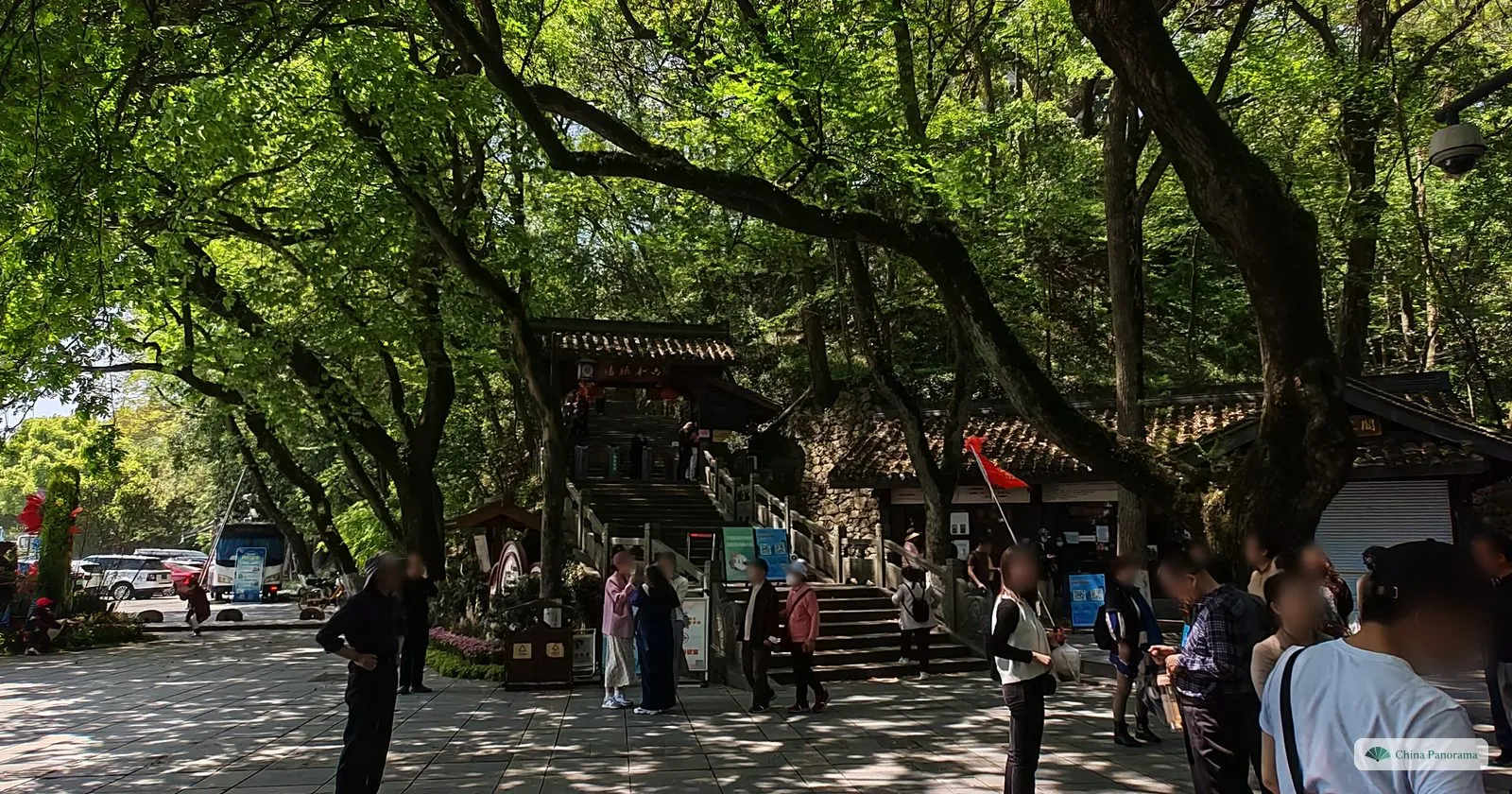
A pavilion gate with red lanterns where the path leaves the crowds and climbs towards Yongfu.
- Just off it0.6 km from the gate
The main temple, with its 33.6 m hall and the 24.6 m camphor-wood Buddha of 1956. It faces Feilai Feng across the stream.
- On our path0.4 km from the gate
Budai with eighteen arhats, 3.6 m high and 9.9 m long, Northern Song.
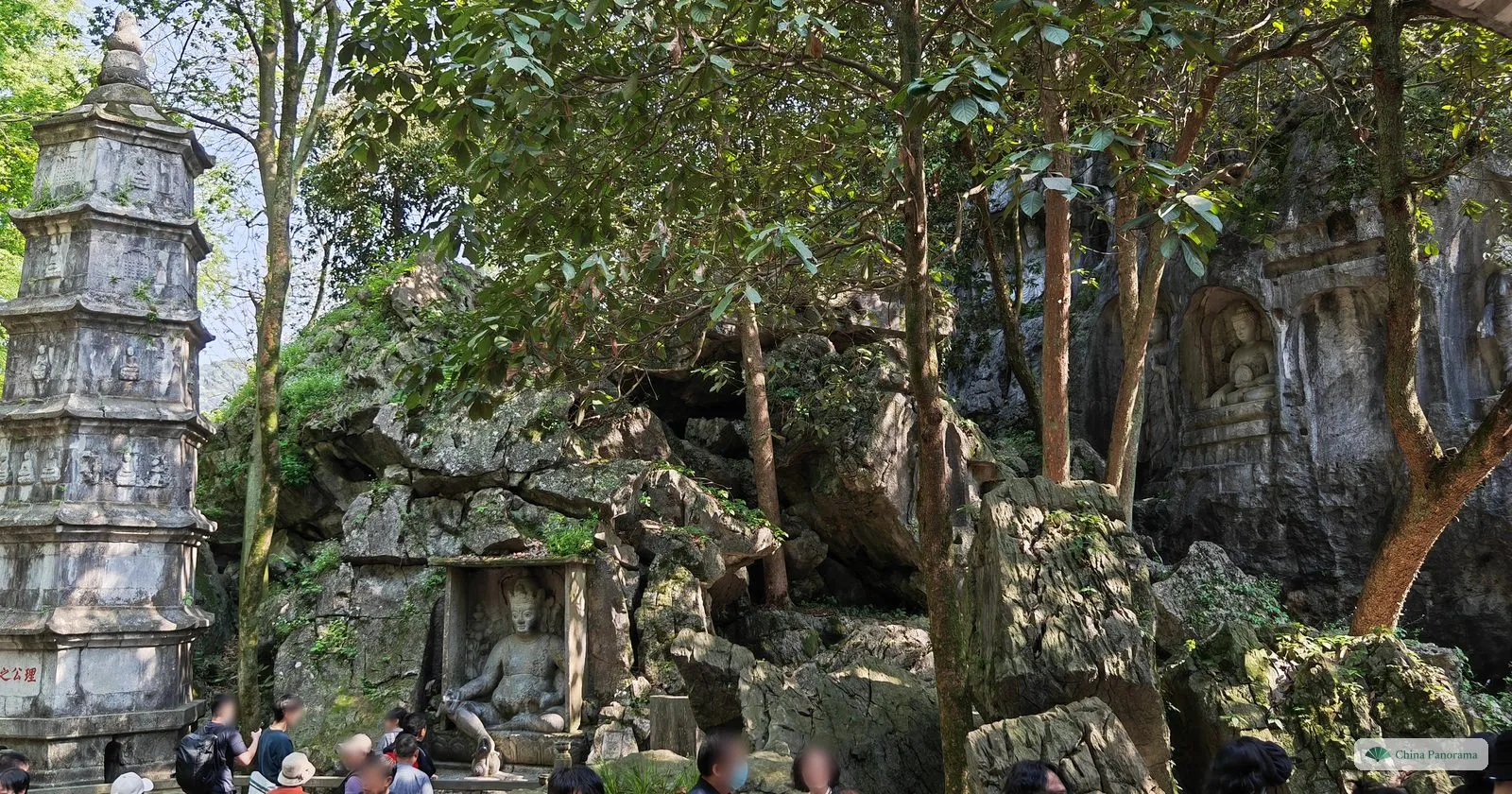 On our path0.3 km from the gate
The six-sided stone pagoda said to hold Huili’s ashes, and the first niches in the rock.
 On our path0.2 km from the gate
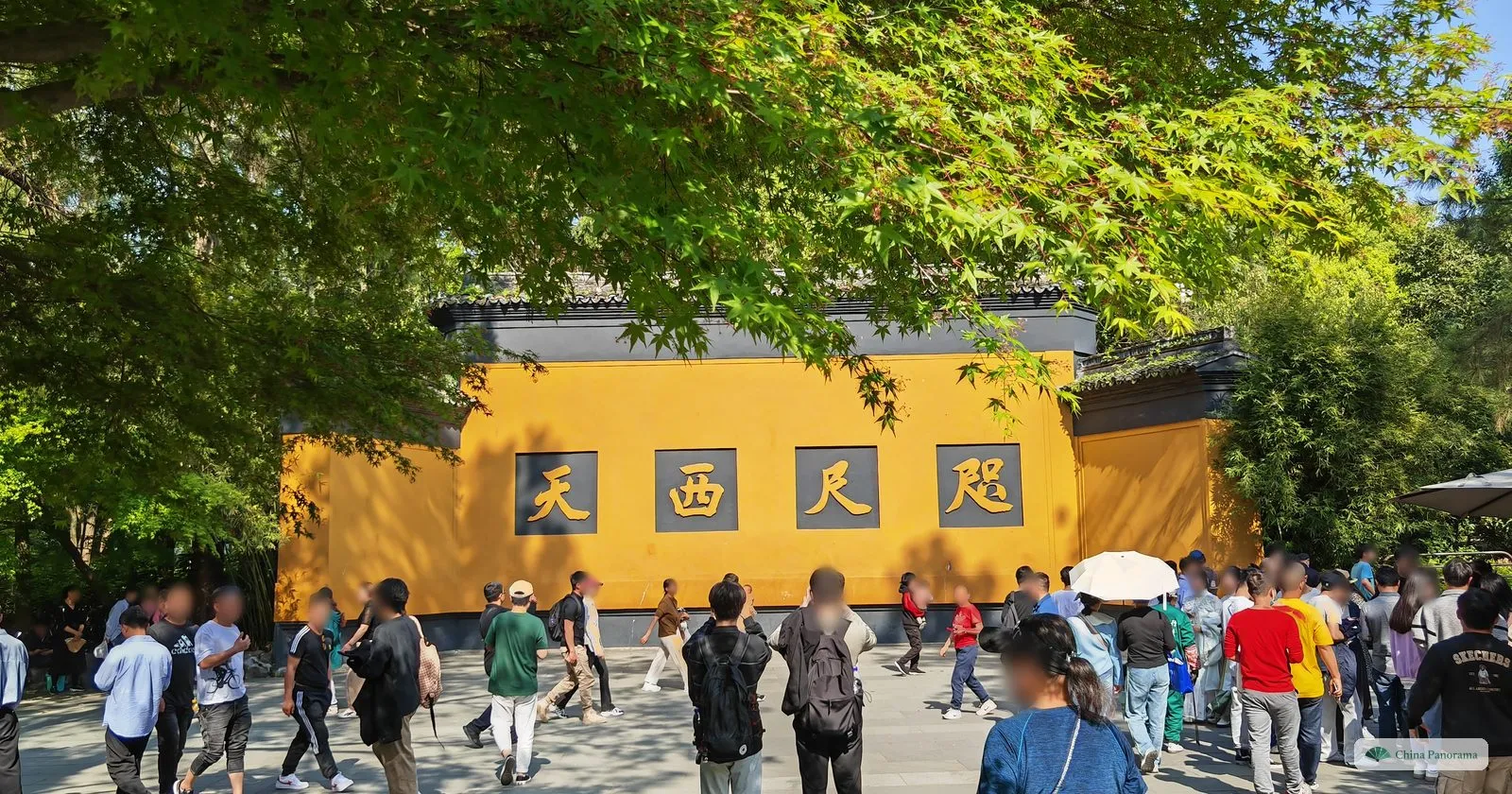
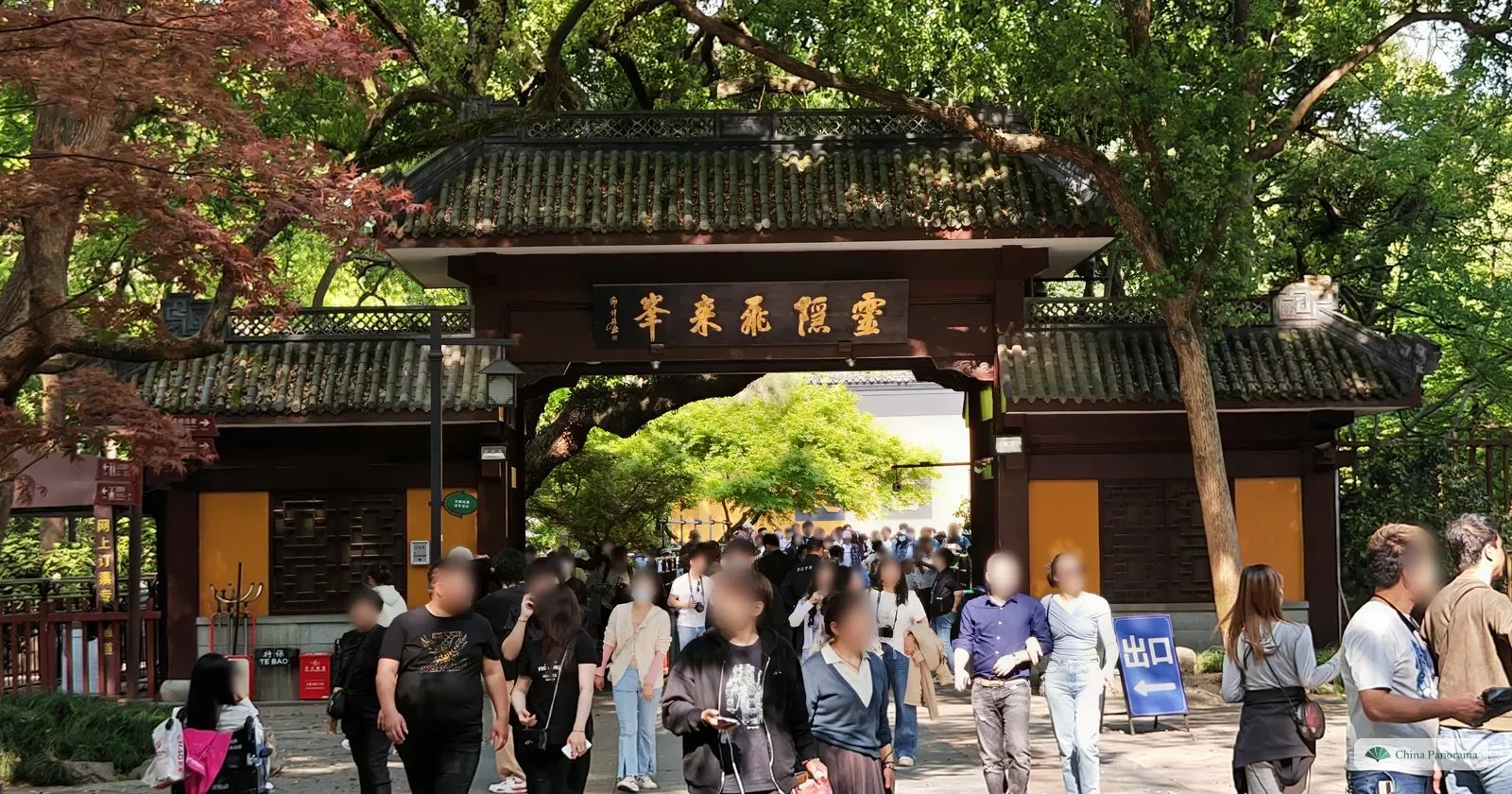
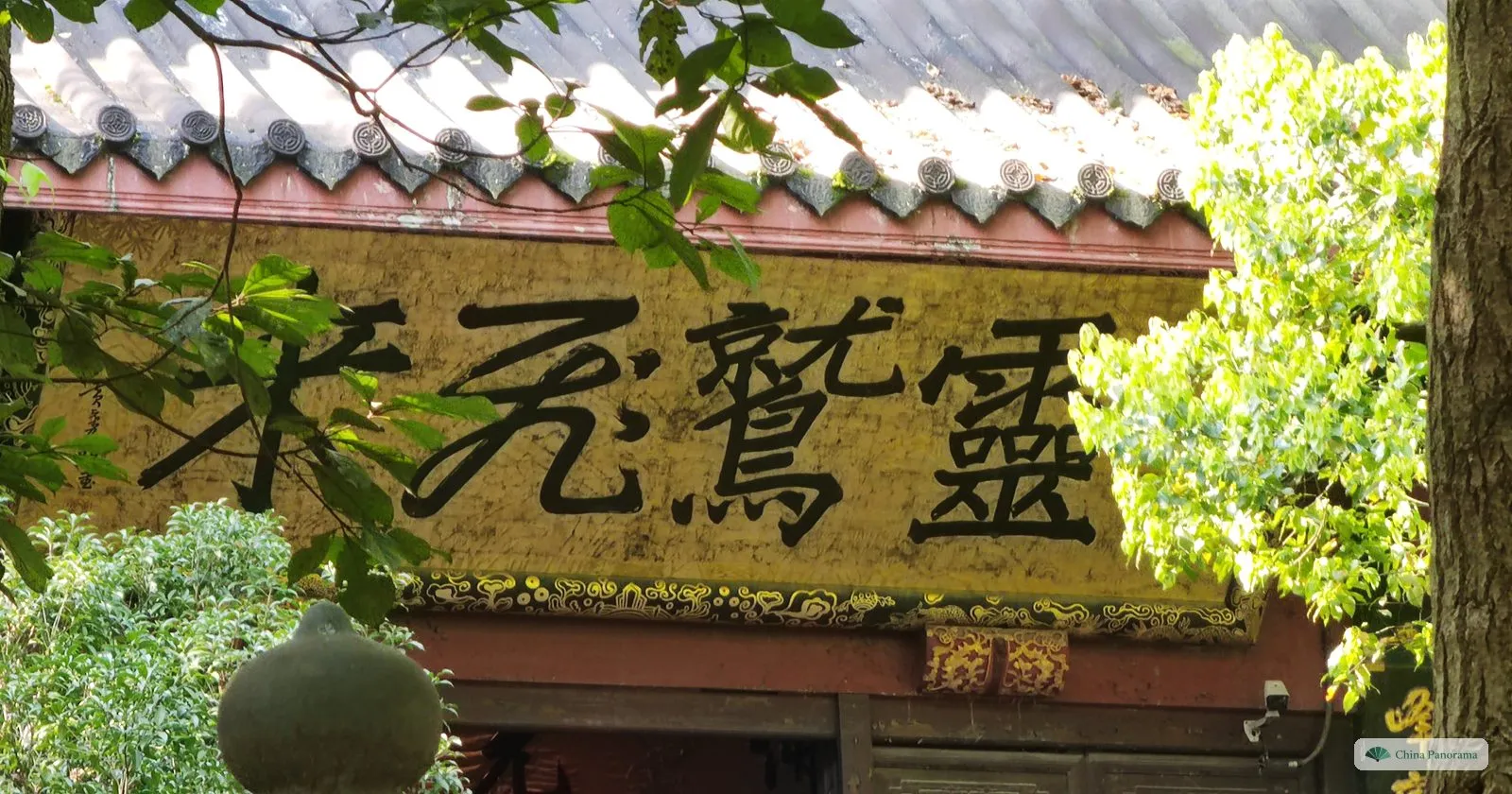
The yellow wall facing the path in. Behind it, the gate to Feilai Feng and the temple.
 On our path0.0 km from the gate
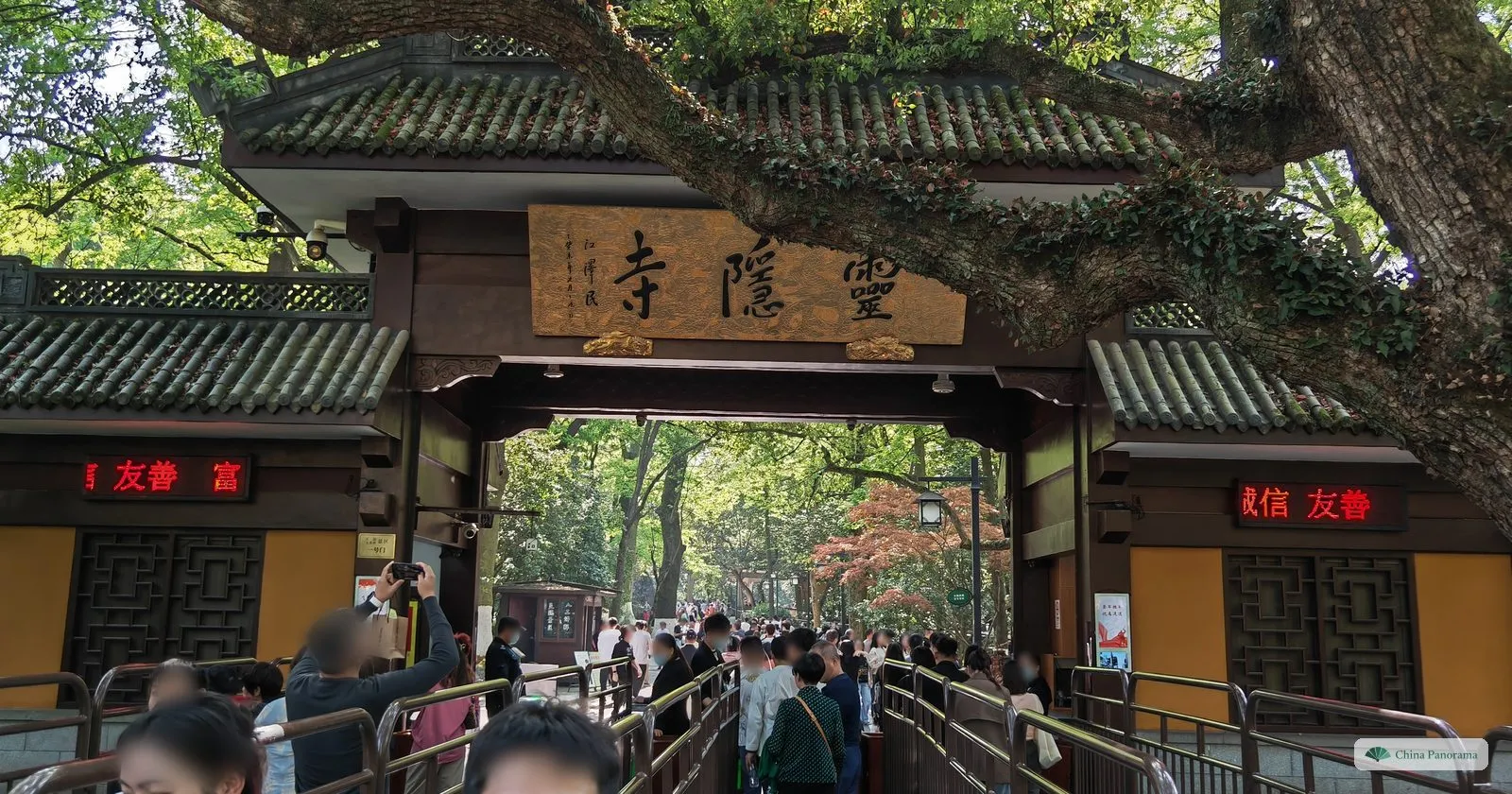
The buses and taxis stop here. Show your booking from the mini-program and walk west up the valley.
What am I looking at?
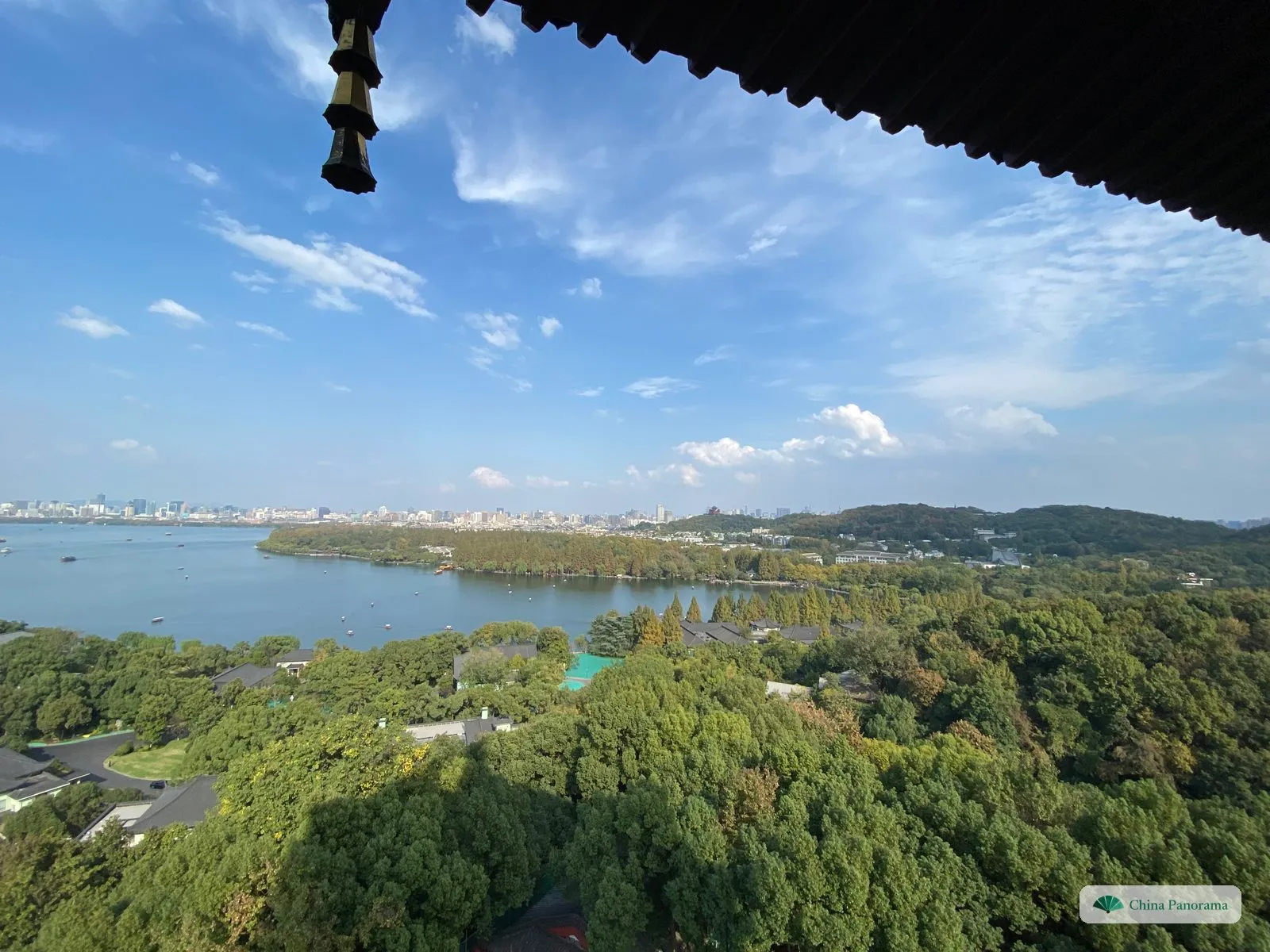
Two views from the top of Leifeng Pagoda, the laughing Buddha of Feilai Feng, the bridge of 1937 over the Qiantang, the giant characters of Hu Qing Yu Tang and Beishan Road. Tap a number on the photograph.
1Xiaoyingzhou
小瀛洲 · 三潭印月 · An island of ponds
The largest island, a ring of dykes round four ponds. The three little stone pagodas stand in the water off its near side, too small to see from here.
Three Pools in the list below →Tap a number on the photo, or a name in the list.
24 places in and around Hangzhou
Filter by type, or by whether you need to be indoors — useful in the plum rains.
 NatureXihu · 西湖区Outdoors
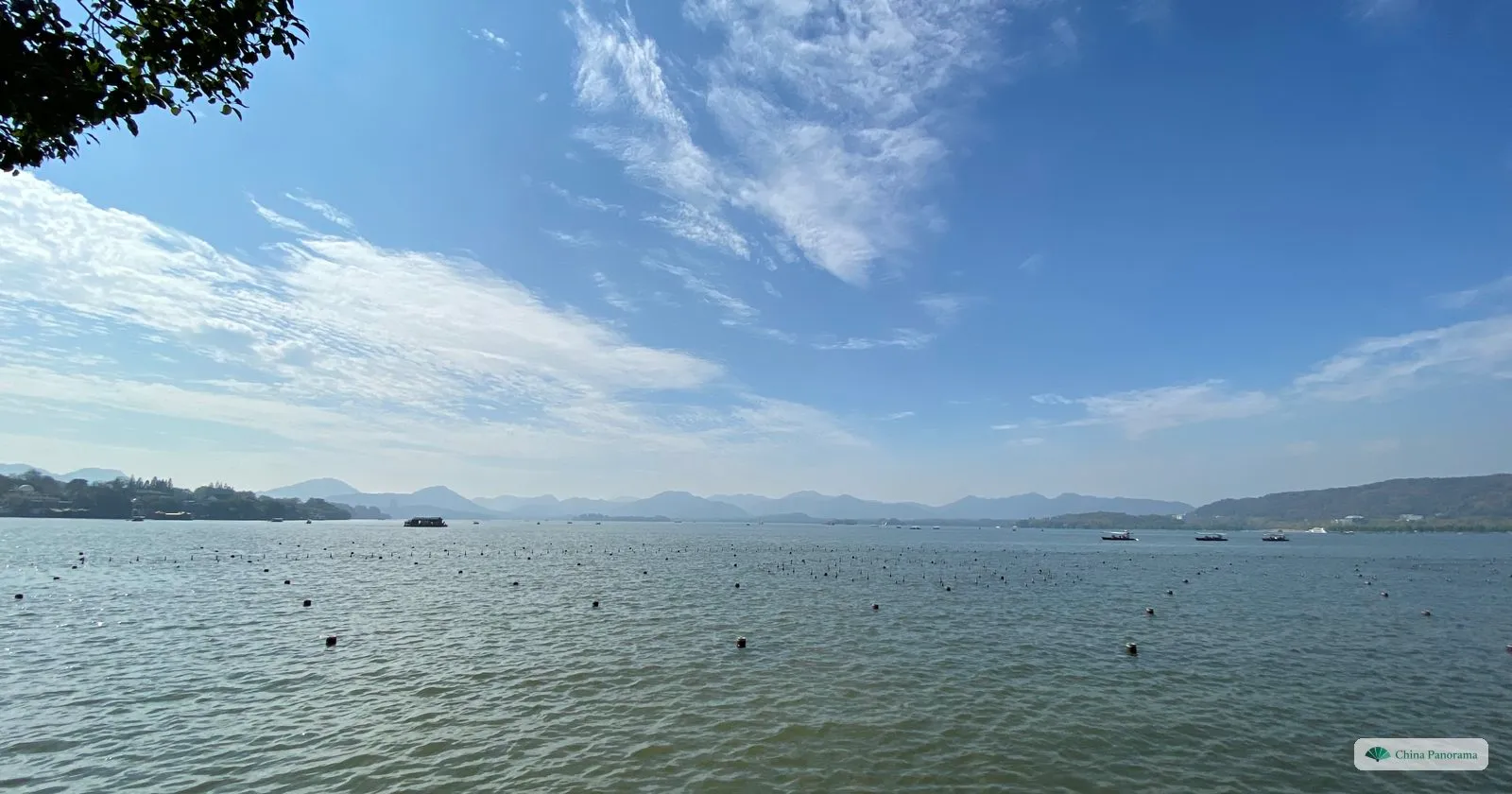
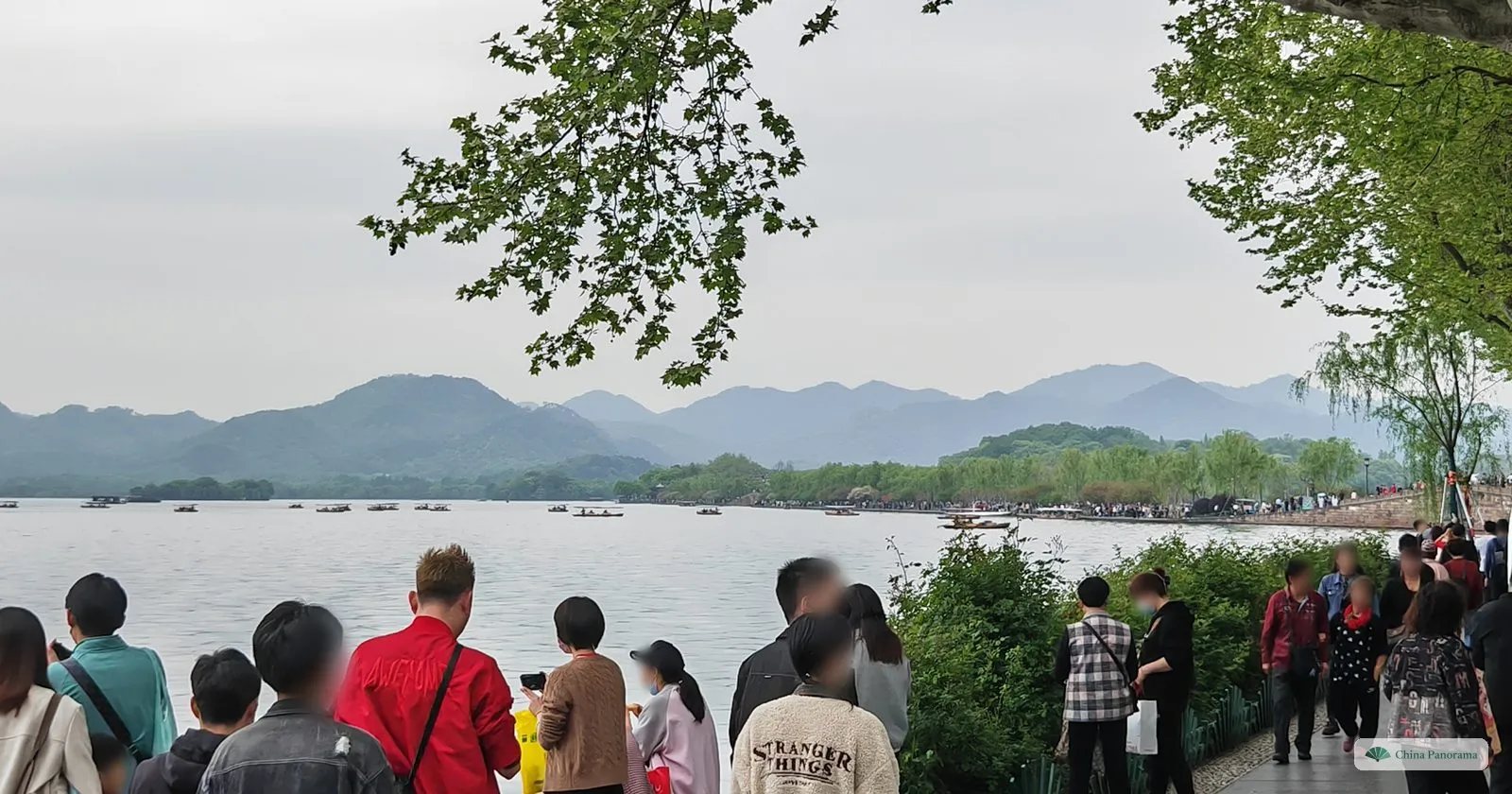
A shallow lake of about 6.4 km² on the west side of the city, 3.2 km from north to south and 2.8 km across, with hills on three sides and the city on the fourth. It is on average only 2.27 m deep. Two causeways cross it, the Su Causeway of 1089 and the shorter Bai Causeway, and a third, the Yanggong Causeway of 1508, runs along its western edge. The only natural island is Gushan, joined to the north shore by bridges. Three small islands in the middle were built from dredged mud. Poets, painters and emperors have described the lake for more than a thousand years, and in 2011 UNESCO inscribed the “West Lake Cultural Landscape of Hangzhou” as a World Heritage Site: the lake with its causeways, islands, temples, pagodas and the Ten Scenes, a list of named views fixed in the Southern Song. The shore is about 15 km round. We walked it on 4 November 2023, from Hubin at 10:55 to the Broken Bridge after dark.
The lake shore, the causeways and the lakeside parks are free and open at all hours. Longxiangqiao station (Line 1) is 300 m from the shore at Hubin. A walk all the way round takes three to four hours: see the walking map on this page. Boats to the islands leave from several piers. We have not checked boat prices.
- Entry
- Free
- Opening hours
- Open at all hours
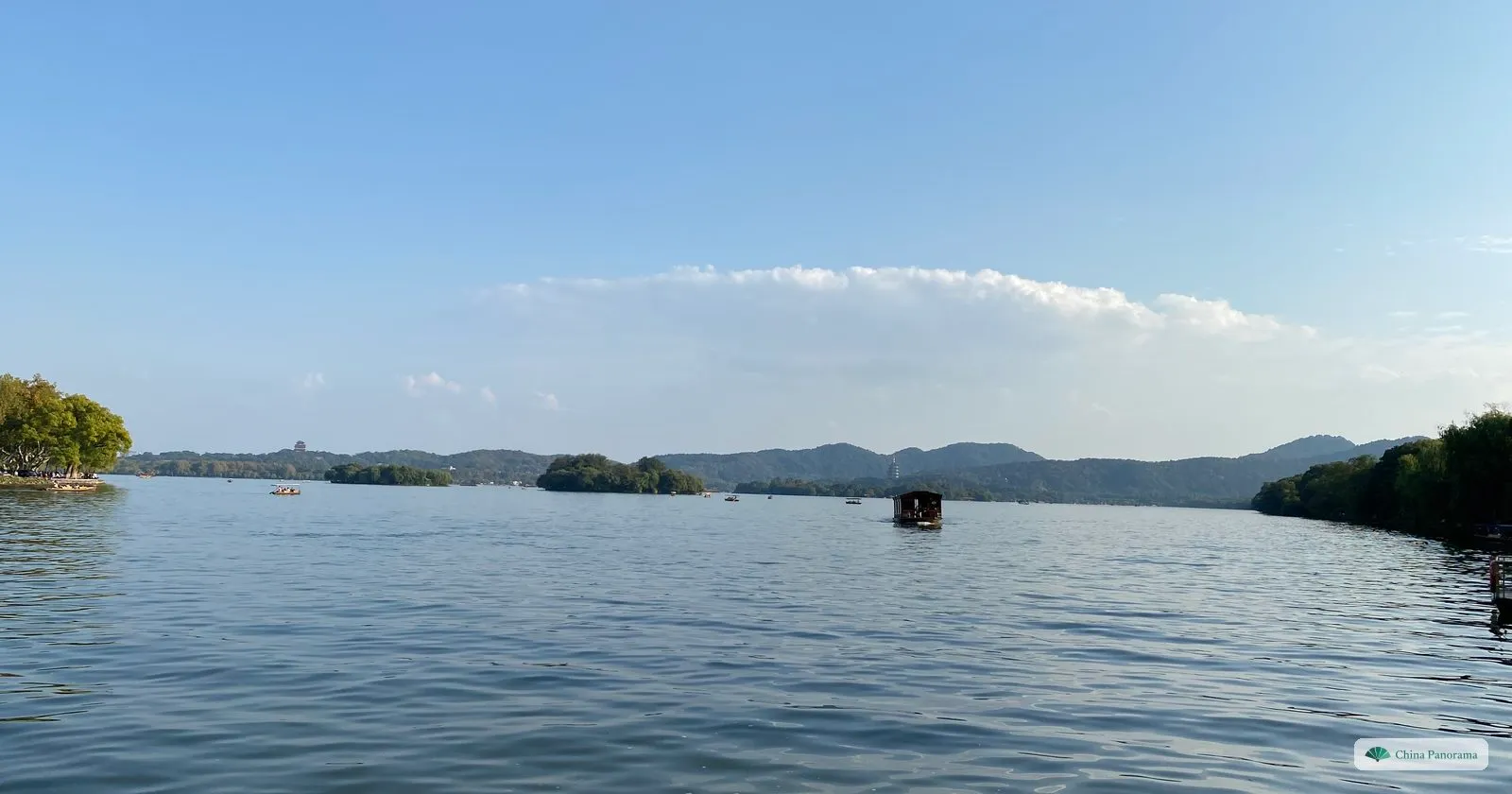
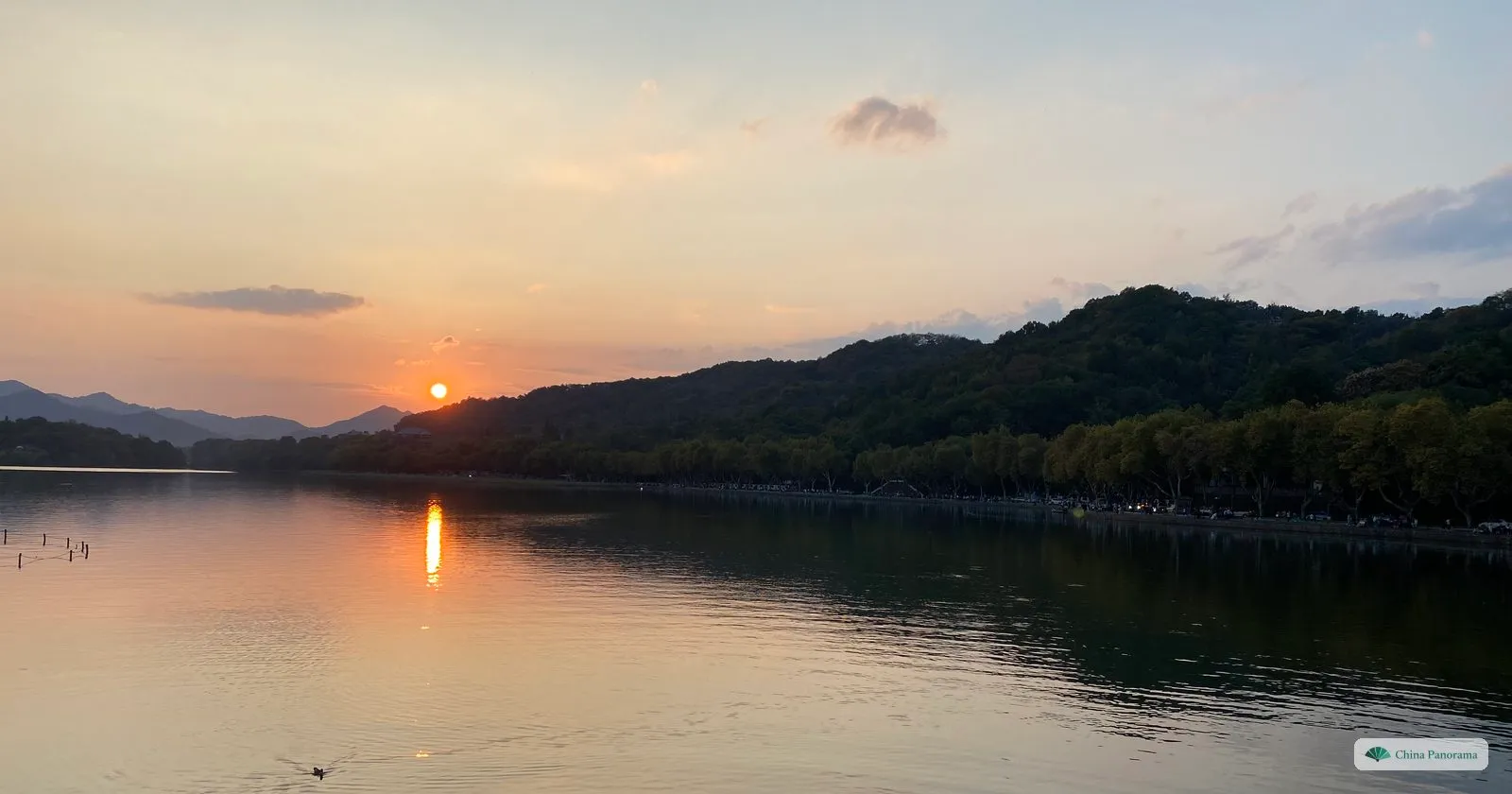
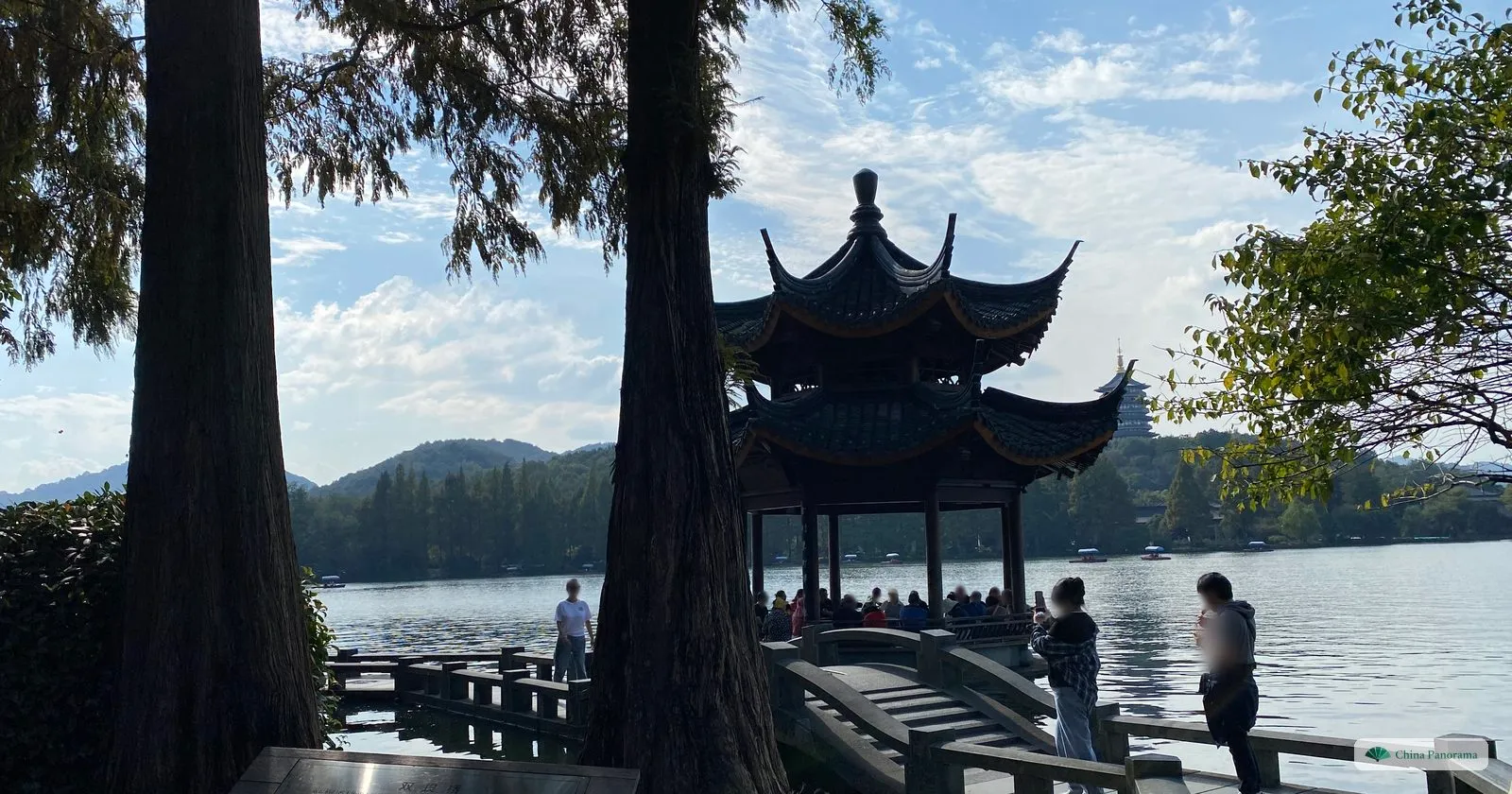
 LandmarkXihu · 西湖区Outdoors
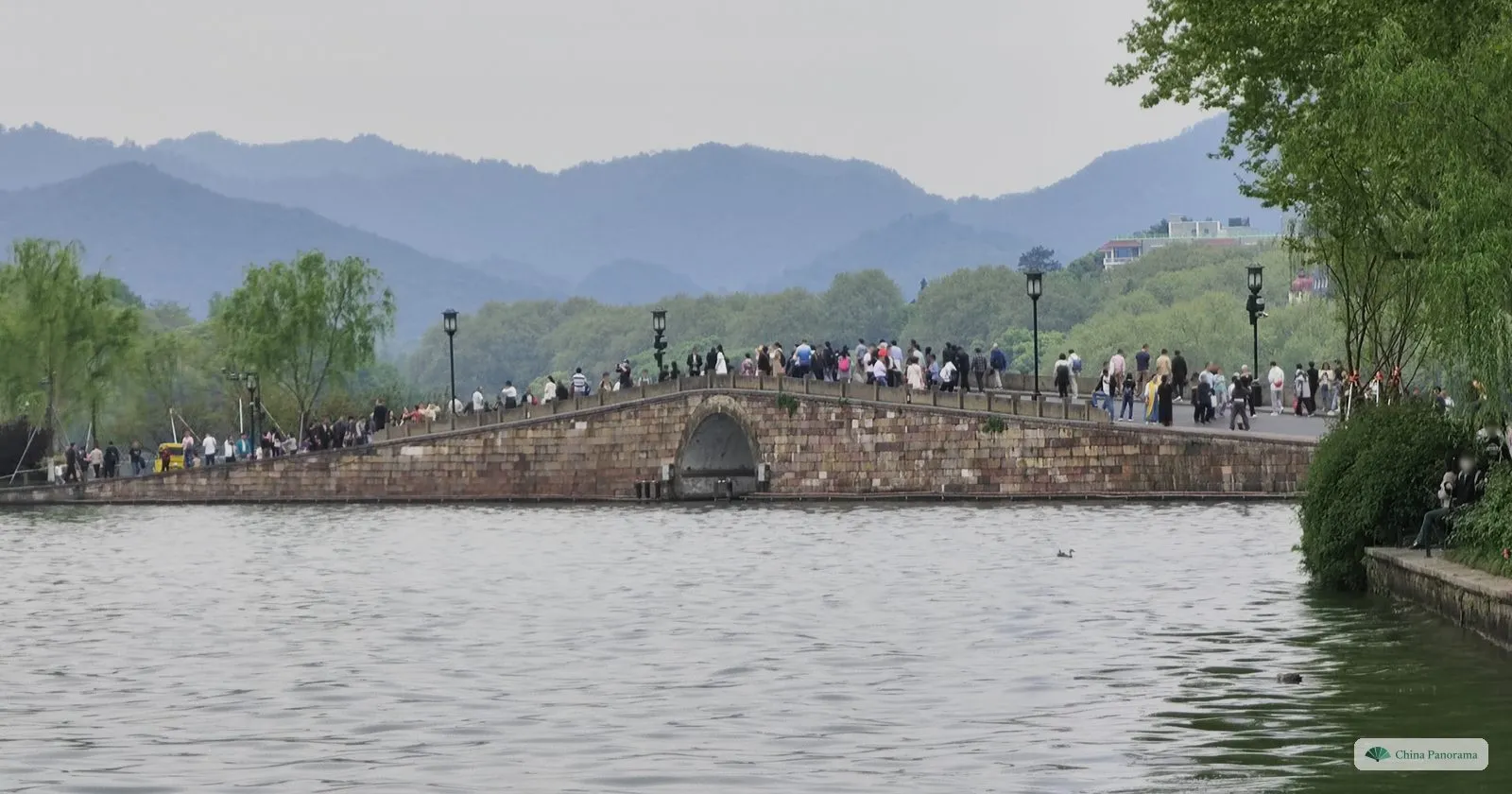
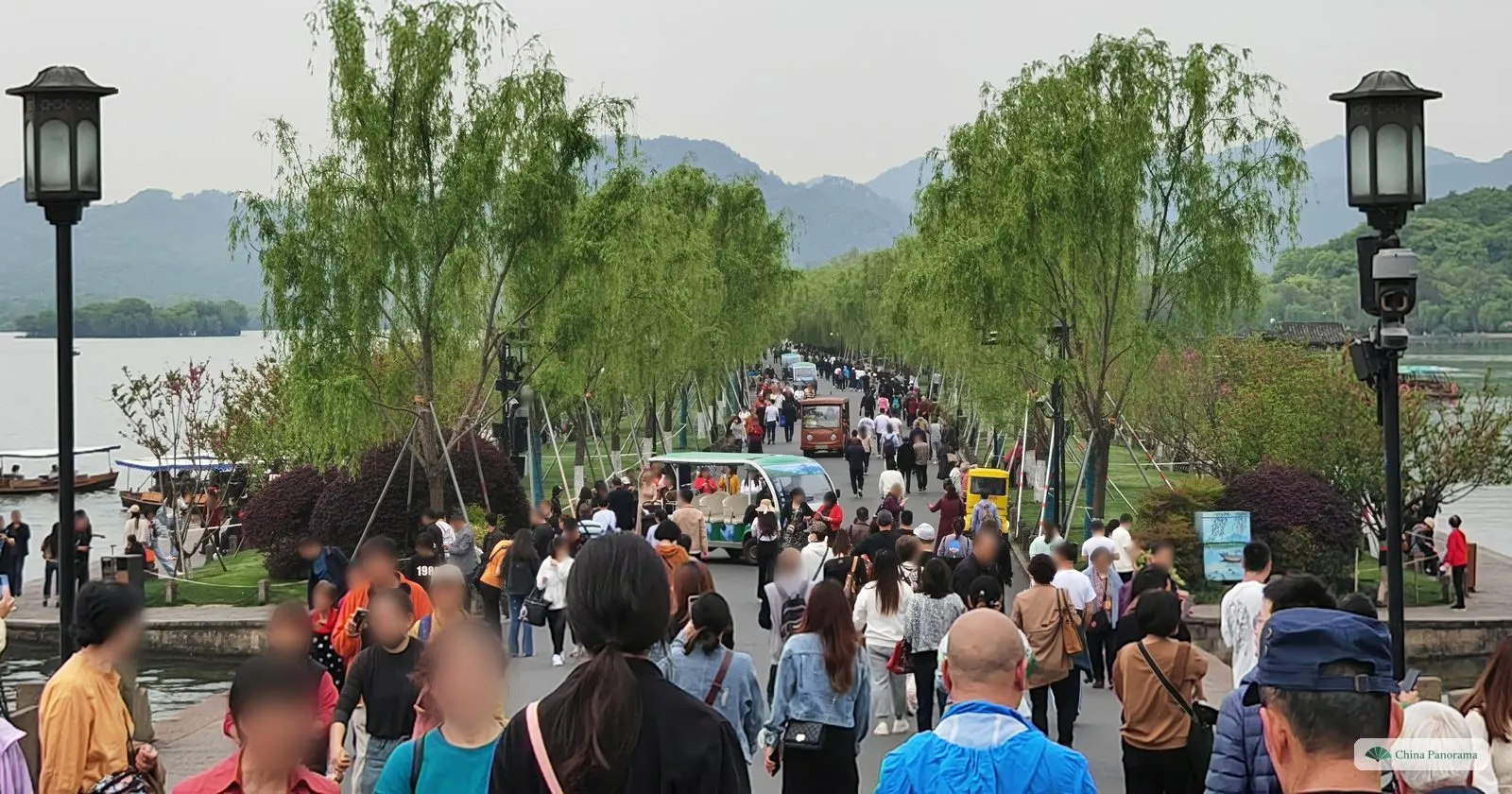
A low stone arch bridge at the east end of the Bai Causeway, where the causeway leaves the north shore. It is not broken: the name belongs to one of the Ten Scenes, “Lingering Snow on the Broken Bridge”, when snow melts first on the sunny side of the arch and the bridge seems to break in two. It is also where, in the Legend of the White Snake, the snake spirit Bai Suzhen meets the young Xu Xian. From the bridge the Bai Causeway runs about 0.9 km west across the lake to Gushan, lined with willows and peach trees. It is named after the Tang poet Bai Juyi, governor of Hangzhou in the 820s, who built a dyke on the lake, though not this one. On a spring Tuesday morning the bridge was packed by 10:12. In the evening, after the day visitors, the causeway is calm and the lights come on round the lake.
Free and open at all hours. From Longxiangqiao station (Line 1) it is about 1.2 km along the north shore, a 15-minute walk. Come before 09:00 or after sunset to have the bridge to yourself.
- Entry
- Free
- Opening hours
- Open at all hours
Gushan Island, Pinghu Qiuyue and Xiling Bridge
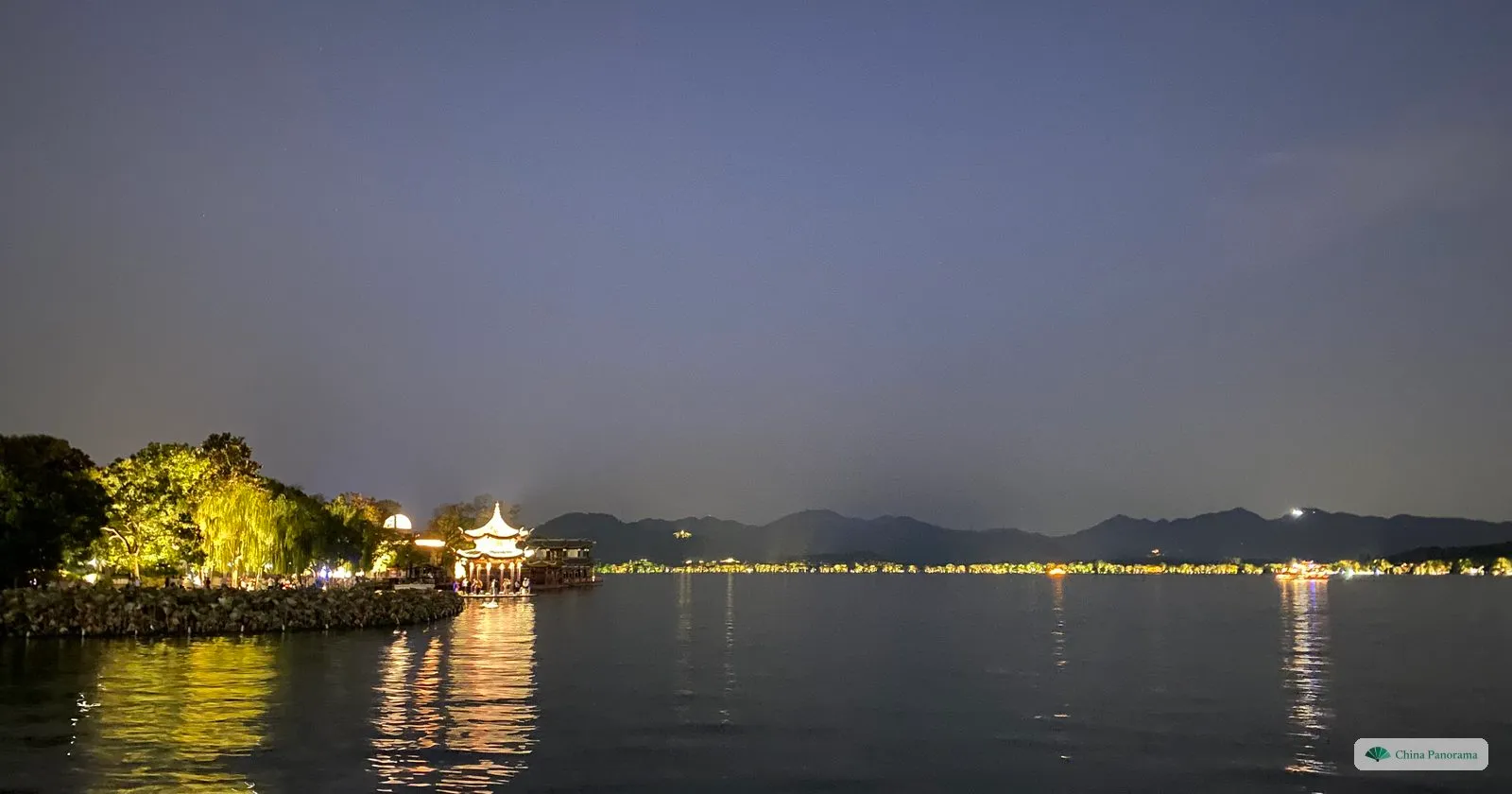
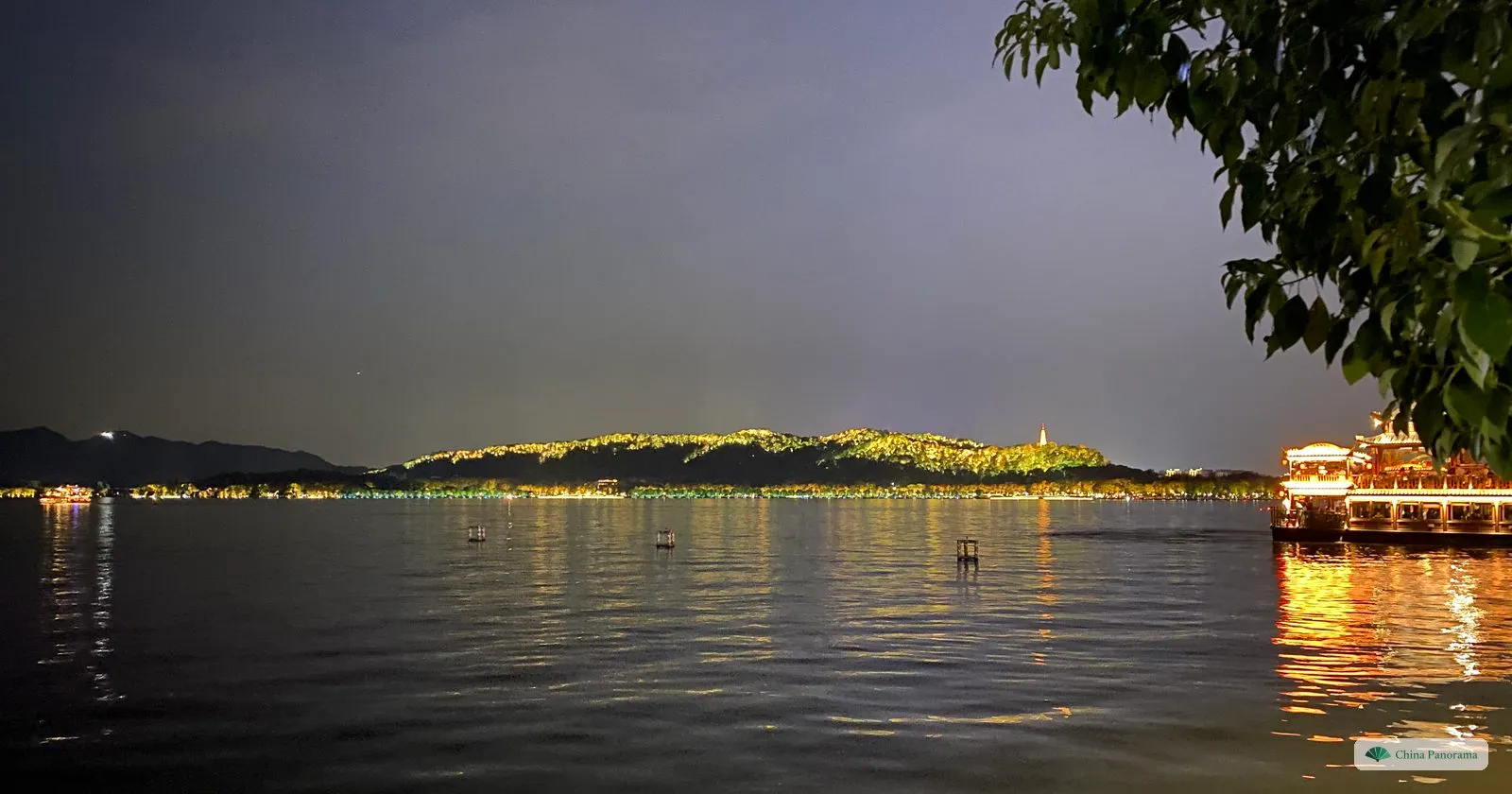
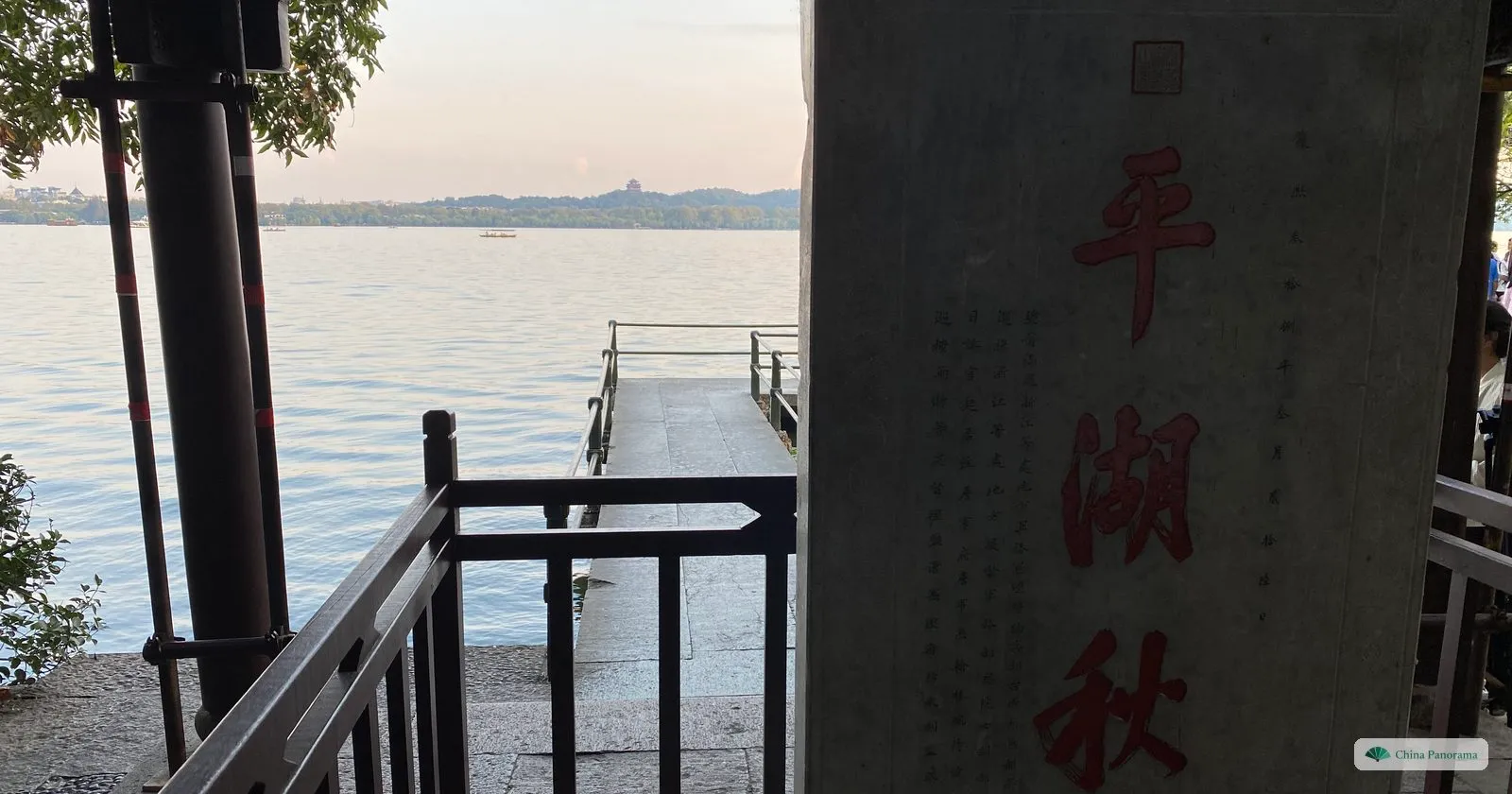
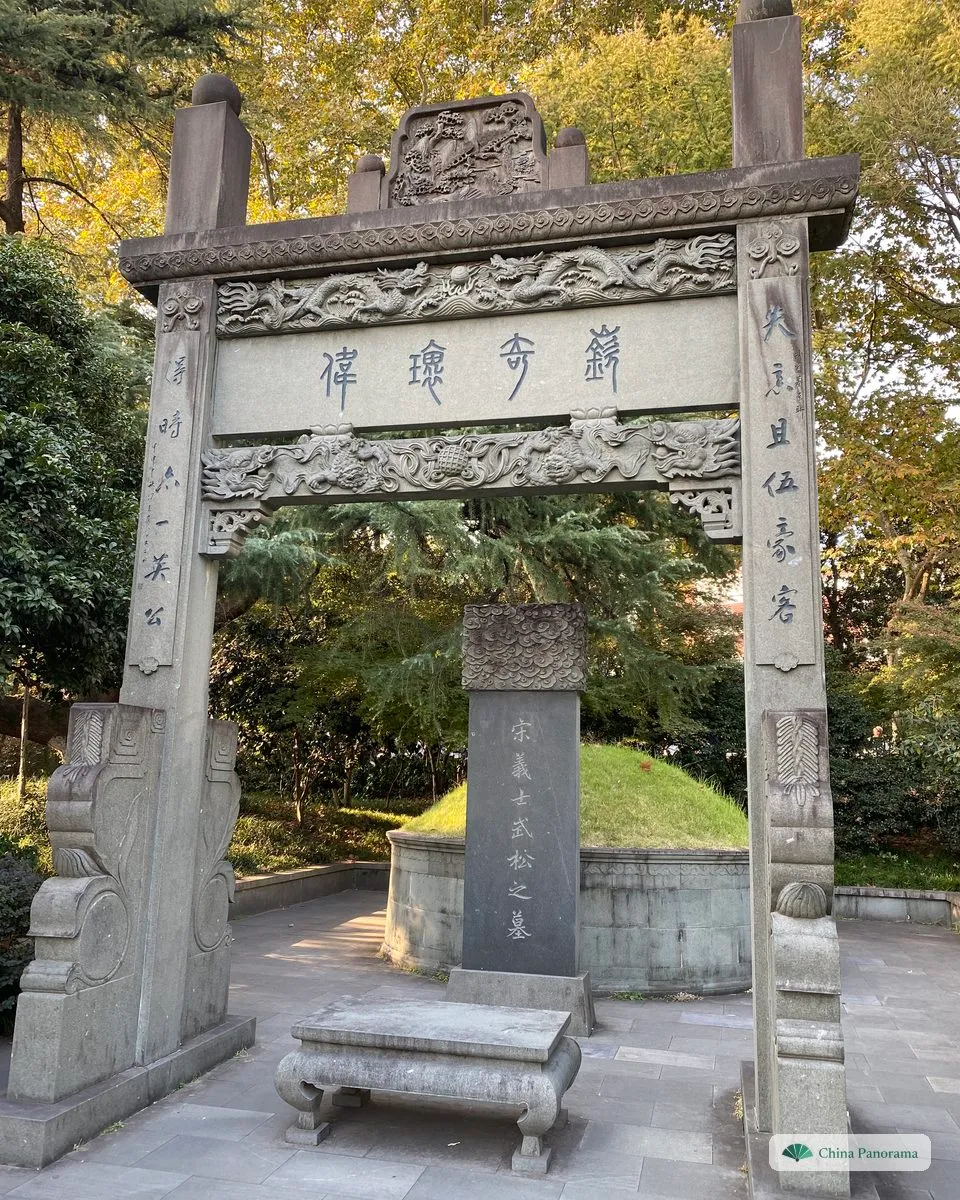
孤山 · 平湖秋月 · 西泠桥ParkXihu · 西湖区OutdoorsThe only natural island in West Lake, a wooded hill at the west end of the Bai Causeway. In the Qing dynasty it held an imperial travelling palace and the Wenlan Pavilion, one of the libraries built for the emperor's great collection of books. Today it is a park with the Zhejiang Provincial Museum's Gushan branch, the seal-carvers' society Xiling Yinshe and, at its eastern tip, Pinghu Qiuyue, “Autumn Moon over the Calm Lake”, one of the Ten Scenes: a waterside terrace, a pavilion and a stele where the causeway comes ashore. At the west end, Xiling Bridge leads back to the north shore. Beside it stands a memorial tomb to Wu Song, the tiger-slaying hero of the novel Water Margin, whose stele reads “tomb of the righteous Wu Song of the Song”. On 4 November 2023 we came across Xiling Bridge at 15:30 and were at Pinghu Qiuyue at 16:30, in time for the sunset from the Bai Causeway.
The island park, Pinghu Qiuyue and the bridges are free and open at all hours. Pinghu Qiuyue is 0.9 km from the Broken Bridge along the Bai Causeway, Xiling Bridge another 0.9 km. We have not checked the museum's entry or hours.
- Entry
- Free
- Opening hours
- Open at all hours
- ParkXihu · 西湖区Outdoors
A straight embankment 2.8 km long that crosses the western part of the lake from north to south, built in 1089 by the poet Su Shi (Su Dongpo), then governor of Hangzhou, from the mud and weed he had dredged out of the silting lake. Six arched bridges let boats through, from south to north Yingbo, Suolan, Wangshan, Yadi, Dongpu and Kuahong. Willows and peach trees line the path. “Spring Dawn at the Su Causeway”, the blossom in early morning mist, is the first of the Ten Scenes. There are no cars, only the electric sightseeing carts and bicycles. On our walk round the lake we took it from south to north in the afternoon.
Free and open at all hours. The south end is 0.8 km from Leifeng Pagoda, the north end 0.3 km from the Yue Fei Temple stop on Beishan Road. Walking the whole causeway takes about 35 minutes without stops.
- Entry
- Free
- Opening hours
- Open at all hours
- LandmarkXihu · 西湖区Outdoors
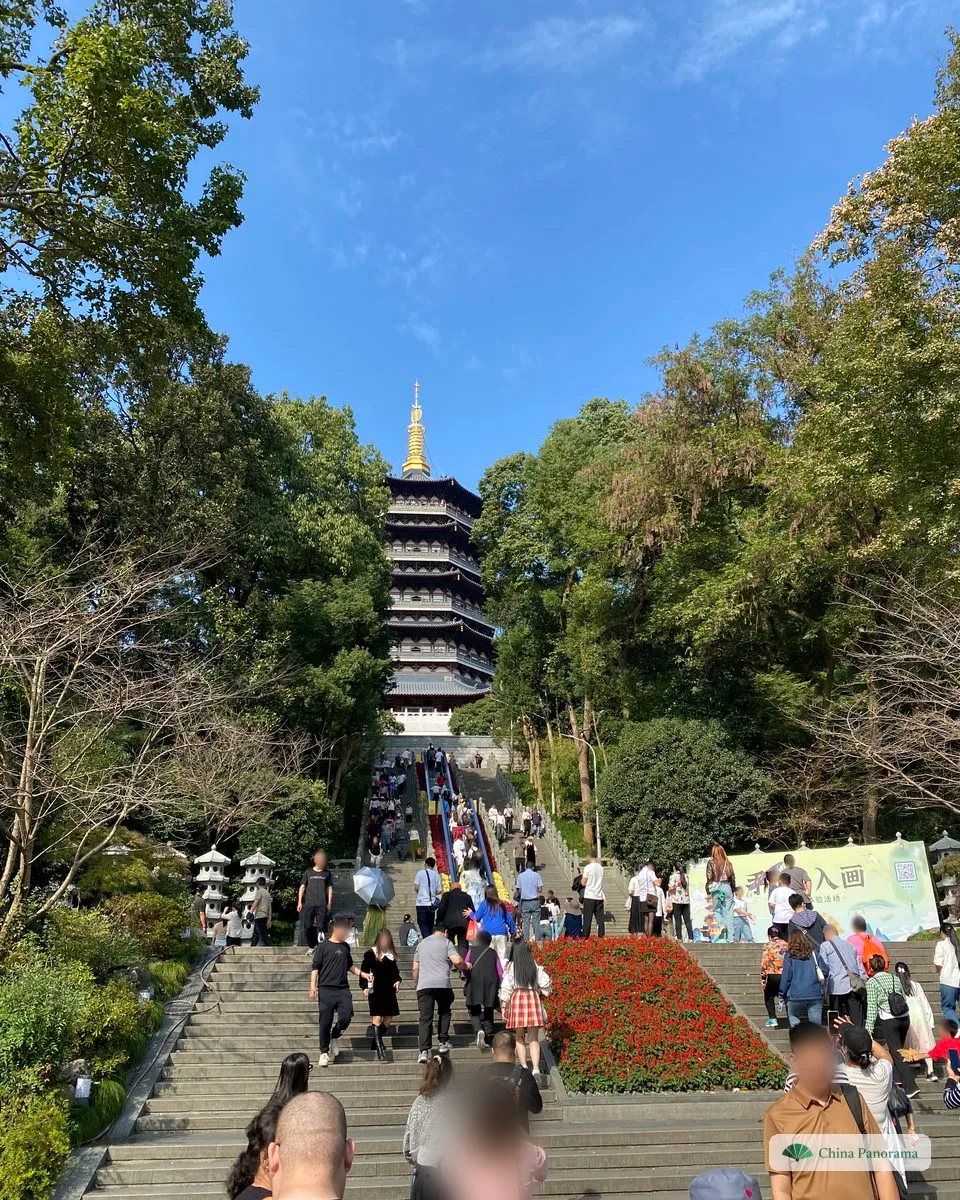
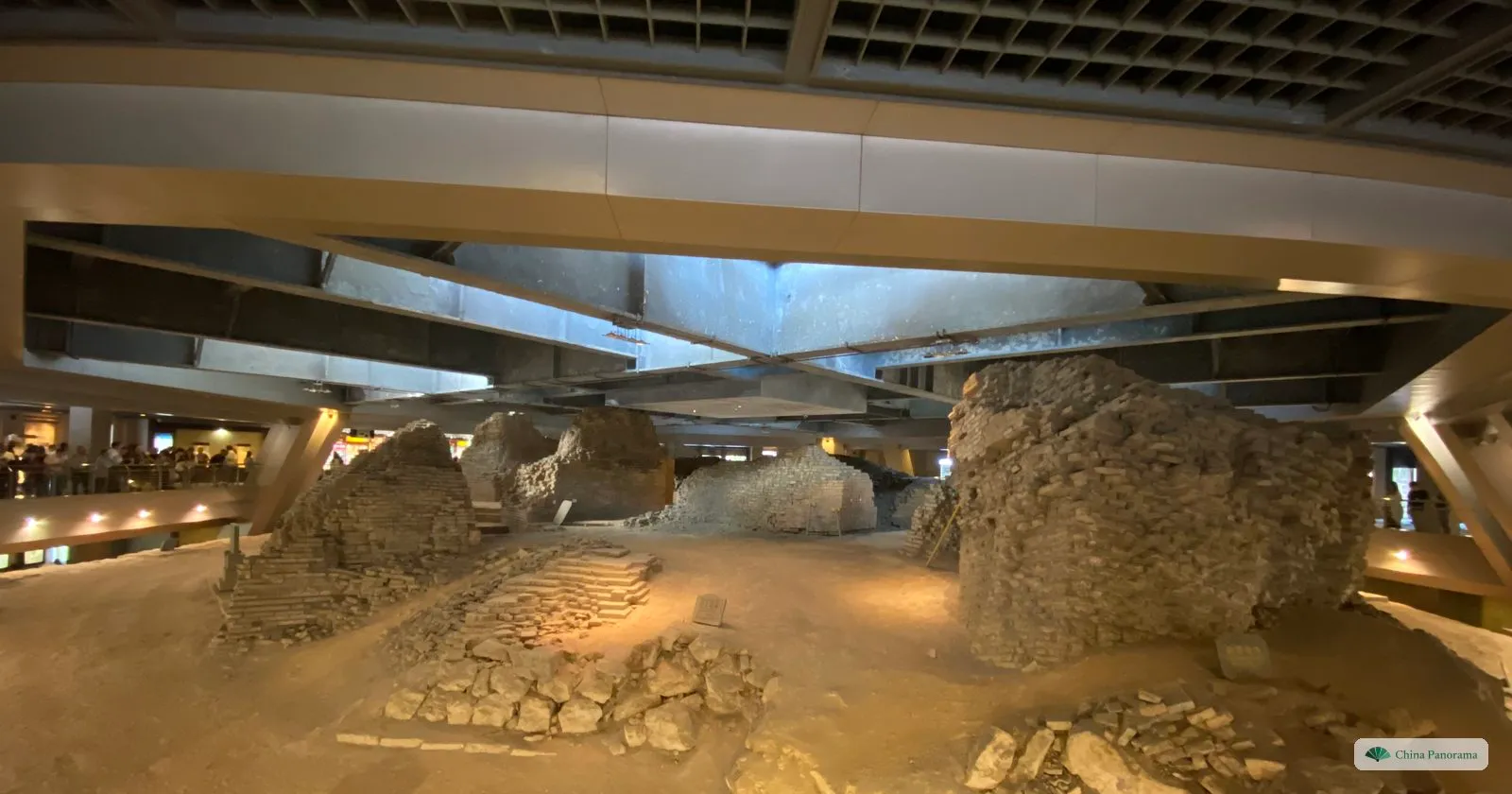
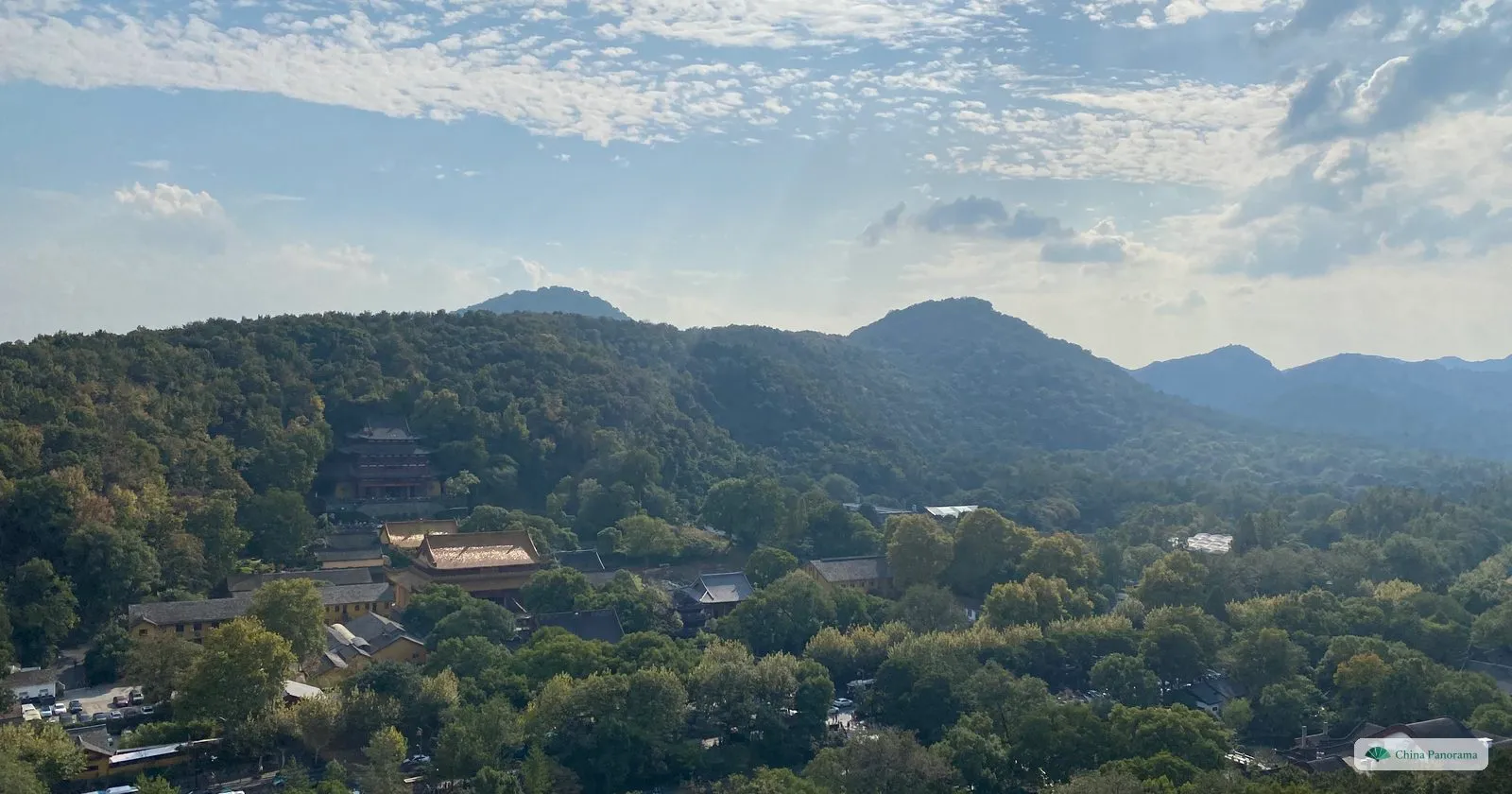
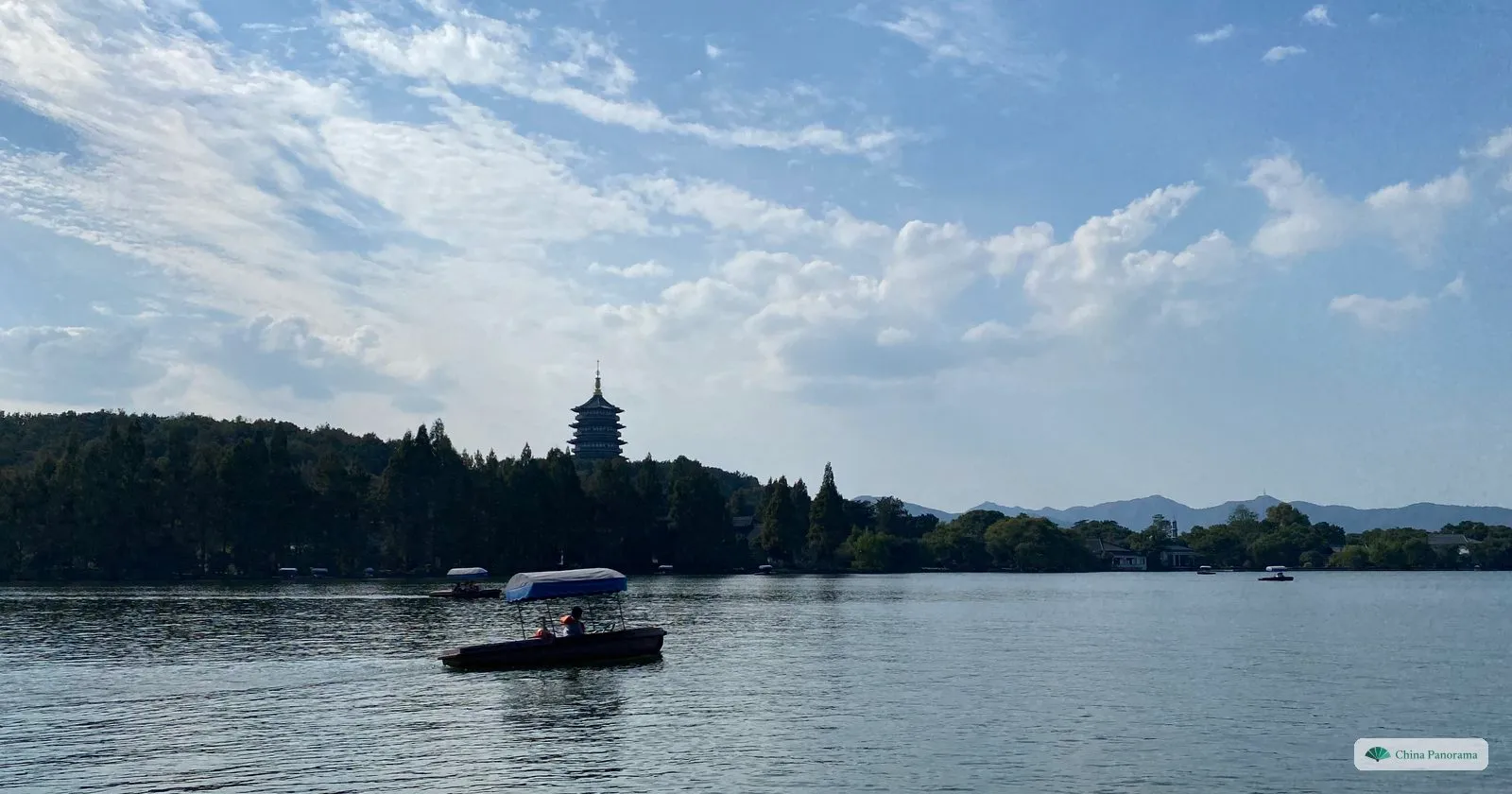
The pagoda on the hill at the south shore, the one in the Legend of the White Snake, under which the monk Fahai imprisons the snake spirit. The first Leifeng Pagoda was built in 975 by Qian Chu, the last king of Wuyue. It was a brick tower that stood, half ruined, until the afternoon of 25 September 1924, when it collapsed. The pagoda you see opened on 25 October 2002, built over the old foundations: 71.7 m with its spire, steel and copper in the shape of the Song original, with lifts and escalators. On the ground floor the ruined brick base of 975 lies under a protective cover. Excavations in 2000–2001 found the crypt with a silver reliquary and other treasures. From the top you look north over the whole lake to the city, south over Jingci Temple, and west to the Su Causeway and the hills. “Leifeng Pagoda in the Evening Glow” is one of the Ten Scenes. We climbed it from 13:29 to 14:01 on 4 November 2023.
On Nanshan Road at the south shore, opposite Jingci Temple. No metro nearby: buses and the sightseeing carts stop at the foot, or walk 1 km from Changqiao Park. The ticket has been reported at 40 CNY and the hours as about 08:00 to 20:00 in summer, closing earlier in winter. We have not checked either against the scenic area.
- Entry
- Price not verified — check on site
- Opening hours
- Hours not verified — check on site
- TempleXihu · 西湖区Outdoors
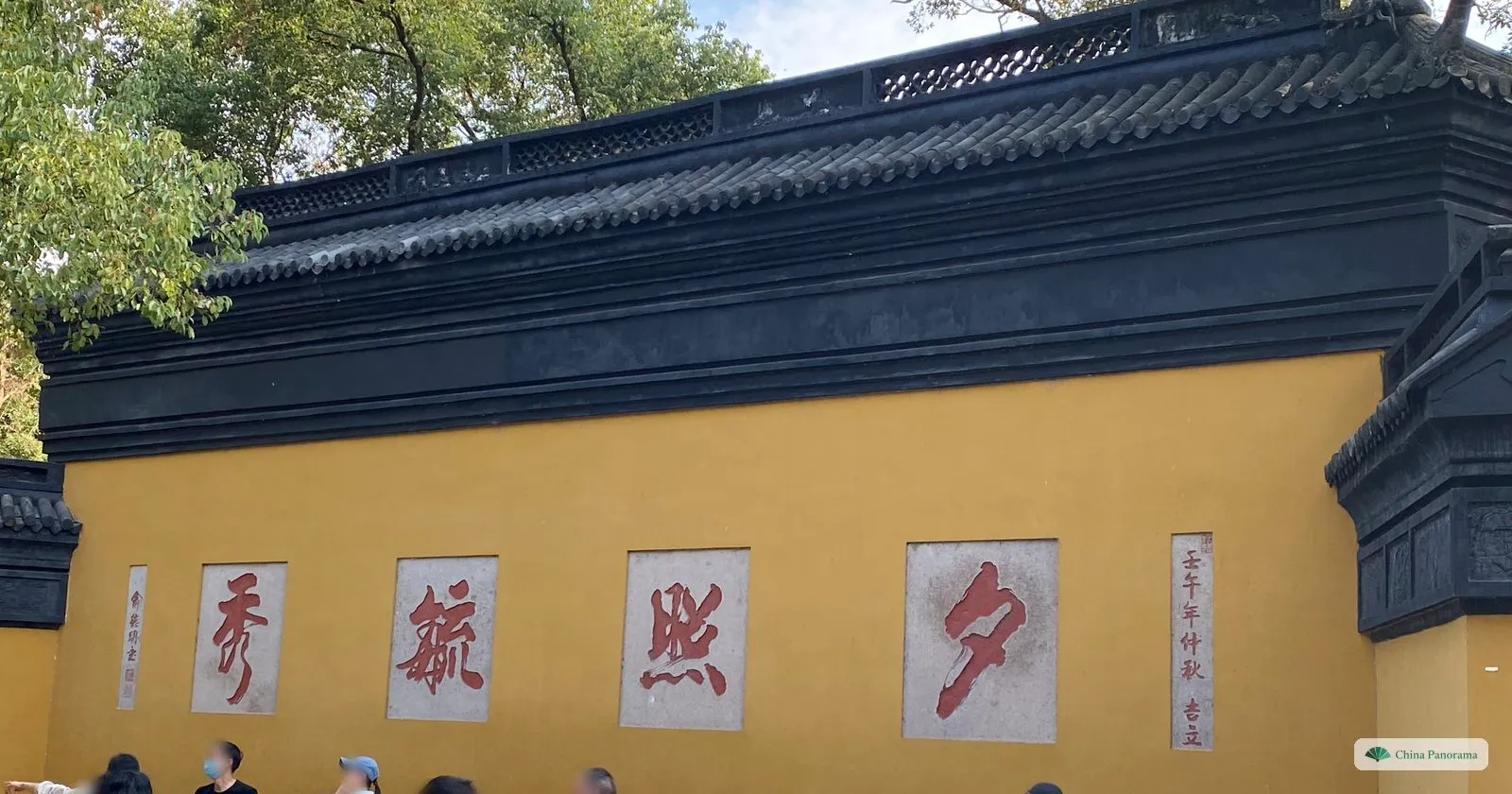
A Buddhist temple at the foot of Nanping Hill, across Nanshan Road from Leifeng Pagoda, founded in 954 by Qian Hongchu, king of Wuyue, for the Chan master Yongming Yanshou. Its bell gave the name to one of the Ten Scenes, “Evening Bell at Nanping Hill”. The Ming bell was lost in the wars of the 19th century. The great bell that hangs there now was cast in 1986 with help from Eiheiji, a Zen temple in Japan. From the top of Leifeng Pagoda you look straight down on its yellow halls. Opposite the pagoda, a yellow wall carries four large red characters, 夕照领秀, a play on the Leifeng scene.
On Nanshan Road, across from Leifeng Pagoda. We have not checked entry or hours.
- Entry
- Price not verified — check on site
- Opening hours
- Hours not verified — check on site
- NatureXihu · 西湖区Outdoors
The largest of the three islands in the lake, a ring of dykes round four ponds, so that it is said to be “an island in a lake, a lake in an island”. Off its south side three small stone pagodas stand in the water. Su Shi set up the first ones in the 11th century to mark where no water chestnuts could be planted. On the night of the Mid-Autumn Festival candles are lit inside them and their round openings throw little moons onto the water. The view of the three pagodas is printed on the back of the 1-yuan note. You see the island best from above: from the top of Leifeng Pagoda it lies in the middle of the lake. The two smaller islands are Huxinting, with its pavilion, and Ruangong Dun, which is a nature reserve and closed to visitors.
Only by boat, from piers at Hubin, the Broken Bridge, Gushan and the Su Causeway, among others. The boat ticket usually includes the island. We have not checked prices or times.
- Entry
- Price not verified — check on site
- Opening hours
- Hours not verified — check on site
Qian Wang Ci and Liulang Wenying
钱王祠 · 柳浪闻莺TempleShangcheng · 上城区OutdoorsA memorial hall on the east shore to Qian Liu (852–932), the founder of the Wuyue kingdom, which ruled from Hangzhou in the 10th century. It walled the city, built sea dykes against the Qiantang tide and kept the region out of the wars of the time. The legend says he had his archers shoot arrows at the tidal bore to drive it back. A bronze statue of him, bow in hand, stands outside the red wall. The first shrine here was the Biaozhong Guan of 1077, for which Su Shi wrote the inscription. The present hall was rebuilt in 2003. Next to it lies Liulang Wenying, “Orioles Singing in the Willows”, one of the Ten Scenes: a lakeside park of willows and lawns. We passed the statue at 12:26 on our walk round the lake.
On Nanshan Road, about 1.6 km south of Hubin along the shore. The park and the statue are free and open at all hours. We have not checked the hall's entry or hours.
- Entry
- Price not verified — check on site
- Opening hours
- Hours not verified — check on site
- StreetShangcheng · 上城区Outdoors
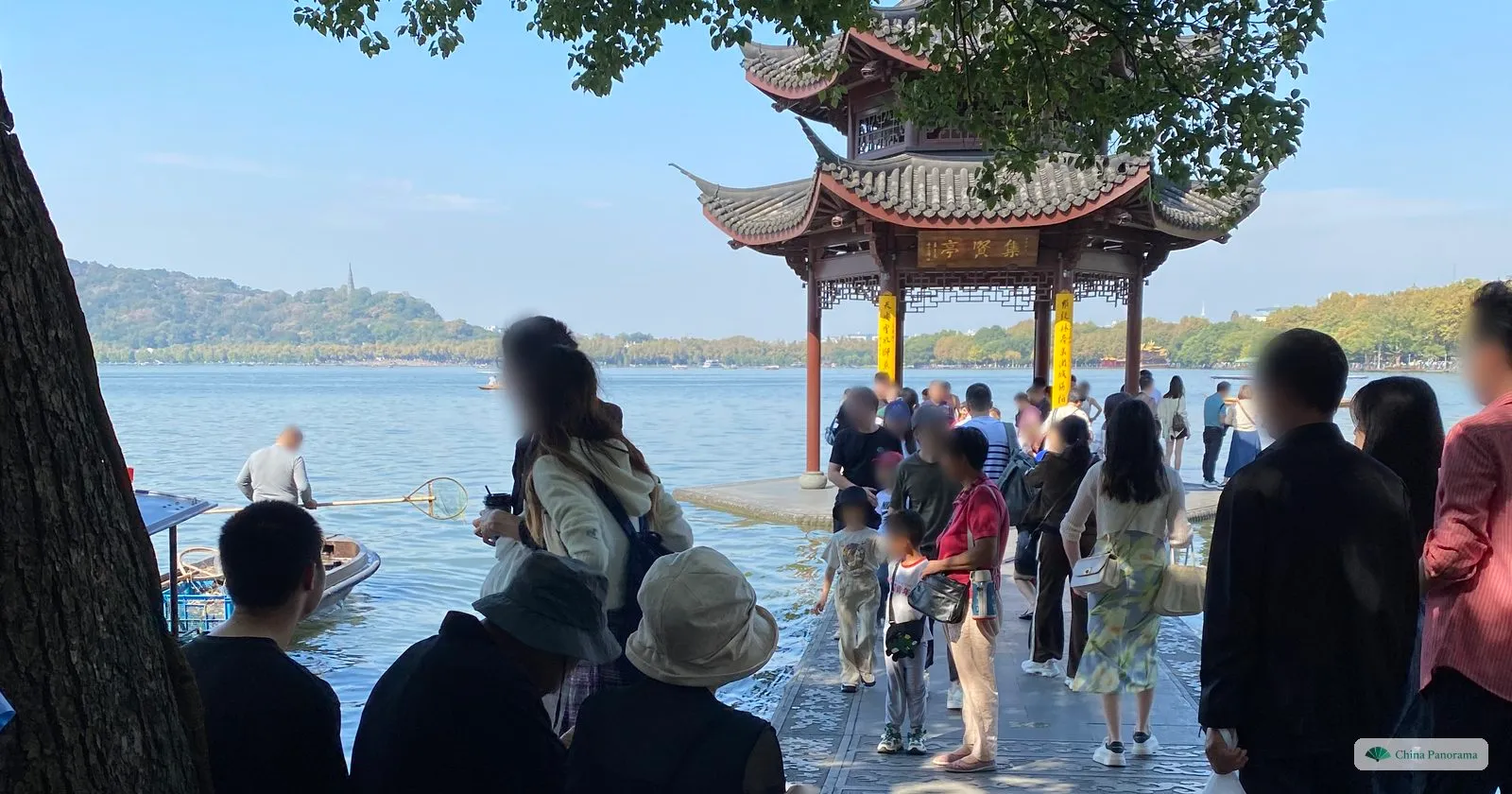
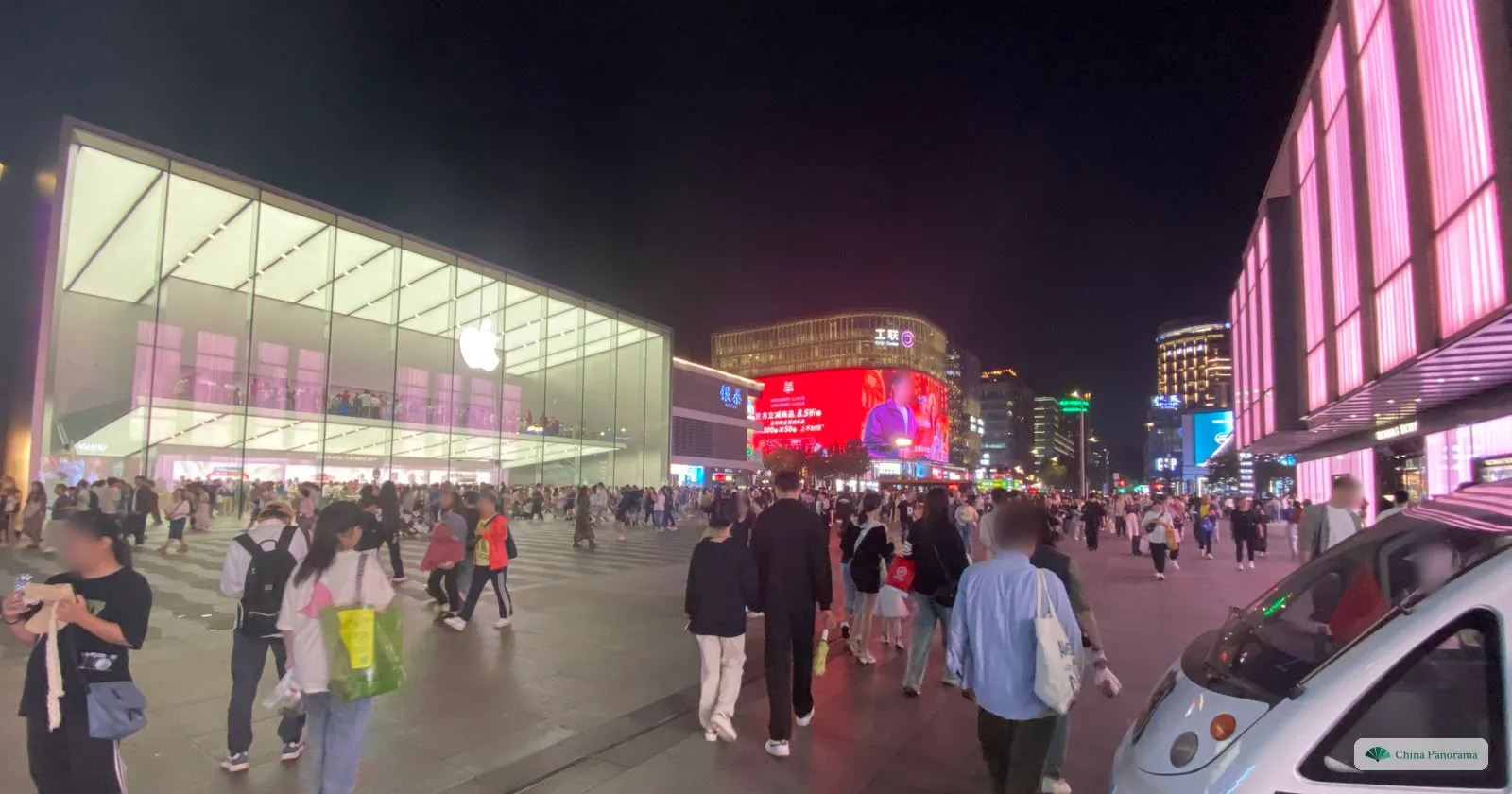
Where the city meets the lake: a promenade along the east shore with benches under plane trees, the musical fountain, the piers for the boats and, a street back, the shopping blocks of Hubin with their flagship stores and, at night, big screens and crowds. A little south, the Jixian Pavilion stands on a stone platform in the water at Tingwan, where in the Qing the garrison practised riding and archery. Most visitors start their West Lake day here. It is also the end of the day, when the lights come on round the lake. We started our walk here at 10:55 on 4 November 2023 and came back at 18:23.
Longxiangqiao station (Line 1) is 300 m from the shore. The promenade is free and open at all hours. We have not checked the times of the fountain show.
- Entry
- Free
- Opening hours
- Open at all hours
Beishan Road and Baochu Pagoda
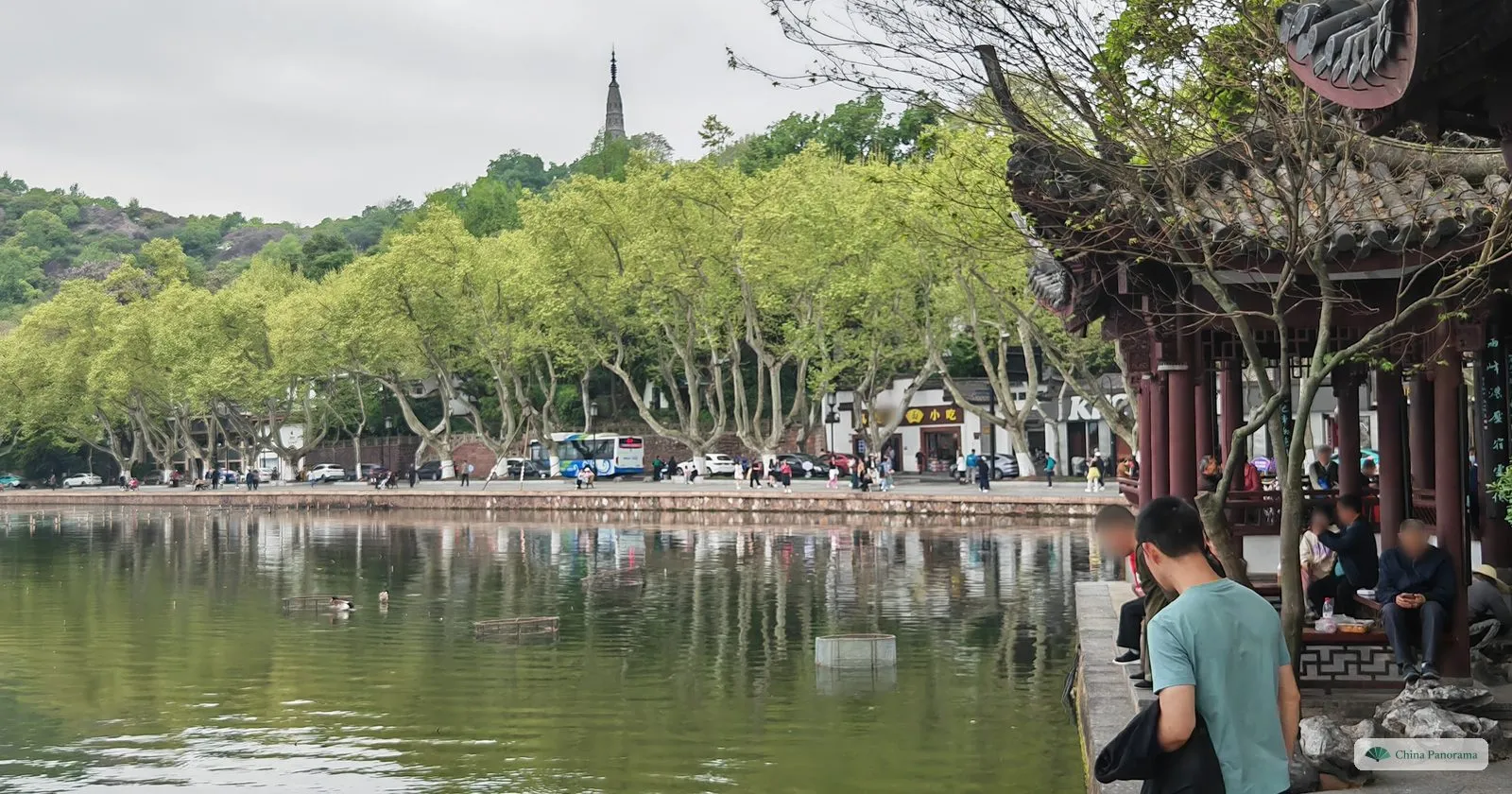
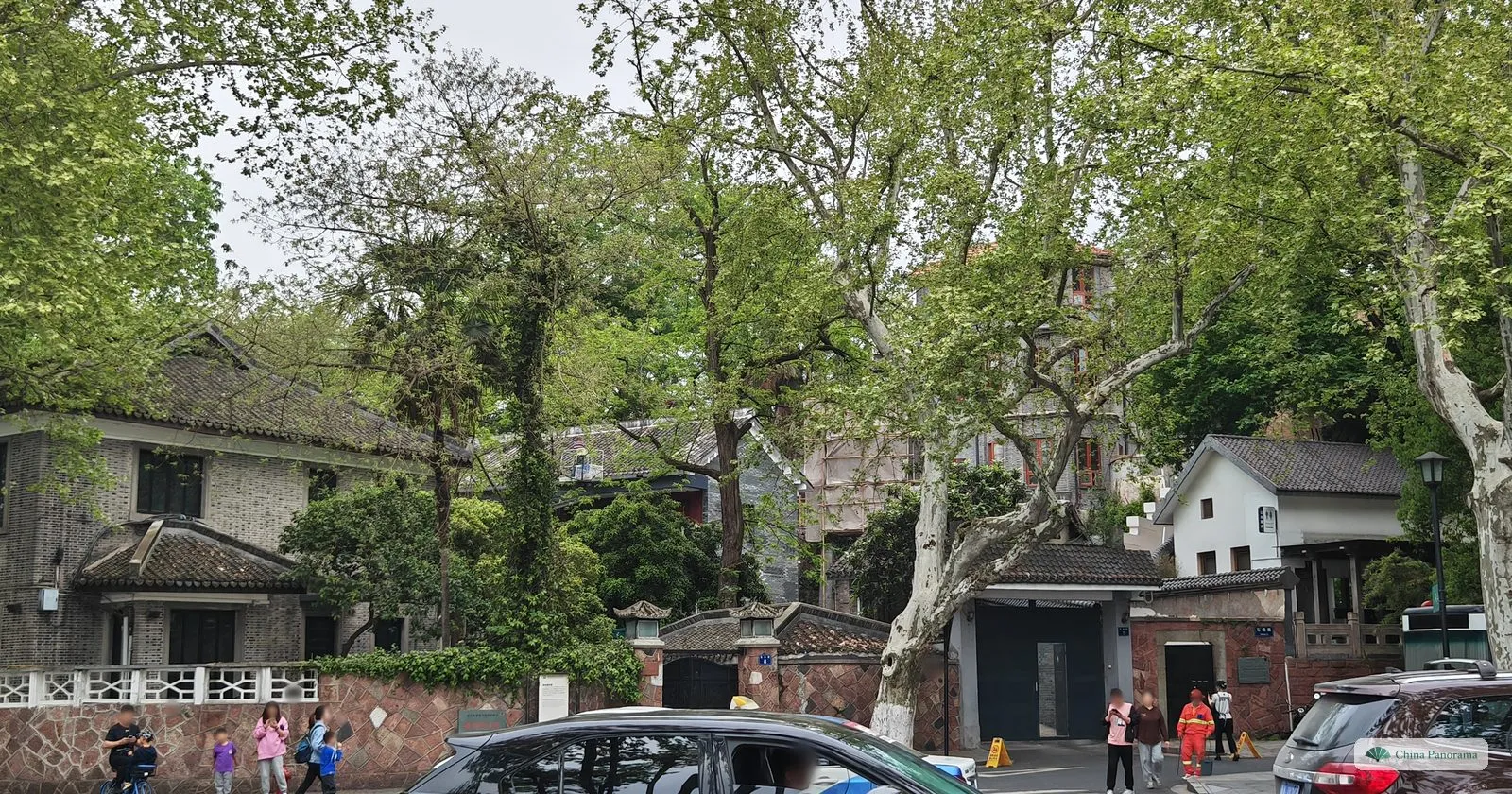
北山街 · 保俶塔StreetXihu · 西湖区OutdoorsThe road along the north shore, from the Broken Bridge to Xiling Bridge, under a double row of plane trees, with the lake on one side and Baoshi Hill on the other. Along it stand villas of the 1920s and 1930s built by bankers, politicians and writers, some now museums or hotels, and pavilions on the water. On the hill above, the thin Baochu Pagoda is the landmark of the north shore. It was first built in the 10th century and last rebuilt in 1933. In April the banksia roses along the road hang in yellow clouds. We walked it from 10:12 to 10:42 on 11 April 2023.
Free and open at all hours. Paths climb Baoshi Hill to the pagoda from behind the road. Fengqi Road station (Lines 1 and 2) is about 1.2 km from the Broken Bridge.
- Entry
- Free
- Opening hours
- Open at all hours
- TempleXihu · 西湖区Outdoors
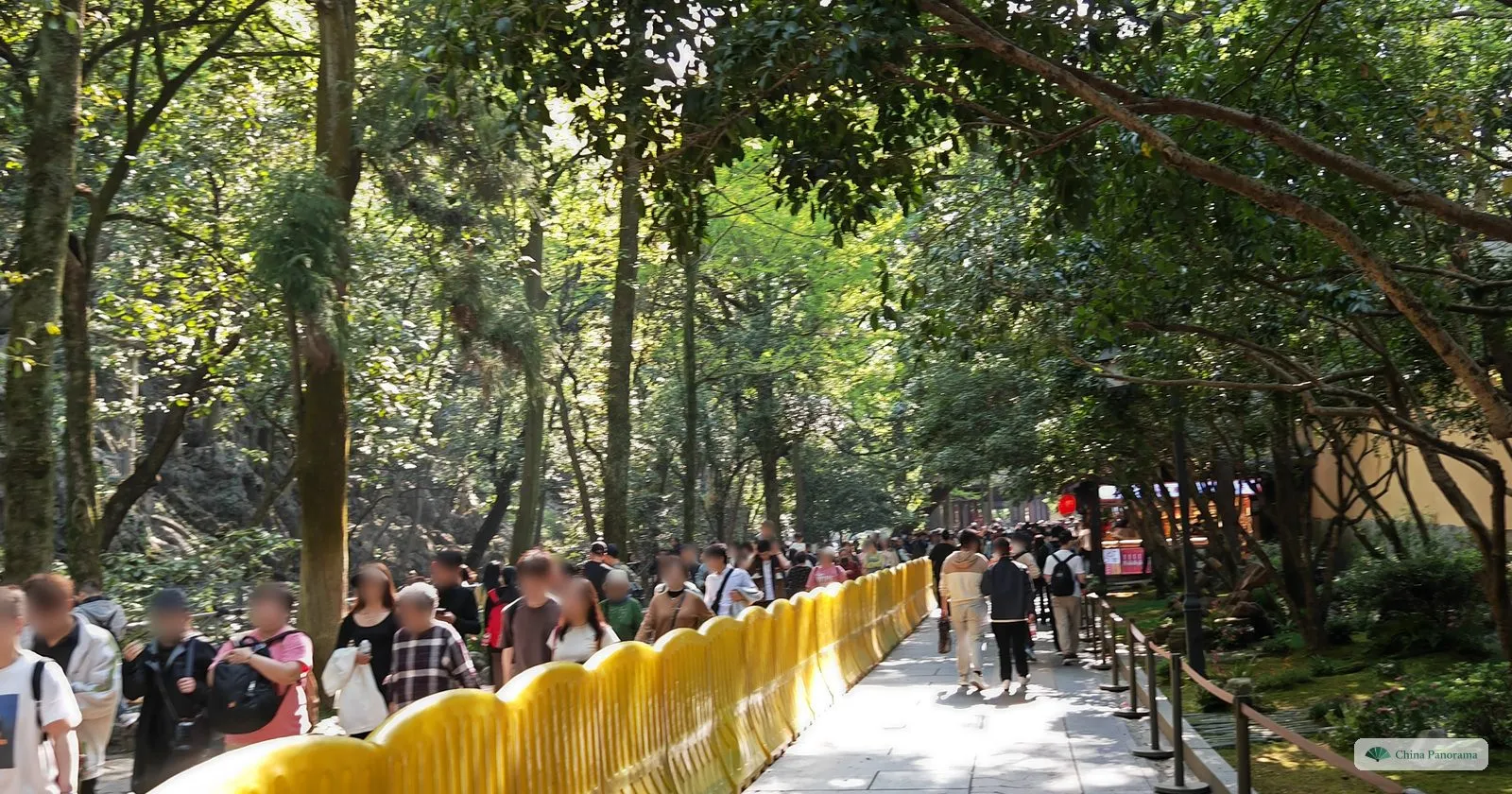
One of the great Buddhist temples of China, in a wooded valley 6 km west of the lake. Tradition says it was founded in 328 by an Indian monk, Huili, who saw the peak opposite and thought it had flown here from India. The temple has been destroyed and rebuilt many times. Its main hall is 33.6 m high, and the seated Buddha inside, 24.6 m with its throne, was carved from camphor wood in 1956. Before the gate, a long yellow wall bears four characters, 咫尺西天, “the Western Paradise is a foot away”. The temple is busy every day, with pilgrims as much as tourists. Since 1 December 2025 the whole Lingyin–Feilai Feng area is free, including the temple, but you book a time slot. We came on the afternoon of 10 April 2023, a Monday, and the paths were full.
Free since 1 December 2025 (before: 45 CNY for the area and 30 CNY for the temple). You book a real-name slot in the “杭州灵隐飞来峰” mini-program in Alipay or WeChat, at least a day ahead and up to seven days, morning 07:30–12:00 or afternoon 12:00–17:00, for up to five people per phone. Visitors aged 70 and over need no booking. Daily caps: 35,000 on weekdays, 50,000 at weekends, 65,000 on holidays. Whether a foreign passport can be entered in the mini-program we could not confirm. No metro: bus or taxi, about 20 minutes from Hubin.
- Entry
- Free
- Opening hours
- Entry 07:30–17:00, in a booked morning (07:30–12:00) or afternoon (12:00–17:00) slot
- TempleXihu · 西湖区Outdoors
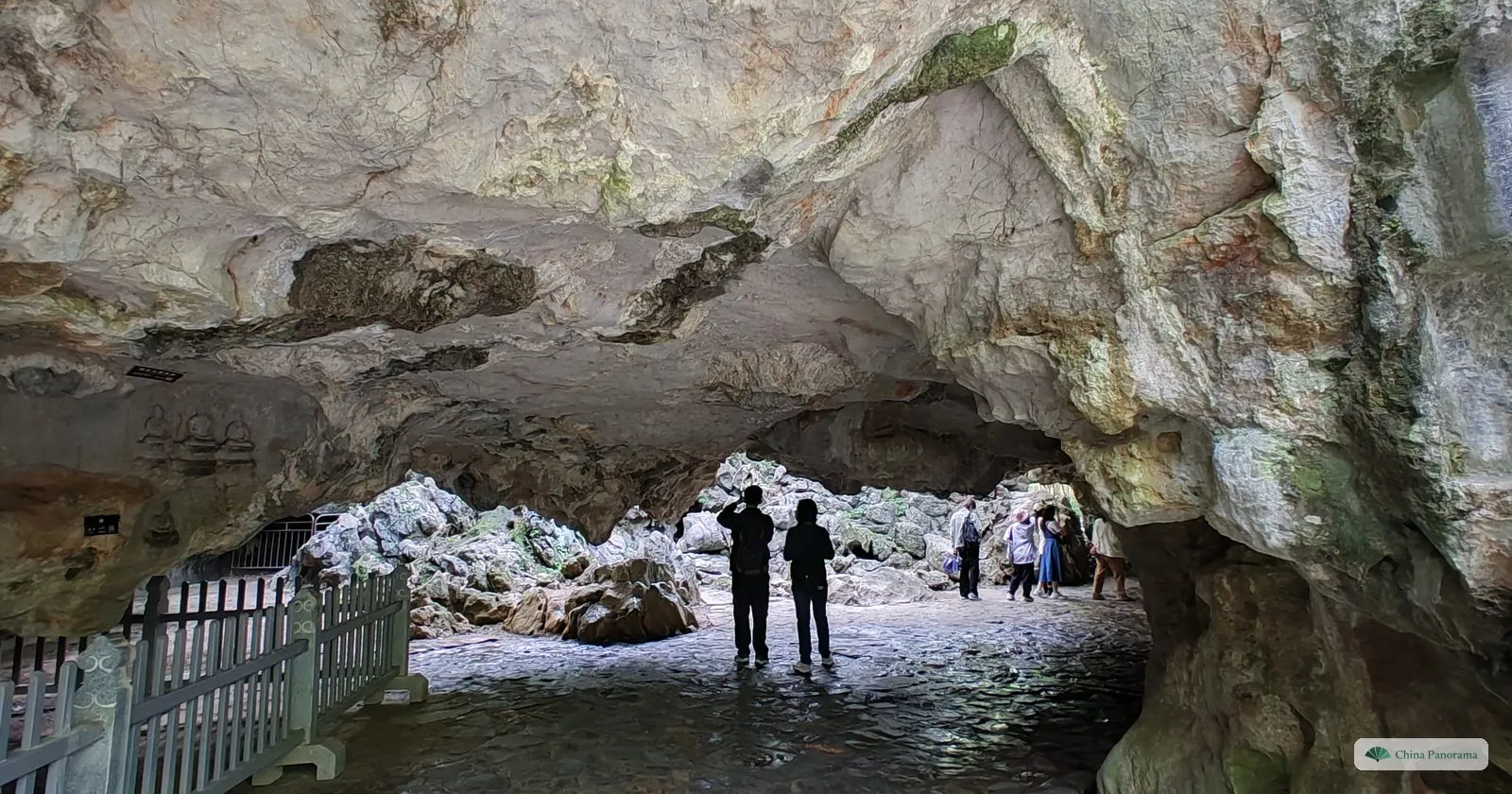
A limestone hill opposite Lingyin Temple, full of caves and covered with Buddhist carvings: 153 niches and more than 470 figures, 338 of them well preserved, carved from the late Tang and the Five Dynasties to the Yuan, most in the Northern Song. The biggest is a laughing Buddha, Budai, the Chinese Maitreya, with his belly bare among eighteen arhats: 3.6 m high and 9.9 m long, from the Northern Song. Near the entrance stands the Ligong Pagoda, a six-sided stone pagoda said to hold the ashes of Huili, the temple's founder. Inside the caves, smaller figures line the walls and a slit in the roof of one lets in a single line of sky. We walked along the carvings from 15:14 to 15:29 and came back through the caves at 16:04.
Part of the same free, booked Lingyin–Feilai Feng area: you pass the carvings on the way to the temple. Same hours and booking as Lingyin.
- Entry
- Free
- Opening hours
- Entry 07:30–17:00, in a booked morning (07:30–12:00) or afternoon (12:00–17:00) slot
Yongfu and Taoguang Temples
永福寺 · 韬光寺TempleXihu · 西湖区OutdoorsTwo smaller temples further up the same valley, beyond Lingyin, which most tour groups skip. Yongfu Temple climbs the hillside in terraces among maples and tea bushes, with a screen wall reading 百福庄严 at its foot. A signposted path leads on up to Taoguang Temple, about 1 km further, with a view back over the lake on a clear day. A path also leads on south to the three Tianzhu temples, among them Faxi Temple, known for its yellow walls. At 15:35 on a crowded Monday, Yongfu was almost quiet.
Included in the free, booked Lingyin–Feilai Feng area. Allow an extra hour for Yongfu and Taoguang, and good shoes for the steps.
- Entry
- Free
- Opening hours
- Entry 07:30–17:00, in a booked morning (07:30–12:00) or afternoon (12:00–17:00) slot
- LandmarkXihu · 西湖区Outdoors
A tall octagonal pagoda on Yuelun Hill above the Qiantang River, 7 km south of the lake. It was first built in 970 by Qian Chu of Wuyue to calm the river's tidal bore and to guide boats at night. The nine-storey tower burnt in 1121. The brick core you climb today was rebuilt by 1163, in the Southern Song, and the wooden eaves round it date from 1900. From outside it has thirteen roofs, inside seven floors, about 59.9 m high, and a stair climbs to the top. Below it the Qiantang River Bridge crosses the river: designed by Mao Yisheng, the first big bridge in China designed and built by Chinese engineers, with a railway below and a road above, 1,453 m long. Trains first crossed on 26 September 1937. On 23 December, as the Japanese army approached, Chinese troops blew it up themselves. It was fully repaired by 1953 and still carries both. We were at the riverside below the pagoda at 11:48 on 10 April 2023.
On Zhijiang Road by the river. Bus or taxi, about 20 minutes from Hubin. The ticket has been reported at 20 CNY, with 10 CNY more to climb the tower (a 2011 report), and hours of 07:00–17:30. We have not checked either.
- Entry
- Price not verified — check on site
- Opening hours
- Hours not verified — check on site
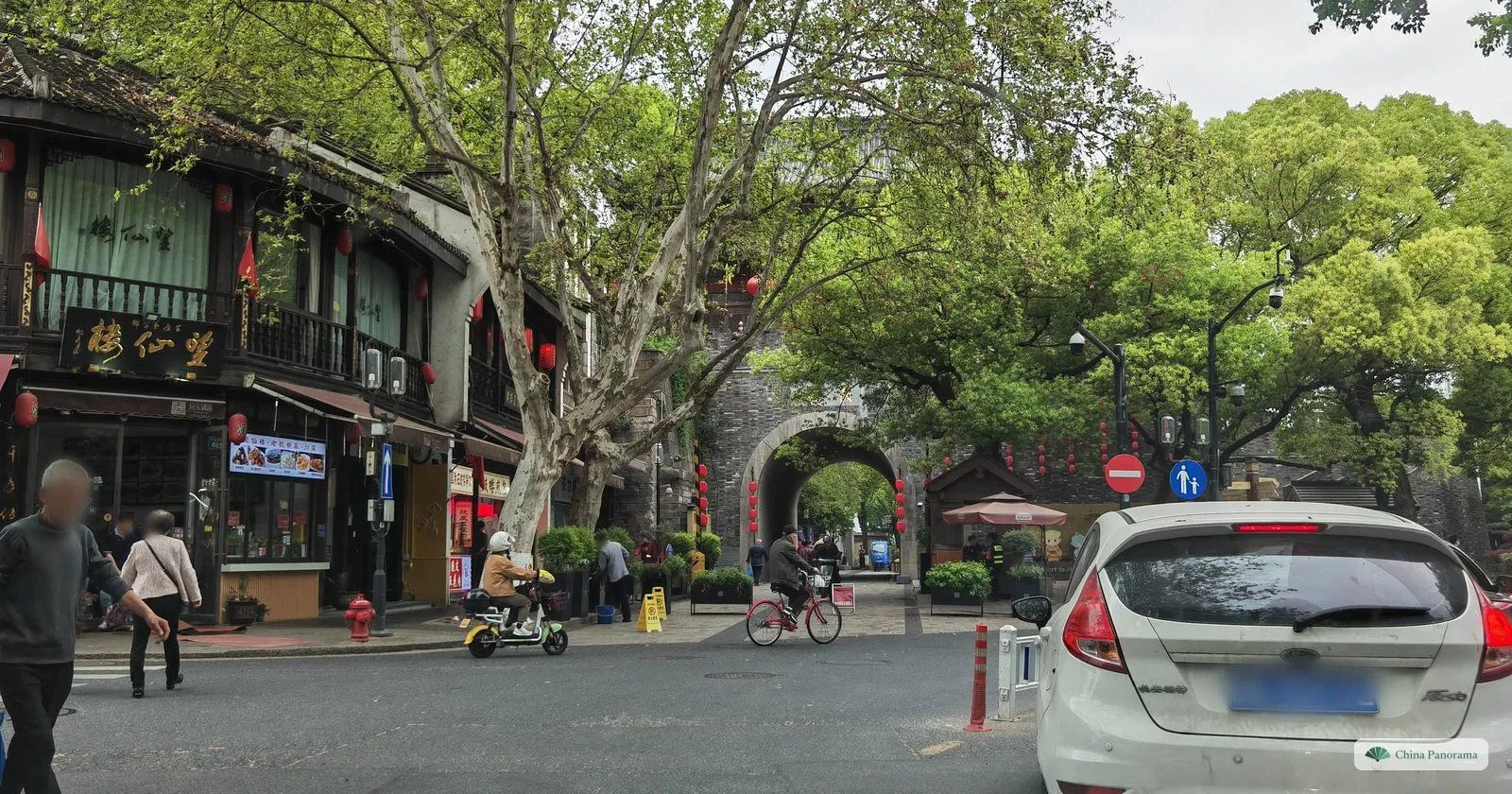
Hefang Street and Qinghefang
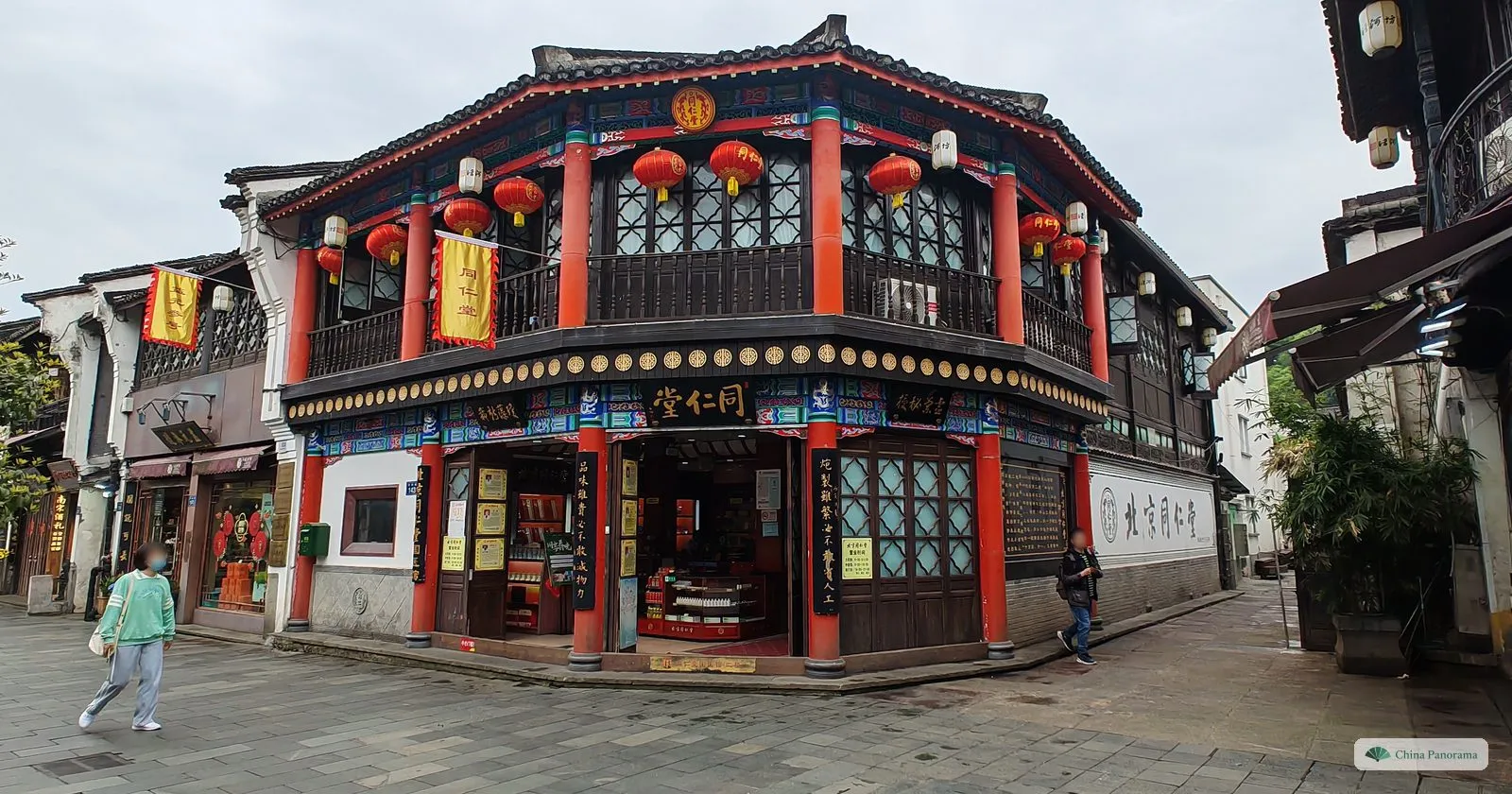
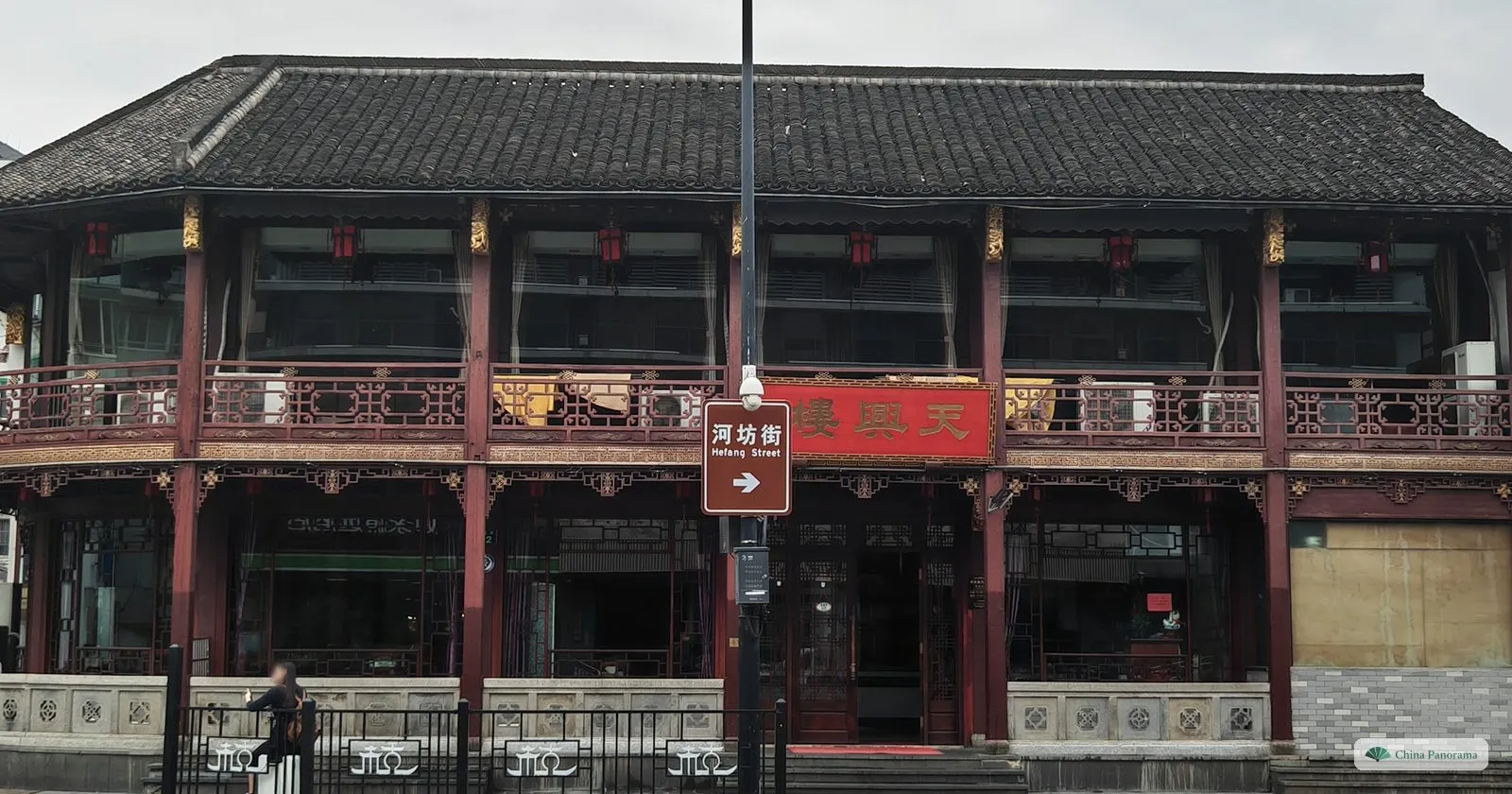
河坊街 · 清河坊StreetShangcheng · 上城区OutdoorsThe old shopping quarter at the foot of Wushan, rebuilt as a pedestrian street of two-storey wooden shophouses in the early 2000s: tea, silk, fans, scissors, medicine shops and snacks, among them Hangzhou specialities such as osmanthus cakes and candied fruit. Some of the old firms are real, such as the Hu Qing Yu Tang pharmacy and Fang Hui Chun Tang. The rest is a souvenir street. A big bronze laughing Buddha in the street is a favourite photo. At 08:30 on a weekday the street was still empty and the shops were opening, by mid-morning it was full.
Free and open at all hours, shops roughly from 09:00 into the evening. Ding'an Road (Line 1) and Wushan Square (Line 7) are both about 500 m away. The Southern Song Imperial Street crosses it at the east end.
- Entry
- Free
- Opening hours
- Open at all hours
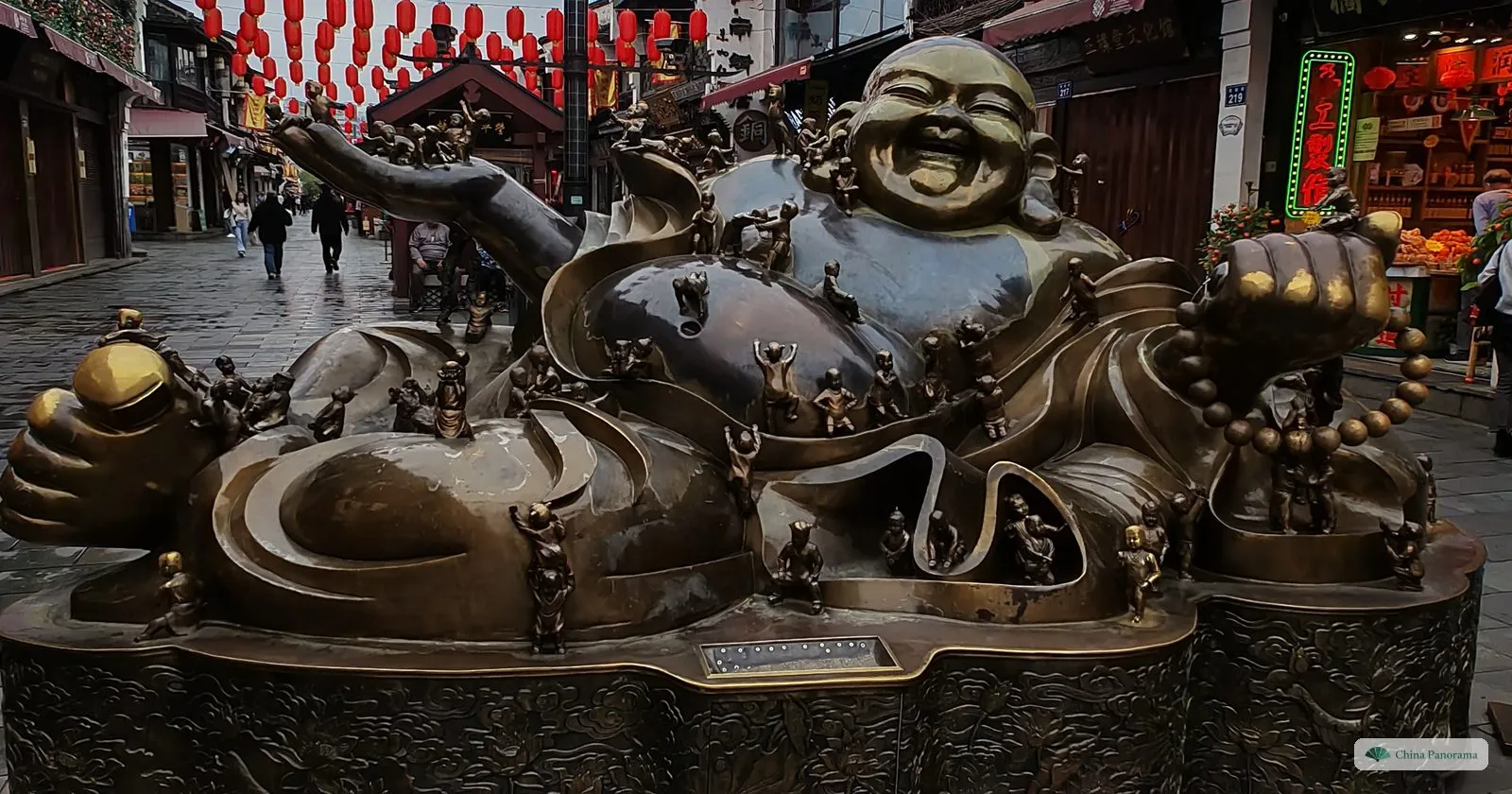
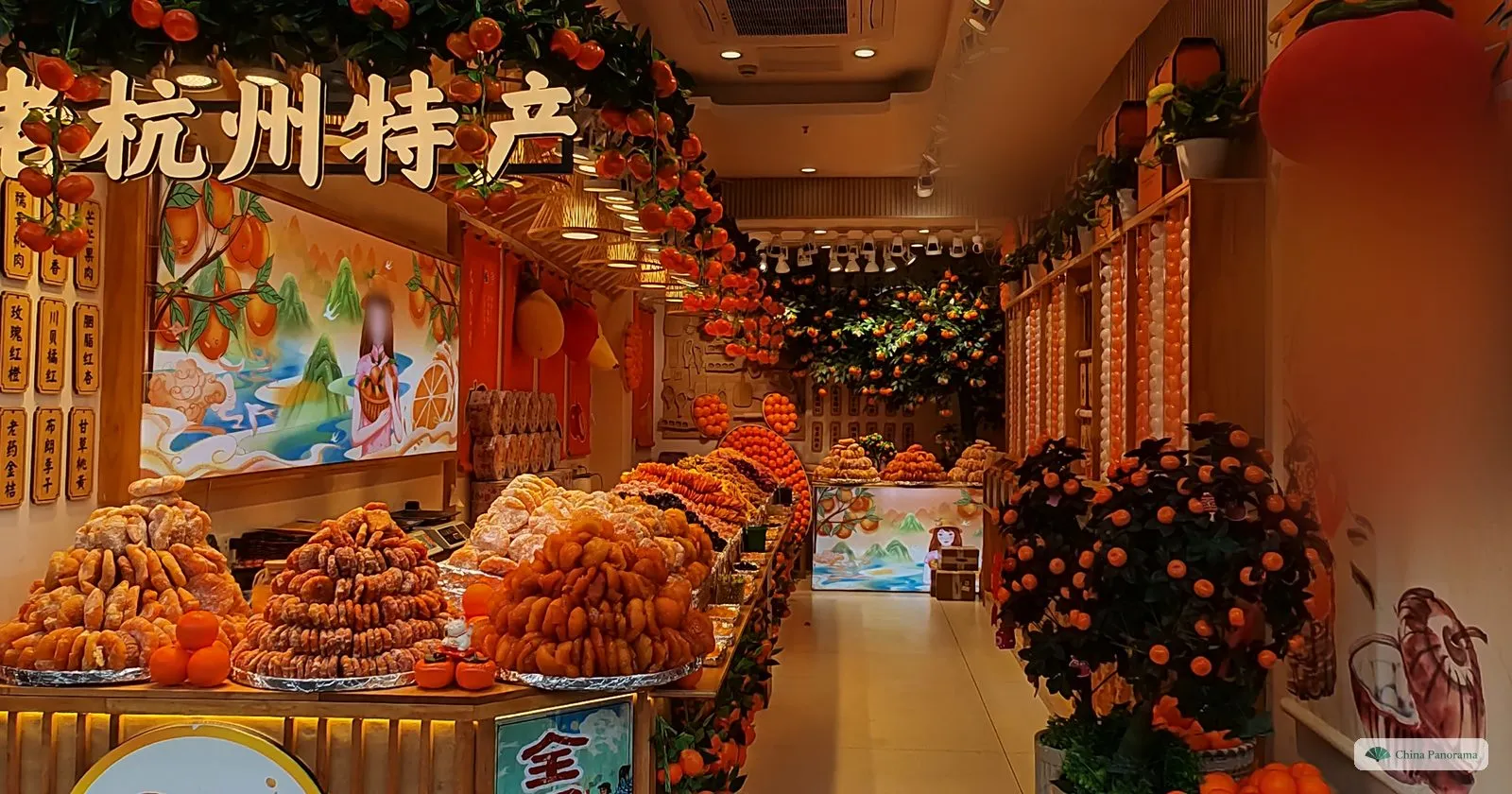
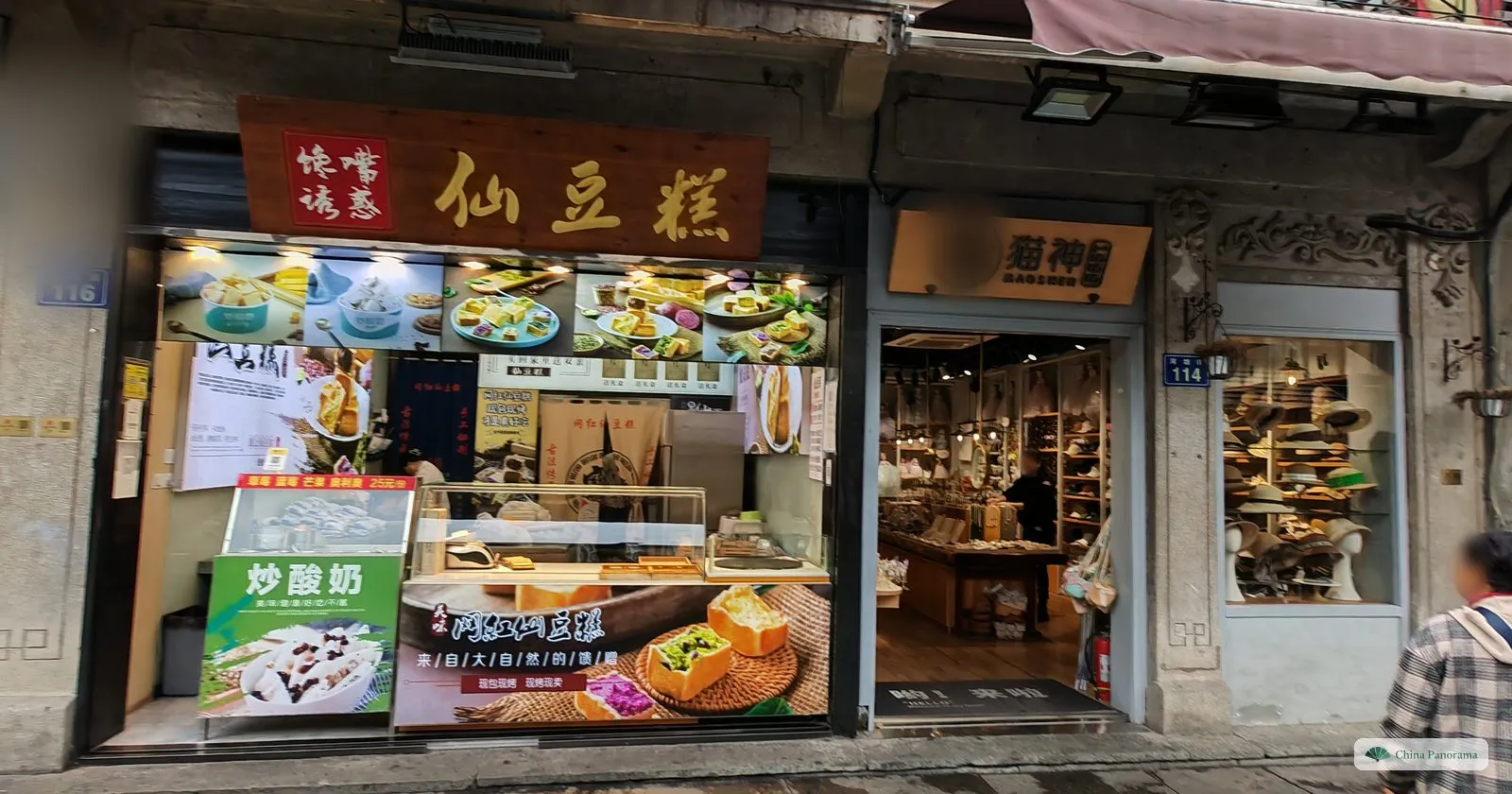
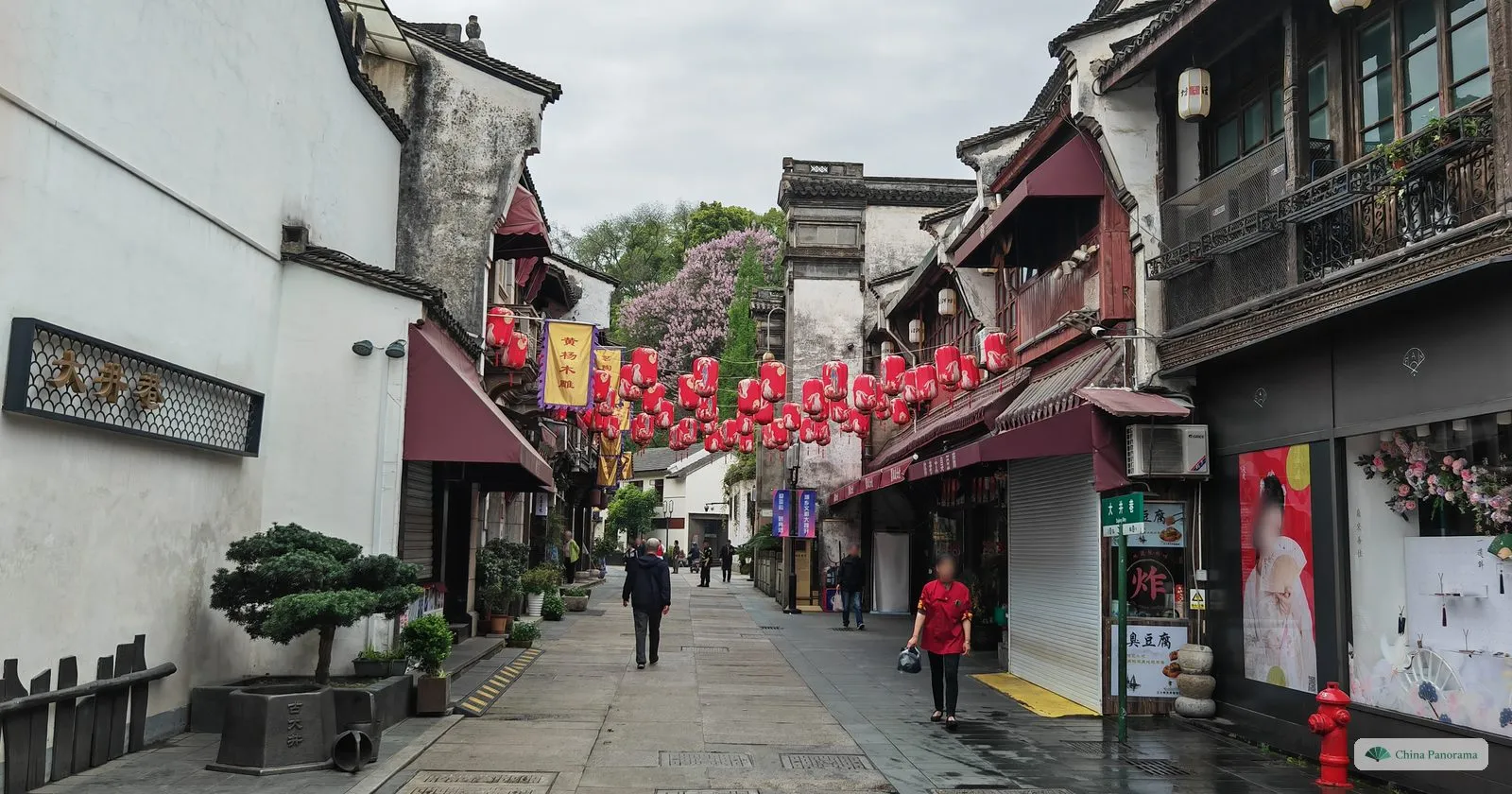
- MuseumShangcheng · 上城区Indoors
A traditional Chinese pharmacy founded in 1874 by Hu Xueyan, the richest merchant of the late Qing, in a courtyard building of over 3,000 m² behind Hefang Street: shop in front, workshops behind. Its outer wall, some 60 m of white plaster along Dajing Lane, carries the old advertisement in huge black characters, 胡庆余堂国药号, “Hu Qing Yu Tang, Chinese medicine house”. Inside are a working pharmacy with its carved counters, and the Museum of Traditional Chinese Medicine with displays on herbs and how the pills were made.
95 Dajing Lane. Hours have been reported as 08:30–17:00, last entry 16:30. We have not checked the museum's entry price. The wall is outside and free.
- Entry
- Price not verified — check on site
- Opening hours
- Hours not verified — check on site
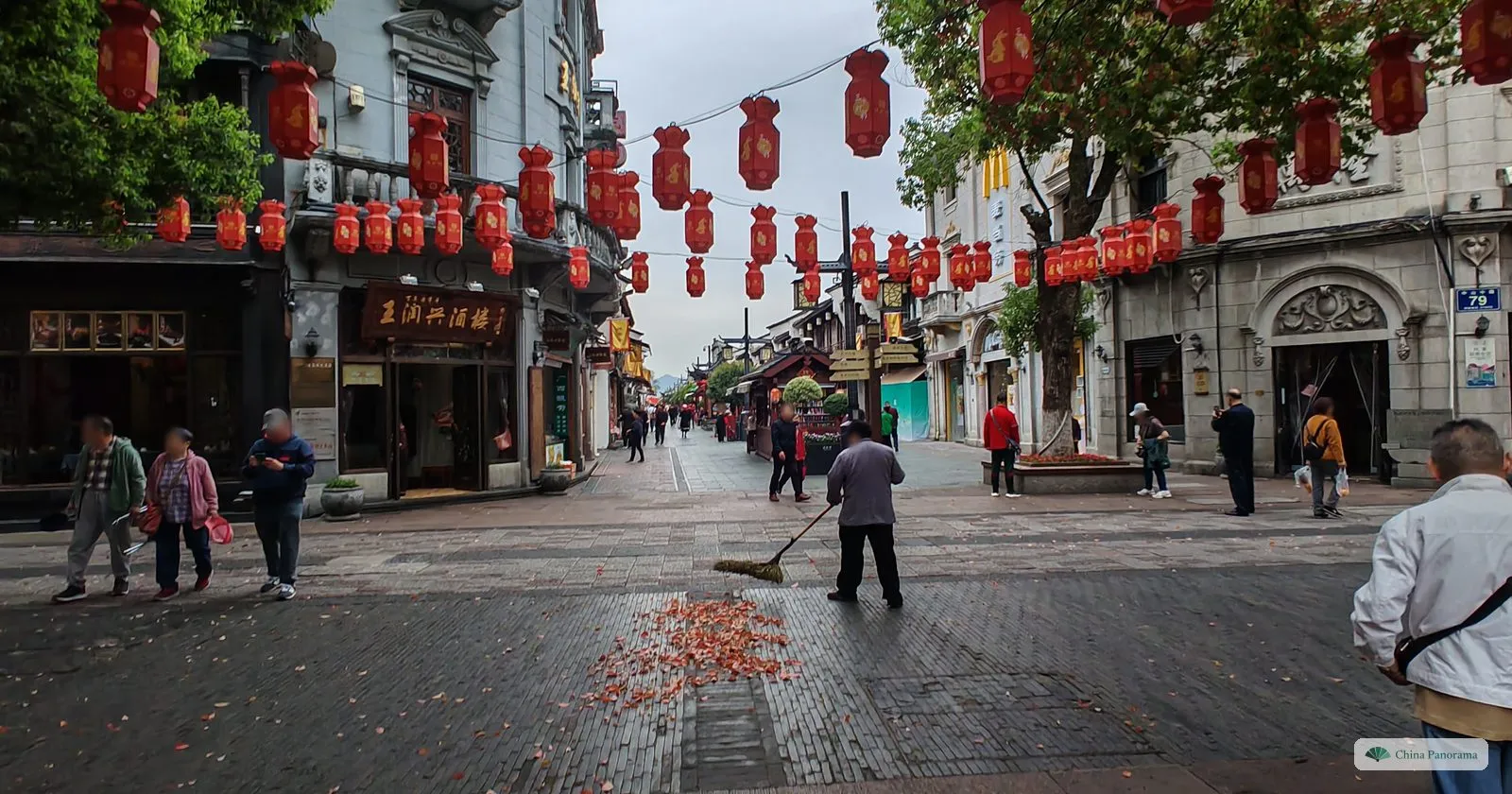
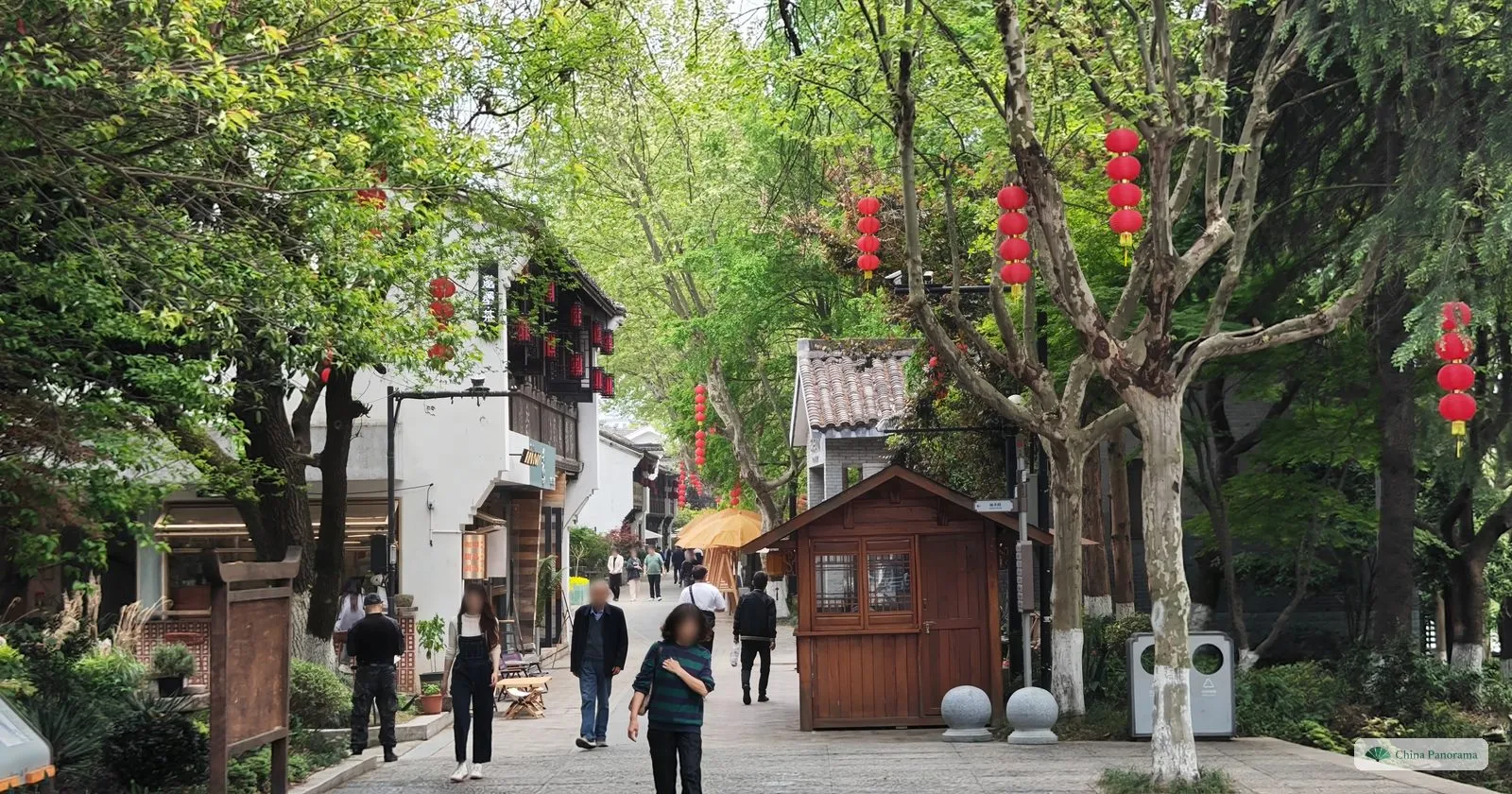
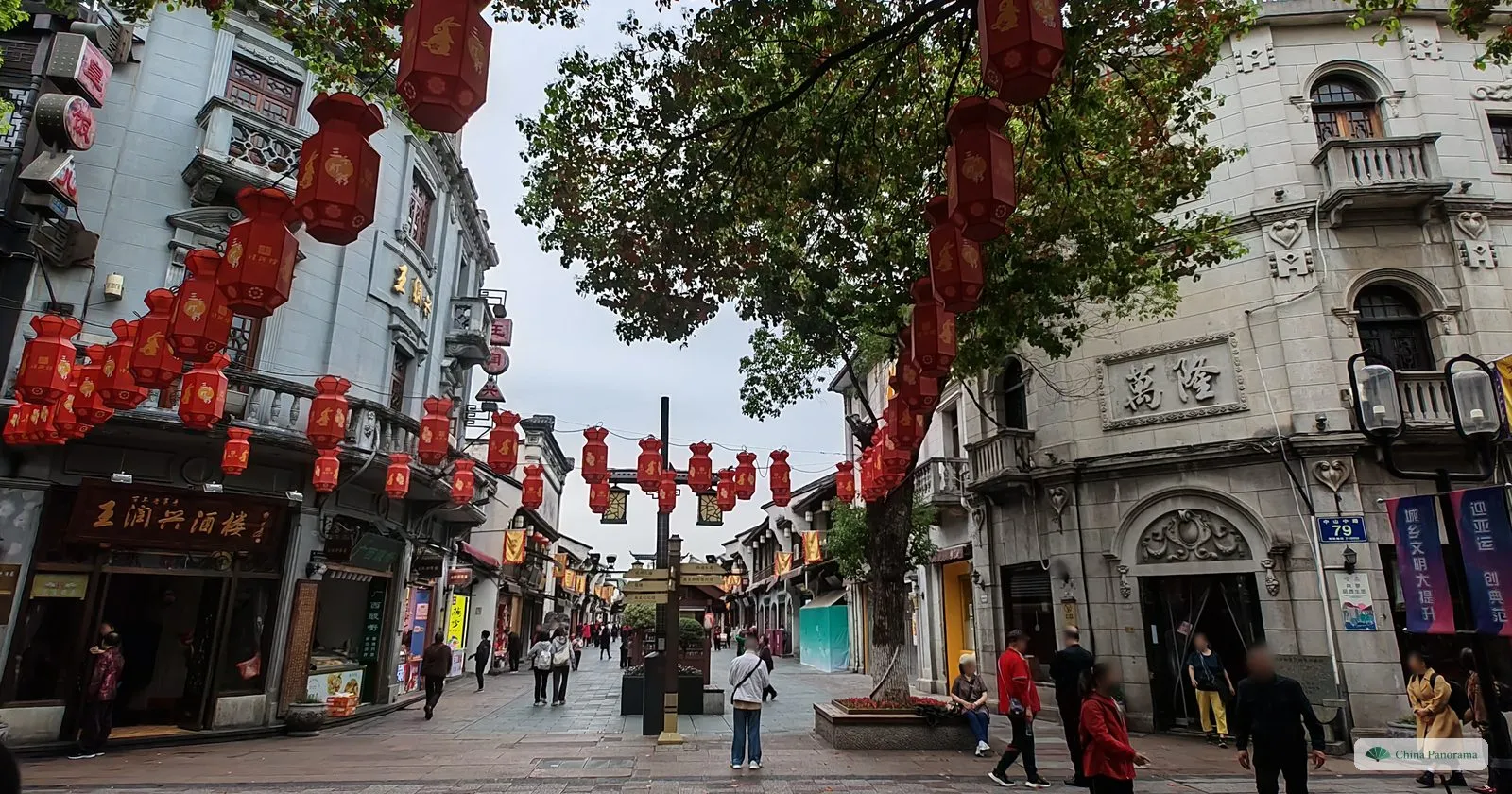 StreetShangcheng · 上城区Outdoors
From 1138 to 1276 Hangzhou, then called Lin'an, was the capital of the Southern Song, and the city's main street was the imperial way from the palace on Phoenix Hill northward. Its line is today's Zhongshan Road. The pedestrian stretch from Gulou to Xihu Avenue has been restored with grey shophouses, Republic-era stone facades with balconies and plaster ornament, old restaurants and lanterns strung across the street. In places the Song road surface excavated beneath it is shown under glass. At 09:15 the street sweepers were still at work.
Free and open at all hours. Ding'an Road (Line 1) is about 500 m from its middle, Wushan Square (Line 7) close by too.
- Entry
- Free
- Opening hours
- Open at all hours
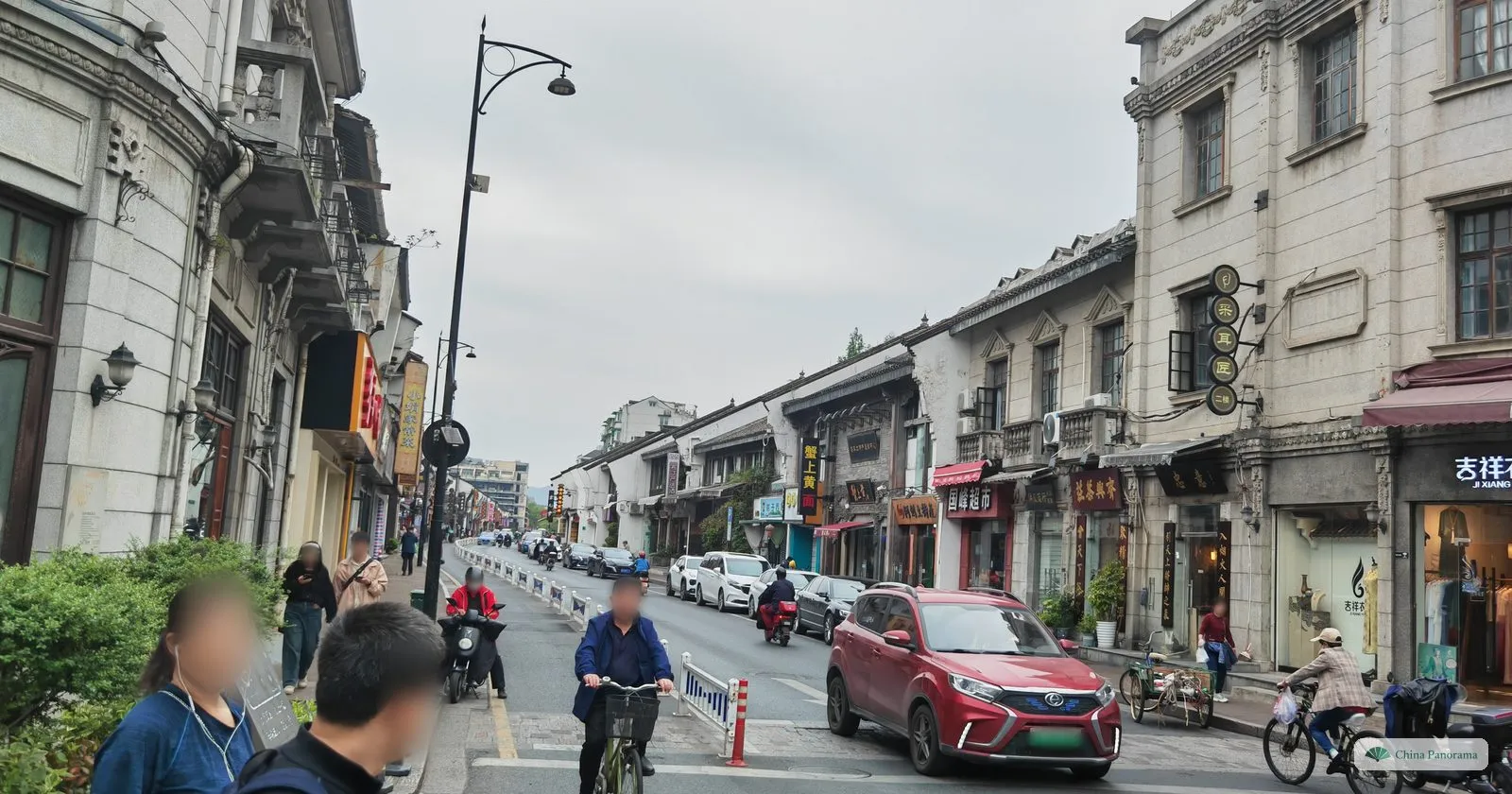
Southern Song Deshou Palace Museum
南宋德寿宫遗址博物馆MuseumShangcheng · 上城区IndoorsA museum built over the excavated ruins of the Deshou Palace, the residence to which the Song emperor Gaozong retired when he gave up the throne in 1162. The site was first found in 1984 and dug in four campaigns up to 2020. The museum, a Song-style hall with white terraces, opened on 22 November 2022 and shows the palace's foundations, drains and garden ponds, with digital reconstructions. Visits are booked in advance. When we passed at 09:42 on 11 April 2023, a queue was waiting at the gate before opening.
On Wangjiang Road, at the east end of Hefang Street, 10 minutes' walk from the Imperial Street. Book in advance. We have not checked the booking channel, price or hours.
- Entry
- Price not verified — check on site
- Opening hours
- Hours not verified — check on site
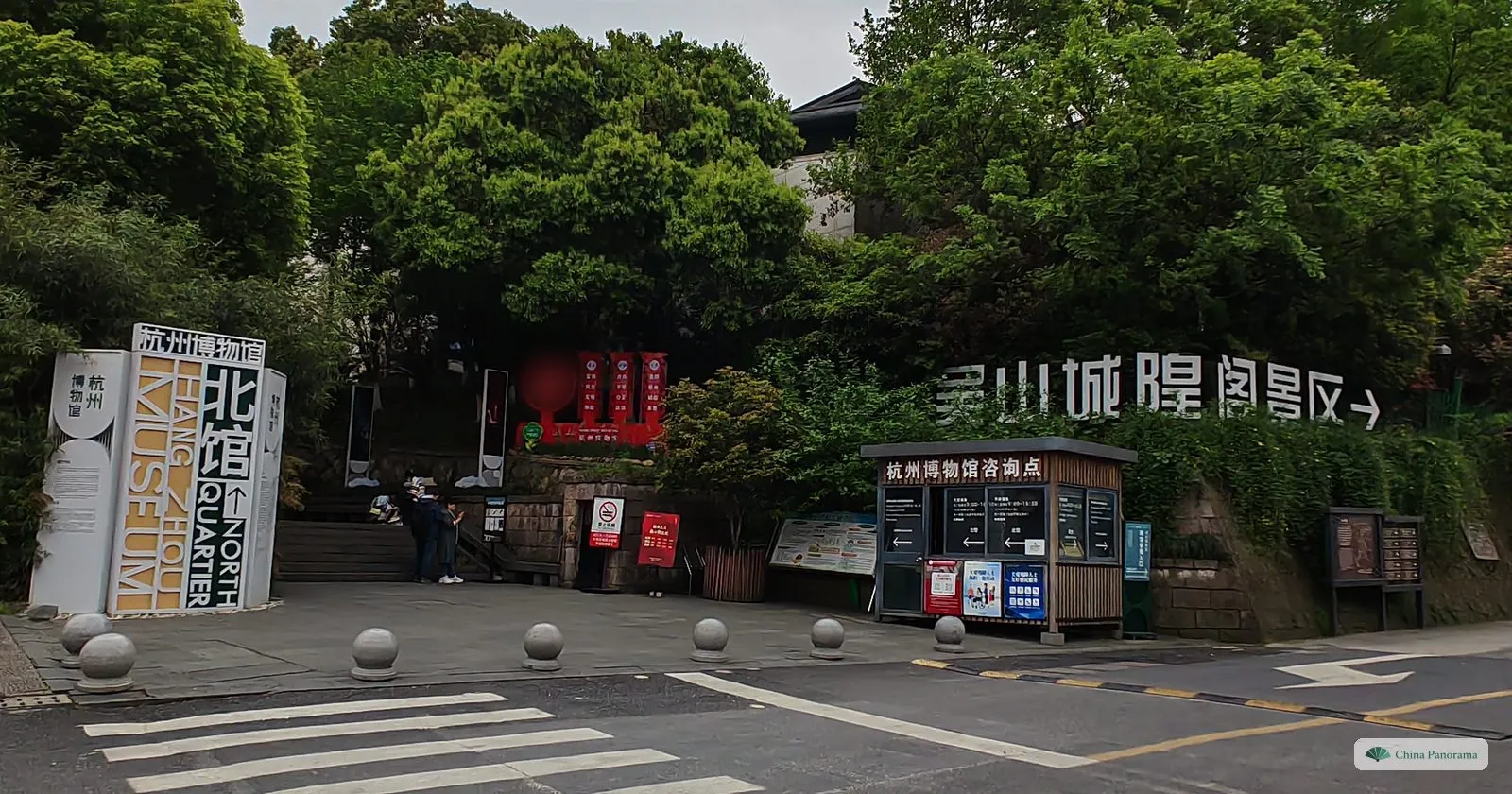
Wushan Hill and the Hangzhou Museum
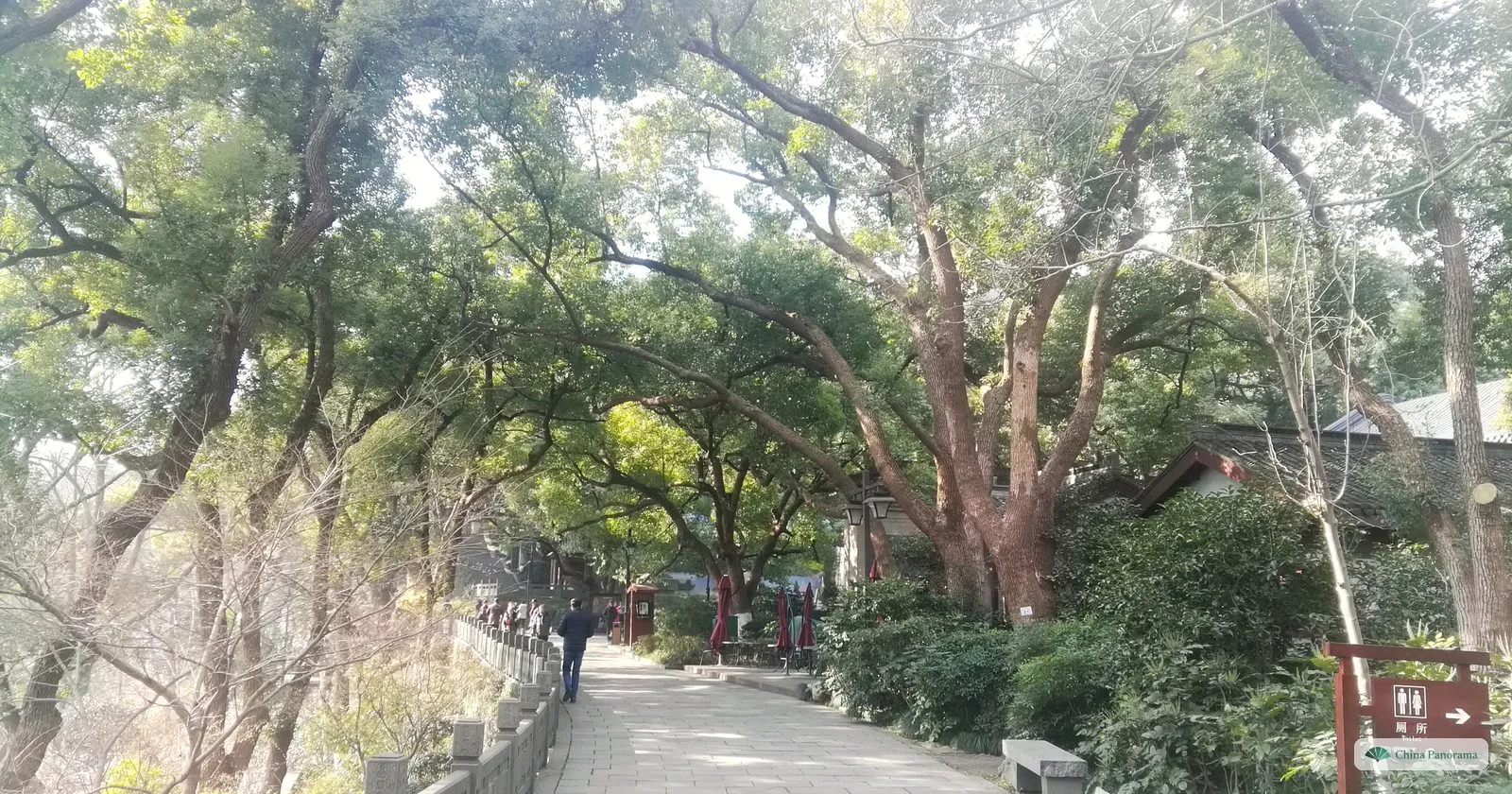
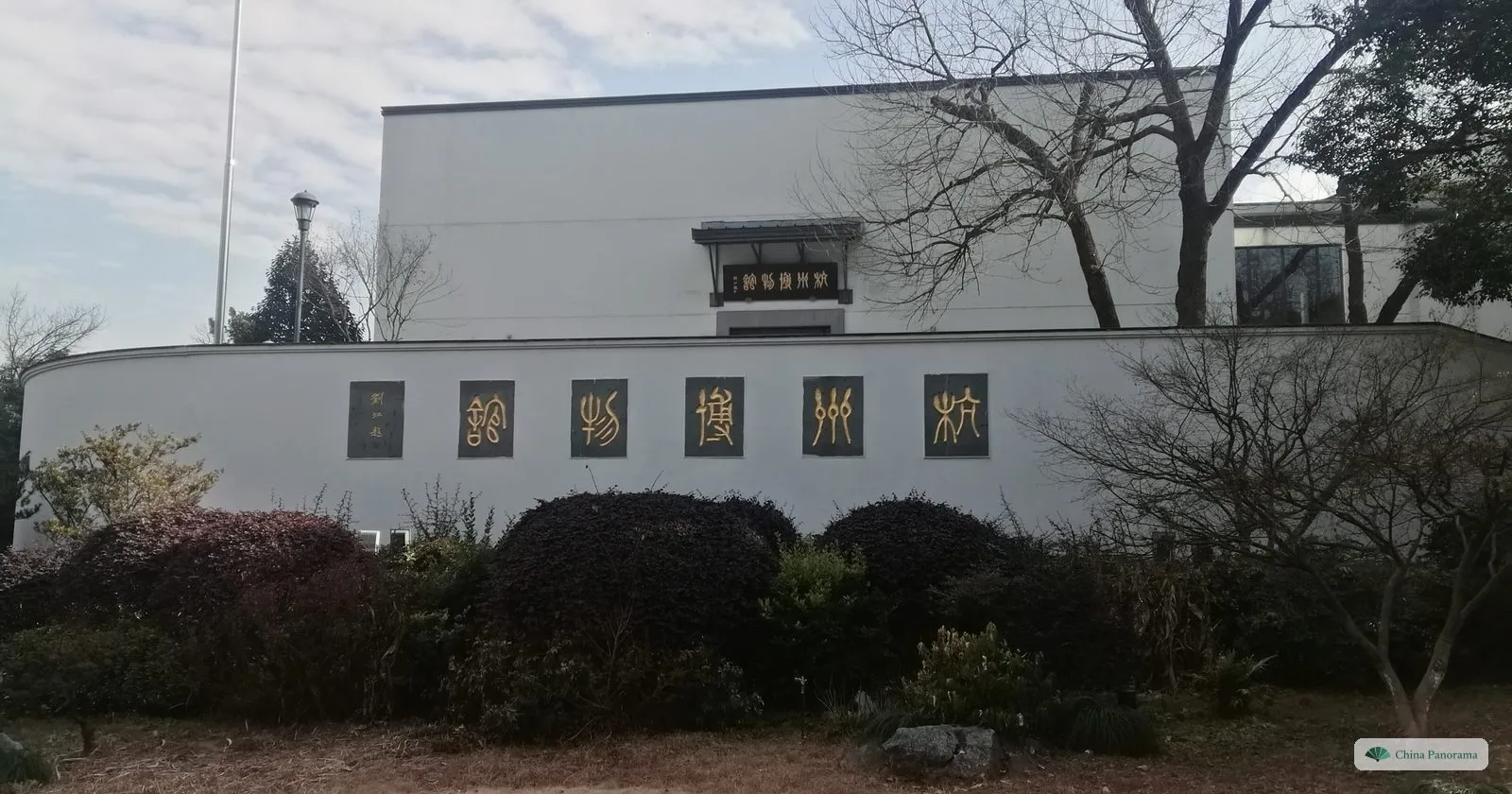
吴山 · 杭州博物馆ParkShangcheng · 上城区OutdoorsThe low hill between Hefang Street and the lake, with old camphor trees, paths and, on its top, the City God Pavilion (Chenghuang Ge), a tower rebuilt in 2000 with a view over both the lake and the old town. On its north slope, at the start of the paths from Hefang Street, is the Hangzhou Museum, with the city's history from the Neolithic to the Republic. We walked up from the museum on a sunny winter morning, 14 January 2018.
The hill paths are free. Wushan Square (Line 7) is at the foot. We have not checked the City God Pavilion's ticket or the museum's hours.
- Entry
- Price not verified — check on site
- Opening hours
- Hours not verified — check on site
Grand Canal: Dadou Road, Wulin Gate and Gongchen Bridge
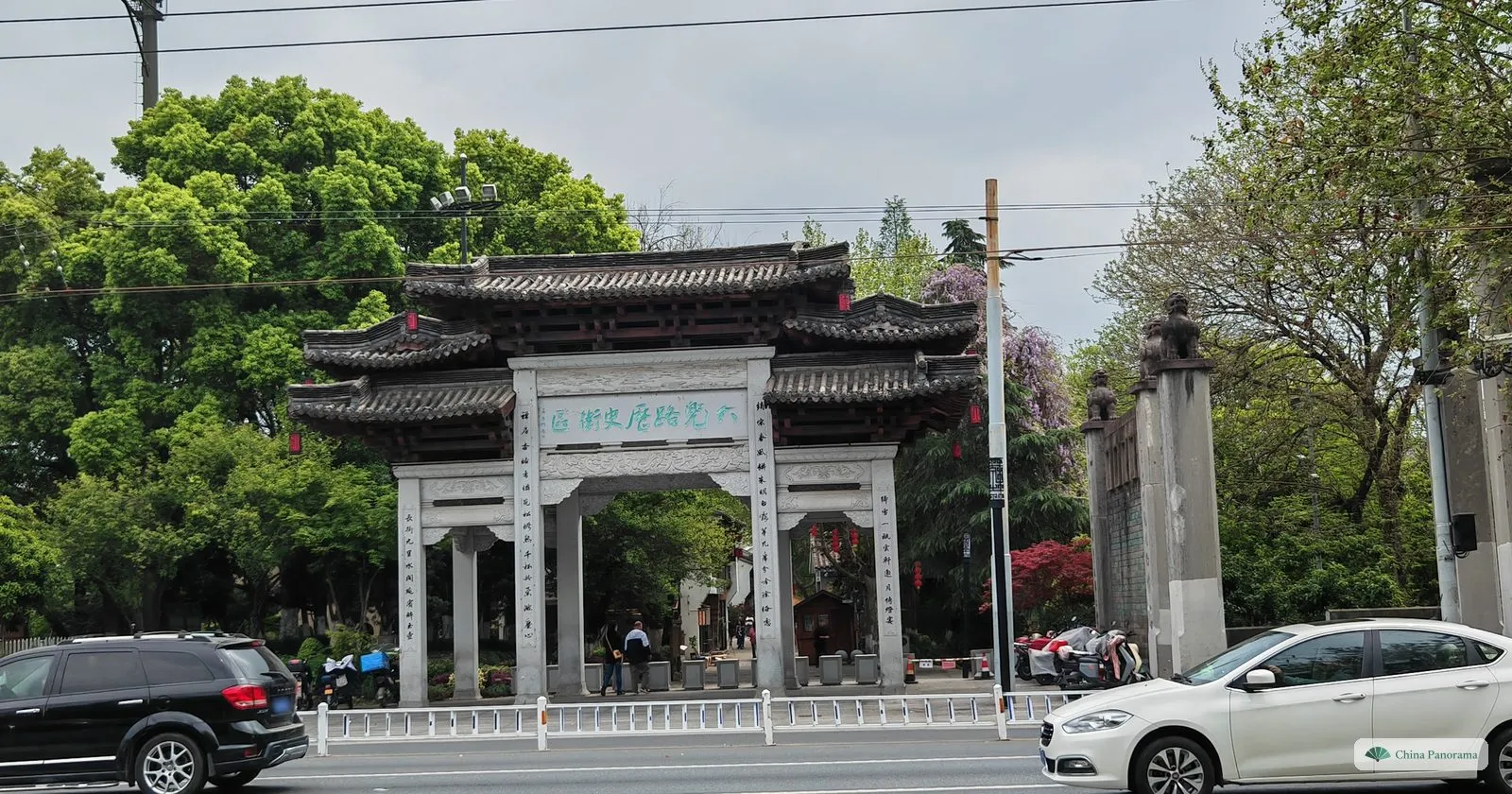
京杭大运河 · 大兜路 · 拱宸桥LandmarkGongshu · 拱墅区OutdoorsHangzhou is the southern end of the Grand Canal, which runs about 1,800 km from Beijing and has carried rice, salt and silk since the 7th century. Since 2014 it has been a World Heritage Site. In the north of the city it is still a working waterway: long strings of barges pass the willow banks. Along it, Dadou Road is a restored canal-side street of white houses and teahouses, with the arch of the Dadou Road historic quarter at its north end. Further north, Gongchen Bridge, a three-arched stone bridge first built in 1631 and rebuilt in 1885, marks the canal's arrival in Hangzhou. Near it are the old streets of Qiaoxi and Xiaohe and the Grand Canal Museum. At Wulin Gate, close to the centre, the water buses leave. We were at Dadou Road at 12:31 on 11 April 2023, and at Wulin Gate in January 2018.
The canal banks and streets are free and open at all hours. Xiangji Temple station (Line 3) is about 400 m from Dadou Road, East Gongchen Bridge (Line 5) is near the bridge. We have not checked water-bus prices or times.
- Entry
- Free
- Opening hours
- Open at all hours
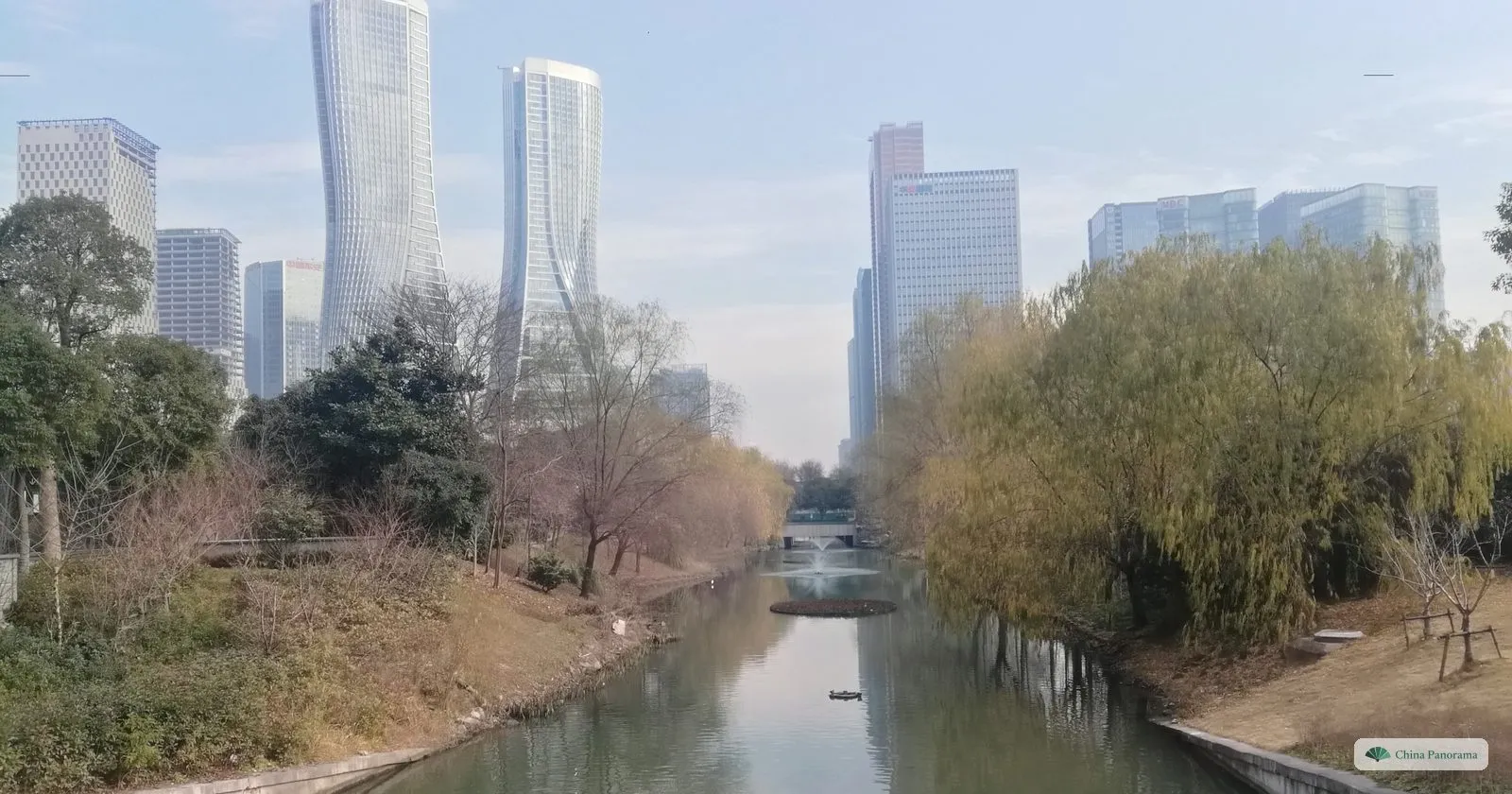
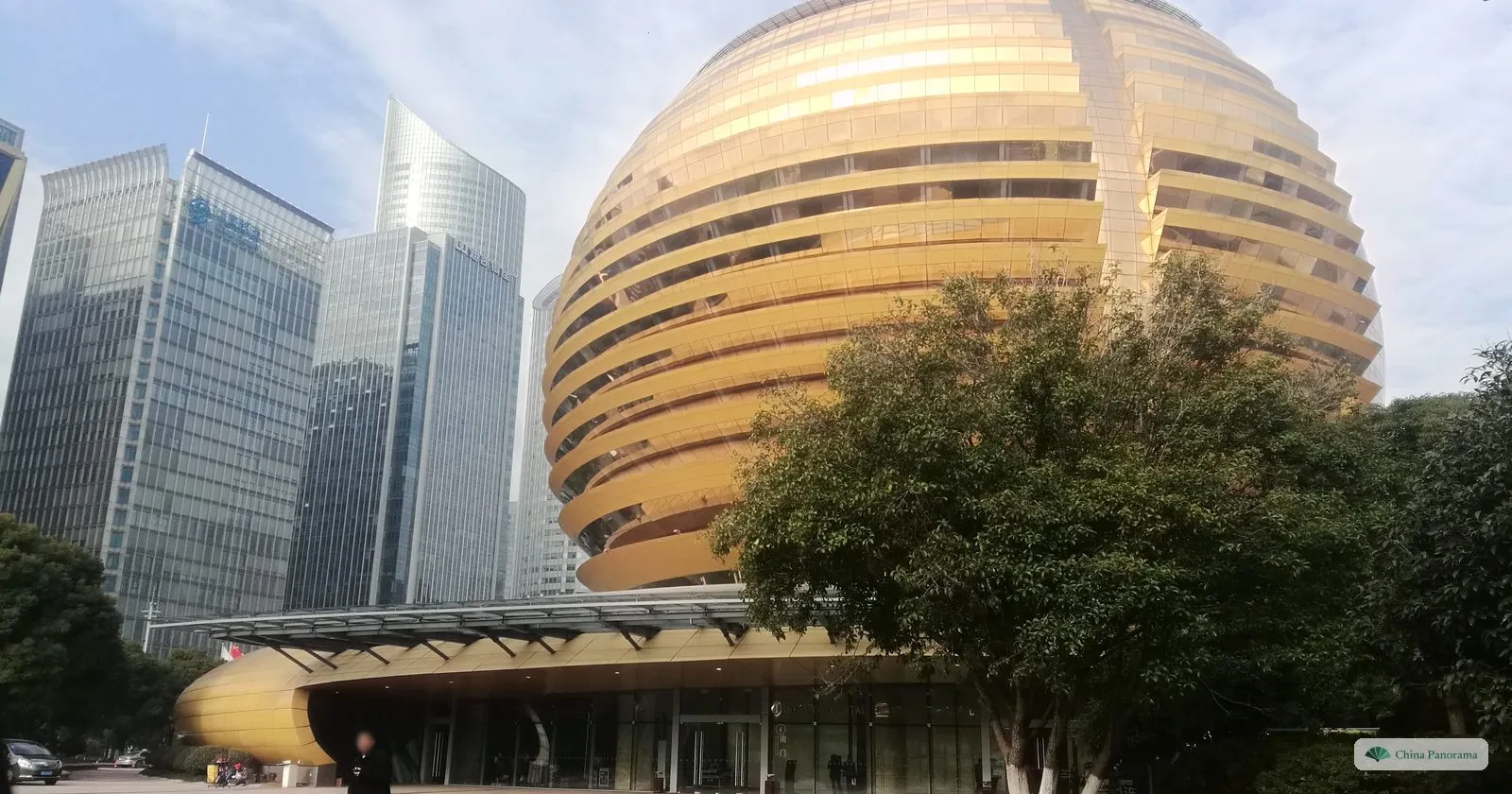 ArchitectureShangcheng · 上城区Outdoors
The new business district on the north bank of the Qiantang River, about 5 km east of the lake: glass towers, the Citizen Center and, by the river, the golden sphere of the Hangzhou International Conference Center. The riverside terrace in front is the place for the evening light shows on the towers, held on some evenings and on holidays. It is a different Hangzhou from the lake: the one of Alibaba, the Asian Games and the high-speed trains. We were here on a hazy January morning in 2018.
Citizen Center (Lines 4 and 7) and Jiangjin Road (Line 4) stations. Streets and riverside free. We have not checked the light-show schedule.
- Entry
- Free
- Opening hours
- Open at all hours
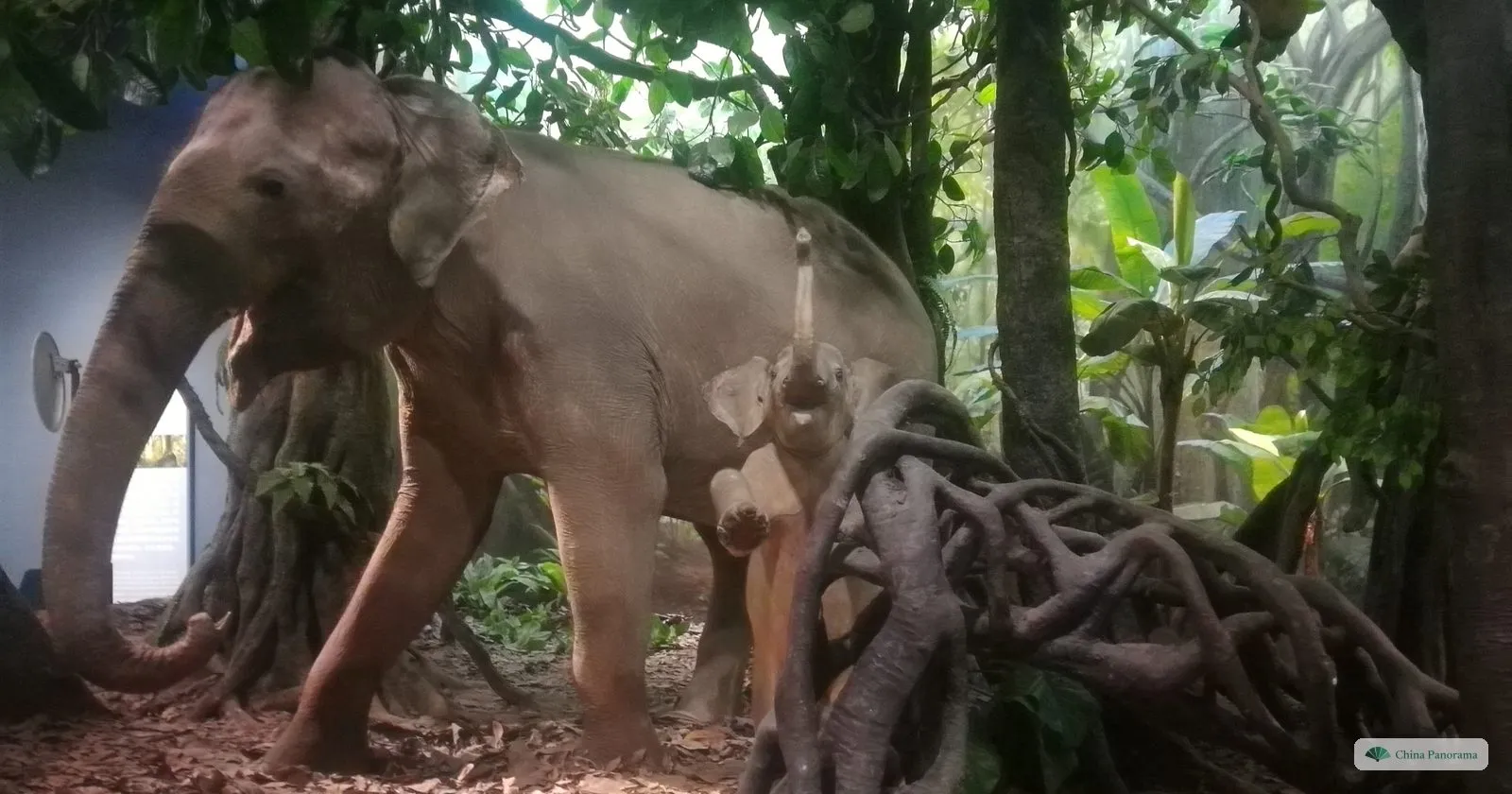 MuseumGongshu · 拱墅区Indoors
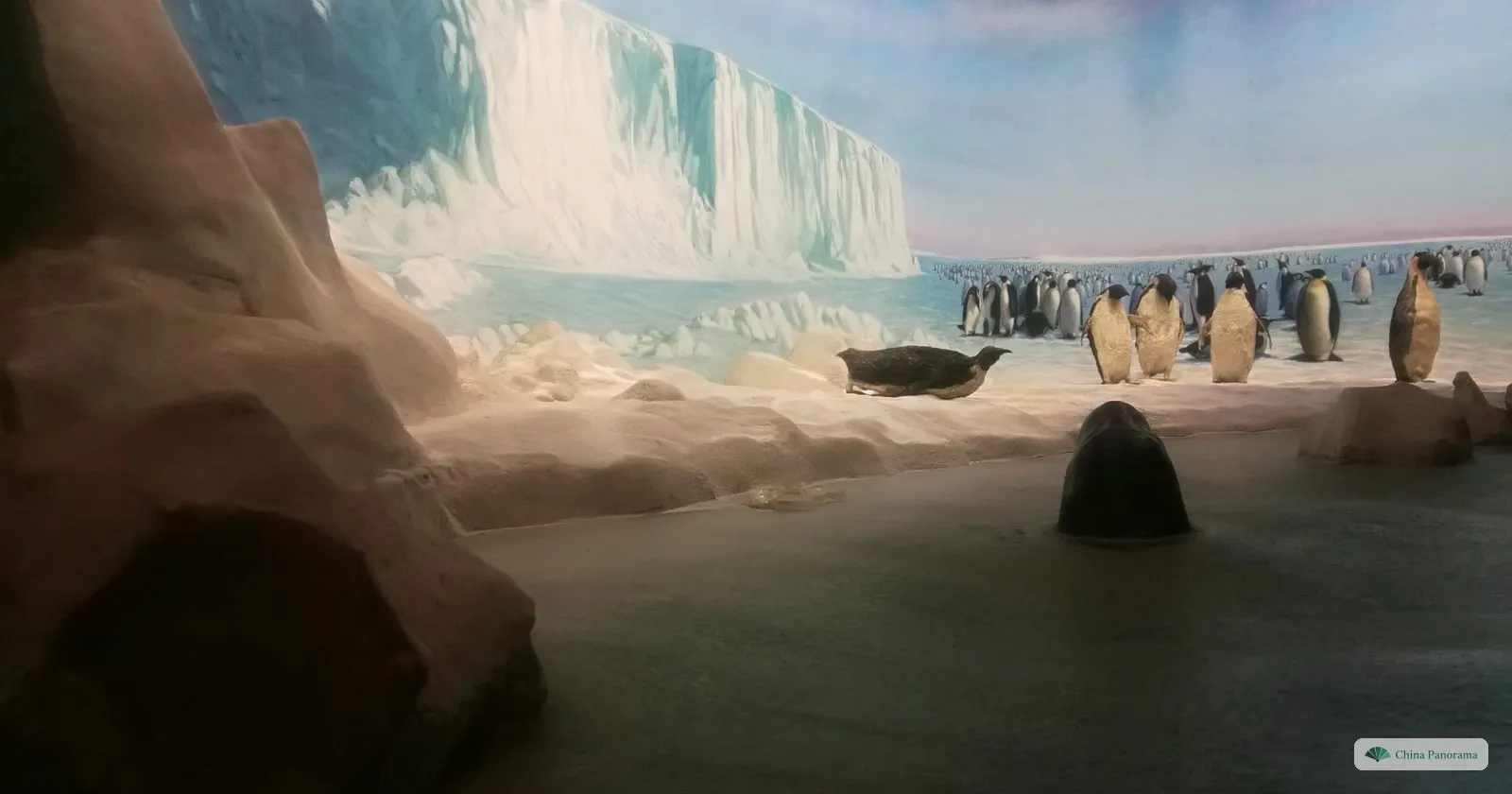
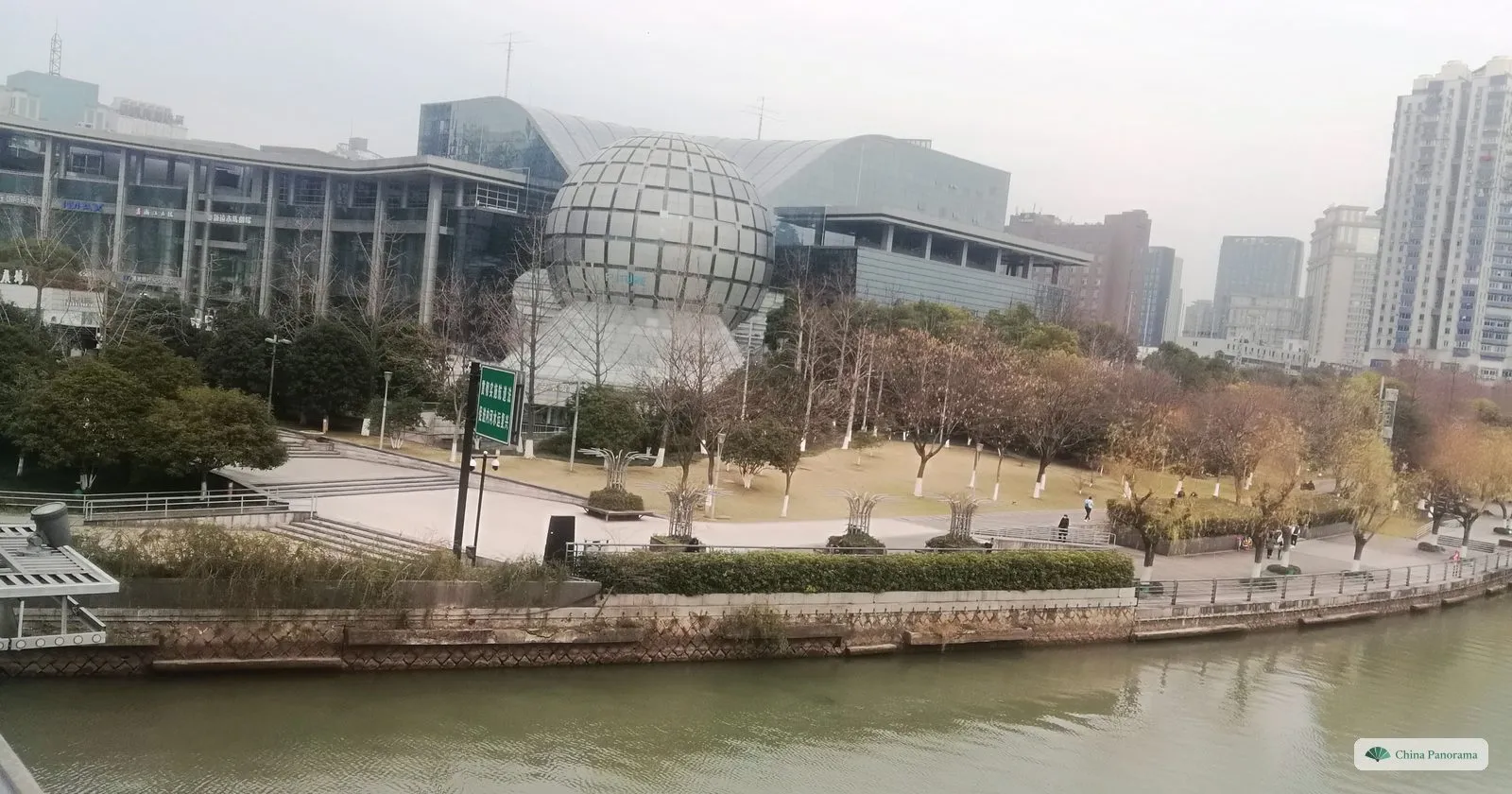
A natural history museum at West Lake Cultural Square in the north of the centre, with dinosaurs, a hall of life-size dioramas, Asian elephants under rainforest trees, penguins on an Antarctic shore, wetland birds, and next door the Zhejiang Science and Technology Museum with its glass globe. A good place for a rainy afternoon, or with children. We went on a grey January afternoon in 2018.
West Lake Cultural Square station (Lines 1, 3 and 19). We have not checked entry, booking or hours.
- Entry
- Price not verified — check on site
- Opening hours
- Hours not verified — check on site
Huanglong Sports Centre
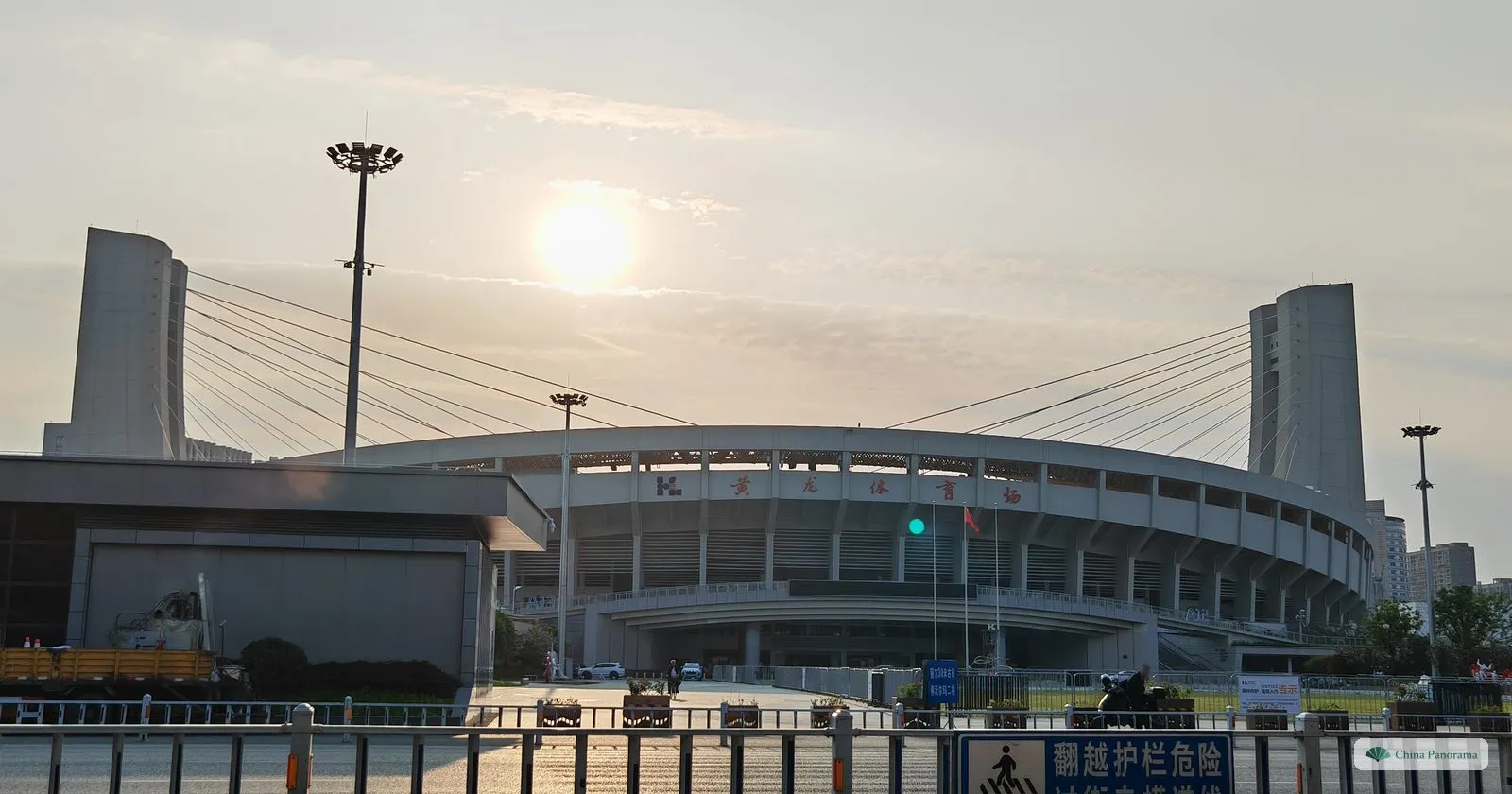
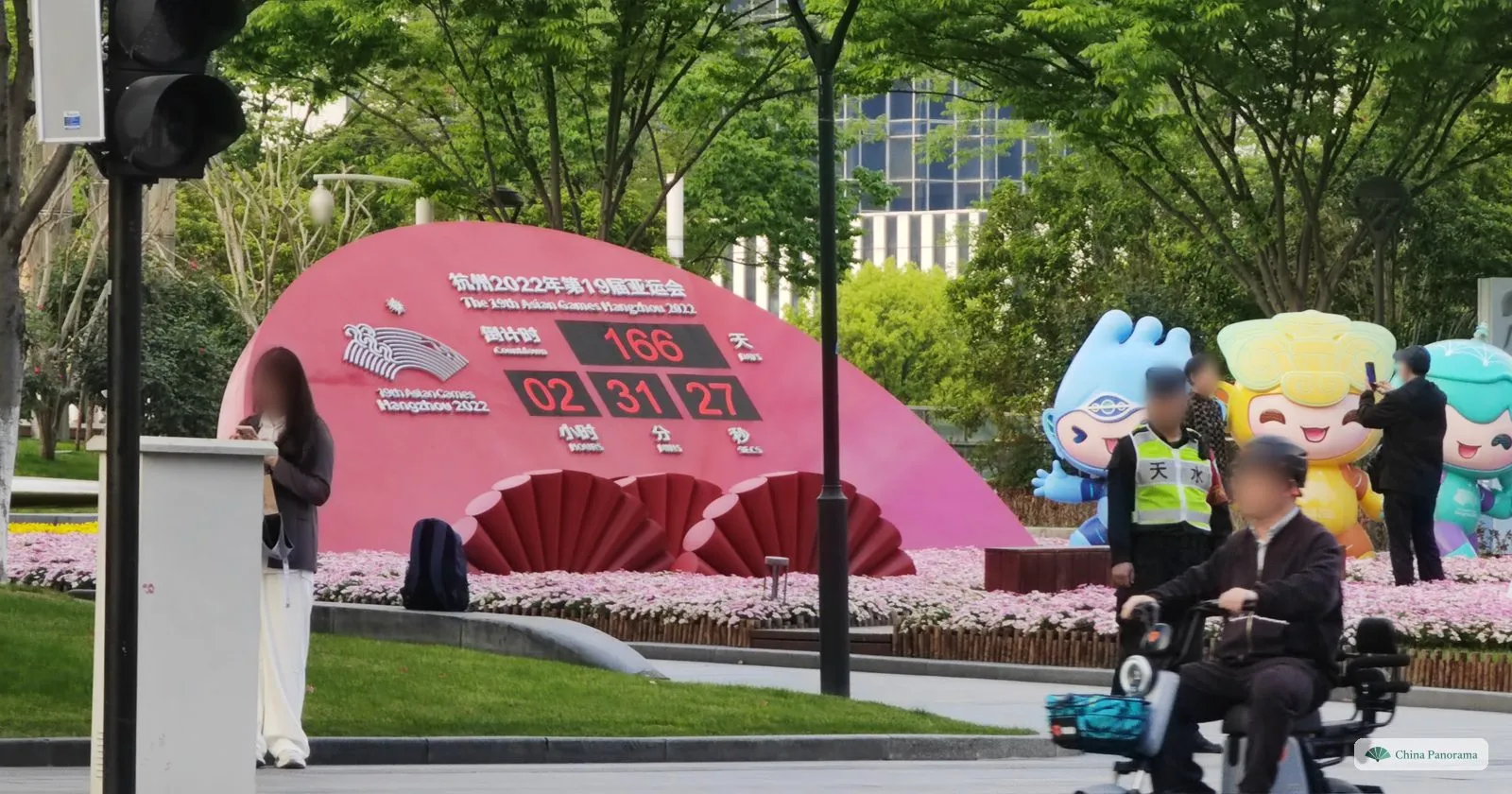
黄龙体育中心ArchitectureXihu · 西湖区OutdoorsA stadium of the late 1990s just north of the lake hills, hung from two tall concrete pylons by steel cables. It was one of the football venues of the 19th Asian Games, which Hangzhou held from 23 September to 8 October 2023, a year late because of the pandemic, which is why the countdown clocks in town still said “Hangzhou 2022”. On 10 April 2023 the one we passed read 166 days to go. Home ground of Zhejiang's football club.
Huanglong Sports Center station (Lines 3 and 10). The outside is free to look at.
- Entry
- Free
- Opening hours
- Open at all hours
- NatureXihu · 西湖区Outdoors
The village in the hills south-west of the lake that gave its name to Longjing, “Dragon Well” tea, China's best-known green tea. West Lake Longjing comes from a small protected area of these hills. Terraces of tea bushes climb the slopes round the village, and in the farmhouses you can drink the new tea. The first picking, before the Qingming festival in early April, is the most prized. On the Longjing road below lies the China National Tea Museum. A path from Longjing leads on to the Nine Creeks, a walk along streams through the tea hills.
About 7 km south-west of Hubin. Bus or taxi. The village and the hills are free. Tea prices in the farmhouses vary widely, so ask before you sit down.
- Entry
- Free
- Opening hours
- Open at all hours
Entry prices and opening hours are marked unverified where we have not checked them against an official source. We would rather show a gap than a number we made up.
Four routes that don’t double back
Round the lake in a day, the pagoda and Lingyin, the old town and the canal, and a winter day in the new city. They follow our photographs, with the time and distance between stops.
About 12 km on foot · 7½ hours with stops, as we did it
Hubin, the east shore
Walk 7 min· 500 m
Jixian Pavilion, Tingwan
Walk 18 min· 1.3 km
Qian Wang Ci
Walk 23 min· 1.7 km
Changqiao Park and Shuangtou Bridge
Walk 13 min· 1 km
Leifeng Pagoda
Walk 4 min· 300 m
Jingci Temple
Walk 11 min· 800 m
Su Causeway, south end
Walk 31 min· 2.3 km
Su Causeway, north end
Walk 4 min· 300 m
Xiling Bridge and Wu Song's tomb
Walk 15 min· 1.1 km
Gushan and Pinghu Qiuyue
Walk 13 min· 900 m
Bai Causeway and the Broken Bridge
Walk 23 min· 1.7 km
Back at Hubin
12 stops · 162 min walking
A day in the southern and western hills · two taxi rides
Six Harmonies Pagoda
Taxi 16 min· 15.3 km
Lingyin: the gate and Feilai Feng
Walk 15 min· 1.2 km
Yongfu Temple
Taxi 6 min· 4.6 km
Huanglong Sports Centre
4 stops · 15 min walking · 22 min by taxi
A morning on foot, two taxi rides · from 08:26 to 12:39
Gulou
Walk 6 min· 400 m
Dajing Lane and Hu Qing Yu Tang
Walk 3 min· 200 m
Hefang Street
Walk 5 min· 400 m
Southern Song Imperial Street
Walk 7 min· 500 m
Deshou Palace Museum
Taxi 5 min· 4.2 km
Beishan Road
Walk 4 min· 300 m
Broken Bridge
Taxi 8 min· 6.7 km
Dadou Road and the Grand Canal
8 stops · 25 min walking · 13 min by taxi
14 January 2018 · from 09:21 to 13:32
Qianjiang New Town
Taxi 7 min· 6.1 km
Wushan and the Hangzhou Museum
Walk 22 min· 1.7 km
Hubin, the boats
Taxi 5 min· 3.4 km
Wulin Gate canal pier
Walk 2 min· 200 m
Zhejiang Natural History Museum
5 stops · 24 min walking · 12 min by taxi
Stop by stop
Round West Lake in a day
Our 4 November 2023, clockwise from Hubin: the east shore at 10:55, the Jixian Pavilion at 11:52, Qian Liu's statue at 12:26, Changqiao Park at 13:11, up Leifeng Pagoda 13:29–14:01, Jingci Temple at 14:13, the Su Causeway from south to north, Xiling Bridge at 15:30, Pinghu Qiuyue at 16:30, the sunset on the Bai Causeway at 16:40 and the Broken Bridge after dark. The same walk is on the map above, with the slider.
Start by the lake at 10:55, a clear autumn morning.
- Entry
- Free
- Hours
- Open at all hours
Walk 7 min· 500 m
The pavilion on its platform in the water: 11:52.
- Entry
- Free
- Hours
- Open at all hours
Walk 18 min· 1.3 km
Walk 23 min· 1.7 km
4Changqiao Park and Shuangtou Bridge
长桥公园 · 双投桥A pavilion on the water with Leifeng Pagoda behind: 13:11.
- Entry
- Free
- Hours
- Open at all hours
Walk 13 min· 1 km
5Leifeng Pagoda
雷峰塔Up the steps and the escalators, the old base inside, the view from the top: 13:29–14:01.
- Entry
- Reported 40 CNY
- Hours
- Not verified
Walk 4 min· 300 m
6Jingci Temple
净慈寺Across the road, the yellow wall with its four red characters: 14:13.
- Entry
- Not verified
- Hours
- Not verified
Walk 11 min· 800 m
Walk 31 min· 2.3 km
8Su Causeway, north end
苏堤 · 跨虹桥2.3 km along the causeway, six bridges, to Kuahong Bridge.
- Entry
- Free
- Hours
- Open at all hours
Walk 4 min· 300 m
9Xiling Bridge and Wu Song's tomb
西泠桥 · 武松墓The memorial tomb by the bridge: 15:30.
- Entry
- Free
- Hours
- Open at all hours
Walk 15 min· 1.1 km
10Gushan and Pinghu Qiuyue
孤山 · 平湖秋月Over the island, past the lotus of the North Inner Lake, to the stele at 16:30.
- Entry
- Free
- Hours
- Open at all hours
Walk 13 min· 900 m
11Bai Causeway and the Broken Bridge
白堤 · 断桥The sun sets behind the western hills at 16:40. Wait for the lights round the lake.
- Entry
- Free
- Hours
- Open at all hours
Walk 23 min· 1.7 km
12Back at Hubin
湖滨Along the north shore and into the lit streets of Hubin: 18:23.
- Entry
- Free
- Hours
- Open at all hours
Easy add-ons: Shorter: walk the two causeways only, from the Broken Bridge over Gushan and down the Su Causeway to Leifeng Pagoda, about 5.6 km, and take a bus or taxi back. Longer: the outer loop by the Yanggong Causeway, about 14 km. Both are on the map.
* Walking and taxi times between stops are OpenStreetMap routing times (routing.openstreetmap.de, 26 October 2026), taxi without traffic, so allow about double at busy times. Clock times are from our own photographs: 14 January 2018, 10–11 April 2023 and 4 November 2023. Stops marked * have prices or hours we could not check against an official source.
Getting there and around
From Shanghai by high-speed train
Most visitors come from Shanghai: trains from Shanghai Hongqiao to Hangzhou East run all day, the fastest in under an hour. Hangzhou East is on Metro Lines 1, 4, 6 and 19. Line 1 takes you to Longxiangqiao by the lake in about half an hour. Book on 12306 or Trip.com with your passport. We have not checked journey times against the 12306 timetable.
Schedules and opening hours not yet verified against an official source.
By air
Hangzhou Xiaoshan International Airport (HGH) lies about 26 km east of the lake in a straight line, across the Qiantang River. Three metro lines serve it: Line 19, the airport express (opened 22 September 2022), to Hangzhou East and Hangzhou West, and Lines 1 and 7 into the city. We have not checked journey times or fares.
Schedules and opening hours not yet verified against an official source.
Nonstop from Europe
Our flight list has nonstop routes to Hangzhou from 2 European airports: Lisbon, Madrid. Most travellers fly to Shanghai and take the train, under an hour from Hongqiao. Airlines and frequencies →
Flight data checked 12 September 2026.
Three stations
Check which one your ticket names: most trains from Shanghai use Hangzhou East.
- Hangzhou East 杭州东站The main high-speed station, about 6 km north-east of the lake: trains to Shanghai, Nanjing, Beijing and the south. Lines 1, 4, 6 and 19.
- Hangzhou (Chengzhan) 杭州站 · 城站The old city station, 2 km south-east of Hubin, with some high-speed and conventional trains. Lines 1 and 5.
- Hangzhou West 杭州西站Opened in 2022, about 18 km west in Yuhang, for trains towards Huangshan and the west. Line 19 to the airport and Hangzhou East.
The metro, in short
How Chinese metros work →Twelve lines. For a visitor: Line 1 runs along the east side of West Lake (Longxiangqiao, Ding'an Road), north to Hangzhou East and on to the airport. Line 7 serves Wushan Square for the old town and also reaches the airport. Line 19 is the airport express, from Xiaoshan Airport via Hangzhou East to Hangzhou West. Line 3 goes to Huanglong and the canal at Xiangji Temple. No line reaches the west side of the lake, Lingyin or Leifeng Pagoda: use buses, taxis or your feet.
- Lines
- 121–10, 16, 19
- Fare
- from 2 CNYfirst 4 km
- Network
- 262 stations516 km (2025)
- Pay with
- Alipay or WeChatforeign cards at gates not confirmed
Pay with the ride code in Alipay or WeChat at the gates, or buy a single ticket at the machines, which take UnionPay contactless cards. The gates also take UnionPay cards. We found no report that Visa or Mastercard cards issued abroad work at the gates, as they now do in Beijing, Shanghai, Chengdu and Guangzhou, and have not tested one. Set up Alipay before you go.
Fares by distance: 2 CNY up to 4 km, 3 CNY up to 8 km, 4 CNY up to 12 km, 5 CNY up to 18 km, 6 CNY up to 24 km. Beyond 24 km, 1 CNY more for each 8 km. From Longxiangqiao to Hangzhou East is a few yuan.
By Wikipedia, the earliest first train leaves at about 05:41 and the latest last train at about 00:18, and every station is served from about 06:10 to 22:30. Times differ by line and station: check the display in the station.
| Hubin, West Lake east shore | Longxiangqiao 龙翔桥 | Line 1 |
| Broken Bridge, Beishan Road (1.2 km) | Fengqi Road 凤起路 | Lines 1/2 |
| Hefang Street, Hu Qing Yu Tang | Ding'an Road 定安路 | Line 1 |
| Southern Song Imperial Street | Ding'an Road 定安路 | Line 1 |
| Wushan, Hangzhou Museum | Wushan Square 吴山广场 | Line 7 |
| Deshou Palace Museum (900 m) | Wushan Square 吴山广场 | Line 7 |
| Grand Canal at Dadou Road (400 m) | Xiangji Temple 香积寺 | Line 3 |
| Gongchen Bridge | East Gongchen Bridge 拱宸桥东 | Line 5 |
| Zhejiang Natural History Museum | West Lake Cultural Square 西湖文化广场 | Lines 1/3/19 |
| Huanglong Sports Centre | Huanglong Sports Center 黄龙体育中心 | Lines 3/10 |
| Qianjiang New Town, Citizen Center | Citizen Center 市民中心 | Lines 4/7 |
| Xiaoshan Airport (HGH) | Xiaoshan International Airport 萧山国际机场 | Lines 1/7/19 |
| Hangzhou East station (high-speed trains) | Hangzhou East Railway Station 火车东站 | Lines 1/4/6/19 |
| Hangzhou station (Chengzhan) | Chengzhan 城站 | Lines 1/5 |
No metro reaches the west side of the lake, Lingyin, Leifeng Pagoda or Six Harmonies Pagoda: there you walk, or take a bus or taxi. Stations are signed in Chinese characters and English. Interchanges a visitor will use: Fengqi Road (Lines 1 and 2), Wulin Square (1 and 3), West Lake Cultural Square (1, 3 and 19), Hangzhou East (1, 4, 6 and 19) and Chengzhan (1 and 5).
Source and date: Fare rule: Hangzhou Metro staff quoted by Hangzhou Daily's news site (10 October 2025). Lines (12), stations (262) and length (516 km) as of 30 June 2025, hours and payment methods: the Chinese Wikipedia article on the Hangzhou Metro, 26 October 2026. Foreign bank cards at the gates: no report found, 26 October 2026. Stations for the sights and the lines serving them: OpenStreetMap stations and route relations, 26 October 2026.
Before you go
Most European passports are visa-free for a short trip — under a one-sided waiver with an end date worth checking before you book:
- UK passport
Visa-free up to 30 days per trip, currently until 31 December 2026.
- EU passports
Dutch, German, French, Irish, Nordic and most other EU passports: visa-free up to 30 days, currently until 31 December 2026.
- US passport
No general waiver: a visa, or the 10-day visa-free transit if you travel on to a third country.
China’s 10-day visa-free transit applies at designated entry ports, for travellers continuing to a third country. Check your passport.
- BWF World Tour Finals
Badminton’s season finale, 9–13 December 2026: session times, tickets and the metro to the arena.
- Set up Alipay
For the Lingyin booking, the metro gates, the lake carts and a shared bike.
- Shanghai
170 km away, under an hour by train — where most visitors to Hangzhou come from.
- Nanjing
The other old capital of the delta, 240 km to the north-west.
- Xiaolongbao
The soup dumplings of the Jiangnan region, Hangzhou included, and how to eat them.
- Golden Week
Why 1–7 October is the worst week for the Broken Bridge.
- Chinese metros
Tickets, transport codes and security checks, city by city.
FAQ
How long does it take to walk around West Lake?
About three hours without stops for the usual loop by the two causeways, 12.1 km by the OpenStreetMap walking route, and a whole day with stops. Our own walk on 4 November 2023 started at Hubin at 10:55 and ended there at 18:23, with Leifeng Pagoda and a long wait for the sunset. The outer loop by the Yanggong Causeway is about 14.1 km. With half a day, walk the Bai and Su Causeways from the Broken Bridge to Leifeng Pagoda, 5.6 km.
Is West Lake free?
Yes. The lake shore, the causeways, Gushan and the lakeside parks are free and open at all hours. You pay for a few sights on the shore, such as Leifeng Pagoda (reported 40 CNY), for boats to the islands and for the sightseeing carts. We have not checked those prices.
Do I need to book Lingyin Temple?
Yes. Since 1 December 2025 the Lingyin–Feilai Feng area, including Lingyin, Yongfu and Taoguang temples, is free, but you book a real-name time slot in the “杭州灵隐飞来峰” mini-program in Alipay or WeChat: at least one day and up to seven days ahead, morning (07:30–12:00) or afternoon (12:00–17:00), up to five people per phone. Visitors aged 70 and over need no booking. We could not confirm whether a foreign passport can be entered in the mini-program. Before December 2025 the area cost 45 CNY and the temple 30 CNY more.
Is Hangzhou worth a day trip from Shanghai?
Yes, but a night is better. Hangzhou East is under an hour from Shanghai Hongqiao by the fastest trains, 170 km in a straight line. In a day you can walk half the lake and see Leifeng Pagoda, or Lingyin and the Su Causeway. With two days, add the old town, the Grand Canal and Longjing. And the lake is at its best at dawn and after sunset, when the day trippers have gone.
How many days do you need in Hangzhou?
Two, or three with the tea hills: one for West Lake on foot, one for Lingyin and Six Harmonies Pagoda, and a morning for the old town and the Grand Canal. Our four routes below follow our own days.
When is the best time to visit Hangzhou?
April and October to early November. April is 24 °C with blossom on the causeways and the new Longjing tea. October is 24 °C with the osmanthus in flower, November 18 °C and clear. July is 35 °C and humid, and the plum rains come from about mid-June. January is 9 °C by day and 2 °C at night. Avoid May Day (1–5 May) and Golden Week (1–7 October), when the causeways are packed.
Why is it called the Broken Bridge?
It is not broken. The name comes from one of West Lake’s Ten Scenes, “Lingering Snow on the Broken Bridge”: after snow, the sunny side of the arch clears first while the shady side stays white, and from a distance the bridge seems broken in two. In the Legend of the White Snake, it is where Bai Suzhen first meets Xu Xian.
What are the Ten Scenes of West Lake?
A list of ten named views fixed in the Southern Song: Spring Dawn at the Su Causeway, Breeze-ruffled Lotus at Quyuan, Autumn Moon over the Calm Lake, Lingering Snow on the Broken Bridge, Leifeng Pagoda in the Evening Glow, Three Pools Mirroring the Moon, Orioles Singing in the Willows, Twin Peaks Piercing the Clouds, Viewing Fish at Flower Harbour and Evening Bell at Nanping Hill. Each is a place with a stele and a season or time of day. You can show them on our walking map.
Is Leifeng Pagoda original?
No. The first pagoda was built in 975 and collapsed on 25 September 1924. The present one, of steel and copper in the old form, opened on 25 October 2002, built over the old foundations. The ruined brick base of 975 is on show inside. Six Harmonies Pagoda, by contrast, still has its Southern Song brick core of 1163.
Can I pay for the Hangzhou metro with a credit card?
With a UnionPay card, yes, at the gates and the ticket machines. With a Visa or Mastercard issued abroad we found no report that the gates accept it, as they now do in Beijing, Shanghai, Chengdu and Guangzhou. Use the ride code in Alipay or WeChat. Fares run by distance, from 2 CNY for the first 4 km.
How do I get from Hangzhou airport to West Lake?
By metro: Line 1 runs from Xiaoshan International Airport (HGH), about 26 km east of the lake in a straight line, straight to Longxiangqiao at Hubin without a change. Line 19, the airport express, runs to Hangzhou East and Hangzhou West, and Line 7 to Wushan Square for the old town. We have not checked journey times or fares. A taxi takes about 40 minutes without traffic.
Where does Longjing tea come from?
From the hills south-west of West Lake, round the village of Longjing, “Dragon Well”, about 7 km from Hubin. West Lake Longjing is a protected name for tea from this small area. The first picking, before the Qingming festival in early April, is the most prized. You can drink it in the farmhouses of the village and visit the China National Tea Museum below it.
What is there to see on the Grand Canal in Hangzhou?
Hangzhou is the southern end of the canal from Beijing, a World Heritage Site since 2014, and in the north of the city it is still busy with barges. Walk the restored canal street at Dadou Road (Xiangji Temple station, Line 3), see Gongchen Bridge of 1631, rebuilt in 1885, and the old streets of Qiaoxi and Xiaohe beside it (East Gongchen Bridge, Line 5), or take a water bus from Wulin Gate.
Do I need a visa for Hangzhou?
Not for a short trip on a British, Irish, Dutch, German, French, Nordic or Australian passport: all are visa-free for up to 30 days per trip, under a one-sided waiver that currently runs until 31 December 2026. US passport holders have no general waiver. The 10-day visa-free transit applies only at designated entry ports and only if you travel on to a third country. Check your own passport on our visa check page.
Sources and status
All photographs on this page are ours, taken on 14 January 2018 (Qianjiang New Town, Wushan, Hubin, Wulin Gate), on 10 April 2023 (Six Harmonies Pagoda, Lingyin, Huanglong), on 11 April 2023 (the old town, Beishan Road, the Grand Canal) and on 4 November 2023 (our walk round West Lake). Faces of passers-by and number plates have been blurred. The West Lake map is ours, drawn from OpenStreetMap data. Data sources: Monthly temperature data, Hangzhou, West Lake: area, depth, causeways, islands, the Ten Scenes, World Heritage 2011 (Wikipedia), West Lake Cultural Landscape of Hangzhou (UNESCO World Heritage Centre), Su Causeway: 1089, 2.797 km, the six bridges (Wikipedia, Chinese), Leifeng Pagoda: 975, collapse 1924, rebuilt 2002, the crypt (Wikipedia), Lingyin Temple: founding, Feilai Feng carvings, the main hall (Wikipedia), Lingyin–Feilai Feng free from 1 December 2025, daily caps (Xinhua, 19 November 2025), Lingyin booking: mini-program, time slots, over-70s (Beijing Daily, 29 November 2025), Six Harmonies Pagoda: 970, Song brick body, 1900 eaves, height (Wikipedia, Chinese), Six Harmonies Pagoda tickets as reported in 2011 (Hangzhou Daily news site, Chinese), Qiantang River Bridge: Mao Yisheng, 1937, demolition and repair (Wikipedia, Chinese), Jingci Temple: 954, Nanping evening bell, the 1986 bell (Wikipedia, Chinese), Qian Wang Ci: Biaozhong Guan 1077, rebuilt 2003 (Wikipedia, Chinese), Hu Qing Yu Tang: Hu Xueyan, 1874, the building (Wikipedia, Chinese), Southern Song Deshou Palace Museum opens, November 2022 (Guangzhou Daily via ycwb.com, Chinese), Gongchen Bridge: 1631, rebuilt 1885, dimensions (Wikipedia, Chinese), The Grand Canal (UNESCO World Heritage Centre), Hangzhou Metro: lines, stations, length, hours, payment (Wikipedia, Chinese), Hangzhou Metro fare rule (Hangzhou Daily news site, 10 October 2025, Chinese), Metro Line 19, the airport express, opens 22 September 2022 (Hangzhou Daily news site, Chinese), Leifeng Pagoda ticket and hours as reported (Ctrip, Chinese), Map data and walking routes: OpenStreetMap contributors (ODbL).
Changelog (1)
- 2026-10-26Page created, with our own photographs from 14 January 2018, 10–11 April 2023 and 4 November 2023, and our own map of West Lake from OpenStreetMap data. Lingyin–Feilai Feng: free with a booked slot since 1 December 2025 (Xinhua, Beijing Daily). Every other entry price on this page is a report we could not check against an official source. Metro: fare rule from Hangzhou Metro staff quoted in 2025, whether foreign bank cards work at the gates is not confirmed.