China Panorama
China Panorama
Entry
Holidays
Flights
Food
Cities
Newsletter
Last verified: 13 Sept 2026

How to Ride the Metro in China: From Entrance to Exit

Riding the metro in China works like this: through the security check, through the gate with one of three ways to pay, ride – and out again at your destination with the same payment method. A ride in Beijing and Shanghai costs from 3 CNY (≈ $0.44). This is how you get through the gate:

  • Alipay ride code (乘车码): open the metro ride code in Alipay, choose the city and scan the QR code directly at the entry gate – no ticket needed.
  • Single-journey ticket from the machine: buy a one-way card at the machine in the station and tap it on the gate’s reader as you enter. On the way out, you insert it into the gate’s slot – the machine keeps the card.
  • Credit card: in Beijing, gates across the whole network accept Visa, Mastercard, JCB, American Express and UnionPay – just tap your contactless card. In Shanghai, it works at metro gates marked “Tap to Ride”.

What catches most visitors off guard is the check at the entrance, paying without a classic ticket and the sheer number of exits. Below you’ll find the whole process as a clickable flowchart, followed by every step with photos we took in Shanghai and Beijing in August and September 2026.

The world’s longest metro networks

Nine of the world’s ten longest metro systems are in China. The top six each run to more than 600 km, and Beijing and Shanghai to more than 900 km. For comparison: London 405.2 km, New York 399 km, Seoul 349.8 km, Tokyo 326 km and Singapore 230.6 km. By the end of 2025, 58 cities in mainland China had an urban rail network – 13,068 km in total, of which about 10,005 km is metro.

Places 1 to 5 – all in China

RankCitySystem lengthPure metro (CAMET, end-2025)Good to know
11. Beijing 北京909 km· pure metro (CAMET) 836 kmLine 17 (central section), Line 18 and the southern extension of Line 6 opened in late December 2025 – 30 lines since then.
22. Shanghai 上海906 km· pure metro (CAMET) 812 kmIncludes the maglev, the Airport Link Line and suburban lines the operator counts as part of the network.
33. Guangzhou 广州779.9 km· pure metro (CAMET) 666 kmAs of end-2025; six new metro sections opened in 2025.
44. Chengdu 成都663.9 km· pure metro (CAMET) 680 kmGrowing especially fast: the city has reported more than 700 km of total network since September 2025.
55. Nanjing 南京625.7 km· pure metro (CAMET) 278 kmAlmost half of it is regional express lines out to neighbouring cities; the pure metro is much shorter.

Places 6 to 10

RankCitySystem lengthPure metro (CAMET, end-2025)Good to know
66. Shenzhen 深圳622 km· pure metro (CAMET) 623 kmAfter the openings in late December 2025, the city now reports 634.5 km.
77. Chongqing 重庆576 km· pure metro (CAMET) 403 kmIncludes about 96 km of monorail – which in Chongqing even runs through a residential building.
88. Wuhan 武汉553 km· pure metro (CAMET) 518 km–
99. Moscow Москва529.7 km· pure metro (CAMET) –The only network outside China in the top ten.
1010. Hangzhou 杭州516 km· pure metro (CAMET) 516 kmA pure metro network with no other rail systems.

How to read this: “System length” and rank come from the list of metro systems on Chinese Wikipedia (accessed 13 Sept 2026) – the only overview that compares every city worldwide. It sometimes includes suburban lines, monorail or airport lines an operator counts as part of its network, and the figures for individual cities are not all equally recent. “Pure metro” is the length of the metro mode (地铁) according to the 2025 annual report of the China Association of Metros (CAMET), all as of end-2025 and only available for Chinese cities. Because the two sources are not equally up to date, the CAMET figure can be higher than the system length – as with Chengdu, which has grown fast since 2025.

At a glance

  • Fare

    from 3 CNY

    ≈ $0.44 per ride, charged by distance. Changing lines costs nothing extra.

  • Payment

    Tap your credit card

    In Beijing and Shanghai straight at the gate, no ticket needed. Or Alipay, WeChat or the machine.

  • Entrance

    Security check

    At every entrance: bags on the X-ray belt; with no bag you walk straight on. You don’t need ID.

  • Exit

    Tap out again

    Leaving also means going through a gate – with the same card or the same code.

Fares, airport and stations by city

This page explains what’s the same everywhere. Fares, getting in from the airport, the railway stations and the right station for every sight are on the city pages.

The process as a flowchart

Choose your city and how you pay – the steps adapt. At the diamonds you decide: do you need to change lines? Won’t the gate open? Tap a step to see the details.

Your city:Fares, airport and stations in Beijing →

How are you paying?Sign购票gòupiào

Tap your credit card

  • Beijing: all lines – Visa, Mastercard, JCB, American Express, UnionPay.
  • You need a card with the contactless symbol ))). One card covers one person per trip – everyone needs their own.
  • Travel companions without a suitable card: you can buy single-journey tickets for them at the machine with your card.

Do you need to change lines?Sign换乘huànchéng

Does the gate open?

Tap a step to open the details. Your choices are only evaluated in your browser, not saved.

How does the metro work in China? Step by step

Click any photo to enlarge it.

1. Find the station and plan your route

Plan the route before you leave the hotel: Amap (高德地图, with an English interface) or Apple Maps shows the line, the transfers and – importantly – which exit to take at your destination. Stations are usually named after the street and signed in two languages. Names appear in pinyin or translated: 陕西南路 is “South Shaanxi Road” on the sign and often “Shaanxi Nanlu” in the app.

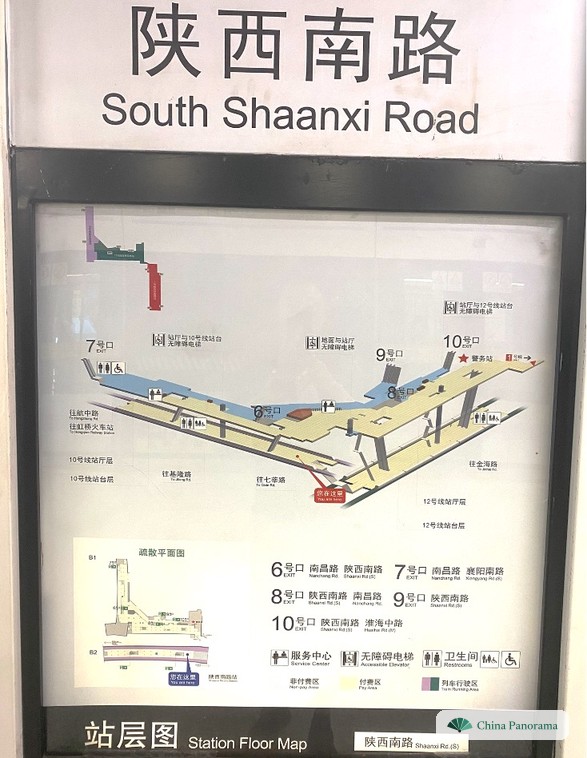
Every station has several entrances and exits (出入口) – big stations often six, eight or more. Some lead up to the street, others straight into a shopping mall or an underground passage. So pick the exit closest to your destination beforehand – otherwise you may surface on the wrong side of the road or in the middle of a mall. Exits are numbered: 6号口 means exit 6.

Every station displays the network map, a map of the station itself and an area map with all exits. Rush hour is roughly 7–9:30 am and 5–7:30 pm – avoid it with luggage if you can.
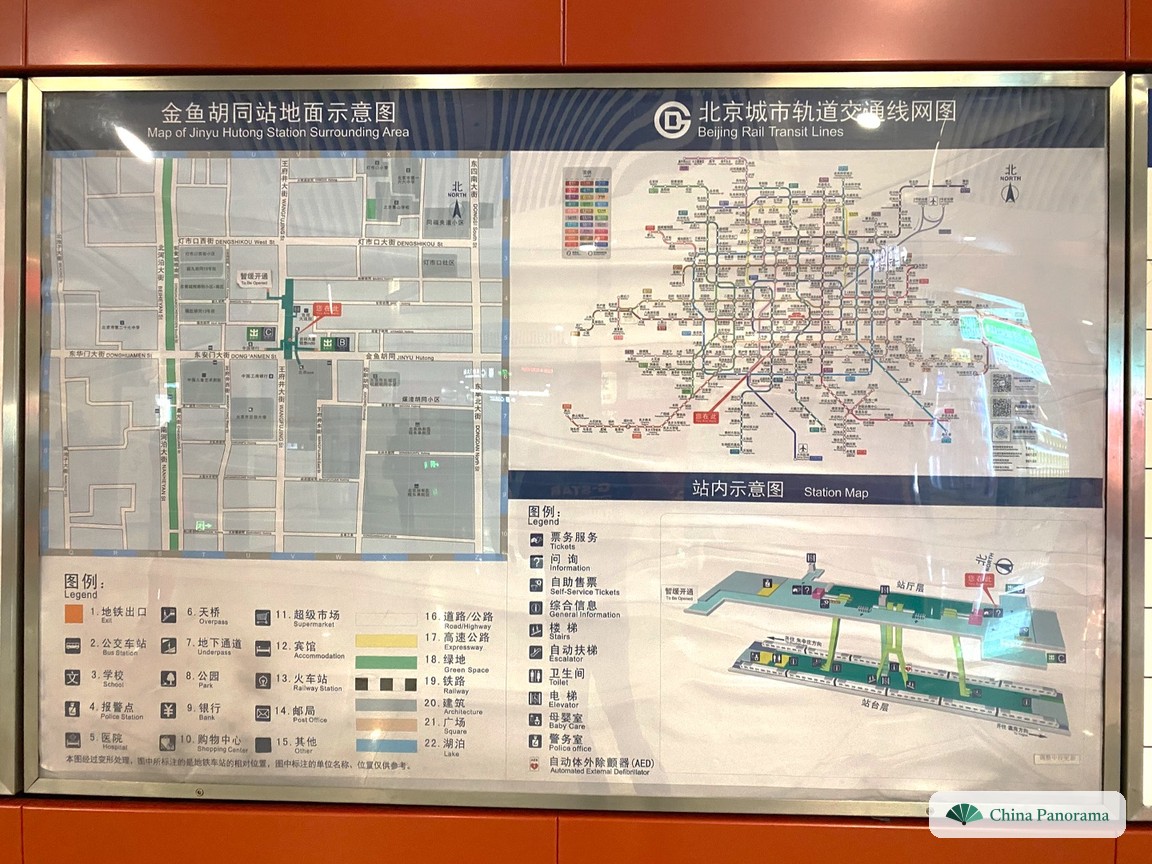
Information board at Jinyu Hutong station in Beijing with the area map on the left, the Beijing Subway network map top right and the station map bottom right
Beijing, Jinyu Hutong station: area map, network map and station map on one board.
Station sign for 陕西南路 South Shaanxi Road in Shanghai, below it the station map with exits 6号口 to 10号口, lifts and toilets
Shanghai, South Shaanxi Road: station name in Chinese and English at the top, the station map (站层图) below. This station has five exits: 6, 7, 8, 9 and 10 – signed 6号口 to 10号口.

2. Security check 安检

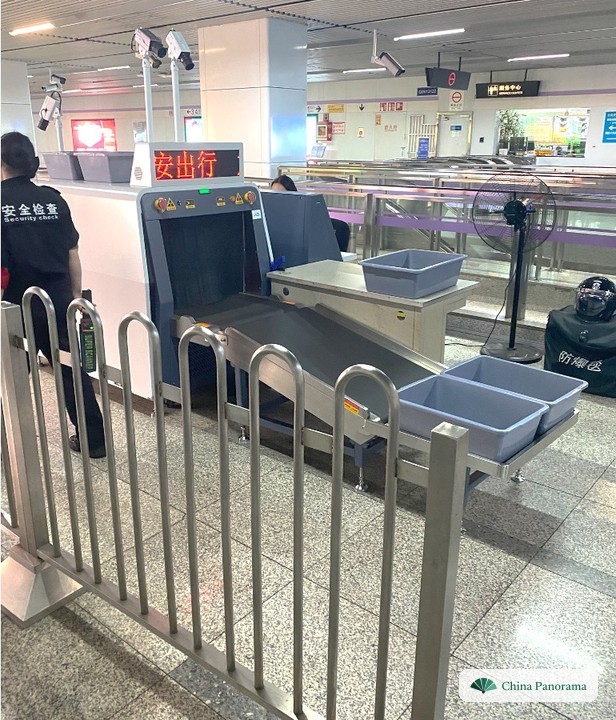
Just inside the entrance there’s an X-ray machine like at the airport, only faster. You put your backpack, handbag or suitcase on the belt, walk through the gap next to it and pick your things up at the other end. It usually takes less than a minute. You don’t show any ID.

If you have no bag, backpack or luggage, there’s nothing to put on the belt: you walk past the X-ray machine straight into the station.

You’ll sometimes be asked to show drink bottles briefly. Not allowed include flammable liquids, fireworks, weapons and larger knives. The check happens at every entrance, even if you’ve already been through it at the same station.

Security check in a Shanghai metro station: X-ray machine with conveyor belt and grey plastic trays, with a barrier in front
Shanghai: X-ray belt with trays right behind the entrance.

3. Paying: four ways

You can’t really get payment wrong – some ways are just more convenient than others. For most visitors, a contactless credit card is the easiest option, provided the city supports it.

Tap your credit card at the gate

No ticket, no app. You tap the card on the reader on the way in and on the way out, and you’re charged by distance. Beijing: all lines, Visa, Mastercard, JCB, American Express, UnionPay. Shanghai: metro gates marked “Tap to Ride”, UnionPay, Visa, Mastercard, American Express, JCB. Everyone needs their own card. In Beijing, you can also use your card at the machine to buy single-journey tickets for companions.

QR ride code in Alipay or WeChat 乘车码

If Alipay or WeChat Pay is set up with your Visa or Mastercard, search there for “Transport” or 乘车码, choose the city and activate the metro code once. Then hold the code over the gate’s scanner on the way in and out. This works in a great many Chinese cities, including those where credit cards don’t work at the gate yet. Setting up Alipay with your card is explained in Alipay for foreigners.

Single-journey ticket from the machine 单程票

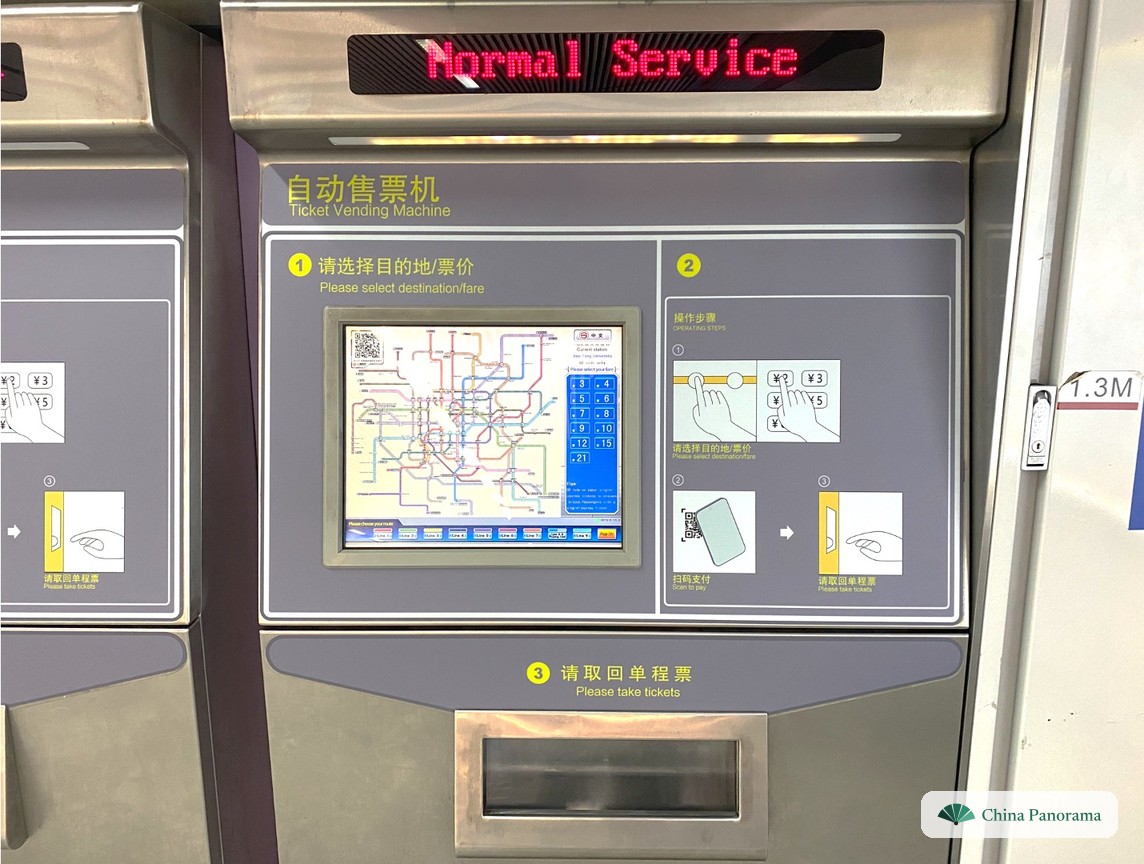
At the machine, switch the language to English first, then tap the line and destination station – or the fare directly if you know it from the app. Choose the number of tickets, pay, take the ticket from the tray. The ticket is a plastic card (a chip token in some cities) and is valid for one trip on the day of purchase.

Day pass or transport card

Some cities sell time-based passes – Shanghai, for example, a 1-day ticket for 18 CNY (≈ $2.66) (all options on the Shanghai Metro page). Rechargeable transport cards (交通卡) exist in every city; for a short trip they’re rarely worth it.

Shanghai Metro ticket machine with a touchscreen and three numbered steps: choose destination or fare, pay by QR code, take the ticket
Shanghai: the machine explains the steps in English too – ① choose destination or fare, ② pay by QR code, ③ take your ticket.
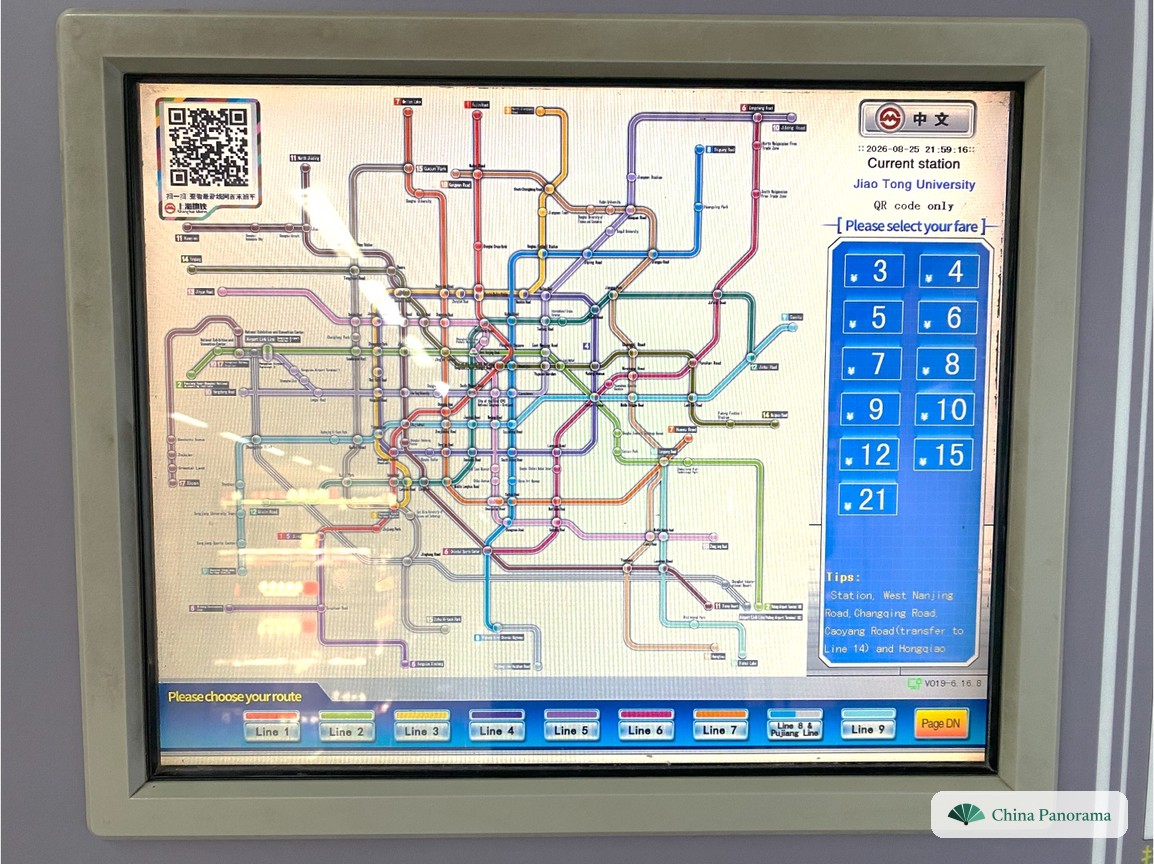
Screen of a ticket machine at Jiao Tong University station in Shanghai, English interface with network map, fare buttons from 3 to 21 yuan and the note QR code only
Jiao Tong University station, August 2026: English interface, fare buttons – and the note “QR code only”. Cash didn’t work at this machine.

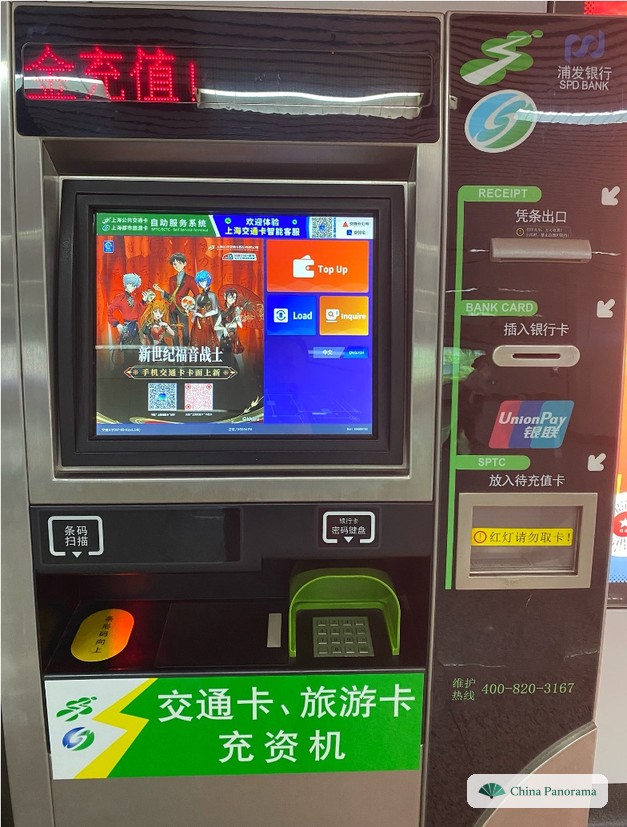
Next to the ticket machines there are often top-up machines for transport cards (充值). You only need them if you have a transport card – they’re irrelevant for credit cards, Alipay or single tickets. Don’t mix them up: the top-up machine doesn’t sell tickets.

Green top-up machine for Shanghai transport cards with touchscreen, bank card slot and a tray for the transport card
Shanghai: top-up machine for transport and tourist cards – it doesn’t sell tickets.

4. Through the gate 进站

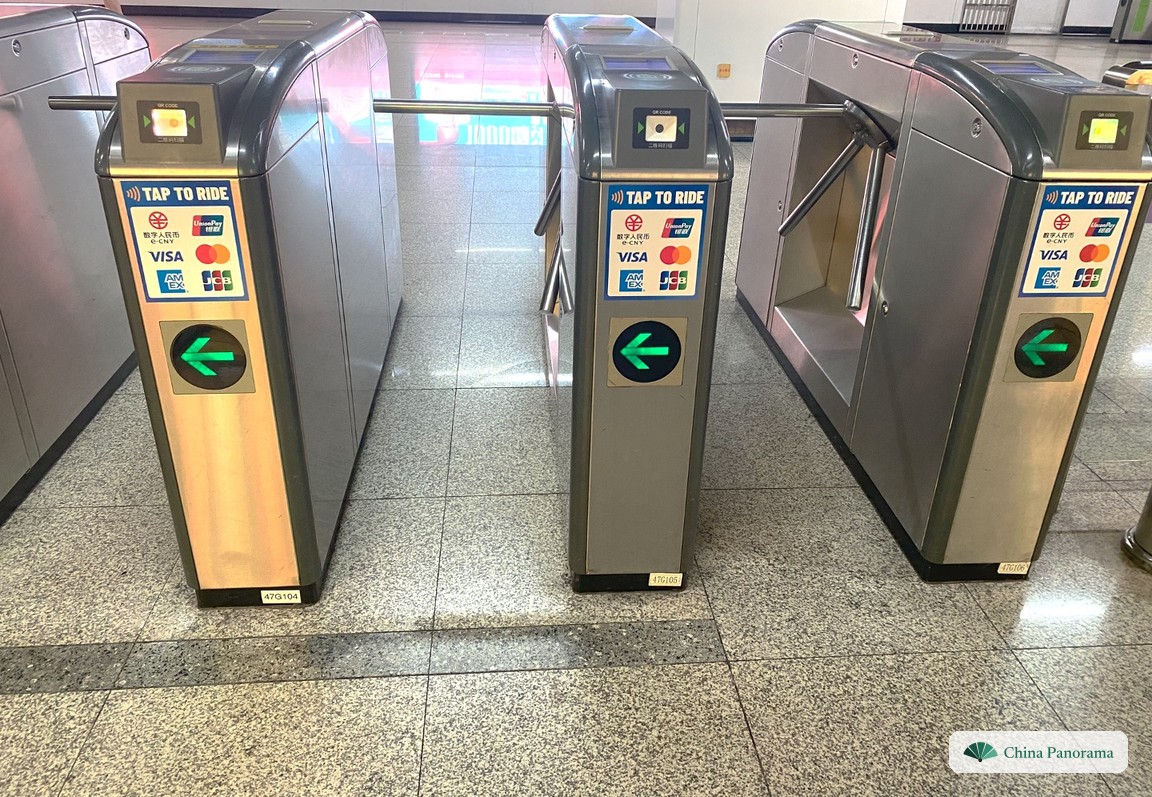
A green arrow above the gate means it’s open in your direction. A red cross means closed or exit only. Hold your credit card or ticket flat on the reader with the card logos; hold the QR code screen-down over the scanner window. The flaps open after a second or two.

Always present just one card, not your whole wallet – otherwise the reader may pick the wrong card, and it won’t match on the way out. With a suitcase or pushchair, use the wide gate at the side.

Three metro gates in Shanghai with the Tap to Ride sticker and the logos of e-CNY, UnionPay, Visa, Mastercard, American Express and JCB, with green arrows below
Shanghai: “Tap to Ride” with the card logos, the green arrow below. On the right, the wide gate for luggage.

5. Find the platform and ride in the right direction

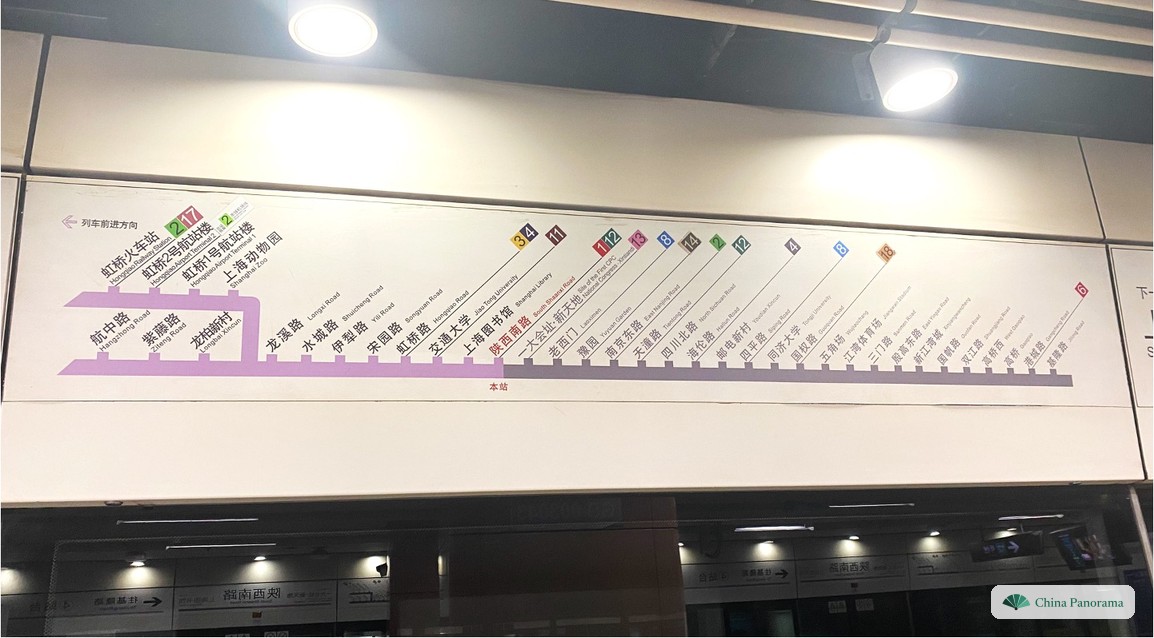
Behind the gates, follow your line’s colour and number. On the platform, direction is everything: it’s always shown as the terminal station, e.g. “往 Hongqiao 方向” – towards Hongqiao. The line map on the wall helps: the current station is marked in red (本站 = this station), an arrow shows the direction of travel, and coloured boxes next to the stations show where you can change to other lines.

Line map of Shanghai Metro Line 10 on the platform wall at South Shaanxi Road station, the current station marked in red, an arrow on the left pointing towards Hongqiao and coloured transfer symbols above the stations
Shanghai, Line 10 at South Shaanxi Road: the current station is highlighted in red, the arrow on the left shows the direction of travel, coloured boxes show transfers.

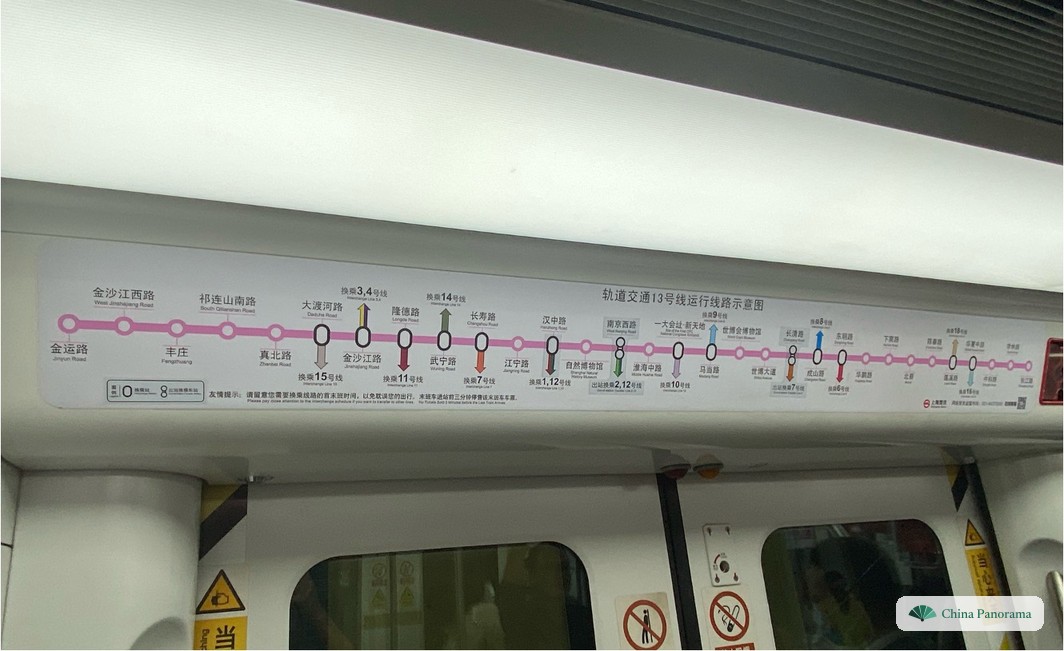
Platforms have glass screen doors. Let people off first, then board. On the train, a map above the door shows the line with all transfers, and announcements are in Chinese and English. The stop before yours is a good moment to move towards the door – it gets crowded at rush hour.

Line map of Shanghai Metro Line 13 above the door of a metro train, pink line with all stations and transfer notes
Shanghai, on a Line 13 train: line map above the door.

6. Change lines 换乘

To change lines, follow the 换乘 signs (“Transfer” in English) with the number and colour of your next line. You don’t need a new ticket: as long as you don’t leave the area behind the gates, it all counts as one trip, charged at your destination. A few minutes’ walk through passages and on escalators is normal at big interchanges. On the new platform, check the direction by the terminal station again.

7. Get off, through the gate, the right exit 出口

At your destination you go through a gate again (出站). What matters now: the same payment method you entered with. Tap the card again, scan the same QR code again – or insert the single-journey ticket into the slot, where the gate keeps it. Only now is the fare calculated. In Beijing you can stay behind the gates for at most 4 hours; otherwise you pay extra.

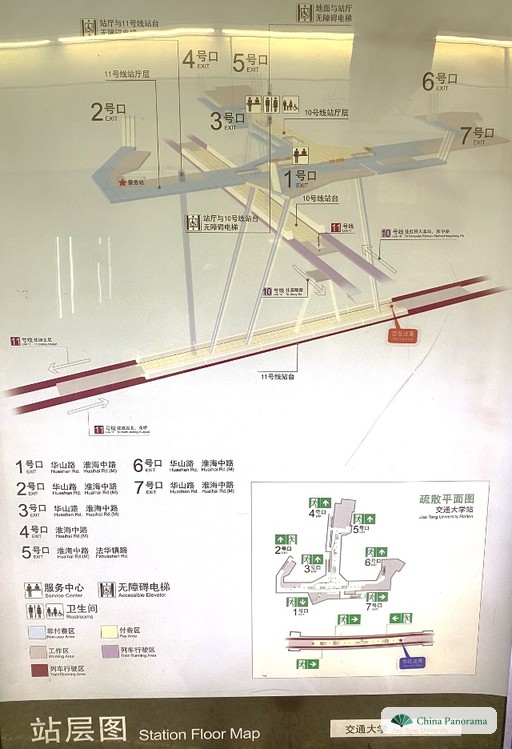
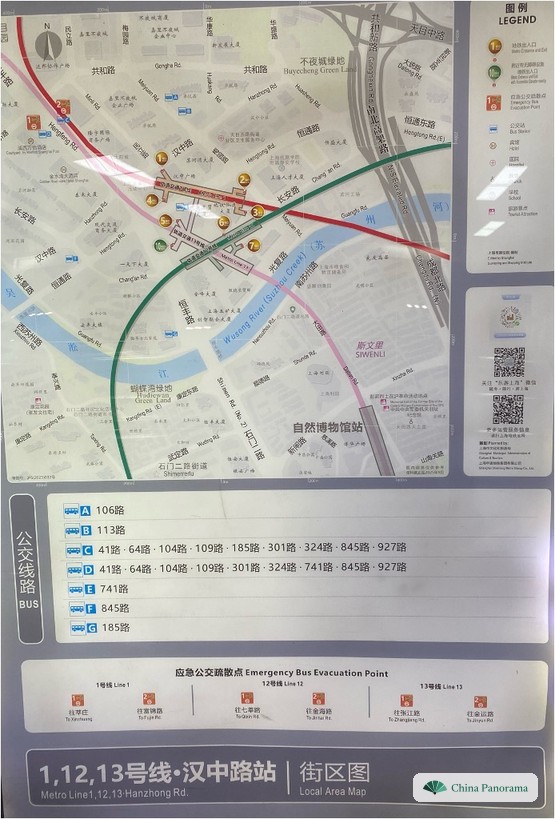
Then comes the step where most people get lost: big stations have six, eight or more exits that can be far apart. In Beijing they’re signed with letters (A, B, C …, sometimes A1, A2), in Shanghai with numbers (1, 2, 3 …). The area map (街区图) in the station – or your map app beforehand – shows which exit leads where. Lifts are marked with the wheelchair symbol and 无障碍电梯.

Station map of Jiao Tong University station in Shanghai with exits 1 to 7, the Line 10 and 11 platforms, lifts and toilets, with a table below listing which exit leads to which street
Shanghai, Jiao Tong University station: station map with exits 1 to 7 and a list of which exit leads to which street.
Area map of Hanzhong Road station in Shanghai for Lines 1, 12 and 13 with numbered exits on the street map and a list of bus routes by exit
Shanghai, Hanzhong Road station: area map with numbered exits and bus stops.

If something goes wrong

If the gate won’t open, it’s almost always one of three reasons: the single-journey ticket was too cheap for the distance, you entered with a different card or code, or the QR code didn’t load. Go to the service centre (客服中心) in the hall near the gates and pay the difference (补票). Staff at the gates often help straight away too – showing the card or your phone is usually enough, no Chinese needed.

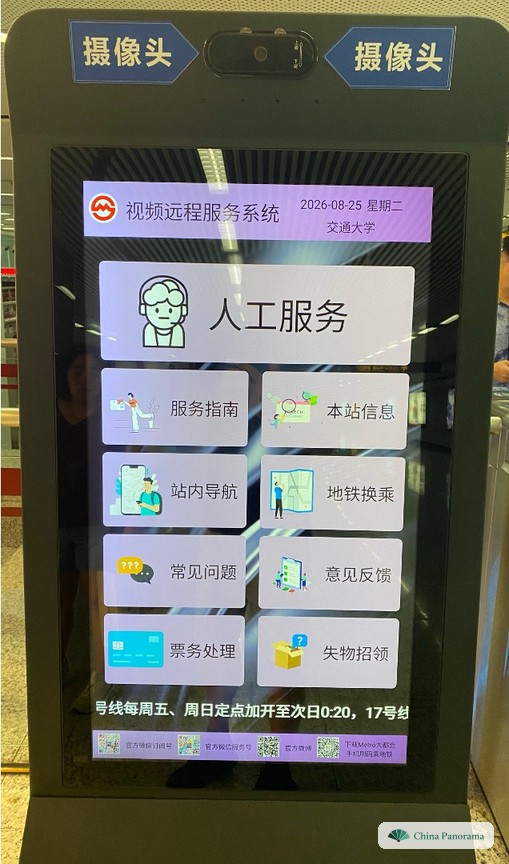
Many Shanghai stations also have video terminals. The big 人工服务 button connects you to a staff member; the interface is in Chinese only, though.

Video service terminal at Jiao Tong University station in Shanghai with a camera on top and the large 人工服务 button to connect to a staff member
Shanghai: video terminal, with the 人工服务 button at the top for a staff member.

Beijing and Shanghai compared

The basic rules are the same, the details aren’t. More on each city on the Beijing Subway and Shanghai Metro pages.

Beijing 北京Shanghai 上海
Network30 lines, 539 stations, 909 kmfigure reported by the city, as of Dec 202521 lines, 523 stations, 906 kmincl. maglev and Airport Link Line, as of Dec 2025
Faresup to 6 km 3 CNY, up to 12 km 4 CNY, up to 22 km 5 CNY, up to 32 km 6 CNY, then +1 CNY per 20 kmAirport lines have their own fares.up to 6 km 3 CNY, up to 16 km 4 CNY, up to 26 km 5 CNY, then +1 CNY per 10 kmThe maglev and the Airport Link Line have their own fares.
Credit card at the gateall linesVisa, Mastercard, JCB, American Express, UnionPaymetro gates marked “Tap to Ride”UnionPay, Visa, Mastercard, American Express, JCB
Day passes–1-day ticket 18 CNY · 3-day ticket 45 CNY
Exits signed withletters (A, B, C …, sometimes A1, A2)numbers (1, 2, 3 …)
Special rulesMax. 4 hours behind the gates. Children up to 1.3 m ride free with an adult.The maglev to Pudong Airport is a separate system with its own fare.

US-dollar amounts on this page are rounded guide values at 1 US$ = 6.77 CNY.

The most important signs

Almost everything is signed in two languages. If there’s only Chinese, these characters help.

  • 地铁

    dìtiě

    Metro, subway

  • 安检

    ānjiǎn

    Security check

  • 自动售票机

    zìdòng shòupiàojī

    Ticket machine

  • 单程票

    dānchéngpiào

    Single-journey ticket

  • 乘车码

    chéngchēmǎ

    QR ride code in Alipay/WeChat

  • 进站

    jìnzhàn

    Entry to the platforms

  • 出站

    chūzhàn

    Gates towards the exit

  • 出口

    chūkǒu

    Exit to the street

  • 出入口

    chūrùkǒu

    Entrance and exit

  • 6号口

    liù hào kǒu

    Exit no. 6

  • 换乘

    huànchéng

    Transfer / change lines

  • 往 … 方向

    wǎng … fāngxiàng

    Towards …

  • 本站

    běnzhàn

    This station

  • 下一站

    xià yí zhàn

    Next station

  • 终点站

    zhōngdiǎnzhàn

    Terminal station

  • 客服中心

    kèfú zhōngxīn

    Service centre, counter

  • 补票

    bǔpiào

    Pay the fare difference

  • 无障碍电梯

    wúzhàng’ài diàntī

    Accessible lift

Sources

FAQ

Can I pay for the metro in China with a credit card?

In Beijing and Shanghai, yes: you simply tap your contactless card on the gate without buying a ticket first. Beijing accepts Visa, Mastercard, JCB, American Express, UnionPay on all lines; in Shanghai it works at gates marked “Tap to Ride” for UnionPay, Visa, Mastercard, American Express, JCB. Other cities don’t all offer this yet – look for the sticker on the gate.

Do I need cash for the metro in China?

Usually not. A credit card, Alipay or WeChat Pay is enough. Many ticket machines mainly take QR payment anyway – in Shanghai, one machine even said “QR code only” in August 2026. If you only have cash, buy the single-journey ticket at the counter (客服中心).

Do I need my passport to ride the metro?

No. Neither the security check nor the ticket requires ID on the metro. You only need your passport for long-distance trains and at the airport.

How much does a metro ride in China cost?

The fare depends on distance and starts at 3 CNY (≈ $0.44) in Beijing and Shanghai. Beijing: up to 6 km 3 CNY, up to 12 km 4 CNY, up to 22 km 5 CNY, up to 32 km 6 CNY, then +1 CNY per 20 km. Shanghai: up to 6 km 3 CNY, up to 16 km 4 CNY, up to 26 km 5 CNY, then +1 CNY per 10 km. Changing lines costs nothing extra; airport lines have their own fares – you’ll find them on our Beijing Subway and Shanghai Metro pages.

Are there day passes for the metro in China?

In some cities. Shanghai, for example, sells a 1-day ticket for 18 CNY (≈ $2.66). At 3 to 5 CNY per ride, it only pays off from about four or five rides a day – for most city visitors, tapping a credit card at the gate is simpler.

What do I do if the gate doesn’t open when I exit?

Go to the service centre (客服中心) in the hall or ask the staff at the gates. Usually the single-journey ticket was too cheap, or you didn’t use the same card or code to enter and exit. You pay the difference on the spot.

Can I take the metro with a suitcase?

Yes. Your suitcase goes through the X-ray check, then you use the wide gate at the side. At rush hour (roughly 7–9:30 am and 5–7:30 pm), the central lines get very crowded with luggage.

How late does the metro run in China?

Roughly from 5:30 am to 11 pm, depending on city, line and station. The last departure is posted on the platform and shown in Amap. If you land late, check the airport line’s hours beforehand.

Related:Beijing Subway → ·Shanghai Metro → ·China travel checklist → ·Trip cost calculator → ·Golden Week 2026 →