
Xi’an
Chang'an, the capital of the Qin, Han and Tang emperors and the eastern end of the Silk Road: the Terracotta Army an hour to the east, a Ming city wall you can cycle round, a pagoda from 652 — and a whole district rebuilt in Tang style since 2000.
西安 · Xī'ān · capital of Shaanxi province · 34.26° N, 108.94° E
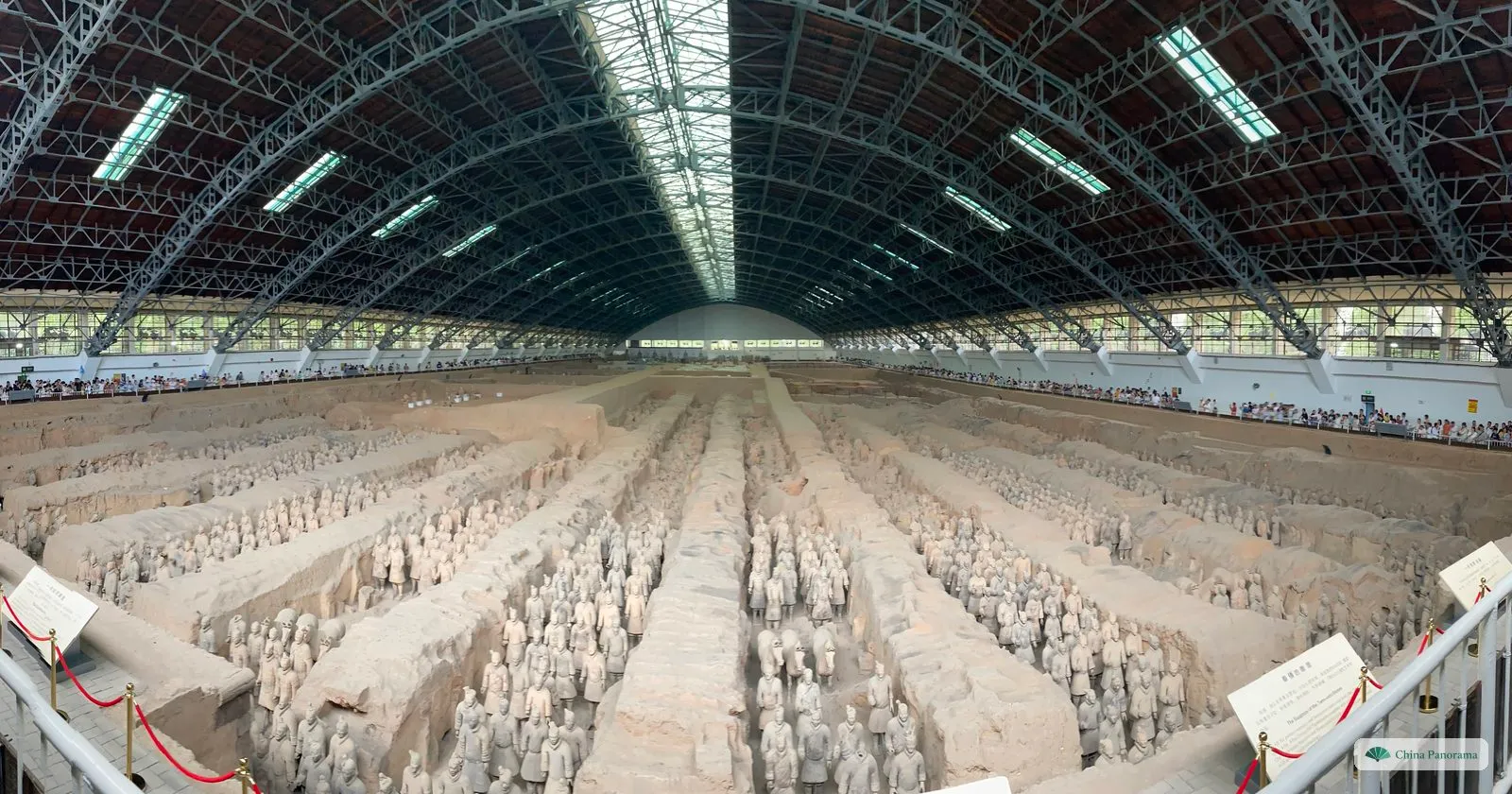
Book with your passport
Terracotta Army tickets are sold online under your real name, and you show your passport at the gate. The Shaanxi History Museum is free but needs a reservation days ahead. What to see →
How long?
Three days: the Terracotta Army, the walled city, and an afternoon and evening around the pagoda. Each is a route with times below. The routes →
Where is Xi’an?
Xi’an is in the middle of China, on the Guanzhong Plain between the Wei River to the north and the Qinling mountains to the south, and it is the capital of Shaanxi province. It is about 910 km south-west of Beijing and 1,220 km west of Shanghai; Chengdu is 610 km to the south-west, Chongqing 570 km to the south, Luoyang 320 km to the east and Lanzhou 510 km to the north-west, up the old Silk Road. At 34.3° N, Xi'an lies further south than any point on the European mainland — about level with Rabat, Beirut and Los Angeles — but it is 400 m above sea level and a long way from the sea, so winters are cold and dry and summers hot. Tap any city on the map to measure the distance.
Straight-line distances, rounded to the nearest 10 km — not travel distances.
Shaanxi is highlighted. Tap a city to measure the distance from Xi'an.
- Province
- Shaanxi陕西省 · capital
- Latitude
- 34.26° N
- Airport
- XIYXianyang · Metro Line 14
- Metro
- 12 linesabout 422 km
- Time zone
- UTC+8
- City flower
- Pomegranate blossom石榴花
What’s Xi’an weather like each month?
A continental climate with four clear seasons: a cold, dry winter with frost at night — 5 °C by day in January — a short, warm spring, a hot summer at 35 °C by day in July, and a mild autumn that starts wet. The sun rises at 05:31 in June and sets at 17:36 in December. Tap a month for temperatures, daylight and what is on.
Scale in °C. Bars run from the average daily low to the average daily high. Source: monthly temperature data, last checked 2026-07-30.
Xi'an in October
Mild- Average high
- 21 °C
- Average low
- 12 °C
- Sunrise / sunset
- 06:48 – 18:11
- Daylight
- 11 h 23 min
On in Oct
- Golden Week crowds, 1–7 Oct
- Most comfortable month of autumn
How hot is Xi’an in summer?
Hot and bright. The three sights that take the most walking — the city wall, Daming Palace and the approach to the Terracotta Army pits — have little or no shade, so do them in the morning and keep the evening for the fountain and Grand Tang Mall, which only come alive after sunset anyway.
June
33° / 22°
Sun 05:31–19:57 · 14 h 26 min
July
35° / 25°
Sun 05:43–19:57 · 14 h 15 min
August
33° / 23°
Sun 06:05–19:33 · 13 h 28 min
Spring
March – MayWarms up fast: one of the two good seasons.
March averages 17 °C by day, April 24 °C and May already 28 °C, with cool nights early in the season. The air is dry. The pomegranate, the city's flower, comes into bloom in May. Avoid the May Day holiday at the start of the month: the Terracotta Army and the city wall are among the most visited places in the country.
What to wear: Layers: a jacket for the mornings in March and April, short sleeves by May.
Summer
June – AugustHot: 33–35 °C by day.
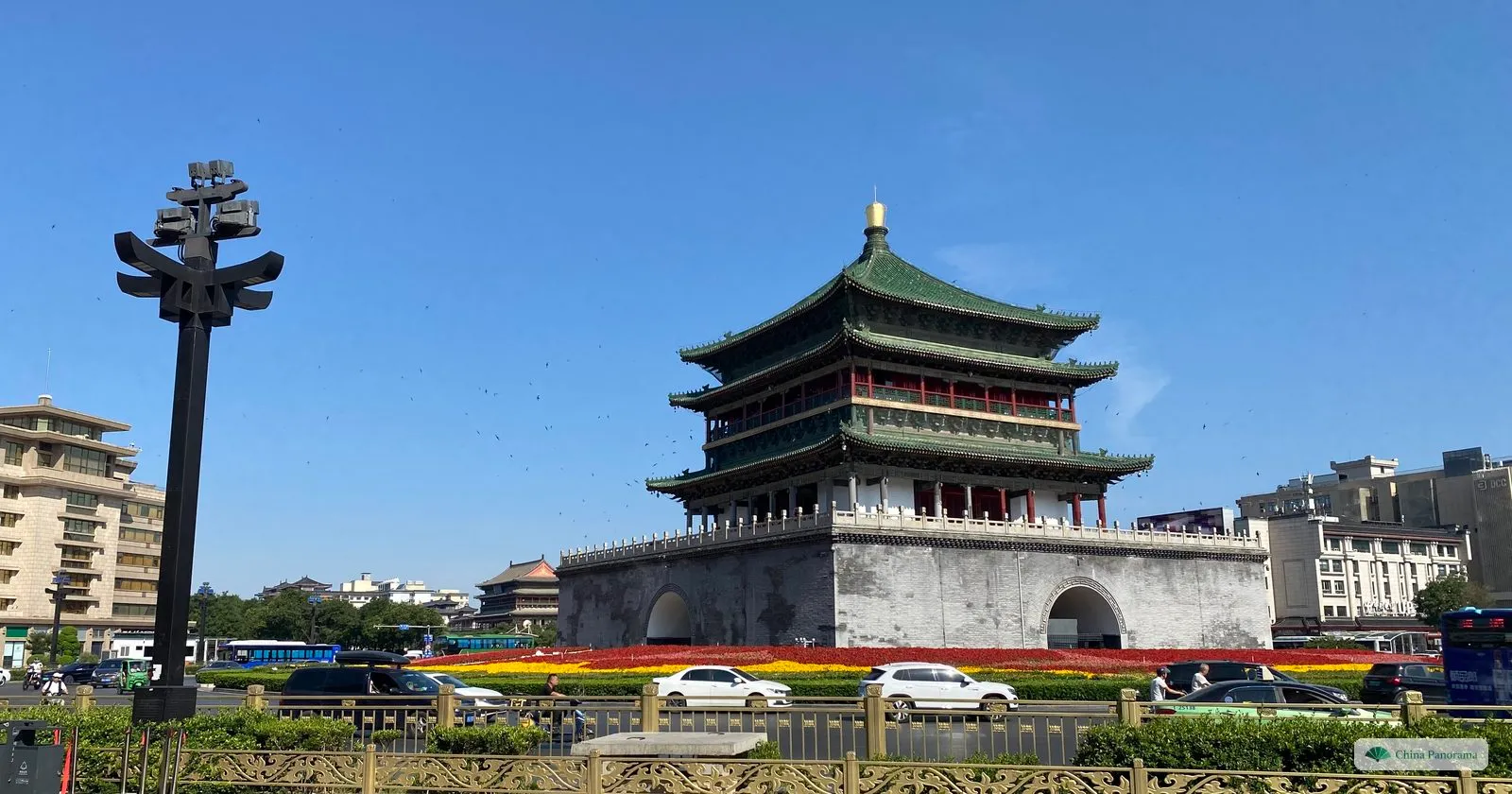
July averages 35 °C by day and 25 °C at night. Our June 2024 photographs show what that looks like: a hard blue sky over the Bell Tower and the wall, and the whole city out of doors after sunset. The city wall and Daming Palace have no shade at all — do them early — and keep the evening for the fountain and Grand Tang Mall.
What to wear: Light clothes, a hat and sunscreen; water for the wall.
Autumn
September – NovemberMild — but September can be wet.
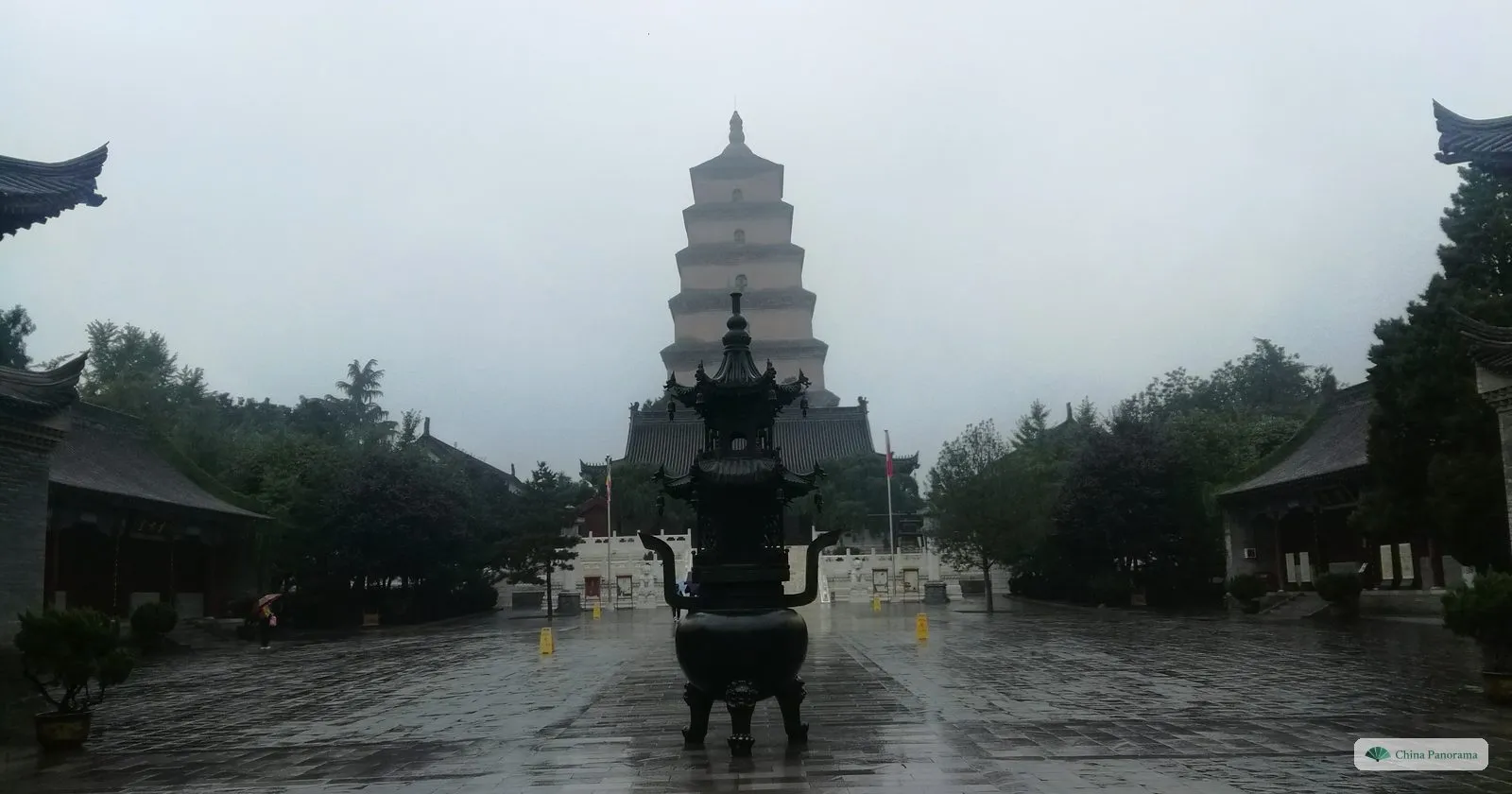
September averages 27 °C by day, October 21 °C and November 13 °C. September often brings long spells of rain: on 28 September 2021 we climbed the pagoda and walked round Tang Paradise in a steady drizzle, with the view gone after a few hundred metres — and almost nobody else about. October is drier and the most comfortable month, apart from Golden Week, 1–7 October.
What to wear: A light jacket and an umbrella in September; a warm layer from late October.
Winter
December – FebruaryCold and dry, with frost at night.
January averages 5 °C by day and −3 °C at night. Buildings are centrally heated, as everywhere in northern China, and the big sights are at their quietest. The fountain shows on the North Square are reported to pause in winter.
What to wear: A proper winter coat, hat and gloves.
April, at about 24 °C by day, and October, at 21 °C, are the months we would pick; late September (27 °C) is warm but can be wet. For how Xi’an compares with the rest of the country month by month, see the best time to visit China.
What to see
13 places, from the Terracotta Army and the city wall to a bell tower in the suburbs. Two things first, because they change how you plan: which of Xi’an’s sights are really as old as they look, and what exactly you are looking at when you stand at the railing of Pit 1.
Which of it is really old?
Xi’an sells itself as the Tang capital, but almost everything that looks Tang was built in this century. Four things on this page are the real fabric of their time — the Terracotta Army, the pagoda, the city wall and the Bell Tower — and one is an honest ruin. Tap a name on the time line, or filter.
Qin dynasty221–207 BC
more than 800 years later
Tang dynasty618–907
about 460 years later
Ming dynasty1368–1644
about 350 years later
Our own timesince 2000
Filled dot: original. Ring: ruin. Square: built in our time.
Tap a name on the time line or a card.
 Originalc. 210 BCabout 2,240 years old
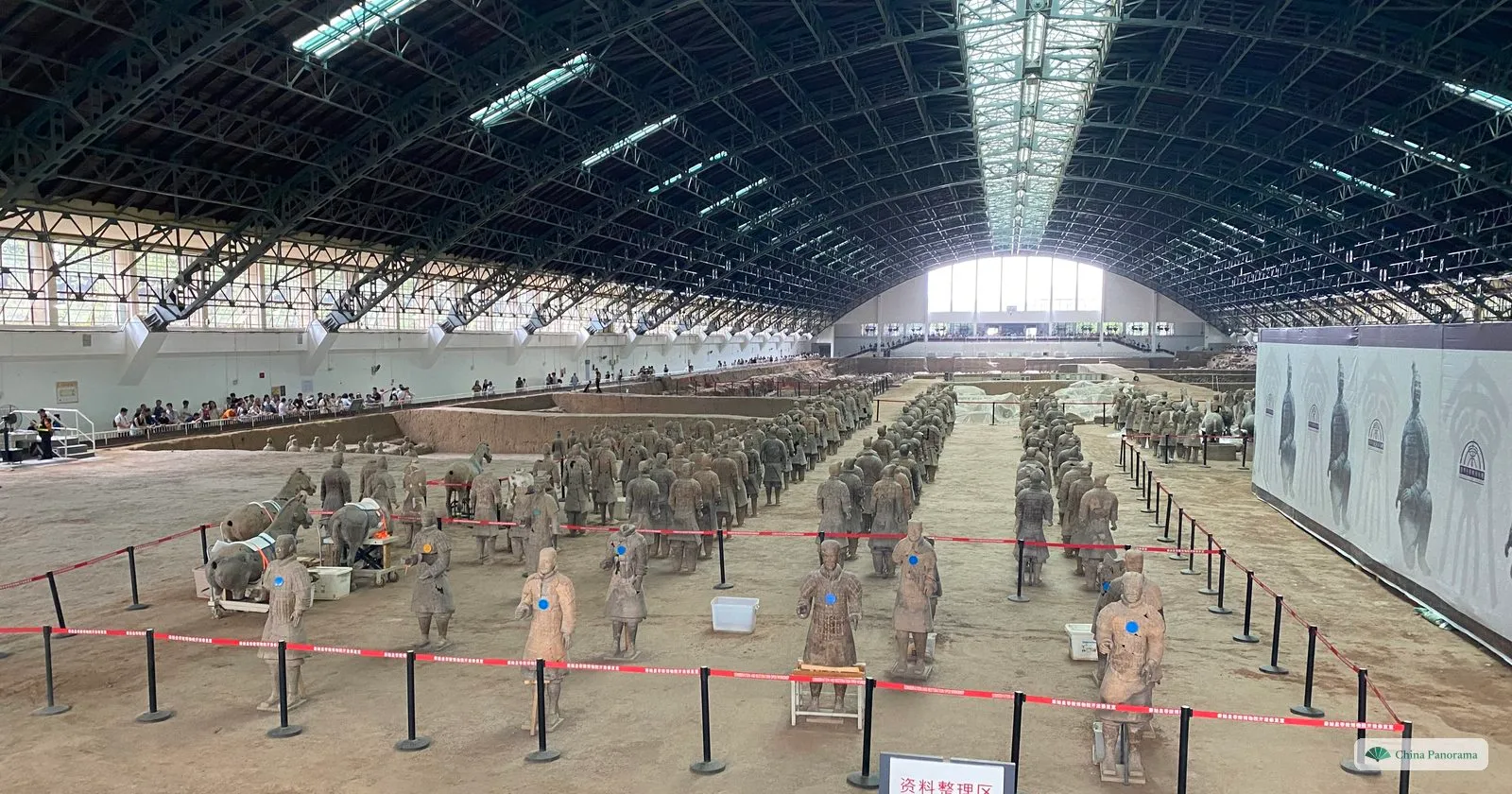
Made for the tomb of the First Emperor, who died in 210 BC, and underground until farmers struck the pits in 1974. What stands in Pit 1 is the original fired clay, put back together from fragments. Only the halls over the pits are modern.
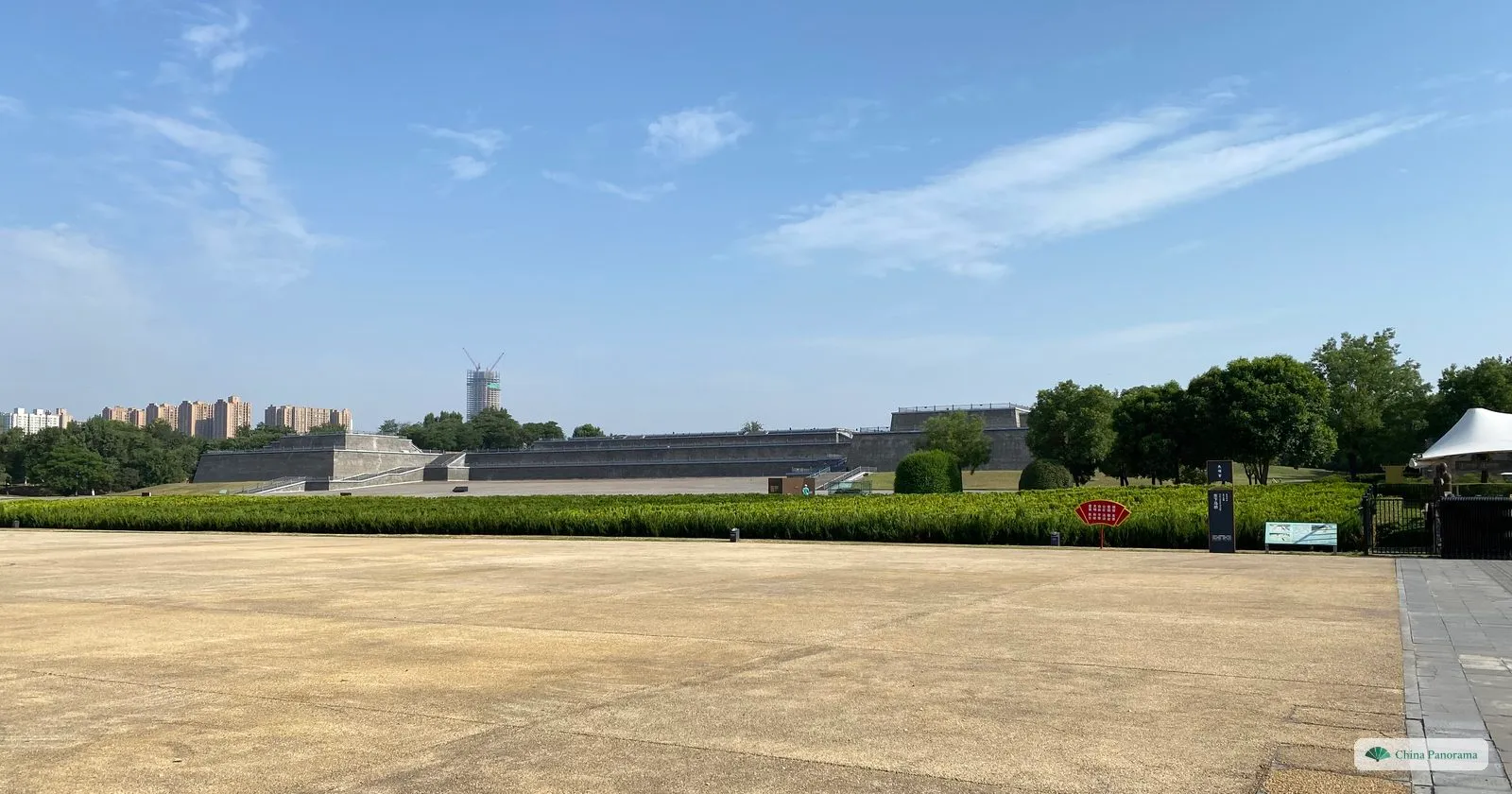 Ruin634about 1,390 years old
The Tang emperors’ main palace, begun in 634 and destroyed by the end of the dynasty. The rammed-earth platforms are original. Danfeng Gate is a modern shell over the excavated foundations, and the halls exist only as models.
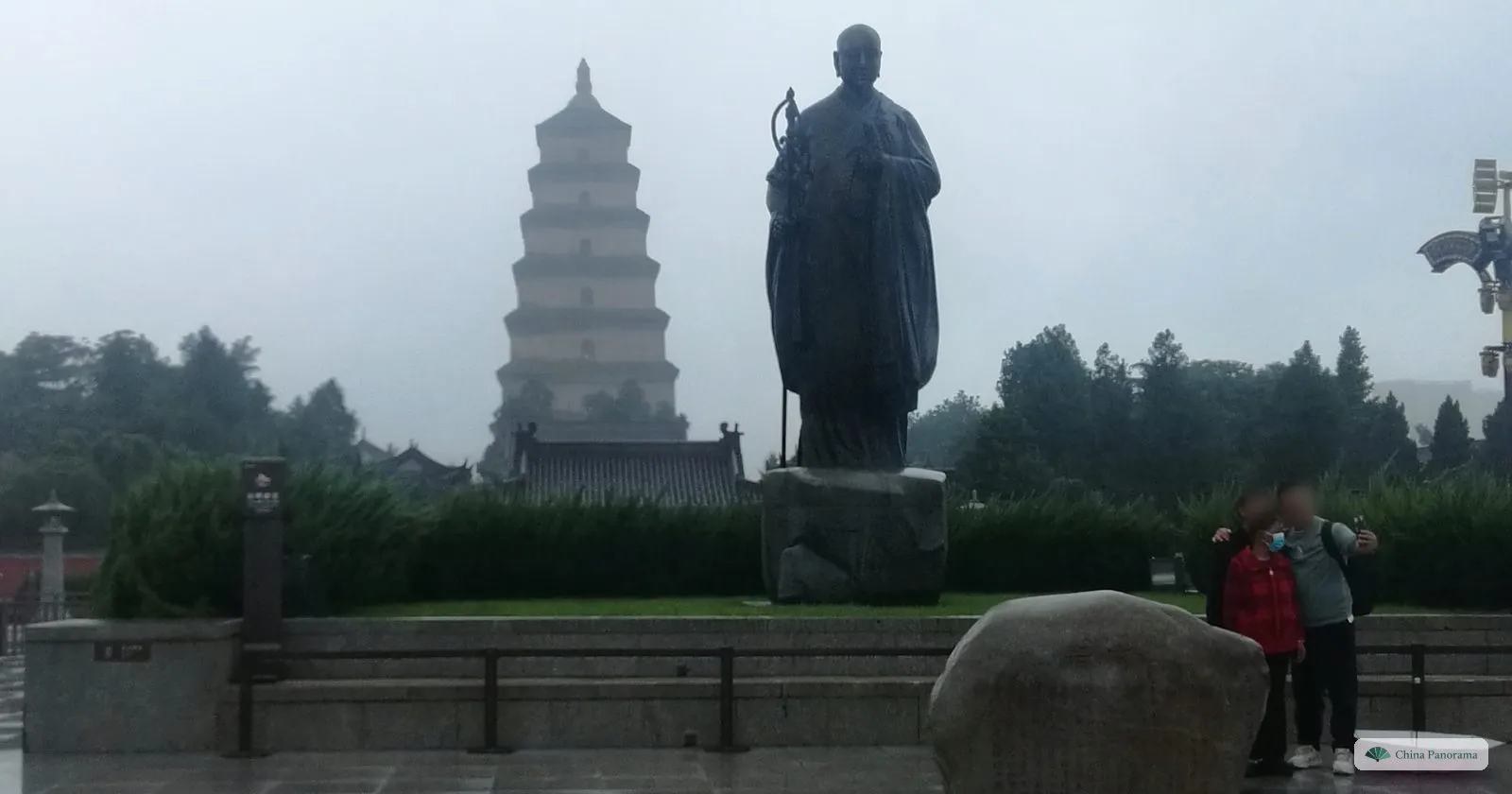 Original652about 1,370 years old
First built in 652 for the scriptures Xuanzang brought from India, rebuilt about fifty years later and given its present outer layer of brick in 1604. Of everything around it — the squares, the fountain, the mall — it is the only structure that is Tang.
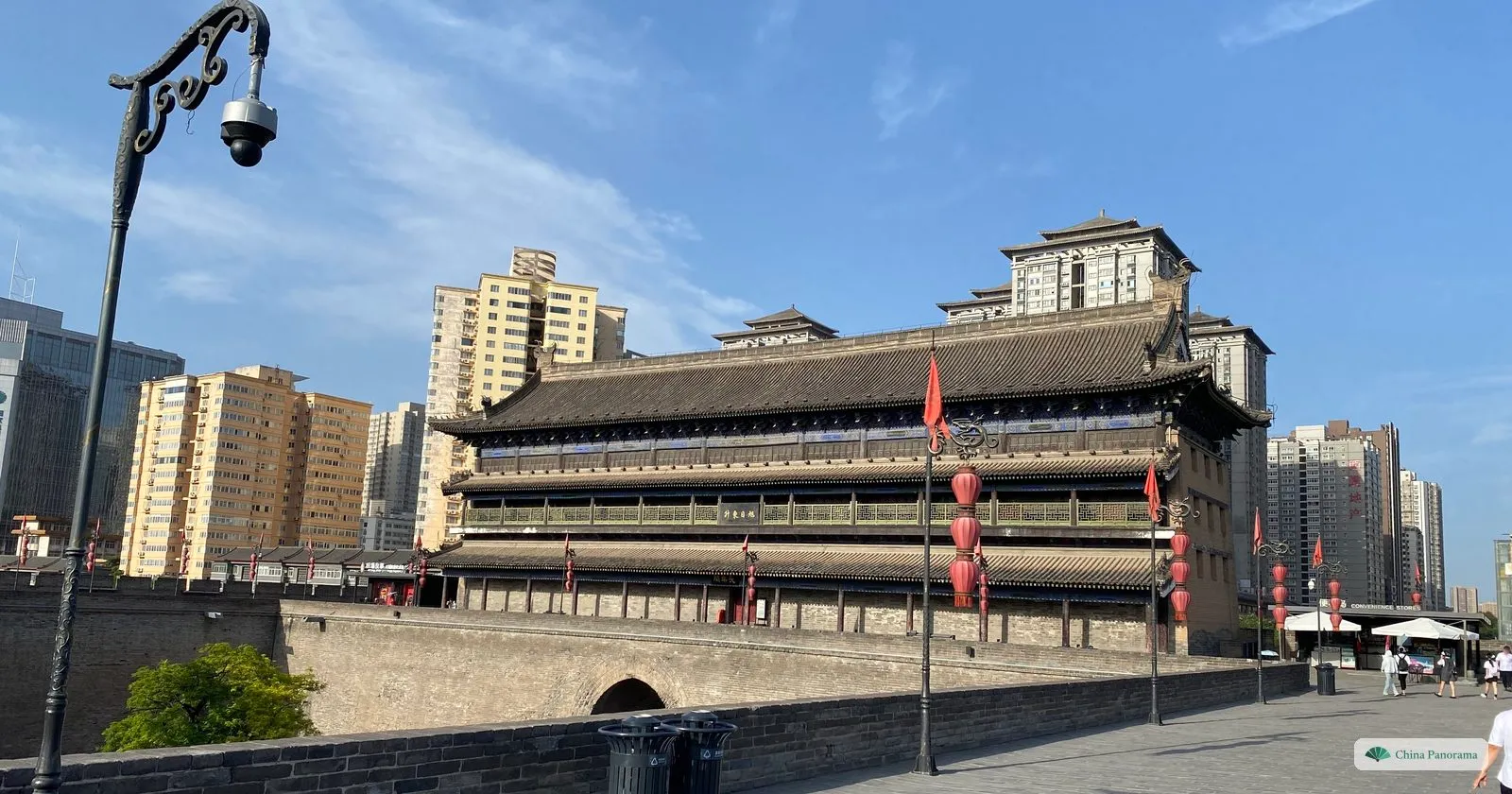 Originalfrom 1370about 660 years old
Built under the first Ming emperor, reusing Sui and Tang ramparts on the south and west sides, faced with brick in 1568 and restored from 1983. What you walk on is the Ming wall.
- Original1384about 640 years old
Built in 1384 and moved to the present crossroads in 1582, after the city had grown eastwards and its centre had shifted. The Tang bell that hung in it is now in the Stele Forest Museum.
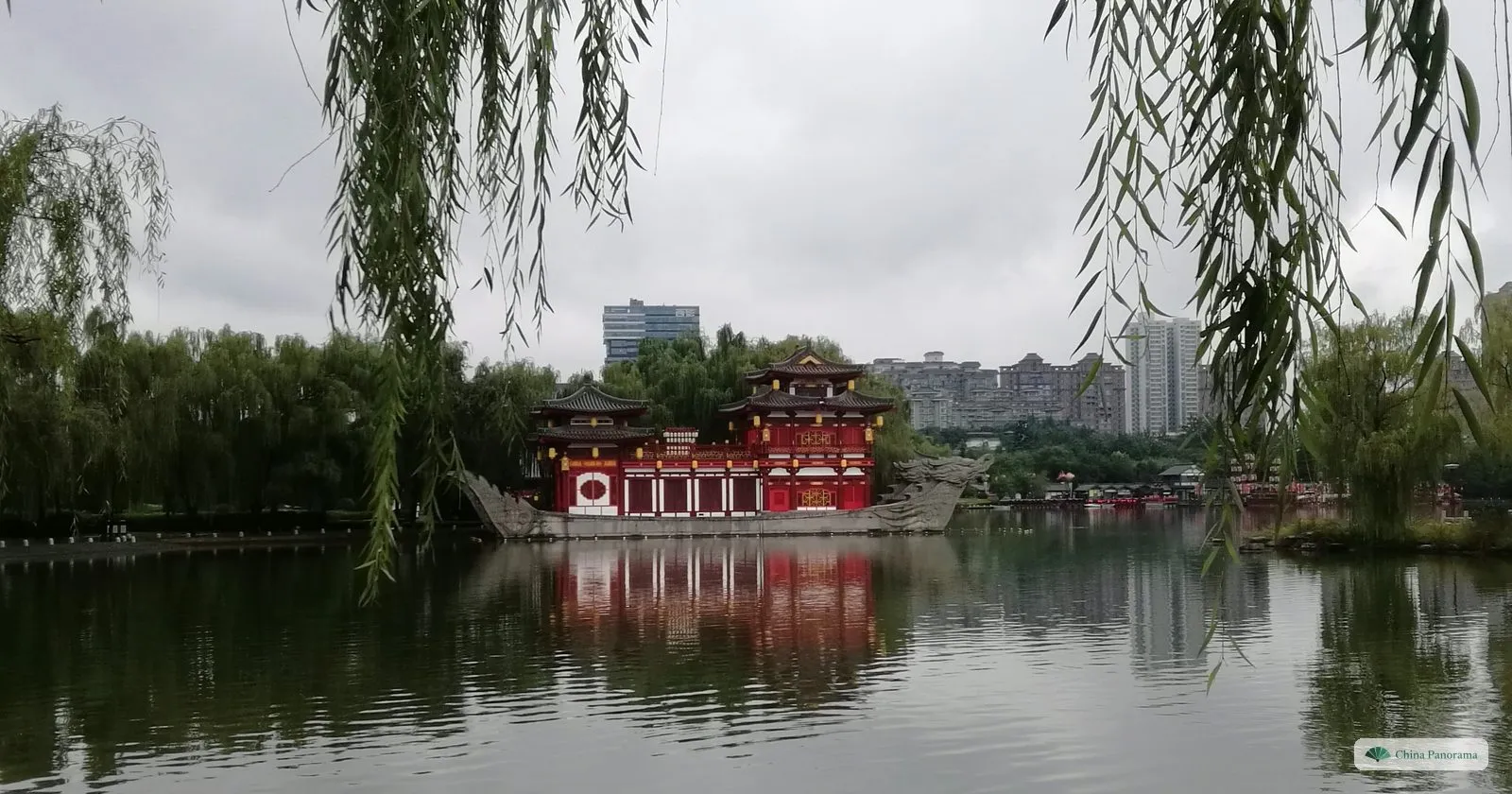 Built in our time200521 years old
Laid out near the site of the Tang emperors’ garden at Qujiang. Nothing in it is old: the halls are modern interpretations of Tang architecture, at palace scale.
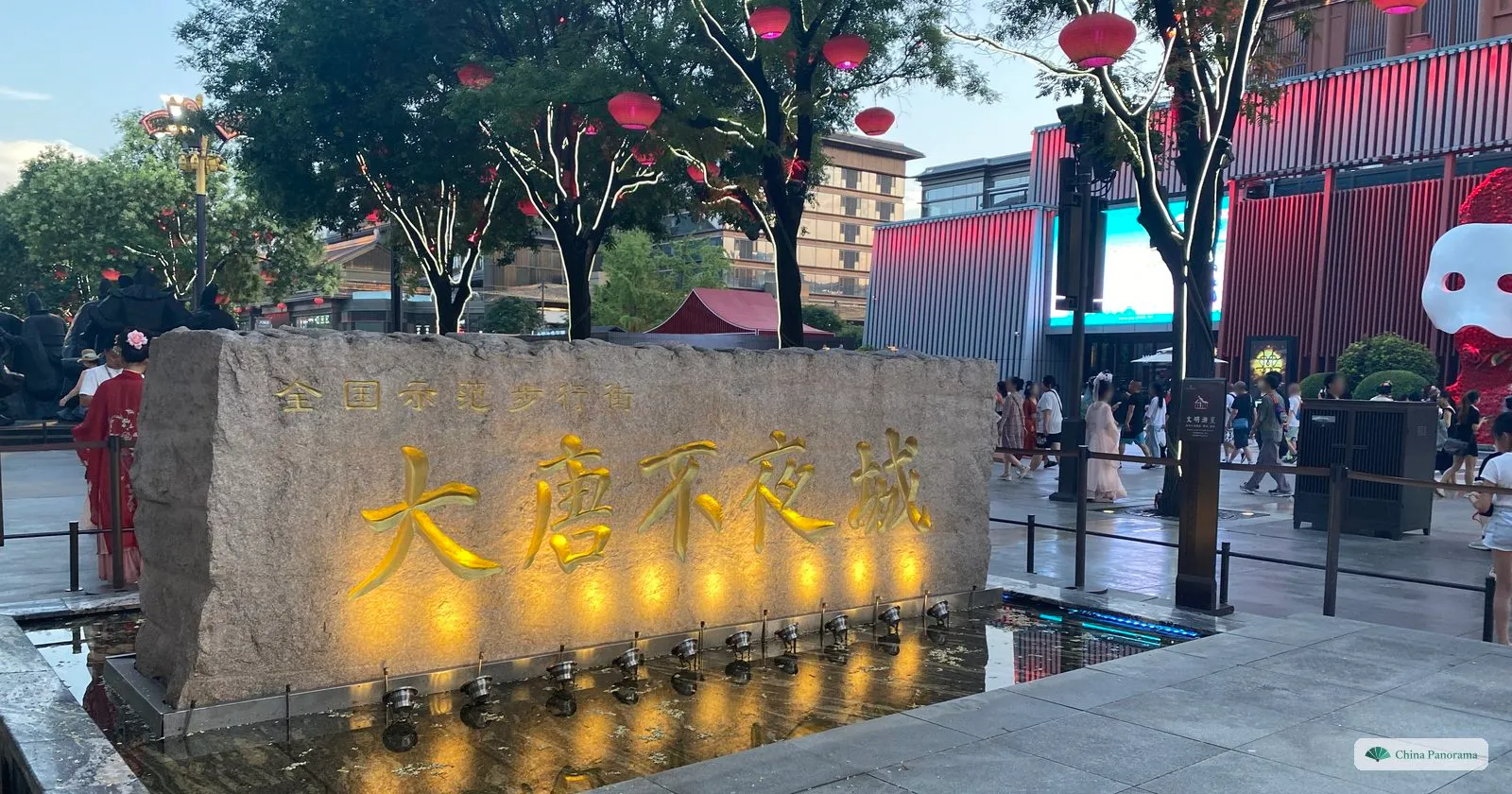 Built in our time200917 years old
Built from 2002, opened in 2009 and refitted in 2018. Tang in costume and lighting only — and nobody pretends otherwise.
What am I looking at?
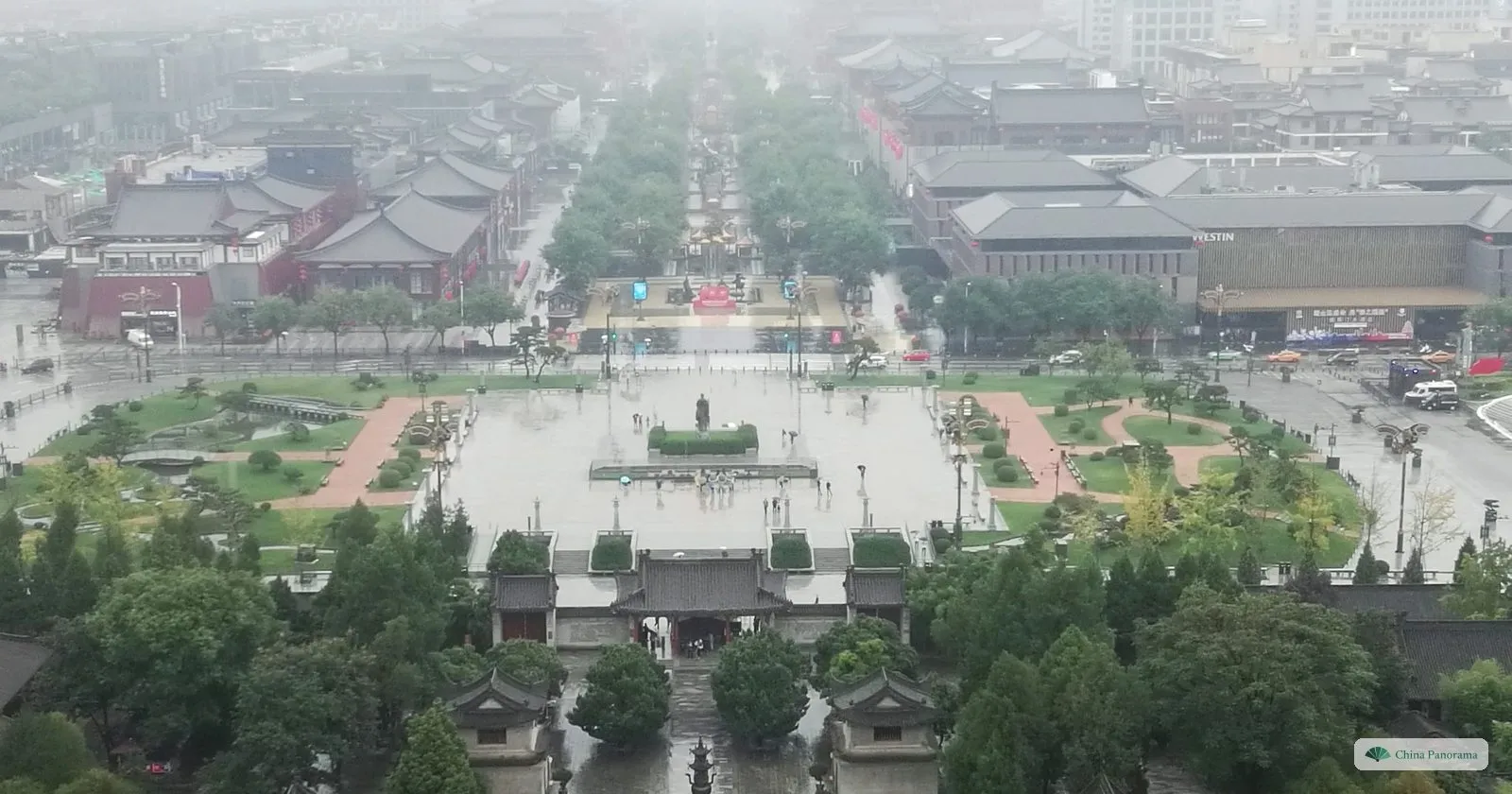
Pit 1 from the visitors’ entrance, and the two views from the top of the Giant Wild Goose Pagoda. Tap a number on the photograph.
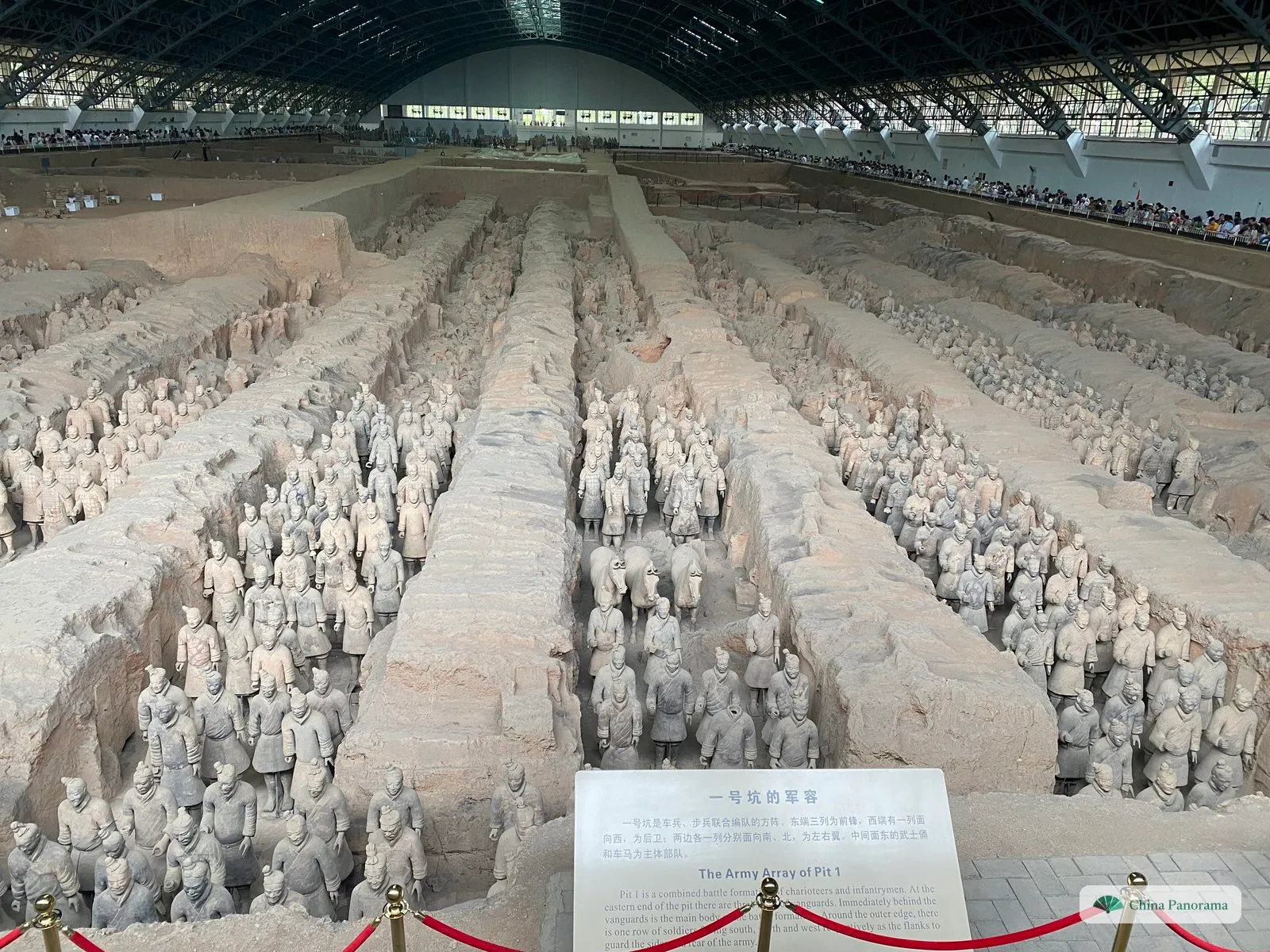
1The vanguard
前锋 · Three rows at the east end
The sign on the railing describes Pit 1 as a formation of chariots and infantry. The three rows nearest you, facing east, are its vanguard — soldiers in plain tunics, without armour. A single row at the far end faces west as the rearguard, and a row on each long side faces outwards to guard the flanks.
Terracotta Army in the list below →Tap a number on the photo, or a name in the list.
13 places in and around Xi’an
Filter by district, or by whether you need to be indoors.
Terracotta Army
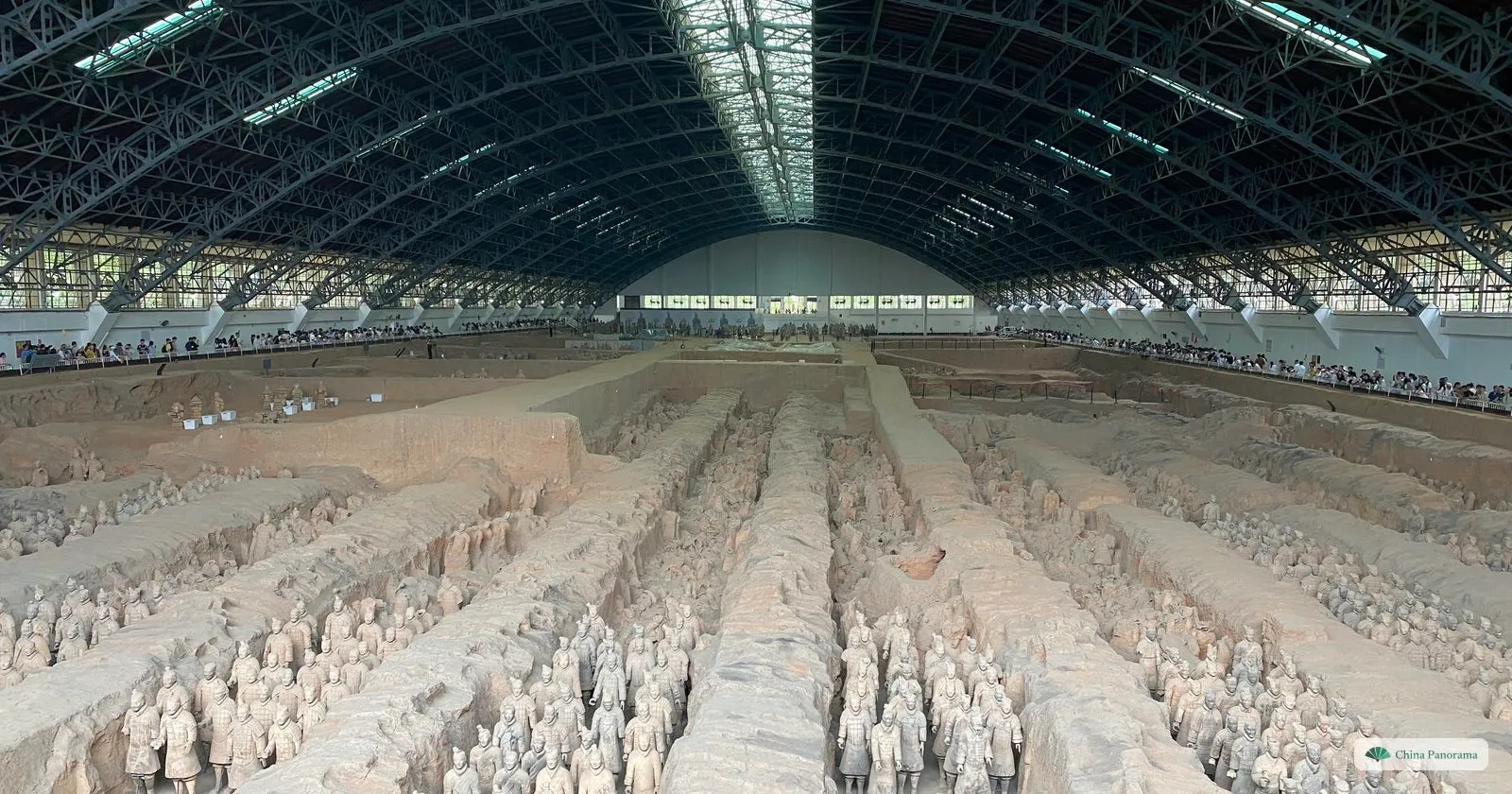
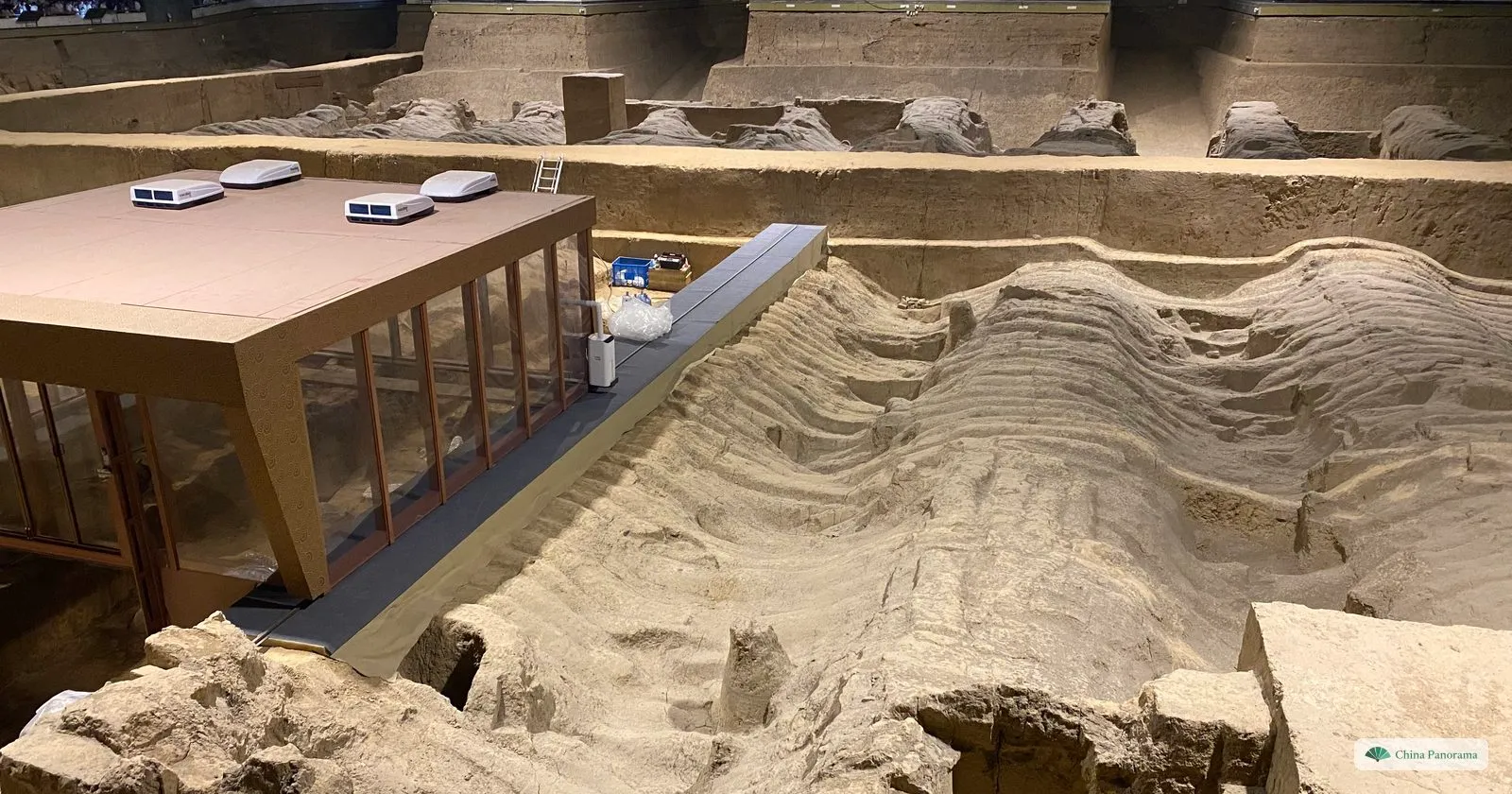
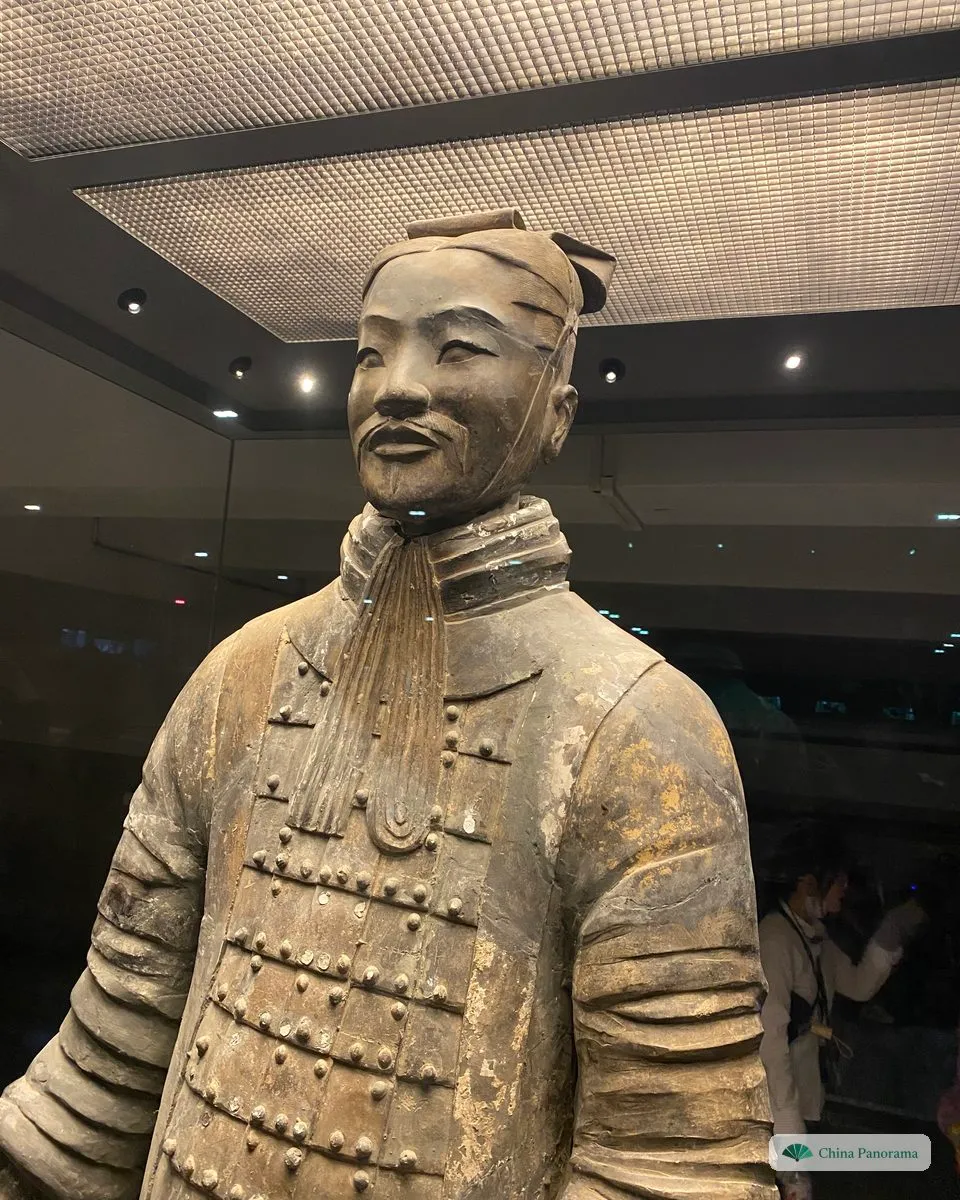
兵马俑 · 秦始皇帝陵博物院MuseumLintong · 临潼区IndoorsThe buried army of Qin Shi Huang, the first emperor of a unified China, who died in 210 BC. Farmers digging a well found it in March 1974, about 1.5 km east of his tomb mound; it has been a World Heritage Site since 1987. Pit 1 is the one in every photograph: a hall 230 m long and 62 m wide, with the infantry standing in eleven corridors between walls of rammed earth — three rows of vanguard at the east end, where you come in, then columns of armoured soldiers and the horses of wooden chariots that rotted away long ago. At the far end, restorers piece broken figures together in the open. Pit 2 is still largely unexcavated: you look down on the wavy remains of its collapsed timber roof. Pit 3, the smallest, is the command post. The best-preserved figures stand in glass cases in the Pit 2 hall, close enough to see the rivets on the armour. The photograph above this list puts a name to what you see in Pit 1.
In Lintong district, about 40 km by road east of the centre. Metro Line 9 runs to Huaqingchi station; the last 8 km are by bus (reported: No. 613) or a ten-minute taxi ride. Tickets are sold online under your real name, and foreign visitors show their passport to buy and again to enter. The ticket is reported to include Lishan Garden around the emperor's tomb mound, with a shuttle bus between the two. In late June 2024 the railing around Pit 1 was lined with visitors all the way round: move past the crush at the entrance and along the side galleries, where there is room.
- Entry
- 120 CNY · passport needed to buy and to enter
- Opening hours
- 08:30–18:30 (16 Mar – 15 Nov), 08:30–18:00 (16 Nov – 15 Mar)
City Wall
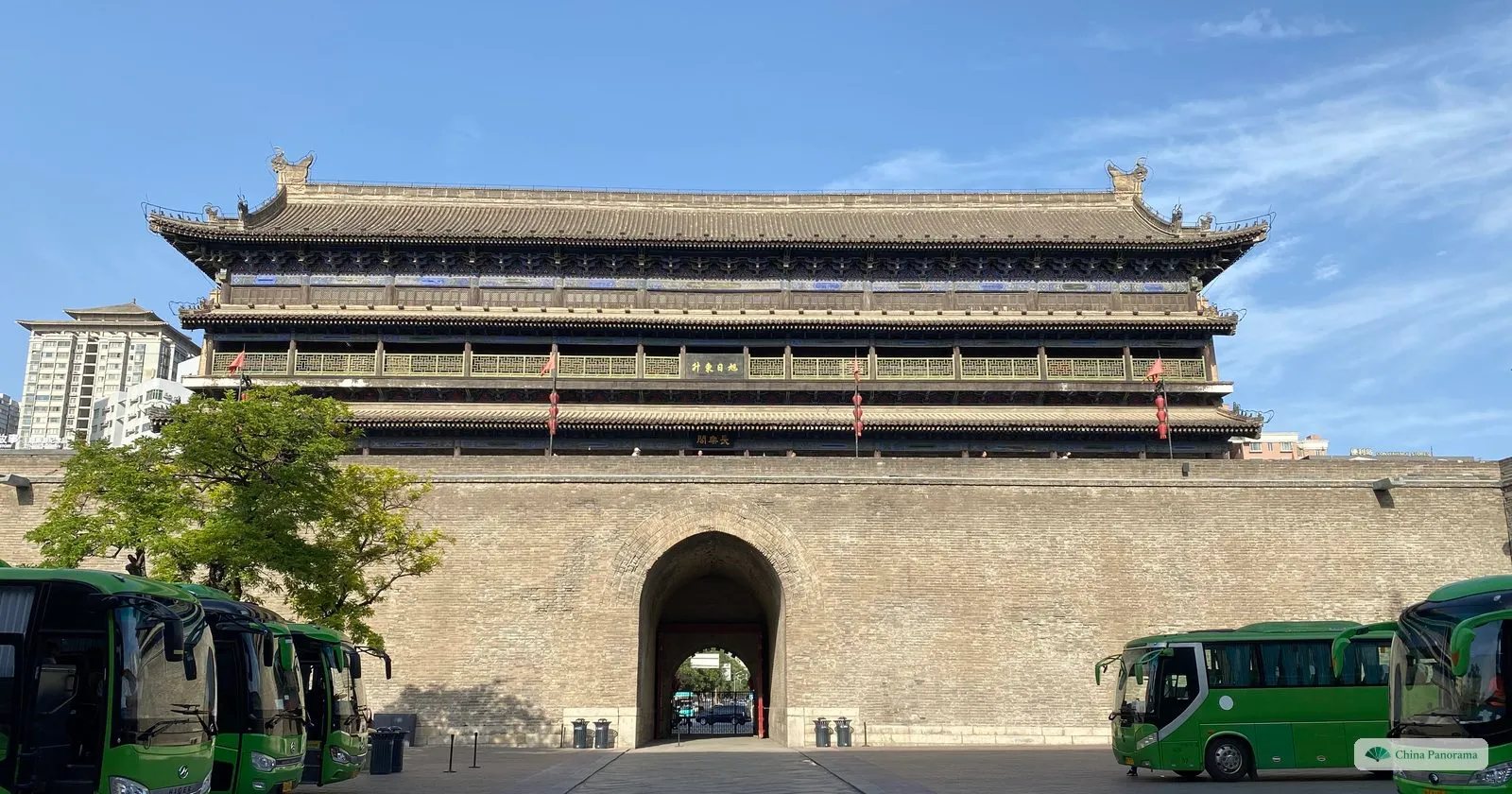
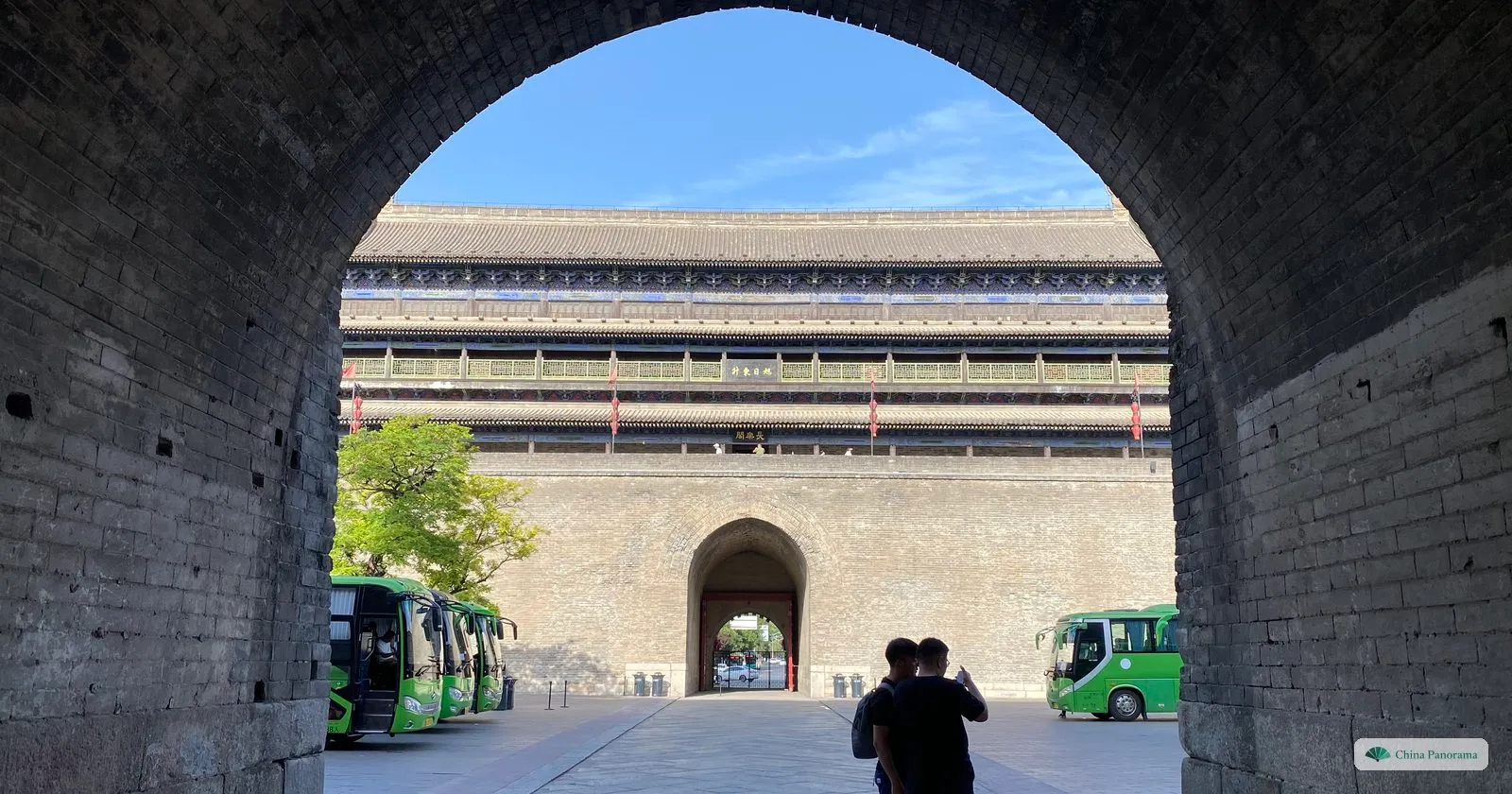
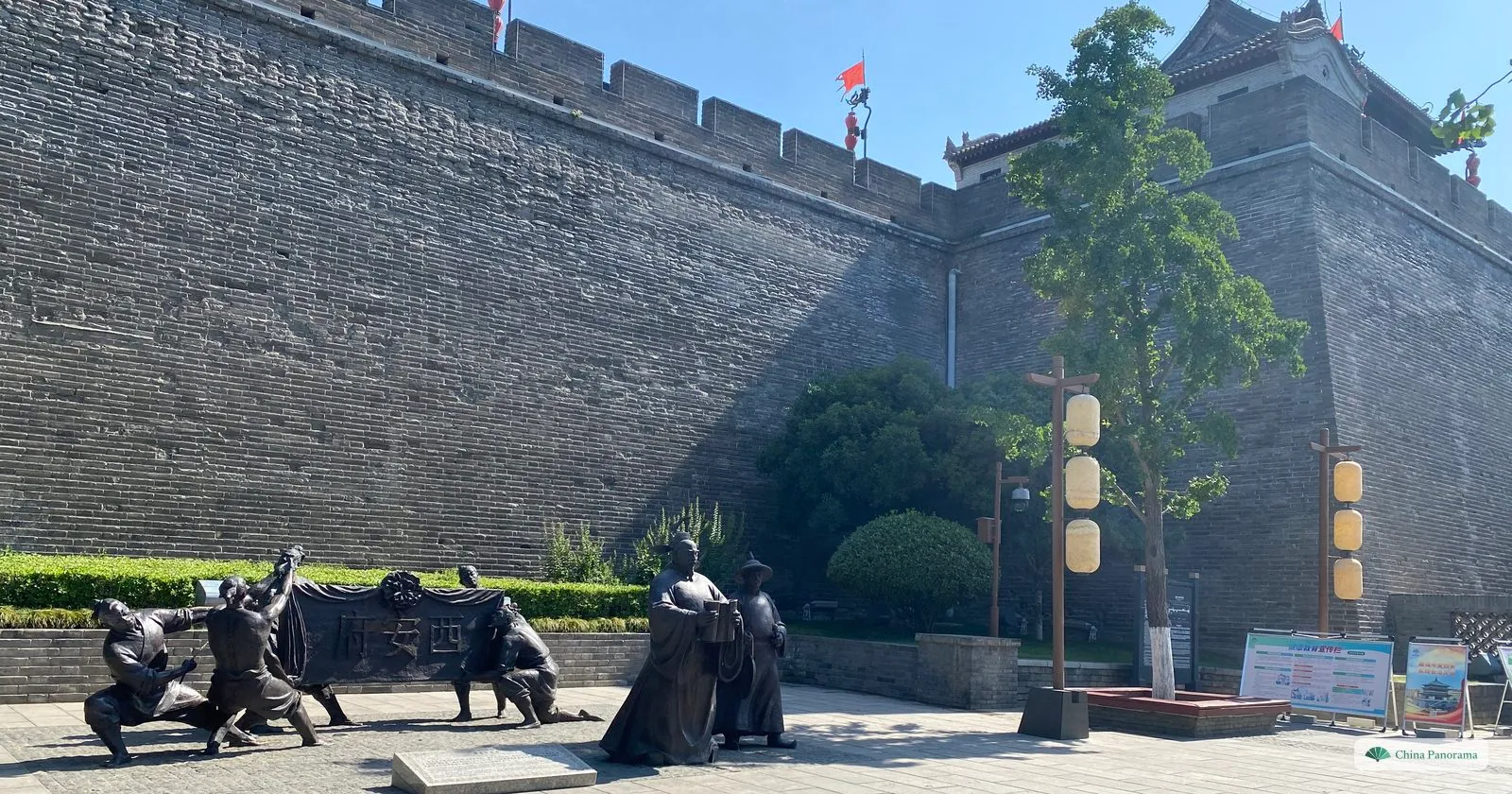
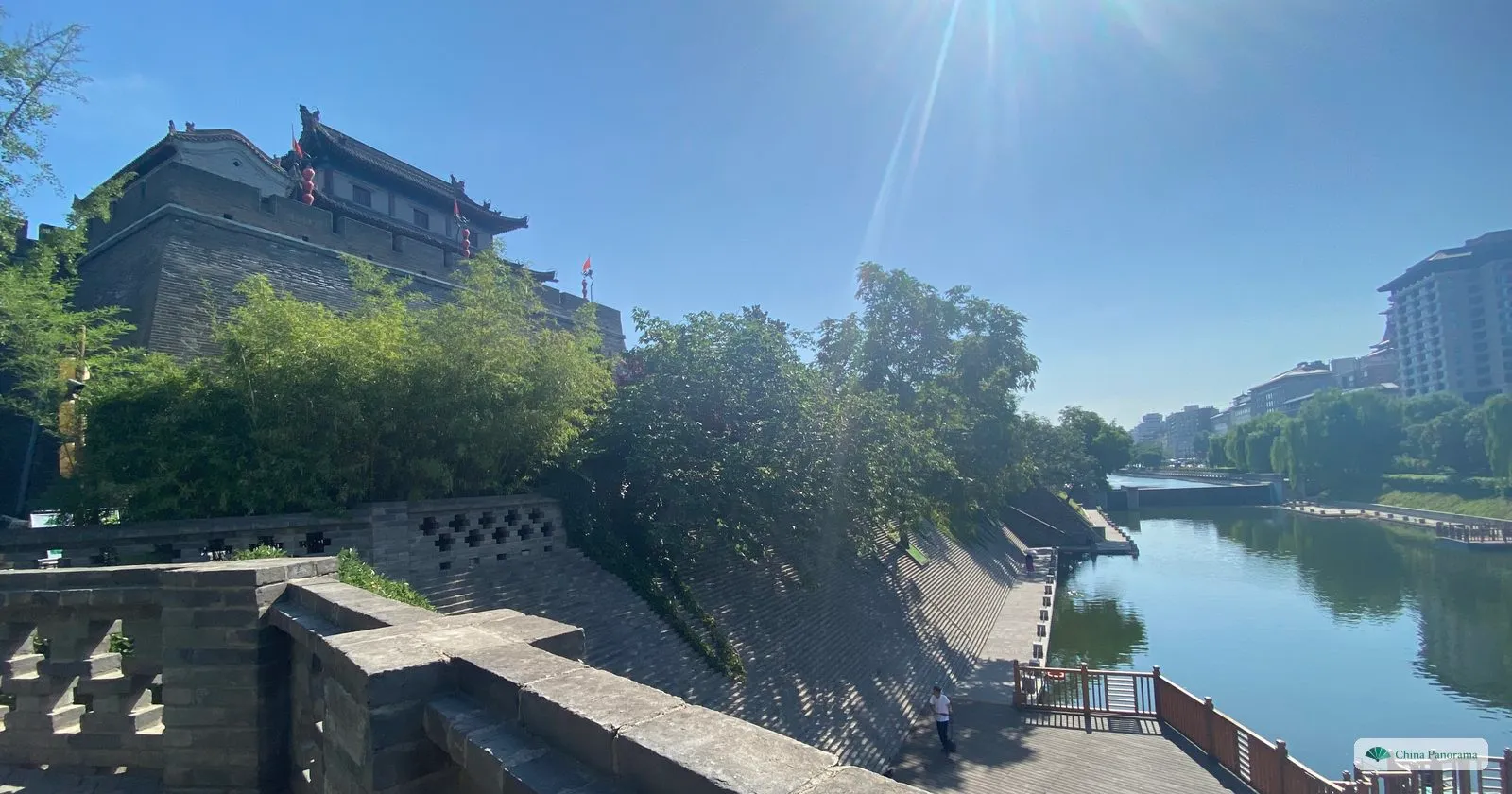
西安城墙LandmarkBeilin · 碑林区OutdoorsOne of the largest and best-preserved city walls in China, built from 1370 under the first Ming emperor and reusing Sui and Tang ramparts on its south and west sides: 13.74 km around, 12 m high and 12–14 m wide on top — wide enough to cycle. It was faced with brick in 1568. A moat runs outside it and a lane, Shuncheng Lane, follows the foot of the wall inside. Each main gate is a small fortress: a walled courtyard, the barbican, between an outer tower and the gate tower proper. Our photographs follow the south-east quarter, from the stretch near Wenchang Gate round to the East Gate, Changle Gate, whose three-tiered tower carries the name 長樂閣. From the top you look into the low old city on one side and at apartment towers on the other.
You can go up at eight of the gates, among them the South Gate (Yongningmen station, Line 2), the East Gate (Changlemen station, Line 6) and Wenchang Gate. Bicycles are rented on top at the four main gates (reported: 45 CNY for two hours, plus a deposit). The ticket is listed at 100 CNY on the government's visitor portal (May 2026) and at 54 CNY on booking sites; we have not been able to confirm which applies, so check at the gate. Walking below the wall along Shuncheng Lane, and in the moat park outside, is free. There is no shade on top: go early or towards sunset.
- Entry
- Price not verified — check on site
- Opening hours
- Hours not verified — check on site
- LandmarkBeilin · 碑林区Outdoors
The centre of the walled city, where the four main streets — North, South, East and West — meet. The tower was built in 1384 and moved to this spot in 1582, after the city had grown eastwards and the old site was no longer in the middle. It stands nearly 40 m high on a square brick base 35.5 m a side, pierced by four arches, and is now the middle of a roundabout planted with flowers. The Tang-dynasty bell it once held is in the Stele Forest Museum; a copy hangs here. The Drum Tower is about 300 m to the west, at the entrance to the Muslim Quarter.
Zhonglou station (Lines 2 and 6) is underneath, and the pedestrian underpass is the only way onto the island. Reported: 30 CNY to go up, 08:30–21:30 — we have not checked. It costs nothing to look at, and it is lit after dark.
- Entry
- Price not verified — check on site
- Opening hours
- Hours not verified — check on site
 StreetBeilin · 碑林区Outdoors
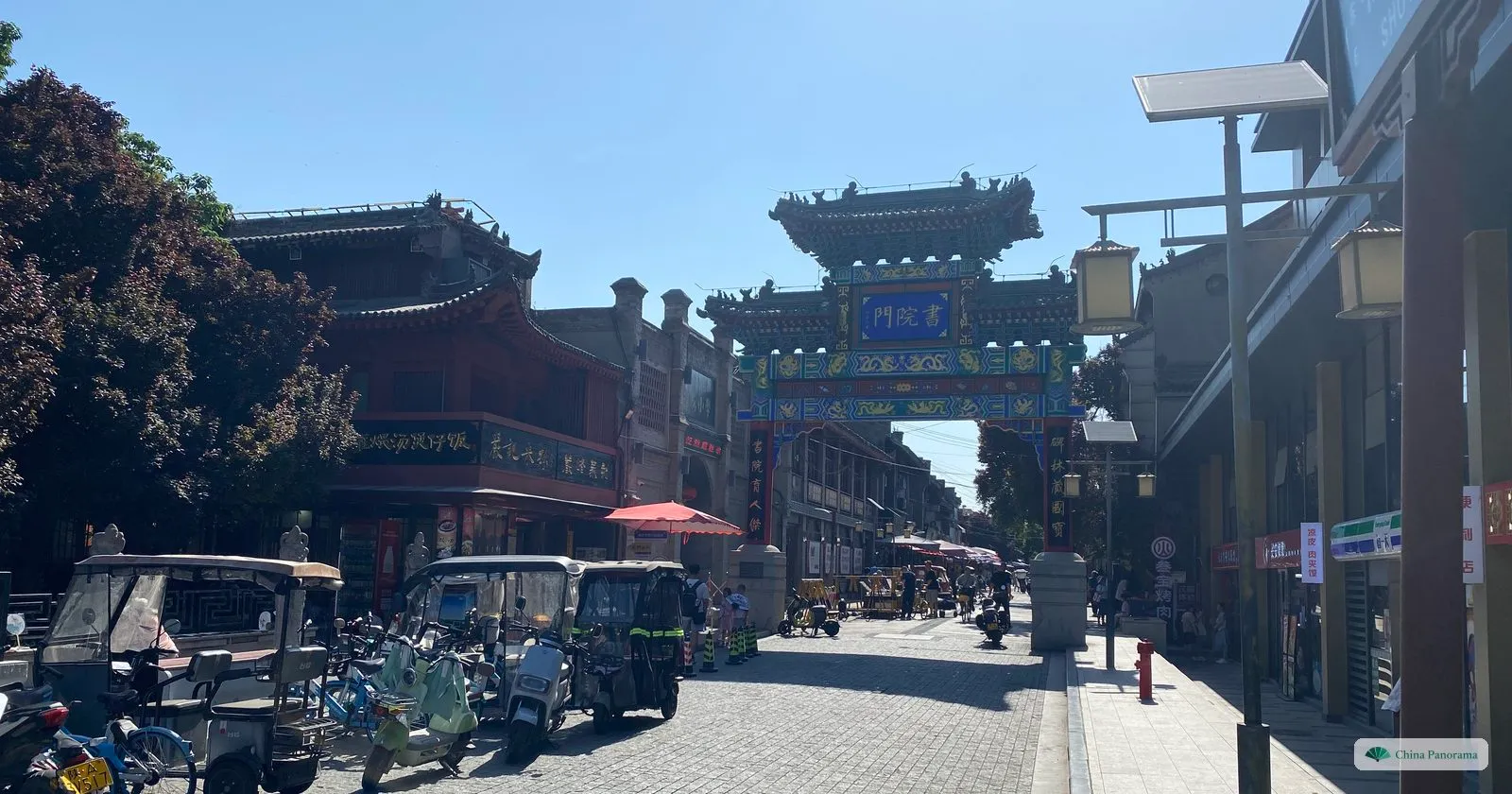
A pedestrian street of grey-brick shopfronts just inside the south wall, entered under a painted archway that reads 書院門 — Academy Gate, after the Ming-dynasty Guanzhong Academy on the street. The shops sell what a scholar needed: brushes, ink sticks, paper, seals and rubbings of inscriptions. The street runs east towards the Stele Forest Museum (Beilin), the city's collection of inscribed stone tablets, and makes a quiet way to walk from the Bell Tower to the wall. When we walked it in June 2024 it was nearly empty.
About ten minutes' walk east of the South Gate (Yongningmen station, Line 2), and thirteen minutes south of the Bell Tower. Free and open at all hours; the shops keep their own.
- Entry
- Free
- Opening hours
- Open at all hours
 TempleYanta · 雁塔区Outdoors
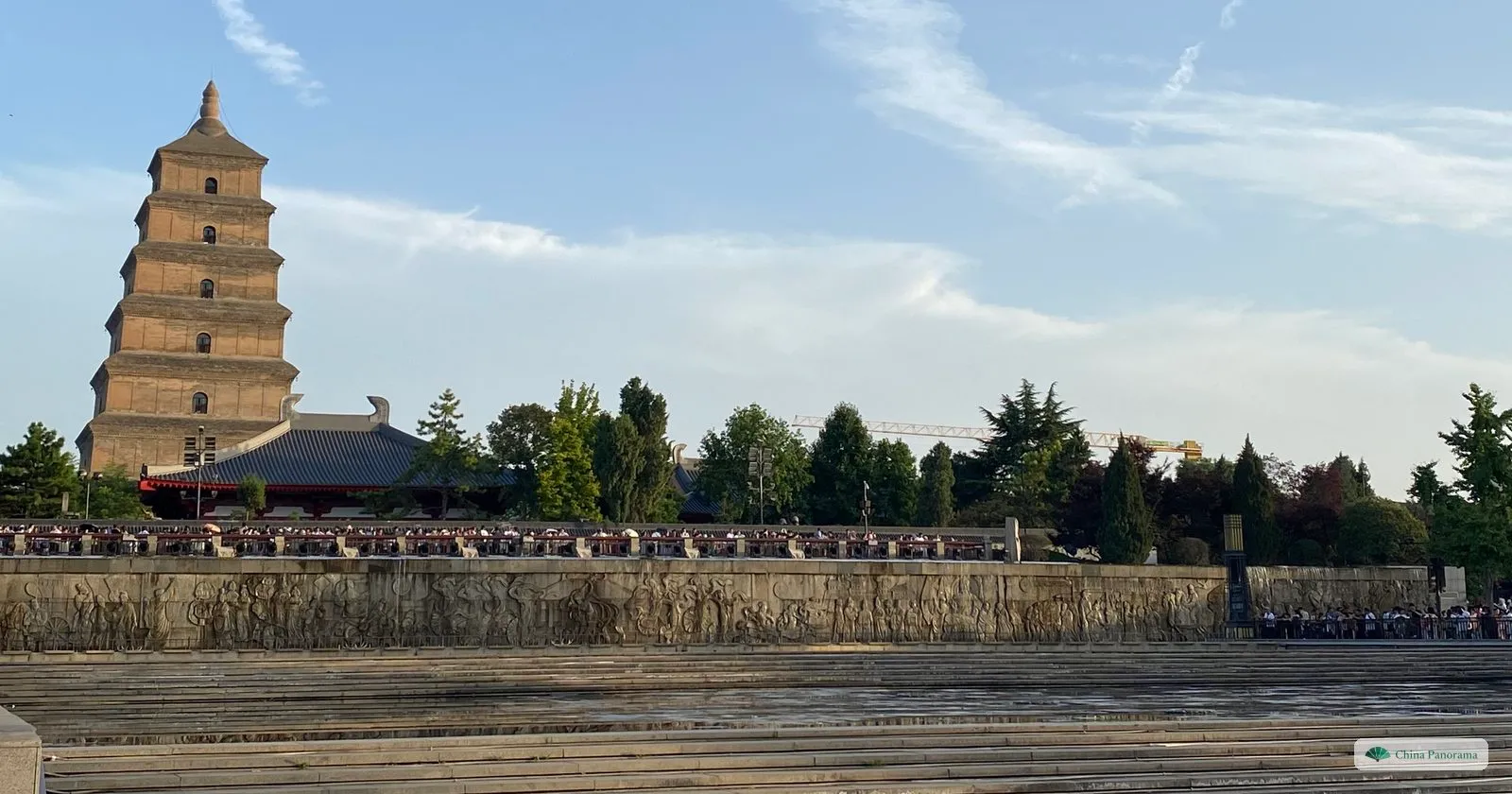
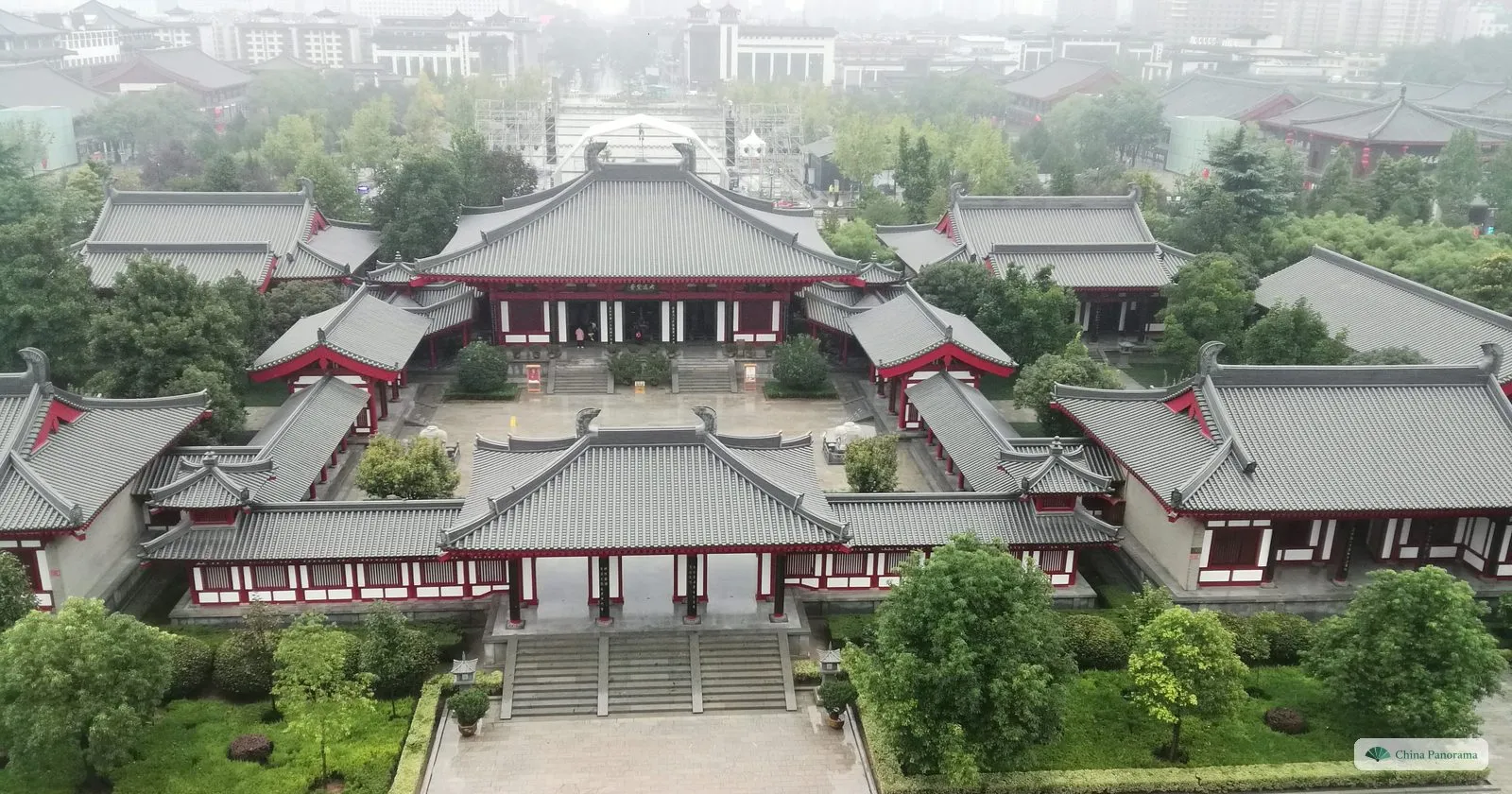
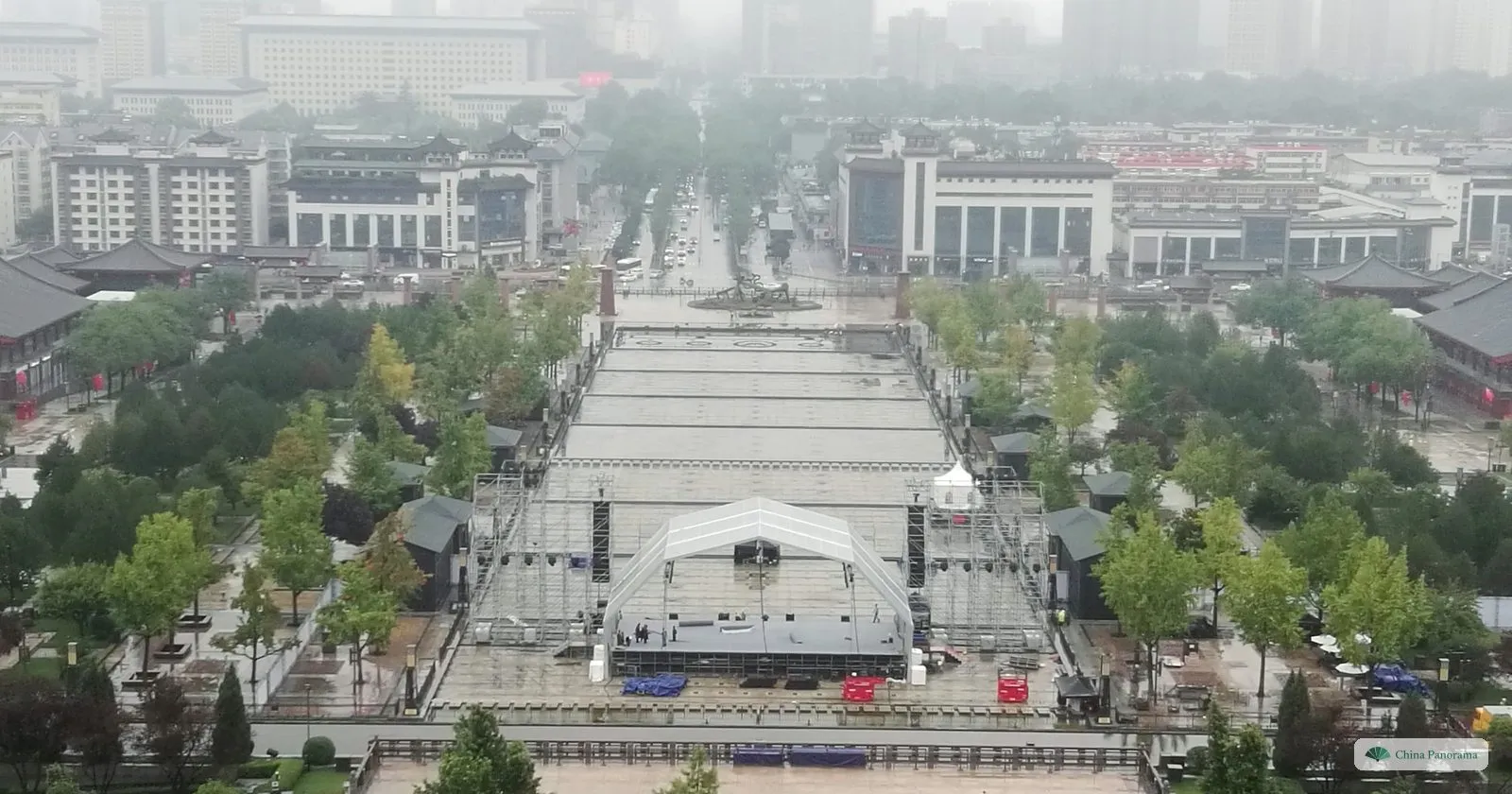
A square brick pagoda of seven storeys, 64 m high, in the grounds of Daci'en Temple. It was first built in 652 to hold the Buddhist scriptures the monk Xuanzang had brought back from India along the Silk Road — his bronze statue stands on the square to the south — and rebuilt half a century later; the outer brick skin dates from a Ming repair in 1604. Since 2014 it has been part of the Silk Roads World Heritage Site. You can climb the stairs inside: from the top windows the temple's courtyards lie below, with the long fountain basin of the North Square on one side and Xuanzang's statue and Grand Tang Mall on the other. We went up on 28 September 2021 in steady rain, the city fading into mist after a few hundred metres. In a district full of Tang-style buildings, this is the one that really is from the Tang dynasty.
Dayanta station (Lines 3 and 4) comes up by the North Square; the temple entrance is on the south side, behind Xuanzang's statue, about ten minutes' walk round. The temple ticket is 50 CNY and climbing the pagoda costs 30 CNY more (government visitor portal, May 2026). Looking at the pagoda from either square is free.
- Entry
- 50 CNY · Daci'en Temple; climbing the pagoda costs 30 CNY more
- Opening hours
- 08:00–18:00
North Square musical fountain
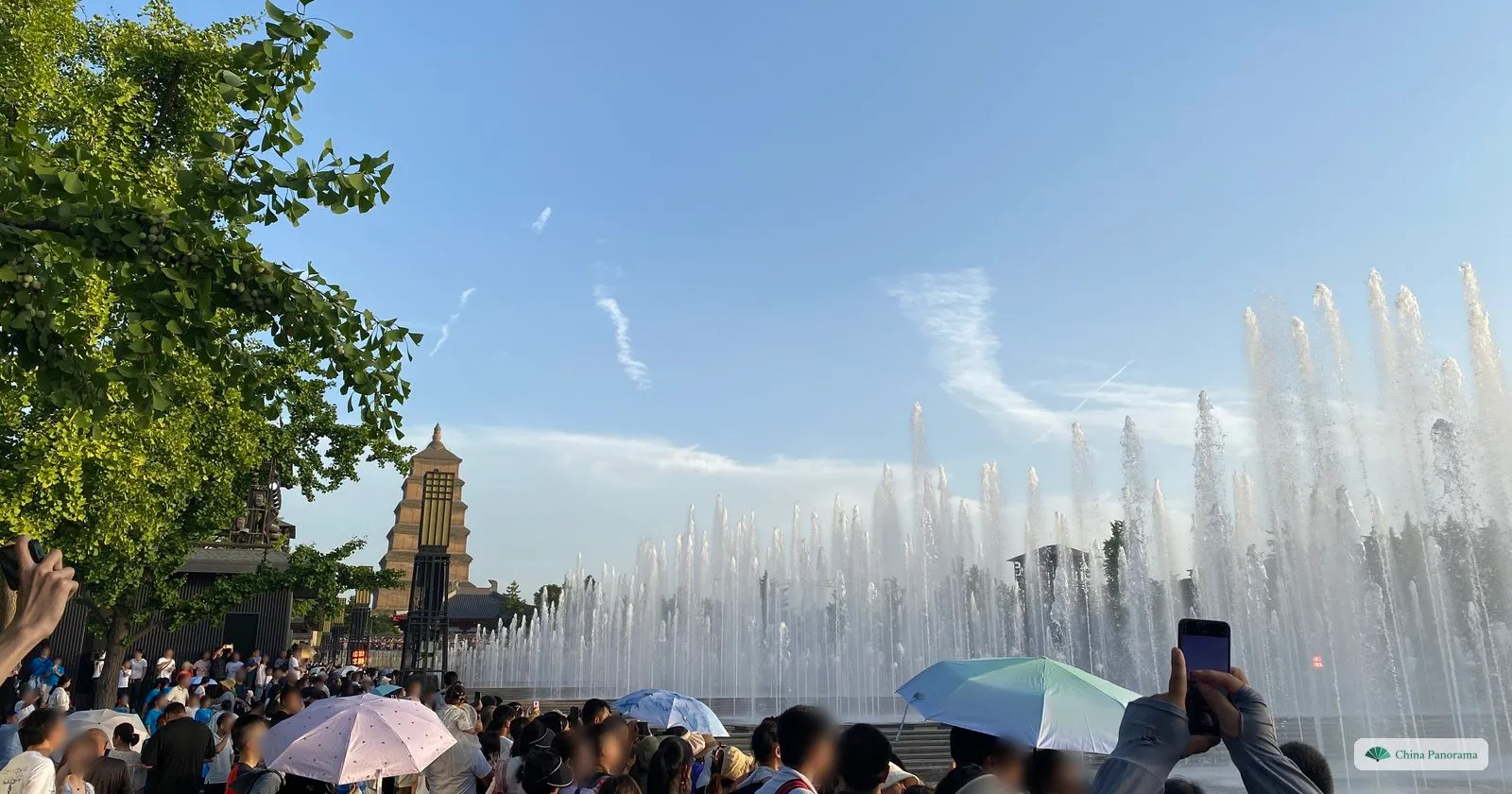
大雁塔北广场音乐喷泉LandmarkYanta · 雁塔区OutdoorsThe long, stepped water basin on the north side of the pagoda, flanked by gardens and rows of Tang-style shopfronts. At set times the whole basin plays to music — hundreds of jets rising and falling in rows — with the pagoda standing behind the spray. In June 2024 we watched an early-evening show in a crowd several rows deep, parasols up against the low sun. When the fountain is off, the basin is an open square with the long classic view of the pagoda.
Dayanta station (Lines 3 and 4). Free. Reported show times are 12:00, 16:00, 19:00 and 21:00, with extra shows at weekends and a pause in winter — we have not checked them. Come a quarter of an hour early for a place at the railing.
- Entry
- Free
- Opening hours
- Hours not verified — check on site
Grand Tang Mall
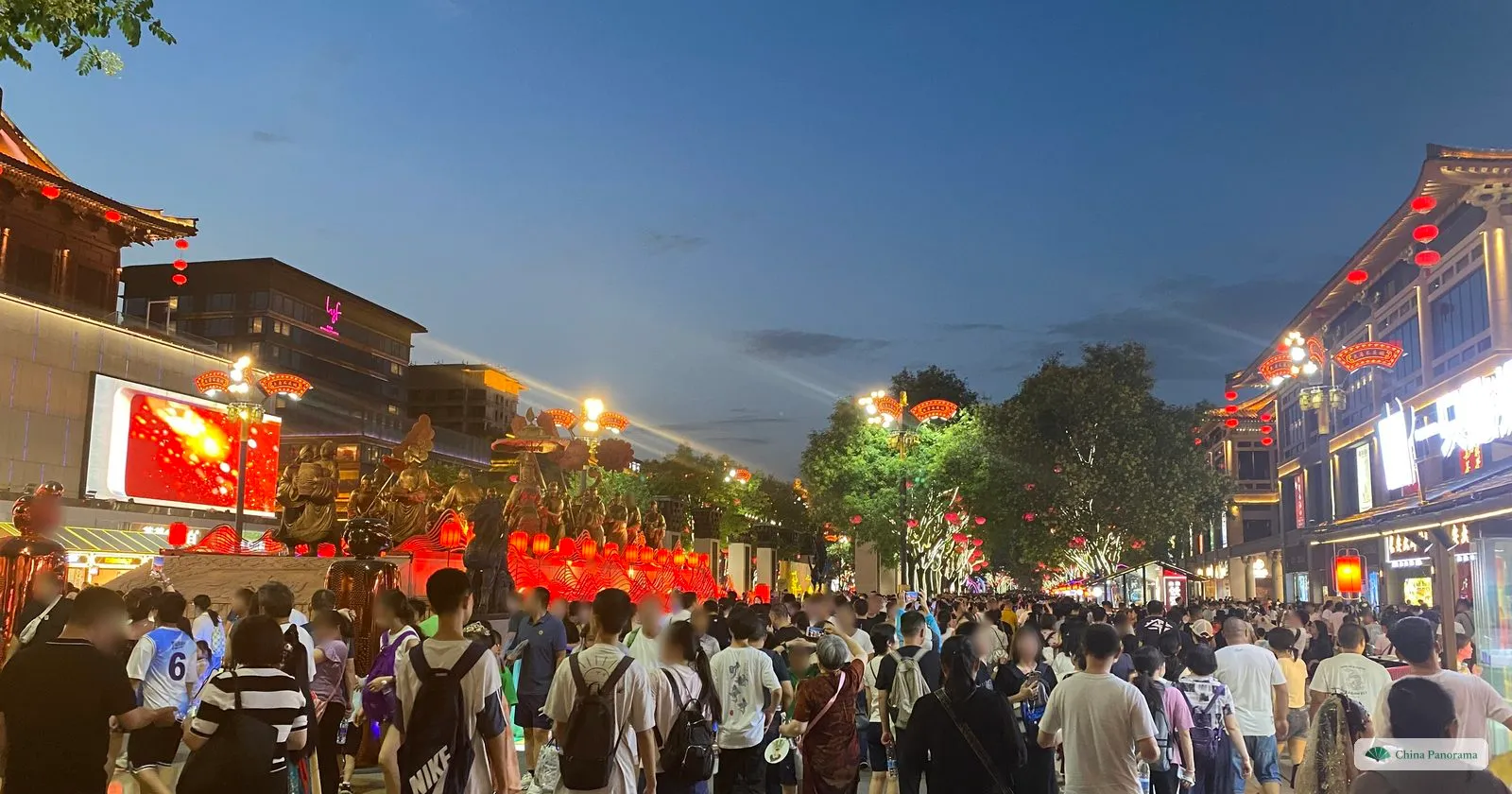
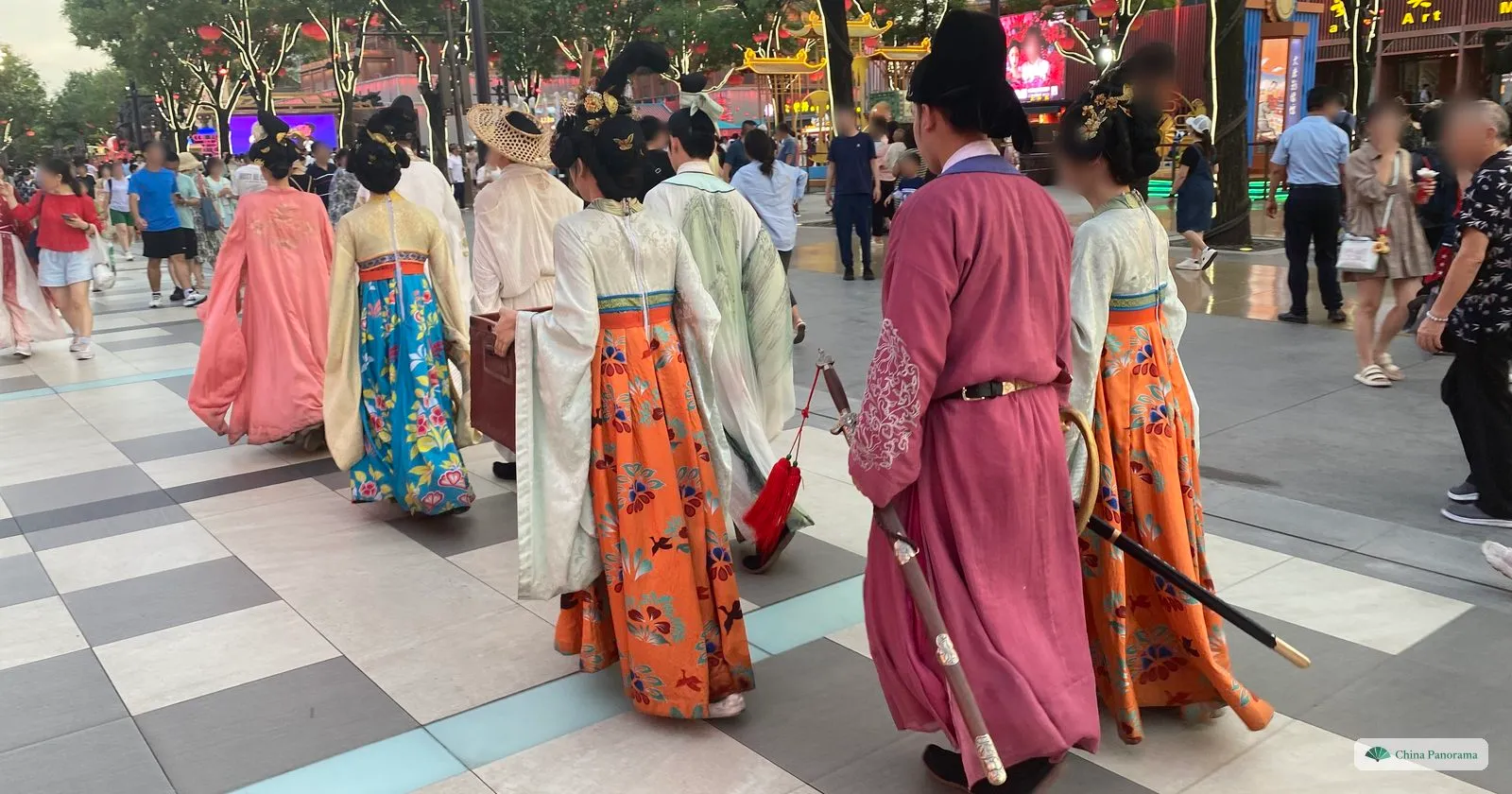
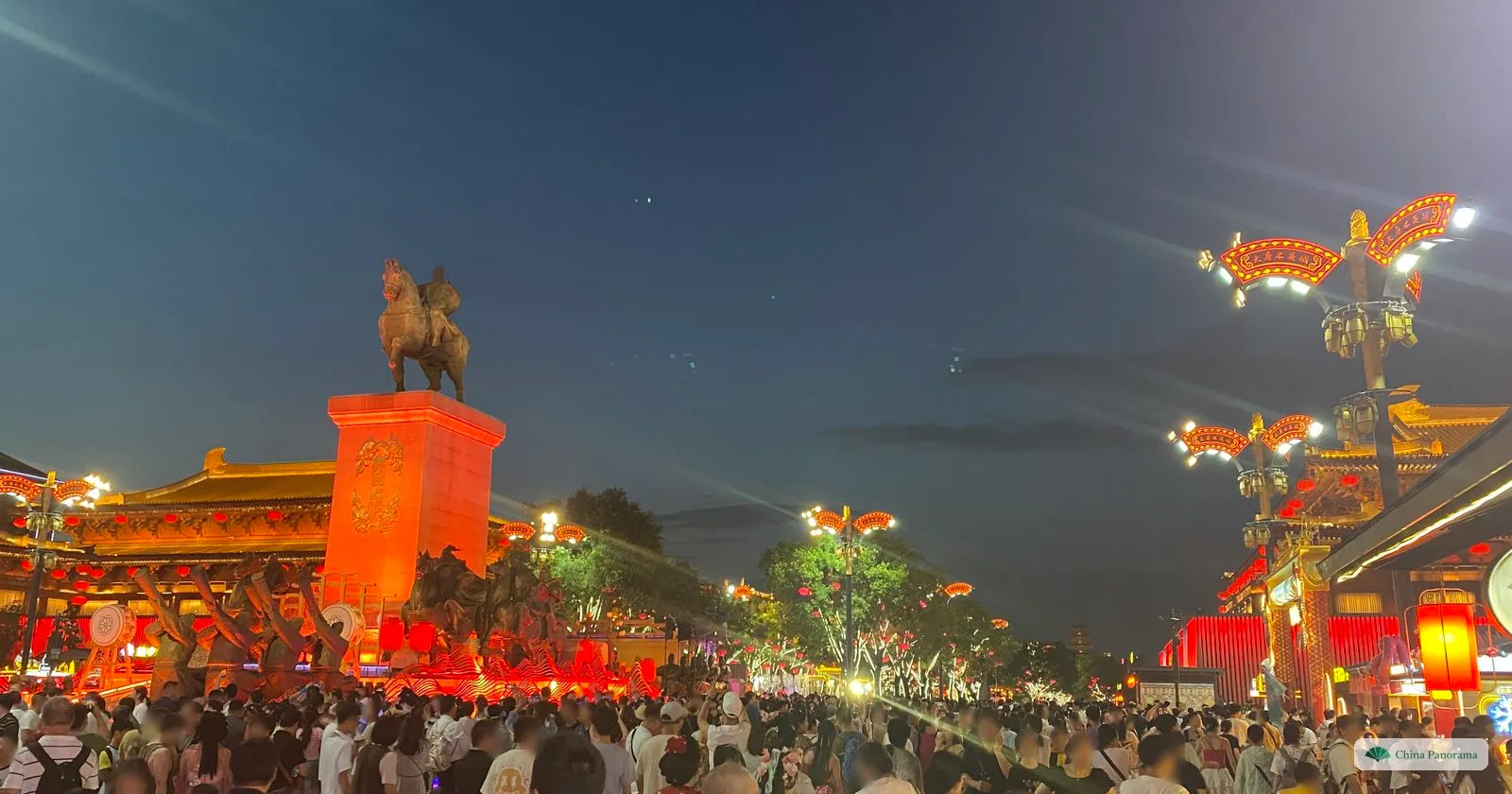
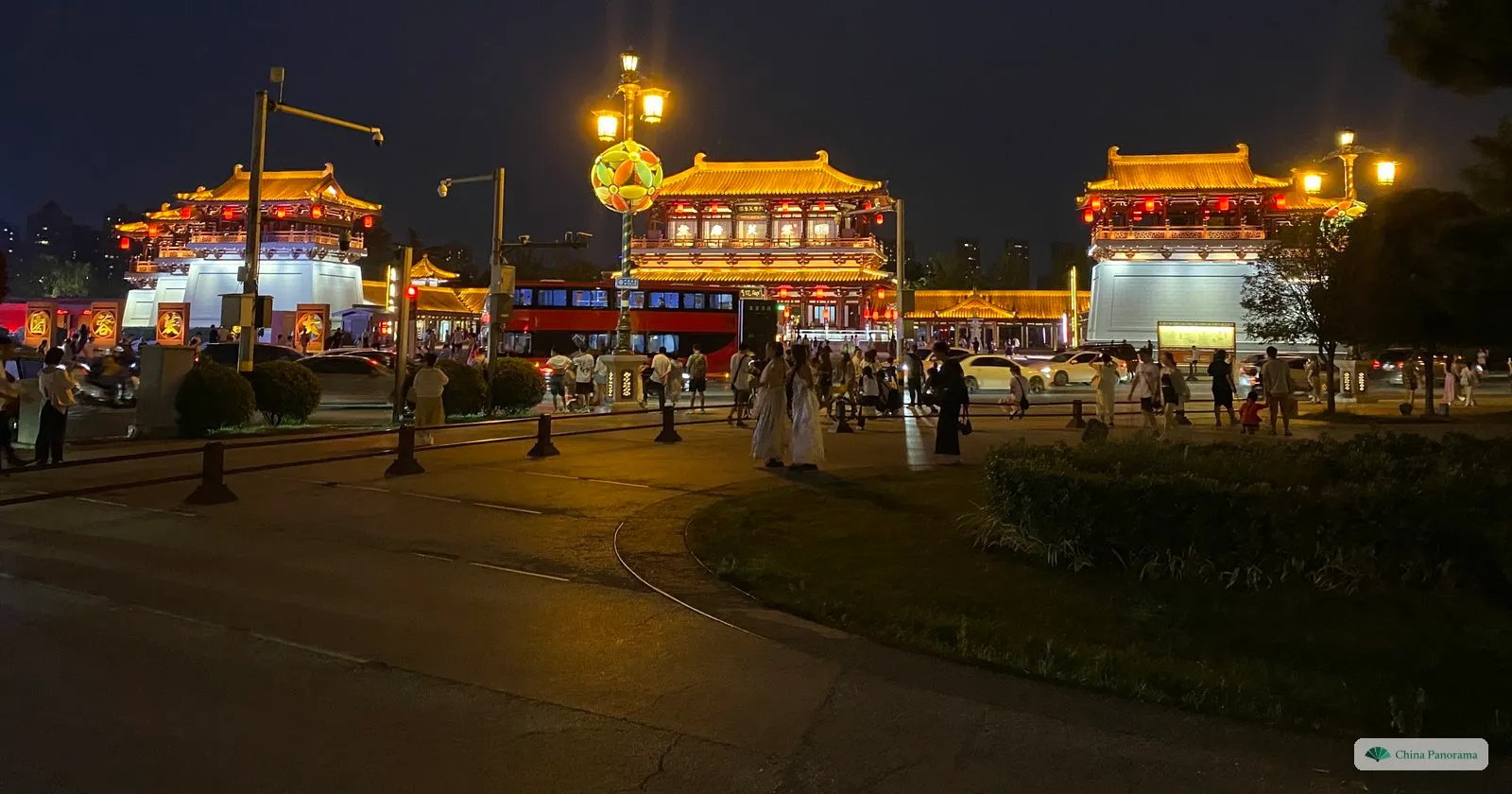
大唐不夜城StreetYanta · 雁塔区OutdoorsA pedestrian street 2.1 km long that runs due south from the Giant Wild Goose Pagoda, lined with Tang-style halls — a concert hall, an art museum, a theatre, shopping centres — with sculpture groups down the middle, among them an emperor on horseback on a tall column. It was built from 2002, opened in 2009 and refitted in 2018; the Chinese name means “the Tang city that never sleeps”, and English signs also call it the Great Tang All Day Mall. The point is the evening: every building is outlined in lights, street performers work fixed spots, and half the visitors are in rented Tang-dynasty dress being photographed. None of it is old, and nobody pretends otherwise — come for the crowd and the lights. Our photographs run from the last daylight to full dark on a June evening in 2024.
Dayanta station (Lines 3 and 4) at the north end, then round the pagoda precinct to the South Square, where the mall begins. Free and open at all hours; the lights come on at dusk. It is packed on summer evenings and at holidays — agree a meeting point. Performance times and places change with the season.
- Entry
- Free
- Opening hours
- Open at all hours
Tang Paradise
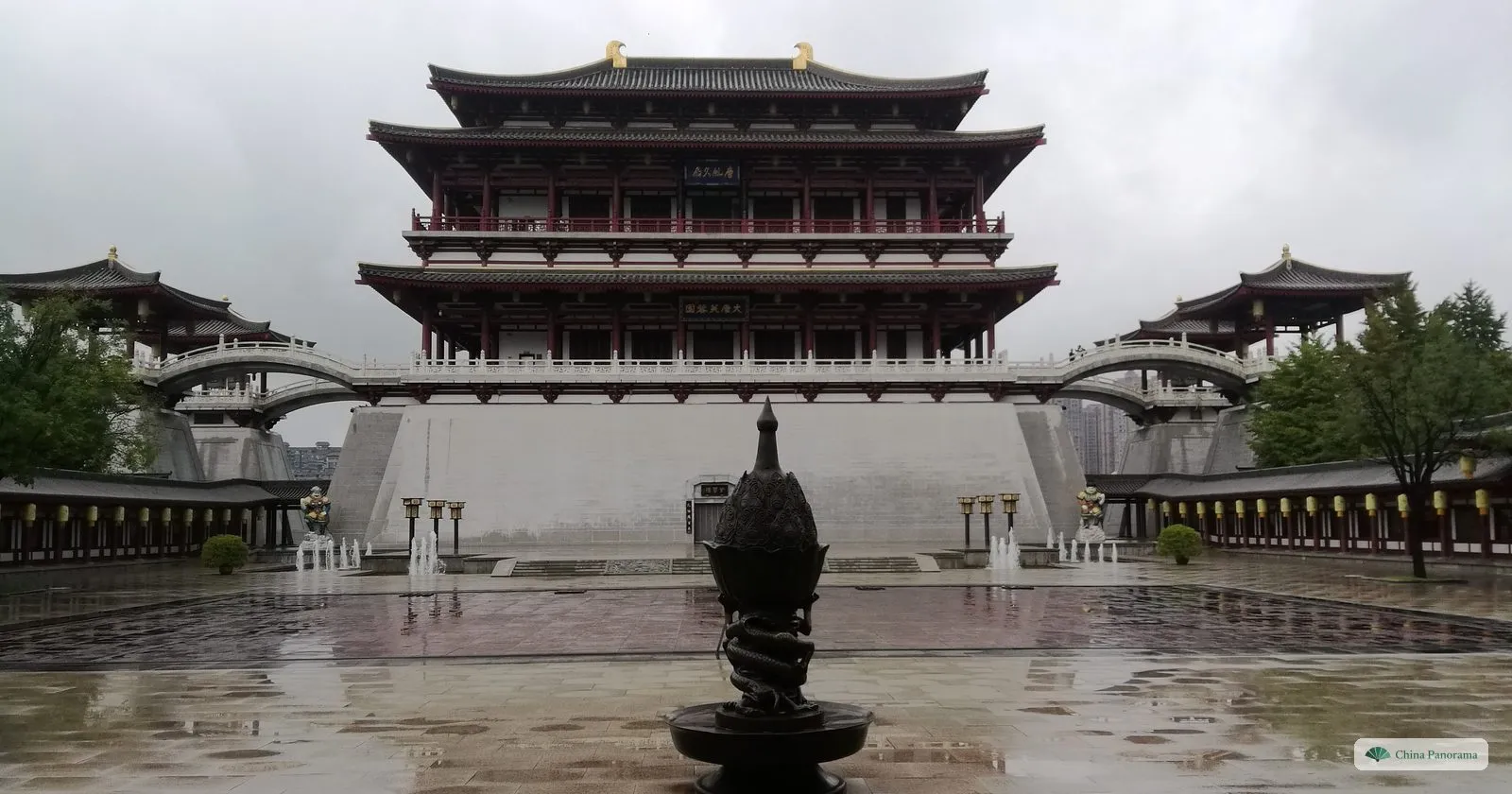
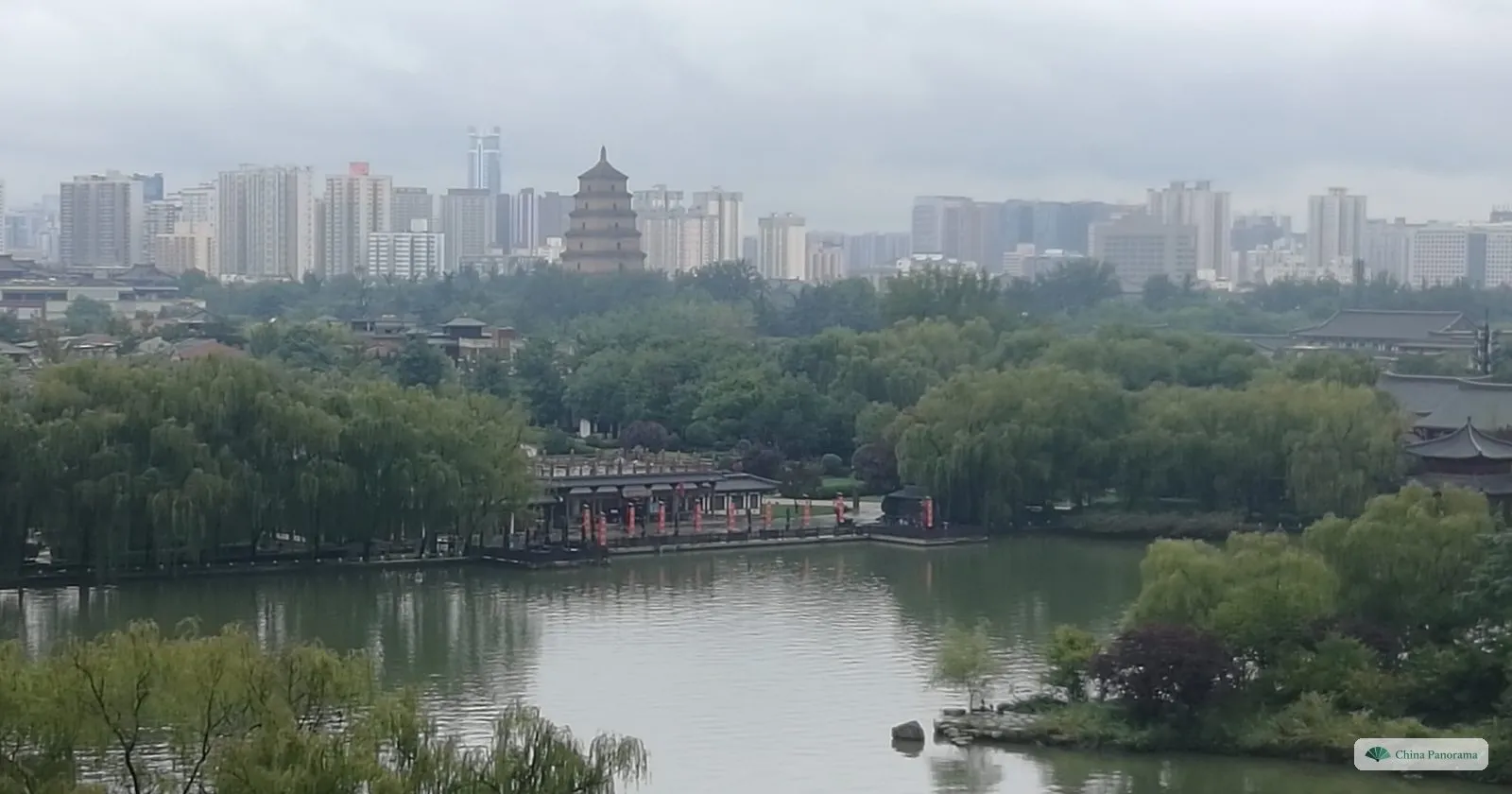
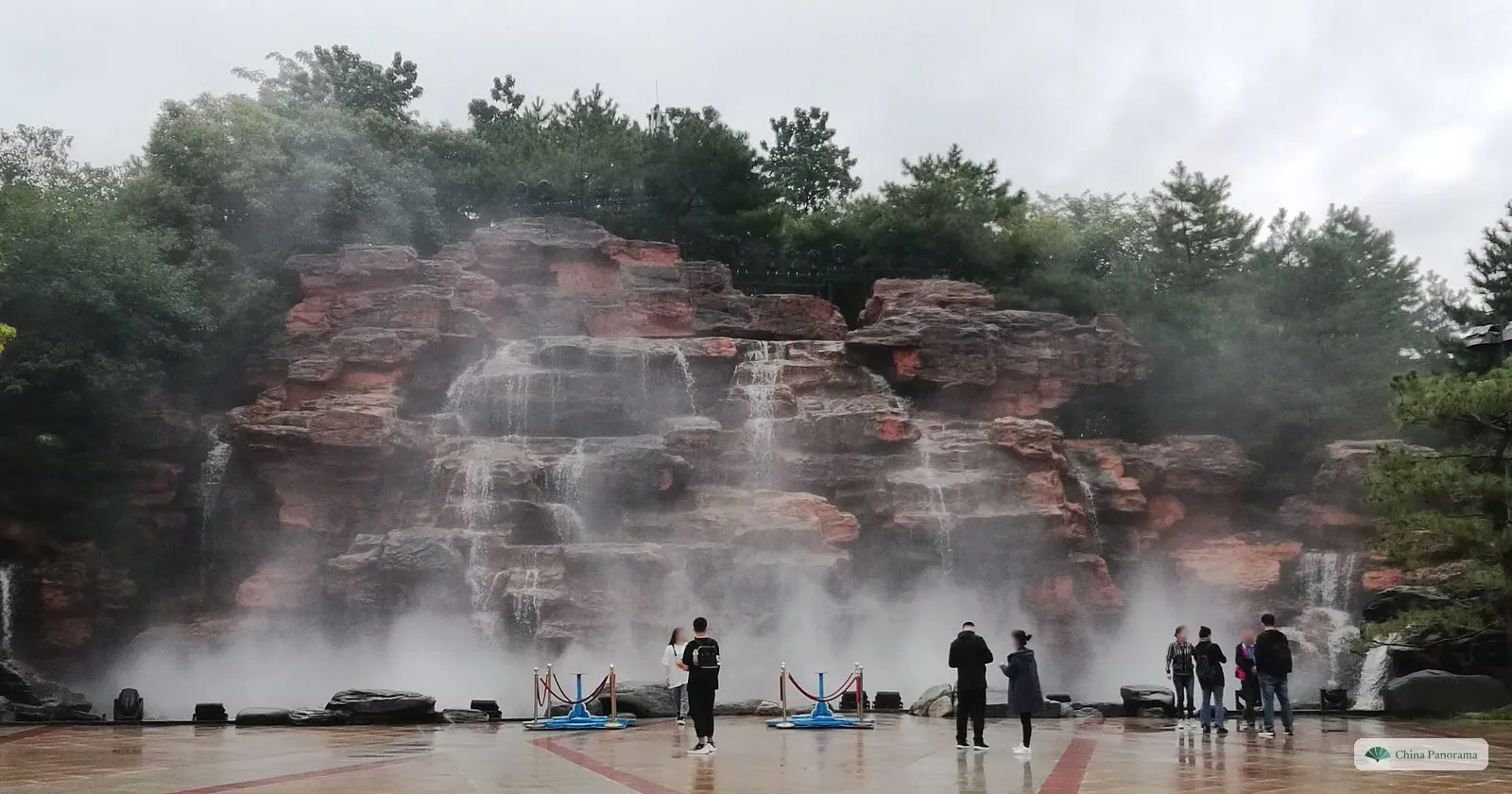
大唐芙蓉园ParkYanta · 雁塔区OutdoorsA park in Tang-dynasty style around a large lake, opened in 2005 close to the site of the Tang emperors' Furong Garden at Qujiang. The buildings are modern interpretations, not reconstructions, but the scale is palatial: the Ziyun Tower on its stone terrace, with arched bridges to the pavilions at its corners; a red pavilion on a boat-shaped base moored by the shore; a waterfall in a cloud of spray, willows and lotus. From the terrace of the Ziyun Tower you look across the lake to the Giant Wild Goose Pagoda — the one real Tang building in the view — standing in front of the apartment towers. We walked round the lake on a wet 28 September 2021 and had most of it to ourselves. After dark there is a water and light show on the lake.
Datangfurongyuan station (Line 4) is a few minutes from the west gate; from the pagoda's South Square it is 15 minutes on foot. Entry to the park is listed as free on the government's visitor portal (May 2026), with last entry at 21:30; the evening show and some attractions are ticketed separately, and we have not checked their prices.
- Entry
- Free
- Opening hours
- 09:00–22:00, last entry 21:30
Daming Palace National Heritage Park
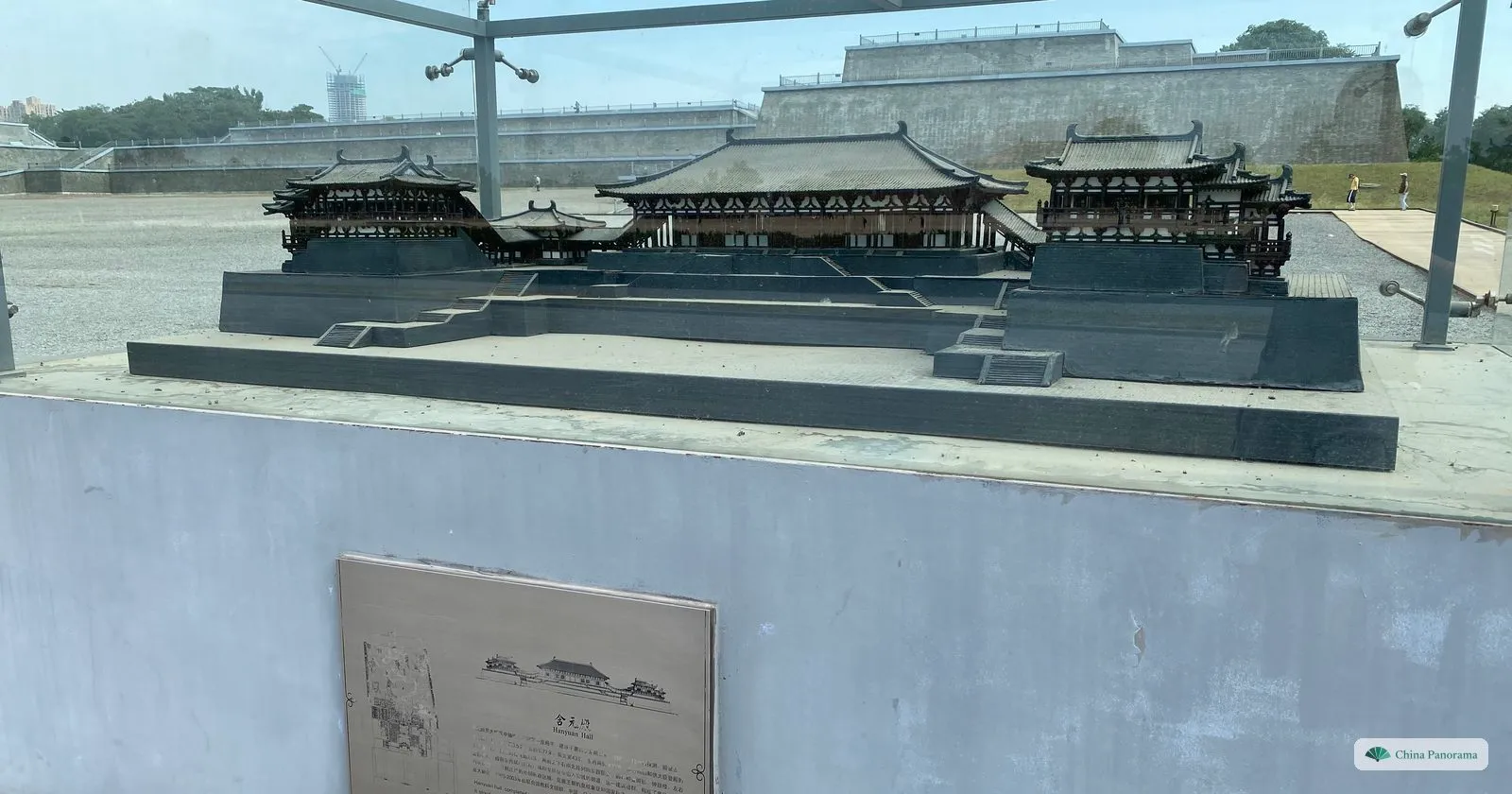
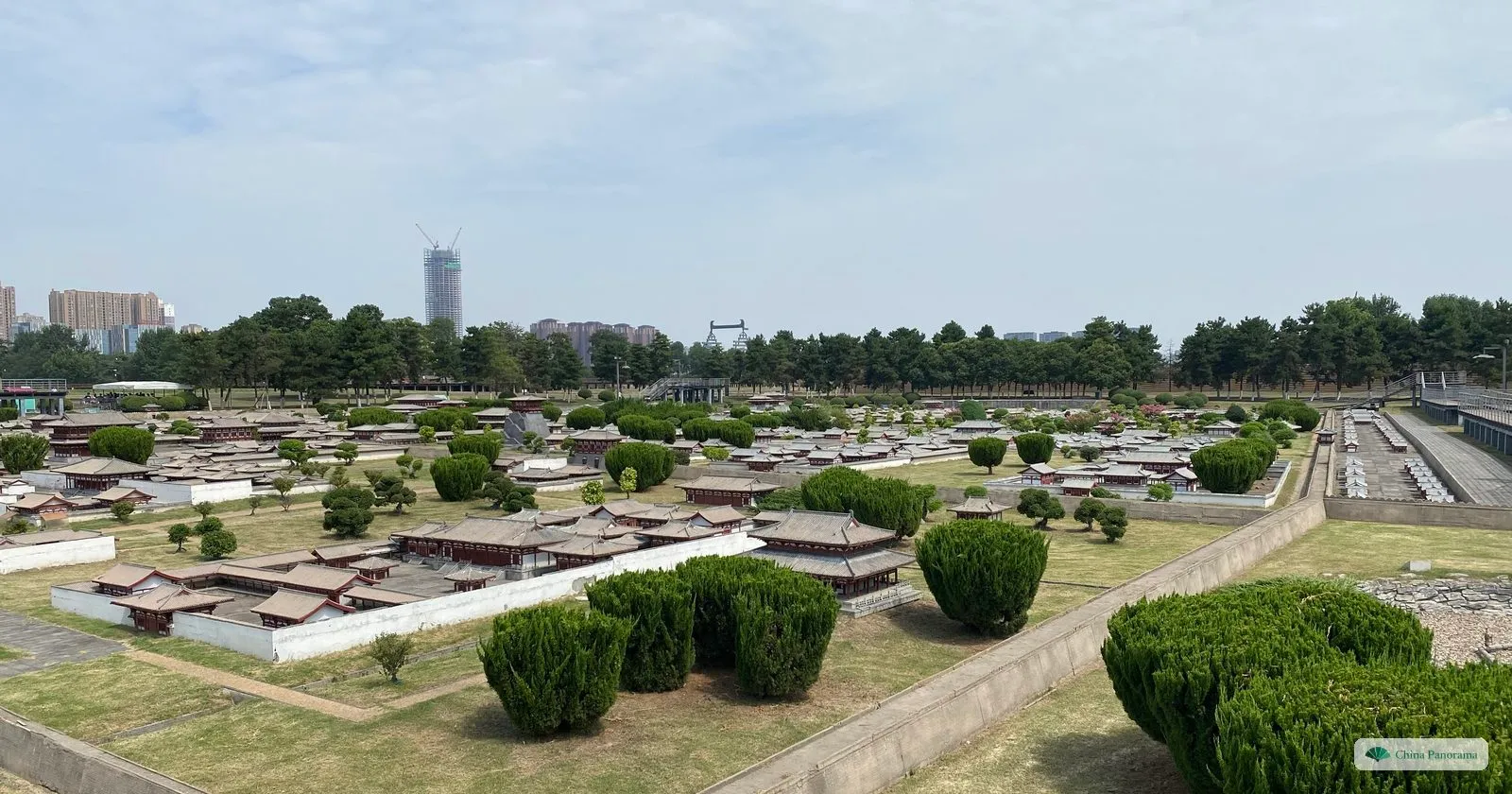
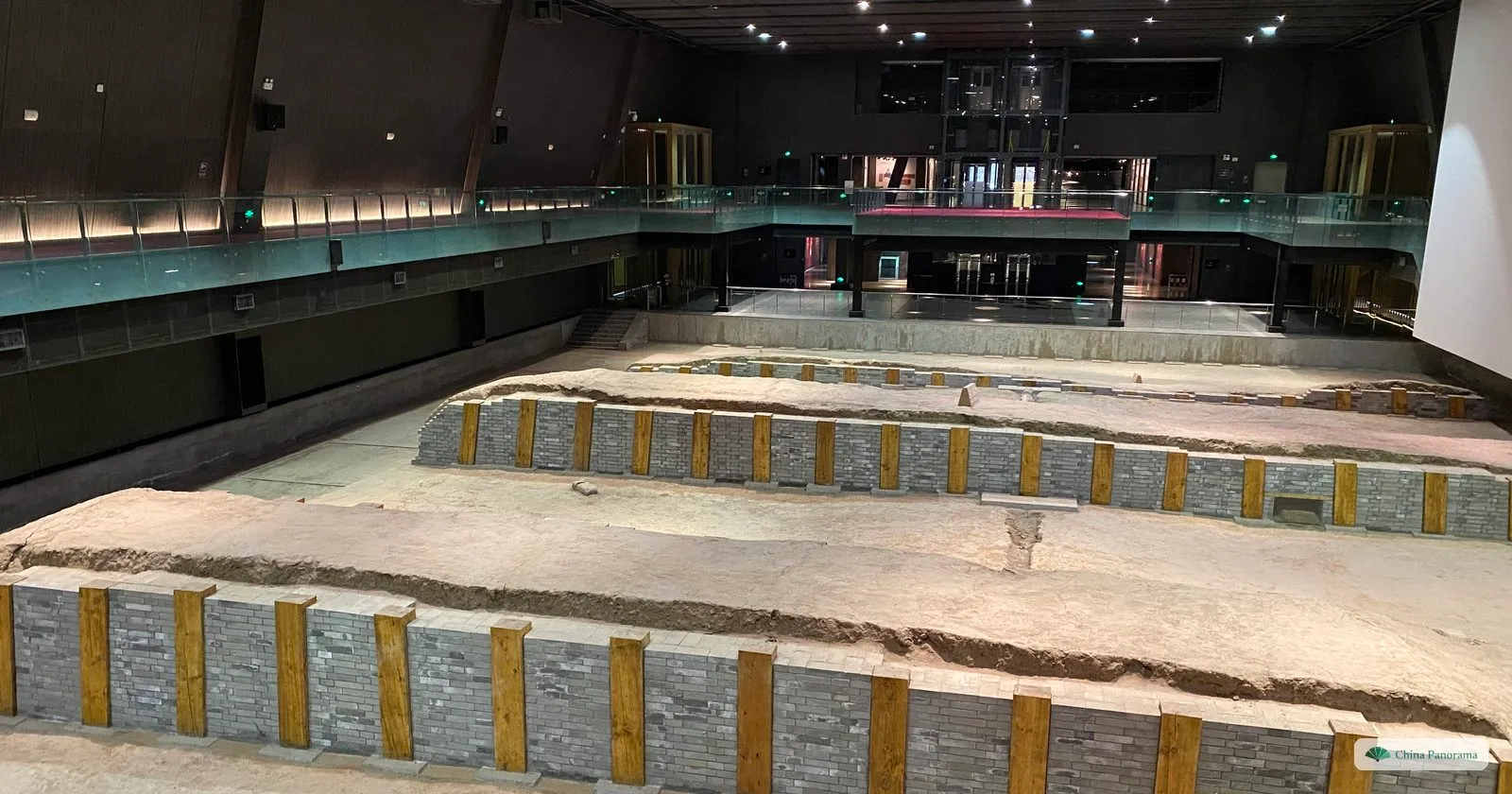
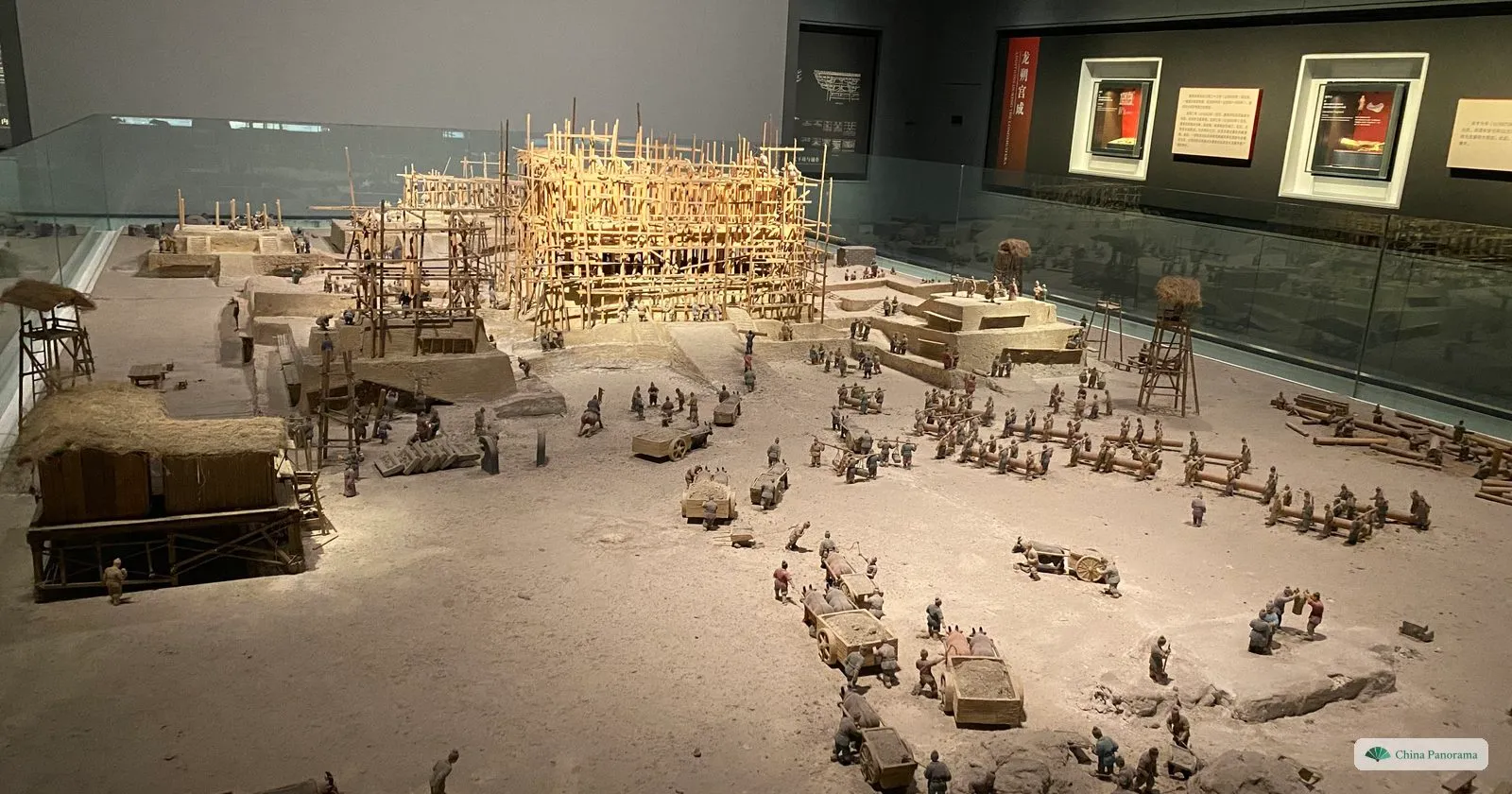
大明宫国家遗址公园Imperial heritageXincheng · 新城区OutdoorsThe site of the Tang emperors' main palace, begun in 634 and the seat of the court for more than 220 years, until it was destroyed at the end of the dynasty. It covered about 3.2 km² — several times the Forbidden City — and what is left is what survives of a timber palace after eleven centuries: platforms of rammed earth. The park, opened in 2010, shows them as they are. The terrace of Hanyuan Hall, the great audience hall, rises at the end of an empty parade ground — 200 m wide and 15 m high — with a bronze model in front of it showing what once stood on top. Danfeng Gate, the main south gate with its five gateways, has been rebuilt as a shell over its excavated foundations; a site museum explains how the palace was built; and an outdoor miniature lays out the whole complex, hall by hall. It is a place for people who like ruins and space: little shade, few visitors. Part of the Silk Roads World Heritage Site since 2014.
The paid core area is entered at Danfeng Gate, at the south end, just north of Xi'an railway station; Metro Line 4 stops along the east side of the park (Hanyuandian and Daminggong). 60 CNY — what we paid on 28 June 2024, and the price on the government's visitor portal in May 2026. The outer parts of the park are free. Distances are long: about 700 m from the gate to Hanyuan Hall alone. Bring water and a hat in summer.
- Entry
- 60 CNY · paid core area; the outer park is free
- Opening hours
- 08:30–18:00
Tang West Market
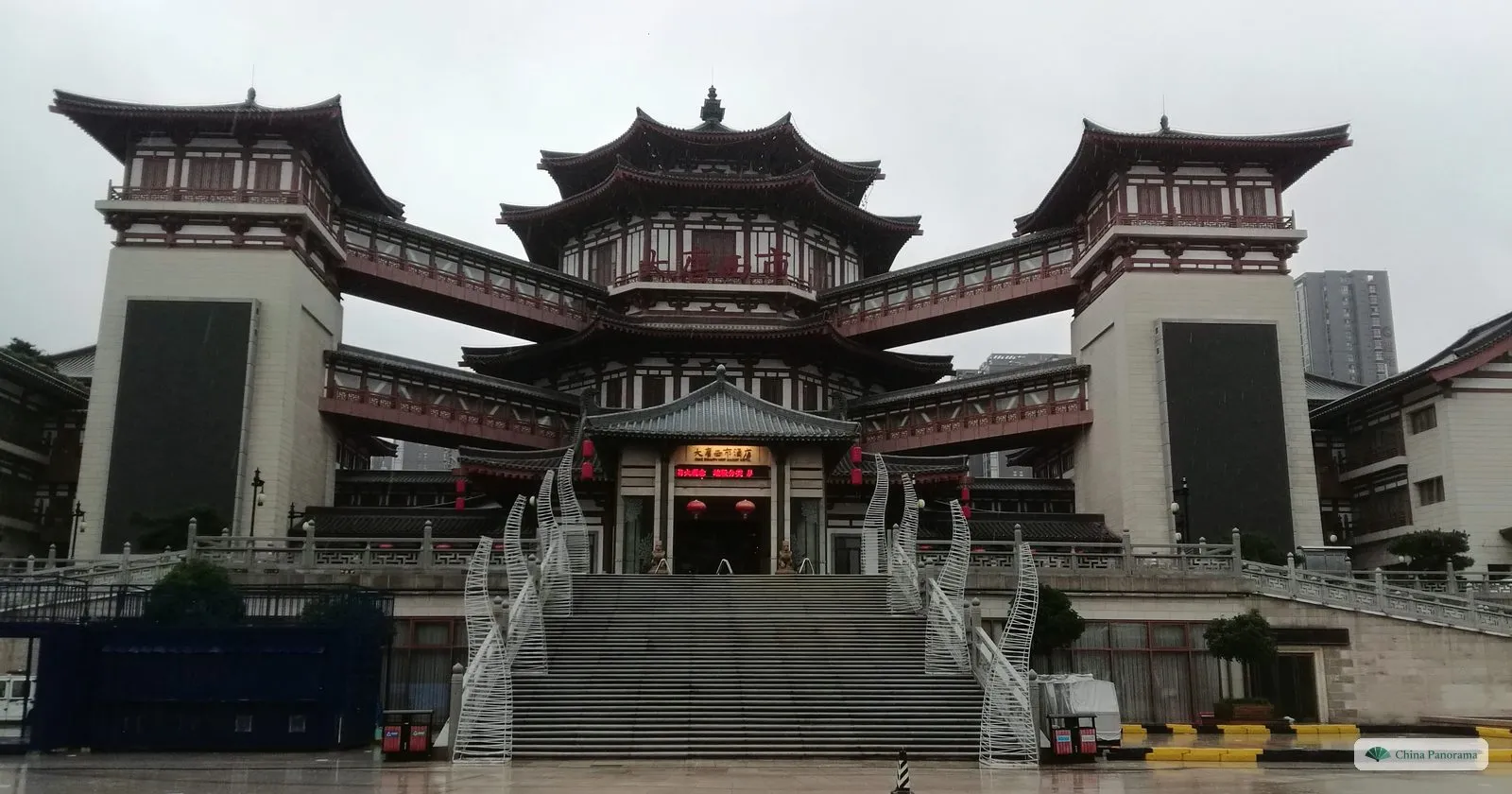
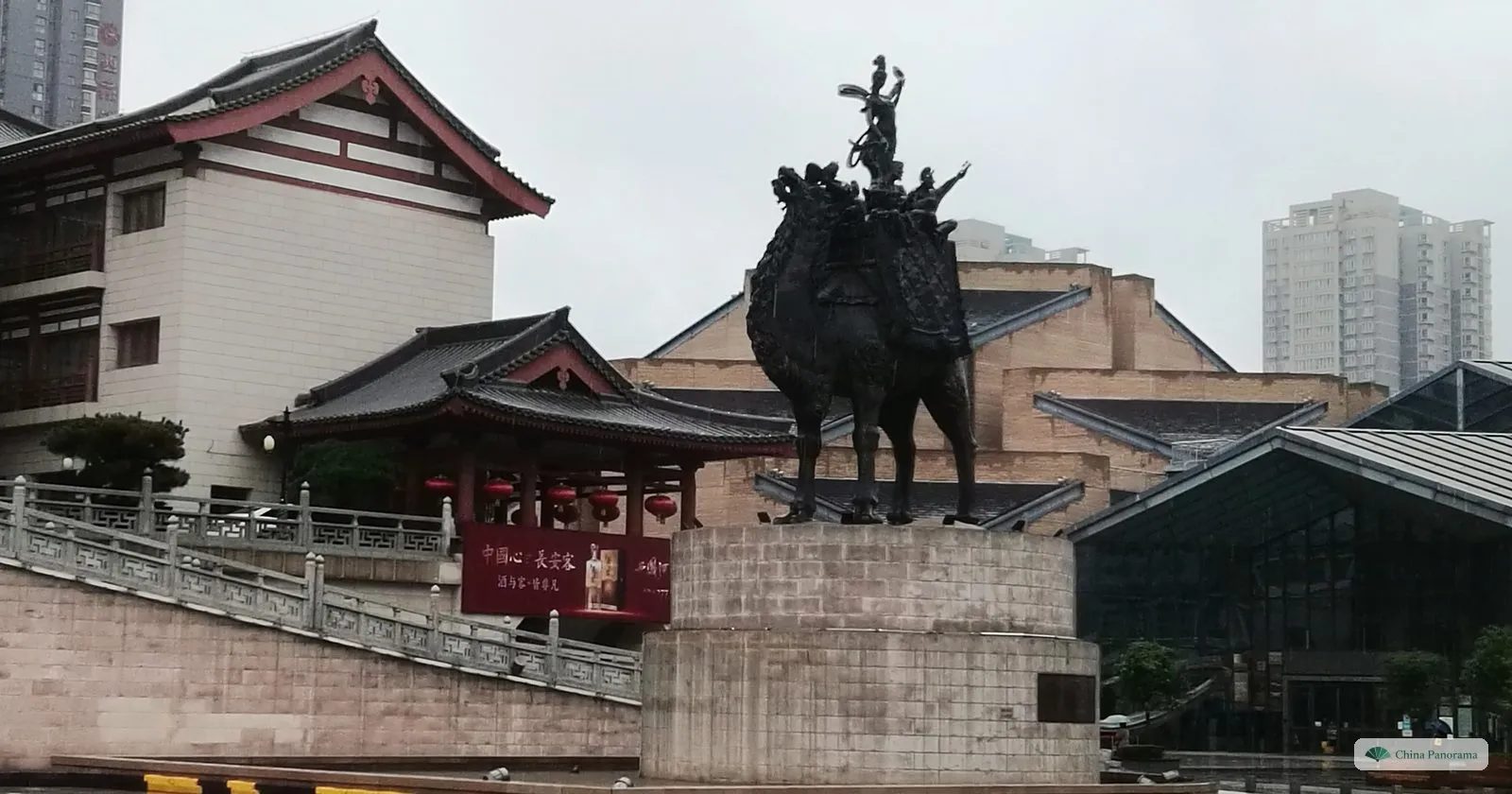
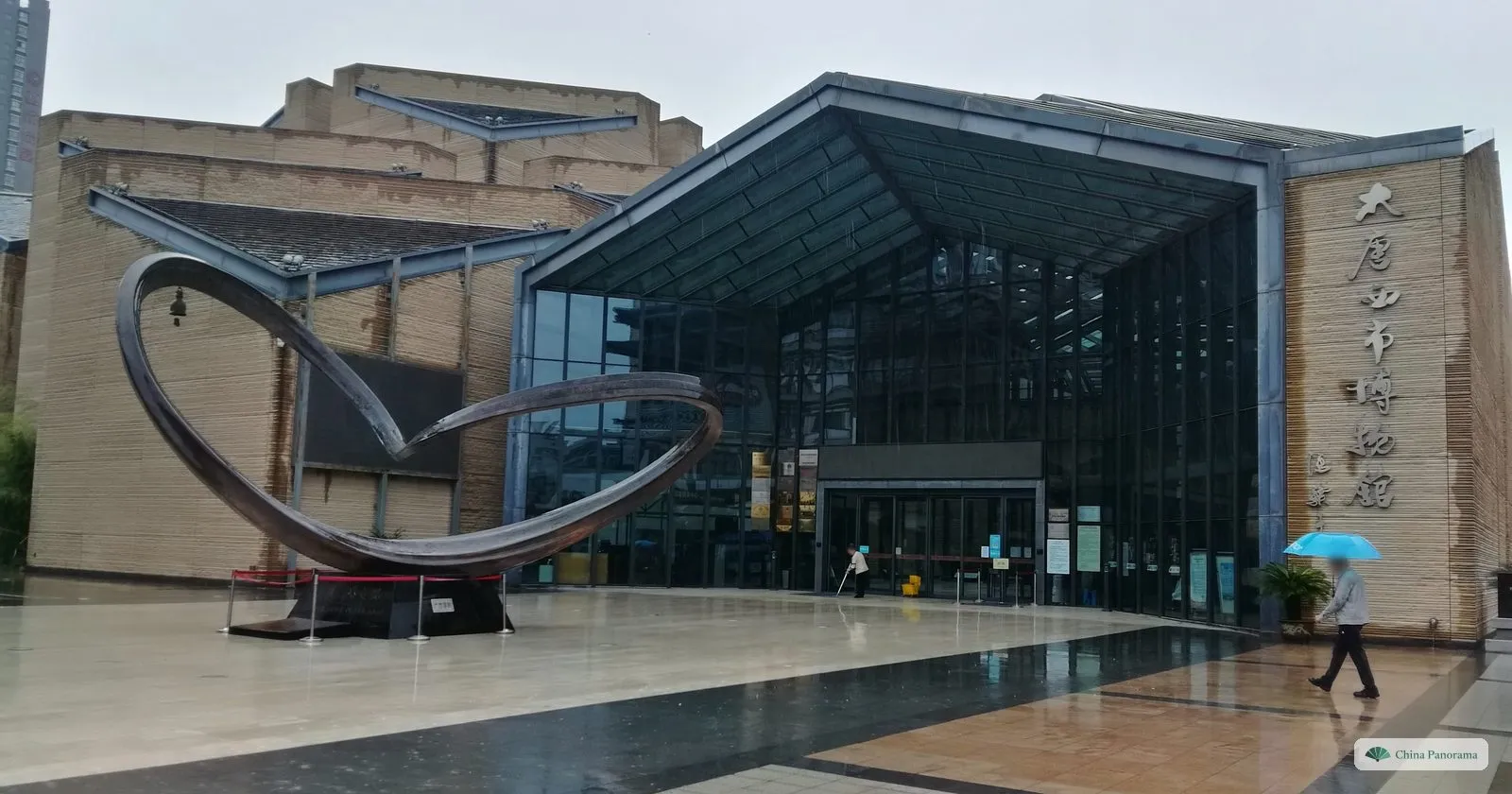
大唐西市MarketLianhu · 莲湖区OutdoorsA shopping and museum quarter in Tang style, built over the site of the West Market of Tang Chang'an — the market where the caravans of the Silk Road traded. A bronze camel carrying a troupe of musicians stands at the entrance, and inside the quarter the privately run Tang West Market Museum is built over part of the excavated market site. We were there at half past eight on a rainy morning in September 2021, before anything had opened: large, quiet and rather empty. Worth an hour if the Silk Road is your subject; otherwise the least essential stop on this page.
Datangxishi station (Line 6), four stops west of the Bell Tower. The streets of the quarter are open and free; we have not checked the museum's hours or entry.
- Entry
- Free
- Opening hours
- Hours not verified — check on site
Huyi Bell Tower
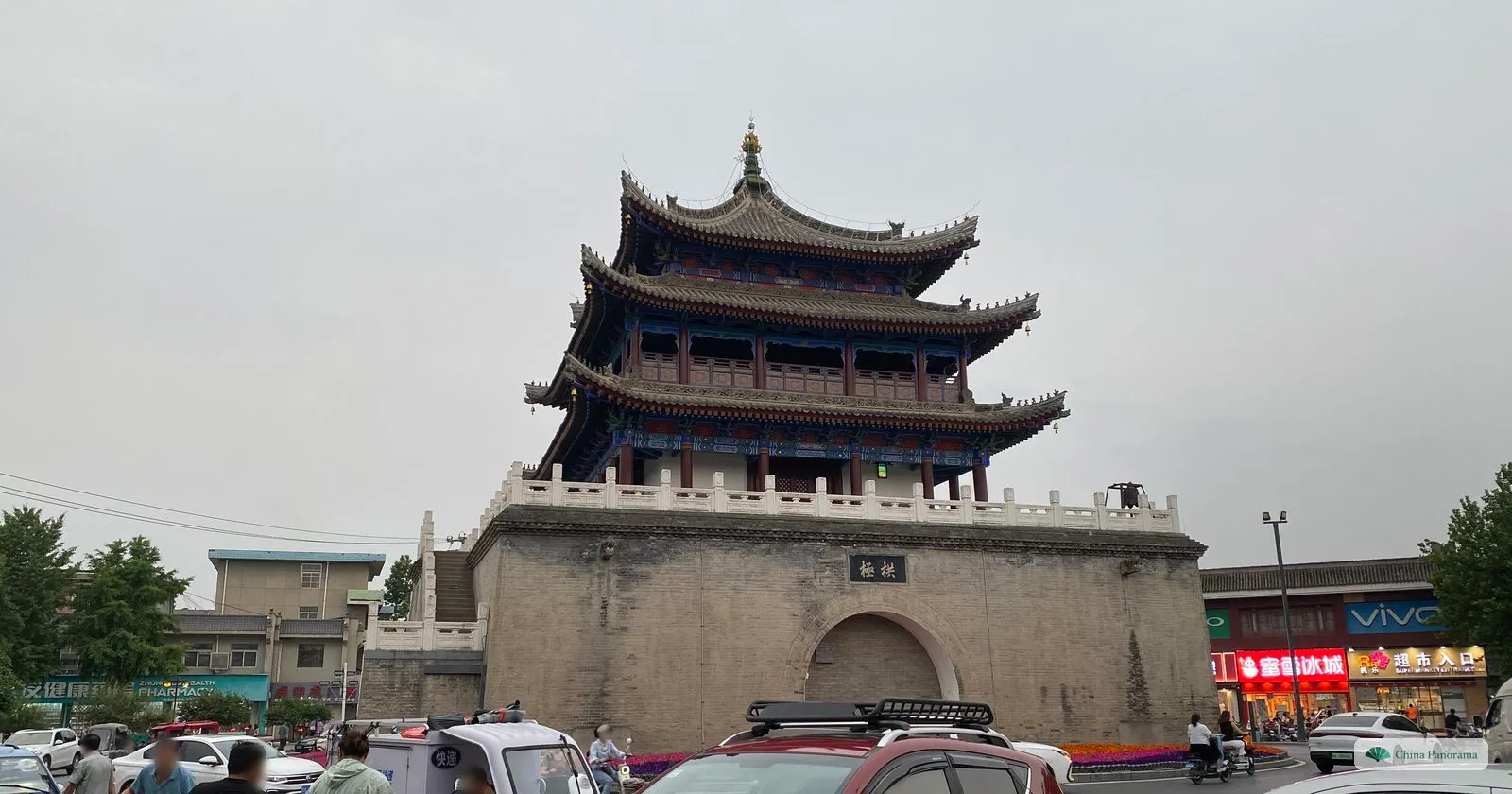
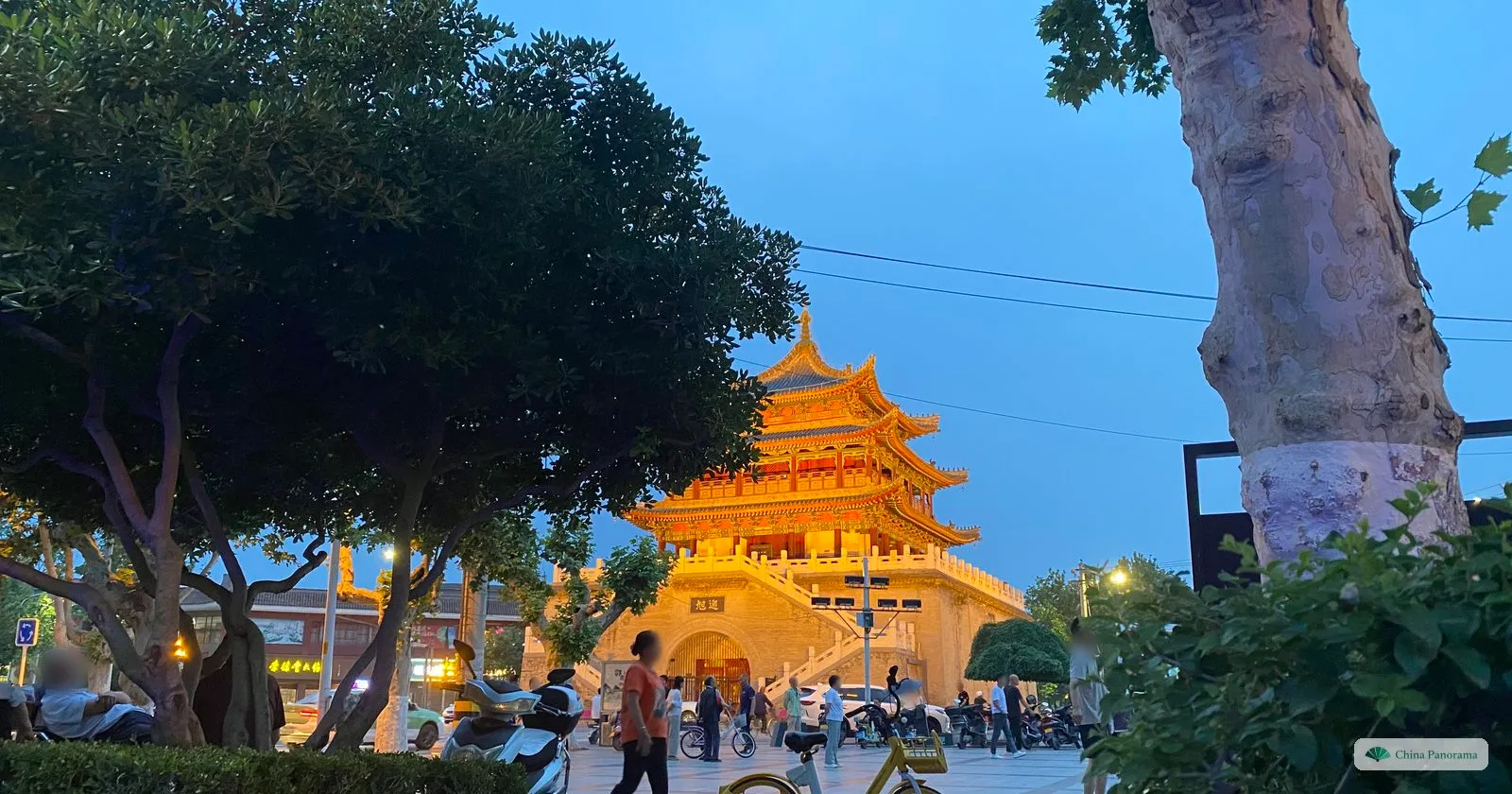
鄠邑区钟楼LandmarkHuyi · 鄠邑区OutdoorsA timber tower with three tiers of eaves on a brick base, at the central crossroads of Huyi, a district town south-west of Xi'an. It was built in 1635 by the county magistrate, on the pattern of the Bell Tower in the city, and first called the Wenchang Pavilion; after a repair in 1745 it was renamed the Daguan Tower, and locals simply call it the Middle Tower. It is 24.55 m high, 6.40 m of that the base. The plaques over the four gateways name the four directions: 迎旭, “welcoming the sunrise”, on the east; 览胜 on the south; 瞻紫 on the west; and 拱极, “facing the pole star”, on the north. It stands in the middle of a busy junction, ringed by flower beds and traffic, and after dark above a square where locals sit under the trees; at dusk it is floodlit in gold. The same idea as the Bell Tower in the city, without the crowds.
About 36 km south-west of the Bell Tower in a straight line, or roughly 43 km by road; the tower is at the central crossroads of Huyi, so you cannot miss it. Looking at it from the street is free at any hour. We have not checked how to get there by public transport, or whether the tower can be entered.
- Entry
- Price not verified — check on site
- Opening hours
- Hours not verified — check on site
- FoodLianhu · 莲湖区Outdoors
The lanes north and west of the Drum Tower, home to Xi'an's Hui Muslim community and the city's best-known place to eat in the street: lamb skewers, roujiamo — chopped meat in a flat bread —, cold liangpi noodles, persimmon cakes and yangrou paomo, a mutton soup into which you crumble unleavened bread. Beiyuanmen, the main street, is loud and crowded from late afternoon; the side lanes are calmer. The Great Mosque, laid out like a Chinese temple with courtyards and pavilions, is hidden in the lanes behind.
Go in under the Drum Tower, about five minutes' walk from Zhonglou station (Lines 2 and 6). The streets are free and busiest in the evening. Stalls expect Alipay or WeChat Pay: have one of them set up, or carry small notes. We have not checked the Great Mosque's entry price or hours.
- Entry
- Free
- Opening hours
- Open at all hours
Shaanxi History Museum
陕西历史博物馆MuseumYanta · 雁塔区IndoorsThe province's main museum, opened in 1991 a short walk north-west of the Giant Wild Goose Pagoda, and the place to see what came out of the ground around Xi'an: Zhou bronzes, figures from the Qin emperor's tomb, gold and silver from Tang hoards and murals from Tang tombs. It is the best single preparation for — or follow-up to — the Terracotta Army. It is also the hardest ticket in town.
Xiaozhai station (Lines 2 and 3), then about ten minutes on foot to the east. Entry is free but only with a timed reservation, released a few days ahead through the museum's official WeChat account and gone within minutes in high season (reported: five days ahead, at 17:00). Closed on Mondays except public holidays. Whether the booking page accepts a foreign passport without help is something we have not tested — ask your hotel to book.
- Entry
- Free
- Opening hours
- Hours not verified — check on site
Entry prices and opening hours are marked unverified where we have not checked them against an official source. We would rather show a gap than a number we made up.
Routes and day trips
The thing most people come for is not in the city at all: the Terracotta Army is 34 km east of the Bell Tower. The Huyi Bell Tower is 36 km the other way, to the south-west, and the airport lies to the north-west. Tap a place to see how far it is from the centre.
Tap a place on the map or in the list.
Xi’an Xianyang International Airport, across the Wei River. Metro Line 14 runs to Xi’an North, the high-speed station 13 km north of the Bell Tower.
In Lintong district; about 40 km by road. Metro Line 9 to Huaqingchi, then 8 km by bus or taxi. Details below ↓
In Huyi district town, south-west of the centre; about 43 km by road. Built on the pattern of the Bell Tower in the city. Details below ↓
Straight-line distances from the Bell Tower, rounded — not driving distances.
Three routes that don’t double back
Two in the city and one day trip. The city routes are the walks in our photographs, with the time and distance between stops; each runs in one direction.
Half a day · about 4.5 km on foot
Bell Tower
Walk 13 min· 1 km
Shuyuanmen
Walk 10 min· 750 m
The wall at Wenchang Gate
Walk 37 min· 2.7 km
East Gate (Changle Gate)
4 stops · 60 min walking
Afternoon into evening · about 2.6 km on foot, plus the mall
North Square fountain
Walk 9 min· 700 m
Daci'en Temple and the pagoda
Walk 15 min· 1.15 km
Tang Paradise
Walk 10 min· 720 m
Grand Tang Mall
4 stops · 34 min walking
A day · Metro Line 9, then 8 km by bus or taxi
Huaqingchi station
Taxi 10 min· 8.2 km
Pit 1
Pit 3
Pit 2 and the showcases
Taxi 10 min· 3.9 km
Lishan Garden and the emperor's tomb mound
5 stops · 20 min by taxi
Stop by stop
Inside the wall: Bell Tower to the East Gate
The walk in our June 2024 photographs, under a cloudless sky: from the Bell Tower down to the calligraphy street, out to the wall near Wenchang Gate and along it to the East Gate. Go up onto the wall at Wenchang Gate for the view, or stay below in Shuncheng Lane for the shade. In summer, start early.
1Bell Tower
钟楼Come up from Zhonglou station through the underpass, walk round the tower once, then leave by South Street.
- Entry
- Free to look at; going up not verified
- Hours
- Not verified
Walk 13 min· 1 km
2Shuyuanmen
书院门Turn left off South Street just before the South Gate, under the painted archway. The Stele Forest Museum is towards the far end.
- Entry
- Free
- Hours
- Street open at all hours
Walk 10 min· 750 m
The wall here stands at its full height, with a tower above and bronze street scenes at its foot; the moat park is just outside the gate. This is one of the gates where you can go up.
- Entry
- Wall ticket not verified
- Hours
- Not verified
Walk 37 min· 2.7 km
Along the wall or the lane below it, round the south-east corner. Walk through the barbican's two archways to see how the defences worked; Changlemen station (Line 6) is just outside.
- Entry
- Free to walk through
- Hours
- Open at all hours
Easy add-ons: The Drum Tower and the Muslim Quarter are five minutes west of the first stop. The Stele Forest Museum is at the east end of Shuyuanmen. A full circuit of the wall is 13.7 km — most people do it by rented bicycle.
* Walking times and distances in the two city routes are computed from OpenStreetMap walking routes between the stops; taxi legs are OpenStreetMap driving times without traffic — allow about double at busy times. Clock times are from our own photographs (28 September 2021 and June 2024). Stops marked with a star have prices or opening hours we have not checked.
Getting there and getting around
By air
Xi'an Xianyang International Airport (XIY) is about 26 km north-west of the Bell Tower, across the Wei River in Xianyang. Terminal 5 opened in February 2025 and has its own station on Metro Line 14, Airport (T5); the older terminals use Airport West (T1, T2, T3). Line 14 runs to Xi'an North railway station, where you change to Line 2 for the Bell Tower or Line 4 for the pagoda. We have not timed the ride or checked the fare.
Schedules and journey times not yet verified against an official timetable.
By high-speed train
Xi'an North is on the high-speed lines to Beijing, to Zhengzhou and Shanghai, to Chengdu and to Lanzhou. It is about 13 km north of the centre, on Metro Lines 2, 4 and 14. Tickets name the station — Xi'an North or Xi'an — and the two are about 11 km apart. We have not checked journey times against the 12306 timetable.
Schedules and journey times not yet verified against an official timetable.
Nonstop from Europe
Our flight list has nonstop routes to Xi’an from 5 European airports: Budapest, London Heathrow, Milan, Paris, Vienna. Airlines and frequencies →
Flight data checked 12 September 2026.
Two stations called Xi’an
Your train ticket will name one of these. They are far apart.
- Xi'an North 西安北站The high-speed station, about 13 km north of the Bell Tower: trains from Beijing, Shanghai, Chengdu and Luoyang arrive here. Metro Lines 2, 4 and 14 — Line 2 runs straight to the Bell Tower, Line 14 to the airport.
- Xi'an 西安站The old main station, just outside the north wall of the old city and directly south of Daming Palace, on Metro Line 4 (Xi'anzhan). A different place from Xi'an North: check which one your ticket names.
The metro, in short
How Chinese metros work →Twelve lines and about 422 km at the end of 2025. Four matter to visitors: Line 2 runs north–south from Xi'an North station through the Bell Tower and the South Gate; Line 4 links Xi'an North, Daming Palace, Xi'an station, the Giant Wild Goose Pagoda and Tang Paradise; Line 14 goes to the airport; and Line 9 runs east to Lintong, for the Terracotta Army.
- Lines
- 1 · 2 · 3 · 4 · 5 · 6 · 8 · 9 · 10 · 14 · 15 · 16
- Fare from
- 2 CNYfirst 6 km
- Network
- 246 stationsabout 422 km
- Pay with
- Alipay or WeChatforeign cards not confirmed
Pay with the transport code in Alipay or WeChat, or buy a single-journey ticket at a machine. Whether the gates take foreign contactless credit cards, as in Beijing and Shanghai, is something we have not been able to confirm.
Fares by distance: 2 CNY up to 6 km, 3 CNY up to 10 km, 4 CNY up to 14 km, 5 CNY up to 20 km, 6 CNY up to 26 km. Beyond 26 km, 1 CNY more for every further 8 km.
First and last trains differ by line and station; we have not checked them against the operator's timetable — look at the display in the station.
| Bell Tower, Drum Tower, Muslim Quarter | Zhonglou 钟楼 | Line 2/6 |
| City Wall at the South Gate, Shuyuanmen | Yongningmen 永宁门 | Line 2 |
| City Wall at the East Gate | Changlemen 长乐门 | Line 6 |
| Giant Wild Goose Pagoda, North Square, Grand Tang Mall | Dayanta 大雁塔 | Line 3/4 |
| Tang Paradise | Datangfurongyuan 大唐芙蓉园 | Line 4 |
| Shaanxi History Museum | Xiaozhai 小寨 | Line 2/3 |
| Daming Palace | Hanyuandian 含元殿 | Line 4 |
| Tang West Market | Datangxishi 大唐西市 | Line 6 |
| Terracotta Army (then bus or taxi, 8 km) | Huaqingchi 华清池 | Line 9 |
| High-speed trains | Xi'an Beizhan 西安北站 | Line 2/4/14 |
| Airport, Terminal 5 | Airport (T5) 机场(T5) | Line 14 |
Official station names are in pinyin rather than translated — Zhonglou for the Bell Tower, Dayanta for the Giant Wild Goose Pagoda — which is how they are listed here. Match the Chinese characters if in doubt.
Source and date: Fare bands: press reports on the opening of Line 15 (The Paper, December 2025). Network size (12 lines, 246 stations, 422 km): Xi'an's 2025 public-works report, January 2026 — reported, not checked against the operator. Station names and lines: the Wikipedia line articles, read on 30 September 2026. First and last trains: not checked.
Xi’an is one of the cities we price up on the trip cost calculator, if you want to model a budget.
Before you go
Most European passports are visa-free for a short trip — under a one-sided waiver with an end date worth checking before you book:
- UK passport
Visa-free up to 30 days per trip, currently until 31 December 2026.
- EU passports
Dutch, German, French, Irish, Nordic and most other EU passports: visa-free up to 30 days, currently until 31 December 2026.
- US passport
No general waiver: a visa, or the 10-day visa-free transit if you fly on to a third country.
China’s 10-day visa-free transit applies at designated entry ports, for travellers continuing to a third country. Check your passport.
- Pre-trip checklist
Payments, SIM, apps — the things to sort before you fly.
- How to order food
Scan-to-order menus and paying at a stall — you will need both in the Muslim Quarter.
- Golden Week 2026
1–7 October: the week to avoid the Terracotta Army and the city wall.
- Beijing
The Ming and Qing capital, about 910 km to the north-east — the usual pairing with Xi’an.
FAQ
Is Xi’an worth visiting?
Yes. It is the one place in China where the early empire is something you can stand in front of: the Terracotta Army of the first emperor, a complete Ming city wall you can walk or cycle round, and a pagoda from 652 that Tang-dynasty pilgrims climbed. It is also a good city to eat in, and compact — the wall, the Bell Tower and the Muslim Quarter are all within a kilometre or two of each other.
How many days do you need in Xi’an?
Three. One day for the Terracotta Army, which is in Lintong, outside the city; one for the walled city — Bell Tower, Shuyuanmen, the wall; and one afternoon and evening for the Giant Wild Goose Pagoda, Tang Paradise and Grand Tang Mall.
How far is the Terracotta Army from Xi’an?
About 34 km east of the Bell Tower in a straight line and about 40 km by road, in Lintong district. Metro Line 9 runs to Huaqingchi station; the last 8 km are by bus or taxi. It is a day trip, or at least most of one.
How much is the ticket for the Terracotta Army?
120 CNY. Tickets are sold online under your real name, and foreign visitors need their passport both to buy and to enter. The museum is open 08:30–18:30 from 16 March to 15 November and 08:30–18:00 for the rest of the year.
Can you walk on the Xi’an city wall?
Yes — all the way round. The wall is 13.74 km long, 12 m high and 12–14 m wide on top, and you can go up at eight of its gates, including the South Gate, the East Gate and Wenchang Gate. Most people rent a bicycle on top. We have not been able to confirm the current ticket price: it is listed at 100 CNY on the government’s visitor portal and at 54 CNY on booking sites.
Can you climb the Giant Wild Goose Pagoda?
Yes. The pagoda stands inside Daci’en Temple: the temple ticket is 50 CNY and the climb costs 30 CNY more. The top windows look down on the temple courtyards, the fountain square to the north and Grand Tang Mall to the south. Seeing the pagoda from the squares outside is free.
Is Grand Tang Mall really from the Tang dynasty?
No. Grand Tang Mall (Datang Buyecheng) is a pedestrian street built from 2002 and opened in 2009, and Tang Paradise next to it is a park opened in 2005. Both are in Tang style and both are best after dark, when they are lit. The genuinely Tang structure in the district is the Giant Wild Goose Pagoda, first built in 652.
When is the best time to visit Xi’an?
April and May, and late September to October. April averages 24 °C by day and October 21 °C. July is the hottest month at around 35 °C by day; January averages 5 °C by day and −3 °C at night. September can be wet. Avoid the May Day holiday and Golden Week, 1–7 October: the Terracotta Army and the wall are among the most visited places in the country.
How do I get from Xi’an airport to the city?
Metro Line 14 runs from the airport — Airport (T5) station for the new terminal, Airport West for Terminals 1 to 3 — to Xi’an North railway station, where you change to Line 2 for the Bell Tower or Line 4 for the Giant Wild Goose Pagoda. The airport is about 26 km north-west of the centre. We have not timed the ride or checked the fare.
Can I pay for the Xi’an Metro with a credit card?
We have not been able to confirm that the gates take foreign contactless cards, as they do in Beijing and Shanghai. What works is the transport code in Alipay or WeChat, or a single-journey ticket from a machine. Fares run by distance, from 2 CNY for the first 6 km.
How far is Xi’an from Beijing?
About 910 km in a straight line. High-speed trains run between Beijing and Xi’an North; we have not checked journey times against the official timetable. Chengdu is about 610 km to the south-west and Luoyang, the other ancient capital, about 320 km to the east.
Do I need a visa for Xi’an?
Not for a short trip on a British, Irish, Dutch, German, French, Nordic or Australian passport: all are visa-free for up to 30 days per trip, under a one-sided waiver that currently runs until 31 December 2026. US passport holders have no general waiver; the 10-day visa-free transit applies only at designated entry ports and only if you fly on to a third country. Check your own passport on our visa check page.
Sources and status
All photographs on this page are ours: Daming Palace, the Terracotta Army, the Bell Tower, the city wall, the North Square and Grand Tang Mall in late June 2024; Tang West Market, the Giant Wild Goose Pagoda and Tang Paradise on 28 September 2021. The two photographs of the Huyi Bell Tower carry no date. Faces of passers-by have been blurred. Data sources: Monthly temperature data, Xi'an; Emperor Qinshihuang's Mausoleum Site Museum: ticket and hours (Chinabound, updated 7 May 2026); Giant Wild Goose Pagoda and Tang Paradise: tickets and hours (Chinabound, 7 May 2026); Daming Palace National Heritage Park: ticket and hours (Chinabound, 7 May 2026); Xi'an City Wall: the 100 CNY listing (Chinabound, 7 May 2026); Terracotta Army (Wikipedia); Fortifications of Xi'an (Wikipedia); Bell Tower of Xi'an (Wikipedia); Giant Wild Goose Pagoda (Wikipedia); Daming Palace (Wikipedia); Tang Paradise (Wikipedia); Grand Tang Mall, 大唐不夜城 (Wikipedia, Chinese); Huyi (Hu County) Bell Tower (Xi'an Bendibao, Chinese); The Hu County Bell Tower: history (Sina, Chinese); Shaanxi History Museum (Wikipedia); Xi'an Metro: lines and stations (Wikipedia); Xi'an Metro network reaches 422 km (Xi'an public-works report, January 2026); Xi'an Metro fares, with the opening of Line 15 (The Paper, December 2025); Xi'an Xianyang International Airport's Terminal 5 opens (China Daily service portal, February 2025).
Changelog (1)
- 2026-09-30Page created, with our own photographs from late June 2024 and 28 September 2021. Tickets and hours for the Terracotta Army, the Giant Wild Goose Pagoda, Tang Paradise and Daming Palace checked on this date against the government’s visitor portal (entries updated 7 May 2026); the City Wall and Bell Tower prices are marked unverified.