
The Chinese five elements: wood, fire, earth, metal and water
Scholars in ancient China ordered the world with five elements, in Chinese 五行 wǔxíng. Seasons, directions, colours, tastes, organs and emotions each found their place in five groups that feed and hold back one another. It is less mysticism than a system of order more than 2,000 years old, and it still shapes Traditional Chinese Medicine (TCM), the calendar and the language. This page shows how it works.
 木WoodSpringsprouts
 火FireSummergrows
 土EarthLate summerripens
 金MetalAutumnis harvested
 水WaterWinterrests
The five elements cycle: who feeds whom and who holds back whom
Tap an element. Green shows what it feeds and what feeds it, red what it controls and what controls it. Each element has exactly one of these relations with each of the other four. With “too strong” and “too weak” you can see what the teaching says happens when the balance tips. Fire is at the top because old Chinese maps put south at the top.
What Wu Xing means: five phases, not five substances
五 wǔ means five, 行 xíng means to go or to move. The term is about five movements rather than five substances, which is why scholars often call them the “five phases”. Wood stands for everything that grows and spreads, fire for the peak, earth for balance, metal for drawing in and water for rest and storing. Together they make a cycle like that of a year: sprouting, growing, ripening, harvesting, resting.
This has little to do with the four elements of the Greeks. Empedocles saw fire, water, air and earth as the basic substances everything is made of. The Chinese list has no air but has wood and metal, and its elements turn into one another.
Where the teaching comes from
The oldest list is in the chapter “Great Plan” 洪范 of the Book of Documents 尚书:
水曰润下,火曰炎上,木曰曲直,金曰从革,土爰稼穑。
“Water soaks and sinks, fire blazes upwards, wood bends and straightens, metal yields and changes shape, earth takes seed and gives harvest.”
In the 3rd century BC the scholar Zou Yan 邹衍 turned this into a teaching in which dynasties, too, follow one another like the elements. In the Han dynasty (206 BC to AD 220) the “Inner Classic of the Yellow Emperor” 黄帝内经 sorted the body into the same scheme. Chinese medicine still builds on this book today.
Feeding and controlling: the two cycles of the five elements
In the generating cycle 相生 xiāngshēng each element brings forth the next. TCM calls this the mother and child rule: wood is the mother of fire. In the controlling cycle 相克 xiāngkè each element keeps the one after next in check. Only the two together make a balance: without feeding nothing grows, and without holding back everything grows beyond its limits.
Generating cycle 相生: each element feeds the next
- Wood feeds fireWood burns and feeds the fire.
- Fire feeds earthWhat burns turns to ash, and ash to earth.
- Earth feeds metalOres grow in the earth, and metal comes from ore.
- Metal feeds waterWater condenses on cold metal, and molten metal flows like water.
- Water feeds woodWater makes plants and trees grow.
Controlling cycle 相克: each element controls the one after next
- Wood controls earthRoots break through the soil and hold it together.
- Fire controls metalFire melts metal.
- Earth controls waterA dam of earth holds back the water.
- Metal controls woodThe axe and the saw fell the tree.
- Water controls fireWater puts out fire.
When an element loses its balance: 乘 and 侮
When an element is too strong, it does not just keep the one after next in check, it overwhelms it: 乘 chéng. It also turns against the element that is meant to control it, and the arrow runs backwards: 侮 wǔ, literally “to insult”. The image for it is a tree with wood so hard that it blunts the axe. When an element is too weak, the same happens from the other side.
| Element | Too strong: overwhelms (乘) | Too strong: turns against (侮) | Too weak: overwhelmed by | Too weak: attacked by |
|---|---|---|---|---|
| 木 Wood | Earth | Metal | Metal | Earth |
| 火 Fire | Metal | Water | Water | Metal |
| 土 Earth | Water | Wood | Wood | Water |
| 金 Metal | Wood | Fire | Fire | Wood |
| 水 Water | Fire | Earth | Earth | Fire |
Five elements chart: seasons, colours, directions and more
This is how ancient China matched the world to the five elements. Earth has no season of its own in the strict sense: some texts give it late summer, others the last 18 days of each season, when one season turns into the next. The organs and emotions are further down, in the chart for TCM.
| Correspondence | 木Wood | 火Fire | 土Earth | 金Metal | 水Water |
|---|---|---|---|---|---|
| Direction 方位 | 东east | 南south | 中centre | 西west | 北north |
| Season 季节 | 春spring | 夏summer | 长夏late summer | 秋autumn | 冬winter |
| Stage 生长化收藏 | 生sprout | 长grow | 化ripen | 收harvest | 藏store |
| Colour 五色 | 青blue-green | 赤red | 黄yellow | 白white | 黑black |
| Climate 五气 | 风wind | 暑heat | 湿damp | 燥dryness | 寒cold |
| Taste 五味 | 酸sour | 苦bitter | 甘sweet | 辛pungent | 咸salty |
| Nature 洪范 | 曲直bends and straightens | 炎上blazes upwards | 稼穑takes seed and gives harvest | 从革yields and changes shape | 润下soaks and sinks |
| Planet 五星 | 木星Jupiter | 火星Mars | 土星Saturn | 金星Venus | 水星Mercury |
| Note 五音 | 角jué, mi | 徵zhǐ, so | 宫gōng, do | 商shāng, re | 羽yǔ, la |
| Celestial animal 四象 | 青龙Azure Dragon | 朱雀Vermilion Bird | – | 白虎White Tiger | 玄武Black Tortoise |
| Numbers 河图 | 3 and 8 | 2 and 7 | 5 and 10 | 4 and 9 | 1 and 6 |
| Heavenly stems 天干 | 甲 乙jiǎ, yǐ | 丙 丁bǐng, dīng | 戊 己wù, jǐ | 庚 辛gēng, xīn | 壬 癸rén, guǐ |
| Earthly branches 地支 | 寅 卯Tiger, Rabbit | 巳 午Snake, Horse | 辰 戌 丑 未Dragon, Dog, Ox, Goat | 申 酉Monkey, Rooster | 亥 子Pig, Rat |
Nature: the words of the “Great Plan” 洪范. Numbers: after the number diagram 河图 hétú, where the smaller number is the one the element is born with. Celestial animals: the four guardians of the directions, and the centre has no animal of its own in the classic group of four.
Planets and weekdays
In Chinese the five planets you can see with the naked eye carry the names of the elements: Jupiter is the wood star 木星, then Mars 火星, Saturn 土星, Venus 金星 and Mercury 水星. Japan made its weekdays from them: 火曜日 is Tuesday, 水曜日 Wednesday, 木曜日 Thursday, 金曜日 Friday and 土曜日 Saturday. That matches the Roman planet days exactly, still heard in French mardi (Mars), mercredi (Mercury), jeudi (Jupiter) and vendredi (Venus), and in English Saturday (Saturn).
The colours in daily life
Yellow is the colour of the centre, which is why it was kept for the emperor. Red, the colour of fire and summer, stands for luck and life, so you see it everywhere at weddings and at New Year. White, the colour of metal, the west and autumn, is the traditional colour of mourning. In China people do not give white flowers or white envelopes on happy occasions.
What element am I? The element of your birth year
In the Chinese calendar every year has one of ten heavenly stems, and each pair of stems belongs to one element. The year follows the lunar calendar: it begins at Chinese New Year, between 21 January and 20 February. If you were born in January or February before that, you still have the element of the year before. Enter two birthdays, for example yours and your partner’s or child’s. The calculator gives both elements and shows whether they feed each other, control each other or match.
How the two elements relate
Wood (second person) controls Earth (first person): controlling cycle 相克.
Roots break through the soil and hold it together.
Chinese fortune tellers like to read something about marriage and business from such pairs. In the teaching itself, though, control is nothing bad, it keeps the cycle in balance. And in a horoscope the whole 八字 counts for more than the year alone.
Without the calculator: the last digit of the year
You can also read the element from the last digit of the Chinese year. Even digits are yang, odd ones yin.2026 is a fire year, and 2027 is a fire year.
- 金 MetalYears ending in 0 and 1e.g. 1960, 1961, 1970, 1971, 1980, 1981, 1990, 1991
- 水 WaterYears ending in 2 and 3e.g. 1962, 1963, 1972, 1973, 1982, 1983, 1992, 1993
- 木 WoodYears ending in 4 and 5e.g. 1964, 1965, 1974, 1975, 1984, 1985, 1994, 1995
- 火 FireYears ending in 6 and 7e.g. 1966, 1967, 1976, 1977, 1986, 1987, 1996, 1997
- 土 EarthYears ending in 8 and 9e.g. 1968, 1969, 1978, 1979, 1988, 1989, 1998, 1999
For birthdays in January and February, use the digit of the year before if Chinese New Year had not yet come. Every New Year date since 1924 is on our page about Chinese New Year 2027.
“You are missing wood”: the element in a horoscope
Chinese fortune tellers do not stop at the year. They read the four pillars 八字 bāzì, the year, month, day and hour of birth, each with a stem and a branch, eight characters in all. Then they count which element dominates and which one is missing. That is where the phrase 五行缺木 comes from, “your five elements lack wood”, and why many Chinese people carry an element in their given name, such as 林 lín, forest, or 淼 miǎo, a wide expanse of water. How your birth year and birth hour each belong to an animal is on the page Chinese vs Western zodiac.
The five elements in TCM
In TCM each element has an organ and an emotion: anger harms the liver, worry upsets the stomach, fear goes to the kidneys. How the “Inner Classic of the Yellow Emperor” explains this, which senses, tissues and tastes belong to each element and how the cycles work in the body is on a page of its own.
- 木LiverAnger
- 火HeartJoy
- 土SpleenWorry
- 金LungGrief
- 水KidneyFear
Five elements and careers: which job suits which element
In China, advice columns and social media like to go one step further. If you know which element does you good according to your horoscope, your 喜用神 xǐyòngshén, you are supposed to choose a career to match. The lists follow the images of the elements: wood grows, fire shines, earth carries, metal cuts precisely, water flows. This is folk belief, not career advice, and not everyone sorts the jobs the same way. Money, for example, counts as metal because coins are metal, but some put trade under water because money flows. As a key to Chinese thinking, the lists are still revealing.
- 木喜木 · WoodGrowth, people, learning
- Teaching
- Publishing and writing
- Design and fashion
- Gardening and floristry
- Human resources
- Training and coaching
- Chinese medicine
Work where something or someone grows
- 火喜火 · FireLight, heat, visibility
- Advertising and marketing
- Social media and video
- Film and TV
- E-commerce
- Energy and power
- Electronics and lighting
- Restaurants
Work that runs on attention and energy
- 土喜土 · EarthLand, buildings, reliability
- Real estate
- Building and architecture
- Warehousing and property management
- Accounting
- Insurance
- Agencies and brokers
- Asset management
Work where people must be able to rely on you
- 金喜金 · MetalRules, precision, money
- Banking
- Securities
- Auditing
- Law
- Jewellery
- Engineering
- Quality control
Work with clear standards and exact judgement
- 水喜水 · WaterFlow, transport, exchange
- Freight and logistics
- Shipping and ports
- Foreign trade
- Tourism
- Consulting
- Cold chain
- Aviation
Work where goods, knowledge or people flow
喜木 means “likes wood”: people for whom wood is good according to their horoscope. The lists follow what is commonly said in China.
The emperor’s dragon robe: the five elements to wear
How deeply the five elements shaped old China shows in a festival robe from the 18th century. It belongs to the Metropolitan Museum of Art in New York, which thinks it may have been made for the Qianlong Emperor. Its pattern is a small world: the sea at the bottom, the rock of the earth in it, and above them clouds and dragons in the sky. All five elements can be read in it. Tap the characters on the picture.
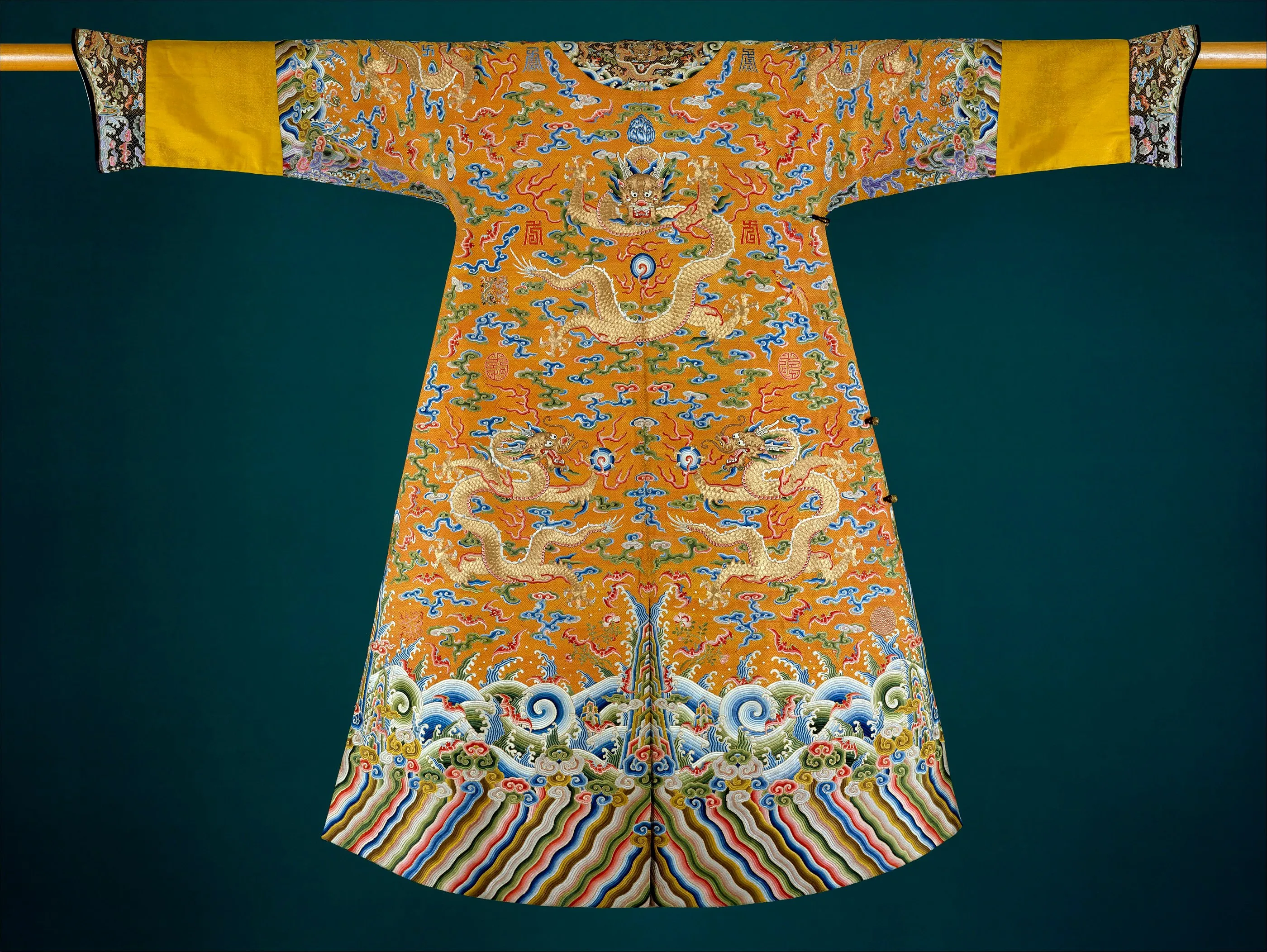
水Water: waves and “standing water”
海水 hǎishuǐ · 立水 lìshuǐ
The hem is filled with slanting, many-coloured stripes, the “standing water” 立水, and above them waves roll with white spray. Water sits right at the bottom, because in the “Great Plan” water is what soaks and sinks. Together with the rock above it, the pattern is called 海水江崖, sea waves and cliffs.
Tap a sign on the photo, or a name in the list.
With the pheasant 华虫 beside the dragon and the fire 火, the robe also shows some of the twelve symbols 十二章 reserved for the emperor. Reading the five elements into the pattern is an interpretation. We know of no Qing-era description that explains it this way.
Where to see the five elements in China
On a trip to China you meet the five elements more often than you might think. Three places where you can see them:
Five-coloured soil in Beijing
Right next to the Forbidden City, in Zhongshan Park, is the Altar of Land and Grain 社稷坛, built in 1420. Its top terrace is covered with soil in five colours: blue-green in the east, red in the south, white in the west, black in the north and yellow in the centre, just as in the chart above. More about the city on our page on Beijing.
A black roof in the Forbidden City
The great halls of the Forbidden City have yellow tiles, the colour of the centre and of the emperor. The imperial library, the Wenyuan Pavilion 文渊阁, has a black roof with a green edge instead. Black is water, and water controls fire, a library’s worst enemy. The same idea is behind the Wensu Pavilion 文溯阁 in the imperial palace of Shenyang.
Black and six for the first emperor
Qin Shi Huang, the emperor of the Terracotta Army near Xi’an, chose water for his dynasty, because water overcomes the fire of the Zhou dynasty. Clothes and banners became black, and six, the number of water, became the measure of things: caps six inches high, carriages six feet wide, six horses in front of the emperor’s carriage.
True or false? Eight claims about the five elements
Guess first, then see what the sources say.
1The five elements are the Chinese version of the four Greek elements.
False
For Empedocles, fire, water, air and earth were the basic substances everything is made of. The Chinese list has no air but has wood and metal, and its elements are phases that turn into one another. The two teachings arose independently.
2Wu Xing literally means “five elements”.
False
五 wǔ means five, and 行 xíng means to go or to move. Literally they are five movements, which is why scholars often translate the term as “five phases” or “five agents”. “Five elements” stuck as the common name all the same.
3The Chinese names of the planets come from the five elements.
True
Jupiter is 木星, the wood star, Mars is 火星, Saturn 土星, Venus 金星 and Mercury 水星. Japan made its weekdays from them: 火曜日 is Tuesday, 水曜日 Wednesday, 木曜日 Thursday, 金曜日 Friday and 土曜日 Saturday.
4Anyone in China could wear yellow.
False
Yellow is the colour of the centre and so of the emperor. Under the Qing dynasty the bright imperial yellow 明黄 míng huáng was reserved for the emperor and empress, other shades of yellow for the imperial family. That is why the dragon robe above is yellow.
5An element can grow so strong that it attacks the element that is meant to control it.
True
This is called 侮 wǔ, literally “to insult”: the arrow of the controlling cycle turns around. Very hard wood blunts the axe, and a fire that is too big boils away the water poured on it. On the wheel above, “too strong” shows this reversed arrow.
6Every year has its own element.
True
The element comes with the heavenly stem of the year and can be read from the last digit: 0 and 1 metal, 2 and 3 water, 4 and 5 wood, 6 and 7 fire, 8 and 9 earth. 2026 is a fire year, and 2027 is a fire year.
7Fire controls water.
False
The other way round: water controls fire, it puts it out. Fire controls metal, which it melts. Only when fire is far too strong does it turn against water, and that is a sign of imbalance.
8Chinese emperors chose their colour by the five elements.
True
Qin Shi Huang, the first emperor, chose water for his dynasty, because water overcomes the fire of the Zhou dynasty before it. Clothes and banners became black, as the “Records of the Grand Historian” 史记 report. Later yellow, the colour of the centre, became the emperor’s colour.
More on Chinese culture: the twelve Chinese zodiac signs and their years and Chinese New Year 2027, the Year of the Fire Goat.
FAQ
What are the Chinese five elements?
Wood, fire, earth, metal and water, in Chinese 五行 wǔxíng. Ancient China used them to sort seasons, directions, colours, tastes, organs and emotions into five groups. The elements are linked in two cycles: each one feeds the next and controls the one after next.
What does Wu Xing mean?
五 wǔ means five, 行 xíng means to go or to move. The term describes five phases that turn into one another, which is why it is also translated as “five phases”. It has nothing to do with the four basic substances of the Greeks.
What element am I in Chinese astrology?
The element of your birth year can be read from its last digit: 0 and 1 metal, 2 and 3 water, 4 and 5 wood, 6 and 7 fire, 8 and 9 earth. If you were born in January or February before Chinese New Year, you have the element of the year before. The calculator on this page checks the exact day by the lunar calendar. Chinese fortune tellers also look at the month, day and hour of birth.
What does the emperor’s dragon robe have to do with the five elements?
The pattern of an imperial festival robe shows the world: waves for water at the hem, a rock for earth in the middle, flaming pearls for fire, flowering sprays and blue-green clouds for wood, and the dragons are embroidered in gold thread, for metal. The yellow ground is the colour of the centre and of the emperor.
Which organ belongs to which element?
Wood belongs to the liver, fire to the heart, earth to the spleen, metal to the lungs and water to the kidneys. In Traditional Chinese Medicine these are systems of functions, not just the organs. There is more, with emotions and tastes, on our page about the five elements in TCM.
What is the difference between the generating and the controlling cycle?
In the generating cycle 相生 each element feeds the next: wood feeds fire, fire earth, earth metal, metal water and water wood. It is also called the mother and child rule. In the controlling cycle 相克 each element controls the one after next: wood controls earth, earth water, water fire, fire metal and metal wood.
What element is the year 2027?
2027 is a fire year, because it ends in 7. The Chinese year only begins at Chinese New Year in January or February, though. Everything else about the year is on our page about Chinese New Year 2027.
Sources and status
The correspondences follow the classical texts, above all the “Great Plan” 洪范 and the “Inner Classic of the Yellow Emperor” 黄帝内经. The medical reading of the cycles follows the standard Chinese TCM textbooks. The career lists reflect what is commonly said in China. The pictures of the elements are our own drawings.
- Wikisource: 尚書·洪範, the oldest list of the five elements and their natures (Chinese)
- Wikisource: 黃帝內經·素問, book 2, chapter 陰陽應象大論: organs, senses, emotions and 怒傷肝 (Chinese)
- Wikisource: 史記, chapter 6, Qin Shi Huang chooses water, black and the number six (Chinese)
- Wikipedia: Wuxing (Chinese philosophy), Zou Yan and the correspondences
- Beijing News: the Altar of Land and Grain 社稷坛 in Zhongshan Park and its five-coloured soil (Chinese)
- The Paper: the Wenyuan Pavilion 文渊阁 and its black roof (Chinese)
- The Metropolitan Museum of Art: Festival Robe, 35.84.8, with its date and the note on the Qianlong Emperor
Changelog (1)
- 2026-11-04Page created, with a calculator for the element of two birthdays.