
China travel food guide · Nº 005
Century Egg and Pork Congee 皮蛋瘦肉粥
Century egg and pork congee (皮蛋瘦肉粥, pí dàn shòu ròu zhōu), also called preserved egg and pork congee, is rice simmered into a soft, loose porridge with chopped century egg and lean pork: a Cantonese breakfast from Guangdong, now on breakfast menus all over China. Savory, not spicy, no bones – but it contains egg and pork, so it is not vegetarian.
The dish card
Tap the red Chinese name to show it full-screen to the staff.
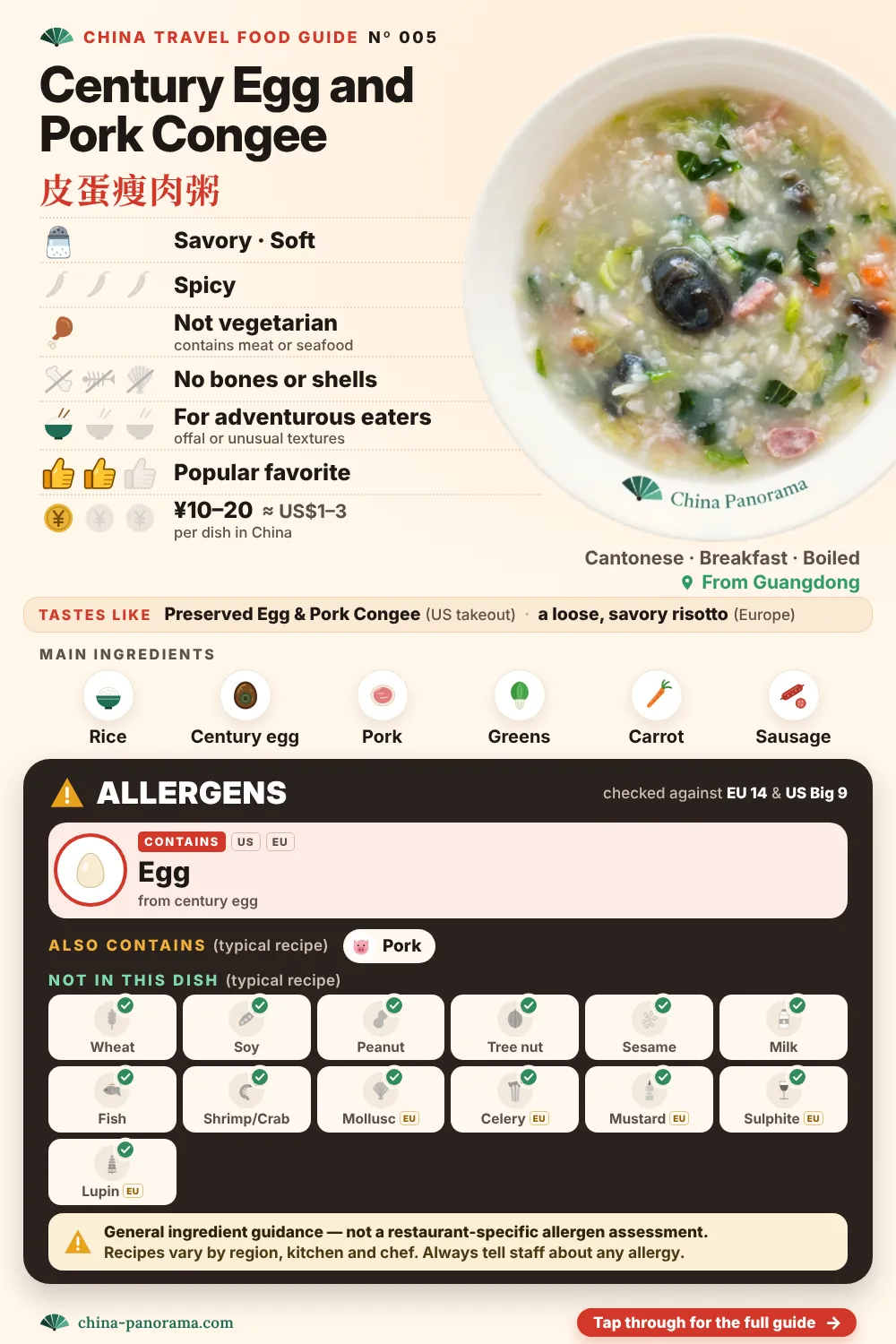 Partly edited with AI
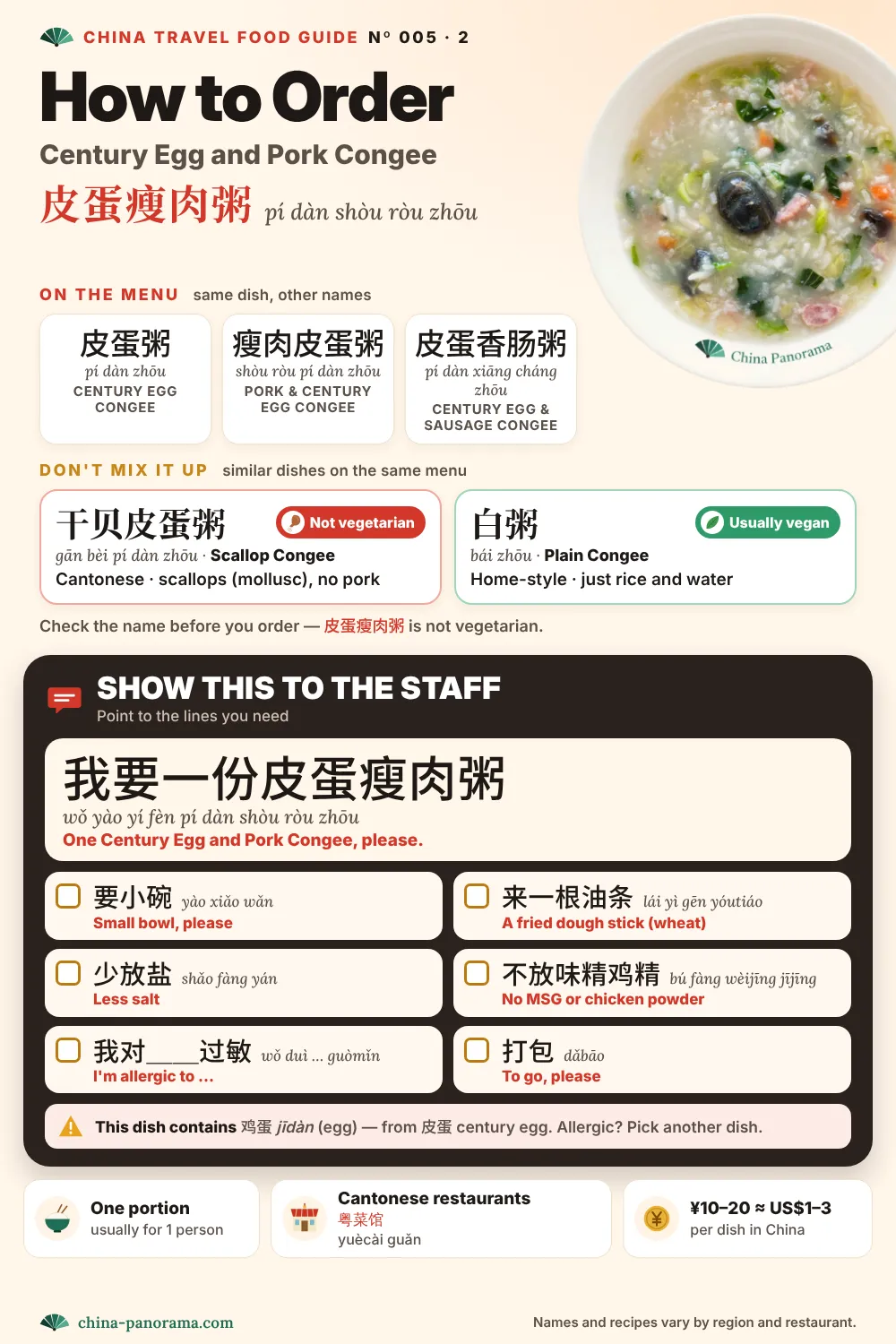
How to order century egg and pork congee
Tick what you need right on the card, then tap the big first line to show it full-screen to the staff.
What is century egg and pork congee?
The name lists what goes in: 皮蛋 (pí dàn) century egg, 瘦肉 (shòu ròu) lean pork, 粥 (zhōu) congee – rice simmered in plenty of water until the grains break down into a soft, loose porridge. The pork is often salted for a few hours first, then cooked in the congee with the chopped century egg; many places add greens, carrot or a few slices of Chinese sausage, as on our card. A century egg is not a hundred years old: it is a duck egg cured for a few weeks in salt and lime, which turns the white into a dark, see-through jelly and the yolk creamy.
It is Cantonese (粤菜) and above all a breakfast: in Guangdong you get it in tea houses with dim sum and in breakfast shops with a fried dough stick (油条, yóu tiáo) on the side, and today in hotel breakfast buffets and canteens all over China. On a menu, 皮蛋粥 is usually the same dish, 皮蛋香肠粥 has sausage instead of the pork. Look at the last character: every name that ends in 粥 is a congee.
It costs about ¥10–20 (US$1–3) in an ordinary restaurant in a big city (2026).
Main ingredients
- 大米dà mǐRice
- 皮蛋pí dànCentury egg
- 猪肉zhū ròuPork
- 青菜qīng càiGreens
- 胡萝卜hú luó boCarrot
- 香肠xiāng chángSausage
What does it taste like?
Mild, warm and savory. The rice cooks down until it is creamy, and the salted pork and the century egg season the whole bowl. The century egg is what surprises people: the white is a firm, dark amber jelly, the yolk soft, creamy and greyish-green, with a deep, salty taste and a sharp smell that fades once it is warm in the congee. Eaten hot with a spoon, often with a fried dough stick (油条) dipped in it.
Tastes like… Preserved egg and pork congee from Cantonese and dim sum restaurants in the US – it is the same dish. In Europe, think of a loose, savory risotto: soupier and milder, eaten with a spoon.
Allergens and diet
Century egg and pork congee contains egg, from the century egg. It also contains pork in the typical recipe.
In the usual recipe
- CEggs· US: Eggs
Not in this dish (typical recipe)
A wheat / gluten, B shrimp / crab, D fish, E peanut, F soy, G milk, H tree nuts, L celery, M mustard, N sesame, O sulphites, P lupin, R molluscs
These are estimates from how the dish is usually made, not a restaurant’s declaration. Every kitchen and every sauce brand is different – always tell the staff about an allergy. Chinese kitchens often fry in peanut oil, and chilli oil may be made with it too; we don’t repeat that for each dish.
Vegan, vegetarian, gluten-free
Not vegetarian: it is made with meat or seafood.
Here it is the pork, and the sausage many places add. On the same menu, 白粥 (bái zhōu, plain congee) is just rice and water – usually vegan.
There is no wheat in the usual recipe, but the fried dough stick (油条) that often comes with it is made of wheat – skip it if you avoid gluten. Chinese sausage (香肠) may have a little soy sauce in it; if you react to traces, ask for it without: 不要香肠 (bú yào xiāng cháng).
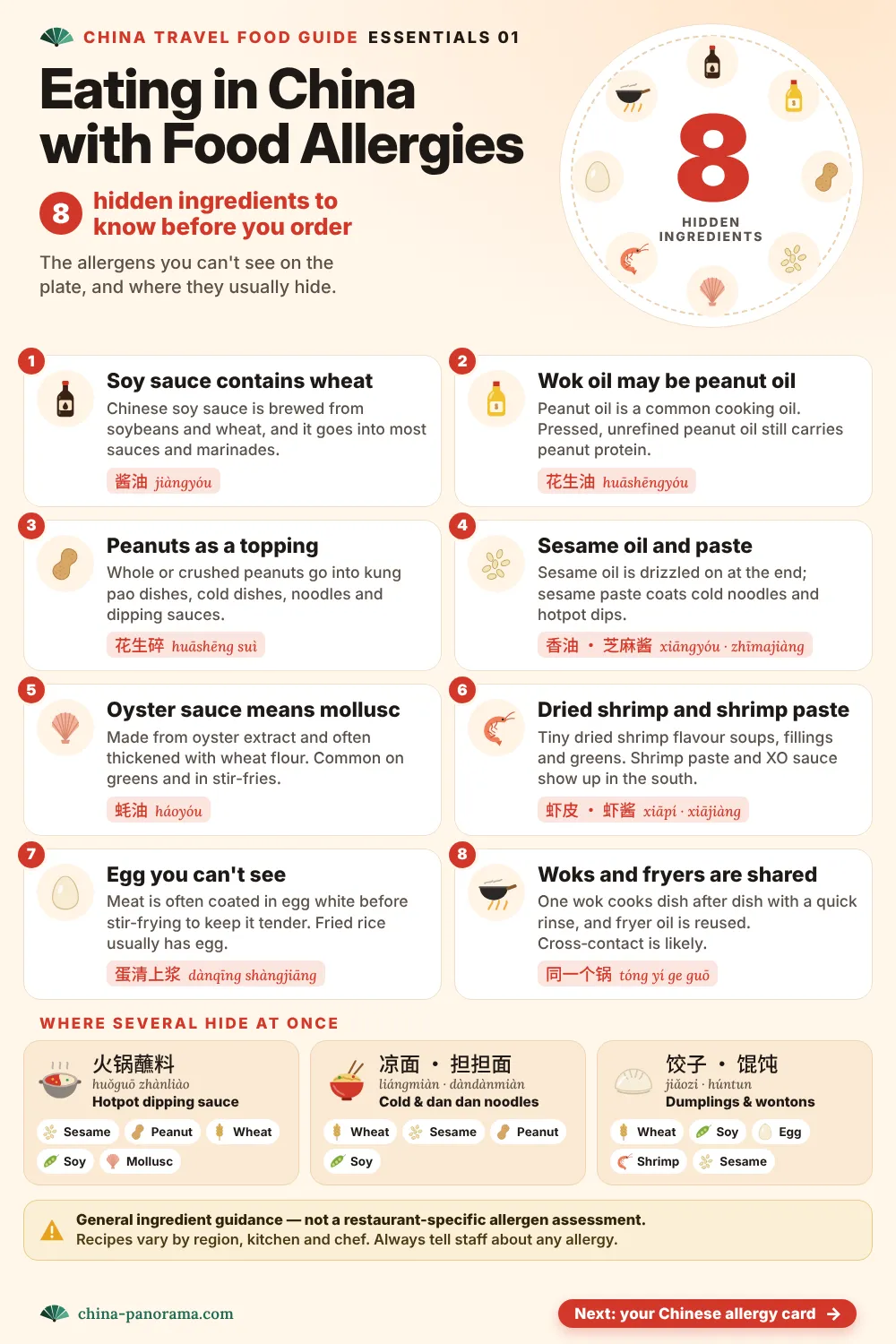
Eating in China with food allergies
Two cards that go with every dish in this guide. The first shows where allergens hide in Chinese cooking – tap an ingredient to ask about it in Chinese. The second is a Chinese allergy card for the staff: tick your allergens right on the card and it turns into one sentence, full-screen.
8 hidden ingredients to know before you order
Tap an ingredient to ask the staff about it in Chinese.
Show this to the staff: your Chinese allergy card
Tick your allergens on the card, then tap the big first line to show them full-screen to the staff. A question or the red line opens full-screen too.
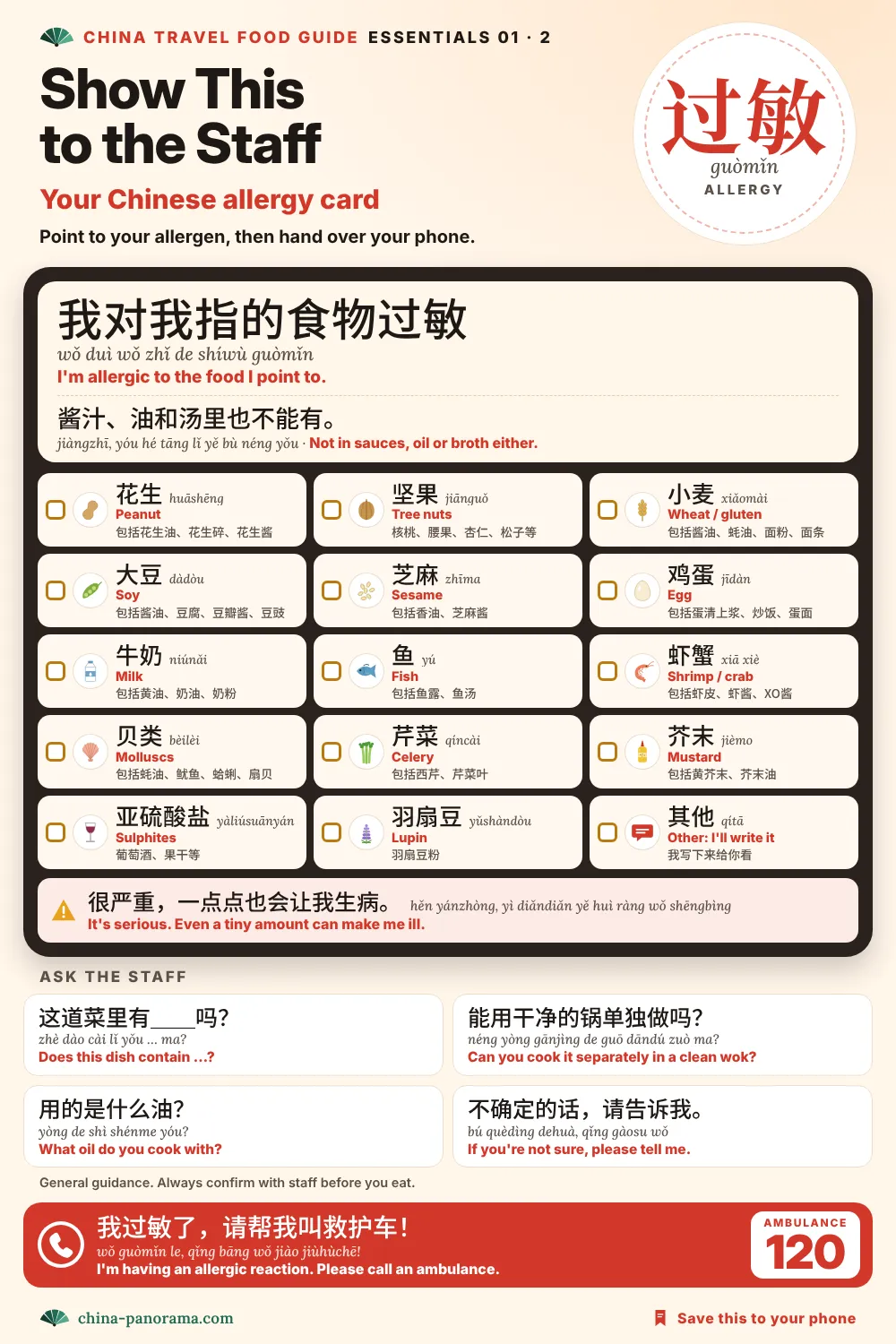
General ingredient guidance, not a restaurant’s allergen declaration. Recipes vary by region, kitchen and chef – always tell the staff about an allergy.
FAQ
Is century egg and pork congee vegetarian?
No: lean pork goes in, and often sausage. For a congee without meat, order 白粥 (bái zhōu, plain congee) – just rice and water, usually vegan. A few kitchens cook the congee base in stock, so ask if you are strict.
Is it gluten-free?
There is no wheat in the usual recipe: rice, century egg, pork and greens. The fried dough stick (油条) that often comes with it is wheat, so leave it out. Chinese sausage (香肠) may contain a little soy sauce, which is brewed with wheat – only a concern if you react to traces; then ask for 不要香肠 (bú yào xiāng cháng, no sausage).
Is it spicy?
No. Congee is one of the mildest things you can eat in China. Some places add white pepper or put chilli oil on the table, but nothing hot goes into the bowl.
What does century egg taste like?
Rich and salty, a bit like a very strong, creamy egg yolk, with a sharp smell that fades once it is warm in the congee. The dark white is a firm jelly with little taste of its own. If you are unsure, congee is the gentlest way to try it: the egg is chopped small and mixed into the rice.
What is the difference between 皮蛋瘦肉粥 and 干贝皮蛋粥?
干贝皮蛋粥 (gān bèi pí dàn zhōu, scallop congee) has dried scallops instead of pork. Scallops are molluscs, so avoid it with a mollusc allergy – and it is not vegetarian either. The names look alike: check for 瘦肉 (lean pork) or 干贝 (dried scallop).
Is it the same as preserved egg and pork congee in the US?
Yes, it is the same dish – preserved egg is another English name for century egg. In the US you find it in Cantonese and dim sum restaurants; in China it is mostly a breakfast and costs much less.
How much does it cost in China?
About ¥10–20 (US$1–3) for a bowl in an ordinary restaurant in a big city (2026). In a breakfast shop or a canteen it is often cheaper, and a small bowl (小碗) costs less than a large one (大碗).
Are century eggs safe to eat?
Yes – they are sold in every supermarket in China and eaten every day. Old curing methods sometimes used lead to speed things up; today’s eggs are made without it, and many packs say 无铅 (wú qiān, lead-free).
What is it called in Chinese?
皮蛋瘦肉粥, in pinyin pí dàn shòu ròu zhōu (typed without tones: pi dan shou rou zhou). 皮蛋 is century egg, 瘦肉 lean pork, 粥 congee; many menus just say 皮蛋粥. To order, show the staff the order card above, or tap the red Chinese name on the dish card.
More Chinese dishes
- Stir-fried eggplant with green peppers →
- Stir-fried tomato and egg →
- Chinese dumplings (jiaozi) →
- Fried rice in China →
- Chow mein in China →
- Xiaolongbao soup dumplings →
- Char siu, Cantonese BBQ pork →
- Canteen and fast-food walkthrough →
- QR-code ordering walkthrough →
Ordering in a restaurant, by QR code or in a canteen? Our restaurant walkthrough, the QR-code ordering walkthrough and the canteen walkthrough show each step.
Cards, photos and sources
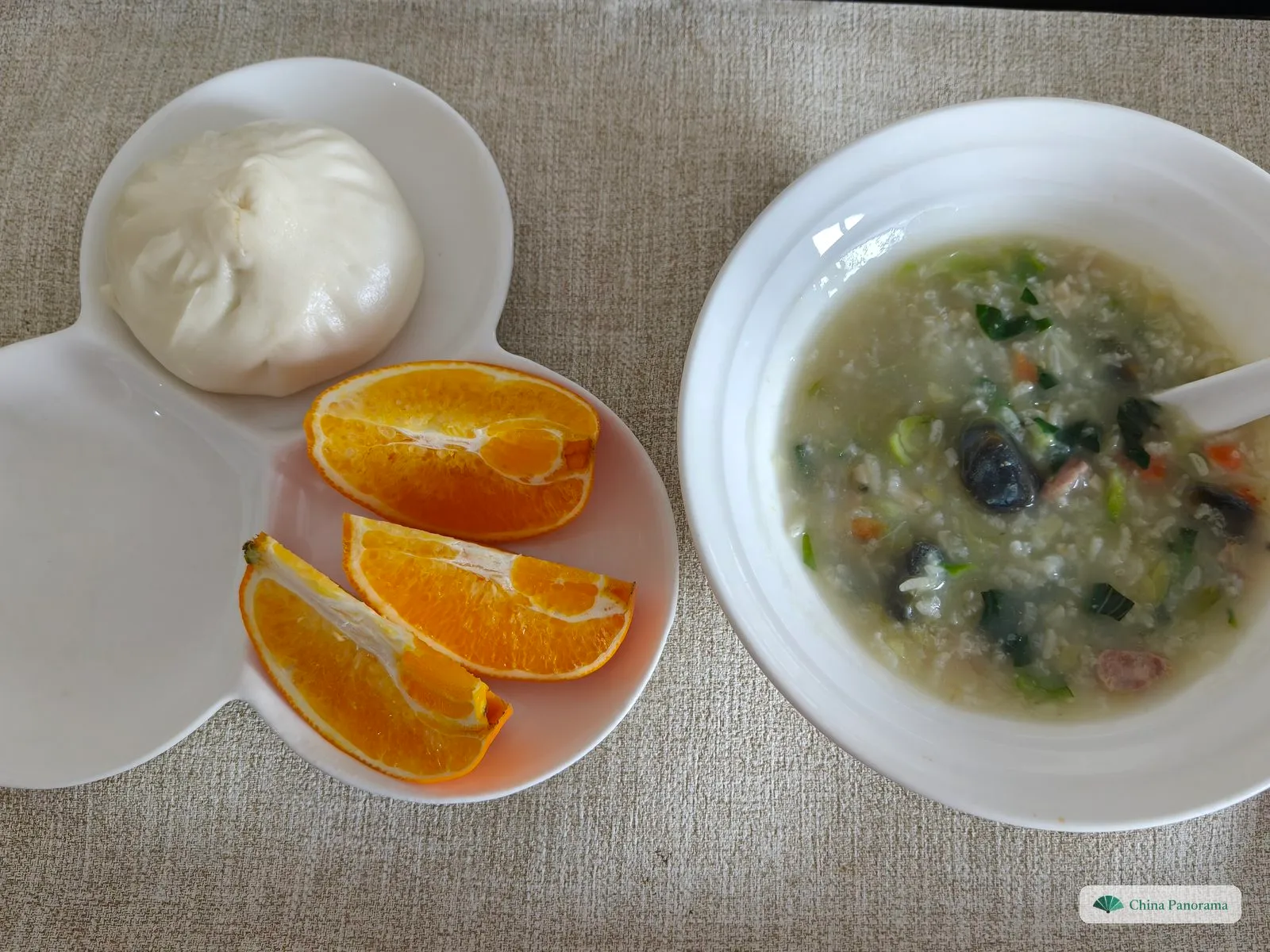
The cards are our own. The dish photo on cards 1 and 2 is partly edited with AI; the other photo on this page is our own, unedited. Prices come from our dish library and are typical for an ordinary restaurant in a big city; dollar prices are rounded. Allergens are estimated from the usual recipe, checked against the 14 EU allergen groups and the 9 major US food allergens. Menu names, similar dishes and phrases are general knowledge – recipes vary by region, kitchen and chef.
Changelog (1)
- 2026-10-04Page created with 4 cards you can use on screen: the dish card, how to order it, and the Essentials cards on eating in china with food allergies.