
Chengdu
The capital of Sichuan, a city of 21 million on a plain watered for 2,000 years by the same irrigation system: giant pandas, the Three Kingdoms shrine of Zhuge Liang, tea houses with bamboo chairs, Sichuan pepper — and an unhurried pace the rest of China teases it for.
成都 · Chéngdū · capital of Sichuan · 30.66° N, 104.06° E
Paying for the metro?
Tap your contactless Visa, Mastercard or Amex at the gate: Chengdu has taken foreign cards on the whole network since July 2025. The metro →
How long?
Three days: a morning with the pandas, a day in the centre, a day trip. Two of the days are routes below, with times from our photographs. The routes →
Where is Chengdu?
At 30.7° N, Chengdu is level with Wuhan, a little north of Cairo and New Orleans. It lies on the western edge of the Sichuan Basin in south-west China, where the plain meets the first mountains of the Tibetan Plateau, about 270 km west of Chongqing. Xi’an is 610 km to the north-east and Kunming 640 km to the south; Lhasa is 1,250 km to the west, Beijing 1,520 km and Shanghai 1,660 km away. Tap any city on the map to measure the distance.
Straight-line distances from Tianfu Square, rounded to the nearest 10 km — not travel distances.
Sichuan province is highlighted. Tap a city to measure the distance from Chengdu.
- Province
- Sichuan四川省 · capital
- Latitude
- 30.66° Nlevel with Wuhan
- Airports
- TFU · CTUTianfu and Shuangliu
- Metro
- 16 linesforeign cards at the gates
- Time zone
- UTC+8Beijing time
- City flower
- Hibiscus芙蓉 · hence “Rongcheng”
Day trips from Chengdu: how far is everything?
Chengdu sits on a flat, fertile plain; the mountains begin just to the west. Most of what people combine with the city lies within a day: the river town of Huanglongxi 39 km to the south, the Bronze Age masks of Sanxingdui 41 km and the irrigation works of Dujiangyan 58 km, and the Leshan Giant Buddha 127 km, in a straight line. The new airport is out there too, 54 km from the centre. Tap a place to see how far it is.
Tap a place on the map or in the list.
The river town. About 45 minutes by car. Details below ↓
The Bronze Age masks, in Guanghan. Details below ↓
The new airport, opened in 2021: flights from Europe land here. Line 18.
The 2,300-year-old irrigation system; Mount Qingcheng is close by. World Heritage 2000. Details below ↓
71 m tall, with Mount Emei 40 km beyond. World Heritage 1996. Details below ↓
Straight-line distances from Tianfu Square, rounded — not travel distances.
What’s Chengdu weather like each month?
Warm and humid in summer — 31 °C by day in July — and grey and cool in winter, at 11 °C by day in January. Spring and autumn are long and mild. The basin is often hazy and the sun is famously rare; most rain falls in summer. The sun rises at 06:00 in June and sets at 18:04 in December. Tap a month for temperatures, daylight and what is on.
Scale in °C. Bars run from the average daily low to the average daily high. Source: monthly temperature data, last checked 2026-07-30.
Chengdu in October
Mild- Average high
- 22 °C
- Average low
- 15 °C
- Sunrise / sunset
- 07:05 – 18:34
- Daylight
- 11 h 29 min
On in Oct
- Golden Week crowds, 1–7 Oct
How hot is Chengdu in summer?
Hot, but less so than Chongqing: July and August average 31 °C and 32 °C by day, with nights around 24 °C and damp air. It is also the rainy season. Plan the pandas for opening time, the museums for the afternoon, and Jinli and the river fronts for the evening.
June
29° / 22°
Sun 06:00–20:07 · 14 h 7 min
July
31° / 24°
Sun 06:11–20:08 · 13 h 58 min
August
32° / 23°
Sun 06:30–19:47 · 13 h 18 min
September
27° / 19°
Sun 06:47–19:11 · 12 h 24 min
Spring
March – MayThe best time: mild, green and often grey.
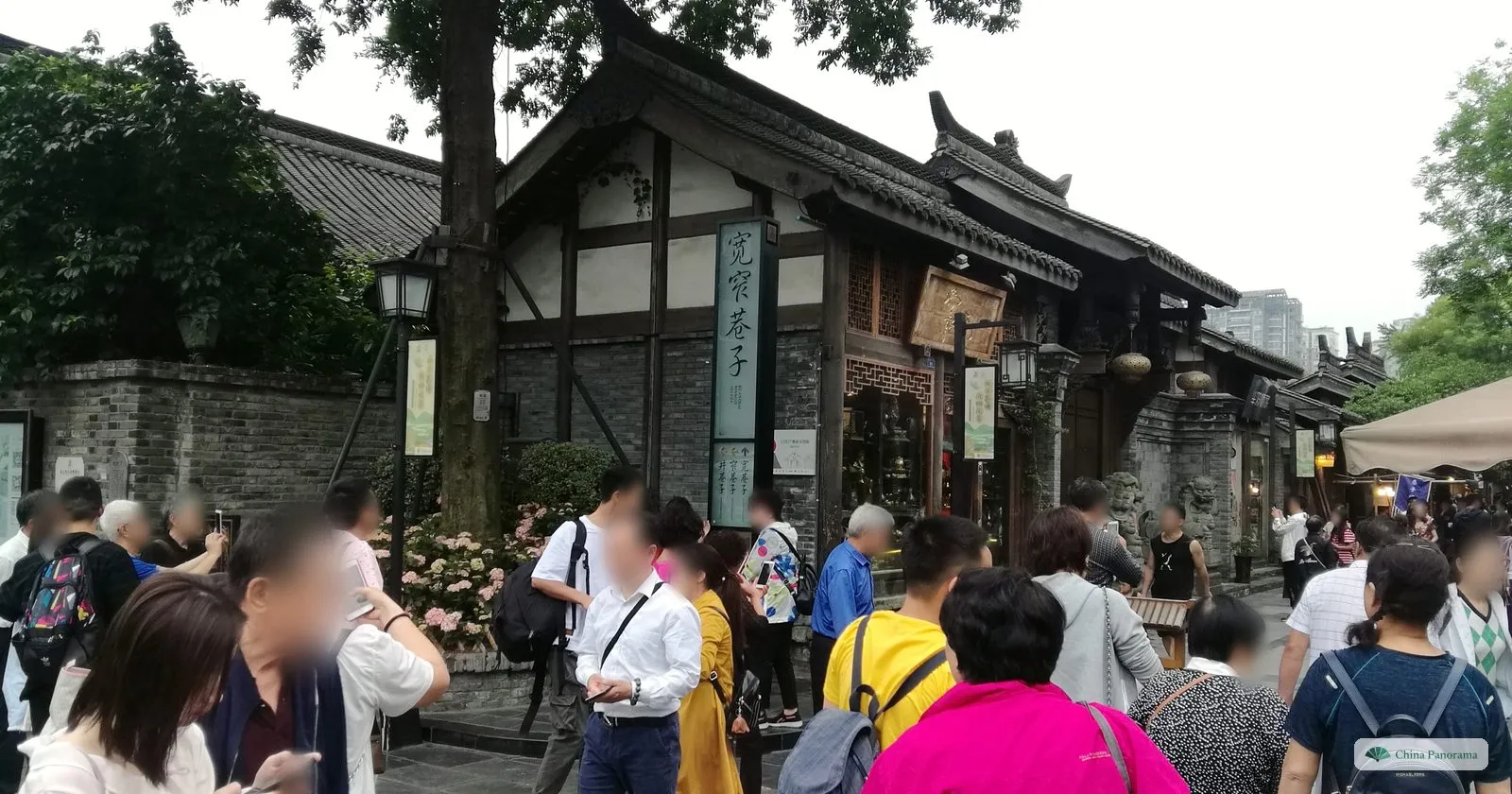
March averages 19 °C by day, April 25 °C and May 28 °C. The sky over the basin is often a soft, hazy grey — our photographs of 29 and 30 April 2019 show both days so — but the parks are in flower, with bougainvillea over the walls of Kuanzhai Xiangzi. May Day, 1–5 May, fills the old streets to bursting.
What to wear: Light layers, a thin jacket and an umbrella.
Summer
June – SeptemberHot, humid and the rainy season: 31–32 °C by day in July and August.
July averages 31 °C by day and August 32 °C, with nights around 24 °C. Most of the year's rain falls now, often at night, and the air is damp. It is cooler than Chongqing, but the Panda Base is best at opening time, when the animals are active and the heat has not set in.
What to wear: Light clothes, a hat and a rain jacket.
Autumn
October – NovemberMild and golden: the ginkgo trees turn.
October averages 22 °C by day and November 17 °C. The ginkgo, the city tree, lines many streets and turns yellow in late autumn. Avoid Golden Week, 1–7 October, when the old streets and the Panda Base are at their most crowded.
What to wear: A jumper and a light jacket.
Winter
December – FebruaryRarely freezing, but grey, damp and cold indoors.
January averages 11 °C by day and 3 °C at night, under low cloud that hides the sun for days. Like everywhere south of the Qinling mountains, buildings have no central heating, so the damp cold follows you inside — which is why winter is hot pot season.
What to wear: Warm layers you can keep on indoors.
April, at about 25 °C by day, and October, at 22 °C, are the months we would pick — outside the May Day and Golden Week holidays. For how Chengdu compares with the rest of the country month by month, see the best time to visit China.
Things to do in Chengdu
16 places, from Bronze Age gold to a museum opened in 2016. Three things first: how to tell the city’s look-alike old streets apart, which of the old-looking places are really old, and what the gates of the Wuhou Shrine and Tianfu Square are telling you.
Kuanzhai Xiangzi, Jinli or Huanglongxi? Guess the old street
Chengdu has three famous “old streets”, and in photographs they look alike: grey tiles, carved wood, crowds. Nine of our photographs, three from each — guess which is which, and see the clue that gives it away.
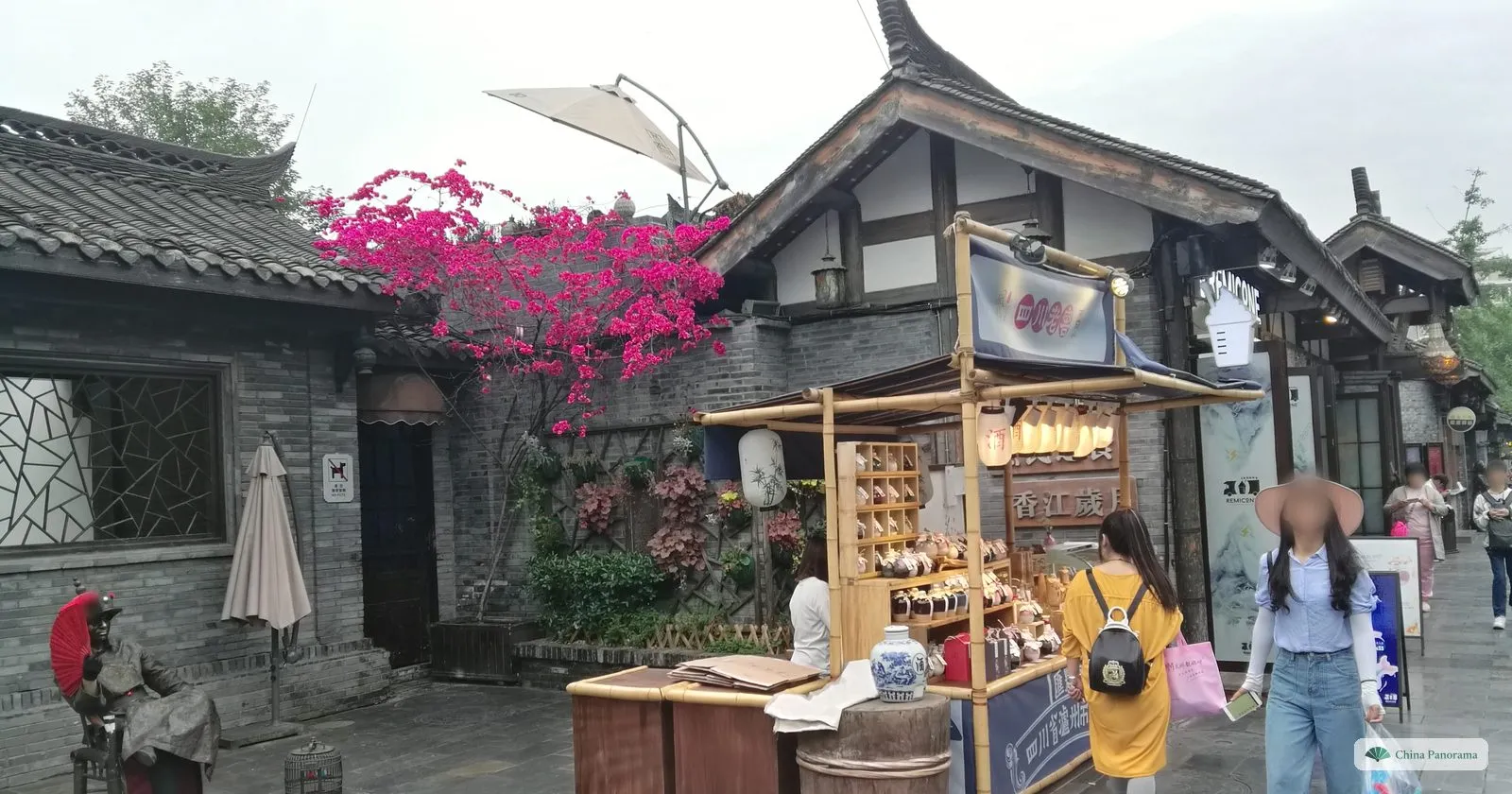
 Photograph 1
Kuanzhai Xiangzi, Jinli or Huanglongxi?
Answer: Kuanzhai Xiangzi
Plain grey brick walls, quiet courtyard gates and bougainvillea over the top: the old Manchu quarter. No water, no red lanterns everywhere.
Kuanzhai Xiangzi, 10:48 on 30 April 2019.
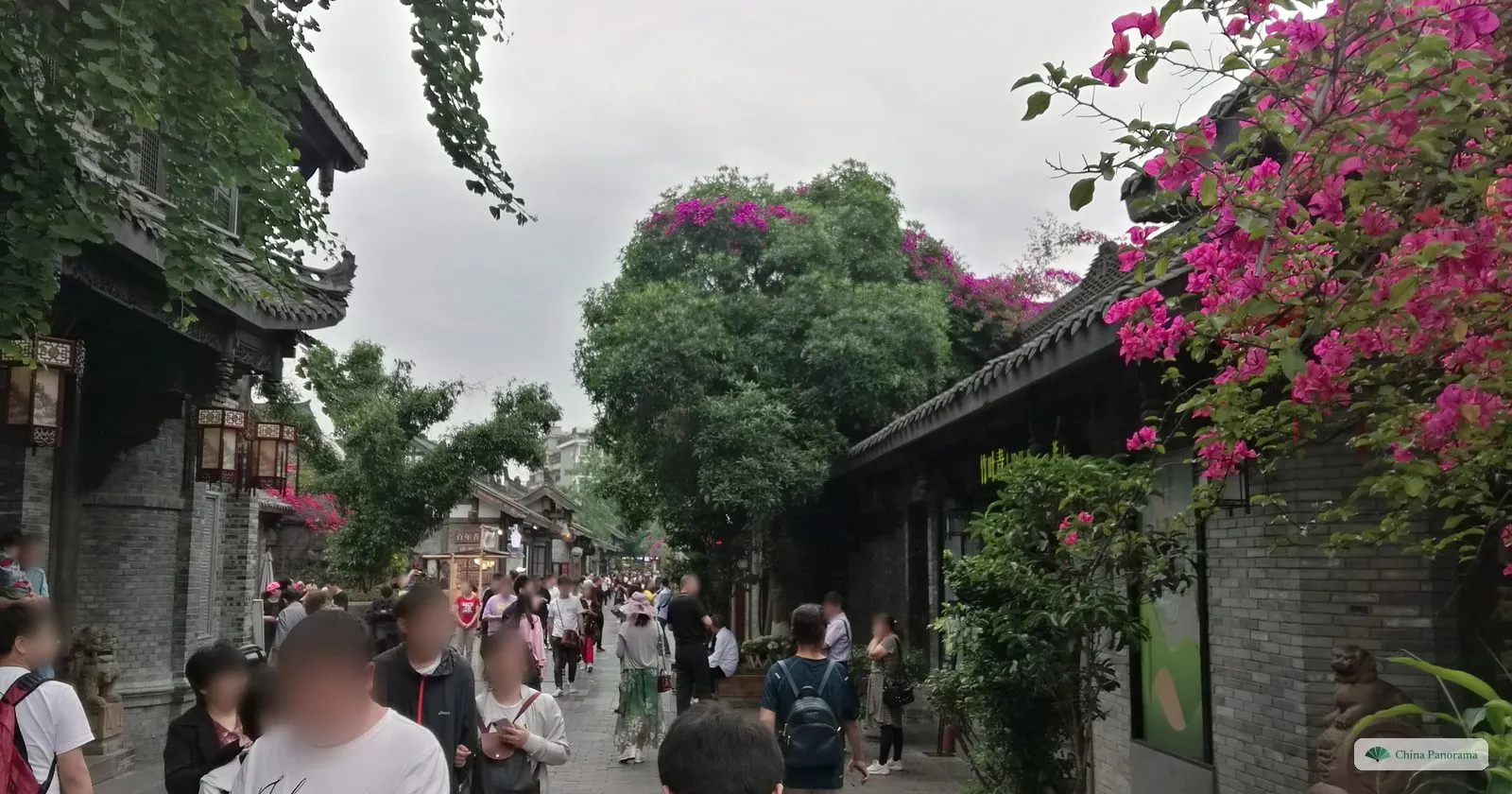
 Photograph 2
Kuanzhai Xiangzi, Jinli or Huanglongxi?
Answer: Jinli
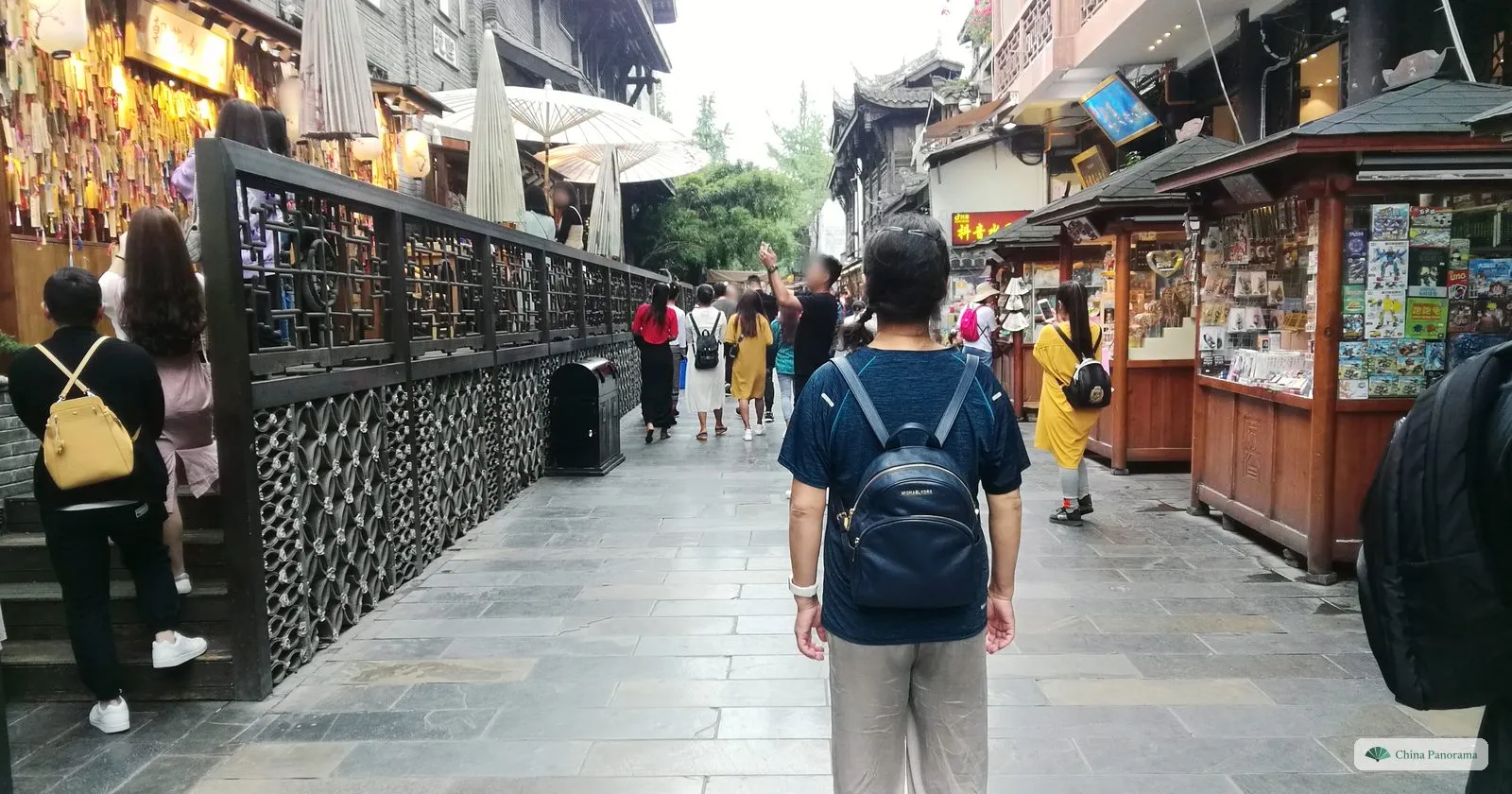
Dark carved wood, red lanterns strung overhead, souvenir baubles and a poster for a face-changing opera show: Jinli, the busiest and most theatrical of the three.
Jinli, 12:11 on 30 April 2019.
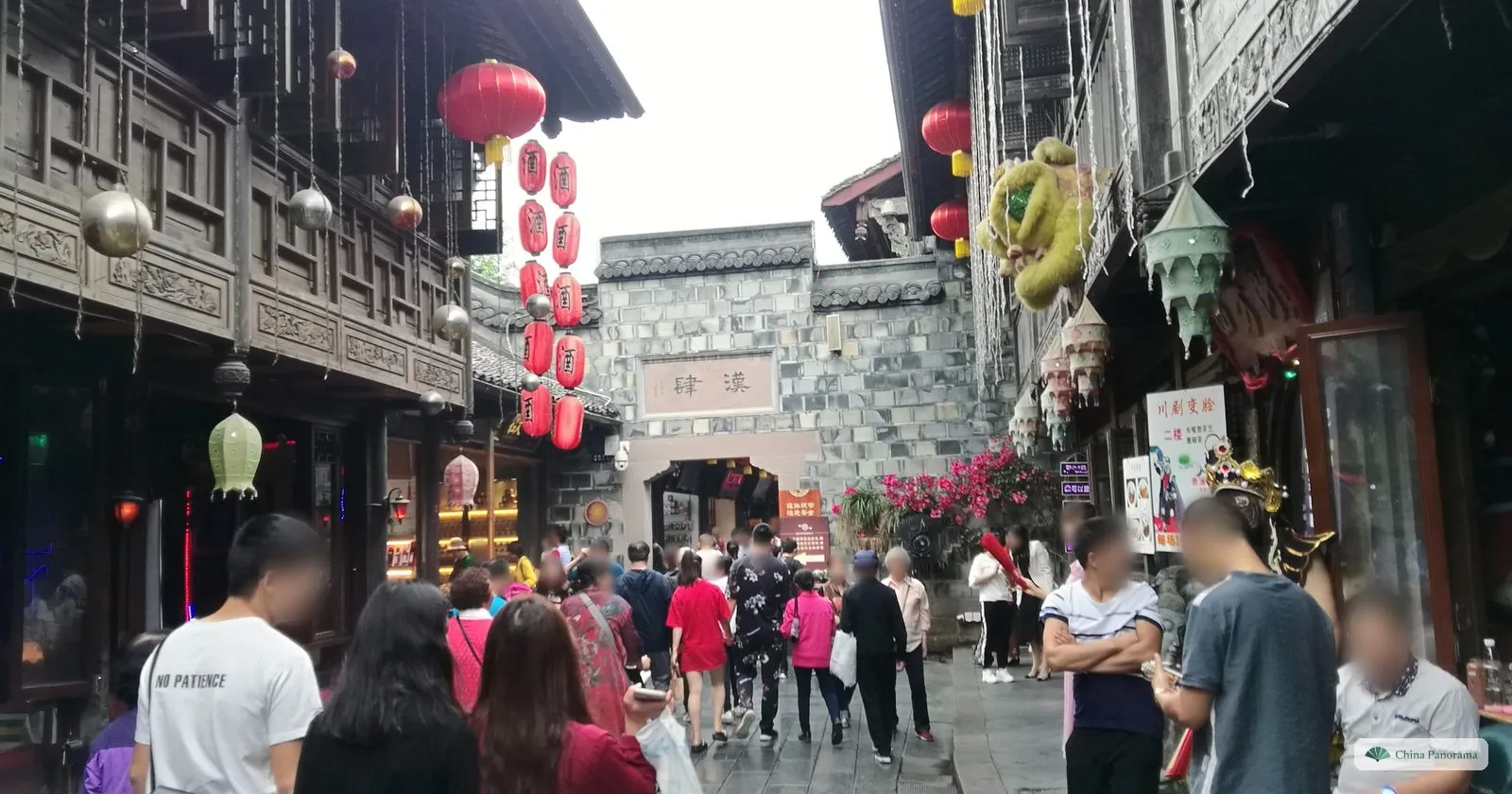
 Photograph 3
Kuanzhai Xiangzi, Jinli or Huanglongxi?
Answer: Huanglongxi
Running water and stepping stones give it away: only Huanglongxi, the river town south of the city, has a stream through its streets.
Huanglongxi, 09:44 on 29 April 2019.
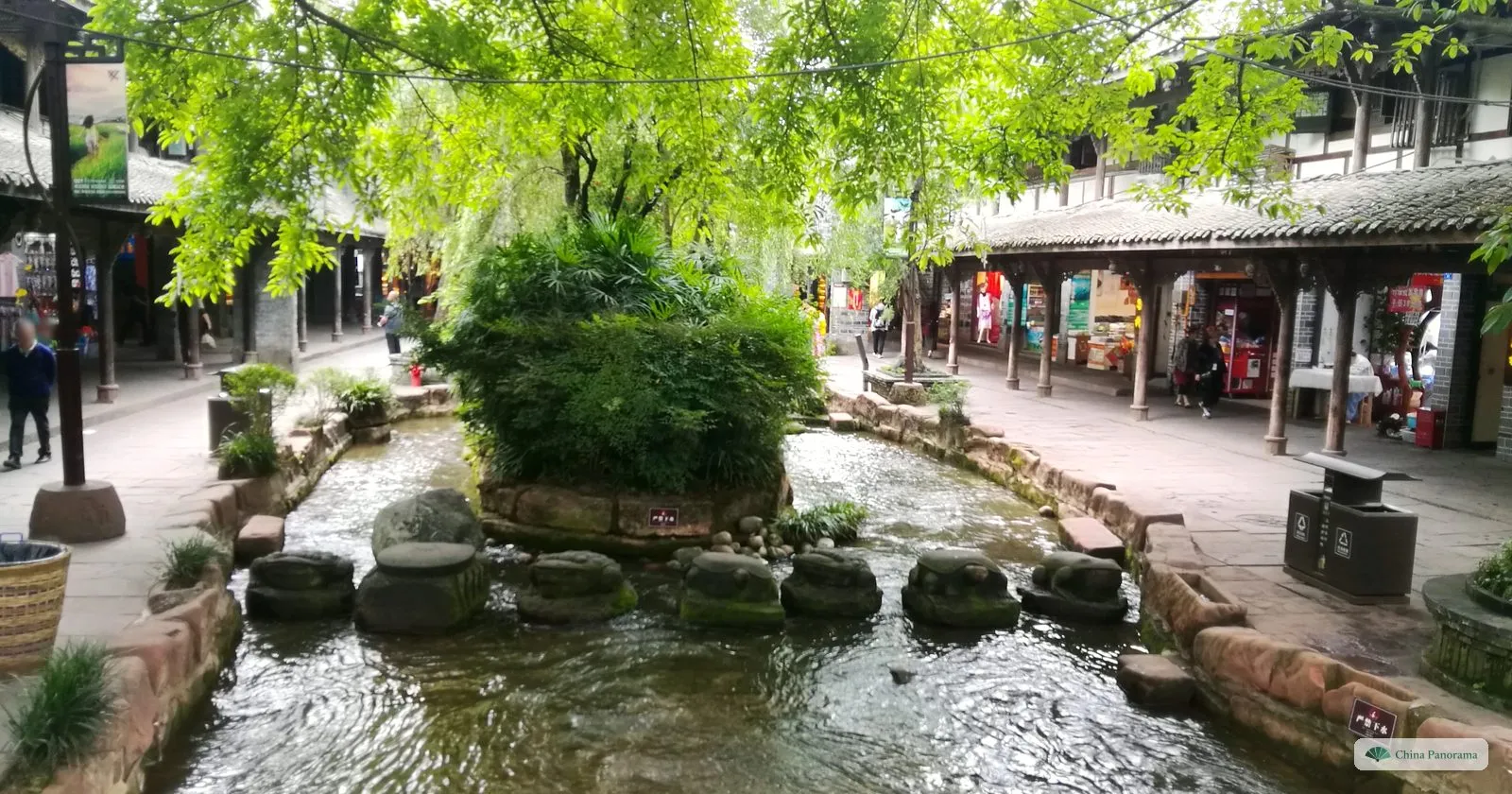
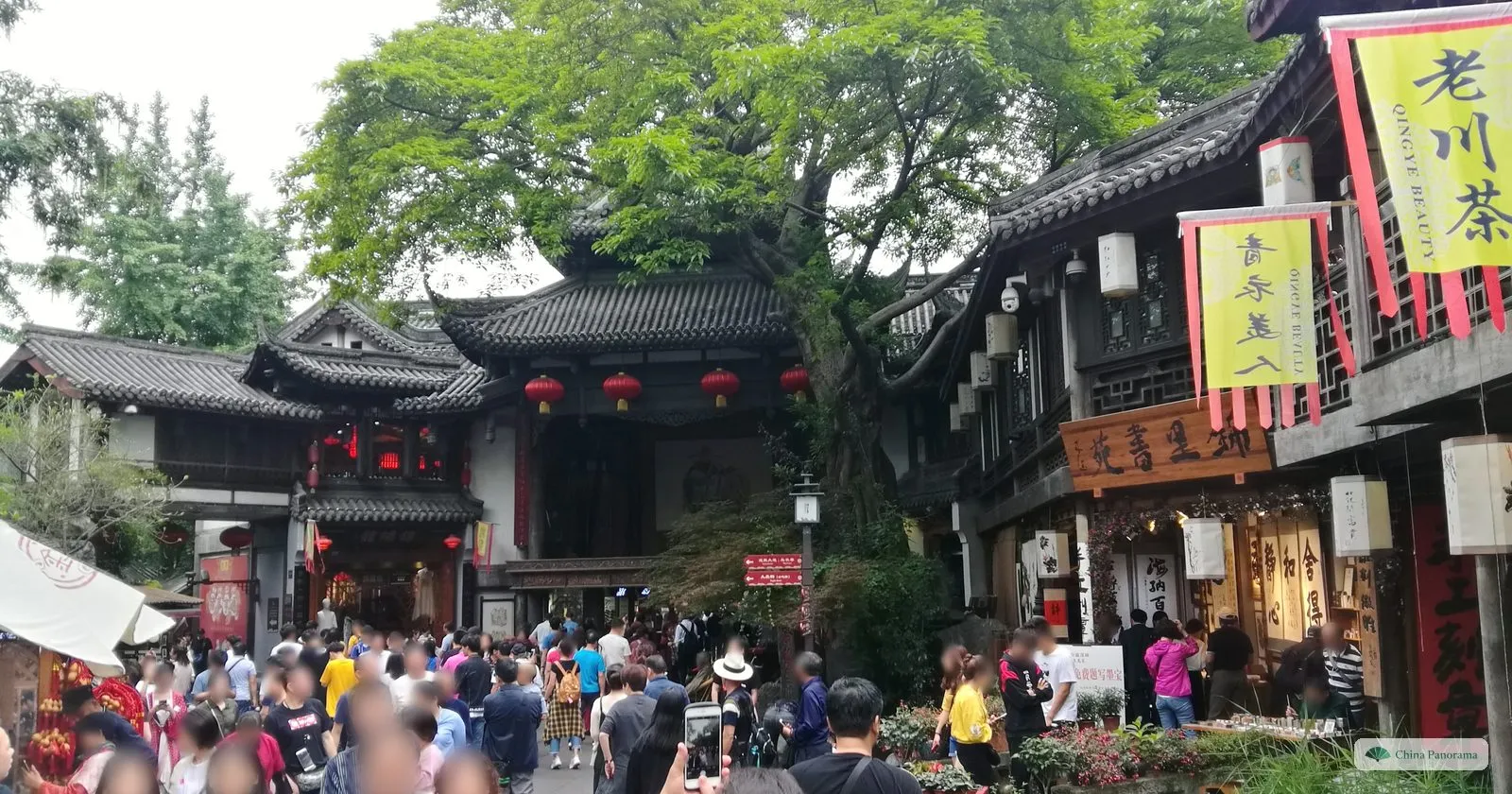 Photograph 4
Kuanzhai Xiangzi, Jinli or Huanglongxi?
Answer: Jinli
Yellow banners advertising old Sichuan tea, two-storey buildings with upturned eaves and a crowd shoulder to shoulder at midday: Jinli, next to the Wuhou Shrine.
Jinli, 12:08 on 30 April 2019.
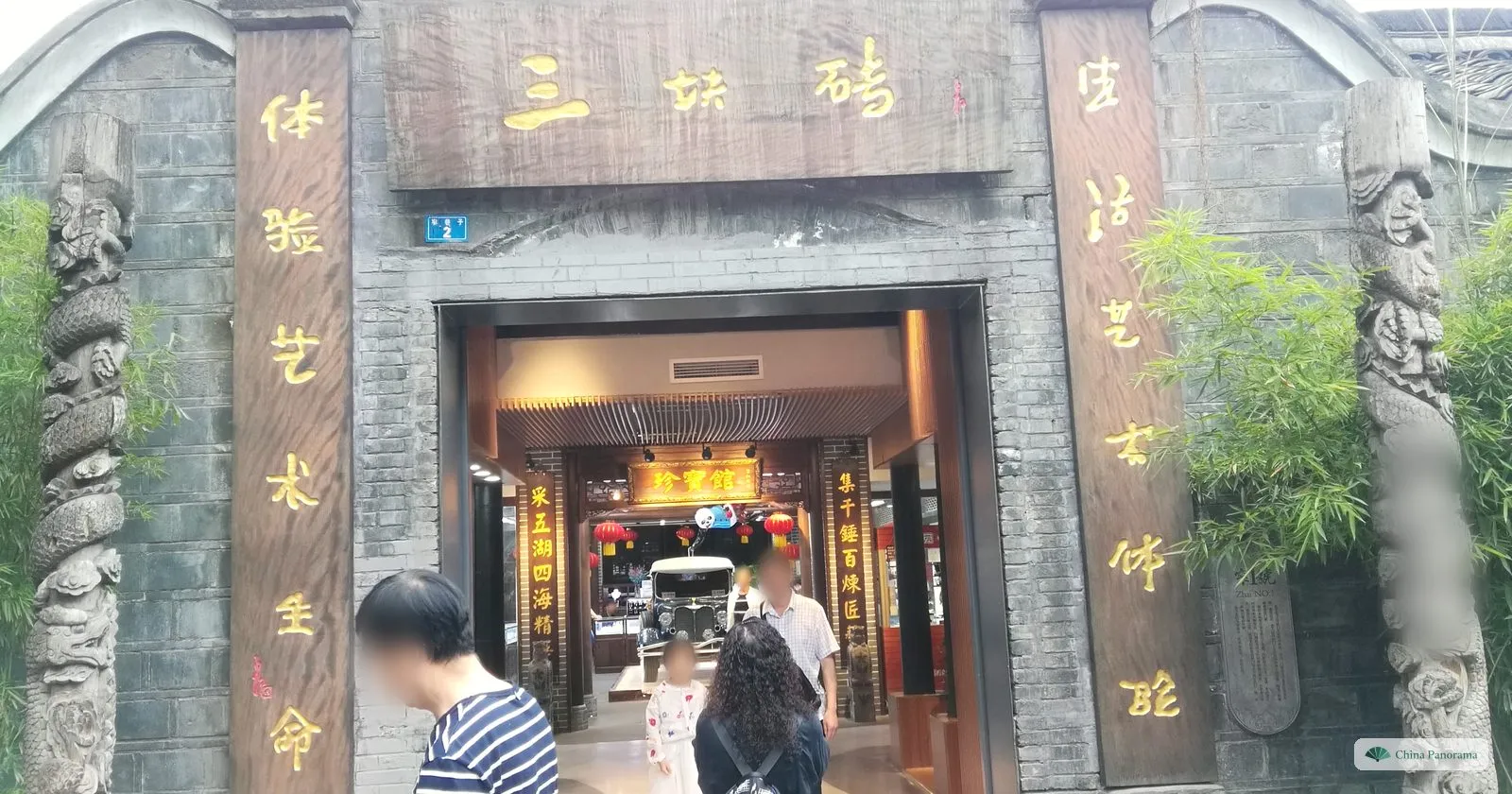 Photograph 5
Kuanzhai Xiangzi, Jinli or Huanglongxi?
Answer: Kuanzhai Xiangzi
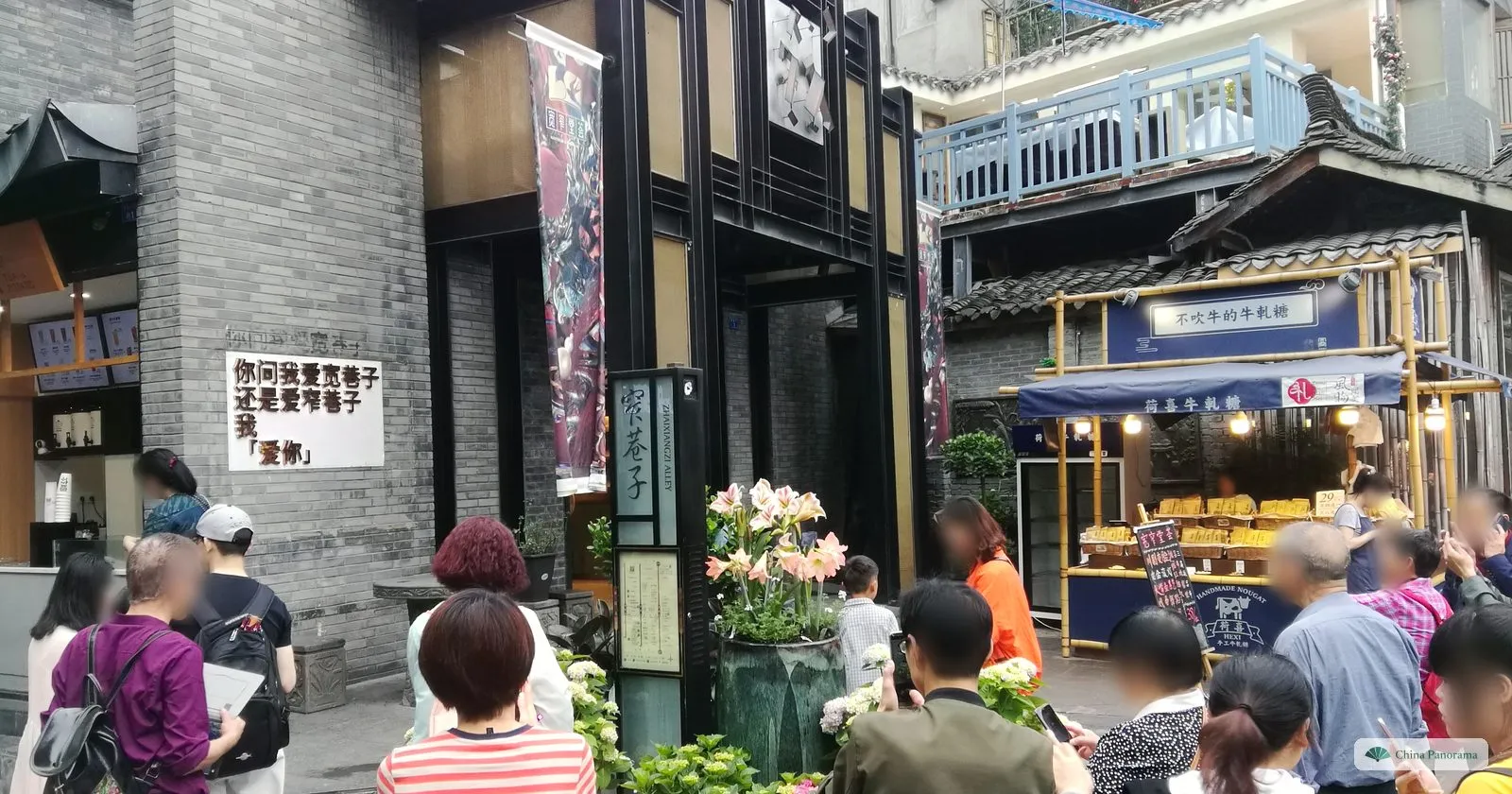
A courtyard gate in a grey brick wall, turned into a shop. Behind the walls of Kuanzhai Xiangzi are the courtyards of the former Manchu garrison, now tea houses, restaurants and boutiques.
Kuanzhai Xiangzi, 10:52 on 30 April 2019.
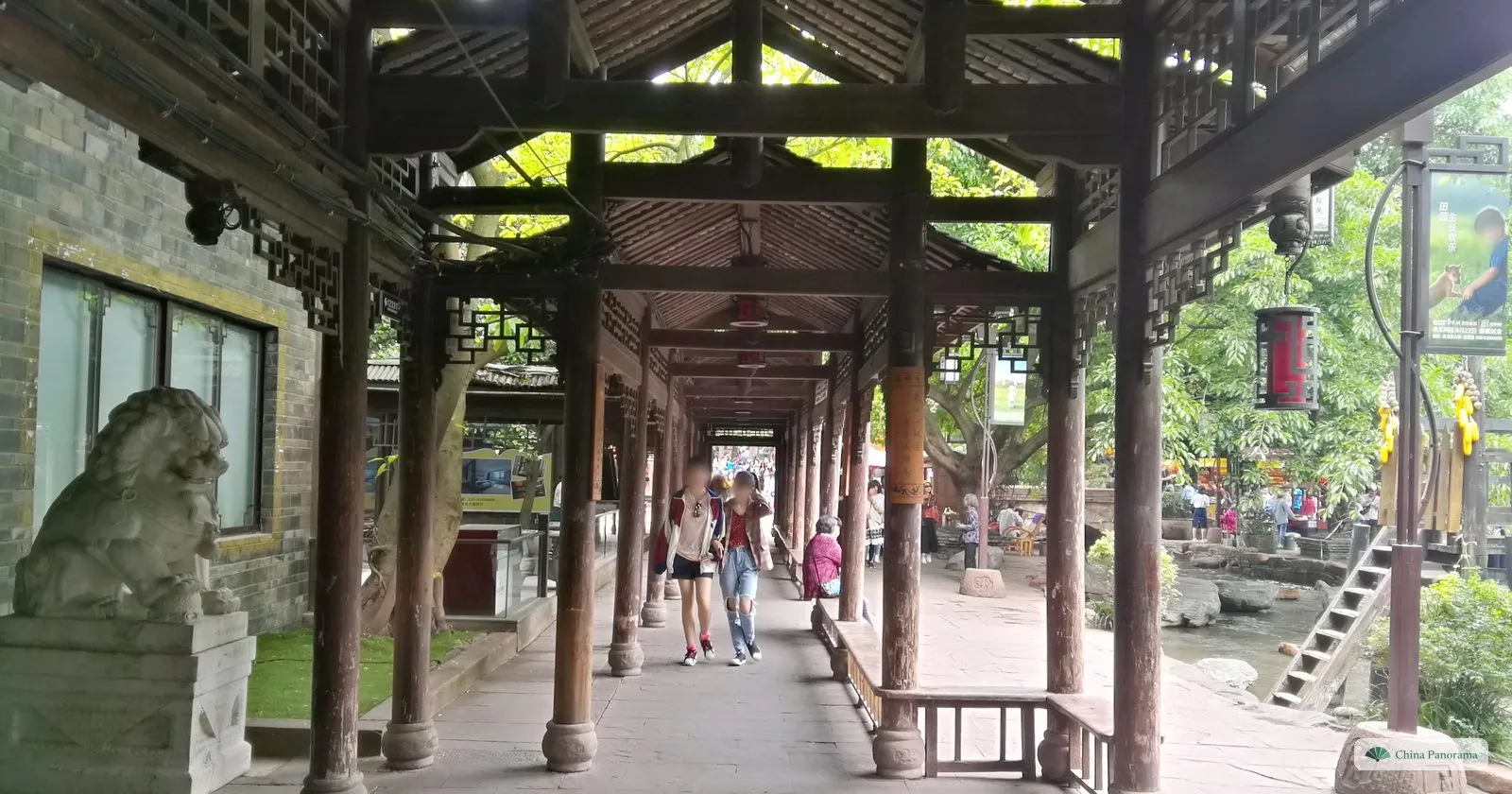 Photograph 6
Kuanzhai Xiangzi, Jinli or Huanglongxi?
Answer: Huanglongxi
A long covered walkway beside the water, with a stone lion at the end. Look right: the stream again. That is Huanglongxi.
Huanglongxi, 09:52 on 29 April 2019.
- Photograph 7
Kuanzhai Xiangzi, Jinli or Huanglongxi?
Answer: Kuanzhai Xiangzi
Grey brick, a round window, a bronze figure of an old Chengdu resident with his fan and a little stall: the bronze townspeople are a feature of Kuanzhai Xiangzi.
Kuanzhai Xiangzi, 10:48 on 30 April 2019.
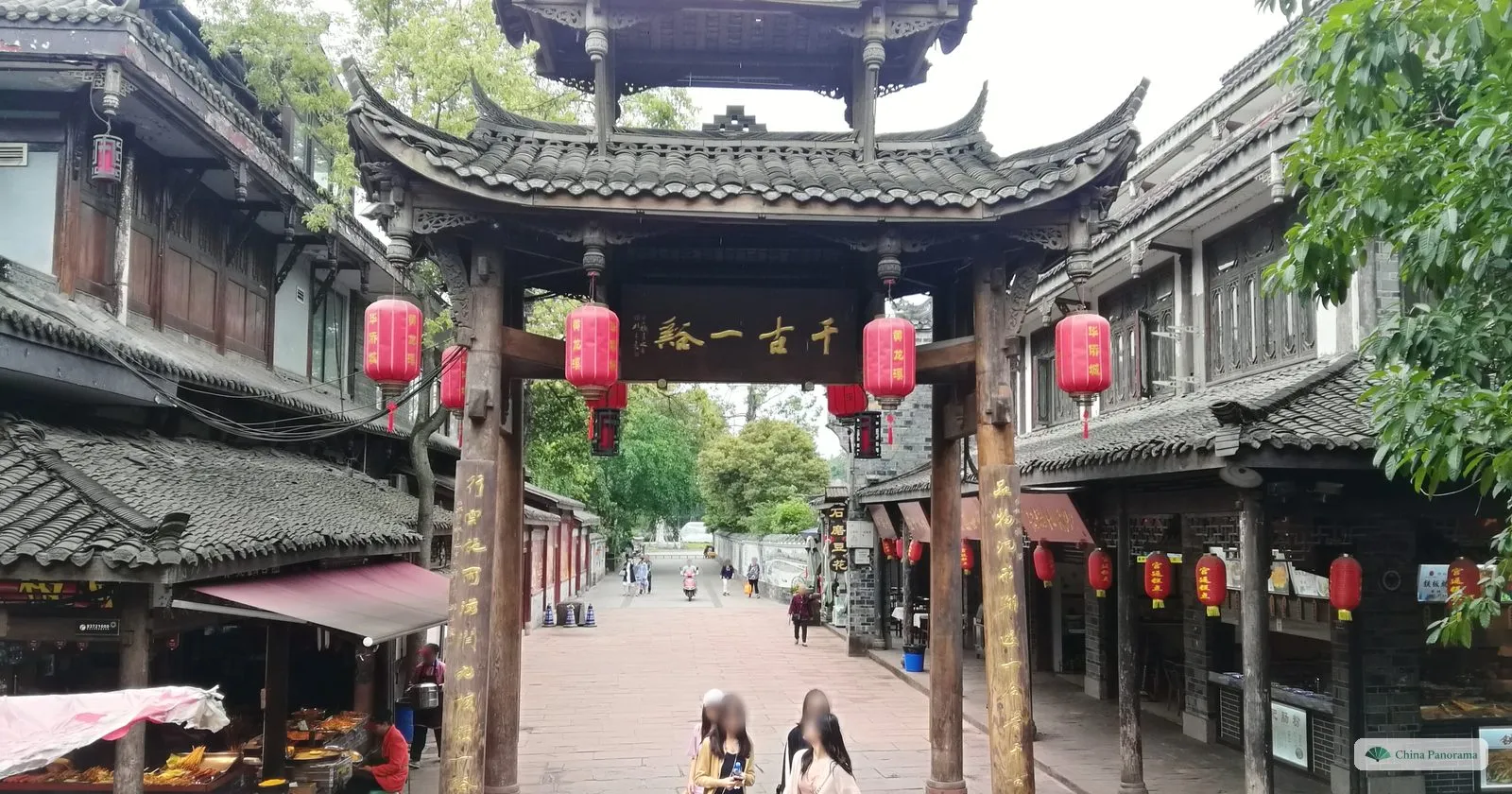 Photograph 8
Kuanzhai Xiangzi, Jinli or Huanglongxi?
Answer: Huanglongxi
This one is hard. The clue is on the lanterns: they carry the name 黄龙溪, Huanglongxi. The wooden archway reads “Unique through the ages”.
Huanglongxi, 09:53 on 29 April 2019.
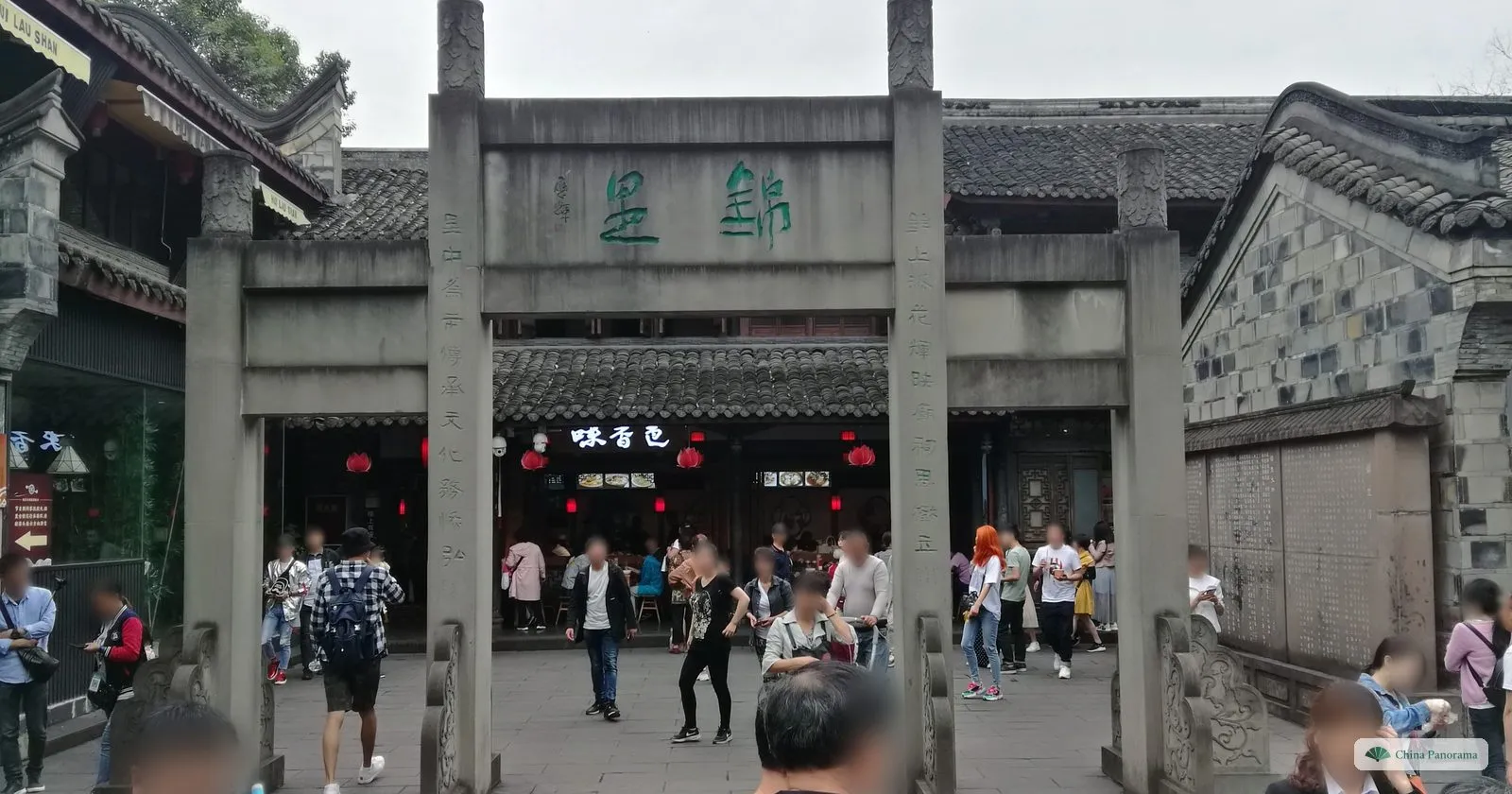 Photograph 9
Kuanzhai Xiangzi, Jinli or Huanglongxi?
Answer: Jinli
Read the lintel: the green characters are 錦里, Jinli, written right to left in the old way. This stone archway stands at the far end of the street.
Jinli, 12:13 on 30 April 2019.
| Kuanzhai Xiangzi | Jinli | Huanglongxi | |
|---|---|---|---|
| What it is | Three lanes of the Qing Manchu quarter | One street built in old style | A river town with Qing houses |
| How old | Laid out 1718, rebuilt for 2008 | Opened 2004 | Mostly Qing, restored |
| Where | 1.8 km from Tianfu Square · Line 4 | Beside the Wuhou Shrine · Line 10 | 39 km south · by car |
| Best for | Courtyard tea houses, a stroll | Snacks, lanterns at night, opera | Water, a half-day out |
| Combine with | People’s Park and its tea house | The Wuhou Shrine next door | The road to Leshan |
Which of it is really old?
Less than it looks. The oldest things in and around Chengdu are underground or in the rivers — Bronze Age pits, an irrigation system of 256 BC — while the temples were rebuilt under the Qing and the old streets in our own time. Tap a name on the time line, or filter.
The ancient Shuc. 1700–316 BC
Qin to Tang316 BC – AD 907
about 600 years later
Ming and Qing1368–1912
The People’s Republicsince 1949
Filled dot: original. Ring: ruin. Square: built in our time.
Tap a name on the time line or a card.
- Ruinc. 12th–11th century BCabout 3,180 years old
Found by chance in 1986, 40 km north-east of the city; now in the museum on the site.
- Ruinc. 1200–650 BCabout 3,030 years old
Found by builders in 2001, inside today’s city. The Golden Sun Bird comes from here.
- Originalc. 256 BCabout 2,280 years old
The irrigation system of Li Bing, governor for the state of Qin — in use ever since.
- Originalfinished 803about 1,220 years old
Carved into the cliff in the 8th century.
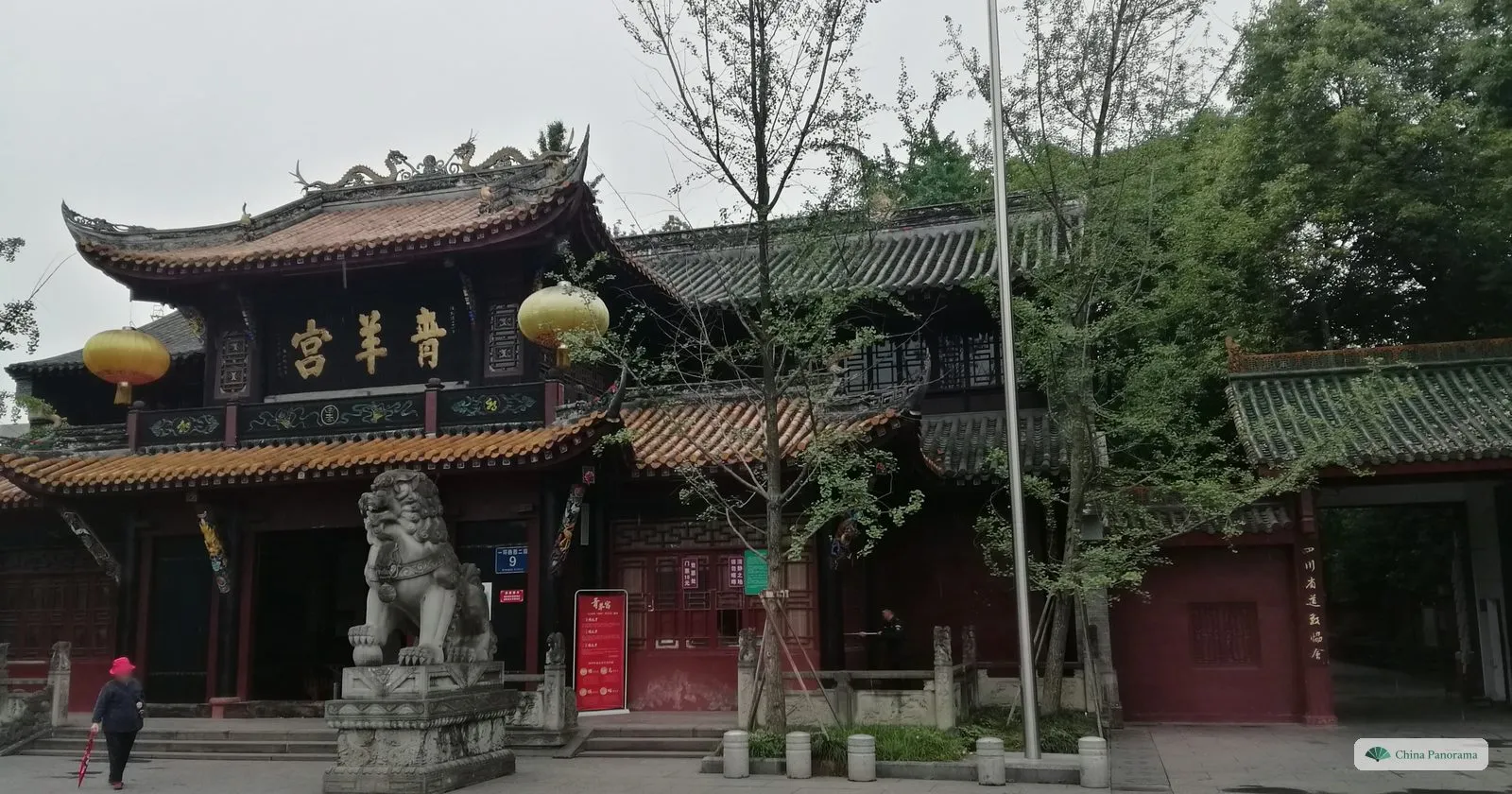 Original1667–1671about 360 years old
Enlarged and named in 881; the Tang buildings were lost and the temple rebuilt under the Kangxi emperor.
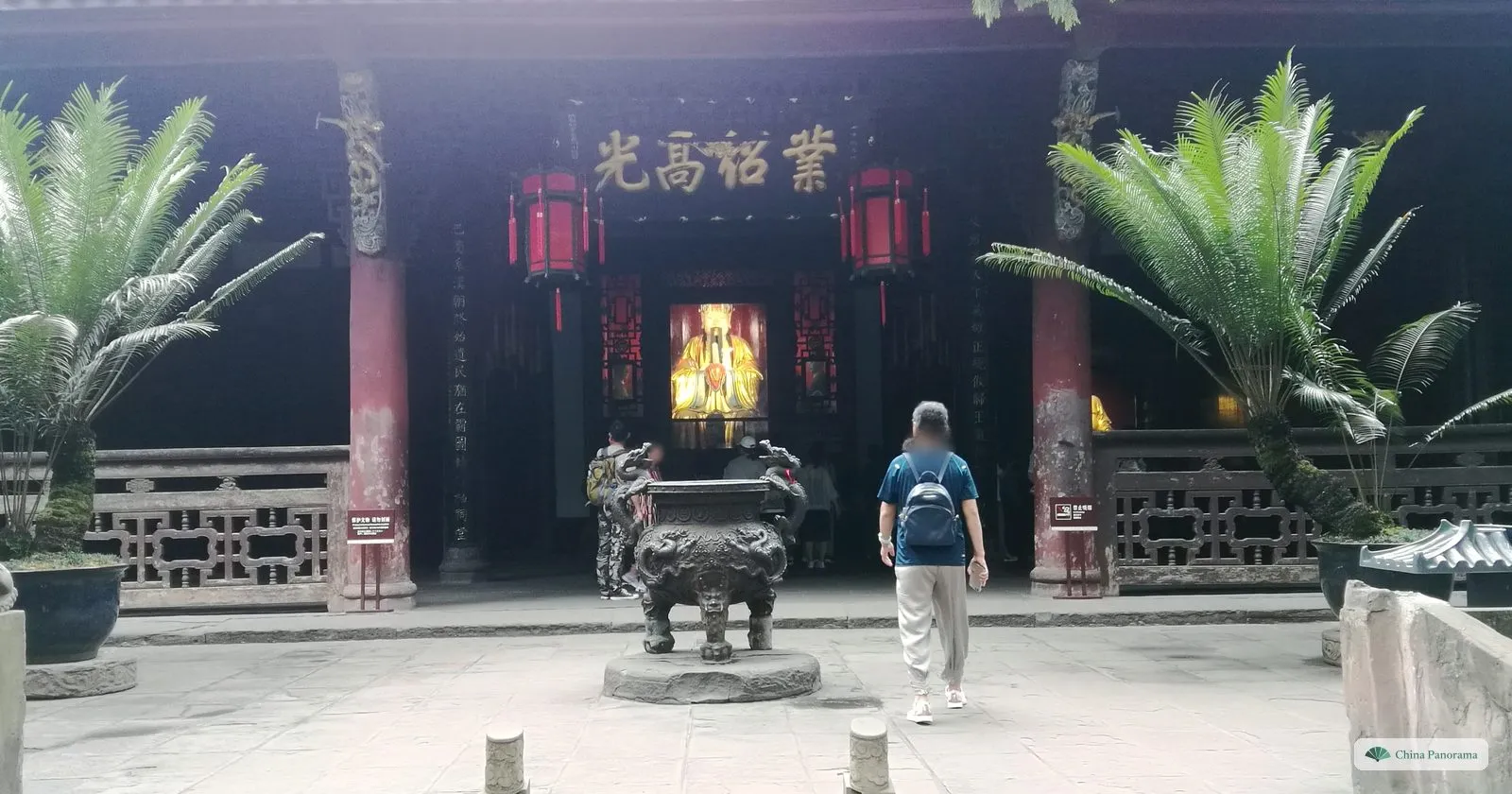 Original1672 (tomb 223)about 350 years old
Liu Bei’s tomb mound dates from 223; the halls were rebuilt in 1672 after the wars at the end of the Ming.
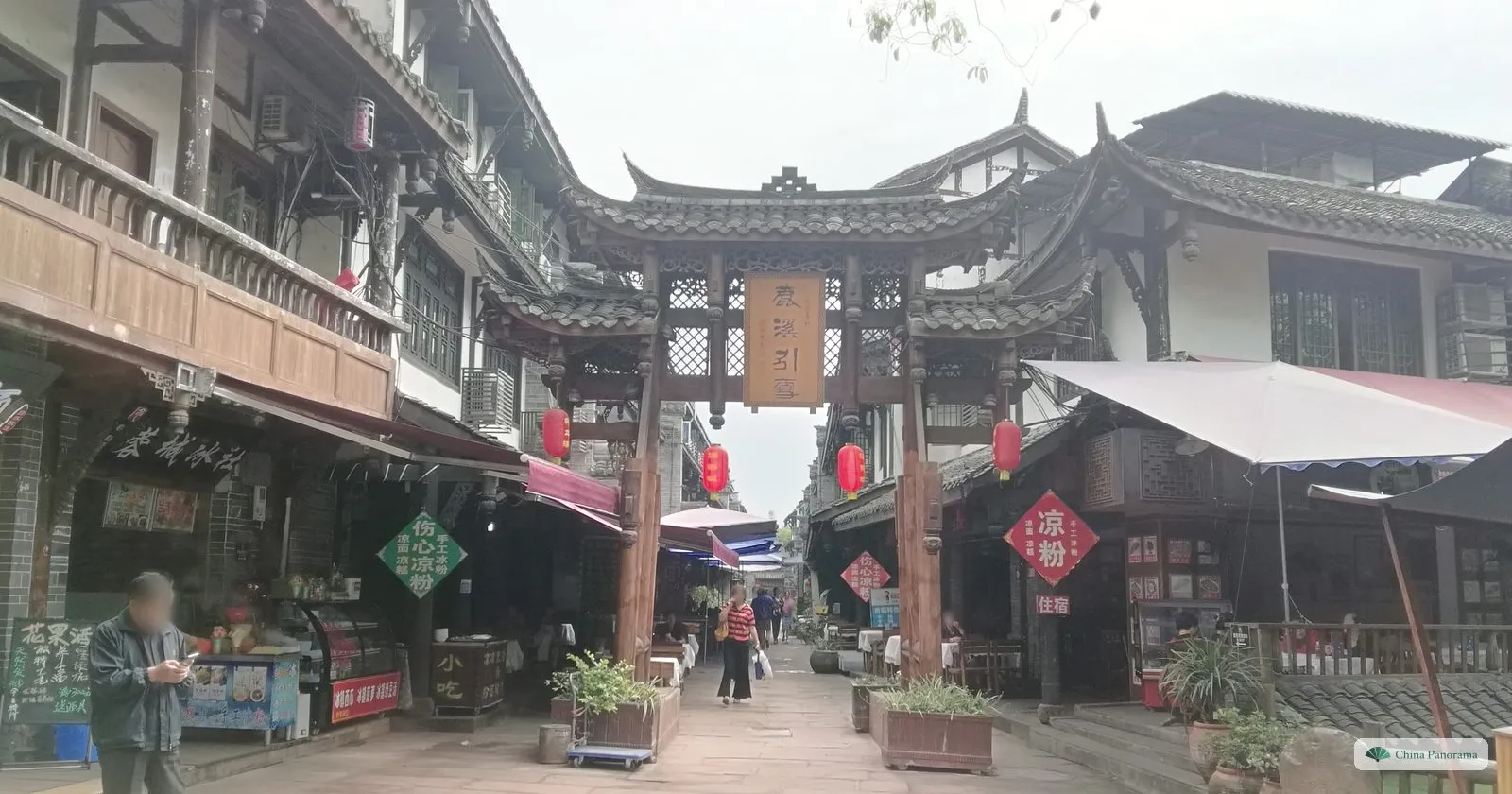 Originalmostly Qing, restoredabout 230 years old
Most houses are Qing; the stream gardens and fountains in the newer part are recent.
- Original16th century and 1811about 220 years old
Du Fu lived here from 759; the hut is a reconstruction, the gardens and halls are Ming and Qing.
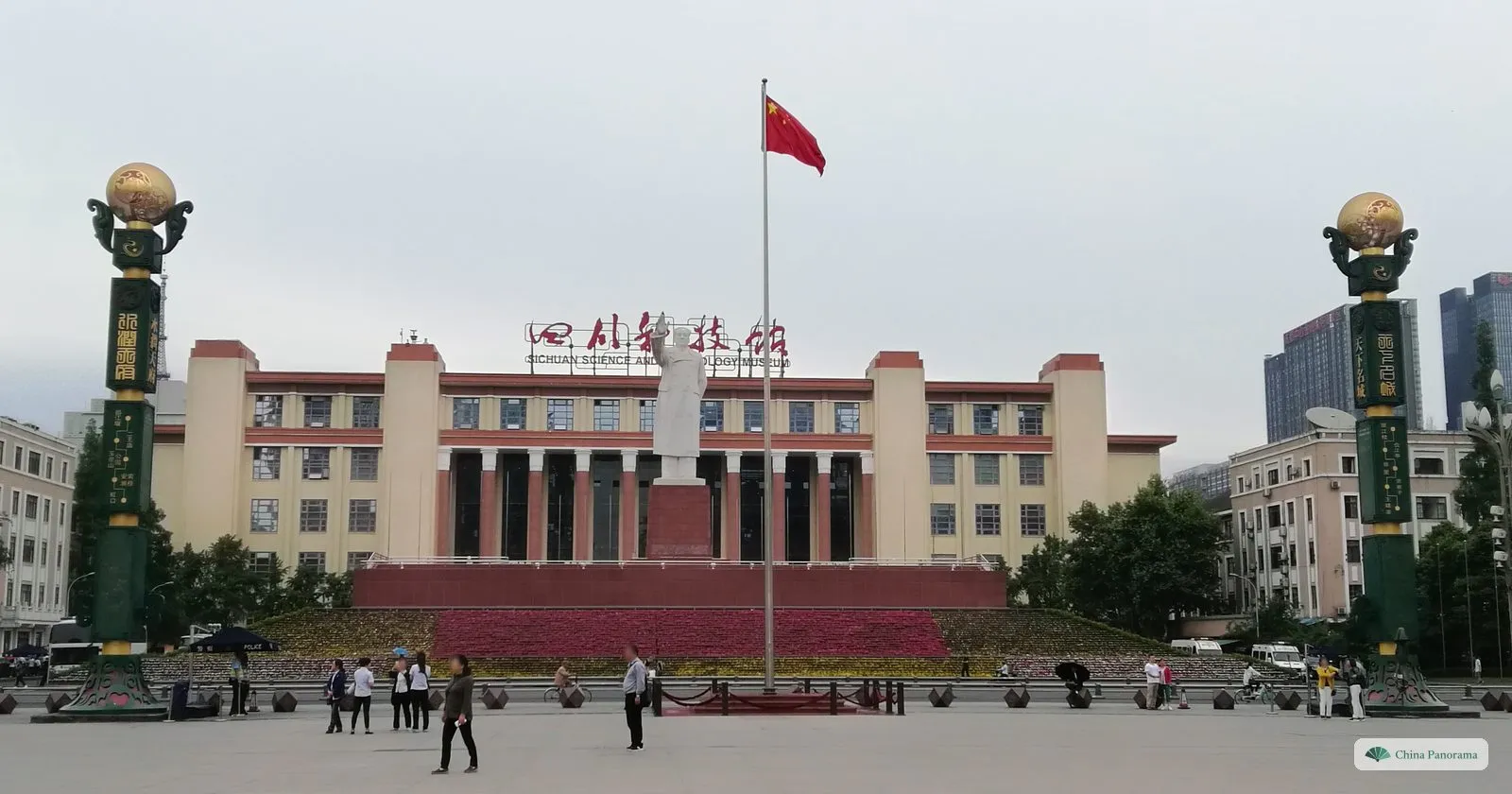 Built in our time196957 years old
The palace gate was pulled down in 1968; the exhibition hall and statue went up in its place.
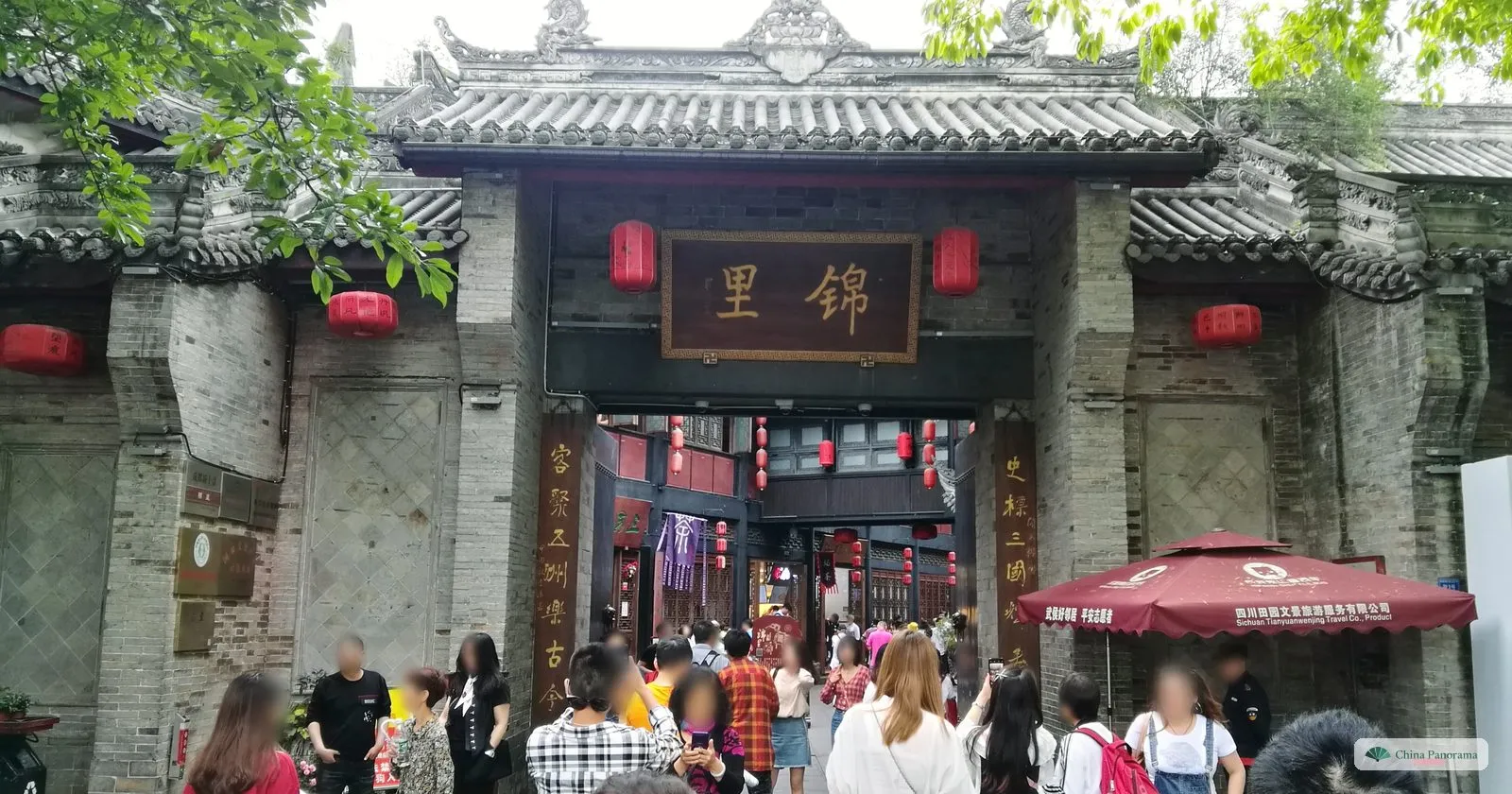 Built in our time200422 years old
Opened in October 2004 beside the Wuhou Shrine; a second section in 2009.
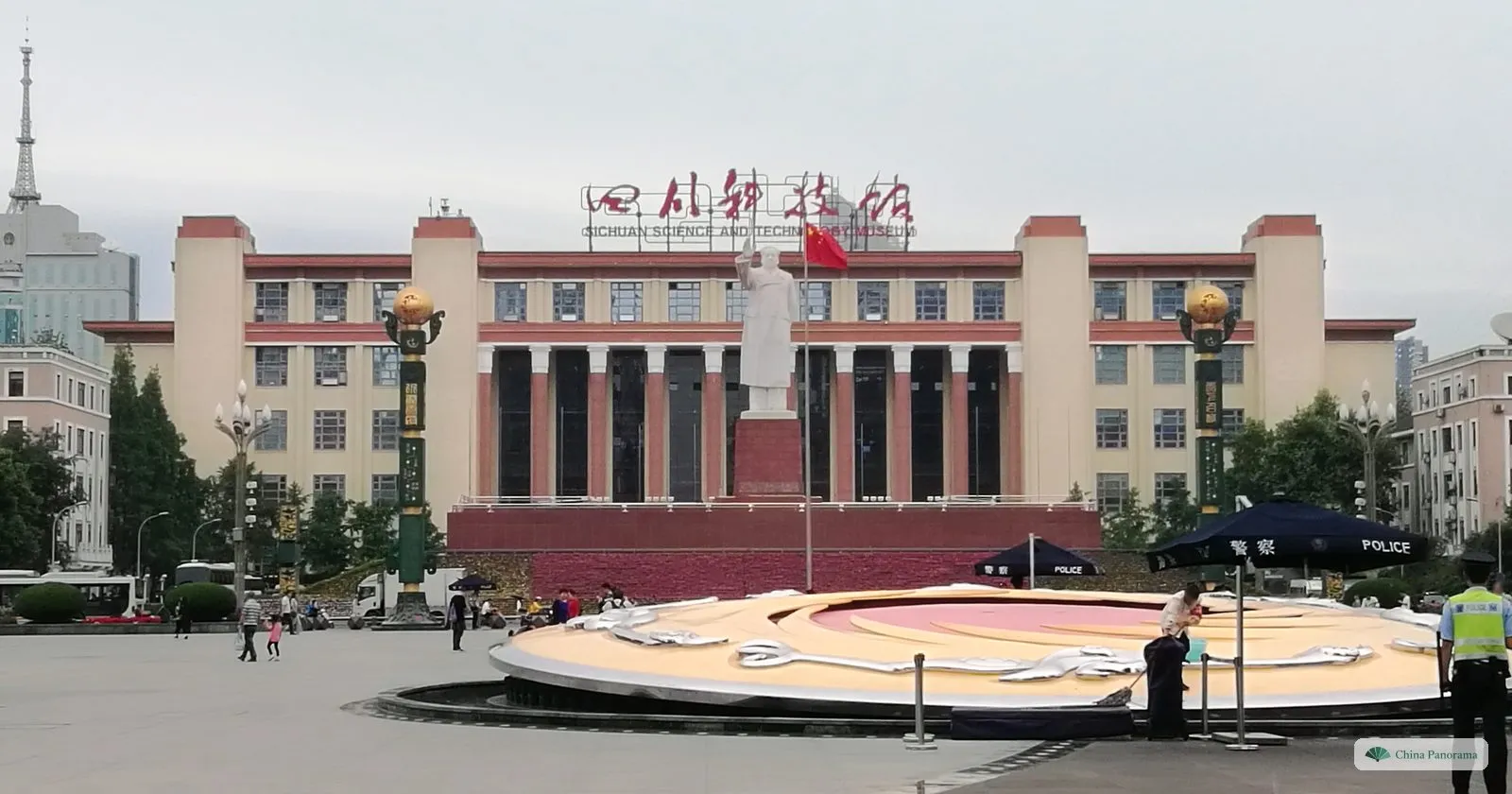 Built in our time200719 years old
Rebuilt together with the metro station below, named in 1999.
- Built in our time2008 (laid out 1718)18 years old
The lanes of the 1718 Manchu quarter; most houses rebuilt for the reopening on 14 June 2008.
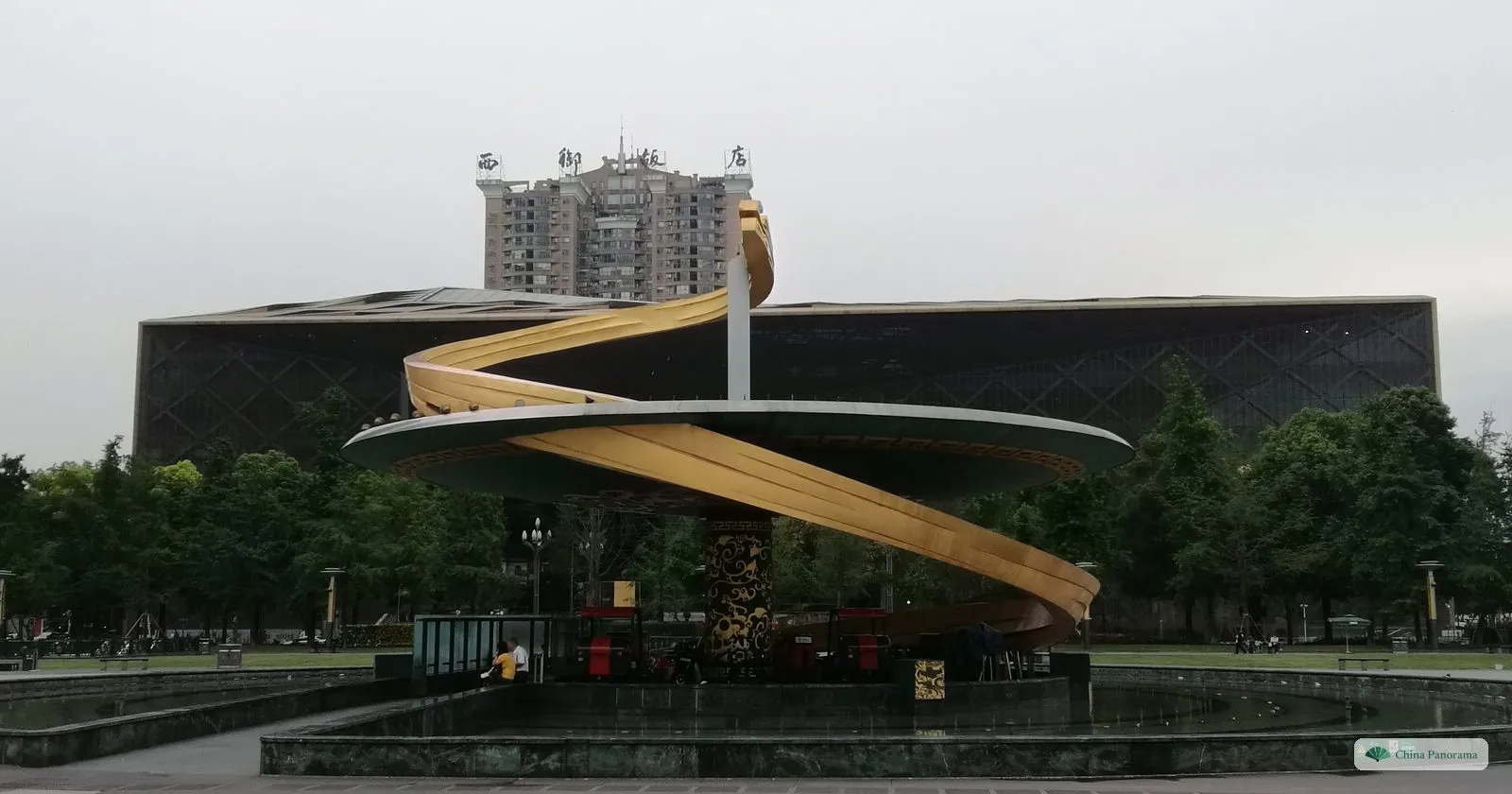 Built in our time201610 years old
Opened on 11 June 2016 on the west side of Tianfu Square.
What am I looking at?
The two names on the gate of the Wuhou Shrine, the hall of Zhuge Liang, Tianfu Square and the signs at Kuanzhai Xiangzi. Tap a number on the photograph.
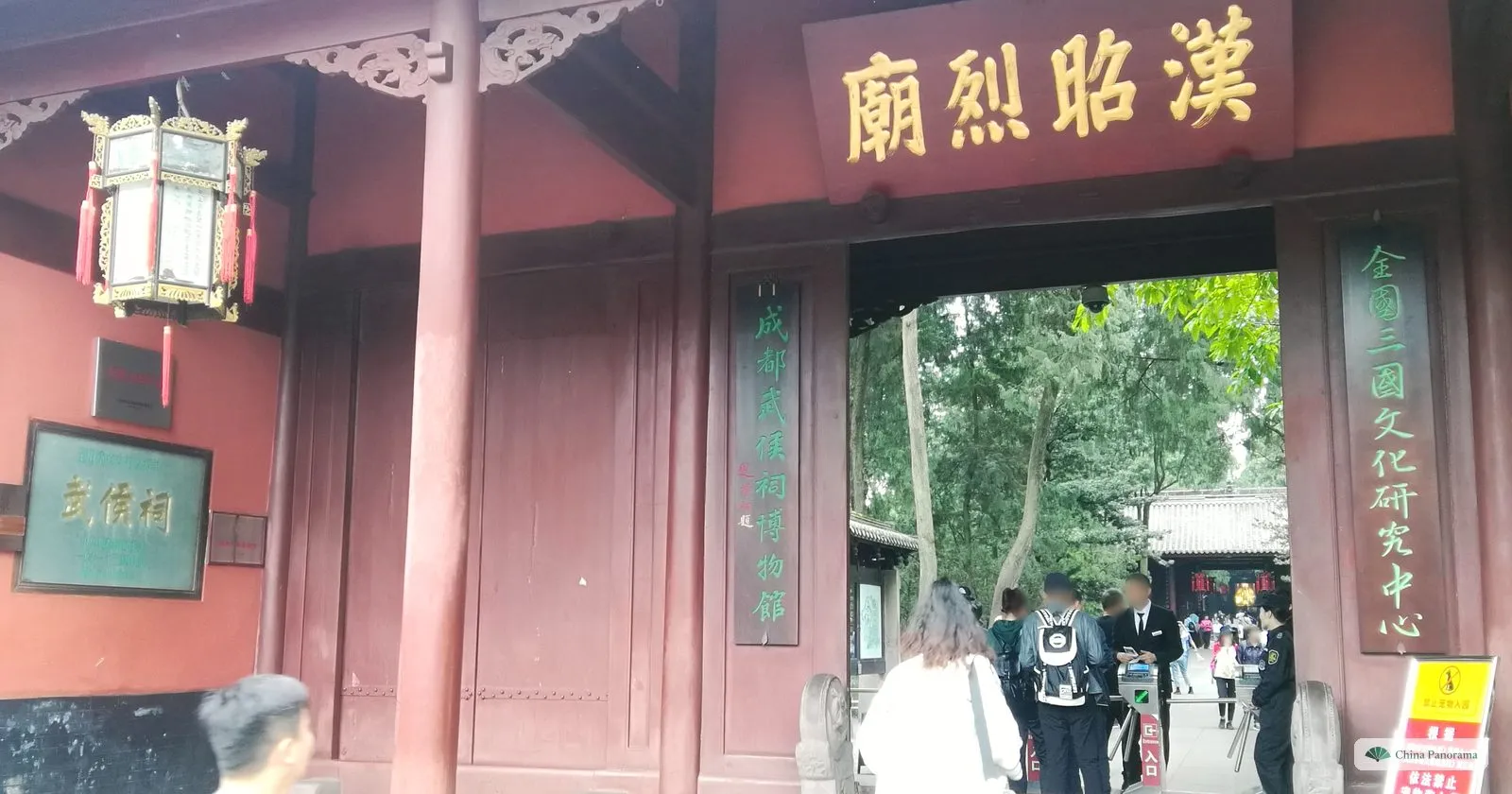
1“Han Zhaolie Temple”
漢昭烈廟 · Liu Bei’s temple, read right to left
Zhaolie was the posthumous title of Liu Bei, who founded the state of Shu Han in Chengdu in 221 and claimed descent from the Han emperors. Officially, this is his temple, and his tomb is behind it.
Tap a number on the photo, or a name in the list.
16 places in and around Chengdu
Filter by type, or by whether you need to be indoors — useful on a rainy summer afternoon. For the food, see how to eat hot pot and mapo tofu, a Chengdu dish.
Wuhou Shrine
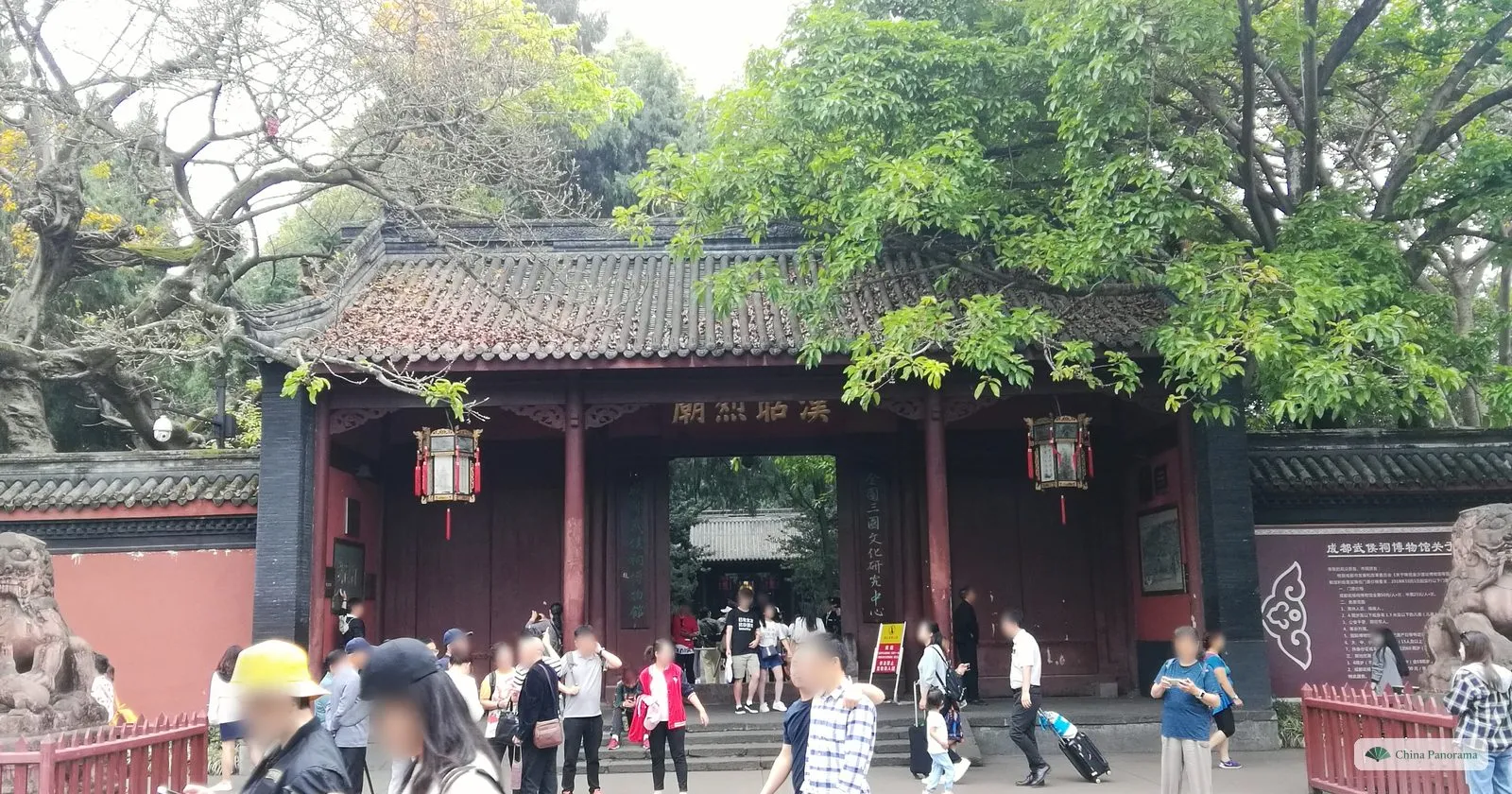
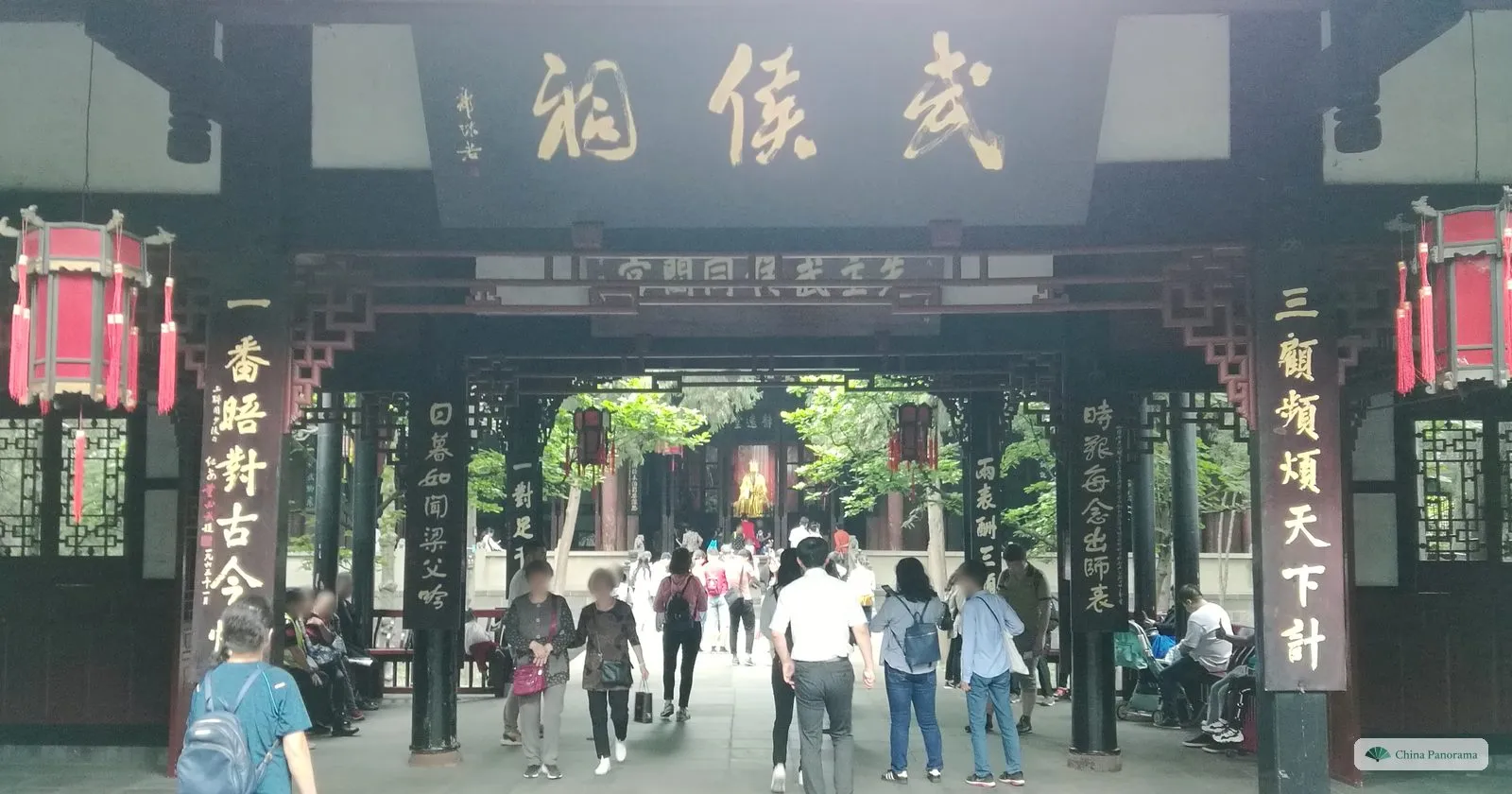
武侯祠TempleWuhou · 武侯区OutdoorsThe shrine of Zhuge Liang, the strategist of the Three Kingdoms, who served Liu Bei, founder of the state of Shu Han, as chancellor — and, unusually, a temple to the emperor and his minister together. The site began in 223 with Liu Bei's tomb, the Huiling, and a temple to him; the shrine to Zhuge Liang was moved here later, and in the early Ming the two were merged. That is why the gate says “Han Zhaolie Temple”, Liu Bei's temple name, while everyone calls the place after Zhuge Liang, the “Marquis Wu”. The halls standing today were rebuilt in 1672, after the wars at the end of the Ming: first Liu Bei's hall, with the plaque “He carried on the glory of Gaozu”, then a passage with Zhuge Liang's name in the calligraphy of Guo Moruo, then Zhuge Liang's own hall. Clay statues of the generals and ministers of Shu line the corridors, and behind the halls are Liu Bei's tomb mound, red walls under bamboo and a garden with a lake. The whole complex has been a national monument since 1961. We were here from 12:48 to 13:45 on 30 April 2019.
Wuhouci station (Line 10, opened September 2025) is nearby; Gaoshengqiao (Lines 3, 5 and 10) is about ten minutes' walk. Jinli, the old-style street, is next to the gate. We have not checked the ticket price or hours; a passport may be needed to buy a ticket.
- Entry
- Price not verified — check on site
- Opening hours
- Hours not verified — check on site
Jinli
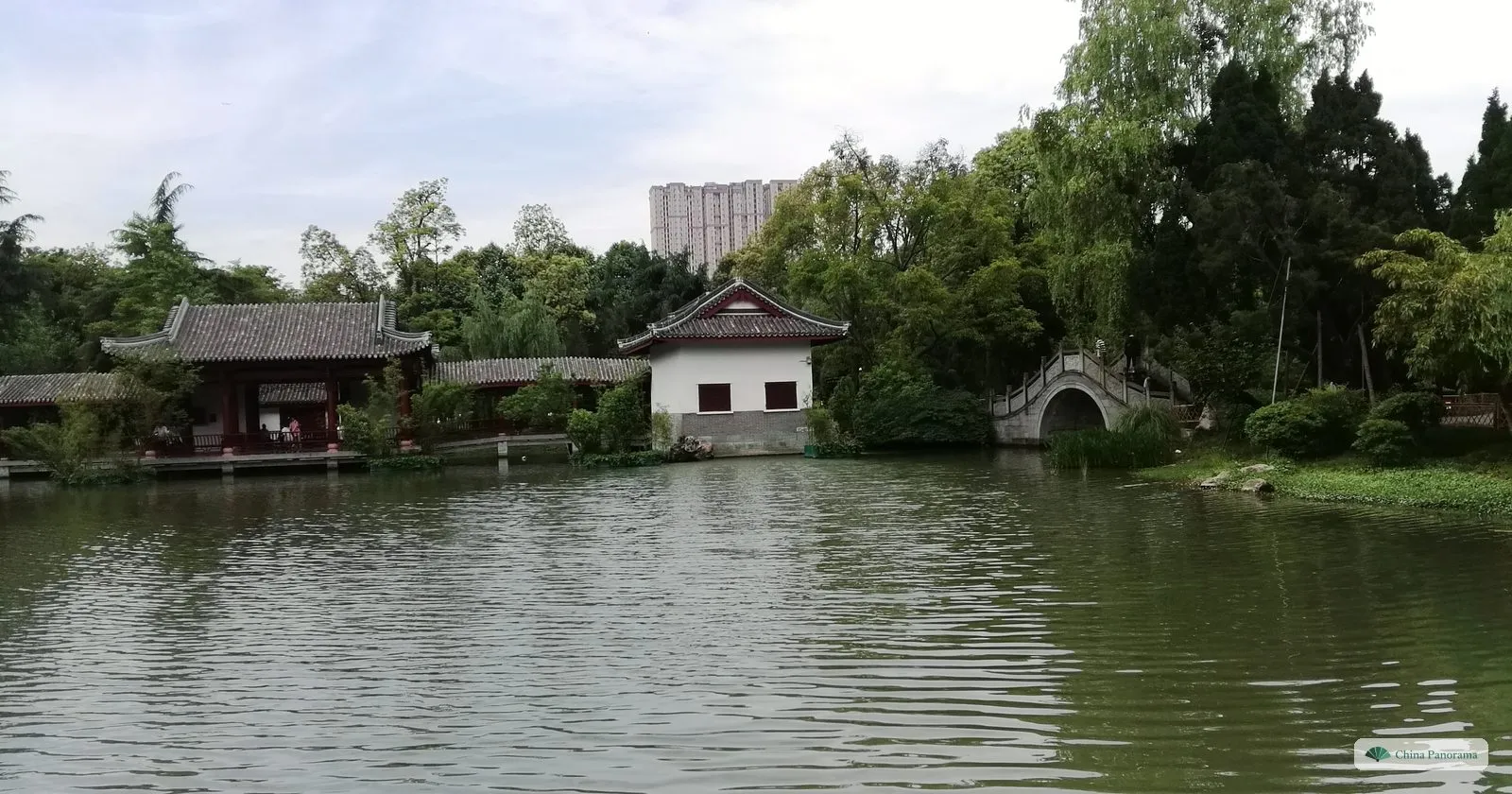
锦里StreetWuhou · 武侯区OutdoorsA lane of grey-brick and dark-timber houses, red lanterns and snack stalls along the east wall of the Wuhou Shrine — built new by the shrine's museum and opened in October 2004, about 550 m long, with a second section added in 2009. The name is old: Jinli, “brocade lane”, is one of the poetic names of Chengdu, the city where silk brocade was rinsed in the river. Inside are tea houses, shops for chopsticks, lanterns and silk, a stage for Sichuan opera, sugar painters and clay-figure makers, and the snacks the city is known for: Zhang Fei beef, named after Liu Bei's general, sweet rice balls thrown against a drum board (san da pao), and noodles of every kind. At midday on 30 April 2019, the day before the May Day holiday, it was packed from gate to gate.
Next to the Wuhou Shrine: Wuhouci station (Line 10) or Gaoshengqiao (Lines 3, 5 and 10). The lane is free and open into the evening; it is busiest at weekends and after dark, when the lanterns are lit.
- Entry
- Free
- Opening hours
- Open at all hours
- StreetQingyang · 青羊区Outdoors
Three parallel lanes in the west of the old city — from north to south Kuan Xiangzi (Wide Alley), Zhai Xiangzi (Narrow Alley) and Jing Xiangzi (Well Alley) — and the courtyard houses between them. They are what is left of the Manchu quarter: in 1718 the Qing left a garrison of Eight Banners soldiers in Chengdu and walled off a “Manchu city” here, with lanes called hutong as in Beijing. The three were Xingren, Taiping and Ruyi Hutong until the Republic renamed them. In the 2000s the area was restored and largely rebuilt — more than 900 households were moved out — and it reopened on 14 June 2008 as a district of tea houses, restaurants, bars and shops. Look for the grey brick walls, the courtyard gates with stone drums, and the timber frames with whitewashed panels typical of western Sichuan. We walked the lanes from 10:39 to 11:00 on 30 April 2019, among the bougainvillea and a lot of people.
Kuanzhai Xiangzi station (Line 4) is at the west end; People's Park (Line 2) is about ten minutes' walk south-east. The lanes are free and open at all hours; shops and tea houses keep their own times. Mornings are quieter.
- Entry
- Free
- Opening hours
- Open at all hours
Tianfu Square
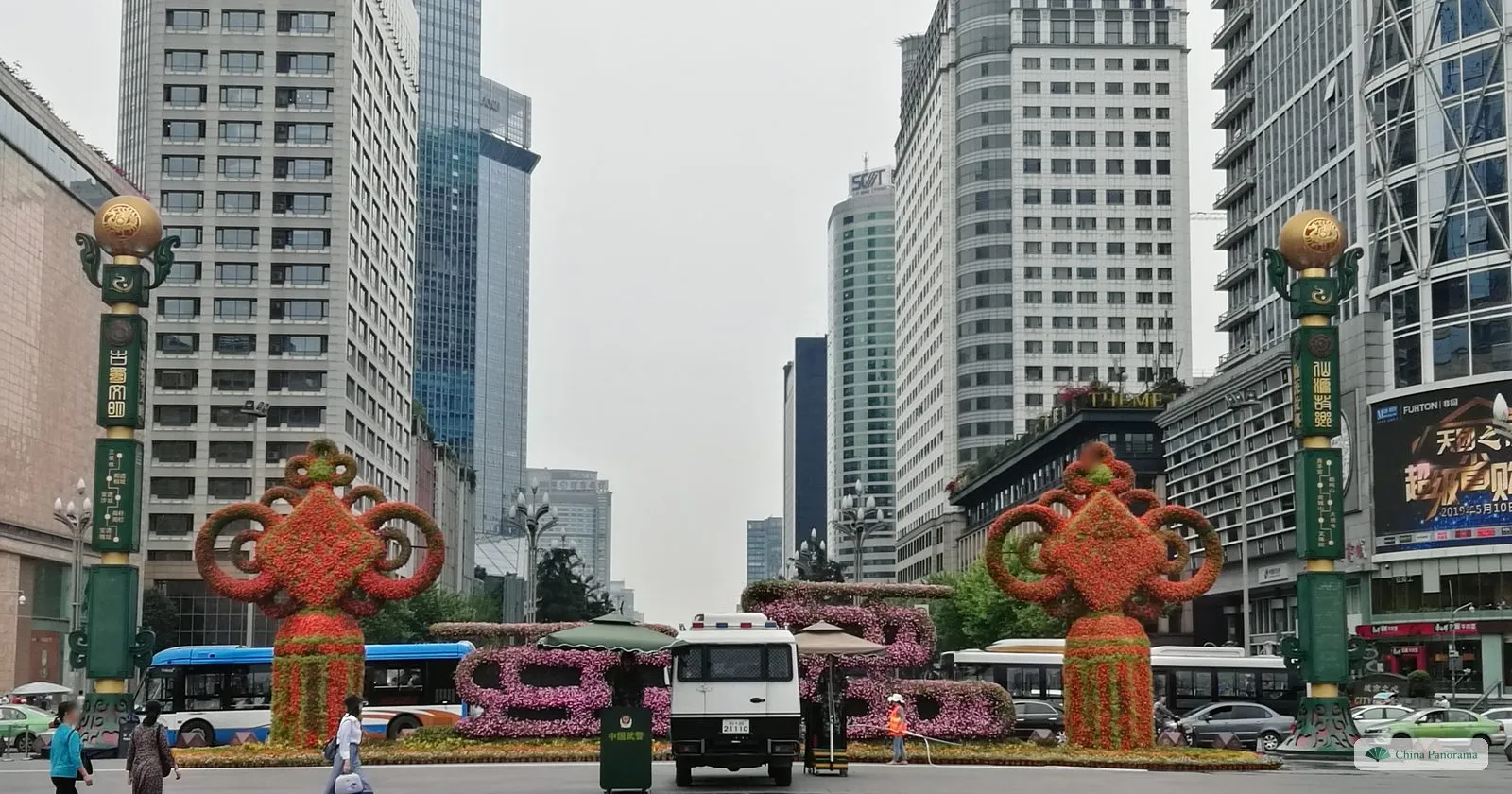
天府广场LandmarkQingyang · 青羊区OutdoorsThe centre of Chengdu, a square of about 88,000 m² where the Ming princes of Shu had their palace, later called the Imperial City. Its south gate and remaining buildings were pulled down in 1968, and in their place came an exhibition hall to Mao Zedong Thought — today the Sichuan Science and Technology Museum — with a giant white statue of Mao in front, waving towards the south. The square took its present name in 1999 and was rebuilt in 2007, together with the metro station below, on the theme of the Golden Sun Bird, the 3,000-year-old gold ornament found at Jinsha. Around it now stand the Chengdu Museum (2016), the new Sichuan Library and the Sichuan Grand Theatre. Our photographs are from 09:23 to 09:30 on 30 April 2019.
Tianfu Square station (Lines 1 and 2) is underneath; Chunxi Road, the main shopping street, is one stop east on Line 2. Free and open at all hours.
- Entry
- Free
- Opening hours
- Open at all hours
- MuseumQingyang · 青羊区Indoors
The building behind the Mao statue was put up between December 1968 and October 1969 as the “Exhibition Hall of the Eternal Victory of Mao Zedong Thought”, became the provincial exhibition hall in 1979 and, after a refit, opened as the science museum on 2 November 2006. Inside are hands-on halls for children and adults; the space hall has models of Chinese spacecraft, among them the Tiangong space-station module in our photograph from 09:48 on 30 April 2019.
On the north side of Tianfu Square, Tianfu Square station (Lines 1 and 2). Entry has been reported free with a passport; we have not checked this, the hours or the closing day.
- Entry
- Price not verified — check on site
- Opening hours
- Hours not verified — check on site
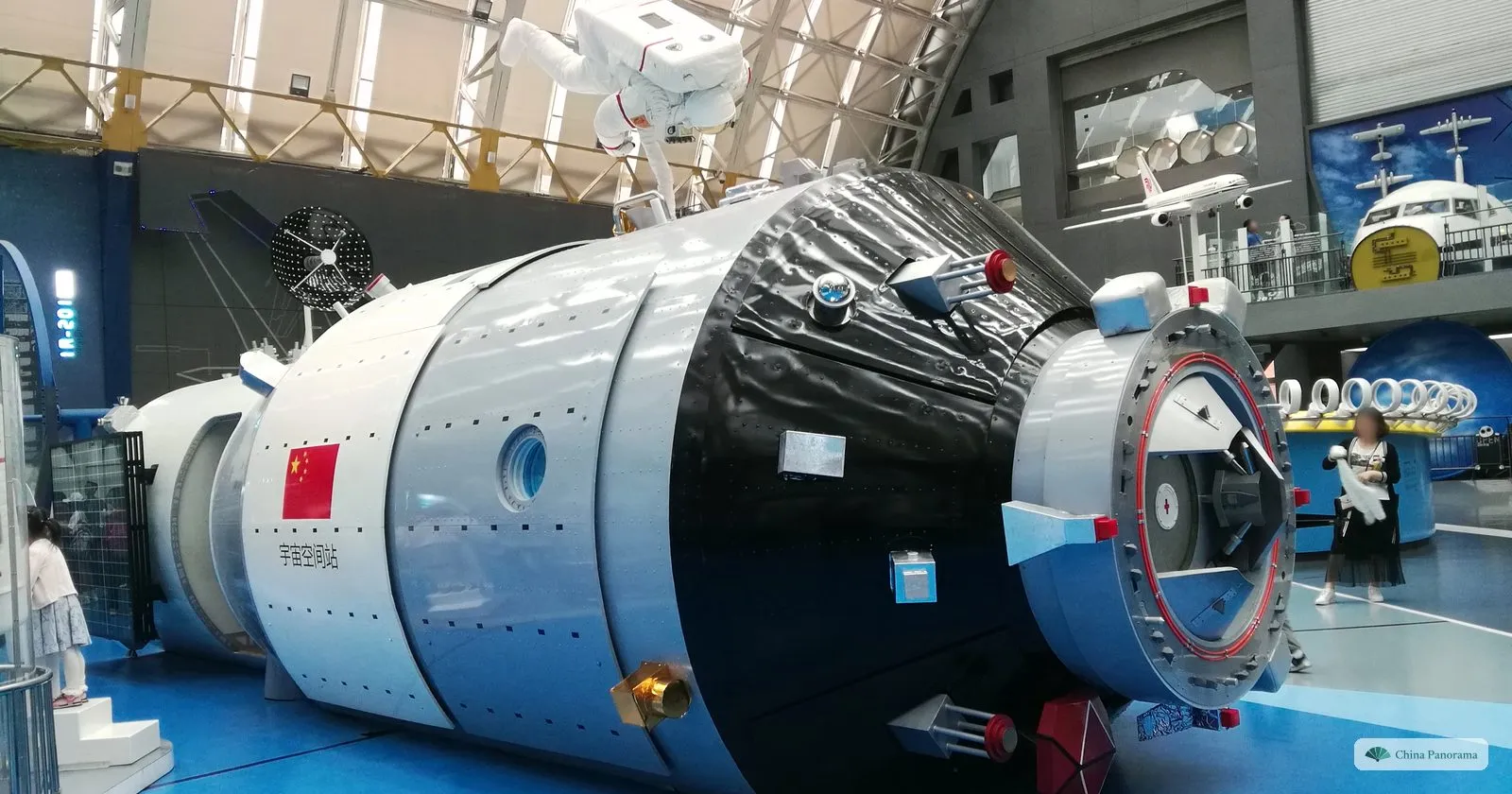
Chengdu Museum
成都博物馆MuseumQingyang · 青羊区IndoorsThe city museum, a dark block wrapped in a lattice of metal on the west side of Tianfu Square, opened on 11 June 2016. Over nine floors it tells the history of Chengdu from the Bronze Age kingdoms of Shu to the tea houses of the 20th century; its best-known pieces are Han-dynasty figures, among them a lacquered figure marked with acupuncture points from the Laoguanshan tombs, and the largest collection of Chinese shadow puppets and marionettes in the country, in a permanent exhibition of its own.
West side of Tianfu Square, Tianfu Square station (Lines 1 and 2). Entry to the permanent exhibitions has been reported free with a passport; we have not checked this, the hours or whether you need to reserve.
- Entry
- Price not verified — check on site
- Opening hours
- Hours not verified — check on site
- TempleQingyang · 青羊区Outdoors
Chengdu's great Taoist temple, the “Palace of the Green Goat”. Legend puts its beginning in the time of Laozi, who is said to have told a disciple to meet him at the “green goat market” in Chengdu; the Tang emperor Xizong, who fled to Chengdu from the Huang Chao rebellion, had it enlarged and renamed in 881. The Tang halls were lost in the wars of the Ming, and the temple you see was rebuilt between 1667 and 1671. Inside are the Eight Trigrams Pavilion and the Hall of the Three Pure Ones, in front of which stand two bronze goats — one with a single horn, given in 1723 — polished by visitors who rub them for luck. Our photograph of the gate is from 08:35 on 30 April 2019. The district of Qingyang is named after it.
Qingyang Palace station (Lines 5 and 13) is at the gate. Culture Park is next door, and Du Fu Thatched Cottage about 1.5 km west. It is a working temple: dress modestly and do not photograph people praying. We have not checked the ticket price or hours.
- Entry
- Price not verified — check on site
- Opening hours
- Hours not verified — check on site
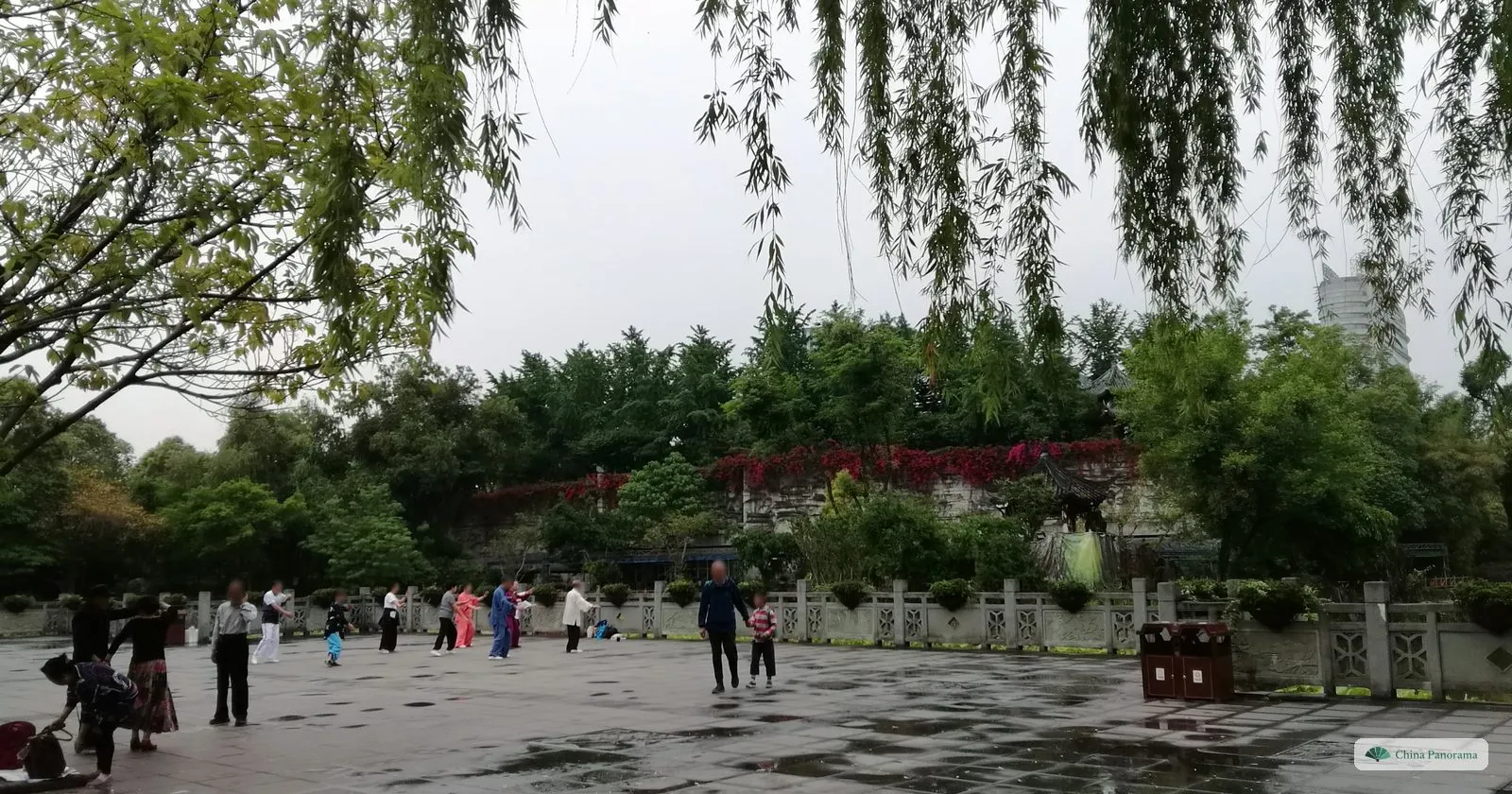
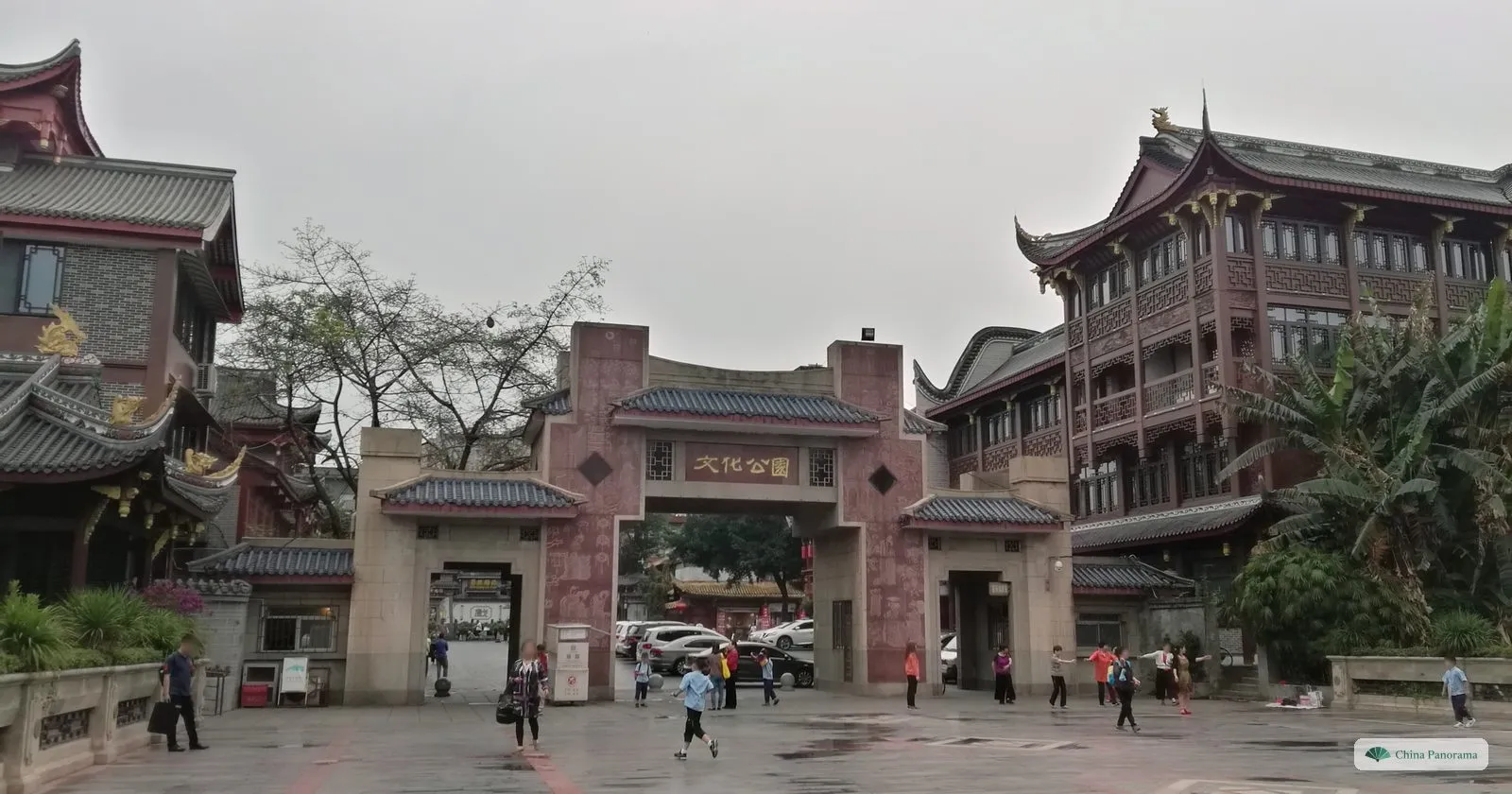
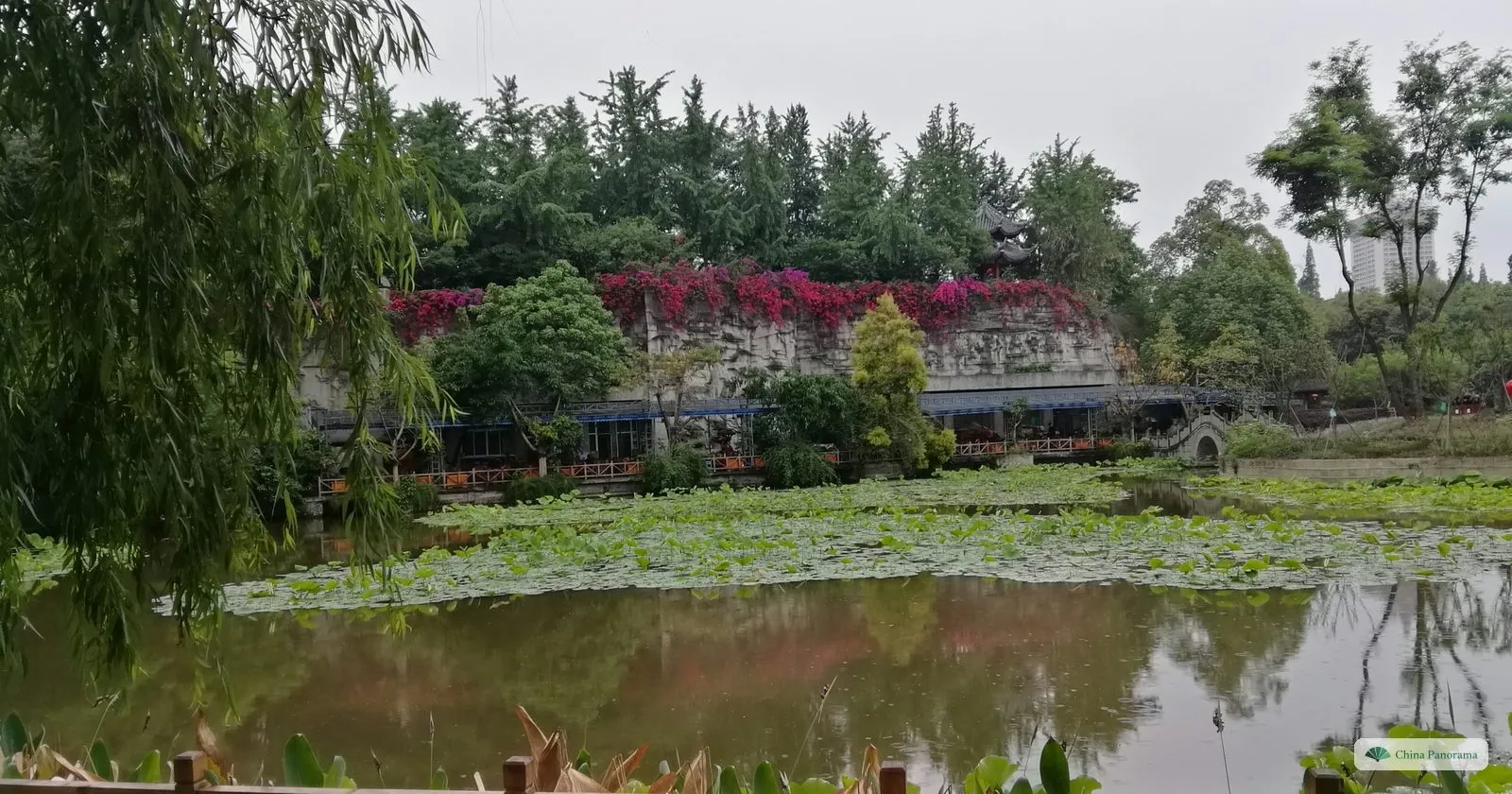
Culture Park and Baihuatan Park
文化公园 · 百花潭公园ParkQingyang · 青羊区OutdoorsTwo city parks side by side on the Huanhua stream, next to Qingyang Palace — the place to see Chengdu's mornings. At eight o'clock on 30 April 2019 the square inside the Culture Park gate was full of people doing tai chi and dancing with fans, and the paths round the lotus pond were lined with bougainvillea. In the park is the Liyuan opera house, one of the city's stages for Sichuan opera; across the canal to the south, Baihuatan Park, “Hundred Flowers Pool”, is entered through a gate with a round moon door and is known for its potted trees. Both are where the tea house culture of the city lives on: bamboo chairs, covered tea bowls and an hour with nothing to do.
Qingyang Palace station (Lines 5 and 13). The parks are free; we have not checked their hours, or show times and prices at the opera house.
- Entry
- Free
- Opening hours
- Hours not verified — check on site
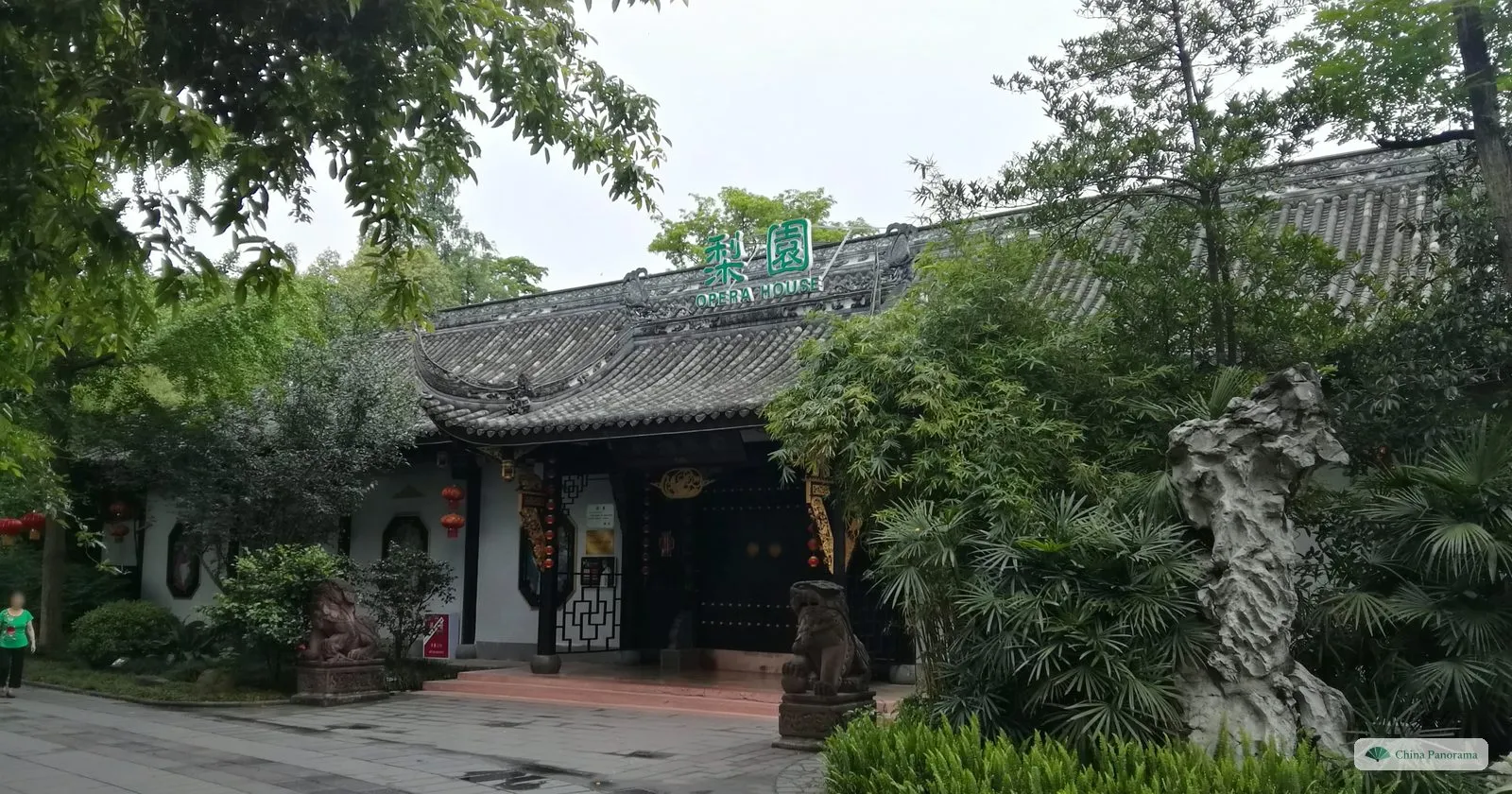
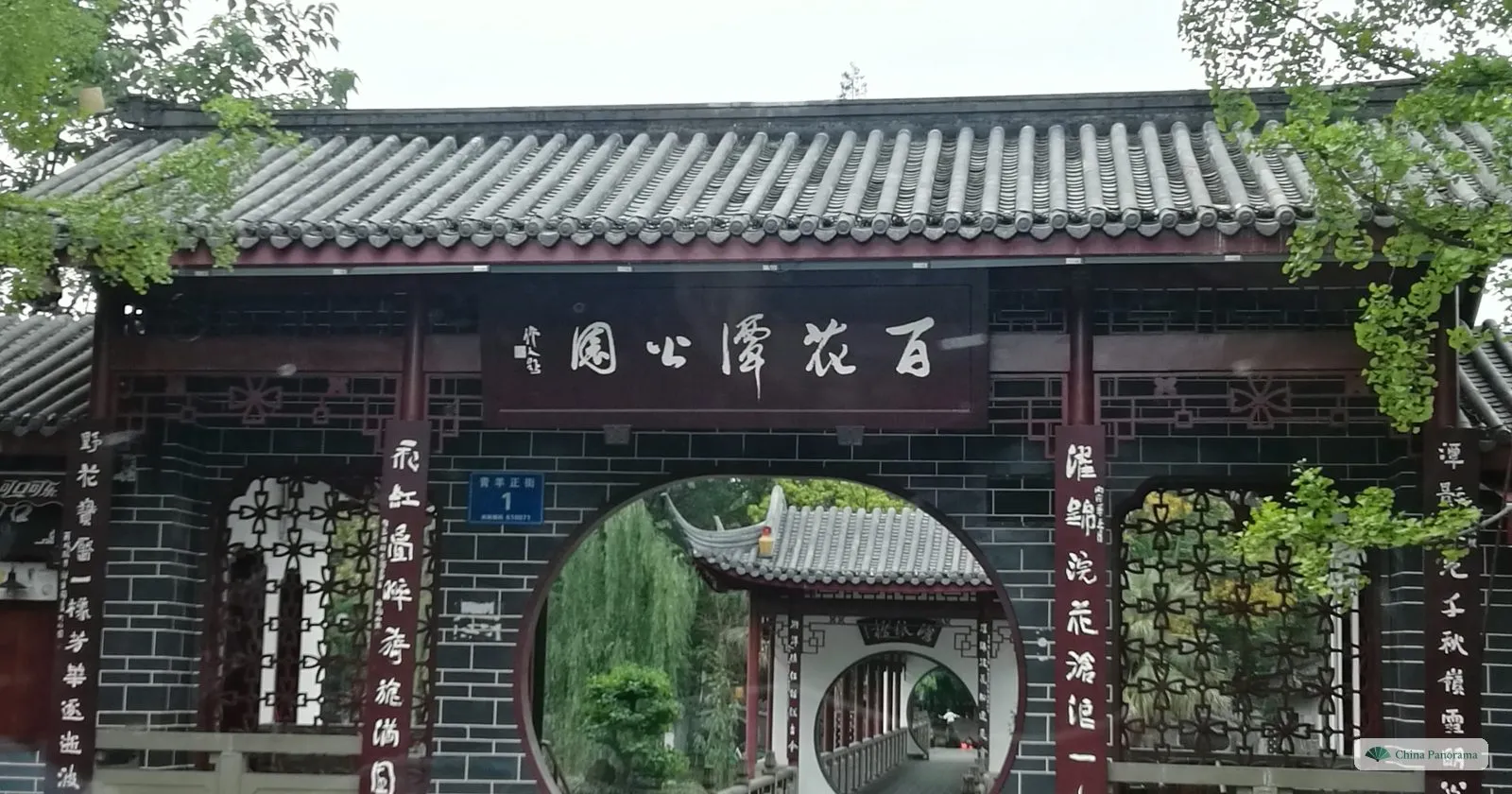
Huanglongxi old town
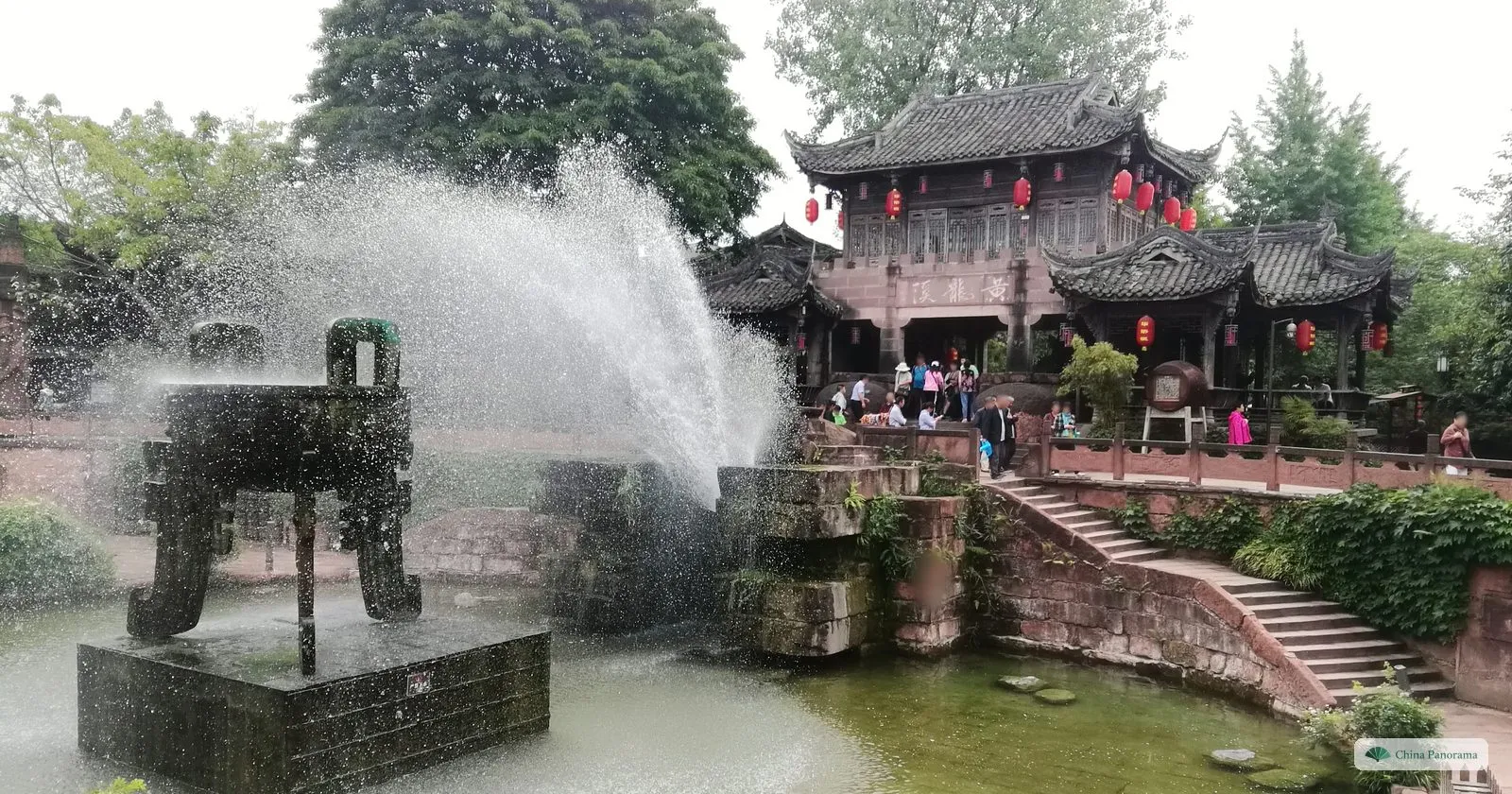
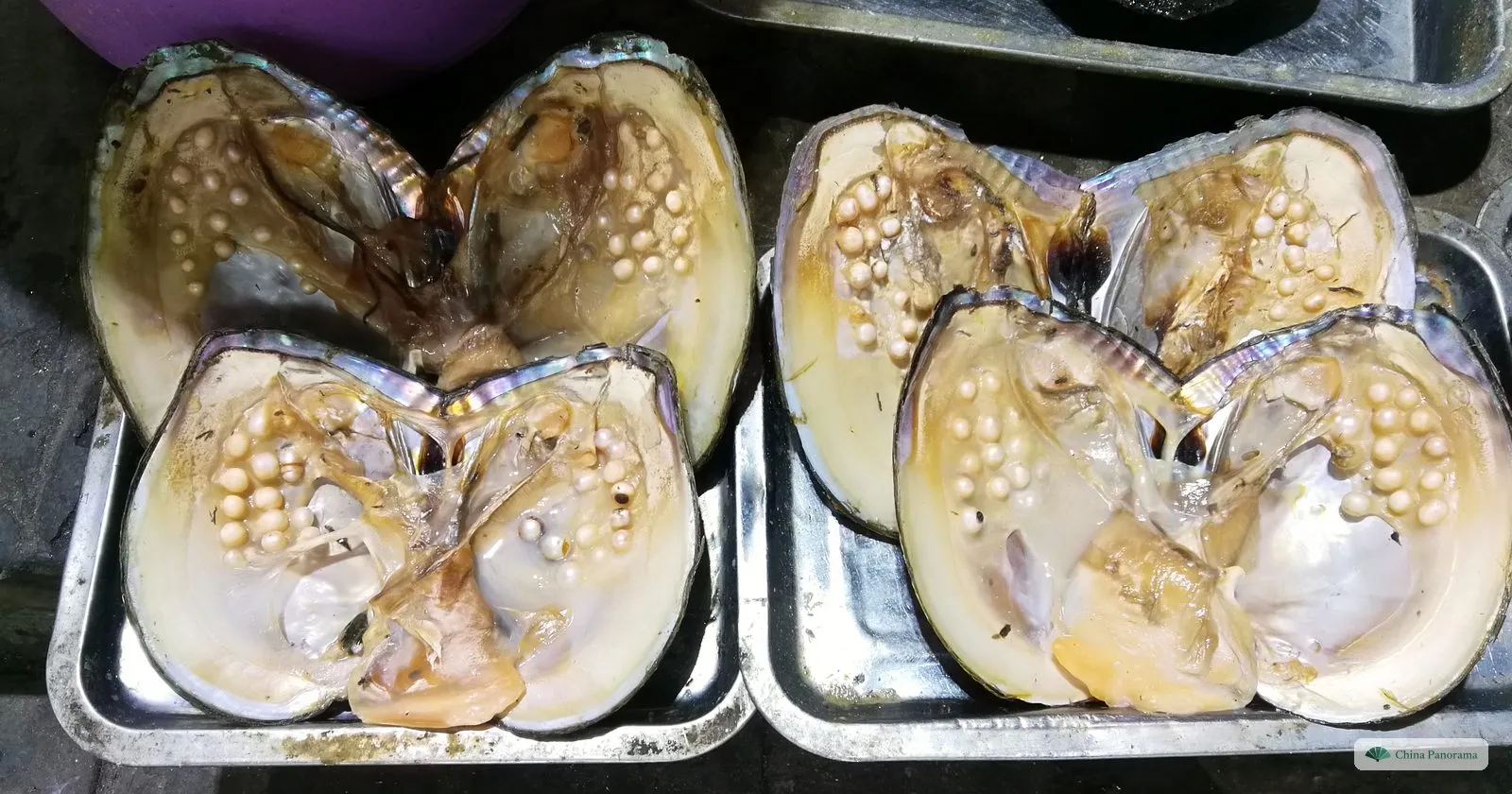
黄龙溪古镇StreetShuangliu · 双流区OutdoorsA river town about 40 km south of the centre in a straight line, where the Lu stream flows into the Jin River — once a wharf on the waterway to the south and the Southern Silk Road. Its old name was Chishui, “Red Water”; the present one, “Yellow Dragon Stream”, comes from a yellow dragon said in the Records of the Three Kingdoms to have appeared here. The town claims more than 2,100 years of history; most of its houses are Qing, and much has been restored for visitors. Its main street has three temples, Gulong, Chaoyin and Zhenjiang, and through the newer part runs a stream with stepping stones, water wheels, little waterfalls and covered walkways. It is a popular film set for costume dramas. We spent the morning of 29 April 2019 here, from 09:39 to about 10:30, with tour groups arriving all the time — and found freshwater pearl mussels opened on the street.
We went by car, about 40 minutes from the centre without traffic. Entry to the town has been reported free; we have not checked this, or buses from the city. Weekends and holidays are very crowded; come early.
- Entry
- Price not verified — check on site
- Opening hours
- Hours not verified — check on site
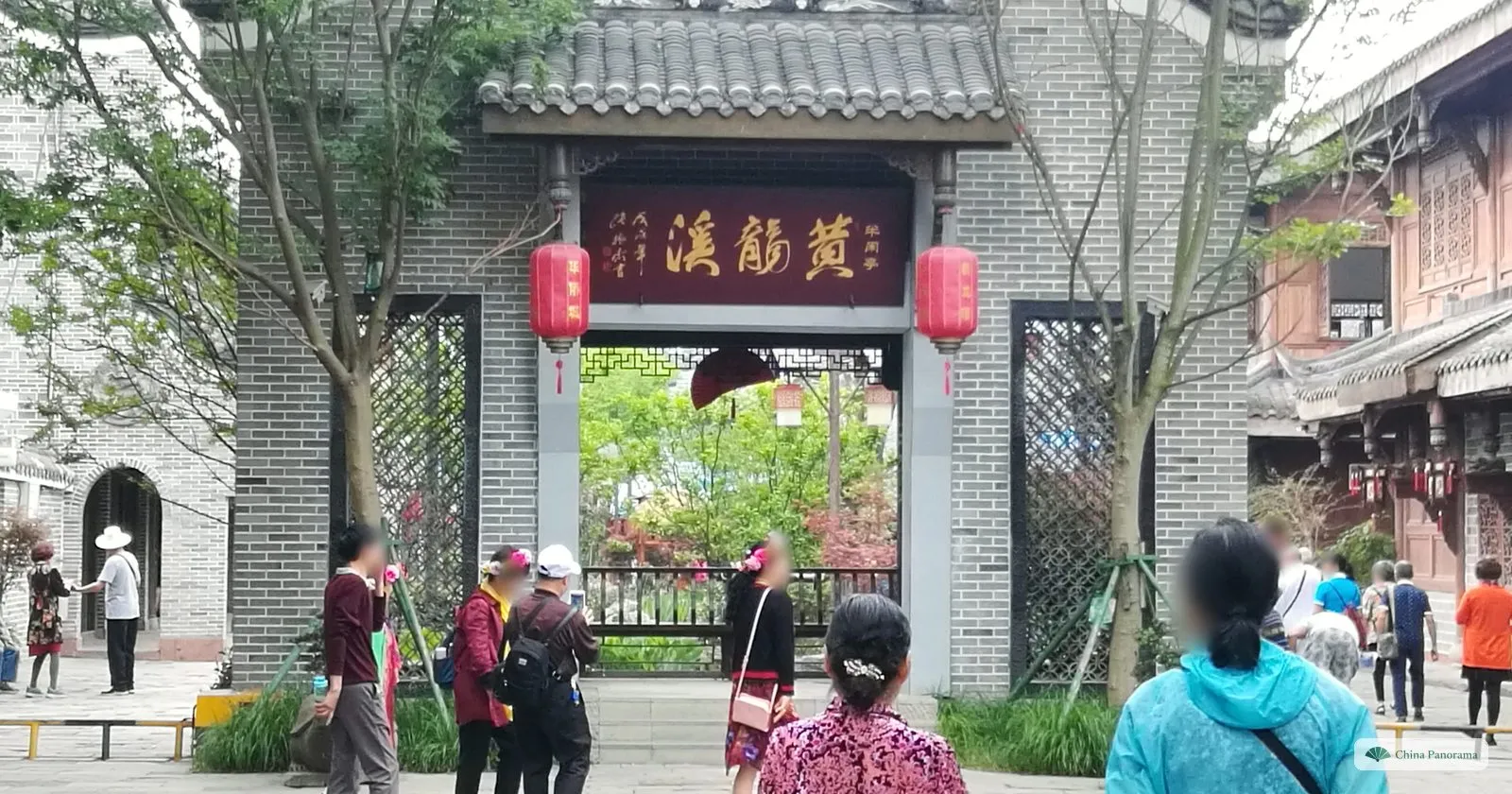
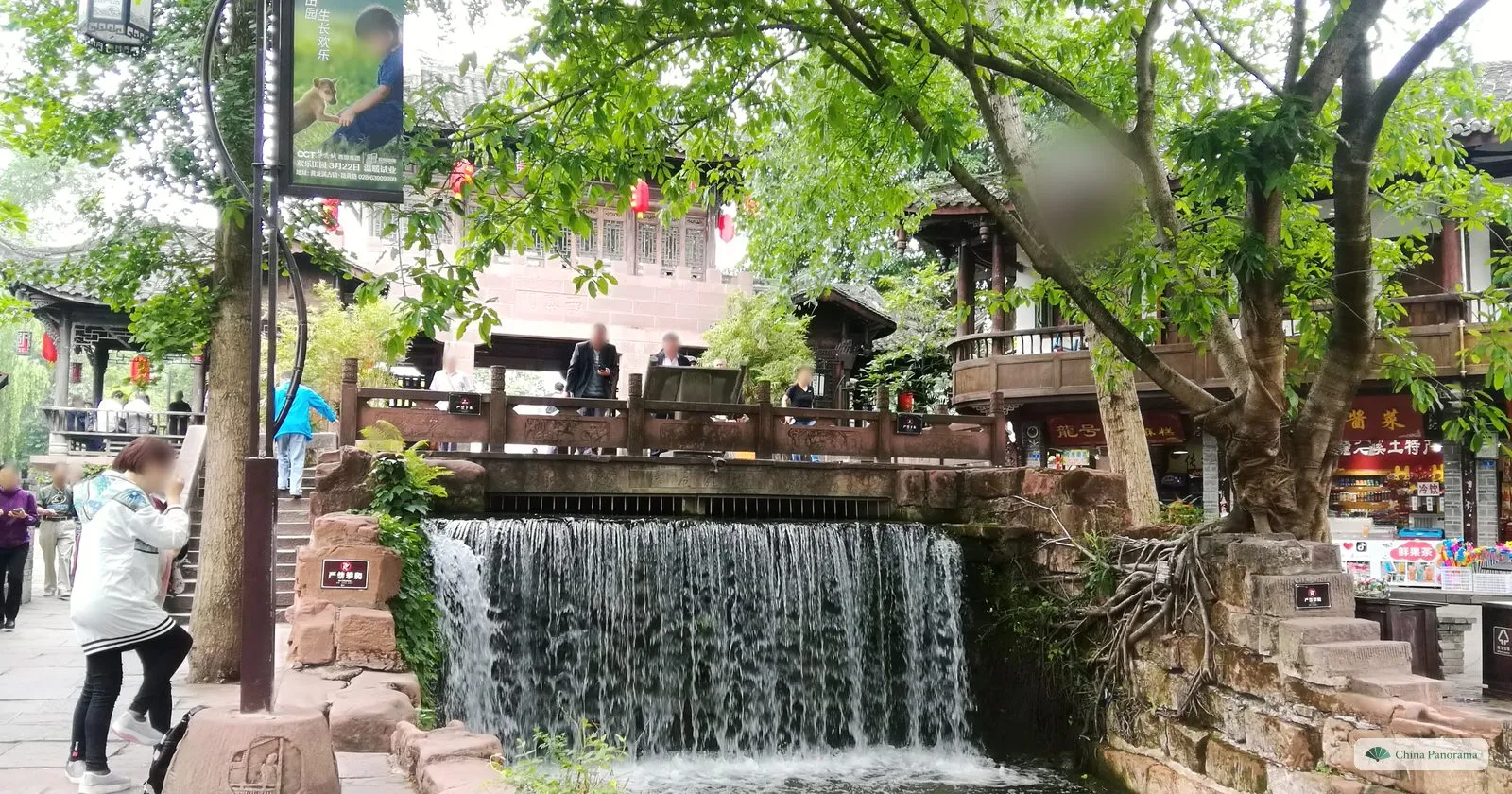
- ParkChenghua · 成华区Outdoors
The reason many people come to Chengdu. The base opened in 1987, about 11 km north-east of Tianfu Square, and has grown into a park of hills, bamboo and enclosures with, at the end of 2024, some 260 giant pandas — from cubs in the nursery to adults — and red pandas. Pandas sleep through much of the day; the usual advice is to come as early as the gates open, when they are fed and most active, and to avoid the midday heat in summer.
Panda Avenue station (Line 3), exit A, then the shuttle bus to the south gate; or Junqu General Hospital station (Line 3) and a shuttle to the west gate. Timed reservation with your passport has been reported. We have not checked prices, hours or the booking rules.
- Entry
- Price not verified — check on site
- Opening hours
- Hours not verified — check on site
- Classical gardenQingyang · 青羊区Outdoors
Du Fu, often called China's greatest poet, came to Chengdu as a refugee in 759 and lived for about four years in a thatched hut by the Huanhua stream, where he wrote some 240 poems — among them “My thatched hut is torn apart by the autumn wind”. The hut itself is a reconstruction; the halls, bamboo groves and plum gardens around it date from the early 16th century and a large restoration of 1811, and the whole is a museum and a national monument since 1961. It is a quiet garden of about 10 hectares, a good contrast to the alleys in the centre.
Caotang North Road station (Line 4), or about 1.5 km on foot west of Qingyang Palace. We have not checked the ticket price or hours.
- Entry
- Price not verified — check on site
- Opening hours
- Hours not verified — check on site
People's Park
人民公园ParkQingyang · 青羊区OutdoorsThe park in the middle of the old Manchu quarter, opened in 1911 as Shaocheng Park, a few minutes from Kuanzhai Xiangzi. It is where to sit in a Chengdu tea house: the century-old Heming tea house by the lake fills its bamboo chairs from the morning, with tea in covered bowls, ear cleaners walking between the tables and mahjong. The obelisk at the entrance remembers the Railway Protection Movement of 1911, a protest in Chengdu that helped bring down the Qing.
People's Park station (Line 2). The park is free; tea is paid at the tea house. We have not checked prices or hours.
- Entry
- Free
- Opening hours
- Hours not verified — check on site
Jinsha Site Museum
金沙遗址博物馆MuseumQingyang · 青羊区IndoorsOn 8 February 2001 builders digging a drain about 5 km west of the centre found ivory, jade and gold: the remains of a Bronze Age capital of the ancient Shu, from roughly 1200 to 650 BC, which probably took over from Sanxingdui. The museum built over the excavation in 2007 shows the dig itself and its treasures, above all the Golden Sun Bird — a disc of gold foil with a twelve-rayed sun and four birds circling it, now the emblem of China's cultural heritage and the motif of Tianfu Square.
Jinsha Site Museum station (Line 7). We have not checked the ticket price, hours or reservation rules.
- Entry
- Price not verified — check on site
- Opening hours
- Hours not verified — check on site
Sanxingdui Museum
三星堆博物馆MuseumGuanghan (Deyang) · 德阳市广汉市IndoorsAbout 40 km north-east of Tianfu Square in a straight line, in the town of Guanghan: the bronzes of a civilisation nobody knew existed until two sacrificial pits were found by chance in 1986 — masks with protruding eyes and huge ears, a standing figure 2.6 m tall, a bronze tree almost 4 m high, all from around the 12th to the 11th century BC and unlike anything else from ancient China. Six more pits were dug between 2020 and 2022, with a gold mask among the finds. It is a half-day or day trip and one of the most talked-about museums in China.
Usually by car, coach or a high-speed train to Guanghan and a taxi. Timed reservation with your passport has been reported. We have not checked tickets, hours or transport.
- Entry
- Price not verified — check on site
- Opening hours
- Hours not verified — check on site
Dujiangyan and Mount Qingcheng
都江堰 · 青城山NatureDujiangyan · 都江堰市OutdoorsAbout 55 km north-west of the centre, two World Heritage Sites (2000) next to each other. Dujiangyan is the irrigation system built around 256 BC under Li Bing, governor of Shu for the state of Qin: an artificial island splits the Min River where it leaves the mountains, without a dam, and has watered the Chengdu plain ever since — the reason the province is called the “Land of Abundance”. Mount Qingcheng, a few kilometres away, is one of the birthplaces of Taoism, a green mountain of temples and stone paths.
Usually a day trip by train to Dujiangyan or by car. We have not checked tickets, hours or transport.
- Entry
- Price not verified — check on site
- Opening hours
- Hours not verified — check on site
- TempleLeshan · 乐山市Outdoors
About 130 km south of the centre in a straight line: a seated Maitreya Buddha 71 m tall, carved into a red sandstone cliff where the Min, Dadu and Qingyi rivers meet, in the 8th century and finished in 803 — meant to calm the waters for the boatmen below. Together with Mount Emei, one of the four sacred mountains of Chinese Buddhism, about 40 km further west, it has been a World Heritage Site since 1996.
A long day trip by high-speed train to Leshan and a bus or taxi to the site, or two days with Mount Emei. We have not checked tickets, hours or transport.
- Entry
- Price not verified — check on site
- Opening hours
- Hours not verified — check on site
Entry prices and opening hours are marked unverified where we have not checked them against an official source. We would rather show a gap than a number we made up.
Routes, and how the city is laid out
The centre is Tianfu Square, inside a set of ring roads. The old city lies around it: People’s Park and Kuanzhai Xiangzi to the west, the Wuhou Shrine and Jinli to the south-west, Qingyang Palace and the Culture Park further west. Further out are Du Fu’s cottage 4 km away, the Panda Base 11 km to the north-east, Chengdu East station 8 km and Shuangliu airport 16 km. Tap a place to see how far it is.
Tap a place on the map or in the list.
The poet’s garden, 1.5 km west of Qingyang Palace. Line 4. Details below ↓
The old main station, “North station”. Lines 1 and 7.
The Bronze Age site and museum. Line 7. Details below ↓
Many trains towards Leshan and Mount Emei. Lines 1 and 7.
The main high-speed station: trains to Chongqing and Xi’an. Lines 2 and 7.
Line 3 to Panda Avenue, then the shuttle bus. Go at opening time. Details below ↓
The older airport, mainly domestic flights. Line 10.
Straight-line distances from Tianfu Square, rounded — not travel distances.
Three routes that don’t double back
A morning in the parks and at Qingyang Palace ending on Tianfu Square, the old streets and the Wuhou Shrine around midday, and half a day in Huanglongxi. They follow our photographs, with the time and distance between stops.
A morning · about 1.5 km on foot, then 4 km by taxi
Baihuatan Park
Walk 5 min· 350 m
Culture Park
Walk 15 min· 1.14 km
Qingyang Palace
Taxi 5 min· 4.25 km
Tianfu Square
Walk 4 min· 270 m
Sichuan Science and Technology Museum
5 stops · 24 min walking · 5 min by taxi
Late morning to afternoon · 4 km by taxi, the rest on foot
Kuanzhai Xiangzi
Taxi 5 min· 3.96 km
Jinli
Walk 2 min· 100 m
Wuhou Shrine
3 stops · 2 min walking · 5 min by taxi
Half a day · about 45 minutes by car, then 600 m on foot
The gate
Walk 3 min· 210 m
The stream and the stepping stones
Walk 2 min· 120 m
Covered walkway and archway
Walk 3 min· 220 m
Waterfall and tripod fountain
Walk 1 min· 70 m
The old street
5 stops · 9 min walking
Stop by stop
Morning: the parks, Qingyang Palace and Tianfu Square
Chengdu at its most local: our morning of 30 April 2019, from the moon gate of Baihuatan Park at 08:11 and the dancers in the Culture Park to Qingyang Palace at 08:35, then by car to Tianfu Square at 09:23 and into the science museum. Start before nine, while the parks are full of people exercising.
1Baihuatan Park
百花潭公园In through the gate with the round moon door; our photograph: 08:11.
- Entry
- Free
- Hours
- Not verified
Walk 5 min· 350 m
2Culture Park
文化公园Across the canal to the Culture Park: tai chi and fan dancing on the square at 08:24, the lotus pond at 08:43.
- Entry
- Free
- Hours
- Not verified
Walk 15 min· 1.14 km
3Qingyang Palace
青羊宫Round to the temple gate on the ring road: 08:35.
- Entry
- Not verified
- Hours
- Not verified
Taxi 5 min· 4.25 km
4Tianfu Square
天府广场By taxi east to the centre, or Line 5 and a change; the Mao statue and the science museum: 09:25.
- Entry
- Free
- Hours
- Open at all hours
Walk 4 min· 270 m
Behind the statue; we were in the space hall at 09:48.
- Entry
- Not verified
- Hours
- Not verified
Easy add-ons: Du Fu Thatched Cottage is about 1.5 km west of Qingyang Palace — add an hour there before you head to the centre. The Chengdu Museum is on the west side of Tianfu Square.
* Walking times and distances are computed from OpenStreetMap walking routes between the stops; the car legs are OpenStreetMap driving times without traffic — allow about double at busy times. Clock times are from our own photographs (29 and 30 April 2019). Stops marked with a star have prices or opening hours we have not checked.
Getting there and around
By air
Chengdu has two airports. Tianfu (TFU), opened in 2021, is about 54 km south-east of Tianfu Square in a straight line; all the nonstop flights from Europe in our flight data land there. Metro Line 18 runs from Tianfu Airport into the city, and Line 19 links it with the older Shuangliu airport (CTU), about 16 km south-west of the centre, which handles many domestic flights. Check which airport your ticket names. We have not checked journey times or taxi fares.
Schedules and opening hours not yet verified against an official source.
By high-speed train
Chongqing, about 270 km to the east, is the most common connection, with frequent high-speed trains from Chengdu East. Xi'an is reached over the Qinling mountains by the high-speed line to the north. We have not checked journey times against the 12306 timetable.
Schedules and opening hours not yet verified against an official source.
Nonstop from Europe
Our flight list has nonstop routes to Chengdu from 9 European airports: Brussels, Frankfurt, Istanbul, London Heathrow, Madrid, Milan, Paris, Rome, Vienna. From elsewhere, most travellers change in Beijing, Shanghai or Guangzhou. Airlines and frequencies →
Flight data checked 12 September 2026.
Three stations called Chengdu
Your train ticket will name one of these. They are far apart.
- Chengdu East 成都东站The main high-speed station, about 8 km east of Tianfu Square, for trains to Chongqing, Xi'an and the east. Lines 2 and 7.
- Chengdu (North) 成都站The old main station, about 4.5 km north of Tianfu Square, called “North station” by locals. Lines 1 and 7.
- Chengdu South 成都南站About 6 km south of Tianfu Square, for many trains towards Leshan and Mount Emei. Lines 1 and 7.
The metro, in short
How Chinese metros work →One of the largest metro networks in China and still growing. For a visitor a handful of lines do most of the work: Lines 1 and 2 cross at Tianfu Square in the centre; Line 2 runs east to People's Park, Chunxi Road and Chengdu East station; Line 4 to Kuanzhai Xiangzi; Line 3 north to the Panda Base and south to Gaoshengqiao for the Wuhou Shrine; Line 7 is the loop, through all the railway stations; and Line 18 is the fast line to Tianfu Airport, with Line 19 linking the two airports.
- Lines
- 16July 2025, more since
- Fare
- from 2 CNYfirst 4 km
- Network
- about 423 stationsabout 672 km (reported)
- Pay with
- Bank card or Alipayforeign cards at the gates
Since 28 July 2025 the gates on the whole network take contactless bank cards issued abroad — Visa, Mastercard, American Express and UnionPay — and the ticket machines sell single and day tickets for them; Chengdu was the third city on the mainland to do this, after Beijing and Shanghai. Your card must be contactless. The transport code in Alipay or WeChat works too. We have not tested a foreign card ourselves.
Fares by distance: 2 CNY up to 4 km, 3 CNY up to 8 km, 4 CNY up to 12 km, 5 CNY up to 18 km, 6 CNY up to 24 km, 7 CNY up to 32 km, 8 CNY up to 40 km, 9 CNY up to 50 km, 10 CNY up to 70 km. Beyond 70 km, 1 CNY more for every further 20 km. A ride across the centre, under 8 km, costs 2–3 CNY.
First and last trains differ by line and station; we have not checked them against the operator's timetable — look at the display in the station.
| Tianfu Square, Science and Technology Museum, Chengdu Museum | Tianfu Square 天府广场 | Lines 1/2 |
| Kuanzhai Xiangzi | Kuanzhai Xiangzi 宽窄巷子 | Line 4 |
| People's Park | People's Park 人民公园 | Line 2 |
| Wuhou Shrine, Jinli | Wuhouci 武侯祠 | Line 10 |
| Wuhou Shrine, Jinli (10 min on foot) | Gaoshengqiao 高升桥 | Lines 3/5/10 |
| Qingyang Palace, Culture Park | Qingyang Palace 青羊宫 | Lines 5/13 |
| Du Fu Thatched Cottage | Caotang North Road 草堂北路 | Line 4 |
| Jinsha Site Museum | Jinsha Site Museum 金沙博物馆 | Line 7 |
| Panda Base (shuttle bus to the south gate) | Panda Avenue 熊猫大道 | Line 3 |
| Tianfu Airport (TFU), Terminals 1 and 2 | Tianfu Airport T1 & T2 天府机场1号2号航站楼 | Lines 18/19 |
| Shuangliu Airport (CTU), Terminal 2 | Shuangliu Airport T2 双流机场2航站楼 | Lines 10/19 |
| Chengdu East station | Chengdu East Railway Station 成都东客站 | Lines 2/7 |
Station names are pinyin with some English (Tianfu Square, Kuanzhai Xiangzi, People's Park, Panda Avenue), and announcements are in Chinese and English. Tianfu Square is the busiest interchange; allow time to walk between Lines 1 and 2.
Source and date: Fare bands: the distance scale in force since the city's 2017 notice on metro fares, as restated in travel and press reports (we found no current page on the operator's site to link). Bank cards at the gates: Xinhua and IT Home, 28 July 2025. Network: 16 lines, 423 stations and 672 km as reported by Xinhua in July 2025; Line 13 has opened since, so treat the totals as approximate. Stations for the sights: OpenStreetMap and the Chinese Wikipedia article of each station, 14 October 2026. First and last trains: not checked.
Chengdu is one of the cities we price up on the trip cost calculator, if you want to model a budget.
Before you go
Most European passports are visa-free for a short trip — under a one-sided waiver with an end date worth checking before you book:
- UK passport
Visa-free up to 30 days per trip, currently until 31 December 2026.
- EU passports
Dutch, German, French, Irish, Nordic and most other EU passports: visa-free up to 30 days, currently until 31 December 2026.
- US passport
No general waiver: a visa, or the 10-day visa-free transit if you travel on to a third country.
China’s 10-day visa-free transit applies at designated entry ports, for travellers continuing to a third country. Check your passport.
- Mapo tofu
Chengdu’s own dish: how hot it is, and how to order it milder.
- How to eat hot pot
Broths, spice levels, sauces and what to order in Sichuan.
- Set up Alipay
For tea houses, snack stalls and taxis that do not take cards.
- The arrival card
Fill it in online, or practise the paper form, before you land.
- Chongqing
The hill city on the Yangtze, 270 km east — often the next stop.
- Golden Week
Why 1–7 October is the worst week for the old streets and the pandas.
FAQ
What are the best things to do in Chengdu?
See the giant pandas at the Panda Base early in the morning; walk through the Wuhou Shrine, the temple of Zhuge Liang and Liu Bei, and the Jinli street beside it; wander the Wide and Narrow Alleys (Kuanzhai Xiangzi) and drink tea in People’s Park; watch the morning dancers in the Culture Park next to Qingyang Palace; and eat hot pot and mapo tofu. With more time, take a day trip to Dujiangyan, Sanxingdui, the Leshan Giant Buddha or the river town of Huanglongxi.
How many days do you need in Chengdu?
Three. One morning for the Panda Base, one day in the centre (Qingyang Palace, Tianfu Square, Kuanzhai Xiangzi, Jinli and the Wuhou Shrine), and a day trip — Dujiangyan, Sanxingdui or Leshan. Add a day for each further trip, or for Mount Emei.
What is the difference between Kuanzhai Xiangzi and Jinli?
Kuanzhai Xiangzi is three lanes of the old Manchu quarter in the west of the centre, laid out in 1718 and largely rebuilt for 2008: grey brick walls, courtyard gates, tea houses and boutiques. Jinli is a single street of dark timber and red lanterns built new in 2004 beside the Wuhou Shrine: snacks, souvenirs and opera. Both are free and both are packed by late morning. Our photo quiz shows how to tell them apart.
When is the best time to see the pandas in Chengdu?
At opening time, in the morning: pandas are fed then and are most active, and they sleep through much of the afternoon, especially in summer heat. Avoid weekends and Chinese holidays. Timed reservation with your passport has been reported; we have not checked the booking rules or prices.
Can I pay for the Chengdu metro with a credit card?
Yes. Since 28 July 2025 the gates across the whole network take contactless Visa, Mastercard, American Express and UnionPay cards issued abroad, and the machines sell single and day tickets for them. Fares run by distance, from 2 CNY for the first 4 km. Alipay’s transport code also works. We have not tested a foreign card ourselves.
Which airport is Chengdu: TFU or CTU?
Both. Tianfu (TFU), opened in 2021, is about 54 km south-east of the centre in a straight line, and all the nonstop flights from Europe in our data arrive there; Metro Line 18 runs into the city. Shuangliu (CTU), about 16 km south-west, handles many domestic flights. Line 19 links the two. Check which one your ticket names.
Do I need a visa for Chengdu?
Not for a short trip on a British, Irish, Dutch, German, French, Nordic or Australian passport: all are visa-free for up to 30 days per trip, under a one-sided waiver that currently runs until 31 December 2026. US passport holders have no general waiver; the 10-day visa-free transit applies only at designated entry ports and only if you travel on to a third country. Check your own passport on our visa check page.
When is the best time to visit Chengdu?
March to May and October to November: April averages 25 °C by day and October 22 °C. July and August reach 31–32 °C and are the rainy season; winter is grey and damp at 11 °C by day. Avoid May Day (1–5 May) and Golden Week (1–7 October), when the old streets and the Panda Base are packed.
How far is Chengdu from Chongqing?
About 270 km in a straight line. High-speed trains run frequently between Chengdu East and Chongqing; we have not checked journey times against the timetable.
Is Chengdu food very spicy?
Often, yes, with chilli and Sichuan pepper, which numbs the lips — mapo tofu was invented in Chengdu. You can ask for mild (微辣, wēi là), and many dishes are not hot at all. Our pages on hot pot and mapo tofu explain how to order.
Can I visit the Leshan Giant Buddha from Chengdu in a day?
Yes, but it is a long day: Leshan is about 127 km south in a straight line, reached by high-speed train and then a bus or taxi to the site. With Mount Emei, plan two days. We have not checked tickets or timetables.
Sources and status
All photographs on this page are ours: Huanglongxi on the morning of 29 April 2019; Baihuatan Park, the Culture Park, Qingyang Palace, Tianfu Square, the science museum, Kuanzhai Xiangzi, Jinli and the Wuhou Shrine on 30 April 2019, the day before the May Day holiday. Faces of passers-by have been blurred. Data sources: Monthly temperature data, Chengdu; Chengdu (Wikipedia): 2020 census, city flower and tree; Wuhou Shrine: 223, the Ming merger, the 1672 rebuilding, national monument 1961 (Wikipedia, Chinese); Jinli: opened October 2004, 550 m (Wikipedia, Chinese); Kuanzhai Xiangzi: former names, reopening 14 June 2008 (Wikipedia, Chinese); The Manchu city of 1718 and the hutong of the banners (The Paper, Chinese); Tianfu Square: the Imperial City, 1968, the 2007 rebuilding (Wikipedia, Chinese); Sichuan Science and Technology Museum: 1969 hall, opened 2 November 2006 (Wikipedia, Chinese); Chengdu Museum: opened 11 June 2016 (Wikipedia, Chinese); Qingyang Palace: 881, rebuilt 1667–1671, the bronze goats (Wikipedia, Chinese); Huanglongxi: 2,100 years, the rivers, the three temples (Huanglongxi town gazetteer, CSSN, Chinese); Chengdu Research Base of Giant Panda Breeding: 1987, 260 pandas at the end of 2024, access (Wikipedia, Chinese); Du Fu Thatched Cottage (Wikipedia); People's Park, Chengdu (Wikipedia); Jinsha site: found 8 February 2001, the sun-bird ornament (Wikipedia); Sanxingdui (Wikipedia); Dujiangyan (Wikipedia); Leshan Giant Buddha (Wikipedia); Bank cards at the metro gates from 28 July 2025 (Xinhua, Chinese); Visa, Mastercard and American Express on the metro and buses (IT Home, Chinese); Chengdu Metro (Wikipedia, Chinese); Chengdu metro fares by distance (Dahepiao, Chinese).
Changelog (1)
- 2026-10-14Page created, with our own photographs from 29 and 30 April 2019. No entry price on this page could be checked against an official source on this date. Metro: foreign bank cards at the gates since 28 July 2025 (Xinhua); fares from the distance scale reported in force since 2017.