China Panorama
China Panorama
Entry
Holidays
Flights
Food
Cities
Culture
Quiz
Last verified: 12 Nov 2026

Chinese zodiac Rat: meaning, personality, years and the Year of the Rat 2032

The Rat 鼠 shǔ is the first of the twelve animals of the Chinese zodiac. It is seen as clever, alert, resourceful and thrifty, and because it has so many young, in China it stands for fertility and a big family. The next Year of the Rat begins on 11 February 2032, a Water Rat, and lasts until 30 January 2033. Below you will find every Rat year, the five Rats by element, three Rat figures spanning 1,200 years, the 1984 Rat stamp and a little game with your life number, partner check included.

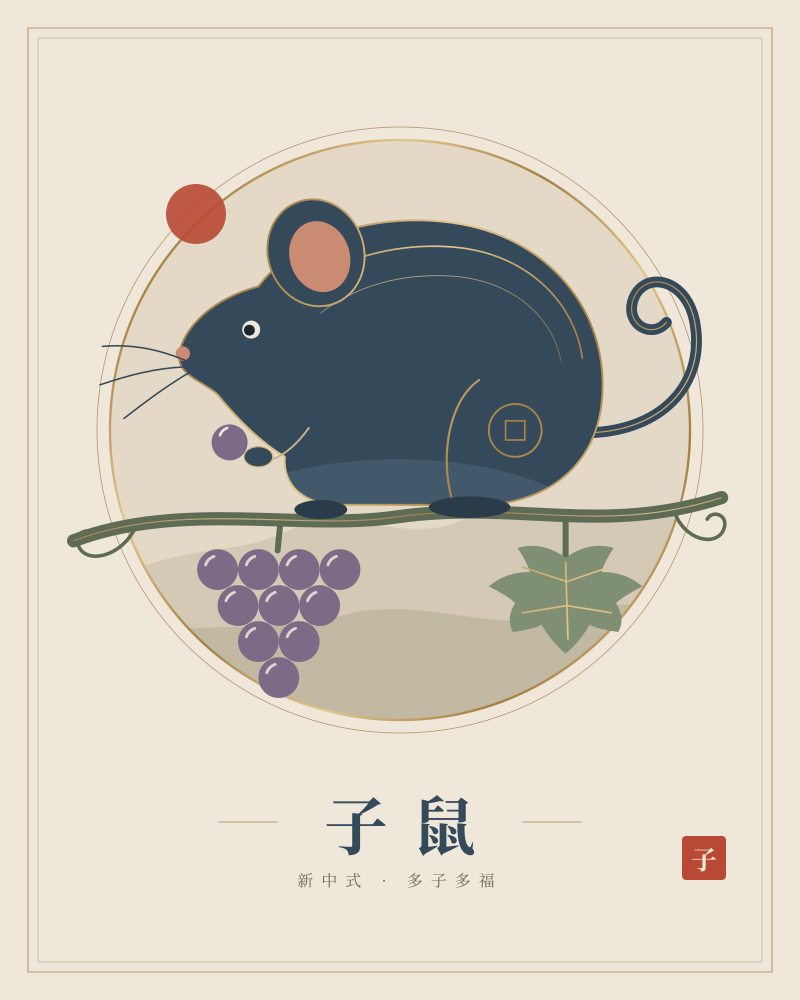
Illustration: a dark blue rat in new Chinese style sits on a grapevine holding a grape in its mouth, with a bunch of grapes and a vine leaf below it, at the bottom the characters 子鼠 and 多子多福

Profile: the Rat in the Chinese zodiac

Character
鼠 shǔ
Earthly branch
子 zǐ, 1st of 12
Double hour
11 pm to 1 am
Direction
North
Element of the branch
Water
Month
Early December to early January
Best matches
Ox, Dragon, Monkey
Opposite
Horse

Each of the twelve earthly branches has an animal. The Rat has the first, 子 zǐ. It stands for midnight, for the north and for the winter month that holds the winter solstice, and belongs to the element water. Why the animal in the calendar has nothing to do with your Western star sign is explained in the comparison of the Chinese and Western zodiac.

Meaning and personality of the Rat

In Europe and America rats make people think of cellars and sewers. In China the animal gets a friendlier look: a house with rats is a house with food in store, and a rat that always finds a way out counts as clever. What people say about those born in the sign of the Rat comes from this picture. It is folk belief, not a personality test.

Strengths

  • clever and alert, quick to see which way the wind blows
  • resourceful, gets by on little and always finds a way
  • thrifty and far-sighted
  • sociable, charming and good with people
  • adaptable, soon feels at home in a new place

Weaknesses

  • mistrustful, keeps a lot to itself
  • restless, finds it hard to wait
  • attached to possessions and likes to hoard
  • sometimes calculating when its own advantage is at stake

The Rat in love

In love the Rat is seen as attentive and caring. It woos with charm but only opens up once it trusts someone, and then likes to build a settled home. By the classical rules the Ox, Dragon and Monkey suit it best, the Horse is its opposite. All twelve animals compared are further down, and in the life number game you can enter your partner’s birthday.

Rat years: every year from 1924 to 2044

The Chinese year does not begin on 1 January but with New Year between 21 January and 20 February. If you were born in January or February of a Rat year, check the exact days: before New Year it is still the Pig.

YearBeginsEndsRatStem and branch
19245 February 192423 January 1925Wood Rat甲子
193624 January 193610 February 1937Fire Rat丙子
194810 February 194828 January 1949Earth Rat戊子
196028 January 196014 February 1961Metal Rat庚子
197215 February 19722 February 1973Water Rat壬子
19842 February 198419 February 1985Wood Rat甲子
199619 February 19966 February 1997Fire Rat丙子
20087 February 200825 January 2009Earth Rat戊子
202025 January 202011 February 2021Metal Rat庚子
2032next11 February 203230 January 2033Water Rat壬子
204430 January 204416 February 2045Wood Rat甲子

New Year dates in China time, each checked against the astronomical new moon. All other animals and a calculator for any birthday since 1924 are in the overview of the twelve Chinese zodiac signs.

The five Rats: Metal Rat 1960, Water Rat 1972, Wood Rat 1984, Fire Rat 1996, Earth Rat 2008

The same Rat comes back every 60 years, because the twelve animals are combined with ten heavenly stems that give each year an element. So there are five kinds of Rat. You can tell the element from the last digit of the year: 0 metal, 2 water, 4 wood, 6 fire, 8 earth. How the elements fit together is explained on the page about the five elements.

  • 木鼠Wood Rat1924 · 1984 · 2044
    Stem and branch:
    甲子
    How stem and branch get on:
    水木相生, wood over water: water feeds wood
    Nayin:
    海中金 hǎi zhōng jīn, “metal in the sea” (metal)
    Colour of the element:
    青 blue-green
  • 火鼠Fire Rat1936 · 1996
    Stem and branch:
    丙子
    How stem and branch get on:
    水火相战, fire over water: water puts out fire
    Nayin:
    涧下水 jiàn xià shuǐ, “water in the mountain stream” (water)
    Colour of the element:
    赤 red
  • 土鼠Earth Rat1948 · 2008
    Stem and branch:
    戊子
    How stem and branch get on:
    土水相克, earth over water: earth dams water
    Nayin:
    霹雳火 pī lì huǒ, “fire of the thunderbolt” (fire)
    Colour of the element:
    黄 yellow
  • 金鼠Metal Rat1900 · 1960 · 2020
    Stem and branch:
    庚子
    How stem and branch get on:
    金水相生, metal over water: metal feeds water
    Nayin:
    壁上土 bì shàng tǔ, “earth on the wall” (earth)
    Colour of the element:
    白 white
  • 水鼠Water Rat1912 · 1972 · 2032
    Stem and branch:
    壬子
    How stem and branch get on:
    水旺, water over water: twice as strong
    Nayin:
    桑柘木 sāng zhè mù, “mulberry wood” (wood)
    Colour of the element:
    黑 black

The branch 子 is water itself. So Chinese horoscope charts look at how the year’s element gets on with it: for the Metal Rat, metal feeds water, which counts as harmonious, for the Fire Rat, water puts out fire, and for the Water Rat, water is twice as strong. Often there is a second element too, the nayin 纳音 nàyīn. It comes from the lore of the 60 pairs used by fortune tellers and has picturesque names such as “metal in the sea” for the Wood Rat of 1984. But when people in China talk about the Wood Rat, they nearly always mean the element of the heavenly stem, as in the table above. Healing stones and crystals for each Rat, which such charts often show as well, are a modern sales idea.

Year of the Rat 2032: the Water Rat and a fresh start

What colour is the Year of the Rat 2032?

Black. Each year gets an element through its heavenly stem. In 2032 it is 壬 rén, yang water, and in the five elements water has the colour black 黑 hēi. Because the branch 子 is water too, 壬子 counts as a double water year. The last Rat, in 2020, was a Metal Rat and so white.

The Rat opens the round 子

Because the Rat is the first animal, a new round of the zodiac begins with it every twelve years. Every 60 years it even coincides with the start of the whole cycle: the year 甲子 jiǎzǐ, the Wood Rat, is the first of the 60 pairs. So it was in 1984, and so it will be again in 2044.

If you are a Rat yourself, 2032 is your own year, your 本命年 běnmìngnián. That means everyone turning 12, 24, 36, 48, 60, 72 or 84 in 2032. Your own year is traditionally seen as a bit risky, so many Rats wear something red from 11 February 2032 to 30 January 2033: red socks, underwear or a red bracelet, ideally a present from a partner or parents. How New Year is celebrated is shown on the page about Chinese New Year 2027.

Game: what does your life number say about you as a Rat?

On Chinese social media there are charts that combine the Rat with the life number 生命数字 shēngmìng shùzì: nine types of Rat with core traits, love, work and room to grow. Unlike the charts for other animals, the Rat chart also names two zodiac animals for each number that are meant to make good partners.

How do I work out my life number?

Write down your date of birth with all its digits and add them up. If the sum still has two digits, add those up again, and keep going until only one is left. For 19 August 1972 that is 1 + 9 + 7 + 2 + 0 + 8 + 1 + 9 = 37, then 3 + 7 = 10, then 1 + 0 = 1. Try it with your own birthday, then enter your partner’s:

Your birthday

✓ A Rat. Born in the Year of the Water Rat 壬子, which began on 15 February 1972.

Play along: add up all the digits until only one is left

  1. Step 1:1972081937
  2. Step 2:3710
  3. Step 3:101

Your life number is 1.

See another number:
1Rat with life number 1The leader
Core traits
The Rat’s cunning meets the leadership of the 1. Independent, decisive and usually the first to break through when things get hard.
In love
Looks for a relationship between equals where both stay free. A meeting of minds matters most. Hates being tied down, but very much wants to grow together.
At work
Start-ups, management, technology, anywhere a sharp eye can push something new.
Room to grow
Listen to others, take the team along and stop deciding everything alone.

Good match, says the chart:
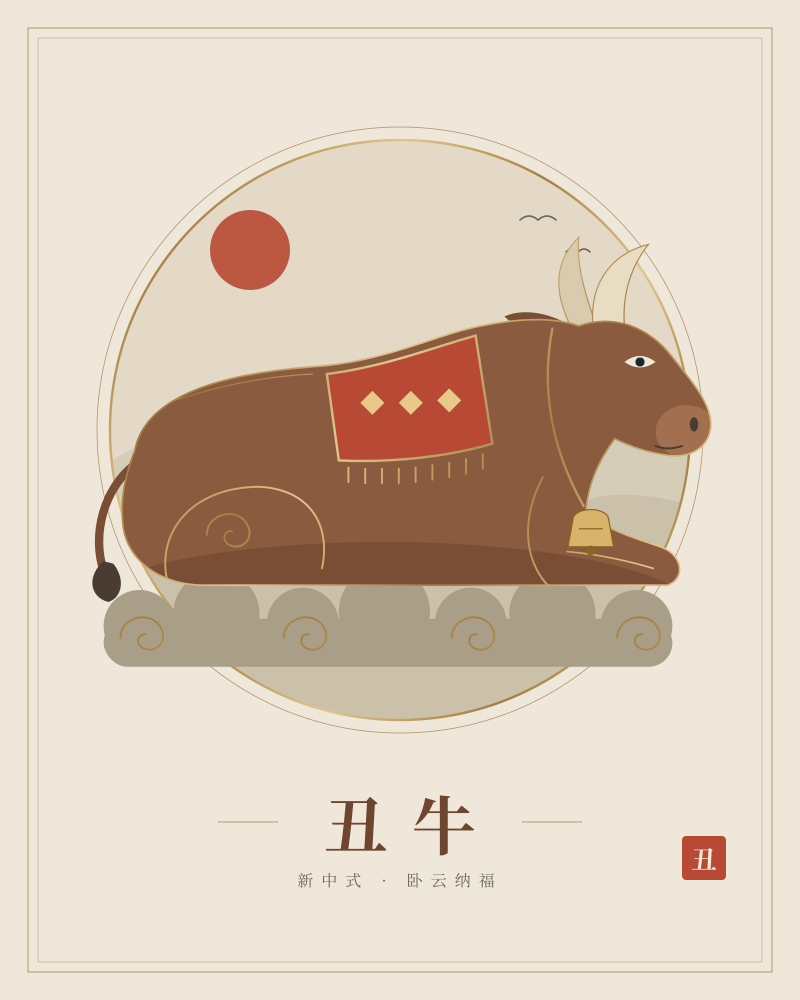
  • Ox 牛gentle and caring, together you get through hard times
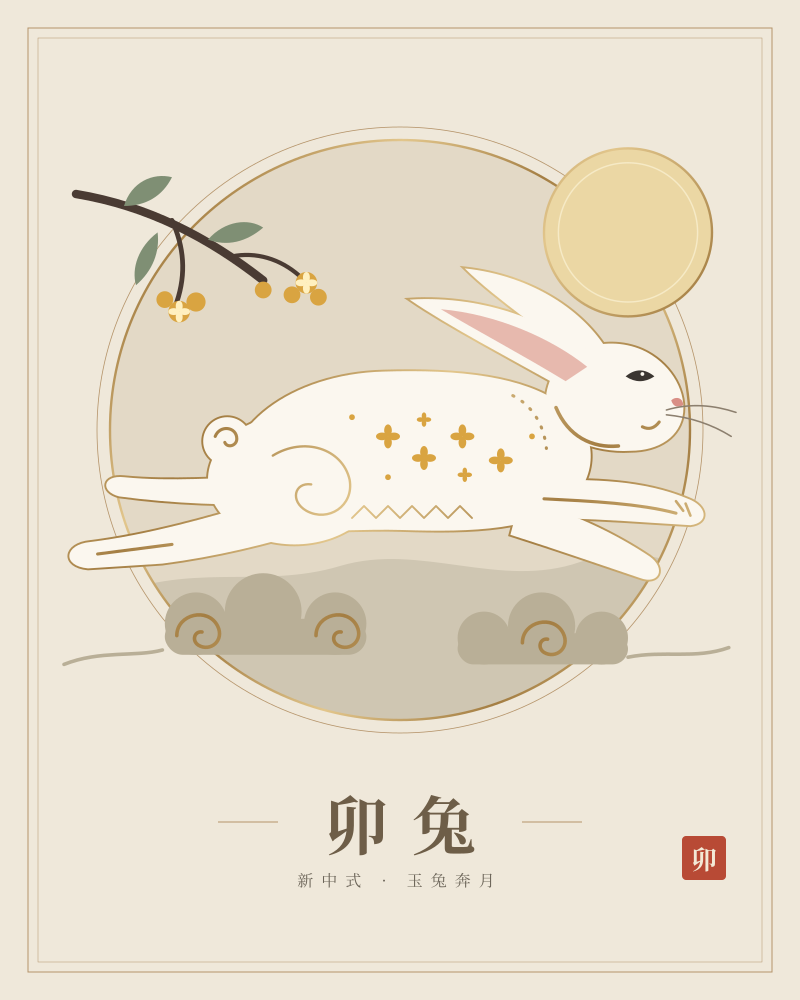
  • Rabbit 兔brings calm and harmony into the relationship
And your partner?

The chart also names the animals that suit each number best. Enter a second birthday:

Partner’s birthday

Your partner was born in the Year of the Water Ox. 癸丑

The chart lists the Ox as a good match for life number 1: gentle and caring, together you get through hard times.

By the classical zodiac rules, Rat and Ox: Good match (六合 liùhé).

A game from Chinese social media, not a prediction. Where the life number comes from is explained below.

Where does the life number come from?

Not from China. The life number belongs to Western numerology, which claims the Greek philosopher Pythagoras as its founder and became popular mainly in the 20th century. Chinese platforms have mixed it with the zodiac, much as Western horoscope books combine the animal with the star sign. The partner check shows how little it has to do with the old teaching: for the 5 the chart recommends Horse and Goat, exactly the two animals the Rat gets on worst with by the classical rules. Take the texts as a game, not a forecast. The same game exists for the Ox, Tiger, Rabbit, Dragon, Snake, Horse, Goat, Monkey, Rooster, Dog and Pig.

All nine life numbers for the Rat at a glance
  1. 1The leader

    Core traits:
    The Rat’s cunning meets the leadership of the 1. Independent, decisive and usually the first to break through when things get hard.
    In love:
    Looks for a relationship between equals where both stay free. A meeting of minds matters most. Hates being tied down, but very much wants to grow together.
    At work:
    Start-ups, management, technology, anywhere a sharp eye can push something new.
    Room to grow:
    Listen to others, take the team along and stop deciding everything alone.
    Good match, says the chart:
    Ox (gentle and caring, together you get through hard times), Rabbit (brings calm and harmony into the relationship)
  2. 2The go-between

    Core traits:
    The Rat’s agility meets the sensitivity of the 2. Loves working with others, talks easily and builds close bonds fast.
    In love:
    Values steadiness and quiet understanding. Wants a love that lasts, shows it through deeds rather than words and has no time for a flash in the pan.
    At work:
    Education, counselling, the arts, jobs where empathy helps others find their balance.
    Room to grow:
    More self-confidence: say what you need and learn to decide on your own.
    Good match, says the chart:
    Dragon (gives backing and courage where the 2 hesitates), Monkey (as sociable and chatty as the 2 itself)
  3. 3The ideas person

    Core traits:
    The Rat’s brains meet the liveliness of the 3. Expresses itself creatively and brightens everyday life with fresh ideas.
    In love:
    Romantic and full of feeling, wants passion and novelty. Has to learn to stay with one person so love does not stay on the surface.
    At work:
    Design, media, performing, anything where imagination makes something of its own and gets noticed.
    Room to grow:
    Balance dreams and reality, set goals and stick with them.
    Good match, says the chart:
    Monkey (funny and open, together the ideas fly), Rooster (shares the fun and the adventure)
  4. 4The rock

    Core traits:
    The Rat’s diligence meets the steadiness of the 4. Down to earth, persistent and the backbone of any team.
    In love:
    Loyalty and responsibility come first. Wants a long, calm partnership and keeps promises through deeds.
    At work:
    Engineering, finance, education, careers that last thanks to careful planning.
    Room to grow:
    Be more open to change, react more flexibly and don’t cling to your own view.
    Good match, says the chart:
    Dog (down to earth and loyal, together you build a safe harbour), Pig (helps and supports, so you reach success together)
  5. 5The explorer

    Core traits:
    The Rat’s adaptability meets the love of freedom of the 5. Drawn to the unknown and always on the move.
    In love:
    Wants love without chains, with lots of space and passion. Has to learn to commit and bond more deeply.
    At work:
    Travel, marketing, freelancing, work where curiosity opens new fields and no two days are alike.
    Room to grow:
    Take on responsibility, combine freedom with stability, don’t act on impulse, stay with long-term goals.
    Good match, says the chart:
    Horse (open and optimistic, a partner for the journey), Goat (gives freedom and encouragement)
  6. 6The carer

    Core traits:
    The Rat’s cleverness meets the care of the 6. Responsible and loving, a pillar for family and friends.
    In love:
    Sees love as duty and devotion. Wants a settled family life and shows deep feelings through deeds.
    At work:
    Medicine, education, charity work, jobs where serving others brings real satisfaction.
    Room to grow:
    Look after yourself too, don’t sacrifice yourself, weigh your own needs against what others expect.
    Good match, says the chart:
    Rabbit (as family-minded as the 6, together it gets warm and cosy), Ox (guards the happiness you share)
  7. 7The thinker

    Core traits:
    The Rat’s sharp mind meets the research spirit of the 7. Thinks things through and gets to the bottom of them.
    In love:
    Sees love rationally and looks for a soulmate to share ideas with. Should not overanalyse feelings.
    At work:
    Research, technology, philosophy, fields where logic solves hard problems.
    Room to grow:
    Open up, trust your gut and other people, don’t withdraw.
    Good match, says the chart:
    Snake (wise and deep, conversations go a long way), Monkey (sparks new thoughts, you learn from each other)
  8. 8The strategist

    Core traits:
    The Rat’s cunning meets the ambition of the 8. Spots chances, plans far ahead and wants to build something.
    In love:
    Wants prosperity and feelings alike and looks for a partner of equal strength. Protects love with what it has achieved.
    At work:
    Finance, management, start-ups, fields where strategic vision builds wealth and standing.
    Room to grow:
    Share power, stay modest, look beyond success and take care of feelings.
    Good match, says the chart:
    Dragon (strong and confident, two strong ones at the top), Tiger (together you take a business to the very top)
  9. 9The peacemaker

    Core traits:
    The Rat’s brains meet the big heart of the 9. Dreams of a fair world and seeks harmony. To avoid conflict it sometimes puts its own wishes too far back.
    In love:
    Gives without counting and looks for a love where souls are in tune. Sees the partner as a companion for life.
    At work:
    Charity work, culture, environmental protection, work that moves society forward and lasts.
    Room to grow:
    Bring ideals down to earth, act instead of only dreaming, and don’t forget your own needs.
    Good match, says the chart:
    Goat (kind and tolerant, together you stand up for others), Pig (spreads hope like the 9 does)

The texts retell a widely shared Chinese chart in our own words. For the 2 the chart’s partner column only repeats the core-traits text, so we added the two partner animals from the classical rules.

Which signs are compatible with the Rat? Partners and love

The classical teaching derives this from where the animals stand in the circle. Rat, Dragon and Monkey form a triangle 三合 sānhé, Rat and Ox a pair 六合 liùhé. The Horse stands directly opposite the Rat. With the Rabbit it shares a “punishment without manners” 无礼之刑, with the Rooster a break 破. An old folk rhyme warns against the Goat:

羊鼠相逢一旦休

“When Goat and Rat meet, it is soon over.”

  • Ox 牛Good match (六合 liùhé)
  • Tiger 虎Neutral
  • Rabbit 兔Tension (刑 xíng)
  • Dragon 龙Good match (三合 sānhé)
  • Snake 蛇Neutral
  • Horse 马Clash (冲 chōng)
  • Goat 羊Friction (害 hài)
  • Monkey 猴Good match (三合 sānhé)
  • Rooster 鸡Tension (破 pò)
  • Dog 狗Neutral
  • Pig 猪Neutral

Tradition, not a forecast. Some families in China still ask about it when planning a wedding, most couples take it lightly.

The Rat in ancient China: the first, the fertile, the bride

Rats live wherever people keep food, and the Chinese have long credited them with a lot. Four ideas still shape how people in China see the Rat:

子First in the circle
The Rat belongs to the branch 子 zǐ, where everything begins: the day at midnight, the year in the month of the winter solstice, the 60-year cycle with 甲子. A folk saying explains it like this: in the beginning all was chaos, until the Rat gnawed a hole in it and heaven opened, 鼠咬天开. The well-known story of the race, in which it rode on the Ox, is much younger.
多子Many children, much luck
Rats have many young, and 子 also means “child”. That is why the Rat stands for fertility and a big family. In pictures it likes to sit next to grapes, pomegranates or melons full of seeds, a symbol of 多子多福, “many children, much happiness”. The illustration at the top of this page and the porcelain figure further down show exactly that.
嫁女The mouse wedding
In the first days of the new year the mice marry off their daughter, or so people say in many parts of China. In the north it is called 老鼠娶亲, in the south 老鼠嫁女, and the day varies by region between the first and the tenth day of the first month. People go to bed early so as not to disturb the party and scatter a few crumbs for the guests. New Year prints show the bridal procession with sedan chair and music, often with a cat already waiting. The writer Lu Xun remembered having such a print by his bed as a child.
子时The hour of the Rat
From 11 pm to 1 am is the time of the Rat 子时 zǐshí. Rats are at their liveliest then, and the middle of the night is seen as the moment when yin is strongest and yang begins to grow again. That is also why the branch 子 is linked with the north and with water.

The Rat in the museum: three zodiac figures spanning 1,200 years

As early as the 6th century, the dead in northern China were given the twelve animals of the zodiac as clay figures for the tomb. According to the Cleveland Museum of Art they were meant to give the afterlife the order of time. Three Rats in American museums show how the image of the animal changed over the centuries: from an official with a rat’s head to a very real rat to a colourful porcelain figure.

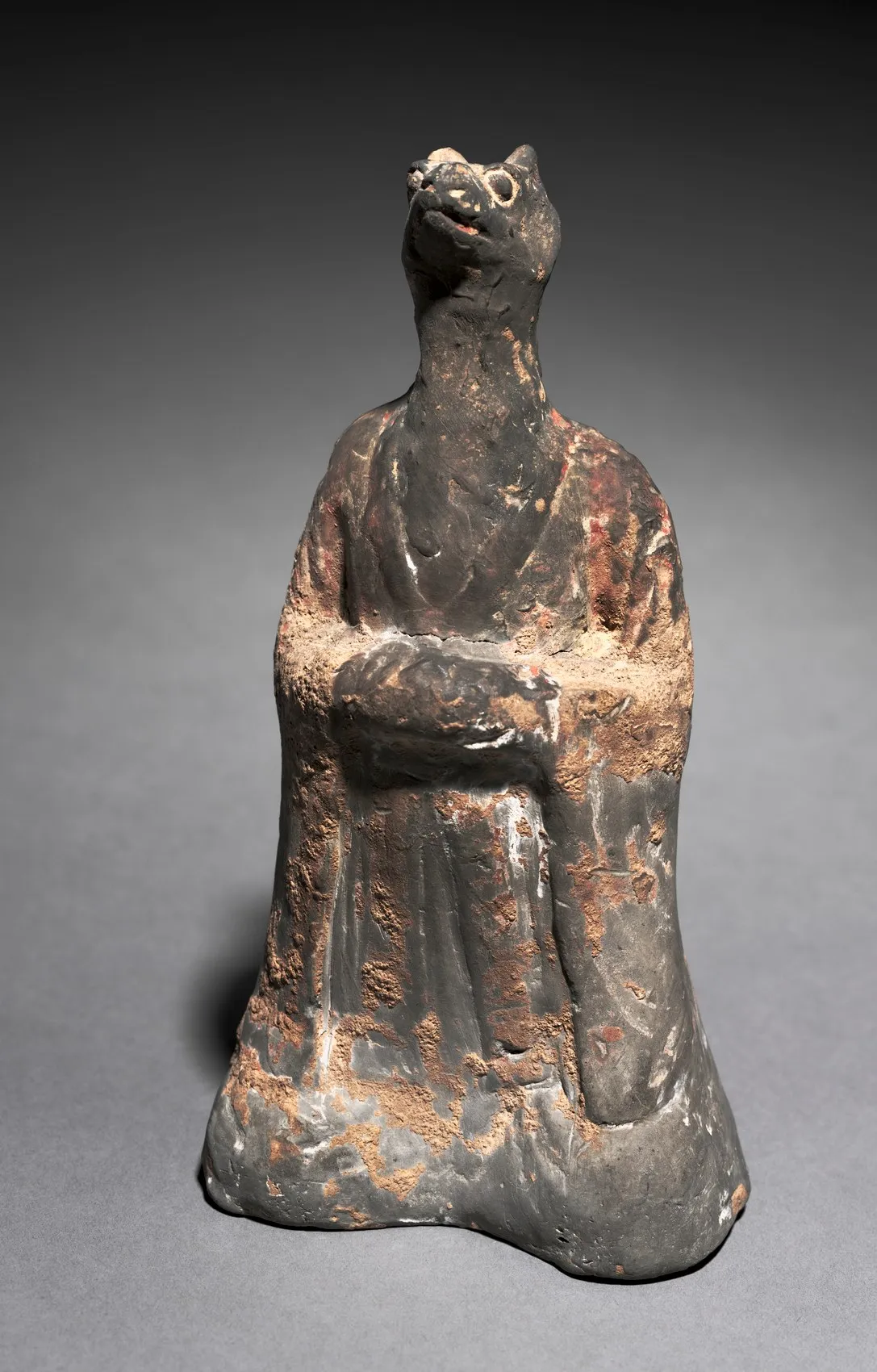
Standing figure of grey clay, about 23 centimetres tall: a person in a long, flowing robe, arms folded in the sleeves in front of the chest, with the head of a rat, its pointed snout raised. Traces of white slip and red paint on the robe. Grey background.

6th century

An official with a rat’s head 北魏

The oldest of the three figures comes from the Northern Wei dynasty, which ruled northern China from 386 to 534. A person in a long robe stands calmly, arms folded in the wide sleeves like an official at court. Only the head is a rat’s, with small ears and a pointed snout raised upwards. Traces of a pale slip and red paint remain on the grey clay, so the figure was once painted.

Figures like this stood in tombs as a set of twelve, each animal in its place in the circle. The Rat belongs to the north, at the beginning. The Ox from the same set is on the page about the Ox.

Mortuary figure of the zodiac sign Rat, China, Northern Wei dynasty, 6th century. Grey earthenware with traces of slip, H. 22.6 cm. The Cleveland Museum of Art, The Norweb Collection, 1972.76.1, public domain (CC0).

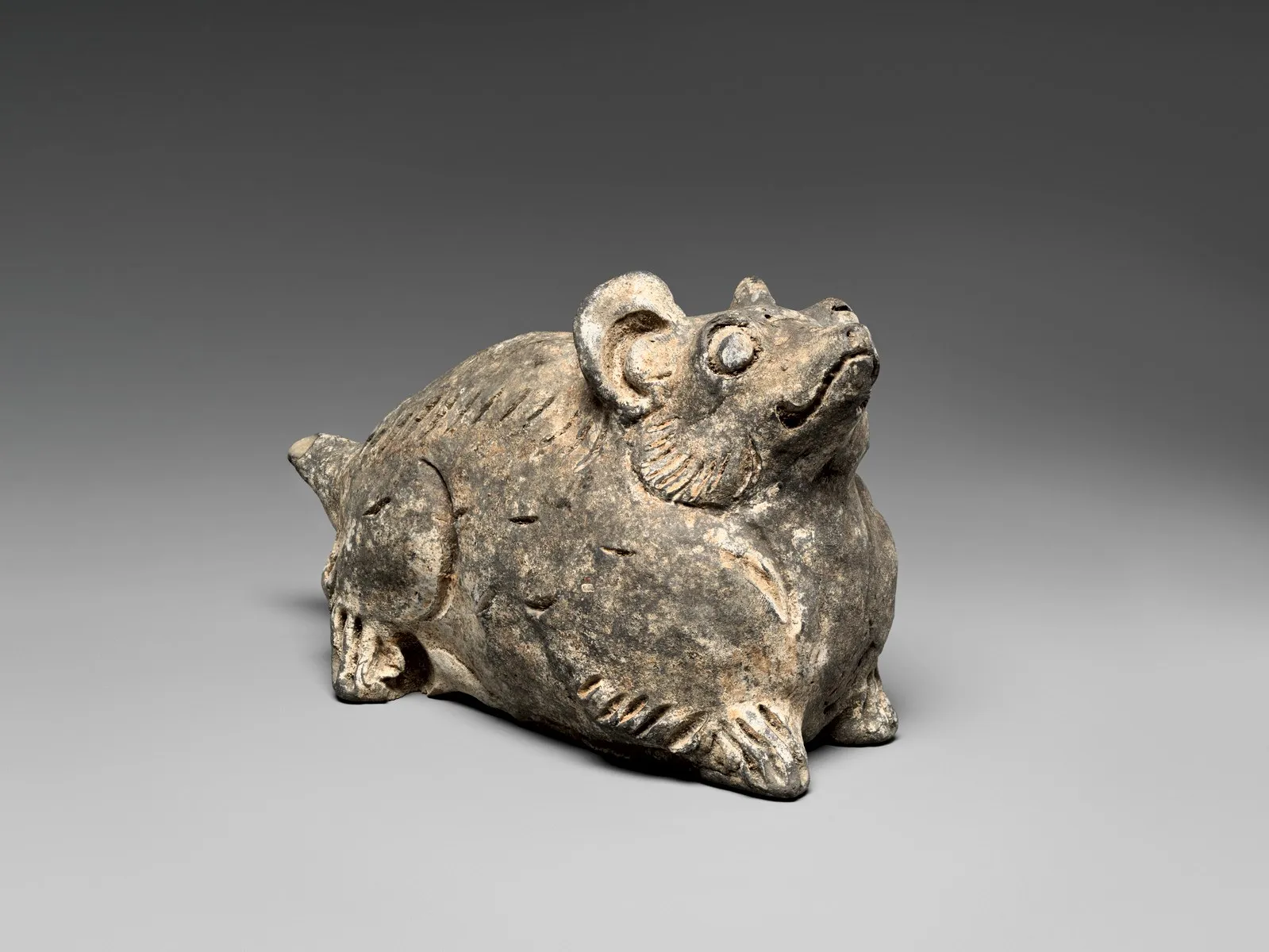
Small reclining figure of grey clay: a plump rat with big, curled ears raising its head. Fur and paws are suggested with incised lines, the tail lies along the side of the body. Grey background.

13th century

Simply a rat 金元

Some 700 years later the official has turned back into an animal. This 13th-century figure from the Jin or Yuan dynasty is hardly bigger than a hand: just under 8 centimetres high and 13 long. The rat lies plump and contented, raises its head and pricks up its big ears. The potter scratched fur and claws into the clay with a few strokes.

The Metropolitan Museum calls it a “mouse” and showed it in a small New Year display for the Year of the Rat 2020. In Chinese there is no contradiction, since 鼠 shǔ means both animals.

Chinese zodiac figure, mouse, China, Jin to Yuan dynasty, 13th century. Earthenware, H. 7.9 cm, L. 13.3 cm. The Metropolitan Museum of Art, New York, Charlotte C. and John C. Weber Collection, Gift of Charlotte C. and John C. Weber, 1994, 1994.605.39, public domain (CC0).

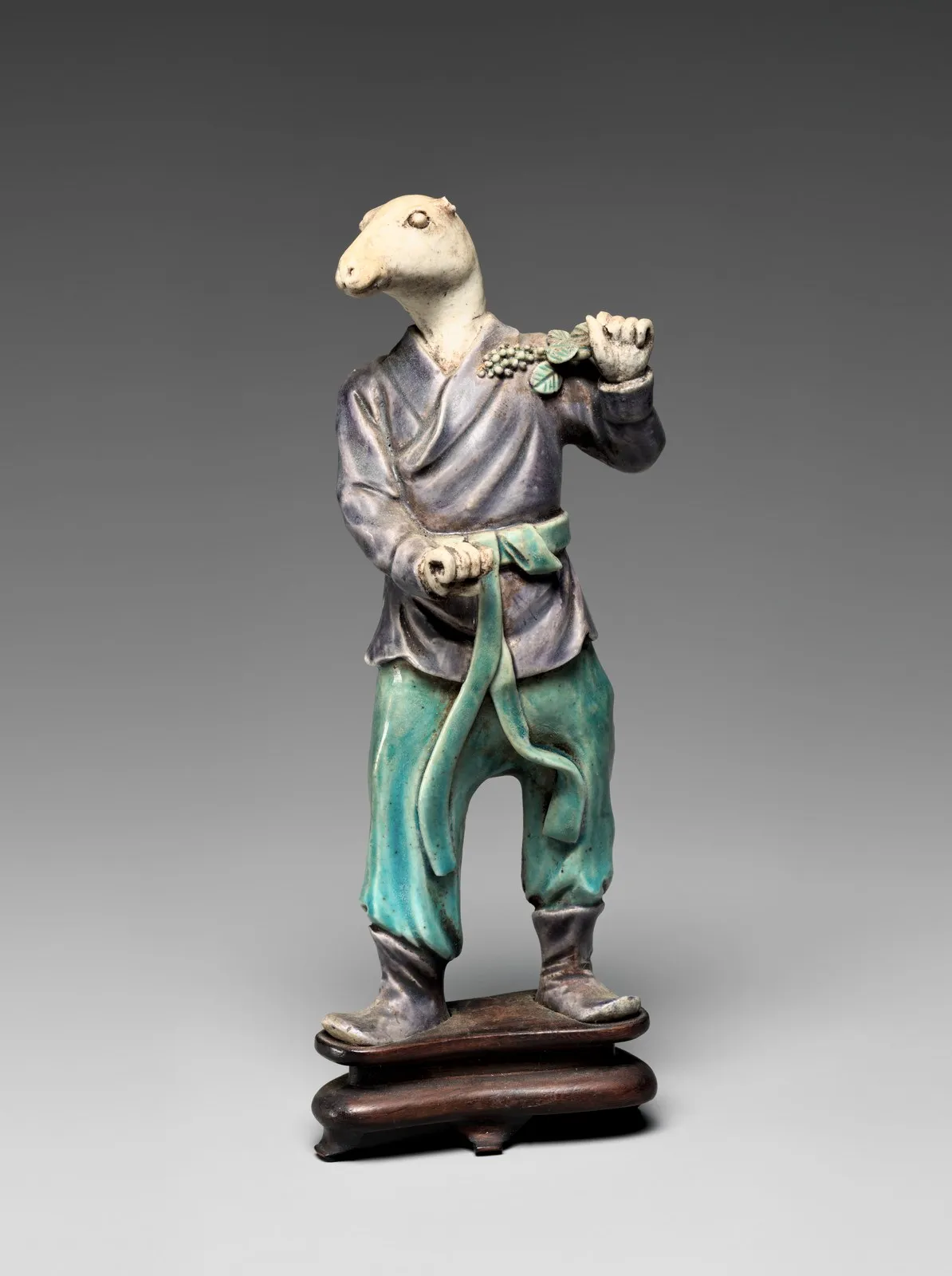
Porcelain figure on a dark wooden stand: a standing man with the white head of a rat, in a purple jacket with a green sash and green trousers. He raises his left hand to his shoulder, over which hangs a green bunch of grapes with leaves.

around 1700

The Rat with the grapes 康熙素三彩

Just over 15 centimetres tall, made of porcelain in the kilns of Jingdezhen under the Kangxi Emperor, who reigned from 1662 to 1722. The Rat stands on two legs again, but now as a cheerful man in a purple jacket, with a green sash, green trousers and boots. Over his left shoulder he carries a bunch of grapes with leaves.

The grapes are no accident: many berries with many seeds stand for many children, just like the Rat itself. The purple, green and yellow were painted on the unglazed, already fired body, a technique called 素三彩 sù sāncǎi in China, “three colours on the biscuit”. The figure belongs to a zodiac set of which the museum owns ten animals. Only the Ox and the Horse are missing.

Zodiac figure: rat, China, Qing dynasty, Kangxi period, late 17th to early 18th century. Porcelain painted in enamels on the biscuit (Jingdezhen ware), H. 15.2 cm. The Metropolitan Museum of Art, New York, Gift of Birgit and Peter Morse, in memory of Betty and Sydney Morse, 1992, 1992.100.1, public domain (CC0).

The Rat in the Chinese language: eight idioms

However kindly New Year prints show the Rat, the language is hard on it: cowardly, short-sighted, despised. Only in the most famous saying about mice is the cat the hero.

  • 胆小如鼠

    dǎn xiǎo rú shǔ · A gall bladder as small as a mouse’s.

    A coward. In China the gall bladder is the seat of courage.

  • 鼠目寸光

    shǔ mù cùn guāng · Rat’s eyes see only an inch.

    Short-sighted, unable to see the bigger picture.

  • 投鼠忌器

    tóu shǔ jì qì · Want to throw at the rat but fear for the vase.

    Hold back for fear of damaging something precious. From a memorial by the scholar Jia Yi to the emperor, preserved in the History of the Han.

  • 首鼠两端

    shǒu shǔ liǎng duān · Like a rat poking its head out of the hole and looking both ways.

    To waver and dither. From the Records of the Grand Historian.

  • 抱头鼠窜

    bào tóu shǔ cuàn · Cover your head and scurry off like a rat.

    To flee in panic and shame.

  • 过街老鼠,人人喊打

    guò jiē lǎo shǔ, rén rén hǎn dǎ · When a rat crosses the street, everyone shouts “hit it!”.

    Someone everybody despises.

  • 猫哭耗子假慈悲

    māo kū hào zi jiǎ cí bēi · The cat weeps for the mouse: false pity.

    Crocodile tears.

  • 不管黑猫白猫,抓到老鼠就是好猫

    bù guǎn hēi māo bái māo, zhuā dào lǎo shǔ jiù shì hǎo māo · Black cat or white cat, if it catches mice it is a good cat.

    Only the result counts. Deng Xiaoping quoted a Sichuan saying in 1962, then still with a yellow and a black cat. It later became the motto of the reform years.

The 1984 Rat stamp and the 1980 Monkey stamp

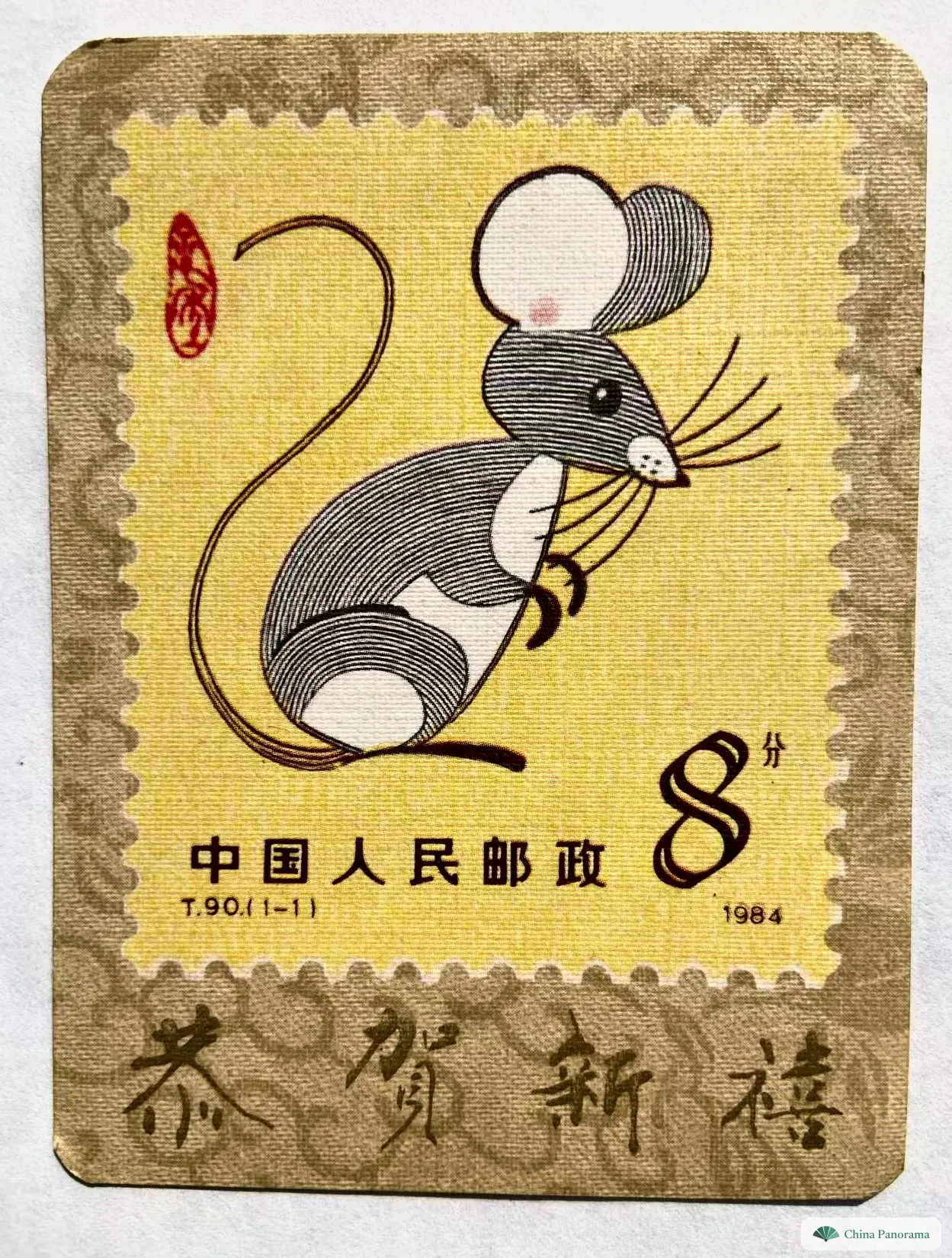
In 1980 China Post issued its first zodiac stamp, the Monkey. The Rat came fifth, after Monkey, Rooster, Dog and Pig, on 5 January 1984. Since then there has been a new Rat stamp every twelve years: 1984 甲子年, 1996 丙子年, 2008 戊子年, 2020 庚子年. The next one follows in 2032. Our two photos do not show the stamps themselves but two New Year cards from the same series that reprint the designs large.

A card with rounded corners and a linen texture: in the middle the printed image of a stamp with a serrated edge. On a pale yellow ground a grey and white rat drawn in fine lines sits upright, with big round ears and a long tail, a red seal at the top left. Below it reads 中国人民邮政, 8 分, T.90.(1-1) and 1984. Under the stamp, in brush script, 恭贺新禧.

The Rat of 1984 甲子年

Stamp T.90 “Year Jiazi” cost 8 fen. On a pale yellow ground sits a grey and white rat drawn entirely in fine, flowing lines, with big round ears, pink inner ears and a tail that curves around it in a long arc. The picture is by the artist Zhan Tong 詹同, known above all for cartoons and children’s books. A red seal in old seal script sits at the top left.

1984 was a special year: 甲子 jiǎzǐ is the first pair of the 60-year cycle. So the Rat stamp marked not only a new round of the zodiac but a new 60-year cycle.

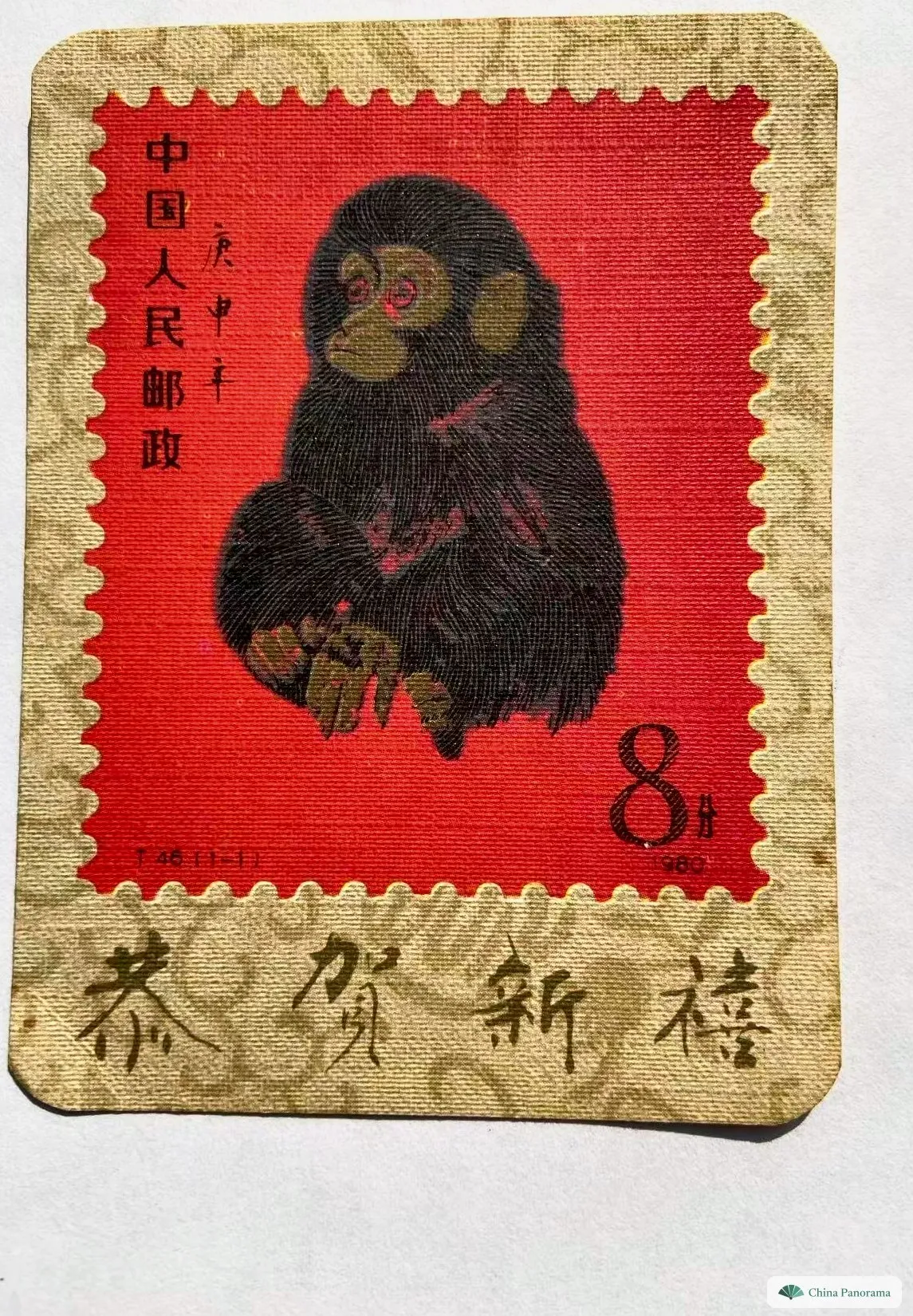
The same kind of card with the design of the 1980 Monkey stamp: a seated black monkey with a golden face on a red ground, below it 恭贺新禧.

The Monkey of 1980 庚申年

The card next to it belongs to the same series: the same linen texture, the same patterned golden-brown frame, the same printed perforations and below them the same greeting 恭贺新禧, “Happy New Year”. It shows the very first zodiac stamp, T.46 of 1980, painted by Huang Yongyu: a black monkey with a golden face on a bright red ground. This “Monkey stamp” is now the best-known stamp in China, its story is on the Monkey page.

Side by side you can see how varied the first round was: the Monkey is a painting in ink and gold, the Rat four years later a playful line drawing. Both have the same value, 8 fen, then the postage for a letter within China.

Rat card: New Year card with the design of stamp T.90 “Year Jiazi” (1984, picture by Zhan Tong). Monkey card: New Year card with the design of stamp T.46 “Year Gengshen” (1980, picture by Huang Yongyu). Photos: China Panorama.

True or false? Six claims about the Rat

Guess first, then read the answer.

  1. 1The Rat comes first because it rode on the Ox in the great race of the animals and jumped off just before the finish.

    False

    It is a lovely folk tale, but not the origin. The order is much older than the story: bamboo texts from the 3rd century BC already link the branch 子 with a rat, and in the 1st century the philosopher Wang Chong lists the twelve animals in today’s order without any race.

  2. 2The double hour of the Rat begins at 11 pm the evening before.

    True

    The hour of the Rat 子时 zǐshí runs from 11 pm to 1 am, with midnight in the middle. That is why people who cast a Bazi chart often start the next day at 11 pm.

  3. 3The 1984 Rat stamp came out before the Year of the Rat began.

    True

    Stamp T.90 “Year Jiazi” was issued on 5 January 1984, but the Year of the Wood Rat only began on 2 February 1984. China Post still issues its zodiac stamps ahead of New Year so they can go on the New Year cards.

  4. 4Anyone born in January 2020 is a Metal Rat.

    False

    Only from 25 January. That day the Year of the Metal Rat began. Anyone born from 1 January up to the day before still belongs to the Year of the Earth Pig.

  5. 5The Chinese chart pairs life number 5 with the Horse, and by the classical rules Rat and Horse go well together too.

    False

    The chart does name Horse or Goat for the 5. But by the classical rules of the earthly branches the Horse is the Rat’s opposite (子午相冲), and the Goat is in friction with it (害). The social-media charts do not follow any old rule.

  6. 6The life number is an ancient Chinese teaching.

    False

    It comes from Western numerology, which claims Pythagoras as its founder. In China it became known mainly through social media. Old Chinese number lore such as the Hetu diagram 河图 works quite differently.

More on the zodiac: the twelve Chinese zodiac signs and their years, heavenly stems and earthly branches and the zodiac in other Asian countries, where in some places a cat joins in. The animal before the Rat, with which the circle ends, is the Chinese zodiac Pig.

FAQ

Which years are Rat years?

1924, 1936, 1948, 1960, 1972, 1984, 1996, 2008, 2020, 2032, 2044. Each year begins with Chinese New Year, between 21 January and 20 February. If you were born in January or February before that day, you belong to the animal of the year before, the Pig.

When is the next Year of the Rat?

2032. It begins on 11 February 2032 with Chinese New Year, is a Water Rat (壬子) and lasts until 30 January 2033. The Wood Rat follows in 2044.

What colour is the Year of the Rat 2032?

Black. In 2032 the heavenly stem 壬 rén gives the element water, and the colour of water is black. Because the branch 子 is water as well, 壬子 counts as a double water year. Other lucky colours on horoscope sites follow no fixed tradition.

Which Rat am I if I was born in 1984?

A Wood Rat (甲子) if you were born between 2 February 1984 and 19 February 1985. Before that you are a Water Pig. The other Rats: Fire 1936 and 1996, Earth 1948 and 2008, Metal 1960 and 2020, Water 1972 and 2032.

What is the personality of the Rat?

In China the Rat is said to be clever, alert, resourceful, thrifty and adaptable, as well as sociable and charming. Its downsides are said to be mistrust, restlessness and a tendency to hoard. That is folk belief, not a personality test.

Which signs are compatible with the Rat?

By the classical rules Dragon and Monkey (三合 sānhé) and the Ox (六合 liùhé) are the best matches. The Horse is the opposite (冲 chōng), the Goat a difficult match (害 hài). With Rabbit and Rooster the Rat shares a punishment 刑 and a break 破. That is tradition, not a forecast.

What does the Year of the Goat 2027 mean for the Rat?

By the classical rules of the twelve earthly branches, Rat and Goat are in friction, one of the six “harms” 六害. An old rhyme says “When Goat and Rat meet, it is soon over” 羊鼠相逢一旦休. If you like, take it as a reason for a little caution. Detailed yearly horoscopes on love, money and health are fortune-telling, no fixed tradition stands behind them.

What are the Rat’s lucky numbers and colours?

Horoscope sites usually list the numbers 2 and 3 and the colours blue, gold and green. There is no old Chinese source for this. What is fixed: the branch 子 belongs to water, whose colour in the five elements is black. The colour of a particular Rat year comes from its heavenly stem, 2032 for example is black, 2020 white.

Which careers suit the Rat?

Folk belief and horoscopes see the Rat wherever brains, overview and a feel for people count: trade and finance, start-ups, management, consulting, research or media. The Chinese life number chart in the game above lists its own careers for each number, from engineering and finance for the 4 to medicine and education for the 6.

Rat or mouse?

Both. The Chinese word 鼠 shǔ covers rats and mice alike, in everyday speech people say 老鼠 lǎoshǔ. English horoscopes almost always say Rat, but some books and museums say mouse. The Metropolitan Museum calls one of the figures below a “mouse” and the other a “rat”.

How do I work out my life number?

Add up all the digits of your date of birth until only one digit is left. Example 19 August 1972: 1 + 9 + 7 + 2 + 0 + 8 + 1 + 9 = 37, then 3 + 7 = 10, then 1 + 0 = 1. The life number comes from Western numerology, not from Chinese tradition.

Sources and status

The New Year dates come from our checked table, each recalculated against the astronomical new moon in China time. The life-number texts retell a widely shared Chinese social-media chart in our own words, the 2’s partner animals are our addition. The Rat illustration is our own, and so are the photos of the two cards. The three figures from Cleveland and New York are in the public domain (CC0), the museums release the photos for any use. We only adjusted brightness and contrast slightly.

Changelog (1)
  • 2026-11-12Page created.