
Zhangjiajie
Three thousand sandstone pillars in the clouds — the “Avatar mountains” of Wulingyuan — a cable car from the city centre to a hole through a mountain, and the Tujia country of north-west Hunan.
张家界 · Zhāngjiājiè · formerly Dayong · Hunan province · 29.12° N, 110.48° E
Book ahead
Wulingyuan and Tianmen Mountain are reported to sell entry only with a booking in your own name, and Tianmen caps its daily visitors in high season. In Golden Week and July–August, book early. Questions →
How long?
Three days: two in Wulingyuan, whose ticket is valid for four, and one for Tianmen Mountain. A fourth for the glass bridge or Furong Town. Planning the days →
Where is Zhangjiajie?
Zhangjiajie is in the hills of north-west Hunan, in the middle of China, about 260 km north-west of the provincial capital, Changsha, and 380 km east of Chongqing. Beijing is 1,320 km to the north and Shanghai 1,080 km to the east; Guilin, with its own karst hills, is 430 km to the south. At 29.1° N, Zhangjiajie lies a degree south of Cairo, between Delhi and Kuwait City in latitude, and level with Houston. Tap any city on the map to measure the distance.
Straight-line distances from the city centre, rounded to the nearest 10 km — not travel distances.
Hunan is highlighted. Tap a city to measure the distance from Zhangjiajie.
- Province
- Hunan湖南省
- Latitude
- 29.12° Na degree south of Cairo
- Airport
- DYGHehua · 4 km from the centre
- Metro
- Nonebuses, taxis, park shuttles
- Time zone
- UTC+8
- World Heritage
- 1992Wulingyuan
City, park or district: which Zhangjiajie?
The name means three things. It first belonged to a forest farm, which became Zhangjiajie National Forest Park, China’s first, in 1982 — the “Zhangjiajie National Park” of most guides. The park is one corner of the Wulingyuan Scenic Area, the World Heritage Site of sandstone pillars, in Wulingyuan District. And since 4 April 1994 it has also been the name of the city, until then Dayong, whose airport and stations you arrive at — 23 to 31 km south of the pillars. Tap a place to see how far it is from the city centre.
Tap a place on the map or in the list.
The summit, 1,518.6 m, on the city’s southern edge. The cable car starts in the centre. Details below ↓
Zhangjiajie National Forest Park, the south-west gate of Wulingyuan, where the Golden Whip Stream begins. Details below ↓
The district town and the east gate of the scenic area, for the Ten-Mile Gallery and Tianzi Mountain. Most hotels for the park are here or at the Forest Park gate. Details below ↓
The northern plateau of Wulingyuan, 1,262.5 m at its highest point. Details below ↓
The Grand Canyon glass bridge in Cili County, about 35 minutes by car from Wulingyuan town. Details below ↓
Straight-line distances from the city centre, rounded — not driving distances.
What’s the weather like in Zhangjiajie each month?
Warm and wet, with four real seasons: 10 °C by day in January, 35 °C in July in the city, and rain in every month — most of it from spring to early summer. The sun rises at 05:38 in June and sets at 17:42 in December. The figures are for the city; the plateaus of Wulingyuan and Tianmen Mountain are higher and cooler. Tap a month for temperatures, daylight and what is on.
Scale in °C. Bars run from the average daily low to the average daily high. Source: monthly temperature data, last checked 2026-07-30.
Zhangjiajie in October
Mild- Average high
- 24 °C
- Average low
- 16 °C
- Sunrise / sunset
- 06:38 – 18:09
- Daylight
- 11 h 31 min
On in Oct
- Golden Week crowds, 1–7 Oct
- Clearest views of the year
How cool is it on top, and will I see anything?
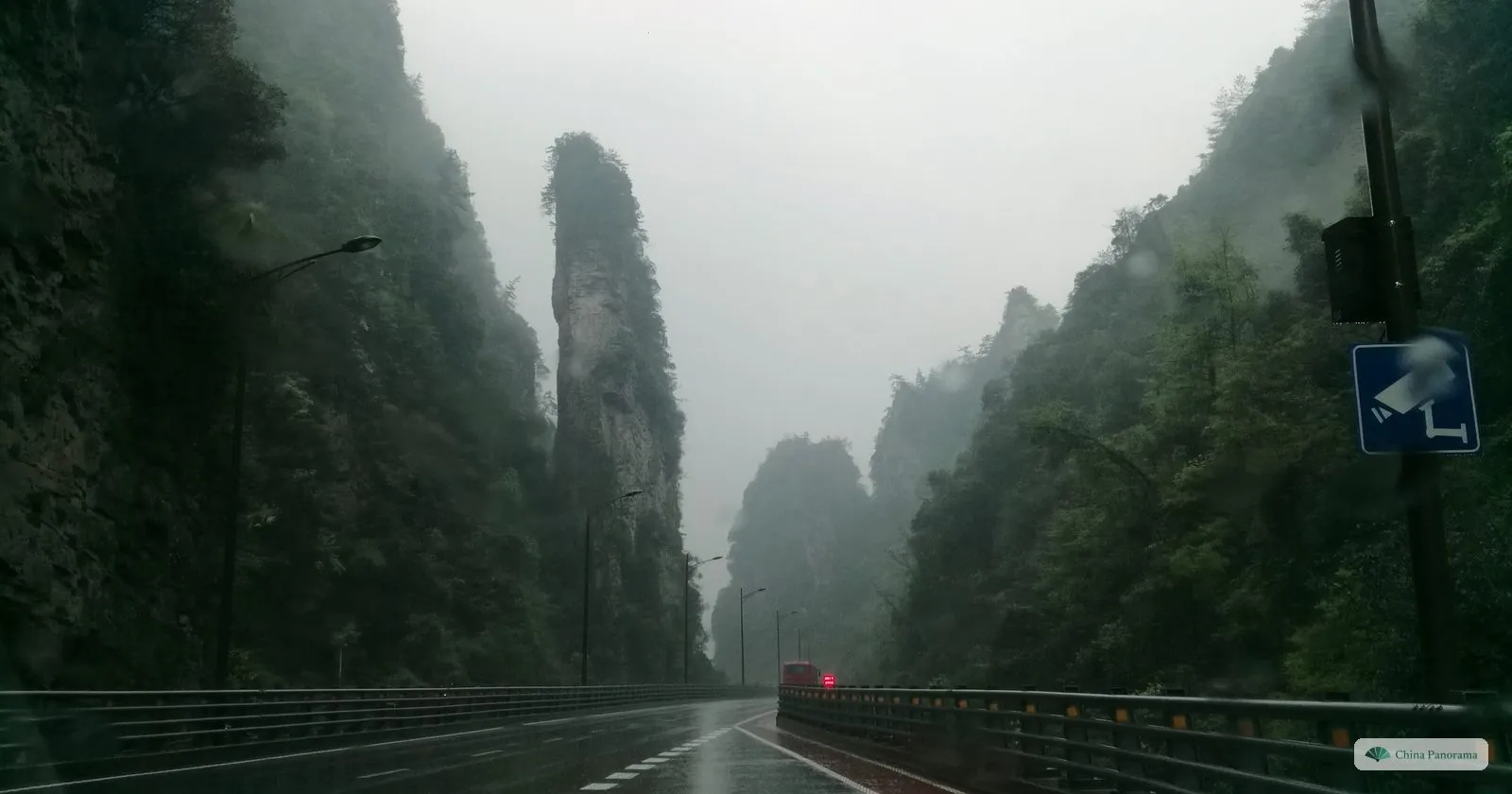
The city centre is at about 200 m; the plateaus of Yuanjiajie and Tianzi Mountain are around 1,000–1,200 m and the top of Tianmen Mountain 1,518.6 m. With the usual rule of about 6 °C less per 1,000 m of height, expect the plateaus to be some 5 °C cooler than the figures above — rough estimates below. Cloud is the other question: on wet days it sits halfway up the pillars, as on our photographs. Then walk the valleys, like the Golden Whip Stream, and keep the viewpoints for a clearer morning.
January
10° / 3°
City, by day / at night · on the plateaus roughly 5° / -2°
April
25° / 15°
City, by day / at night · on the plateaus roughly 20° / 10°
July
35° / 26°
City, by day / at night · on the plateaus roughly 30° / 21°
October
24° / 16°
City, by day / at night · on the plateaus roughly 19° / 11°
Spring
March – MayGreen, warm, and often in cloud.
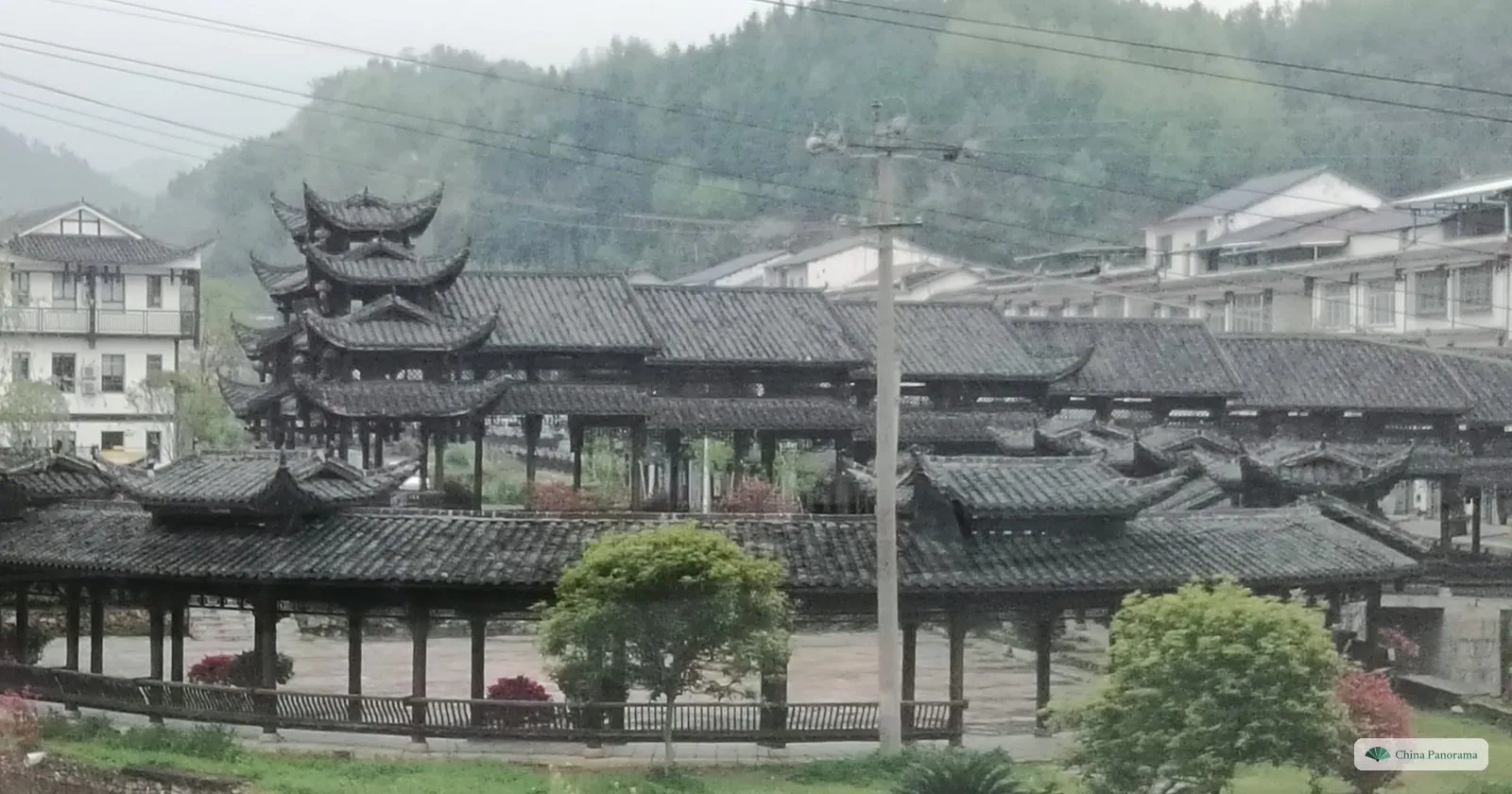
March averages 19 °C by day, April 25 °C and May 29 °C in the city. Rain comes often, and with it the low cloud that wraps the pillars: on 10 April 2019 it rained from before seven until we left Wulingyuan at half past nine, and the tops of the pillars came and went in the cloud. The hills turn bright green, and the May Day holiday, 1–5 May, fills the scenic area.
Photograph: a wind-and-rain bridge in Yanghe, Cili County, at 07:04 on 10 April 2019.
What to wear: A rain jacket, layers for the cooler plateau, and shoes with grip on wet stone steps.
Summer
June – AugustHot in town, wet in June, crowded in the holidays.
July and August average 35 °C by day in the city and 26 °C at night. Up on the plateaus, around 1,000 m higher, it is several degrees cooler — the usual rule is about 6 °C per 1,000 m. June and early July bring the heaviest rain of the year. July and August are the Chinese school holidays, when the queues for the Bailong Elevator and the Tianmen cable car are at their longest.
What to wear: Light clothes, sun protection, a rain jacket — and an early start.
Autumn
September – NovemberThe best season, apart from Golden Week.
September averages 30 °C by day, October 24 °C and November 17 °C, with less rain than spring and summer and the best chance of clear views from the plateaus. The leaves on the slopes colour in late October and November. Avoid Golden Week, 1–7 October, when the scenic area is at its fullest of the year.
What to wear: Layers: warm by day in the valleys, cool on the plateaus in the morning.
Winter
December – FebruaryCold, quiet and cheaper.
January averages 10 °C by day in the city and 3 °C at night, and the plateaus are colder; snow and frost on the pillars are possible. The scenic area has its off-season price from December to February and far fewer visitors — except around the Spring Festival, whose date follows the lunar calendar. Buildings have little heating.
What to wear: A warm coat, hat and gloves for the plateaus; a warm layer indoors.
October, at about 24 °C by day in the city, and April, at 25 °C, are the months we would pick — October for the views, April for the green and the cloud. For how Zhangjiajie compares with the rest of the country month by month, see the best time to visit China.
Things to do in Zhangjiajie
9 places: the four parts of Wulingyuan and the gorge road between them, Tianmen Mountain on the city’s edge, the glass bridge to the east, a Tujia park in town and Furong Town on its waterfall to the south-west. First, three photographs to read: the signs on the road in, a pillar in the rain, and the gate of Furong Town.
What am I looking at?
Tap a number on the photograph.
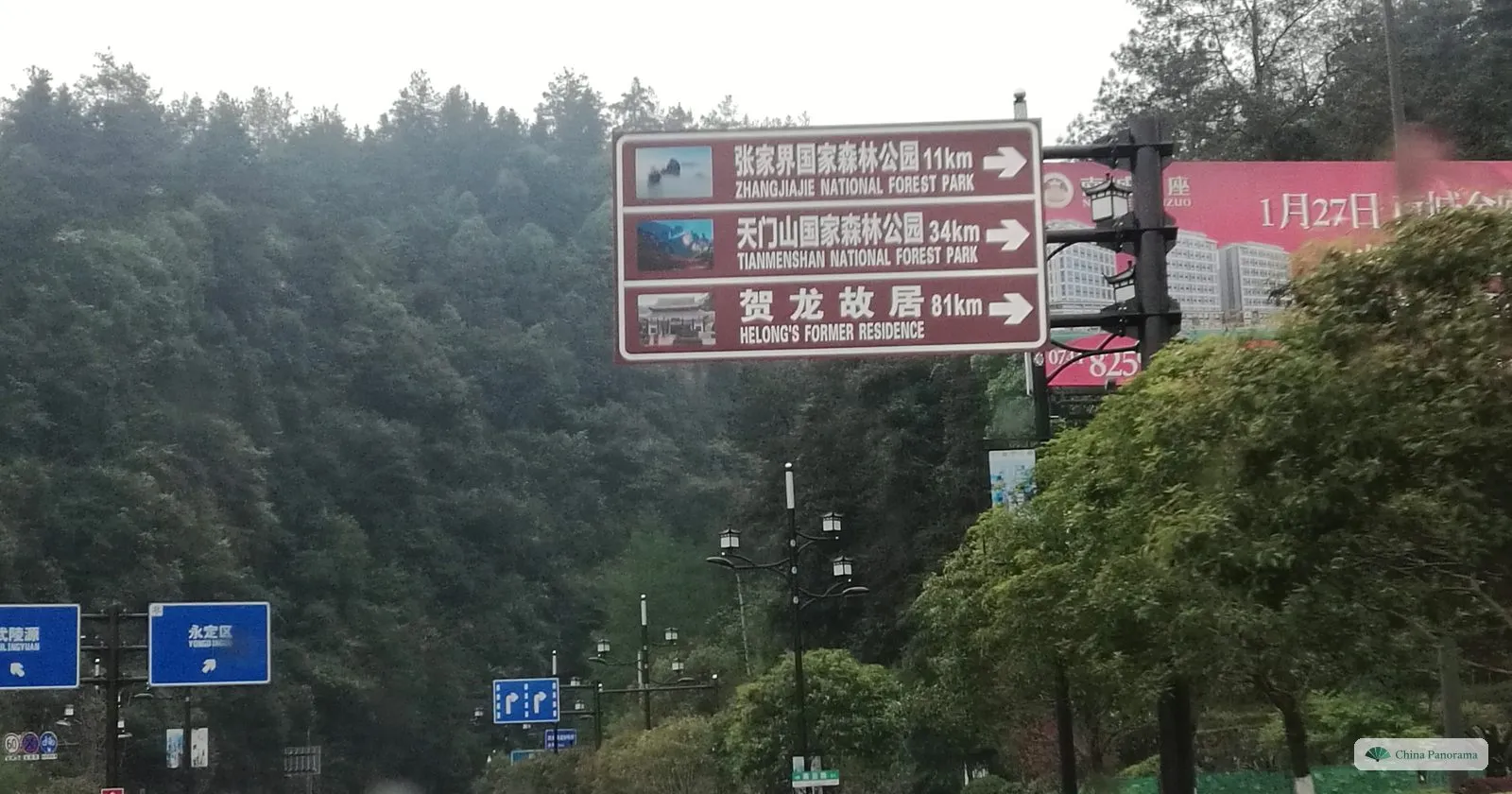
1Zhangjiajie National Forest Park · 11 km
张家界国家森林公园 · The park, not the city
China’s first national forest park, opened in 1982 and named after the forest farm before it. It is the south-western part of Wulingyuan, 11 km on through Baizhang Gorge. The Golden Whip Stream starts at its gate.
The Forest Park in the list below →Tap a number on the photo, or a name in the list.
9 places in and around Zhangjiajie
Filter by district: Wulingyuan for the pillars, Yongding for the city.
Wulingyuan Scenic Area
武陵源风景名胜区NatureWulingyuan · 武陵源区OutdoorsThe reason anyone comes: more than 3,000 pillars and peaks of quartz sandstone, many of them over 200 m tall, standing in a forest that fills the valleys between them. The sandstone was laid down some 400 to 350 million years ago; water working along vertical cracks has since cut it into columns, walls and natural bridges, and low cloud drifts between them on most wet days. UNESCO listed the area as a World Heritage Site in December 1992, and it became a Global Geopark in 2004. The film Avatar borrowed its floating mountains from here. Wulingyuan is the name of the whole protected area, and of the district it lies in, about 30 km north of the city. It has four parts: Zhangjiajie National Forest Park in the south-west, the Suoxi valley in the east, Tianzi Mountain in the north and Yangjiajie in the west. One ticket covers all four, and the scenic area runs its own shuttle buses between them. We drove through on the wet morning of 10 April 2019; the pillars came and went in the cloud.
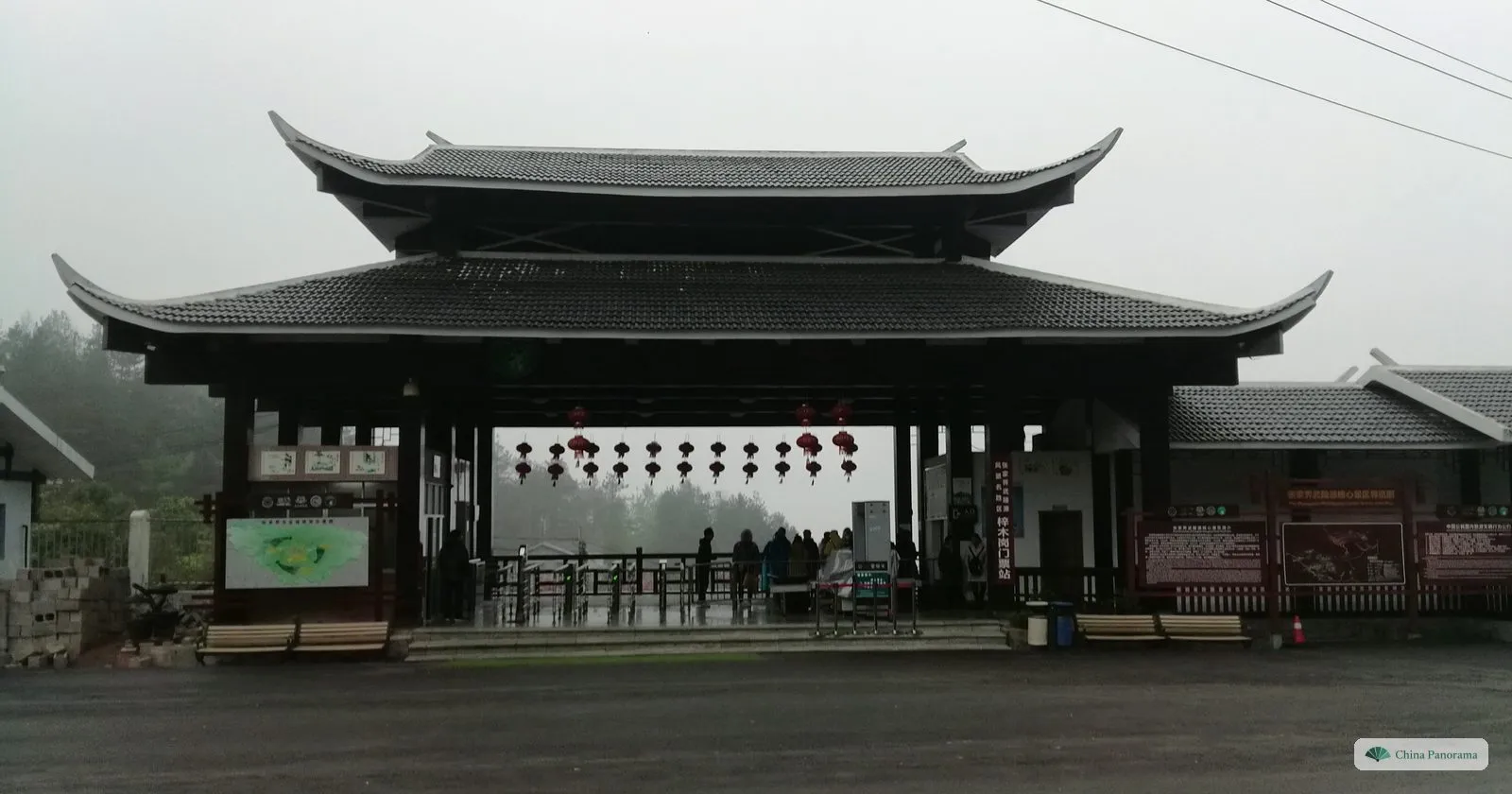
Five ticket gates. The two most used are the Forest Park gate in the south-west, at the start of the Golden Whip Stream, and the Wulingyuan gate on the edge of Wulingyuan town in the east; Zimugang, where our photograph of the gate was taken at 08:47, is a quieter one between them. Reported: entry 165 CNY from 1 March to 30 November, plus about 60–71 CNY for the shuttle buses (225–236 CNY together), less in winter; valid for four consecutive days. Tickets are reported to be sold only with a real-name booking made in advance, online or through a WeChat mini program. We have not checked prices, hours or whether booking works with a foreign passport.
- Entry
- Price not verified — check on site
- Opening hours
- Hours not verified — check on site
Zhangjiajie National Forest Park and the Golden Whip Stream
张家界国家森林公园 · 金鞭溪NatureWulingyuan · 武陵源区OutdoorsThe park that gave the city its name — and what most visitors mean by “Zhangjiajie National Park”. In 1958 a state forest farm was set up here on the land of the Zhangjiajie farming cooperative — Zhangjiajie means roughly “the Zhang family's boundary” — and in September 1982 it became China's first national forest park. The classic walk is the Golden Whip Stream, a paved path along a clear stream at the bottom of the gorge, under the pillars, named after the Golden Whip Rock that rises beside it. Guides give the stream as 7.5 km long; the paved path from the trailhead near the Forest Park gate to Shuiraosimen, “water around four gates”, where four streams meet, measures 5.9 km on OpenStreetMap. It is mostly level and shaded, and it is the park's answer to bad weather: on a day when the viewpoints above are lost in cloud, the stream is still worth walking. Above it, the Huangshi Village plateau, at about 1,050 m, is reached by steps or by cable car. Watch for the macaques along the path; do not feed them and keep food out of sight.
The Forest Park gate is in the village of the same name, about 29 km by road from the city centre — 26 minutes by car without traffic on OpenStreetMap. Buses run from the Central Bus Station next to the railway station; we have not checked their times. Allow two and a half to three hours for the stream with stops; OpenStreetMap's walking time for the 5.9 km is 80 minutes. At Shuiraosimen the lower station of the Bailong Elevator is about 1 km on. Entry is part of the Wulingyuan ticket.
- Entry
- Price not verified — check on site
- Opening hours
- Hours not verified — check on site
Yuanjiajie, the Avatar mountain and the Bailong Elevator
袁家界 · 乾坤柱 · 百龙天梯NatureWulingyuan · 武陵源区OutdoorsA plateau at about 1,000 m with the most famous views in Wulingyuan, along a loop of railed paths and platforms on the edge of the drop. The pillar everyone photographs is the Southern Sky Column, 1,080 m above sea level at its top, which the scenic area renamed “Avatar Hallelujah Mountain” in January 2010, after the film. Nearby a slab of rock spans two pillars as the “First Natural Bridge under Heaven”. The way up from the Golden Whip Stream is the Bailong Elevator: three glass cars running 326 m up the face of a cliff, the lower part inside the rock, the upper part in an open steel tower. It was built from 1999 and opened in 2002; Guinness recorded it in 2015 as the tallest outdoor elevator in the world, and since an upgrade that year the ride takes one minute and 32 seconds. It has been criticised since it opened for what it does to a World Heritage landscape.
The elevator's lower station is about 1 km from Shuiraosimen, at the end of the Golden Whip Stream; at the top, the shuttle buses run on to the Yuanjiajie viewpoints. Reported: 65 CNY one way (some sources say 72), on top of the Wulingyuan ticket; long queues at midday in summer and at holidays. We have not checked prices or hours. Without the elevator, the shuttle buses also reach Yuanjiajie by road.
- Entry
- Price not verified — check on site
- Opening hours
- Hours not verified — check on site
Tianzi Mountain and the Ten-Mile Gallery
天子山 · 十里画廊NatureWulingyuan · 武陵源区OutdoorsThe northern part of Wulingyuan, a plateau whose highest point, Kunlun Peak, reaches 1,262.5 m. Local tradition takes the name from Xiang Dakun, a Tujia leader who rose in revolt in 1353 and called himself Tianzi, “Son of Heaven”. From the viewpoints on the edge — the Imperial Brush Peaks are the best known — you look down on a whole field of pillars. On the plateau stands He Long Park, laid out in 1985–86 around a statue of Marshal He Long, the Red Army commander born in Sangzhi County next door. Below, near the Wulingyuan gate, the Ten-Mile Gallery is a valley lined with pillars that have been given names — an old man gathering herbs, three sisters — with a small sightseeing train along it and a footpath beside the track.
From the Wulingyuan gate the shuttle buses run to the Ten-Mile Gallery and to the lower station of the Tianzi Mountain cable car, reported at 72 CNY one way. The plateau is linked by shuttle bus to Yuanjiajie, so Tianzi and Yuanjiajie can be one day. We have not checked prices or hours for the cable car or the train.
- Entry
- Price not verified — check on site
- Opening hours
- Hours not verified — check on site
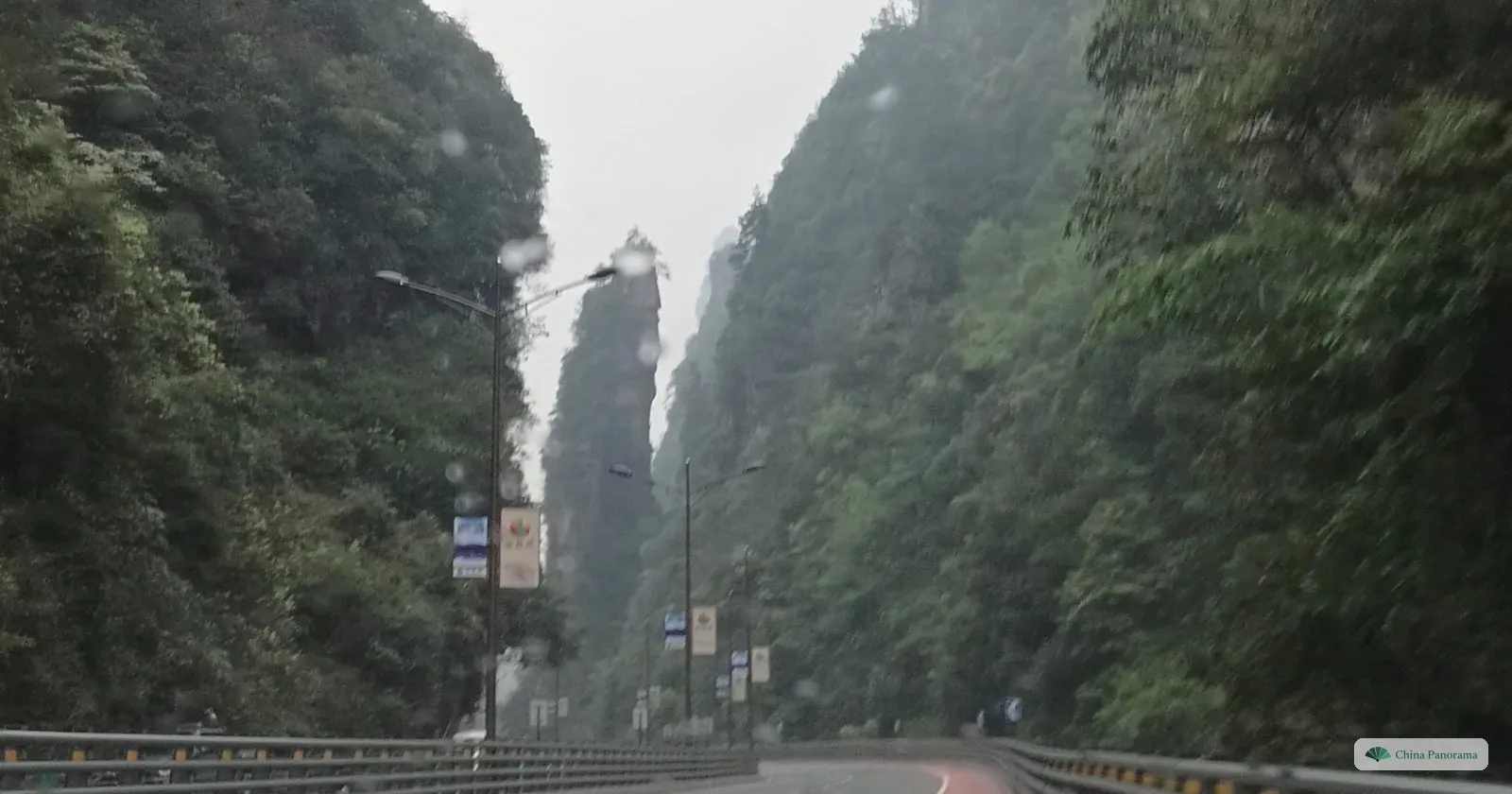 NatureWulingyuan · 武陵源区Outdoors
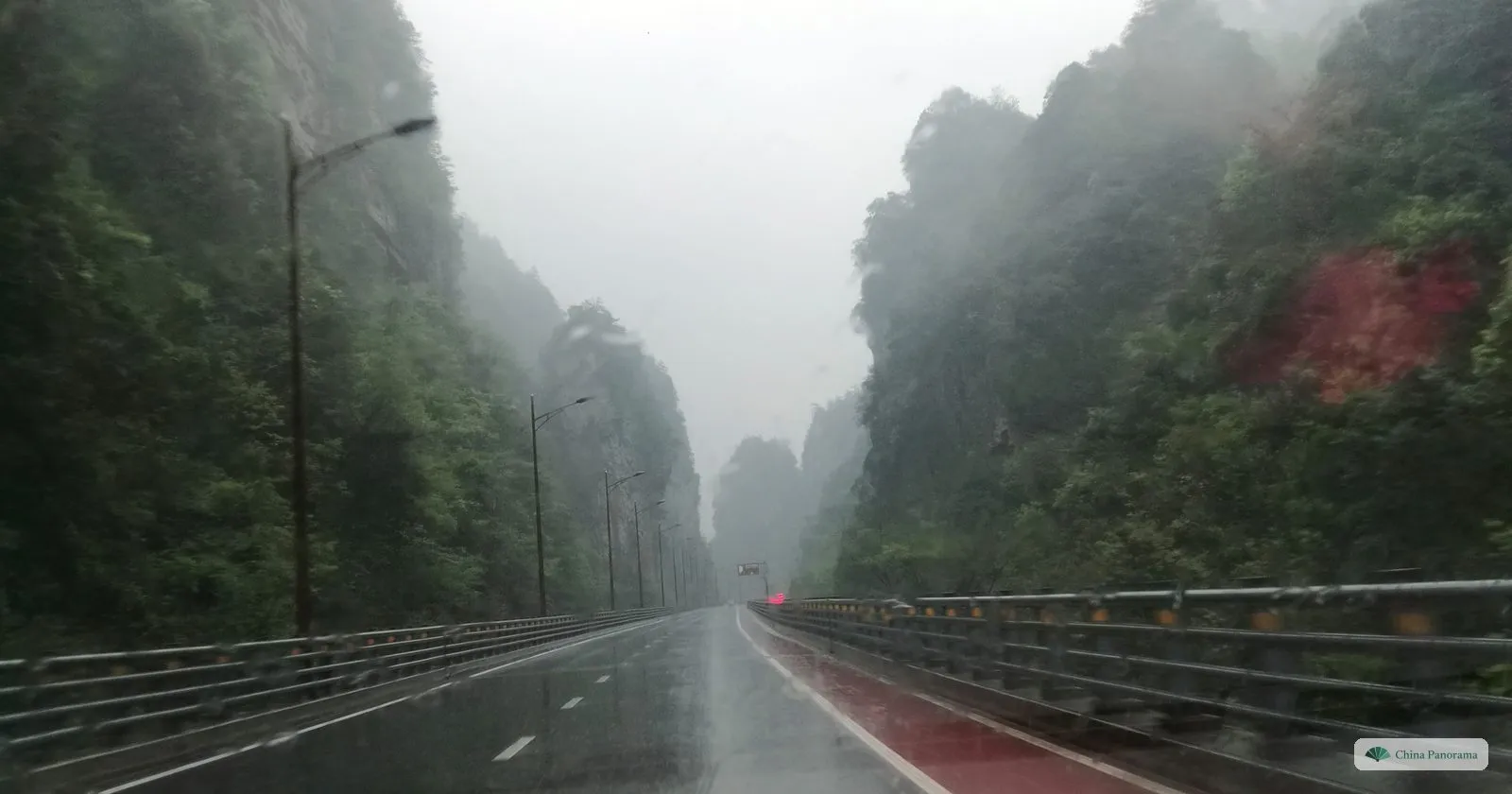
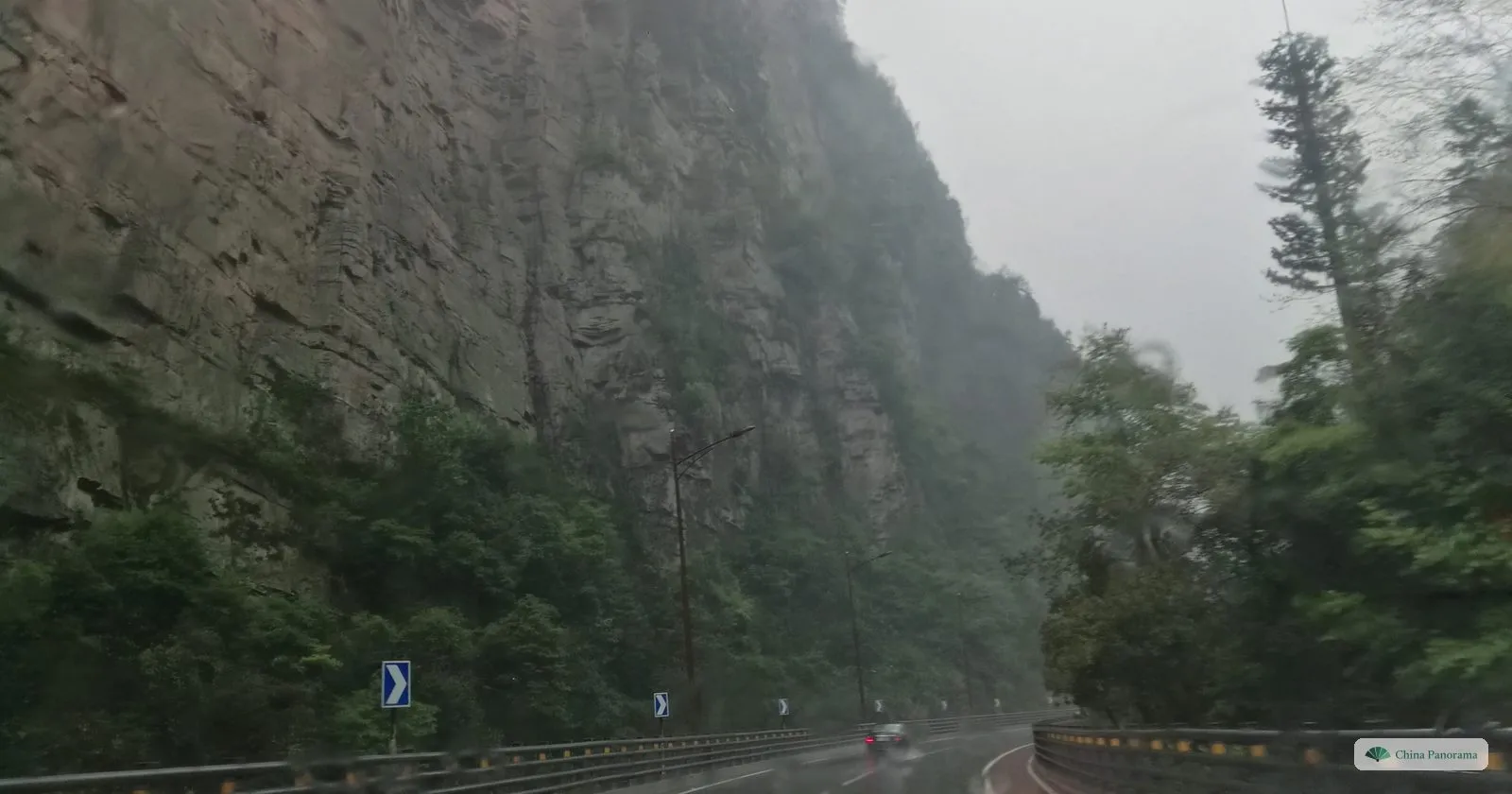
The gorge that Wulingshan Avenue, the road between Wulingyuan town and the city, follows for about 15 km. It is named after its rock walls, “nearly a hundred zhang” high — a zhang is about 3.3 m — and it gives you, from a car or bus window, the same sandstone as the scenic area: free-standing pillars with trees on their heads, and cliffs whose horizontal layers show how the rock was laid down. We drove it twice on the morning of 10 April 2019, at a quarter past eight and again at twenty past nine, in rain with the cloud down to half the height of the pillars; at the Wulingyuan end a sign named the bridge we crossed “Baizhangxia Stream Bridge No. 10, 153 m”.
Free: it is a public road. A taxi between the city and Wulingyuan town drives through it, as does a car to the Forest Park gate. There is nowhere sensible to stop on the carriageway; take the photographs from the passenger seat.
- Entry
- Free
- Opening hours
- Open at all hours
- NatureYongding · 永定区Outdoors
The mountain on the city's southern edge, 1,518.6 m high, with a hole right through it: Tianmen Cave, “Heaven's Gate”, a natural arch 131.5 m high, reached by a stairway of 999 steps. Getting up is half the point. A cable car leaves from the middle of the city and climbs 1,279 m over 7,455 m of cable, over the rooftops and then the farms on the lower slopes; it was built by the French firm Poma and opened in 2005. The other way is Tongtian Avenue, a road of 99 bends over 11 km, driven by the scenic area's buses. On top, paths run round the cliff edge, including stretches of glass walkway bolted to the rock — the one on Coiling Dragon Cliff opened in August 2016 — and there is a temple on the summit.
The lower cable-car station is in the city centre, a few minutes' walk from the railway station and the Central Bus Station. Reported: about 245 to 290 CNY depending on the line — cable car both ways, or one way with the bus over the 99 bends — with entry times booked in advance and a daily cap in high season; the escalators through the cliff to the cave are reported at 32 CNY more and shoe covers for the glass walkways at 5 CNY. We have not checked any of it. The summit is often in cloud: look at the top before you buy.
- Entry
- Price not verified — check on site
- Opening hours
- Hours not verified — check on site
- LandmarkCili County · 慈利县Outdoors
A footbridge with a glass floor, 430 m long and 300 m above the floor of a canyon east of Wulingyuan, designed by the Israeli architect Haim Dotan. It opened on 20 August 2016 and had to close again on 2 September, after 13 days, because far more people came than it was built for; it reopened on 30 September. For a while it was the longest and highest glass bridge in the world, a record since taken by bridges elsewhere in China. Below it, the canyon has a walk past waterfalls and a stretch by boat.
About 28 km by road from Wulingyuan town, 35 minutes by car without traffic on OpenStreetMap; about an hour from the city. Reported: 128 CNY for the bridge alone, 219 CNY for the bridge and the canyon walk, booked online in advance with your passport. We have not checked prices or hours.
- Entry
- Price not verified — check on site
- Opening hours
- Hours not verified — check on site
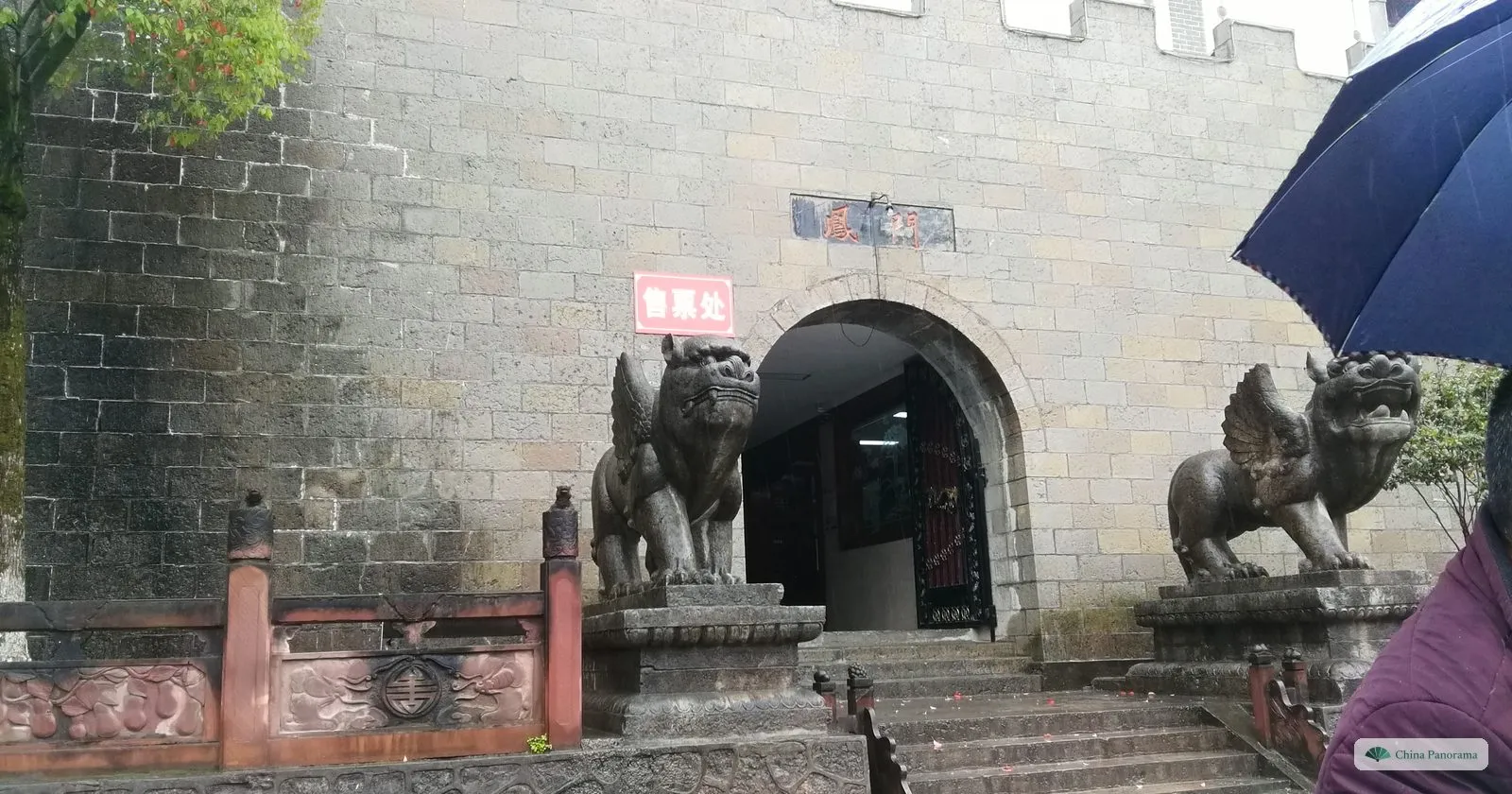 MuseumYongding · 永定区Outdoors
A park in the city that shows the culture of the Tujia, the people whose country north-west Hunan is: stilt houses of dark timber, halls with galleried courtyards, silver jewellery and costume, and the baishou or “hand-waving” dance, performed in the hall built for it. Its tallest building is a timber tower called Jiuchongtian, “ninth heaven”. The park presents itself as the castle of a Tusi, one of the hereditary chieftains through whom the emperors ruled the Tujia; we could not confirm how much of it is old and how much was built for the park. We stood at its stone gate, between two winged lions, in rain at 10:23 on 10 April 2019.
In Nanzhuangping, about 2 km north-west of the city centre; a short taxi ride. The dance is reported to be performed at ten in the morning. Prices quoted online range from 10 to 120 CNY, and we have not checked them or the opening hours.
- Entry
- Price not verified — check on site
- Opening hours
- Hours not verified — check on site
Furong Town
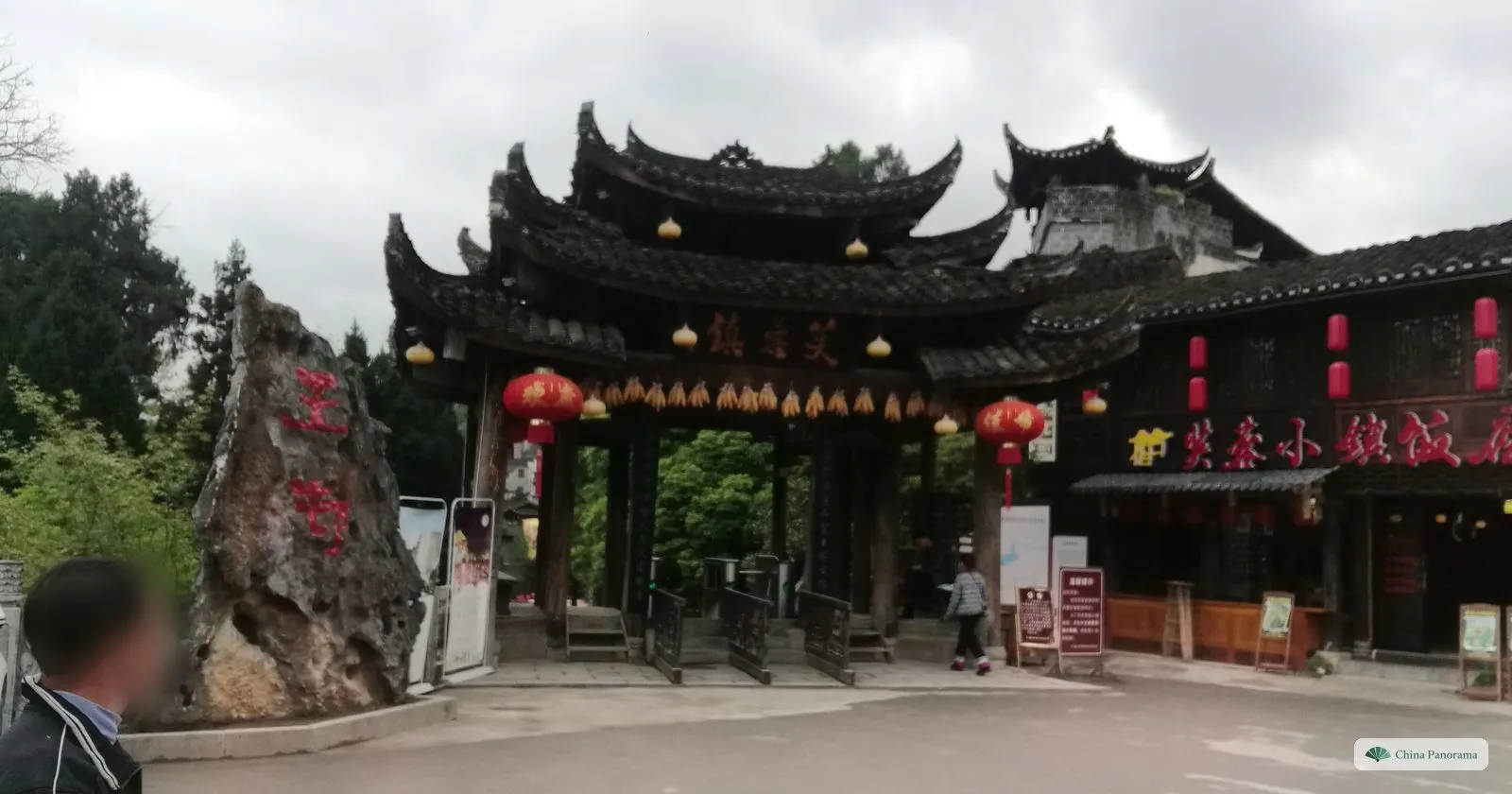
芙蓉镇 · 王村StreetYongshun County · 永顺县OutdoorsAn old town on cliffs above the You River, where a waterfall about 60 m high and 40 m wide drops through the middle of it — it calls itself “the thousand-year-old town hanging on a waterfall”. Stilt houses climb the rock, and a flagstone street runs down to the river. For eight centuries it was the seat of the Peng clan, the Tusi chieftains of Xizhou; in the town stands the Xizhou bronze pillar, cast in 940 to record a peace between the King of Chu and the Xizhou governor Peng Shichou, with more than 2,300 characters on it. The town was called Wangcun until Xie Jin shot his film Hibiscus Town here in 1986 — Furong means hibiscus — and it later took the film's name. The film's heroine sold rice tofu, and so, now, does half the main street. Our photographs are of the entrance square and the gate, hung with dried corn cobs, at twenty past one on 10 April 2019.
In Yongshun County, in the Xiangxi Tujia and Miao Autonomous Prefecture, about 80 km by road south-west of the city — 59 minutes by car without traffic on OpenStreetMap, by the expressway. Or by high-speed train from Zhangjiajie West to Furong Town station, on the Zhangjiajie–Jishou–Huaihua line opened in December 2021; the station is about 5 km from the old town. Reported: about 100 CNY, open from 07:30 into the late evening, with the waterfall and the houses lit after dark. We have not checked the price or the hours.
- Entry
- Price not verified — check on site
- Opening hours
- Hours not verified — check on site
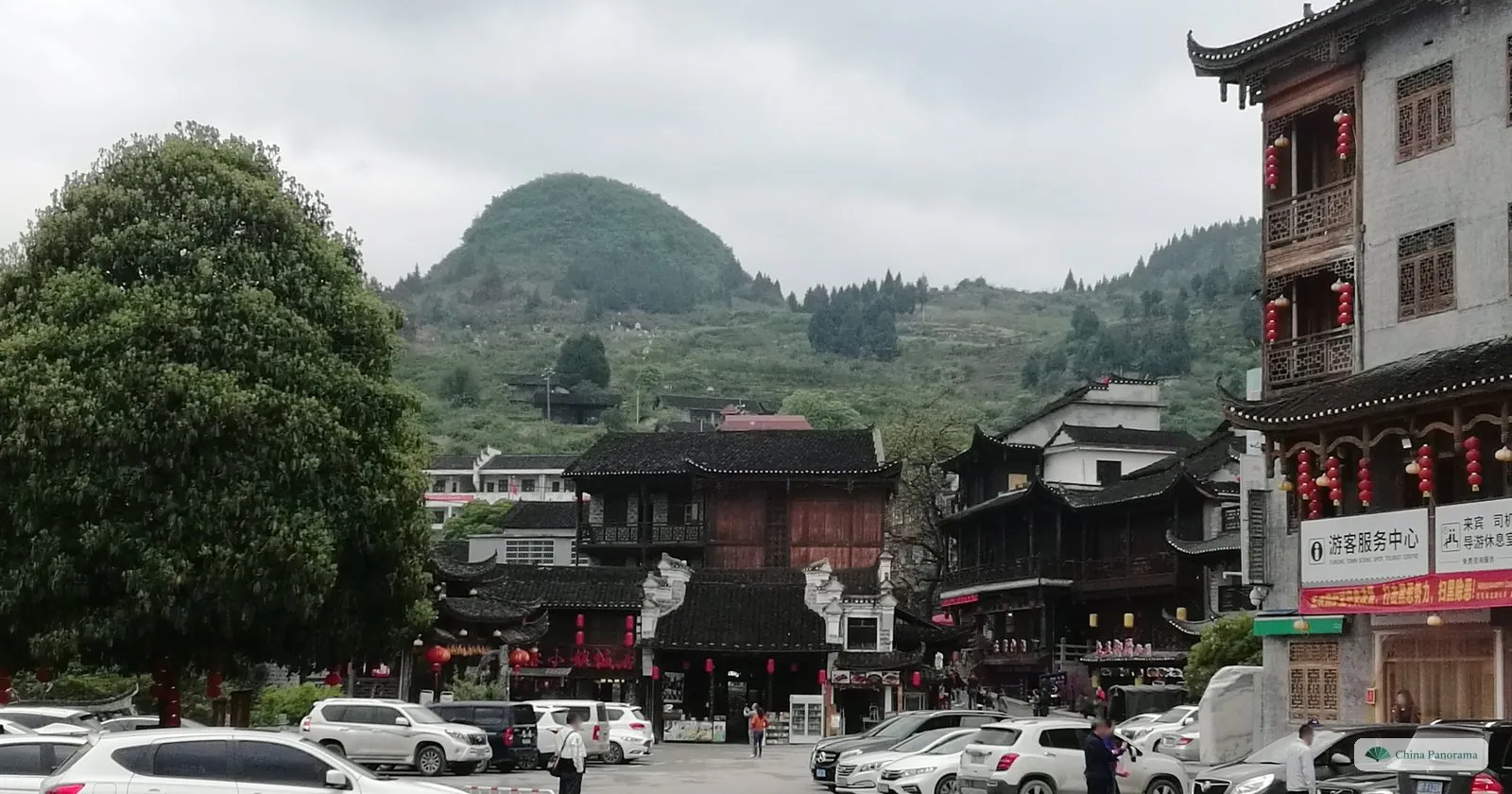
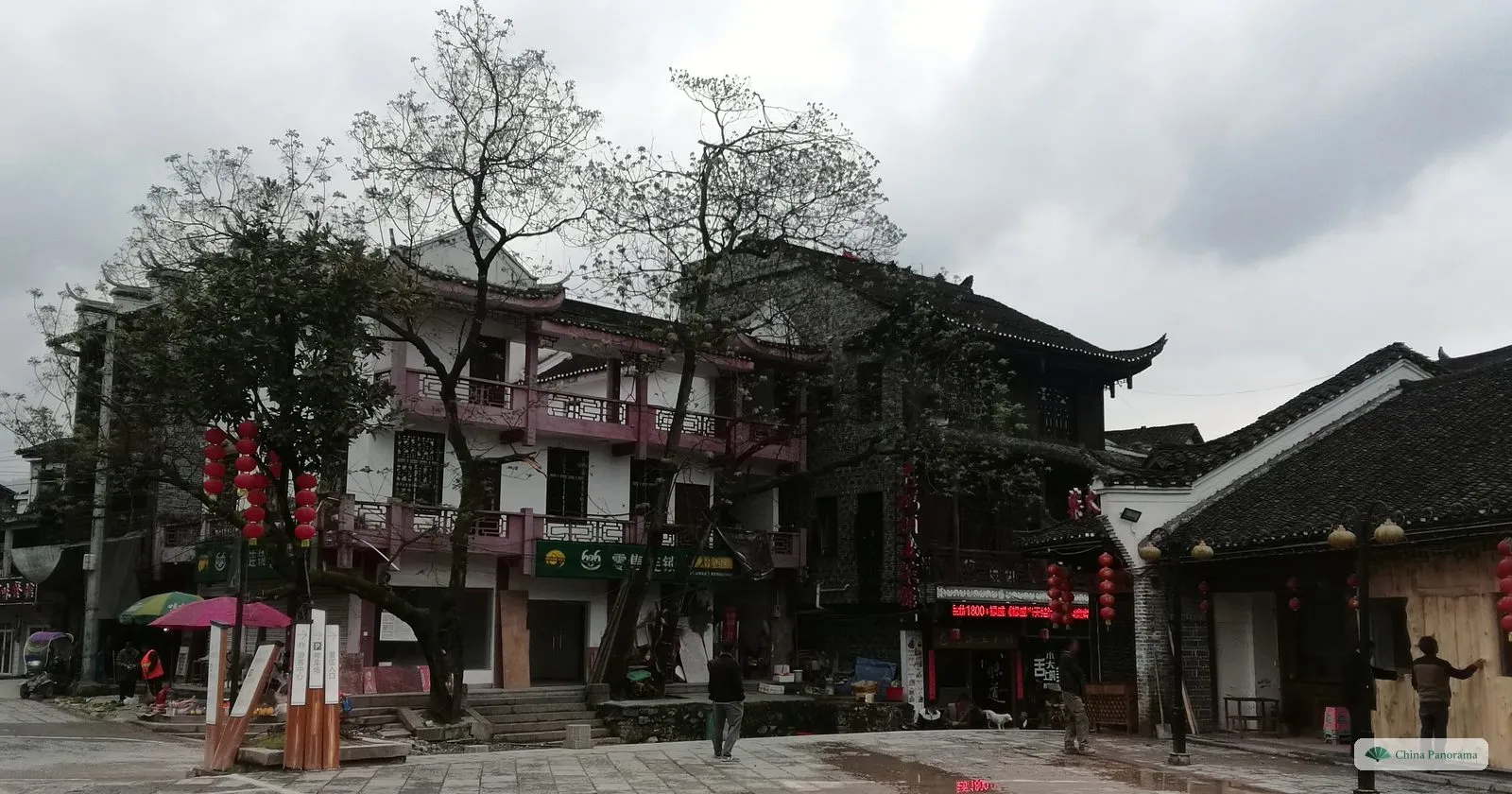
Entry prices and opening hours are marked unverified where we have not checked them against an official source. We would rather show a gap than a number we made up.
Routes and planning
Two days in Wulingyuan, one for Tianmen Mountain
Inside the scenic area you walk, ride its shuttle buses and take a lift or a cable car up to the plateaus; private cars stop at the gates. The ticket is valid for four consecutive days, so two days inside cost no more than one. This is the usual way to divide it:
Day 1 · The valley and Yuanjiajie
In at the Forest Park gate, along the Golden Whip Stream to Shuiraosimen (5.9 km of paved path), up the Bailong Elevator to Yuanjiajie and the Avatar pillar, and out by shuttle bus.
Day 2 · Tianzi Mountain
In at the Wulingyuan gate, by shuttle bus to the Ten-Mile Gallery, up the cable car to Tianzi Mountain, and across the plateau by bus — to Yangjiajie, or back to Yuanjiajie if the first day was cloudy.
Day 3 · Tianmen Mountain
From the city centre, up by cable car, round the cliff paths, and down by bus over the 99 bends with a stop at Tianmen Cave — or the other way round.
Shuttle-bus routes, lift and cable-car prices and opening hours are not verified; the distances are from OpenStreetMap.
Our day by car: Wulingyuan to Furong Town
The routes in our photographs, both from 10 April 2019: a wet early morning on the roads of Wulingyuan, then south-west through the city to Furong Town, about 80 km by road. Each runs in one direction, with the driving time between stops.
An early morning · about 21 km by car
Wulingyuan town
Taxi 20 min· 12.8 km
Zimugang gate
Taxi 17 min· 8.1 km
Baizhang Gorge
3 stops · 37 min by taxi
Late morning to afternoon · about 79 km by car
Tujia Folk Customs Park
Taxi 2 min· 2.1 km
The Lishui River
Taxi 57 min· 76.6 km
Furong Town
3 stops · 59 min by taxi
Stop by stop
Wulingyuan by car: the brown signs, Zimugang and the gorge
Our morning of 10 April 2019, in steady rain: from the edge of Wulingyuan town up to the Zimugang gate, then back down through Baizhang Gorge. It is the way to see the sandstone when the viewpoints above are in cloud — and the way most visitors first meet it, from a car window on the road in.
1Wulingyuan town
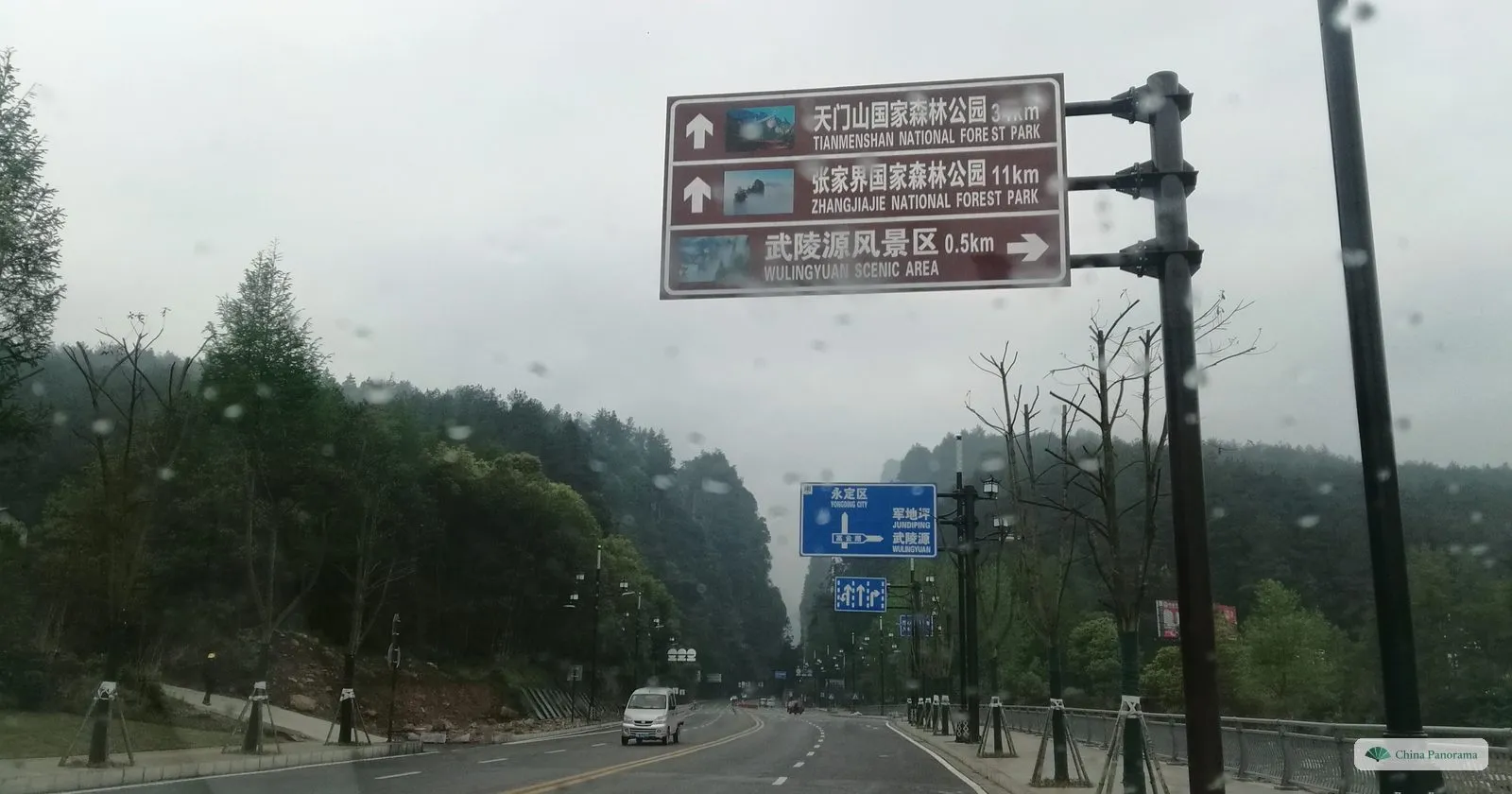
武陵源 · 军地坪Where the road from the city reaches Wulingyuan, brown tourist signs give the distances: the Wulingyuan Scenic Area 0.5 km, the Forest Park 11 km, and Tianmen Mountain, back at the city, 34 km. Our photograph: 08:13.
- Entry
- Free
- Hours
- Open at all hours
Taxi 20 min· 12.8 km
2Zimugang gate
梓木岗门票站Up the main road to one of the quieter gates of the scenic area, at about 800 m, where the shuttle buses start. We were there at 08:47, in cloud.
- Entry
- Wulingyuan ticket, reported 165 CNY + shuttle bus
- Hours
- Not verified
Taxi 17 min· 8.1 km
3Baizhang Gorge
百丈峡Back towards Wulingyuan town on Wulingshan Avenue, through the gorge between the pillars. Our photographs: 09:19 to 09:24.
- Entry
- Free
- Hours
- Open at all hours
Easy add-ons: From the gorge to the city centre is about 33 km on Wulingshan Avenue, 24 minutes by car without traffic. Huanglong Cave, a large show cave, and Baofeng Lake, a reservoir among the pillars with boat trips, are both on the Wulingyuan side, a few kilometres from the town; we have not checked their prices.
* Driving times and distances are computed from OpenStreetMap car routes between the stops, without traffic — allow more at busy times. Clock times are from our own photographs of 10 April 2019. Stops marked with a star have prices or opening hours we have not checked.
Getting there and getting around
By air
Zhangjiajie Hehua International Airport (DYG) is about 4 km west of the city centre, 6 minutes by car without traffic. It has domestic flights from the large Chinese hubs; we have not checked which airlines fly or how often. From Europe, the usual way is to fly to a hub such as Changsha, Shanghai or Beijing and change.
Schedules and journey times not yet verified against an official timetable.
By high-speed train
Zhangjiajie West is on the line to Changde and Changsha — since the last section opened in December 2022 the fastest trains are reported at under two hours — and on the line south to Furong Town, Fenghuang and Huaihua, opened on 6 December 2021, with connections towards Guilin and Guangzhou. We have not checked journey times against the 12306 timetable.
Schedules and journey times not yet verified against an official timetable.
From the station or airport to Wulingyuan
Most visitors stay in Wulingyuan town or by the Forest Park gate rather than in the city. Zhangjiajie West station is about 9 km by road from the city centre; from there or from the centre, Wulingyuan town is another 30-odd km by taxi or bus. We have not checked bus times.
Schedules and journey times not yet verified against an official timetable.
Nonstop from Europe
Our flight list has no nonstop route from Europe to Zhangjiajie. The nearest airport with one is Changsha, the provincial capital, from London Heathrow — then under two hours by high-speed train, as reported. Airlines and frequencies →
Flight data checked 12 September 2026.
Three stations
Your ticket will name one of these.
- Zhangjiajie West 张家界西站The high-speed station, about 6 km north-west of the centre: trains to Changsha, to Chongqing by way of Qianjiang, and south to Furong Town, Fenghuang and Huaihua.
- Zhangjiajie 张家界站The old station in the city centre, next to the Central Bus Station and a short walk from the Tianmen Mountain cable car. Conventional trains only.
- Furong Town 芙蓉镇站On the high-speed line south, opened in December 2021, about 5 km from the old town of Furong.
No metro: how to get around
Zhangjiajie has no metro. In the city you take buses or a taxi; to Wulingyuan, a bus or a taxi; and inside the scenic area its own shuttle buses, plus lifts and cable cars that you pay for separately.
- City to WulingyuanBuses leave from the Central Bus Station next to the railway station for Wulingyuan town and for the Forest Park gate. By taxi it is about 34 km to Wulingyuan town and 29 km to the Forest Park gate — 26 to 27 minutes without traffic on OpenStreetMap. We have not checked bus times or fares.Not verified.
- Shuttle buses inside WulingyuanPrivate cars stop at the gates. Inside, the scenic area's own buses link the gates, Shuiraosimen at the end of the Golden Whip Stream, Yuanjiajie, Yangjiajie and Tianzi Mountain. They are sold with the entry ticket, reported at about 60–71 CNY on top of the entry price. We have not checked the routes or hours.Not verified.
- Lifts and cable carsPaid separately, each way. Reported: Bailong Elevator 65 CNY (some sources 72), Tianzi Mountain cable car 72 CNY, Yangjiajie cable car 76 CNY, Huangshi Village cable car 65 CNY. Not checked against the operators.Not verified.
- Tianmen Mountain cable carLeaves from the city centre, a few minutes' walk from the railway station: 7,455 m of cable to the top of Tianmen Mountain. Its price is part of the Tianmen Mountain ticket.Not verified.
- In townCity buses and taxis; ride-hailing apps work too. The centre, the railway station, the Central Bus Station and the Tianmen cable car are all within walking distance of each other.Not verified.
Source and date: Ticket and lift prices: press reports and travel sites read on 6 October 2026, and the 2020 notice that split the shuttle-bus fare from the entry ticket (The Paper). Distances and driving times: OpenStreetMap. Nothing in this block was checked against an operator.
Zhangjiajie is one of the cities we price up on the trip cost calculator, if you want to model a budget.
Before you go
Most European passports are visa-free for a short trip — under a one-sided waiver with an end date worth checking before you book:
- UK passport
Visa-free up to 30 days per trip, currently until 31 December 2026.
- EU passports
Dutch, German, French, Irish, Nordic and most other EU passports: visa-free up to 30 days, currently until 31 December 2026.
- US passport
No general waiver: a visa, or the 10-day visa-free transit if you fly on to a third country.
China’s 10-day visa-free transit applies at designated entry ports, for travellers continuing to a third country. Check your passport.
- Pre-trip checklist
Payments, SIM, apps — and the booking apps for Wulingyuan and Tianmen.
- How to order food
Scan-to-order menus are the norm in the restaurants of Wulingyuan town.
- Regional cuisines
Hunan cooking: fiery and sour rather than numbing, with smoked pork.
- Mountains, lakes and rivers
Where Wulingyuan sits among China’s other great landscapes.
- School holidays
July and August are when the lift and cable-car queues are longest.
- Golden Week 2026
1–7 October: the fullest week of the year in Wulingyuan.
FAQ
Is Zhangjiajie worth visiting?
Yes, if landscape is what you travel for. Nowhere else in China looks like Wulingyuan: more than 3,000 sandstone pillars standing in forest, a World Heritage Site since 1992, with paths along the valley floors and viewpoints on the plateaus above them. Add Tianmen Mountain, with its cable car from the city centre and a natural arch through the summit ridge, and Furong Town on its waterfall an hour away. It is not a place for city sights: the town itself is a base.
How many days do you need in Zhangjiajie?
Three is a good number. Two days for Wulingyuan, whose ticket is valid for four days — one for the Golden Whip Stream and Yuanjiajie, one for Tianzi Mountain and the Ten-Mile Gallery — and one for Tianmen Mountain. Add a day for the glass bridge, or for Furong Town on the way south.
Is Zhangjiajie a city or a park?
Both, which is why people get confused. The name first belonged to a forest farm, which became Zhangjiajie National Forest Park in 1982, China’s first. The park is one of four parts of the Wulingyuan Scenic Area, the World Heritage Site, in Wulingyuan District. In 1994 the city of Dayong, about 25 km to the south, took the name as well. Your train and plane arrive in the city; the pillars are in Wulingyuan, about half an hour away by road.
How long is the Zhangjiajie National Park ticket valid?
The Wulingyuan ticket — the one most people mean by “Zhangjiajie National Park” — is valid for four consecutive days and covers all four parts: the Forest Park, Yuanjiajie, Tianzi Mountain and Yangjiajie. Entry is reported at 165 CNY from 1 March to 30 November, plus about 60–71 CNY for the shuttle buses, and less in winter. The Bailong Elevator and the cable cars cost extra. We have not checked the prices against an official source.
Where are the Avatar mountains?
In Wulingyuan, and the one with the name is on the Yuanjiajie plateau: the Southern Sky Column, which the scenic area renamed “Avatar Hallelujah Mountain” in January 2010. The film’s floating mountains were inspired by this whole landscape of pillars. The Bailong Elevator takes you from the valley floor up to Yuanjiajie in about a minute and a half.
Do I need to book Zhangjiajie tickets in advance?
Reportedly yes: both Wulingyuan and Tianmen Mountain sell entry with a real-name booking, made online or in a WeChat mini program, and Tianmen caps its daily visitors in high season. We have not tested whether a foreign passport goes through without help. In Golden Week and the summer holidays, book as early as you can.
When is the best time to visit Zhangjiajie?
April–May and September–October. April averages 25 °C by day and October 24 °C in the city, and the plateaus are several degrees cooler. Spring is green but often wet and misty; autumn has the clearest views. July is hot, about 35 °C by day in town, and crowded with the school holidays; January is cold, 10 °C by day, and quiet. Avoid Golden Week, 1–7 October, and the May Day holiday.
How do I book the Zhangjiajie glass bridge?
Online and in advance, with your passport details: the ticket windows are reported to sell only discounted tickets. Prices are reported at about 128 CNY for the bridge alone and 219 CNY with the canyon walk below it. We have not checked the prices or the booking channel.
Cable car or bus up Tianmen Mountain?
Most people do one each way. The cable car leaves from the city centre and climbs 1,279 m over 7,455 m of cable; the bus takes Tongtian Avenue, 11 km with 99 bends, and stops near Tianmen Cave and its 999 steps. Tickets are sold by line — cable car up and bus down, or the other way round — and reported at about 245 to 290 CNY. In high season, book a time slot early.
Is the Zhangjiajie glass bridge on Tianmen Mountain?
No — they are often mixed up. The glass bridge spans the Grand Canyon in Cili County, about 38 km north-east of the city and 35 minutes by car from Wulingyuan town. Tianmen Mountain, on the city’s southern edge, has glass walkways bolted to its cliffs, not a bridge.
How do I get from Changsha to Zhangjiajie?
By high-speed train from Changsha South to Zhangjiajie West: since the Changde–Changsha line opened fully in December 2022, the fastest trains are reported at under two hours. Changsha is about 260 km away in a straight line. We have not checked the timetable; look it up on 12306.
Should I stay in Zhangjiajie city or in Wulingyuan?
For the scenic area, stay in Wulingyuan town or by the Forest Park gate: the gates open early, and the first hour is the quietest. For Tianmen Mountain and the trains, the city is closer. Many visitors split their nights between the two.
Do I need a visa for Zhangjiajie?
Not for a short trip on a British, Irish, Dutch, German, French, Nordic or Australian passport: all are visa-free for up to 30 days per trip, under a one-sided waiver that currently runs until 31 December 2026. US passport holders have no general waiver; the 10-day visa-free transit applies only at designated entry ports and only if you fly on to a third country. Check your own passport on our visa check page.
Sources and status
All photographs on this page are ours, from one day, 10 April 2019: the wind-and-rain bridge at Yanghe in Cili County at 07:04; Wulingyuan town, the Zimugang gate and Baizhang Gorge between 08:13 and 09:24; the Tujia Folk Customs Park and the Lishui River at 10:23 and 10:29; Furong Town from 13:21 to 13:26. The Baizhang Gorge pictures were taken through a wet windscreen. Faces of passers-by have been blurred. Data sources: Monthly temperature data, Zhangjiajie; Wulingyuan Scenic and Historic Interest Area (UNESCO World Heritage List); Wulingyuan (Wikipedia); Zhangjiajie National Forest Park (Wikipedia); Zhangjiajie National Forest Park at 40: approved in September 1982 as China's first (China Daily, December 2022, Chinese); How the forest farm, the park and the city got the name Zhangjiajie; Dayong renamed on 4 April 1994 (Liaowang Think Tank via The Paper, Chinese); Bailong Elevator (Wikipedia); Tianmen Mountain (Wikipedia); Zhangjiajie Glass Bridge (Wikipedia); Baizhang Gorge: about 15 km of road under walls “nearly a hundred zhang” high (China Daily, March 2021, Chinese); From 1 November 2020 the Wulingyuan ticket is split: 165 CNY entry and the shuttle bus separately (The Paper, Chinese); Zhangjiajie (Wikipedia); Furong, Yongshun County (Wikipedia); Furong Town (Hunan Provincial Government); Zhangjiajie–Jishou–Huaihua high-speed railway opens, 6 December 2021 (China Daily, Chinese); Changde–Yiyang–Changsha high-speed railway fully open, December 2022 (China Daily, Chinese).
Changelog (1)
- 2026-10-06Page created, with our own photographs from 10 April 2019. No entry price on this page could be checked against an official source on this date: the figures we found are quoted as reported and marked unverified.